 GERALD´S CADILLACS - NEWS
1966 AC BLOWER VACUUM MASTER SWITCH
I rebuilt the carburetor and let the car idle for a while. During this I wanted all accessories to move and also turned on the heat. It came on as always and after about 30sec the blower went off again. The power servo started to move in and out all the time by itself, but the blower would stay off. The idle speed up came on and off as well depending on the placement of the power servo. After a while it stopped doing this and stayed in the fully retracted position (full heat). If I turned the temperature dial it did not change anything - but it was around freezing outside and this is what it should, do as the sensors sense the low temperatures and then send the system into full heating mode.
I checked the following things.
- Master Switch seemed to work and gets engaged by vacuum. Power is going through it as it should. Current is going in and out. (This is what I thought…)
- Blower Motor tested with a direct feed - worked
- Blower Motor Relay - tested. Put a 12 V feed to the dark blue connector and it engaged and the blower motor came on. There was no current coming through the blue wire though.
- Power Servo - cleaned all contacts and measured the resistance in all positions - looked good to me
- Control Head in Dash - removed it and checked the blower switches - it seemed to work.
Full vacuum was applied to the power servo, and I also checked the vacuum and voltage at the transducer. I also checked all vacuum actuators with a vacuum gauge, but everything checked out perfectly.
I then put everything back together. Still the system did not work in the full heat position. I did a lot more tests and checked the vacuum and electrical diagrams.
I ordered the 1966 AC manual from "Cadillac Tim" which is available also on ebay for $45,- . These instructions are a must-have for your car, as everything about the AC system is explained very well by Tim. There is a great troubleshooting guide in there. Its money well spent! Tim also offers a rebuild service for many Cadillac parts and has a great selection of refurbished parts. Check out his website!
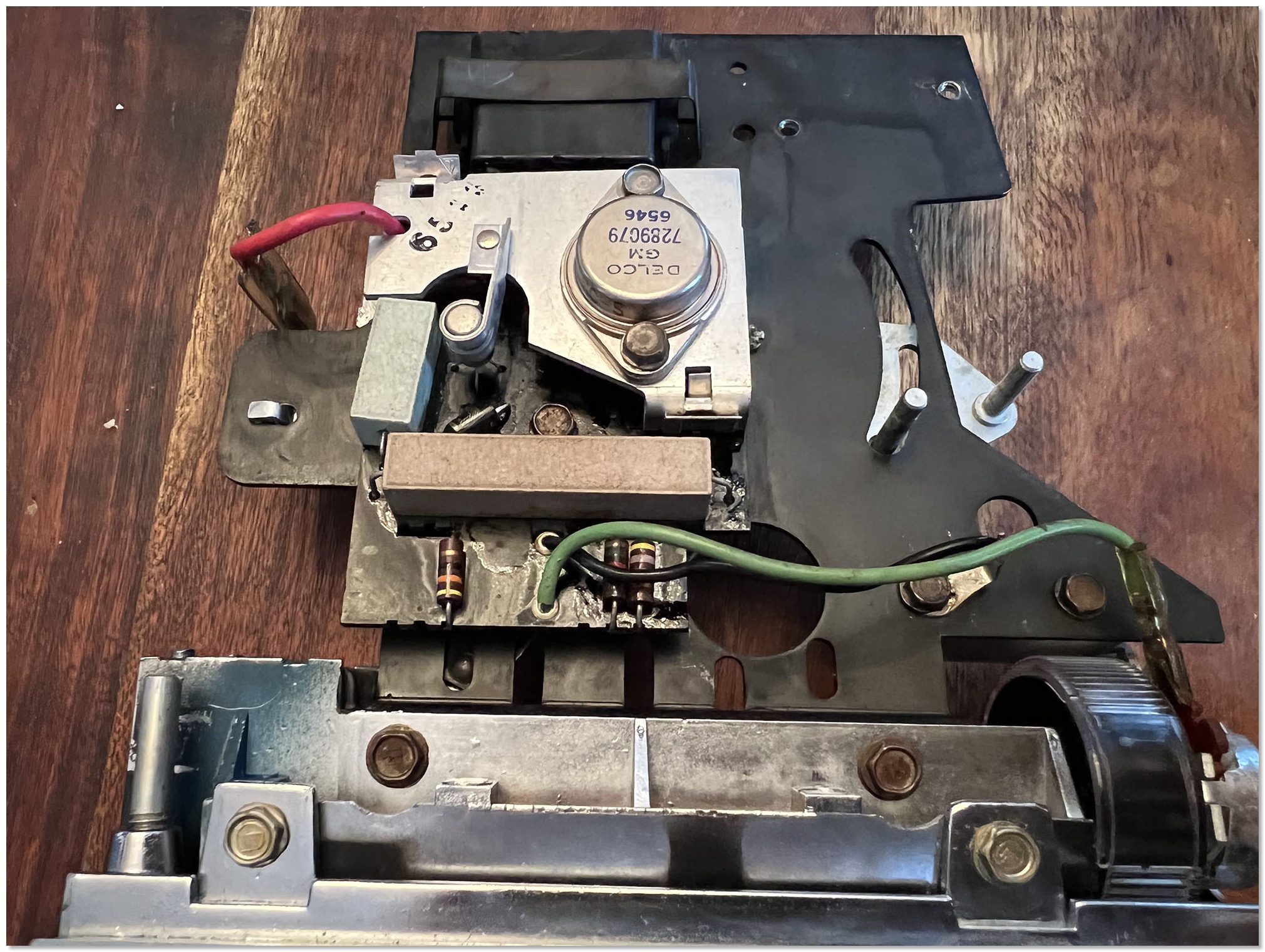
The 1966 dash control unit - here you can see the amplifier part.
After days of troubleshooting it finally dawned on me where the problem was. I had checked the master vacuum switch multiple times and when checked it always had electrical continuity. But I did not check it correctly. I only pushed the backside of the switch until I heard a click.
I should have tested it with full vacuum applied. As it turned out, if high vacuum was applied to the switch (during heating mode), the switch did no longer work correctly!
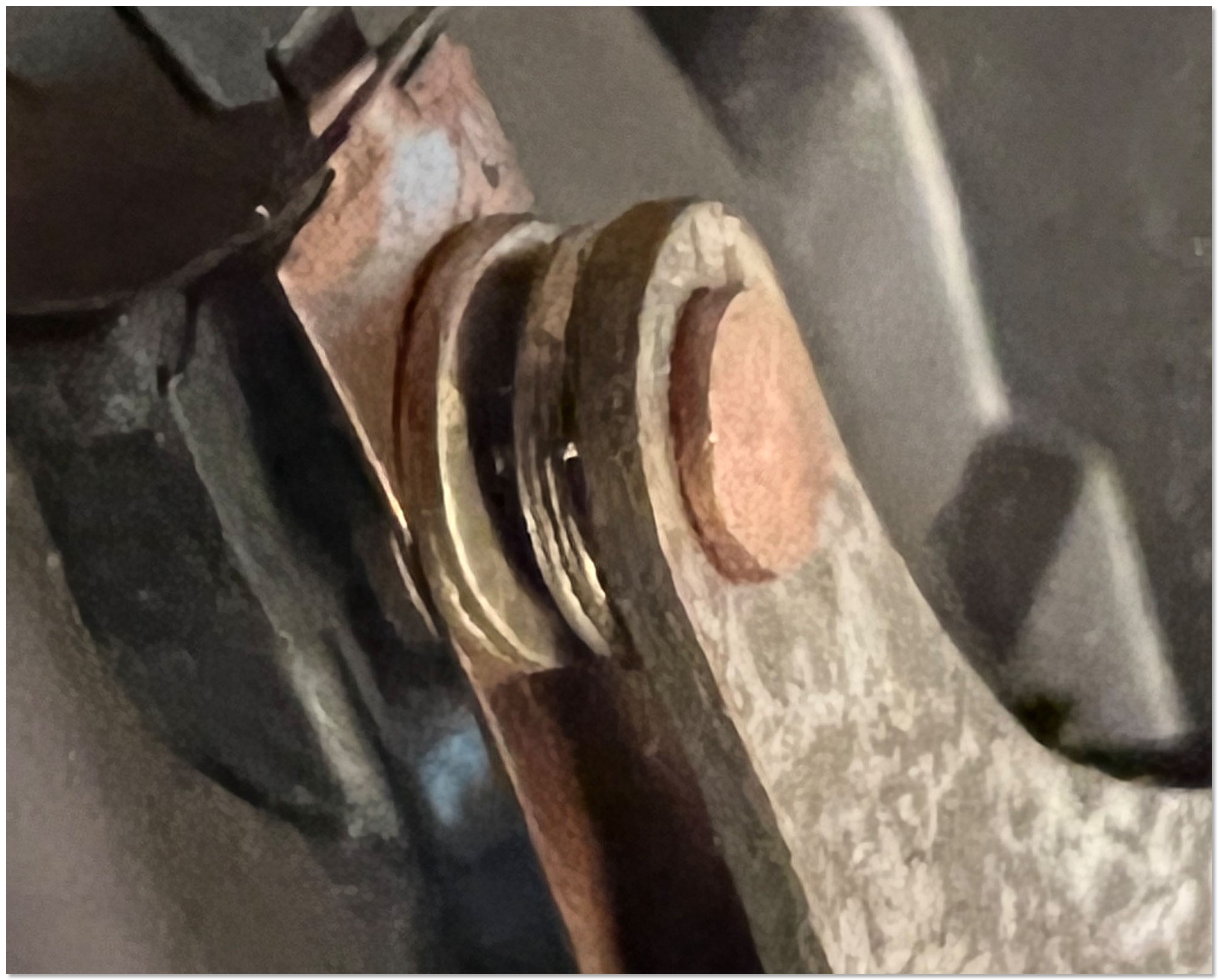 The contacts did no longer touch when full vacuum was applied to the switch…
Today I took it apart and made a video about it. As it turned out the switch contacts did not align as they should and I had to bend it a little bit to make it work again. I then put everything back together and now the AC system works perfectly again. Check out the video for all the details!
THE 1966 COUPE DEVILLE IS BACK
Through a couple of car trades within my Cadillac friend community, the car became available again, and my dear friend Georg helped me to get it back.
I can't thank Georg enough - without him I would have never gotten the car back!
Today was the day to pick it up at my Georgs garage and drive it home, although I do not really have enough garage space anymore…
READ MORE!

Taking over the keys - THANKS MY FRIEND!!!!
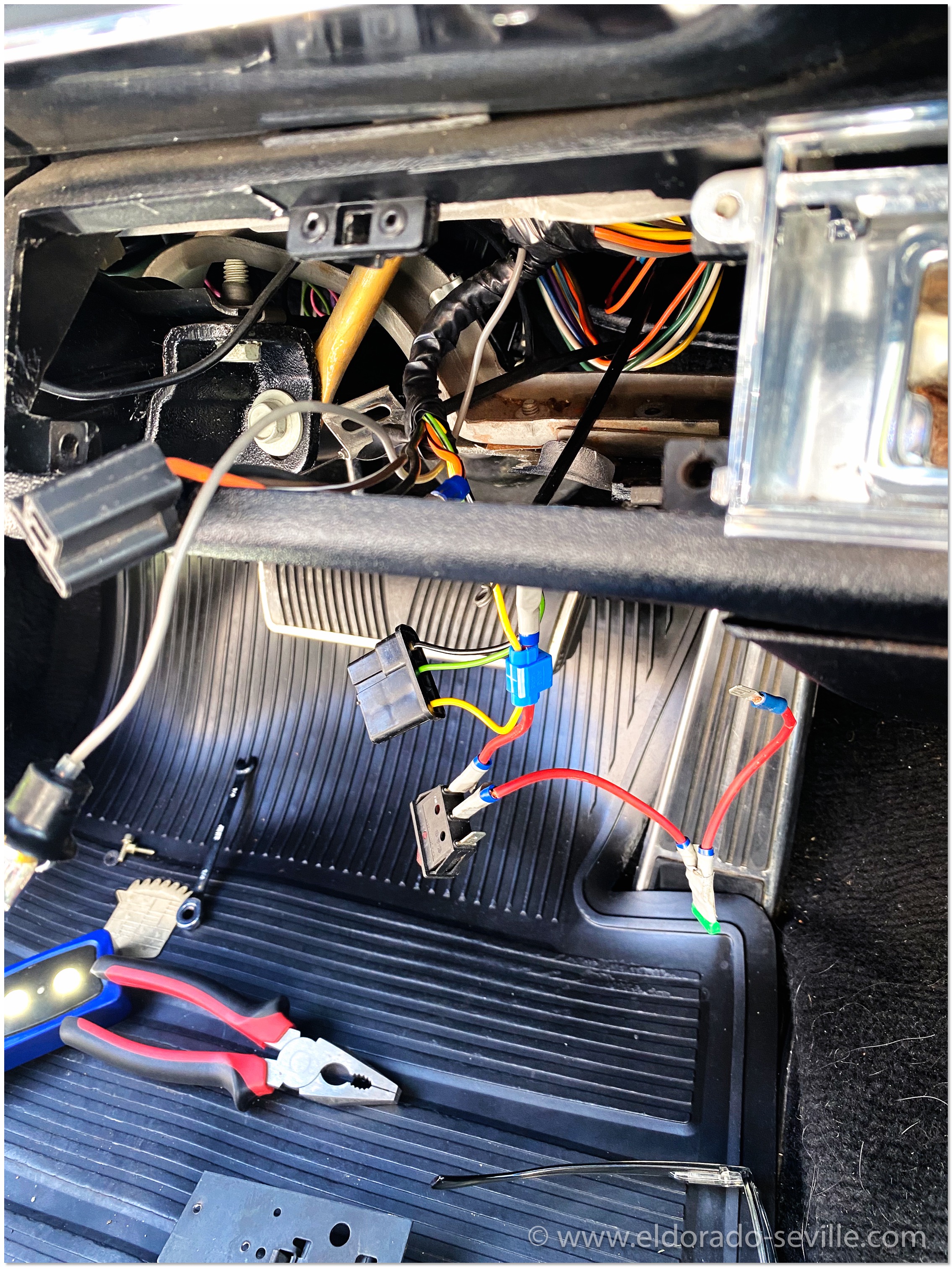
This is how the shop messed up the ATC system of the car… I reversed everything back to original!
READ MORE...A6 AC COMPRESSOR REPAIR - BAD BEARING ON THE 1974
Due to all the other projects I never managed to get the AC back in fully working order until now.
Unfortunately the rebuilt AC compressor came with the clutch coil terminals in the wrong position. They are available with the terminals at the correct 10 o clock position or the 2 o clock position, which is correct for other years.
If the terminals are in the wrong position you cant connect the original wires to them as they are too short. With the high shipping costs it was no option to send the incorrect compressor back.
As it turned out the cars original compressor had a bad bearing and that was the reason why it was disconnected.
My friends Lucky and Steve were here to help me with the compressor project and so I took both of my compressors to Lucky´s workshop, as he has all the necessary tools and experience with these compressors from his own cars.
Originally I just wanted to turn the clutch coil on the rebuilt compressor into the correct position, but then we decided to rebuild the original compressor instead, because it still has the original decal, which is not available as a correct reproduction. All the available compressor reproduction decals are TOTALLY incorrect for the 1974 Cadillacs. The 1974 reproduction decals all show the wrong amount of refrigerant! They are also different in many other details. The closest match of reproductions for 1974 are the ones from 1972 Cadillacs…
We still disassembled the rebuilt compressor to "borrow" its pulley bearing to replace the bad one on the original compressor.
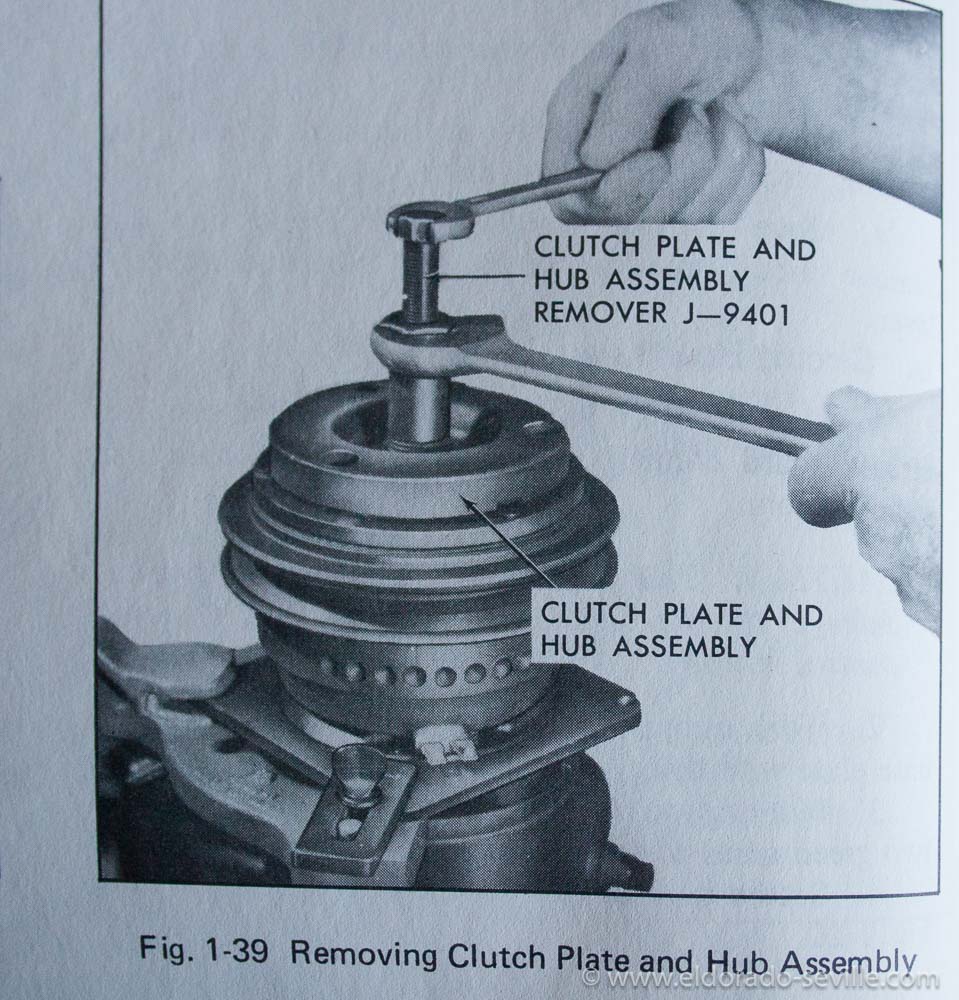
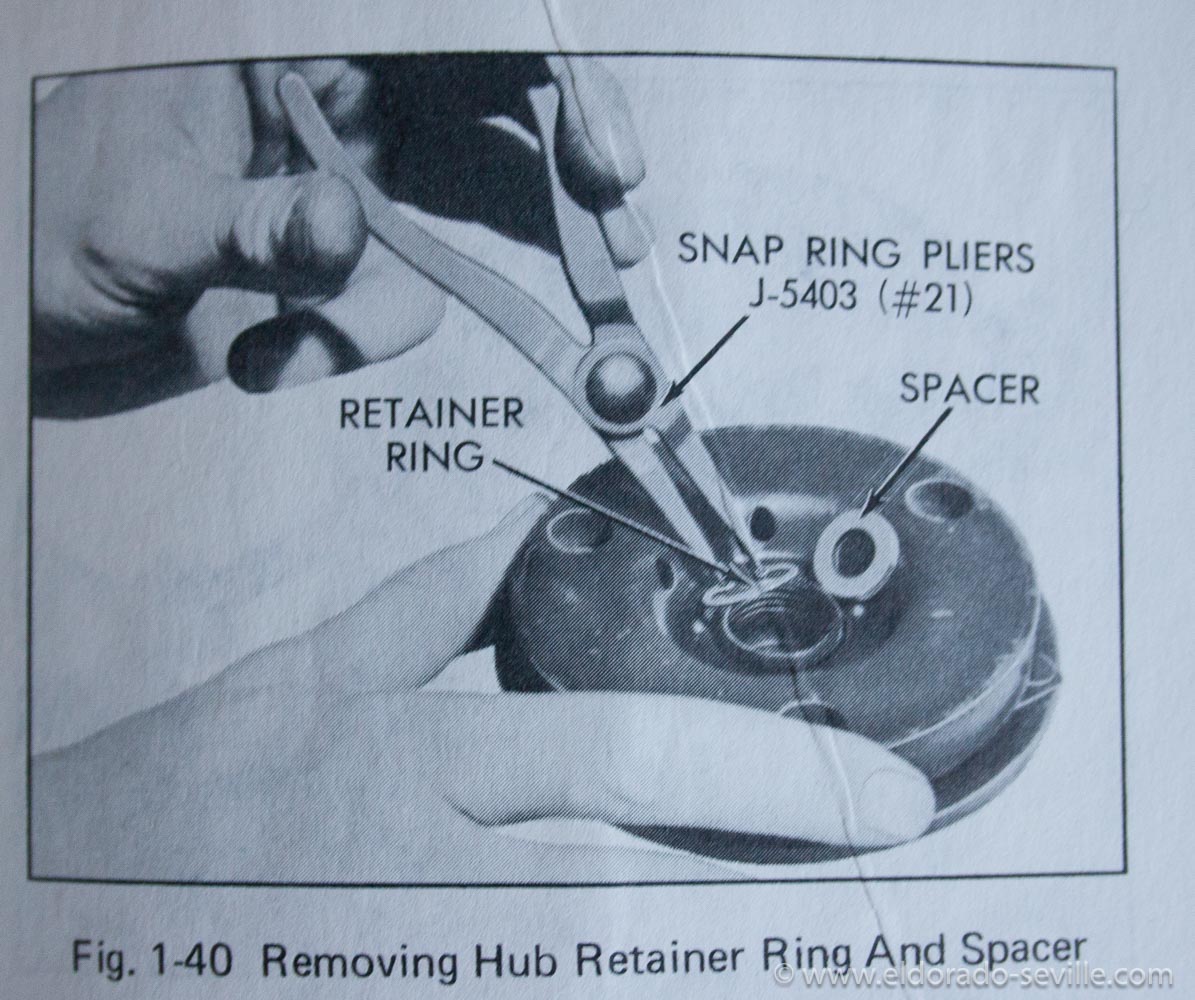
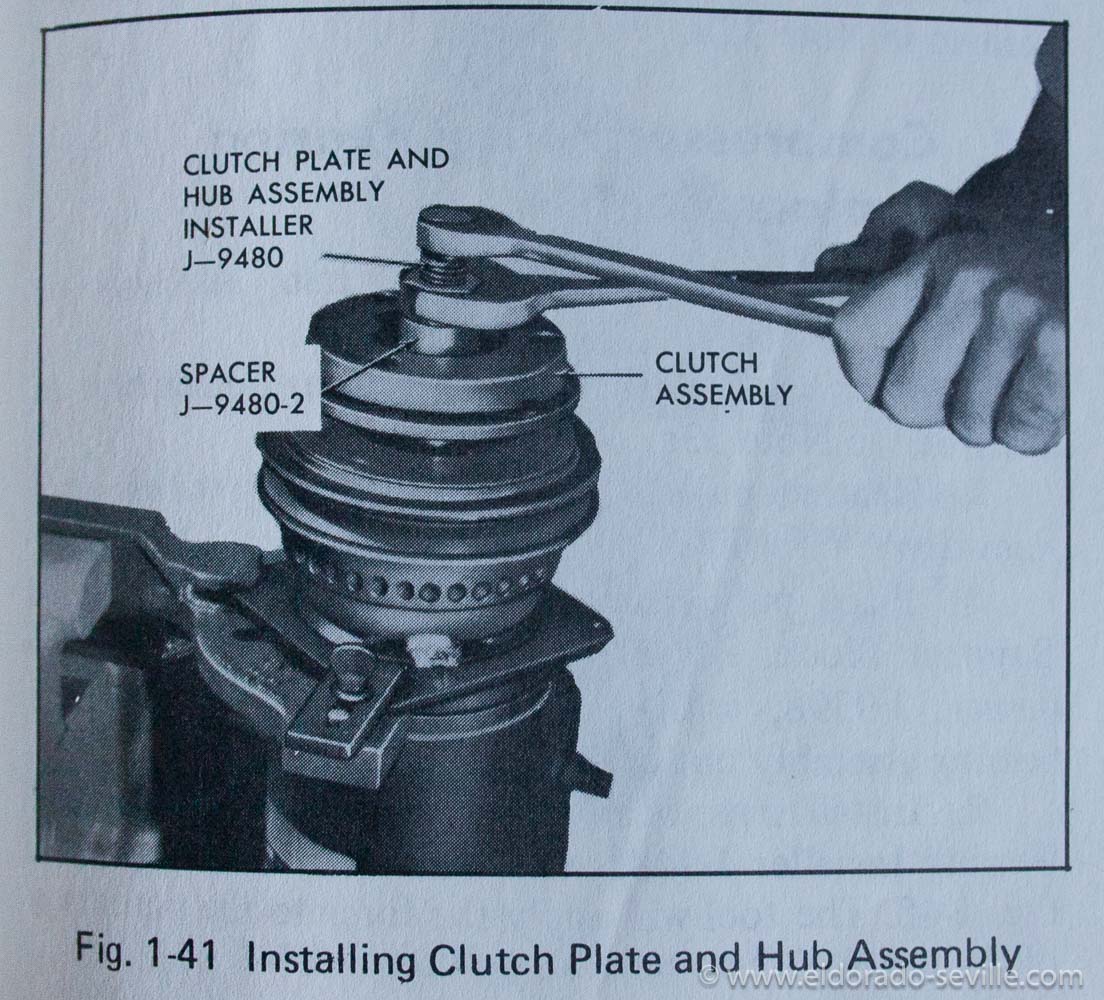
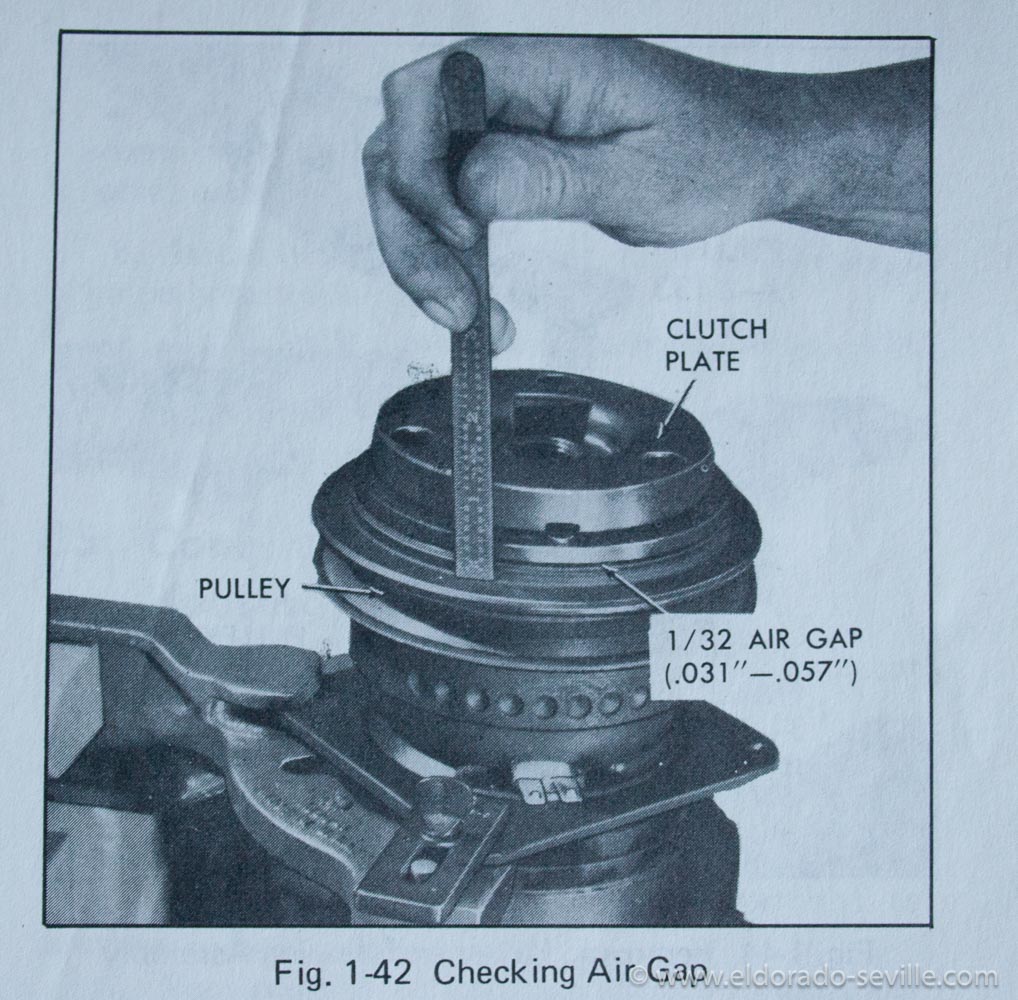
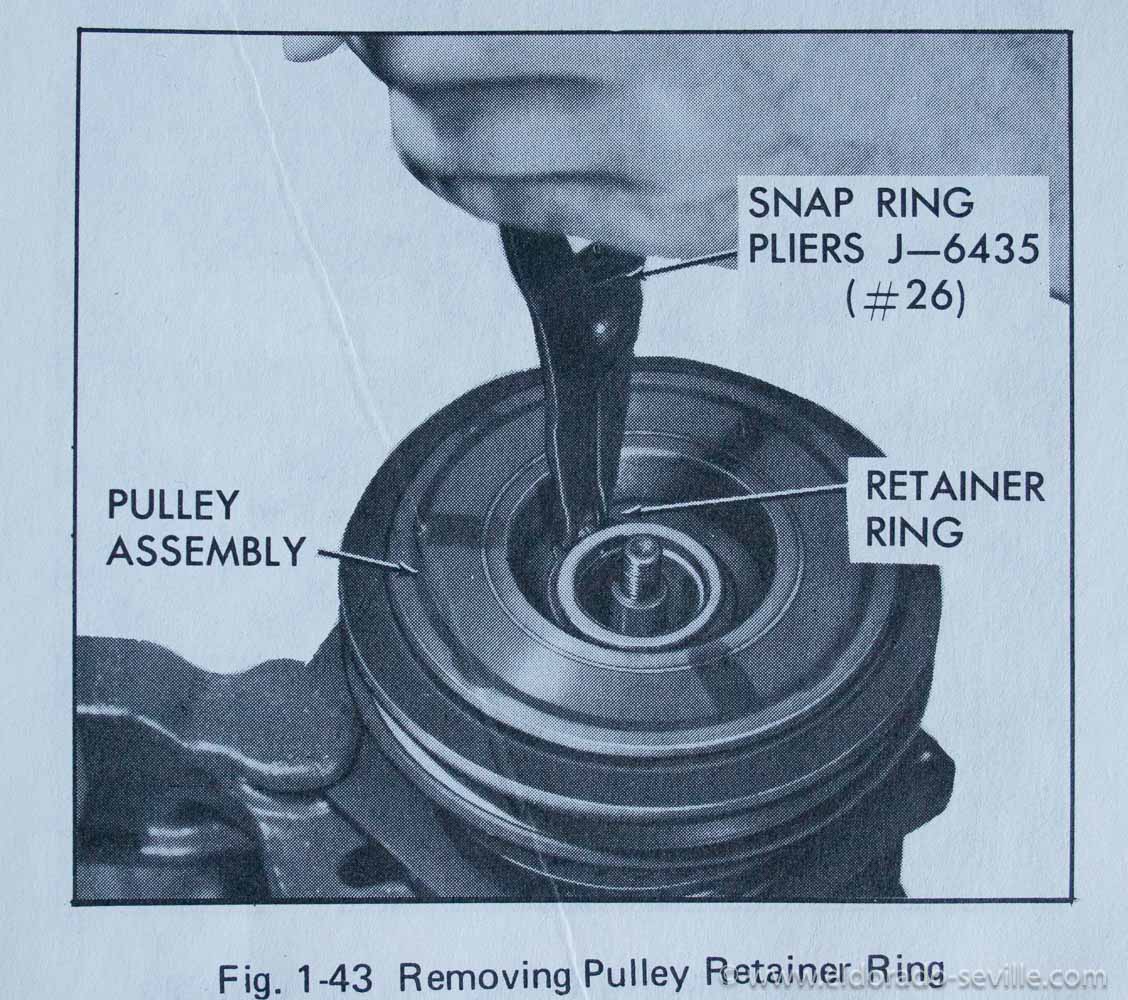
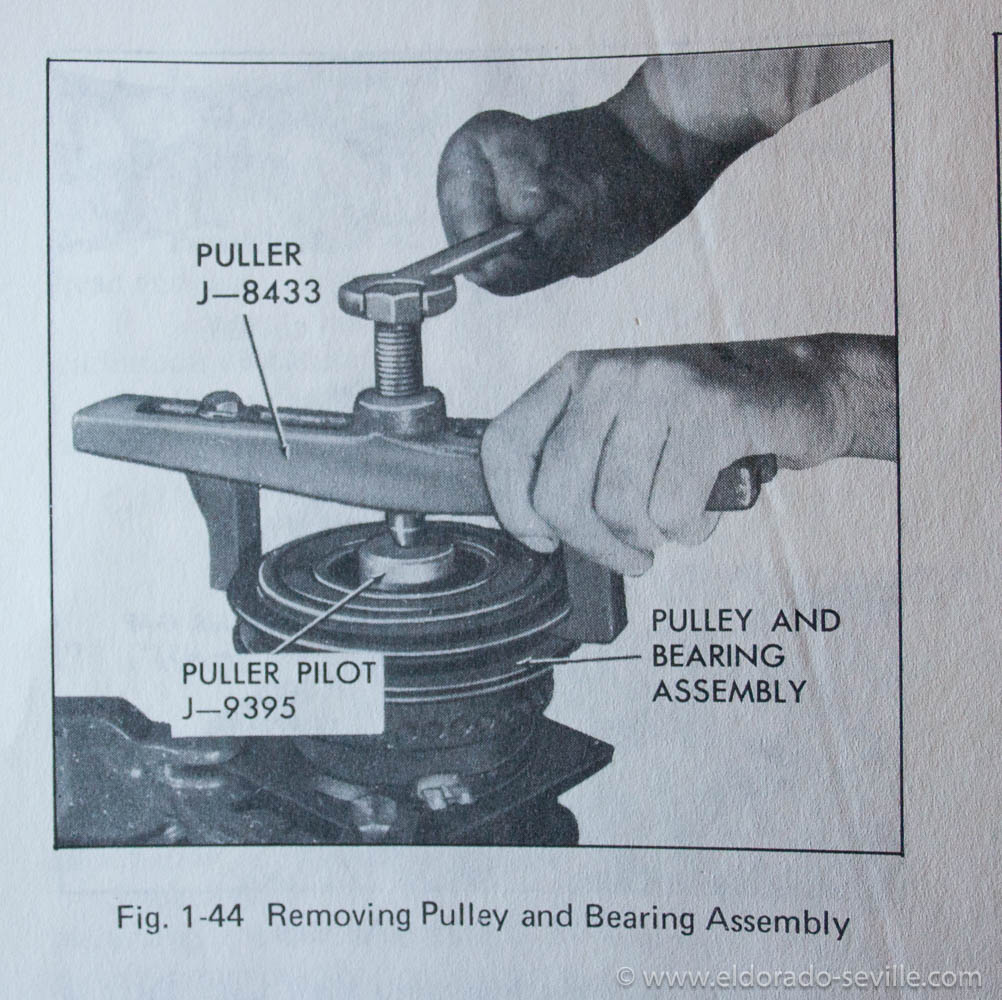
The procedure to be able to replace the bearing and to turn the clutch coil is not too difficult - but you need some special tools. Without those you cant do it. You´ll need a basic clutch puller / installer set for this job and some long nose snap ring pliers to get the retaining rings out.
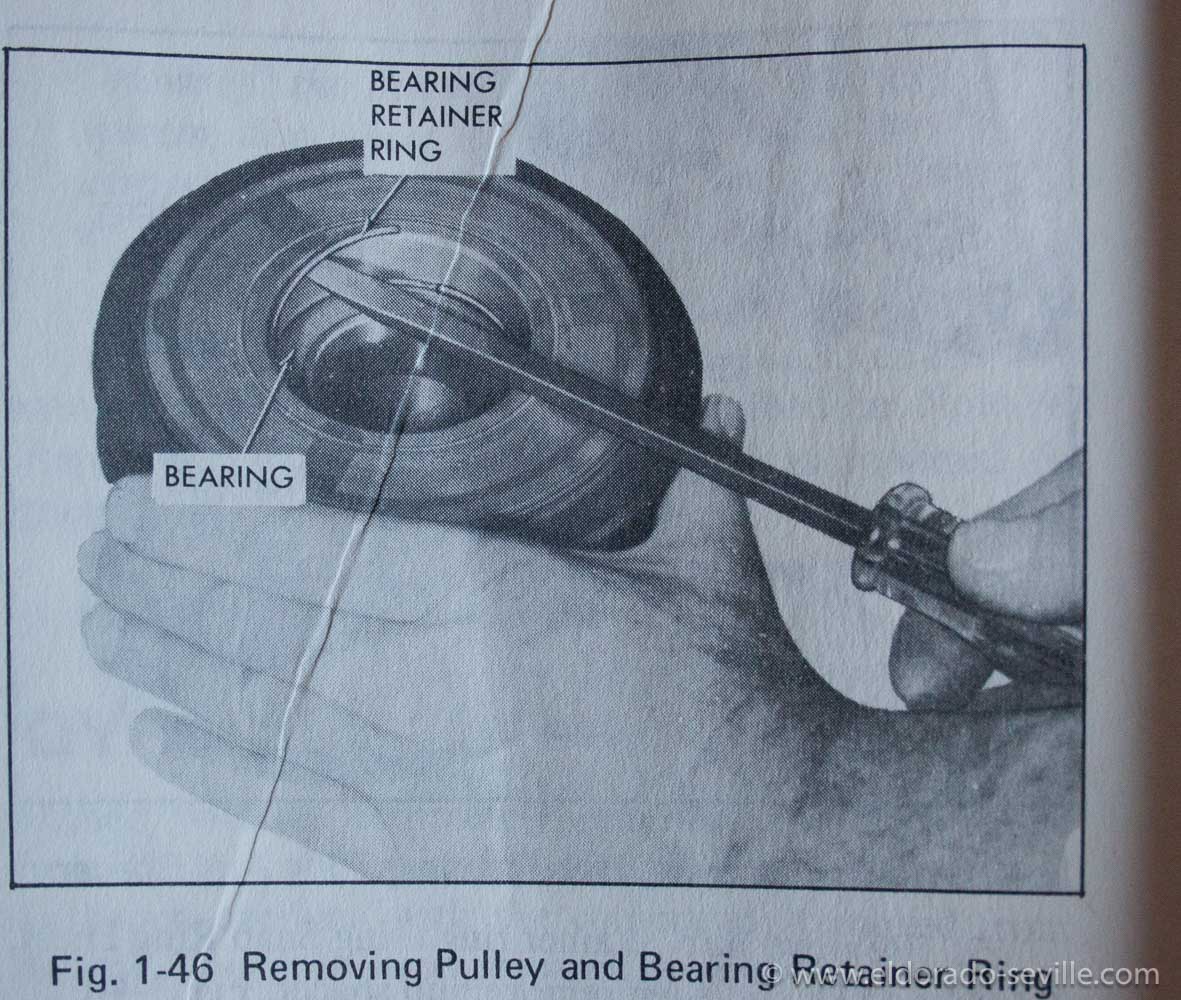
First remove the shaft nut and the snap ring ( the rebuilt compressors always seem to come without this snap ring) and then pull the clutch with the special puller. Pull off the pulley and take the bearing out and replace it with a new one.
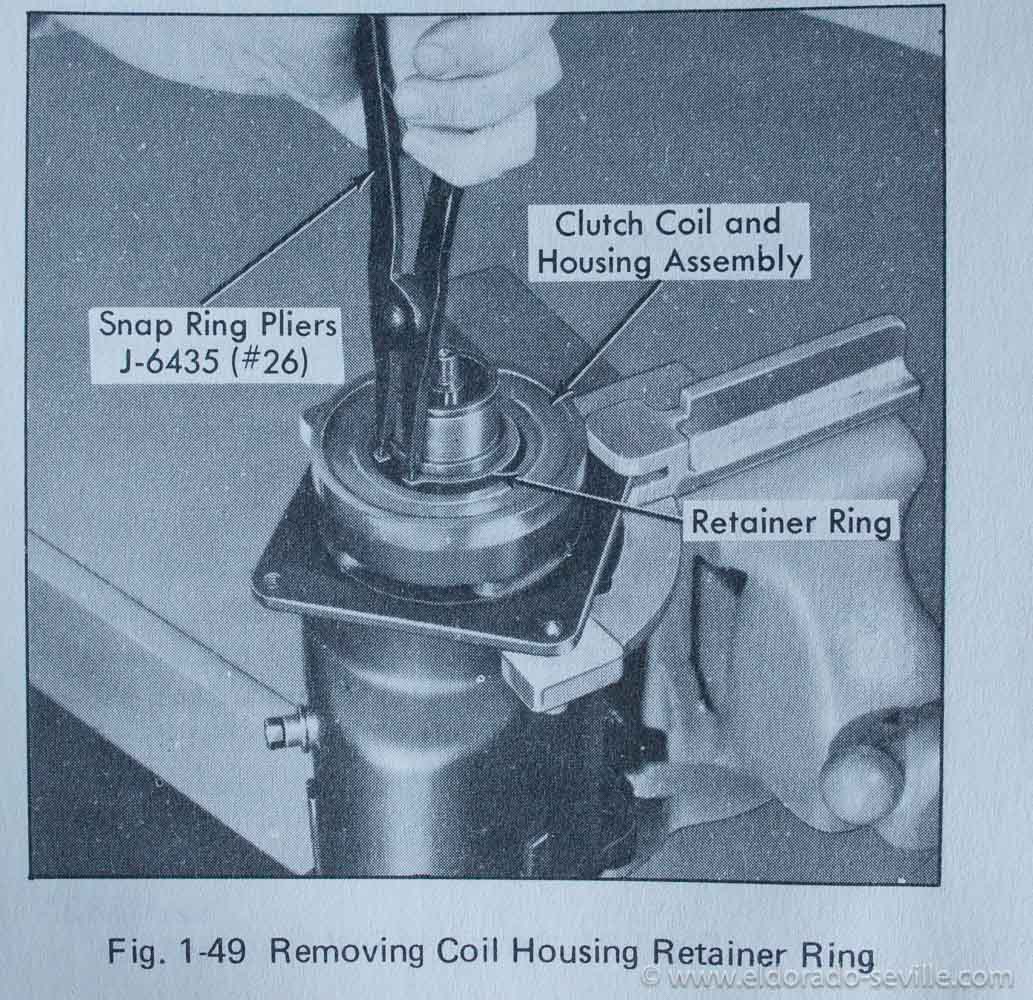
To be able to turn the clutch coil you´ll have to remove another snap ring. This snap ring was the biggest challenge for us. The shop manual lists a special tool for this which we of course did not have… It could be done with a very long nose plier as well, but we did not have these either. So it took us quite a long time to get it out with screwdrivers and self made hooks… You can then simply turn the coil into the correct position.
Putting it back together is pretty straightforward as well, but again you need a special installer tool to get the clutch back on and to adjust it properly.
I will now have to buy a new bearing so that I can put the rebuilt compressor back together and have it as a spare.
I have attached some pics from the shop manual which show how to remove the various parts of the compressor to remove the pulley and the clutch coil.
As always you can find ALL the pictures in my restoration gallery!
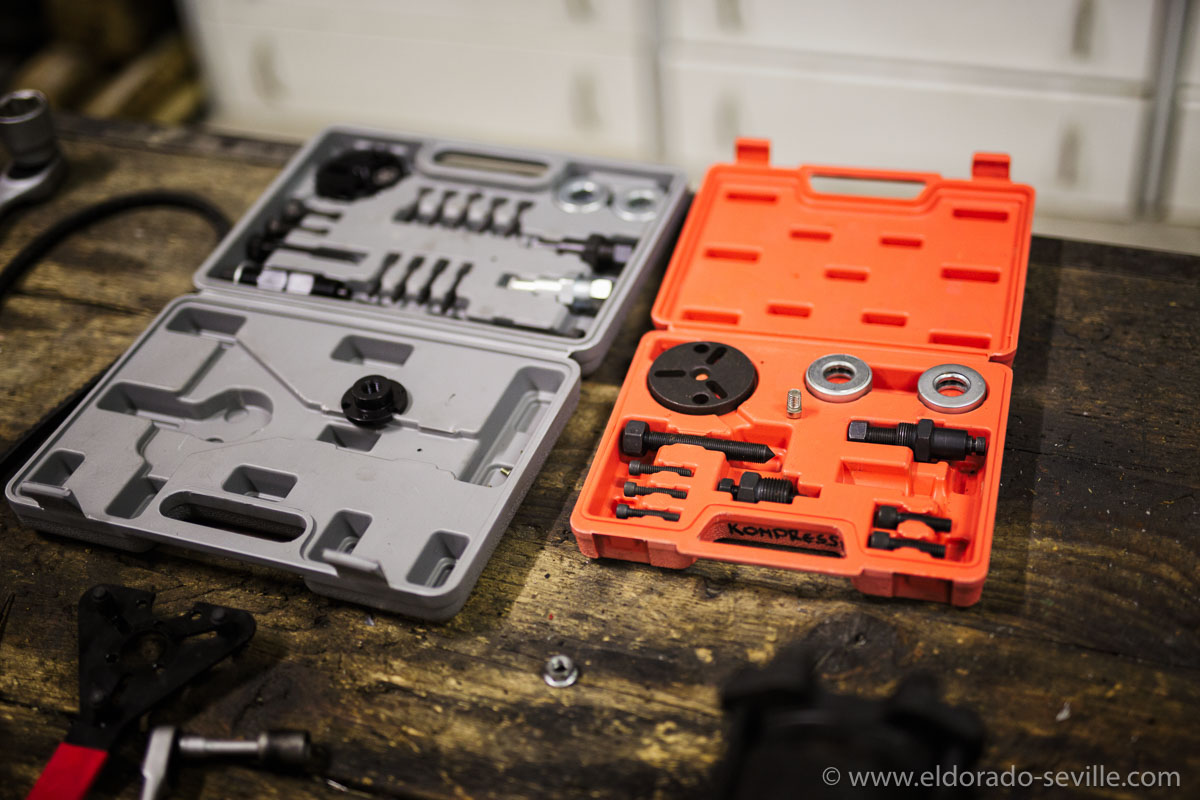
You need some special tools to disassemble the A6 AC compressor.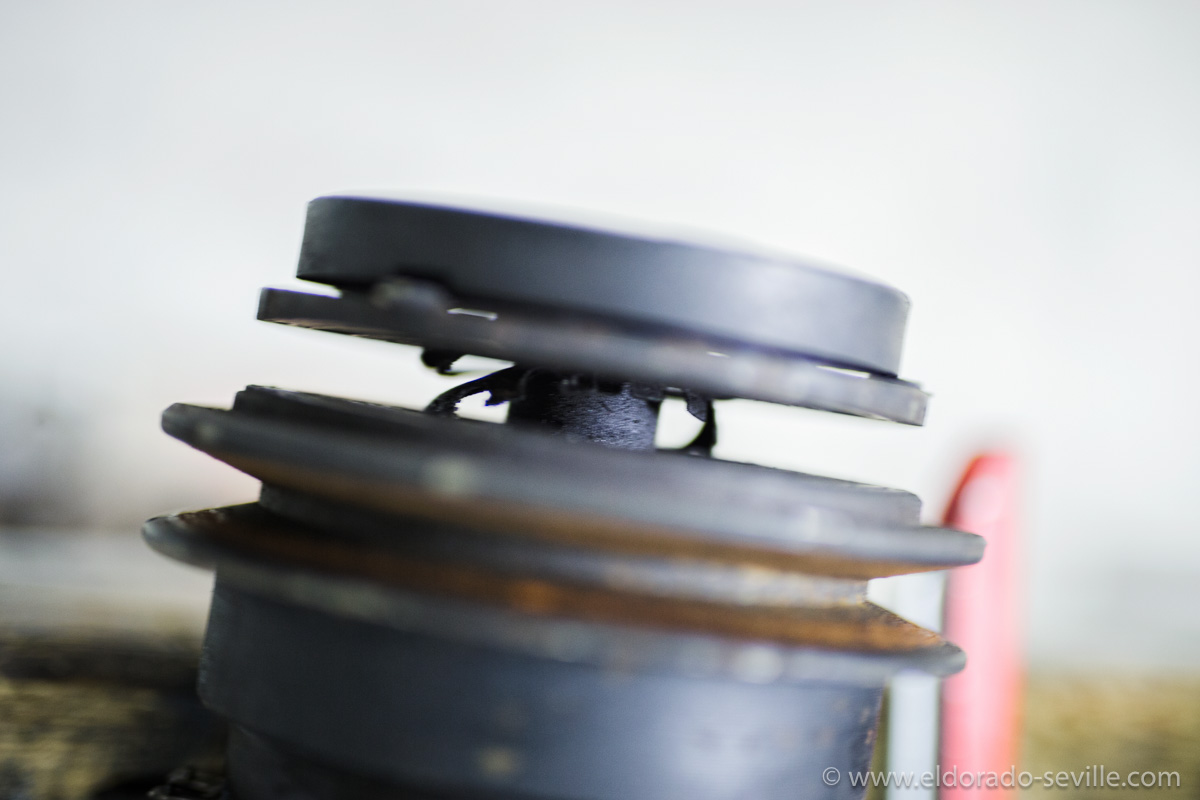
On the 74´s original AC compressor clutch the bearing was bad.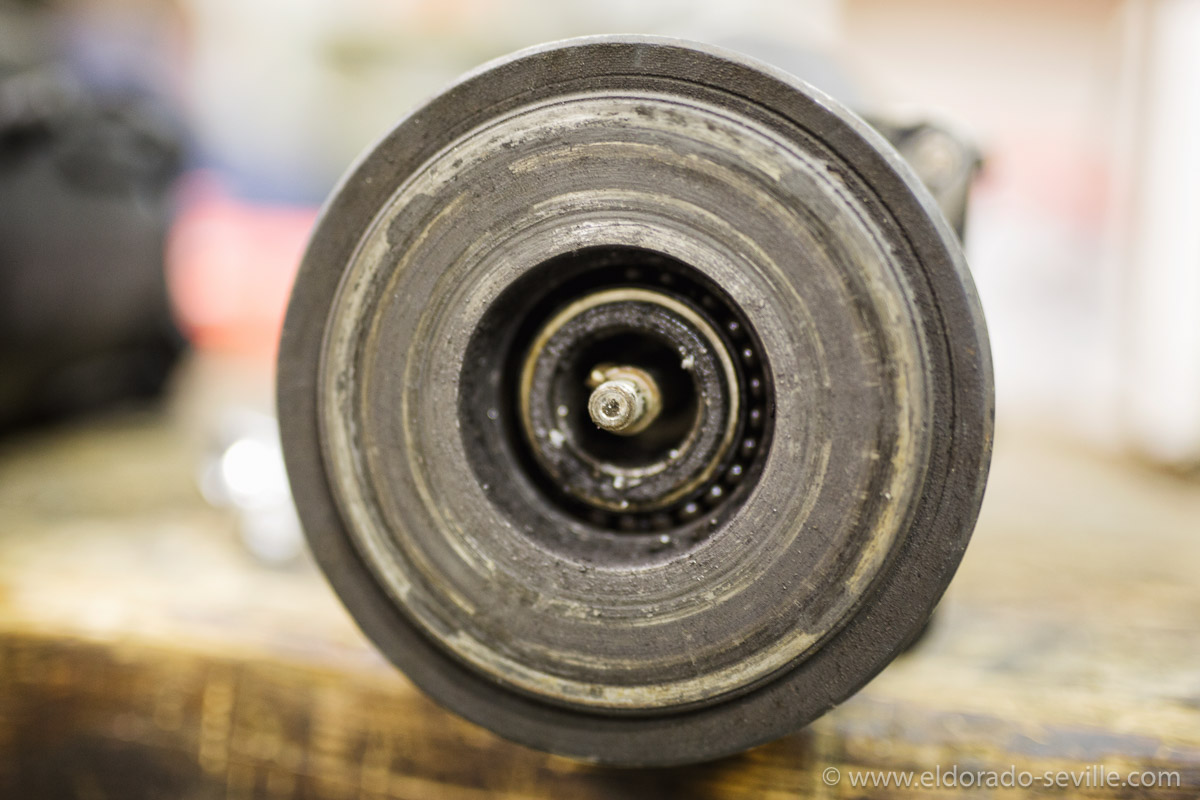
The compressor clutch removed. You can see the bad bearing inside which is normally sealed. Some balls were already missing.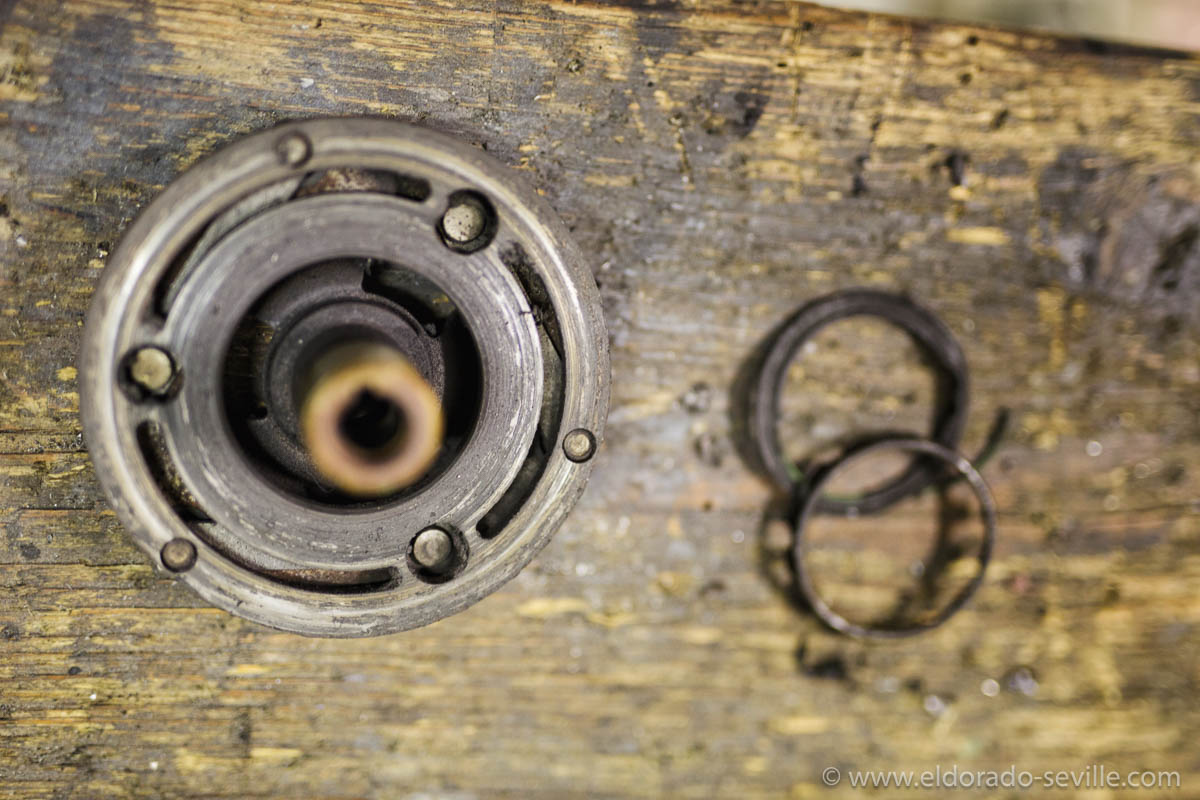
The clutch with some remains of the bearings.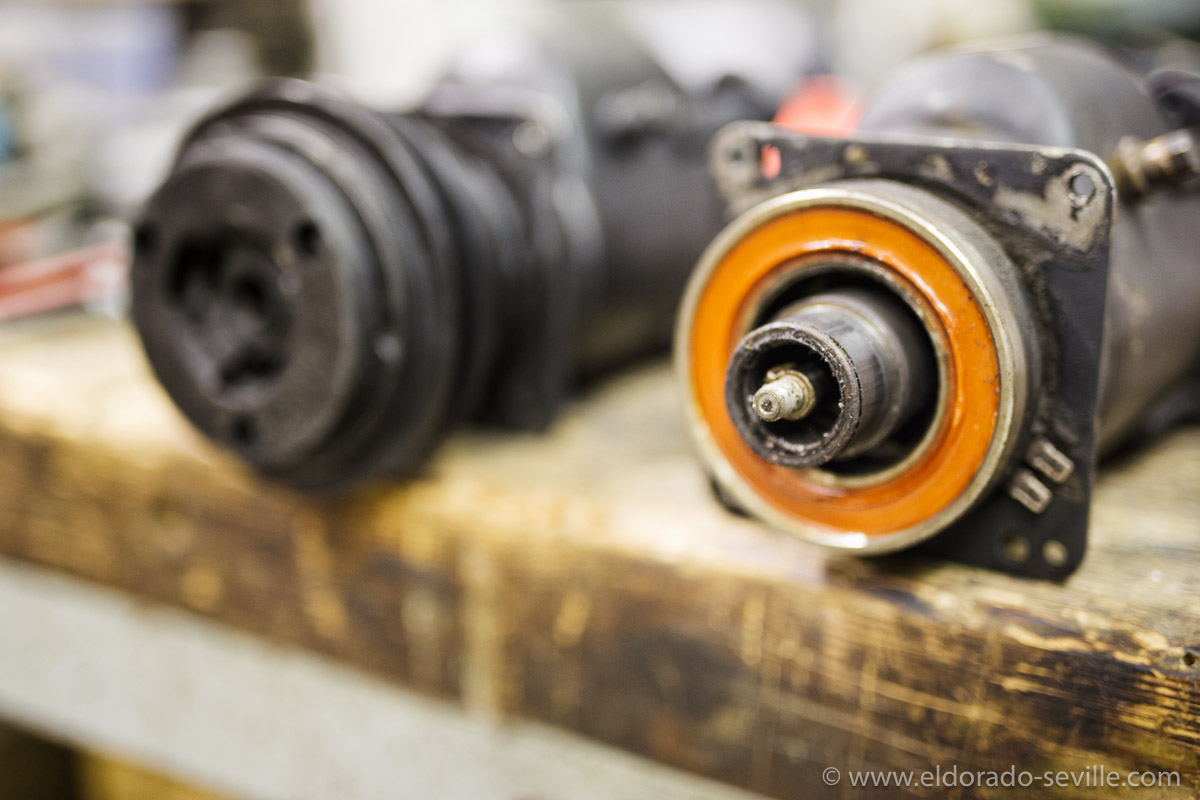
The clutch and pulley removed on the original compressor.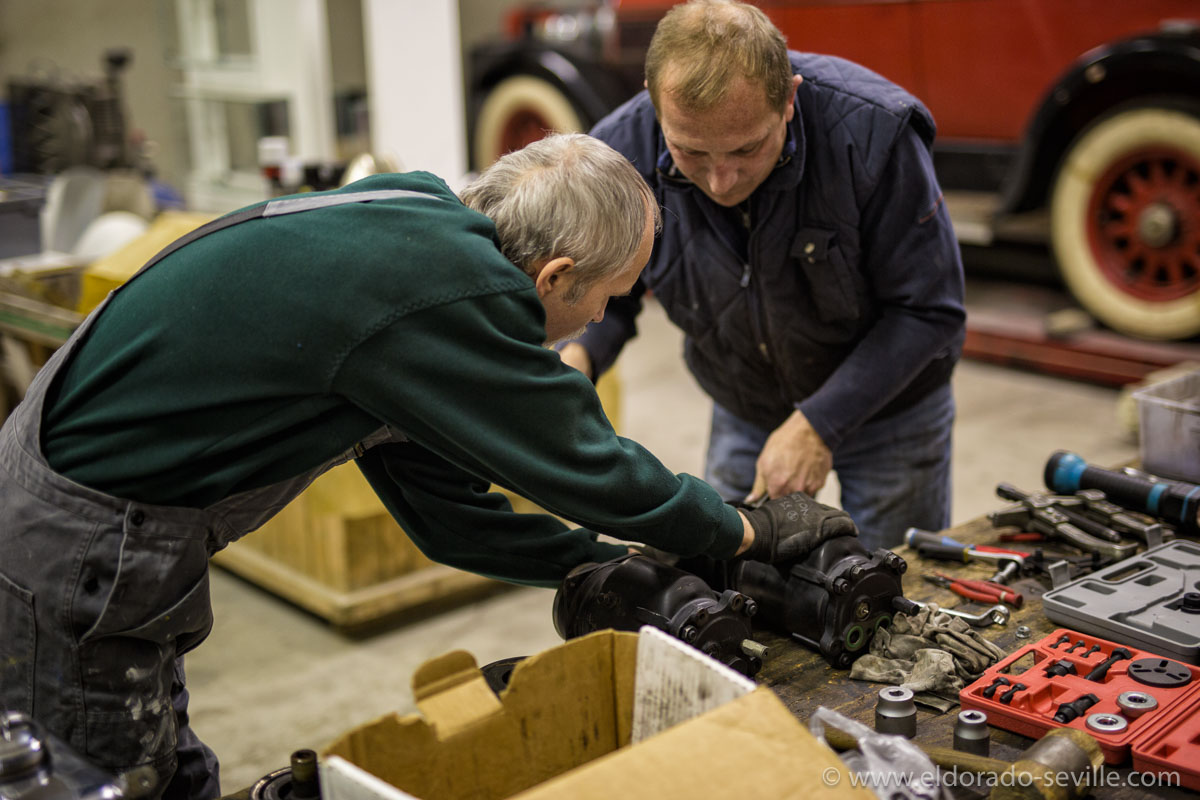
My friends Steve and Lucky at work. We also replaced all the O - rings.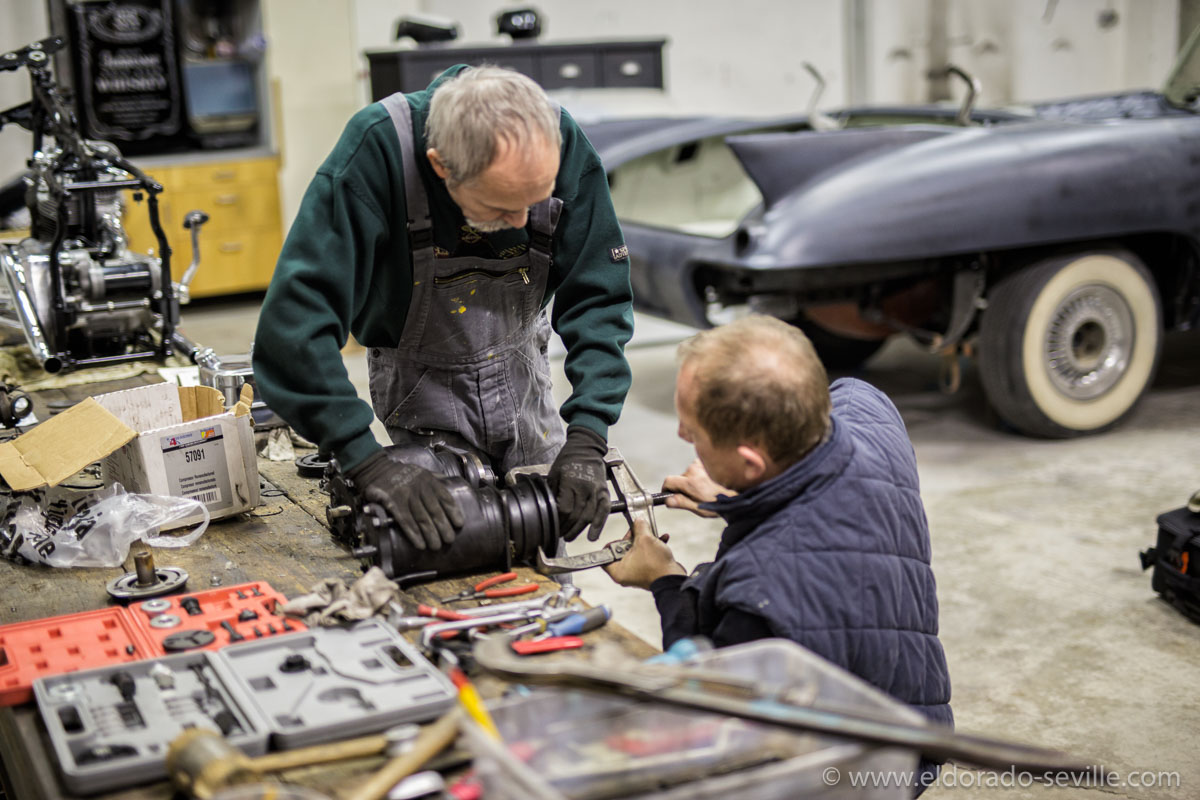
Removing the pulley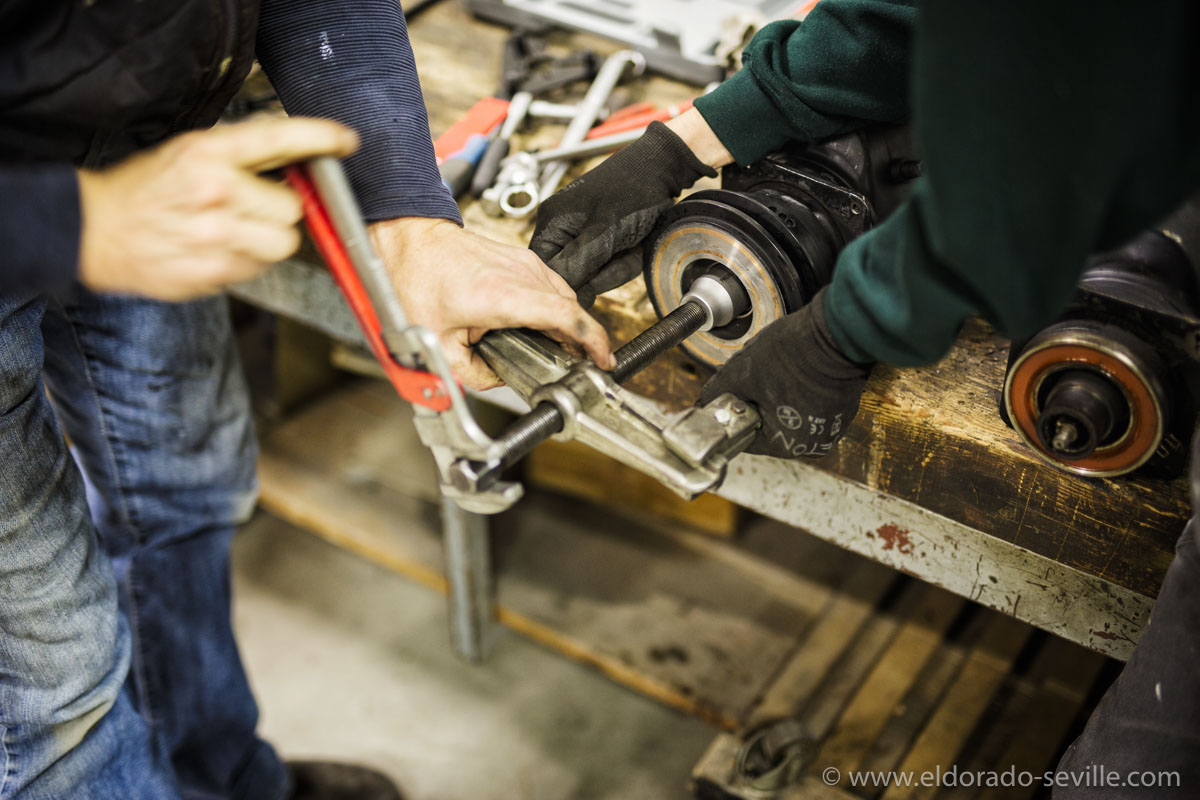
Removing the pulley from the rebuilt compressor.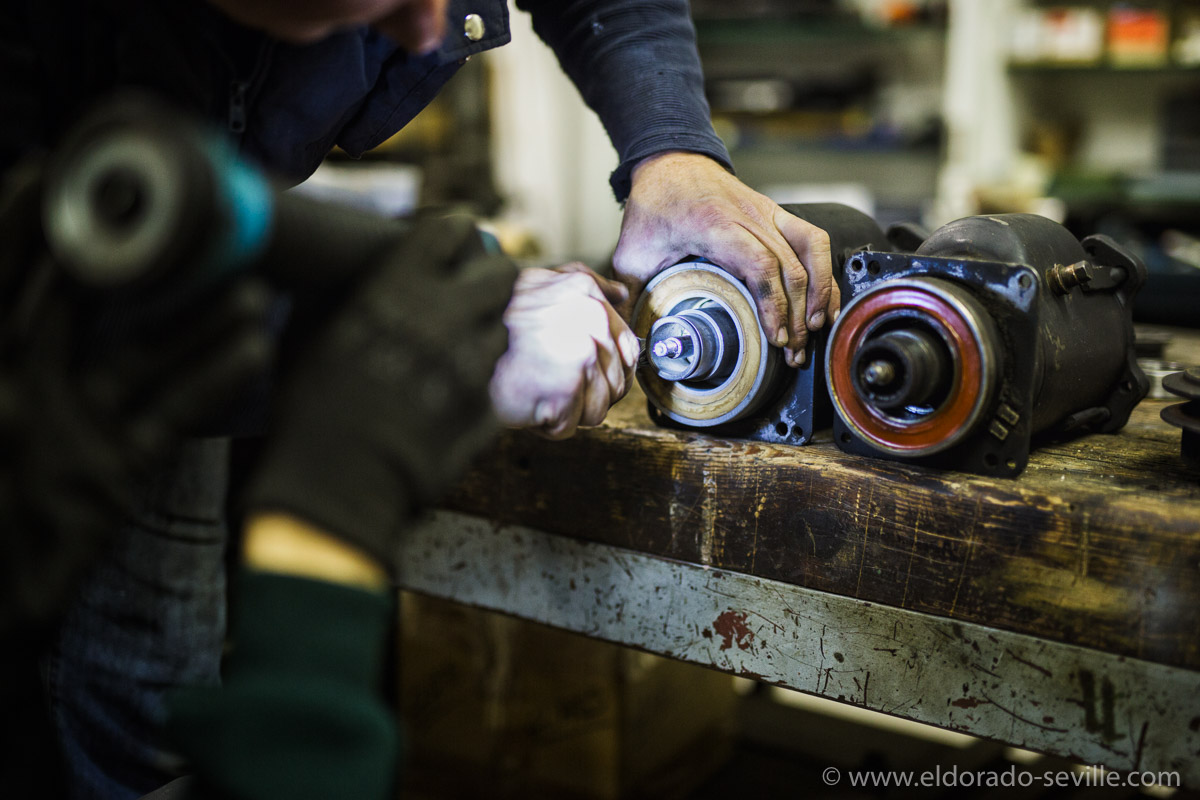
There is this one snap ring we just did not have the right tool for. The shop manual lists a special plier for this. After a lot of fiddling we got it out eventually…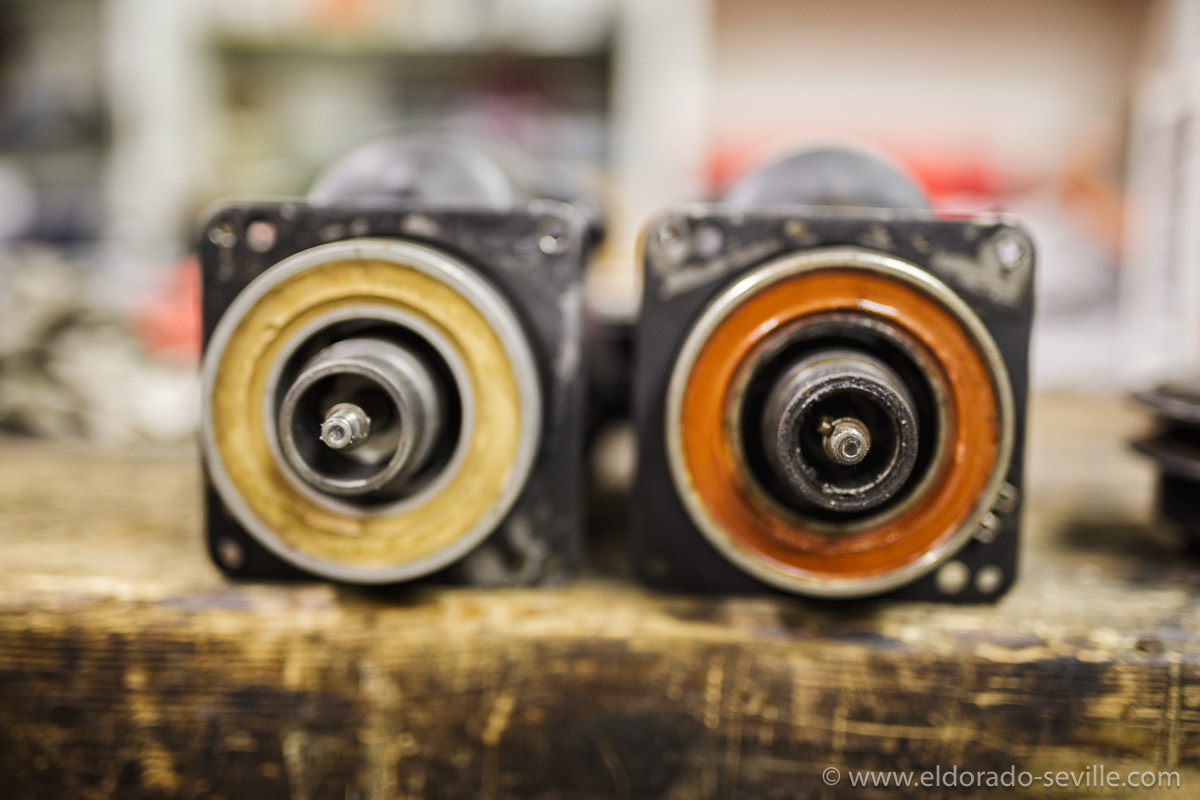
The magnetic coils on the rebuilt and the original compressor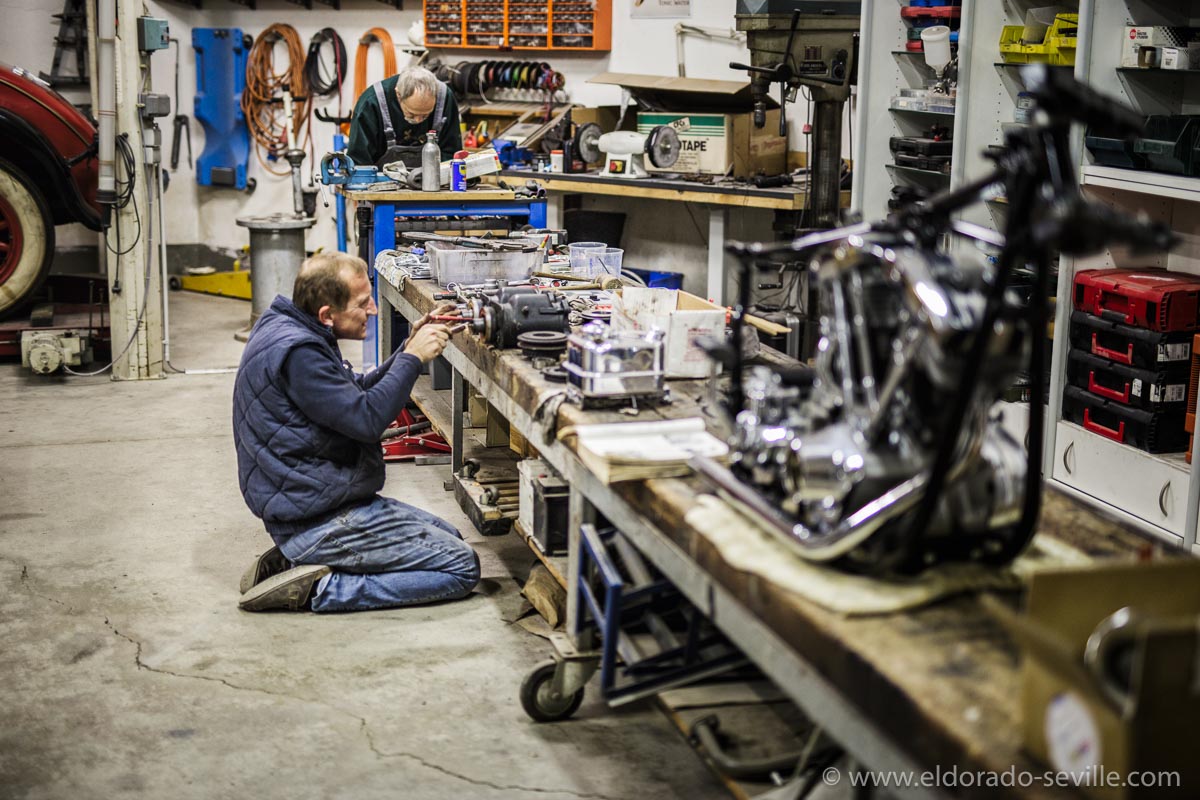
Lucky in action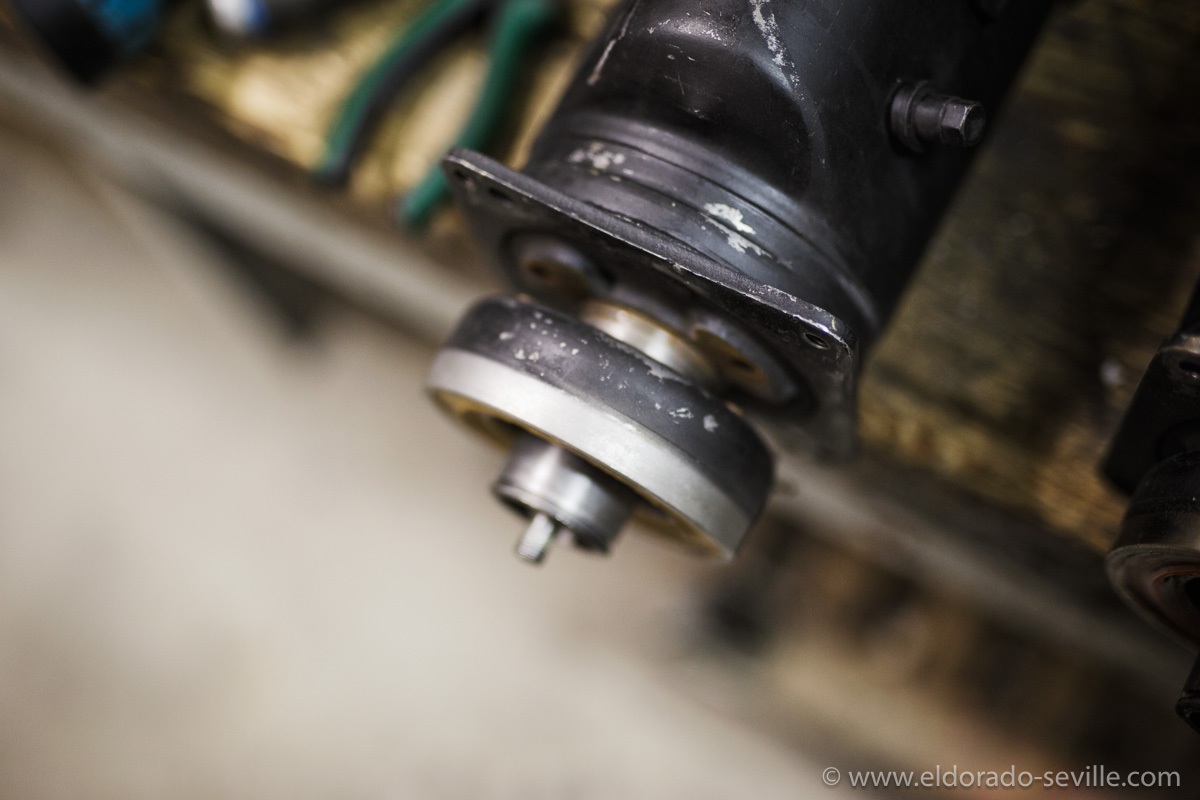
Once the snap ring is out you can turn the coils terminals to the 11o´clock position or the 1 o clock position. On the 74 it has to be at the 10 o clock position, otherwise the connecting wires are too short.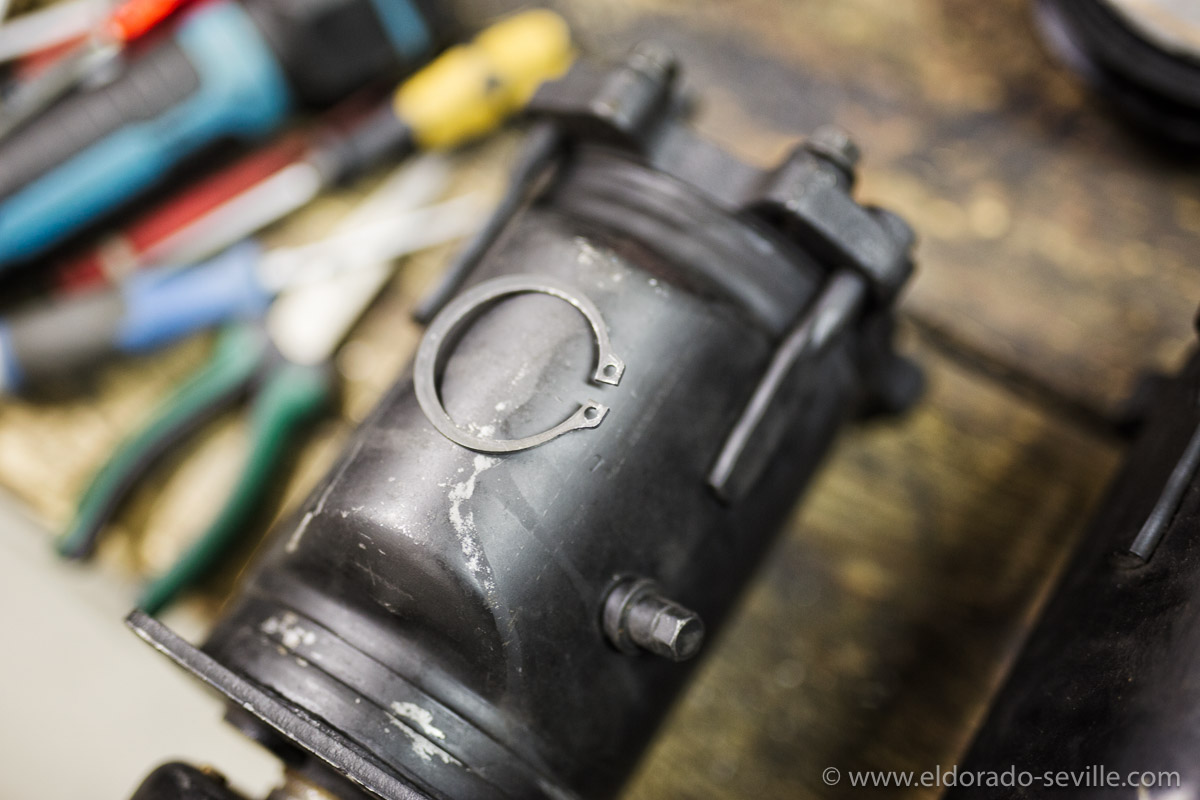
Getting this snap ring out was the hardest part on this job, due to not having the right tool for it.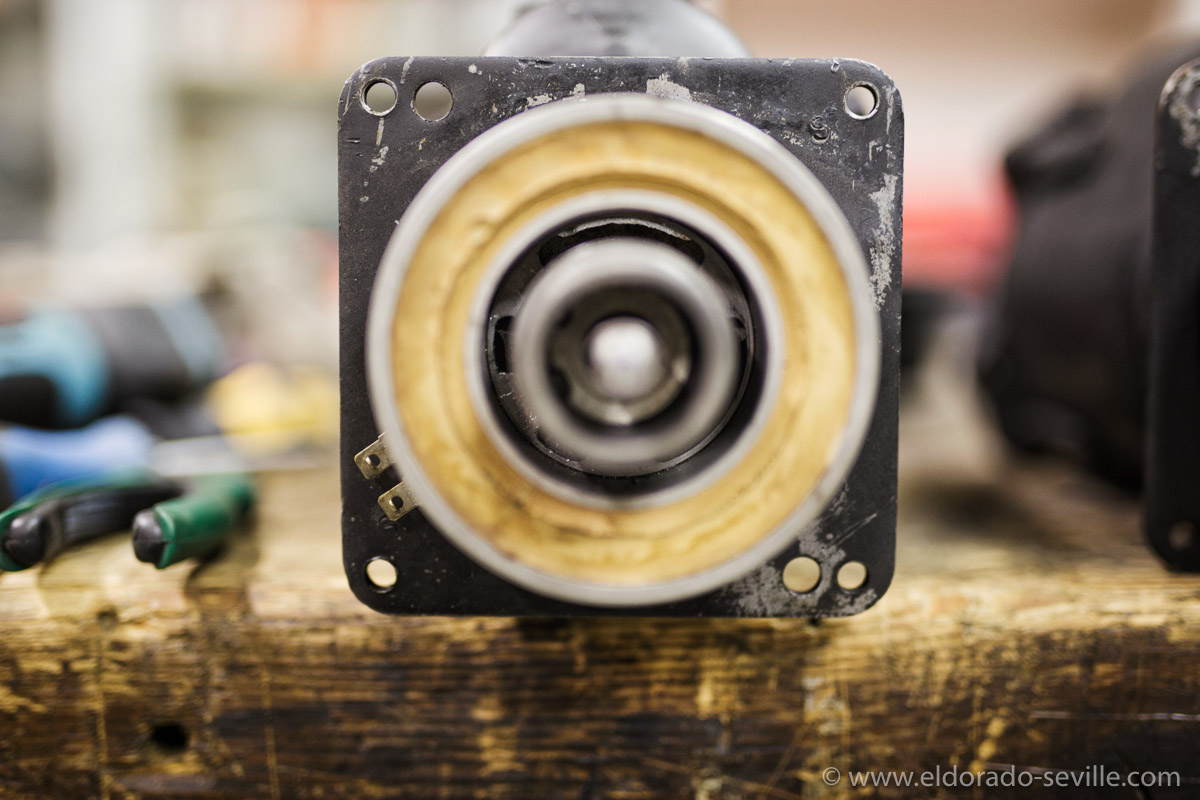
The terminal at the incorrect position at the rebuilt compressor.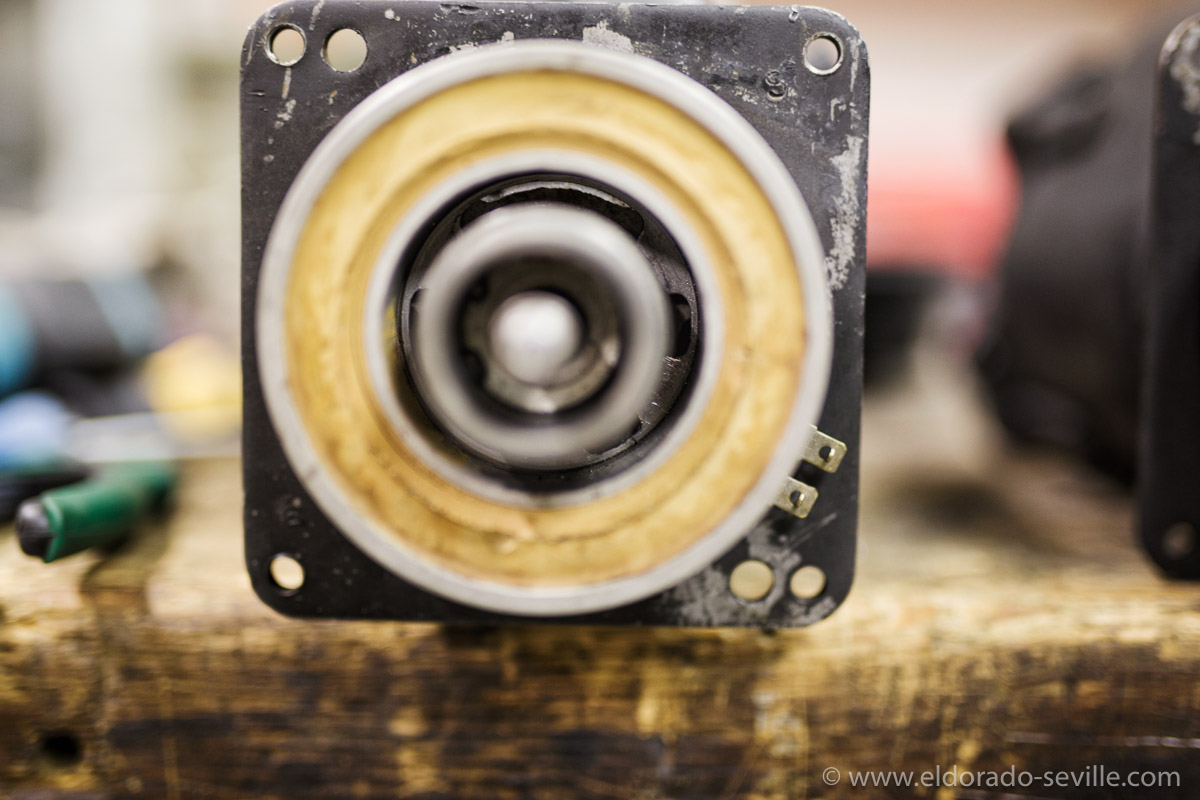
We turned the terminal to the correct position.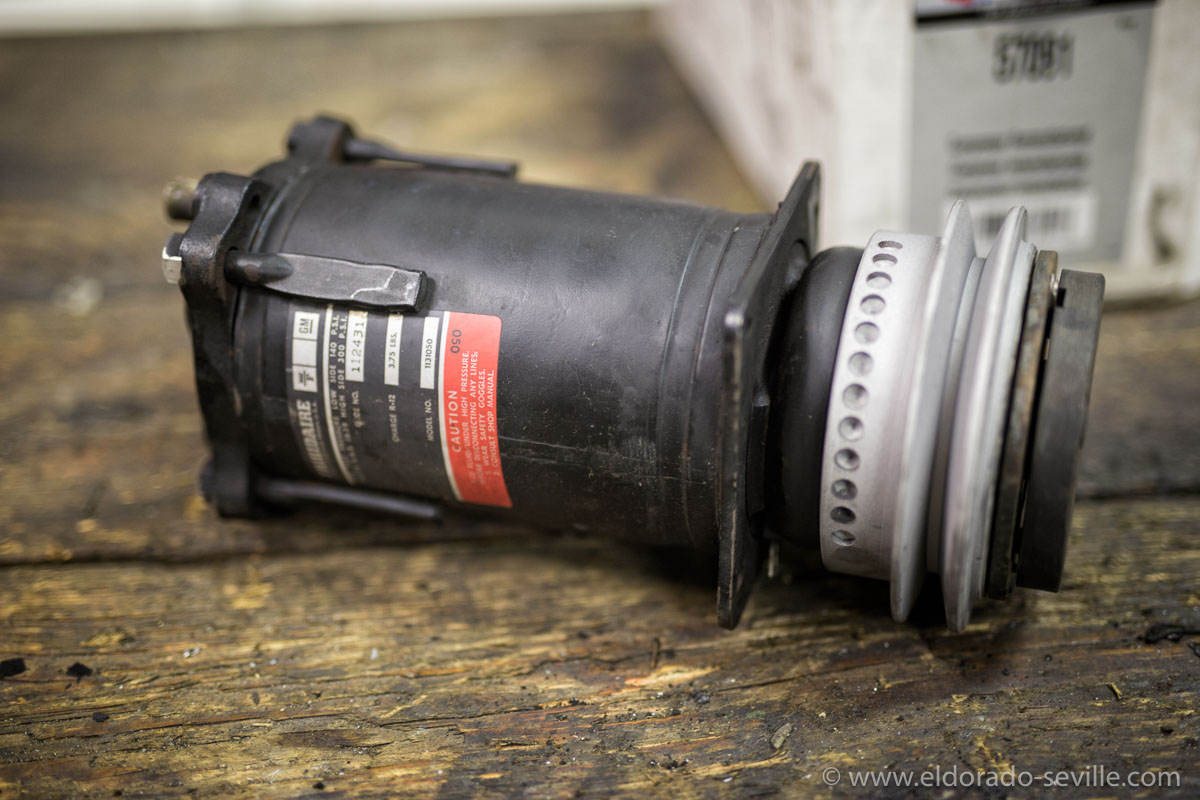
We sandblasted the pulley while it was out of the car so that I can repaint it now. Note the original decal! All the available reproduction decals are totally incorrect for the 1974 Cadillacs. The reproduction decals all show the wrong amount of refrigerant! They are also different in many other details. The closest match of reproduction decals for 1974 are the ones from 1972 Cadillacs…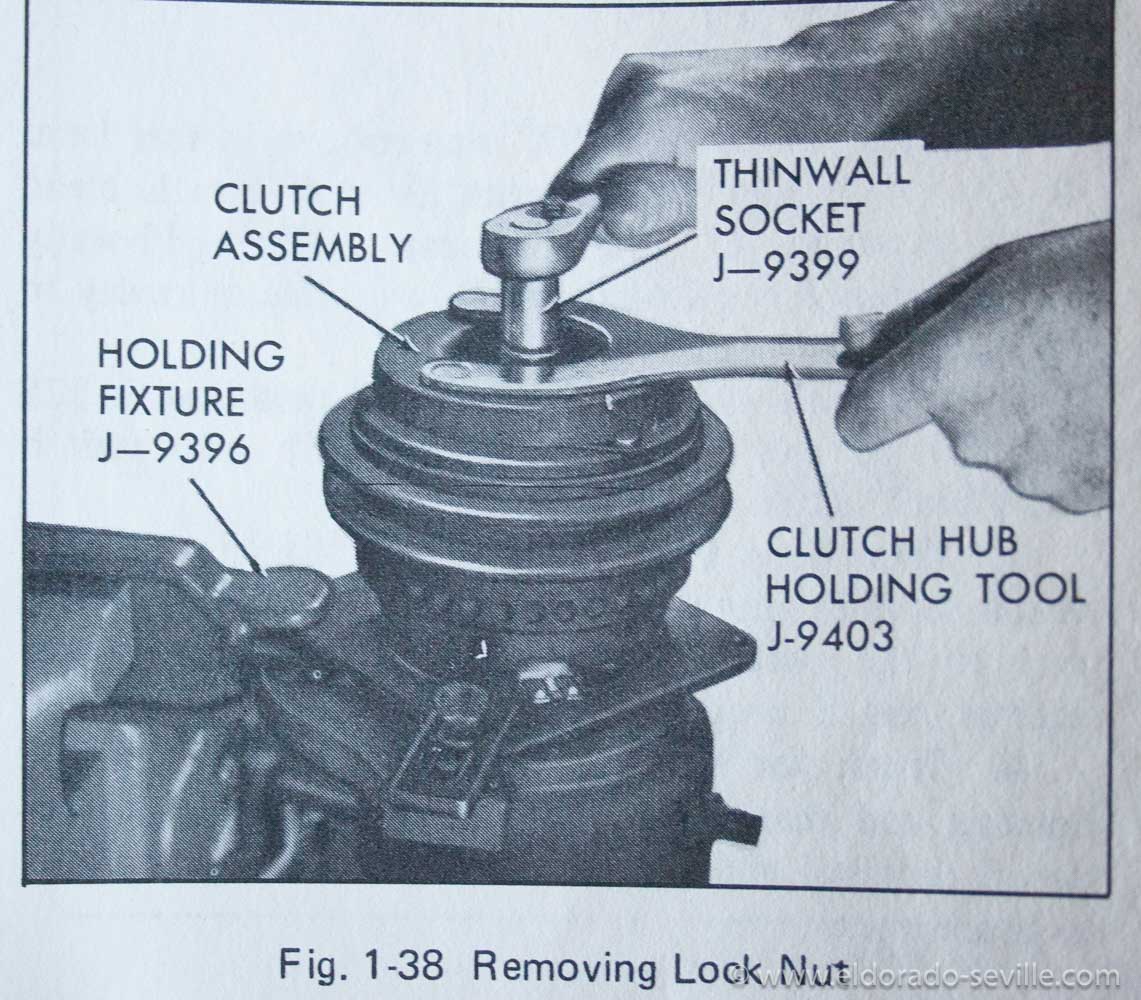
FLUSHING THE COOLANT OF THE 74
I first flushed everything with a cooling system flush chemical followed by fresh water and then I put in all new coolant (I used Prestone) and connected the heater core to the system again. Everything came out very clean, so I think that a good flush was already done a short time before I got the car.
It took a while until I got the air out of the system and the new heater core did not work at first. But after about 30 minutes of letting the car idle at about 2.000 rpm, the air was out and the AC finally blew out warm air.
Its great to have heat in the car again.
When I reconnected the heater valve to the heater core I needed a short piece of heater hose. I found perfect reproductions at Fusick - they look exactly like the original GM heater hoses with 5 ribs and are available by the foot. They are not exactly cheap, but perfect replacements if original appearance is important for you. They are also available in the correct size - 5/8 and 3/4. The smaller diameter goes from the heater core to the hot water valve.
By the way - Fusick has exceptional customer service , which impressed me very much. I will definitely buy from them in the future again.
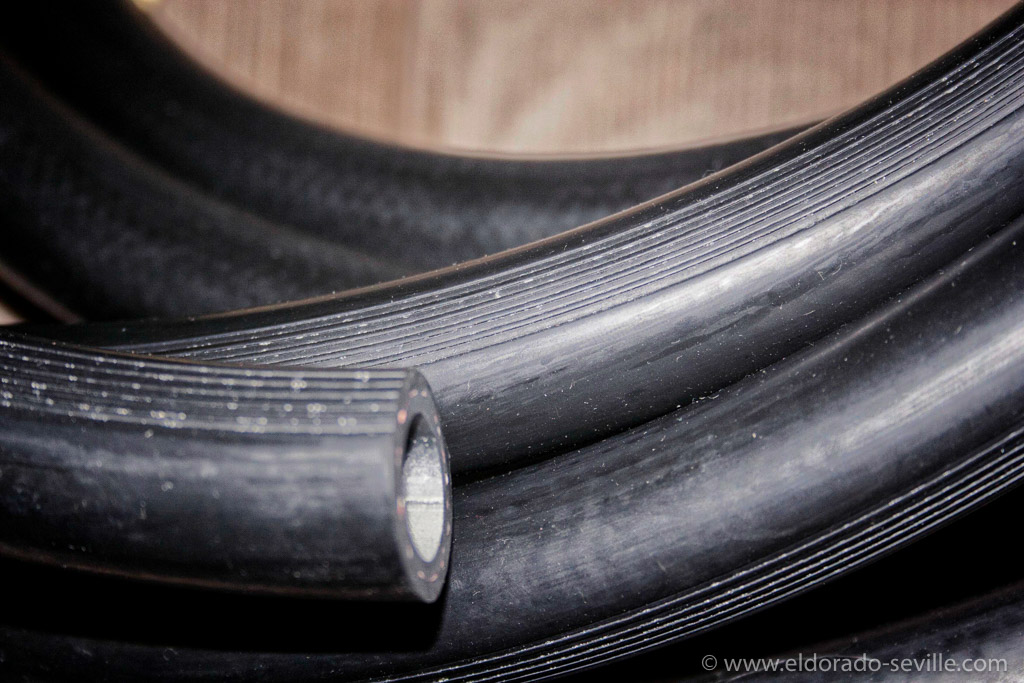
Fusick offers a perfect reproduction of the original ribbed GM heater hoses. The original heater hoses had 5 ribs just like these super nice reproductions.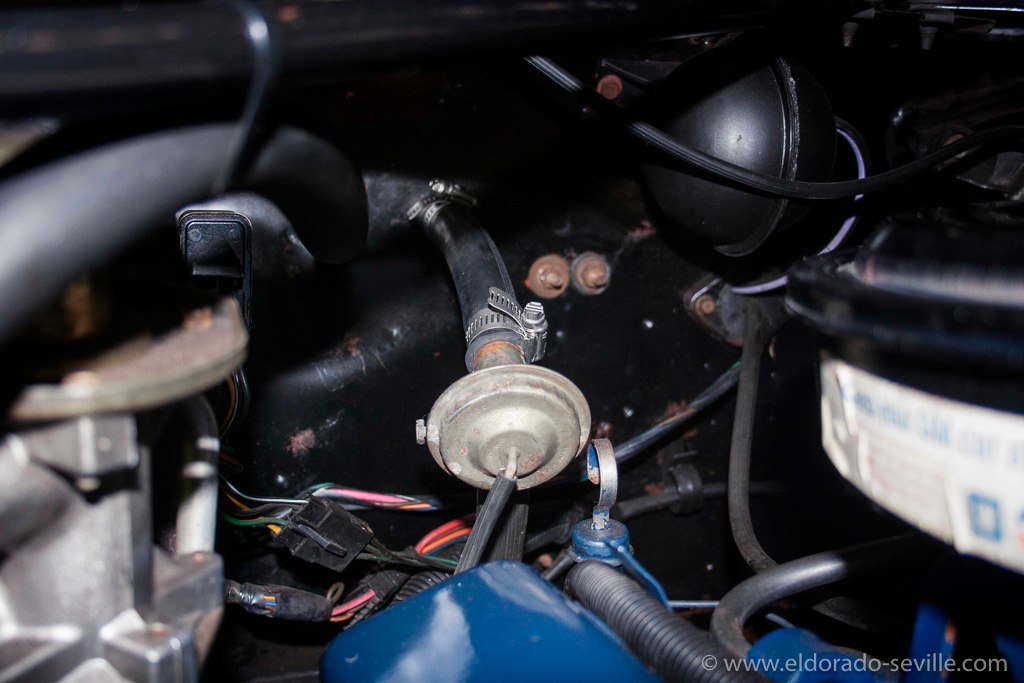
I re-connected the new heater core to the cooling system and used correct reproduction heater hoses to connect the original heater valve which is still working perfectly. The hose clamps are not the correct ones yet. I think there should be tower style hose clamps which I do not have at the moment. There is still an original one on the bottom of the valve and also one on the other heater hose, thats why I´m very sure that the other two clamps should be tower style as well. I have not found a perfect reproduction clamp yet, but I´m still looking…
REMOVING AND REPLACING THE 1974 CADILLAC HEATER CORE
There could have been 3 possible scenarios why it was disconnected:
- The heater core is leaking
- The heater core is blocked
- The heat could not be turned off in the heating system due to a problem in the ATC
Most probably the core is leaking on such old cars. So I had ordered a new core a while ago, but I never really wanted to tackle this job as it needs quite a bit of effort to get it done and it is not a very funny job. It's not that technically challenging but very tedious. I finally bit the bullet and decided to finally do it.
You can normally detect a defective heater core by fog build up inside the car and by the smell of coolant.
I studied the shop manual and started to tear the dash apart to get access to the heater box which houses the heater core.
I found out that the shop manual lists a lot of necessary work and does not show all the screws that you have to remove to get the box out. Some of the screws are very well hidden and finding them was the most frustrating part of this job.
Here is how to remove the heater core: (text in black is from the shop manual - my remarks are in green)
First you have to remove the Instrument Panel Pad
Removal of Instrument Panel Pad
- Disconnect negative battery cable.
- Remove three climate control outlet grilles - right, left and right center (see picture below on how it is done with a special tool - I just did it with two flat screwdrivers)
- Working through outlet openings, remove 3 fasteners securing pad to instrument panel support.
- Remove screws securing pad to instrument panel horizontal support.
- Pull pad outward and disconnect electrical connector from windshield wiper switch.
- Remove pad.
Heater Case Removal
- Drain radiator. (not necessary if you just clamp the hoses off, but flushing the system never can hurt)
- Remove hoses from heater core nipples and plug nipples to prevent spilling coolant remaining in core. (Thats indeed extremely important as you have to move the heater case around and it would definitely spill any remains of coolant on your carpet. Also make sure that there are no traces of leaked coolant underneath the carpet from the bad core.)
- Remove instrument panel pad. (As described in the chapter above.)
- Remove center A/C outlet support and connector from position between cowl and horizontal support, Fig. 1-36. (Scroll down to see the illustration, You basically only have to unhook the rubber part of the outlet and push it downwards.)
- Remove left A/C outlet hose from A/C distributor. (There are some steel clips inside the tube where it is mounted to the plastic distributor. You have to reach in and unclip them to be able to remove the hose without using a lot of force and maybe damaging it. See the picture where I put my arm into the opening below.)
- Remove center support and associated braces as shown in Fig. 1-36. ( I can´t see any reason why this should be done - I removed only one of the braces, and it was completely unnecessary. You only have to remove the round bent brace on the bottom of the heater case as its in the way to get it out - see the picture where I am unscrewing it below.)
- Remove two screws securing A/C distributor to heater case and remove distributor, Fig. 1-36. (If you did not remove the braces mentioned above like I did, you can´t get this part out. I just put it to the side where the glove box normally is, which you will also have to remove anyways - see later.)
- Remove one screw securing defroster nozzle and remove nozzle. (You have to remove the screw - but leave the nozzle in place. There is no whatsoever reason to take it out. And its also impossible to get out if you did not remove ALL the braces and brackets.)
- Remove glove compartment liner. (Its self explanatory - just remove all the philips screws you see inside.)
- Remove vacuum and electrical connectors from programmer. (You can do this now through the glove box opening.)
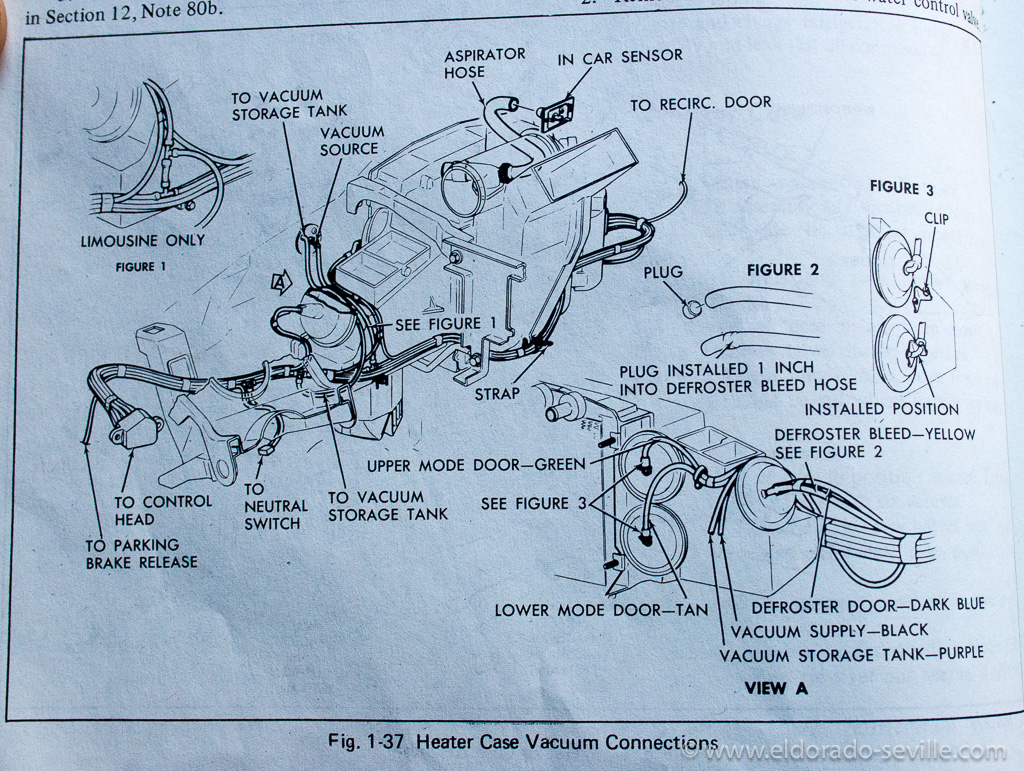
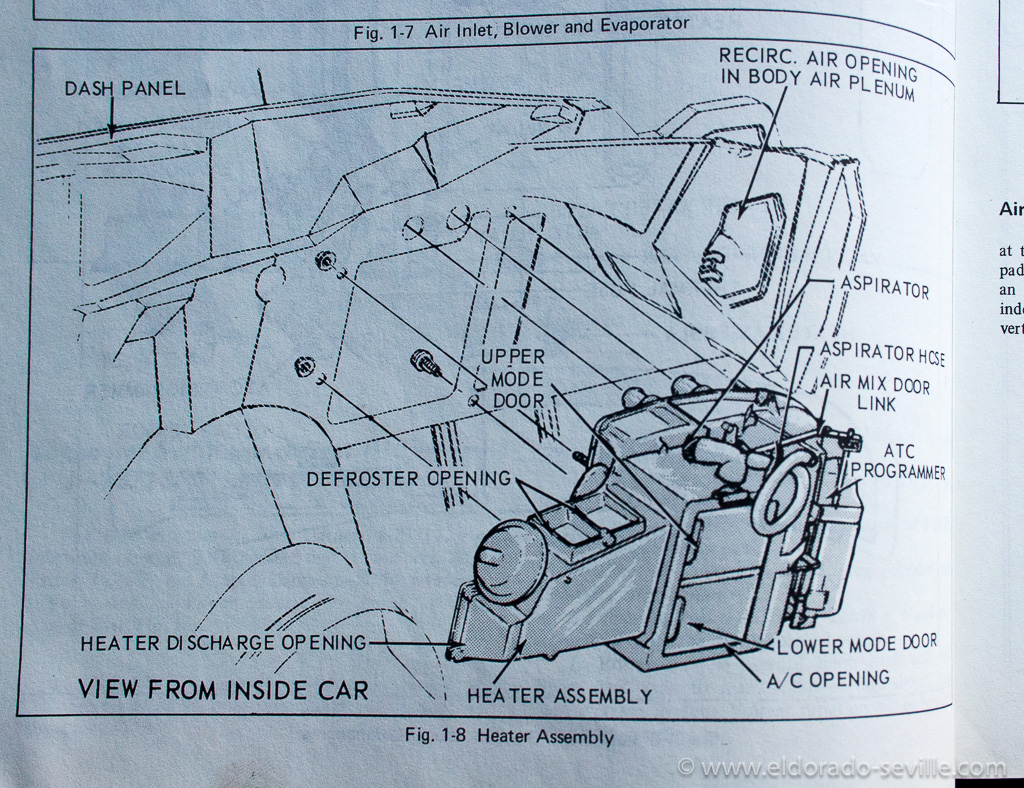
- Disconnect vacuum hose from recirc door actuator (Orange - near the right door kick panel.) , defroster door actuator (You can see it on the left side of the heater box with a blue and a yellow hose going into it.), mode door actuator (There is no way you can remove these hoses now, as they are on the back of the heater case. The upper mode door is green and the lower one is tan. You can really only remove them once the entire box comes out.) and position vacuum harness out of way, Fig. 1-37.
- Disconnect aspirator hose from in car sensor. (The thick black hose on top of the heater box)
- Remove three nuts and one screw securing heater case to cowl on engine side of cowl, Fig. 1-8. (It was the most tricky part for me to find these screws. See my picture below where I have marked the location of the screws as seen from the engine bay.)
- Remove heater case from position under instrument panel .(See picture how you have to position it to get it out - remove the two vacuum hoses mentioned before on the back now. Be careful - they are attached with metal clips)
- Replace heater core. (Only 2 screws - self explanatory - also re-use the rubber seals from your old core around the water nipples.)
You can then put everything back together which should be much faster, but before you could also remove the clock, which is very easily accessible now and clean and lubricate it (the shop manual recommends to do this every 2 years). You also have access to all the dash lights, tell tale and warning lights and to the speakers (which are shot on my car due to a defect in the amplifier in my radio) while everything is apart. While I had the heater box out of the car I also cleaned the inside of the programmer and re-lubricated it with white lithium grease. I used electronic cleaner to clean the electric contacts inside the programmer while it was open, as most probably the contacts will have some oxidation on your car as well. While the heater box is out you can also lubricate the various doors and clean out all the dust which has collected inside the box over the last decades.
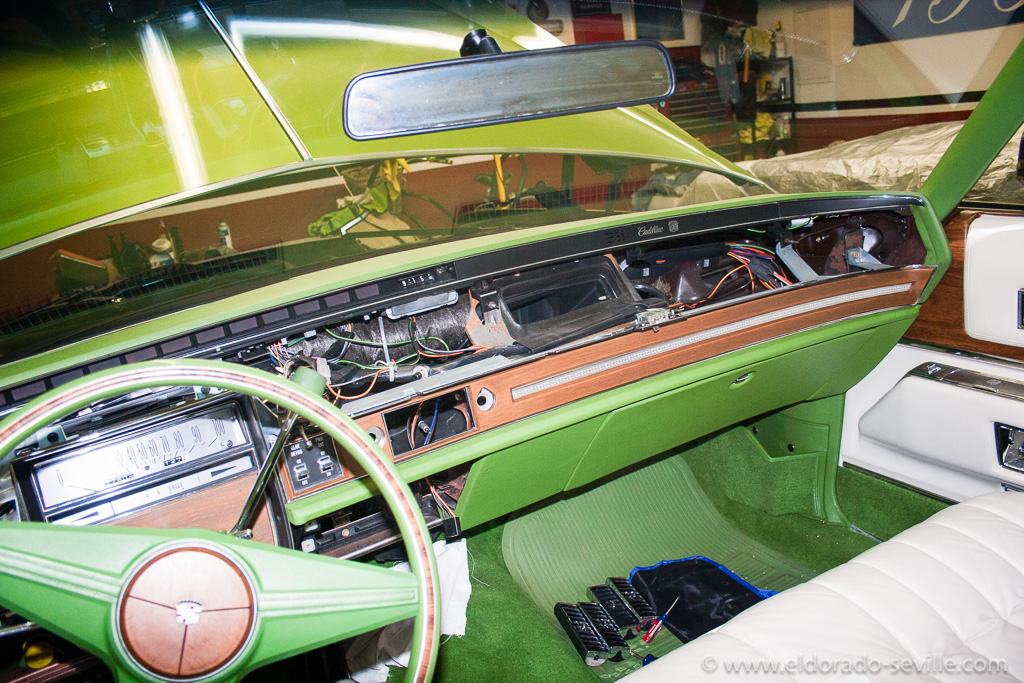
The dash removed. The radio is also out for repair.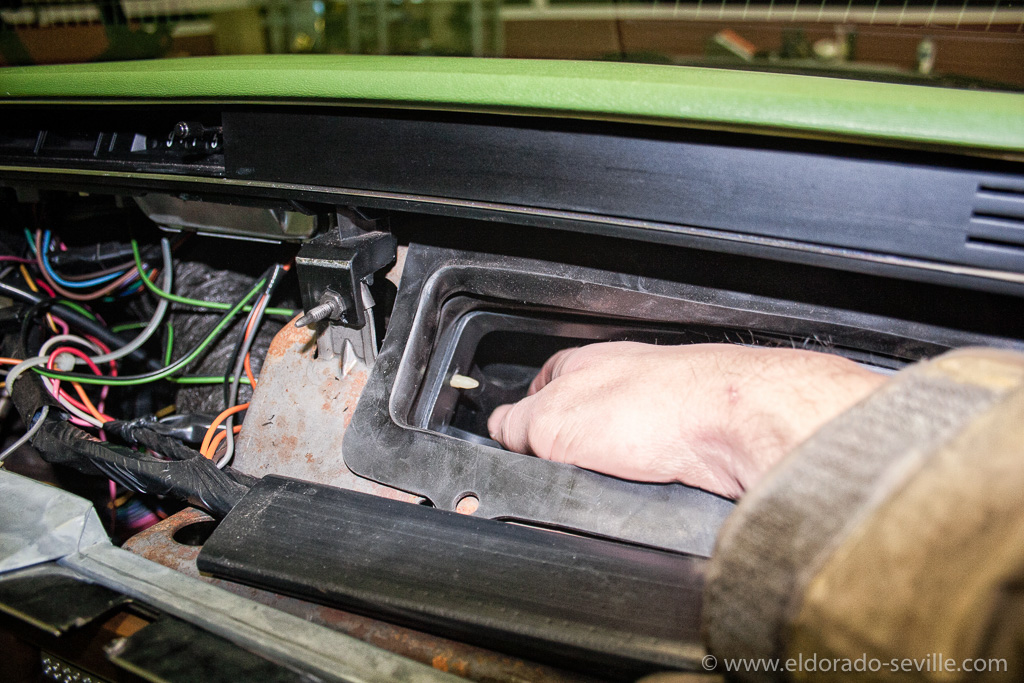
There are metal clips inside holding the left A/C hose in place. You have to reach in and unclip them.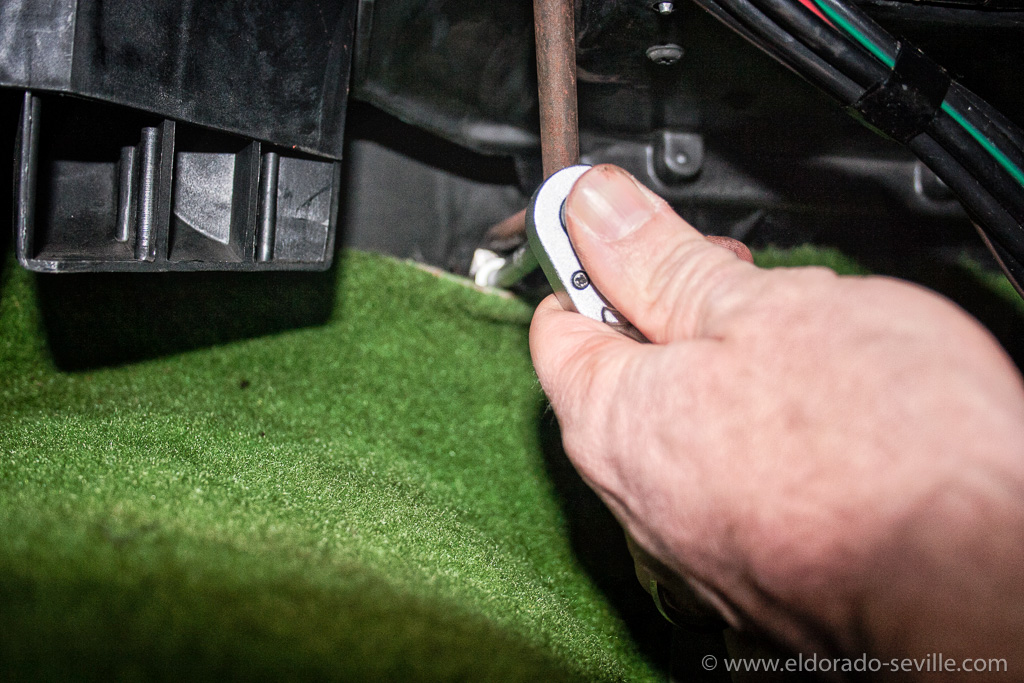
You will have to remove this support bracket.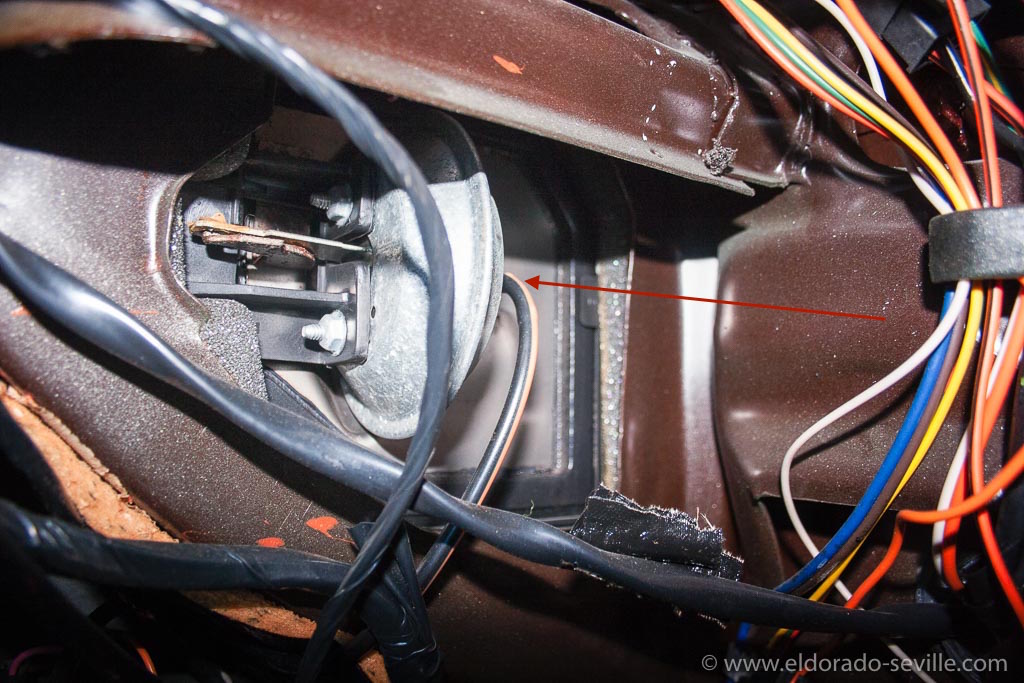
Recirculation door - un-plug the orange vacuum hose.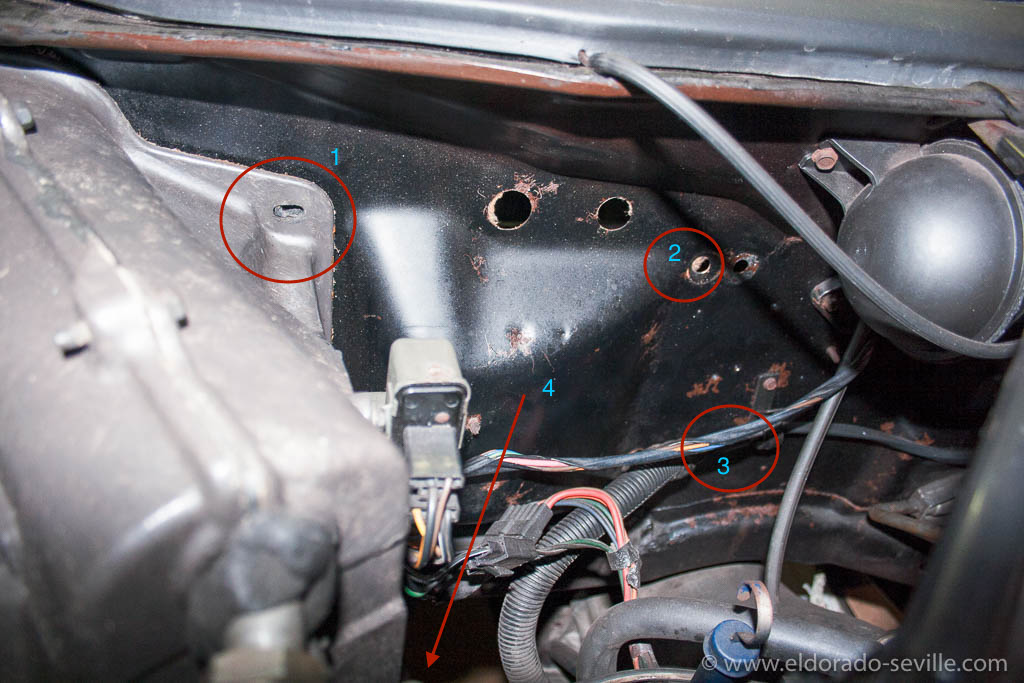
You have to remove these 4 screws/nuts on the firewall. You can access number 4 from underneath the car only. Number 3 is hidden underneath the cables.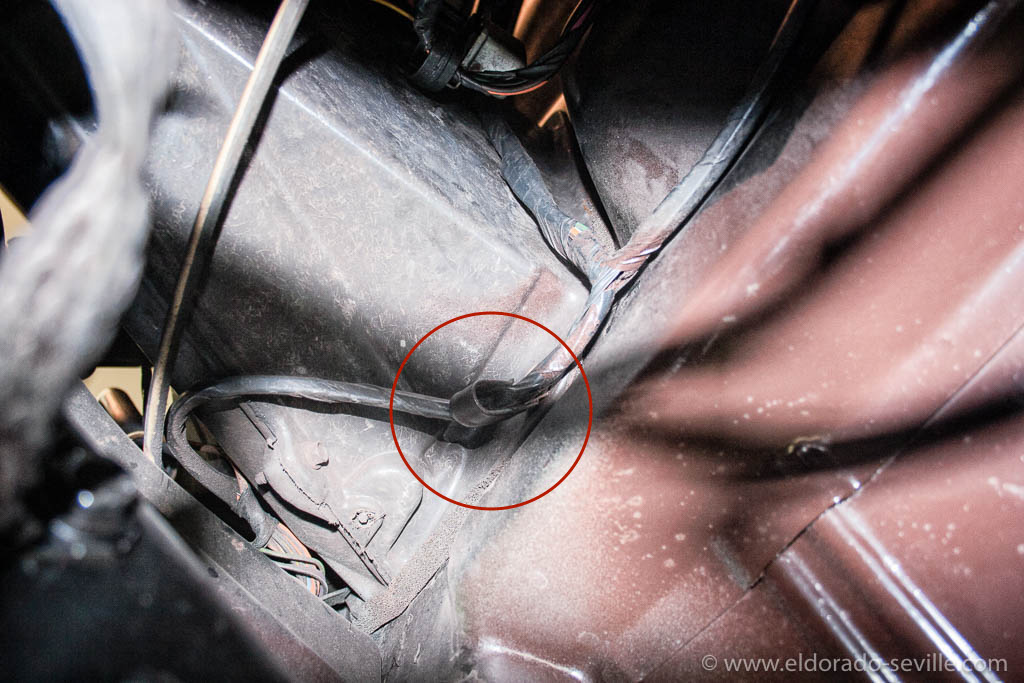
The number 4 screw on the cowl is holding a cable clip in place and the other end is the right bottom screw of the heater box - you need a second person with a 7/8 wrench to release it from the side under the car while you unscrew it from inside the car with a 3/8.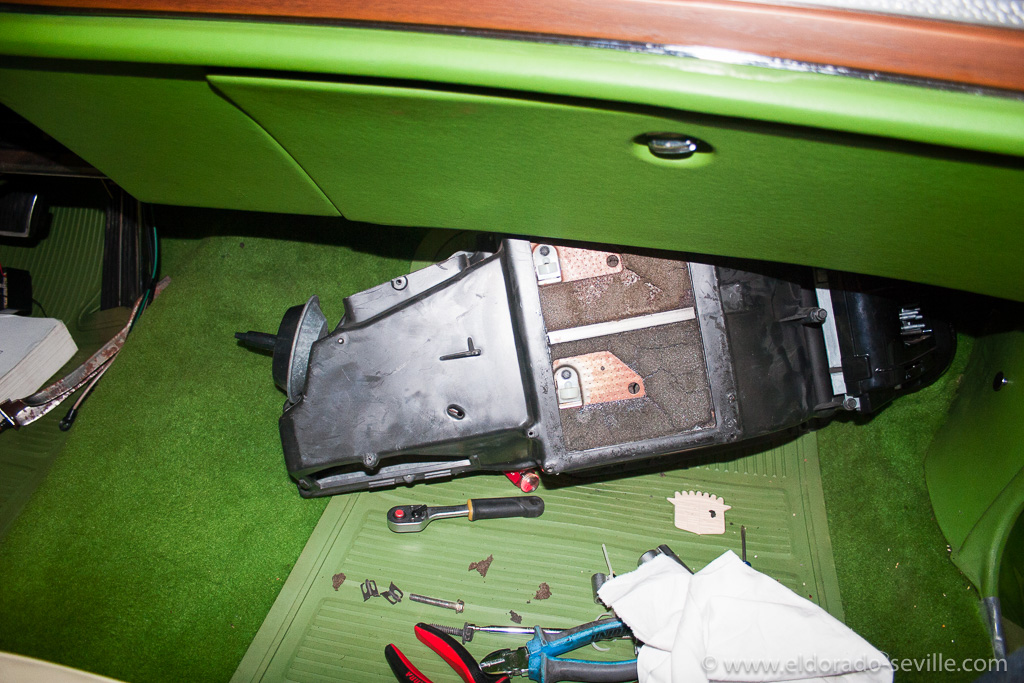
Once all the screws are off you can carefully remove the box. You have to slip it to the passenger side to get it out.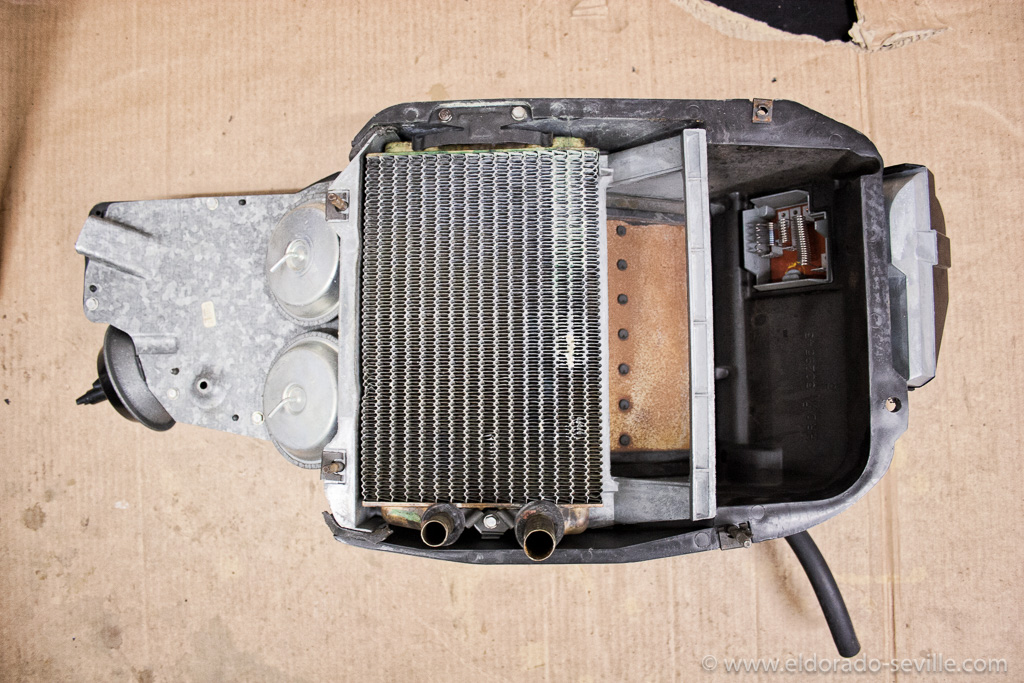
The old core in the heater case.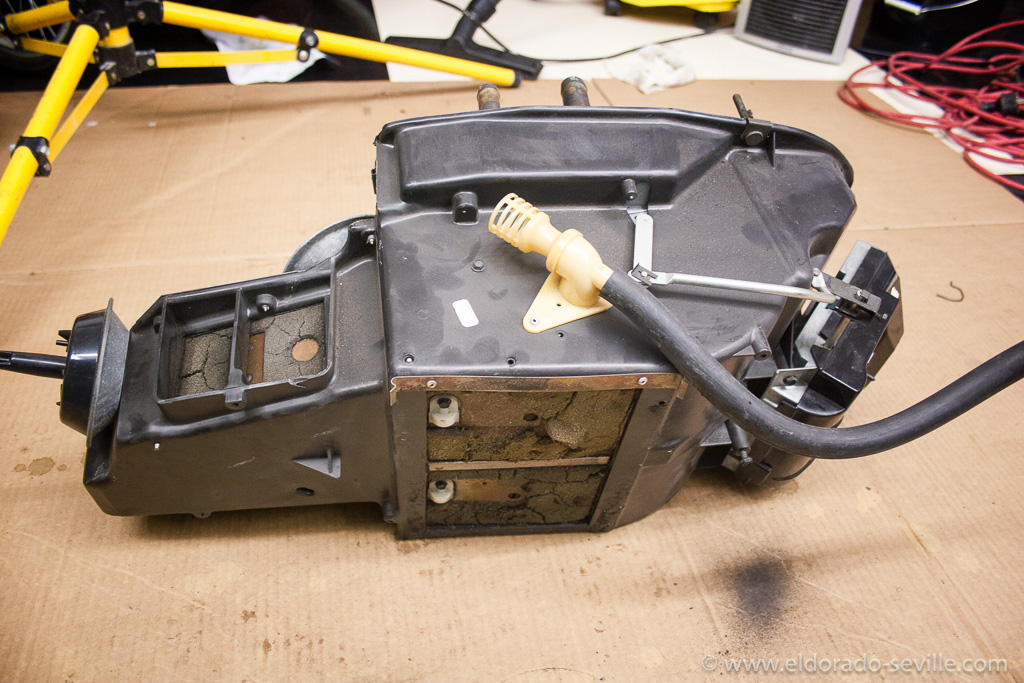
The 1974 Cadillac heater case and heater core. You can see the two mode doors here and on the right is the recirculation door. The thick hose on top is the aspirator hose going to the temperature sensor in the dash.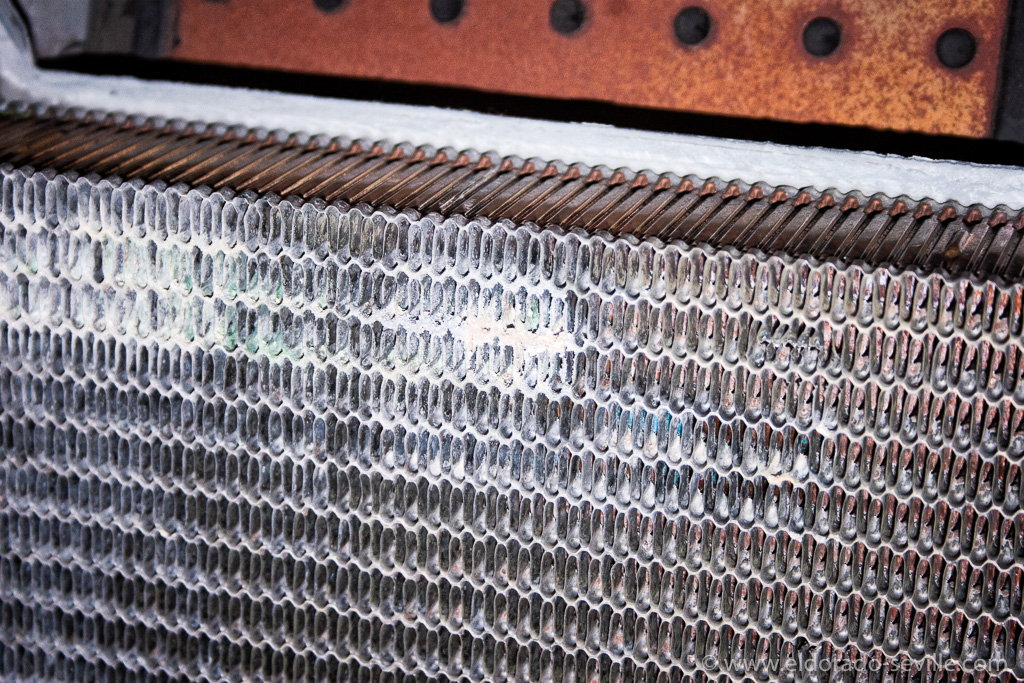
This is where the old core had developed a leak.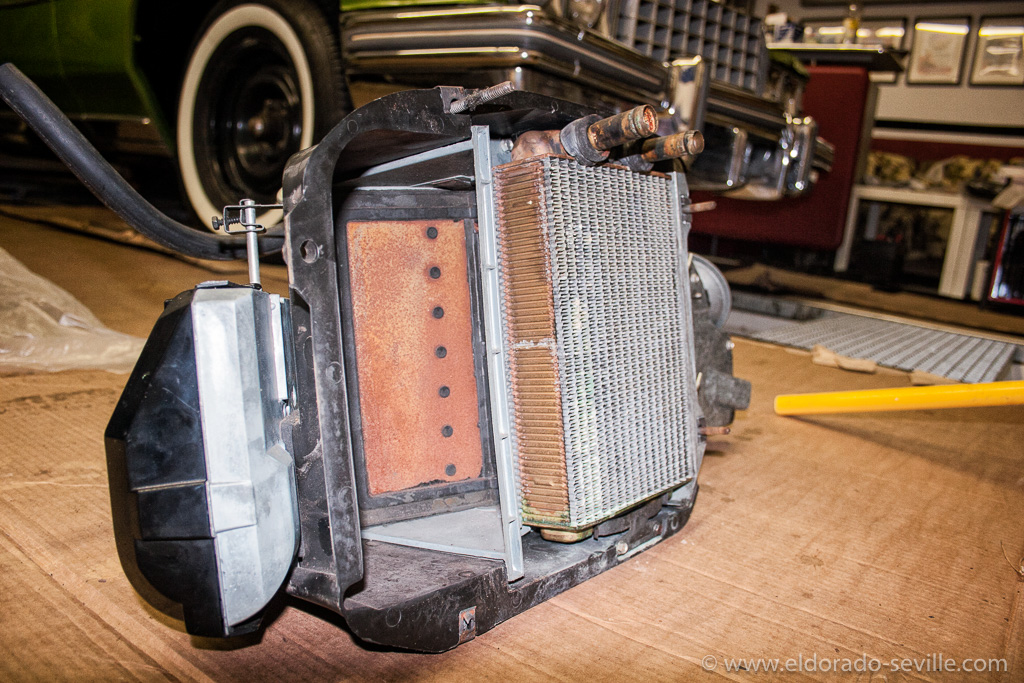
The old core still in place. Note the rubber seals on the tubes of the heater core. You have to move them over to the new core.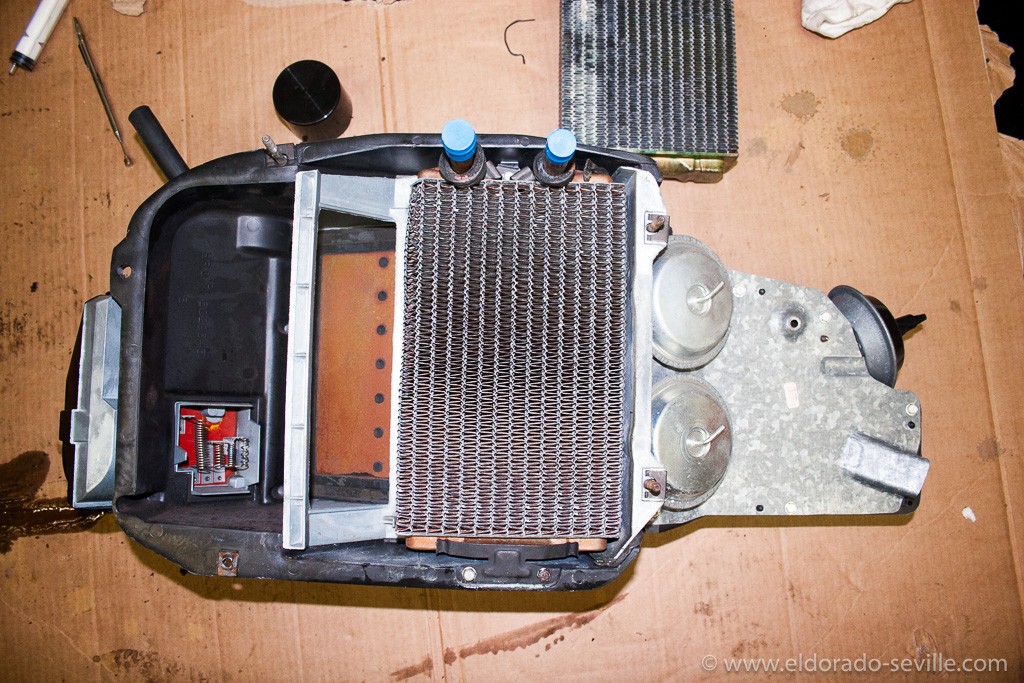
The new heater core in place. I got mine from rockauto.com. Its very similar - the only difference is how the two tubes are braced to the core, but that is no problem at all.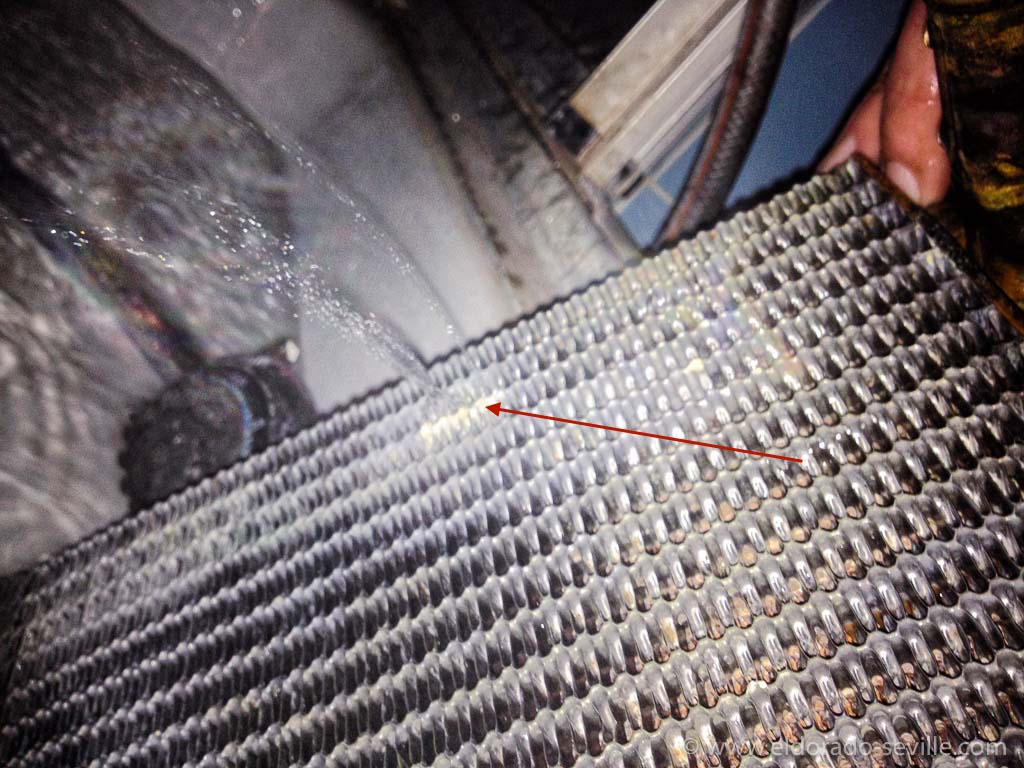
Out of curiosity I checked where the old core was leaking, and the leak was pretty obvious as you can see.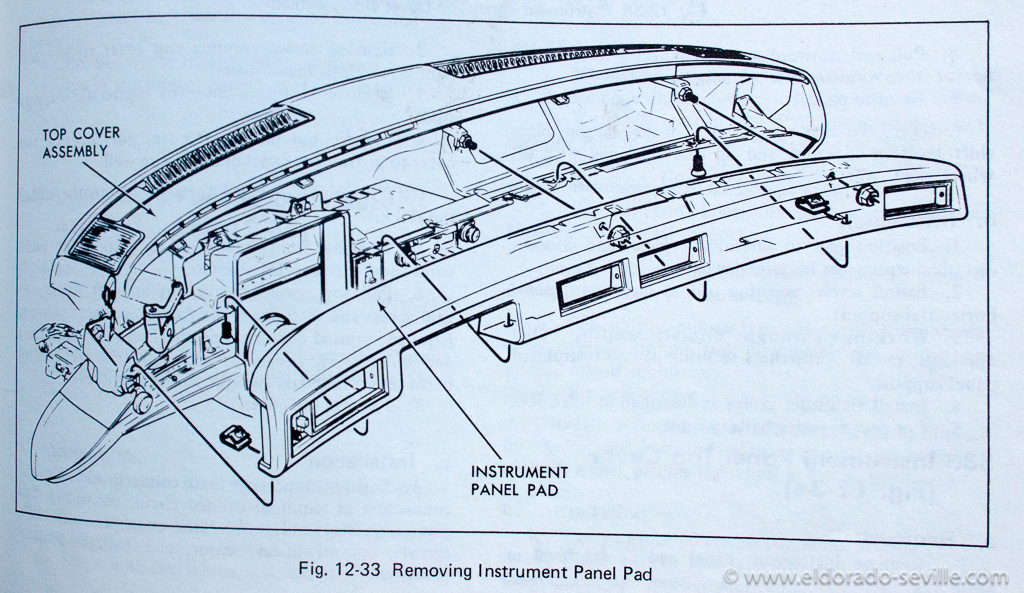
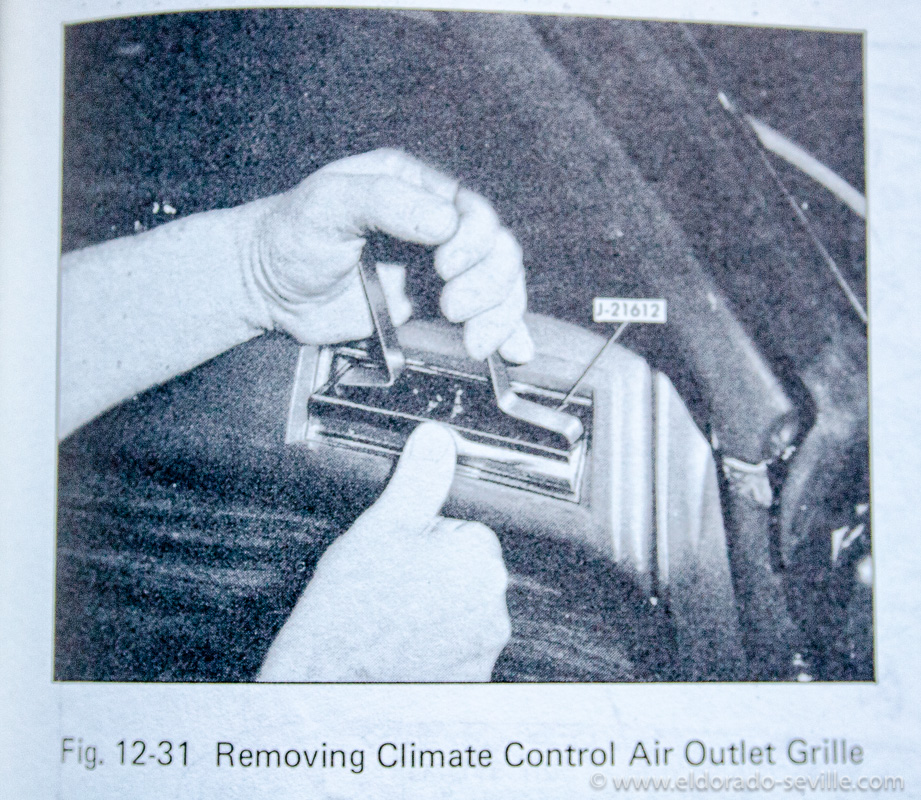
I just used two flat screwdrivers instead of this special tool.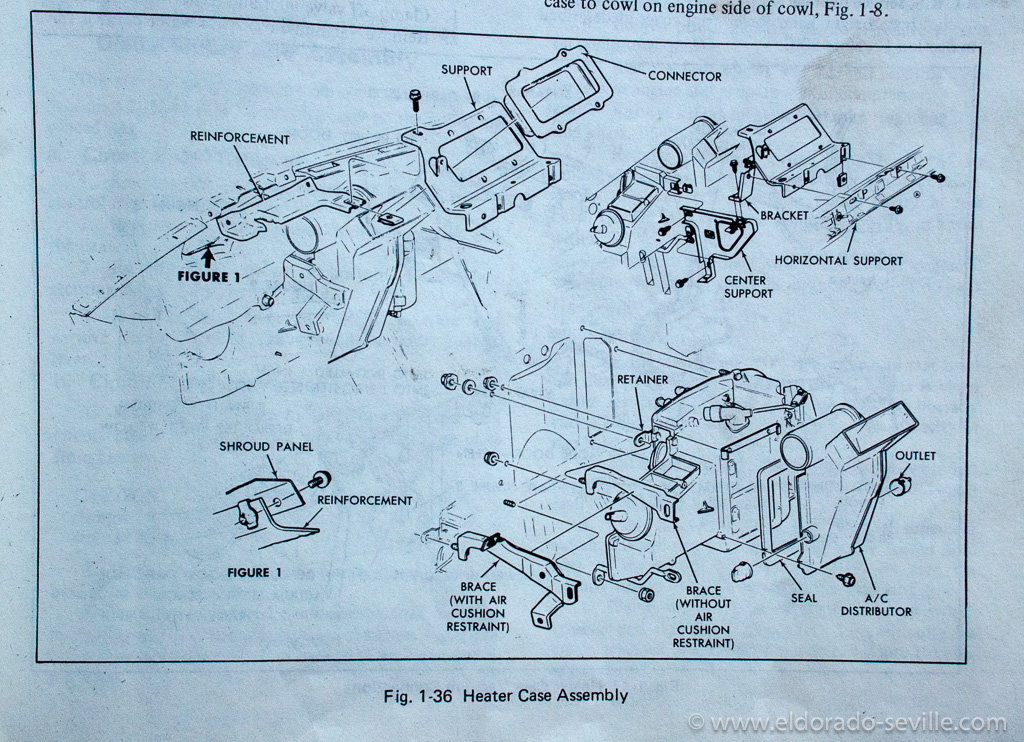
Additional information for Eldorado owners regarding the heater core:
Dan Mercer reached out to me and wrote the following: (Thanks Dan for letting us know!)
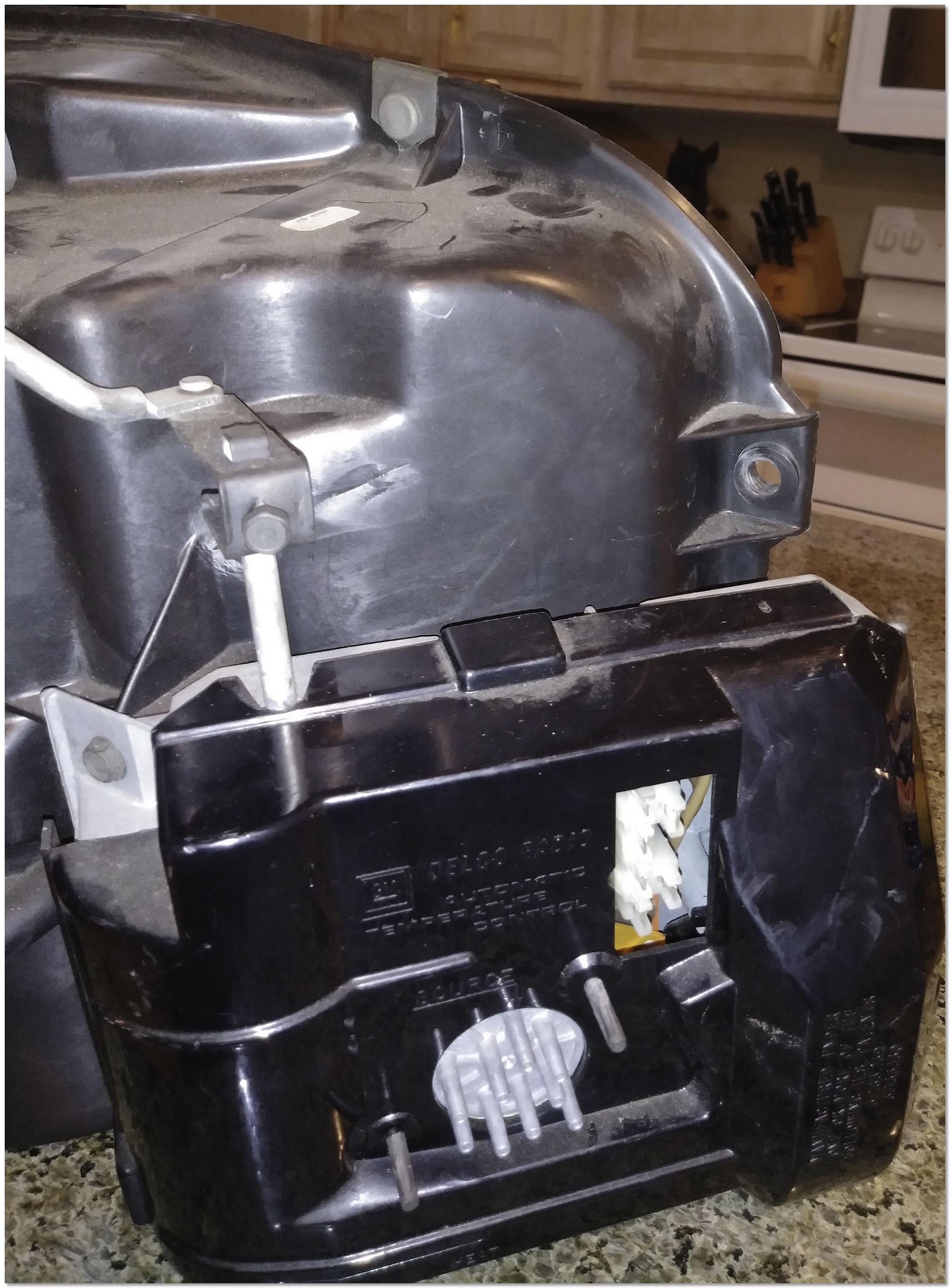
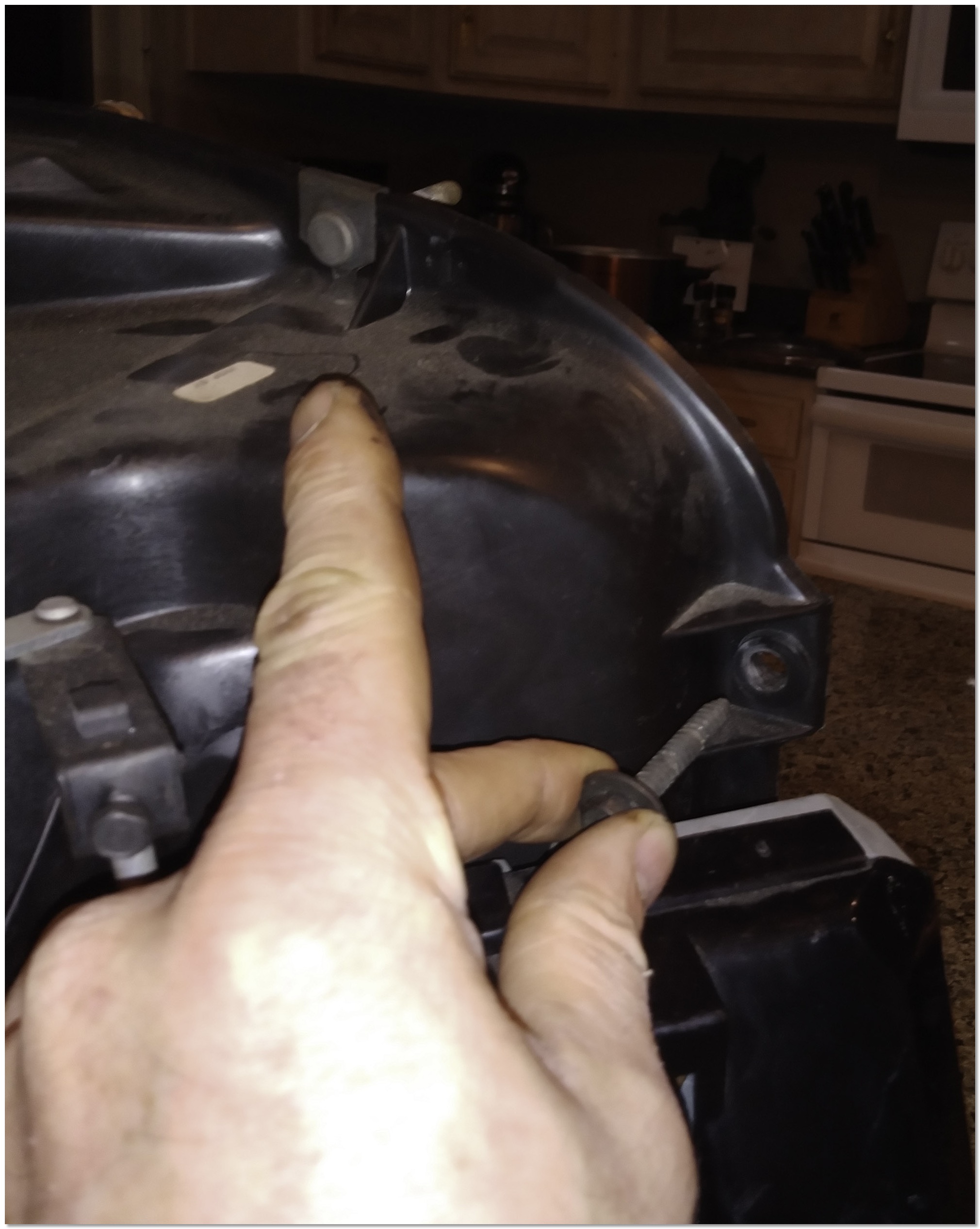
As a favor to Eldorado owners who will undoubtedly come across your repair process and use it in the future, would you be so kind as to add one addendum to it?1976 Eldorados have a FIFTH fastener attaching the heater box to the firewall! For the life of me I can't really figure out how this would have been necessary on an Eldorado but not a DeVille, but it's true. The 7/16's screw that needs to be removed is just above the right side of the ATC, in between the upper attachment and the lower one you have to get at underneath the car. Due to where it sits somewhat behind the ATC, it's impossible to see from any angle in the car.
I've attached pictures below.
REPAIRING THE 1967 CADILLAC AC CONTROL HEAD
This time the 67 Eldorado had a new problem which I had to fix.
It suddenly only blew hot air out of the AC outlets. It did not change modes at all. That was a sign of a weak vacuum signal…
I started to inspect all the AC related vacuum lines of the car which checked out fine. Next I did the test I´m describing here in an older posting, as I suspected that the power servo had a problem.
I soon found out that still not enough vacuum was supplied through the transducer.
That meant that either the transducer could be faulty, the temperature sensor could be defective, or the dash control head would not work properly. I took out the temperature sensor of my 67 Deville to test it in the Eldorado but it did not change anything.
I then removed the control head and tested it with a spare one I once bought cheaply on ebay. It did miss some connectors and switches, it had some blemishes on the chrome and did not look good enough to install it into any of my cars. When I put it into the Eldorado anyway the AC suddenly worked perfectly again.
So I removed all the electrical parts from this working unit and transferred it to the perfectly looking but defective control head. After I had swapped all the usable parts I put the unit back into the car and I now have a perfectly working unit once again.
It looks like that there was a problem in the amplifier part which translates the signal coming from the rheostat into a current going to the transducer which regulates the vacuum going to the control head and the power servo.
Lets see what issue comes up next spring…
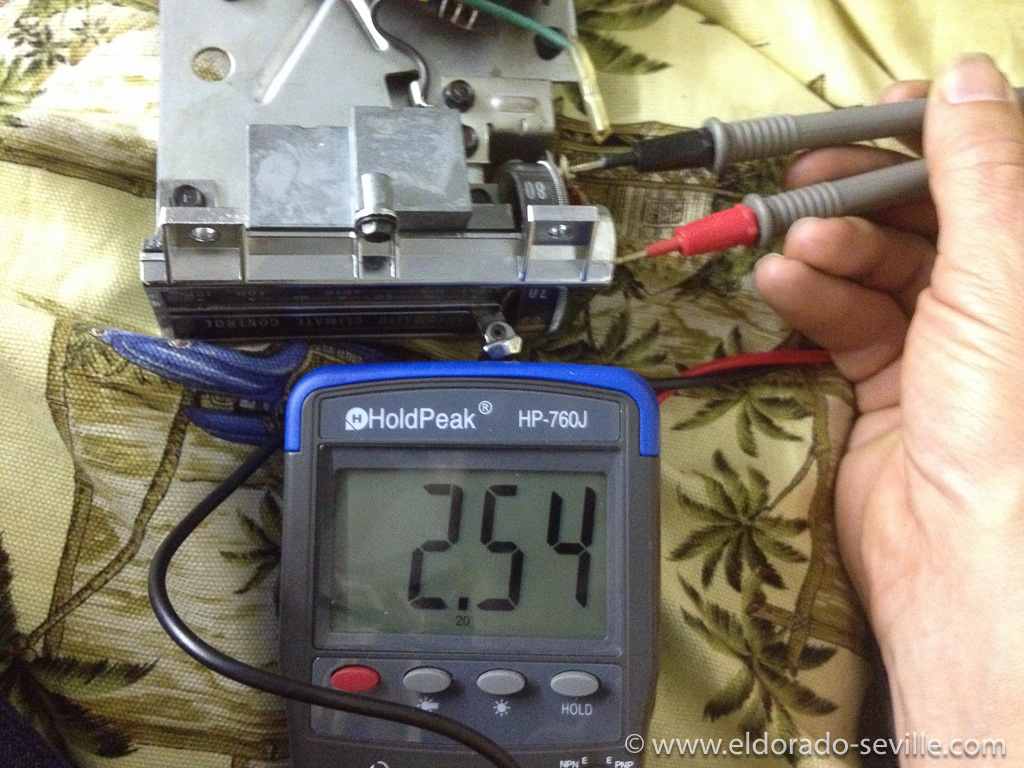
The Rheostat when set to the lowest temperature setting shows around 2,5 Ω You can check if it is working with an Ohmmeter.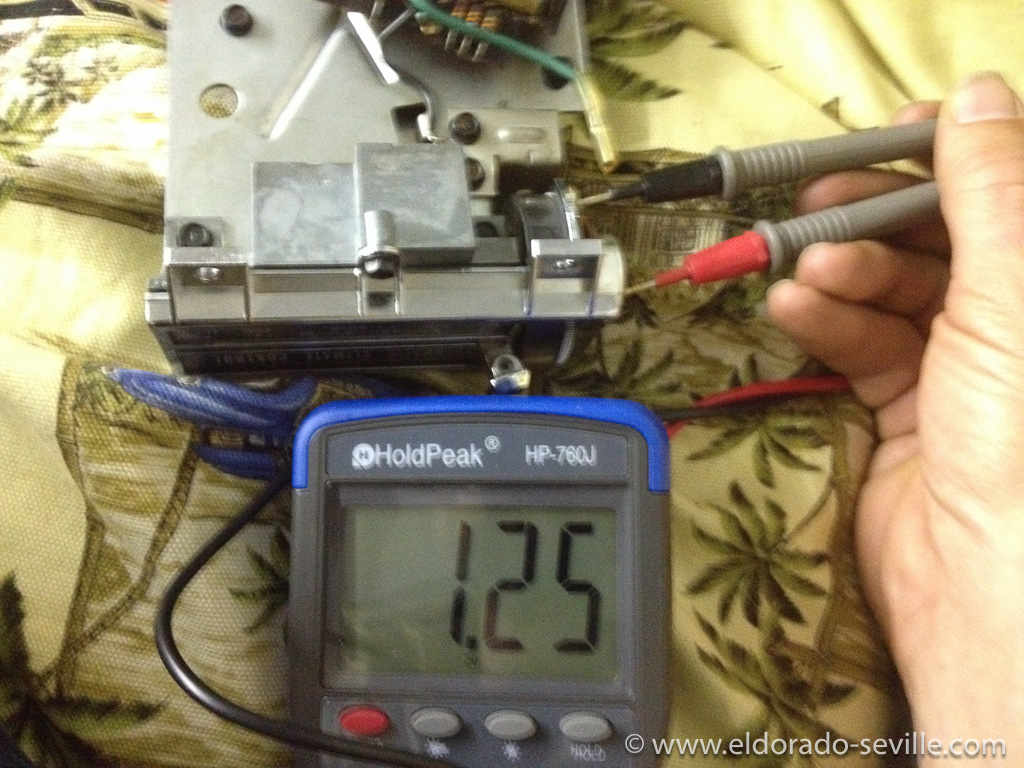
At the highest temperature setting the resistance is getting lower.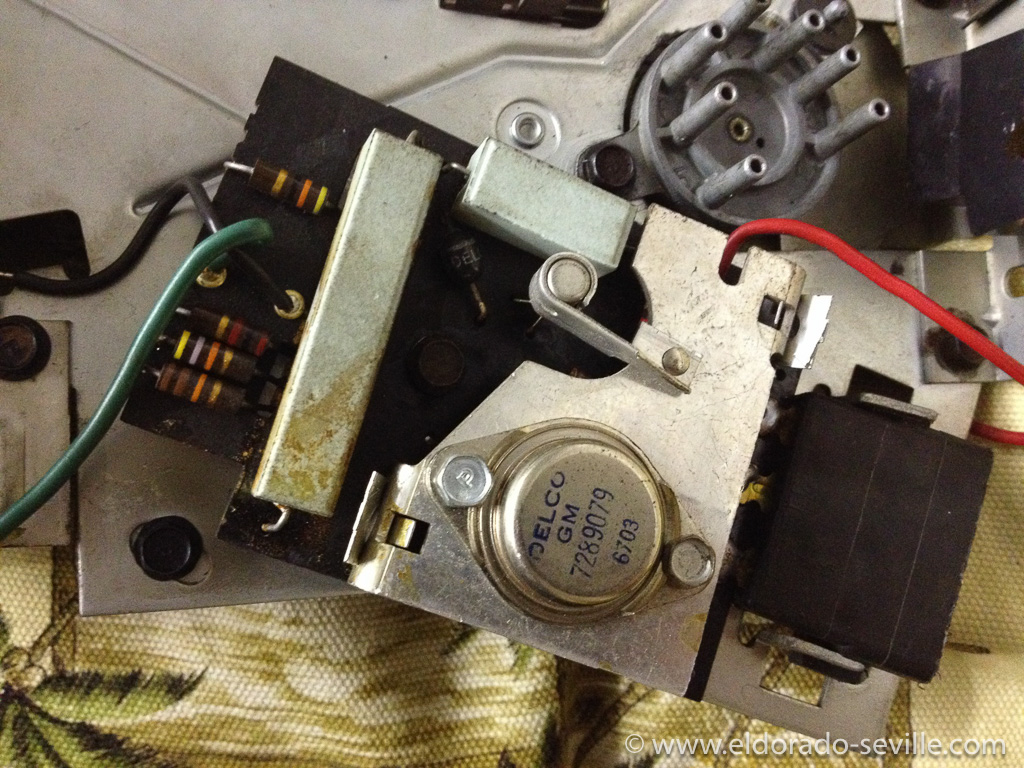
The Amplifier part of the control head is on the underside. Something in here must have gone bad on my control head. I will try to find out what went bad and repair it to have a spare part.
The 67 Eldorado is back on the road for the 2015 season.
REPAIRING THE 1978 ATC PROGRAMMER (AGAIN)
***This is an update to an older article as I had a very similar problem in the past already.***
I finally found the time to take the 1978 Eldorado out of winter storage. It started right up after many months of inactivity and I checked all accessories and options for operability.
Everything checked out fine but the air-condition… It only blew warm air out of the heater outlets and would not change modes, blower speed or temperature.
I immediately suspected a problem in the ATC programmer again. I already fixed it last year when the system would only work in full AC mode.
Last time I had a bad contact at the transducer which is the most important part in the programmer as it regulates the vacuum supply to the system.
The shop manual mentions that when the system is stuck in full heater mode, most probably an electrical problem is the main cause.
So I tried to push the transducer in again but the system did not come back to life like it did last time when I did this.
The MKII programmer which you can access through the glove box had to come out again for inspection.
This is how it looks with the cover removed:
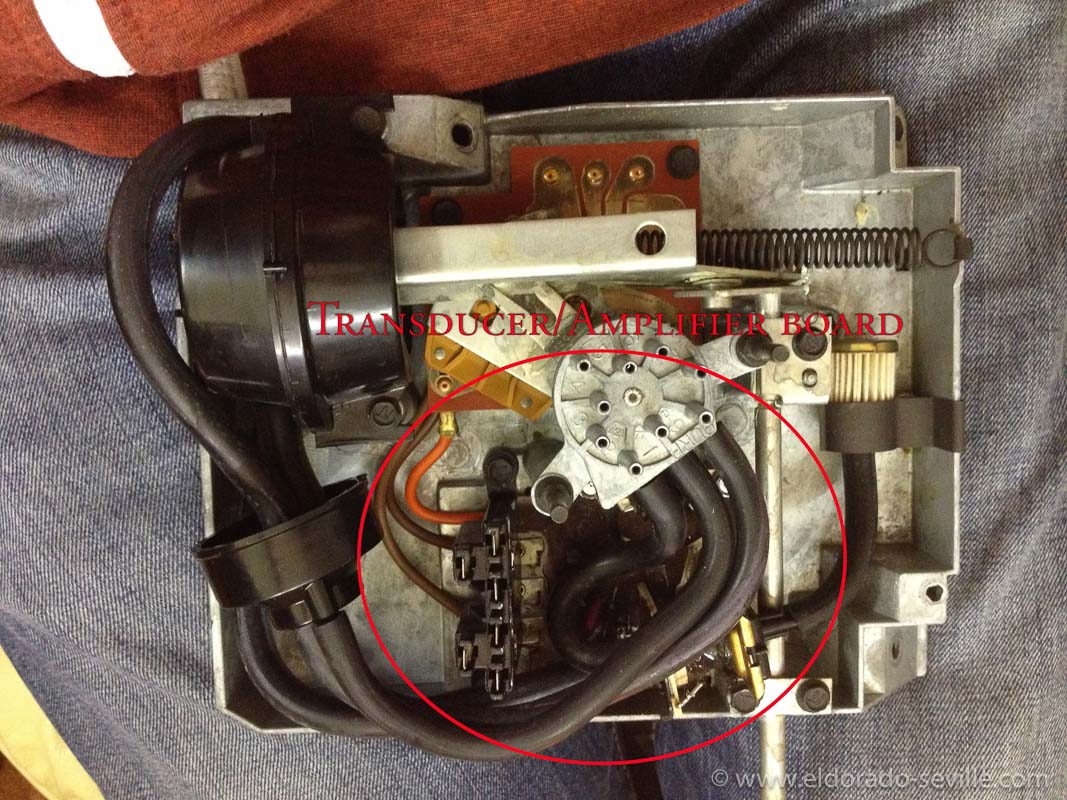
The 1978 MKII programmer with the cover removed.
I decided to take the transducer/amplifier board out of the programmer this time to see where the problem could be. It can be removed very easily - it's only held in place by 4 screws. Be careful not to turn the gear wheel with the potentiometer though as you would have to recalibrate it again afterwards.
After the board came out, I quickly found out where the problem was. Below is a picture of the removed board:
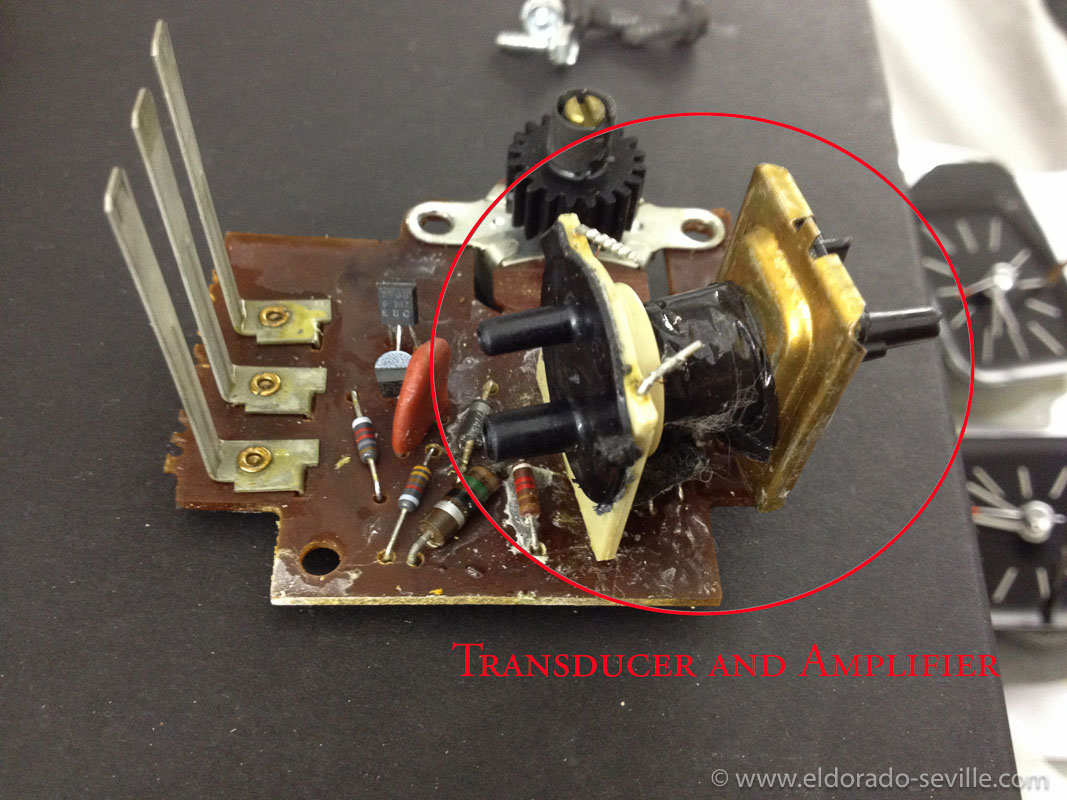
The transducer/amplifier board.
The transducer/amplifier unit was sitting pretty loosely on the circuit board, and one of the very thin and fragile wires going to the coil was broken, as you can see on the picture below:
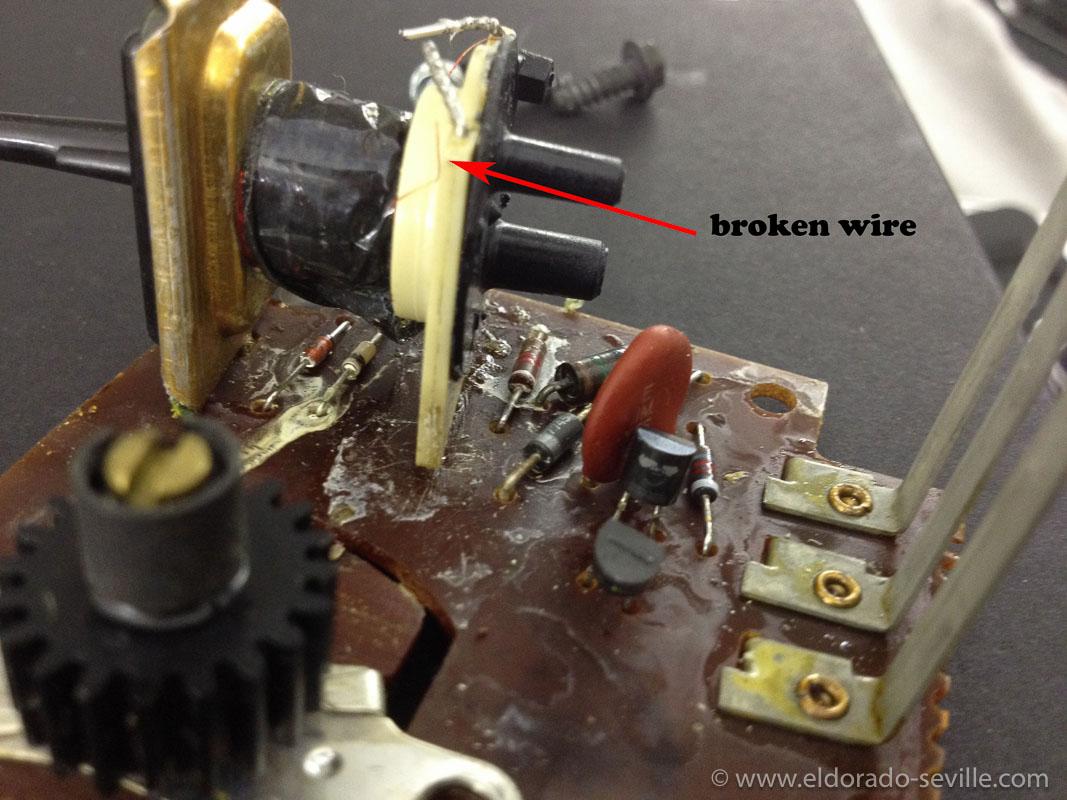
A broken wire at the coil of the transducer.
When I turned the circuit board around I could see that the soldering points on the circuit going to the transducer and the amplifier were broken and that they no longer were making good contact. That was the reason why the system did no longer work.
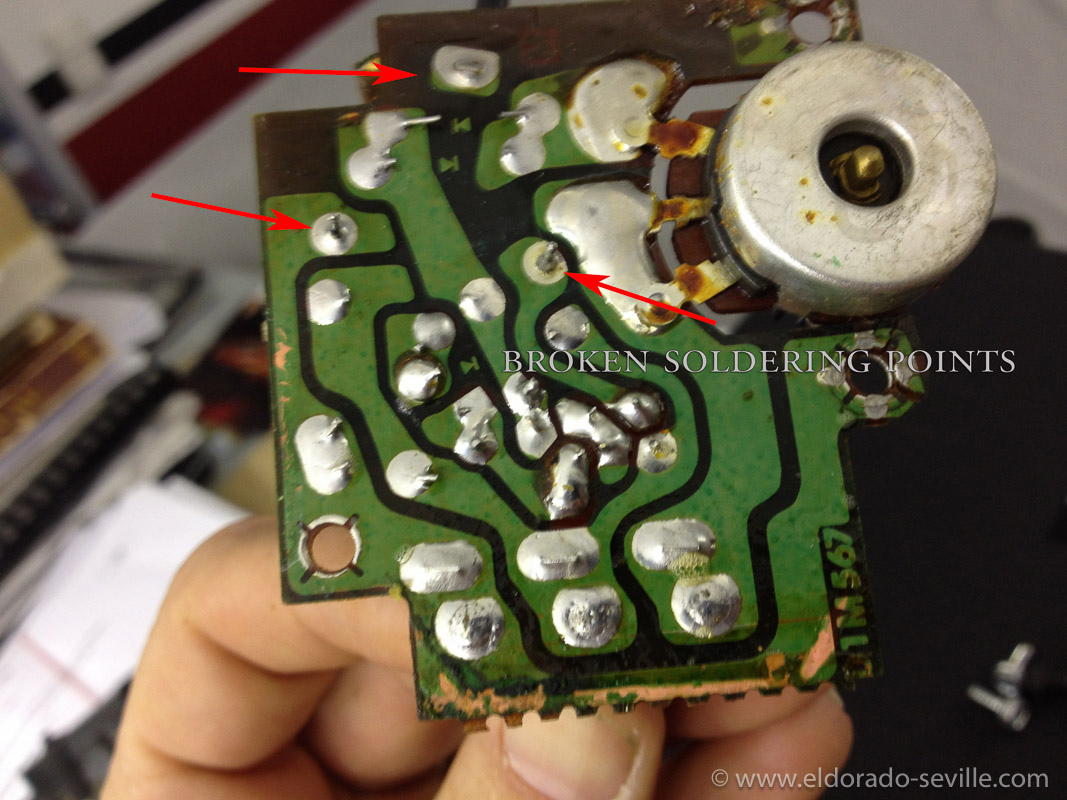
Broken soldering points at the rear of the circuit board.
The pretty simple solution was to re-solder the 3 soldering points and fix the broken wire going to the coil. I then put everything back together and now have a perfectly working ATC again. These old circuit boards can be very troublesome and I think that most of the time when a programmer goes bad on these 70s cars its probably a fixable problem like this. I was very worried that I would need an expensive rebuilt programmer and I am very glad that I could fix it by myself.
I have no idea though why everything worked when I put the car into storage last fall and how it broke while the car was inoperative…
Check my older post of the MKII programmer to also see the electrical diagram for the ATC system.
REPAIRING THE AIRCONDITION OF THE 1966 COUPE DEVILLE
So I started to search for the cause of the problem.
Everything seemed to be fine on the vacuum side. When the lever on the control panel was moved all the vacuum actuated doors operated and the master vacuum switch also seemed to work.
After some searching I found out that no current was flowing through the master vacuum switch on the firewall.
So the switch was taken apart.
If you do this you have to be very careful not to damage the membrane.
The contacts inside the switch were oxidized and so no more current could flow through.
The contacts were also adjusted so that the switch could engage properly when vacuum was applied.
When everything was put back together the whole system once again worked as it should.
It works absolutely perfect now.
*UPDATE 2022* - Check out this article and video as well!
Unfortunately I forgot to take pictures of the switch rebuild but here is a video on youtube where a gentleman explains how this switch works…
A video that explains how this switch works
The original AC system of the 1966 Coupe deVille is now working perfectly again.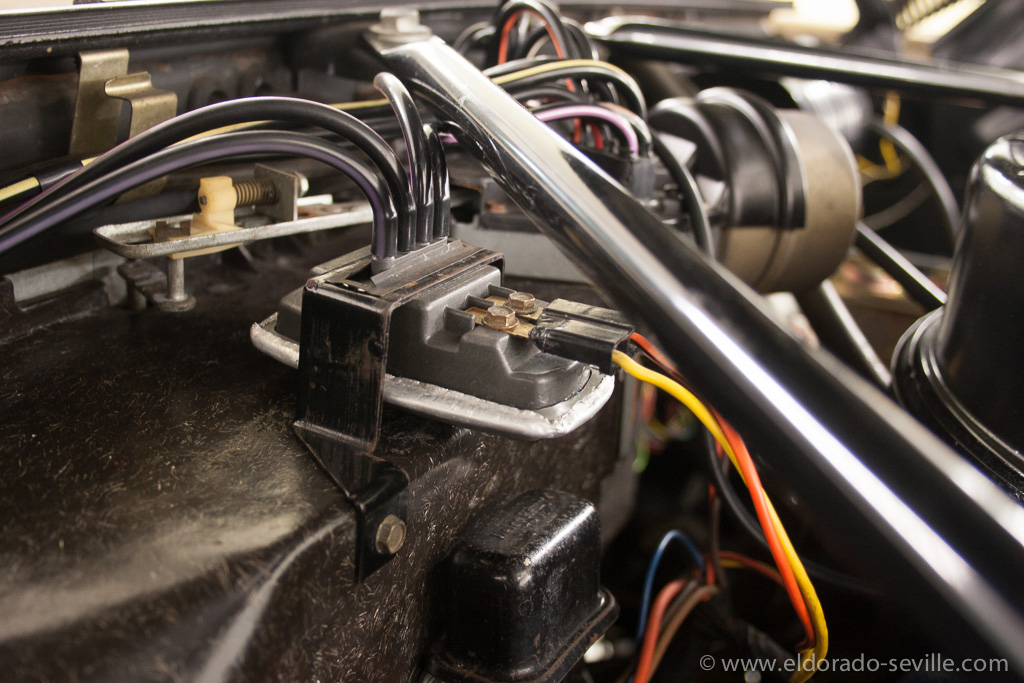
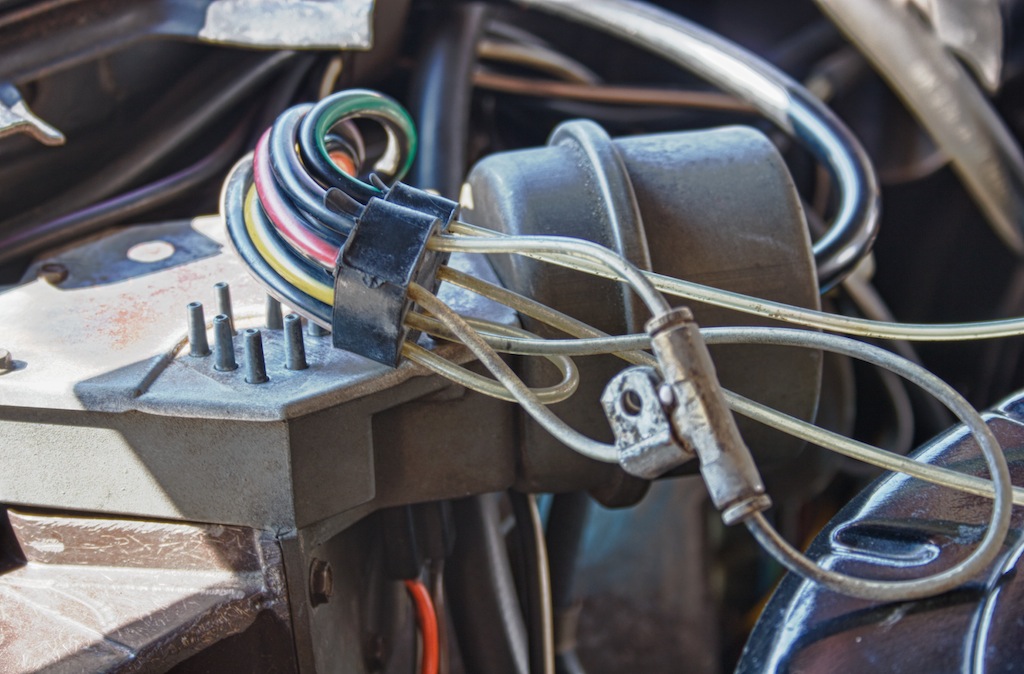
Thats the master vacuum switch which was defective.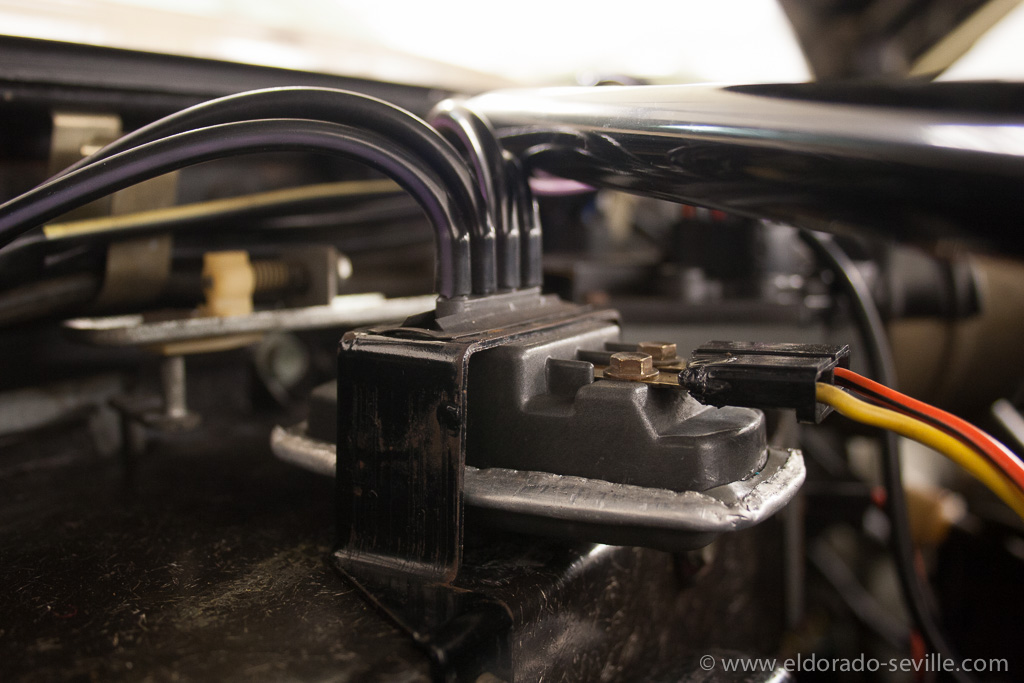
The rebuilt master vacuum switch.
Fixing the 1978 Cadillac Eldorado´s ATC programmer. The AC works again.
****UPDATE****
An update to the article below can be found here as I had to repair the programmer again in May 2015:
The air-condition in my 1978 Biarritz did not work correctly. For some reason the system always stayed in full AC mode and no matter to where I put the temperature dial on the control head I could not get the heat on, no matter what I tried.
The shop manual is very helpful in trouble shooting the system. Its covered in the 1977 factory shop manual (FSM) as there were no changes made to the system in 1978.
It took me a while to fully understand how the system works - so I had to read the FSM multiple times to get the grip what is going on in the system.
First I inspected all the vacuum lines in the car to make sure that there was no leak anywhere, as the heating mode requires a very high vacuum at the vacuum motor in the controller.
All lines were in very good condition. I also checked the control head connections in the dash which were good as well.
I then suspected the vacuum motor in the programmer as it did not move. I removed the programmer from the car. You can access it from underneath the dash on the passenger side or even better if you remove the glove box lining through the glove box.
From there you only have to unscrew 5 screws, unplug the wires and the vacuum lines to get it out.
When I had it out of the car I checked the vacuum motor. I just sucked air through the hose and it moved and held vacuum perfectly.
The transducer or the amplifier in the programmer were most likely the problem.
When I checked the transducer which regulates the vacuum supply to the vacuum motor, I noticed that it seemed to not be connected to the electrical board as it should. I pressed it in, so that it made good contact with the board again and put the programmer back into the car and connected everything again.
***UPDATE 2015 - its not connected with pins but soldered to the circuit board - 3 of this soldering points were broken - the “repair“ I made here only temporarily worked. You have to check the soldering points for a permanent fix***
I started the car and the AC came back to life again immediately. I could see how the vacuum motor went through all the modes as it should according to the position of the temperature dial on the control head.
The build quality of the programmer obviously is not very good and the transducer somehow came loose causing the ATC to not work as it should. ***Update 2015 - it did no come loose but the soldering points broke***
After I tested everything I put the parts back together and can now enjoy a full working ATC in my 78 Biarritz again ;-)
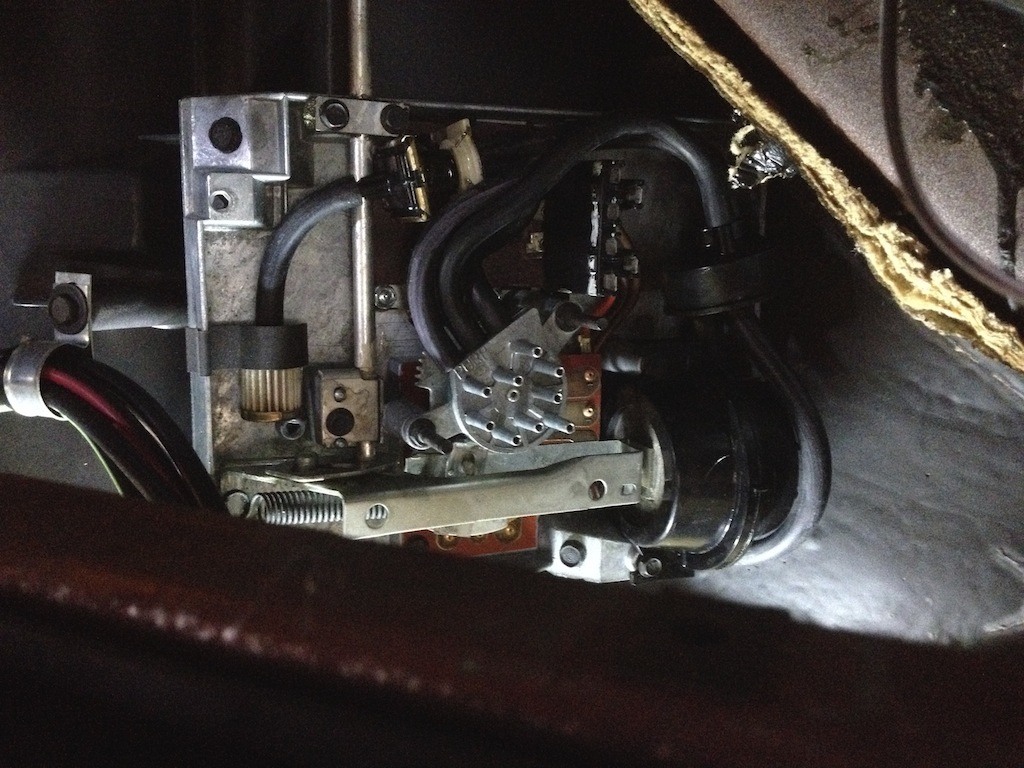
The programmer as seen through the glove box with the connectors and the plastic case removed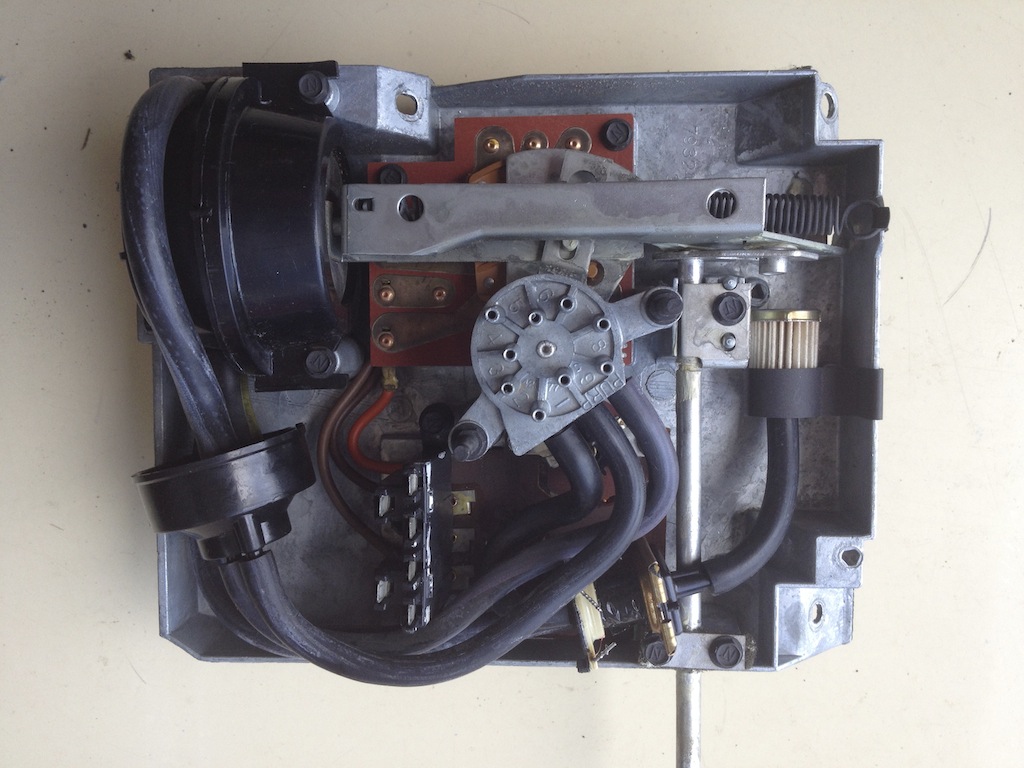
The 1977 / 1978 Eldorado MK II Automatic Temperature Control Programmer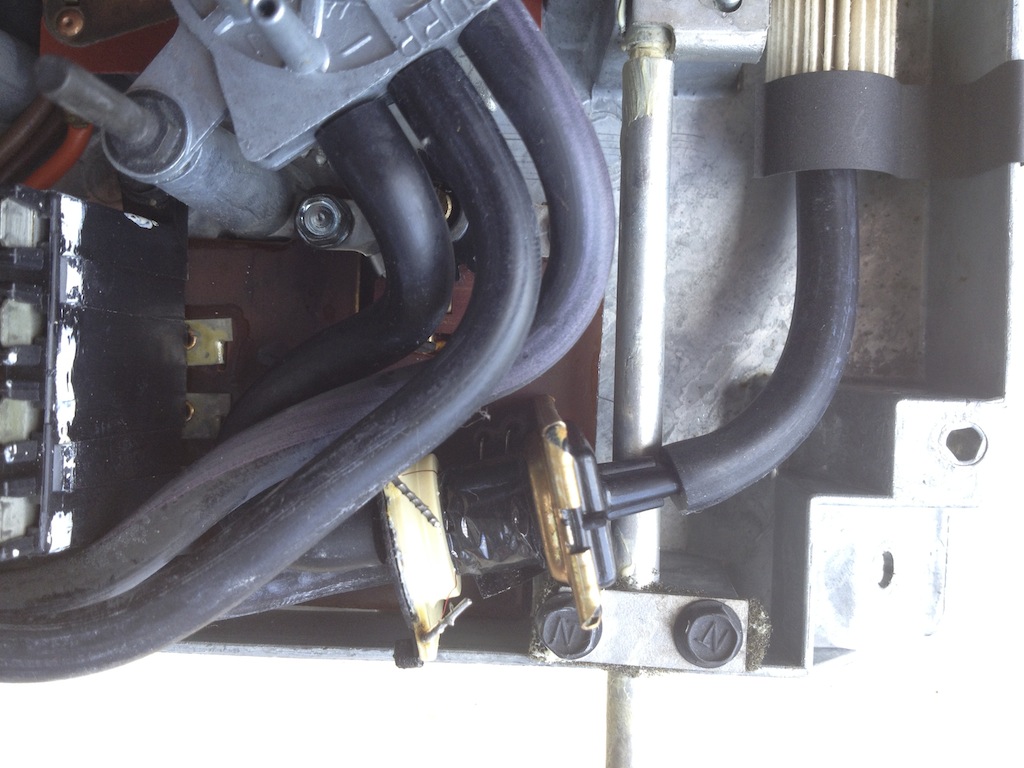
The transducer which caused the problem (the golden part with the single vacuum line going into it)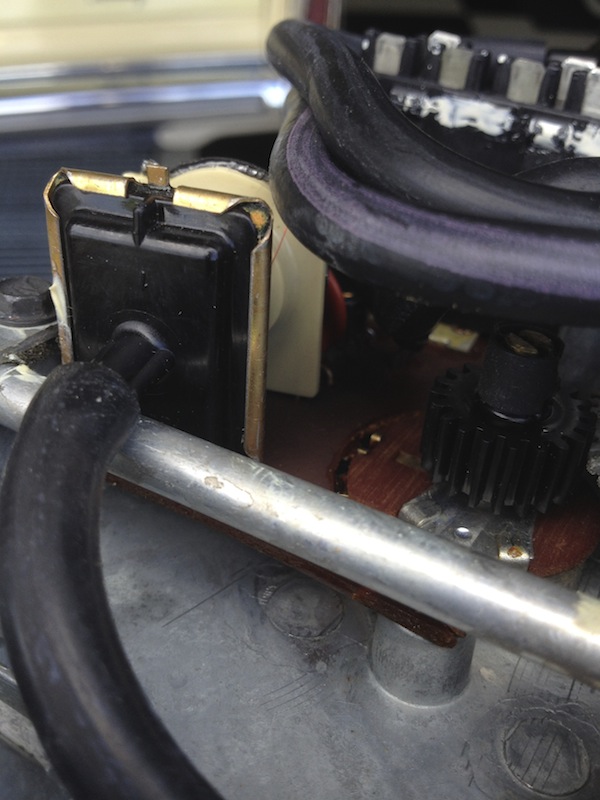
The transducer is connected to the electrical board through a couple of pins - it was not connected properly and somehow became loose over the years - that was why the system did not work.
***UPDATE 2015 - its not connected with pins but soldered to the circuit board - 3 of this soldering points were broken***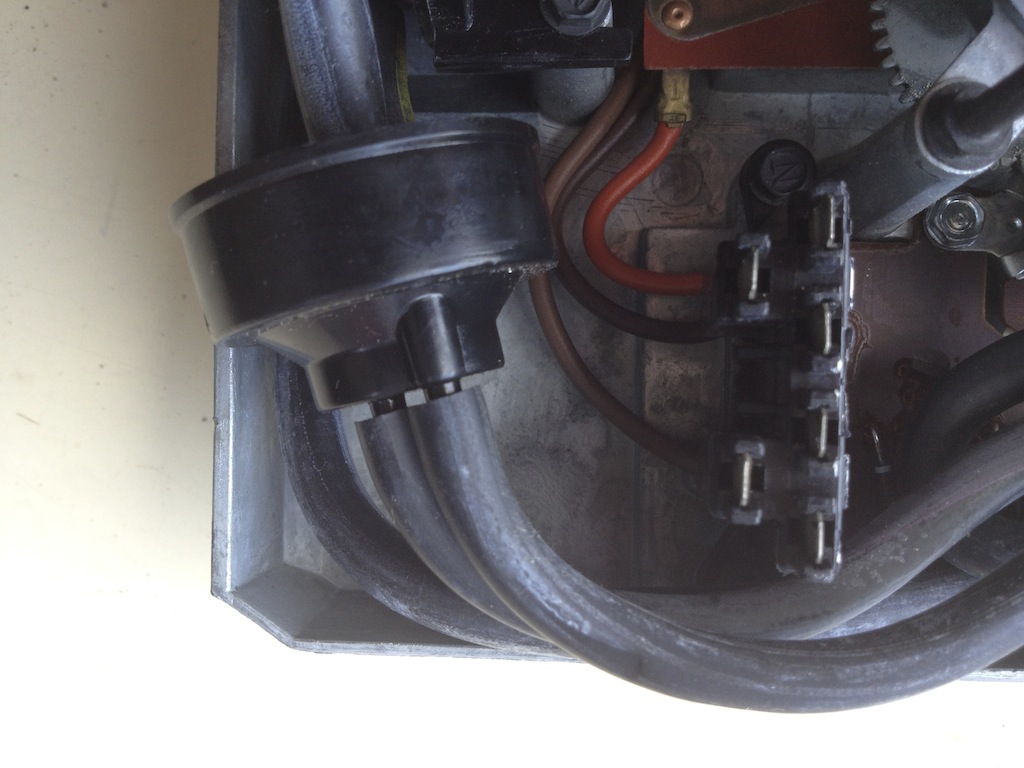
The vacuum checking relay and the electric connectors.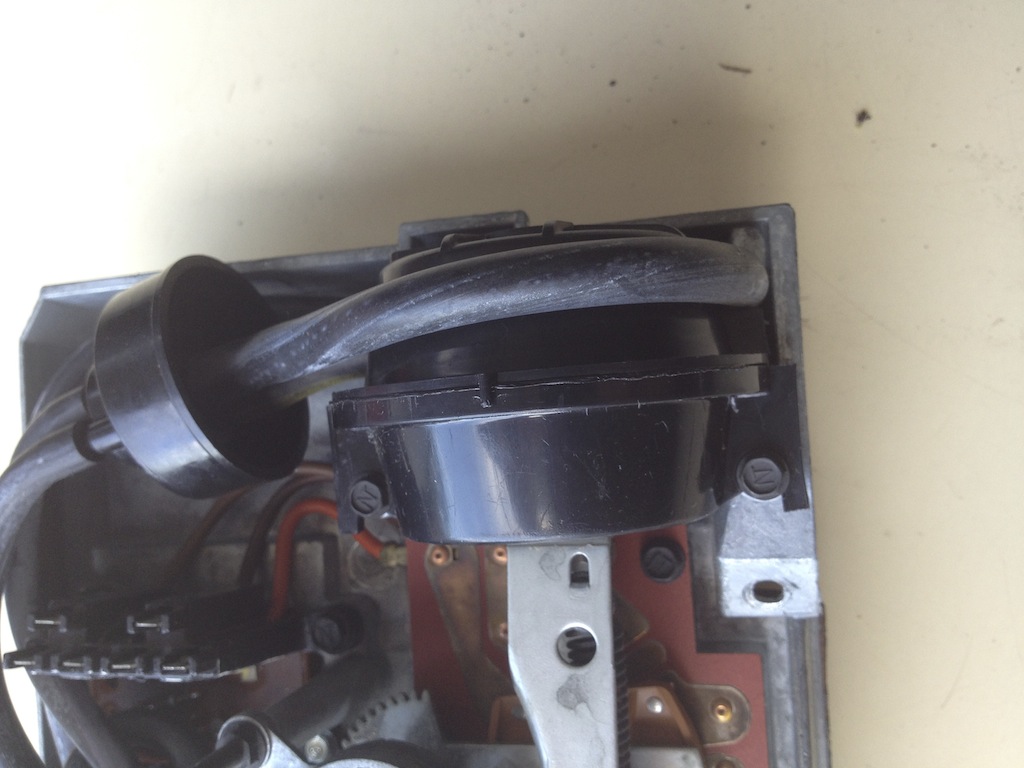
The vacuum power motor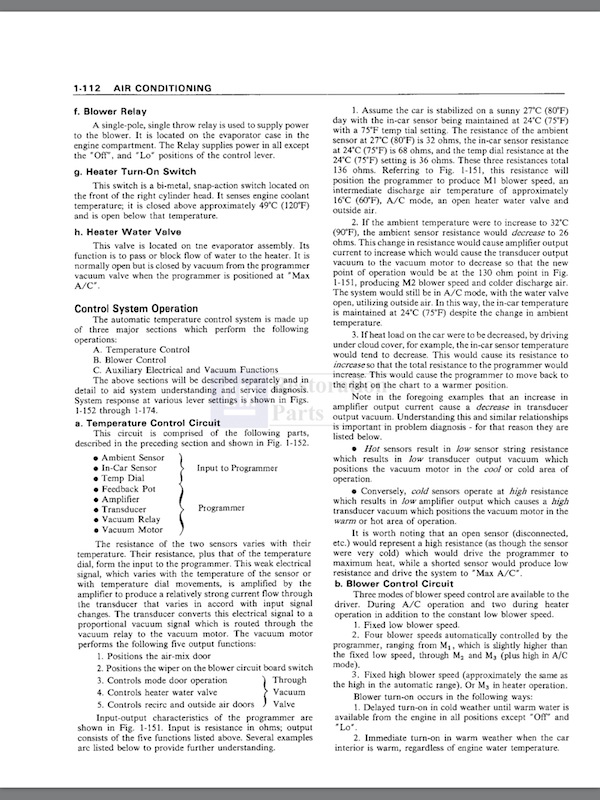
from the 1977 FSM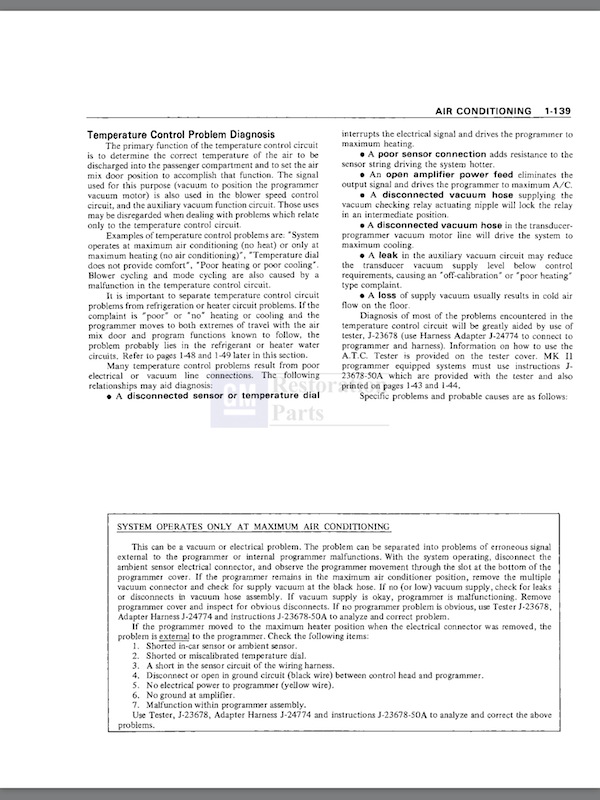
Trouble shooting guide for when the system works in full AC mode only.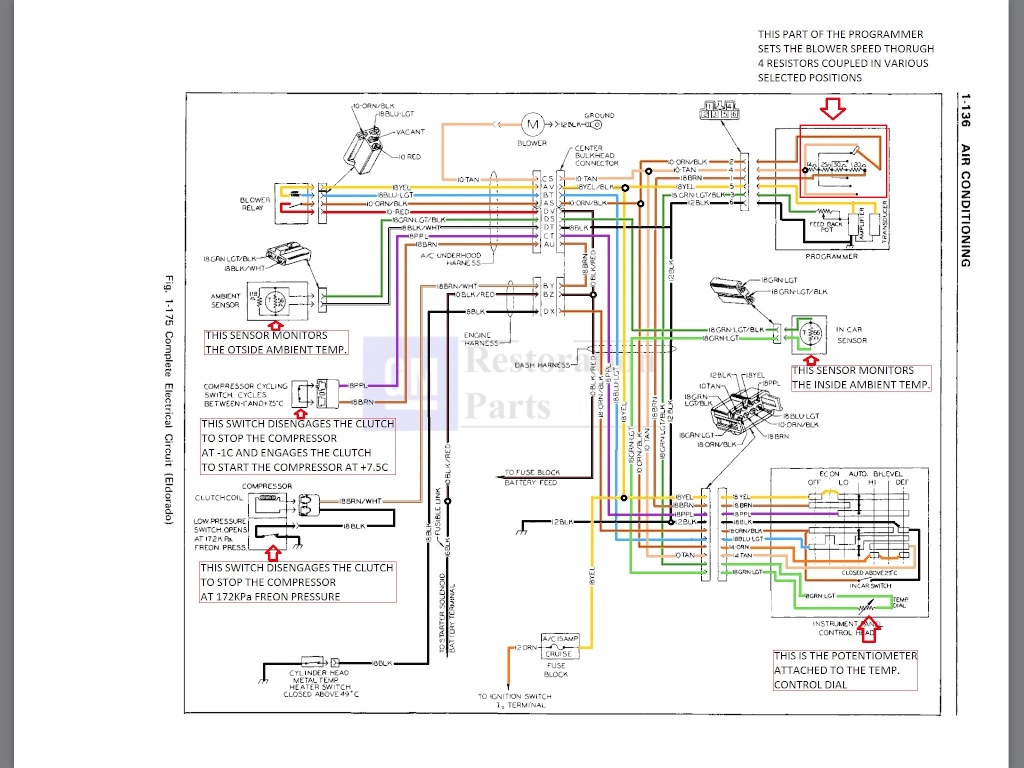
A color coordinated electrical schematic with annotations to describe the various functions of the system.
The 67 Eldorados new POA valve and recharge of the AC
I got a new remanufactured POA valve (suction throttling valve) from Classic Auto Air to make sure that the system can cope with the much higher pressures of R134. Classic Auto Air was very helpful with providing the factory correct parts. Classic Auto Air says that the re-calibrated valve can make a 15-20º F / 6º C difference.
Yesterday I got the Eldo back from the shop and so far it seems to cool the car down properly. The air discharged out of the vents is 10º C / 50º F cold - not bad for R134.
This is what Classic Auto Air is recommending for a change from R12 to R134:
Minimum Requirements
- Change or restore the filter-drier.
- Drain the compressor oil and recharge with 134a compatible oil. (PAG or Ester Oil)
- Insure that the system is clean and free of contaminants (Depending on component condition, this may be a simple matter of blowing out with compressed air or liquid flushing with an air-conditioning flushing agent)
- Replace or restore all rubber hoses with barrier hose.
- Install 134a charge port adapters
- Send POA valve in to be calibrated
- Charge with 134a between 70-80% of the original R12 charge amount.
- Replace any o-rings with 134a compatible
Recommended:
- Install hi/lo pressure switch
HELPFUL HINTS
- Ignore the sight-glass. A properly charged 134a system will likely show bubbles in the sight-glass.
- Typical 134a charge rate will be approximately 70-80% of the factory R12 charge amount.
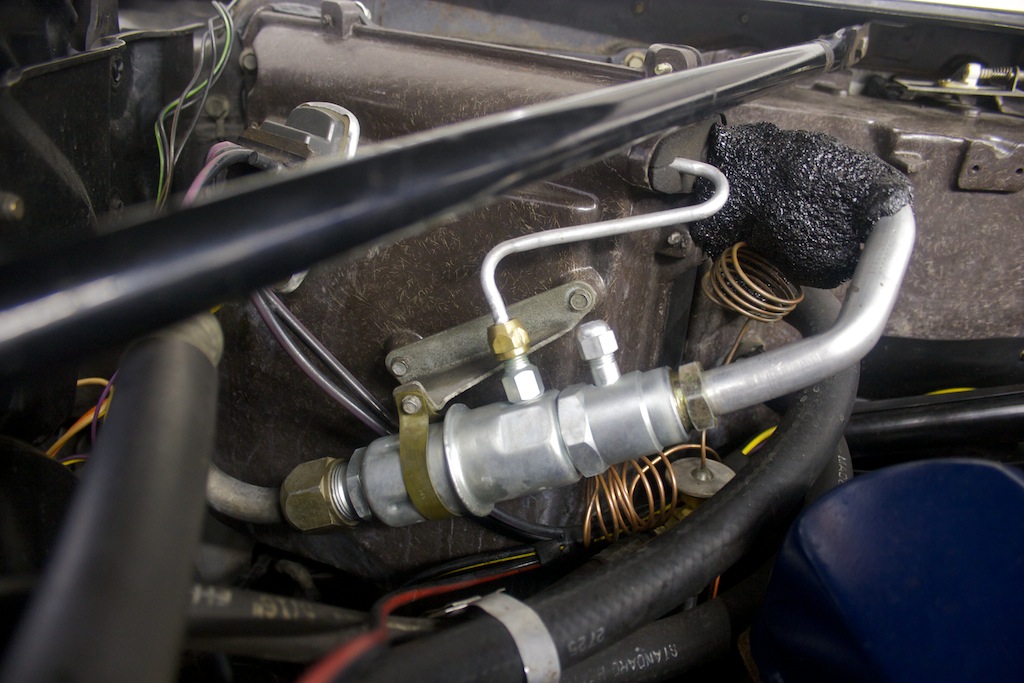
The new factory correct POA valve. Internally it was calibrated for the use of R134 instead of R12. The expansion valve was also replaced together with the evaporator, condenser, compressor, O-rings, filter-dryer. I did not install a hi/lo pressure switch which would cycle the compressor on and off to keep the car original.
THE 1967 CADILLAC AUTOMATIC CLIMATE CONTROL SYSTEM - MORE ISSUES - AND A FINAL FIX? RESTORING THE POWER SERVO VALVE!
The 67 Eldorado lost its complete charge of refrigerant over the winter - so it will have to go back to the shop to see where it is leaking. All components were replaced with new ones last year and so I have no idea where it could have leaked out. A tracer was put in before the last recharge so we should be able to find the leak. I guess that it will be one of the original hoses are a bad fitting.
Another thing that bothered me was that the system basically worked most of the time, but sometimes I had to wait for a long time before the system came on, or I had to switch to “FOG“ or “ICE“ position before the blower would come on in the “Auto“ position. Then sometimes the blower would cut out again if the temperature dial was moved to a colder temperature. Sometimes the temperature would move to full heat regardless off the selected temperature in the 67 Eldorado.
I had the very same problems on my 67 Deville as well - but there also the “Vent“ and “Low“ position did not work at all...
So I started trying to find the issues and finally wanted to fix them. Sounded easy - but it took me 4 full days with long nights in the garage to fix it...
BTW - Cadillactim has an excellent trouble shooting guide for the ACC on his website - its for sale for $ 45.- and I can highly recommend it if you are troubleshooting your 1967 or 1968 Air Condition System.
A great troubleshooting guide for 1967 and 1968 Cadillac´s Automatic Climate Control Systems I got from Gary Sisk - owner of a 1968 Cadillac.
This is a very easy to follow explanation which will save you a lot of time and you do not even need any special tools.
It was written by Lynn Nicholls and can be found on Stampies Cadillac page - here is the direct link to it. I used some excerpts from his document in the explanation below:
I first suspected a vacuum leak to be responsible for most of the erratic behavior of the system. A clear indication was that the system would initially have to be switched to the “ICE“ position to make the blower come on.
Lynn Nicholls writes:
“Sometimes the dash control can be switched to the fog or ice positions to bring the blower motor on and then when it is switched back to auto the blower may stay on and the system seems to work fine until the car is shut off. If the vacuum leak is only moderate there may be enough vacuum to hold the master switch closed once it gets , but not enough to pull it closed in the first place. When the dash control is switched to fog or ice, it assumes the air temperature is cold and that the engine is not yet warmed up, but that the blower is needed immediately for defrosting the windshield. So it supplies vacuum to the master switch through another circuit, bypassing the temperature controlled vacuum switch on the heater core shutoff valve on the right fender well. This source of vacuum is enough to close the master switch.When the dash control is switched back to auto this vacuum source is shut off, but there may be just enough vacuum left from other circuits to hold the switch closed. This routine will work for a while but as the leak gets worse, there won’t be enough vacuum left to hold the master switch closed anymore and the blower will shut off again as soon as the system is switched back to auto.With these symptoms and behavior the problem is most likely the power servo. This is half the brains of the system; the other half is the control panel in the dash. The power servo is controlled by a varying vacuum signal from the transducer. This vacuum supply is a completely separate circuit from that which supplies vacuum to the master switch. High vacuum moves the servo to the maximum heater position, and with low vacuum, a return spring moves it to the maximum AC position. In between these two extremes, it regulates the air temperature door to blend warm air and cool air, and simultaneously regulates the blower speed. It also spins an internal rotary vacuum valve back and forth that makes various connections between the several small vacuum lines on the top. This rotary valve controls the various vacuum motors of the system that operate the AC, heater, and defrost functions. It is this rotary valve that goes bad. l have seen these things visibly warped, and very badly so. It must be caused by engine heat, because there is also one inside the car on the control panel that is moved back and forth by the dash control lever, but that one seldom seems to cause any trouble. A warped rotary valve leaks all kinds of vacuum and the first part of the system to be affected by low vacuum is the master switch; there’s not enough vacuum there to close it and turn on the blower. To verify this is the problem, take some spare vacuum line, some scraps of 1/8 inch pressure line (like for air shocks), and a vacuum T and manually make the connections that the rotary valve should make in the maximum AC position. The connections that the rotary valve makes in various positions are shown in the factory shop manual. Disconnect the black connector with the striped vacuum lines from the power servo. Connect the yellow, red, and purple lines together with a T; also connect the tan and blue lines together and connect the orange and green lines together. If this rotary valve is the one and only culprit the AC will now work beautifully and the blower motor will come on every time, like magic. With the dash control on high the system should be recirculating air and there will be a lot of air noise coming from under the right side of the dash; when the dash control is moved to auto the air door should move to provide fresh air and the system will become much quieter. Of course with these manual connections the system is not fully automatic and the heater won’t work right at all, however this is enough to diagnose the problem.“
I did this test (see picture below) - and with the power servo bypassed everything worked as it should. This way I knew that the power servo was to blame for some of my problems.
So this rotary valve needed to be repaired...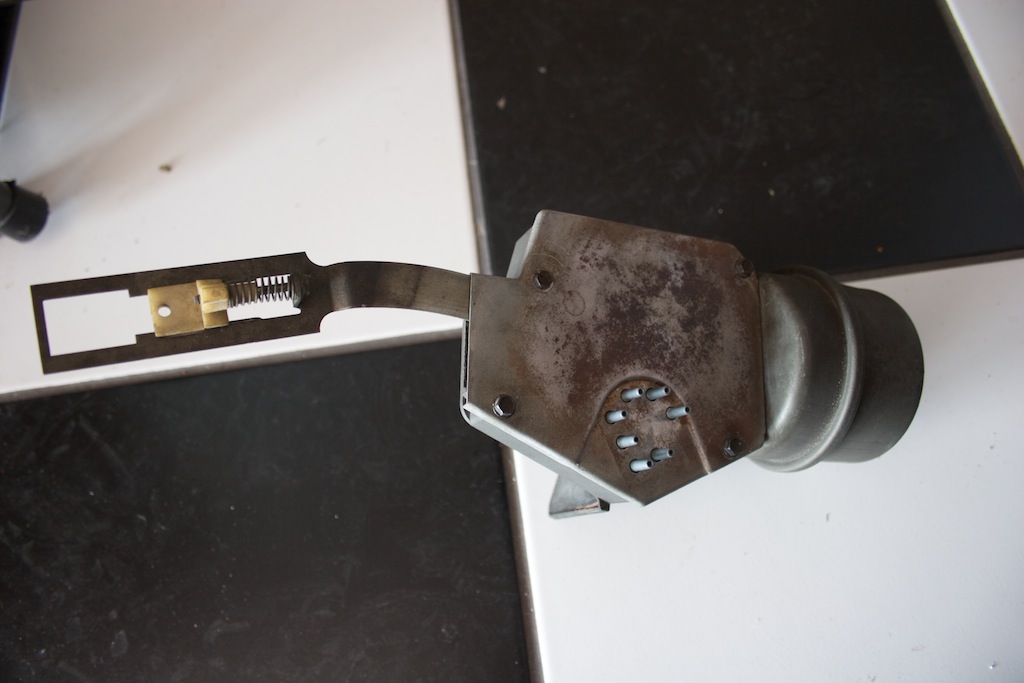
I removed it from the power servo and disassembled everything.
The removed power servo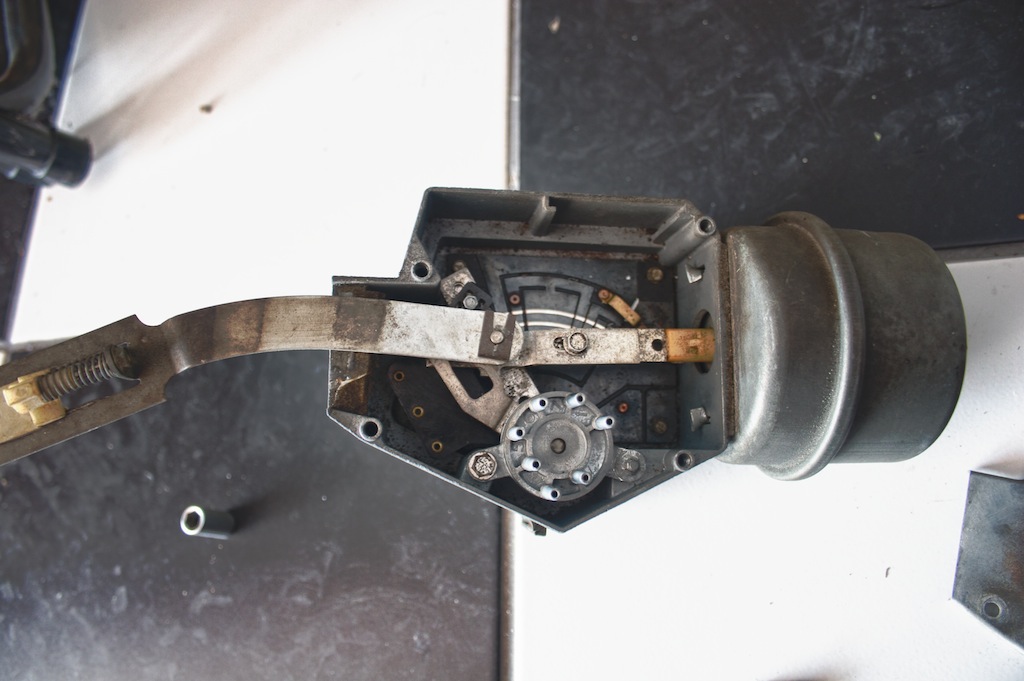
After opening the cover, you can see the rotary valve in the lower center.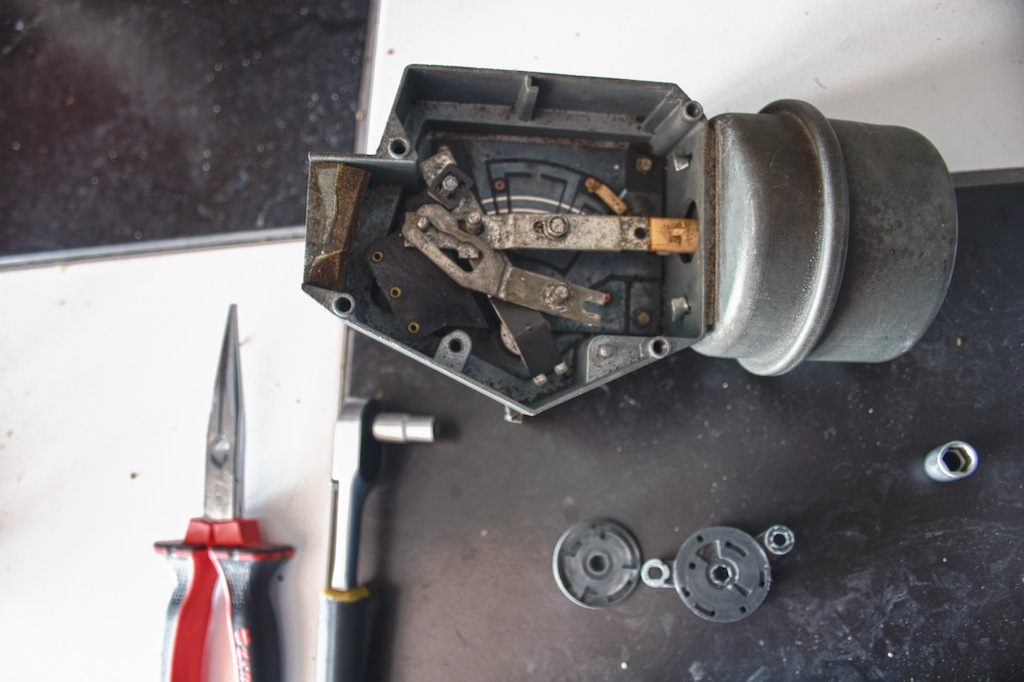
Remove one screw and a clip and the rotary valve comes out.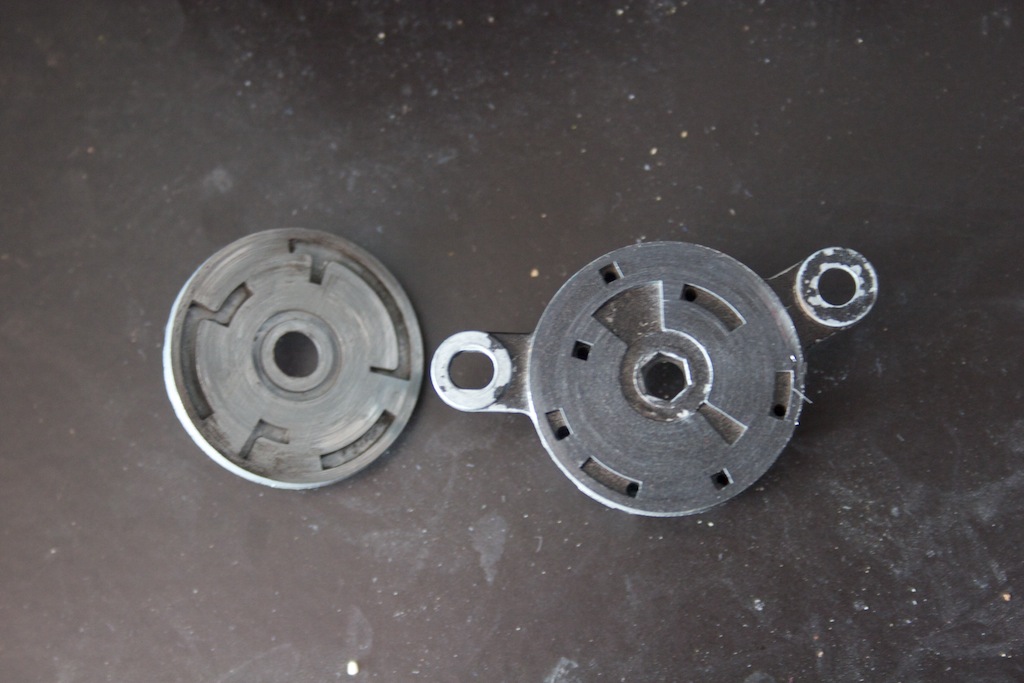
The rotary valve consists of two halves which make the connections - as you can see it was very dirty and rough - and slightly warped.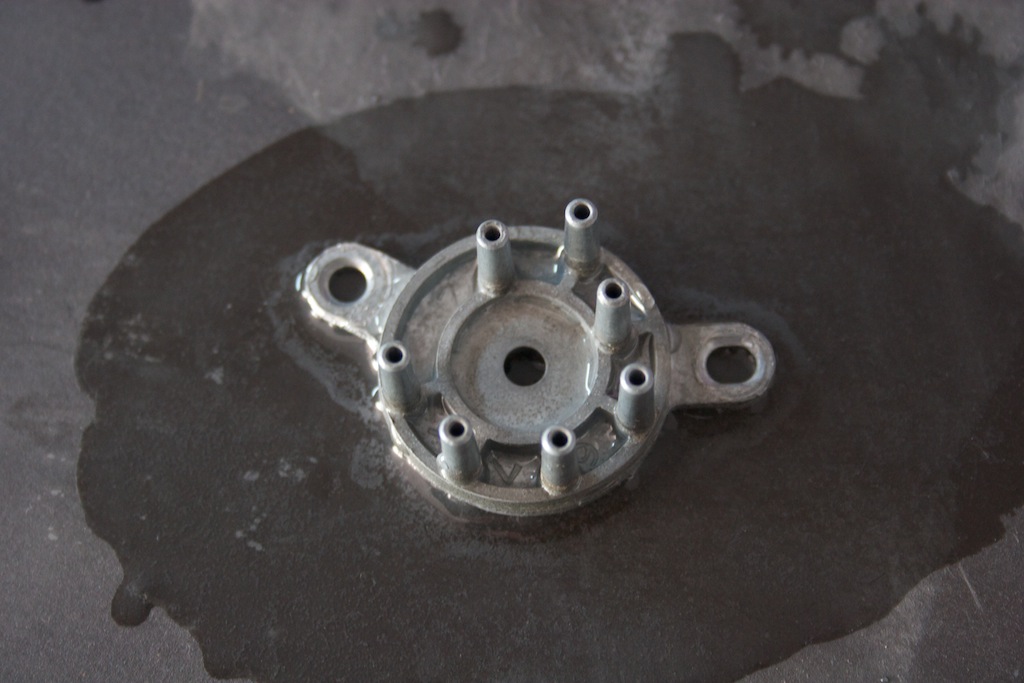
I started to wet sand both halves with 800 grit sandpaper.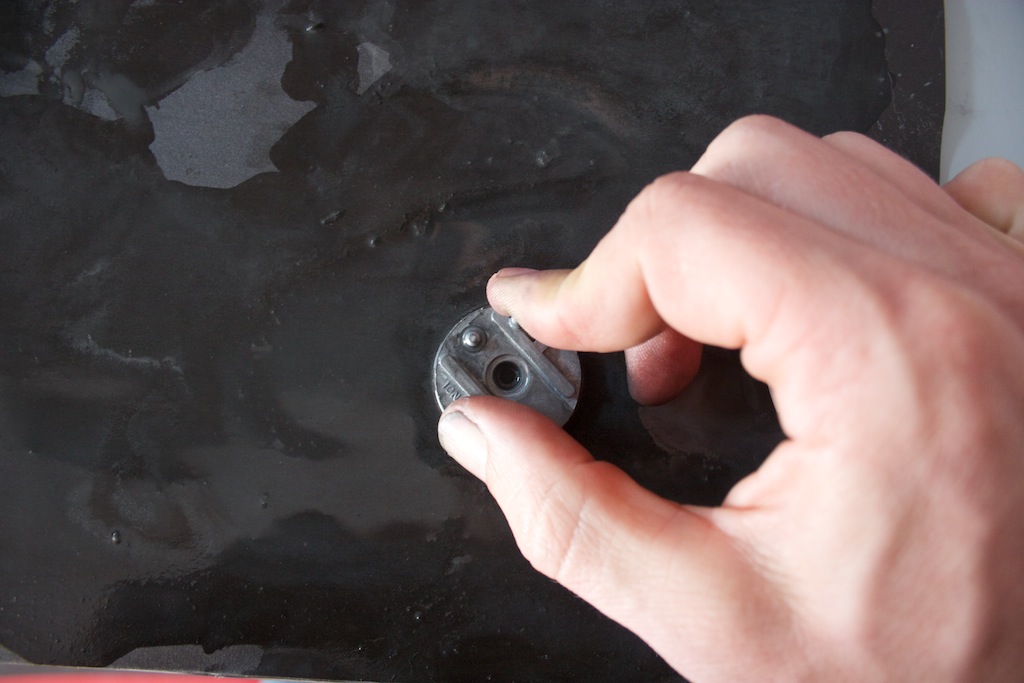
When everything was flat and shiny again I used some 2000 grit sandpaper for a perfect finish.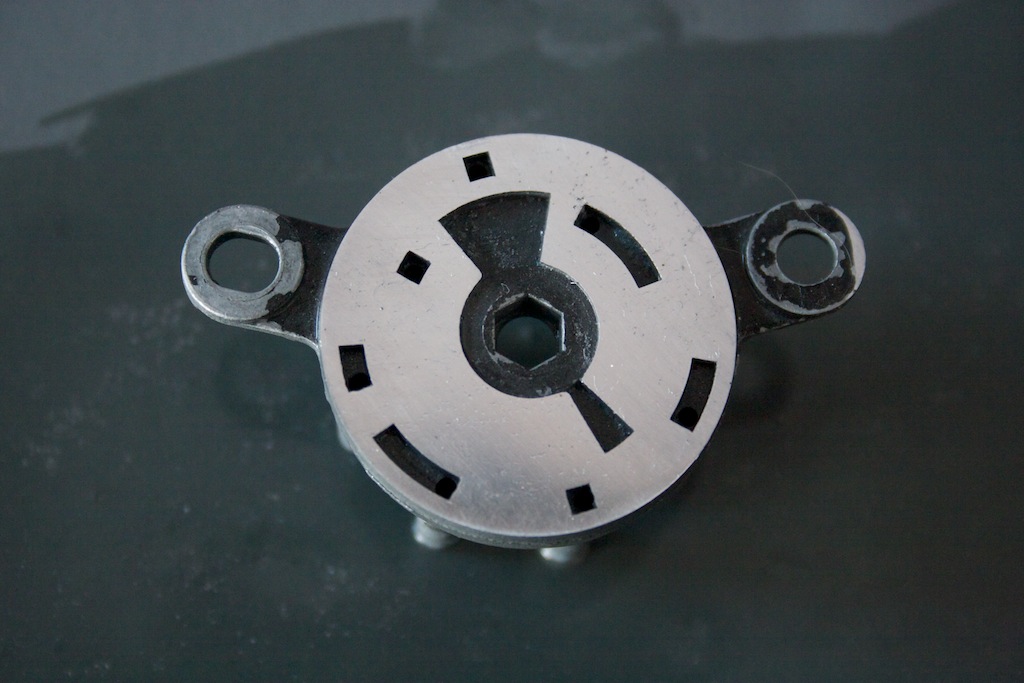
Looks shiny and flat again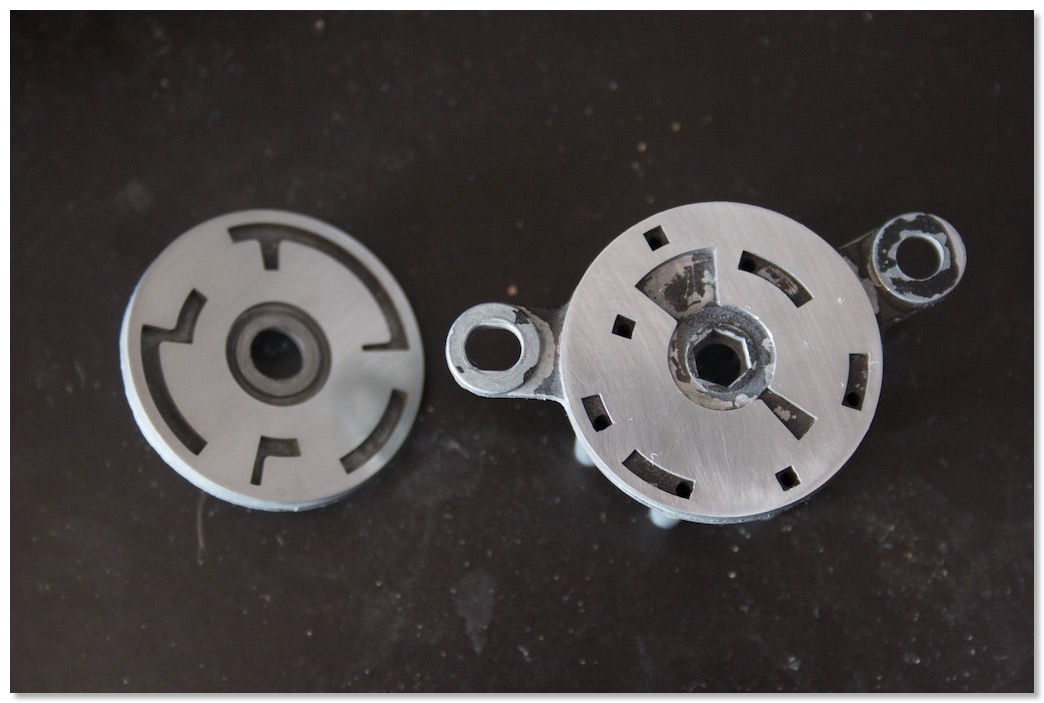
Make sure that none of the ports are clogged - I used compressed air to clean everything.
When you put the two halves together lubricate with WD40 to make sure that when you put them back into the power servo that they are properly held together with the underlying spring.
After I reinstalled them into my cars - almost everything worked as it should. In the 67 Eldorado I still had the problem that in the “AUTO“ position the fan would always be slow - so I knew that the control head in the dash had a problem with the “LOW - AUTO“ switch as well.
In the 67 DeVille the “VENT“ and “LOW“ position still did not work at all...
So I switched the control panels between the two cars and suddenly everything in the 67 Eldorado worked perfectly. I never had such a perfectly working system before. Its like it just left the factory!
In the DeVille I still had no “VENT“ and “LOW“ settings working... So out came the control panels again... (its a pain in the a*** to remove and install them...)
As it turned out the “LOW-AUTO“ switch on one panel was stuck in the “LOW“ position. You can easily remove it and readjust it to work again - sorry I forgot to take pictures. Make sure that all switches on the control head are adjusted properly or they wont work as they should!
So I knew that both control heads were working correctly by installing it back to the 67 Eldorado and the other panel back to the 67 DeVille.
While the 67 Eldorado was perfectly fixed now with everything working as it should - the 67 DeVille was still giving me the problem with a non working “VENT“ position...
I studied the shop manual for hours and could not find what the problem could be. I knew that the power servo was working perfectly now and I knew that the control head was in perfectly working order as well. I verified this once again by switching these parts between the cars once again and everything worked as it should in the Eldorado but not in the DeVille.. I´m really good in switching these parts between my cars now ;-)
I started to look for electric connection problems and finally found out that no electricity was coming out of one of the three power servo connectors, but I did not know why...
After I removed the power servo once again to re-check it again it struck me - one of the pins was slightly bent and the wire connector did not make proper contact. This problem was not visible with the power servo installed in the car. It took me 2 long nights to find this little flaw... I just bent it straight and everything works as it should on both of my 67 Cadillacs. Now I have to recharge the systems and I should have perfectly working AC again... I will also install new dryers and a re-calibrated R134 POA valve before the recharge.
One the one hand the 1967 ACC is very complicated but once you know how it works its pretty easy to fix. The rotary valve in the power servo is pretty easy to refurbish, the dash servo valve is riveted together unfortunately, so its not such an easy fix, but NOS valves are still available at “Classic Auto Air“
*UPDATE 2022* - Check out this article and video as well as I had to repair my switch again in 2022 on my 66 DeVille!
Here is a video about the Master Switch that a gentleman posted on youtube
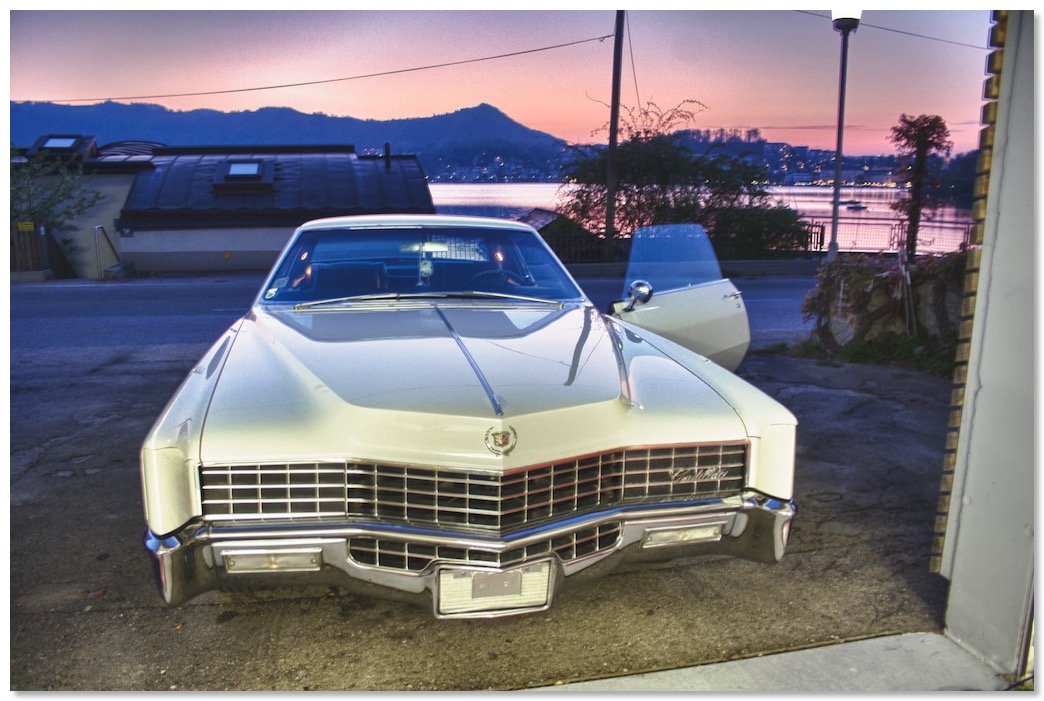
The 67 Eldorado in front of the garage after the AC system was fixed.
The 67 Eldorado is at the shop again
Also the ignition and the rebuilt carburetor were not quite up to my standards yet, and so I decided to ask for some professional help for the last finishing touches. So I delivered the car to the shop, and the experts did some more tweaking. The result is that I finally have a perfectly working AC on my car. It took a while, but finally it's working as it should. When I got the car, a lot of AC parts were defective or torn out, and now everything is back to factory specs.
Also the carburetor is finally working as it should.
From a technical standpoint the car is now in perfect condition - you wont find anything that´s not working as it should.
Great! - next up is a repaint...
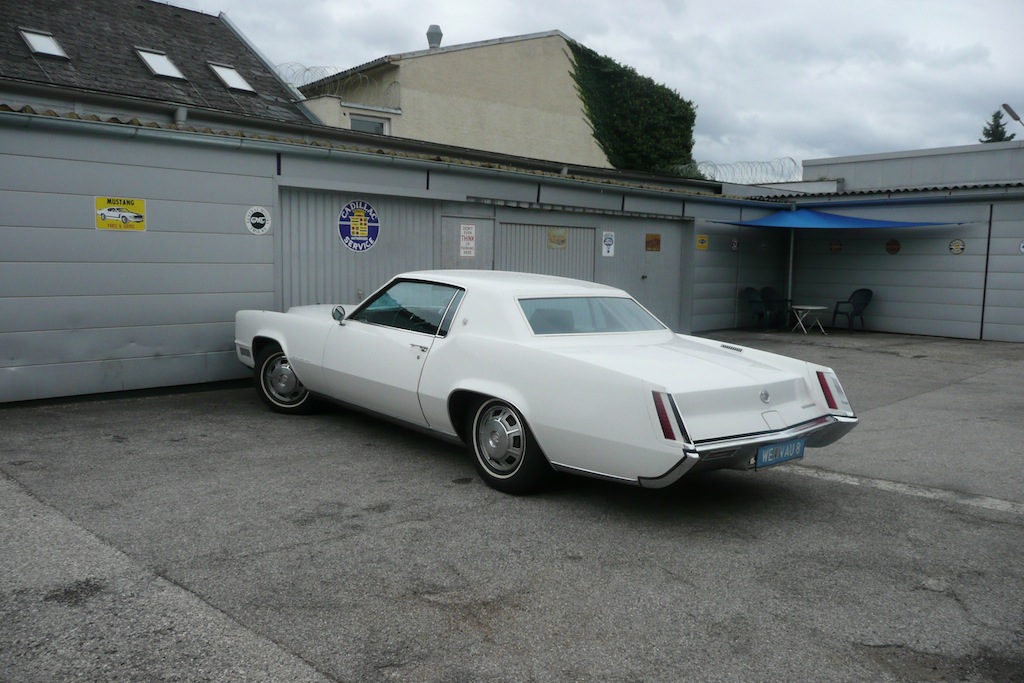
The Eldo at the shop.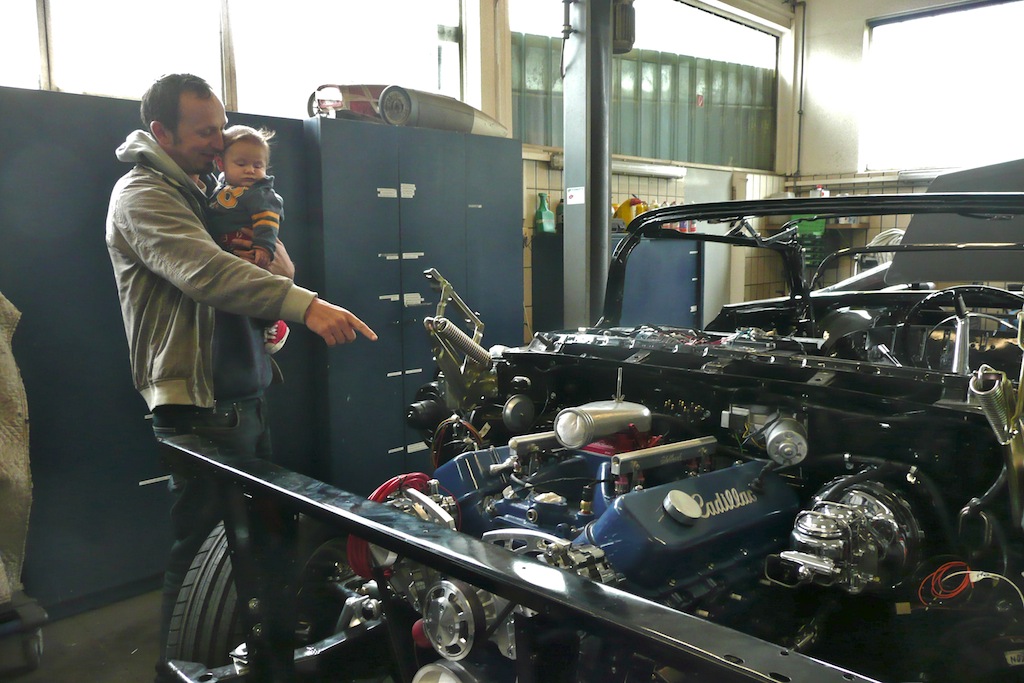
I took my little son with me to show him whats going on in the restoration shop.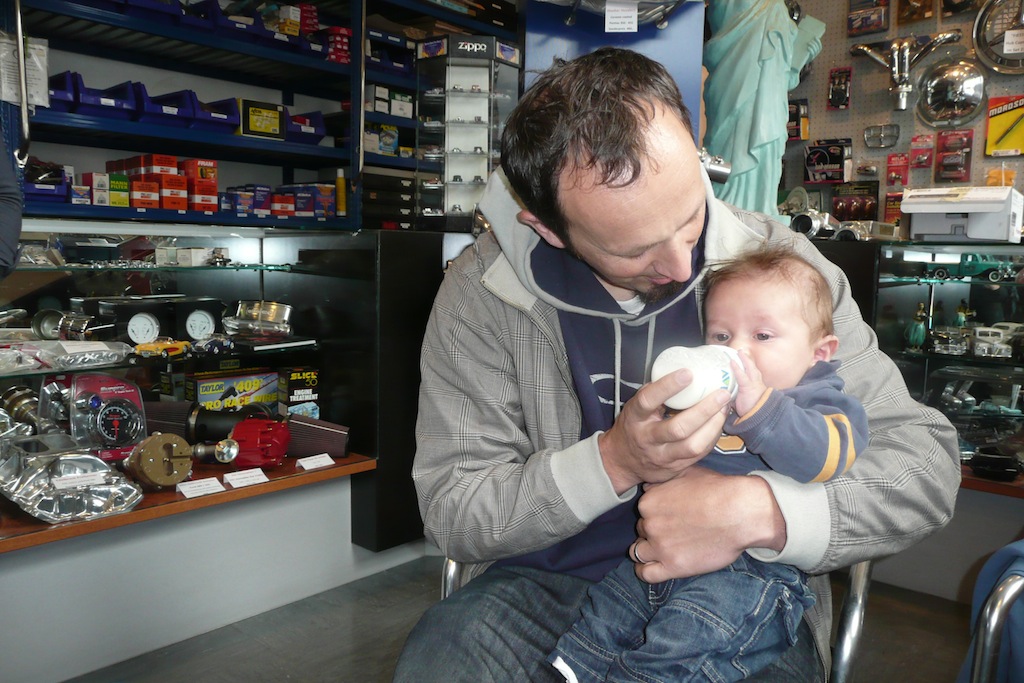
Looking at so many cool cars made little Elliot very thirsty. Here he is having his milk in the shop.
The 67 Eldorado is at the restoration shop again
Also on the „to do list“ is to install a new condenser for the air condition, recharge it with good old R12 and to fix a problem with the ignition timing. Cant wait to have the car back!
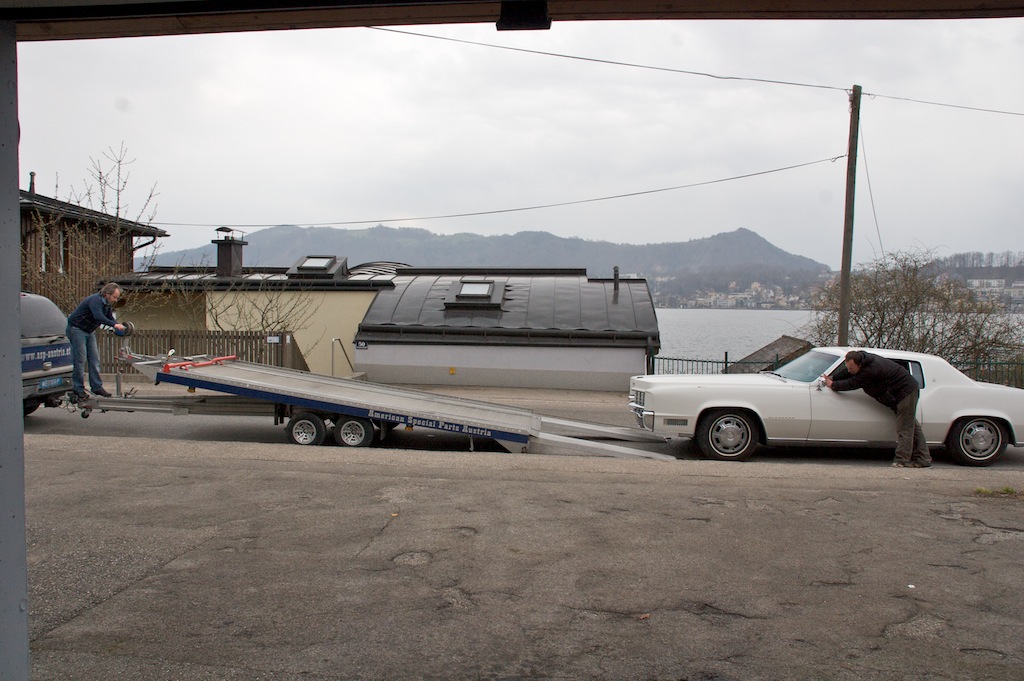
As I could not start the car we had to winch it up onto the trailer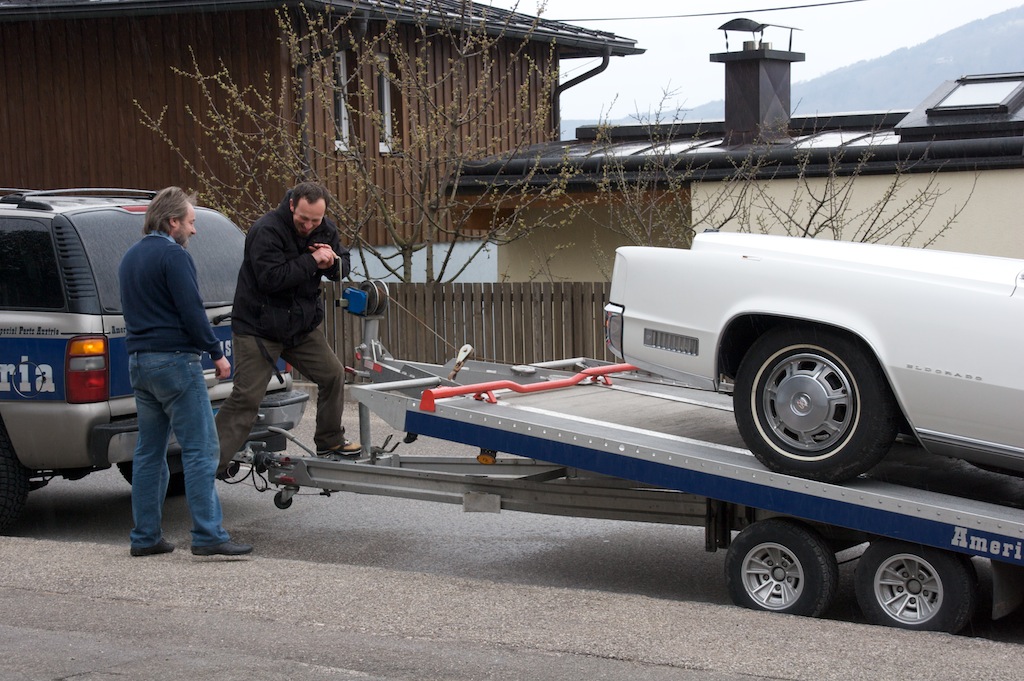
Its pretty heavy...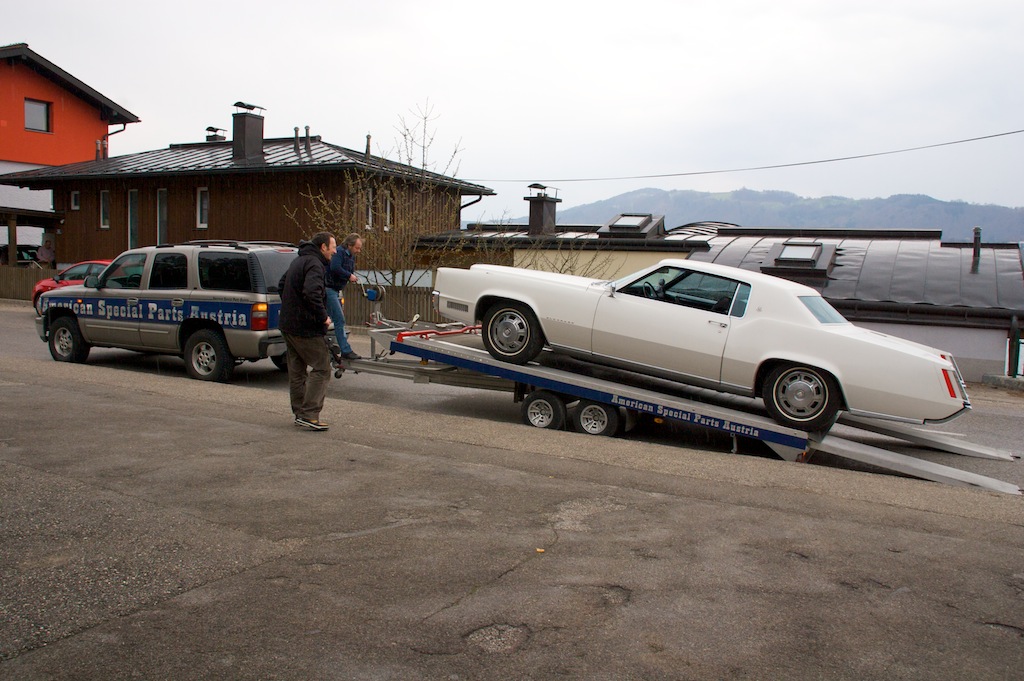
Almost up...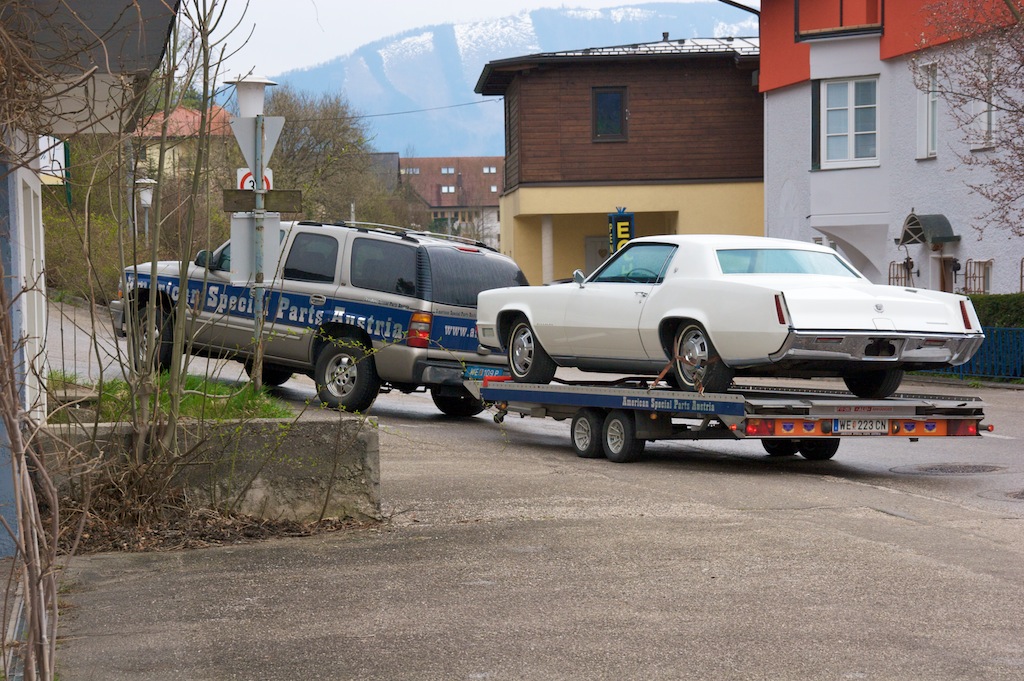
Good bye!
The 67 Eldorado´s Automatic Climate Control System is back in working order
I suspected a vacuum leak somewhere in the system. Troubleshooting began with going through all the vacuum hoses. I replaced some which were a little worn out at the connectors. I also cut off the ends of most hoses, as they were all becoming a little loose during the last 40 years. I then plugged them in again.
Not much did change though.
When I came to the hose of the hot water valve and the delay relay, I had the first success. At least the blower motor would stay on in all “Auto” modes, even when the car was idling - but would still go off in “Fog” and “Ice”. I then suspected a leak in the power servo or in the dash controller. So I installed the power servo from my 67 DeVille where everything works perfectly, to be able to rule out any problems. Nothing changed though - the blower would still come on and off depending on the throttle position.
I then soon found the culprit of the whole issue - it was the master vacuum switch - which seems to have a problem with the internal electric switch. As I had a spare one around I installed it - and voilá - everything worked as it should. It always looked good when I checked it before.
I´m very happy that everything is back in working order. The only thing which I still have to repair is the fast idle diaphragm which completely dried out and is no longer functioning. Fortunately I do have a spare 429 engine in the garage from where I can grab and use this part - so I will repair it soon.
I then need a new condenser which is already on the way across the Atlantic coming from Old Auto Air.
By the way - Cadillactim has an excellent trouble shooting guide for the ACC on his website.
The evaporator had to be replaced as well along with the heater core. This is a pretty big task as you can see on the pictures below. You even have to remove the hood to get access to the whole unit. The fiberglass AC enclosure had to be repaired at my car as well as the previous owner tried to repair the evaporator and missed a screw and made a tear into the enclosure. The restoration shop repaired this professionally and it looks like new now.
The best troubleshooting guide for 1967 and 1968 Cadillac´s Automatic Climate Control Systems I got today from Gary Sisk - owner of a 1968 Cadillac.
This is a very easy to follow explanation which will save you a lot of time and you do not even need any special tools.
It was written by Lynn Nicholls and can be found on Stampies Cadillac page - here is the direct link to it.
Below you can find some pictures of my system:
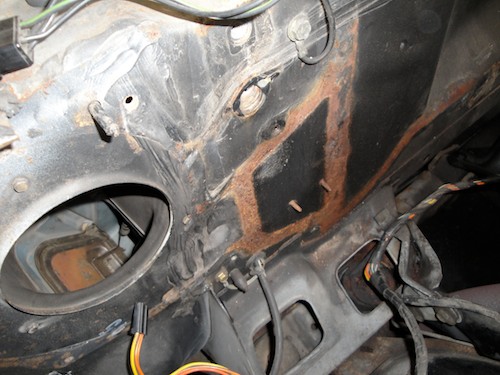
The whole AC unit has to be removed to get access to the evaporator and heater core... The slight surface rust that showed up where the gaskets were, was removed as well of course...
The big hole on the left is where the blower motor is installed.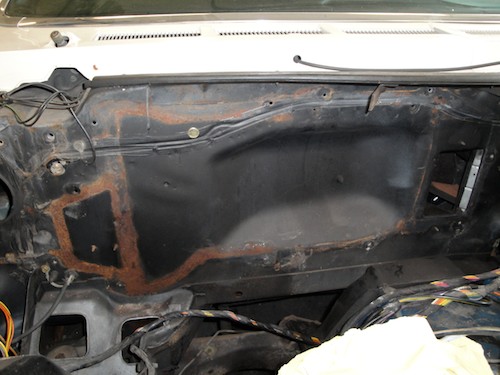
This is where the AC box usually is installed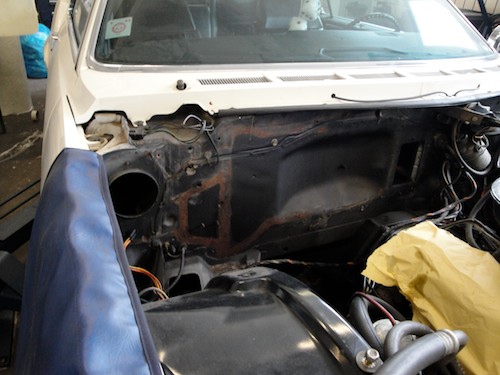
You can see how much has be removed just to get to the evaporator and heater core...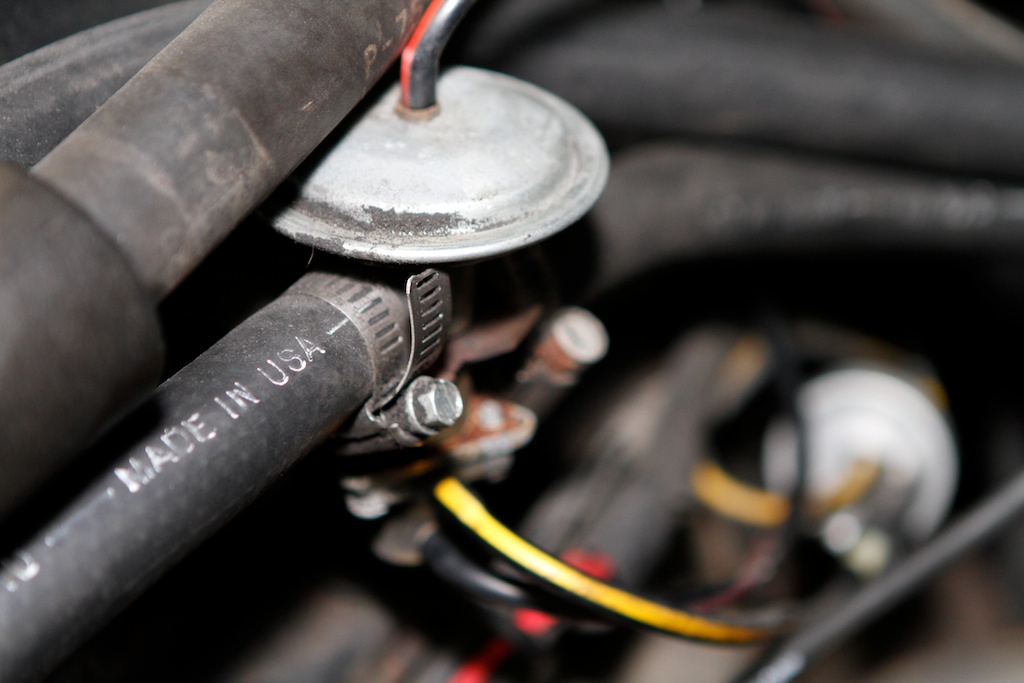
I discovered the first issue at the hot water valve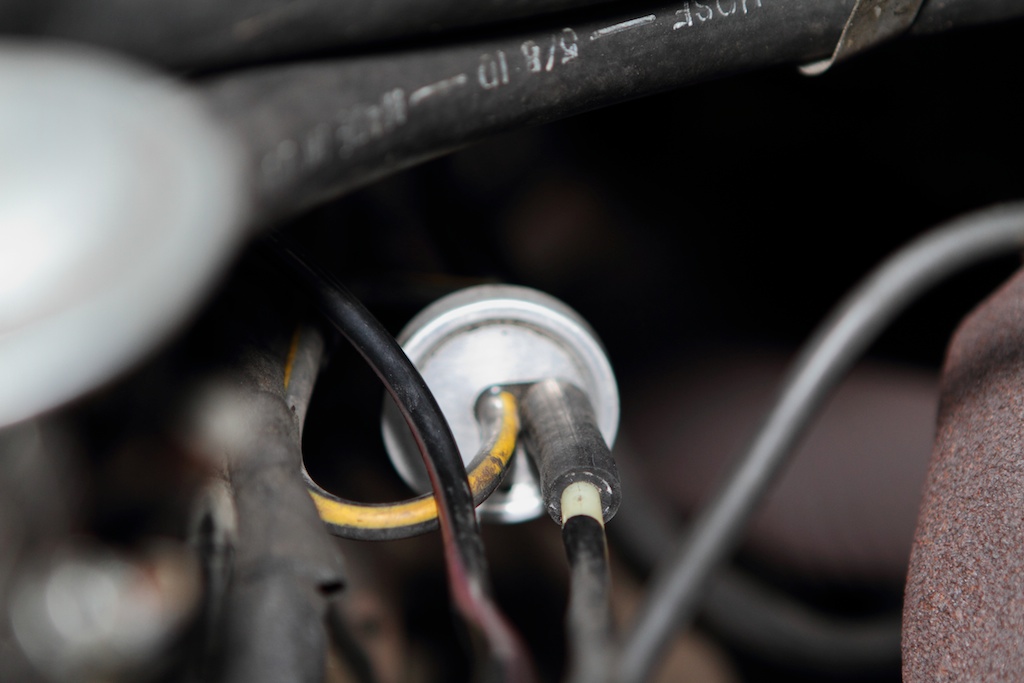
The hoses around the time relay delay were leaking a little bit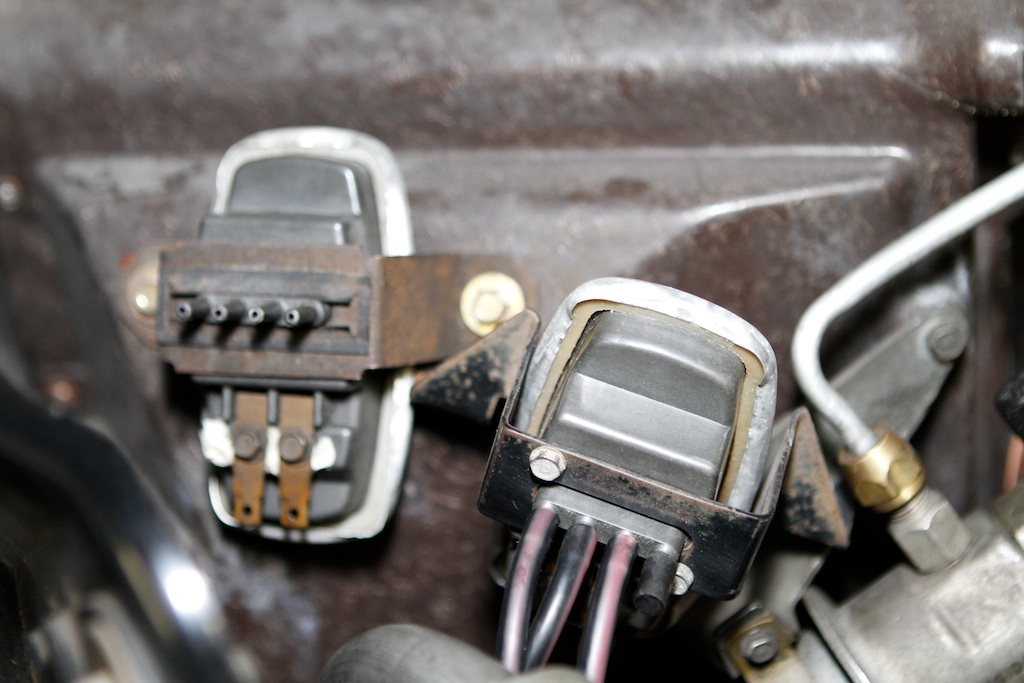
For testing purposes I hung a spare master vacuum switch into the car - this solved the problem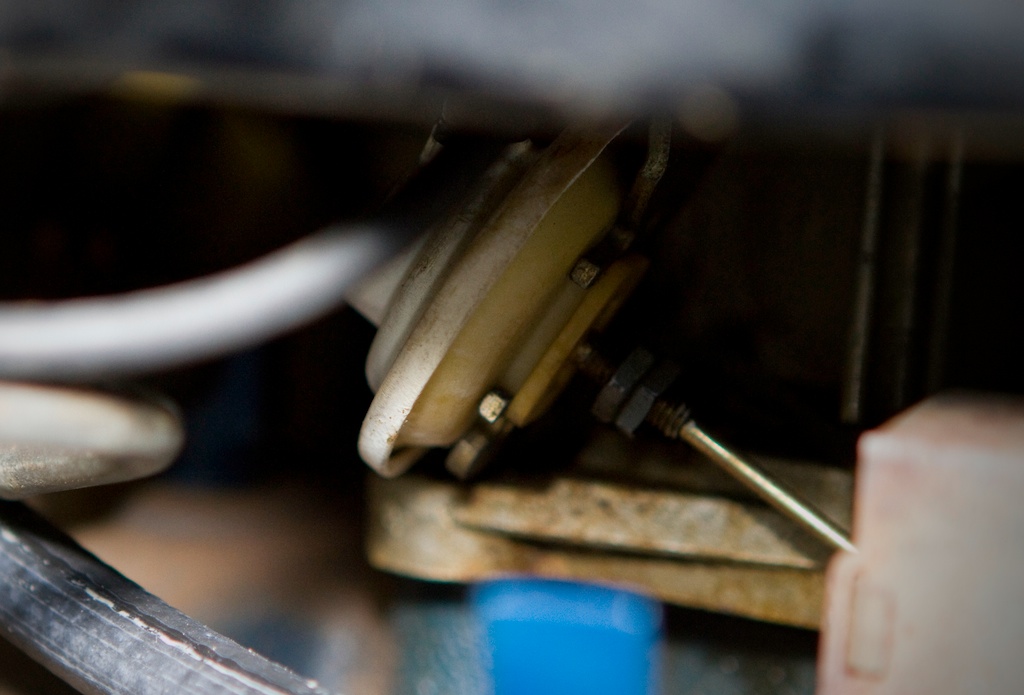
The old fast idle diaphragm was leaking and brittle and was replaced with a better one...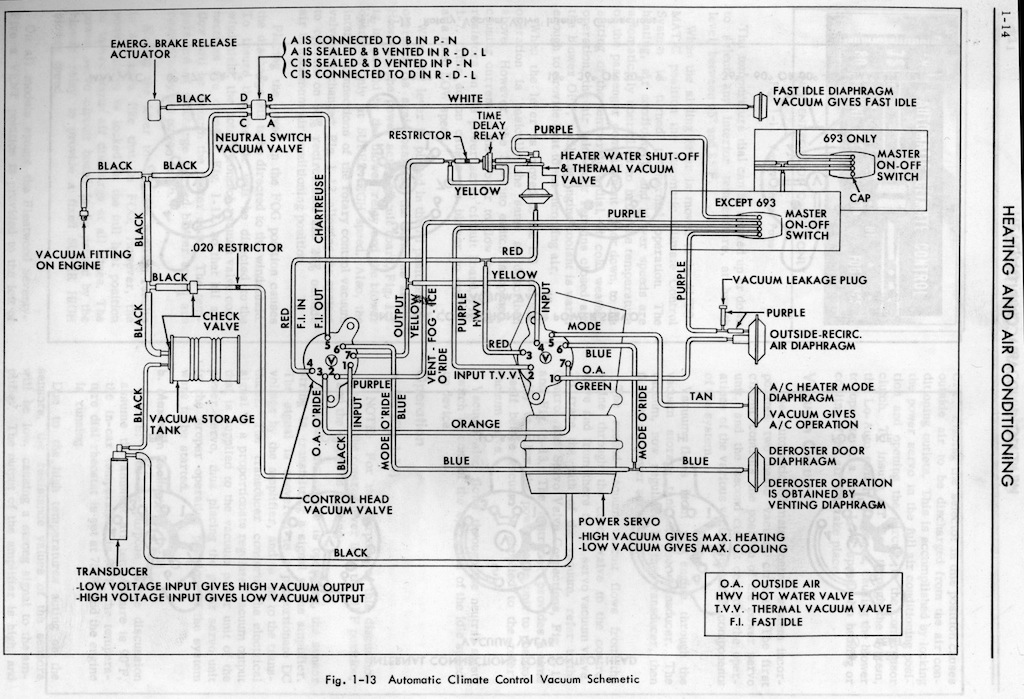
The 1967 Cadillac Automatic Climate Control Vacuum Schematic from the shop manual -
1968 is almost identical BTW... Click on the image for a larger view!
Here is a video about the Master Switch that a gentleman posted on youtube
Preparations for the Cadillac BIG Meet
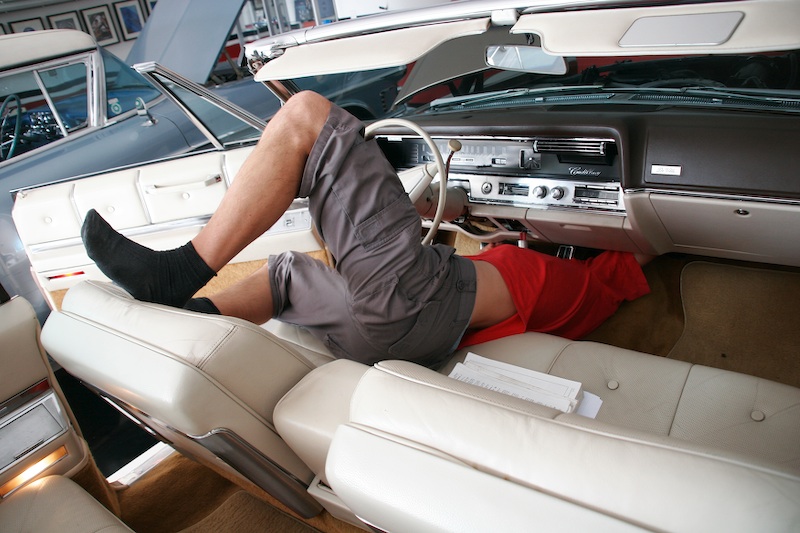
working on the AC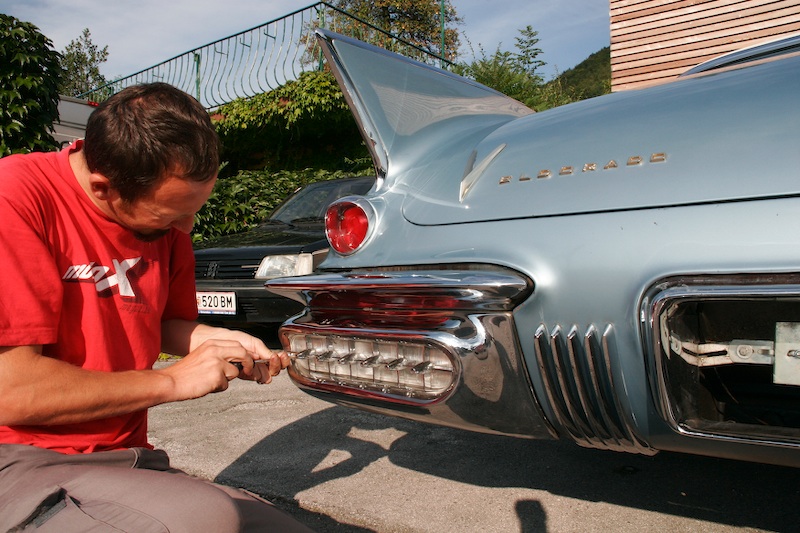
installing the new backup lenses - which had to be custom fitted...
AC Problem
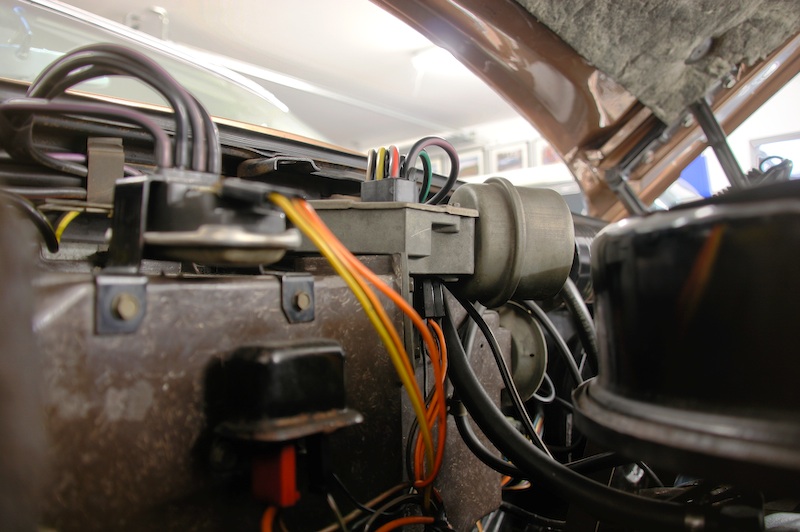
Three parts could cause this problem:
- The dash switch with its rotary valve from where I can hear a slight hissing noise,
- the power servo on the firewall
- or the master switch itself - what I doubt.
As I hate when something does not work on my cars I ordered all the parts. I found a good source which sells all these parts rebuilt. Hopefully they will arrive soon as I would like to have this issue resolved before the Cadillac Big Meet. It should not be too much of a hassle to install them when they are here.
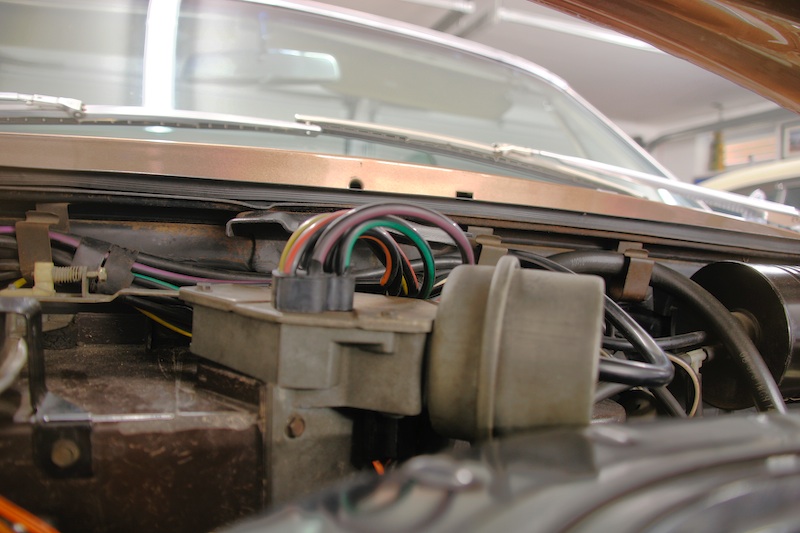
The power servo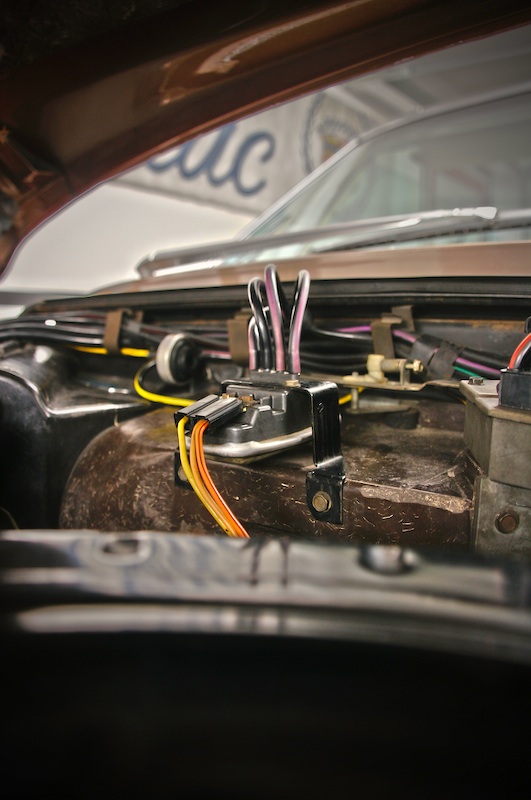
The power servo and master switch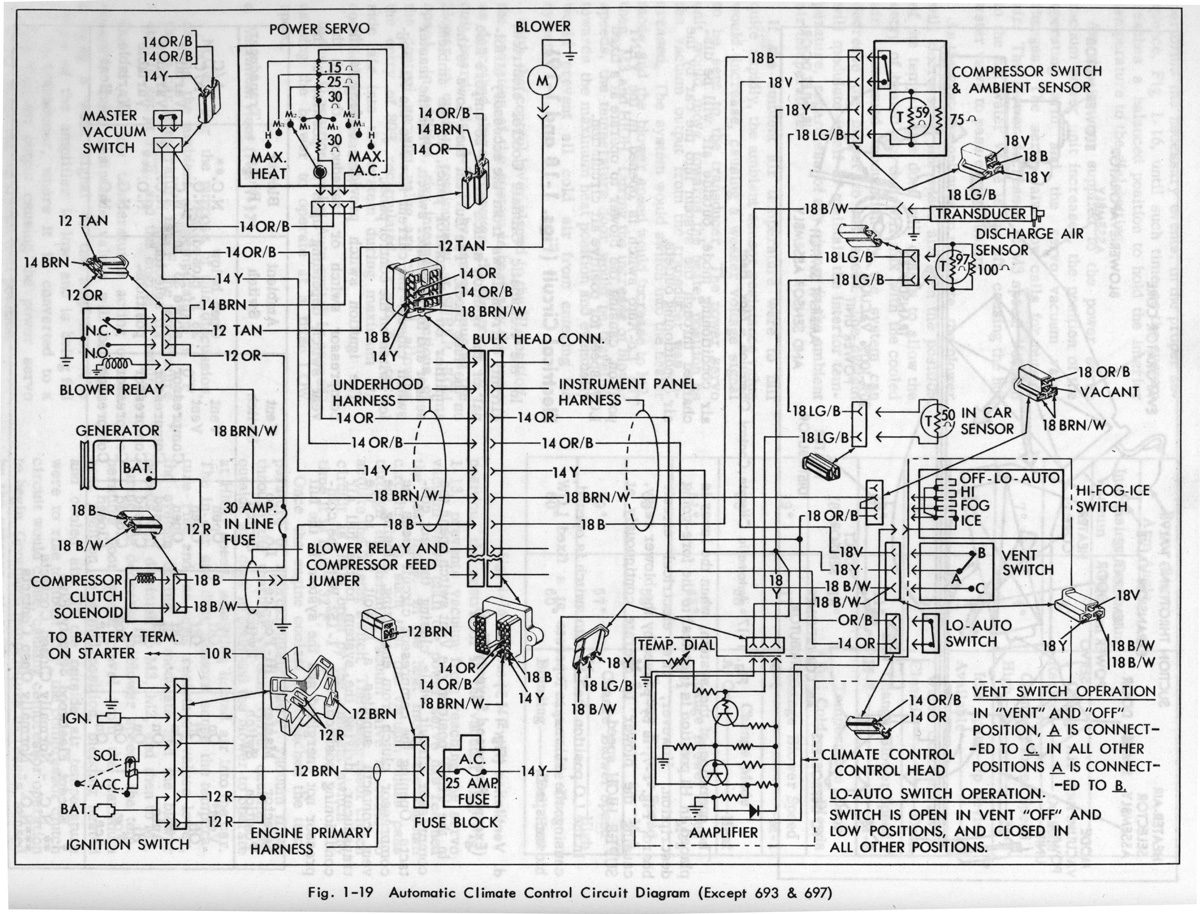
The electrical circuit of the Air Conditioning system of the 1967 Cadillac DeVille in a digram
Here is a video about the Master Switch that a gentleman posted on youtube
1966 Cadillac Coupe deVille (16)
1967 Cadillac DeVille (54)
1967 Cadillac Eldorado (73)
1971 Lincoln Continental Mark III (24)
1974 Cadillac Coupe deVille (46)
1978 Cadillac Eldorado Biarritz (25)
1996 Buick Roadmaster (20)
Cadillac BIG Meet (2)
Car Shows (55)
Cruising (4)
CT6 (1)
For Sale (3)
Garage Stuff (32)
Pacer (1)
Restoration (140)
Various (55)
Video (21)
Website News (31)
- 6 way power seat
- 8-track
- 10 Ohm
- 429
- 1932
- 1957
- 1958
- 1958 Cadillac Eldorado Seville
- 1958 Cadillac Repair Tip
- 1959 Cadillac Eldorado Seville
- 1964
- 1965
- 1966
- 1966 Cadillac Coupe deVille
- 1966 Cadillac Repair Tips
- 1967
- 1967 Cadillac DeVille
- 1967 Cadillac Eldorado Repair Tip
- 1967 Cadillac Repair Tip
- 1967 Eldorado
- 1968
- 1970 Cadillac Eldorado
- 1971
- 1971 Lincoln Continental Mark III
- 1974
- 1974 Cadillac Coupe DeVille
- 1974 Cadillac Repair Tip
- 1976
- 1977
- 1978
- 1978 Cadillac Eldorado Biarritz
- 1978 Cadillac Repair Tip
- 1980 Cadillac Eldorado Biarritz
- 1996
- 2012
- 2014
- 2017
- 2018
- 2019
- 2022
- 2023
- 2025
- 3063206
- 7027235
- 7800483
- 7805675
- 7805676
- 12355706
- 17058531
- 17059968
- 17059969
- 22010515
- 22010661
- A.I.R
- A6
- AC
- AC Compressor
- AC Electrical Diagram
- ACC
- Accelerator Pump
- Accelorator pump
- Accident
- Actuators
- Adriatic Blue Metallic
- Ads
- Aftermovie
- Air Pump
- Aircondition
- AIRPUMP
- ALC
- Alternator
- AM
- AM-Transmitter
- Antenna
- Anti Rattle Clips
- Antique Gold
- Arizona Vintage Parts
- Arrival
- Article
- ASC
- Ash Tray removal
- ATC
- Atlantis Blue Firemist
- Austria
- Austro Classic
- Autolite SP-459
- Automatic Seat Back Release
- Award
- Banner
- Barn Find
- Battery
- Battery Tray
- Beach Race
- Bearing
- Bendix
- Biarritz
- Bigfoot
- Bill Hirsch Engine Enamel
- Bleeder Screws
- Bleeding
- Blower
- Bodywork
- Bolts
- Book
- Borg
- Brake Booster
- Brake Fluid
- Brake Gray
- Brakes
- Broken Bolt
- Brougham
- Bucket seats
- Buick
- Bumper End
- Bushings
- Cadillac
- Cadillac BIG Meet
- Cadillac BIG Meet
- Cadillac birthday cake
- Cadillac Blue
- Cadillac Color Selections Dealer Book
- Cadillac Coupe deVille
- Cadillac Dealer
- CADILLAC GRAND EUROPEAN
- Cadillac Meeting
- Cadillac Mini Meeting
- Camaro RS
- Caorle
- Car Show
- Carburetor
- Card
- Carpet
- Carter AFB
- Cavalry Twill Vinyl
- CB
- CBM
- CCCD
- Choke
- Christmas
- Citizens Band
- Classic Cadillac Club Deutschland
- Clay Towel
- Cleaning
- Clock
- Clockwork
- Clutch
- Clutch Coil
- Collector
- Colonial Yellow
- Color Coded Springs
- Commercial
- Compound
- Compressor
- Condenser
- Continental Mark III
- Control Head
- Conversion
- Convertible top
- Coolant
- Corona
- Cowl
- Cruise Control
- Cruising
- CT6
- CV Boots
- CV JOINTS
- D6230
- Dash Trim
- Decal Removal
- Decals
- Decoration
- Dehumidifier
- Delco Moraine
- Der Standard
- detailing
- Deville
- Diagnosis Chart
- Diagram
- Dial
- Digital Rotary Drum Clock
- Diner
- Disc Brakes
- Distributor
- Diverter Valve
- Door Jamb Switch
- Door Rubber Conduit
- Dornbirn
- Dot3
- Drive Shaft
- Driving tour
- Drum brakes
- Dry Ice Blasting
- Dry Ice Cleaning
- DVD
- Eastwood
- Eldorado
- Electric Choke Thermostat
- Electrical schematic
- Elvis
- Engine Bay
- Ep
- Epoxy floor
- Europe
- Evaporator
- Exide
- Factory Markings
- Fender Skirt
- Floor
- Flushing
- Flyer
- Foam
- For Sale
- Front AXLE
- Front brakes
- Front bumper filler
- Front Floor
- Front wheel bearing
- Fuel Filter
- Fuel Pump
- Fuel Sending Unit
- Fusible Link
- Garage
- Garage Cabinets
- Gasket
- GE
- Gear indicator
- General Time
- Glove box light
- Grand European
- H4
- Haus of Hot Rod
- Headlight Actuator
- Headlight doors
- Headlights
- Heater Core
- Heater Hose
- Heater Valve
- High Idle
- History
- Holley
- Honest John
- Hood
- Hood Emblem
- Hood Ornament
- Hose Clamp
- Hot Choke
- Hot Water Valve
- HotRod
- How to
- Hödlmayr
- Ignition Diagram
- Illuminated Entry
- John D‘Agostino
- John Foust
- Klassikwelt Bodensee
- Kremsmünster
- LaSalle
- Leather seats
- Light Switch
- Limited
- Lincoln
- Lincoln Mark III Repair Tip
- Low Mileage
- Magazine
- Marilyn Monroe
- Mark III
- Master Cylinder
- Master Switch
- Master Vacuum Switch
- Media Blasting
- Meeting
- Meguiras
- MK II
- Mobile
- Model
- Moldings
- Mom
- Mopar Nationals
- Mostkost Kustom
- Movie
- Munich
- Neon
- NOS
- Oberösterreicher des Tages
- oilchange
- ORF
- Overspray
- Pacer
- Paint
- Paint correction
- Paintjob
- Part Number
- Parts
- Patch Panel
- Perfect Circle
- Permabag
- Persian Lime
- Photo shooting
- Photoshooting
- Pictures
- PinUp
- POA Valve
- Power Antenna
- Power Servo
- Power Vent Windows
- Power Window
- Printed Circuit Board
- Programmer
- Pulley
- Quadrajet
- Quarter Panel
- Quartz Conversion
- R134
- Radiator
- Radio
- Rattle
- Rear brakes
- Rebuild
- Recalibrate
- RediRad
- Reed Switch
- Relais
- Relaunch
- Removing Overspray
- Repaint
- Repair
- Restoration
- RIP
- Roadhouse
- Roadmaster
- Rochester
- Rocker Arm Cover
- Rocker Panel Extension Clips
- Rostio
- Rotary Valve
- Rotterdam
- Rupes
- Rust removal
- Rust removal gel
- Sabre Wheels
- Sand Blasting
- Sandblasting
- Screed
- Season Greetings
- Seasons Greetings
- Seat Back Locks
- Seat Padding
- Seat Transmission
- See through ornament
- Self adjusters
- Self Starter
- Sepp's Garage
- Seville
- Sheetmetal
- Shocks
- shop manual
- short
- Sign
- Solenoid
- Spark Plug Wire Routing
- Speakers
- Special Award
- Speed Bleeder Screws
- Splash Guard
- Starter Diagram
- Starter Motor
- Steering Column
- Storage
- suction throttling valve
- sunroof
- suspension
- Swirl Mark removal
- Switzerland
- T3
- Taillight Cover
- Texan´s Choice Award
- Thermostat
- Tilt and Telescope
- Time capsule
- Tomsclub
- Torque Specifications
- Tower Hose Clamp
- Towtruck
- Trailer
- Transducer
- Transmission
- transmission control selector
- transmission control selector indicator light
- transmission shift indicator
- Treadle Vac
- Treffen
- Tri-Band
- Troubleshooting
- Trunk Cardboard Kit
- Trunk lid
- Trunk lining
- Trunk to bumper cover
- Turn Signal Switch
- TV
- Typisierung
- Ultimate Garage
- Underbody
- Undercarriage
- Undercoating
- Undercoating Removal
- Vacuum Booster
- Vacuum diagram
- Vacuum hoses
- Vacuum Master Switch
- Vacuum Schematic
- Vacuum Valve
- Valve Cover
- Various
- Vent Window Switch
- Vibration
- Vibrator
- Vicodec roof
- Video
- Vinegar
- Vinyl Roof
- Visitor
- Washer Fluid Float
- Washer Fluid Low Level Indicator
- Water Pump
- Wax
- Weatherstripping
- Website News
- Westclox
- Wheel Bearings
- Wheel Housing
- Wiesbaden
- Windlace
- Winter
- Wiring
- Wiring Diagram
- Wonderbar
- Workbench
- Zurzach