 GERALD´S CADILLACS - NEWS
1967 ELDORADO BROKEN POWER WINDOW CABLE
Details coming soon!
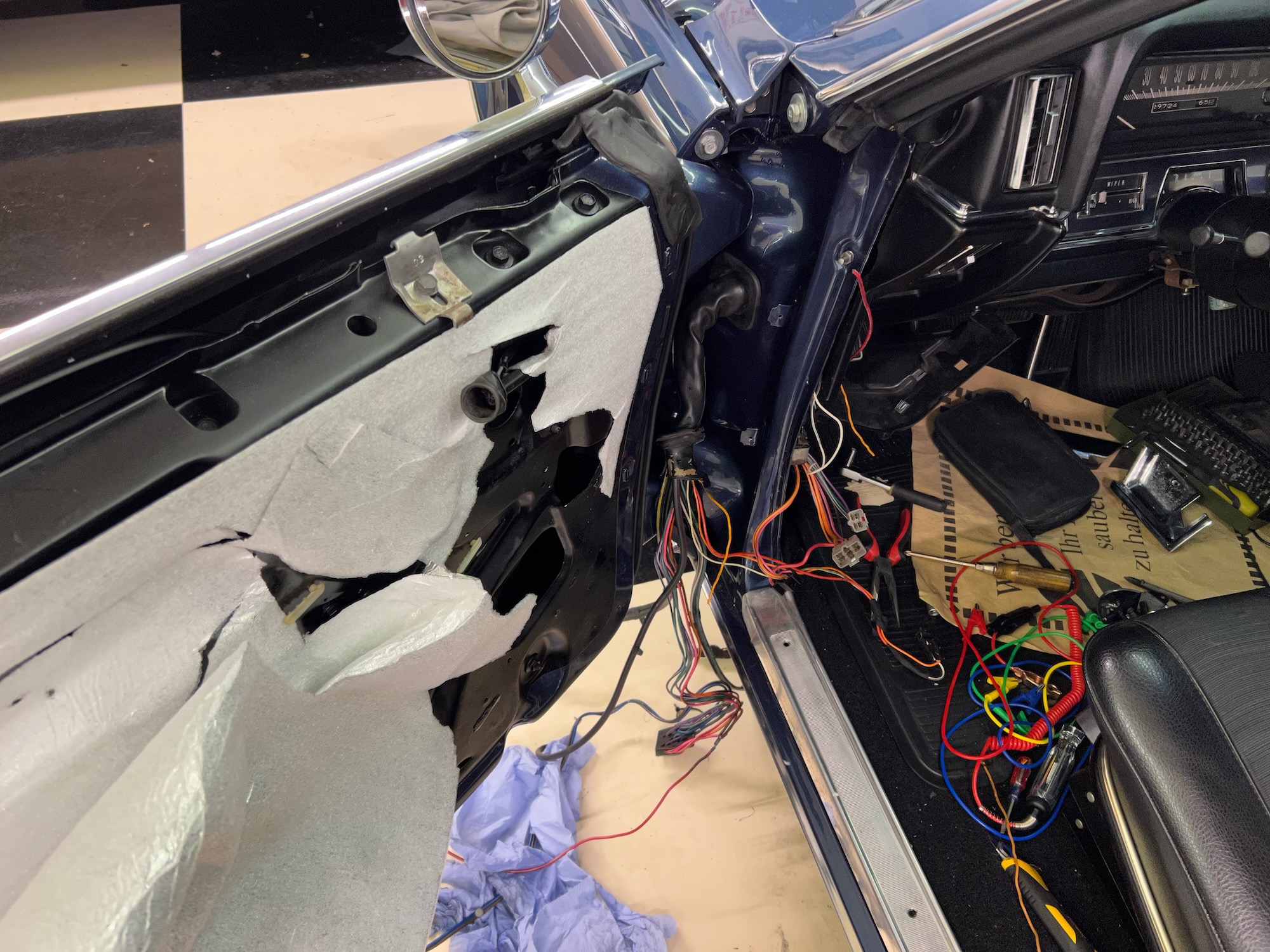
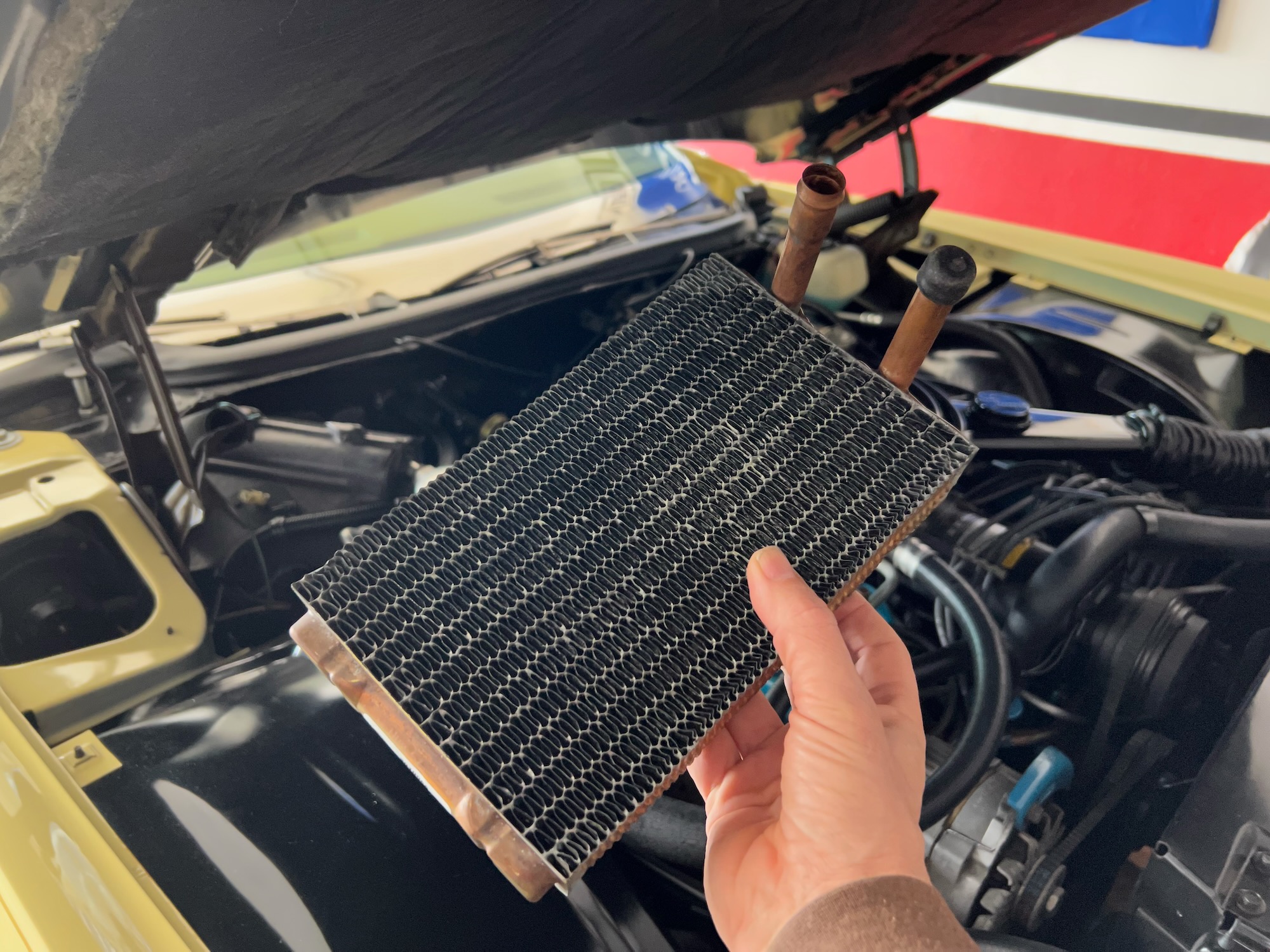
1978 CADILLAC ELDORADO HEATER CORE REPLACEMENT
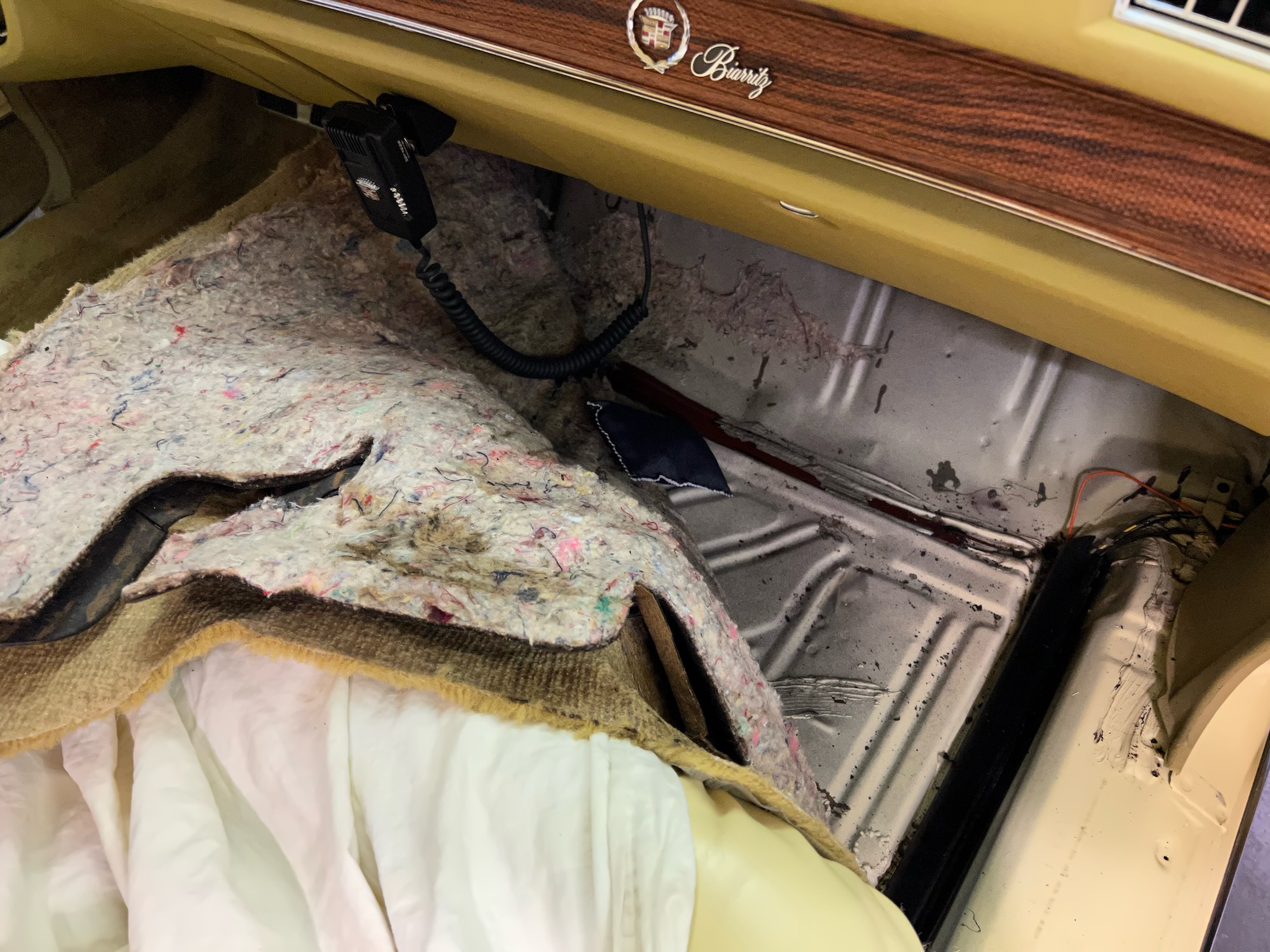
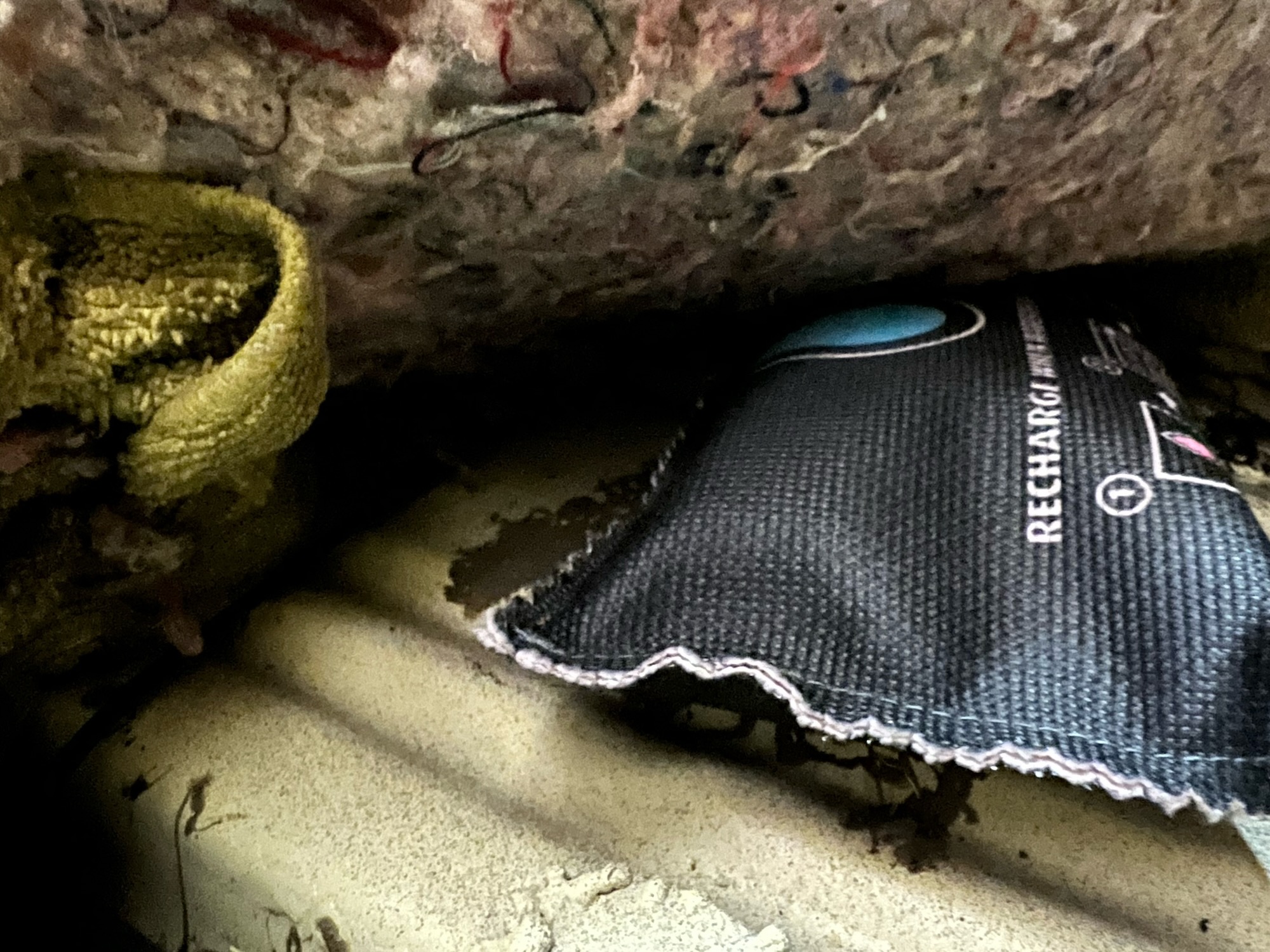
THE 1966 UNDERCARRIAGE PROJECT - LONG POST!
VIDEO RECAP
I did not plan to do a video about the restoration, but here is a short collage of some footage I had: (on youtube you can watch it in 4k HDR
This is a short video showing what was done
BEFORE
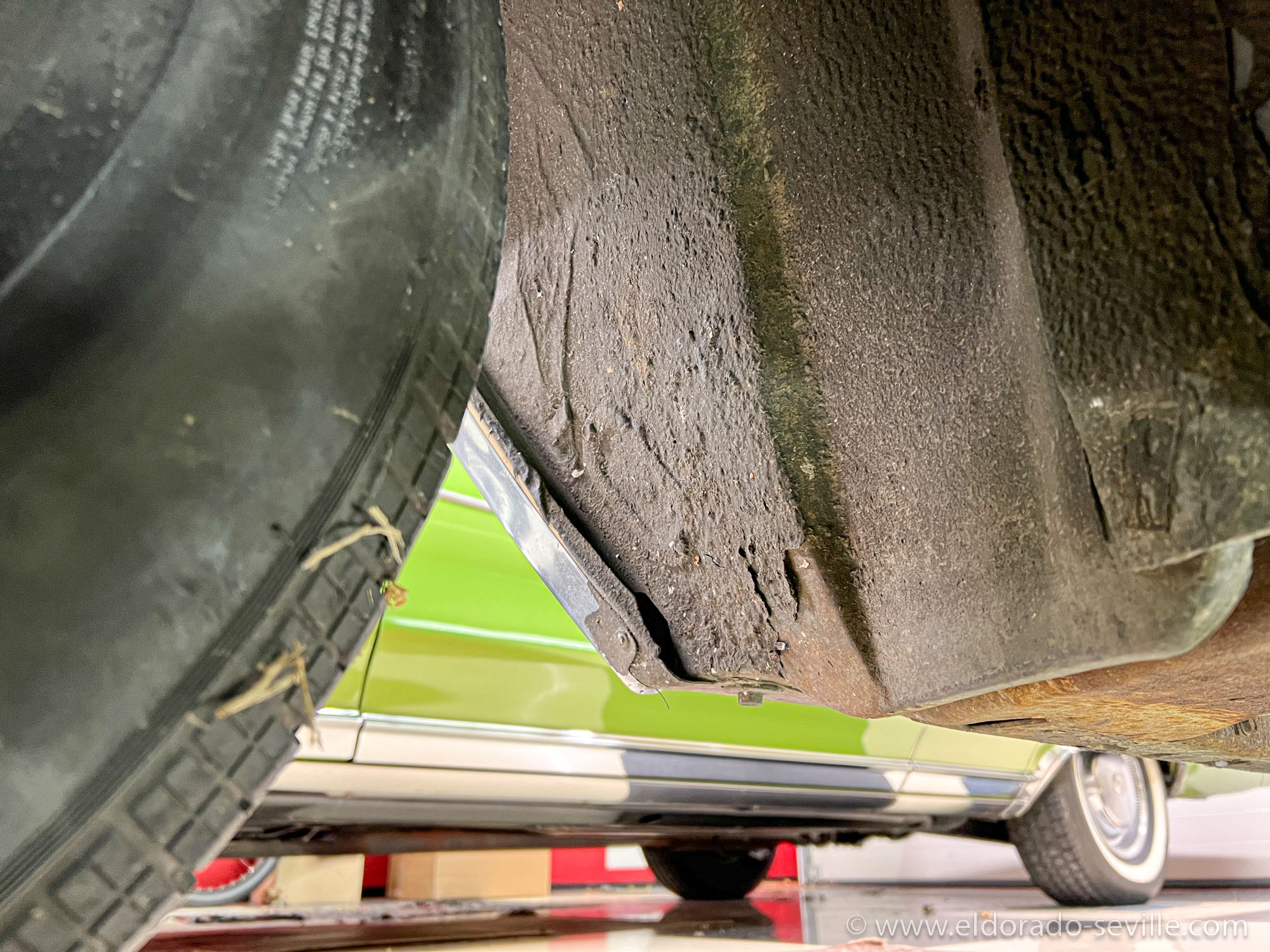
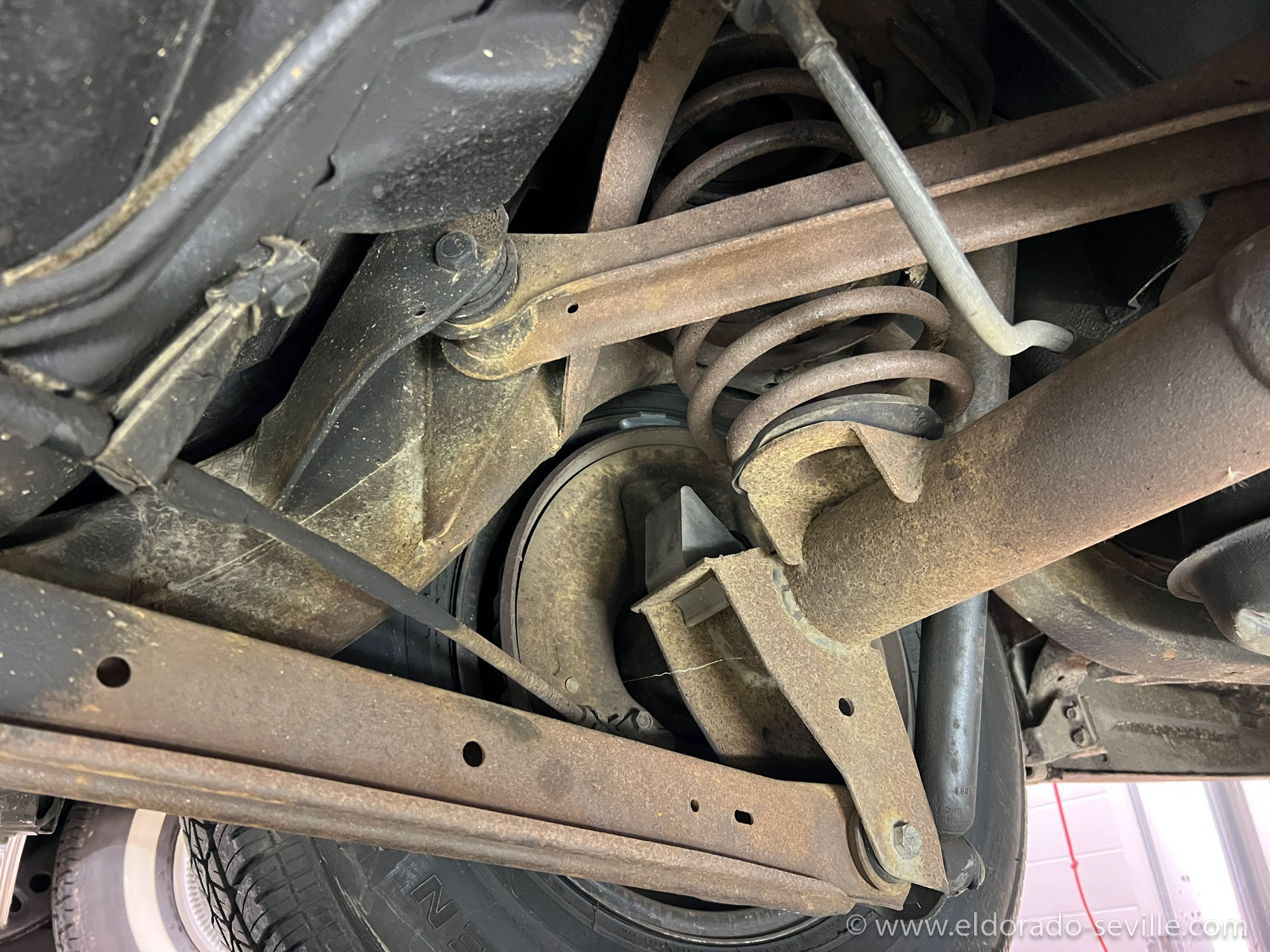
Some "BEFORE" pictures showing how the car looked before I started working on it.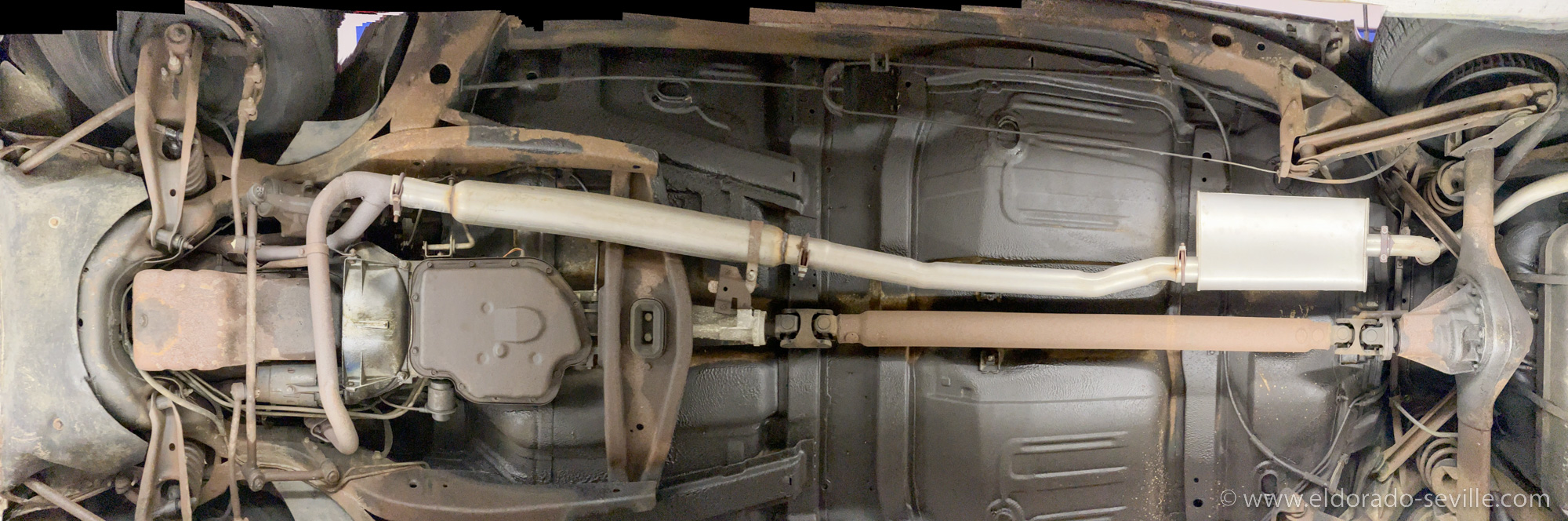
AFTER
This is how it looks now - after all the work I did. Click to see the full report.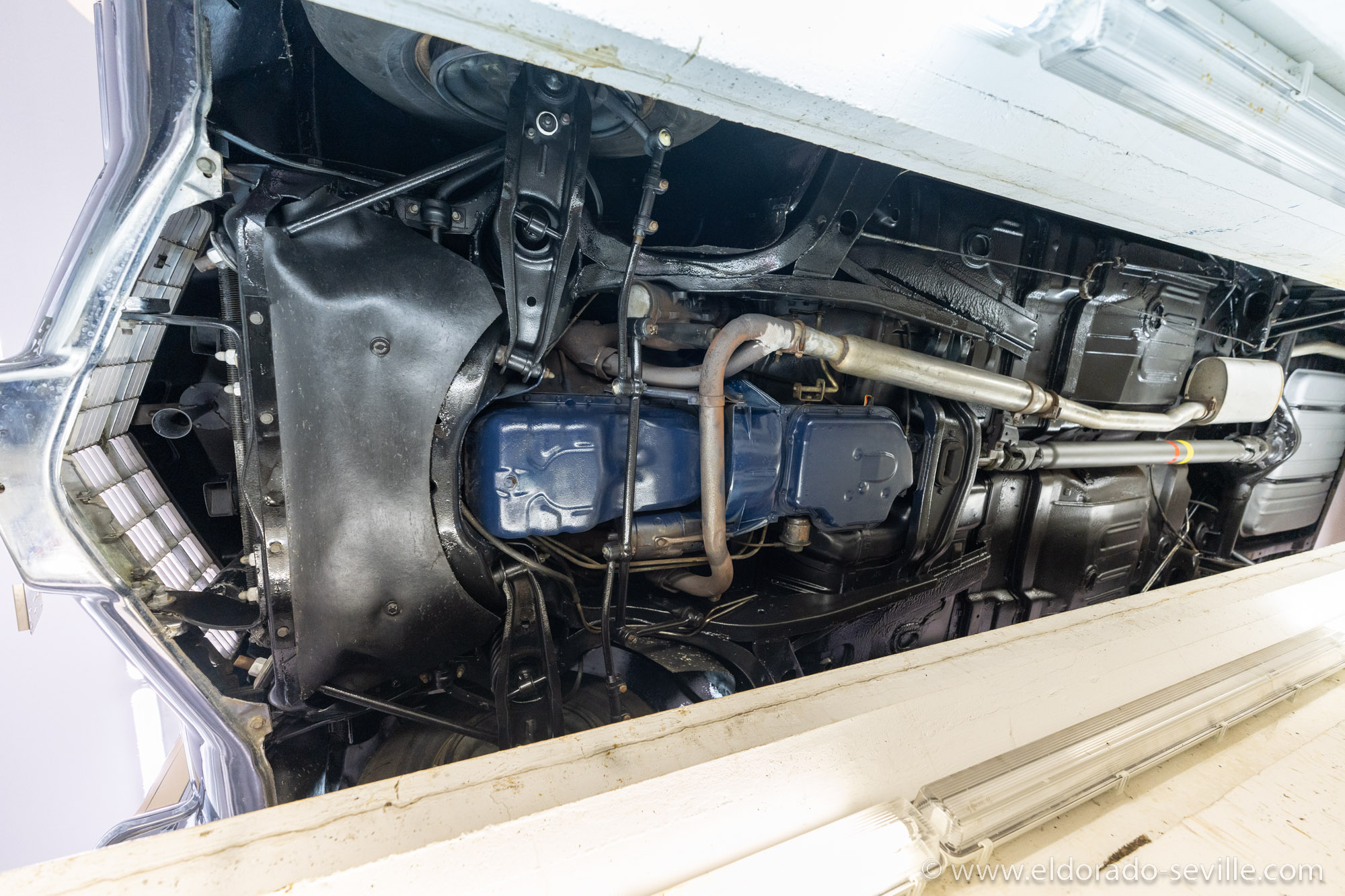
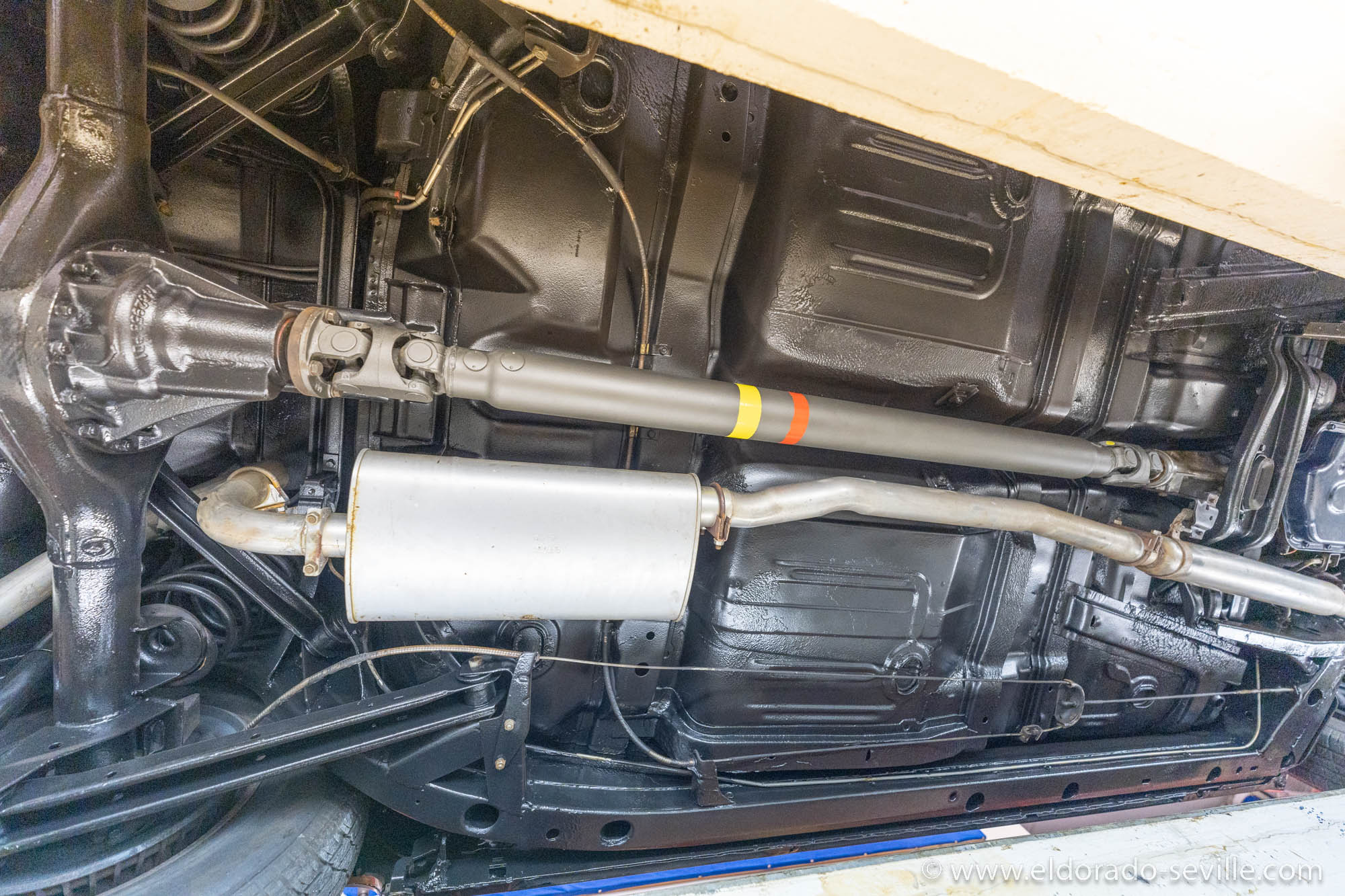
READ MORE...
1966 AC BLOWER VACUUM MASTER SWITCH
I rebuilt the carburetor and let the car idle for a while. During this I wanted all accessories to move and also turned on the heat. It came on as always and after about 30sec the blower went off again. The power servo started to move in and out all the time by itself, but the blower would stay off. The idle speed up came on and off as well depending on the placement of the power servo. After a while it stopped doing this and stayed in the fully retracted position (full heat). If I turned the temperature dial it did not change anything - but it was around freezing outside and this is what it should, do as the sensors sense the low temperatures and then send the system into full heating mode.
I checked the following things.
- Master Switch seemed to work and gets engaged by vacuum. Power is going through it as it should. Current is going in and out. (This is what I thought…)
- Blower Motor tested with a direct feed - worked
- Blower Motor Relay - tested. Put a 12 V feed to the dark blue connector and it engaged and the blower motor came on. There was no current coming through the blue wire though.
- Power Servo - cleaned all contacts and measured the resistance in all positions - looked good to me
- Control Head in Dash - removed it and checked the blower switches - it seemed to work.
Full vacuum was applied to the power servo, and I also checked the vacuum and voltage at the transducer. I also checked all vacuum actuators with a vacuum gauge, but everything checked out perfectly.
I then put everything back together. Still the system did not work in the full heat position. I did a lot more tests and checked the vacuum and electrical diagrams.
I ordered the 1966 AC manual from "Cadillac Tim" which is available also on ebay for $45,- . These instructions are a must-have for your car, as everything about the AC system is explained very well by Tim. There is a great troubleshooting guide in there. Its money well spent! Tim also offers a rebuild service for many Cadillac parts and has a great selection of refurbished parts. Check out his website!
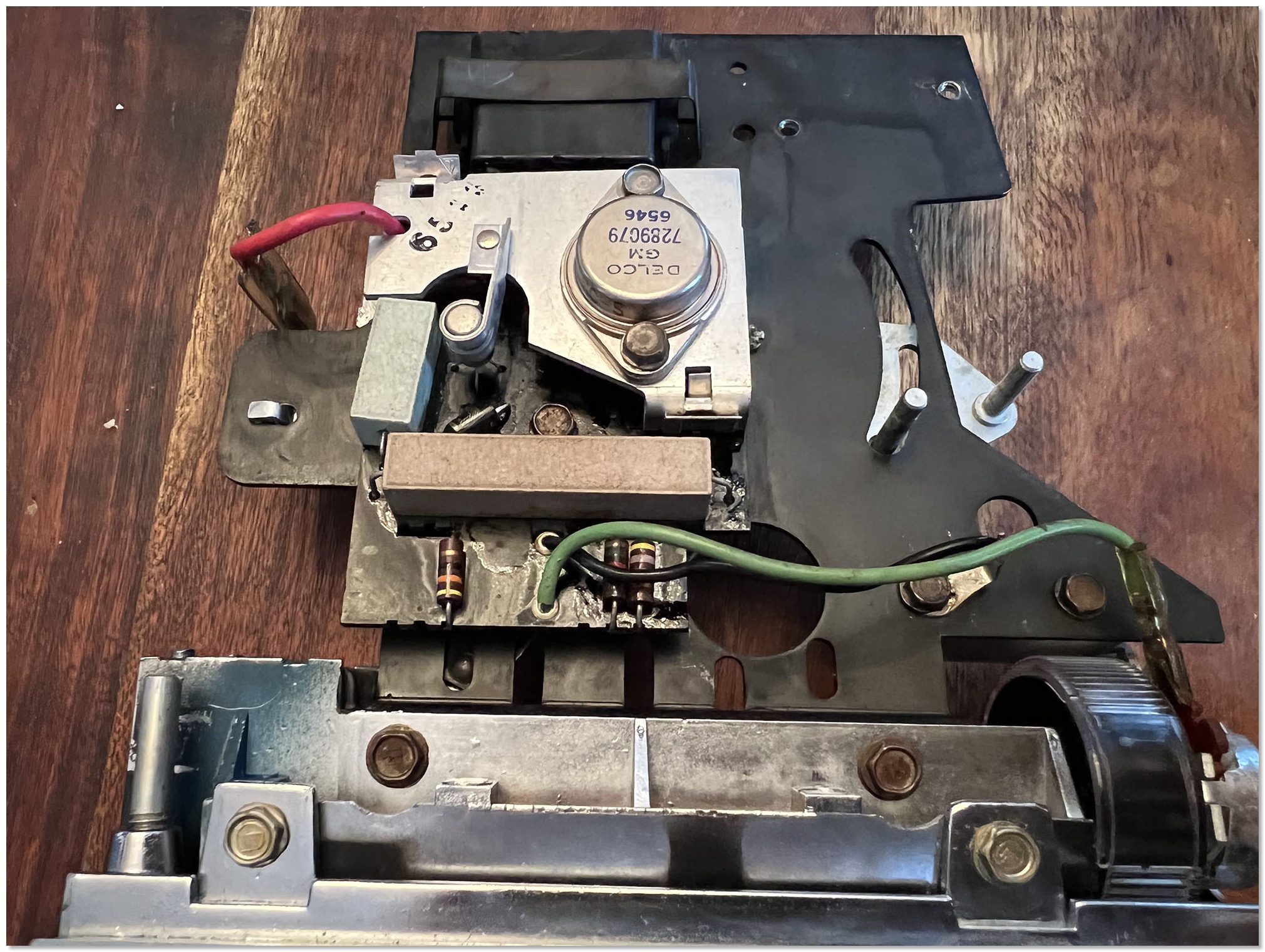
The 1966 dash control unit - here you can see the amplifier part.
After days of troubleshooting it finally dawned on me where the problem was. I had checked the master vacuum switch multiple times and when checked it always had electrical continuity. But I did not check it correctly. I only pushed the backside of the switch until I heard a click.
I should have tested it with full vacuum applied. As it turned out, if high vacuum was applied to the switch (during heating mode), the switch did no longer work correctly!
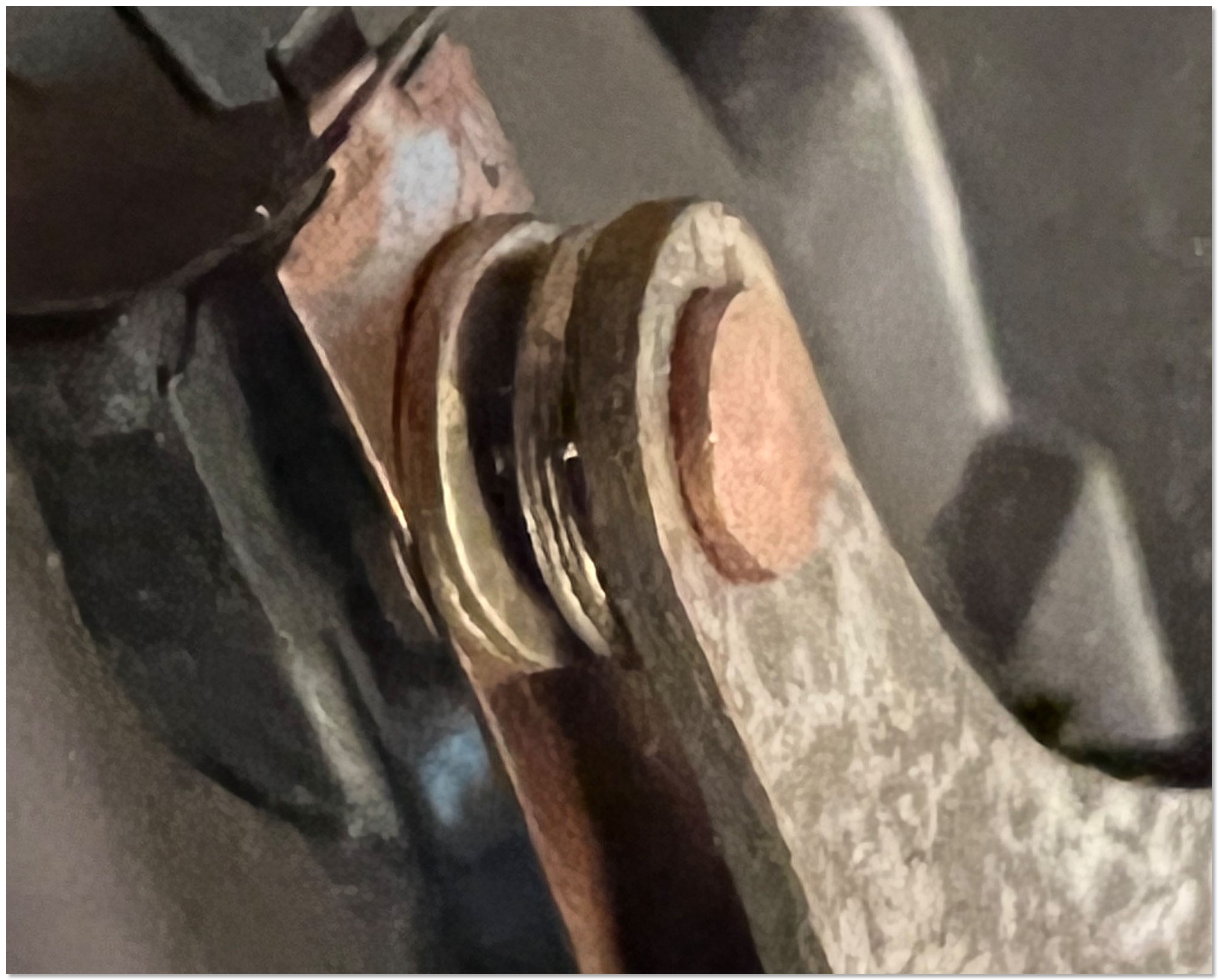 The contacts did no longer touch when full vacuum was applied to the switch…
Today I took it apart and made a video about it. As it turned out the switch contacts did not align as they should and I had to bend it a little bit to make it work again. I then put everything back together and now the AC system works perfectly again. Check out the video for all the details!
1978 ACCELERATOR PUMP REPAIR
The car would have a slight hesitation for one or two seconds when driving away from standing still and idling. The hesitation was not present at any higher speeds - only when starting from standing still, no matter how hard I hit the pedal.
Once the car was rolling, it ran perfectly. 2 or 3 times the engine even stalled in the past.
That's why I suspected the accelerator pump.
Replacing it is not too difficult. You basically only need a rebuild kit and remove the carburetor from the car. Then you have to remove 8 screws to take the top off and remove 2 linkages. I'm not a carburetor expert at all, but luckily my friends ,who did the job before, helped me, but it really is not difficult at all. I found some great how-to video on YouTube on how the Quadrajets are taken apart and back together - They have some very informative videos on their youtube channel - here is one of them:
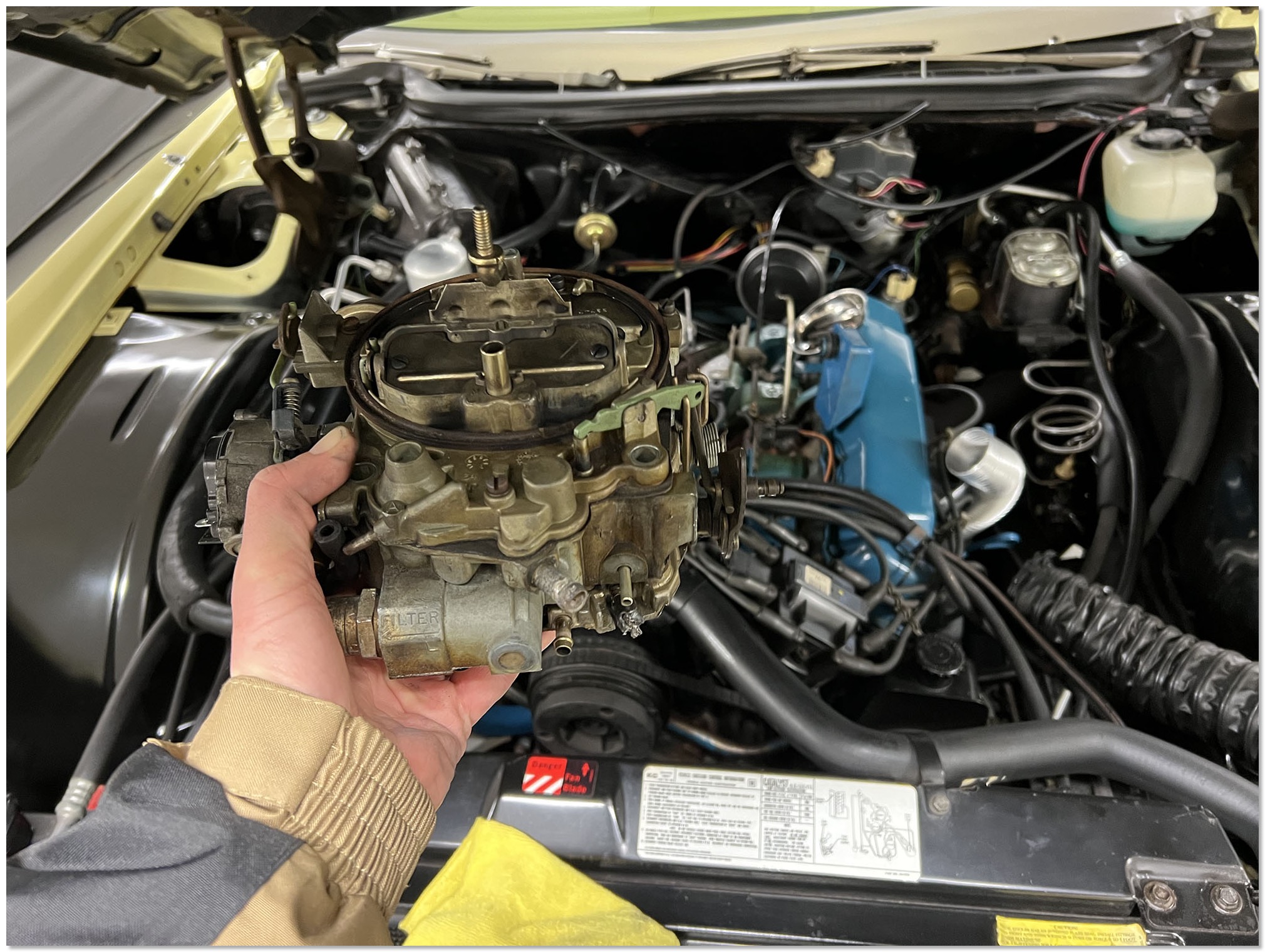 The Quadrajet after removal.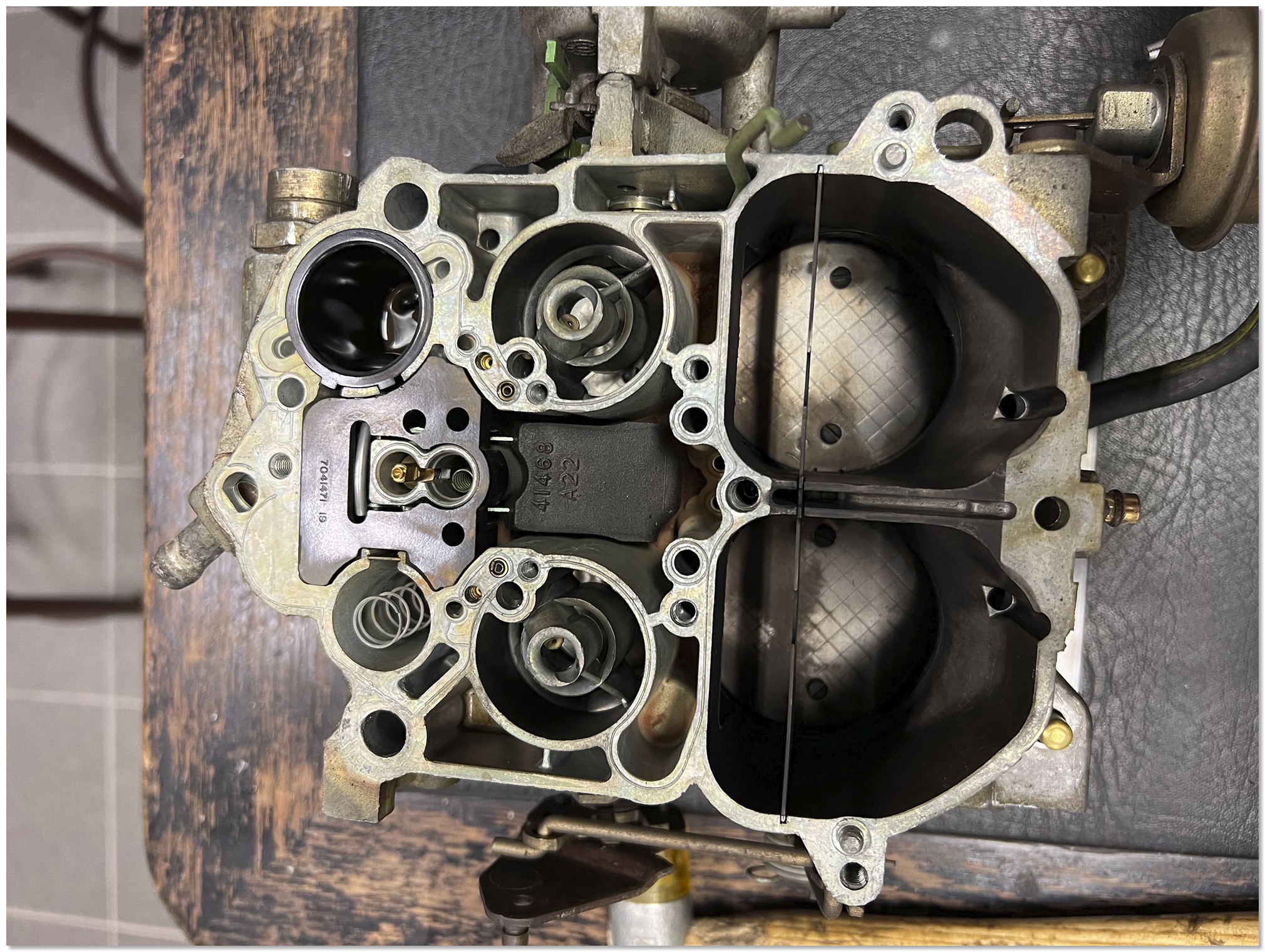
The Quadrajet with the top removed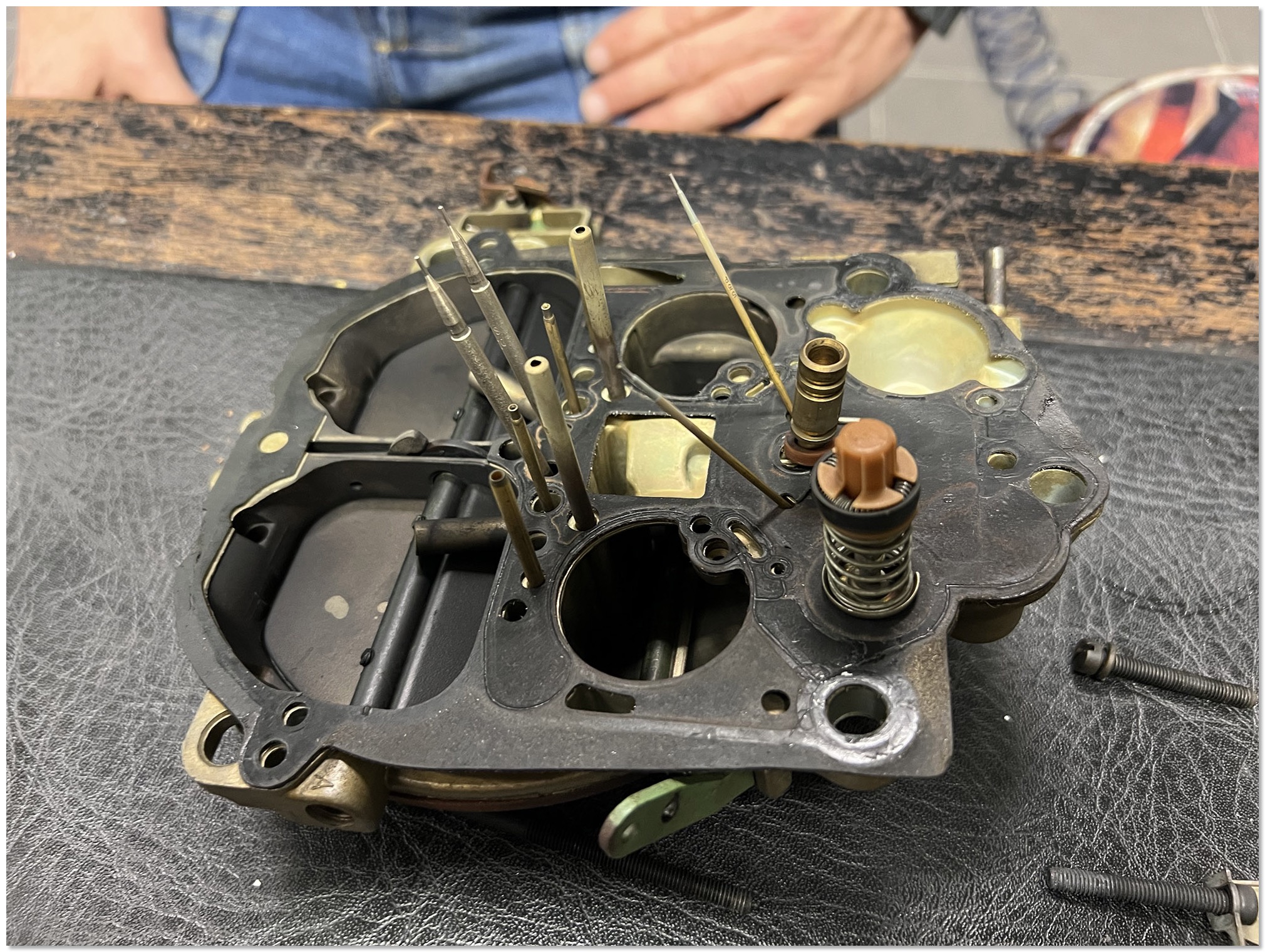 The accelerator pump on the right side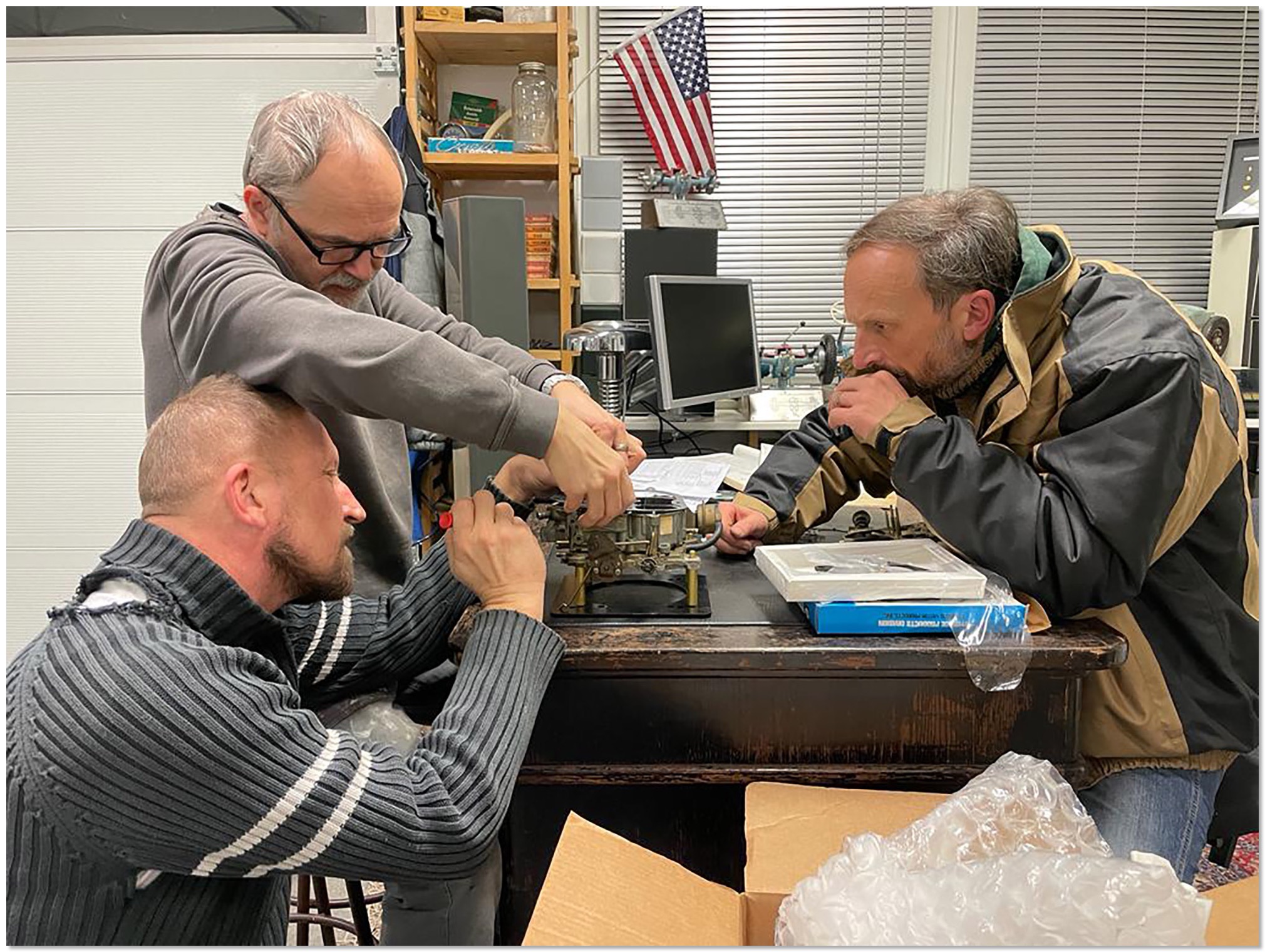
My friends Steve and Lucky helped a lot. Thanks my friends! We did all the work in Luckys fantastic garage and shop.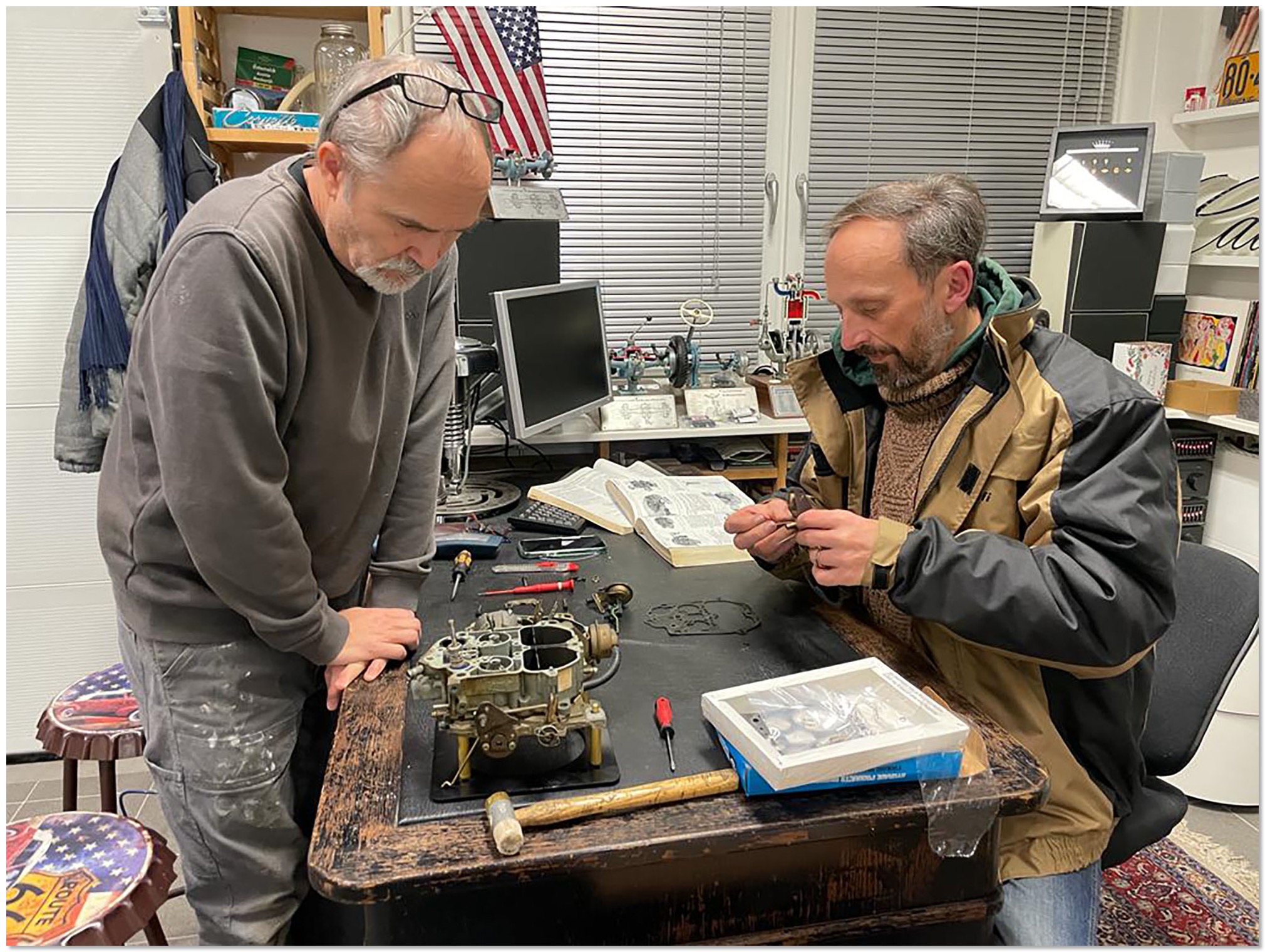
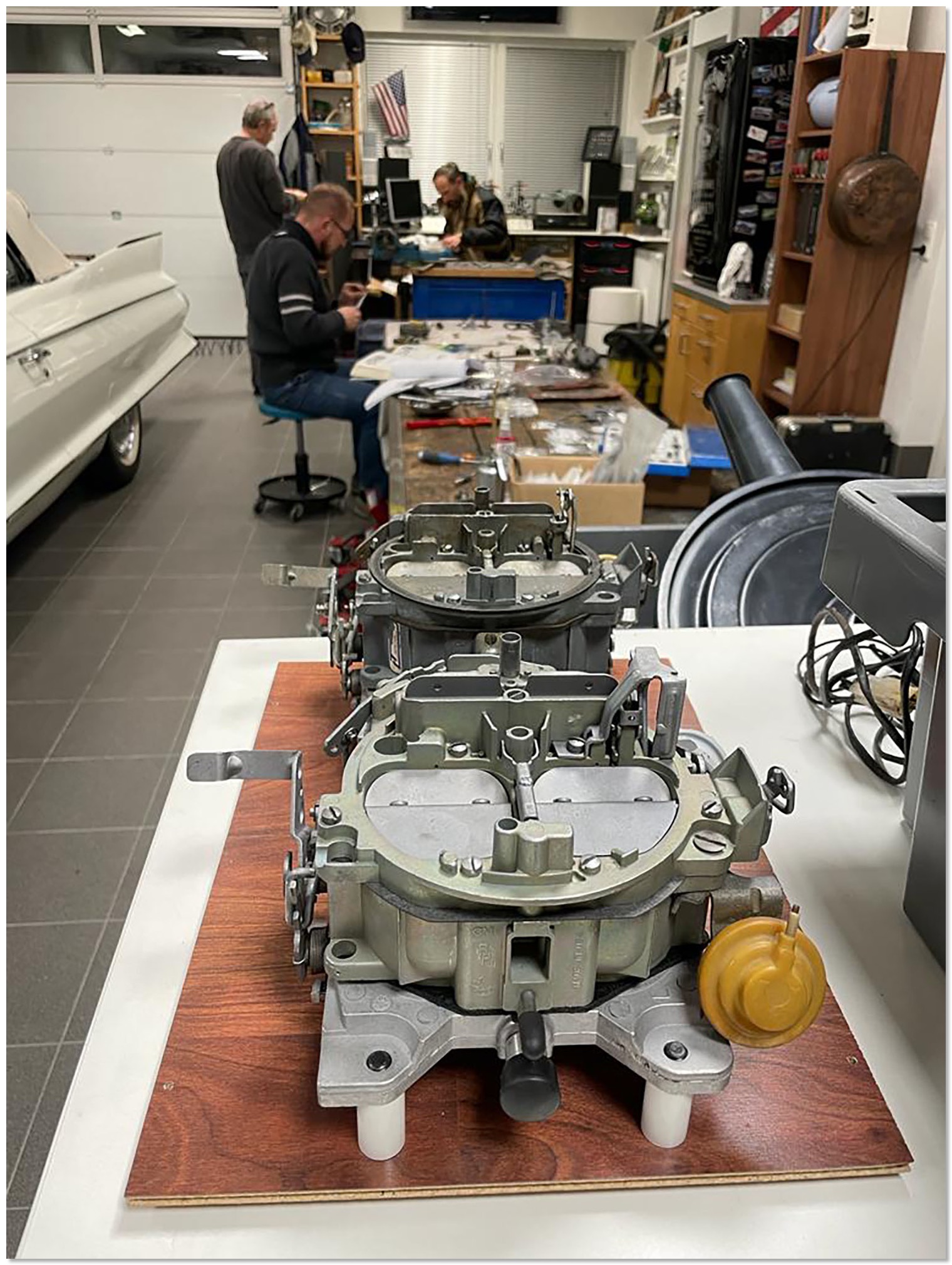 We had "Carburetor Monday" as everybody was working on their carburetors.
We replaced the pump rubber and put everything back together. The carburetor looked very clean inside with only minor deposits, so we left everything else as it was.
I can't wait to install it back into the car and hope the problem is fixed - did not do a full rebuild as it is still very clean and nice inside. Only installed new rubber on the pump and new top gaskets. Hopefully the problem is fixed now. I will update the page once the carb is back in the car.
1966 HOT CHOKE CARBURETOR REPAIR
I removed the choke housing from the car and it was completely stuck and did not move at all. Both the lever and the counter weight were completely frozen up although everything inside the housing looked pretty clean.
First I tried anti seize oil which did not change anything. Then I soaked the unit in a parts cleaner solution over night which did not free it up either. The next day I soaked it in a rust removing solution which did not help either. I then put it in a can of transmission fluid for a while.
In-between I always gently tried to move it and suddenly it freed up and now works perfectly smooth again. I put the carburetor back together and now the car is very easy to start again - even on a very cold day.
The choke after repair.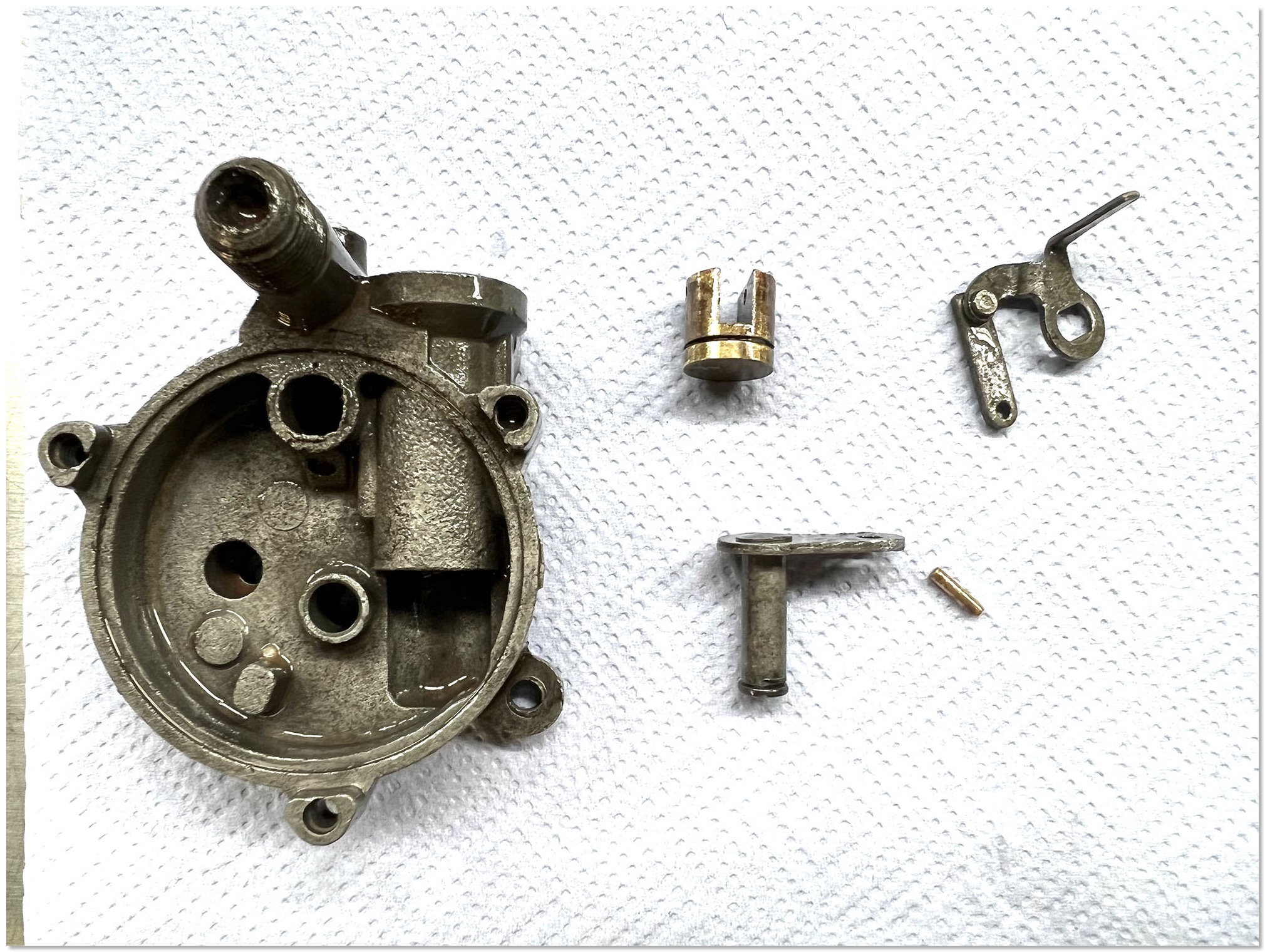 The choke mechanism disassembled for repair after I managed to free it up.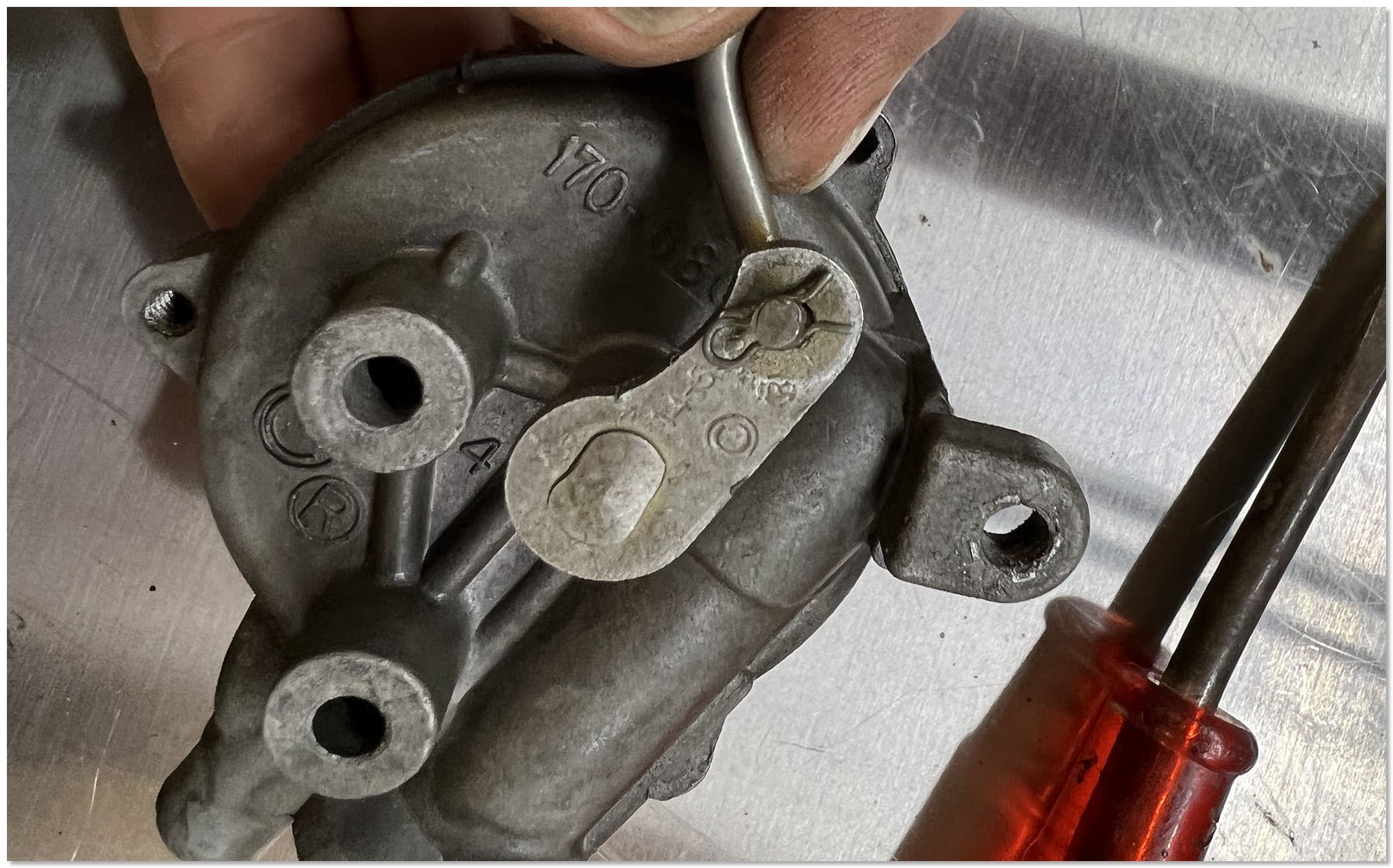
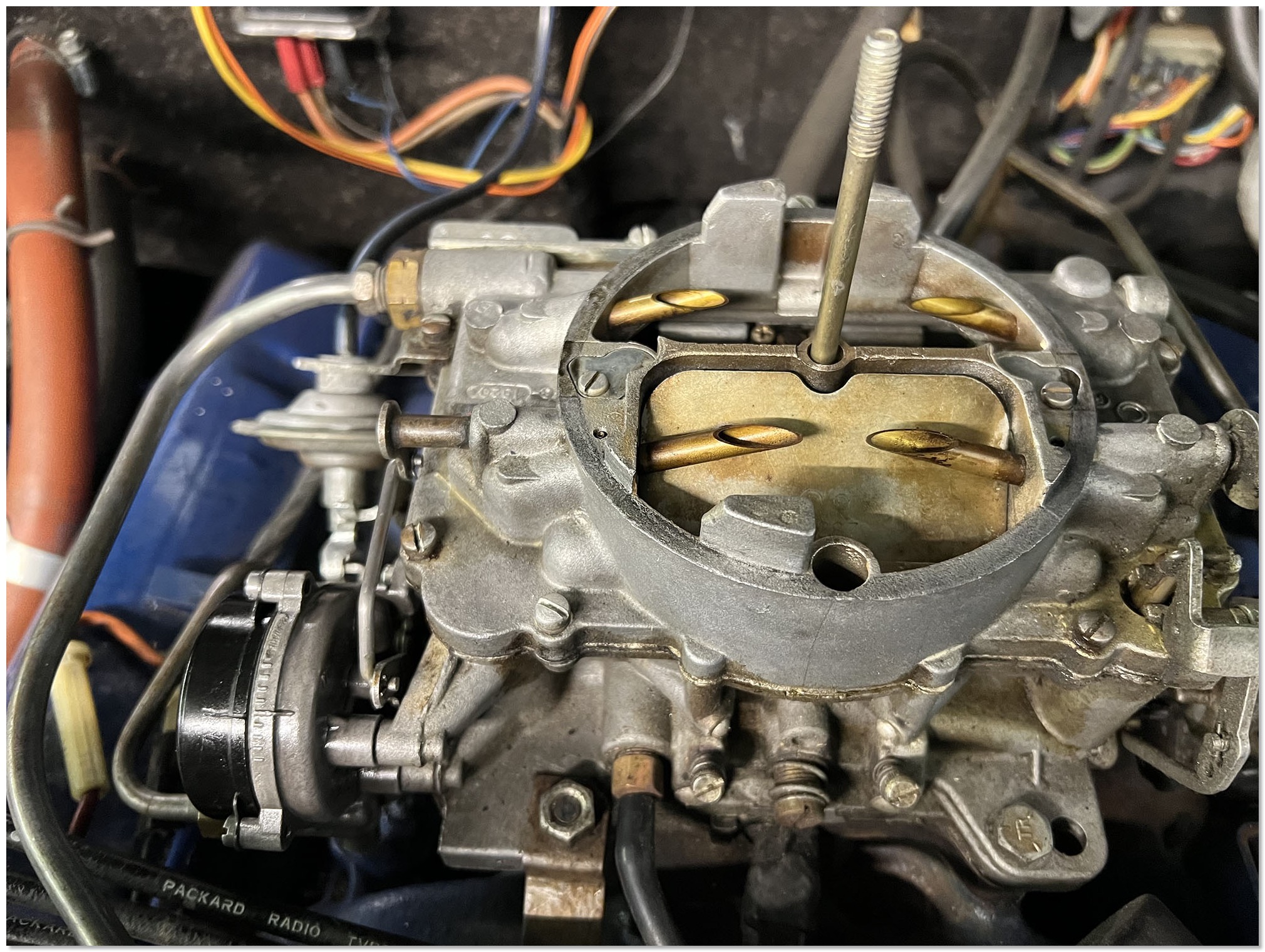
1967 ELDORADO CARBURETOR REPLACEMENT
The Eldorado now purrs like a kitten again with its new Quadrajet. I now have two more carburetors to do - the 1966 has a stuck choke and the 1978 needs a new accelerator pump.... The video is also available on YouTube in 4K HDR quality...
I took a short video of the installation process.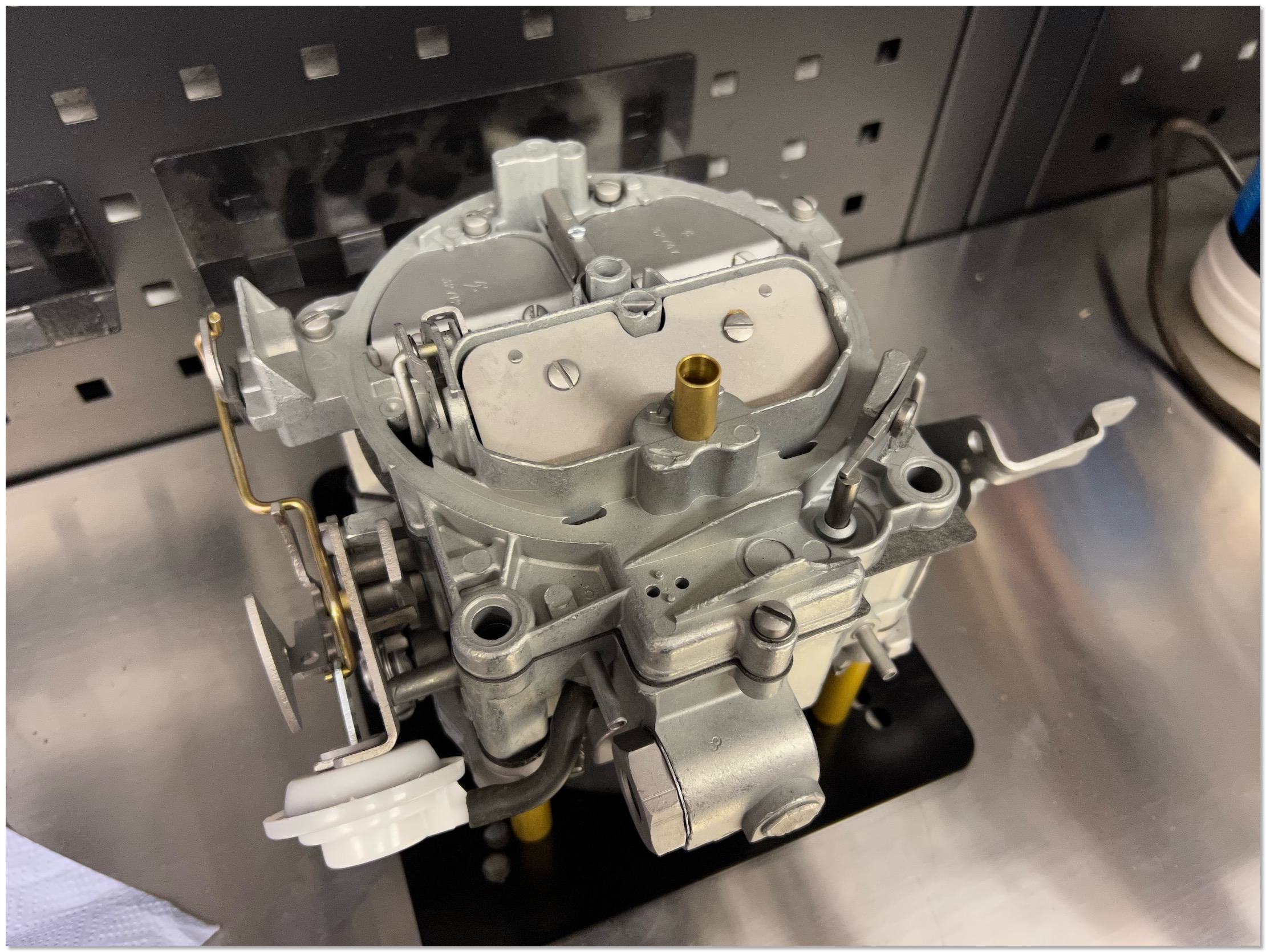
The rebuilt Quadrajet on the bench.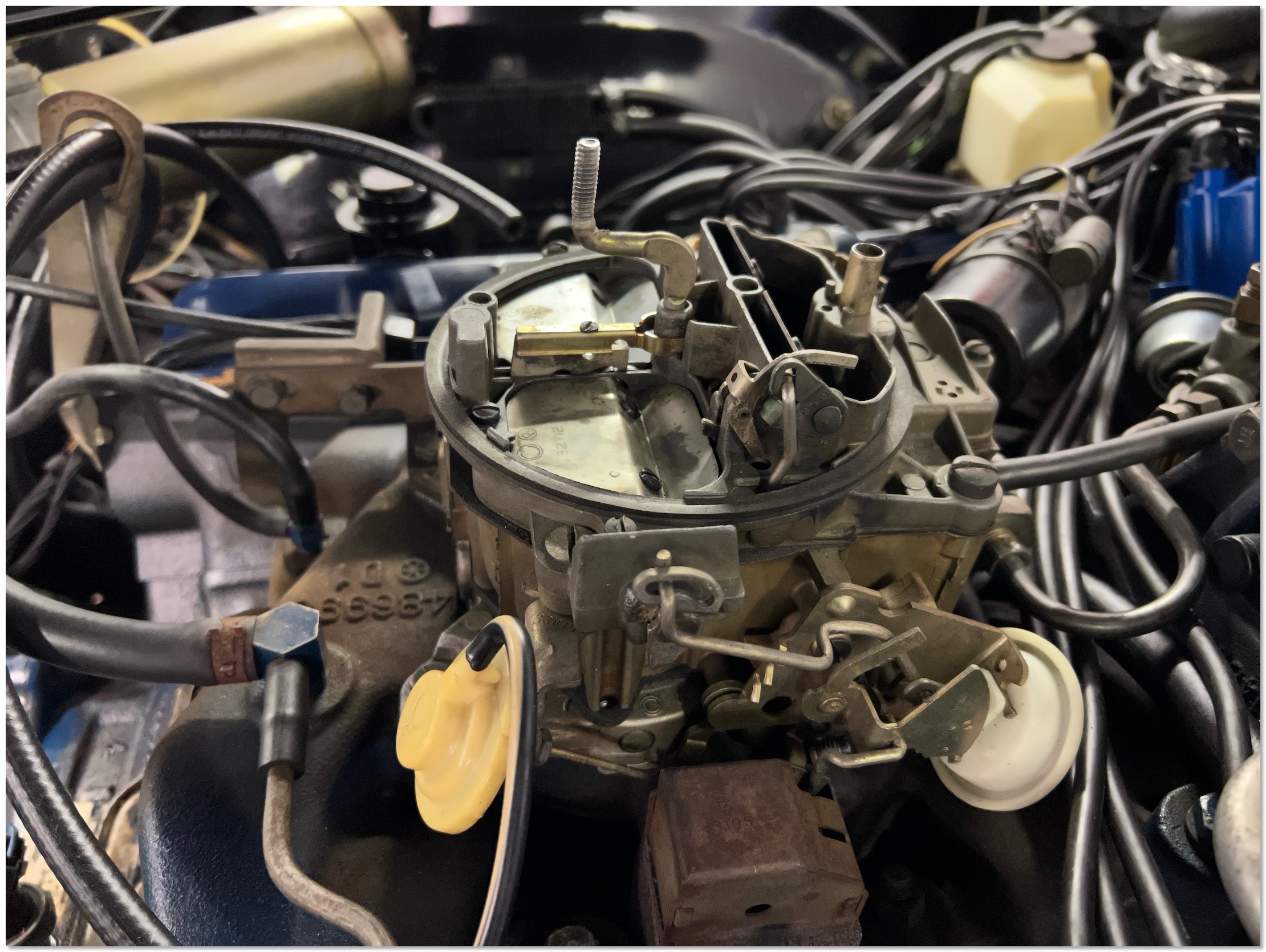
The old original 1967 Eldorado Quadrajet - this is the non California version.
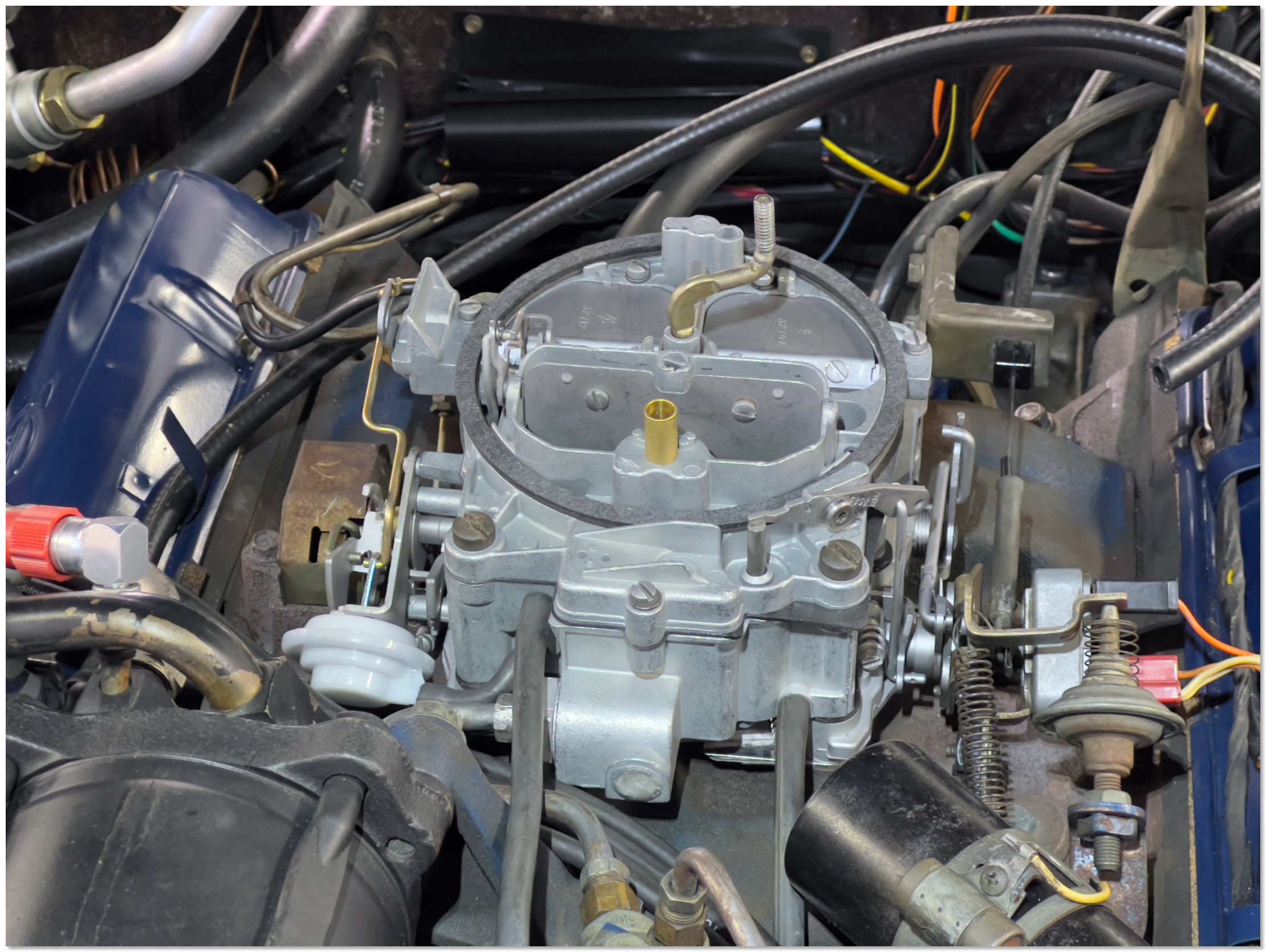
The rebuilt Quadrajet installed.
1966 UNDERCARRIAGE CLEAN UP PROJECT
To make the car perfect again I will also dry ice blast the undercarriage and totally clean it up like I did on my 74 and the Roadmaster to preserve it as good as possible.
Today I started to brush some of the surface rust away. After that I will apply some rust remover.
I took some "before" pictures and a video.
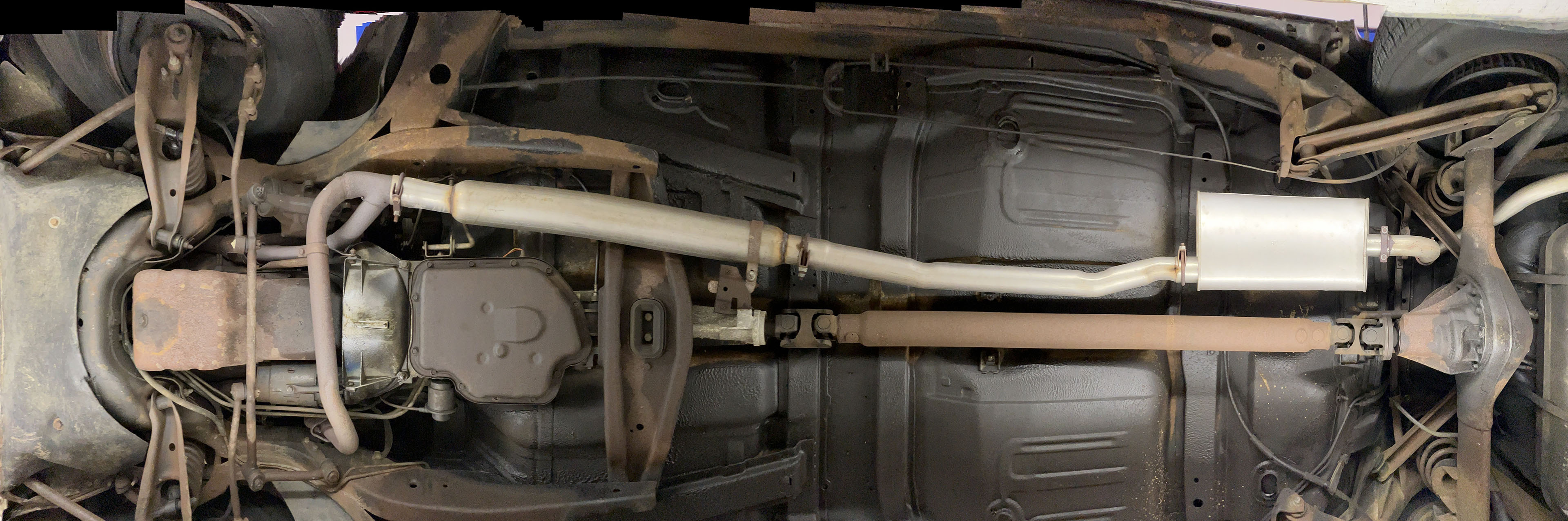
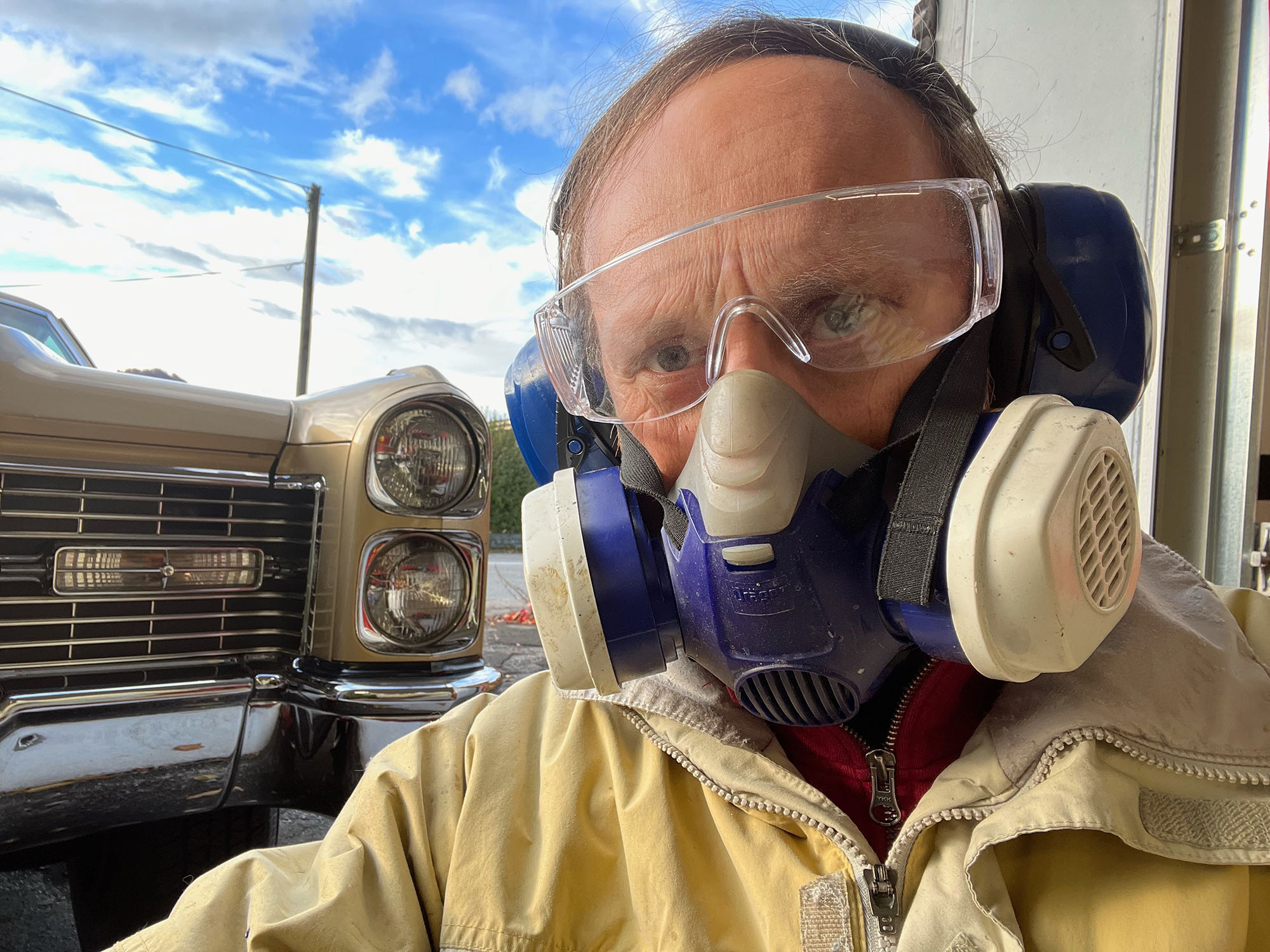
It will be a long and dirty job…
THE 1966 COUPE DEVILLE IS BACK
Through a couple of car trades within my Cadillac friend community, the car became available again, and my dear friend Georg helped me to get it back.
I can't thank Georg enough - without him I would have never gotten the car back!
Today was the day to pick it up at my Georgs garage and drive it home, although I do not really have enough garage space anymore…
READ MORE!
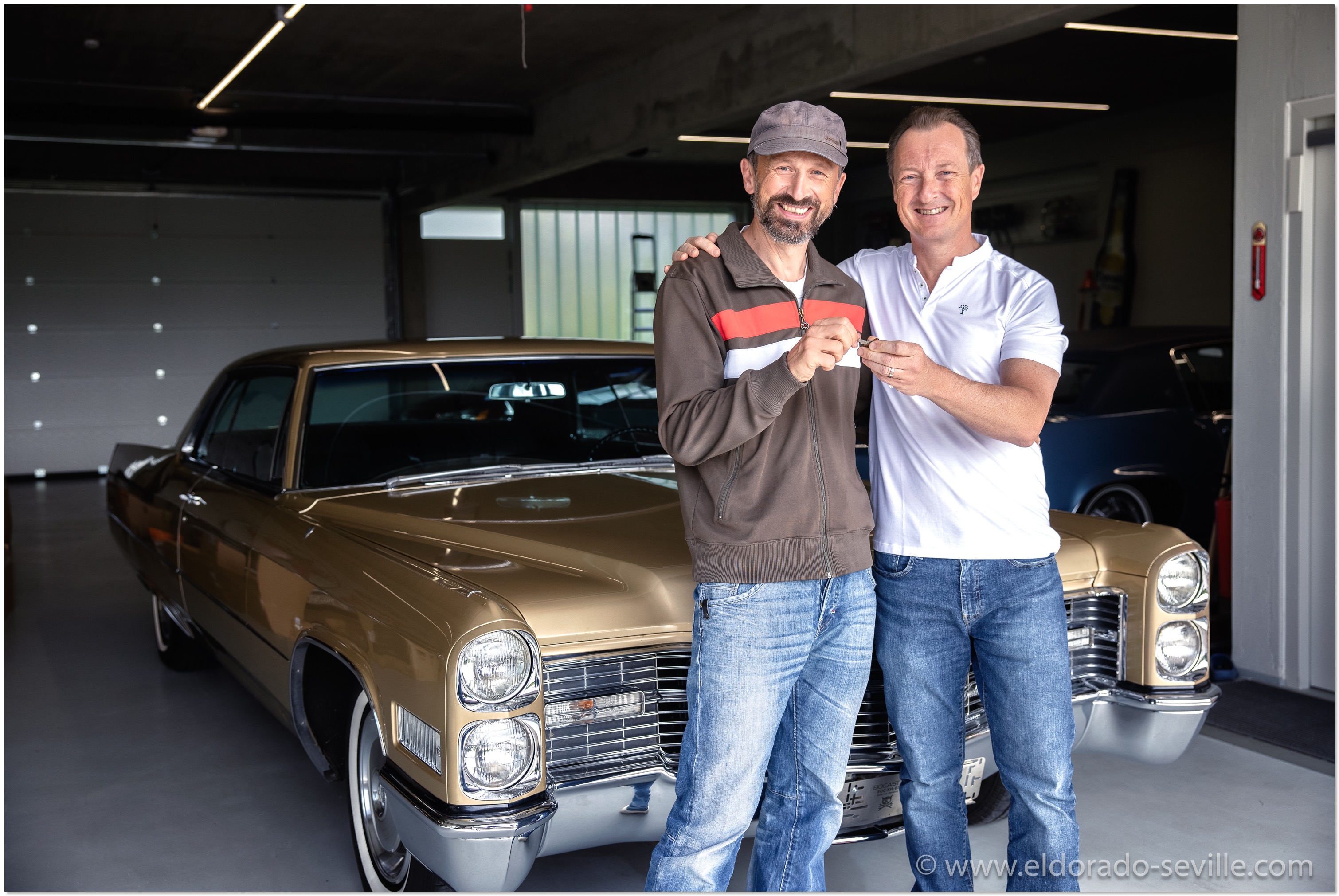
Taking over the keys - THANKS MY FRIEND!!!!
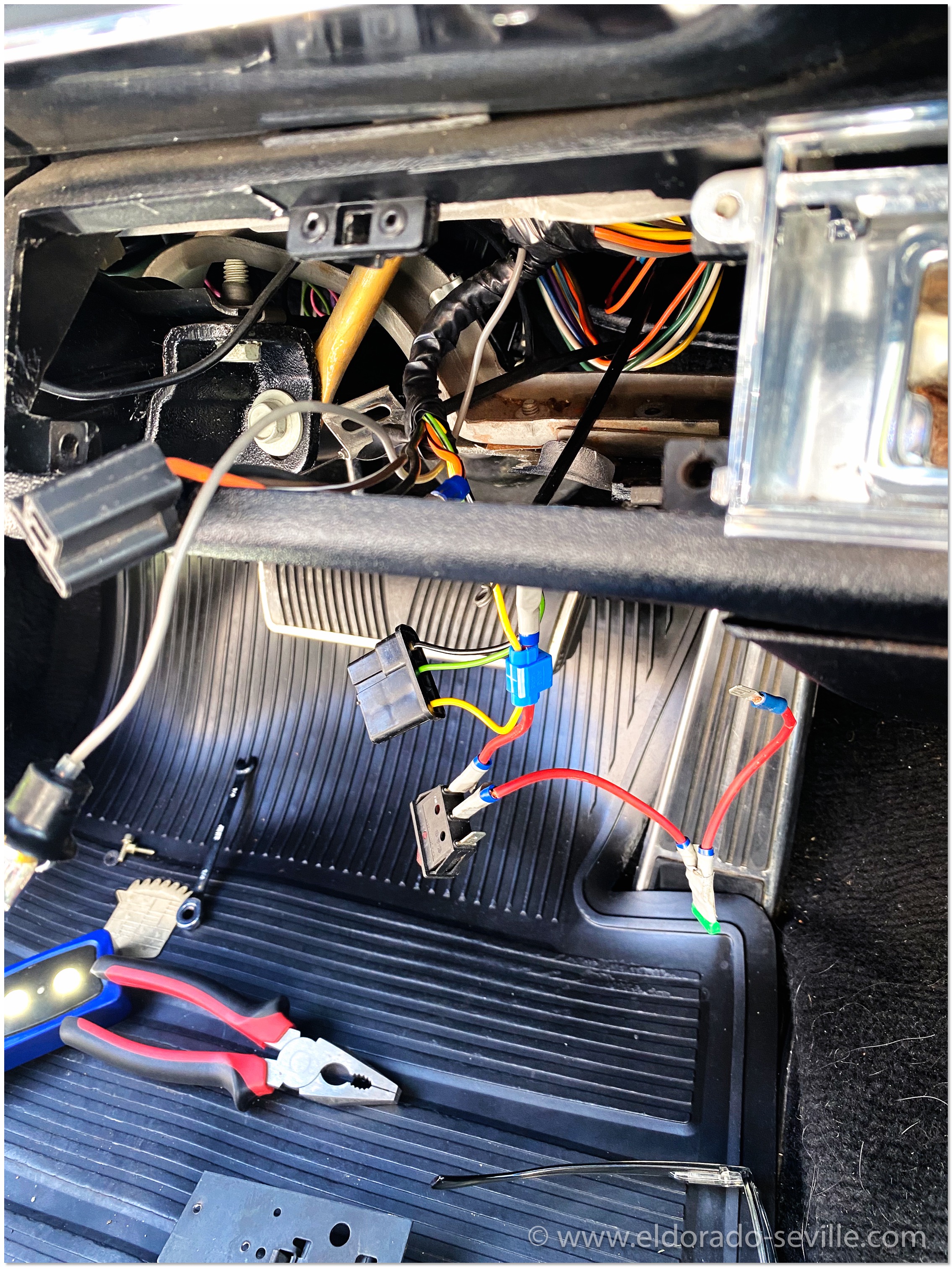
This is how the shop messed up the ATC system of the car… I reversed everything back to original!
READ MORE...UPDATE - REPLACING THE CV-JOINTS AND AXLES OF MY 1978 ELDORADO - BUSHINGS
One thing I completely overlooked when I installed replacement axles on my 1978 Biarritz is the fact that the mounting holes for the drive axle to output shaft are bigger on the replacement axles than the original ones. Because of this there is some play.
I did not notice this fact, but my friend Lucky found this problem when he wanted to install a replacement axle to a 67 Eldorado he had been working on. (BTW: There are no replacement axles available that would be an exact fit on a 67/68 Eldorado - you will always have to rebuild your original ones!)
Lucky came up with a perfect solution for this issue though. He found some reduction bushings from 7/16" to ⅜" made by Bates at a Harley Davidson parts shop.
These bushings are a perfect fit and also solve the problem of the too long bolts on the driver side axle. These bolts are too long because the mounting surface of the replacement axle is thinner than the original, and because of that I had to install spacers before.
With these bushings the original bolts do fit perfectly again!
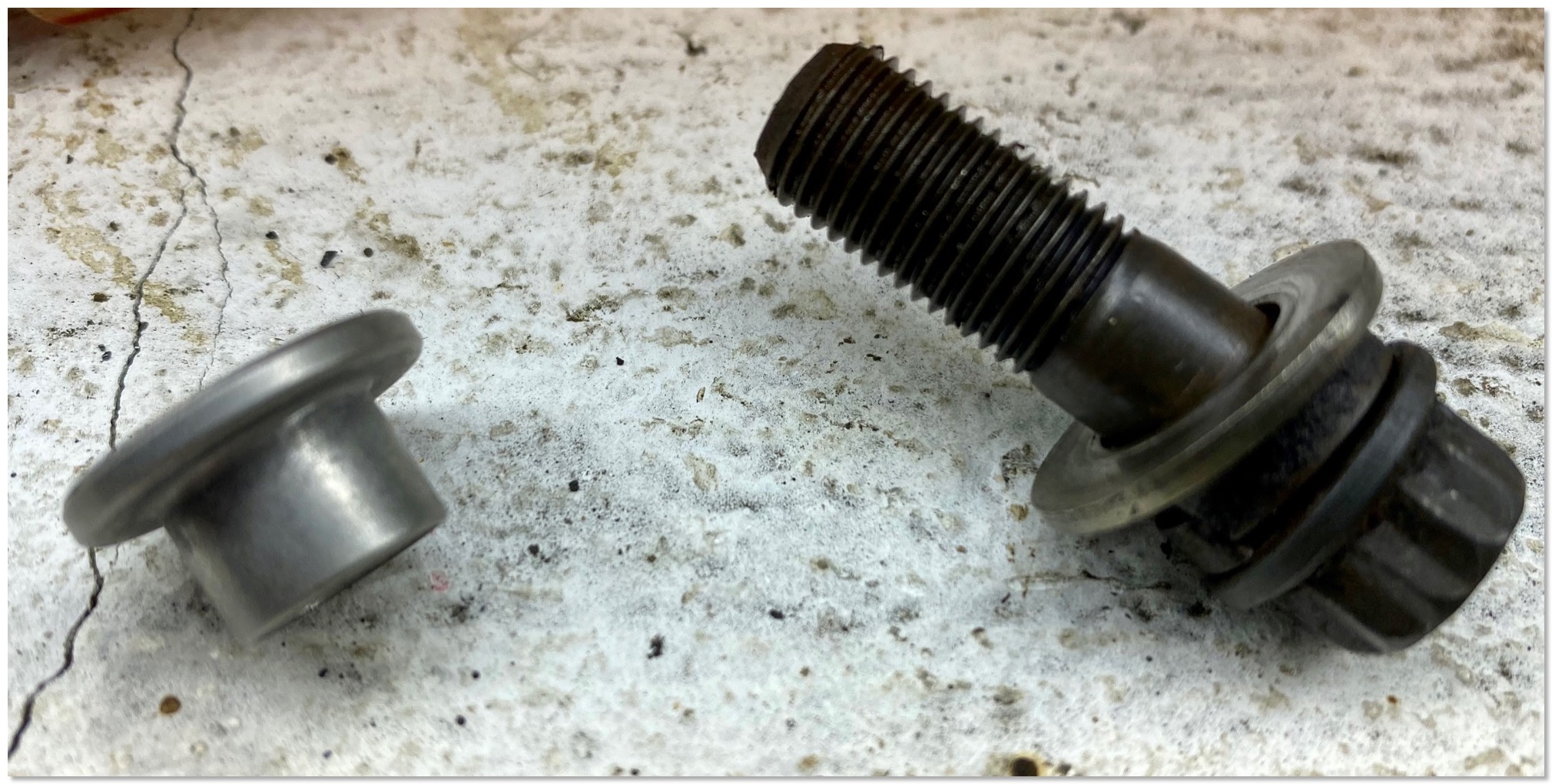
The bushing on the left - the bolt with a now no longer necessary spacer on the right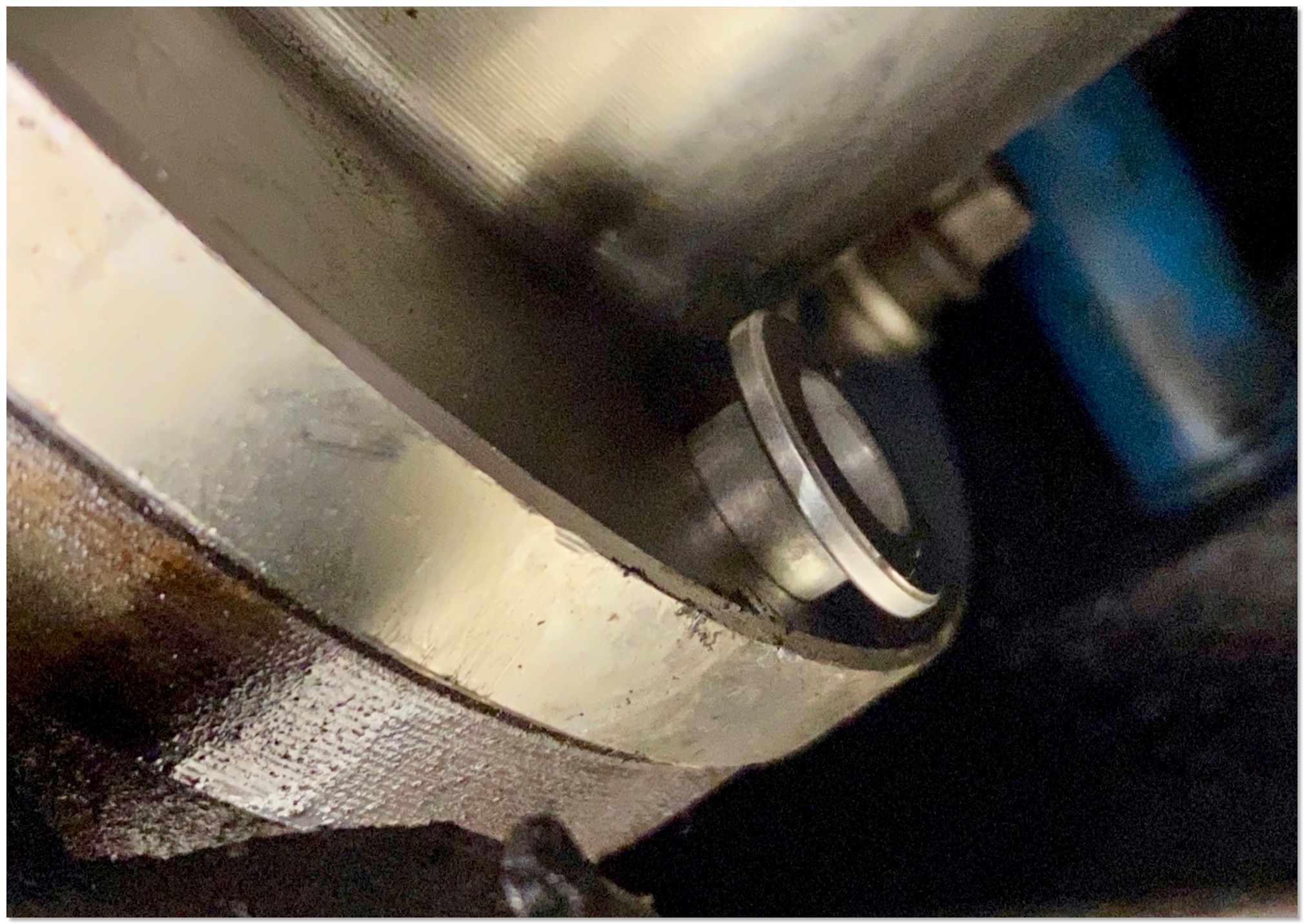
The bushing in place
REPAIRING THE FRONT DRUM BRAKE ADJUSTERS ON MY 67 DEVILLE
On the warmer side there was a slight brake drag while on the other side the wheel spun completely freely.
I did not notice any problem while braking and had the impression that the brakes worked evenly as the car did not pull in any direction.
When I now opened up the brakes…
READ MORE!
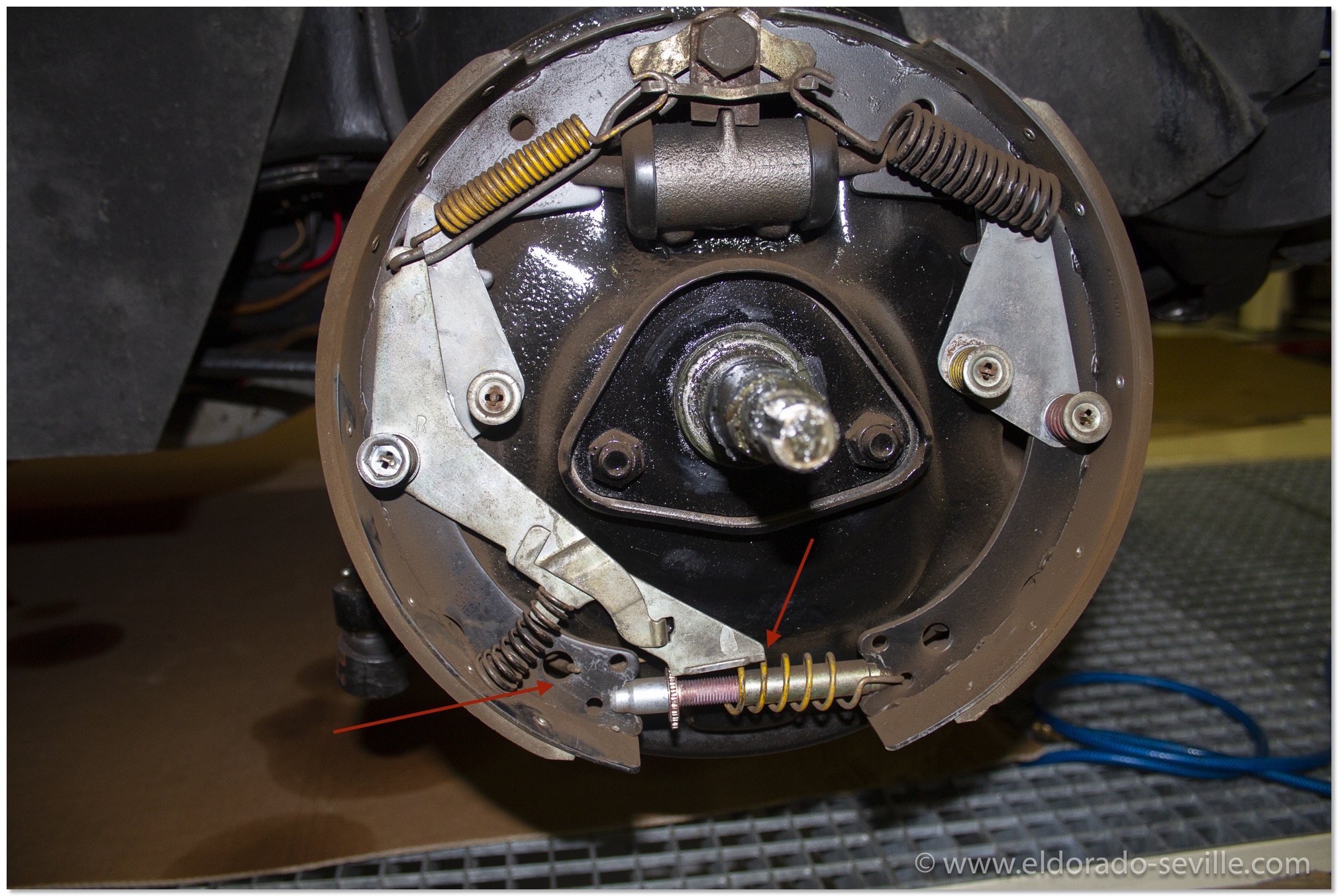 This is how the last shop which worked on my brakes assembled my right front brake… I will never let a "professional" touch my car again… They used the wrong spring and non fitting front adjusters. To make things worse they attached the wrong spring to the wrong holes in the brake shoes which stretched the spring and made it unusable.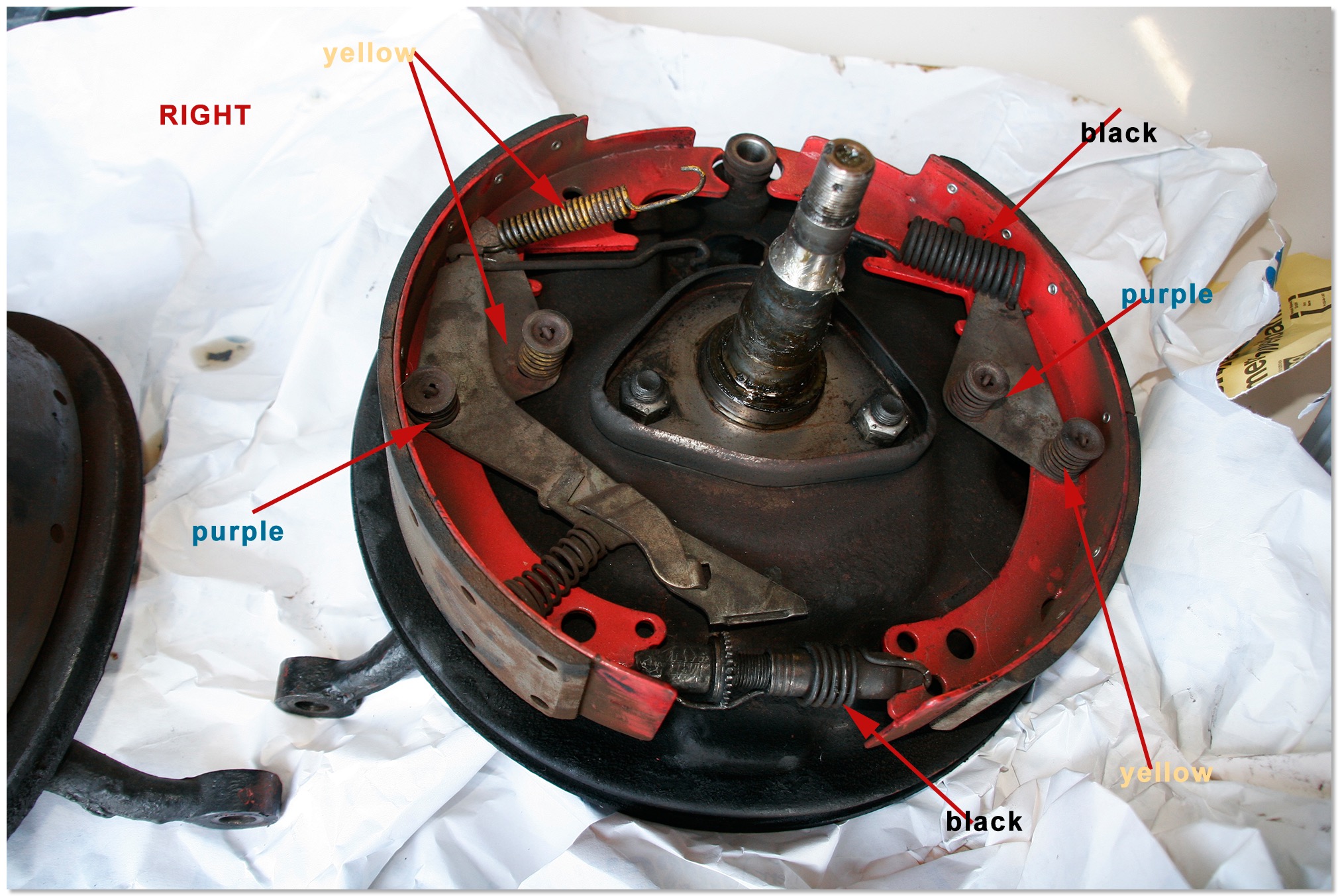
This is one of the many detailed pictures I provided to the shop to make sure they would reassemble the brakes correctly… They failed miserably!
MY 1967 ELDORADO BLEW A CARBURETOR GASKET (AGAIN)
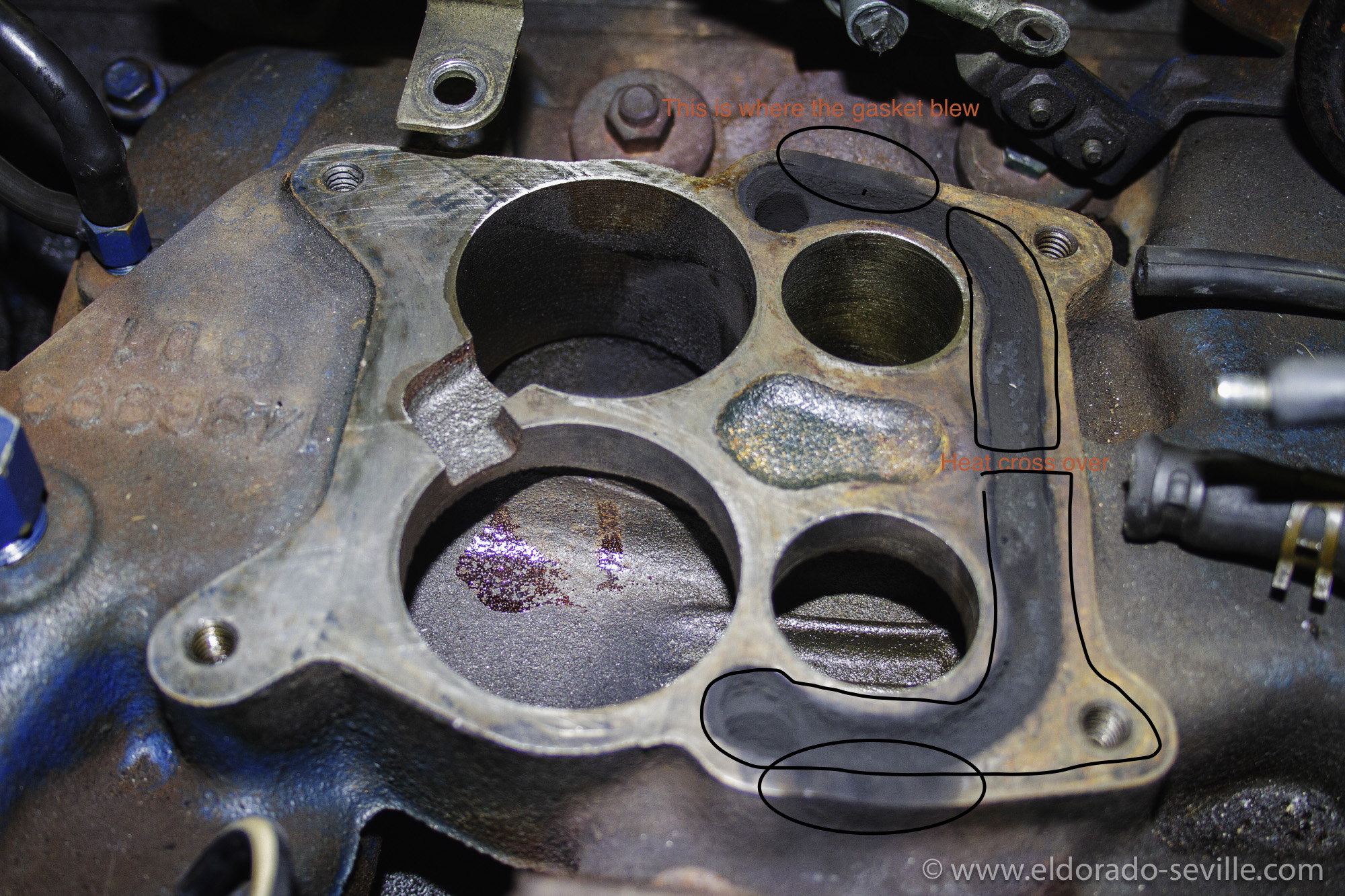
A new gasket was installed in the correct order then, and the car ran really good until recently, when the car suddenly had the exact same symptoms again…
I ordered new gaskets again and removed the carburetor from the car.
Click to READ MORE!
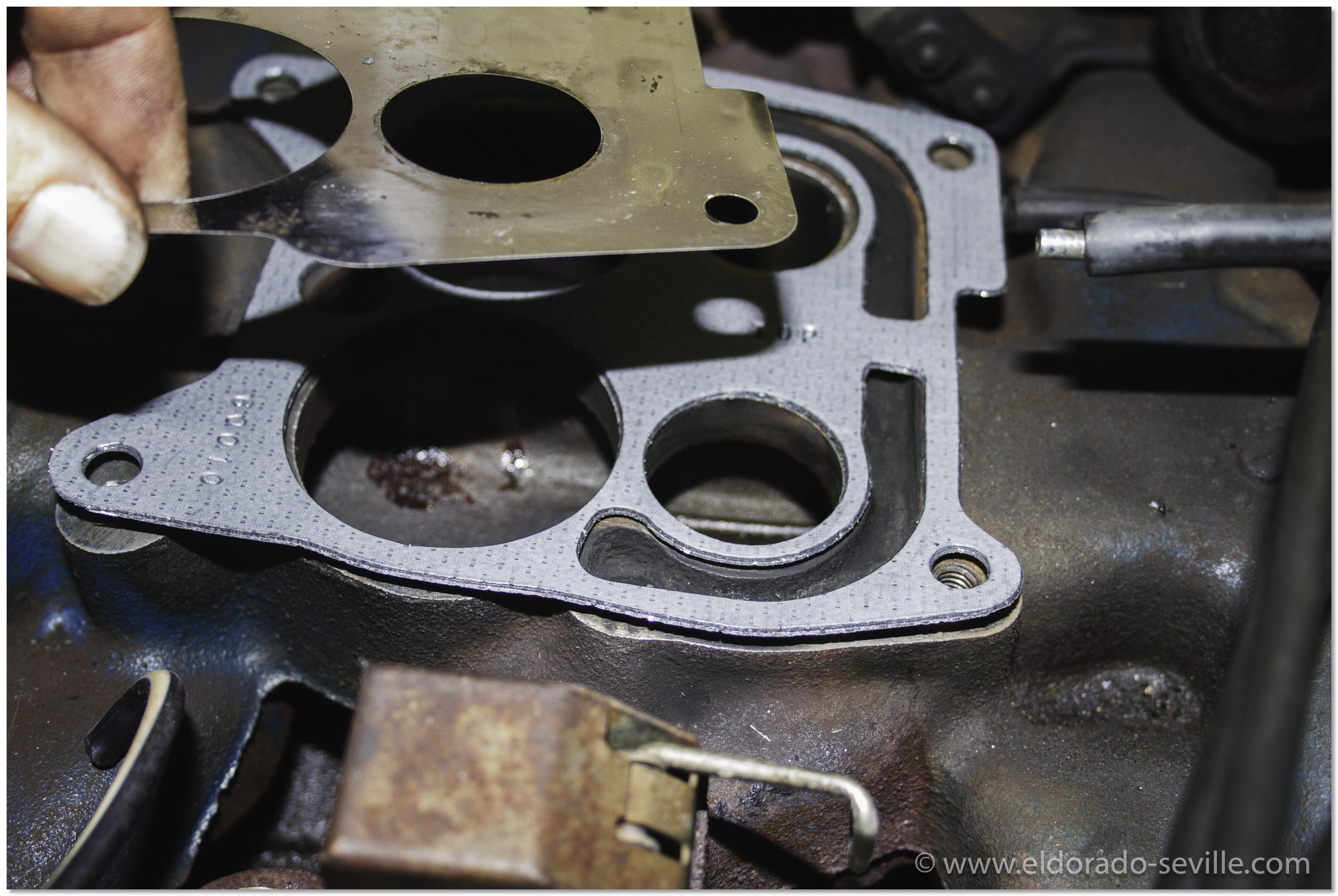 Make sure to install the gasket and the metal shim in the correct order!
LINCOLN MARK III CARBURETOR REBUILD
CLICK BELOW TO READ MORE
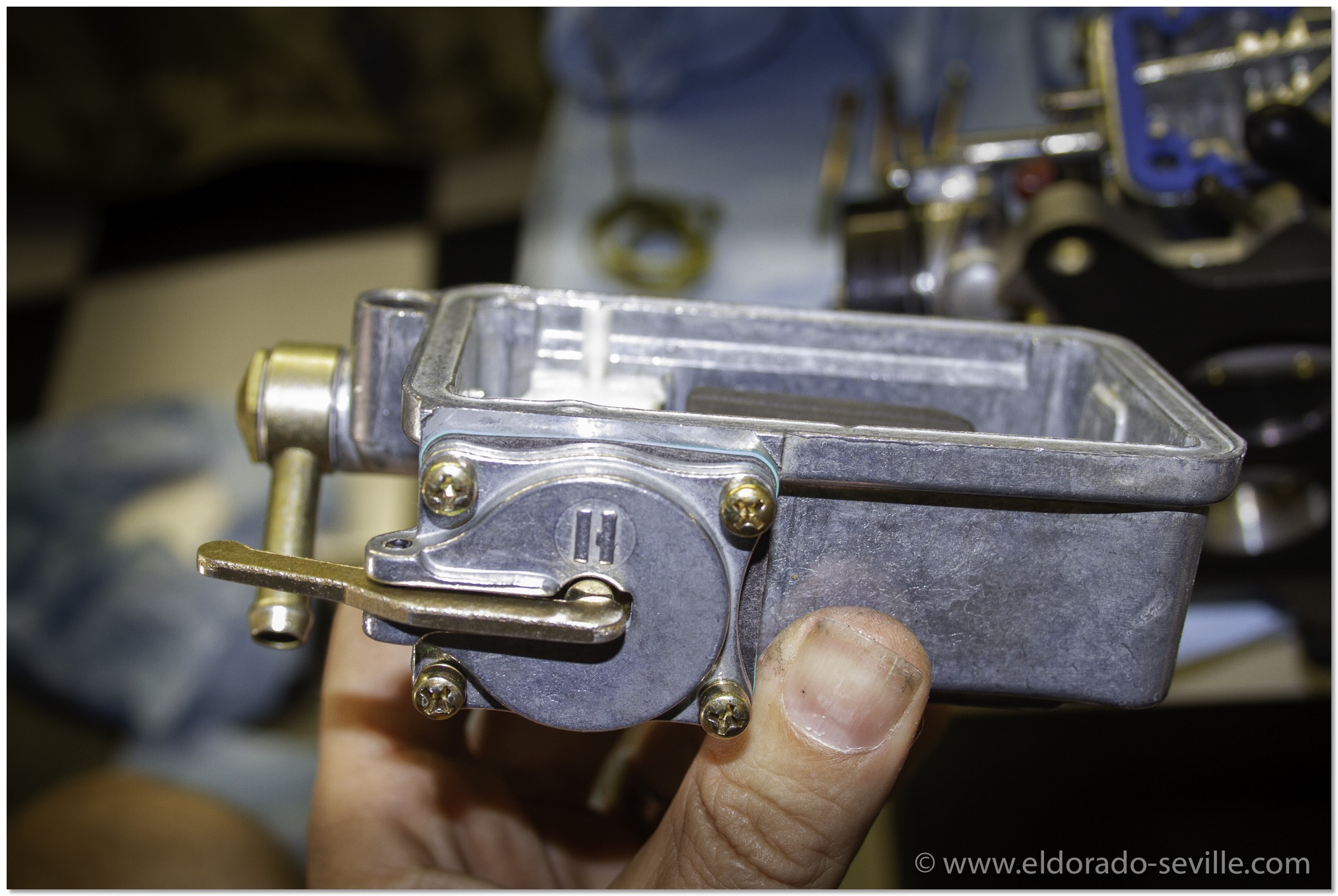
New diaphragm in place
RATTLING REAR BRAKES ON THE 1978 ELDORADO
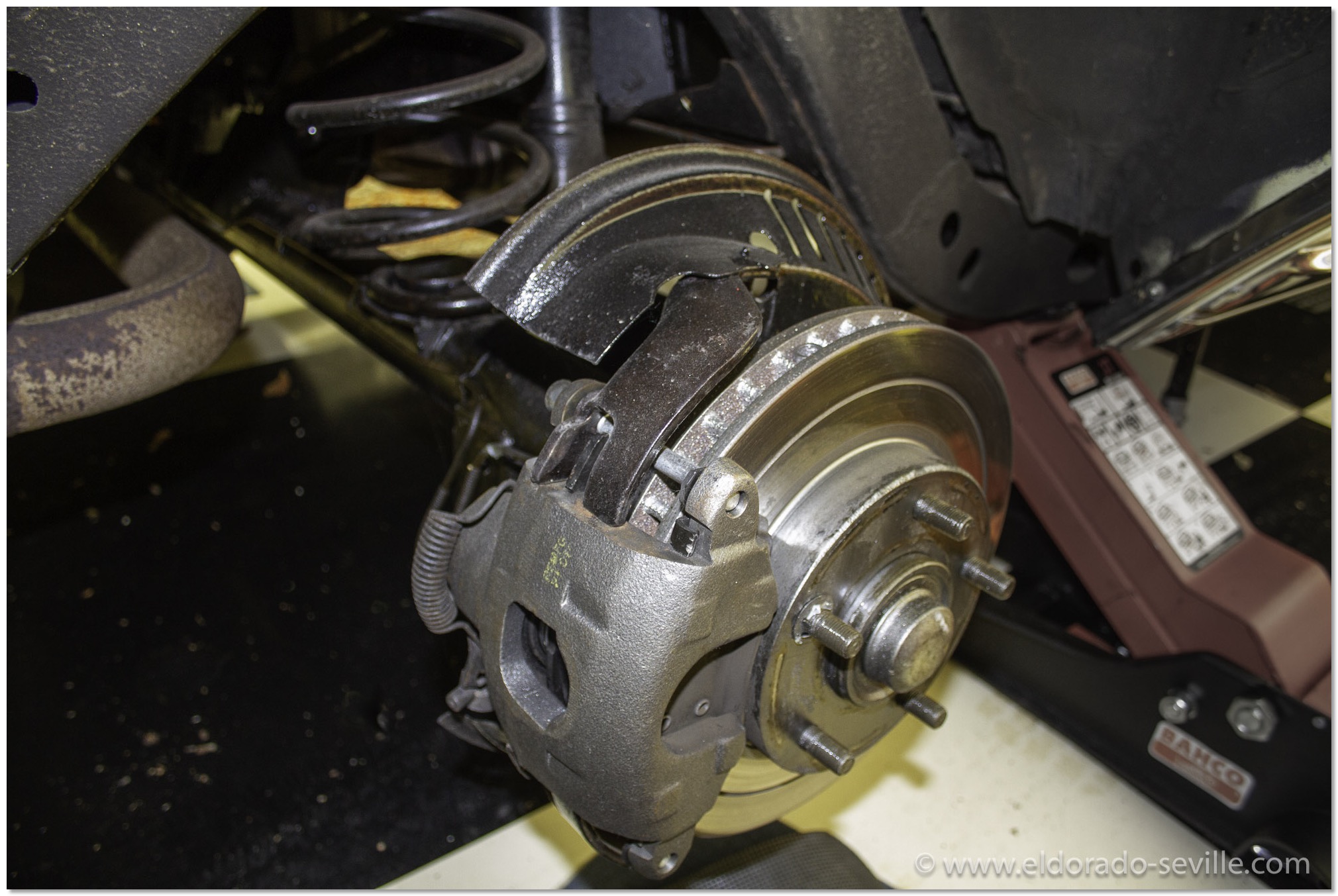
The right rear brake of my 1978 Biarritz before I took it apart.
READ MORE...CHANGING THE FUEL PUMP OF MY MARK III
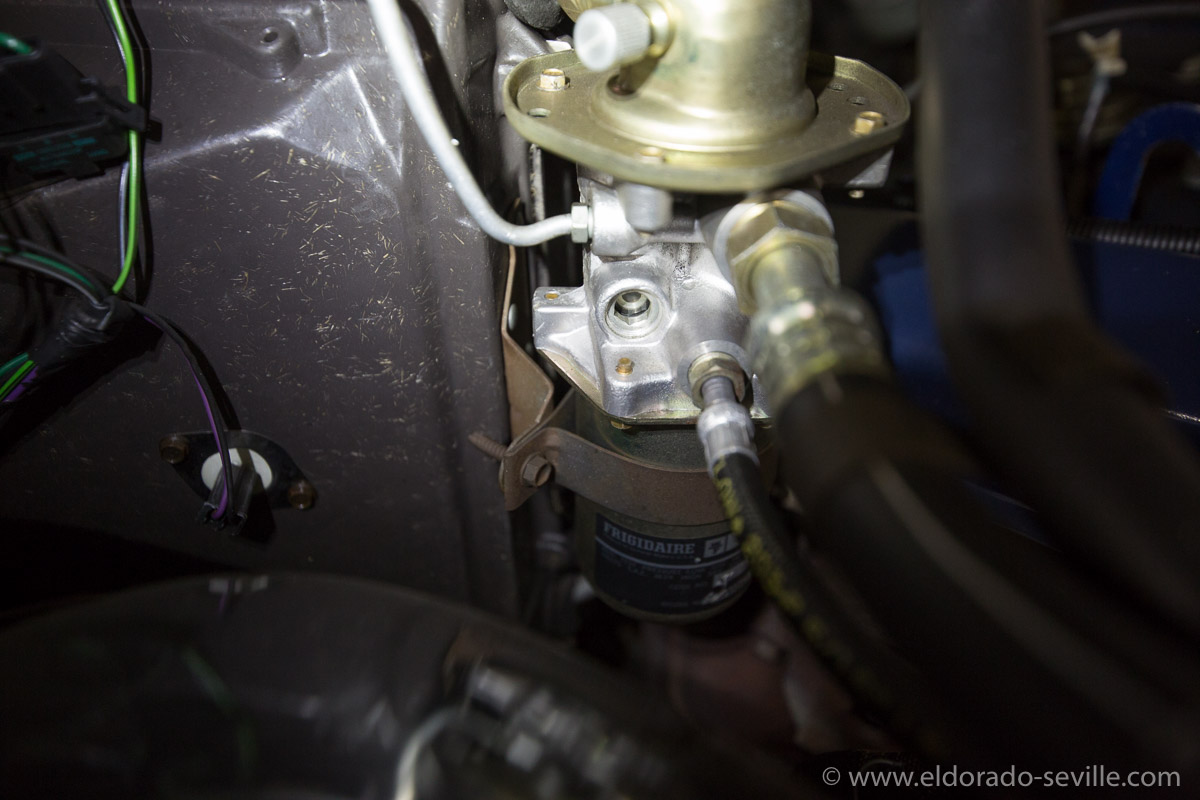
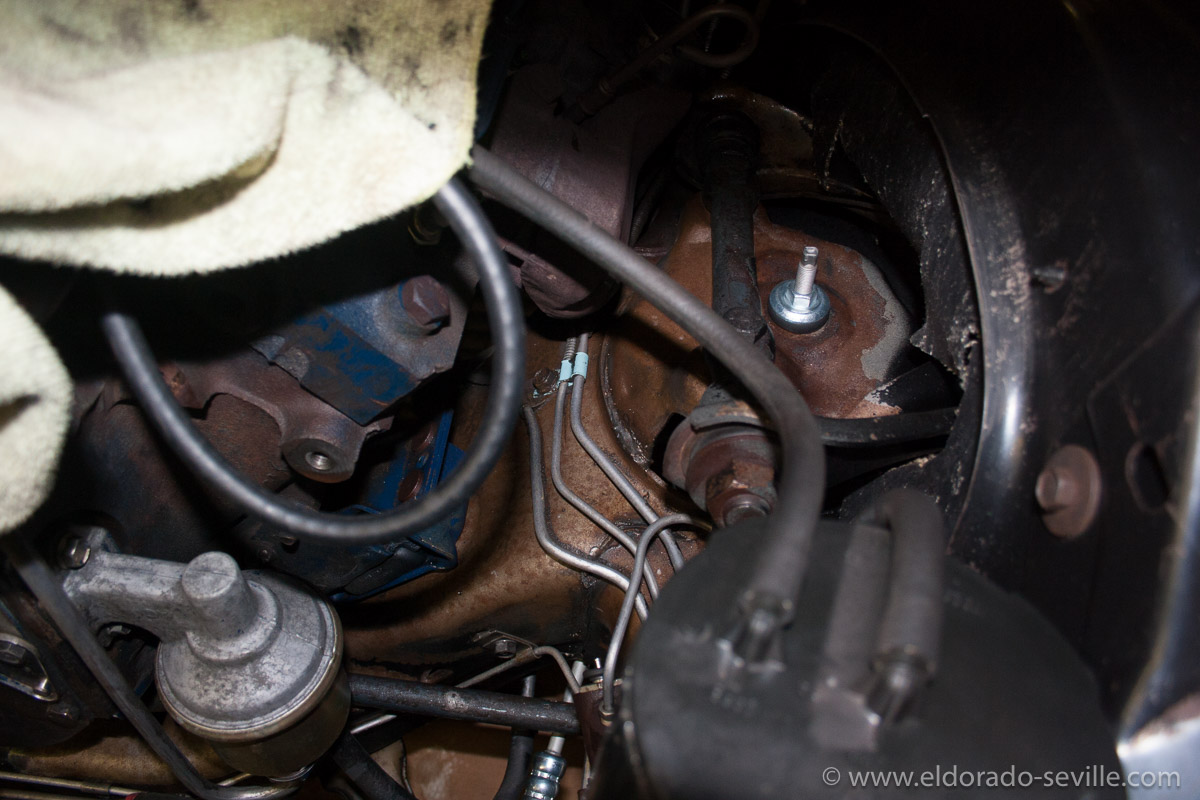
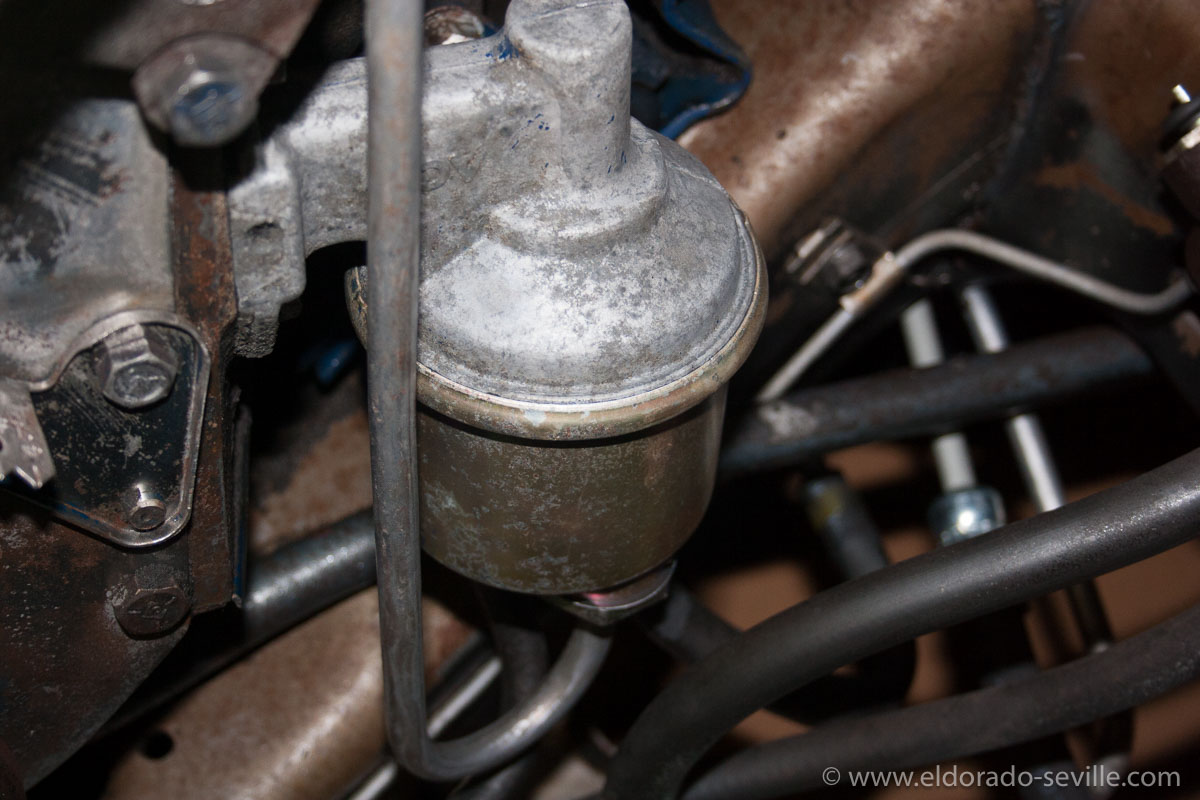
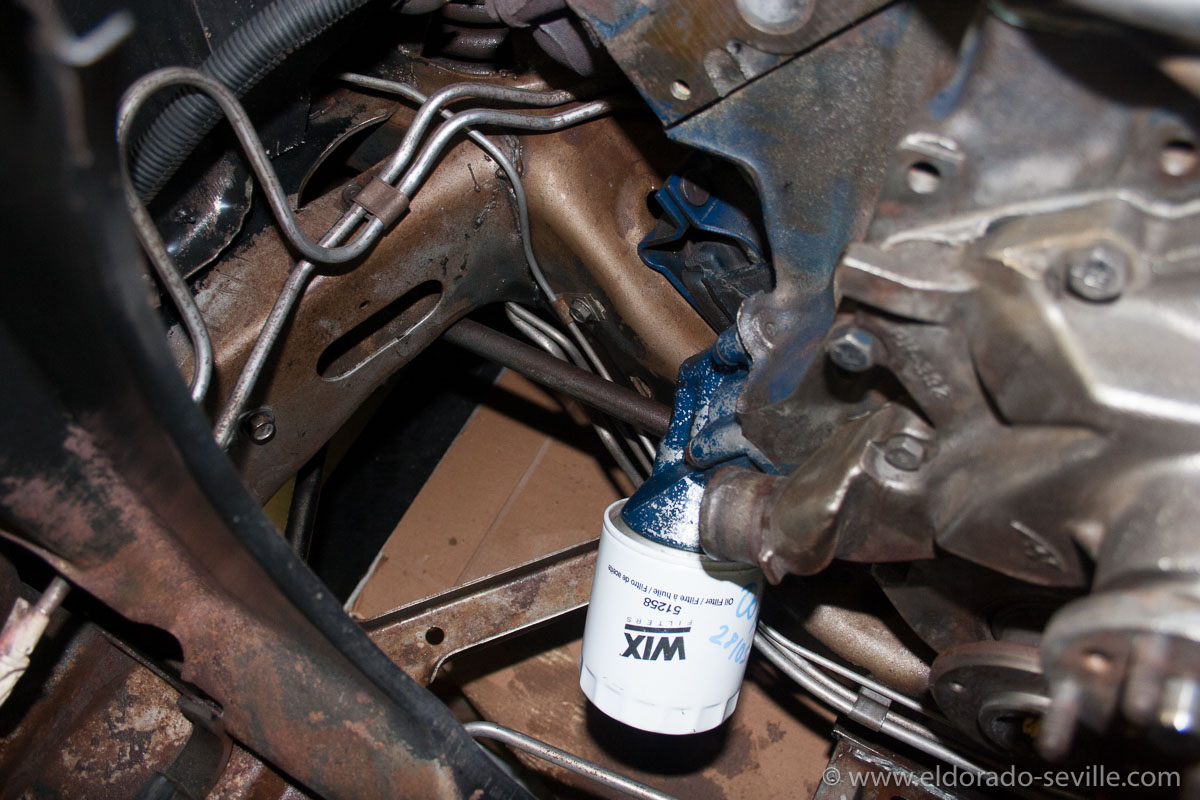
The fuel pump is not exactly easy to replace because of its location and very limited accessibility to the two mounting screws.
I had to remove the oil filter and also loosened the power steering pump....
CLICK BELOW TO READ MORE
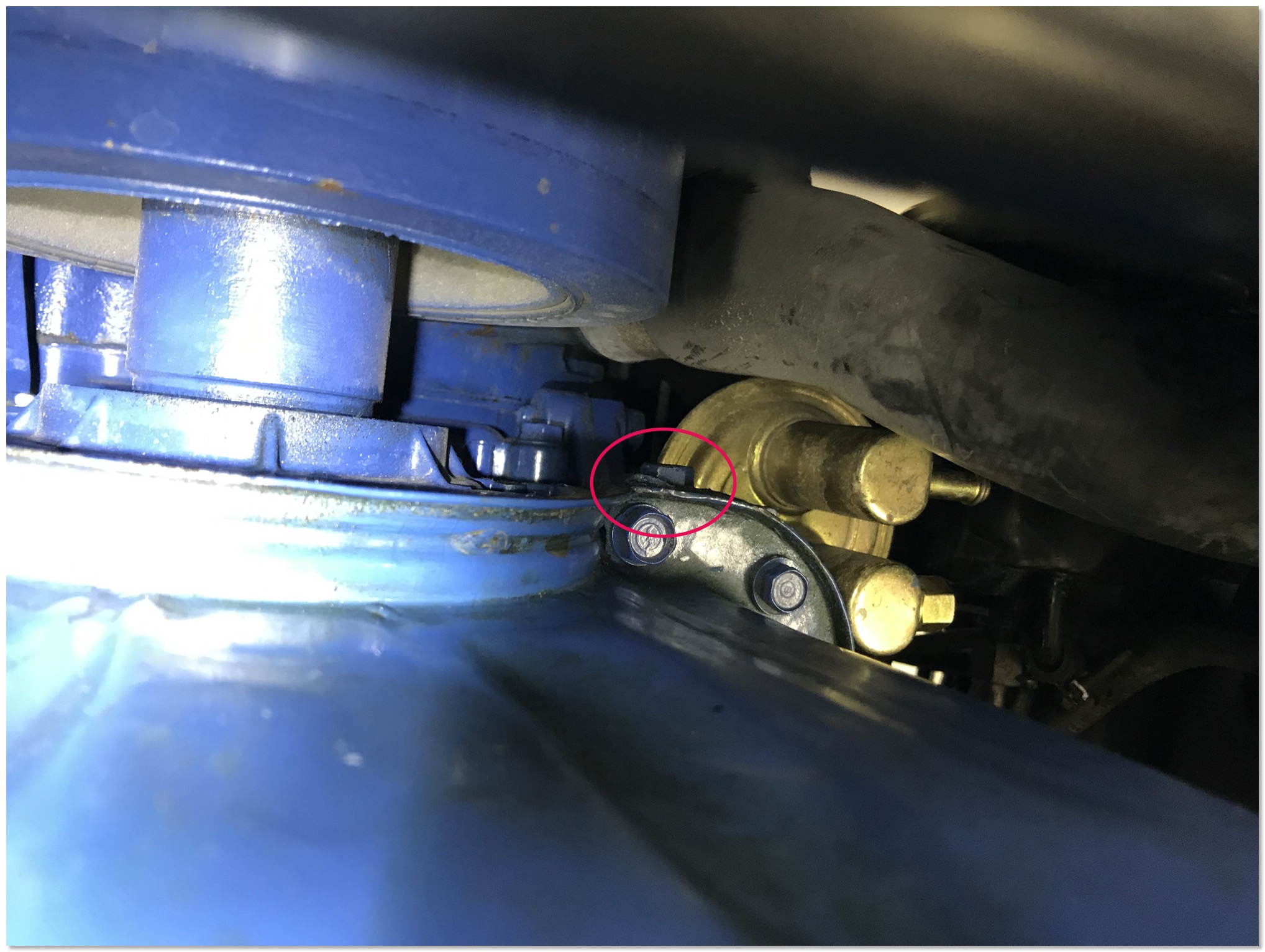
Changing fuel pumps normally is an easy repair - but getting the two mounting bolts out on the 460 engine takes a lot of patience.
READ MORE...REPLACING THE CV-JOINTS AND AXLES OF MY 1978 ELDORADO
CLICK "READ MORE" underneath the picture to read the entire article.
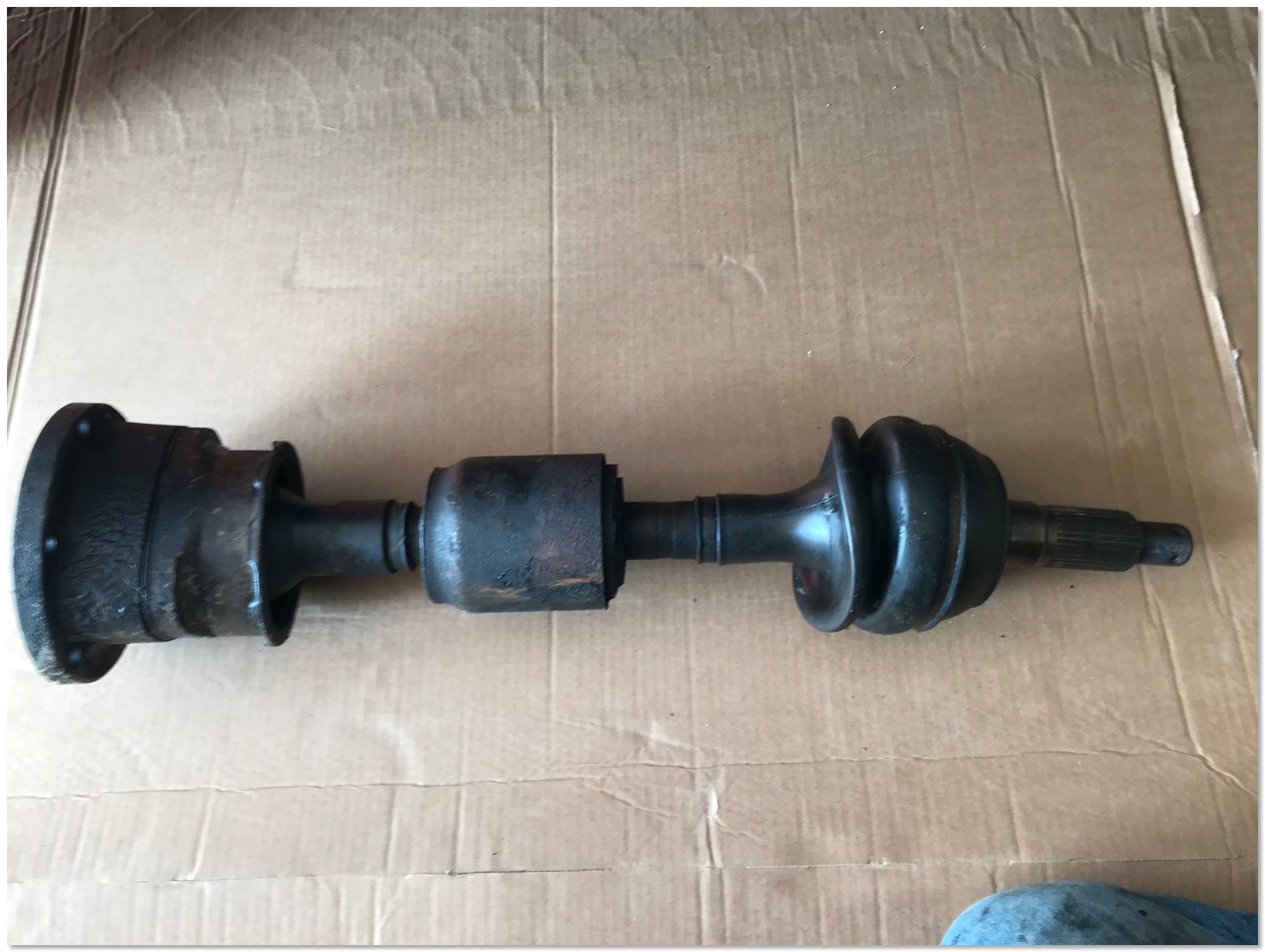
The removed original right front axle including the rubber dampener. I will some time restore it and install new rubber boots and put it back into the car instead of the replacement axles I installed now, just to make it 100% original again.READ MORE...
I FOUND A NOS 1967 CADILLAC T&T COLUMN TURN SIGNAL SWITCH.
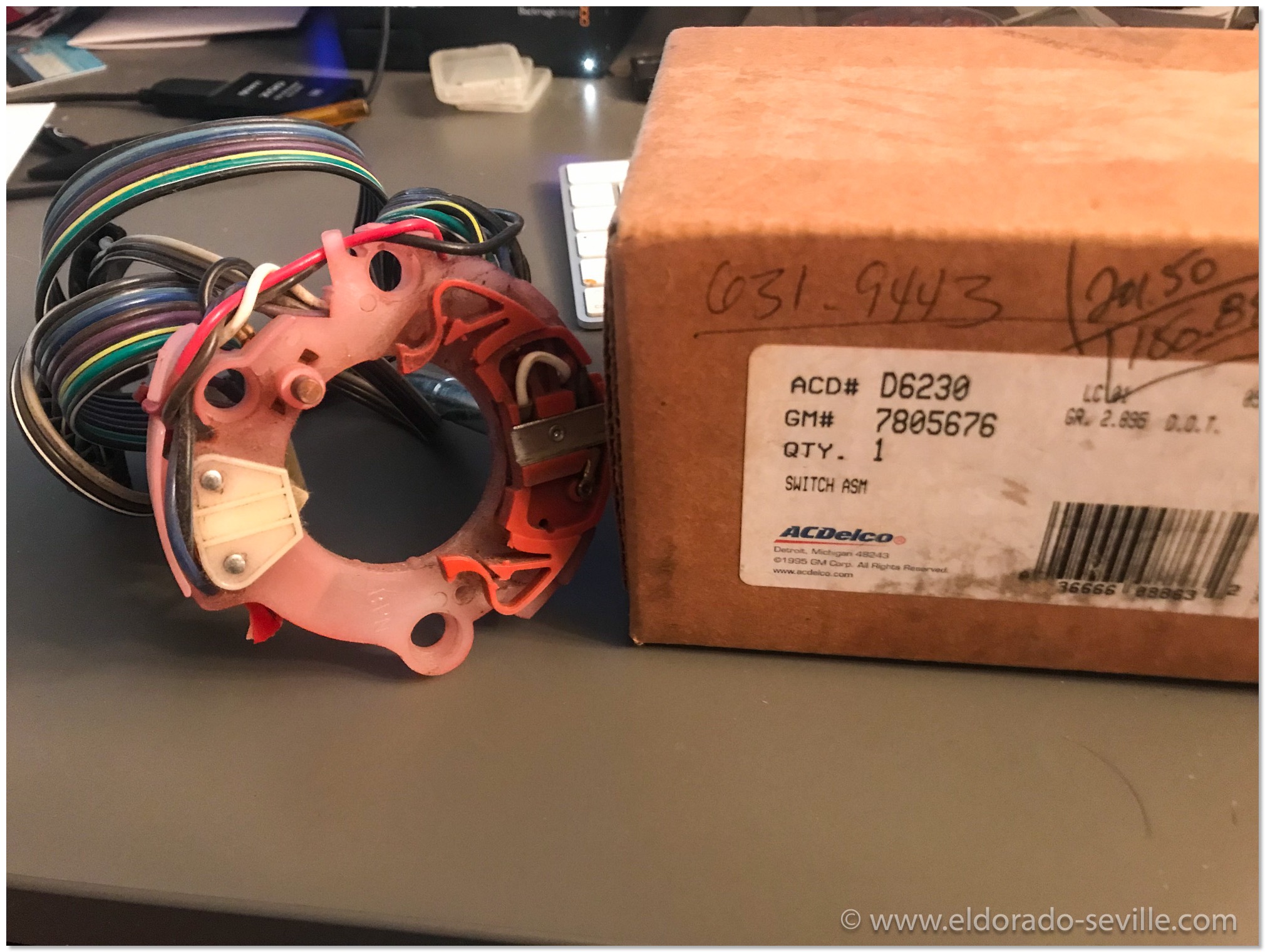
This switch is almost impossible to find GM #7805676 ACD# D6230. It is for 1967&68 Cadillacs with Tilt and Telescope column.
READ MORE...MY WINTER PROJECTS 2018/19 - CV BOOTS AND FUEL PUMP
The Mark III has a leaking fuel pump if it was parked for more than an few days... (It stops leaking after its running for 2 minutes...).
The 1978 Eldorado needs both CV boots replaced ( the original ones just came loose but did not rip after only 40 years slinging grease everywhere). The 78 will also need some minor exhaust work (welding) and either the EGR valve needs to be replaced or the accelaration pump in the carburetor has a problem... it won’t get boring in the dead car season… I had hoped that I wouldn’t have to spend any…
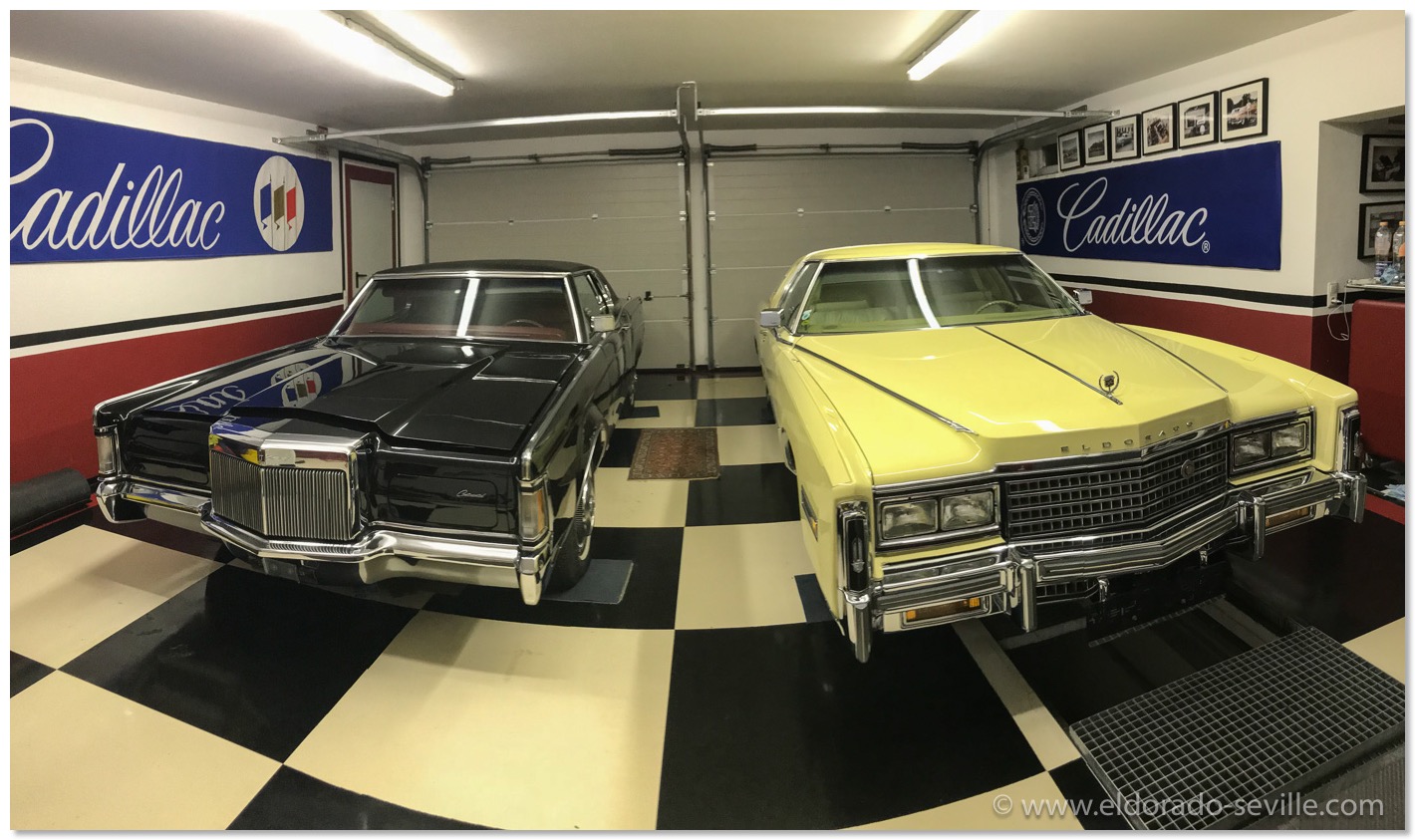
The two "patients" in the shop
CLEANING THE UNDERCARRIAGE OF THE "NEW" 1996 BUICK ROADMASTER
This is how the car looked like after dry ice cleaning.
READ MORE...THE RESTORATION OF MY 1967 ELDORADO IS FINISHED
The restoration shop let me know that my 67 Eldorado was finished and ready for pick up.
After work my wife and I jumped into the car and drove 2 hours to Radstadt where the restoration shop is located.
I saw the finished car for the very first time.
The job Bernd Preussler and his small team did is amazing. The paint job is the best I have ever seen. Their commitment to details is outstanding.
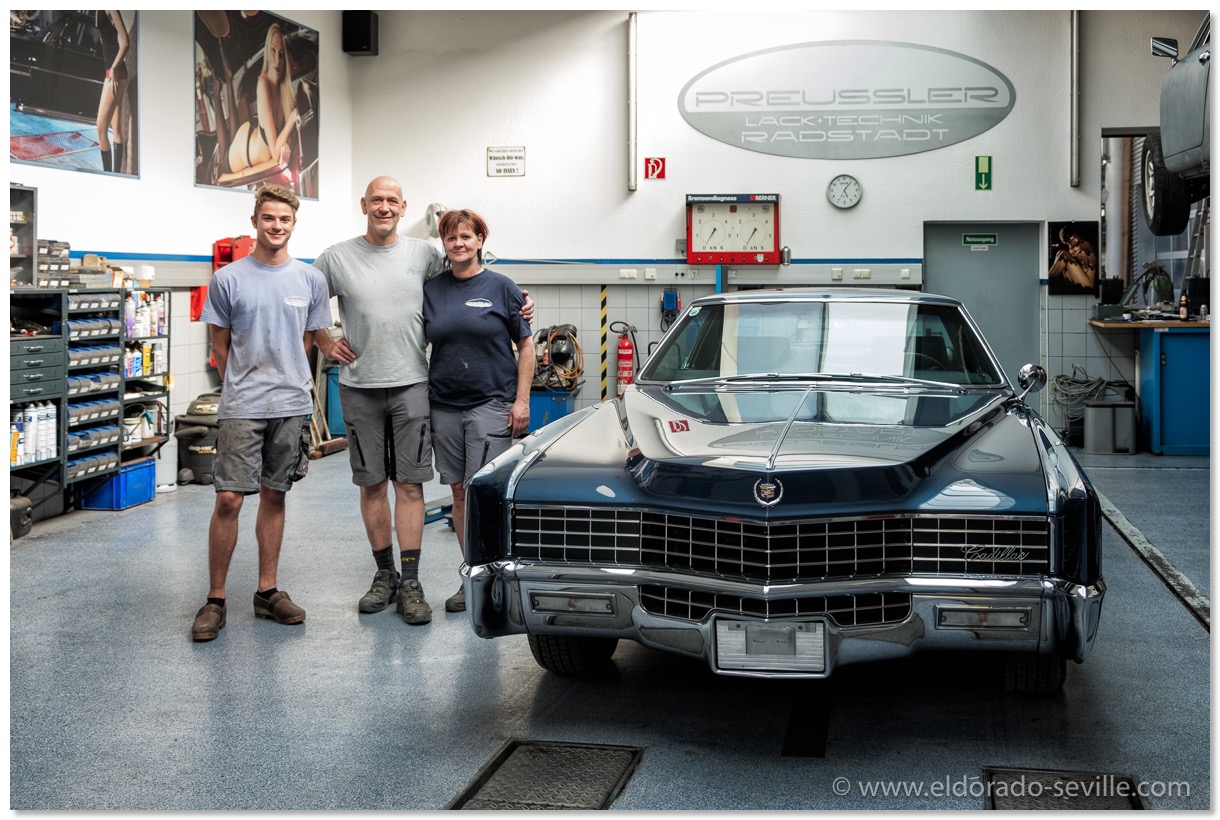
The small team that restored my Cadillac. Thank you so much for your great work! You are my heroes!
Michael Hammer, Bernd Preussler, Angela Steiner (from left to right)
THE 67 ELDORADO RESTORATION IS IN ITS FINAL STAGE
The restoration shop on the other side did a fantastic job so far. There are some minor details they still want to address and the car should be ready for pick up sometimes in May.
Here is a short video I took with my phone at the shop when I delivered the bumper, showing the almost finished car. Make sure to watch in HD to see all the details
The almost finished car still in Bernds Restoration Shop
THE 1967 ELDORADO RESTORATION - WHAT WE HAVE LEARNED SO FAR...
Whenever you restore a car you can learn a lot about it. The ongoing restoration of my 67 Eldorado is taking a little break now, and here is a summary of things we have learned so far during the restoration process:
There seems to be a design and/or a problem at the front windshield which causes rotten floors and rust in the A- pilar:
Although my car is a low mileage car (28k miles) with no other real rust issues, the front floor of my car had to be replaced as we found out when the carpet was removed. I have heard some similar stories from fellow Eldorado owners who had the same problem with their cars. Some of them owned very low mileage texas cars and had rotten floors and/or rust in the A-pillar. The water seems to enter at the A-pillar and often causes rust through holes there. It can then seep into the car, where it ends on the front floor, from where it cant evaporate due to the rubber insulation used underneath the carpet. When the windshield on my car was re-installed, we made sure that it seals perfectly and we used some modern material to make sure there wont be any future issues. The front floor on my car had to be replaced as you can see on the pictures of my restoration gallery.
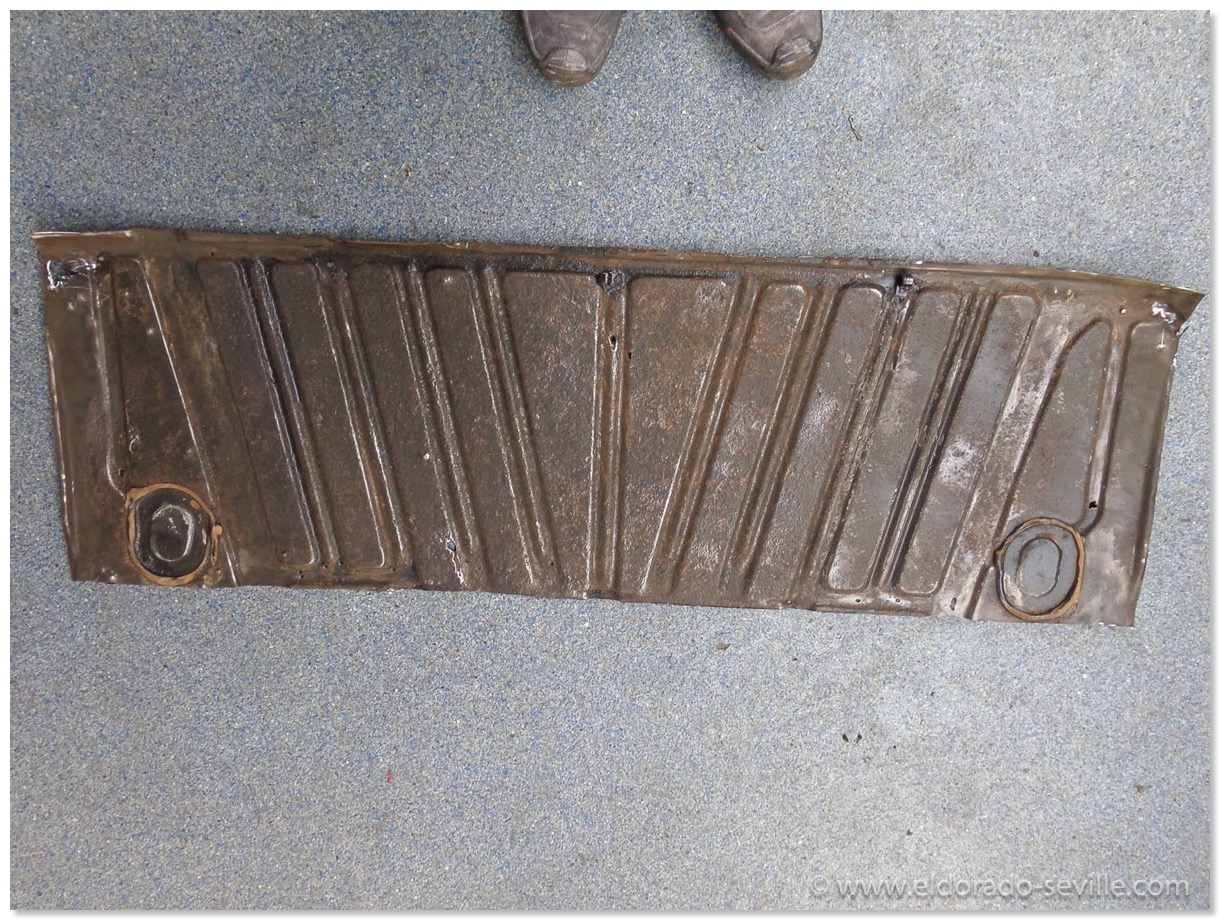
The cut out front floor.
THE 1967 ELDORADO HAS NEW PAINT!
Today was especially exciting. I saw the Eldorado in its new paint for the first time!
Doesn't she look spectacular in its fresh coat of "Atlantis Blue Firemist! ?
Bernd and his team did an awesome job so far as you can see in the restoration gallery.
There is still tons of work left - but everything looks very promising so far.
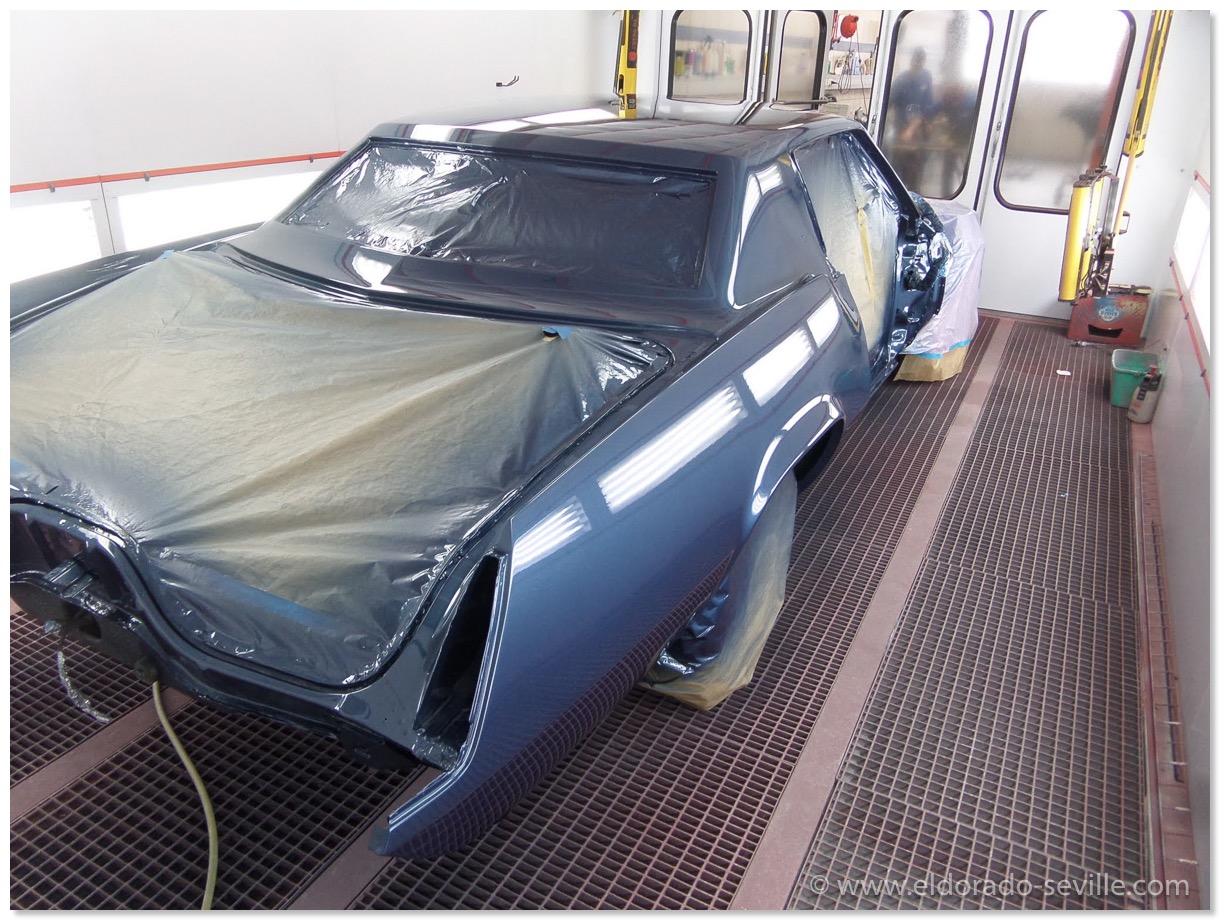
In the paintbooth with fresh paint.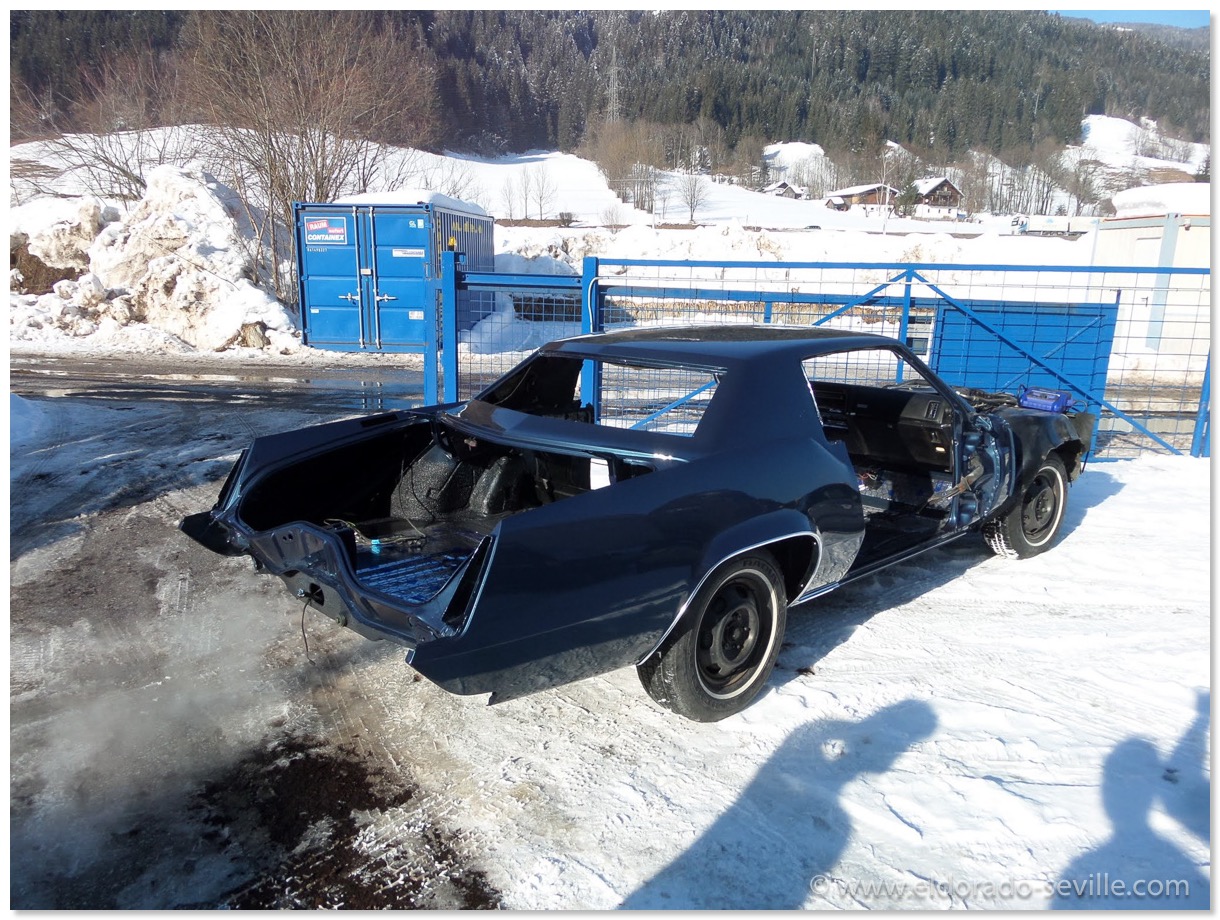
First time in the sunlight, with the first trim parts already installed.
REPLACING THE FRONT FLOOR OF THE 67 ELDORADO
While the exterior of the car did not have much rust I was surprised that the front floor of the car had quite a bit of rust.
Some of the previous owners seems to have tried to stop the rust on the floor sometimes in the past by applying a good amount of rust converter, or whatever the black paint was , he applied over the rusty floor.
It seems that it did not help but just made the sheet metal oxidize underneath this sticky mess.
The restoration shop now started to remove this paint just to find some weak metal with some holes in it.
This is when they decided to cut the entire front floor out and replace it with some fresh metal instead.
They had to make a patch panel from scratch as no new panels are available for this car anywhere. The new custom made replacement floor was now welded in.
Like on the factory rubberized undercoating was reapplied underneath the car and the welding seams were sealed with seam sealer.
You can see all the detailed pictures in the restoration gallery here.
I hope this was the last unpleasant surprise for a while…
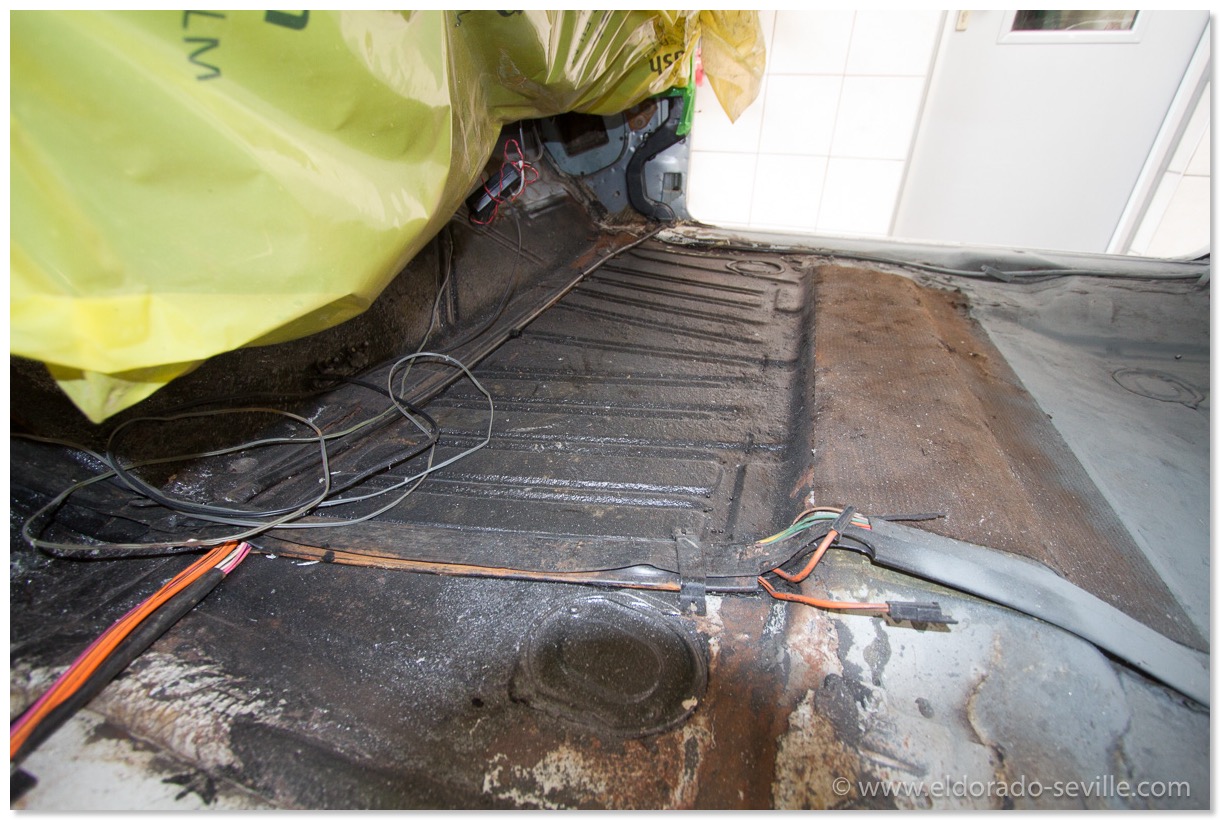
This showed up when the carpet and the seats were removed…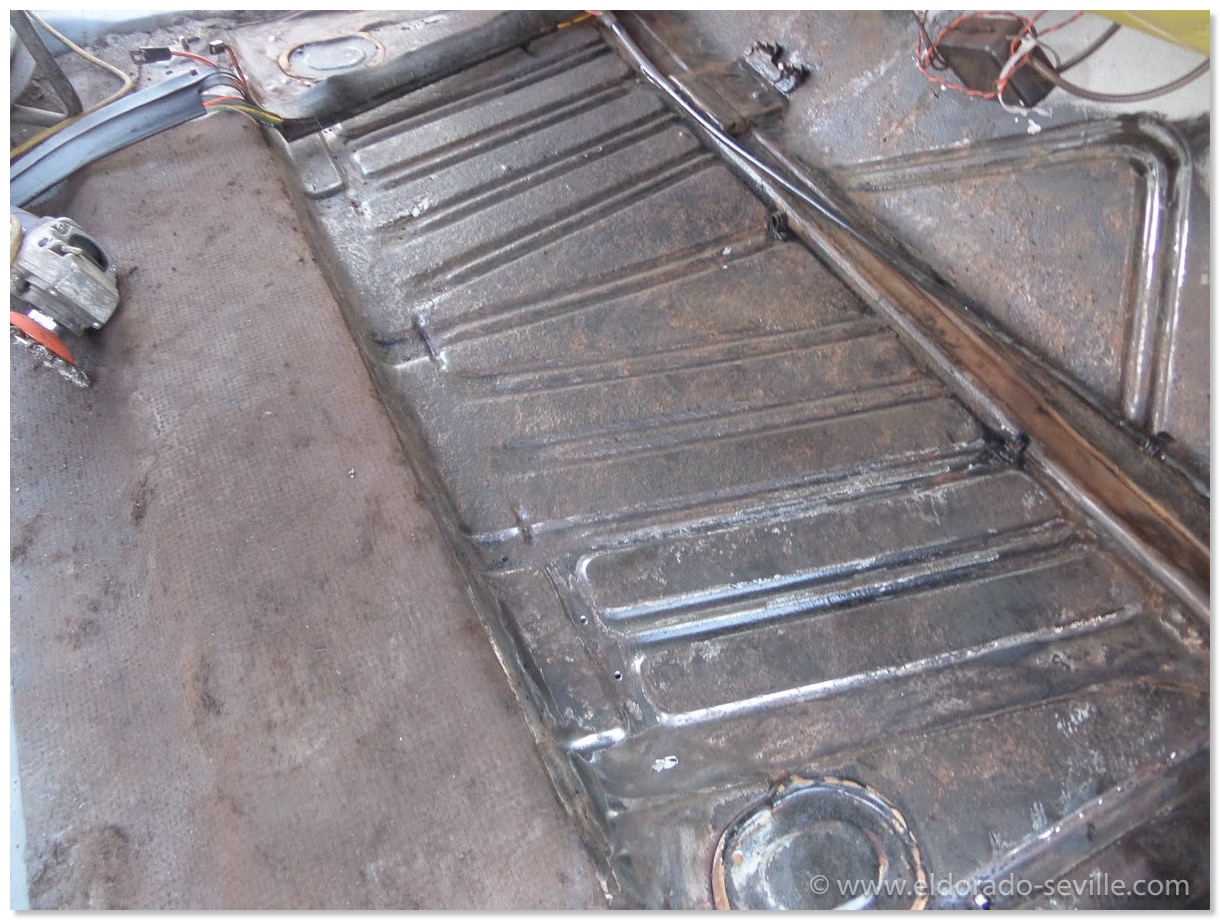
After removing the black mess, the weak metal and some rust holes showed up.
Unfortunately the original floor had to be cut out…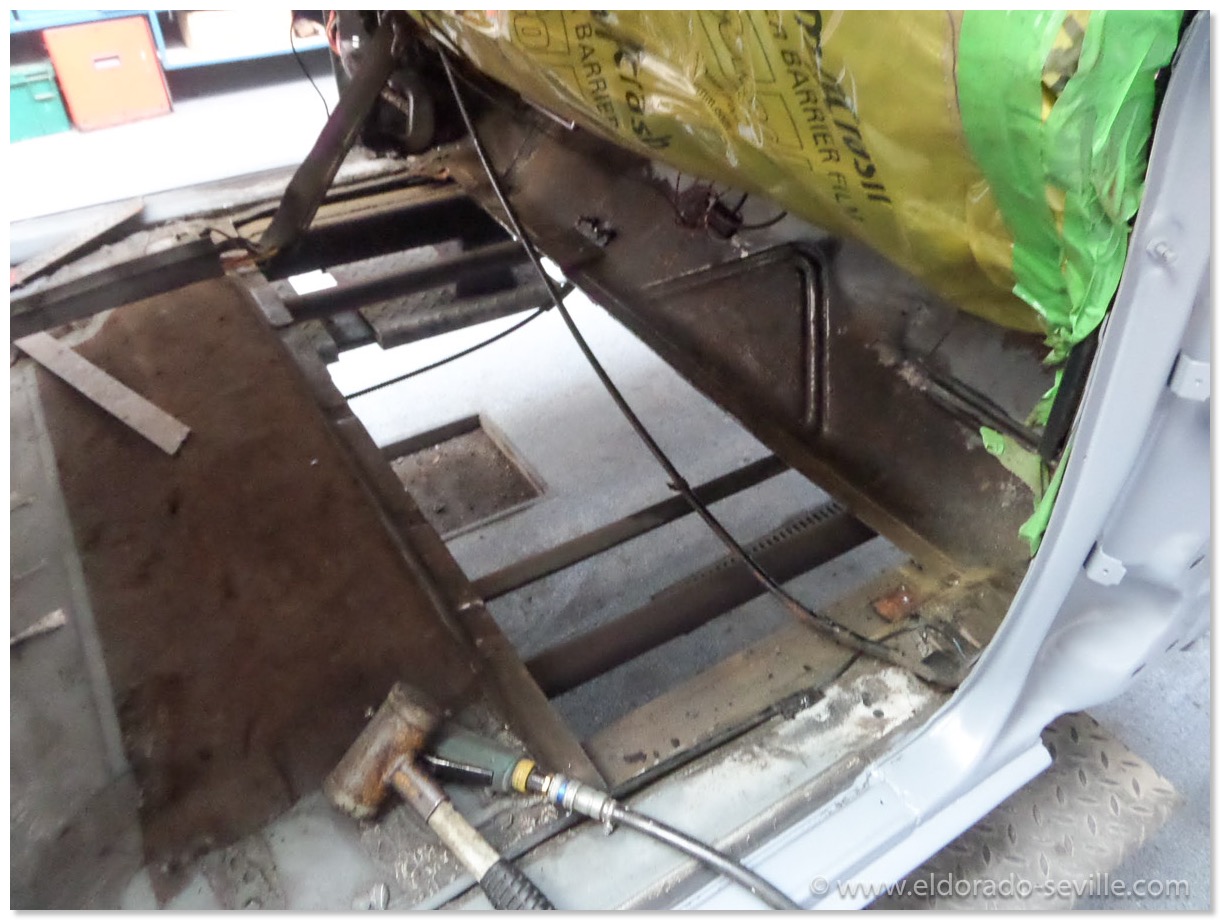
Big hole in the floor.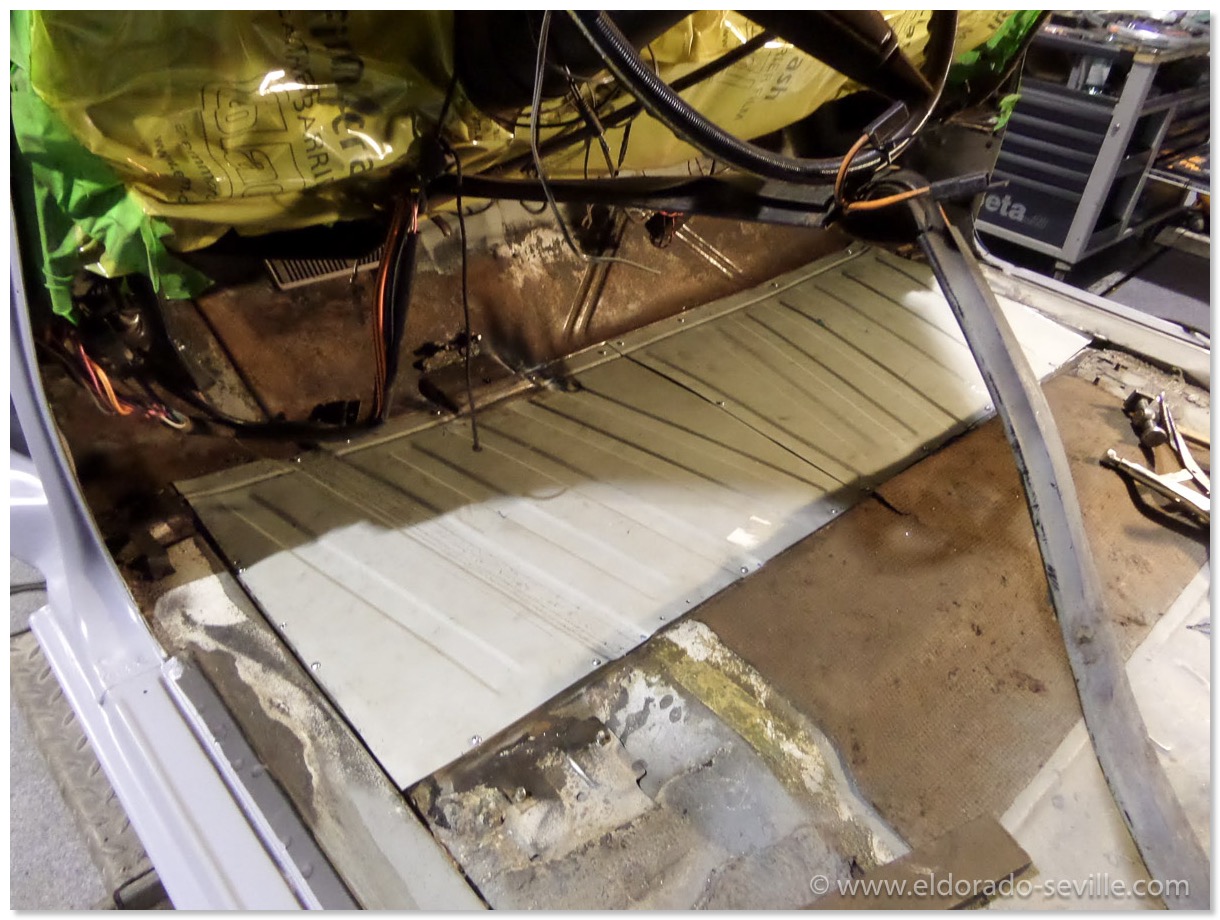
A new custom made patch panel is fitted and will be welded in.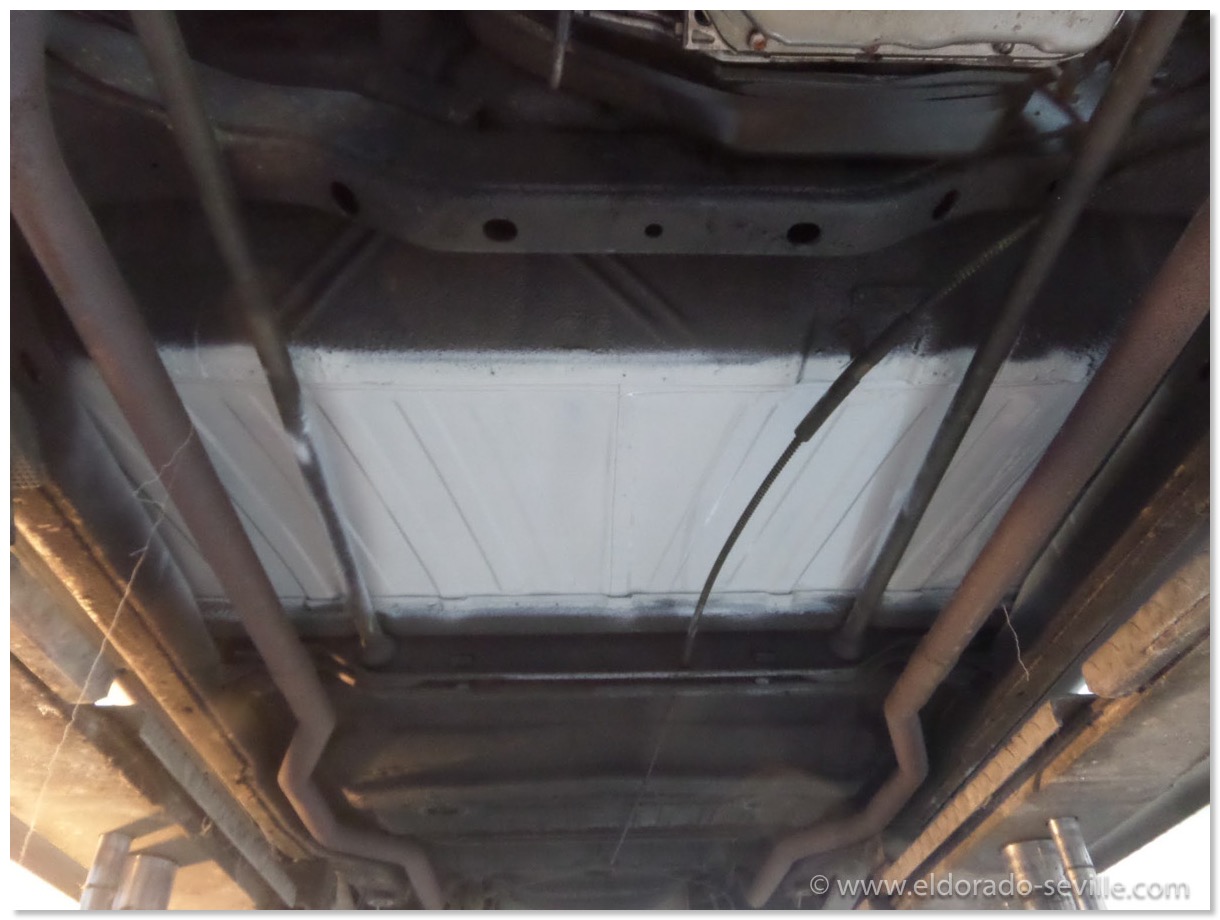
The new custom made patch panel as seen from the underside.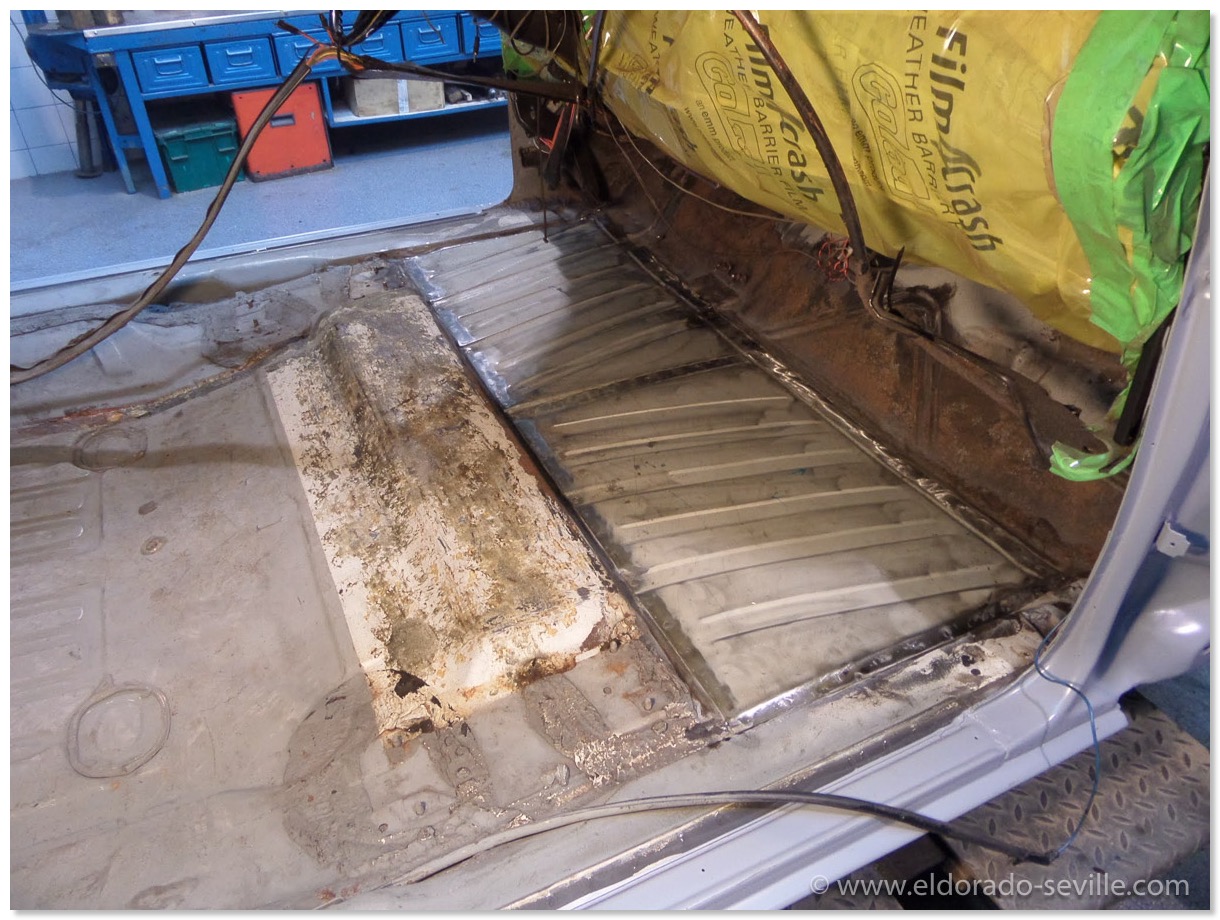
The new panel is completely patched in.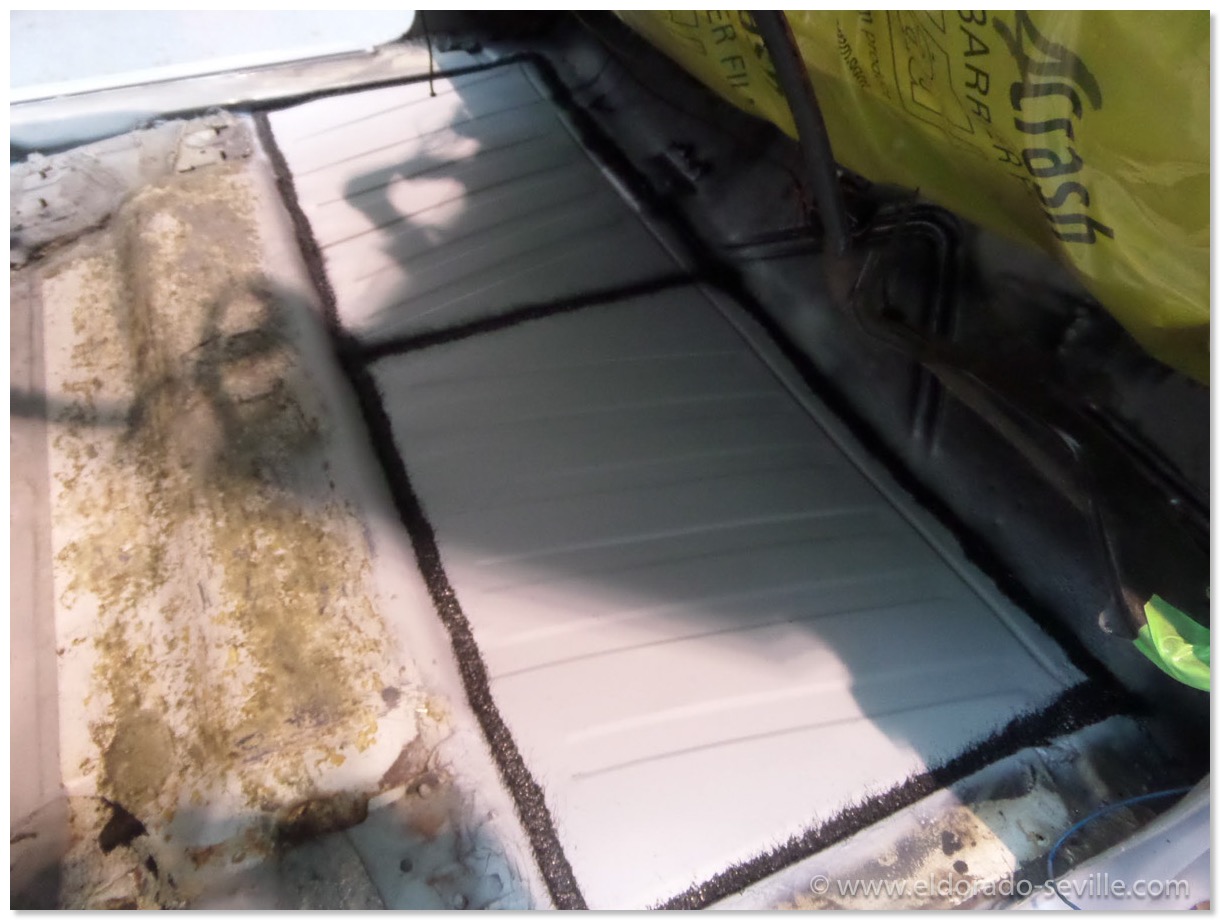
Seam sealer was applied like it was done at the factory. In the factory they just painted over the seam sealer. We will do the same here.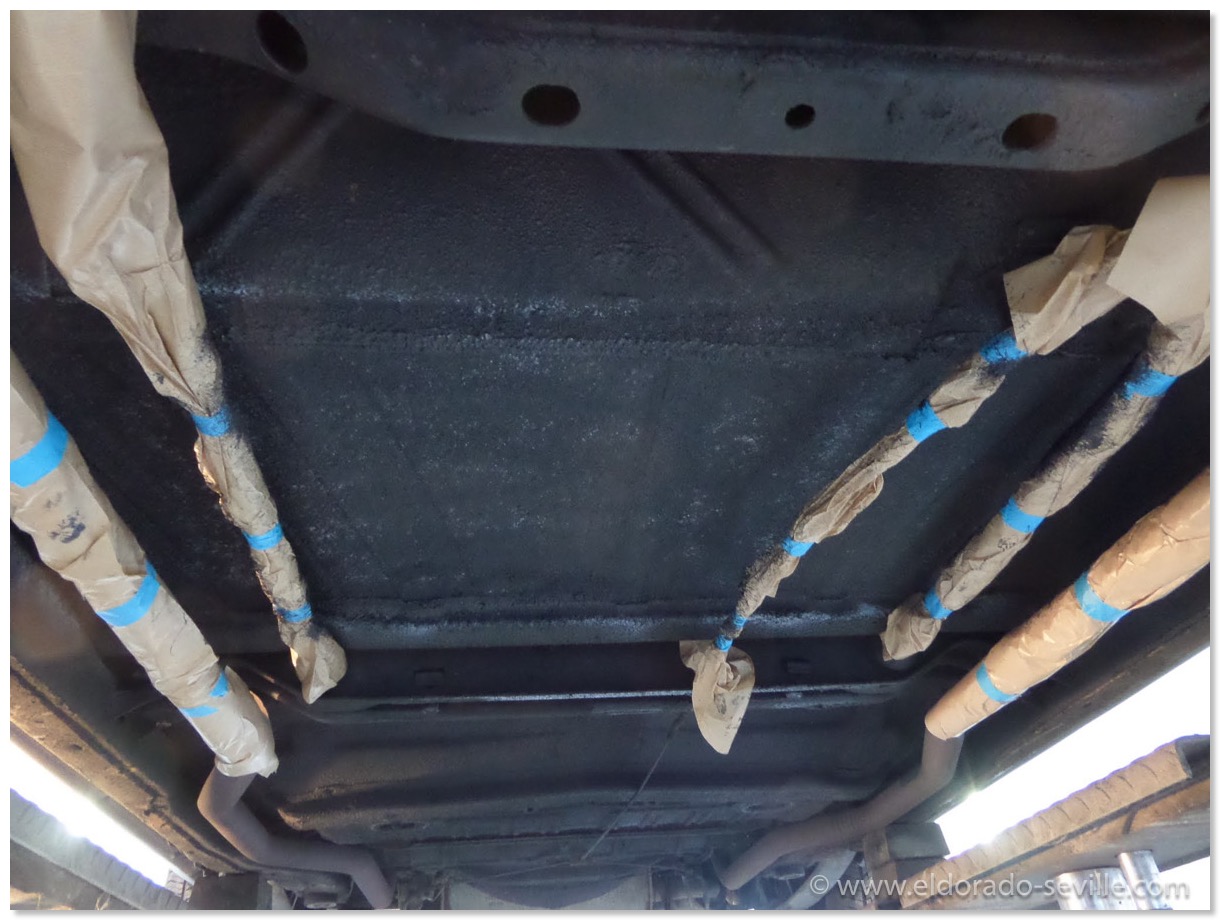
This car came with factory applied rubberized undercoating which was re-applied over the patched floor.
THE 1967 PAINTJOB PROJECT HAS STARTED
The restoration shop is sending me detailed pictures of the process. They are really doing a great job. Very exciting times.
Of course there are the first unpleasant surprises to be seen - there is a little more rust around the rear window than I expected, but still nothing serious. After disassembly we could see that the car is in fantastic shape.
You can find all the pictures of the restoration here on my website as high res pictures.
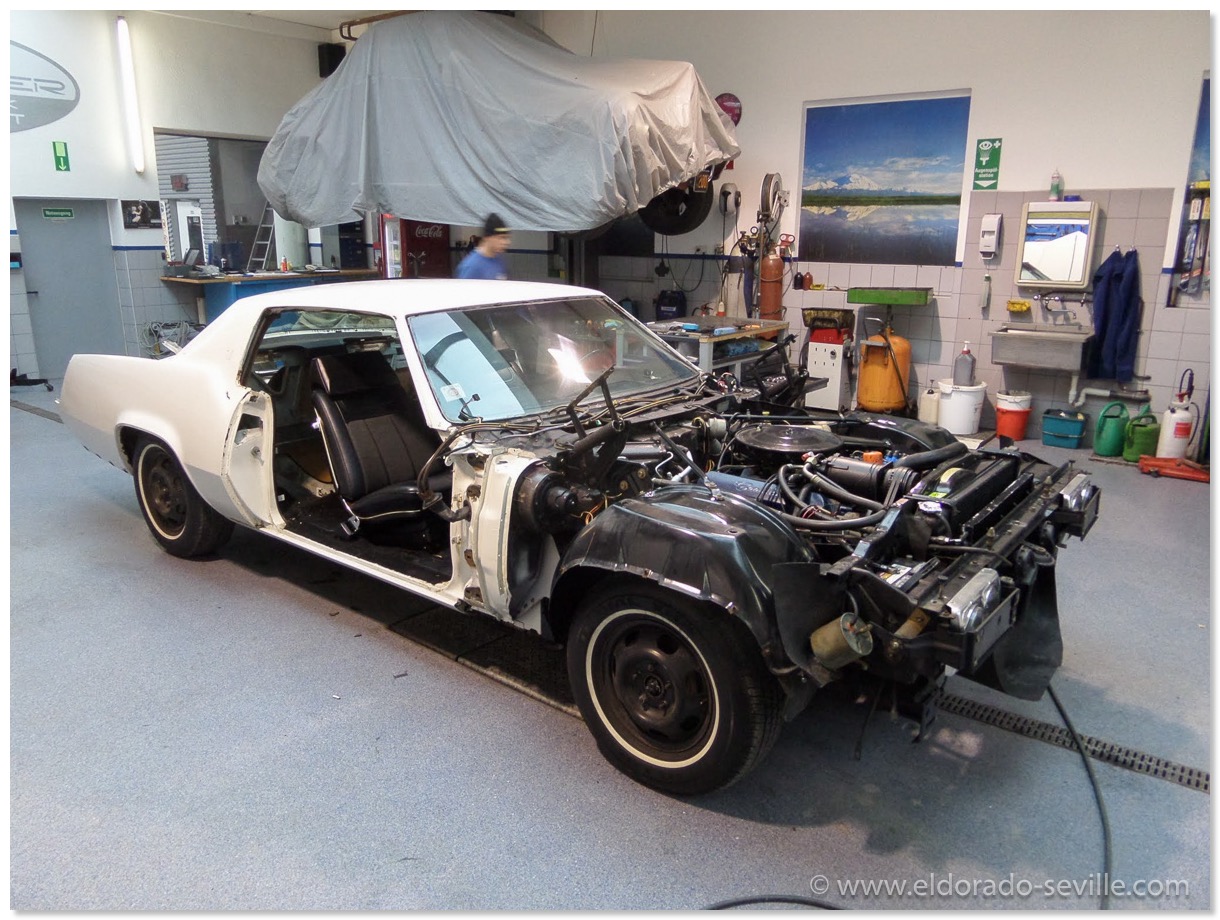
In the shop - disassembly began. They are cleaning everything up now.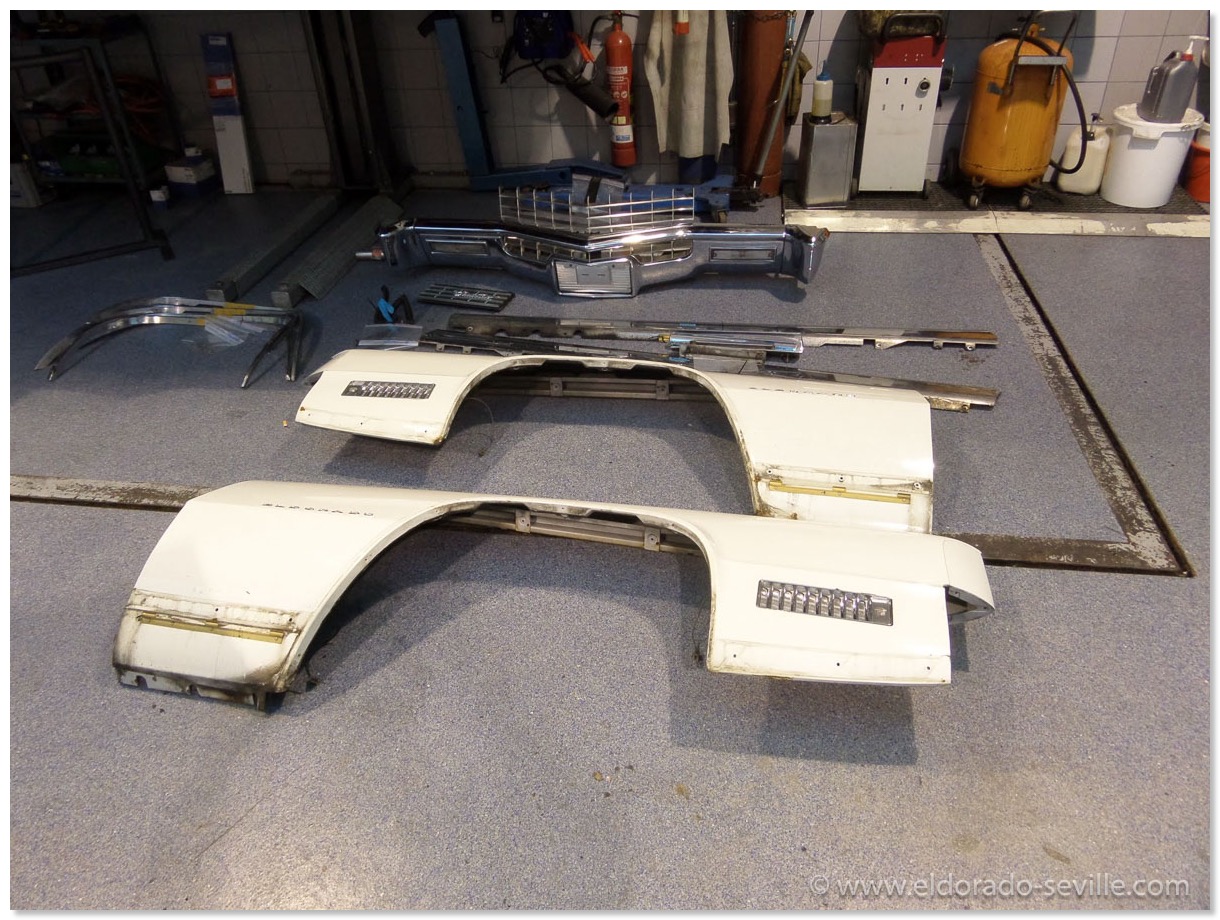
Removal of all the trim and sheet metal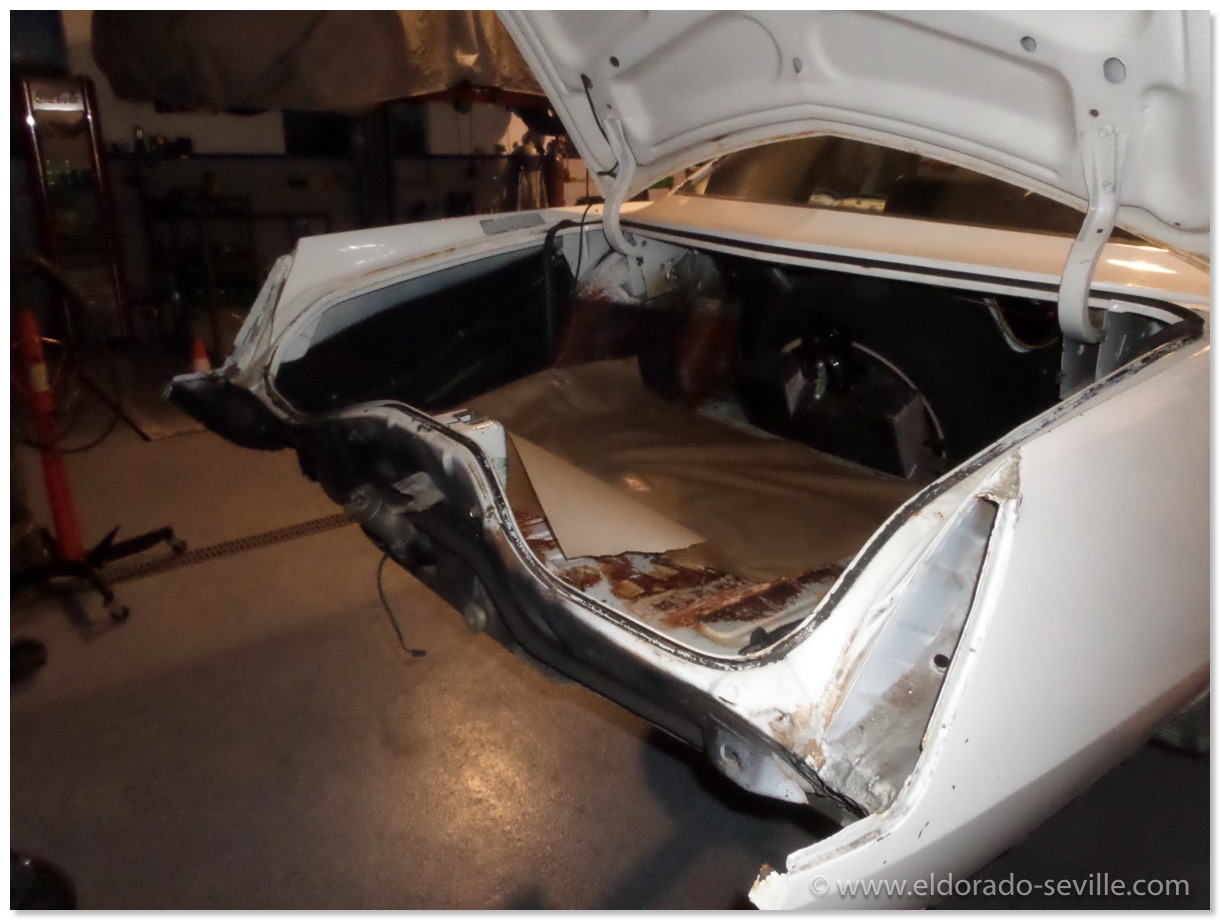
I will also redo the trunk.
NEW PAINTJOB FOR MY 1967 ELDORADO
One of the previous owners of this car tried to touch up the paint in some areas but it was not done properly…
I bought the car in 2009, and since then I was planning to repaint the car to make it perfect.
Being a perfectionist I had a hard time finding a shop which is up to my quality standards and work ethics. During a photo-shooting I came in contact with a shop about 2 hours from where I live. My wife and I were invited to photograph one of the owners Hotrods and he also owns a Cadillac with a breathtaking paint job. While we were there I was extremely impressed by the cleanliness of his shop and the quality of the work I saw there and especially about the attitude of the owner Bernd. A couple of years later 3 of my cars needed some little paint touch ups which made me pretty nervous. But Bernd did the most excellent job on my cars, so that I asked if he could also do my 67 Eldorado.
Unfortunately a couple more years went by where I did not have the financial means to do the job.
Last year - out of nowhere I was contacted by an uncle I had not had any contact for the last 42 years after my dad was killed at a work accident. To make a long family story short - he "inherited" me a very generous amount of money - almost as much as I´ll need for the paint job of my 67 Eldorado.
Yesterday I delivered the car to the restoration shop.
After a long and thorough inspection by the shop owner, the restoration will start soon. The owner is optimistic that hopefully there wont be too many bad surprises hiding. He measured the paint thickness and found some evidence that some damage might be hiding in the right rear quarter panel. Maybe the car had a fender bender sometimes in its previous life.
The car will be completely disassembled. Front and rear glass will be removed. Fenders, hood, trunk and doors are coming off. The interior will be completely removed, but the body will stay on the frame.
Then everything will be taken down to bare metal by sanding, as its too cold to strip the paint with chemical paint stripper during the winter months.
Every step will be documented with pictures which I will post here on my website as well. So keep coming back to follow the restoration if you are into this kind of entertainment.
I´m so happy that the car will be fixed at this shop. It's the first shop I have no worries about the quality of job done. Bernd - the shop owner - is a perfectionist like me. He only accepts perfect quality and wont take any short cuts.
FINDING THE RIGHT COLOR…
The big question for me now is if I should have the car repainted in its original "Grecian White" color, which I am not exactly a big fan of, or repaint it in one of my favorite 1967 Cadillac Eldorado Colors "Atlantis Blue Firemist" which was a pretty expensive optional paint in 1967When I asked my friends to help me decide, about 80% said I should paint it in "Atlantis Blue Firemist"… If I could go back to 1967 and order one from the factory I would probably order the blue one…
I was also informed that the Cadillac LaSalle club does not deduct any points during judging if you do a color change, as long as it is done in a correct color for a certain year…
Being an originality buff - I´m having a hard time to do a color change though. My little son also wants to keep the car white - my wife would like to have it changed to blue… I´m sure whatever I decide - I will sometimes regret my decision. If I paint it in its original white I will always find the color on the boring side and if I paint it blue I will regret that I changed the original color…
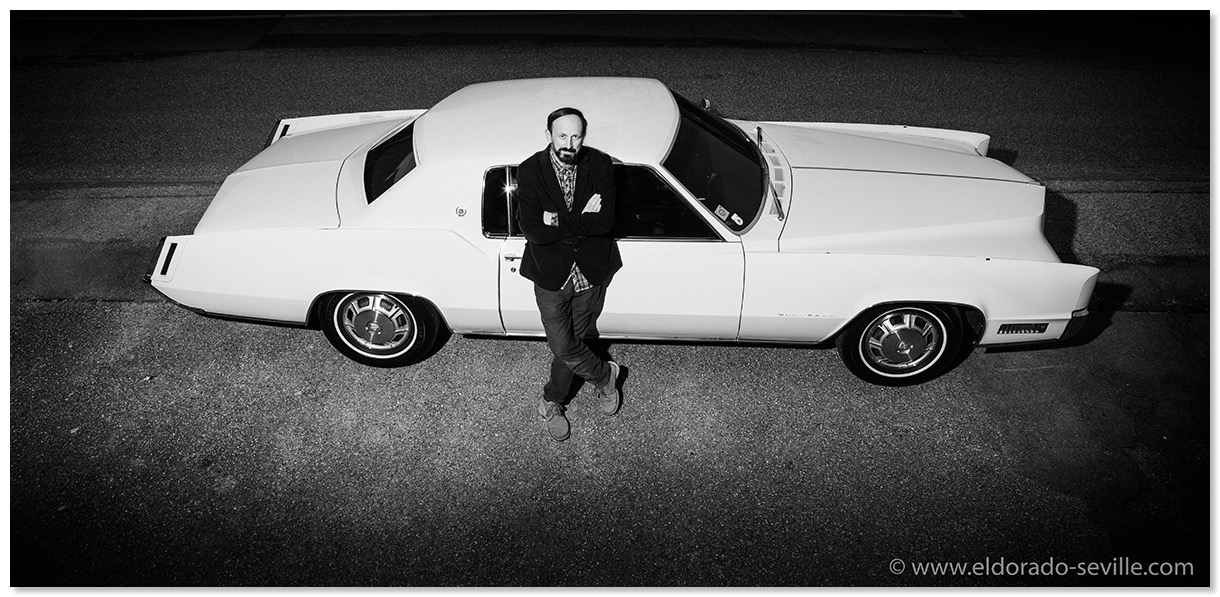 The last The last picture of the 67- still with the original paint.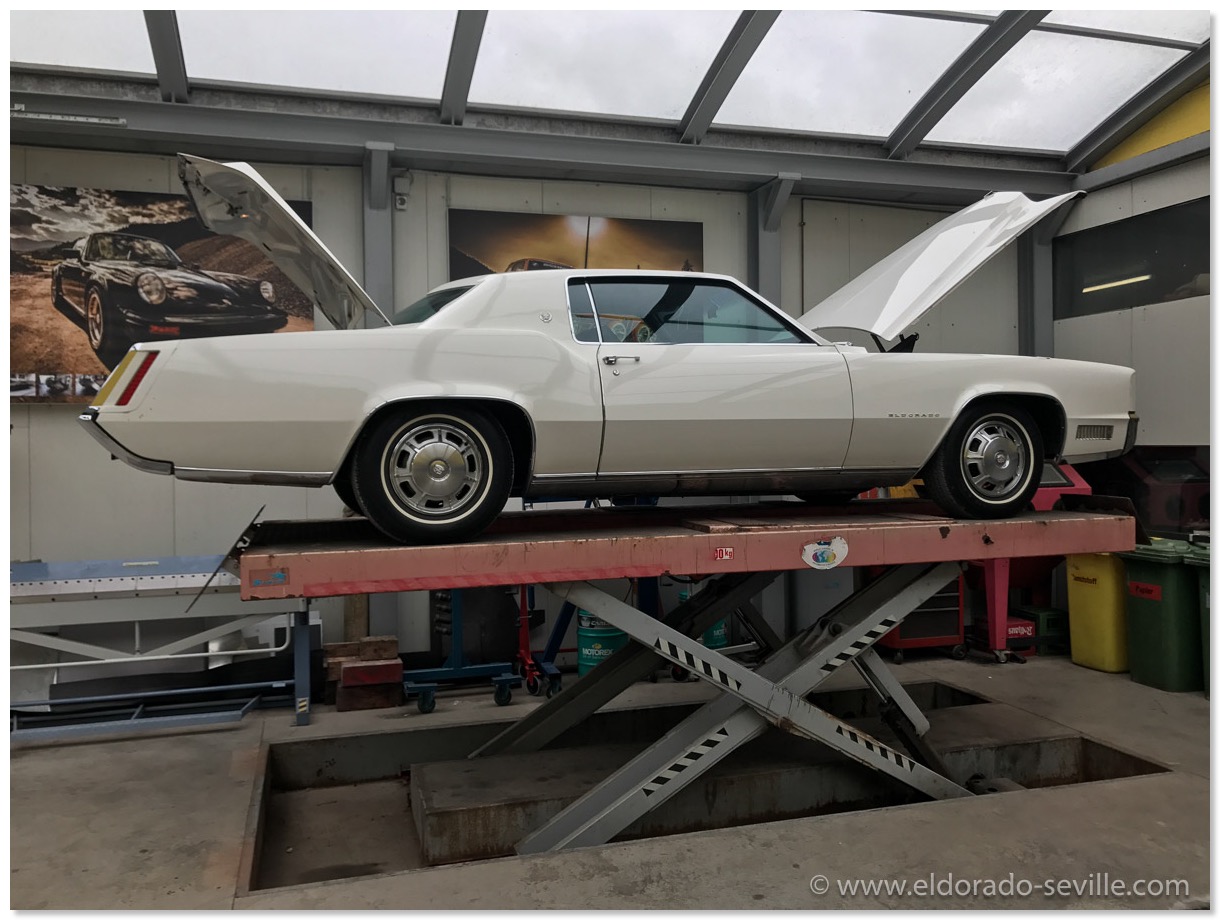
The car at In the restoration shop during the first inspection. The owner of the shop was pleasantly surprised by the condition of the car.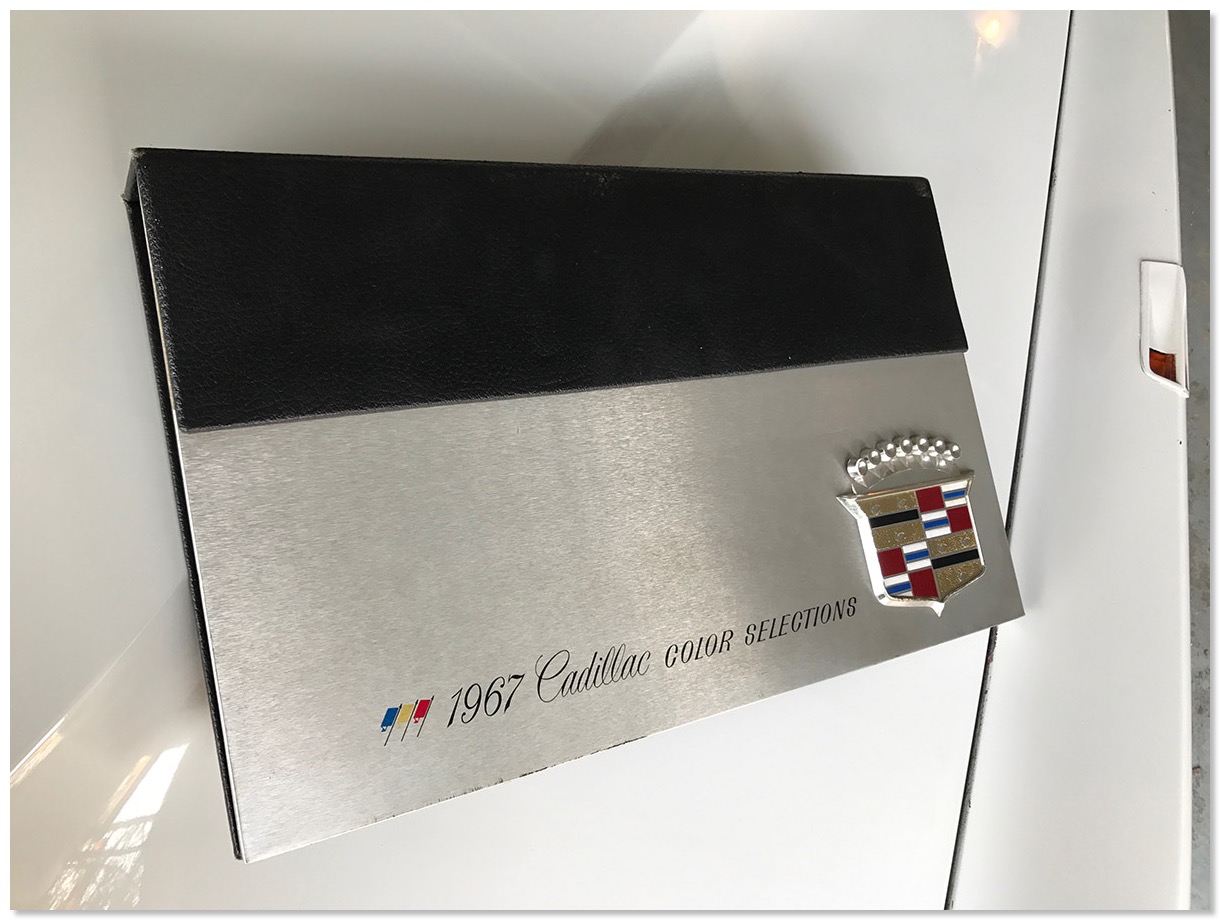
Cadillac buyers had quite a color choice for the 1967 model year. Here is the original 1967 Cadillac Exterior Color Selections Dealer Book
.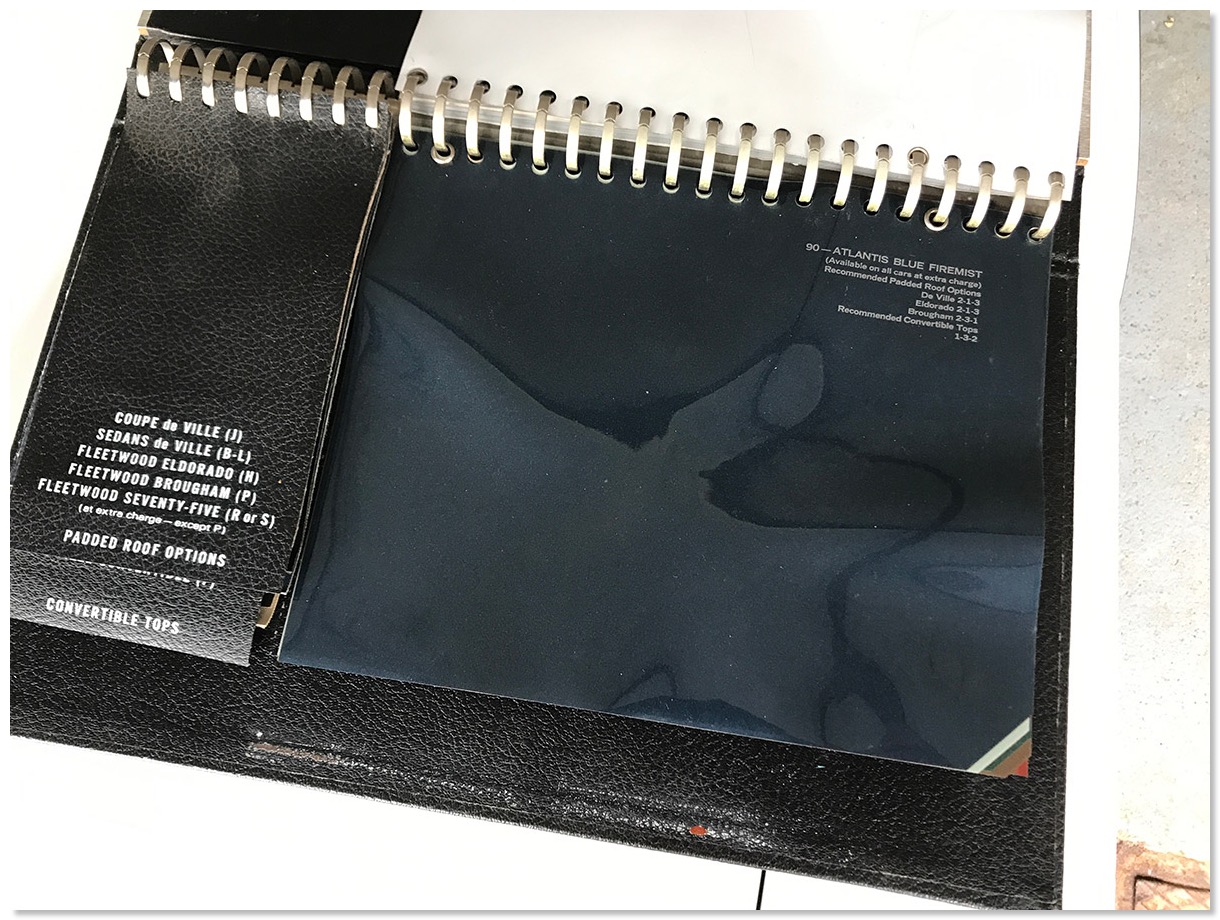
Code 90 - The optional "Atlantis Blue Firemist" is my favorite color for the 67 Eldorado.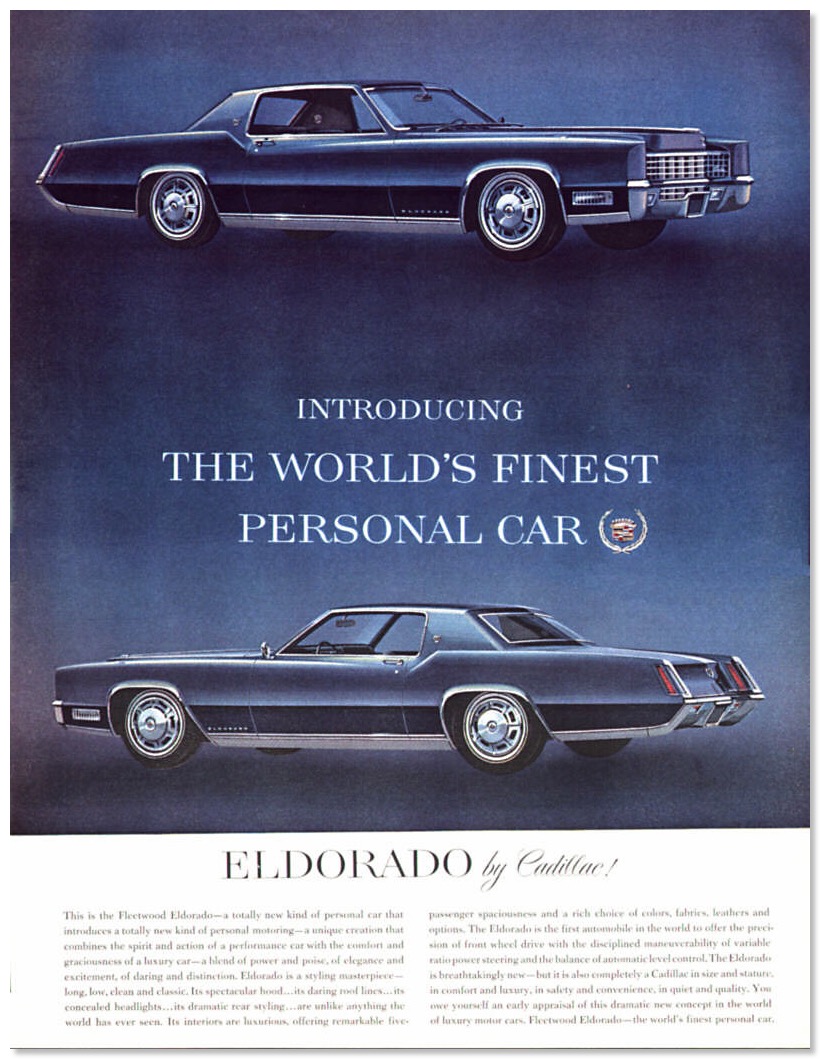
Atlantis Blue Firemist cars were used for advertising the new 1967 Eldorados - Color Code 90. This would be my favorite 1967 Eldorado color…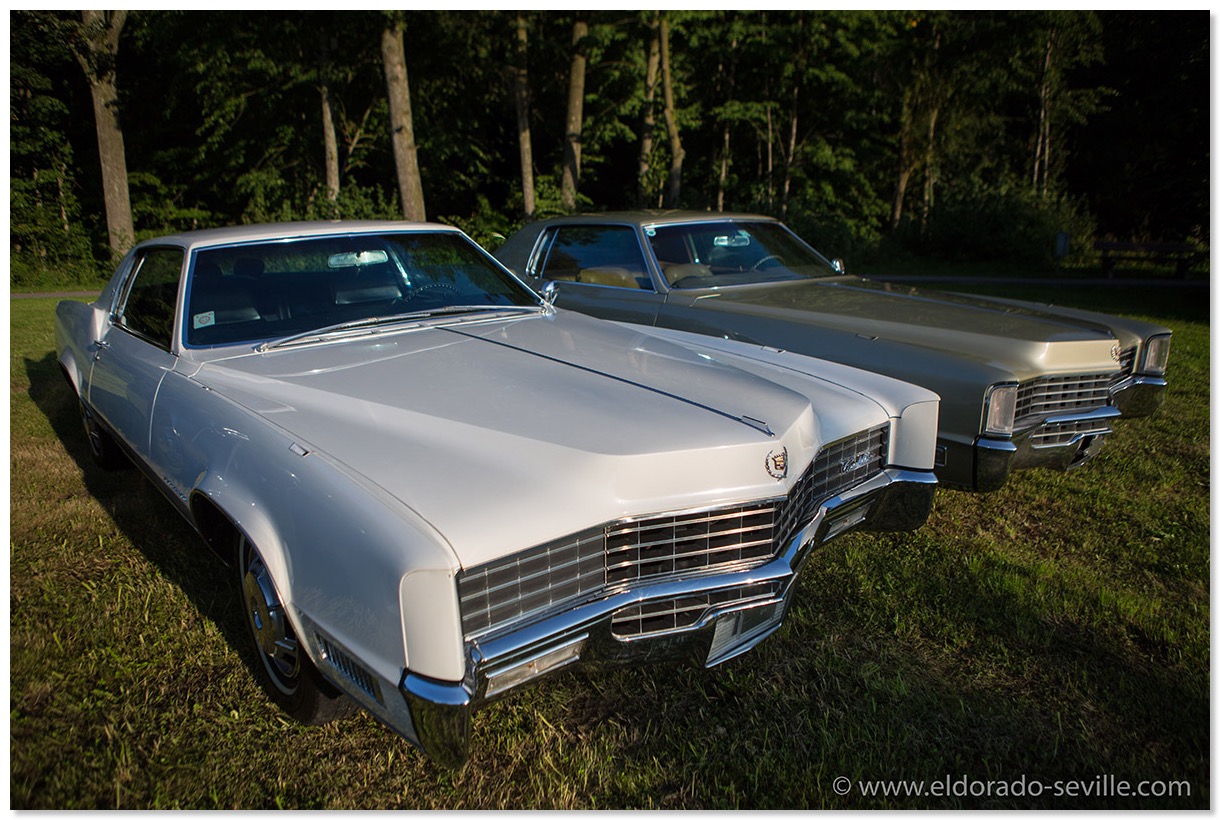
My car still looked flawless on pictures until you looked closer…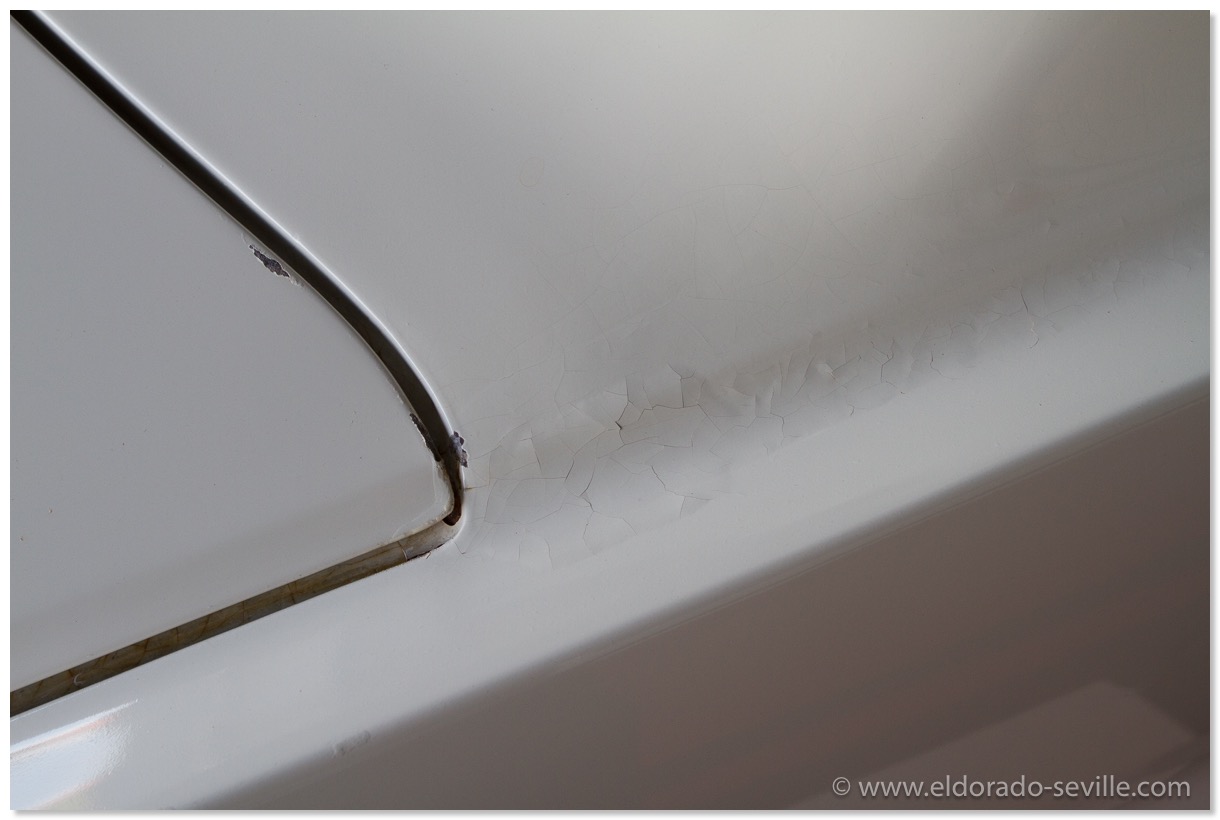
One of the areas where the paint was flaking off.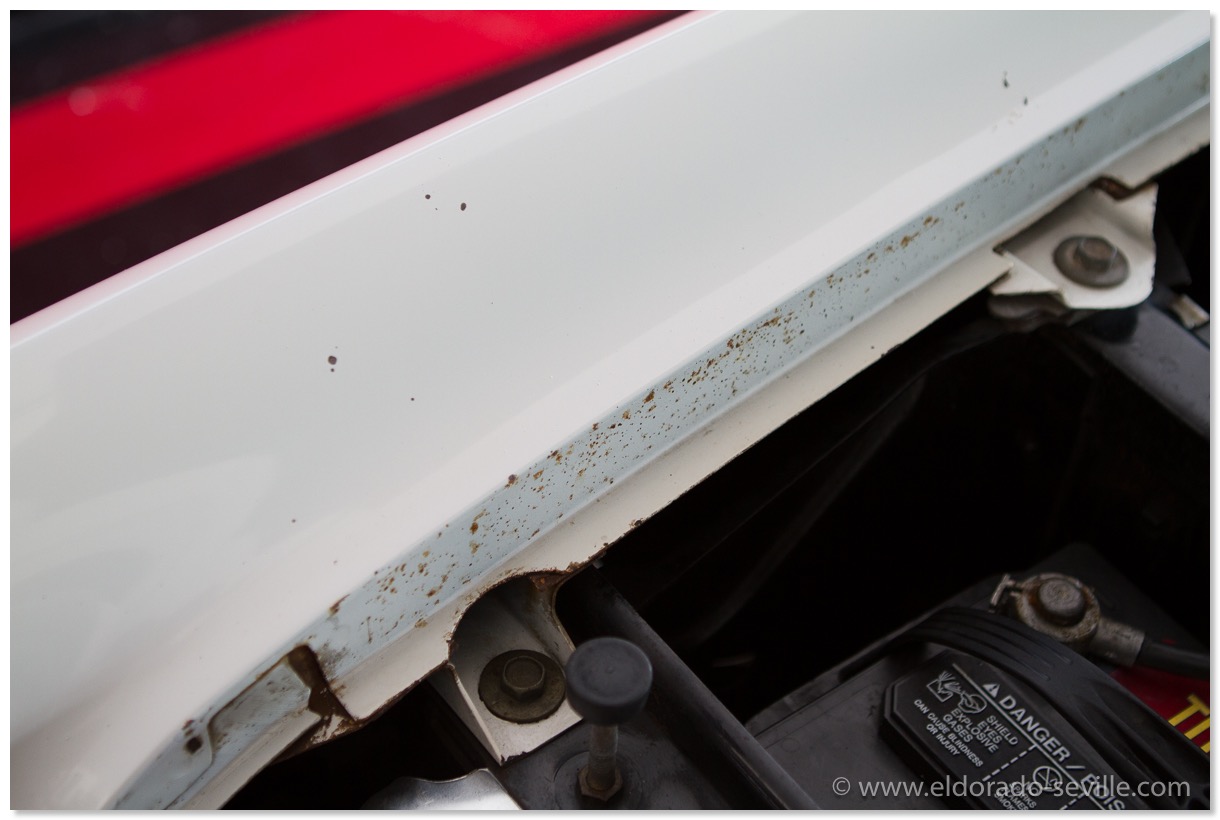
Some of the areas where the paint was pretty worn and surface rust was developing.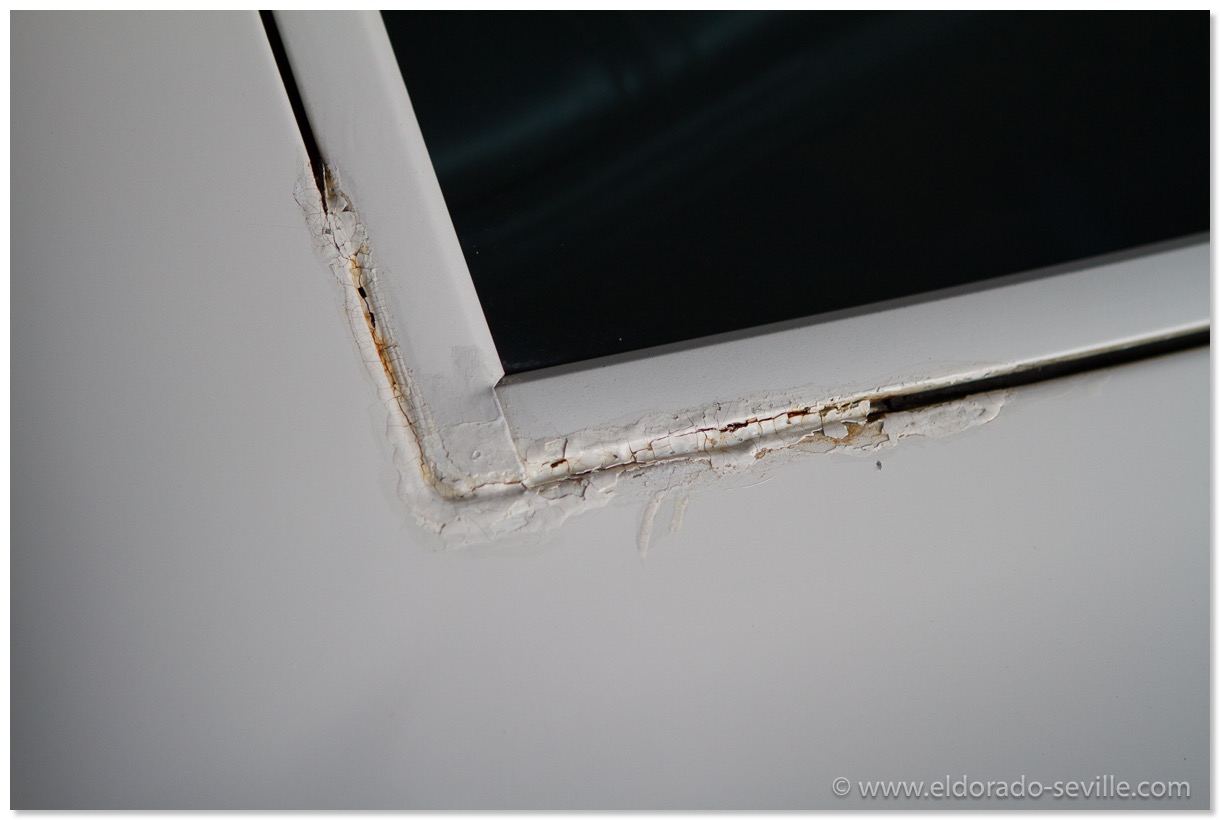
The rear window had to come out to fix this "repair" attempt by one of the previous owners…
FINISHED THE 1974 CADILLAC ENGINE BAY RESTORATION PROJECT
Everything that came out was cleaned up, and wherever I found some surface rust or flacking paint it was completely removed and the according part was repainted. I had to do all of this on a very tight budget, but luckily the total cost of this project was extremely low, as all I needed were 3 cans of paint, some wire brushes and some cleaning chemicals .
I took a break from Nov. 2016 to April 2017 where I did not do any car related work at all. During the last 2 weeks I finished everything, and the car is now ready and only needs a good cleaning prior to the upcoming season. When everything was back together the car started up immediately (see video below) but I could not let it run for a longer time yet as the engine enamel (I used Bill Hirsch engine enamel) needs at least 2 weeks to fully cure.
I did not restore parts which still had their original decals, because some are irreplaceable, as there are no correct reproduction decals for the 1974 Cadillac out there. Many decals for sale for the 1974 Cadillac are totally incorrect - beware! For example there is no correct "Caution Fan" decal or AC compressor decal available anywhere. So there is still some patina left on some areas, and at first glance the engine bay does not look restored at all, but more like an extremely well kept car with very low mileage. I did not want to go for this over restored look.
But let the pictures speak for themselves - here are 3 Before/After pictures (Click on them for a larger view) and the rest of the restoration pictures can be found here.
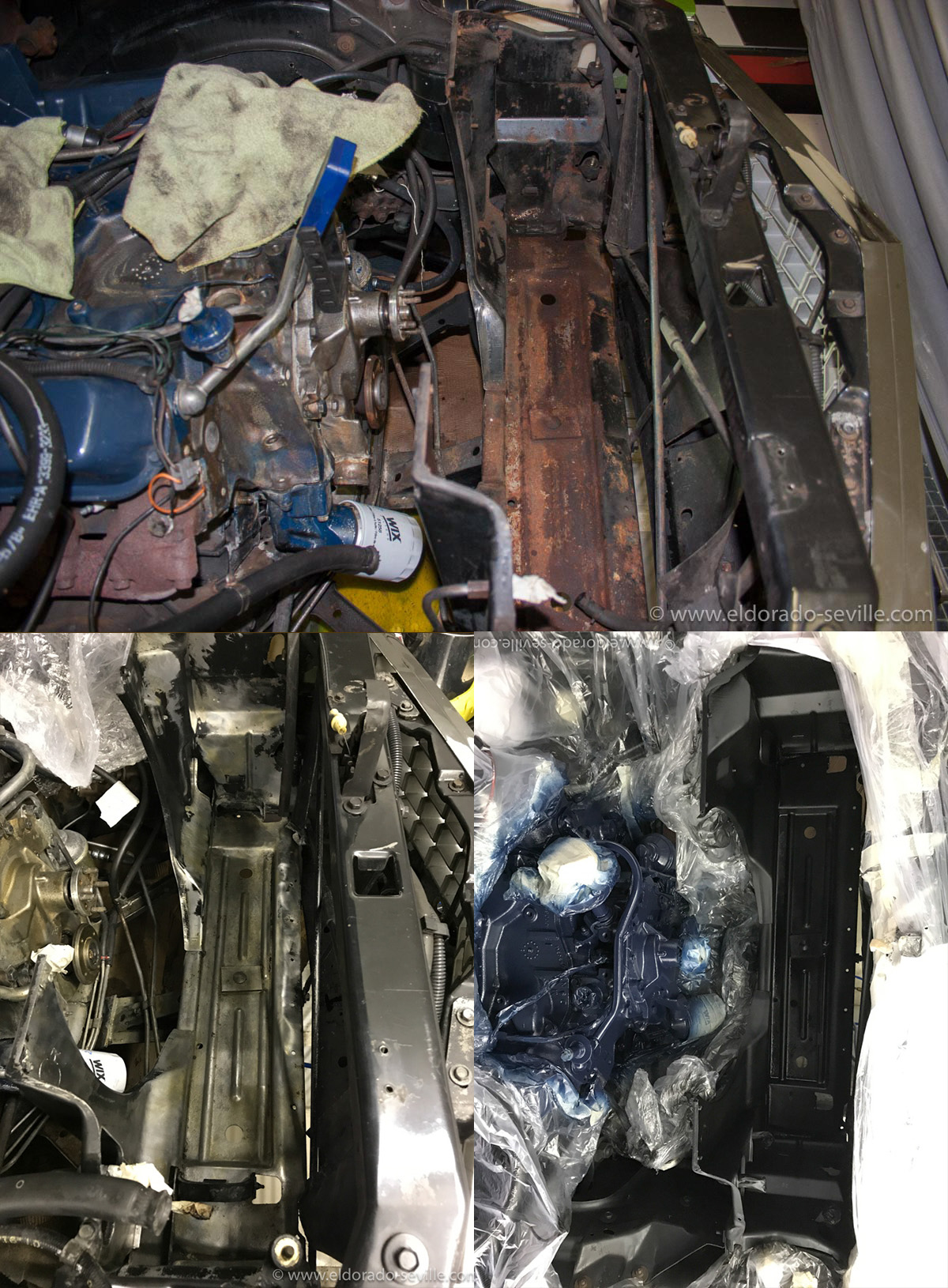
The radiator support frame before, after removing the rust and after painting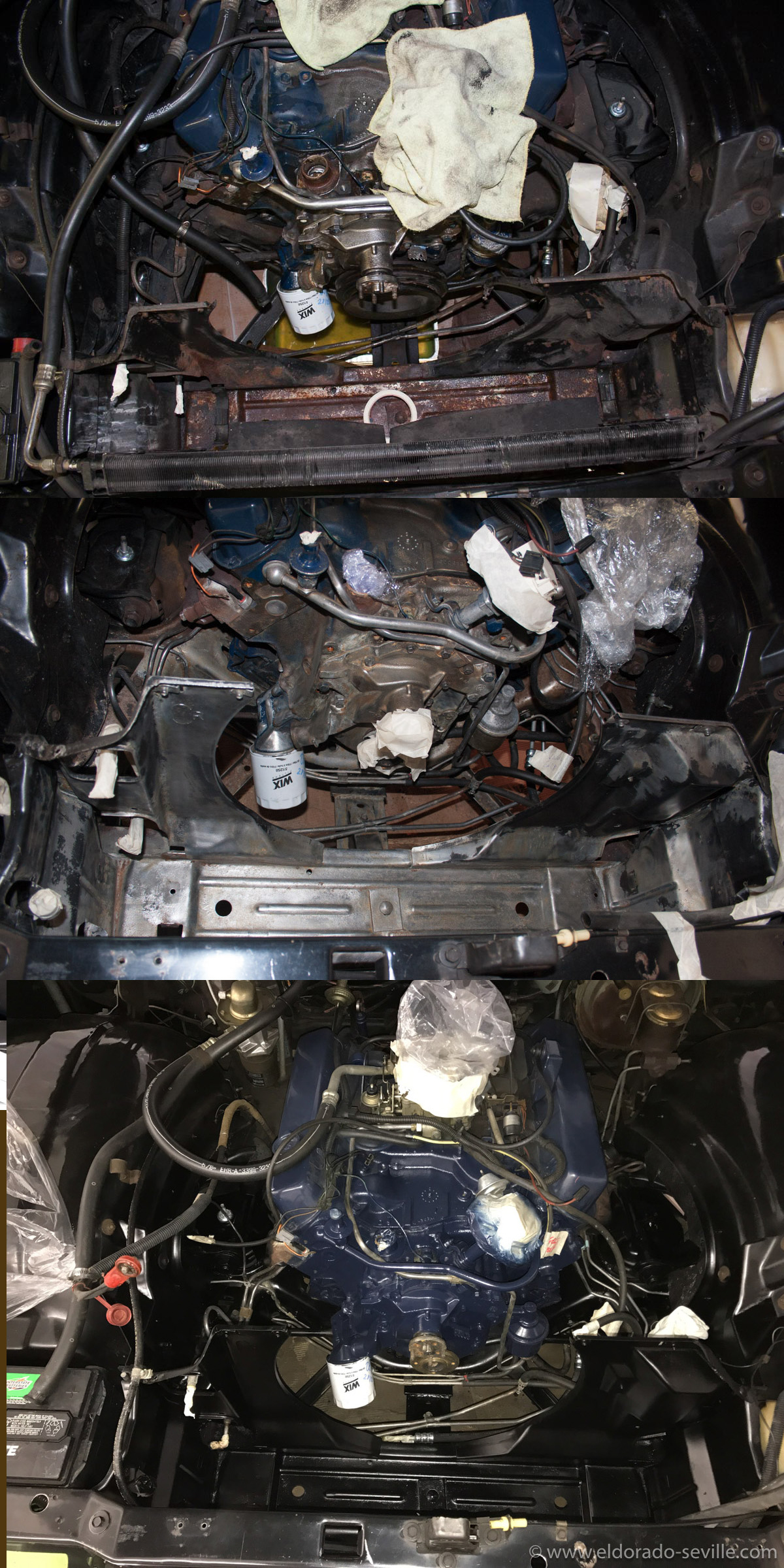
The radiator support frame before, after removing the rust and after painting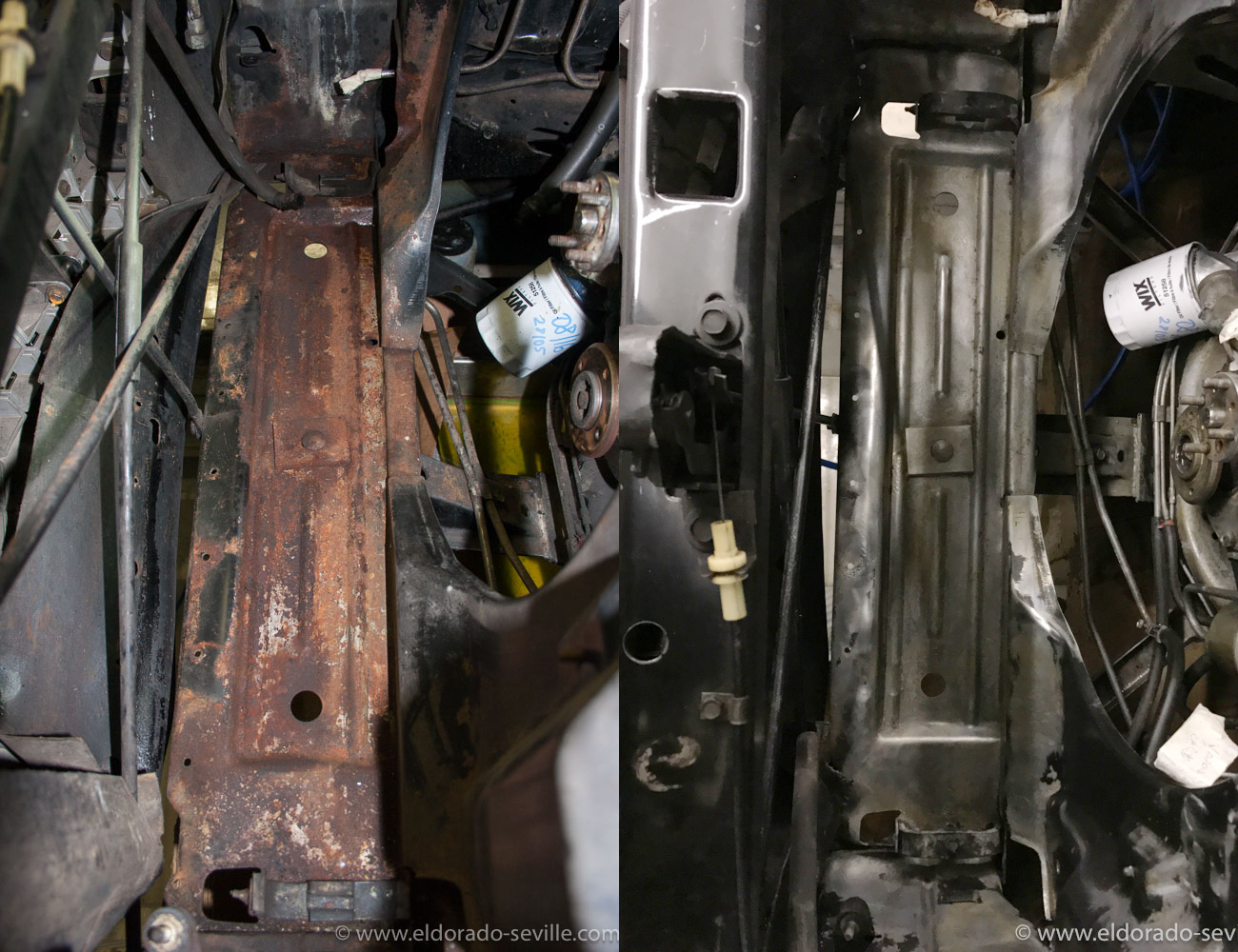
Before and after rust removal
Here is short video of the first start up after the restoration.
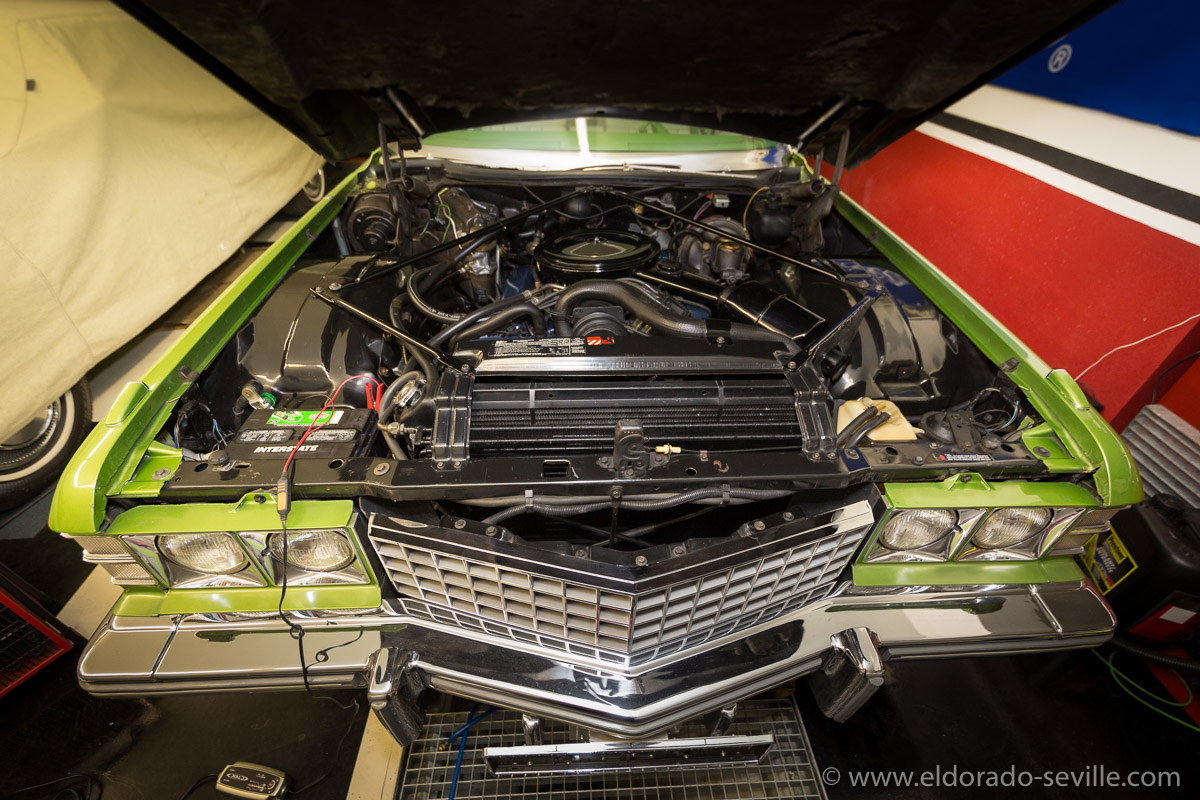
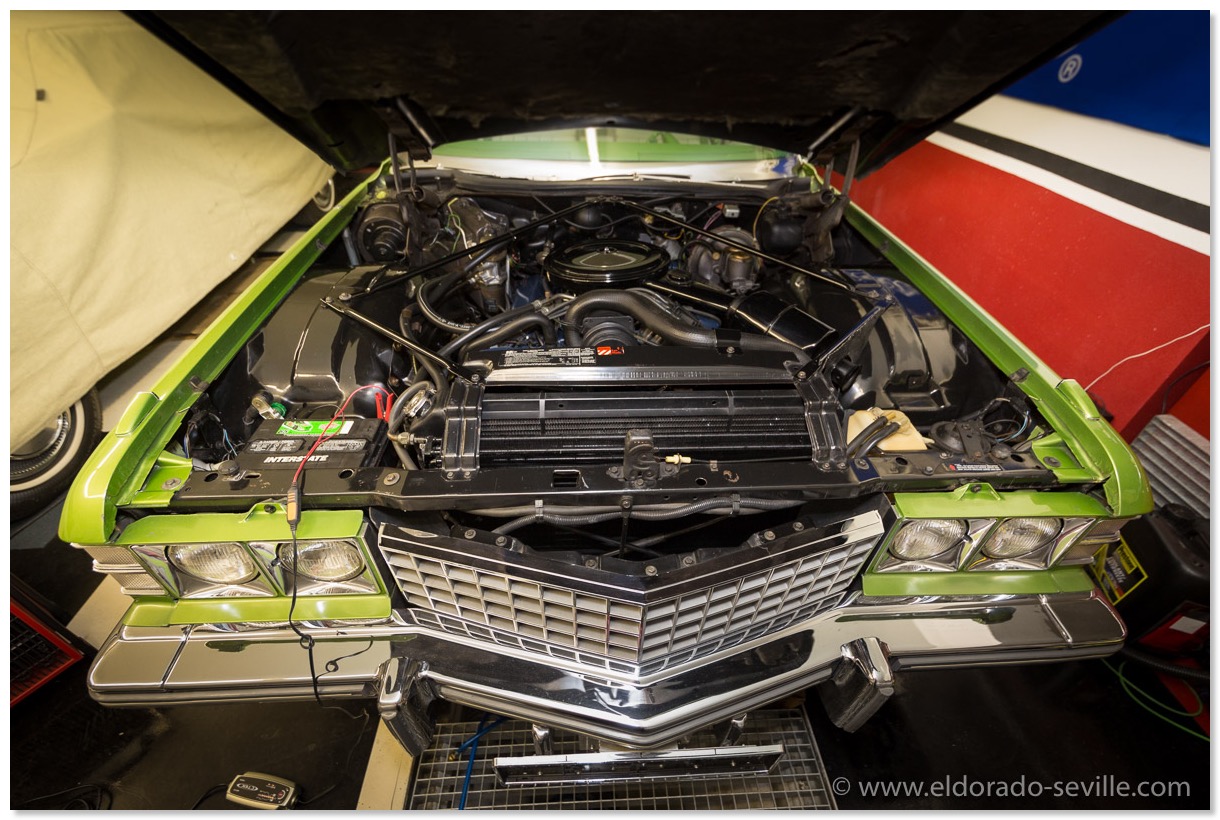
The finished engine bay looks pretty nice!
More pictures of the finished engine bay can be found here.
A6 AC COMPRESSOR REPAIR - BAD BEARING ON THE 1974
Due to all the other projects I never managed to get the AC back in fully working order until now.
Unfortunately the rebuilt AC compressor came with the clutch coil terminals in the wrong position. They are available with the terminals at the correct 10 o clock position or the 2 o clock position, which is correct for other years.
If the terminals are in the wrong position you cant connect the original wires to them as they are too short. With the high shipping costs it was no option to send the incorrect compressor back.
As it turned out the cars original compressor had a bad bearing and that was the reason why it was disconnected.
My friends Lucky and Steve were here to help me with the compressor project and so I took both of my compressors to Lucky´s workshop, as he has all the necessary tools and experience with these compressors from his own cars.
Originally I just wanted to turn the clutch coil on the rebuilt compressor into the correct position, but then we decided to rebuild the original compressor instead, because it still has the original decal, which is not available as a correct reproduction. All the available compressor reproduction decals are TOTALLY incorrect for the 1974 Cadillacs. The 1974 reproduction decals all show the wrong amount of refrigerant! They are also different in many other details. The closest match of reproductions for 1974 are the ones from 1972 Cadillacs…
We still disassembled the rebuilt compressor to "borrow" its pulley bearing to replace the bad one on the original compressor.
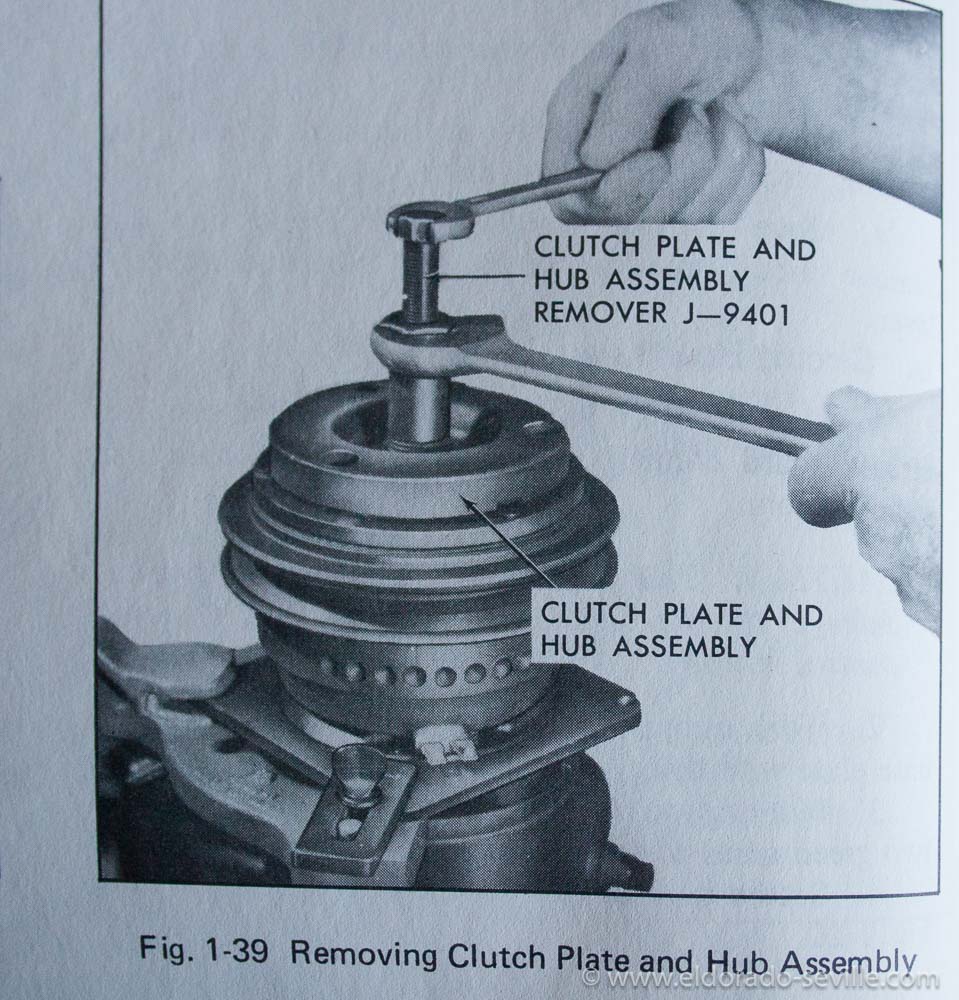
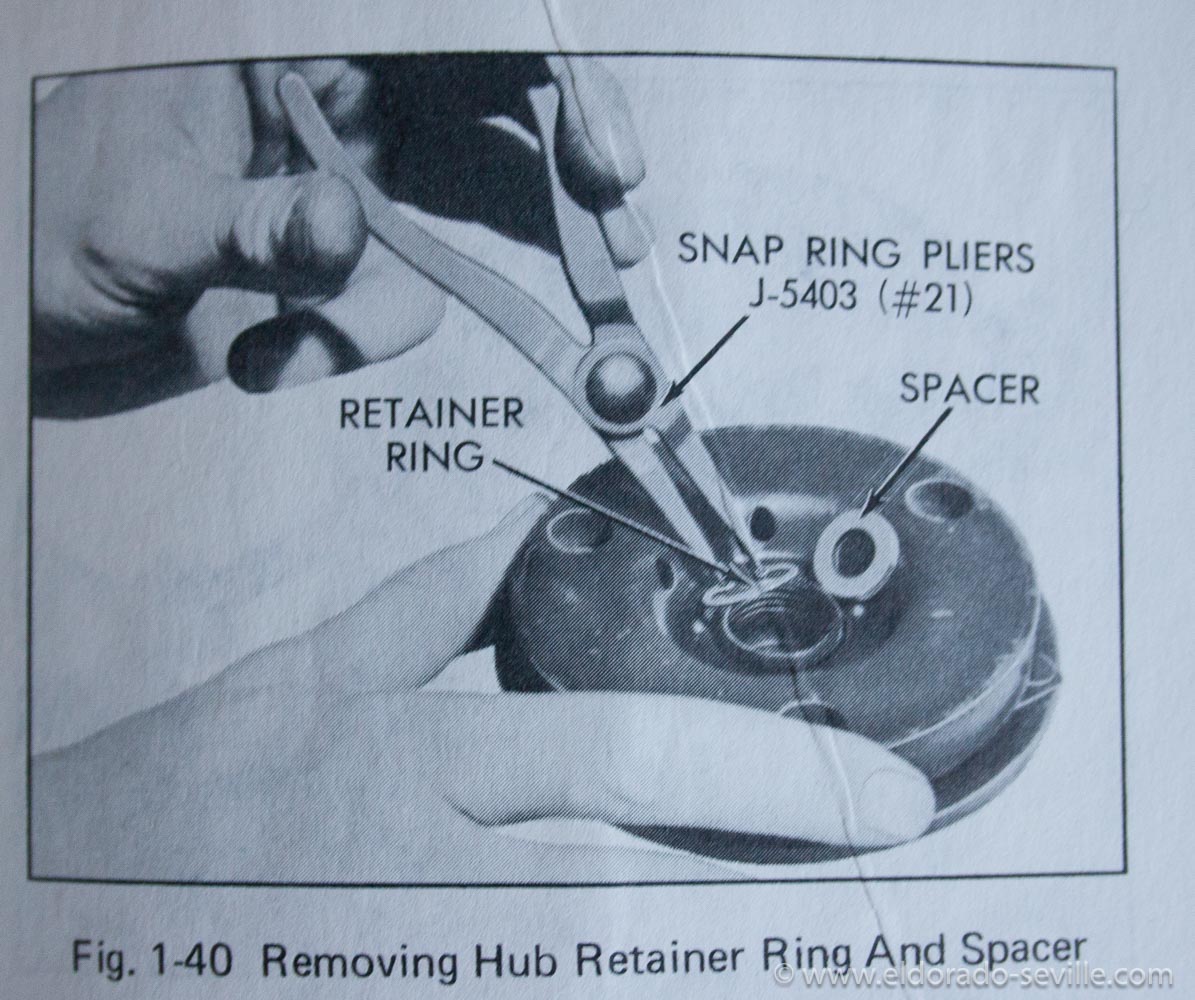
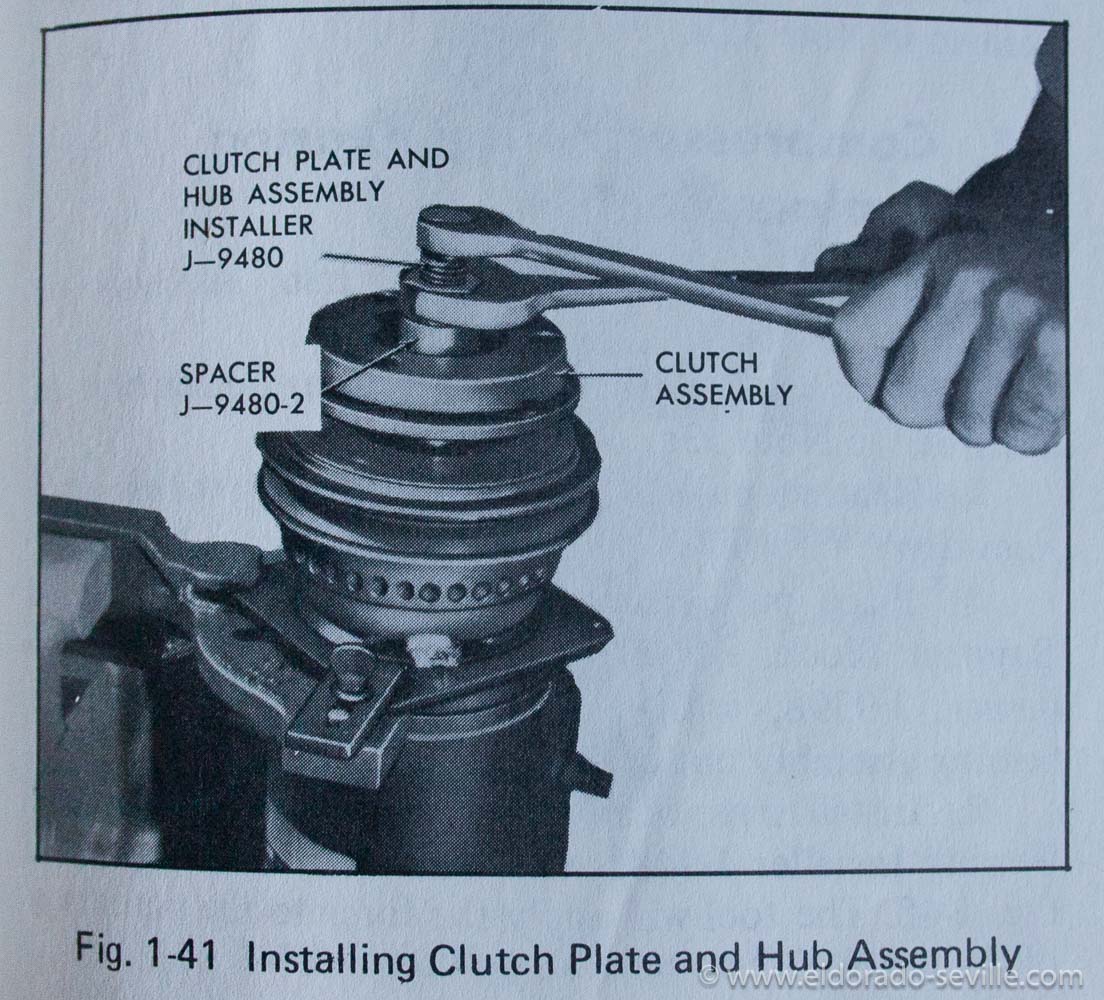
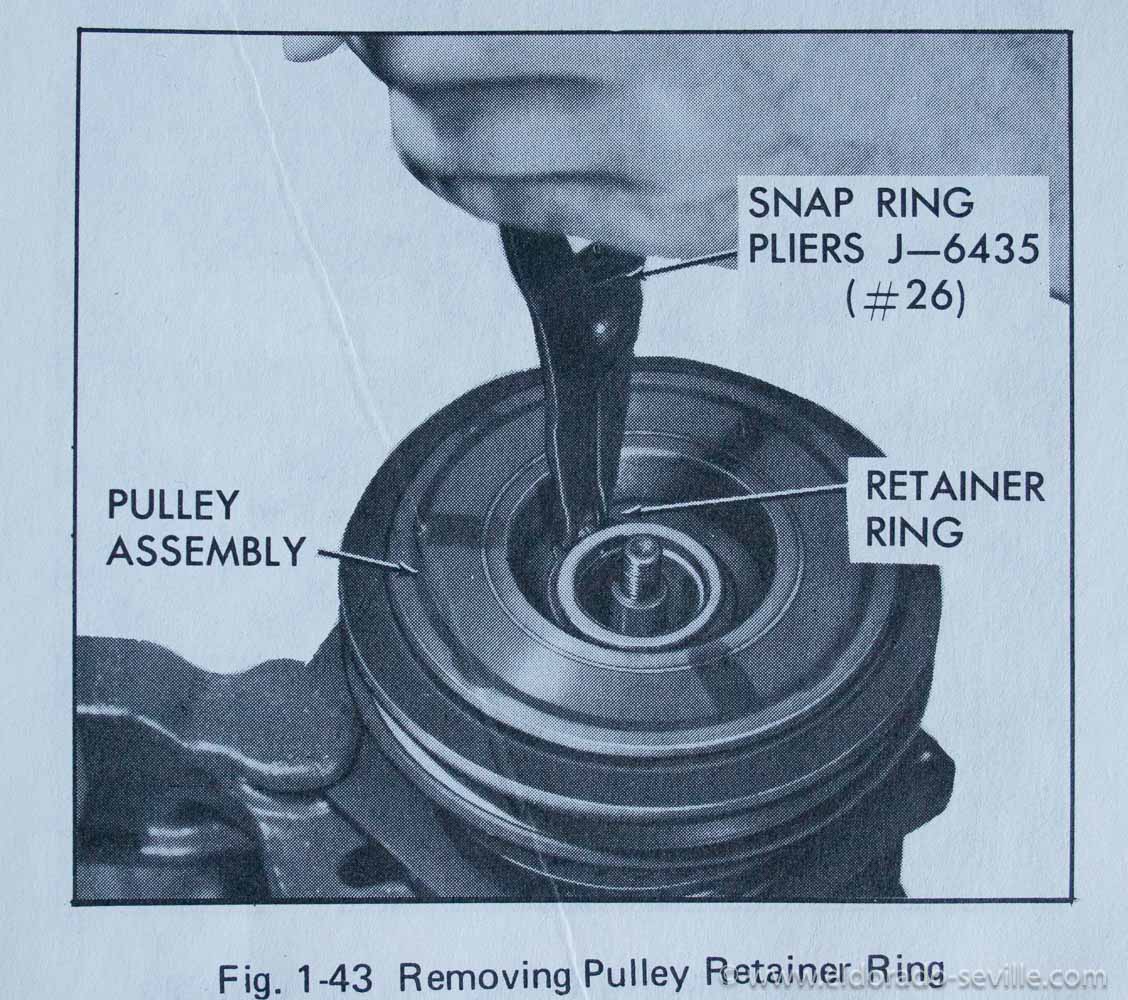
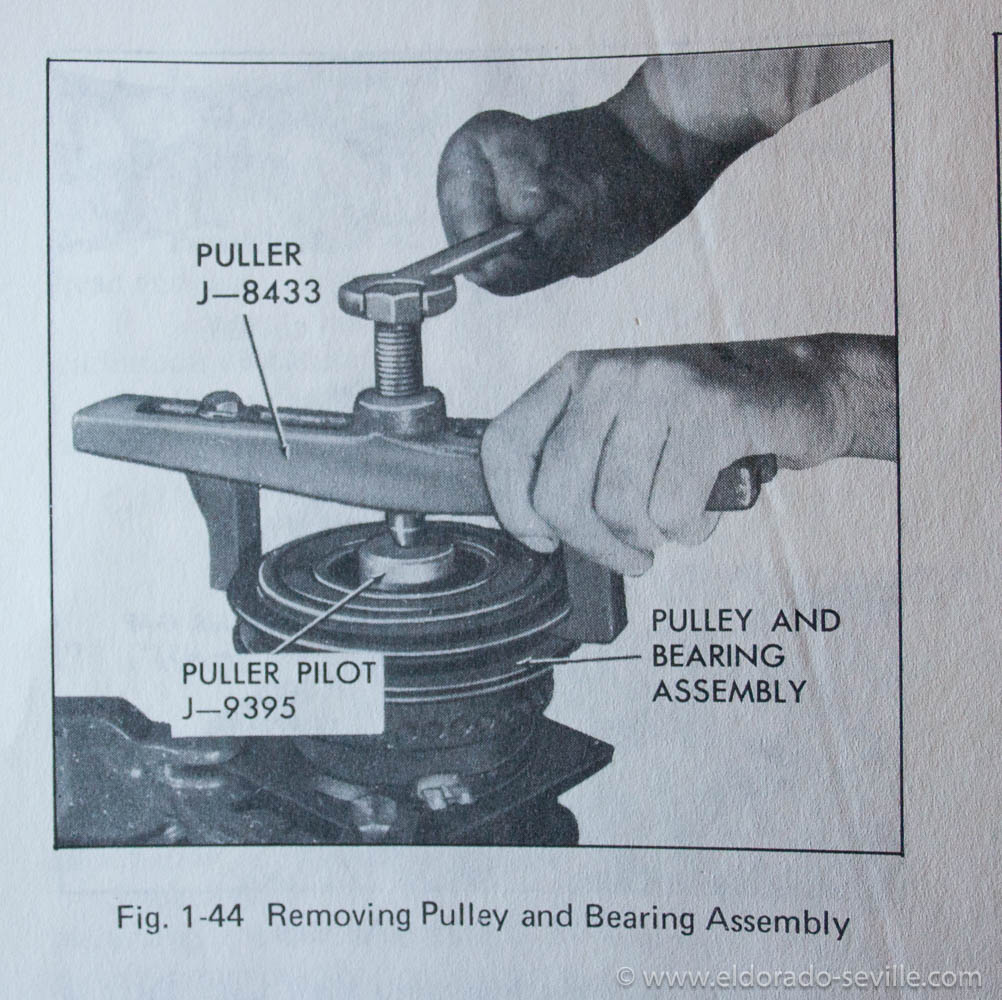
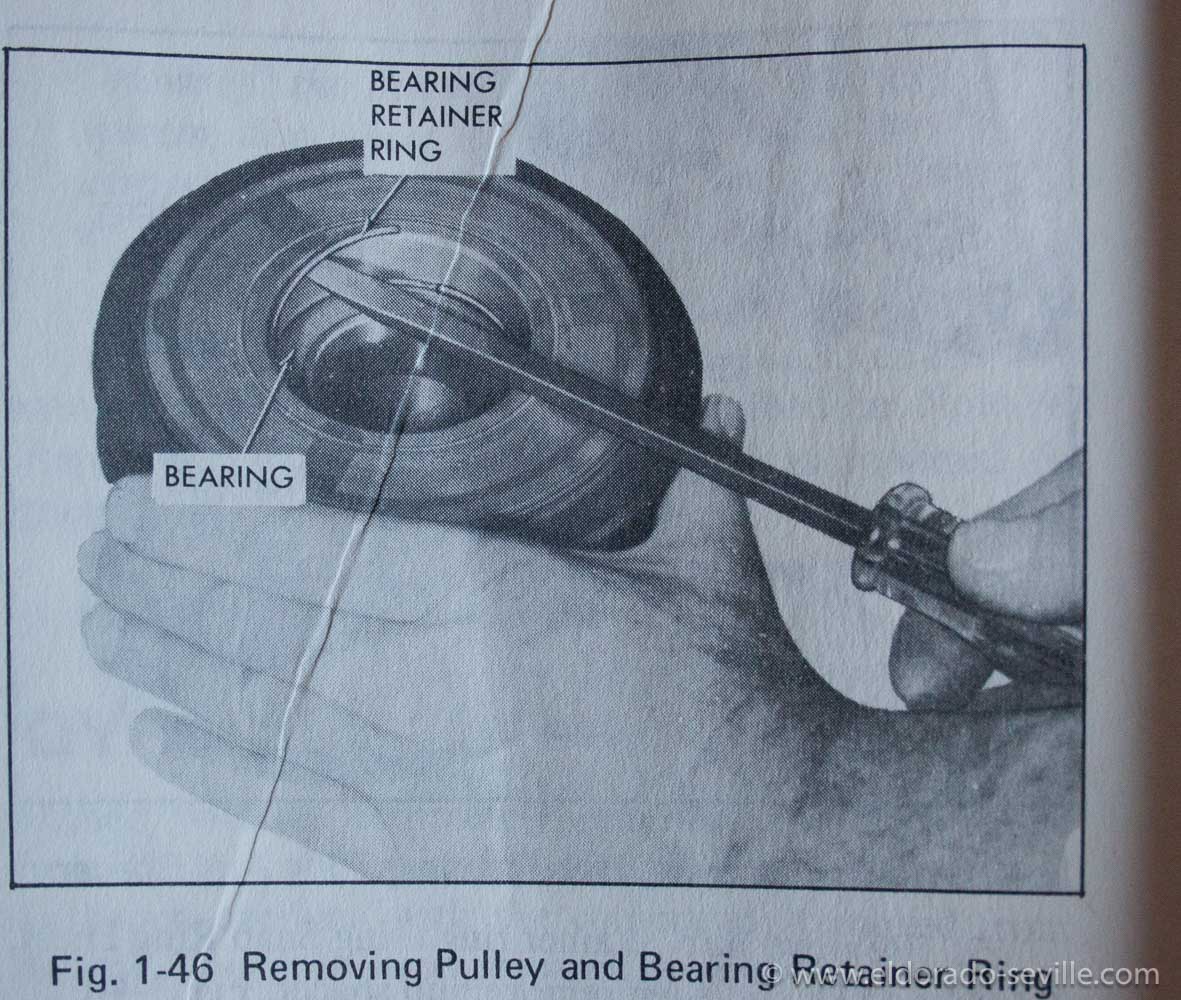
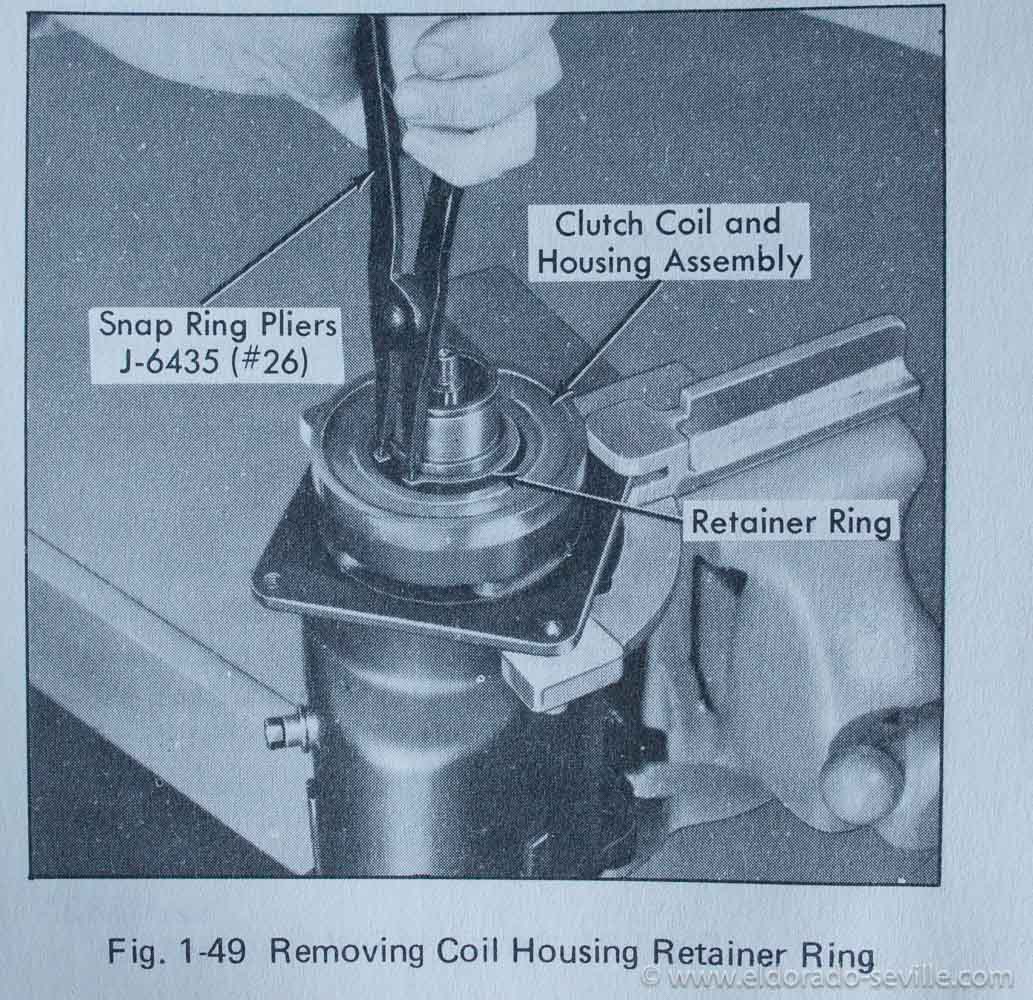
The procedure to be able to replace the bearing and to turn the clutch coil is not too difficult - but you need some special tools. Without those you cant do it. You´ll need a basic clutch puller / installer set for this job and some long nose snap ring pliers to get the retaining rings out.
First remove the shaft nut and the snap ring ( the rebuilt compressors always seem to come without this snap ring) and then pull the clutch with the special puller. Pull off the pulley and take the bearing out and replace it with a new one.
To be able to turn the clutch coil you´ll have to remove another snap ring. This snap ring was the biggest challenge for us. The shop manual lists a special tool for this which we of course did not have… It could be done with a very long nose plier as well, but we did not have these either. So it took us quite a long time to get it out with screwdrivers and self made hooks… You can then simply turn the coil into the correct position.
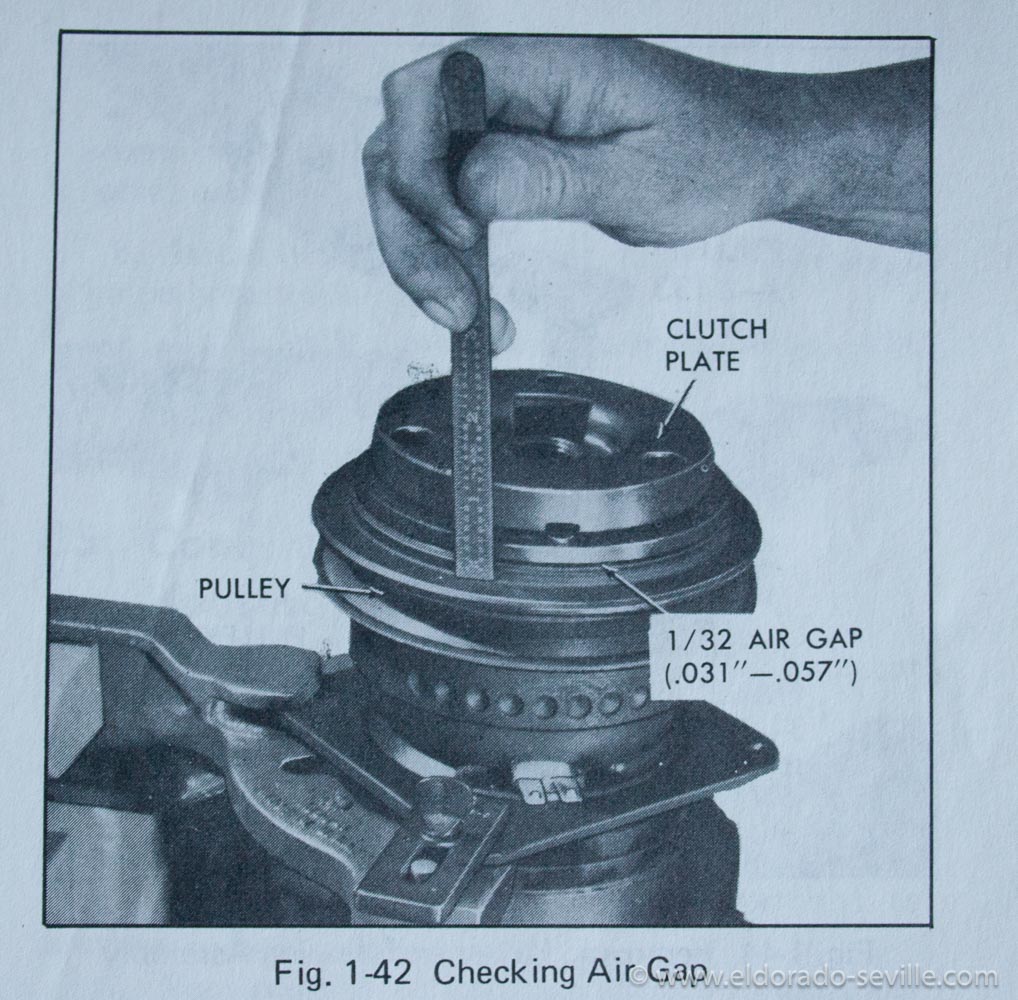
Putting it back together is pretty straightforward as well, but again you need a special installer tool to get the clutch back on and to adjust it properly.
I will now have to buy a new bearing so that I can put the rebuilt compressor back together and have it as a spare.
I have attached some pics from the shop manual which show how to remove the various parts of the compressor to remove the pulley and the clutch coil.
As always you can find ALL the pictures in my restoration gallery!
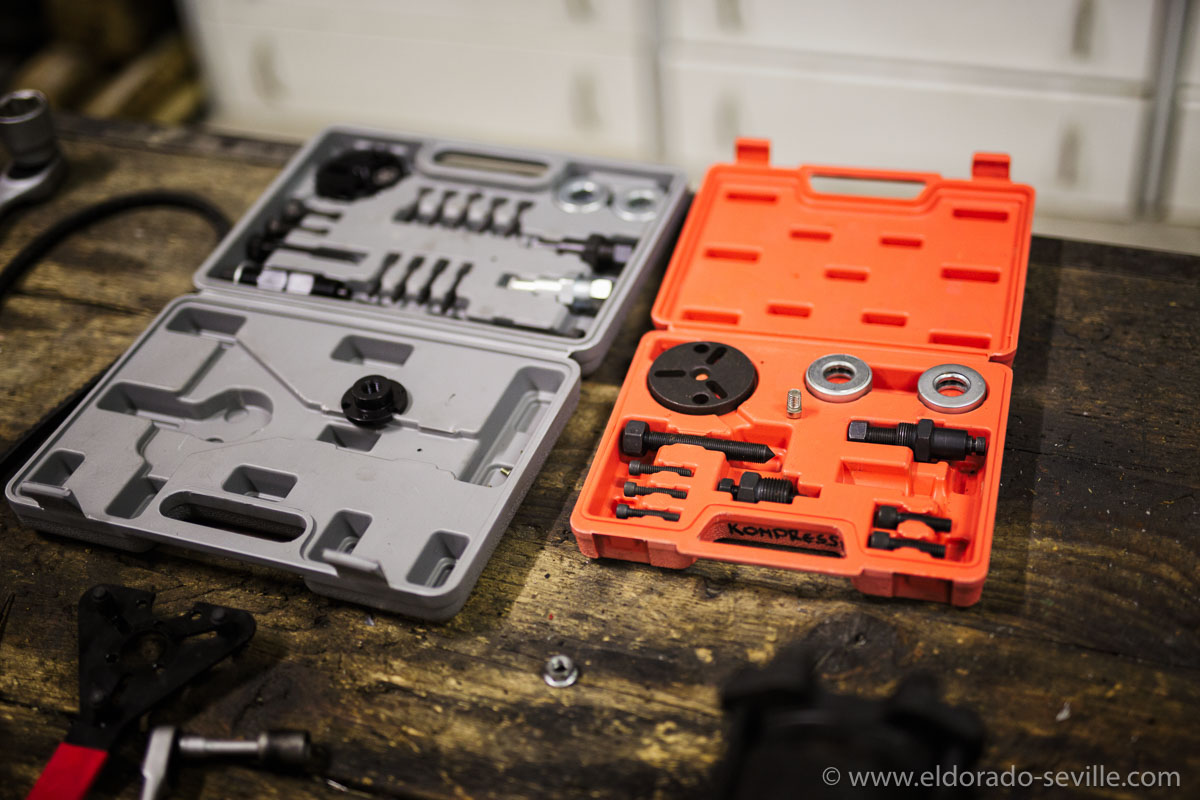
You need some special tools to disassemble the A6 AC compressor.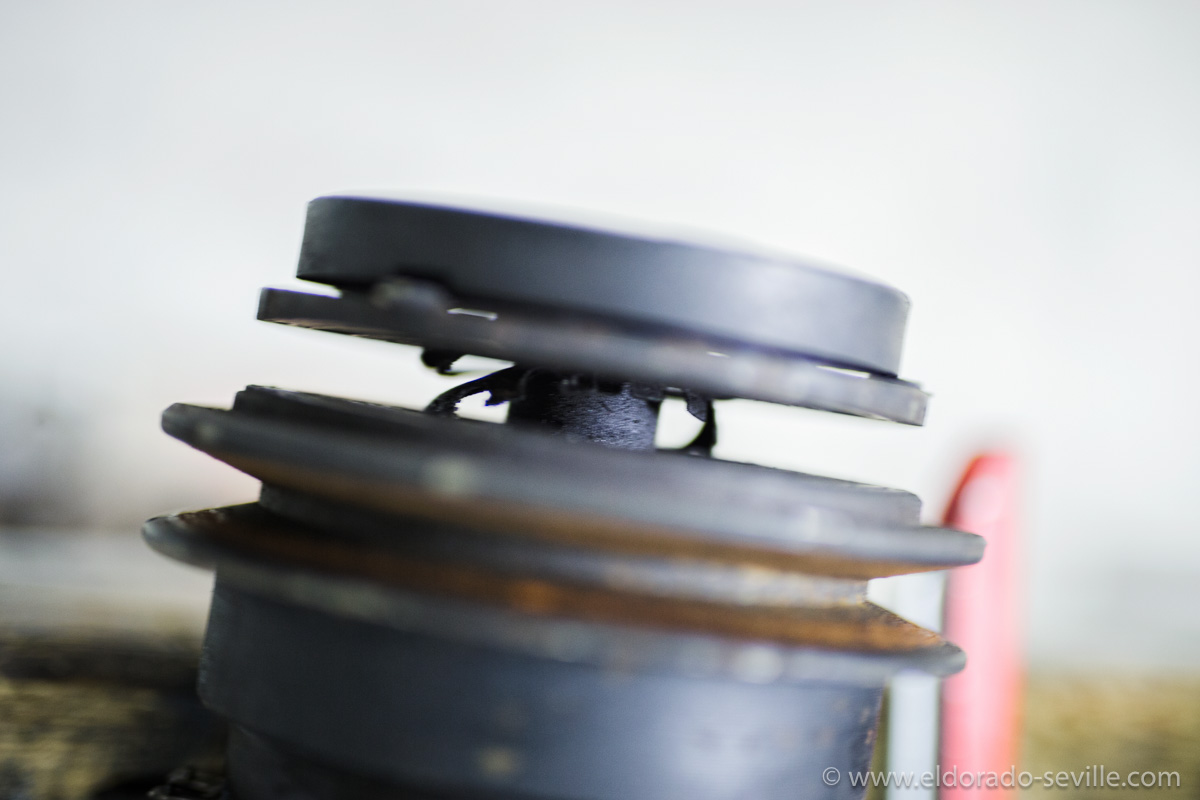
On the 74´s original AC compressor clutch the bearing was bad.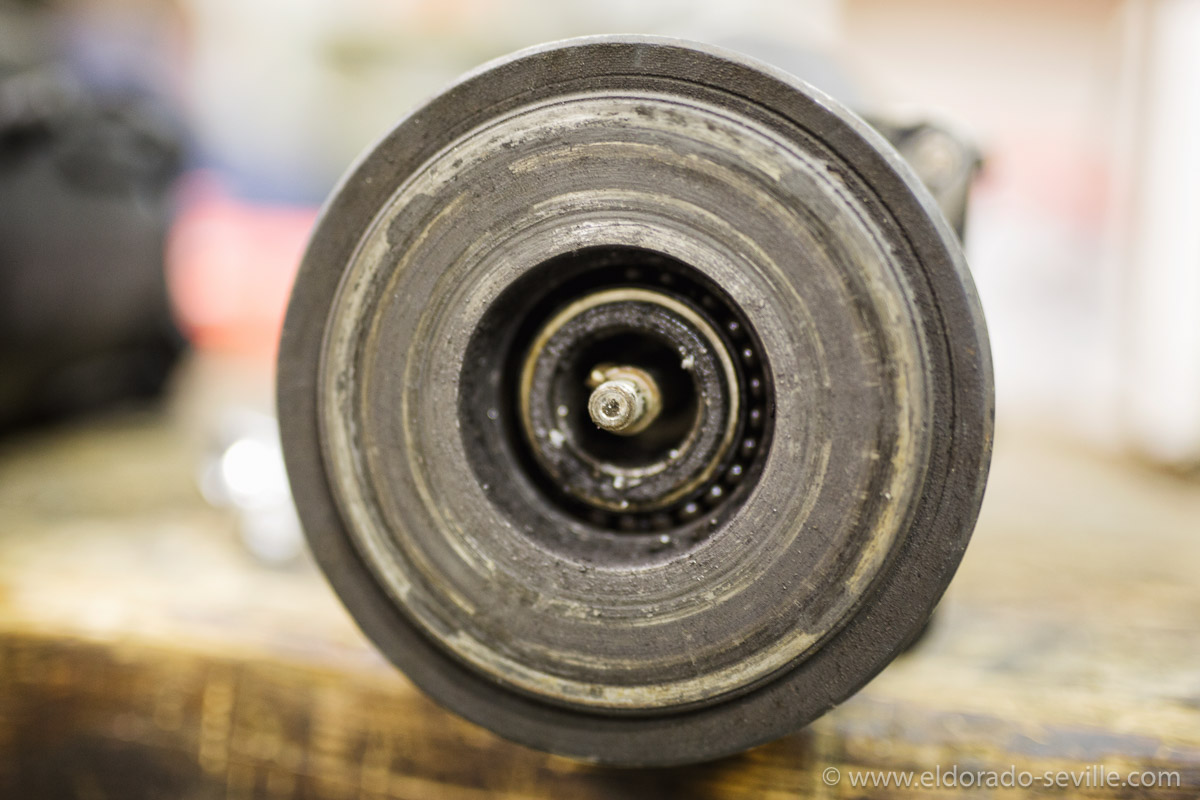
The compressor clutch removed. You can see the bad bearing inside which is normally sealed. Some balls were already missing.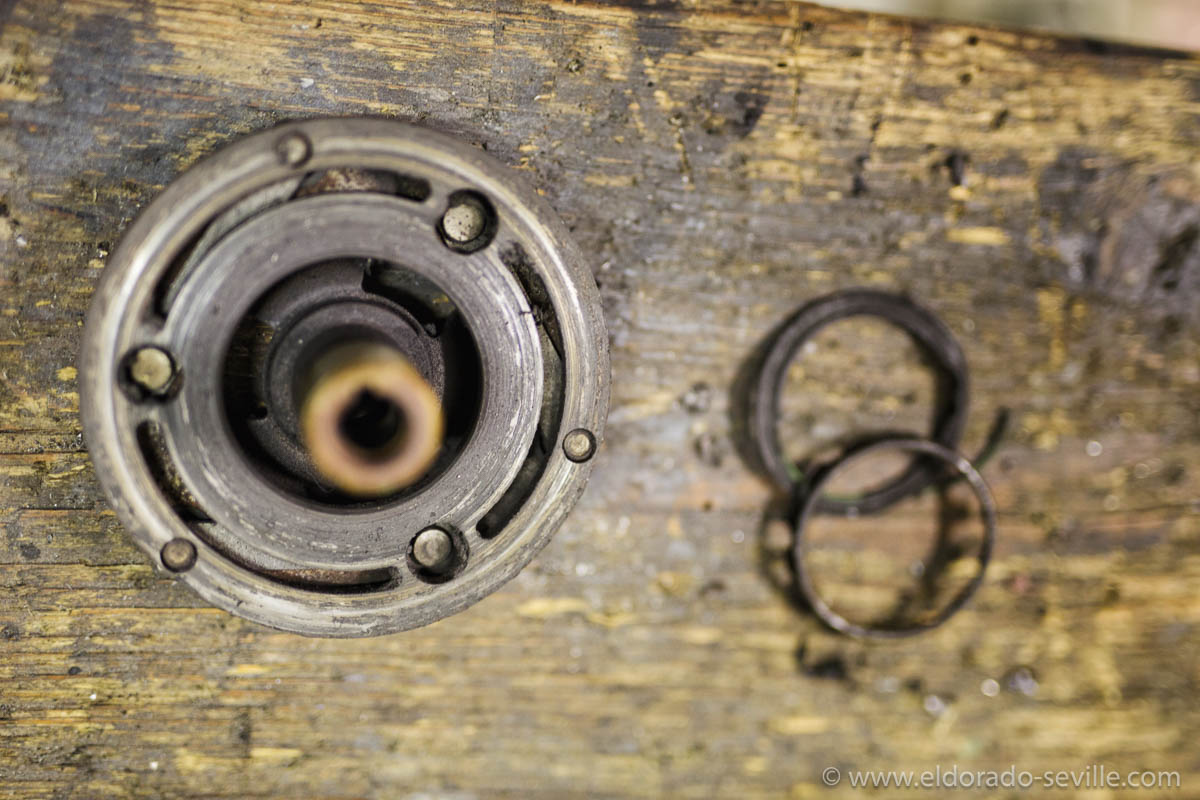
The clutch with some remains of the bearings.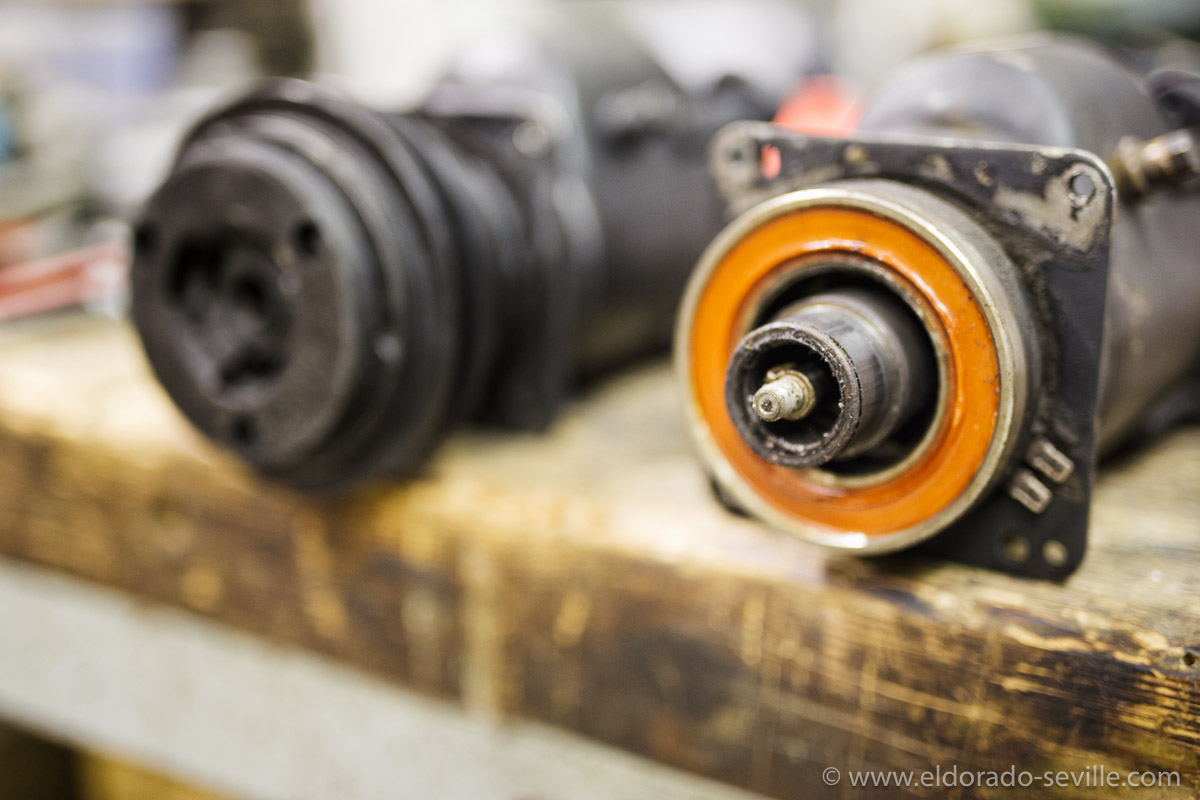
The clutch and pulley removed on the original compressor.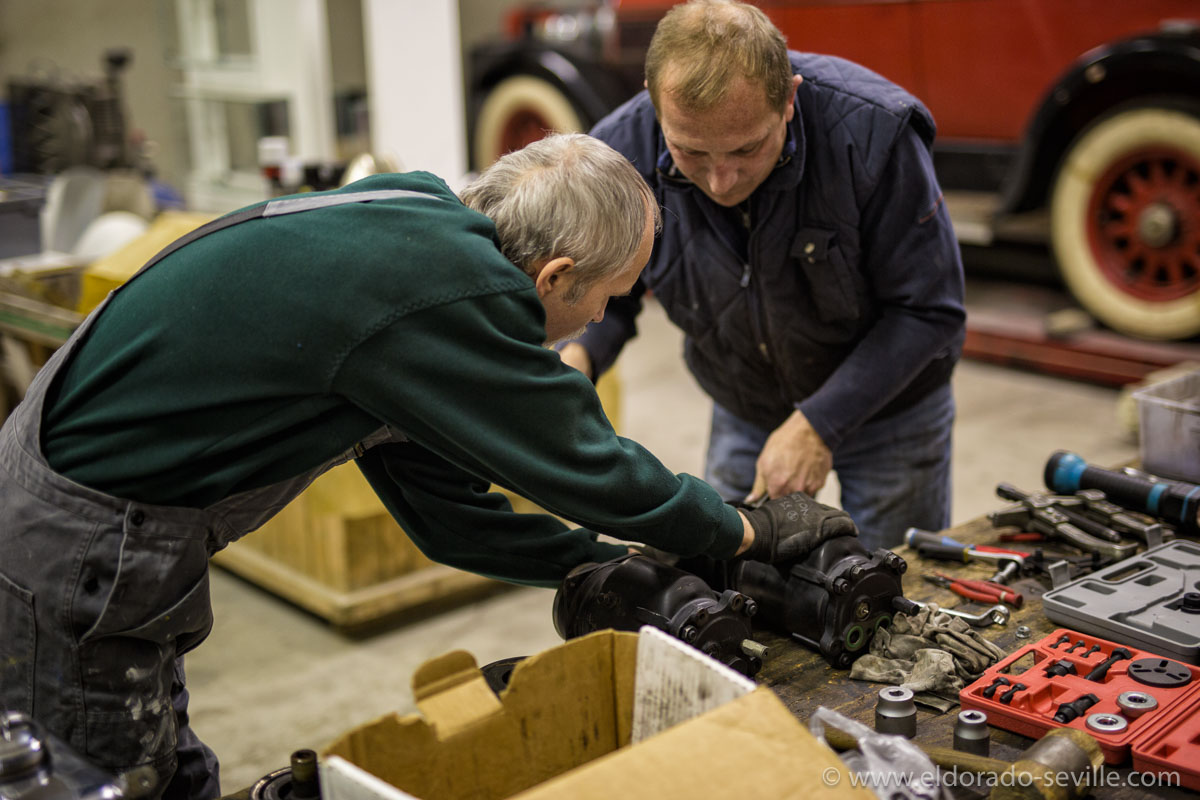
My friends Steve and Lucky at work. We also replaced all the O - rings.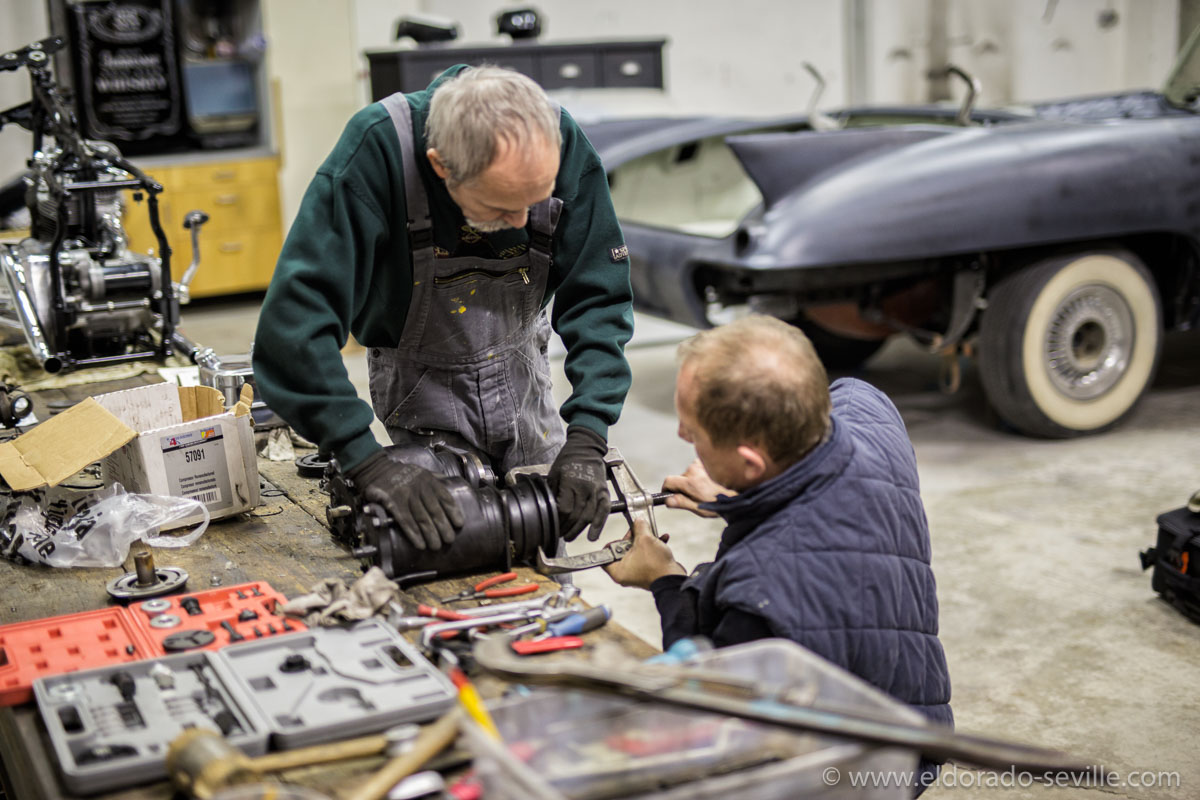
Removing the pulley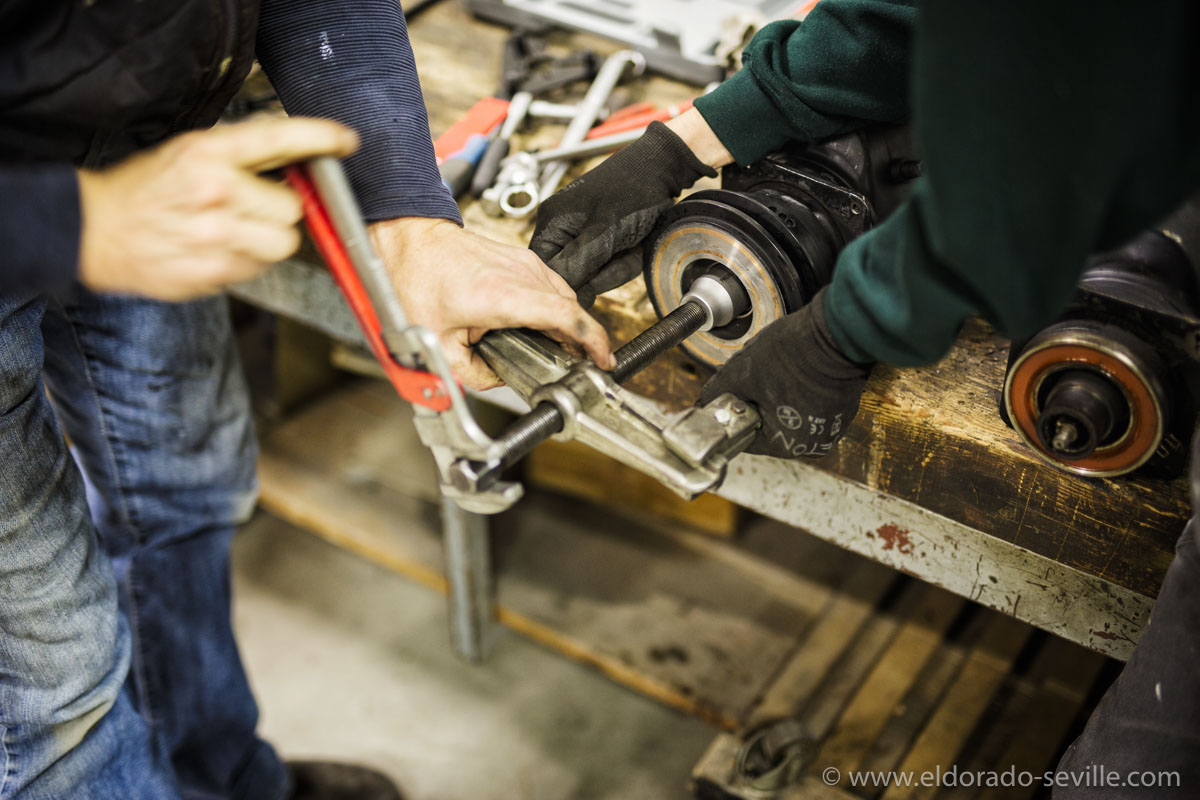
Removing the pulley from the rebuilt compressor.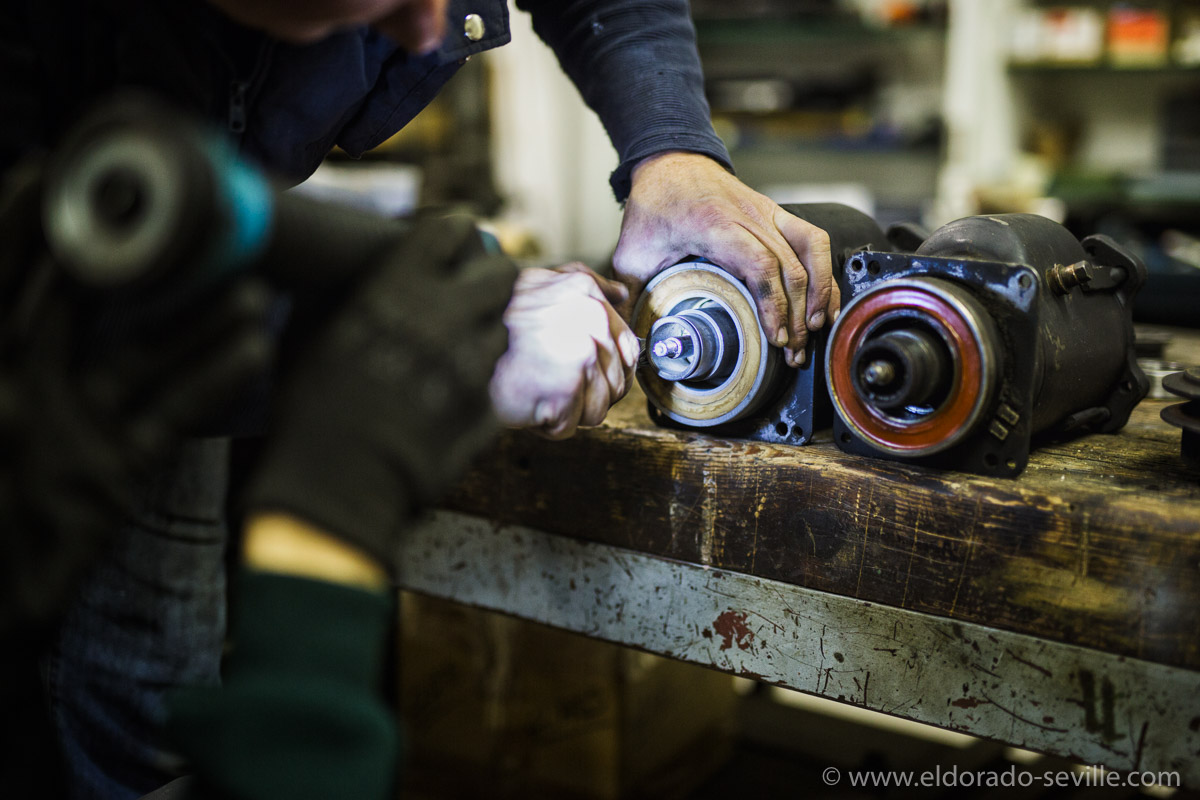
There is this one snap ring we just did not have the right tool for. The shop manual lists a special plier for this. After a lot of fiddling we got it out eventually…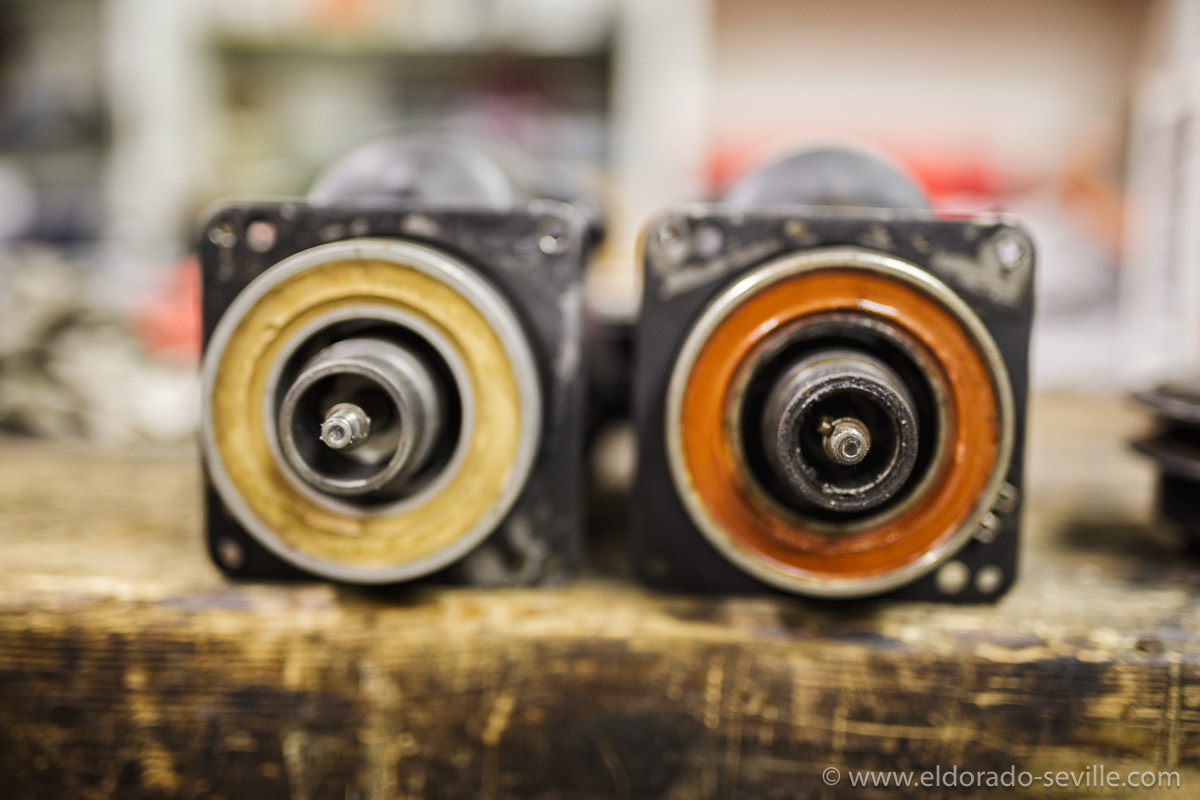
The magnetic coils on the rebuilt and the original compressor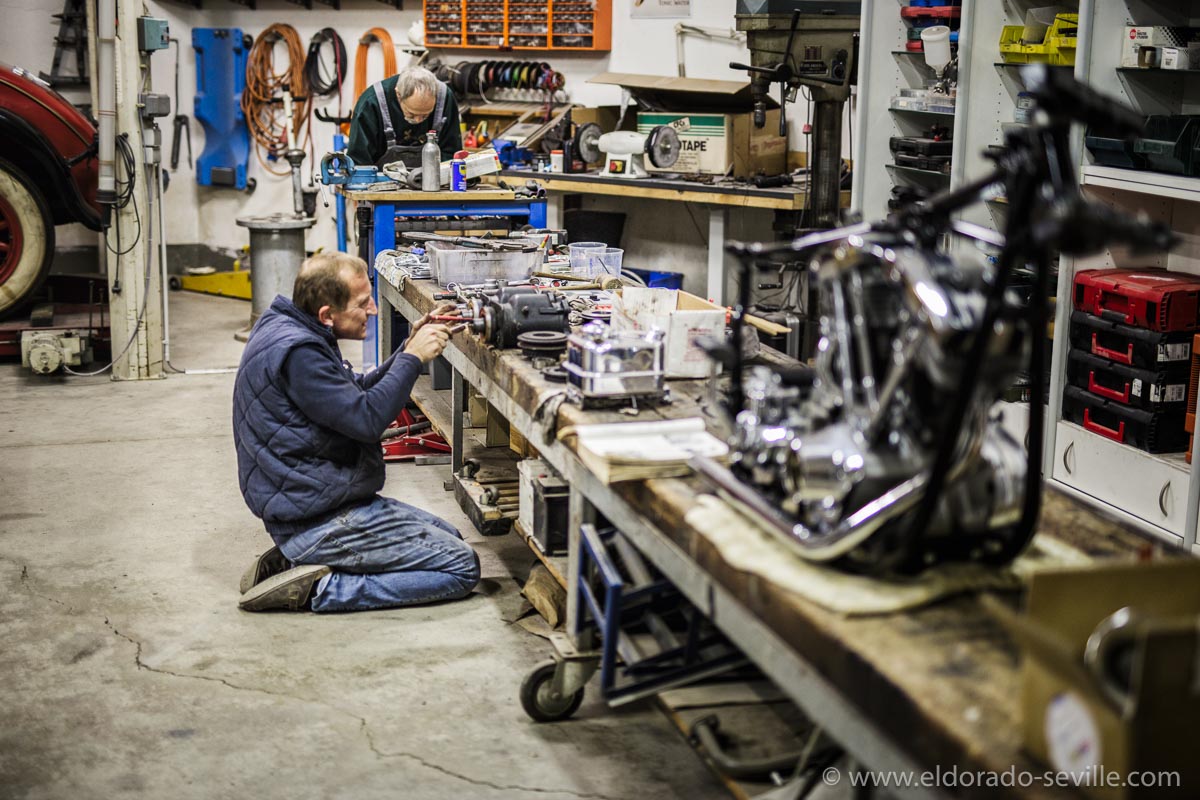
Lucky in action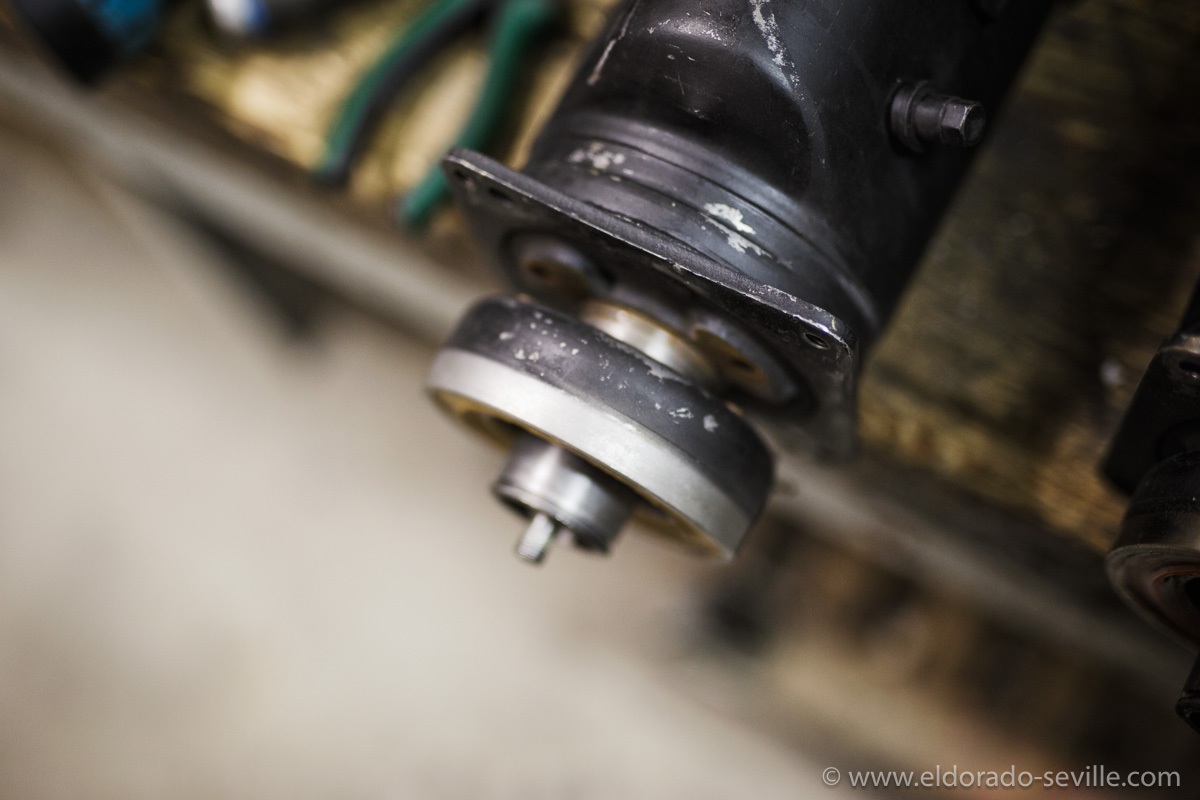
Once the snap ring is out you can turn the coils terminals to the 11o´clock position or the 1 o clock position. On the 74 it has to be at the 10 o clock position, otherwise the connecting wires are too short.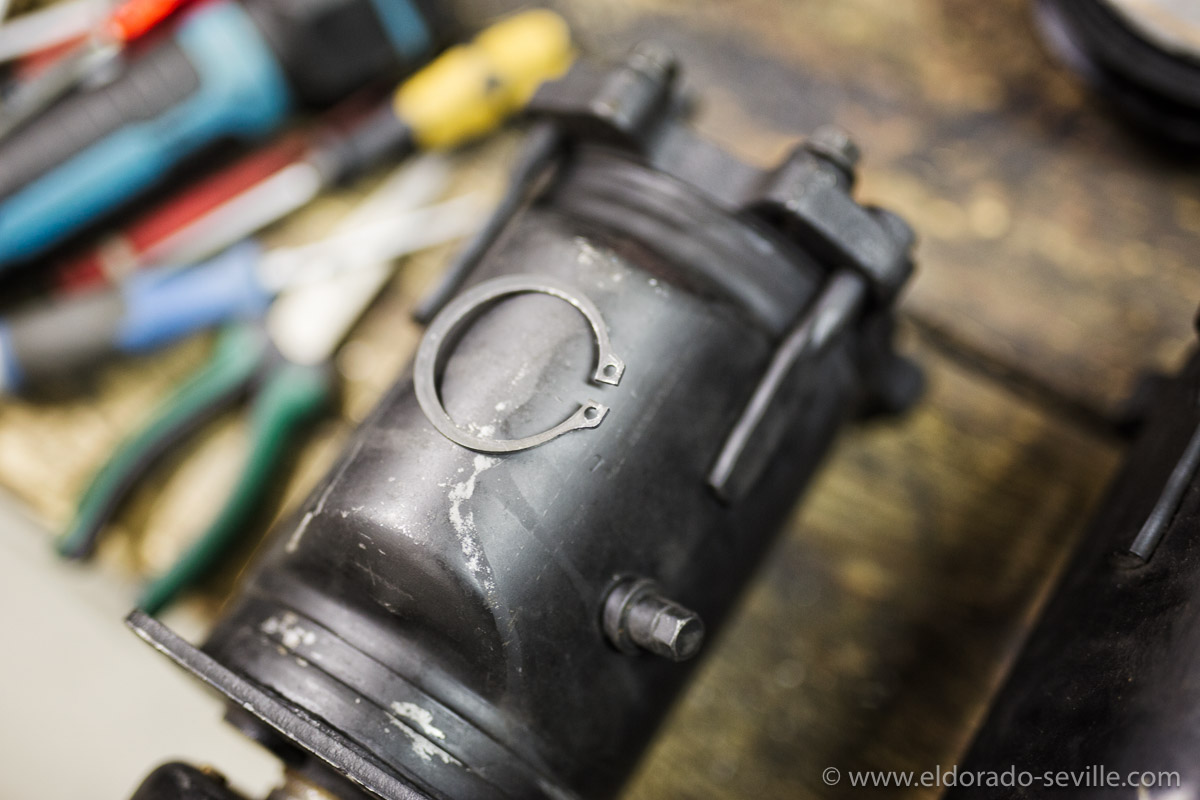
Getting this snap ring out was the hardest part on this job, due to not having the right tool for it.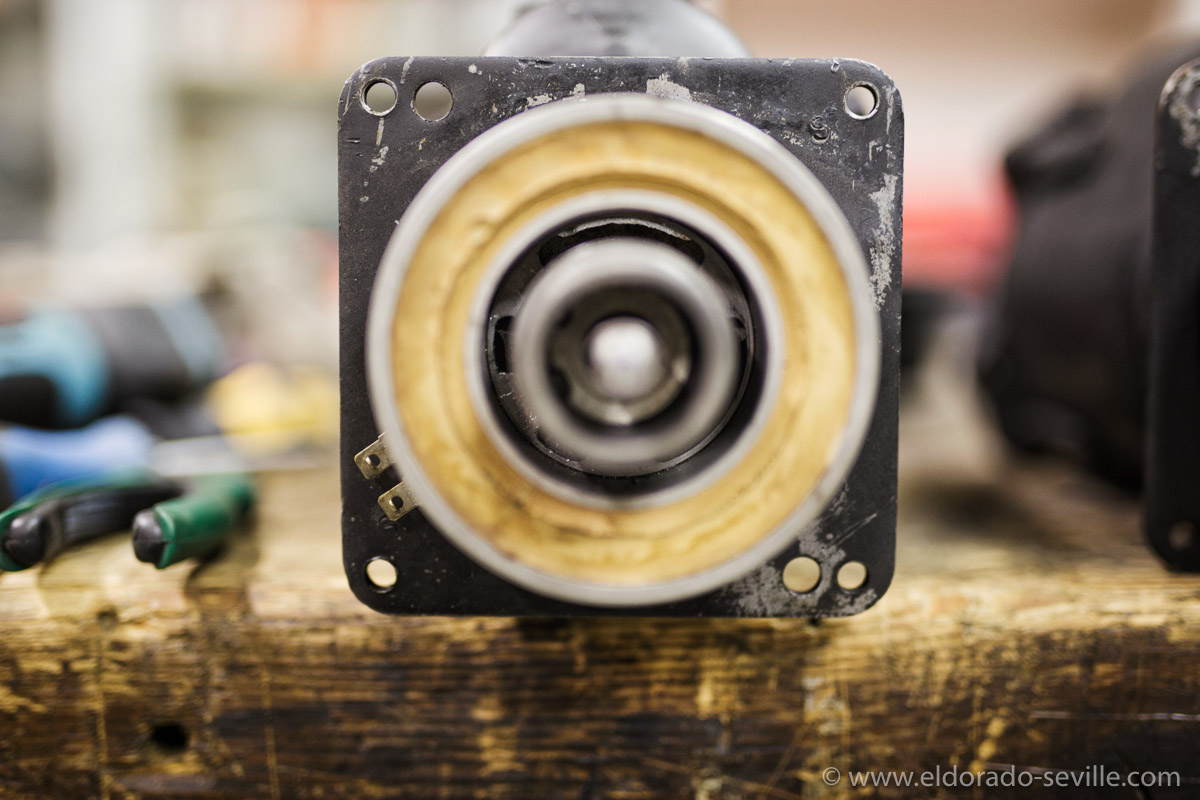
The terminal at the incorrect position at the rebuilt compressor.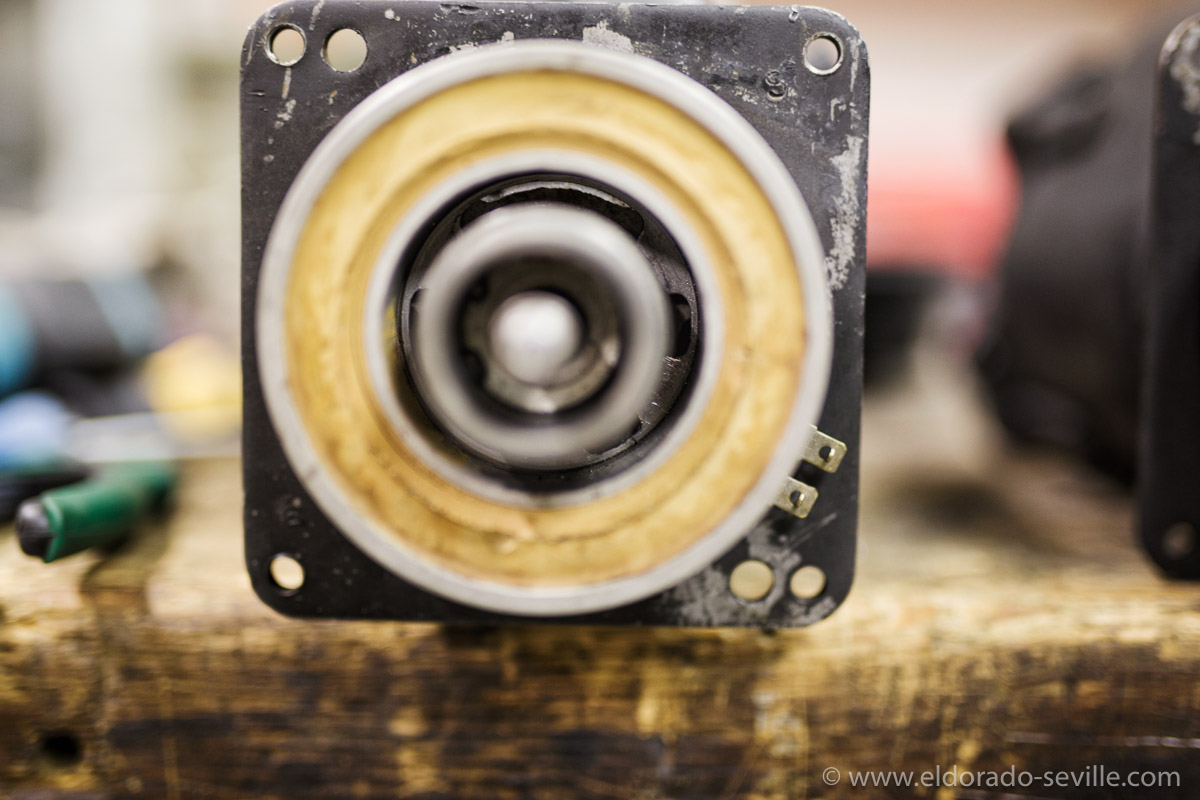
We turned the terminal to the correct position.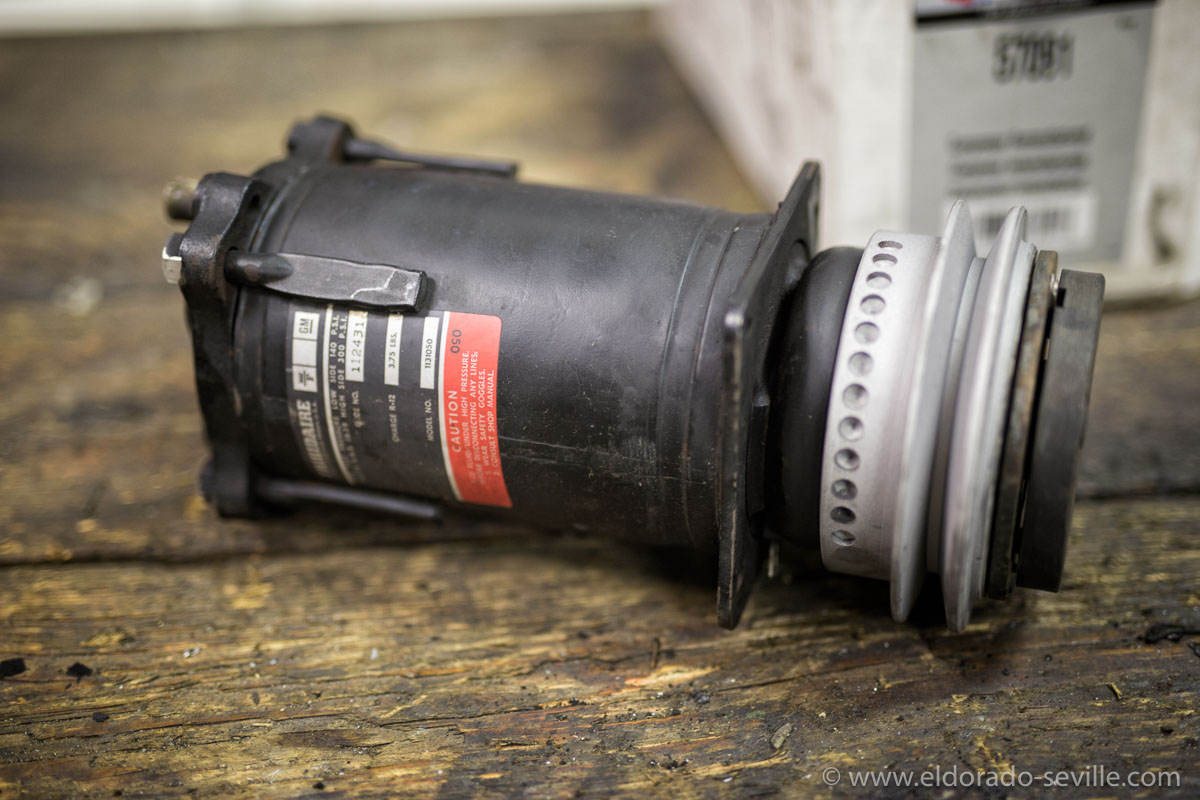
We sandblasted the pulley while it was out of the car so that I can repaint it now. Note the original decal! All the available reproduction decals are totally incorrect for the 1974 Cadillacs. The reproduction decals all show the wrong amount of refrigerant! They are also different in many other details. The closest match of reproduction decals for 1974 are the ones from 1972 Cadillacs…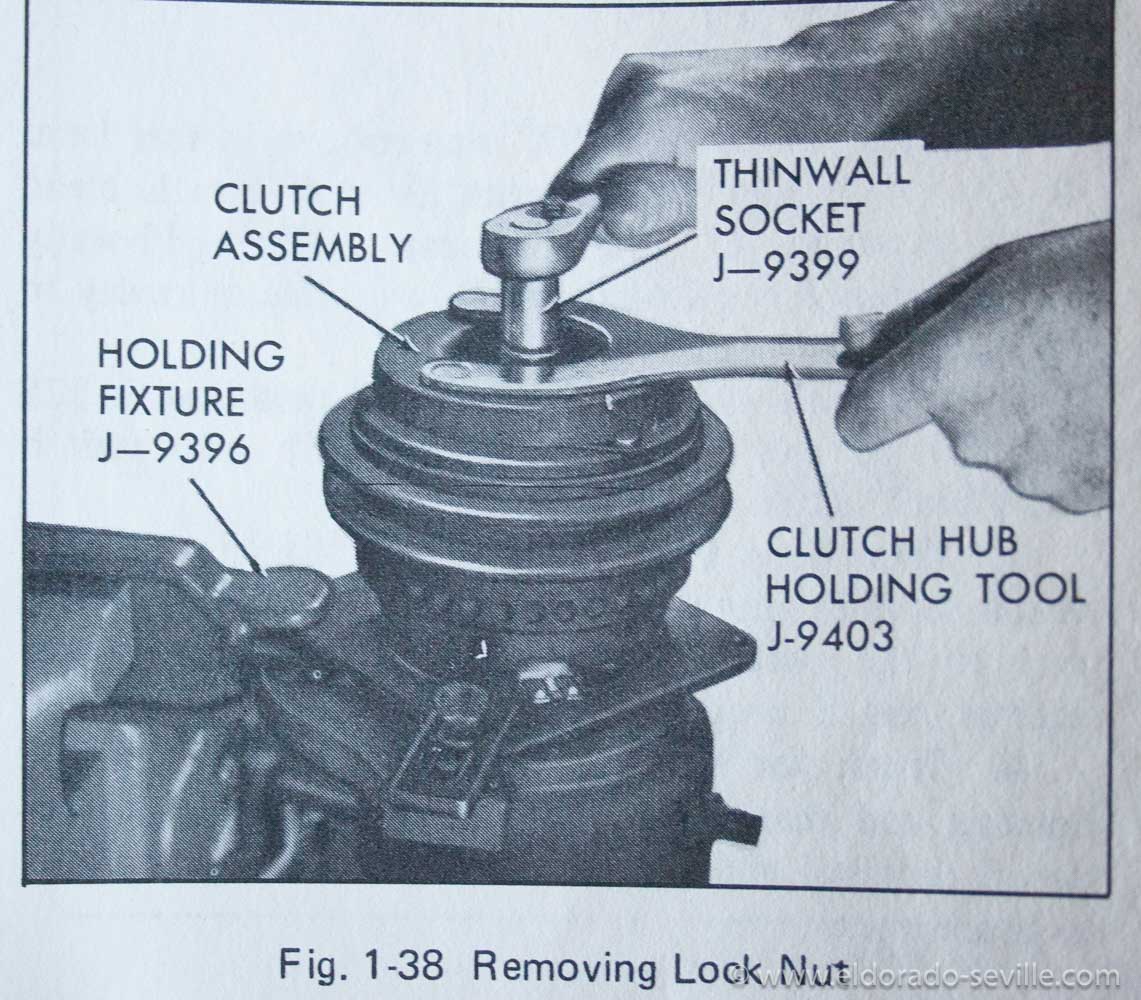
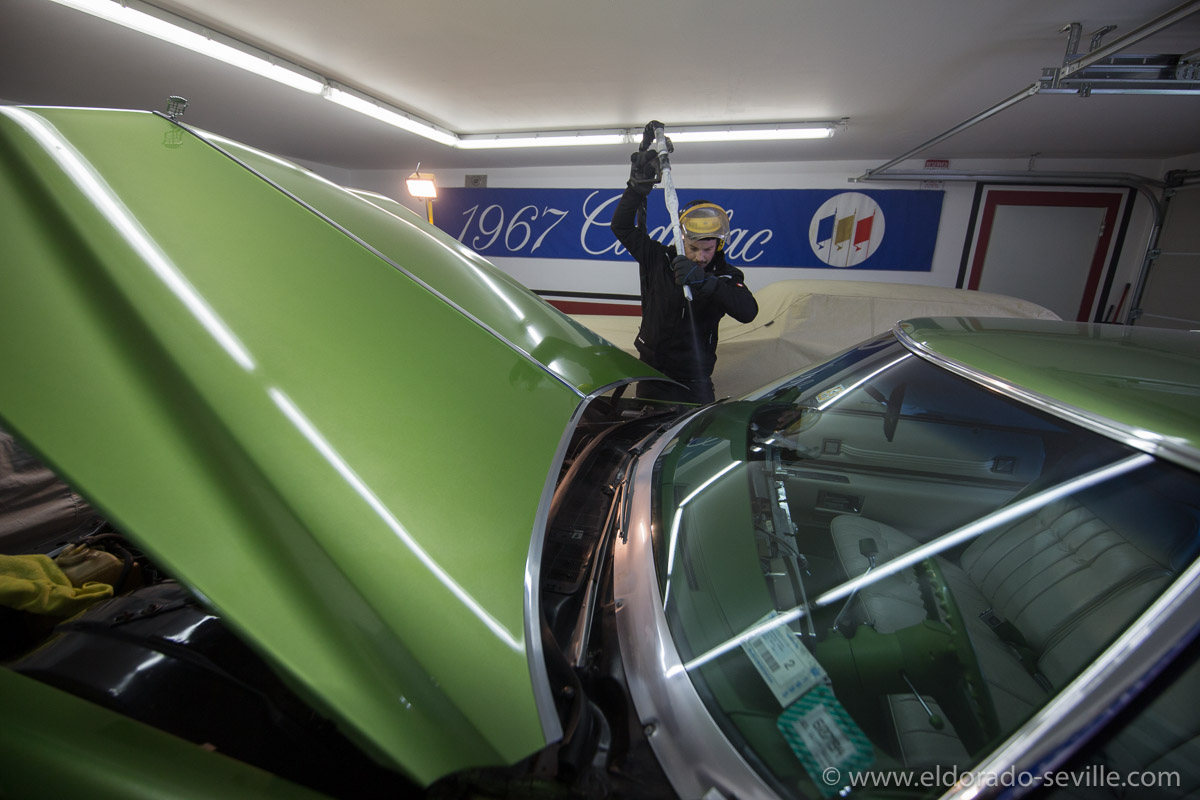
DRY ICE CLEANING THE ENGINE AND ENGINE BAY OF MY 1974 COUPE DEVILLE. (VIDEO).
A conventional engine cleaning with a strong degreaser, steam or a pressure washer was not successful when I tried, because the main issue I had was overspray, which you cant remove with traditional cleaning methods.
During the undercarriage project last winter - the paint shop did not cover the engine bay good enough, and a lot of overspray settled down on the entire engine bay. It looked terrible!
This overspray is extremely difficult to remove, and this is why I thought of dry ice cleaning for the remains which I could not remove with clay and polishing.
I had some very good results with dry ice blasting during my undercarriage project for removing the undercoating.
Dry ice-blasting is a form of carbon dioxide cleaning, where dry ice, the solid form of carbon dioxide, is accelerated in a pressurized air stream and directed at a surface in order to clean it. An alternative media for non-abrasive blasting is water-ice, known as ice blasting.
The method is similar to other forms of abrasive blasting such as sand blasting, plastic bead blasting, or soda blasting but substitutes dry ice as the blasting medium. Dry-ice blasting leaves no chemical residue as dry ice sublimates at room temperature.
Dry-ice blasting involves propelling pellets at extremely high speeds. The actual dry-ice pellets are quite soft, and much less dense than other media used in blast-cleaning (i.e., sand or plastic pellets). Upon impact, the pellet sublimates almost immediately, transferring minimal kinetic energy to the surface on impact and producing minimal abrasion. The sublimation process absorbs a large volume of heat from the surface, producing shear stresses due to thermal shock. This is assumed to improve cleaning as the top layer of dirt or contaminant is expected to transfer more heat than the underlying substrate and flake off more easily. The efficiency and effectiveness of this process depends on the thermal conductivity of the substrate and contaminant. The rapid change in state from solid to gas also causes microscopic shock waves, which are also thought to assist in removing the contaminant.
Unlike abrasive media blasting you cannot remove rust with dry ice blasting.
With this cleaning process I could remove 99,99% of the overspray and the engine is now extremely clean. I will have to remove all of the remaining surface rust with rust remover, and then re-paint the areas which will then be bare metal. Some of the original paint had flaked off over the last 45 years, but I´m trying to keep as much in original paint as possible and only repaint where it is absolutely necessary. Areas of the block will get some fresh Bill Hirsch engine enamel and I had to repaint some brackets, pulleys and the power steering pump.
Below I have put together a short video to show how dry ice cleaning was done in my engine bay. Enjoy and make sure to watch in HD to be able to view all the details!
Here is a short video I shot during dry ice cleaning - it shows the process and explains it a little. MAKE SURE TO SET THE QUALITY TO HD TO SEE ALL THE DETAILS!
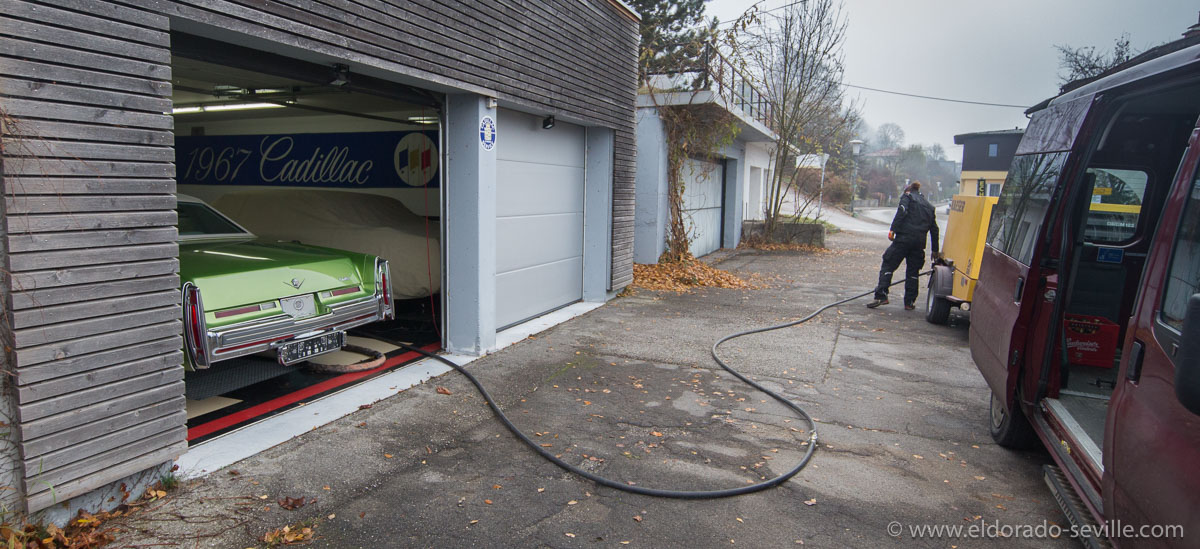
You need a very strong compressor for dry ice cleaning - even a very good shop compressor is not strong enough and cant supply the necessary capacity of air.
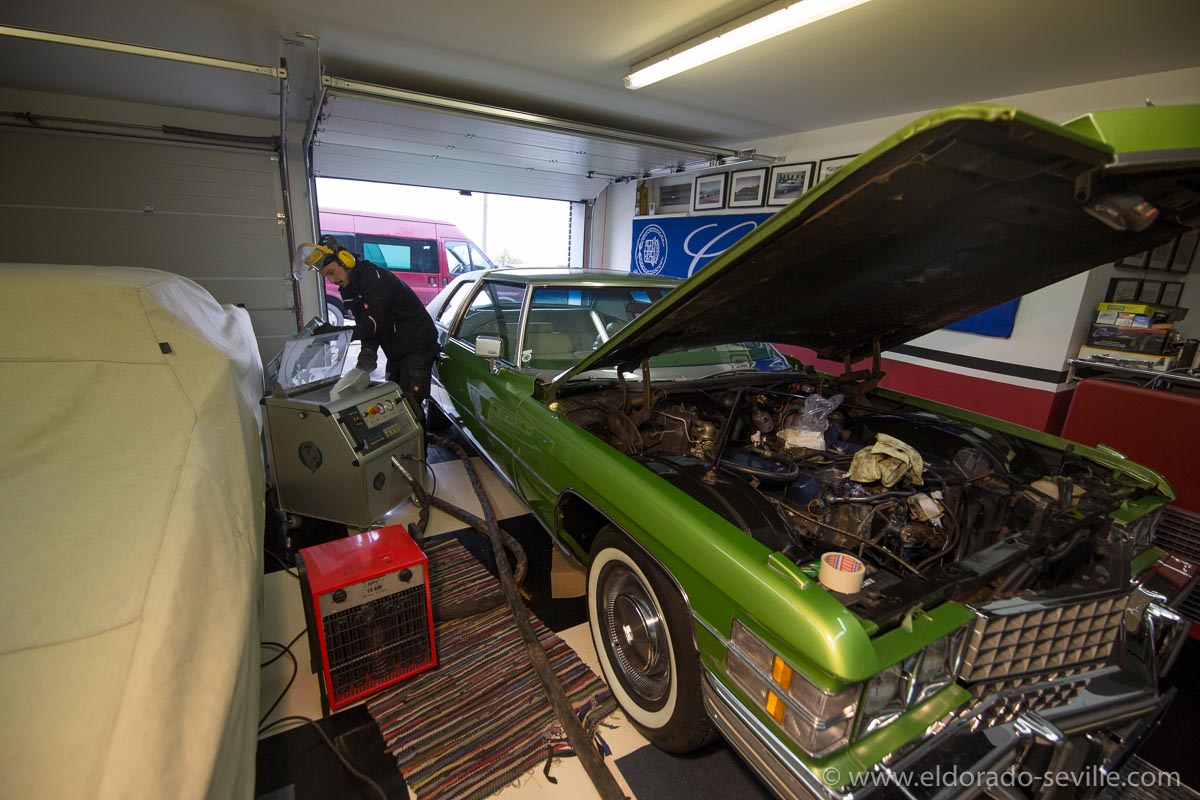
Christoph with his dry ice blasting machine.
Loose paint will come off easily
You can also clean weatherstripping and rubber hoses very well.
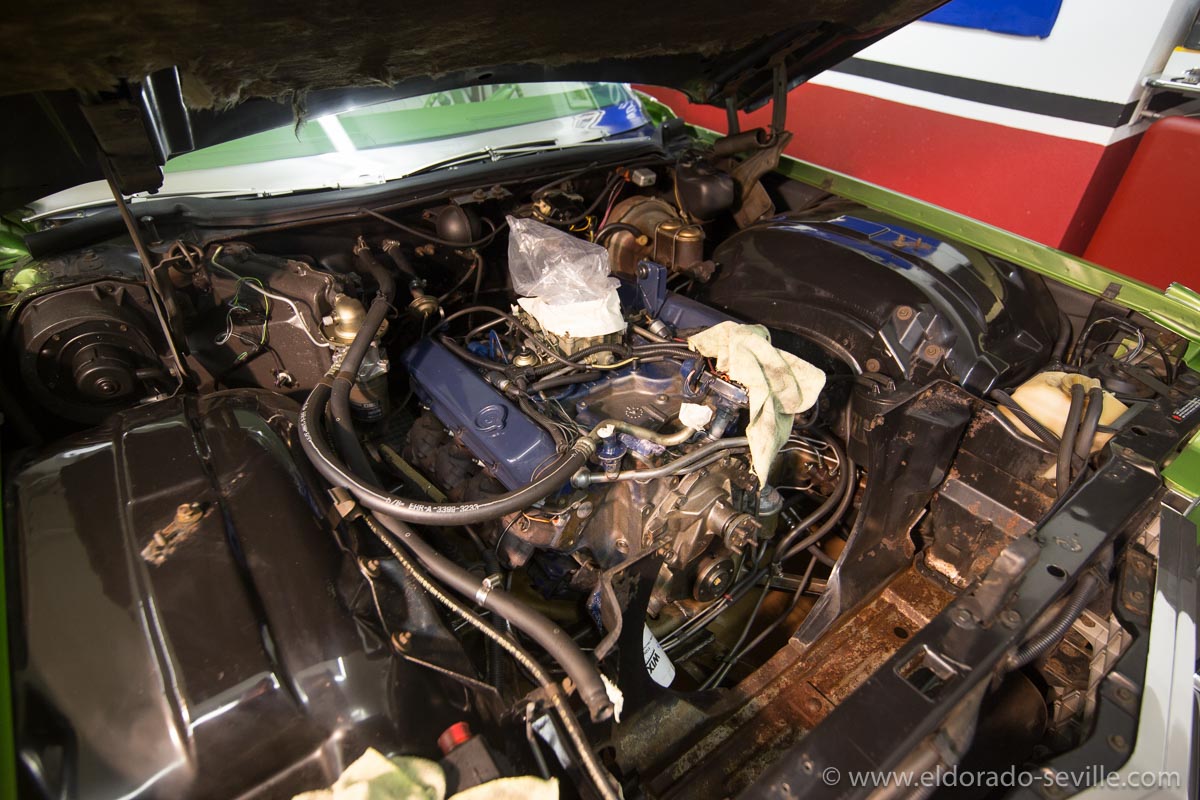
After cleaning - the overspray is gone :-)
After cleaning - the overspray is gone :-) All the hoses and wires are clean again.
After cleaning - the overspray is gone :-) All the hoses and wires are clean again.
You can also clean the carburetor with dry ice.
This is the area underneath the radiator. The surface rust will come off pretty easily with rust removing gel. Afterwards I will re- paint it.
As you can see its clean, but there is some surface rust remaining which I will have to remove before applying some fresh paint.
As you can see its clean, but there is some surface rust remaining which I will have to remove before applying some fresh paint. I will remove the fuel pump for painting.
As you can see its clean, but there is some surface rust remaining which I will have to remove before applying some fresh paint.
COLOR CODED VACUUM HOSES - BEWARE OF TERRIBLE REPRODUCTIONS!
These vacuum hoses unfortunately get extremely hard and brittle over the decades under the harsh conditions in the engine bay. Often they literally break into pieces by just touching them.
On my 67 Eldorado I had to replace most of the vacuum lines when I got it - and it really has a lot of hoses.
When I searched for reproductions I could not find a really good source and I gave up.
At my ongoing project on my 74 another of these original lines fell apart while working in the engine bay. So I started to look for the correct hoses once again.
Soon I found a link on ebay to a well known seller, whose name I do not want to mention, offering the lines in all the colors I needed.
I ordered quite a few Ft of each color.
The seller describes them as factory correct and as a perfect part - see screenshots below.
As they do not ship to Europe, a friend of mine was so kind to forward the hoses to me.
When they arrived I was shocked - I have never ever seen a worse product.
The paint is peeling off or missing at all. As soon as you even slightly bend the hoses, the paint on the stripes just cracks and falls off. It could not be worse.
Also the hoses are too thick and the walls are to thick. The original hoses are quite a bit slimmer than these crappy reproduction hoses.
They also charged me for 15ft of red striped hoses but only sent 10ft. This was about the worst buying experience ever.
I´m trying to return the hoses at the moment - but communication with this seller is terrible.
I normally never criticize sellers here on my website and never leave any negative comments on ebay - but this is the worst I have ever experienced.
Shipping back these hoses will cost me at least $50 and I already paid $60 for having them shipped to me in Europe - with the import tax I will have lost $160.- for this BS… Money I would urgently need for some other parts… :-(
I´m now trying to find another good source for quality reproduction hoses. There is one Corvette parts dealer which looks promising as he offers some great kits for Corvettes, but they are all pre-cut… I hope he can send me some ft. of the hoses I will need - I hope that I will get a positive reply.
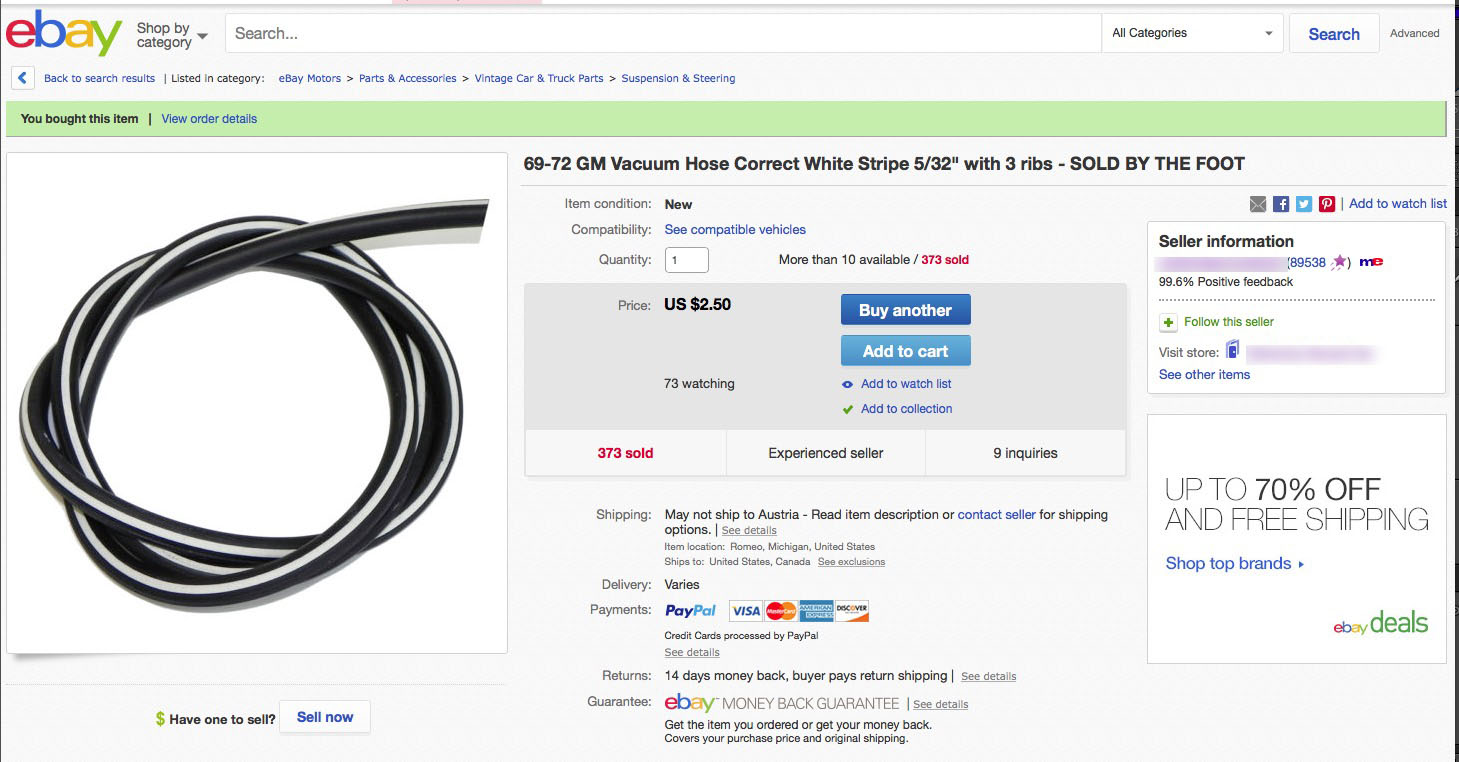
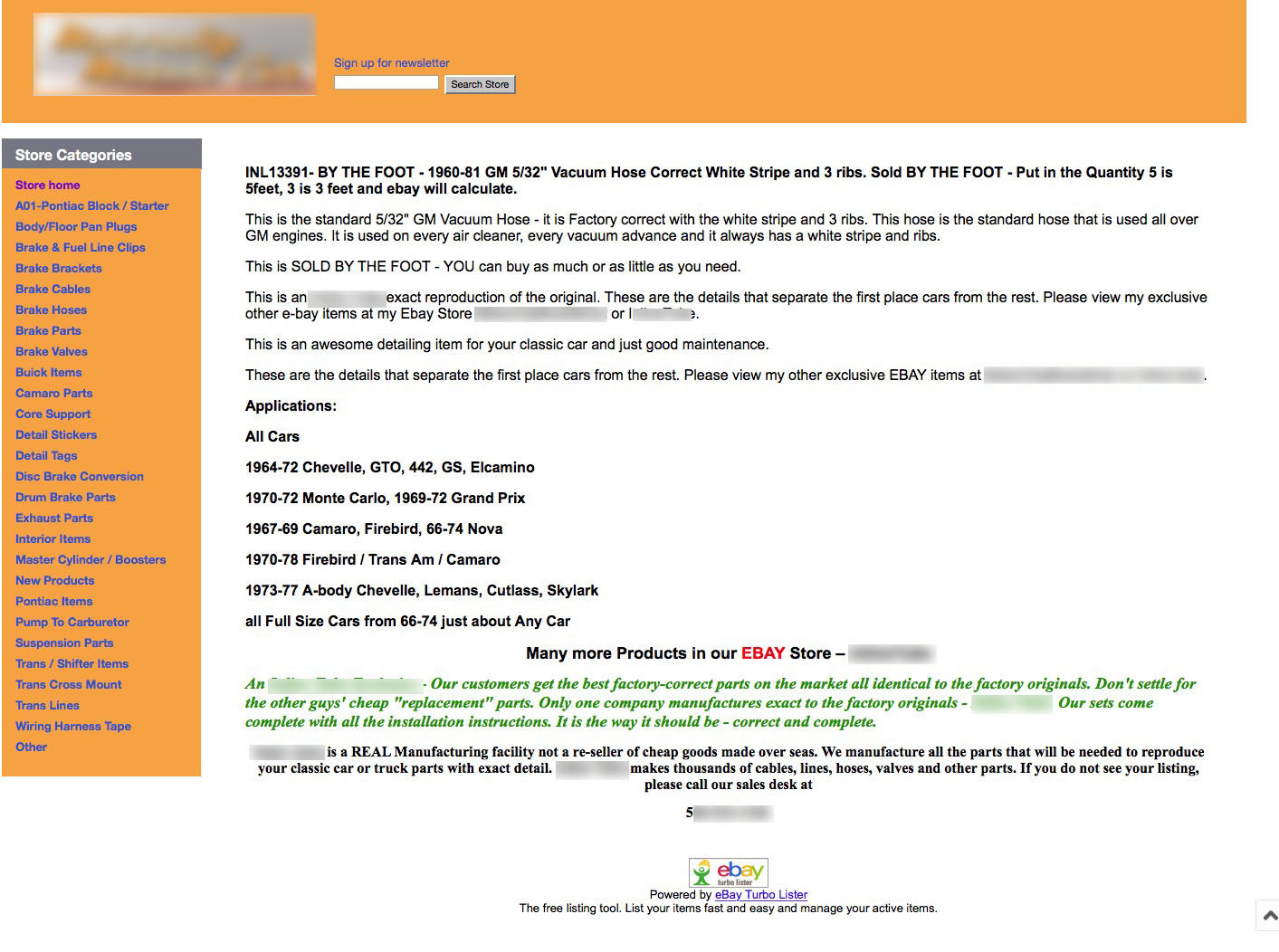
Ebay seller screenshot - this is how they describe the hoses…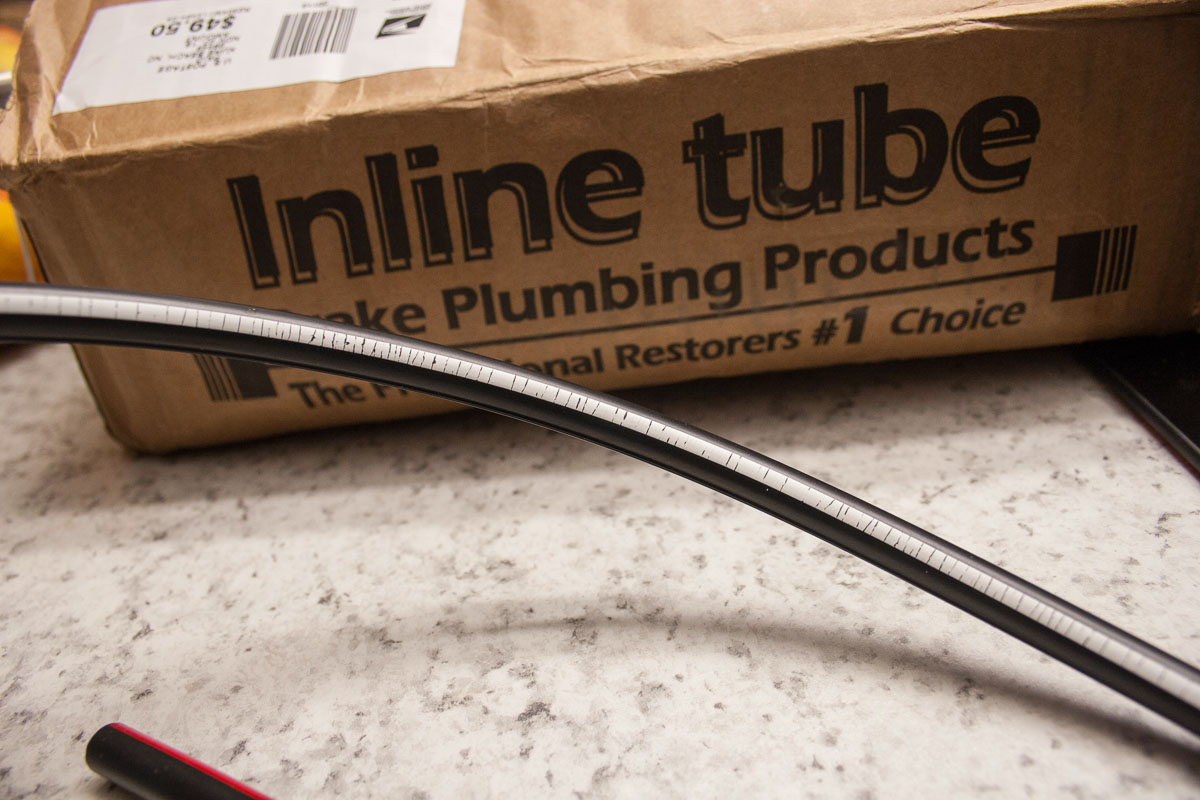
As you can see the paint stripe is just cracking everywhere.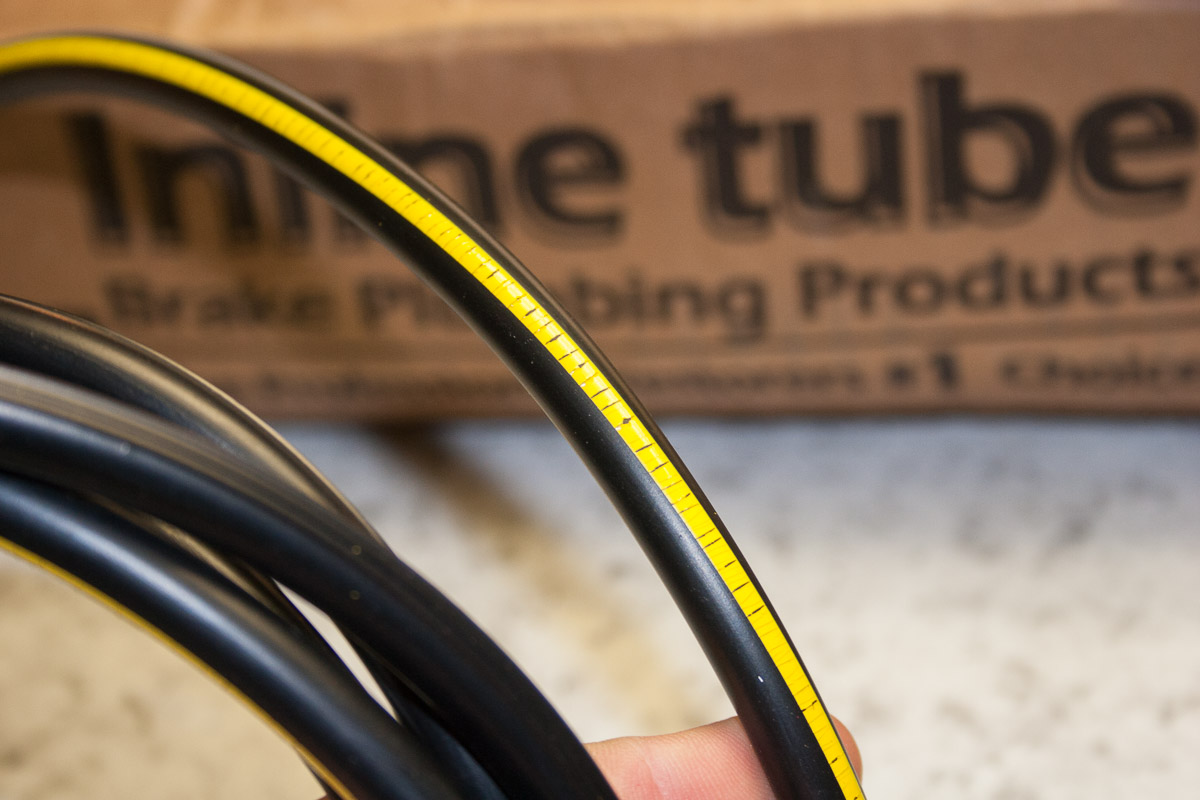
As you can see the paint stripe is just cracking everywhere.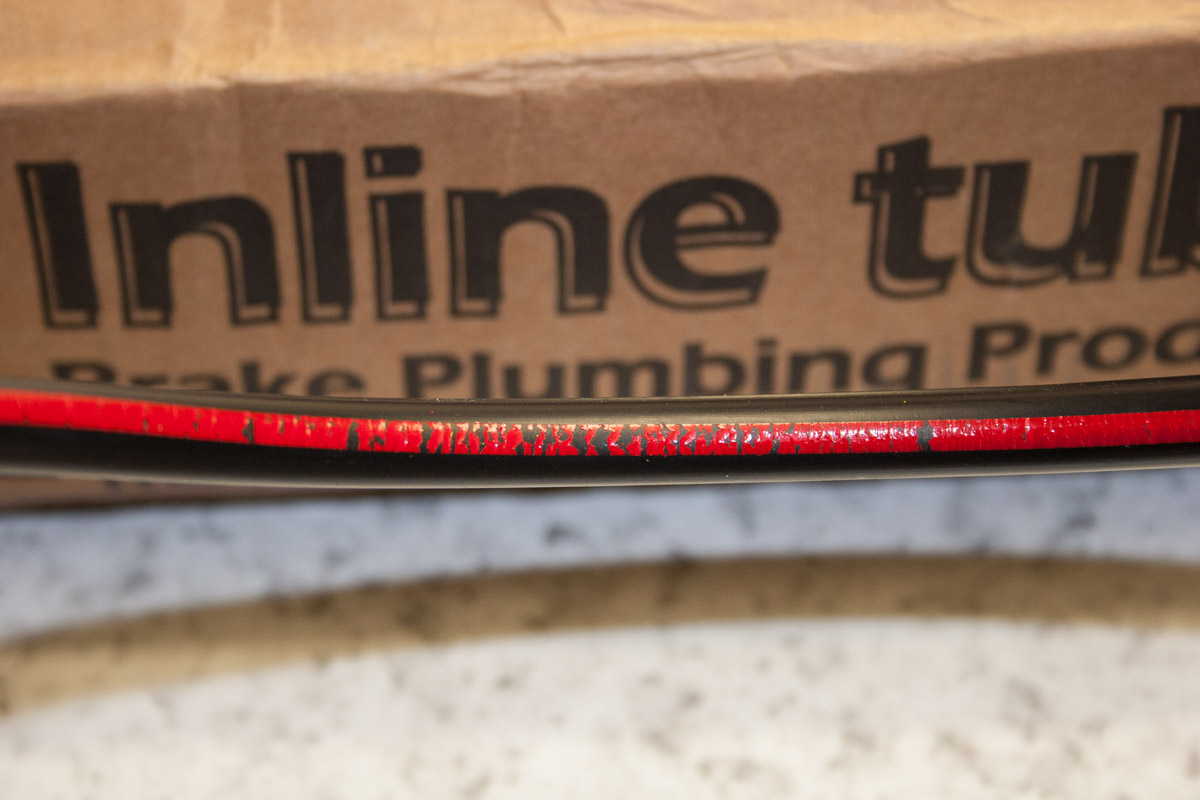
As you can see the paint stripe is just cracking everywhere.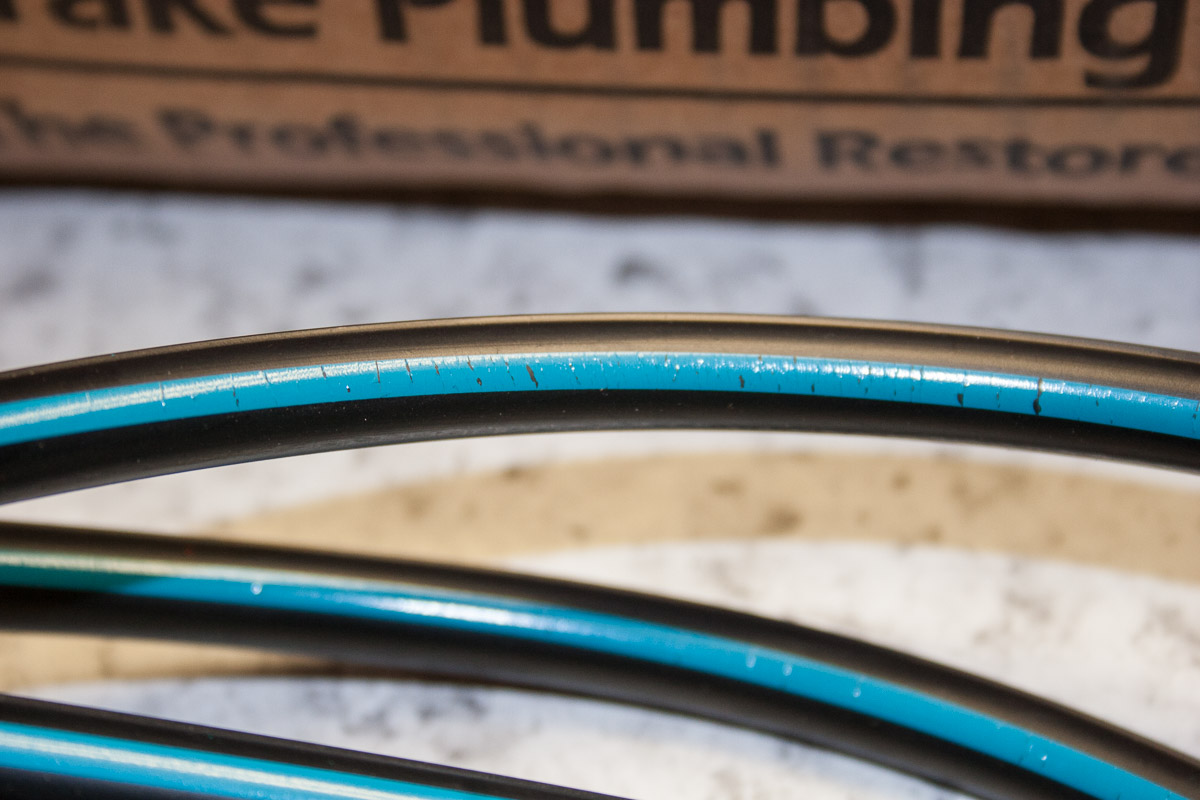
As you can see the paint stripe is just cracking everywhere.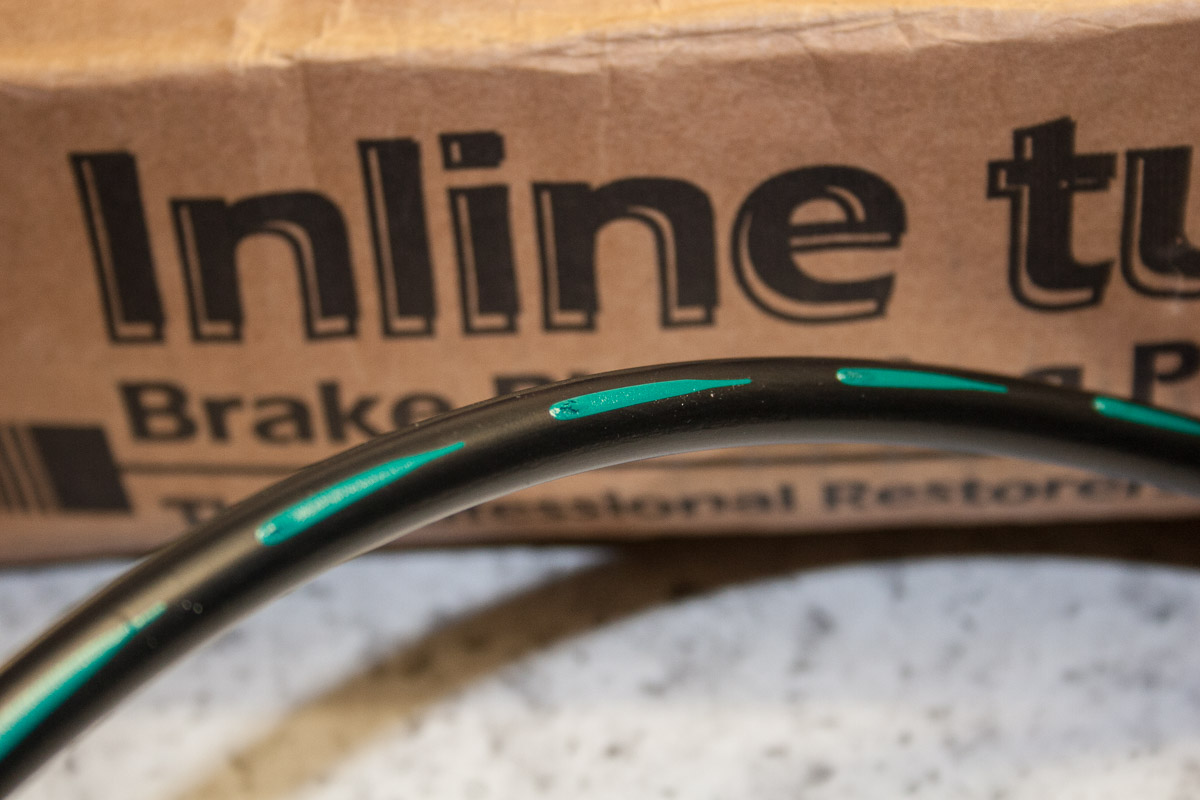
As you can see the paint stripe was not even painted correctly on the green hose…
DETAILING THE ENGINE BAY AND REMOVING A BROKEN BOLT FROM THE AIR PUMP OF THE 1974 CADILLAC
During the restoration of the battery tray of my 74 Coupe deVille I noticed that the belt from the AIR Pump was a little loose. While I tried to find out how to properly tension it, I noticed that one of the bolts going through the pulley into the pump seemed to stick out a little bit at a strange angle. When I touched it, it immediately broke off… Great…
So I had to remove the pump to be able to get to the broken pulley bolt and replace it with a good new one. It was very common on GM cars from the 70s which used this air pump, that the bolts broke off. GM used 3 very cheap and weak bolts to hold the pulley in place.
Before I took any bolts out to remove the pump, I sprayed every nut and bolt with penetrating oil to make sure I could open them without damage.
I anyway had to take out the AC compressor as well for another winter project. After that I removed the generator and then the air pump including all the brackets.
You can see the at the diagram below where the bolts are hiding.
With these parts removed I now have access to many parts of the engine which I can freshen up to the original factory fresh look. I will remove the surface rust on the block, clean everything and re-paint in the original Cadillac Blue paint.
I can clean the air pump, the generator and will blast the brackets and re-paint them. While the AIR Pump is out you might also want to check the diverter valve atop the smog pump to be sure the vacuum canister holds and hasn't ruptured at the vacuum diaphragm. If the diverter valve does not respond to vacuum, it can lead to all of the positive pressure from the pump being injected into the exhaust stream which can cause a backfire through the exhaust.
Many people also plug the AIR Pump and remove everything inside, so they do no longer have to bother with it. Rebuilt pumps are still available, but you can´t get the diverter valve anywhere.
So it is now officially my winter project to freshen up the engine bay…
The air pump is very fragile btw. It's not allowed to put it into a vise. Luckily I could remove the broken bolt with a bolt extractor. I just had to drill into the remains of the stuck bolt a little bit and could then remove it using the left turning extractor tool.
I have now to find replacement bolts now. They seem to be SAE bolts with the following dimensions: 1/4"(diameter)-20(threads per inch) and 1/2" (without the head) long. The original bolts were of the lowest grade material, the new ones I am going to install will be grade 5 or grade 8.
While cleaning the block I decided to also remove the fan and water pump pulley to be able to clean them as well. The pulley was pretty rusty and I had to soak it in rust removing liquid for 48 hours before the rust was gone and I had to paint it immediately as this material develops flash rust immediately.
UPDATE - OCTOBER 28th 2016:
I now also removed the power steering pump to get better access to the front of the engine block. I will also remove the radiator to be able to remove the surface rust underneath. I will then have the entire engine bay dry ice blasted to properly clean everything.
UPDATE - NOVEMBER 5th 2016
I took out the radiator today to be able to clean the surface rust underneath.
I also finished painting all the brackets and the power steering pump which I took down to bare metal before.
You can find much more pictures of this project in my 74 restoration gallery.
As this project is still going on - I will update this posting here soon.
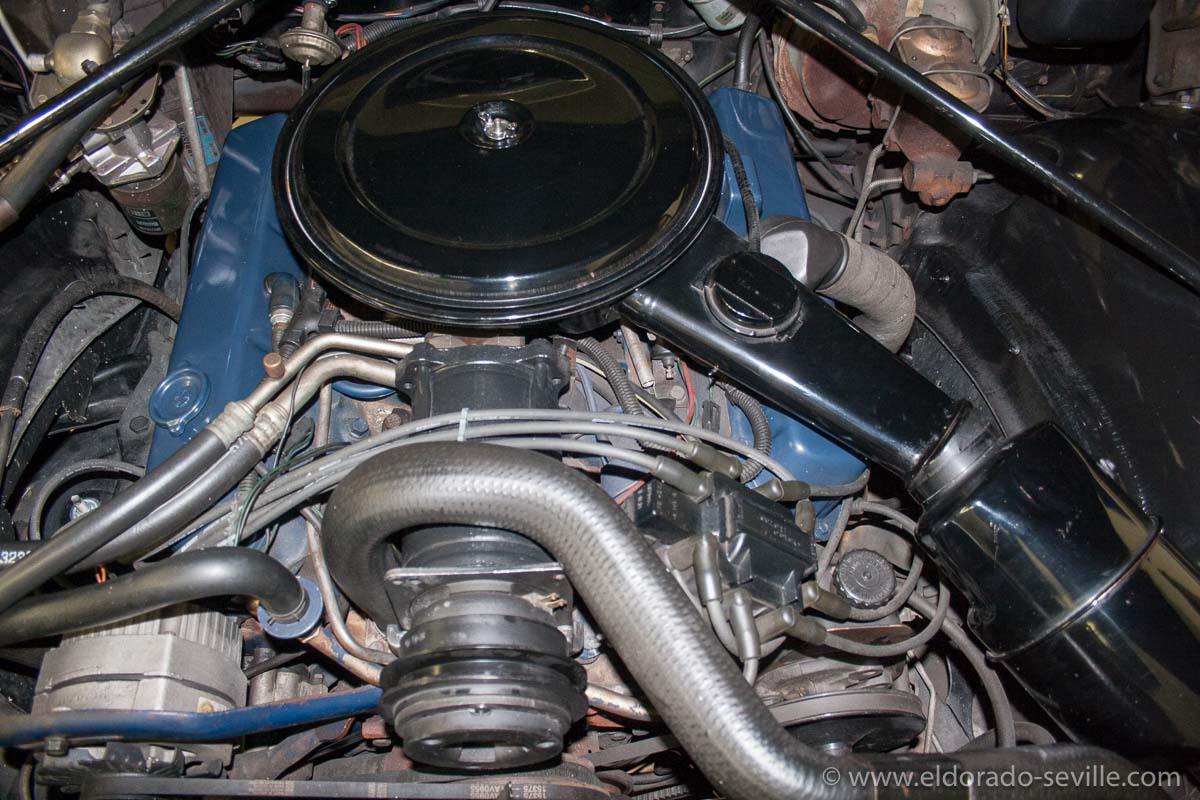
The engine bay before the start of the project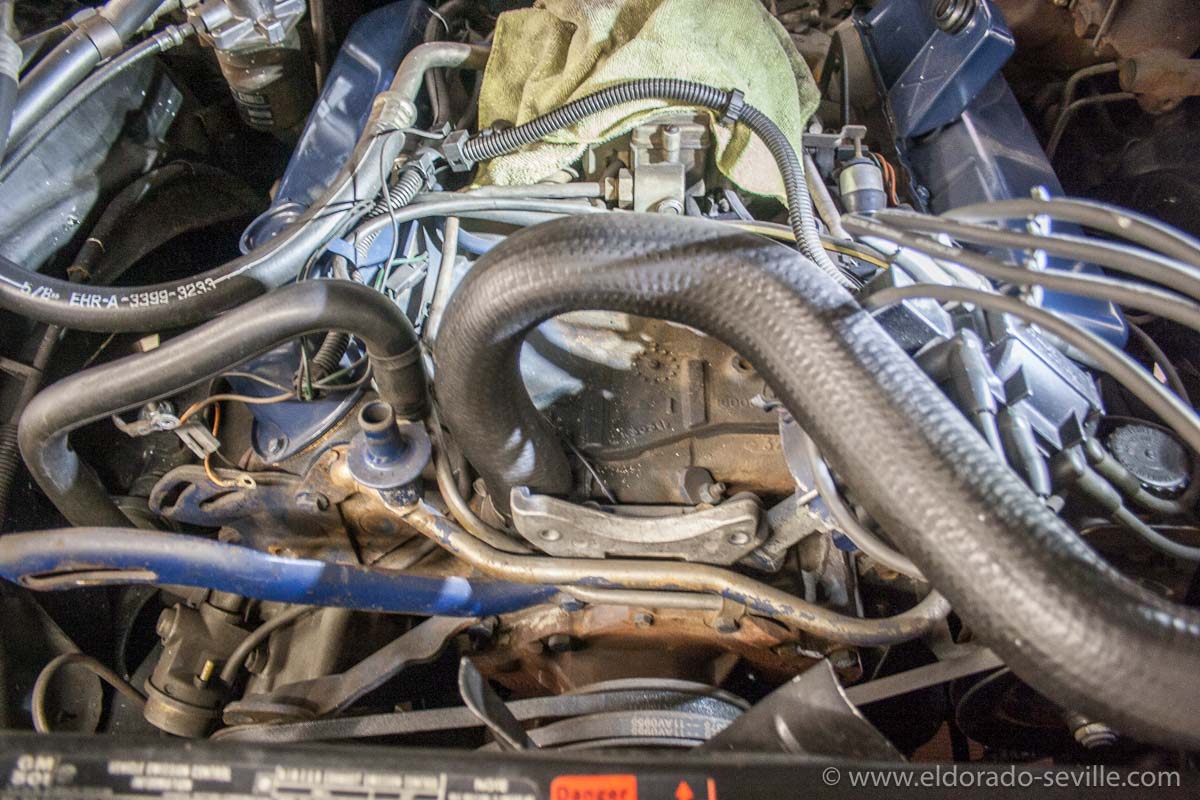
AC compressor and generator removed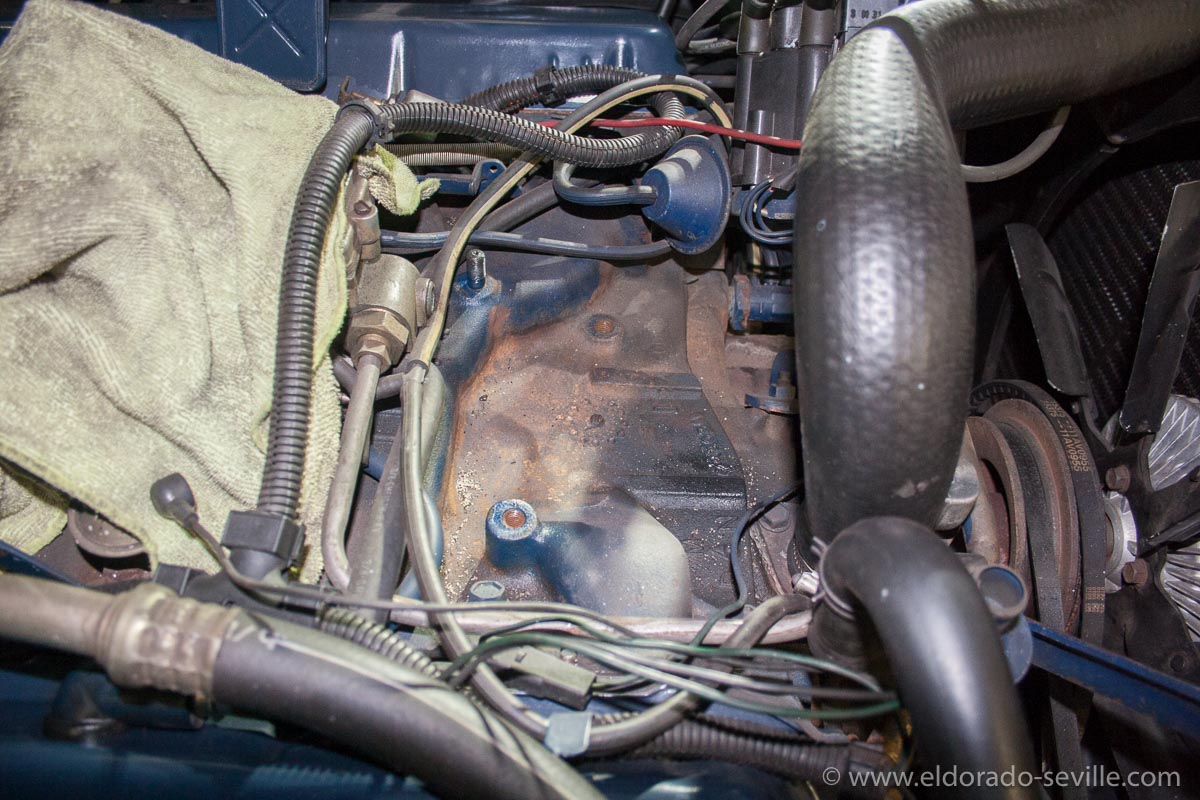
The area below the AC compressor will need some good de-rusting, cleaning and detailing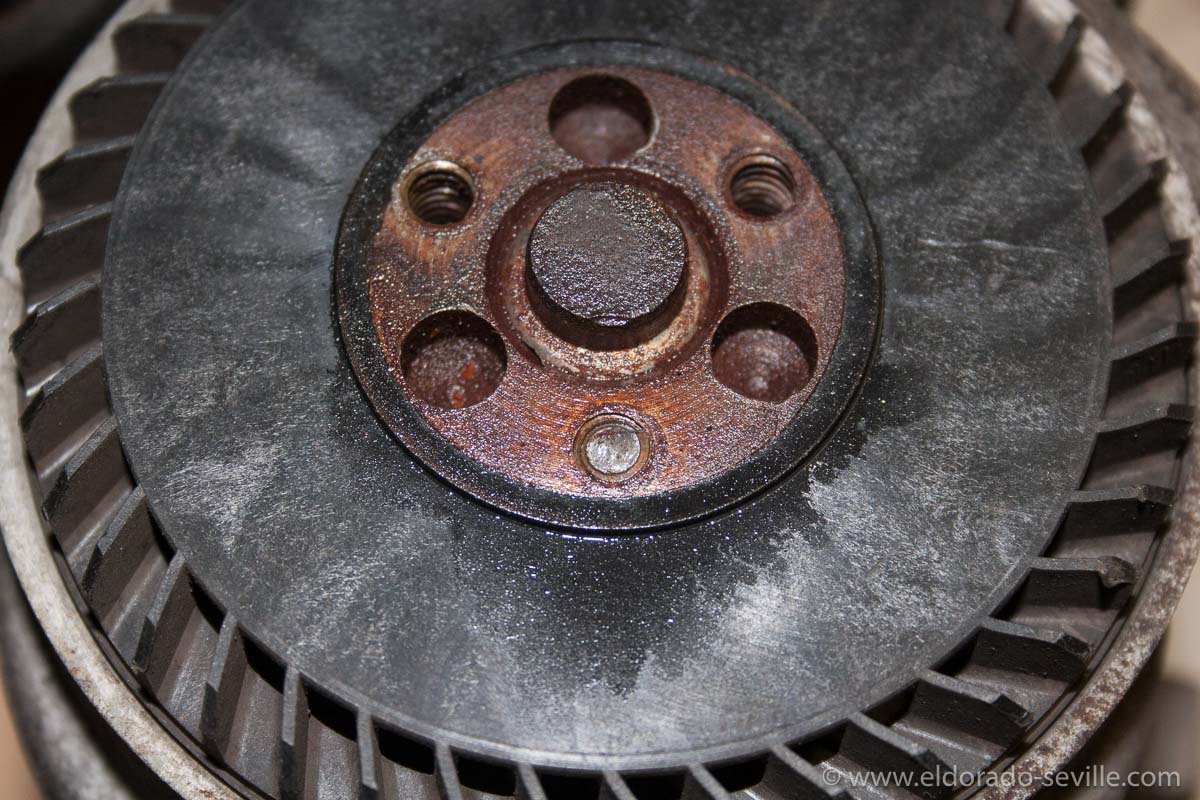
Here you can see the remains of the broken bolt in the AIR pump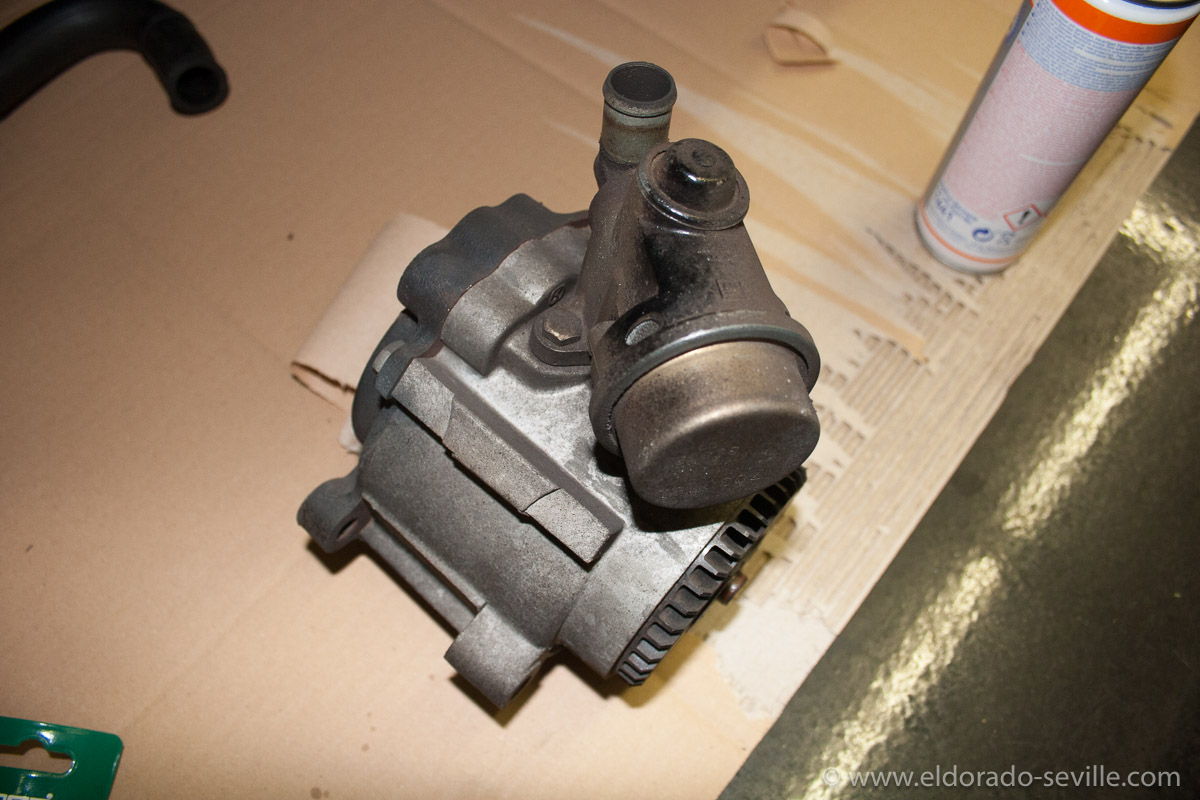
The AIR pump before cleaning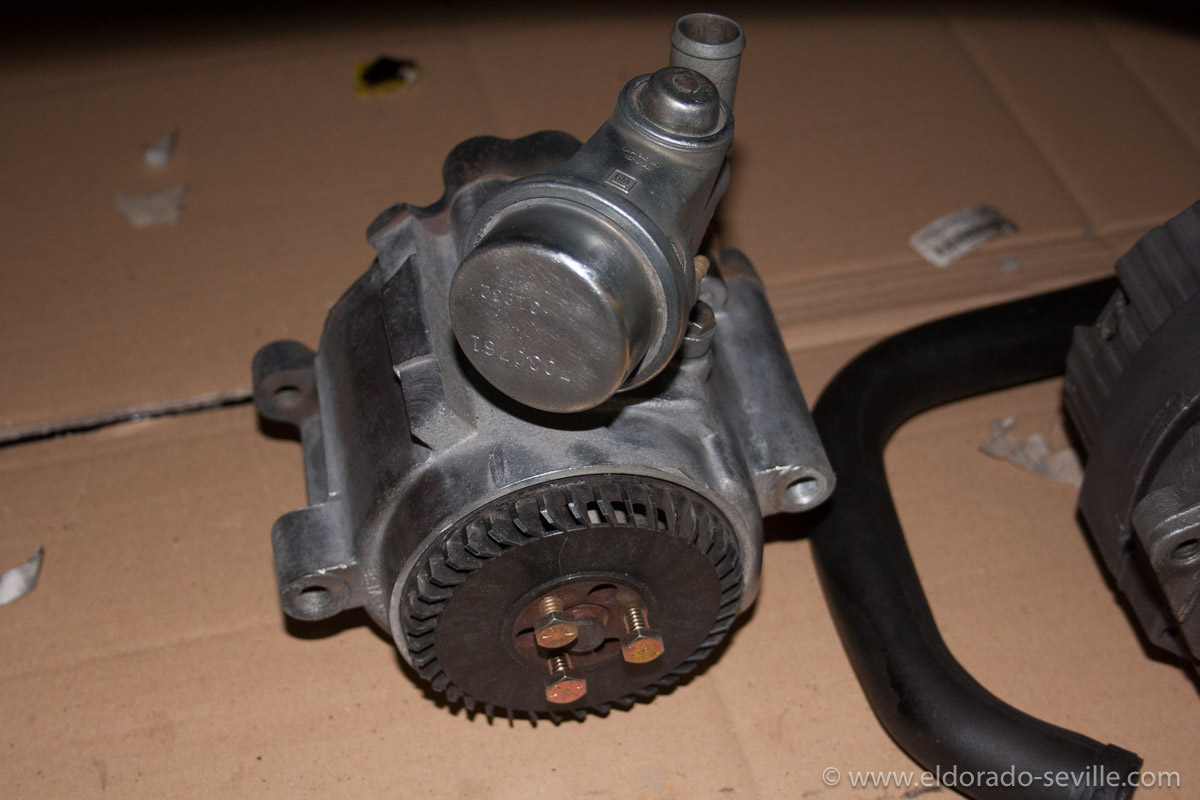
The AIR pump after cleaning - some details will still have to be done.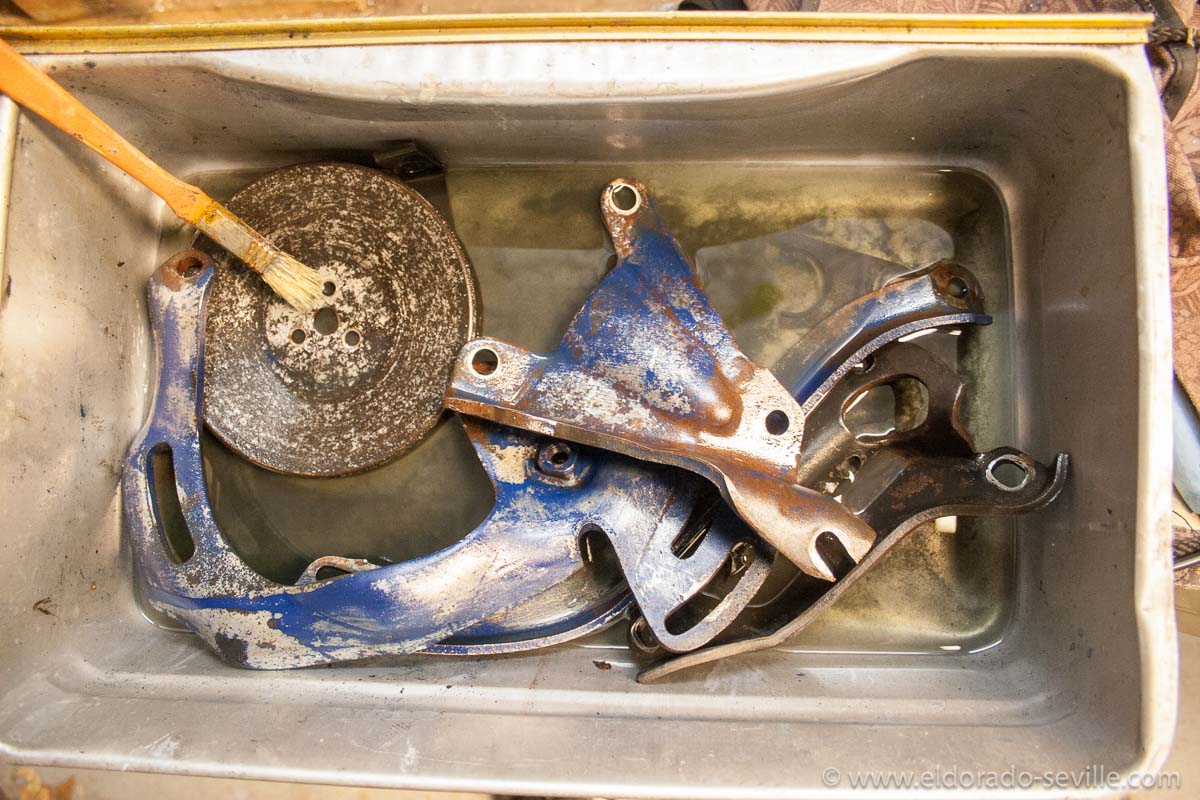
First I soaked the removed brakets in acetone to remove the dirt, grime and paint.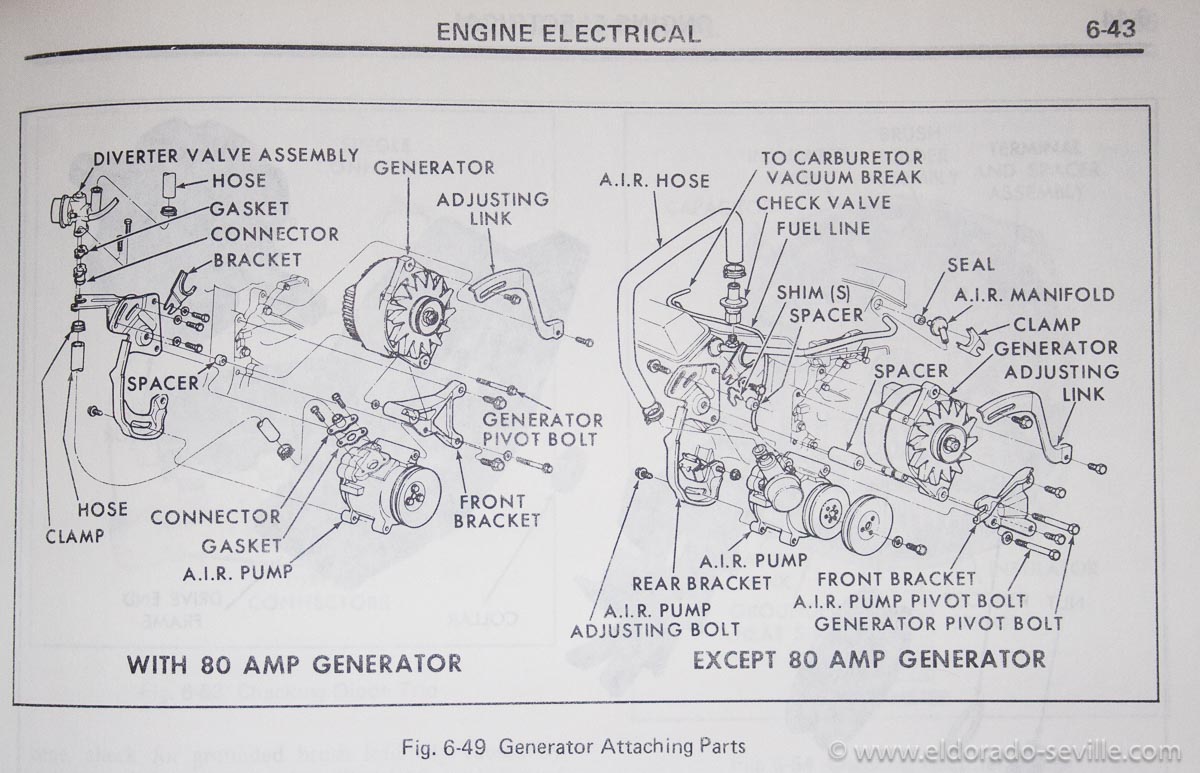
This shows the brackets in the shop manual.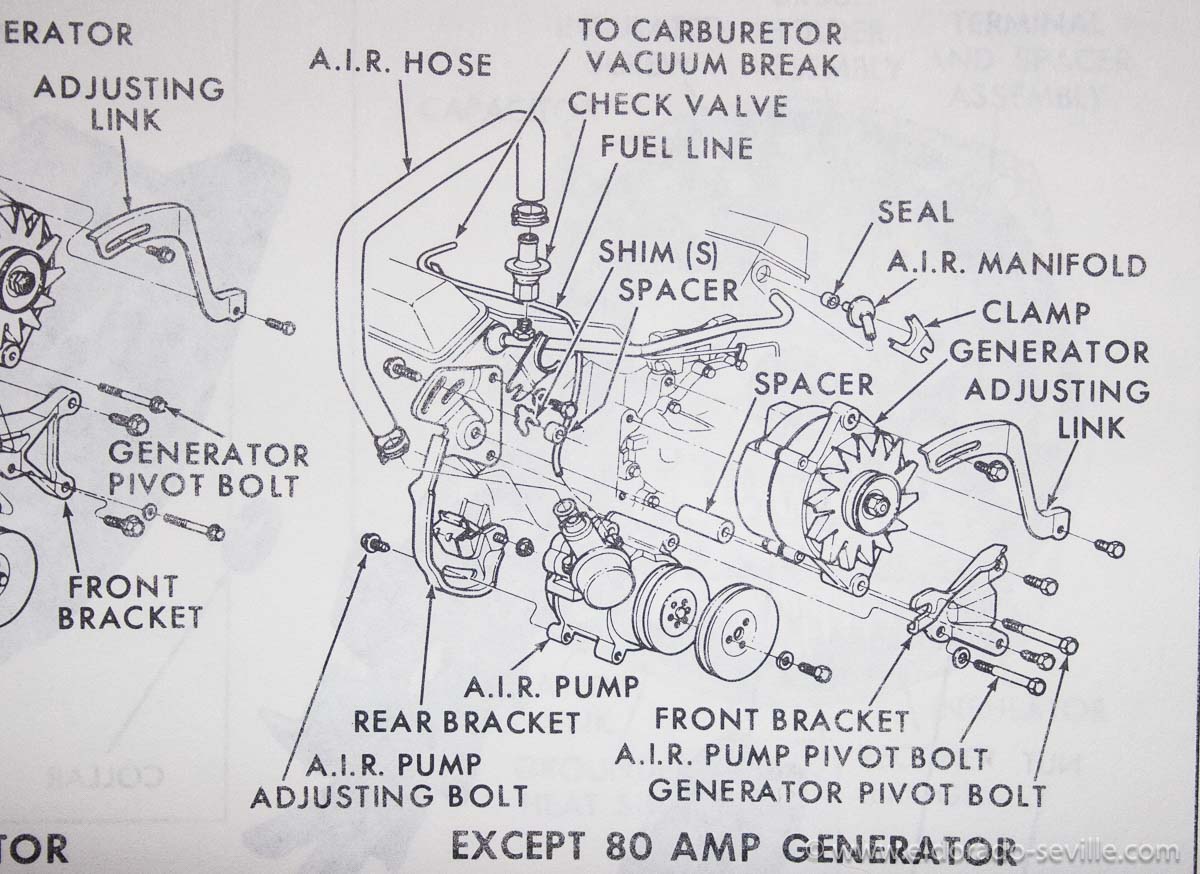
This shows the brackets in the shop manual.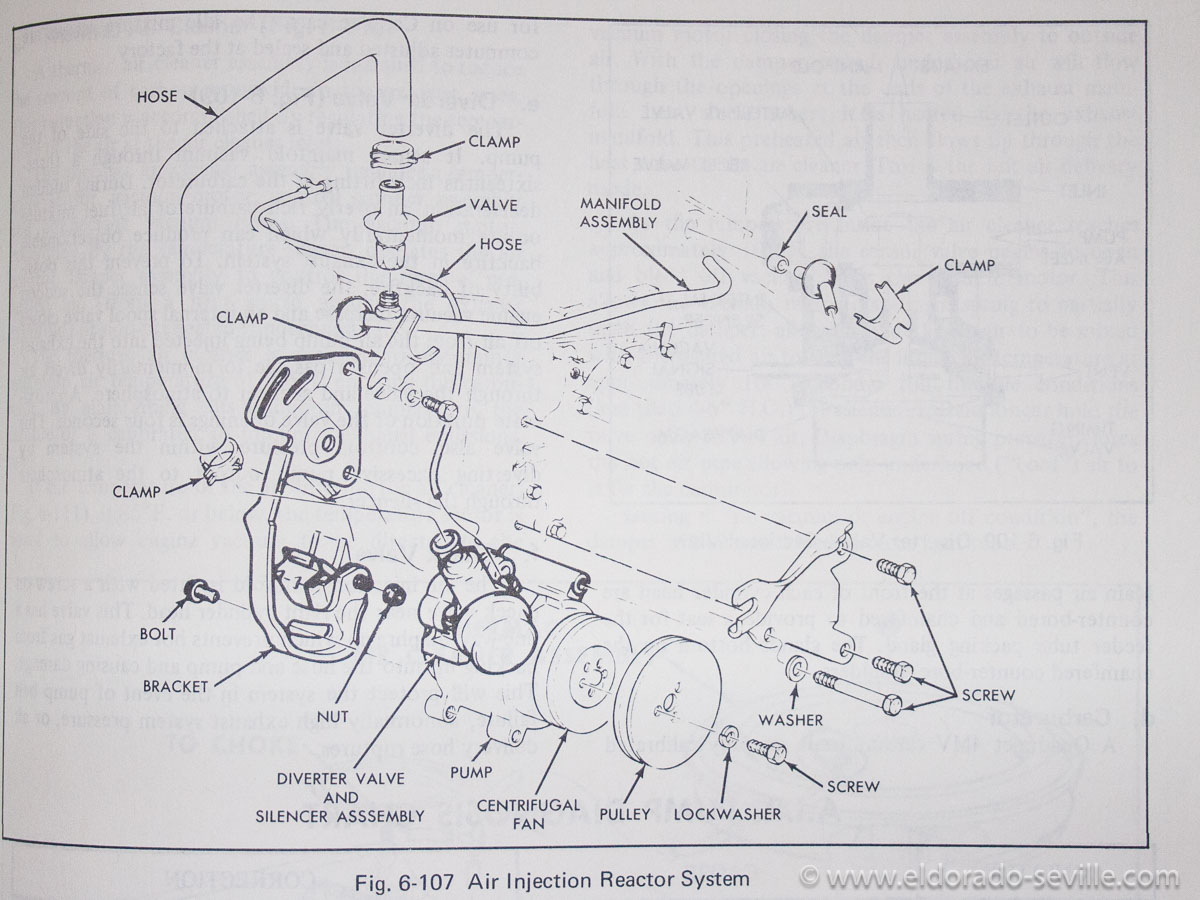
This shows the brackets in the shop manual.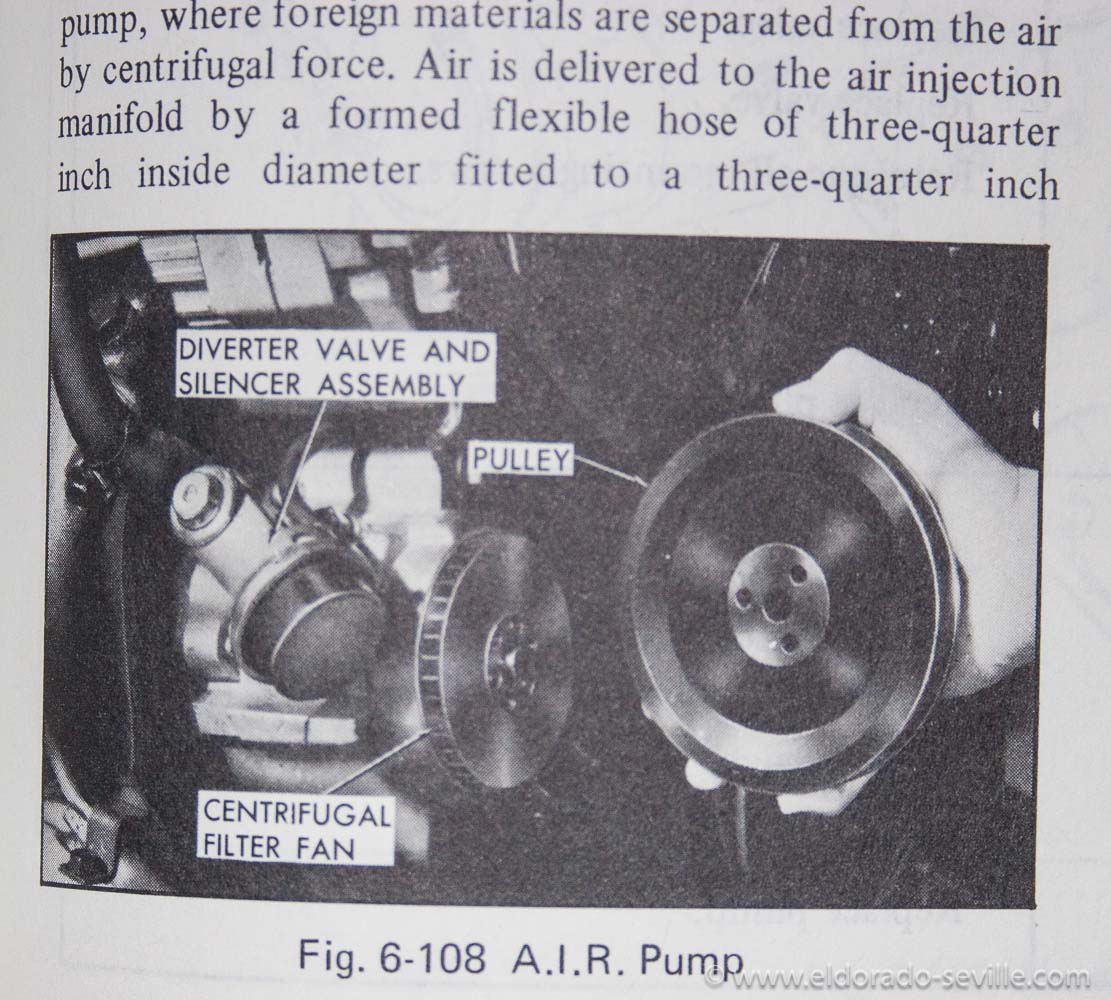
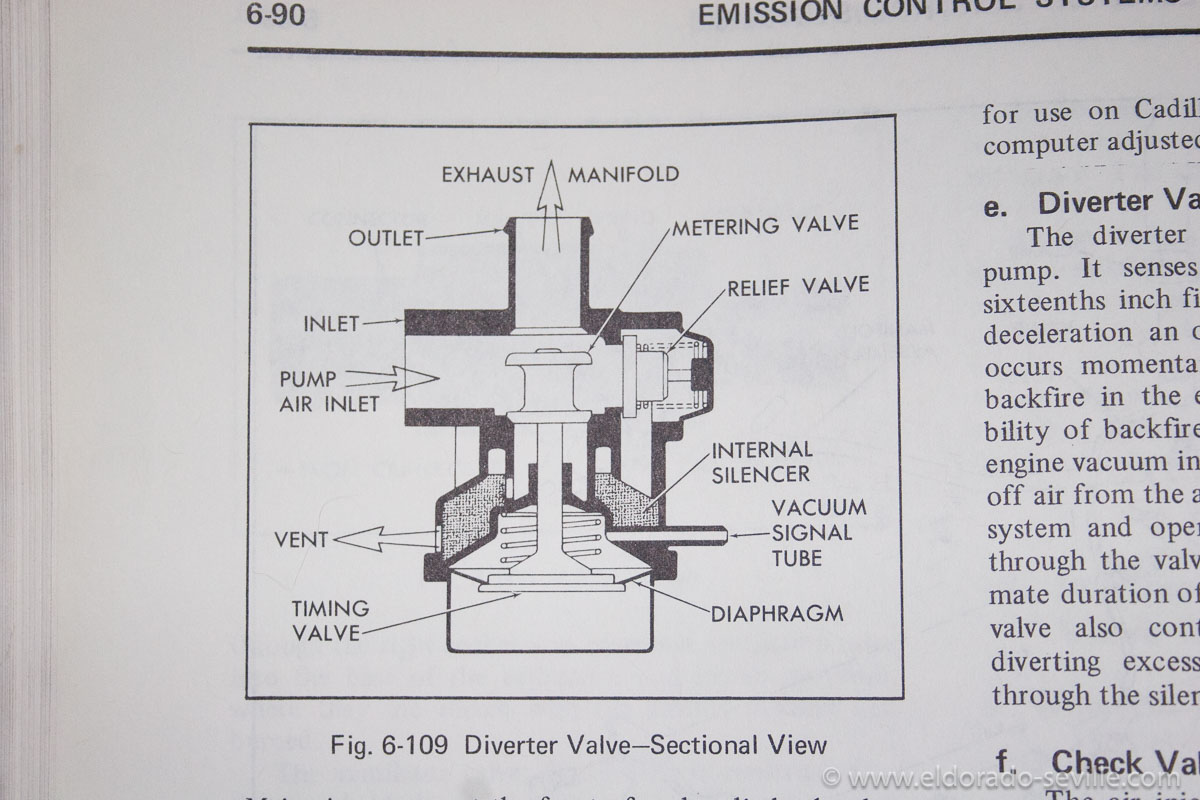
The divert valve which is no longer available. Check the vacuum diaphragm inside while it is out.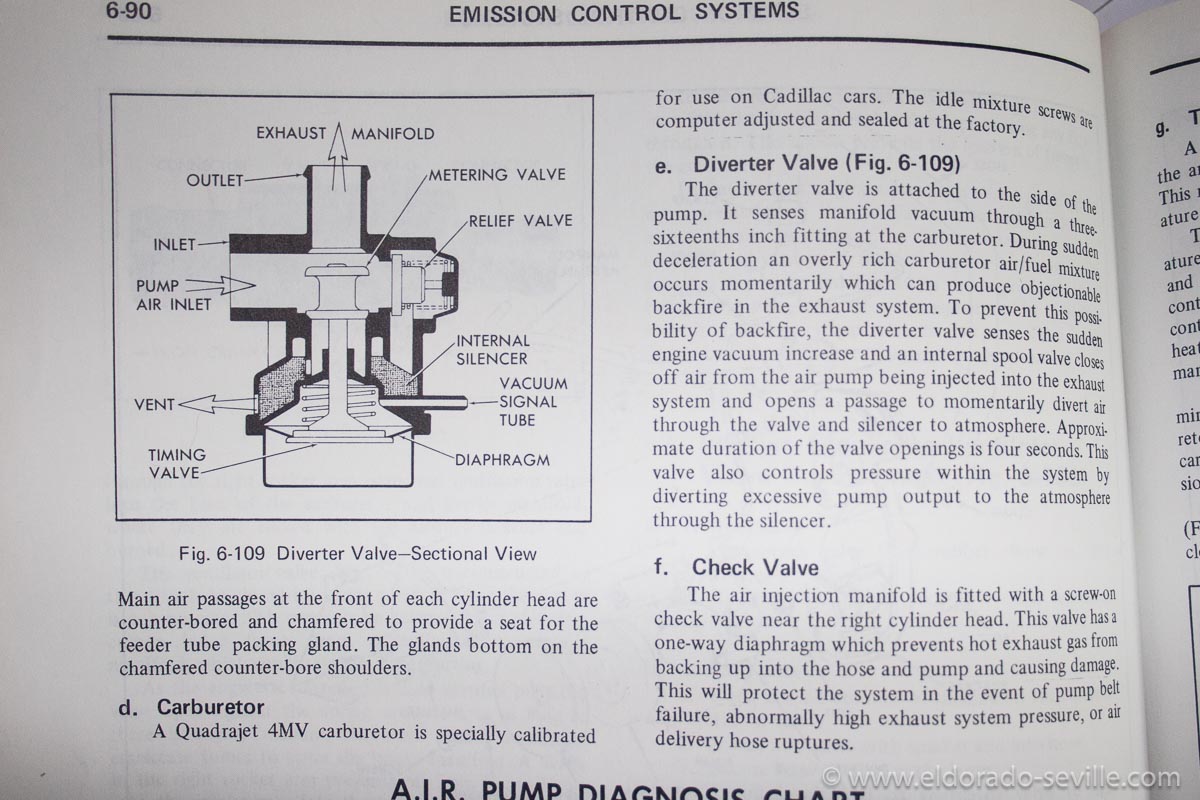
The divert valve which is no longer available. Check the vacuum diaphragm inside while it is out.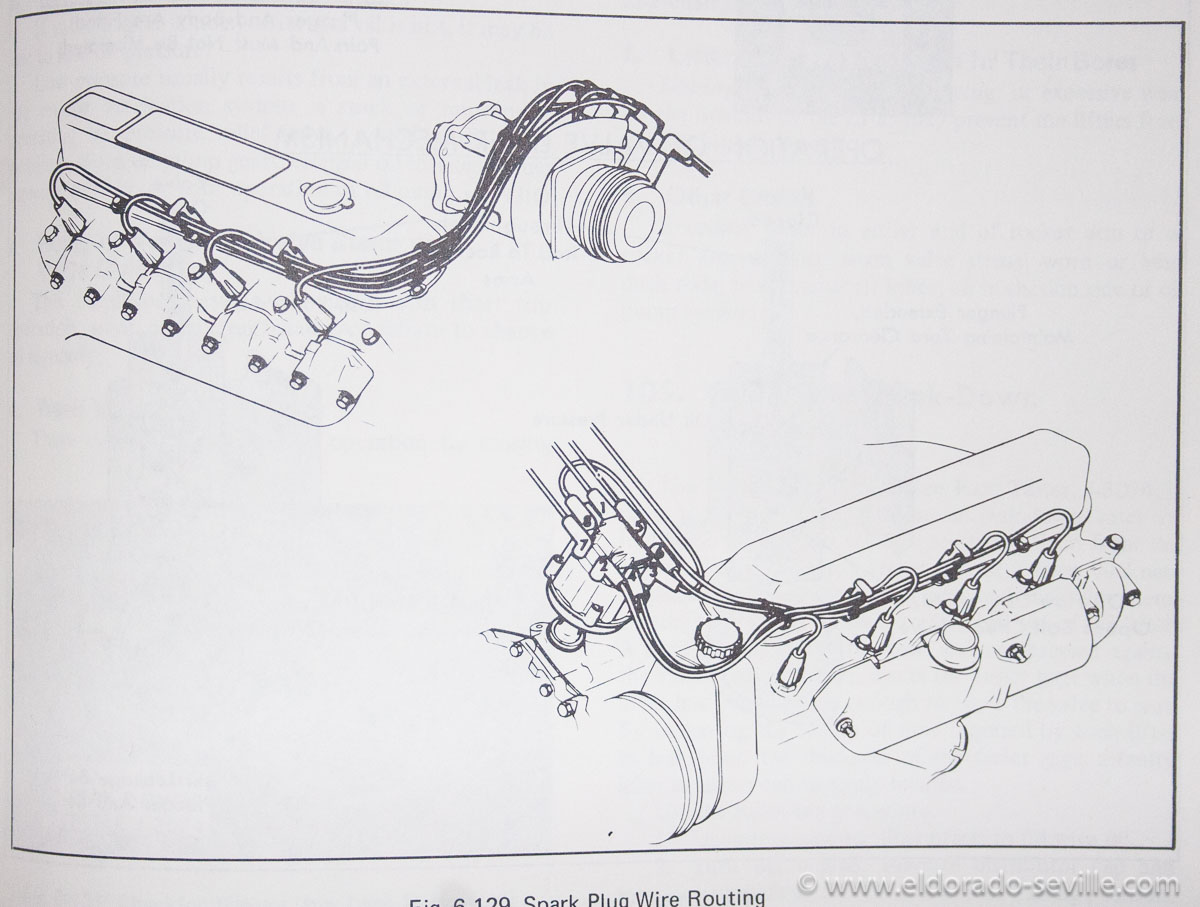
I had to remove the spark plug wires - this is how to put them back correctly.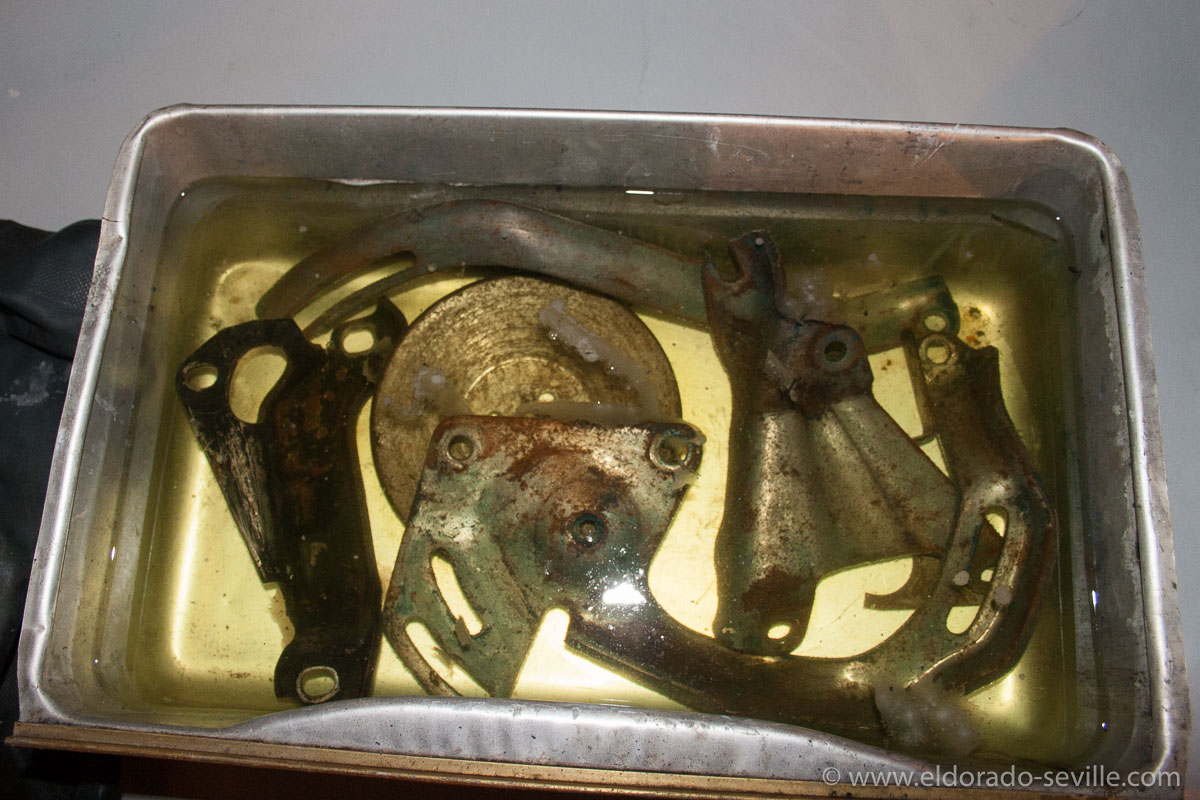
The brackets after I removed the paint - soaking in rust removing liquid until all the rust is gone.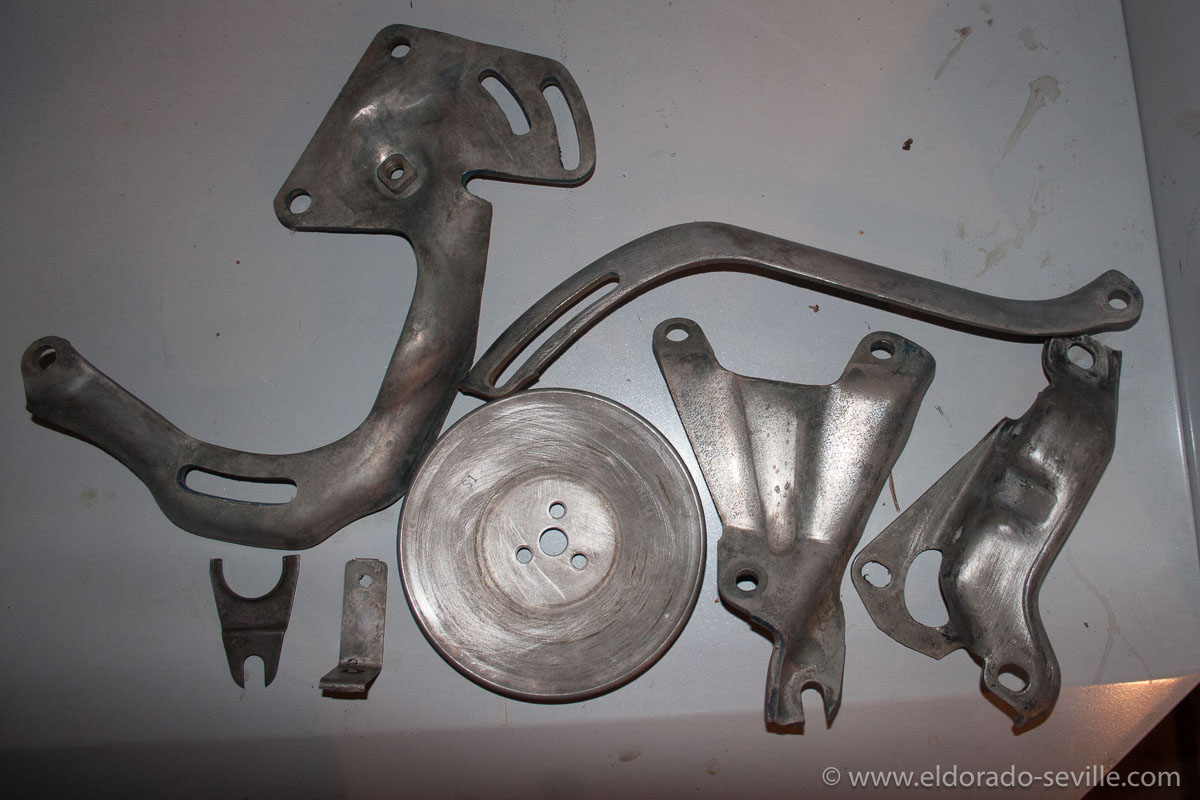
All the brackets and the pulley are now clean, rustfree and ready for paint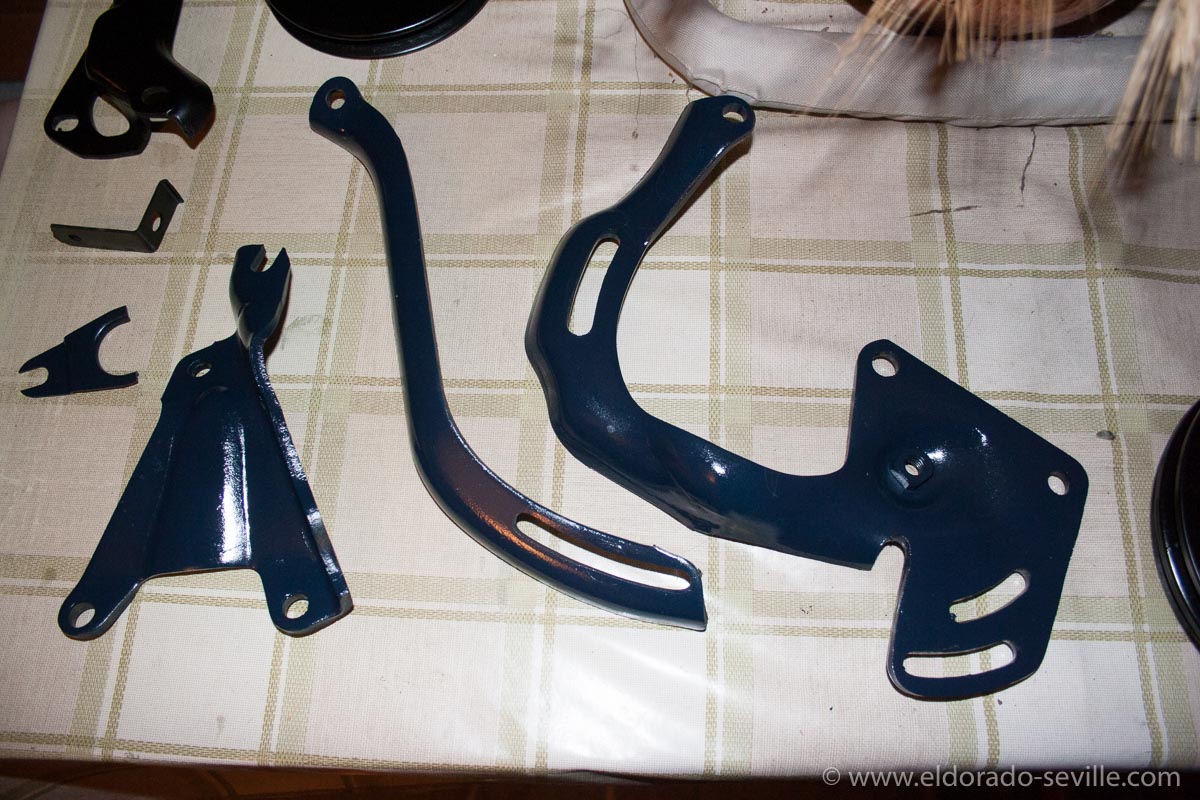
The brackets after painting.
Rust removing gel in action
Rust removing gel in action - I decided to remove the waterpump pulley and the fan as well after I took this picture.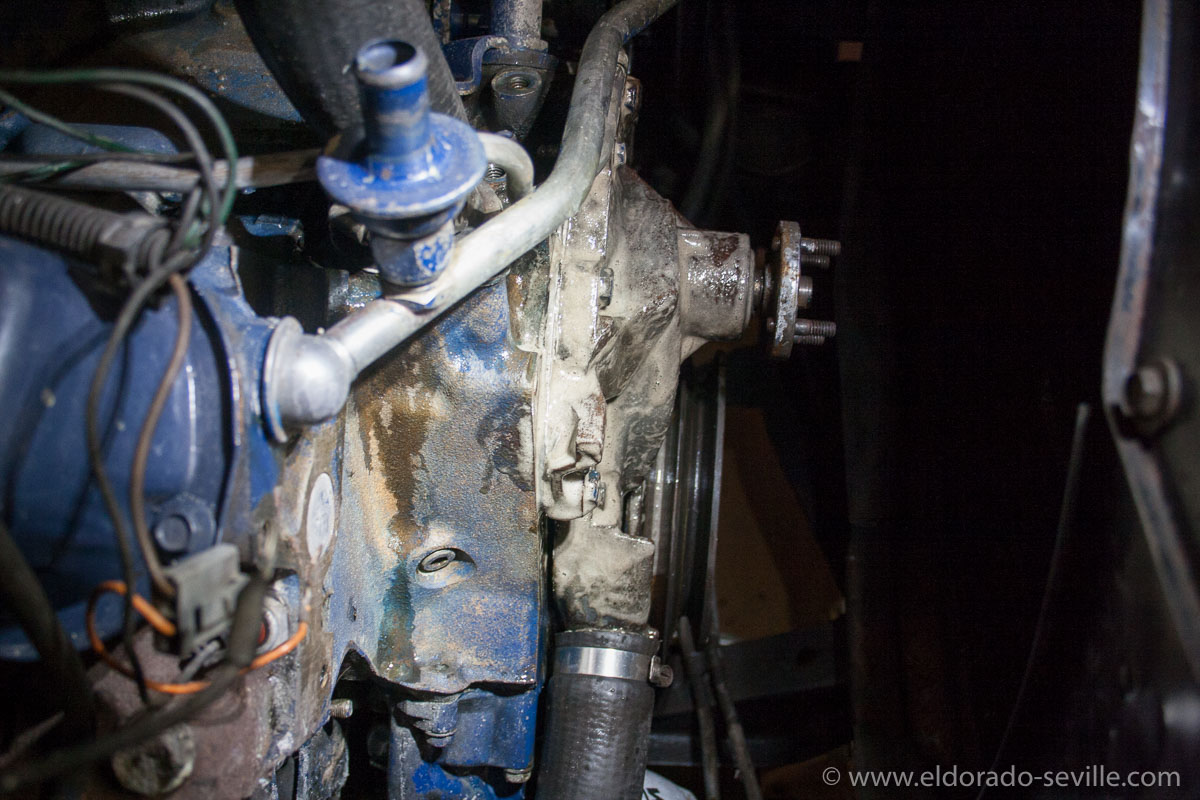
Rust removing gel in action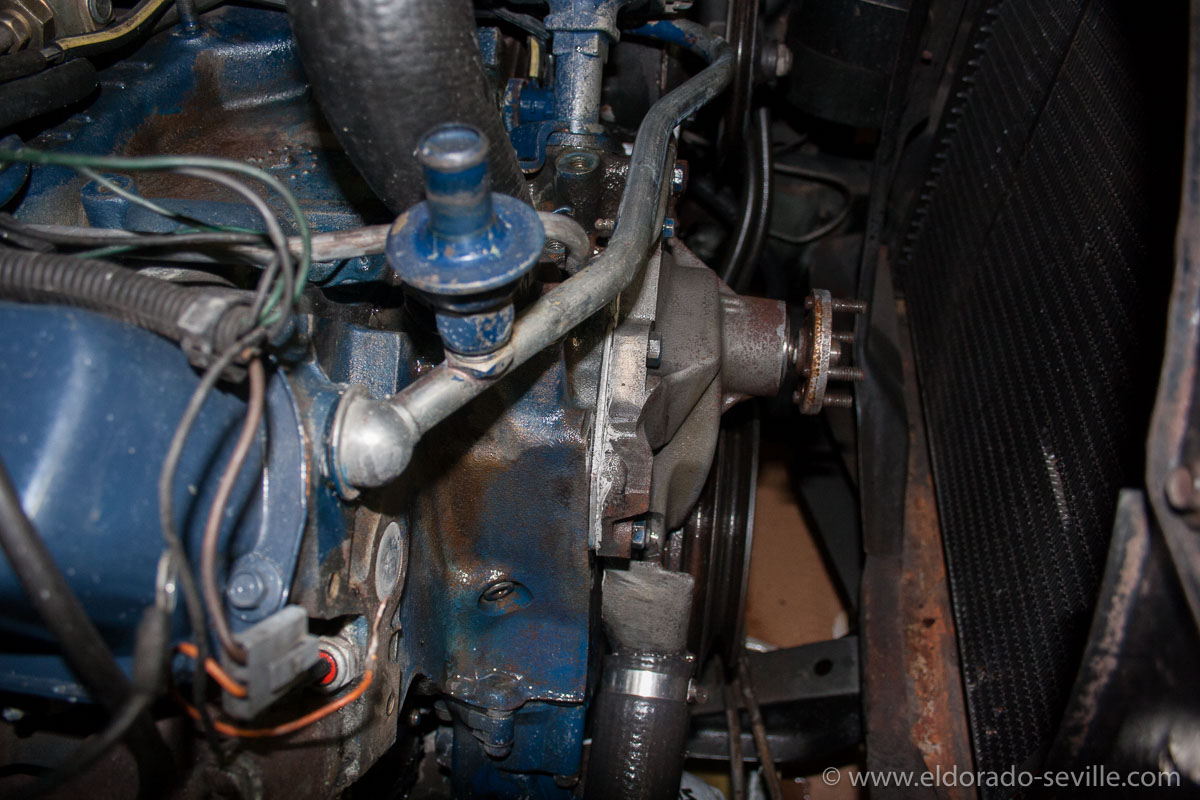
Almost clean - one more treatment will be necessary before it is ready for paint. The waterpump was not painted and therefore was pretty rusty.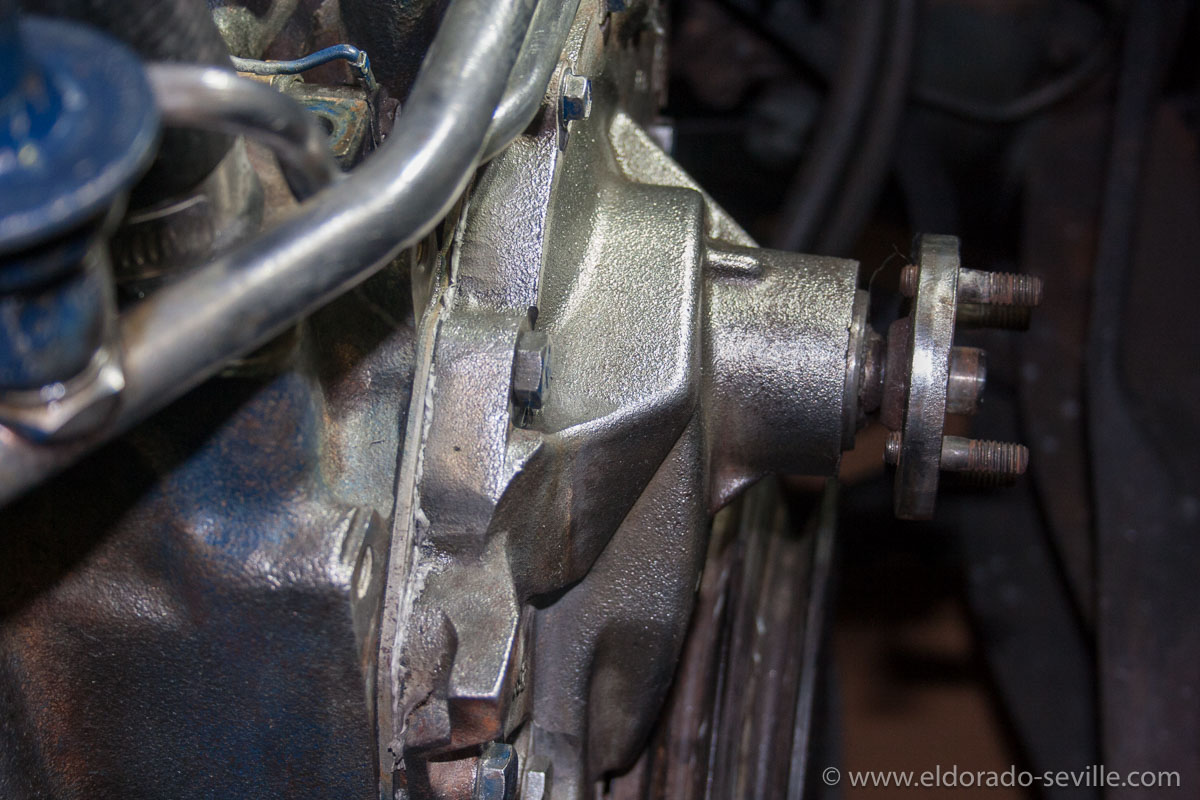
The water pump is now completely rust free and ready for paint.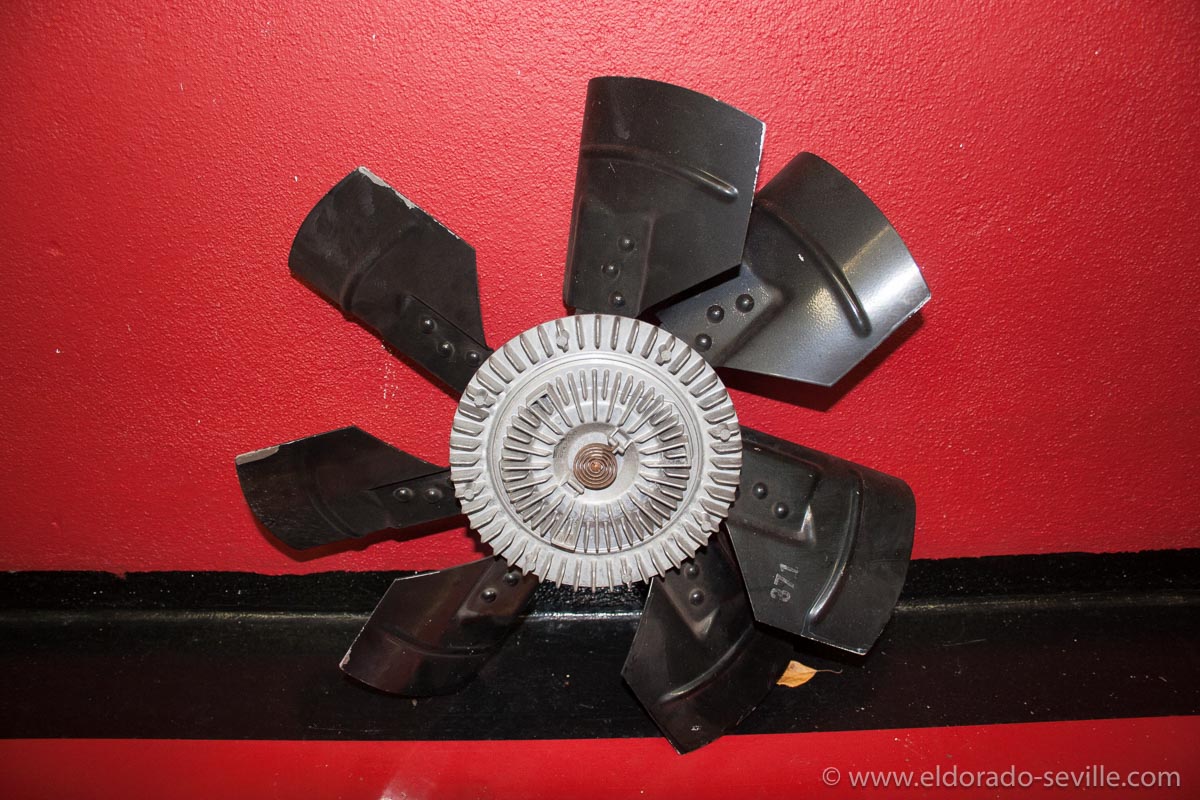
I can now fully clean and detail the fan as well. It even still carries the factory stencil.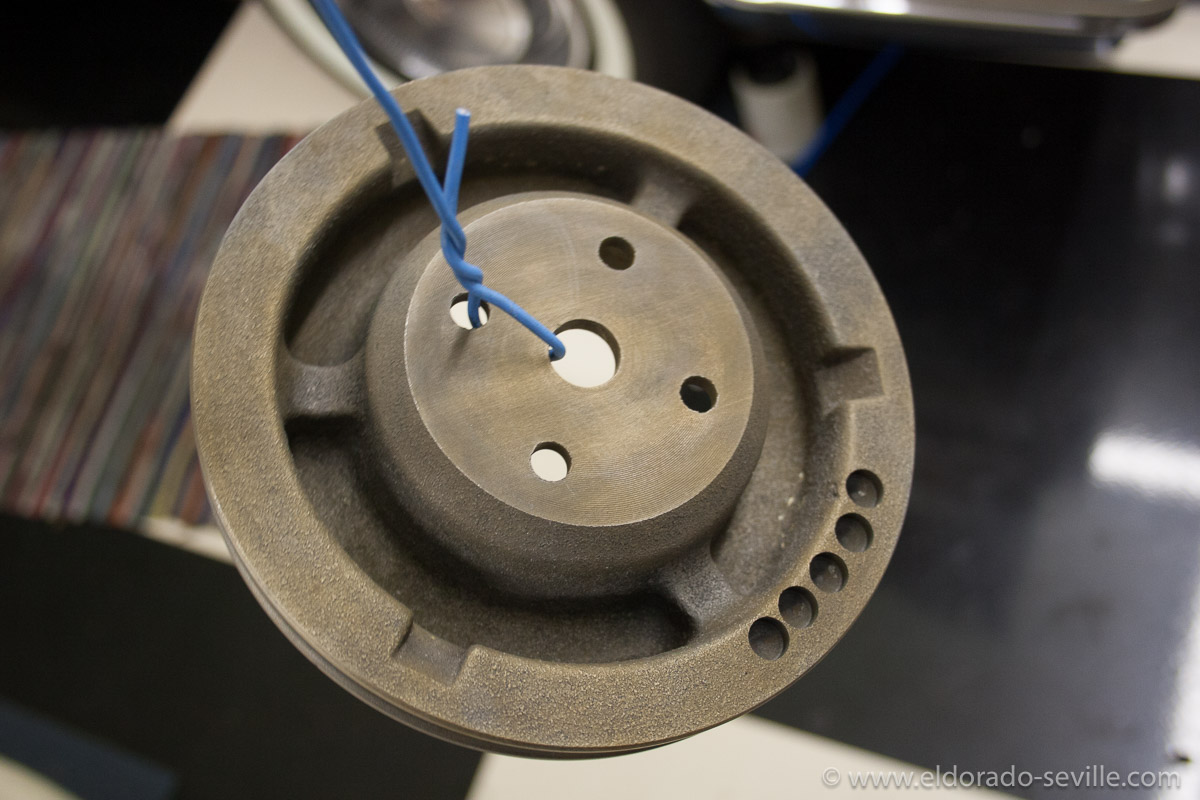
The water pump pulley after rust removal. I had to paint it very quickly because it developed flash rust immediately after removing it from the rust removing liquid.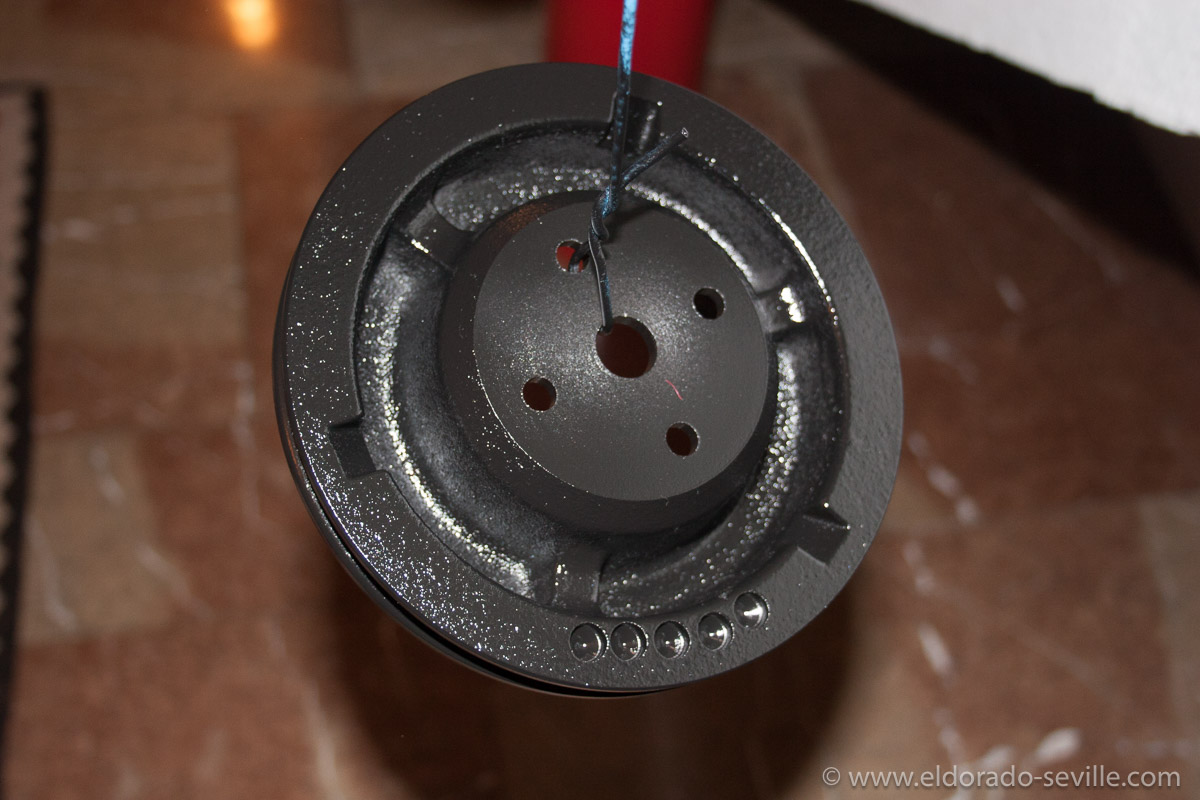
The water pump pulley after rust removal. I had to paint it very quickly because it developed flash rust immediately after removing it from the rust removing liquid. Here it is in black primer to stop it from rusting.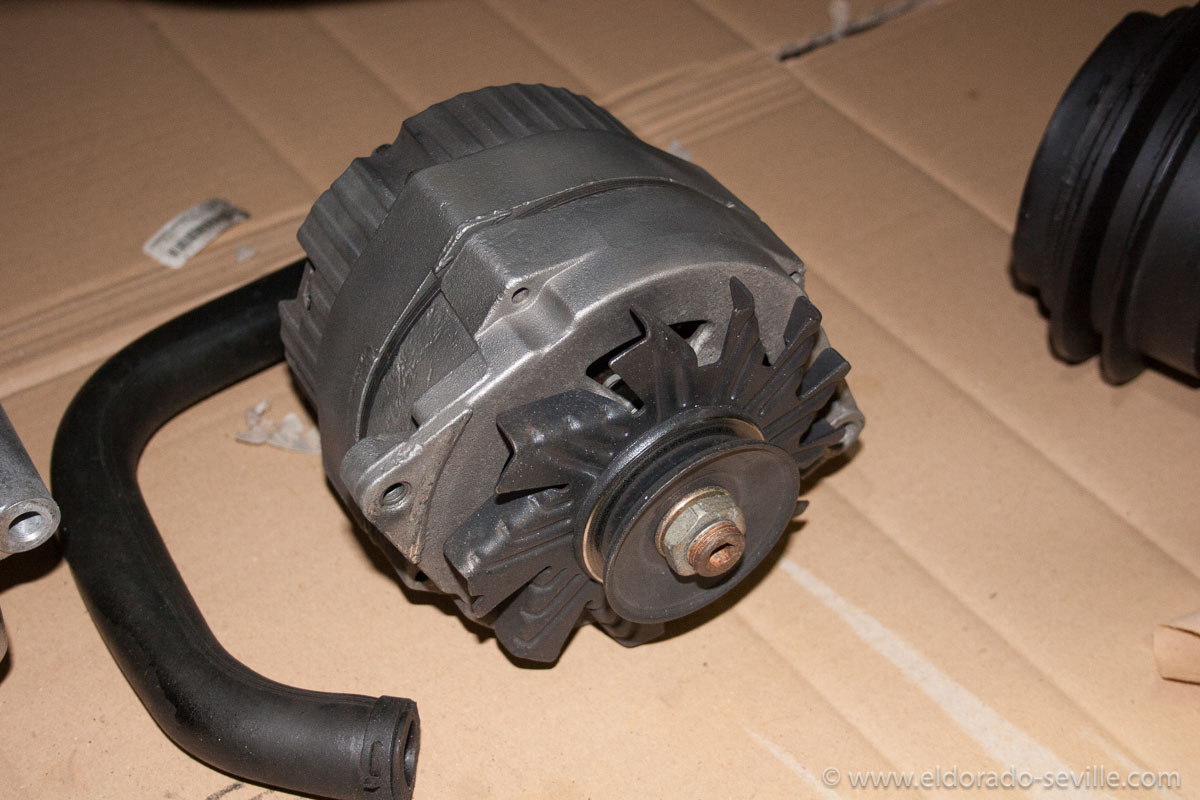
The alternator housing after cleaning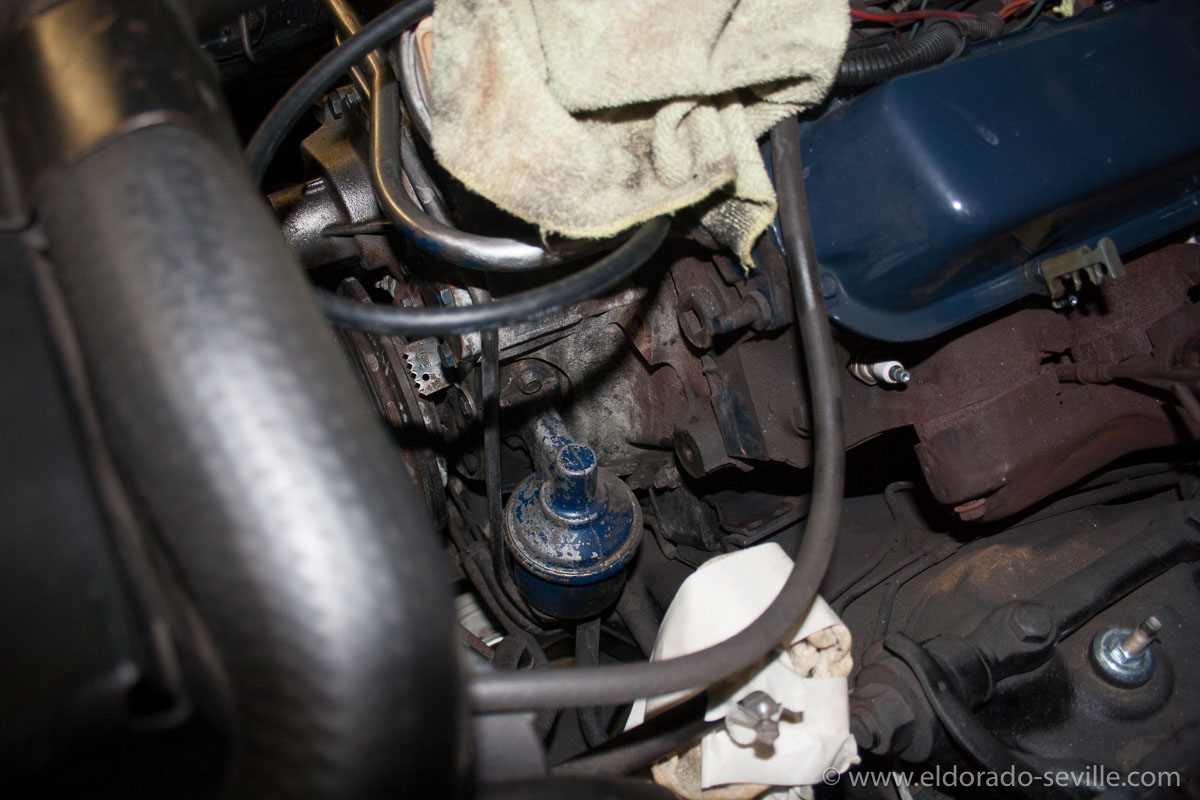
The power steering pump removed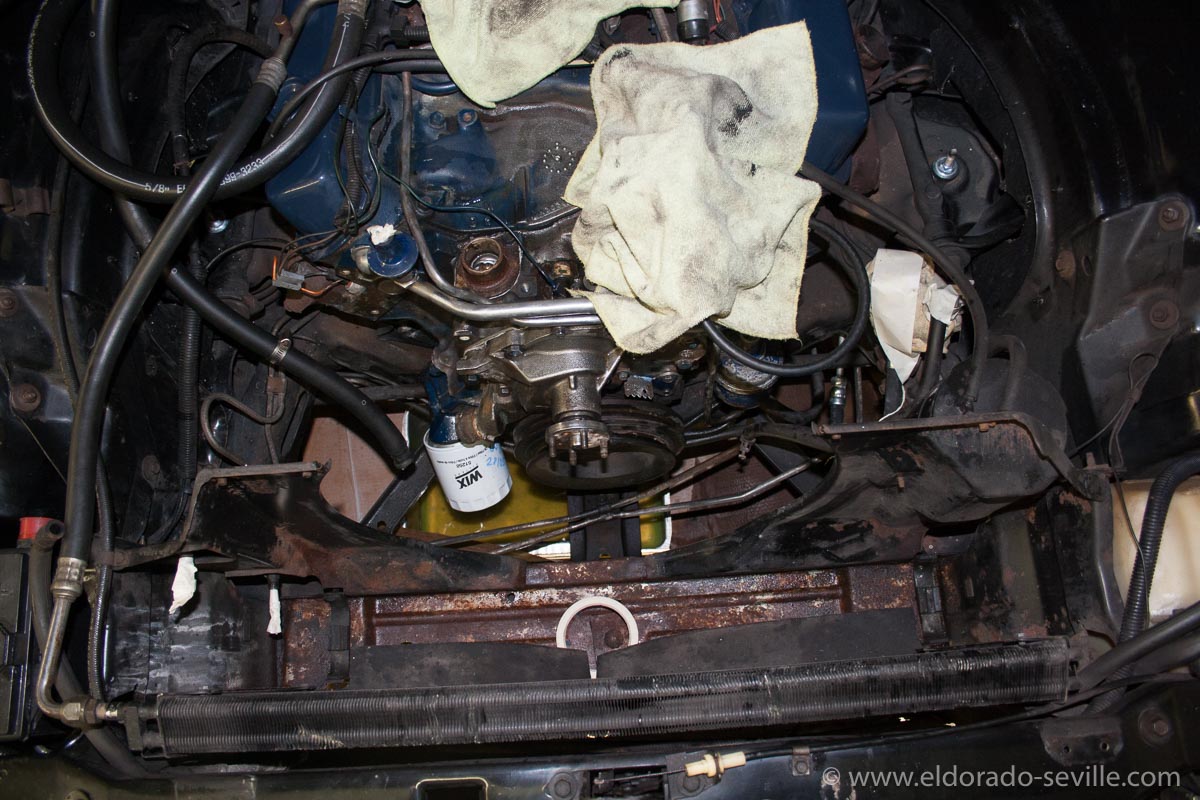
I took out the radiator to clean up the surface rust underneath…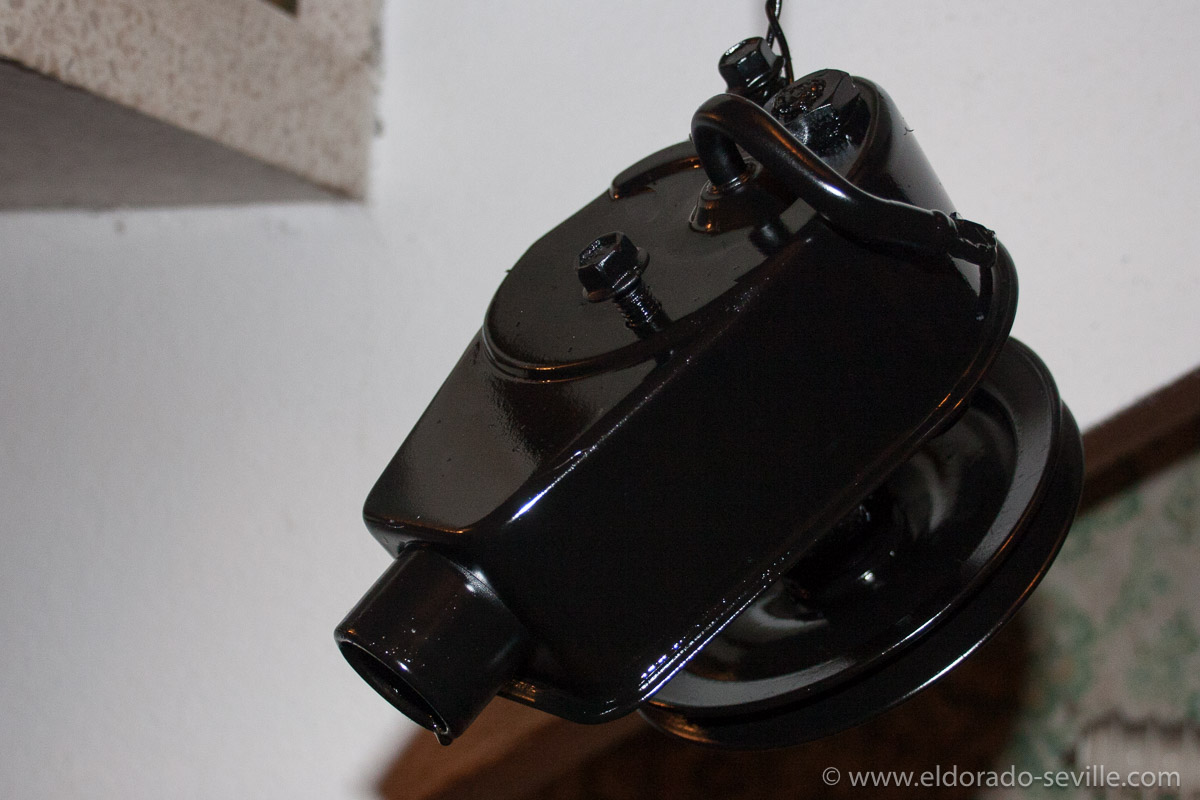
The power steering pump right after painting with wet paint... I took it down to bare metal before painting, but I forgot to take a picture...
RESTORING THE BATTERY TRAY IN THE 74 CADILLAC
I striped all the rust and paint and removed the headlights to get better access. I also de-rusted all the bolts, nuts and washers with rust removing liquid and removed the old paint with a wire brush.
After everything was completely rust free and down to clean bare metal, I primed the tray and afterwards painted it with 2 coats of Eastwood Chassis Black Extreme, which has an OEM sheen.
Now it is looking very nice again - almost OEM - and the new paint should protect it for a long time.
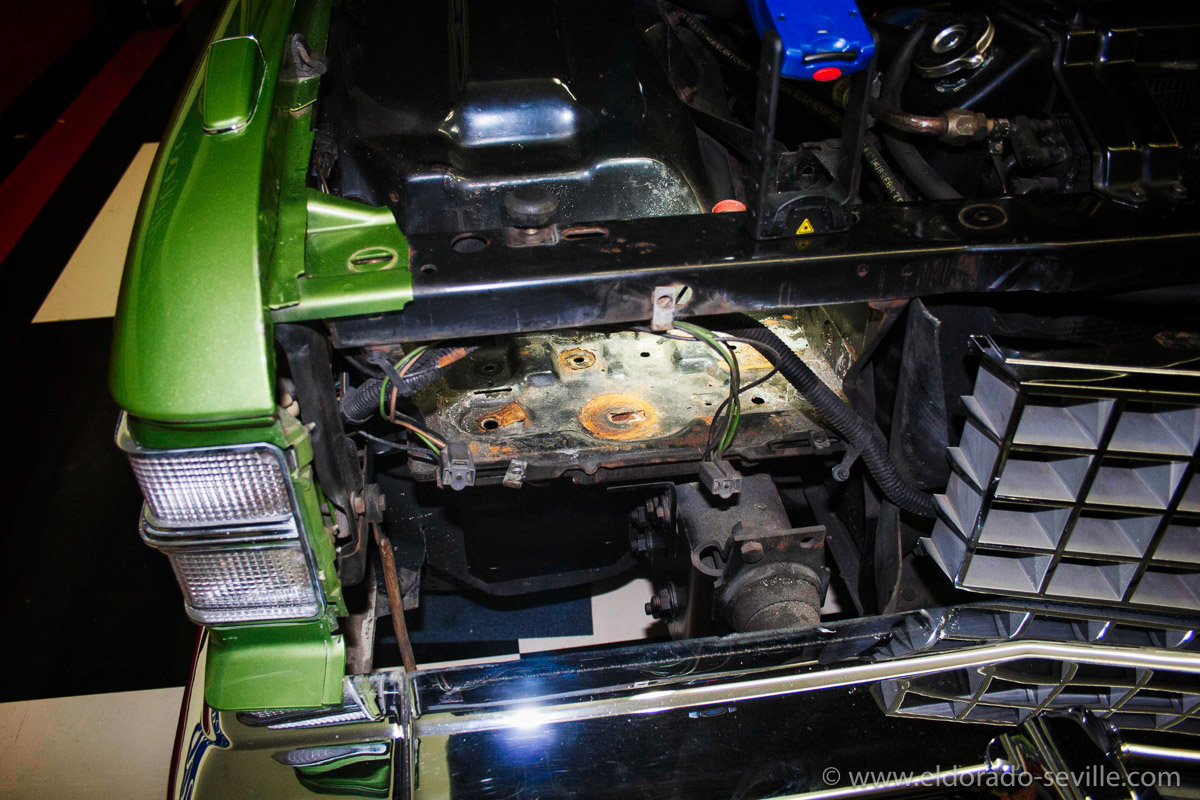
With the battery and headlights removed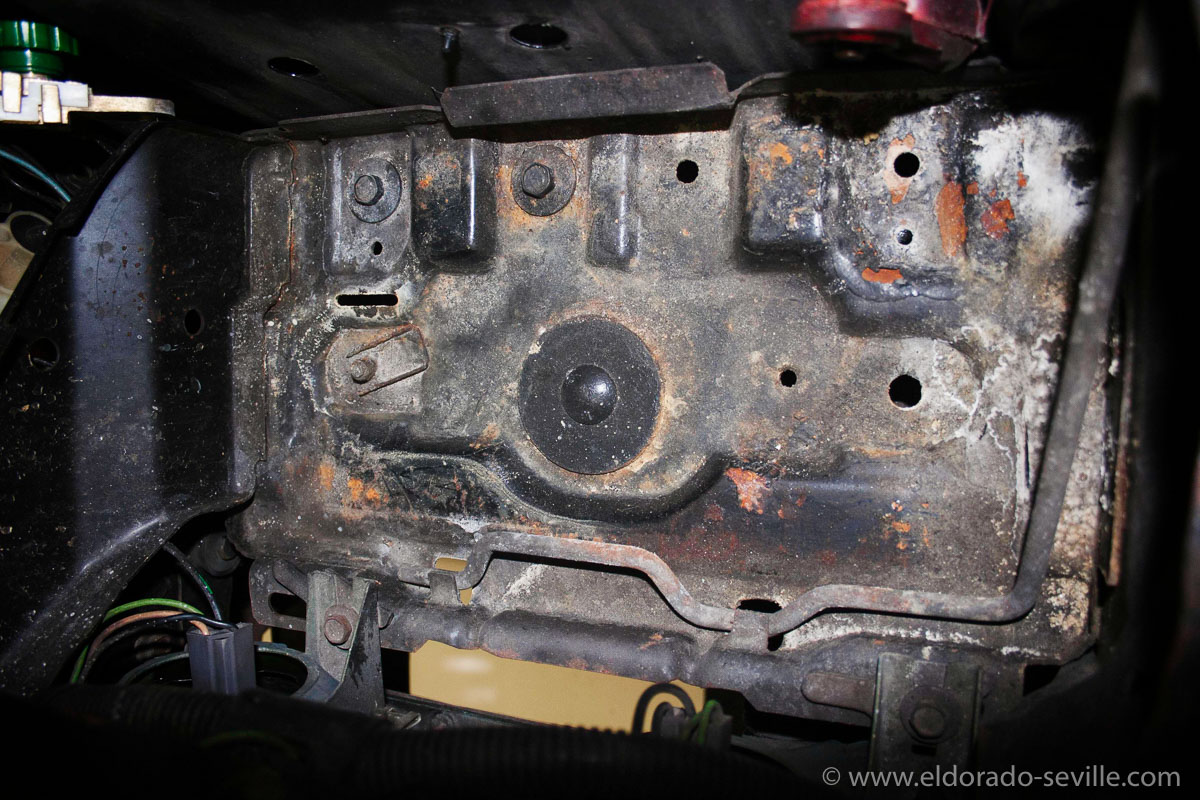
Luckily the rust was not too bad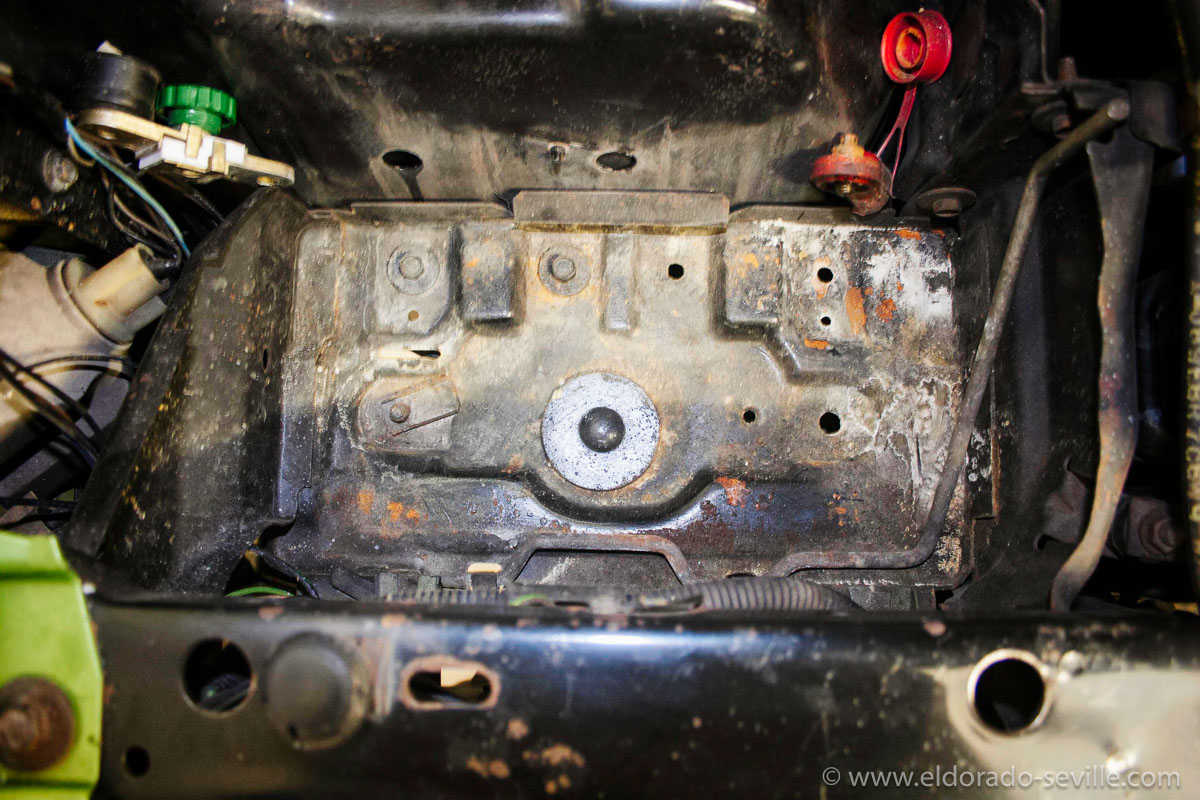
Luckily the rust was not too bad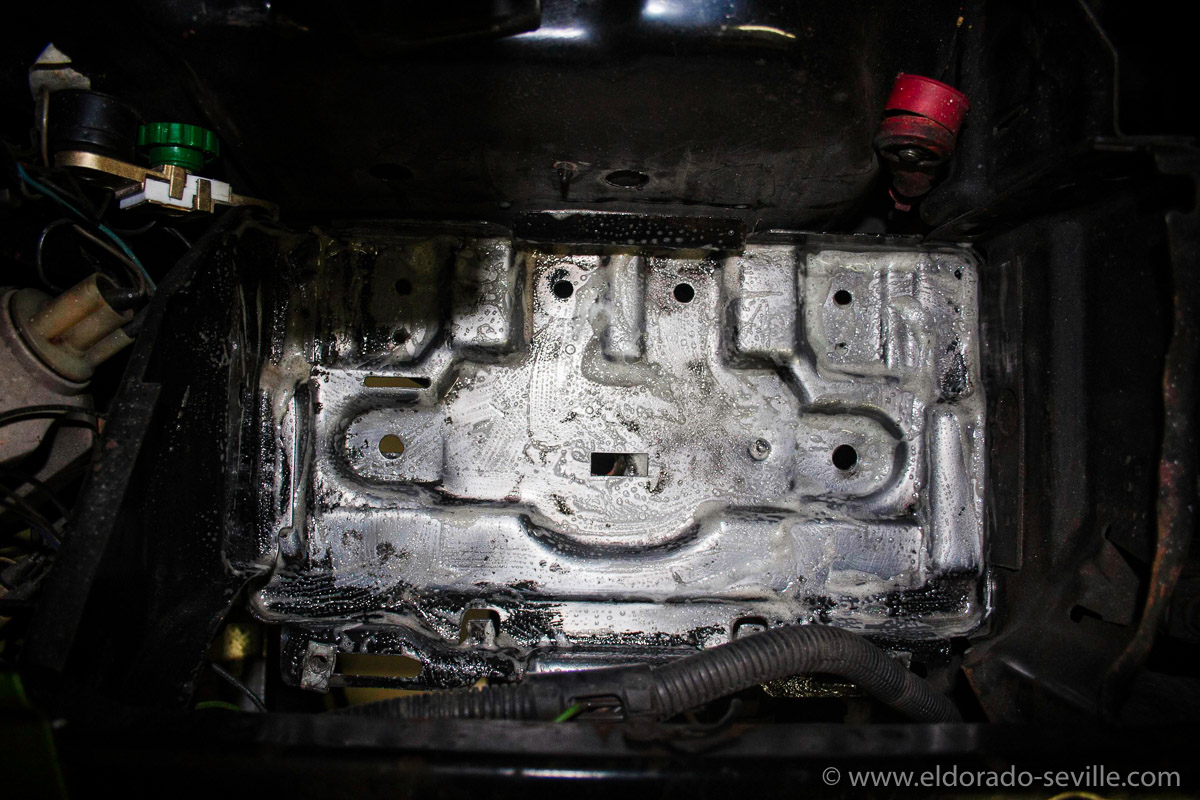
Rust remover liquid in action
After removing the rust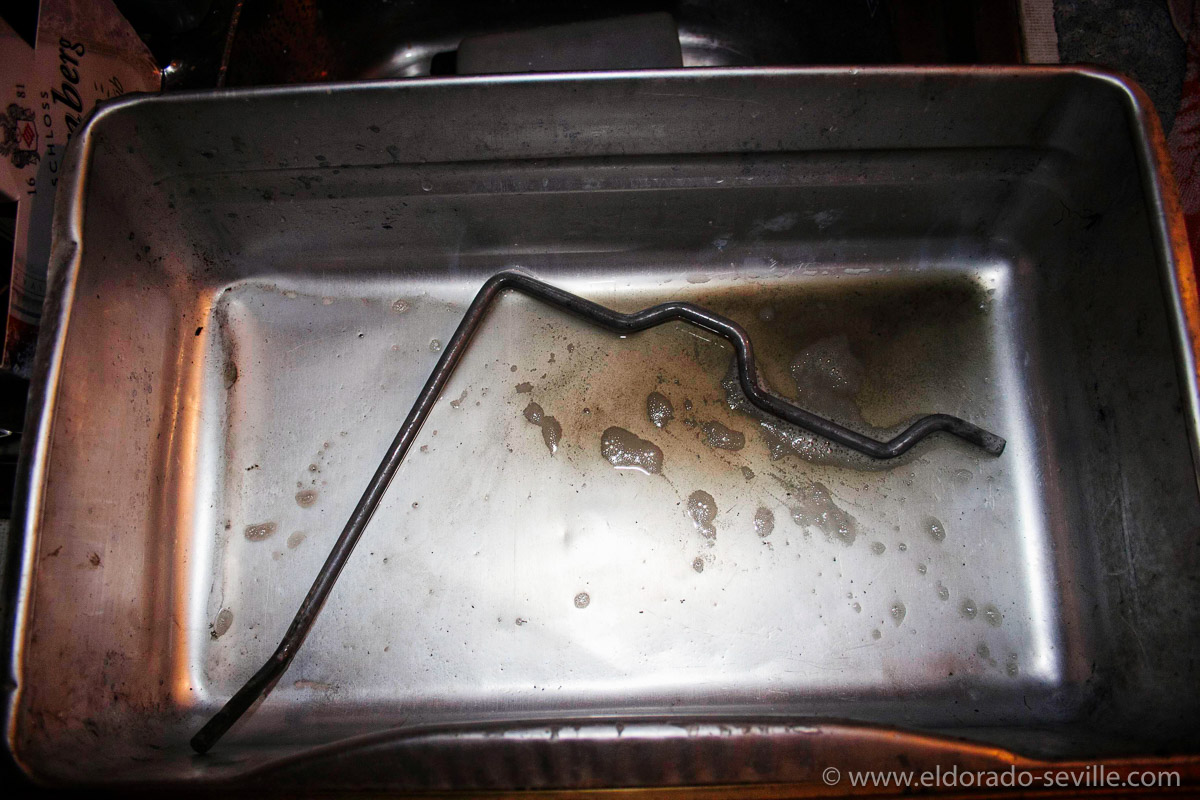
I also cleaned the battery hold down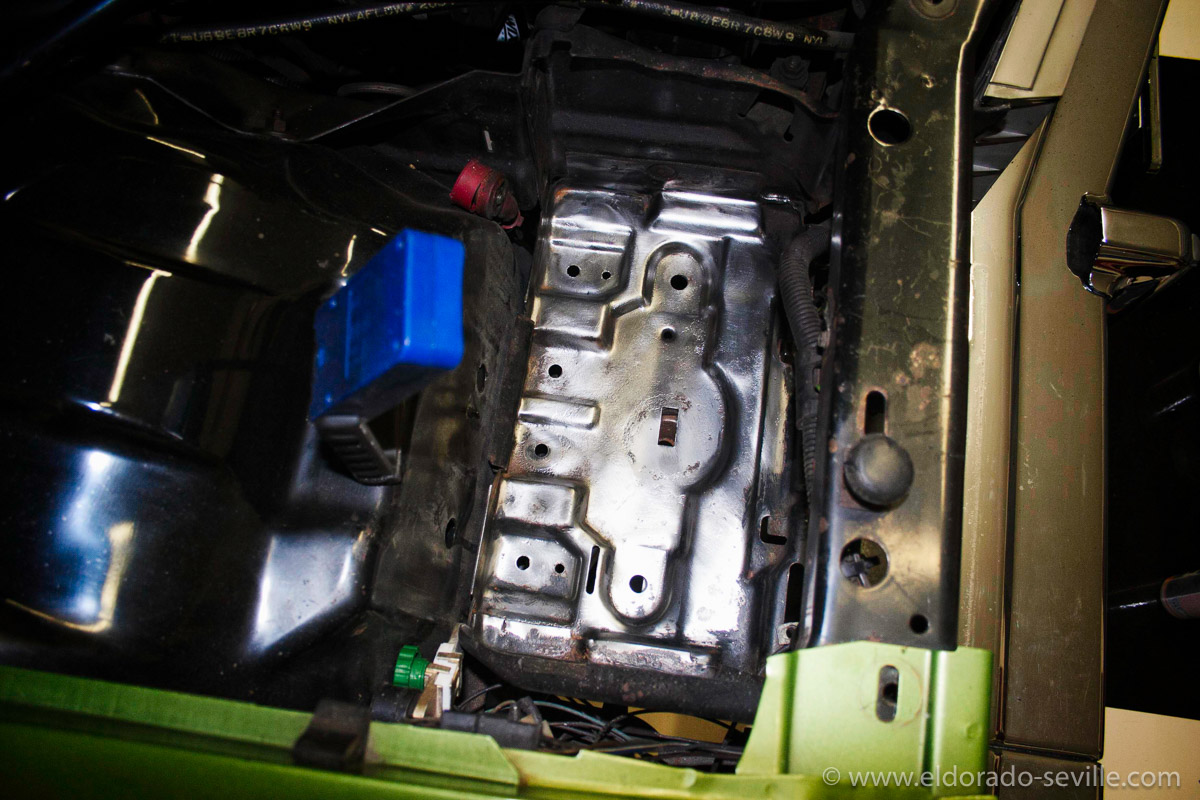
Almost rust free tray after the first treatment with rust remover. I got it much cleaner after this picture was taken.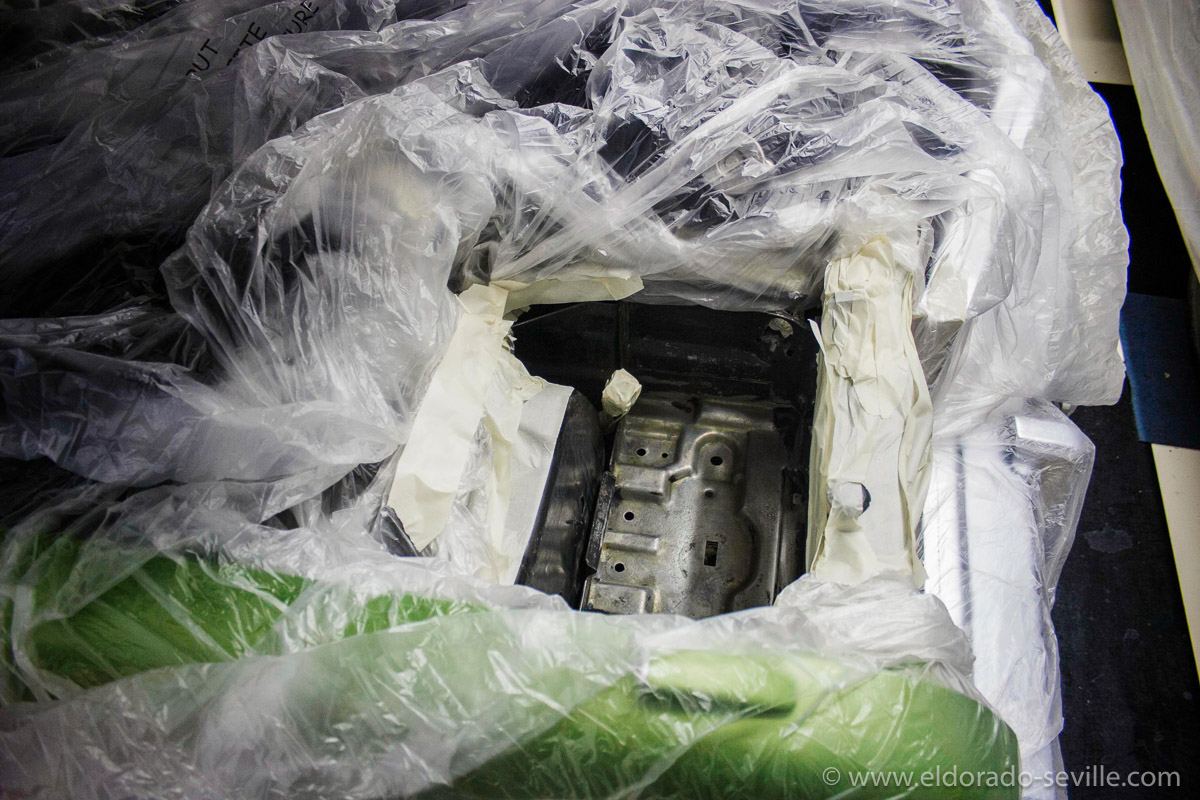
Ready for paint - no more rust. Everything was also wire brushed and and sanded.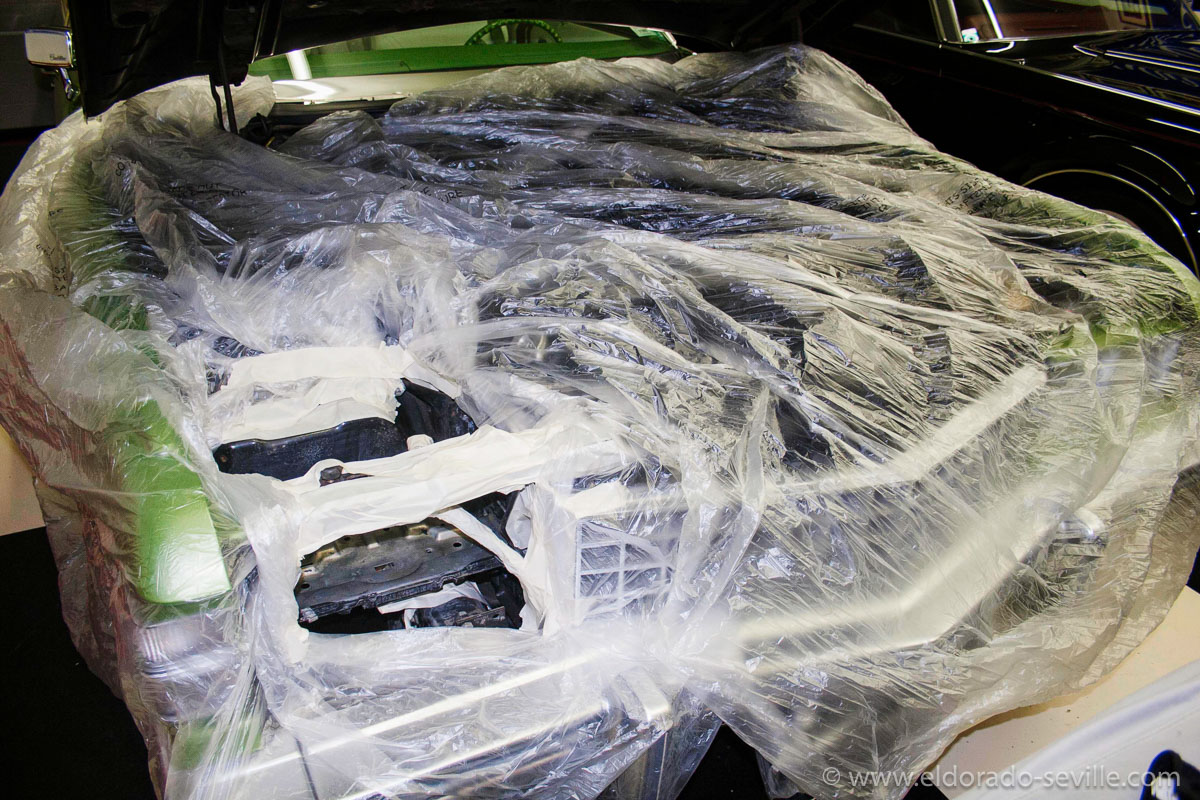
Ready for paint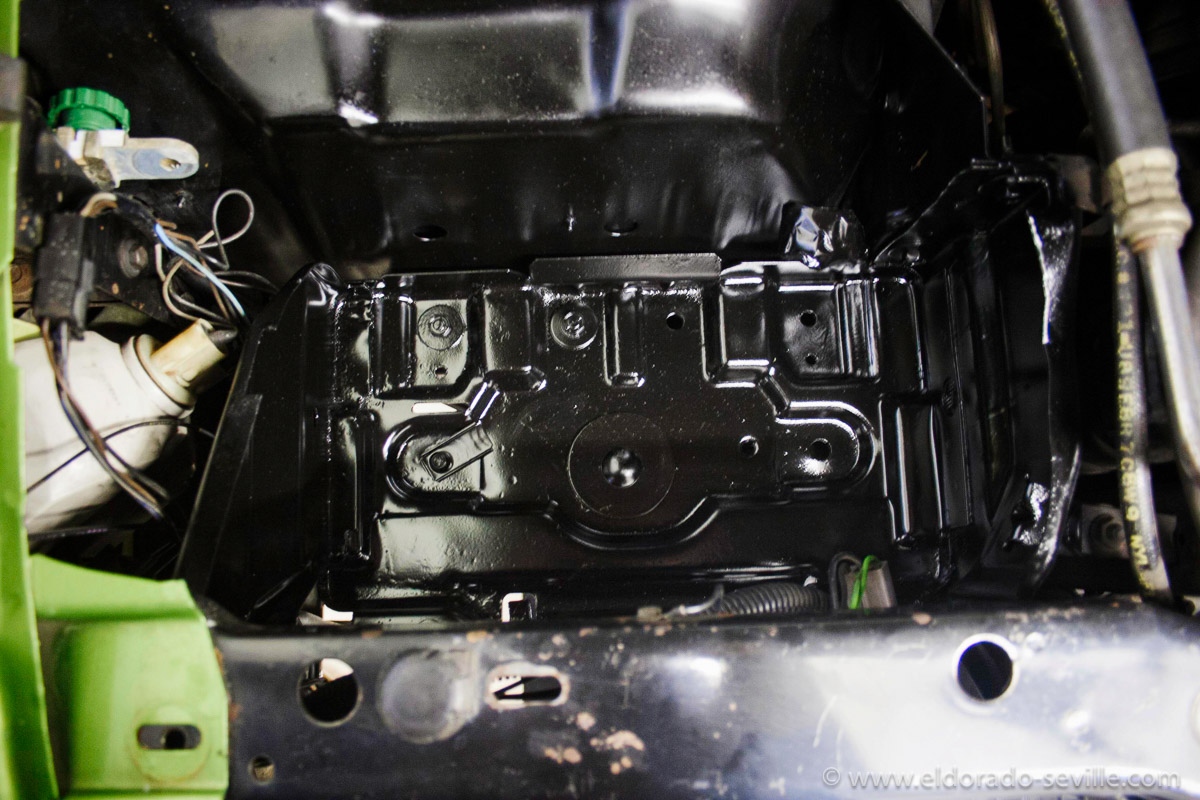
The restored tray. 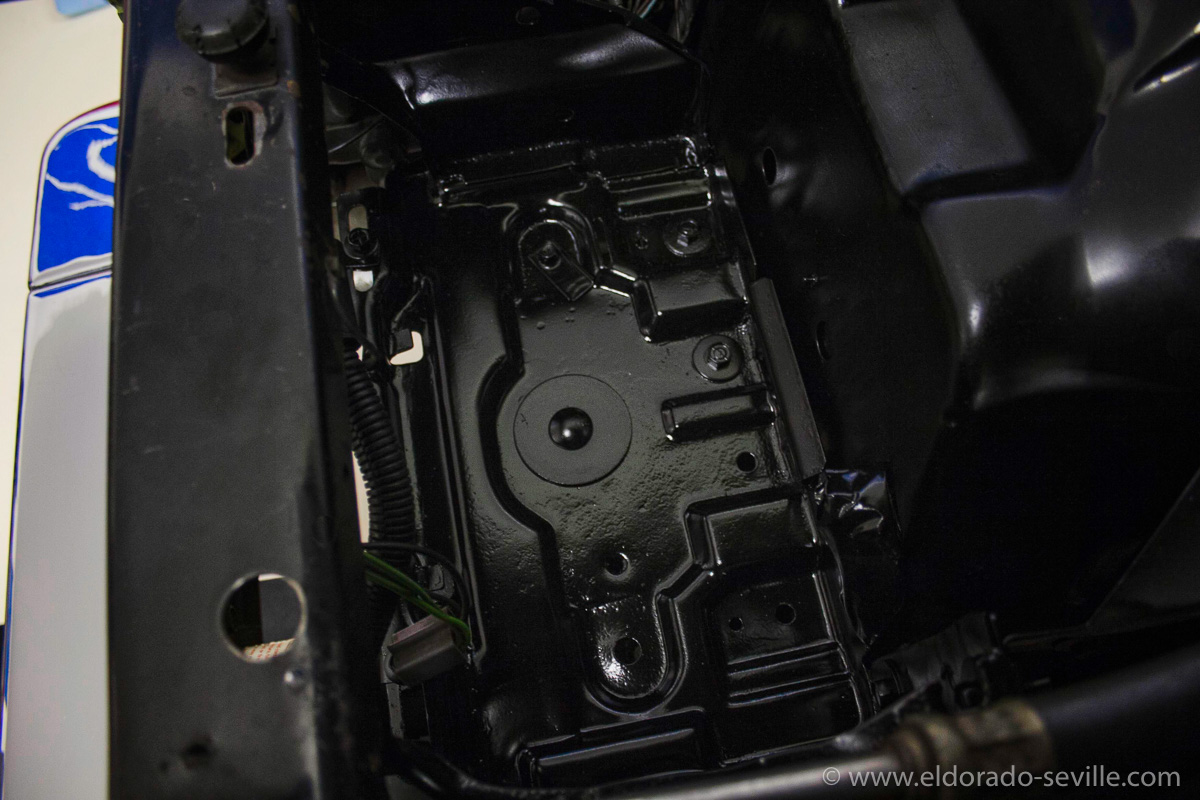
The restored tray - you can see where the rust was, as it left some marks in the metal. But it is now well protected and rust should be stopped.
ELECTRIC SEAT BACK LOCK IN THE 74 WAS BROKEN AGAIN
I already made 2 previous repair attempts after the solenoid for the unlatching mechanism failed, and for a while it seemed to work perfectly after the repairs were made …
The last mechanism I installed got so weak that it did no longer unlatch by itself when I opened the door…
So I had to order another used unit from my favorite source - Arizona Vintage Parts.
They sent me a perfectly working unit once again - it only had some surface rust, which I removed with rust removing gel once again (see pictures below). After this treatment it looked like new.
Like the last time, I had to disassemble parts of the back seat to replace the defective actuator with a new working one.
The new actuator I installed did work right away, but upon further investigation, I noticed that the latch did not come off as easily as it should, after it had engaged with the striker. On the passenger side the latch does not even touch the striker while it unlatches.
So the solenoid needed a lot of power to unlatch, and when the door was open for a longer period of time the solenoid got pretty hot and would eventually burn at least one of the coils inside. You can only make some minor adjustments to the mechanism itself, and there was no way to get it right on my seat so that it could clear the striker without hanging up.
This definitely already was not done correctly at the factory, and the misalignment of the striker was the reason why the drivers door side solenoid always broke. I´m sure it worked for a while when the car left the factory, but eventually it caused problems.
The only way to make it right was to slightly modify the catch latch. I just had to remove a tiny bit of metal with a file and the mechanism could then move freely, and now the solenoid only needs very little power to unlatch the seat back, once the door is opened.
I hope this is a permanent fix now…
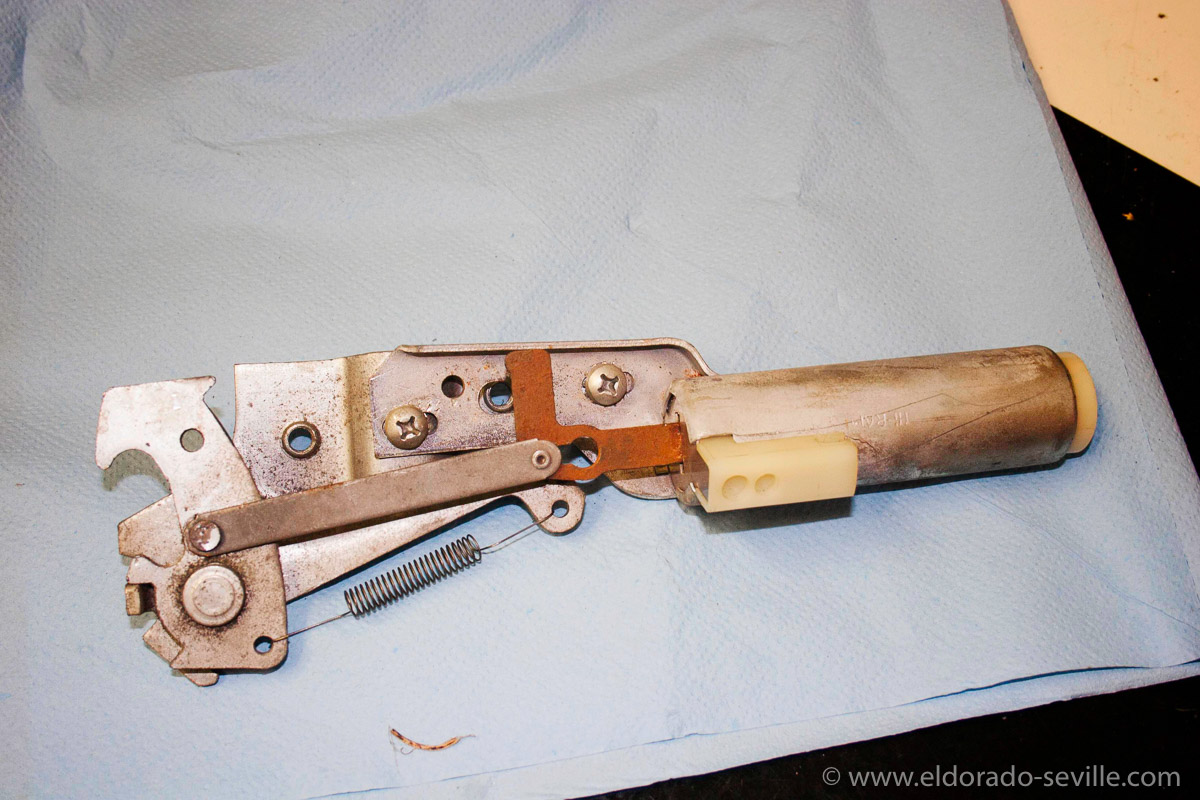
The new part I got - before cleaning it up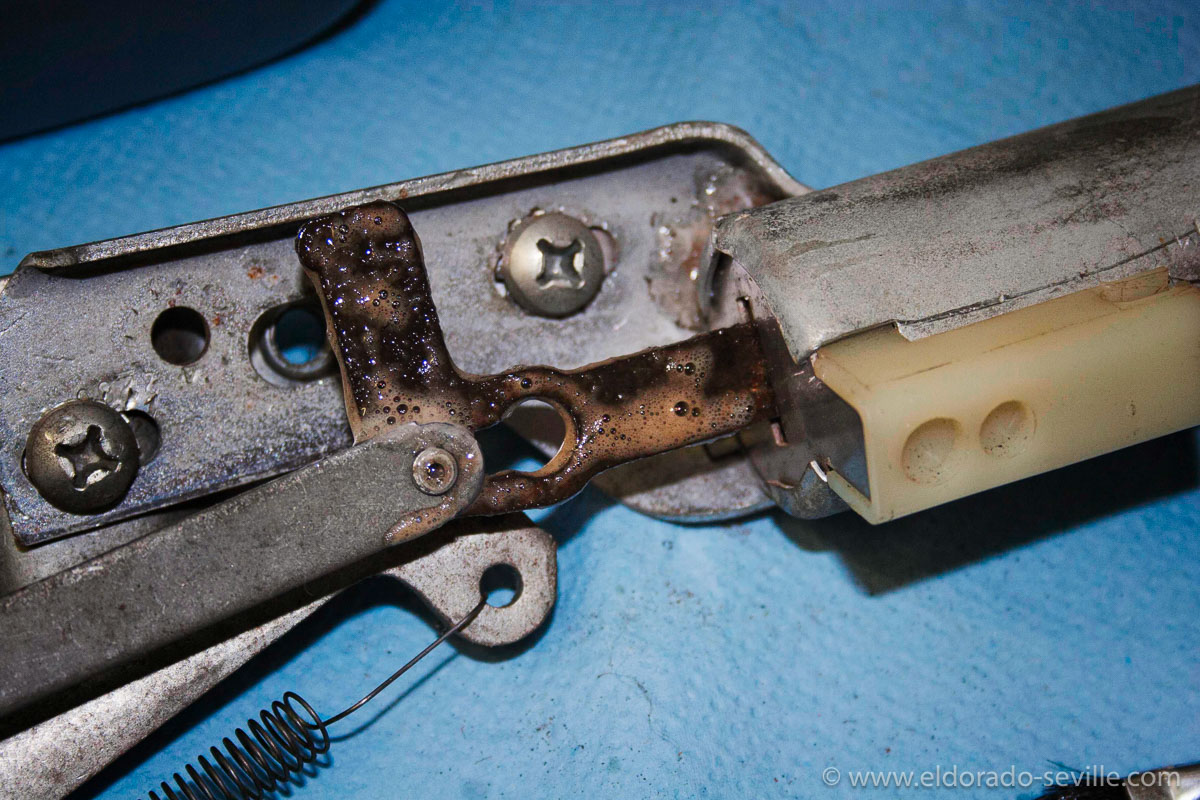
Removing the rust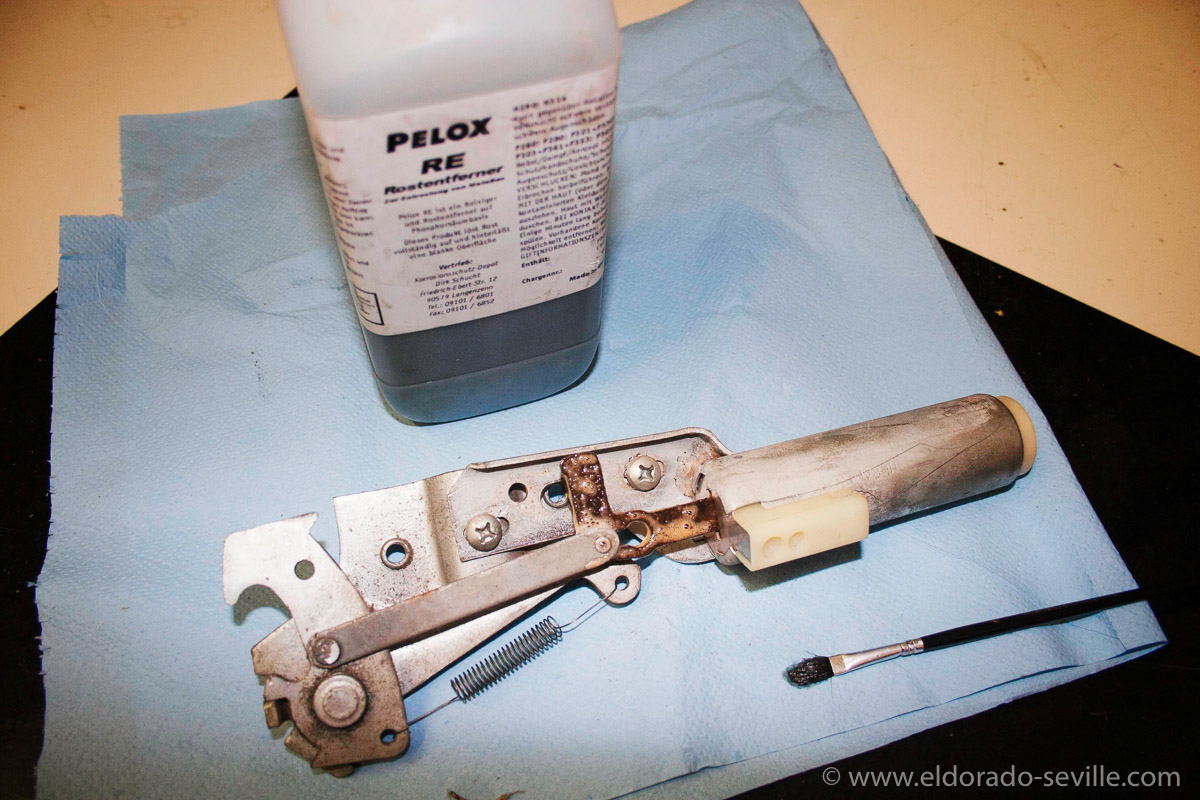
Removing the rust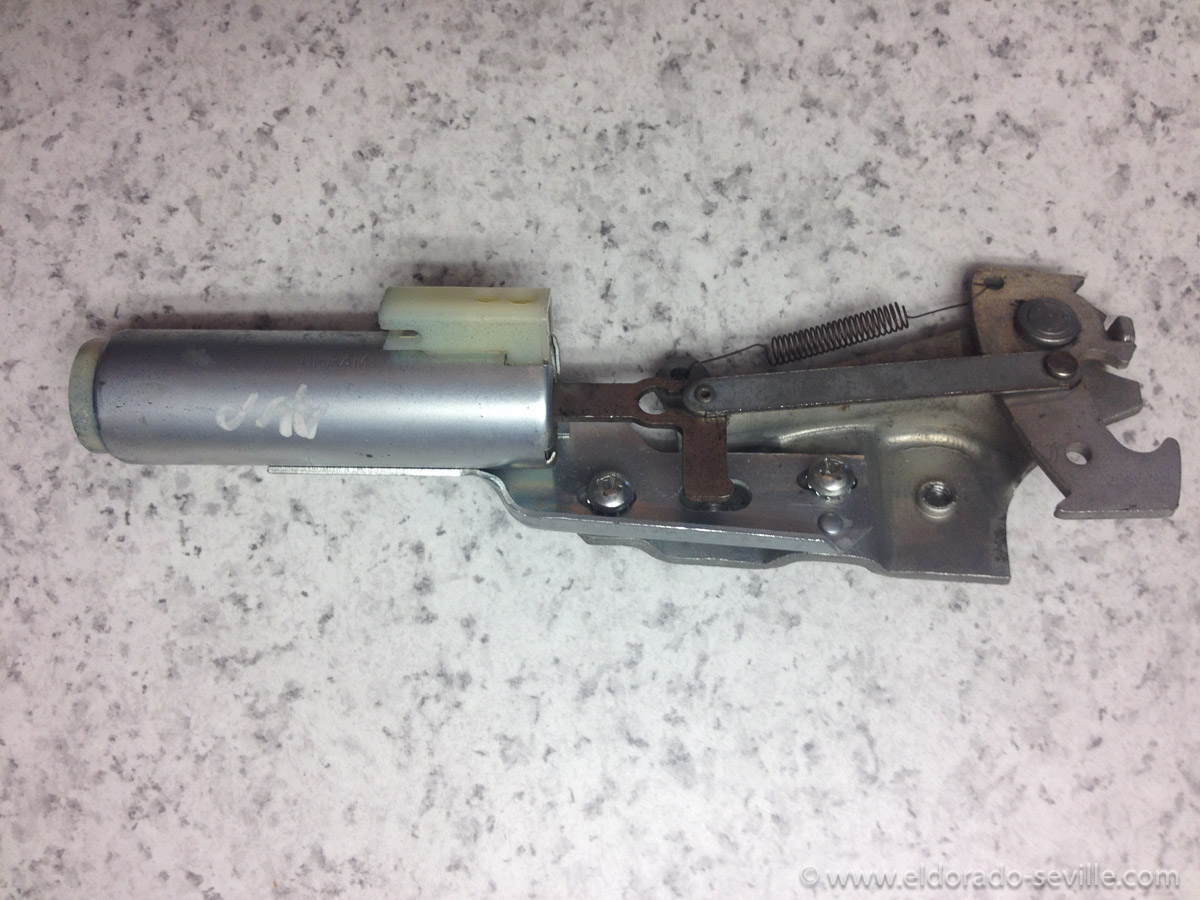
The clean mechanism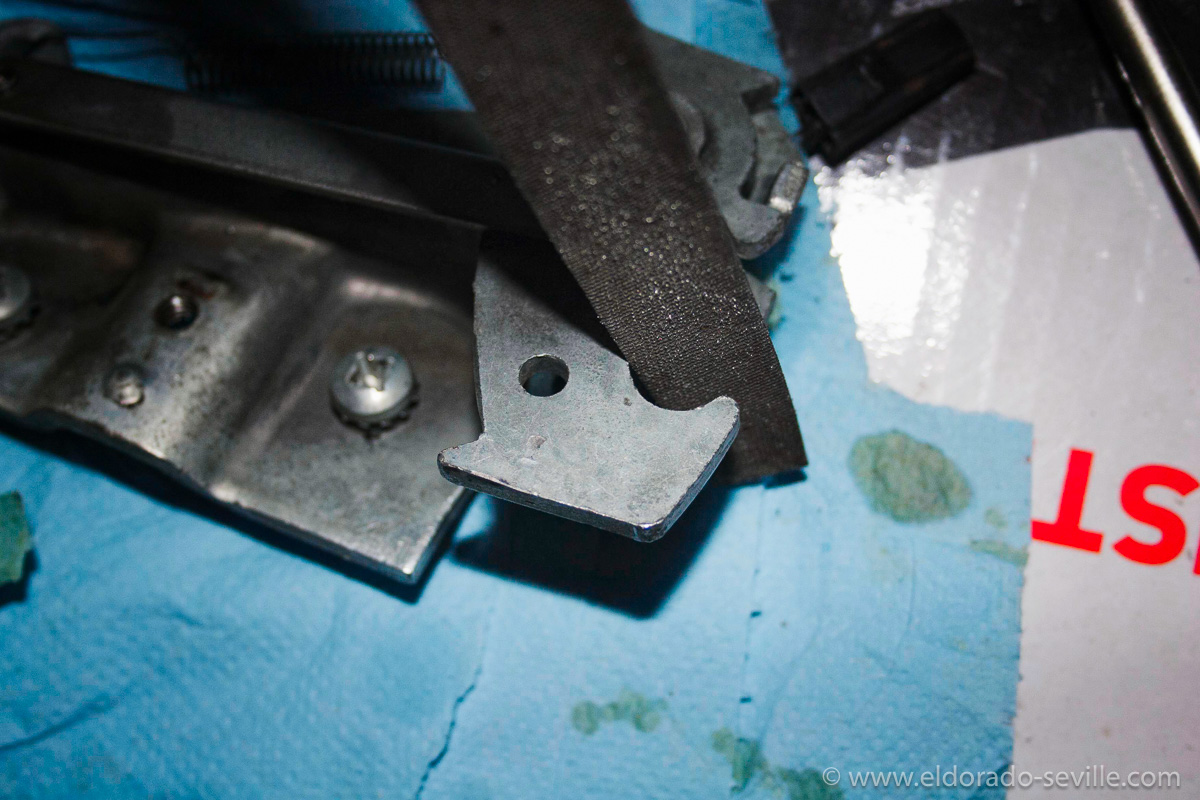
I had to file a little bit of material from the edge of the latch, so that it could move freely. They messed up the striker alignment on the seat in the factory.
THE ILLUMINATED ENTRY SYSTEM RELAY IN THE 1978 ELDORADO
It took me a while to find out what was going on, but eventually I could track it down to the illuminated entry system relay.
Sometimes the interior lights would not come on at all, as they should when the car was locked and I pushed the door button from the outside, or the lights would only flicker, and one could hear a relay making a ratcheting sound.
After a while it dawned on me that the illuminated entry relay must be faulty.
After browsing on ebay for months, I found an offer for an NOS relay, which is extremely hard to find and not available anywhere, as this system was an extra cost option in 1978.
After mailing back and forth with the very well informed and nice seller, I began trying to locate the relay in my car to compare it to the one he offered. Two different ones where used in 1978. They came from two different manufactures but were interchangeable. They have different terminal locations which do not matter though, as there were two different connectors used which you can connect to both models. The part number for the relay is #3063206 - it's the same for both models.
It took me a while to figure out where the relay was hiding, as the factory shop manual did not reveal its location.
I finally found it behind the drivers side kick panel. You have to remove quite a few of the interior panels and the door sills to get access to it. Another problem is that the kick panel is connected with the hood release lever and cable, which makes it very difficult to remove. Luckily I could spread it open wide enough to access the relay without removing the hood release cable, which would have been a pain in the butt to get out.
I removed the relay and compared it to the one I found on ebay, and it was identical to the one which was offered. So I hit the "BUY IT NOW" button immediately as I was concerned that somebody else could buy it.
I then opened the relay up. I wanted to take more pictures, but the battery of my phone died, and I had no other camera at hand - thats the reason why I unfortunately do not have more pictures of this repair.
Everything looked good inside, but then I found out why the relay did not work properly.
It should be mounted to the car with a screw which acts as the ground for the relay, which acts as a 20sec timer for the illuminated entry system.
But there was no screw on the relay… After further investigation I found a broken screw underneath the carpet, and the rest of the screw was stuck inside the screw hole.
It looks like the screw already broke off when the car was assembled and nobody cared as it might have worked for a while… Sometimes the system worked and sometimes it didn't… Probably the owners did not even notice the problem - it took me about a year to notice it as well…
I had a hard time getting the broken screw out of the hole, but after fiddling with it for about an hour, I got it loose and could screw it out. Luckily I had a spare screw and reinstalled the original relay with the new screw, and voila - it now works perfectly again. It probably never worked that good before - even when the car was new…
Too bad I had already ordered the new relay - but at least I have a spare NOS part now, which I will hopefully never need!
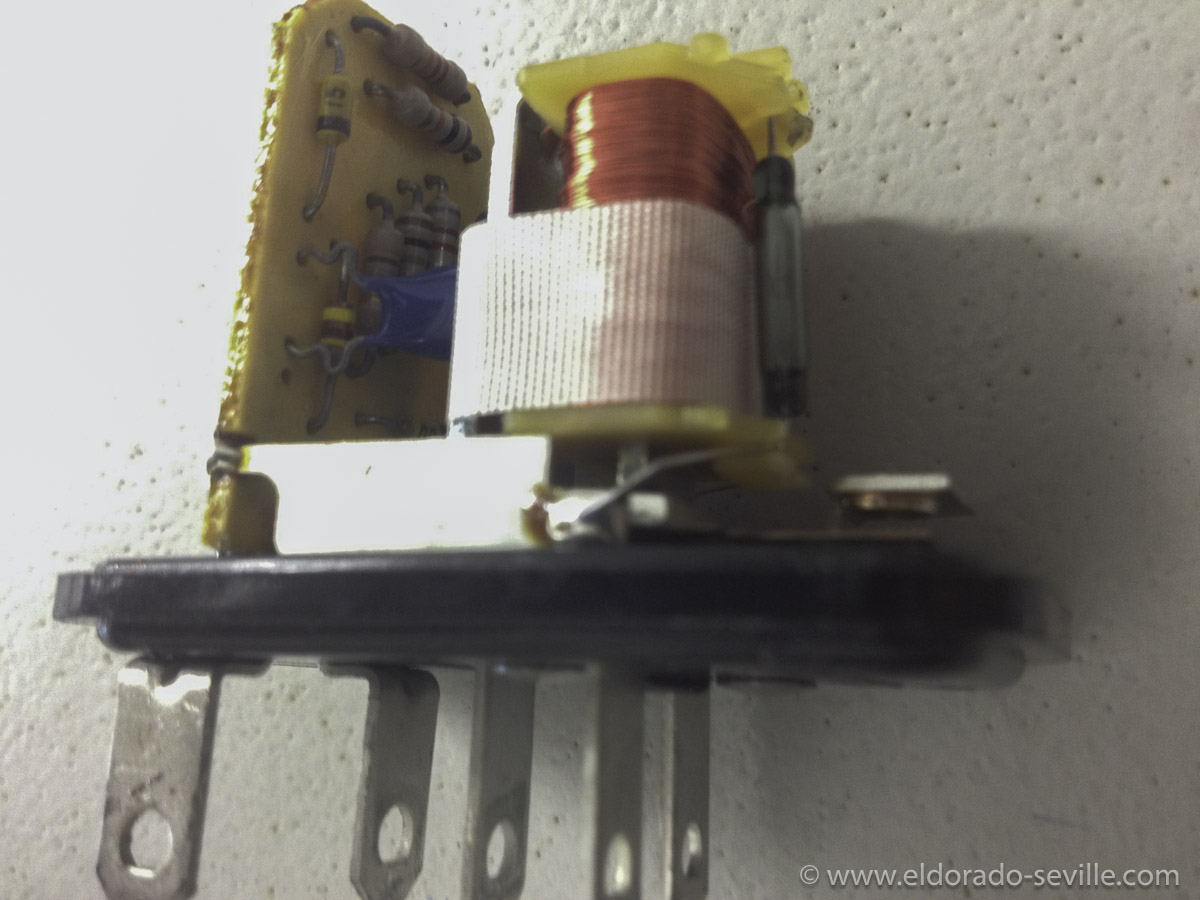
My original relay after I opened it up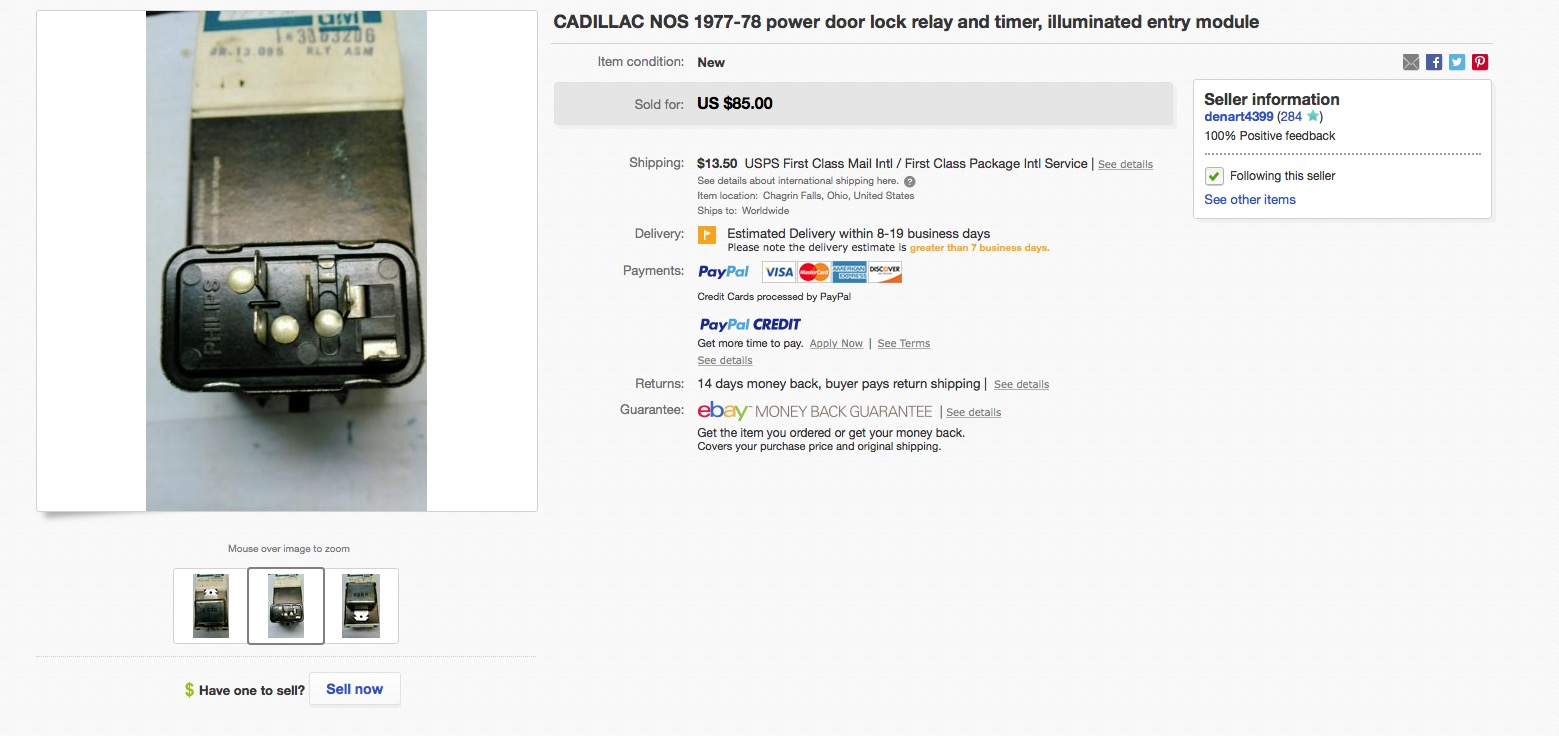
The NOS relay I found on ebay - part # 3063206 - its exactly the same one as I originally have in my car. It is made by Philips.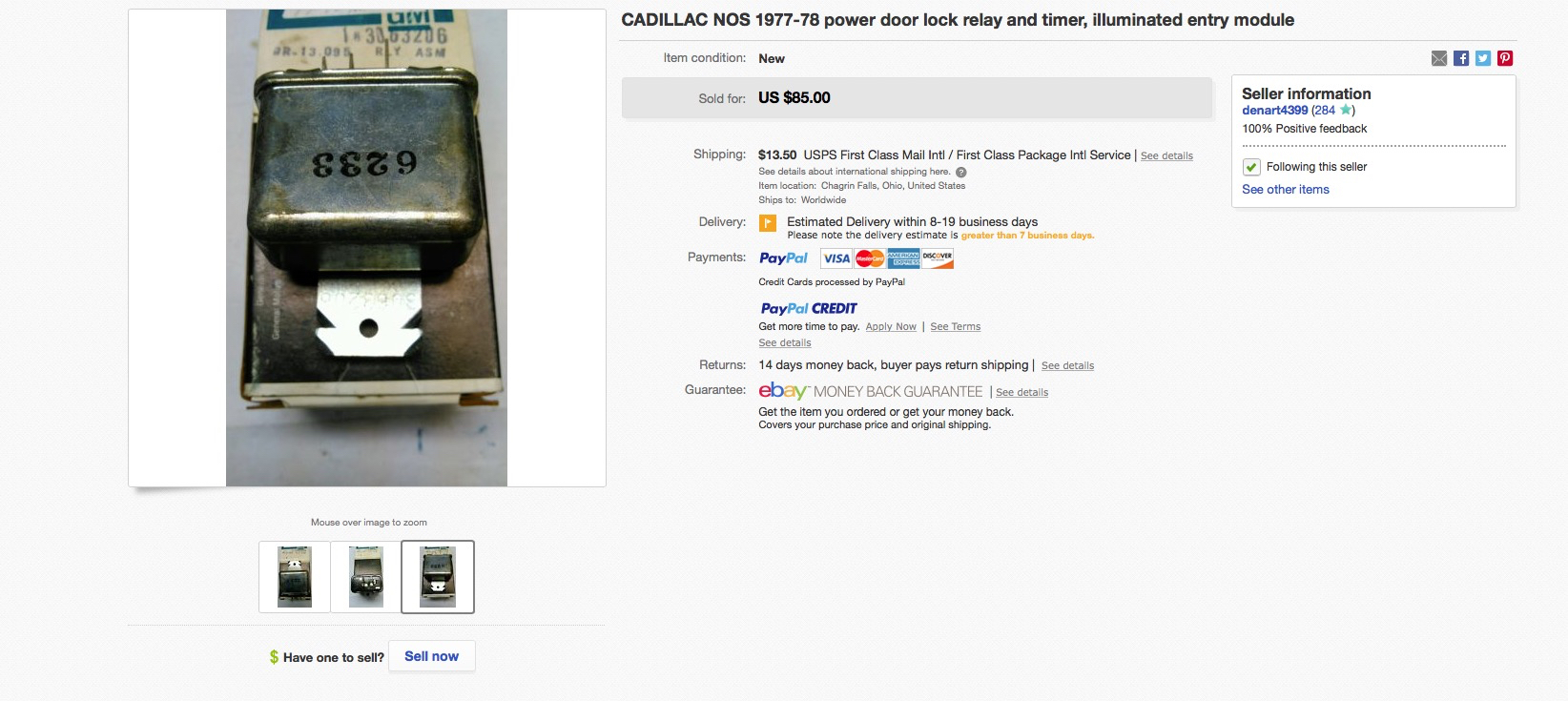
The NOS relay I found on ebay - part # 3063206 - exactly the same one I originally have in my car. It is made by Philips.
THE 1974 IS NOW STREET LEGAL IN AUSTRIA
This state inspection is very thorough, and they do test everything. Everything like the brakes, lights, horn, wipers and everything else has to work. They also check and test the complete suspension.
It's not allowed to have rust, and the car has to run as clean as possible to pass the smog test.
One of the major modifications that need to be done involves converting the lighting system of the car. Red directional lights are not allowed - amber blinkers are obligatory. The parking light has to be inside the headlight. T3 - sealed beams are not allowed - we have to have H4. We have to make room to be able to install license plate holders for our huge number plates, and the rear one has to be lit. So a lot of modifications have to be made - some of them are pretty major and involve the cars wiring of the tail lights.
For an originality freak like me, it hurts a lot to do these modifications, and I´m always doing them in a way that they could theoretically be undone and reverted back to original condition after the inspection… (only if it would be legal of course) So the most important goal is to do everything without destroying anything and not cutting any wires.
Together with my friends Lucky and Steve I spent a whole evening in the shop where my undercarriage project was still going on, to do all these necessary modifications to pass the inspection.
Steve is the electrical genius among my great Cadillac friends, and he found the perfect solution to pass the inspection without wire cutting involved. He also fabricated the illuminated license plate holders. My friend Lucky also helped a lot!
Thank you guys - it's an honor for me to have you as my friends.
On August 11 th the 74 passed the state inspection with flying colors. The inspector was extremely impressed by the condition of the car. He said that it looked better than a new car. He also could not find any technical flaws. Thank you to Mike Meier from Mikes Garage for helping me as well!
The car now has a registration as an "historic car", and I can finally legally drive it!
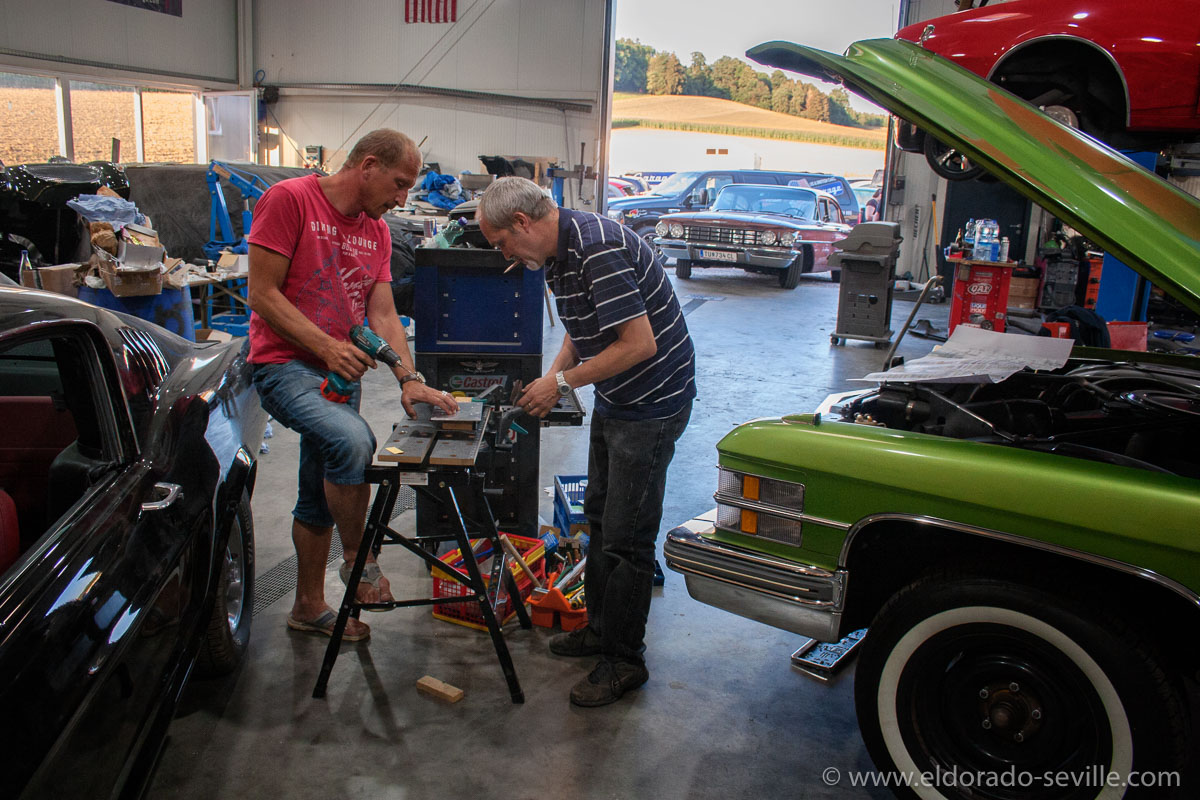
My friends Lucky and Steve at work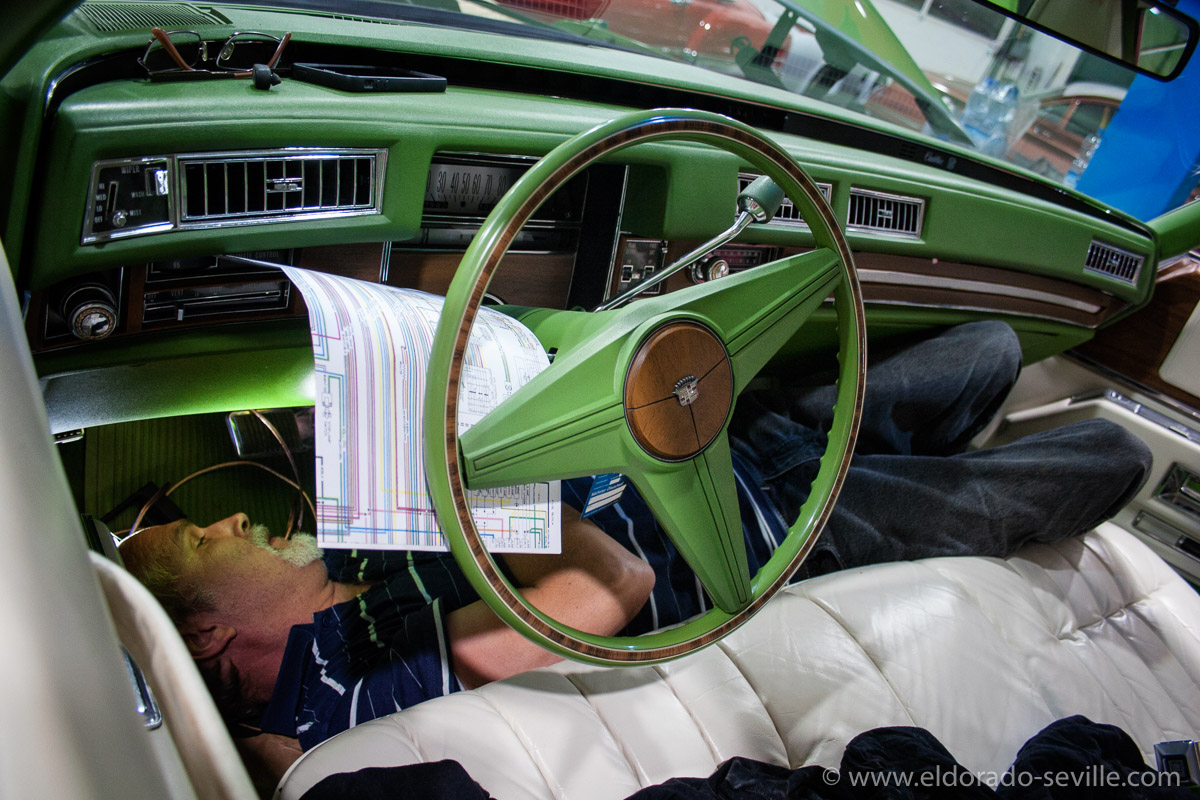
My friend Steve at work - working on the wiring for the rear blinkers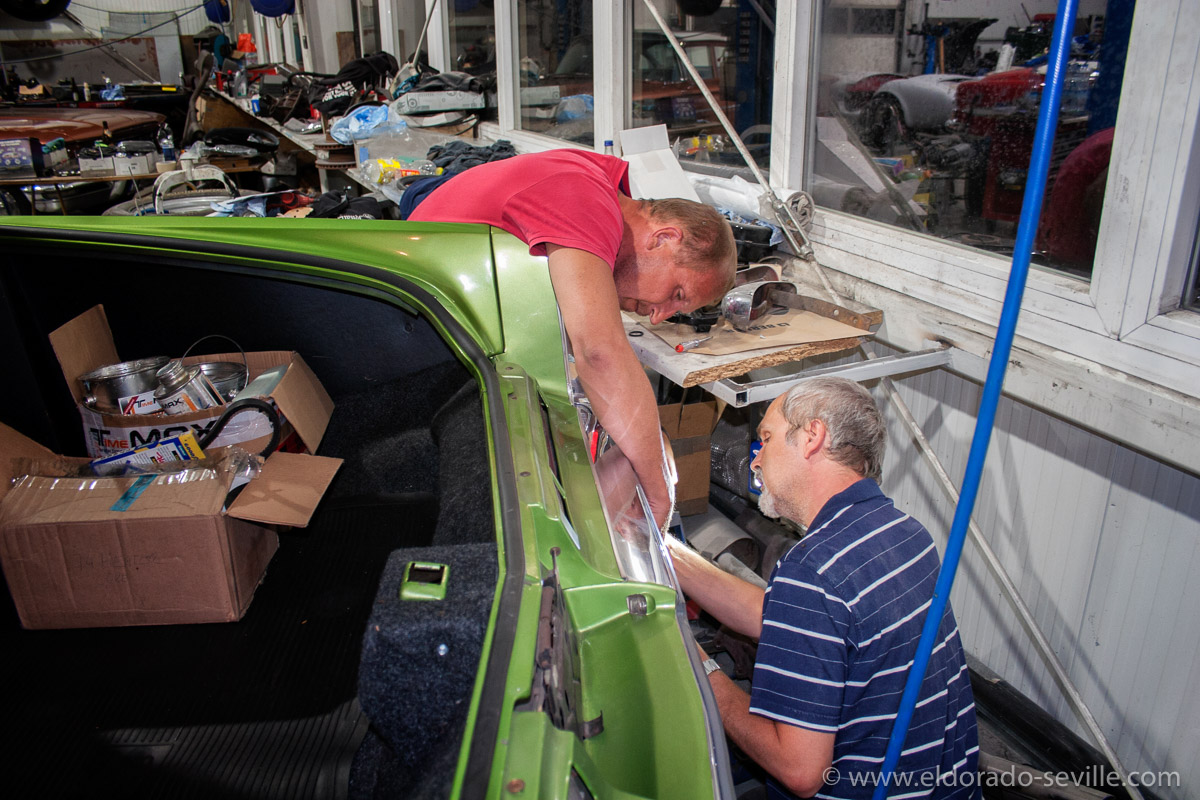
My friends Lucky and Steve at work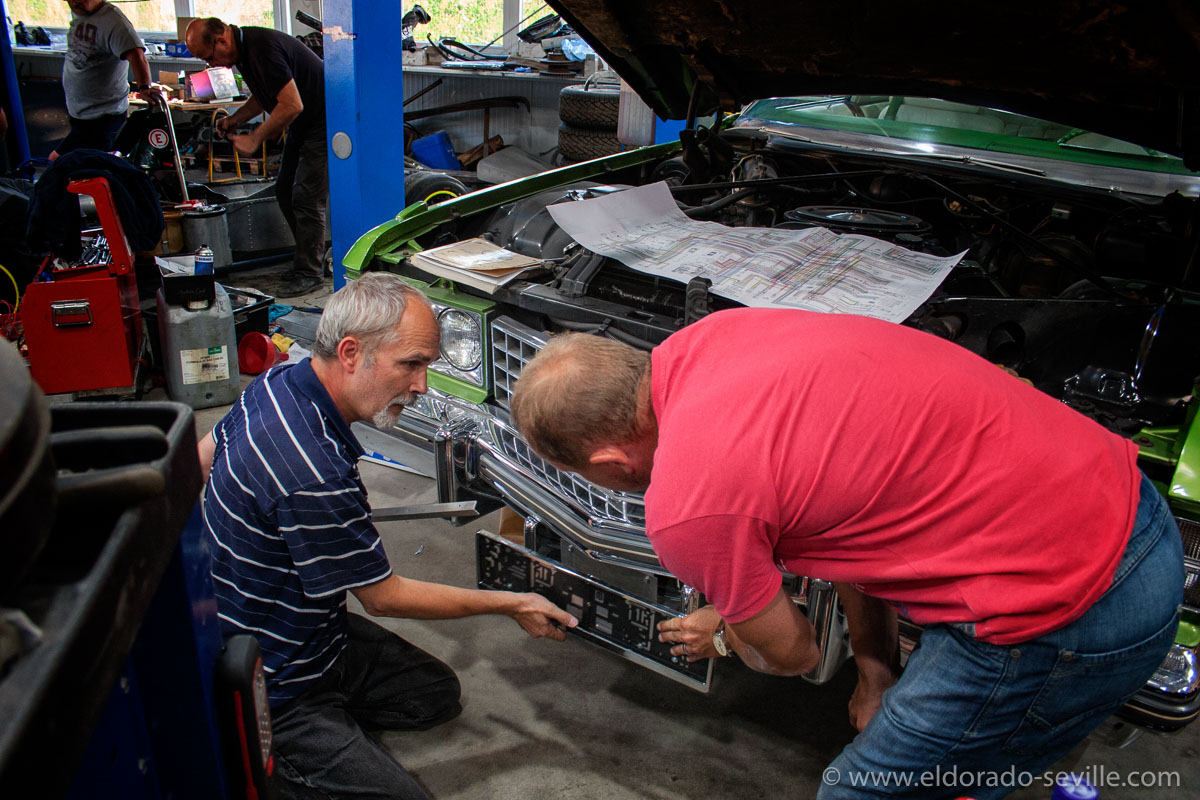
My friends Lucky and Steve at work. The car did not come with a front license plate holder - so Steve fabricated one for our huge Austrian plates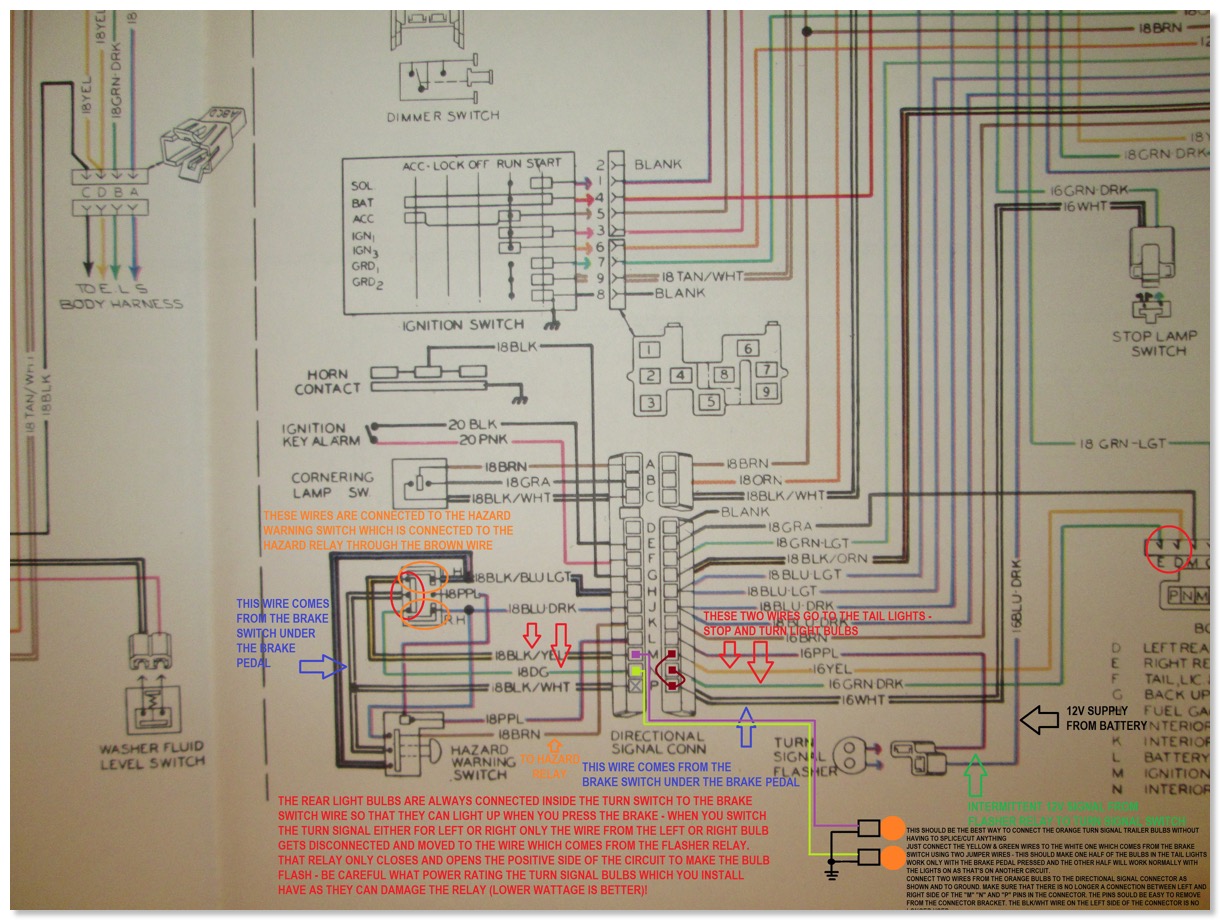
This is how we did the rear turn signal conversion on my 78 Eldorado - on the 74 its almost identical.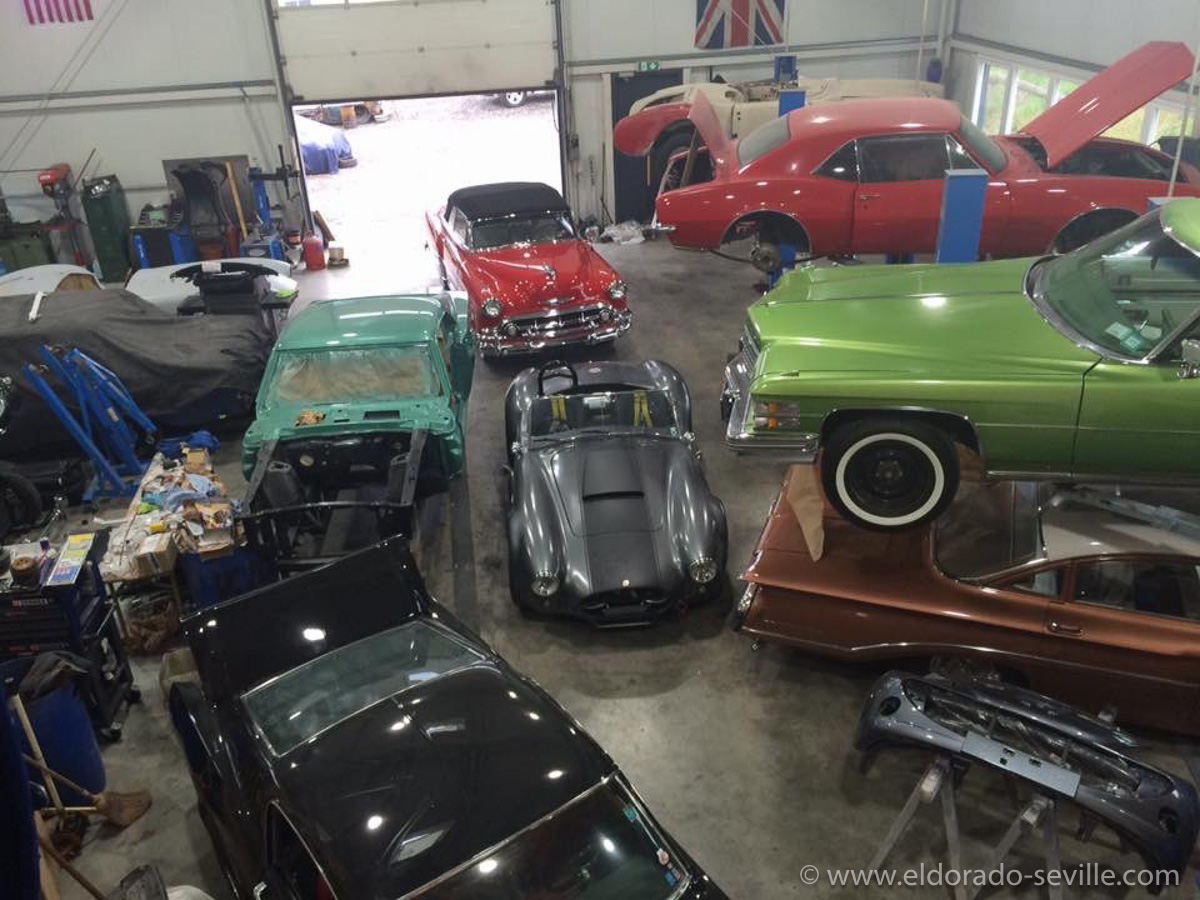
In Mikes Garage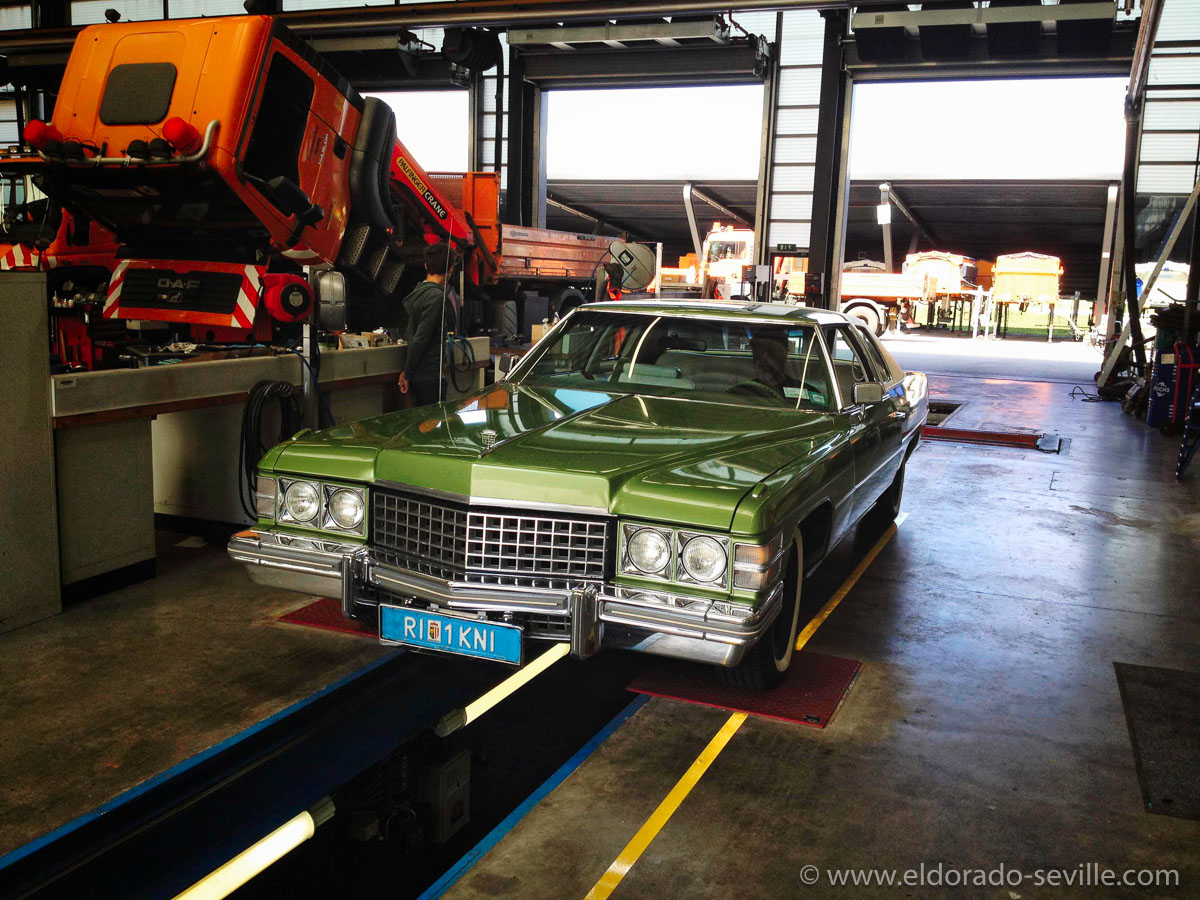
During the state inspection - here they are testing the front suspension on a moving plate.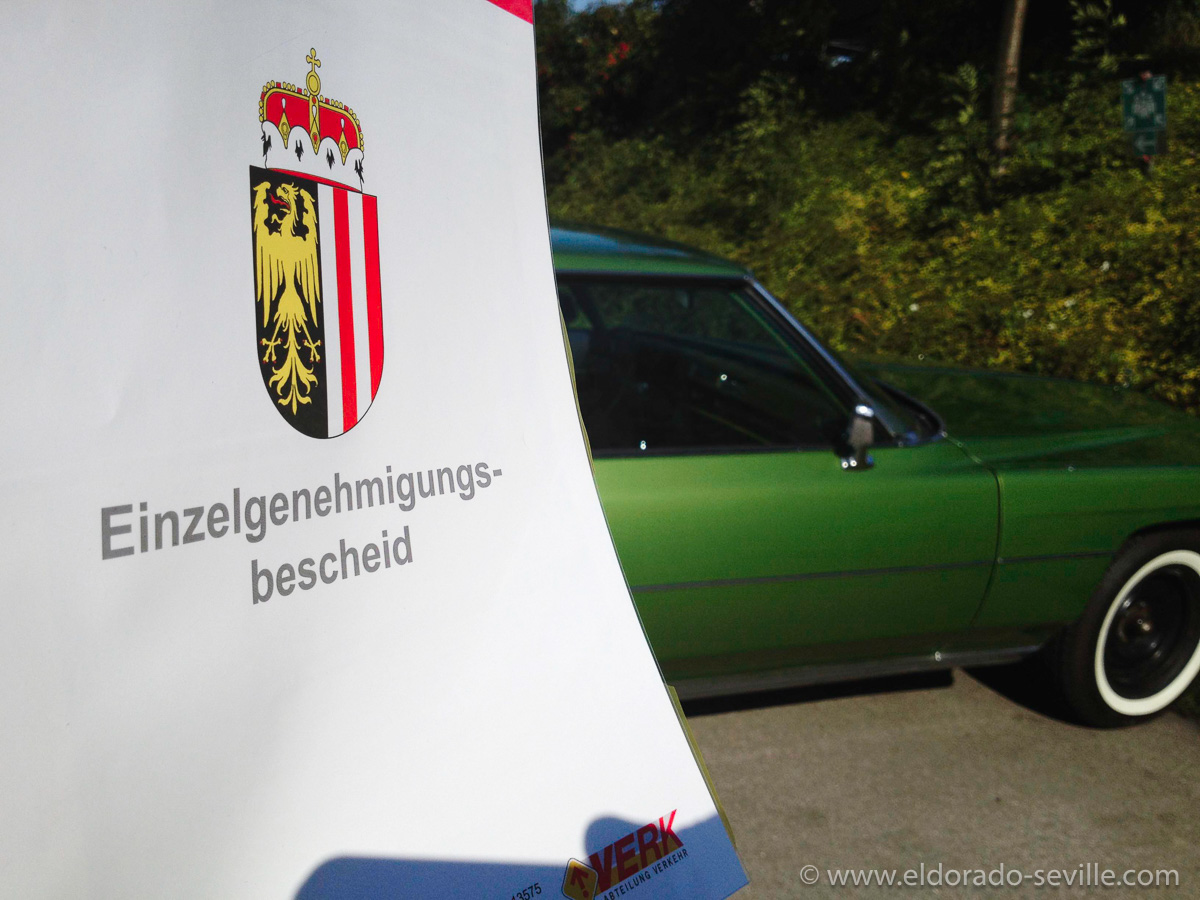
I now have all the necessary documents to drive the car.
THE 1974 UNDERCARRIAGE PROJECT IS FINISHED
I had some really bad luck with non sticking paint, undercoating reacting with the paint and shops not doing their job right…
The goal of this project was to remove all the surface rust, clean everything up and paint it in the correct colors again. For the ultimate, invisible protection I applied transparent undercoating from "Timemax" and transparent stone guard to the wheel housings. It was very important for me that the car looks as original and as perfect from the underside as the rest of it.
You can read reports about what I had to do by clicking here. You can also see all the restoration pictures in this gallery.
The undercarriage restoration project involved the following things:
- Removed some of the surface rust with rust remover gel.
- Had the undercarriage dry ice blasted and cleaned
- Removed all the surface rust with rust remover gel and liquid
- Cleaned the undercarriage with wire brush to strip bad paint down to bare metal
- Fully detailed the drive shaft
- Repainted the brake drums and fully detailed them with original factory markings.
- Had the rust free undercarriage painted in a paint shop in original black and brown with epoxy paints.
- Had the edges of the lower body parts painted as well in Persian Lime
- Found out that the new paint on undercarriage did not stick…
- Removed all the paint again with sandblasting and dry ice cleaning
- Repainted the undercarriage in the correct colors once again in the paint shop
- Applied transparent undercoating
- Applied transparent stone guard to wheel-housings
- The stone guard coating reacted with paint underneath
- Had another shop remove the paint from the wheel-housings again, as I did not want to do it myself for another time.
- This shop repainted the wheel housings and coated them with transparent undercoating and stone guard once again.
- I was not satisfied with their work so they had to re-do it.
- They sandblasted the wheel housings once again to get everything off to bare metal to be able to start all over once again.
- The restoration shop repainted the wheel housings and coated them with transparent undercoating and stone guard for the third time.
- I finally was satisfied with their work and took over again to detail all the splash guards and put everything back together.
- De-rusted the inner sides of the fender skirts and repainted them.
Other things I did on the 74 during this project:
- Repaired seat back release (3 times)
- Repaired the transmission shift dial indicator which was stuck in “L“ position.
- Replaced some of the plastic headlight adjusting parts which were broken.
- Fabricated license plate holders for Austrian plates.
- Repaired front ashtray mechanism which was stuck.
- Fixed loose left outer rear view mirror.
- Fixed a hole in the exhaust. (Temporary fix before I will replace the still original system which was installed in 1974)
- Replaced numerous burnt bulbs inside and outside of the car.
- Replaced AC compressor as bearing and clutch was shot.
- Repaired clock .
- Repaired radio.
- Replaced all speakers.
- Replaced heater core.
- Replaced front center bumper ends.
- Adjusted grill which was misaligned by the factory.
- Restored battery tray.
- Adjusted doors as they did not close well.
- Repaired door striker on passenger side.
- Replaced door bumper rubber.
- Installed new reproduction - correct heater hoses.
- Flushed cooling system.
- Changed oil.
- Changed shocks front and back.
- Changed stabilizer link and rubber.
- Replaced incorrect lug nuts.
- Changed lighting system to Austrian standards to get it road legal for the inspection.
- Replaced hood ornament.
- Replaced panel in dash.
- Sandblasted and repainted valve covers.
- Repaired washer fluid sensor.
- Replaced antenna.
- Fully detailed the paint and interior.
- Polished the windshield with glass polish.
- Painted oil pans.
- Painted fuel tank.
- Touched up some small stone chips
- Perfectly removed dents on the roof which happened during shipping of the car from the USA to Europe
- Tuned carburetor to factory specs
I´m sure that I have already forgotten some details - unfortunately I often forgot to take pictures, so I cant document everything with pictures…
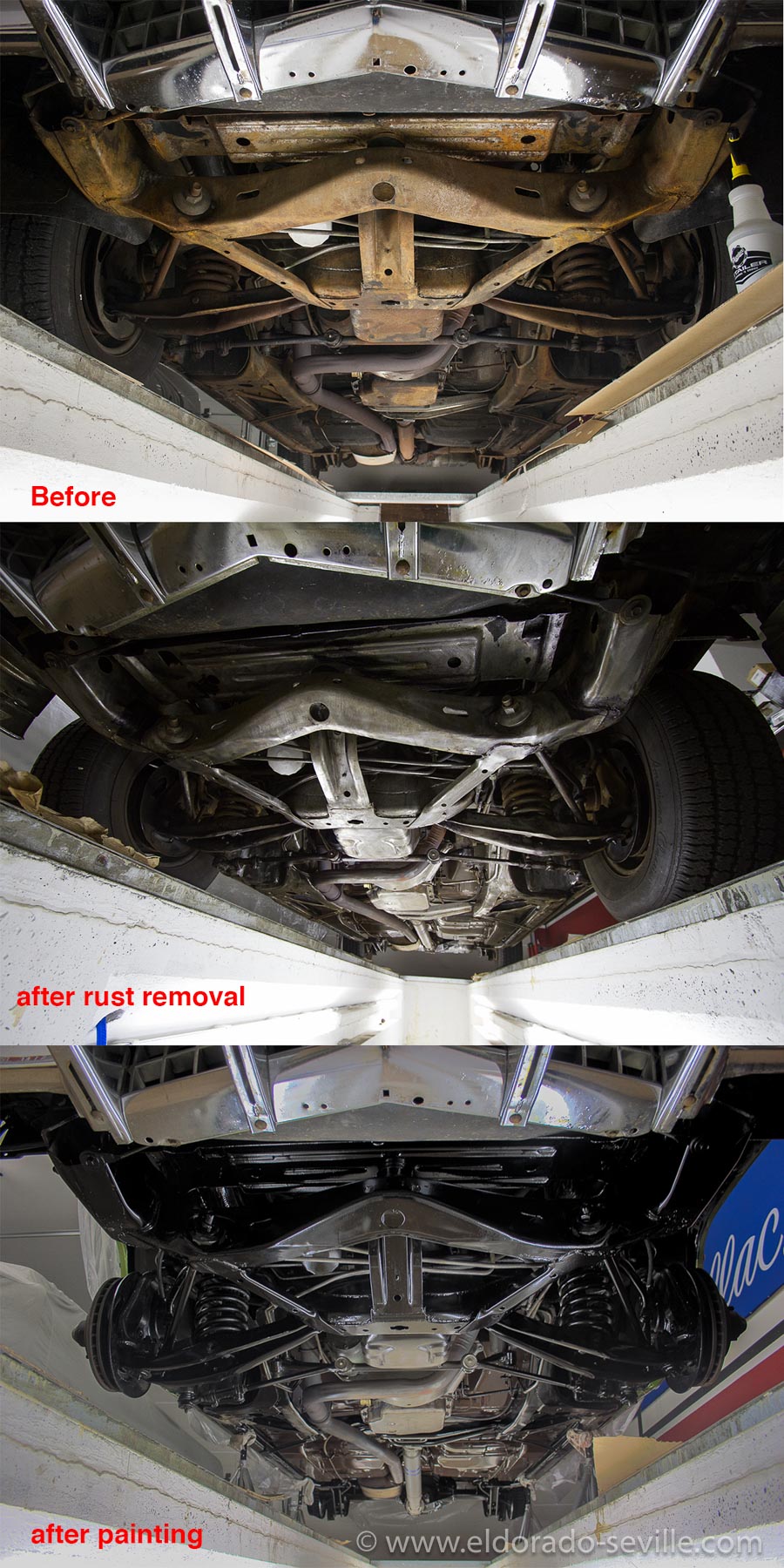
The various stages of this project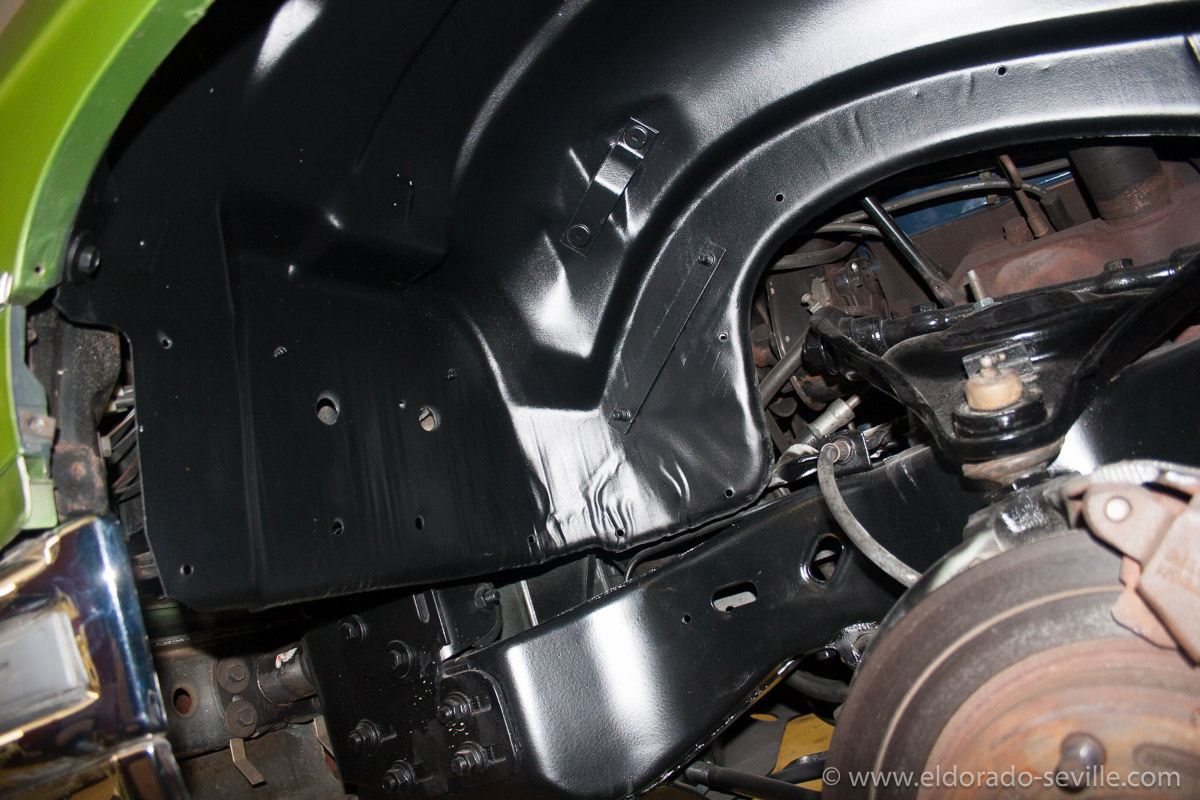
The re-painted wheelhousings. There are a few coats of "Timemax transparent undercoating" and "Timemax Body transparent" - a stone guard applied to protect the paint underneath.This stuff is great and also almost invisible.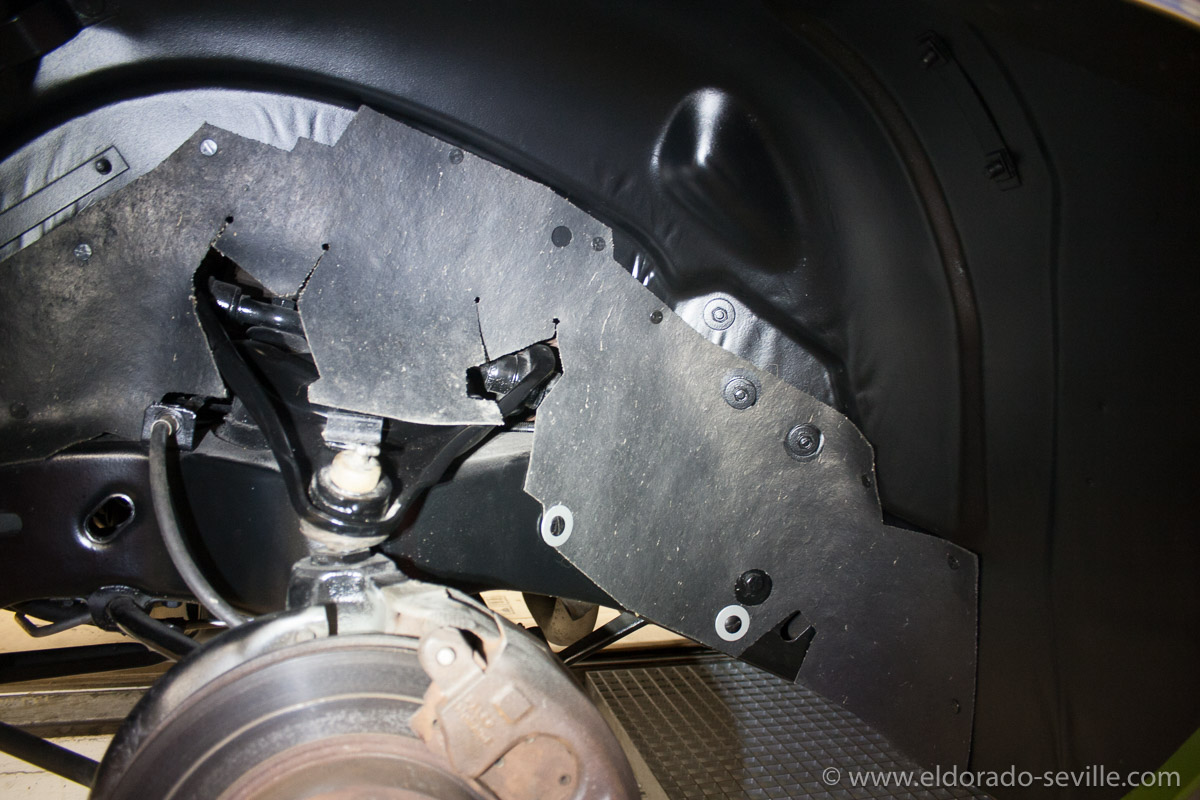
The re-painted wheelhousings. There are a few coats of "Timemax transparent undercoating" and "Timemax Body transparent" - a stone guard applied to protect the paint underneath.This stuff is great and also almost invisible. You can also see the detailed splash guards back in place.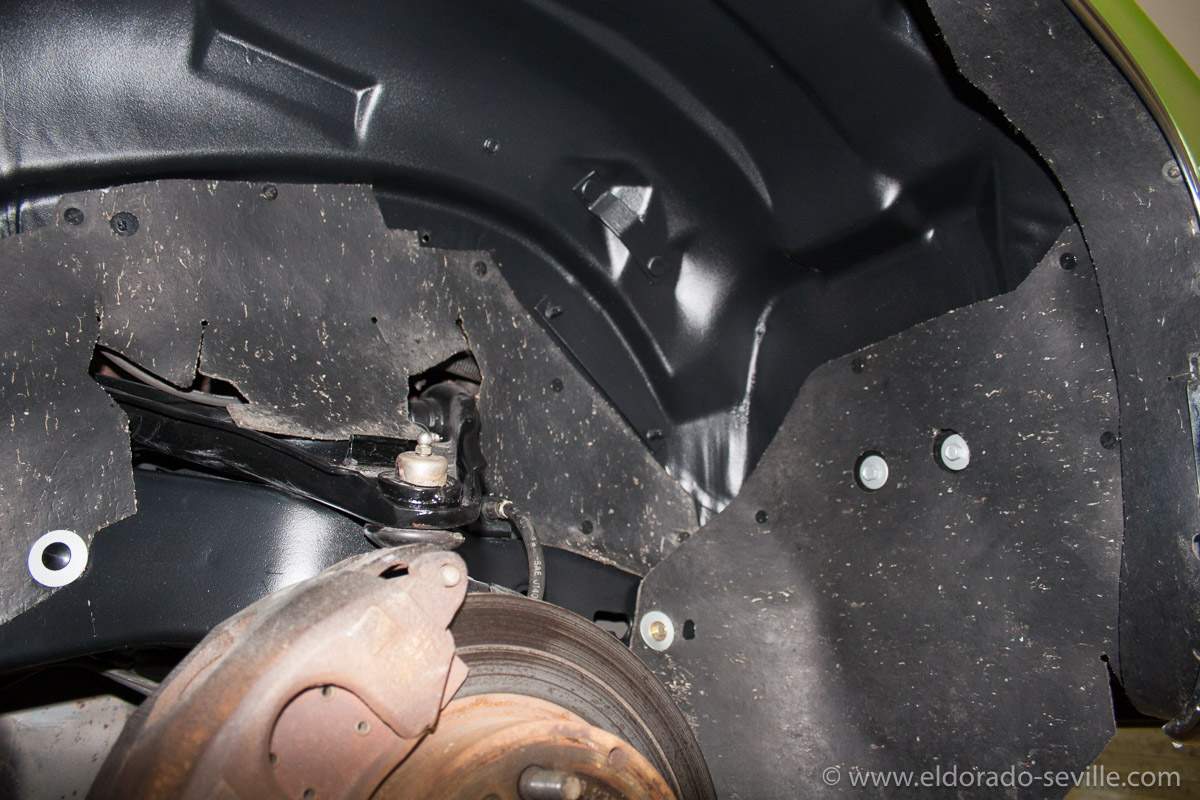
The re-painted wheelhousings. There are a few coats of "Timemax transparent undercoating" and "Timemax Body transparent" - a stone guard applied to protect the paint underneath.This stuff is great and also almost invisible. You can also see the detailed splash guards back in place.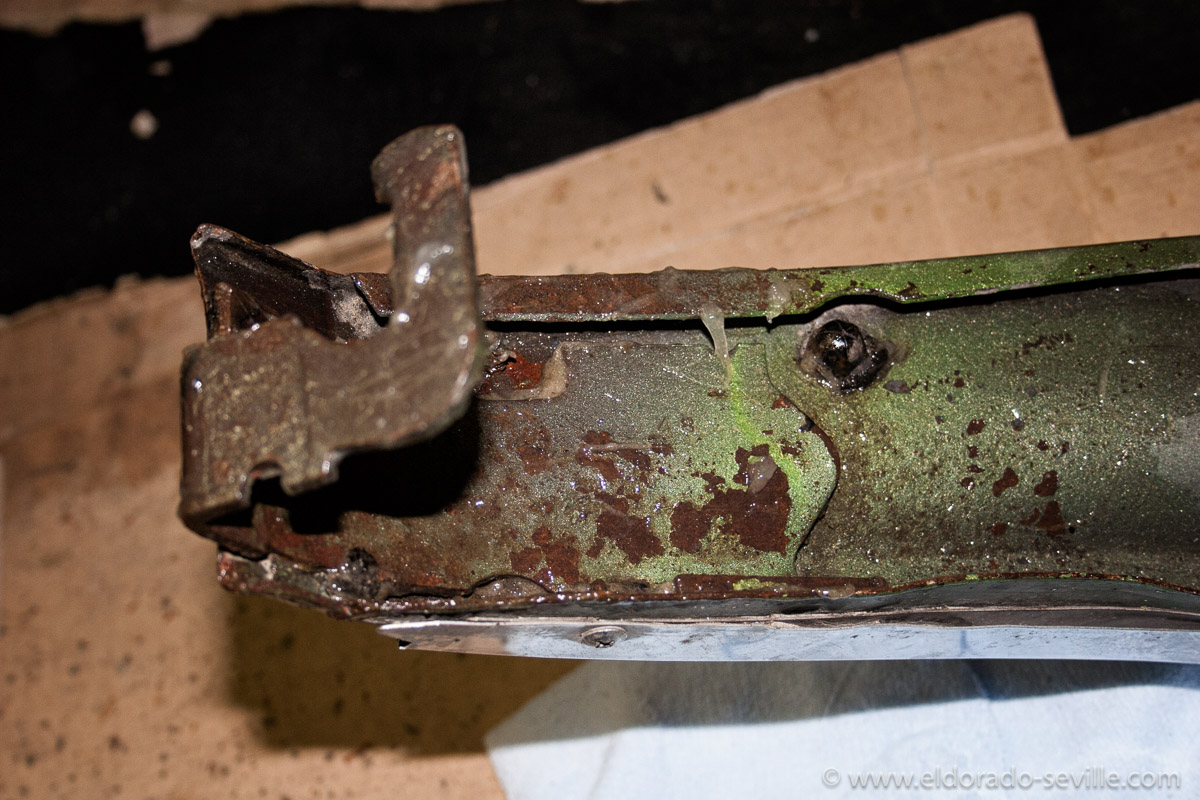
I removed all the rust inside the fender skirts as well and painted them afterwards to protect them. I also undercoated them with transparent undercoating as well.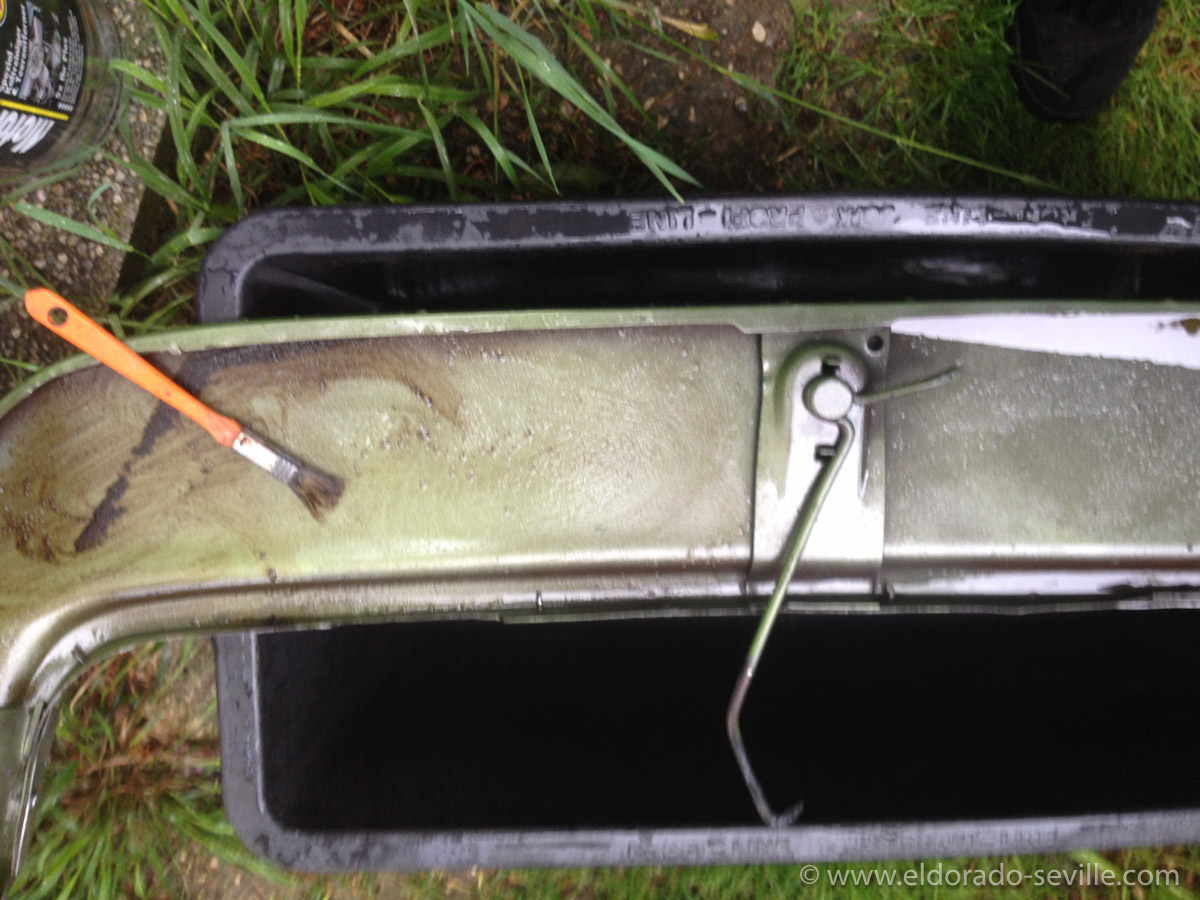
I used tar remover to clean the inside of the fender skirts which still had some factory applied undercoating on them.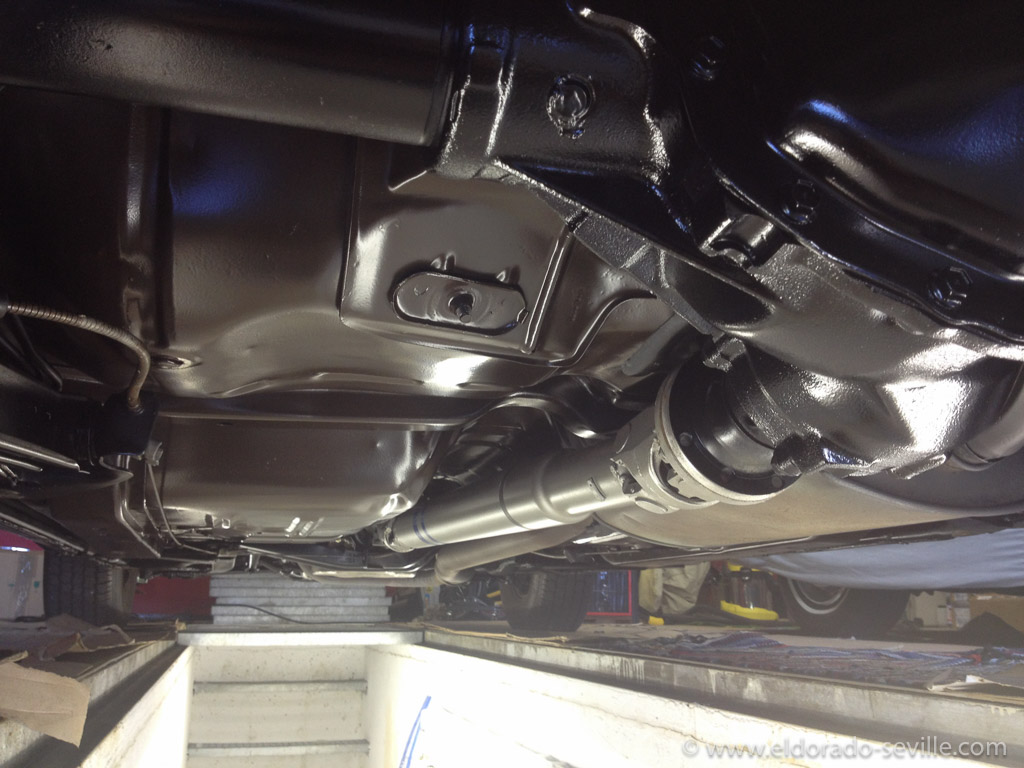
This is how the rest of the underside of my 74 is looking now. I painted everything in the correct colors and protected it with transparent undercoating afterwards.
FIXING A LEAKING VALVE COVER ON MY 1967 DEVILLE
The gasket was replaced a couple of times since I own the car, but it never was very successful in stoping the leakage.
After my last attempt it leaked even more than before…
The valve cover design of the 429 engine is not exactly the best from a technical standpoint. It's only held in place by 4 screws.
I did some research and tried a different approach this time to seal it.
First I used a different valve cover from a spare engine I have in my garage which did not show any signs of leakage.
I had to fully detail it first to make it look perfect. I repainted it with Bill Hirsch Engine enamel in the correct color.
I made sure that everything was flat as these cover often get warped at the bolt holes by over tightening them.
They checked out flat. I then glued the new cork gasket (I used a Fel-Pro gasket) to the valve cover with high temp gasket sealer. To make sure that it stayed where it belongs to I used a lot of cloth pins to keep the gasket in place.
I let it dry over night.
The next day I put some wheel bearing grease to the other side of the gasket and put it back on the heads. The grease helps to make sure that you can remove the gasket any time again.
I then tightened the four bolts to 28 INCH/Pounds of torque as specified by the shop manual. (thats 3,1 NM) I had to buy a small torque wrench for such a small torque rating first… I could have never guessed how much torque it is.
I then ran the engine and let it cool down and re-torqued the bolts afterwards.
After the first 25 miles test drive it seems that the valve cover is 100% leak free for the first time since I own this car.
I´m not sure what fixed it this time, but during my research I read multiple times, that for cork gaskets one should not use gasket sealer on the head side of the gasket, and one should only use grease instead. Some recommend that gasket adhesive (spray) should be used to keep the gasket in place in the valve cover.
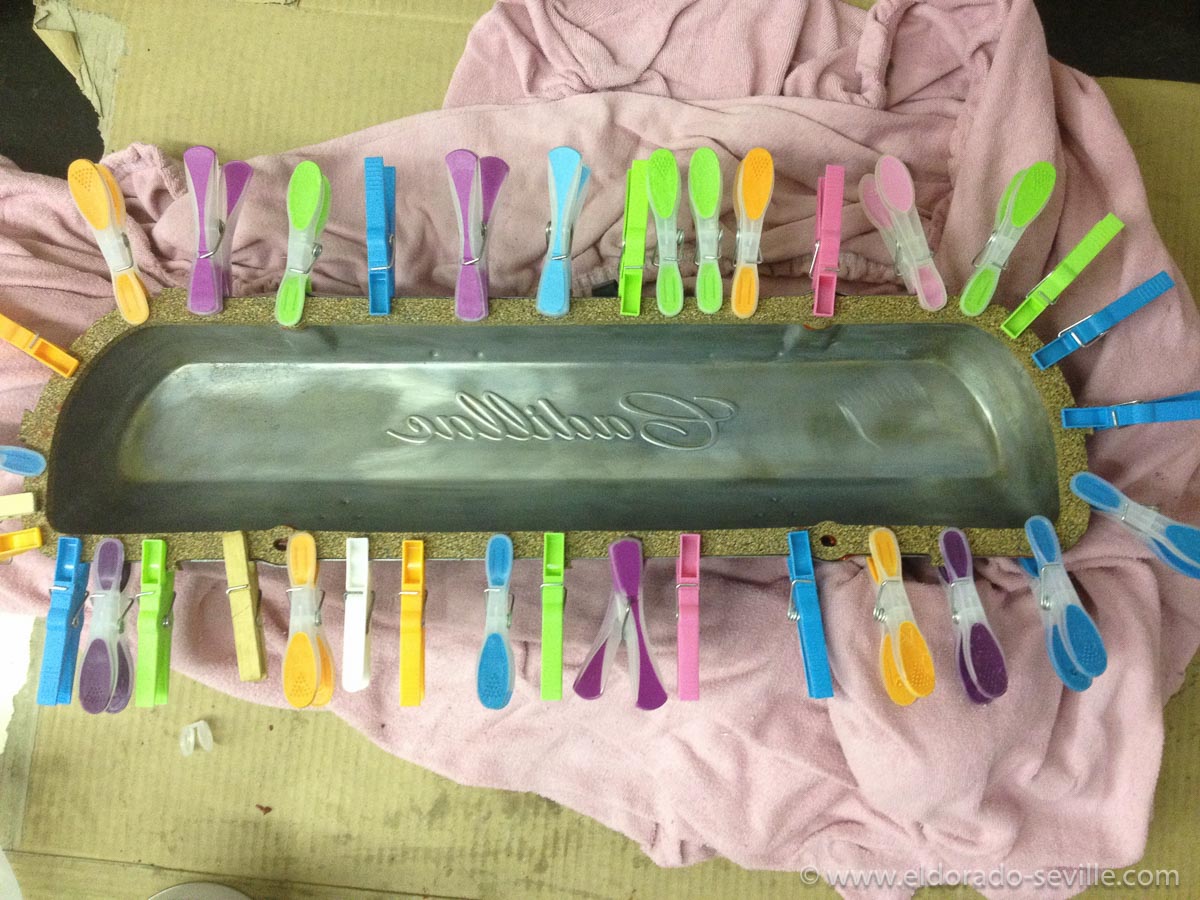
I know it looks very strange, but I used cloth pins to make sure that the gasket is glued to the valve cover properly…
THE 1967 WATERPUMP PROJECT IS COMING TO AN END - DETAILING THE AC COMPRESSOR AND A LEAKING VALVE COVER
The project had a major delay as the reproduction radiator hoses were held by customs for 5 weeks. Its unbelievable…
I could now finally refill the cooling system and start the car again with the new water pump in place.
The car fired right up although I had also removed the distributor and forgot to mark how it was in. So I had to find TDC (top dead center) before I could install the distributor back into the car.
I also bought a cheap timing light and set the timing to 5 degrees. You have to set idling to 480 rpm, disconnect the vacuum hose to the distributor and the parking brake and plug the hoses to set timing correctly
After the first few miles I am quite satisfied with my work. I hope that everything will stay like this and that no leaks will show up.
Only the right valve cover where I had replaced the gasket seemed to have a slight leak with oil dropping on the exhaust manifold... Looks like I will have to take the compressor out again to be able to take the valve cover off again and install another new gasket… But first I will have to find out why it is actually leaking. I hope that the cover itself is not warped as it was already leaking before on exactly the same spot. Often these covers get tightened down too much. All it needs is 28 INCH pounds of torque (3,1 NM) I will also make sure the screw holes have not become dished (usually due to over-tightening of the screws). Use a small block of wood as an anvil and a small hammer to flatten the screw holes back out.
The engine somehow runs and idles better than before and has more power. It seems like the ignition was off before. I had the car tuned by a professional years ago - another thing they did not get right...
The new reproduction hoses I got from Fusik are also in place with the correct tower hose clamps. The hoses have the correct numbers stamped on, but compared to my original hoses the stamping looks different where the numbers are much smaller. The hoses fit very well, only the lower radiator hose had to be cut a little to fit.
I also detailed the replacement AC compressor I installed years ago. I bought a new reproduction decal which is a very good match to the original decal. In general I found out that all the reproduction decals available out there are not a 100% match. They look very similar but they all differ in size, spacing of the numbers, and most of the time the font used is very similar, but not exactly the same. I have no idea why the manufactures did not get it 100% right. Maybe I will have to produce my own decals in the future… Most of the AC compressor labels you can buy are incorrect for the year or model they are offered. If you want to get the correct one for the 67 Deville you will have to buy the one for the 67 Eldorado. Often these reproduction decals have the wrong colors, numbers and R12 capacity on them. So do your research to get the correct one.
Another challenge was to reproduce the O.K. inspection stamp. Years ago I found the stamp on ebay and experimented with different kinds of paint and never got any useable results.
Eventually I found a stamp kit set for Corvettes which included the correct yellow paint and a stamp felt and the Corvette stamp. I could not use the Corvette stamp of course, but the rest of the kit is perfect and finally I could apply the stamp to my AC compressor which now looks factory new again.
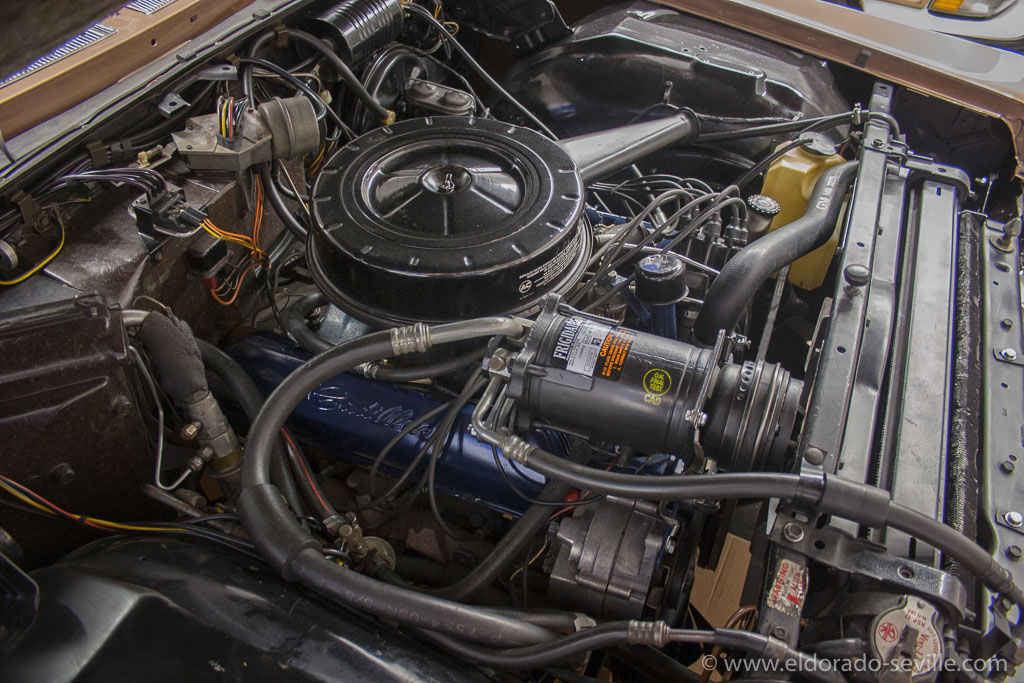
The engine is back together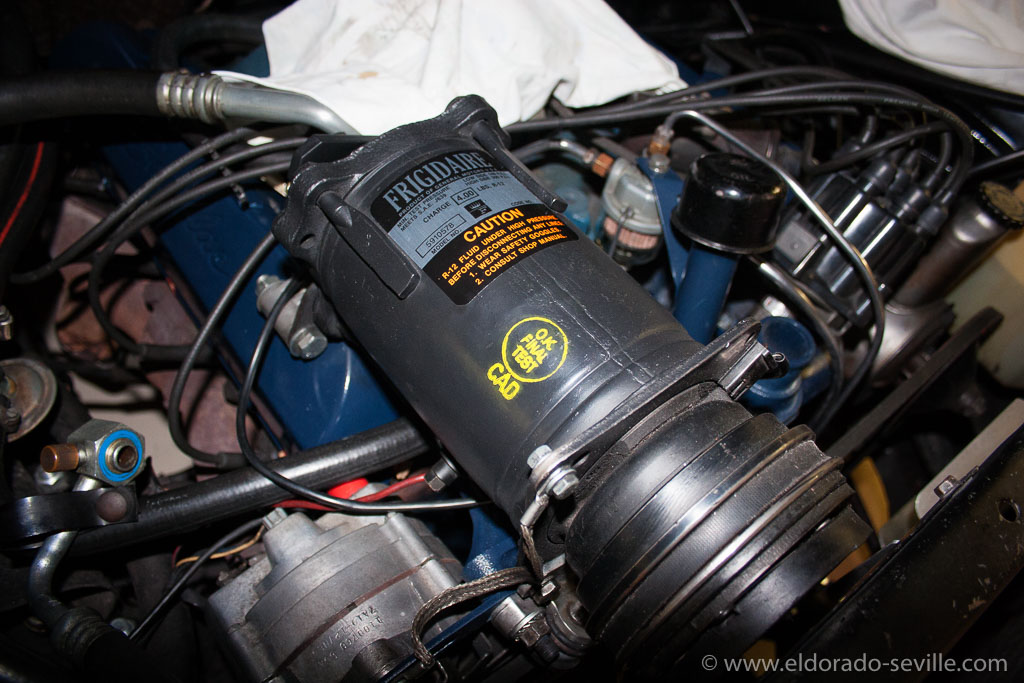
The detailed AC compressor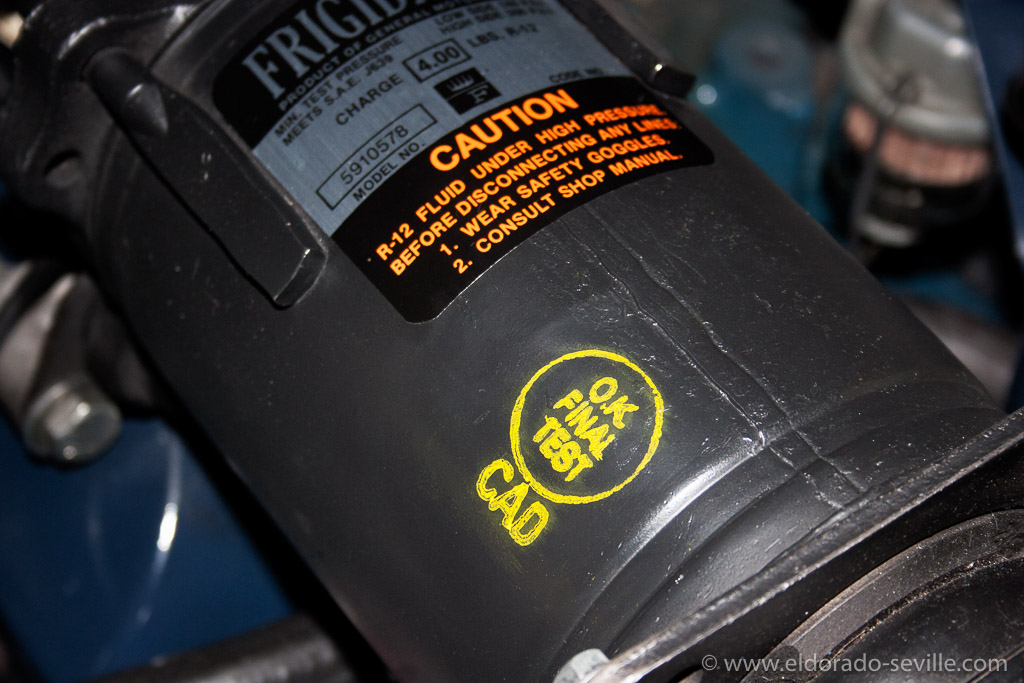
The O.K: final test stamp
A NEW WATER PUMP FOR THE 67 DEVILLE AND DETAILING THE ENGINE
So I ordered a new, high quality rebuilt water pump from one of my favorite sources. When I got it, I found out that it was one for a 64/65 Cadillac with an additional water outlet. This seems to be the type everybody is selling nowadays and it is much more common. It will fit the 1967 429 engine and it even has the additional water outlet pre-plugged with a rubber plug. The problem I had with it, is that it looks completely incorrect on the 1967 Cadillac, and so it was not acceptable for me.
I then found a very good source for Cadillac parts. They are priced higher than other outlets (if you can even find this parts anywhere else..), but David - the owner - offers only 100% correct and high quality parts. He also has a huge collection of NOS parts. I found some parts through him that I did not find anywhere else. His customer service is excellent as well - I can highly recommend him.
Until around 2009 I had most work on my cars performed by a restoration shop specialized in American Cars. Then I decided to no longer go there for a lot of reasons. With the growing numbers of cars I collected, I could no longer afford to pay somebody to have all the work done, and I no longer accepted to pay good money for lousy work and bear the shop owners terrible attitude against his clients.
Now that I´m trying to do everything by myself, I found a lot of bad work the professionals did, and sometimes I´m really shocked to see what I wasted my money for, but I had no idea about cars and they could have told me everything and I would have believed them…. Lots of work they did leaves a lot to be desired, and you can see some examples in the pictures below…
When they repainted parts of my 67 Deville´s engine, they used the completely incorrect Cadillac blue, which was used from 1977 on. I always hated it, and now that I had to disassemble so much to replace the water pump they did in 2001, I decided to paint everything correctly.
I detailed all the parts I took off and had them media blasted. After they were cleaned, I painted them with the correct shade of Cadillac Blue. Bill Hirsch engine enamel is the best and most correct engine enamel for Cadillacs. You can see lots of pictures below which document what I did. Besides the incorrect paint I found out that fuel lines were damaged, bolts were missing or broken off and many other small flaws which I corrected now.
I´m now waiting for the correct upper and lower radiator hoses to arrive, which are reproduced by Fusick, to replace the still original hoses from 1967! The originals still look great and would probably last for a long time, but I do not want to take any chances… I am now hoping that nothing is leaking and that I wont have to re-do any of the work.
When I took the radiator out, the overflow tube came loose. I already had the same problem years ago, and it was not fixed properly by the restoration shop… Luckily I found an old gentleman locally, who could brace it back together the old school way. I will of course detail the radiator as well before installing it back into the car.
This is a short video which shows the problem I had with the water pump and the bad bearing. You can clearly see the wobbling of the shaft and hear the shot bearing.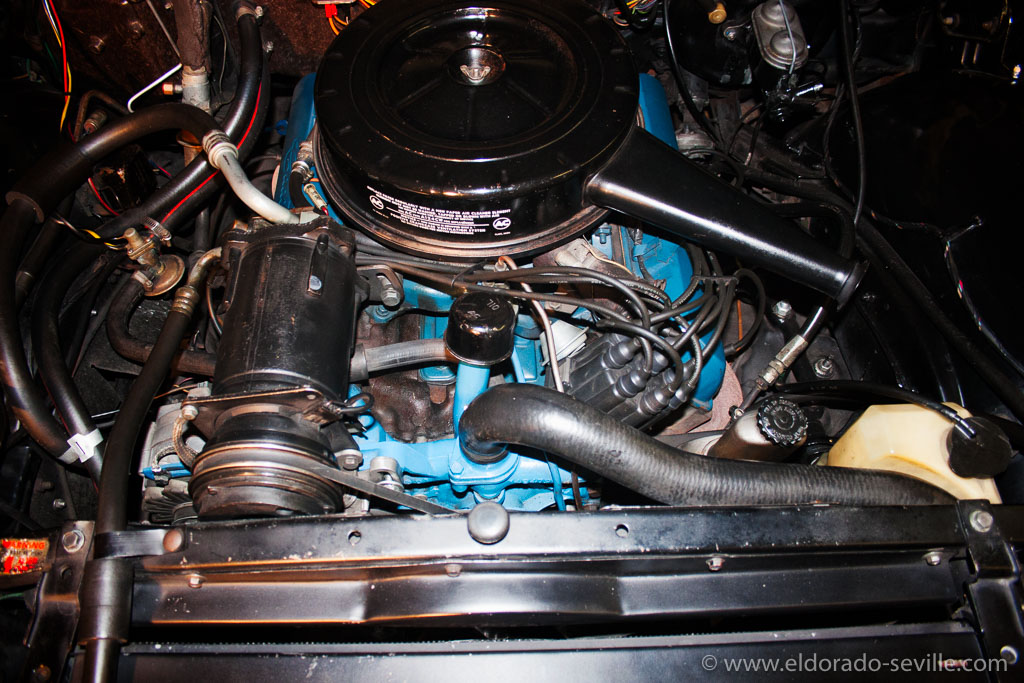
This is how the engine bay looked like before, with everything painted in the incorrect later Cadilllac Blue...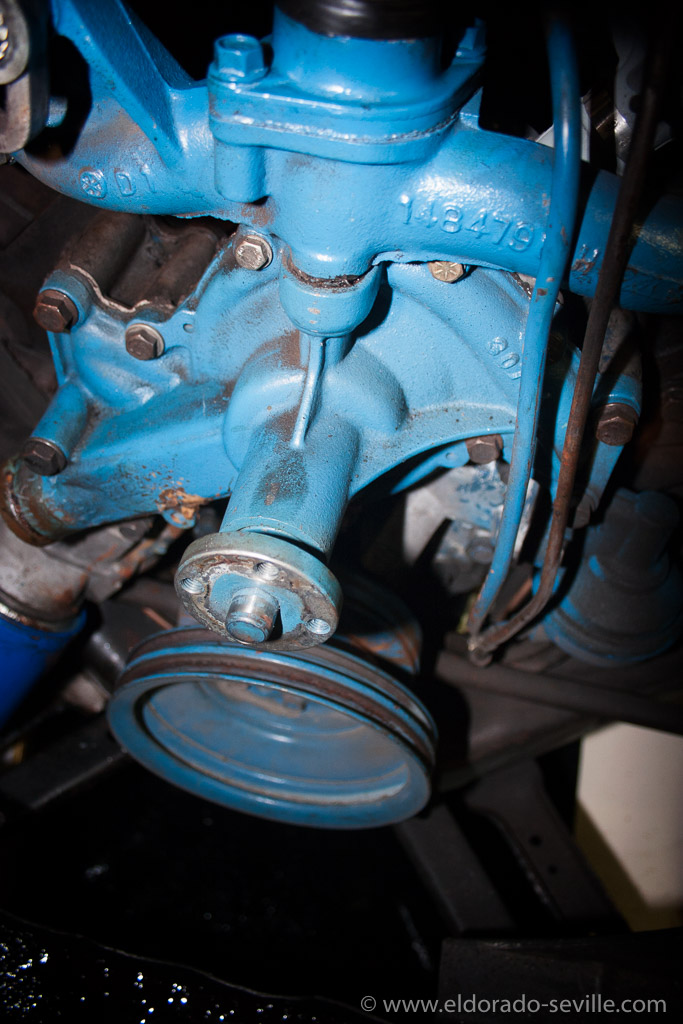
The defective water pump is about to come out. I will also replace the painted fuel line with a correct one from a spare engine I have. The water pump made a loud bearing noise and the shaft was a little loose.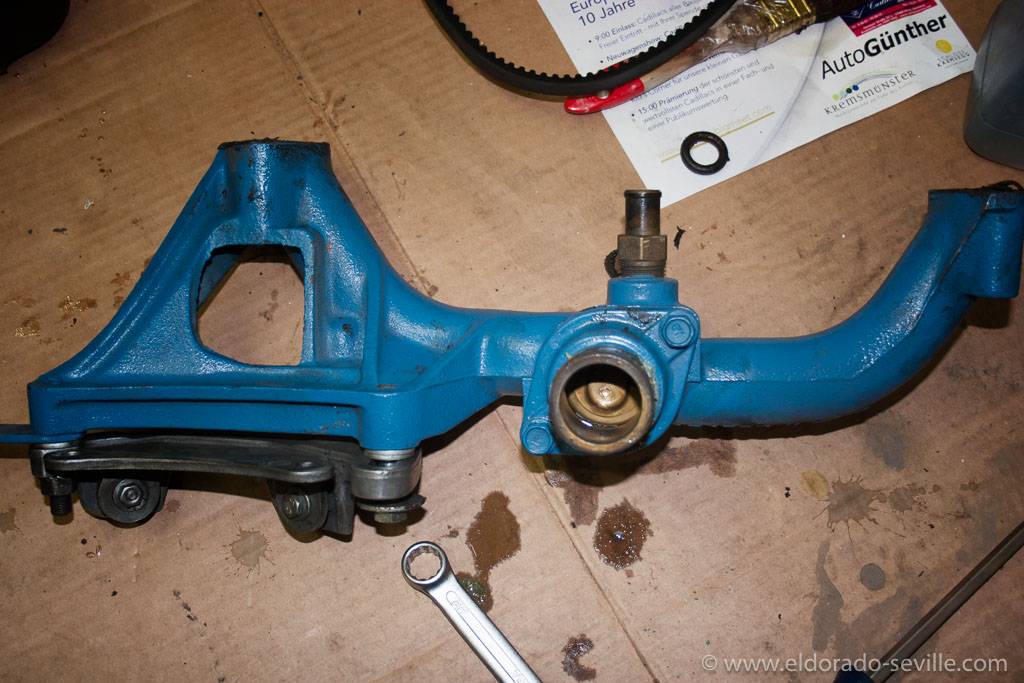
I will sandblast and repaint the hot water crossover passage.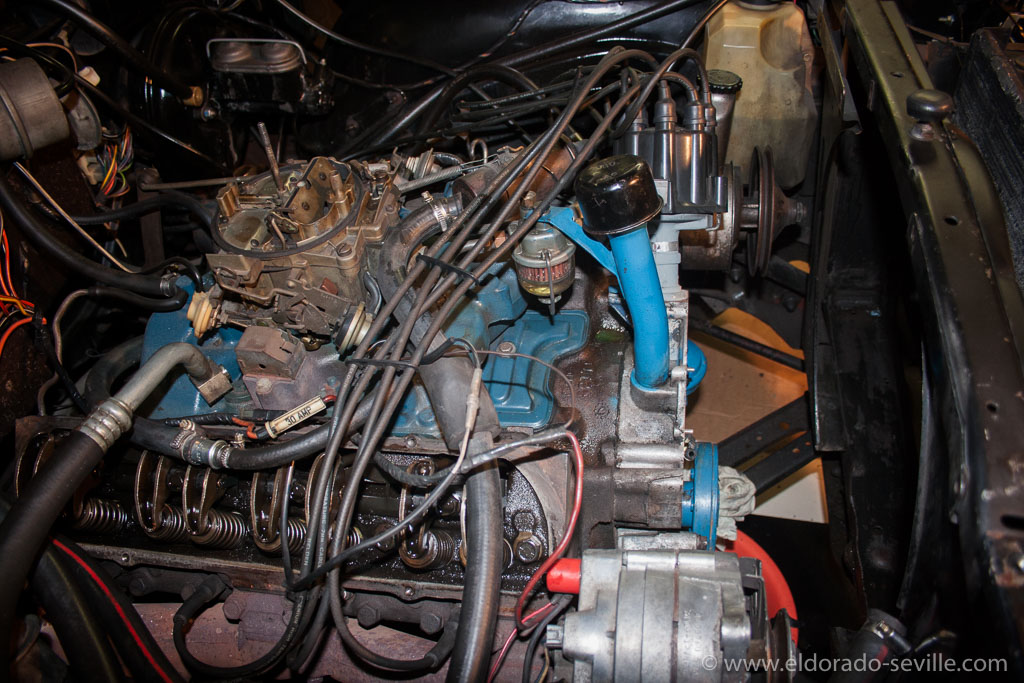
Water pump, radiator and valve covers removed.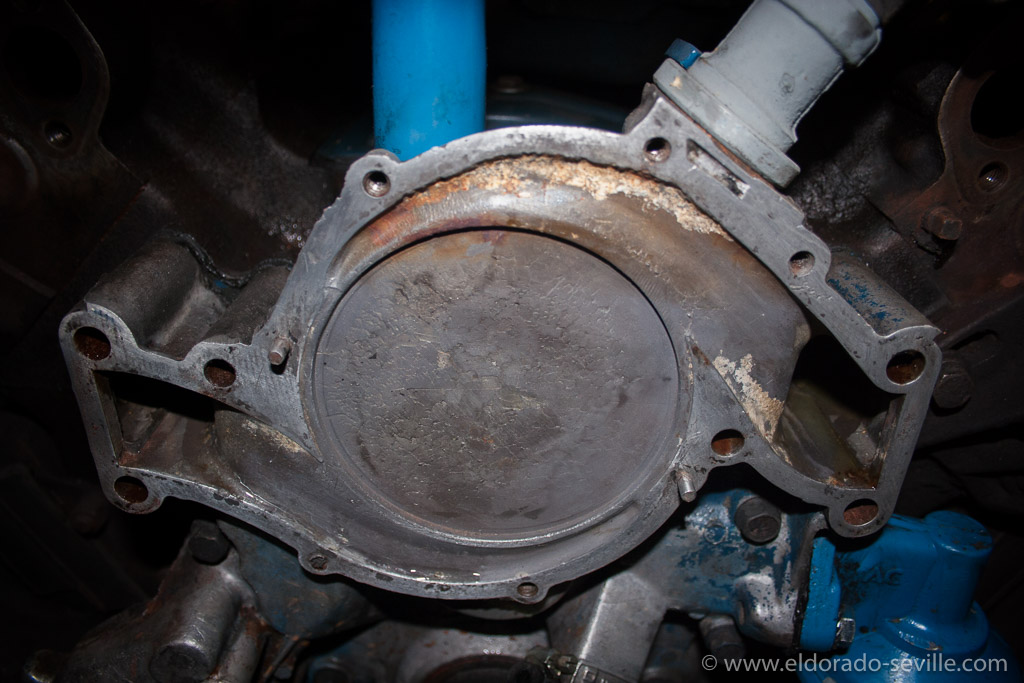
The water pump was removed - the front cover looks pretty good.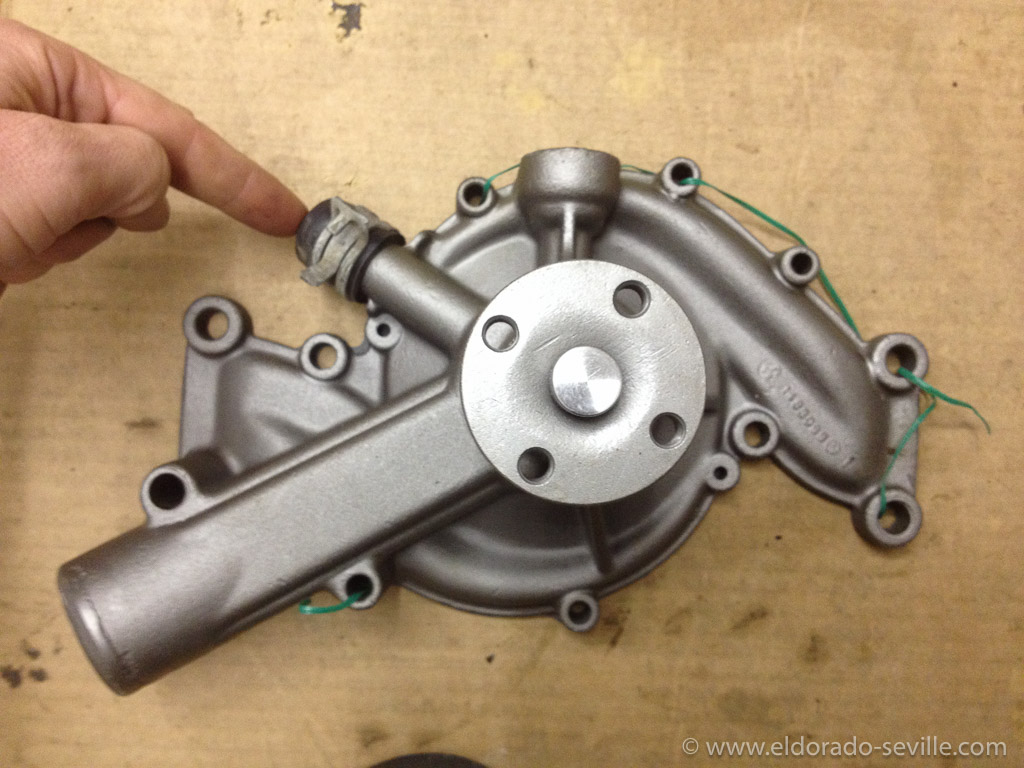
This is the incorrect 1965 water pump everybody is selling for the 429 engines. It will work with the 66 and 67 Cadillacs as well, but it has an additional water outlet which was not used from 1966 on. If you buy them for your 66 or 67 the no longer used outlet is often blocked like you can see on this picture. The correct 1966/67 pumps are much harder to find and way more expensive.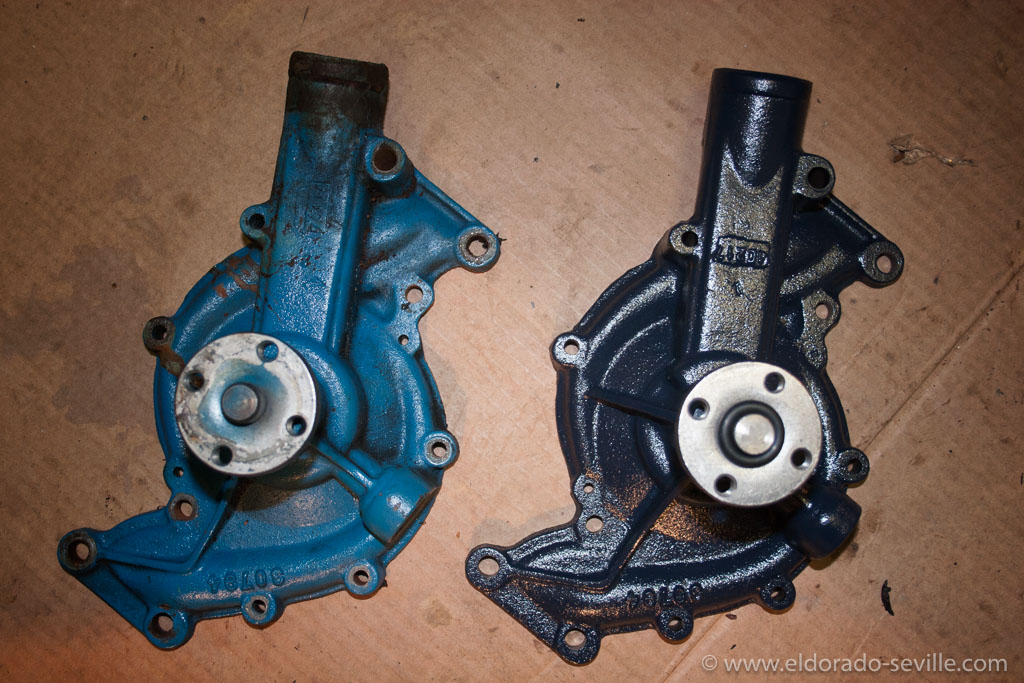
The original water pump on the left and the correct rebuilt 1966/67 Cadillac pump on the right in the correct color.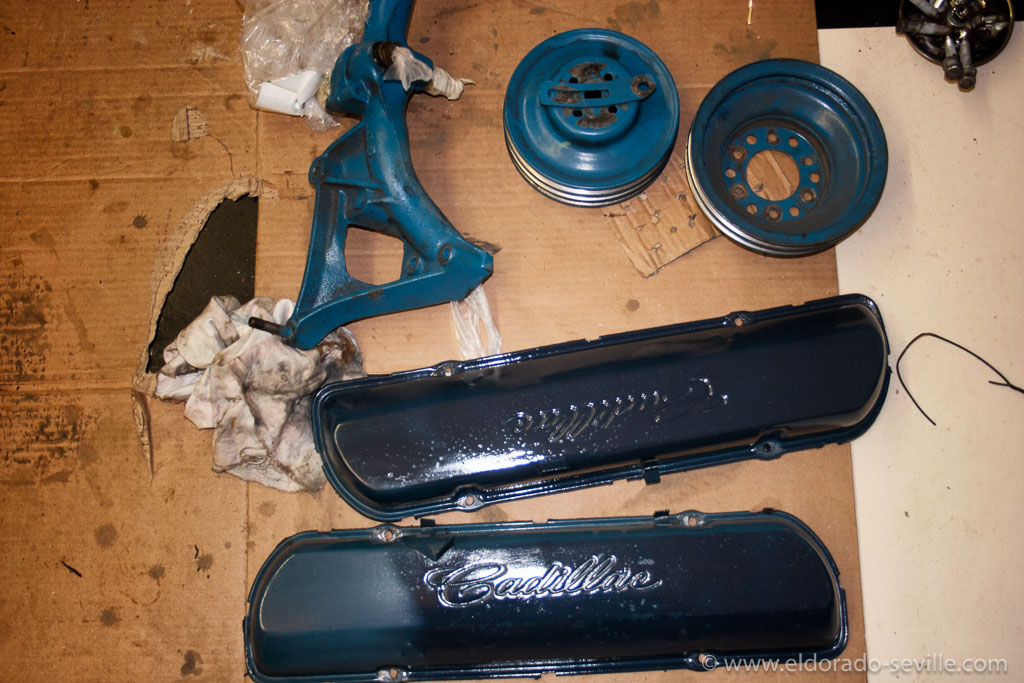
I will sandblast and repaint all this parts soon.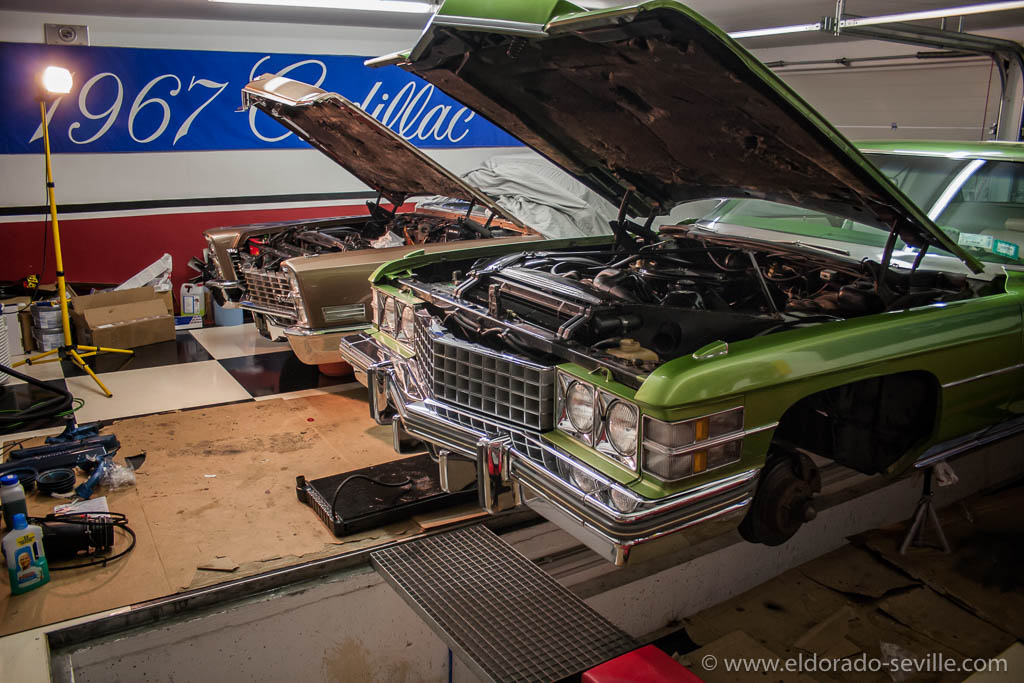
I do have two bigger projects in my garage at the moment and it looks like a mess in there.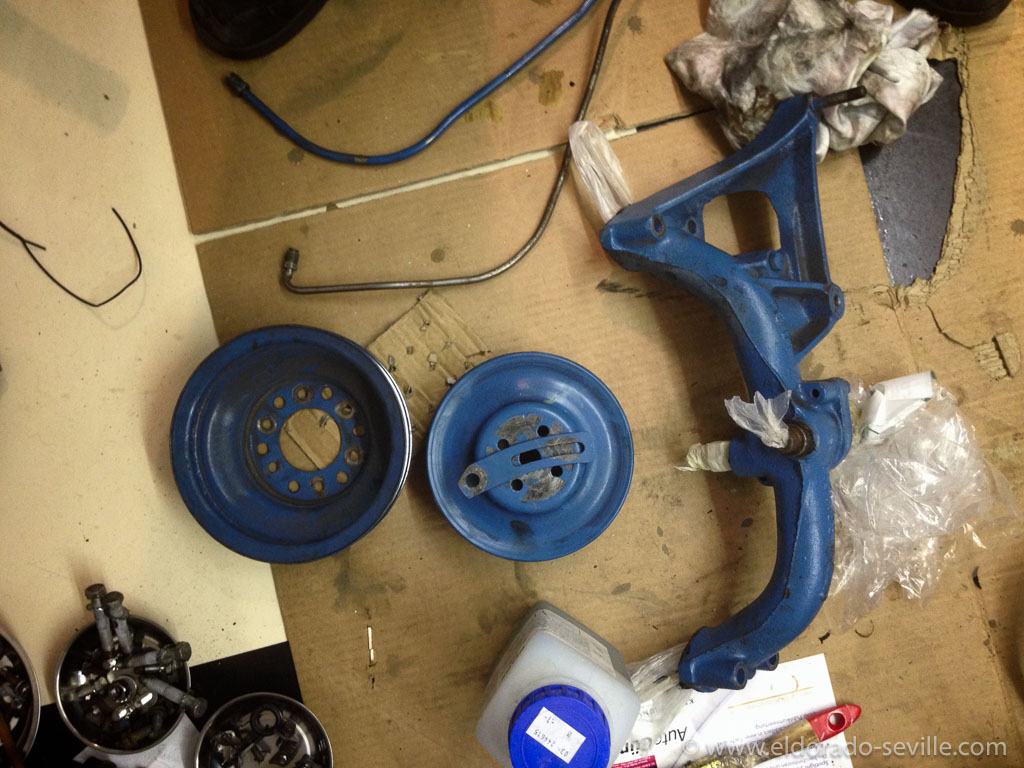
The parts before they were media blasted.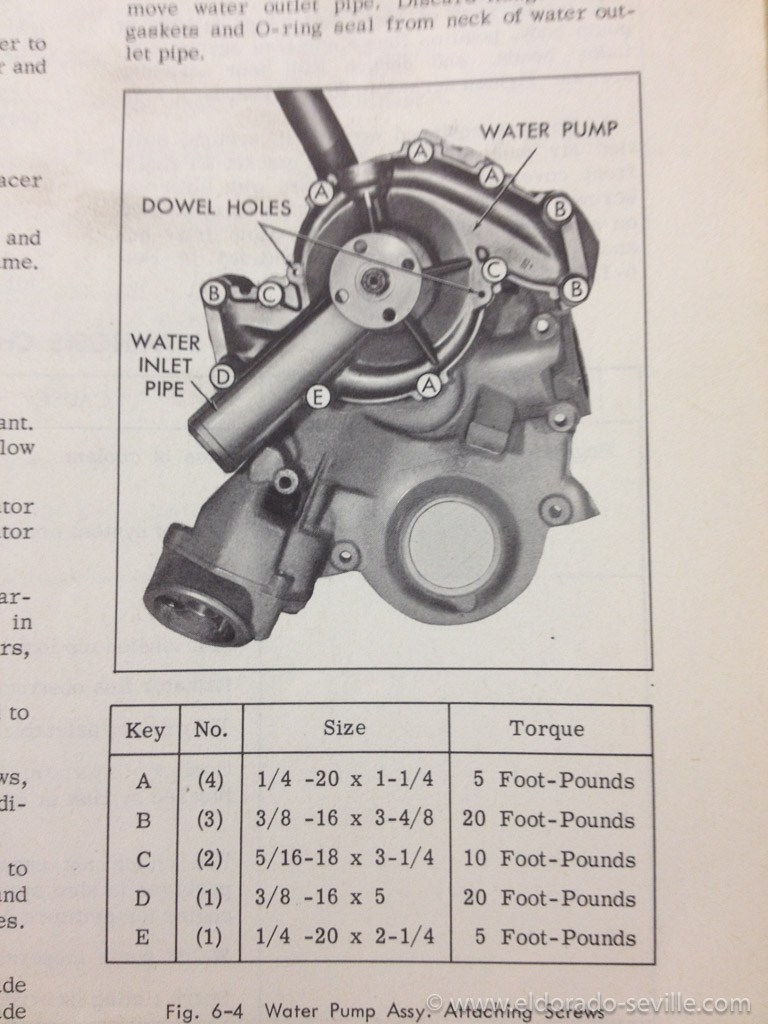
1967 Cadillac Water Pump torque specifications - make sure to follow them EXACTLY!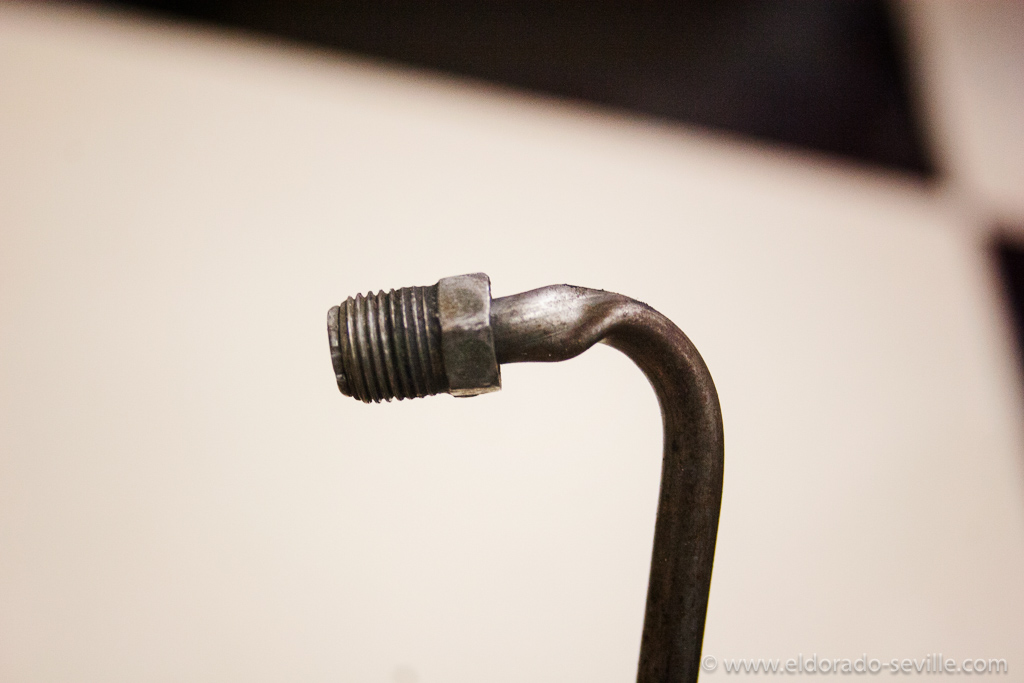
This is how a professional restoration shop damaged the original fuel line when it tightened it 15 years ago during a carburetor rebuild. i think I was lucky that it did not leak and still let fuel through...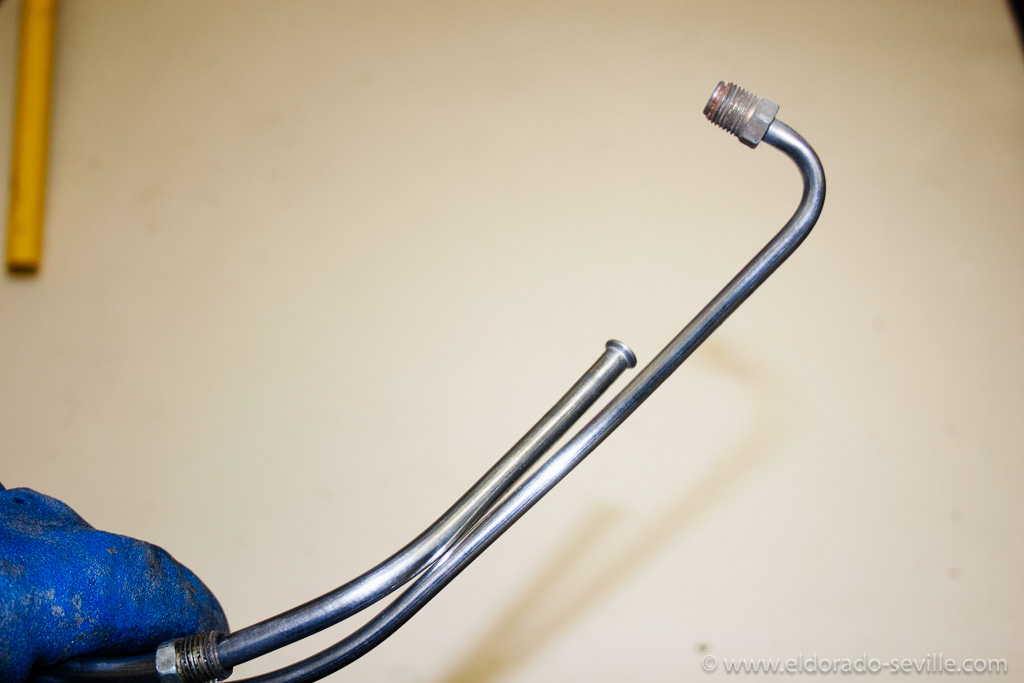
I detailed the fuel lines I have from my spare engine and installed these instead..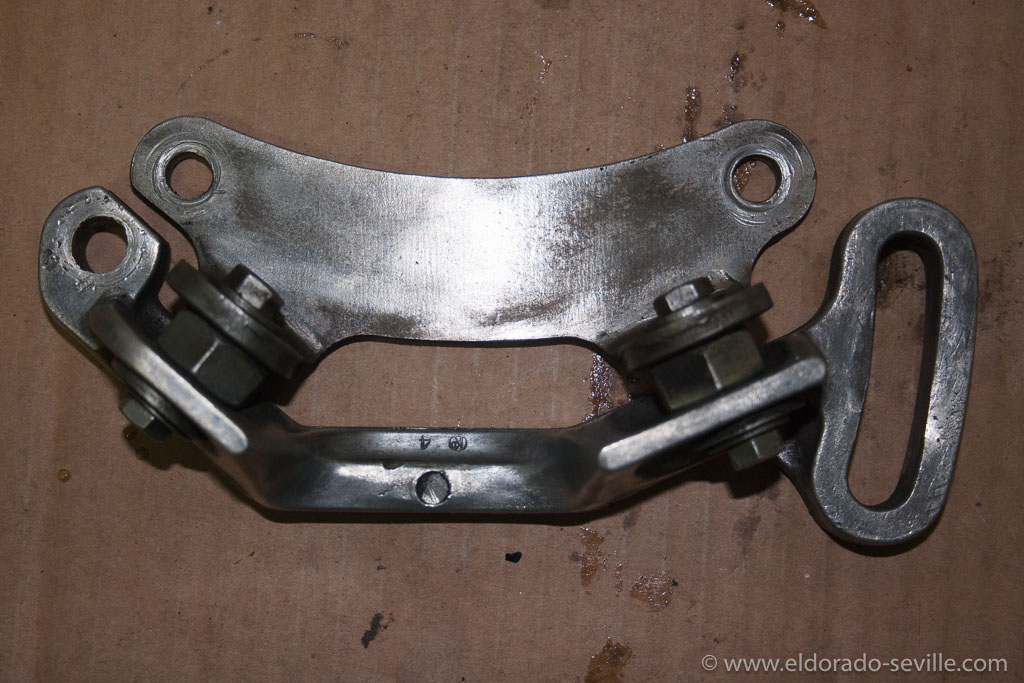
Another construction the restoration shop made for the AC compressor bracket: - instead of rubber bushings they installed this nuts, bolts and washer construction ...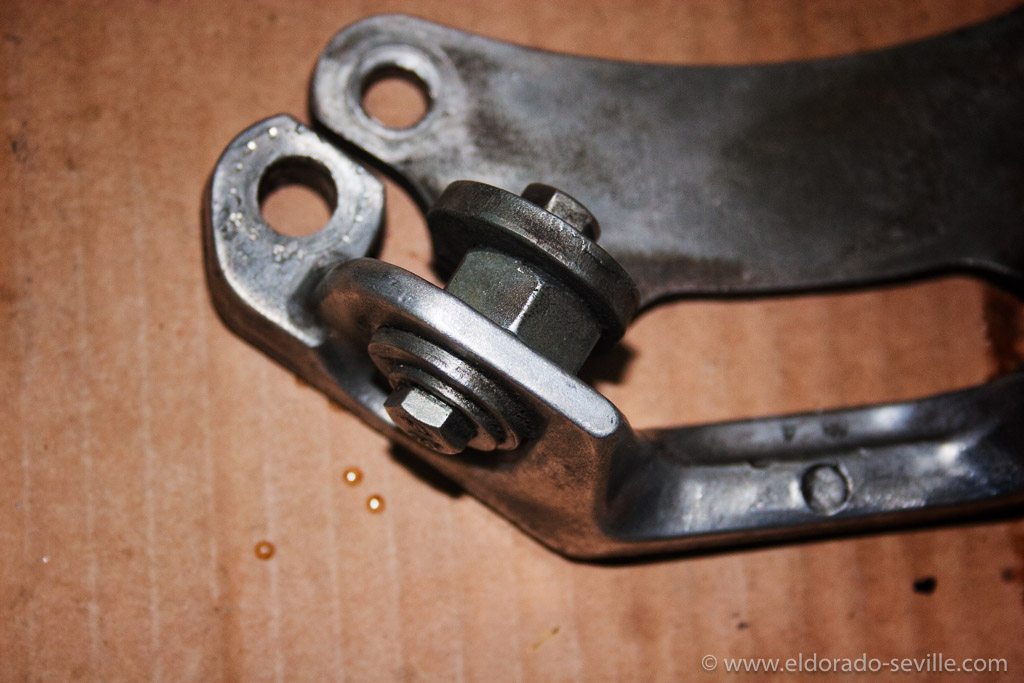
Another construction the restoration shop made for the AC compressor bracket: - instead of rubber bushings they installed this nuts, bolts and washer construction ...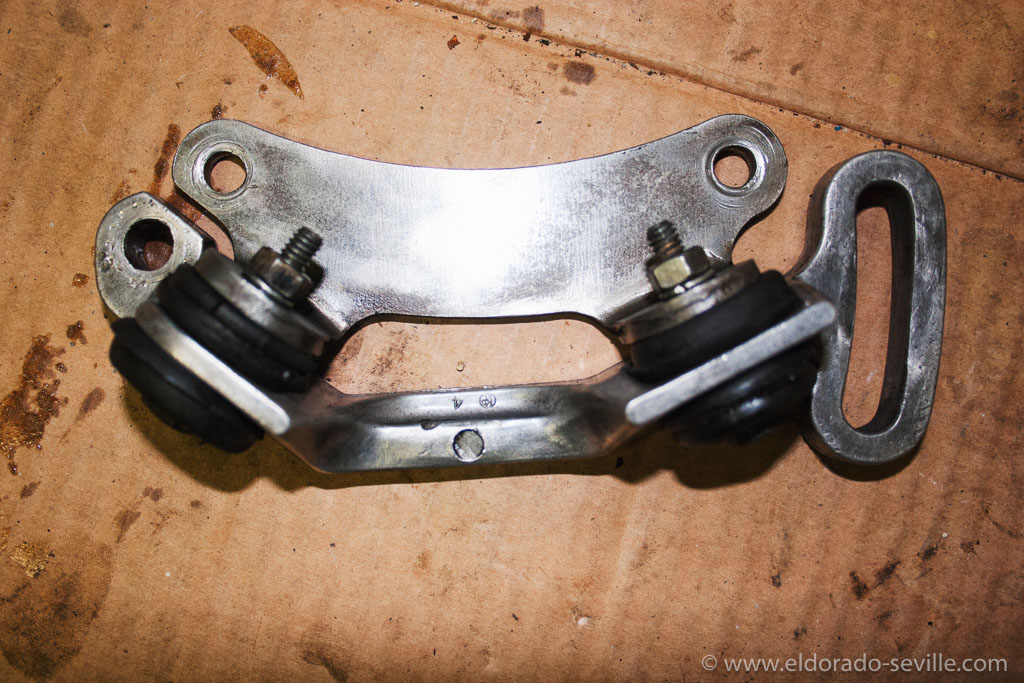
I changed it back to original with the correct bolts and rubber bushings which I soaked in silicone lubricant for a couple of hours to make them soft again...
When I removed the overflow hose from the radiator the neck came loose. Luckily I found an older gentleman locally, who could brace it back together the old school way. I will of course detail the radiator as well before installing it back into the car.
I did not want to remove the front cover so I had to repaint the oil filler tube inside the car... First I brought it back to bare metal.
Oil filler tube - painted in the correct shade of Cadillac Engine Blue.
I detailed everything I removed from the car.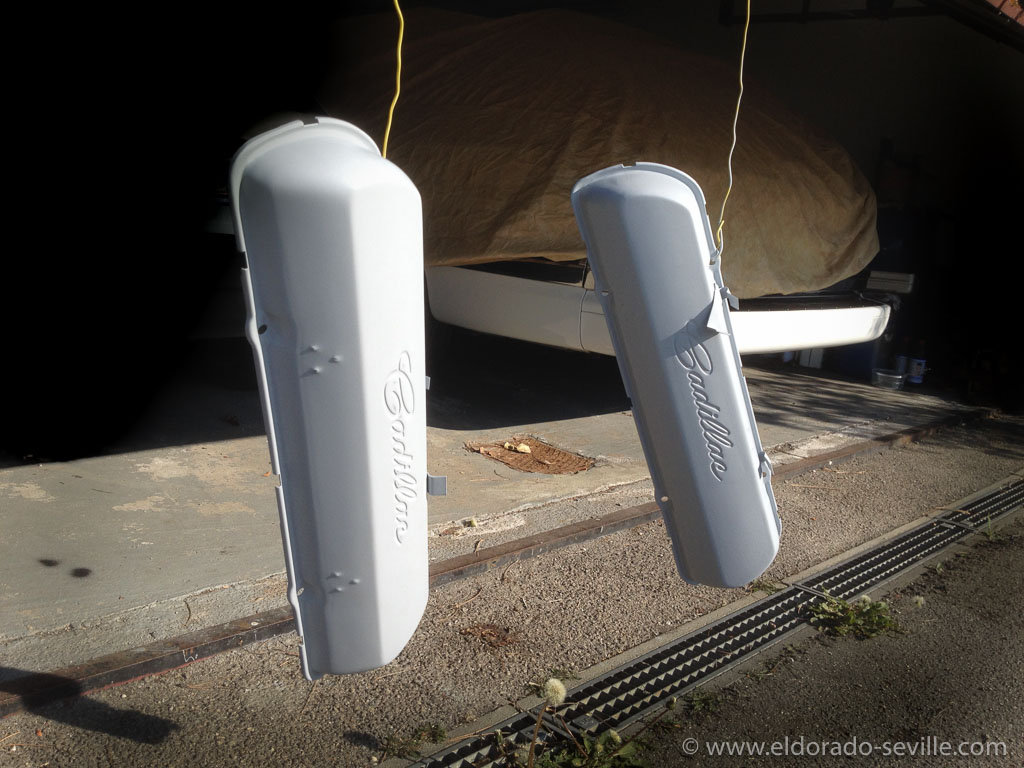
I primered and fillered the valve covers and sanded them to perfection before painting.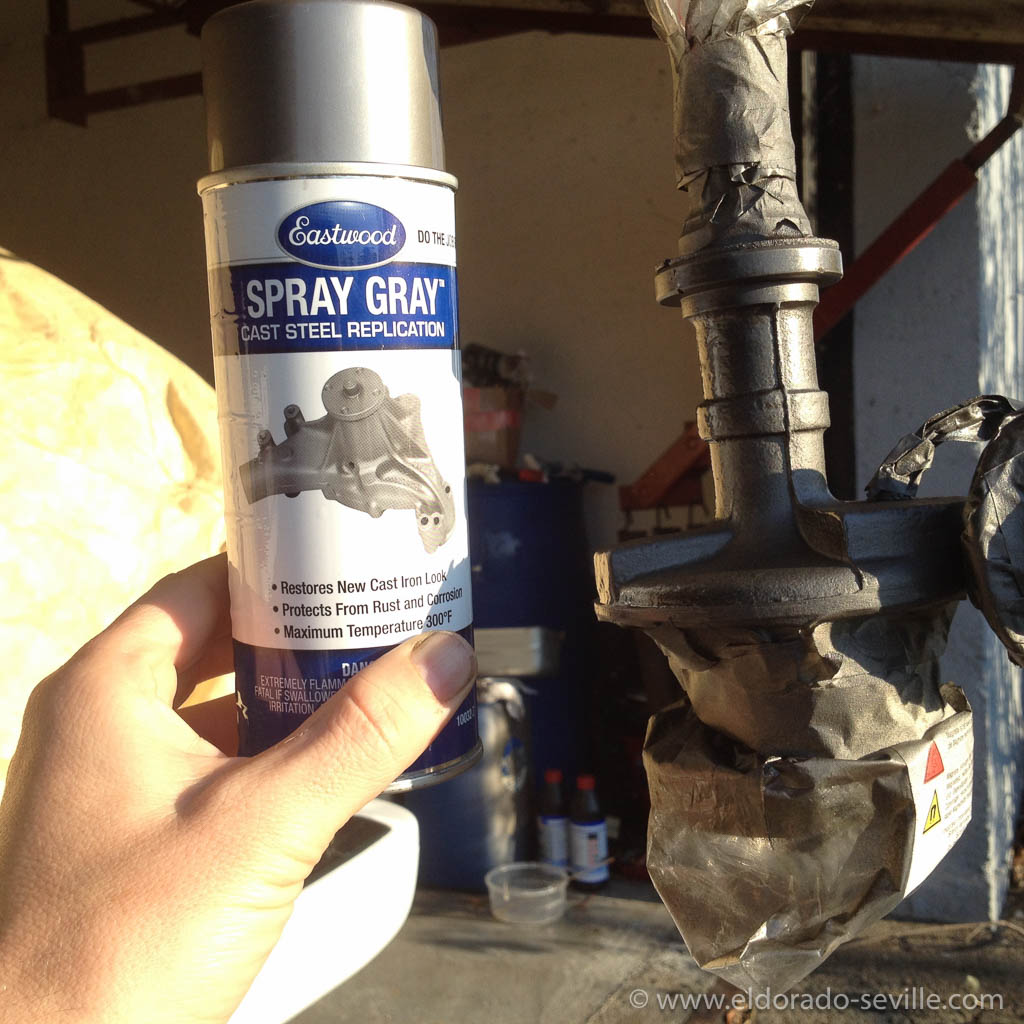
The distributor after painting. This spray gray paint from Eastwood replicates cast steel very very well. I tricked a lot of people with this paint who insisted that it must be bare metal.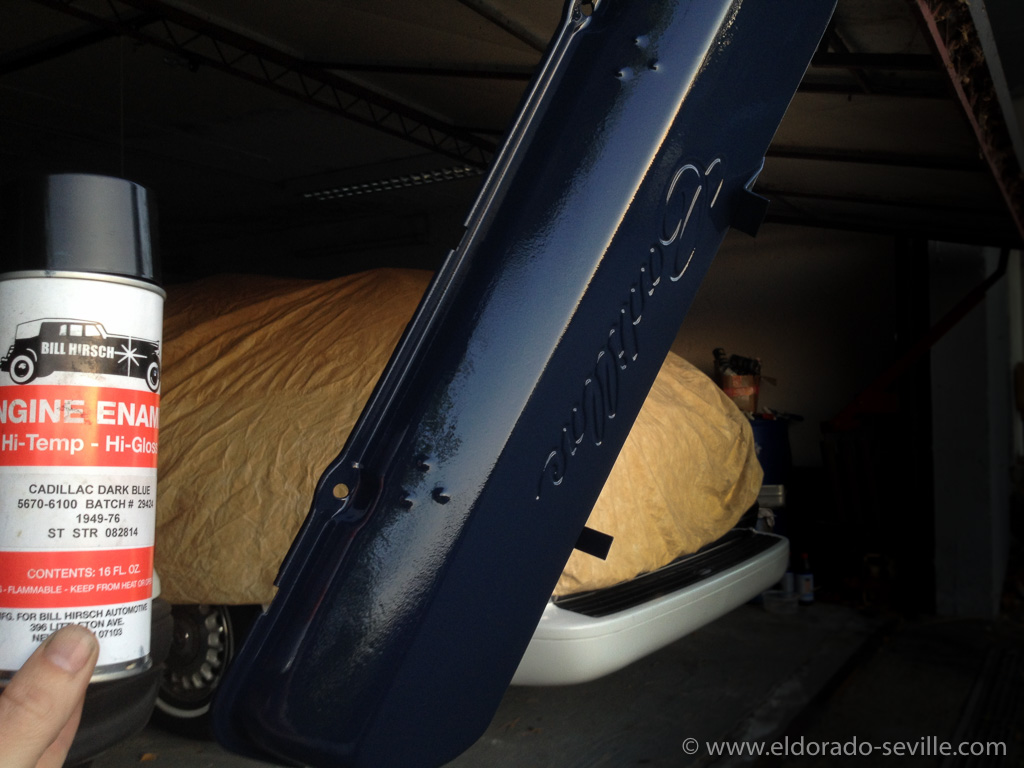
I used Bill Hirsch engine enamel to paint all the engine parts.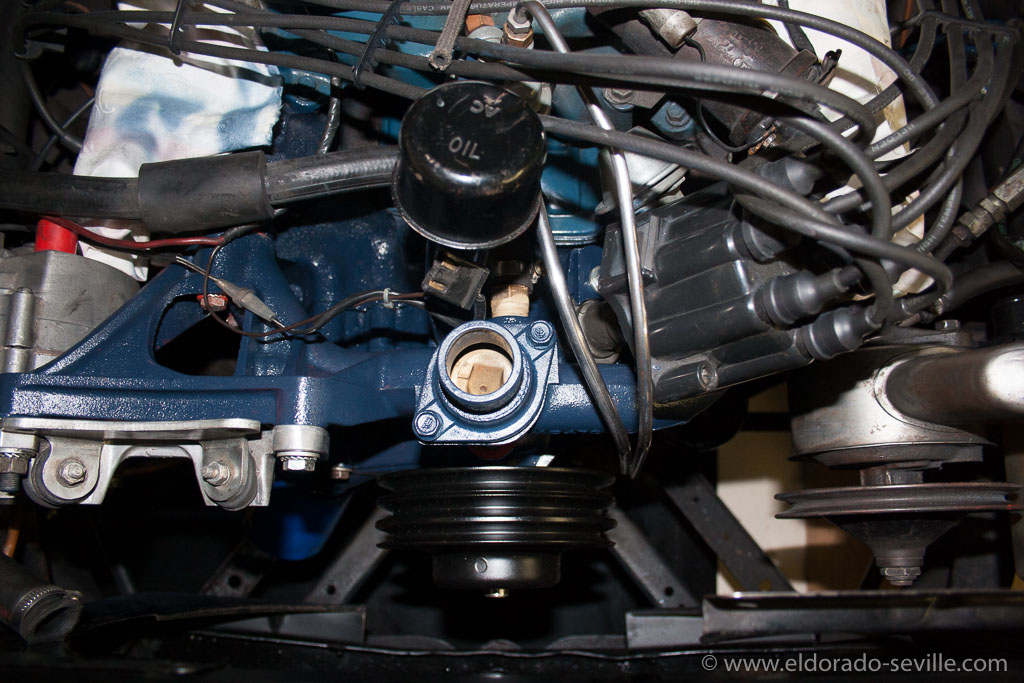
The new water pump and the mediablasted and then repainted parts back in the car. Also painted the water pump pulley in the correct color now (black).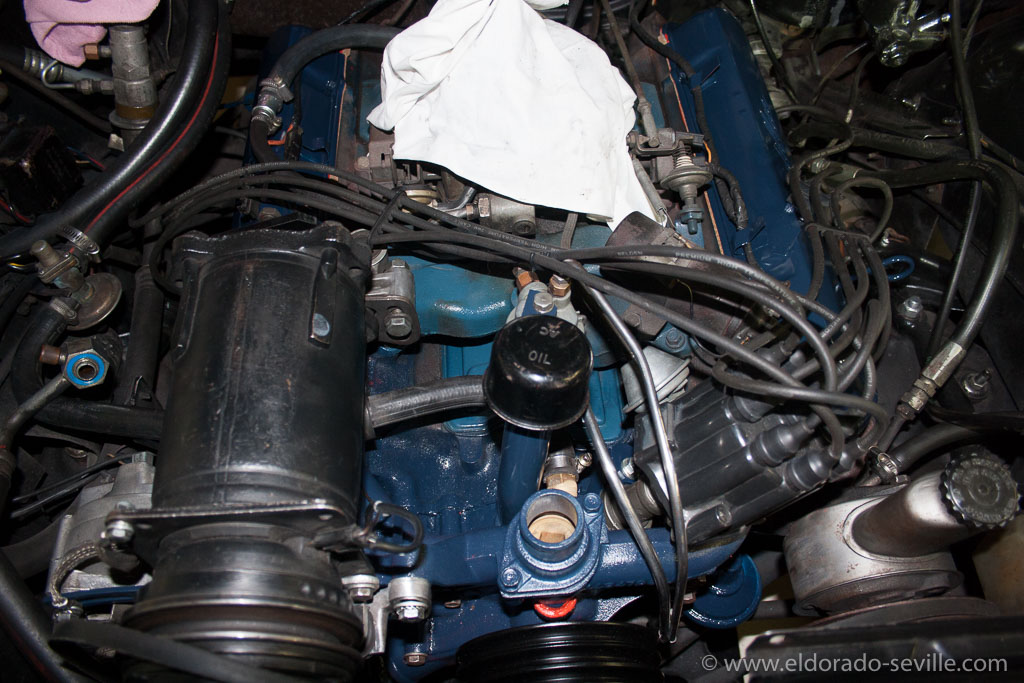
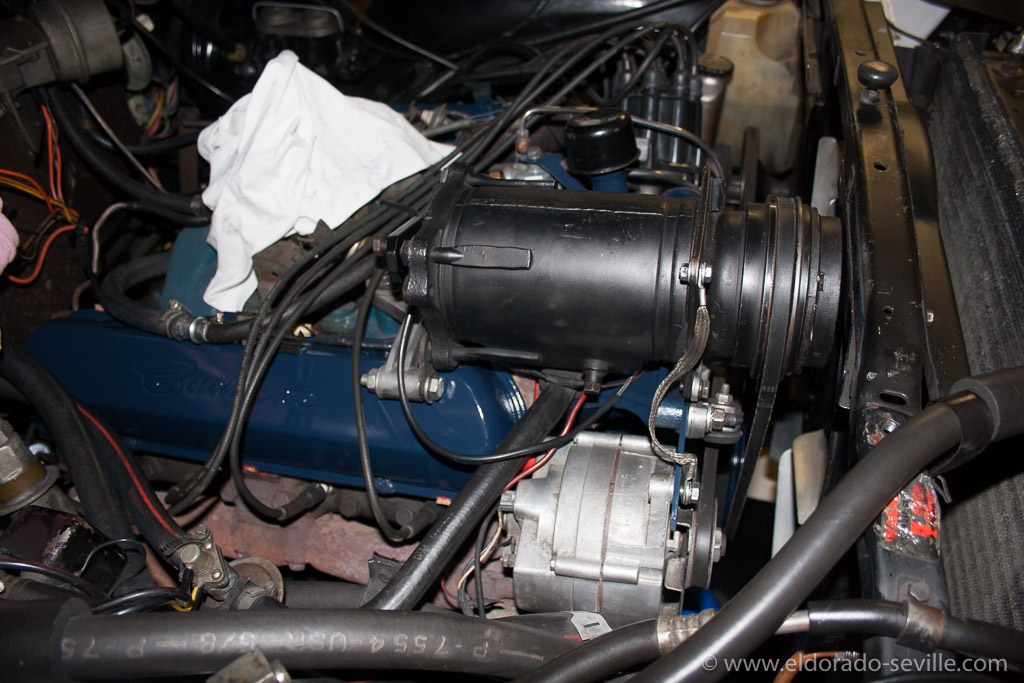
Most things are back together. I am still waiting for the correct reproduction radiator hoses to arrive. I did not repaint the intake manifold in the correct color as I did not have the necessary gaskets to reinstall it. I will do this eventually later, in the case that I have to remove the carburetor...
RESTORING THE 1974 CADILLAC´S WHEEL HOUSINGS ONCE AGAIN
I have already been so close to the finish line...
😭
I have no idea how to finish this project now, I will most probably have the 4 wheel housings done again by a professional restoration shop eventually. The rest of the undercarriage is finished and looks fantastic. I used the correct colors and replicated the factory new look.
The finished undercarriage - I applied some transparent undercoating over the freshly painted underbody which is completely invisible. This is some great stuff!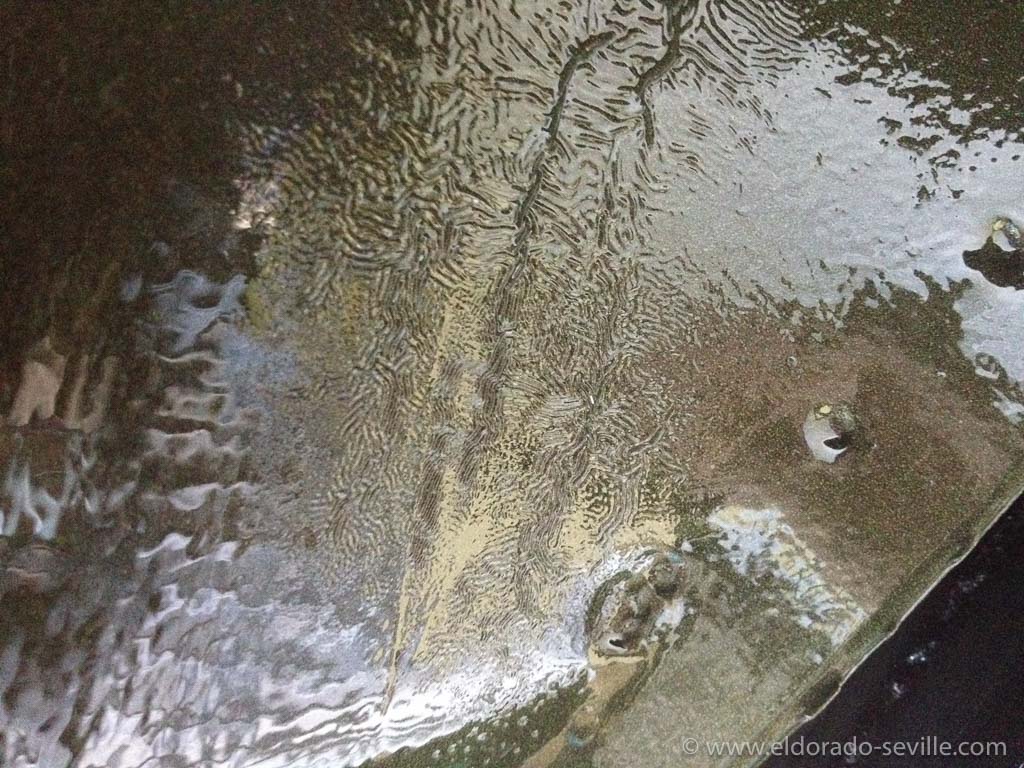
The transparent stone guard reacted with the paint... Now it's peeling off...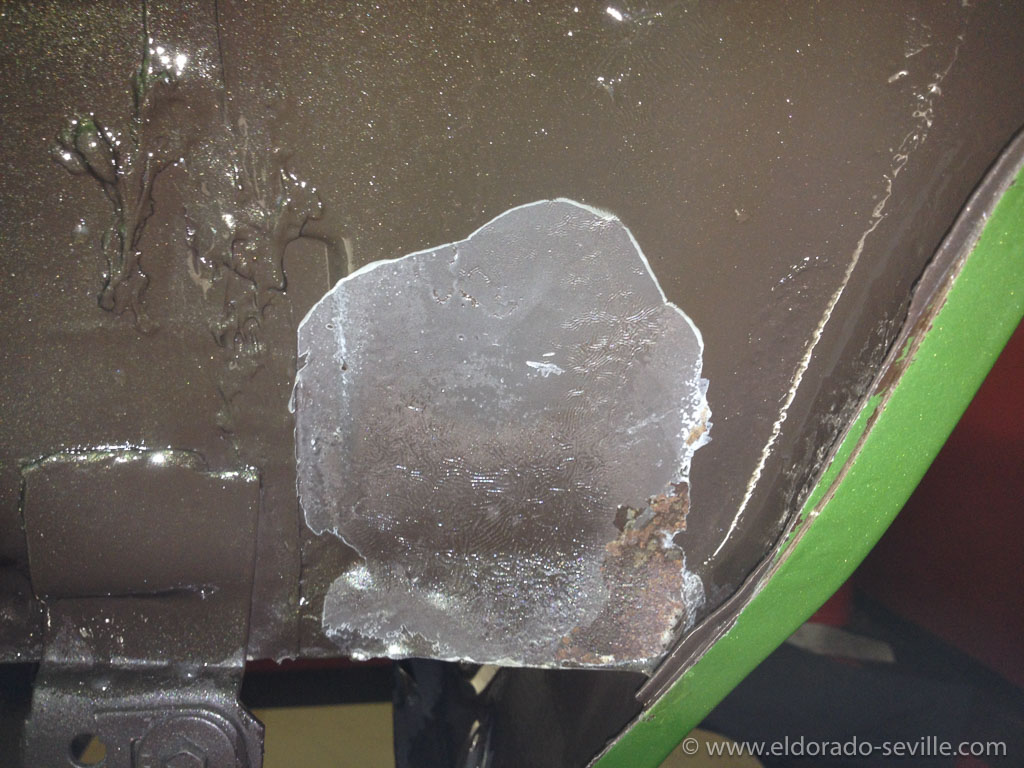
The transparent stone guard reacted with the paint... Now its peeling off...
1974 HOOD ORNAMENT, DASH TRIM REPLACEMENT AND SPLASH GUARD DETAILING
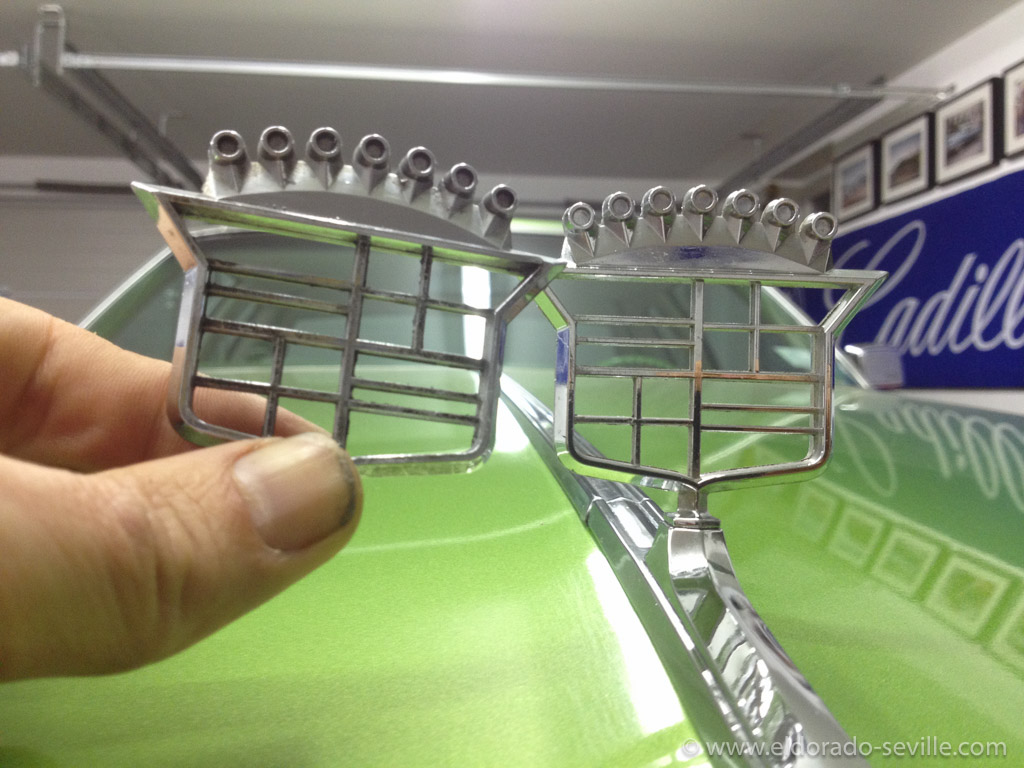
Some 1974 models like the "Cabriolet" Coupe DeVille version were equipped with see through hood ornaments. The one on my car was quite pitted so I got a new used one which looks much better.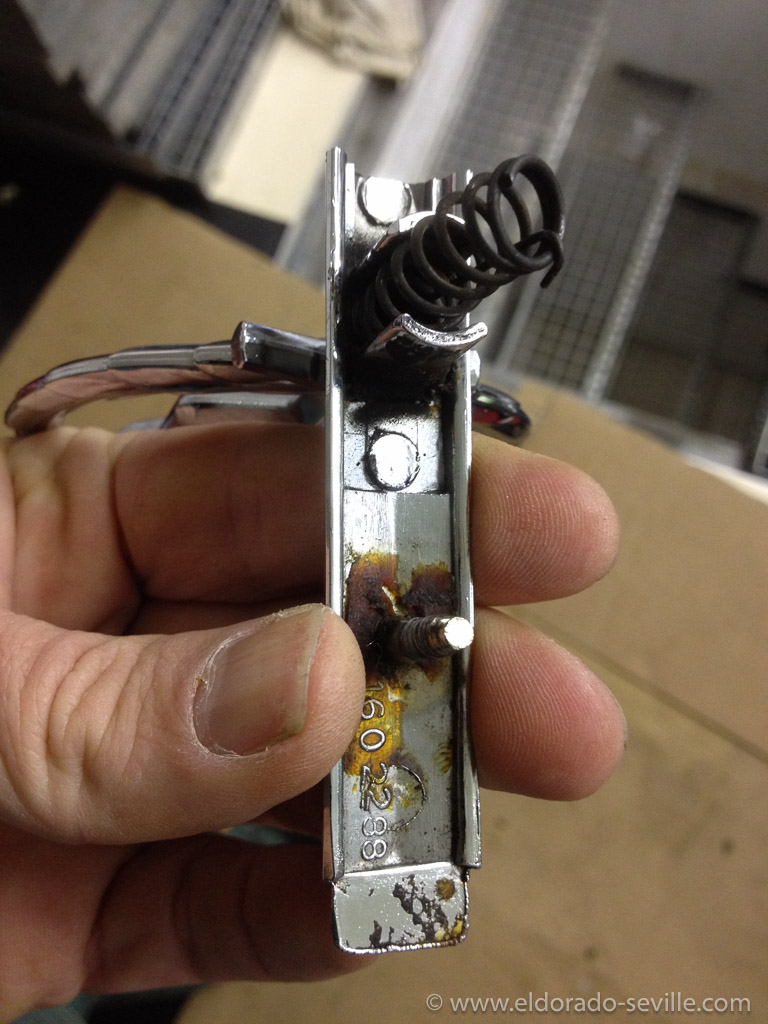
This is how Cadillac typically mounted its hood standup ornaments.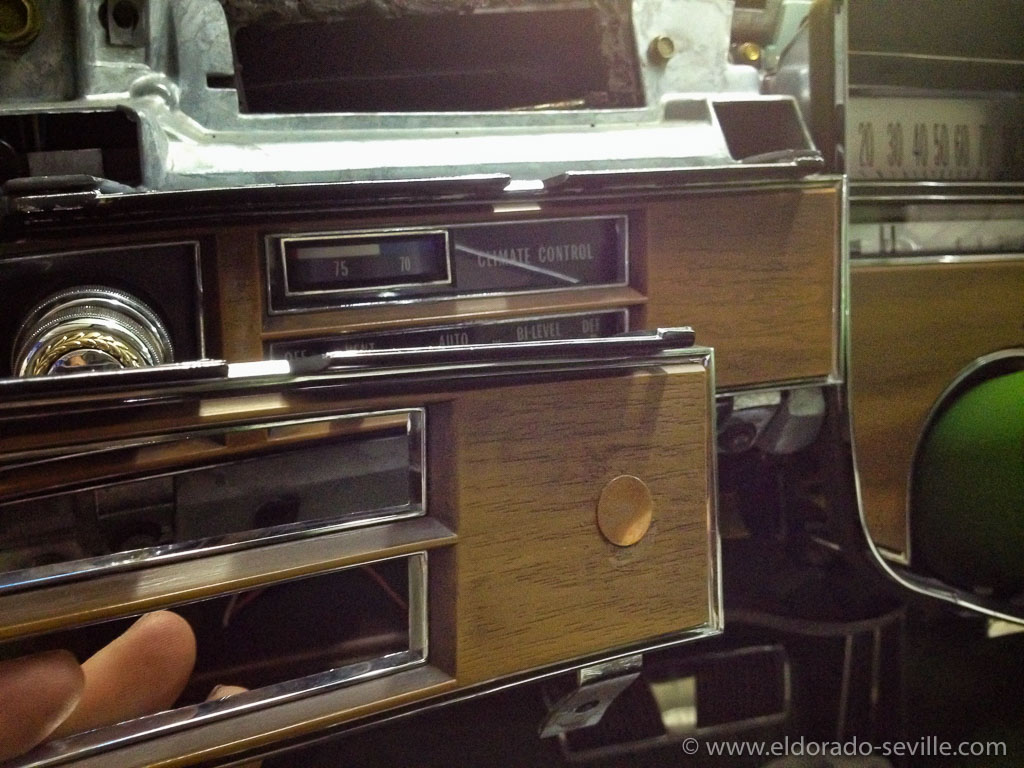
The previous owner glued some emblem to the dash which came off and left some residue on the plastic wood. I got a good used part and replaced it. Here you can see the old part in the front and the "new" part already installed. As I had the dash cover still removed from my heater core replacement and radio/speaker repair it was only a matter of removing two screws.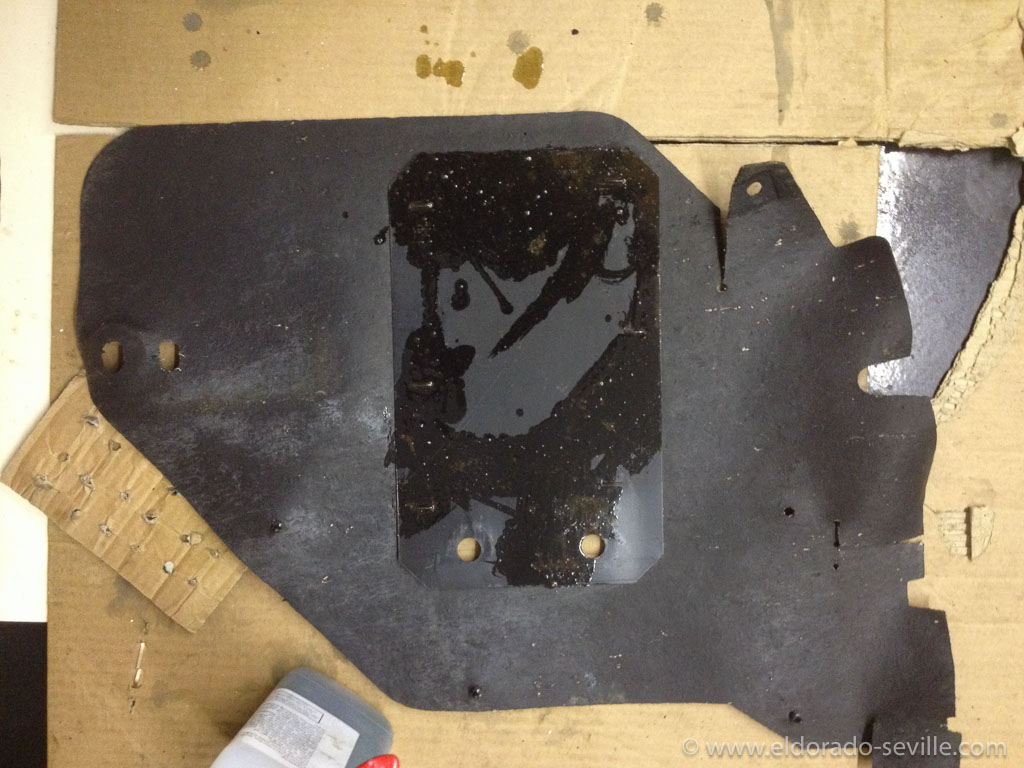
I removed all the rust from the splash guards in the inner fenders with rust remover gel and repainted them afterwards. Here you can see the applied gel.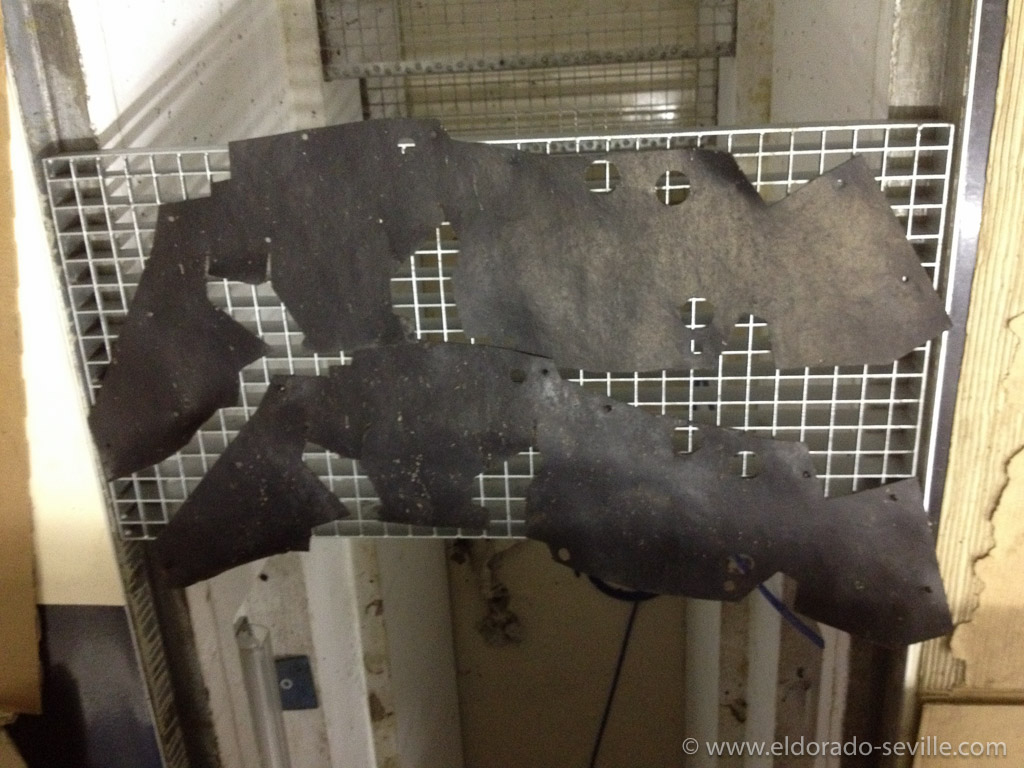
The original rubber splash guards got a very good cleaning and are still in very good condition. The rubber has white/grey fabric woven into the rubber - therefor it's not completely black and the white dots you see are not dirt.
1978 CADILLAC ELDORADO CB ANTENNA
My Eldo comes with a radio with the CB option, so it should have the according tri-band antenna for the 78 Eldorado.
One of the previous owners had replaced the original antenna with a replacement antenna, which worked, but it had very poor CB reception and of course it does not look correctly.
What I have found out is that #22010515 was the original part number for the antenna.
This antenna was also used in the 1977 to 1982 Corvette and is extremely rare...
Replacement antennas had the part number #22010661 on the sticker with a date code below.
When these replacement antennas were no longer available, it seems they switched to a different antenna design as a replacement #12355706 (which I had in my car). This last design came with a special antenna splitter. I do not know if this splitter is essential or of it would also work with the original splitter which is still in my car.
It took me quite a while to find the correct antenna for my car as it seems to be made out of "unobtainium". I did search the net for days and somebody sent me an incorrect antenna which was for a Buick… Suddenly during my daily search, a correct, working antenna showed up on ebay, and I immediately hit the "Buy it now" button. It was not exactly cheap, but I was happy to have finally found it. When it arrived I cleaned it up properly.
I then found out that I would also need the correct antenna bezel on the fender. Various sellers sent me incorrect ones which they claimed would be the correct ones, and eventually I found a good used one from the seller of my antenna and a NOS one from a parts vendor (it has not arrived yet as once again USPS sent it to Australia instead of Austria - don't ask what this little bezel has cost… :-( )
I then also had to replace the thinner replacement antenna lead with an original one going from the antenna splitter behind the glove box to the antenna. I got this one from Arizona Vintage Parts.
I can say now that my car is 100% correct again. Unfortunately this project was an extremely expensive project and I will now try to sell all the not needed parts on ebay. They will fit Eldorados with non CB antennas and the other wrong CB antenna I got will be for Buicks, but could also be installed into the 78 Cadillacs, as the mast itself is exactly the same as on the original antenna and from the outside it would look completely stock. But purist as I am, I just needed the 100% correct antenna ;-)
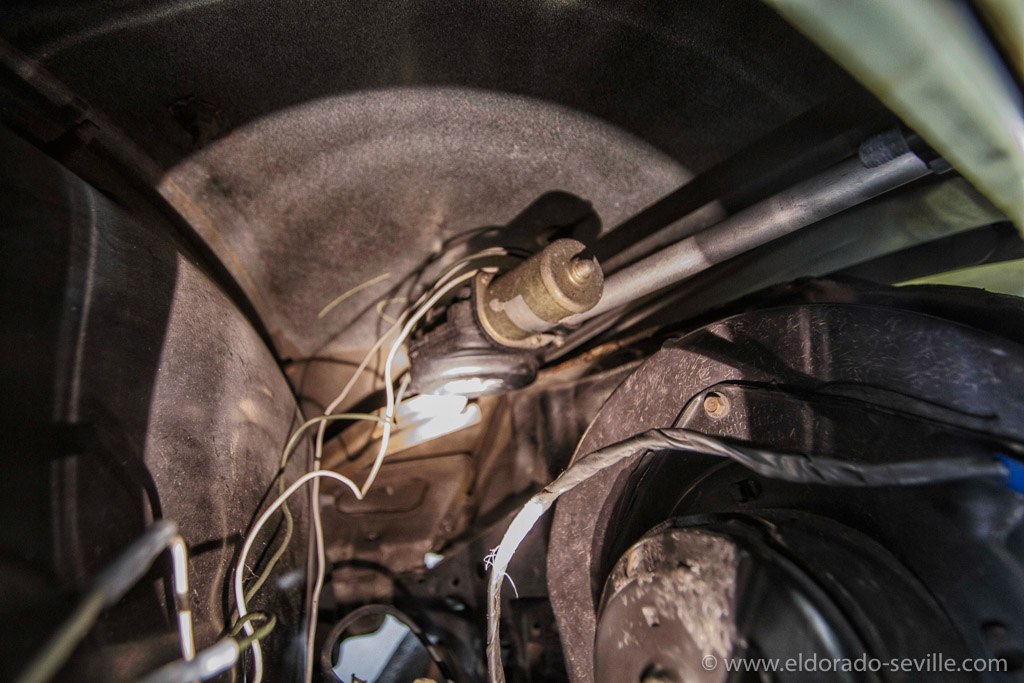
The later style replacement CB antenna which I wanted to replace with an original one.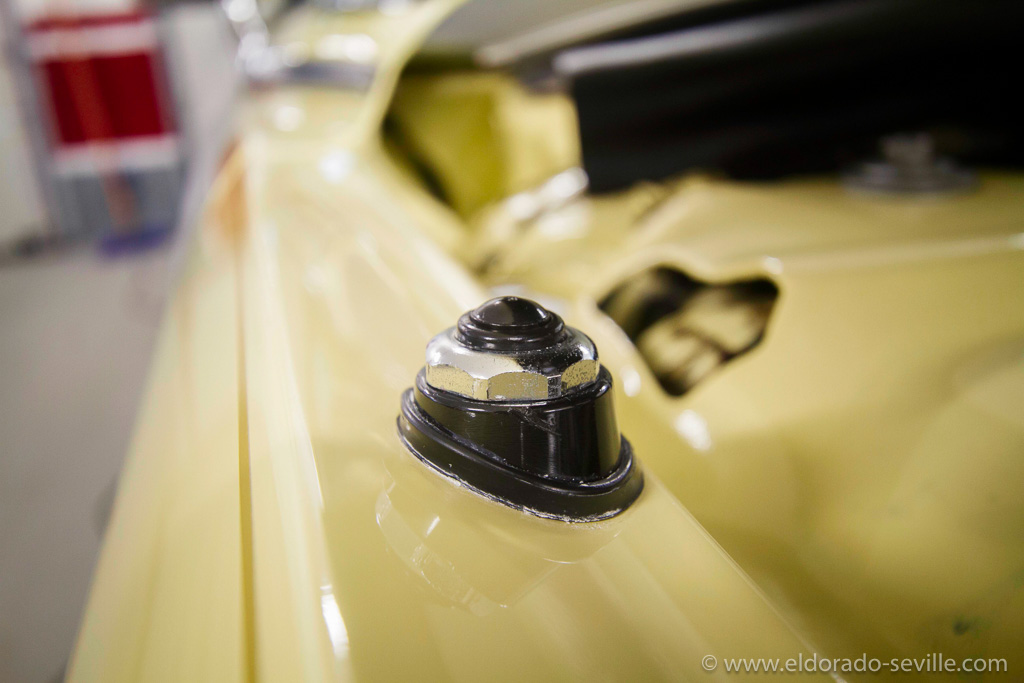
The later replacement style fender bezel looks completely different from the original one.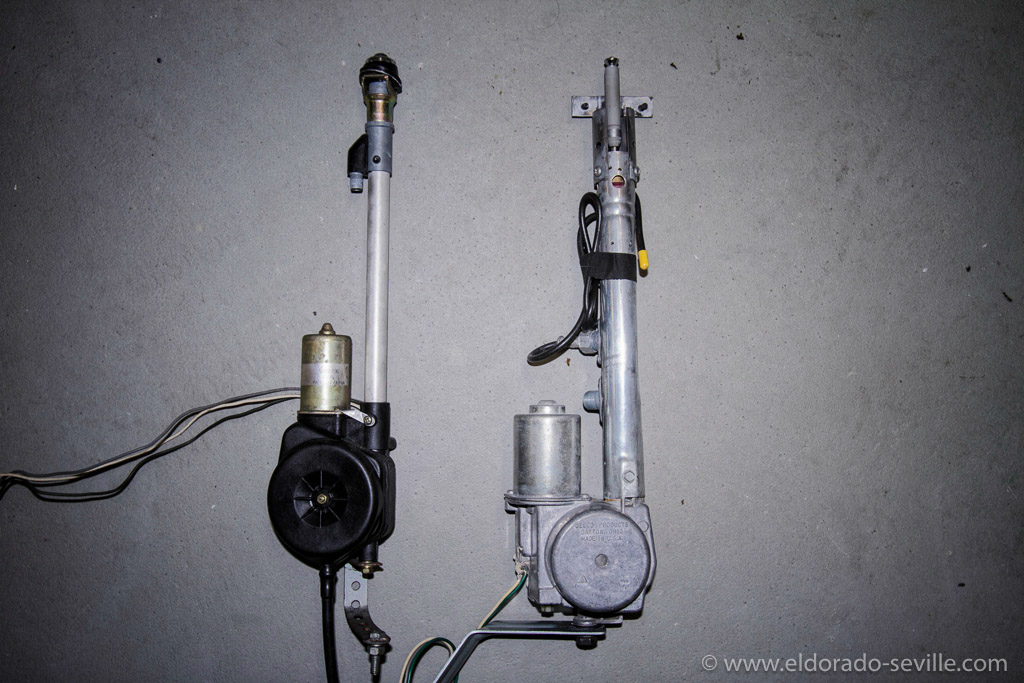
On the left you can see the official later style replacement CB antenna which looks very different. It does not have a load coil and no additional stub antenna. This is part #12355706. On the right you can see the original 1978 CB power antenna with the load coil on the mast and two antenna leads and the additional FM stub antenna. This antenna is nearly impossible to find…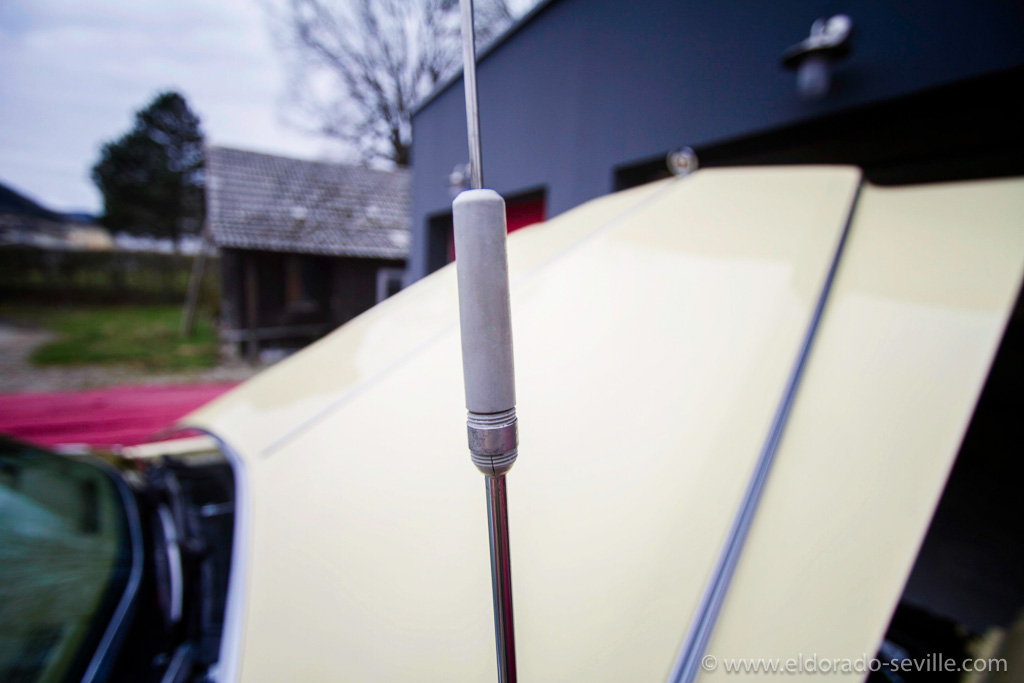
Thats the CB - load coil, which can be adjusted. The plastic unfortunately got very brittle over the years on all antennas of this vintage.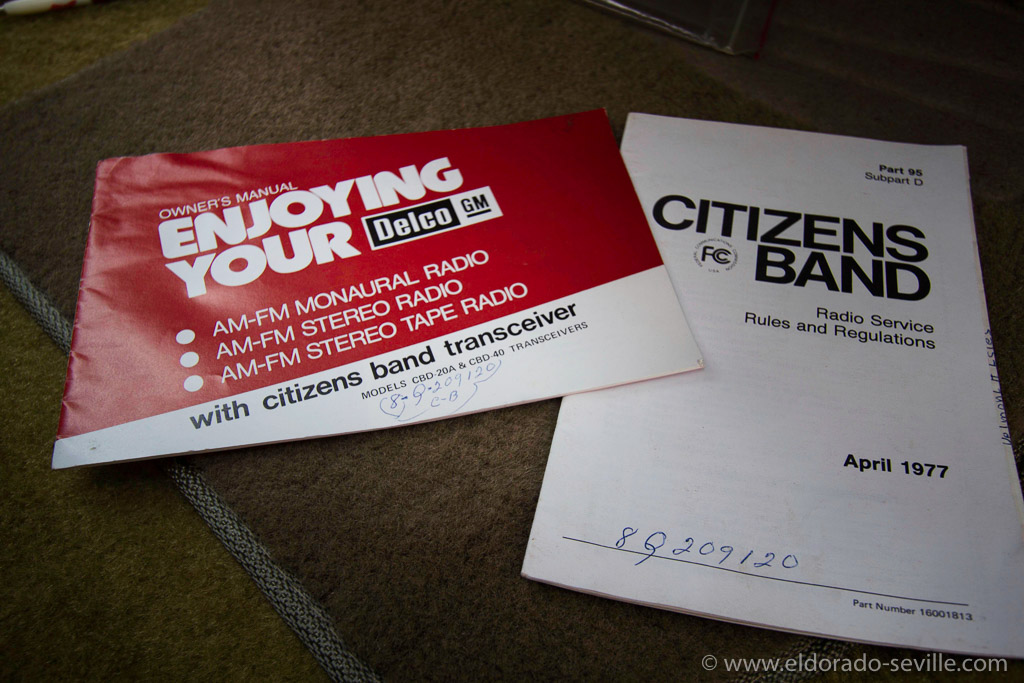
This are the instructions which came with the car, if you ordered the very expensive CB option…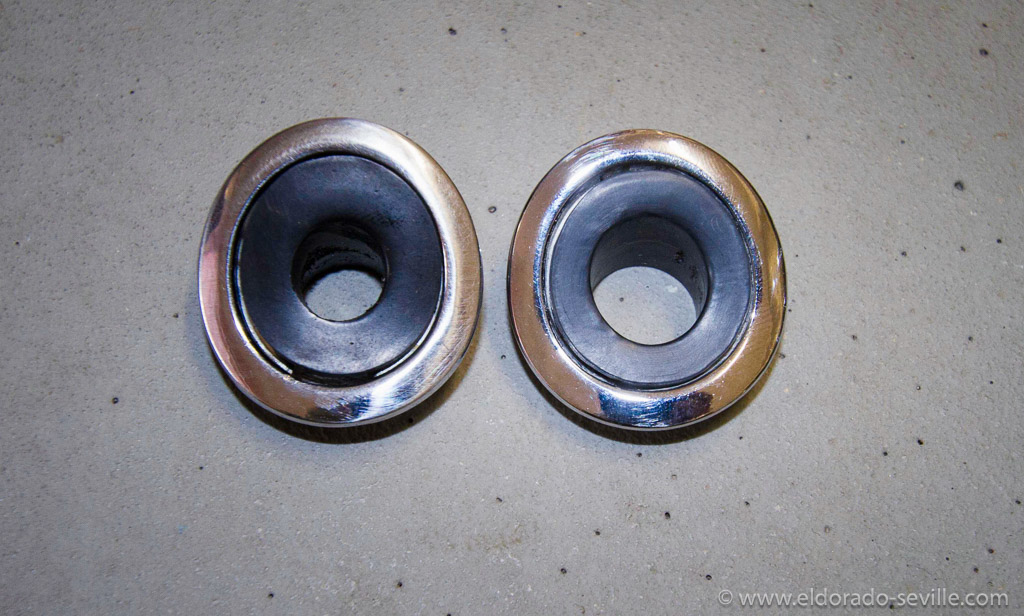
The antenna trim bezels for the 1978 Cadillacs. On the left the one for the regular antenna - on the right the one for the CB antenna with a larger diameter in the plastic part. The chrome ring is exactly the same for both. These two are used ones I found.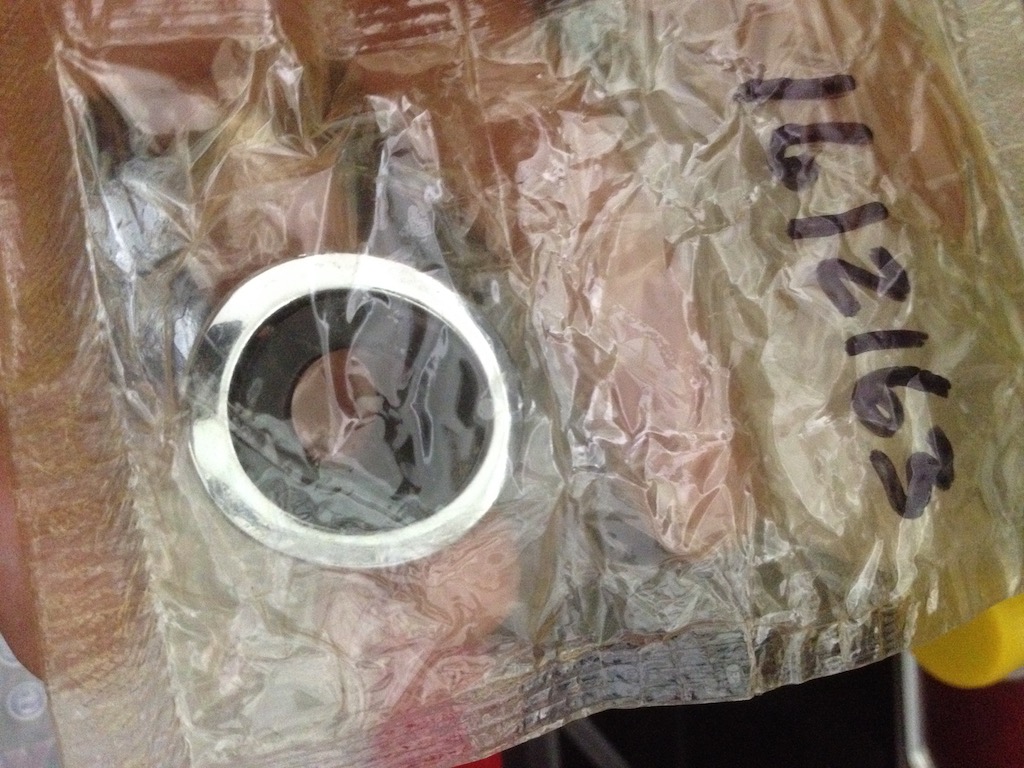
I cant believe that I was lucky enough to find this super rare antenna bezel as a NOS part - still wrapped in its original plastic bag. Not exactly a bargain, but its 100% perfect.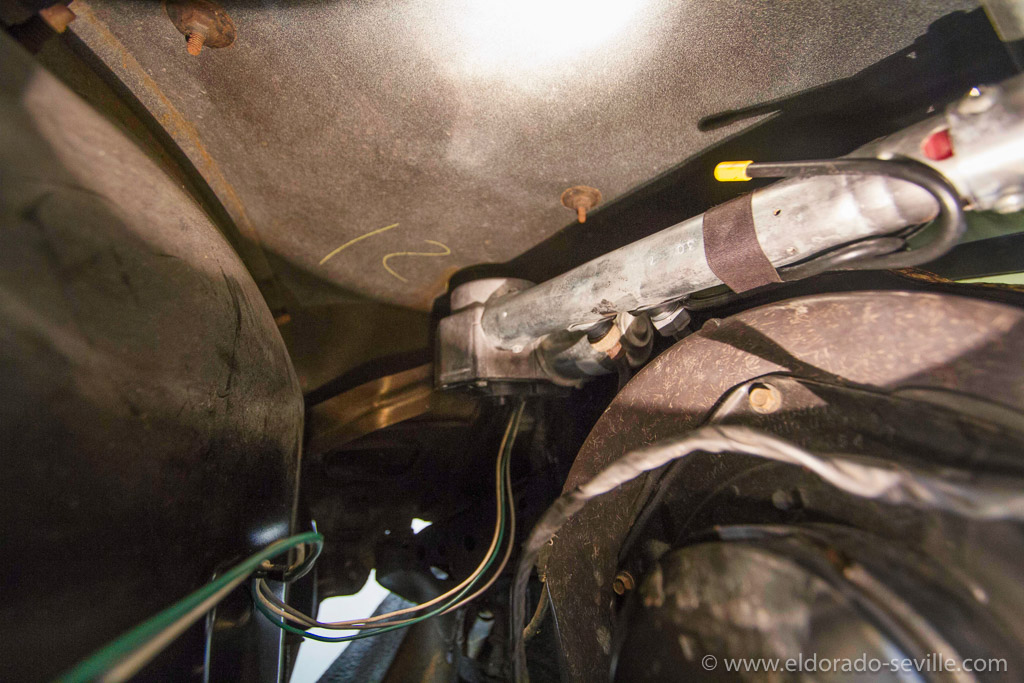
The new, correct antenna installed into the car.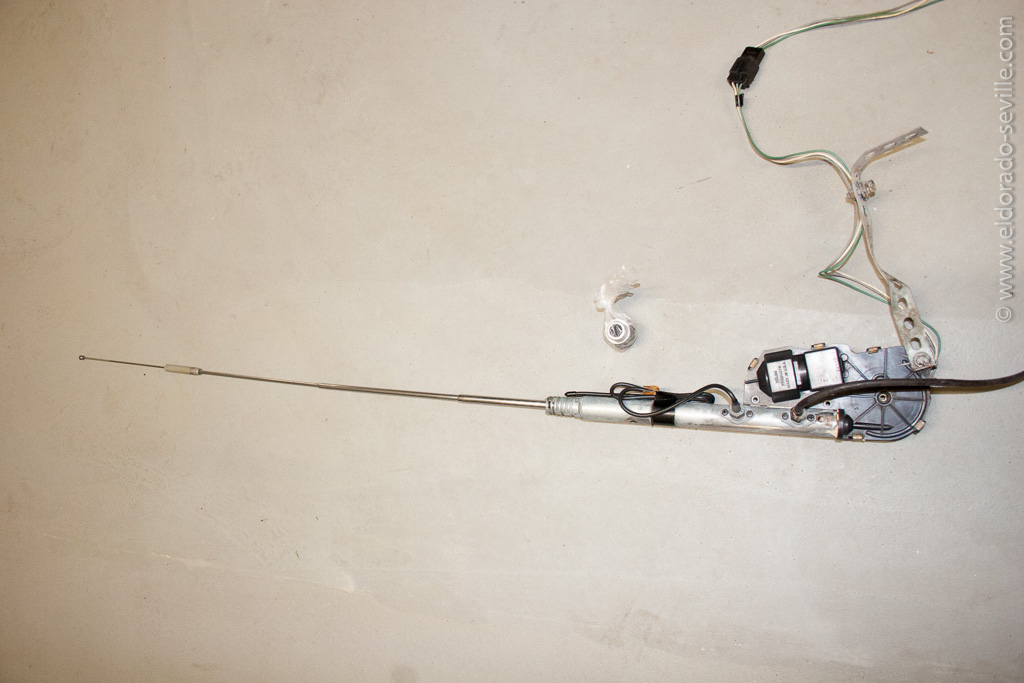
This is the incorrect CB antenna I got. It could be installed into a 78 Eldorado without any problem and would look 100% correct from the outside. It works perfectly smooth, and the chrome mast is in excellent condition. The load coil and the FM stub antenna are all there. The previous owner of this antenna removed it from a 78 Eldorado, but it would normally be correct for Buicks. If you are not such a purist as I am, you can buy it from me for what I paid for it. ($250 + shipping) It comes with all the necessary hardware to install it.
SANDBLASTING AND DRY ICE BLASTING/CLEANING THE UNDERCARRIAGE OF THE 74 CADILLAC
The paint shop wanted to have the undercarriage media blasted this time, to make sure that everything is 100% clean, and that the paint can stick to the metal much better due to a rough surface.
Personally I´m not a big fan of media blasting a non disassembled car, as so many things could go wrong and I do not recommend to do it to anybody else.
The paint shop really wanted to go this route though, and they said that they have a very experienced media blaster to perform the work.
They did tape the car for hours to make sure that the blasting media would not go close to any mechanical or fragile parts.
The blaster worked with very low pressure (1bar - 14psi) to get the old paint off and it really came off within minutes. He did not want to risk anything and so there were some areas with the old paint left after he was finished.
We then spent a whole day trying to get rid of the rest of the remaining paint, by hand. With 240 grit paper we worked on all the areas we could reach. After a whole day under the car it was clear that we could not reach all the areas and that the job would not be good enough.
I then contacted a dry ice blaster who took over to remove the rest of the remaining paint. Normally you cannot remove paint with dry ice blasting, but as the paint on my car´s undercarriage does not stick, it works. It took him a couple of hours to get everything off.
The undercarriage is now completely clean and back to bare metal once again. He even was able to remove some of the old undercoating in the rear wheel wells which the other dry ice blaster could not get off.
We will now degrease everything multiple times and then scuff all the metal. Then its time to mask all the necessary parts and repaint everything once again with 2k paint. I will keep you updated here on my website about the progress.
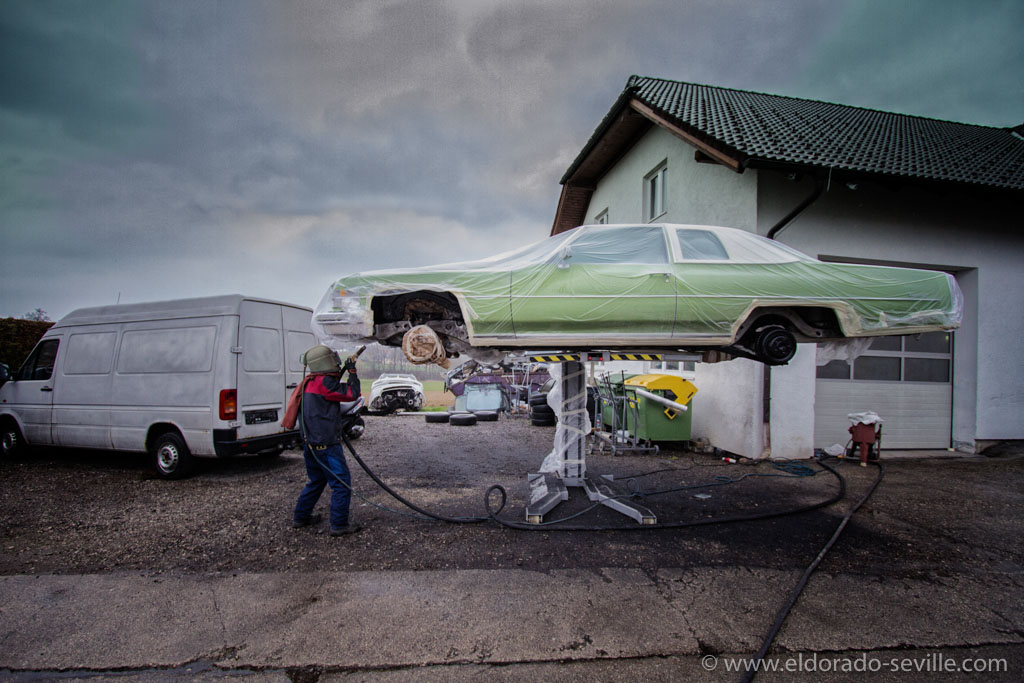
The media blaster at work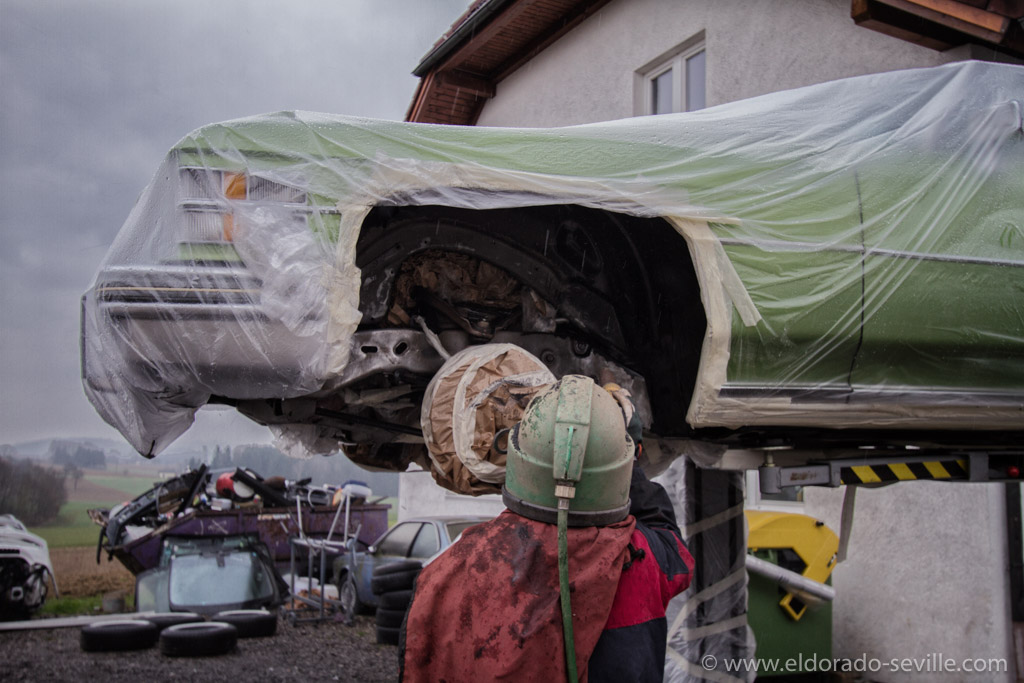
Media blasting the undercarriage.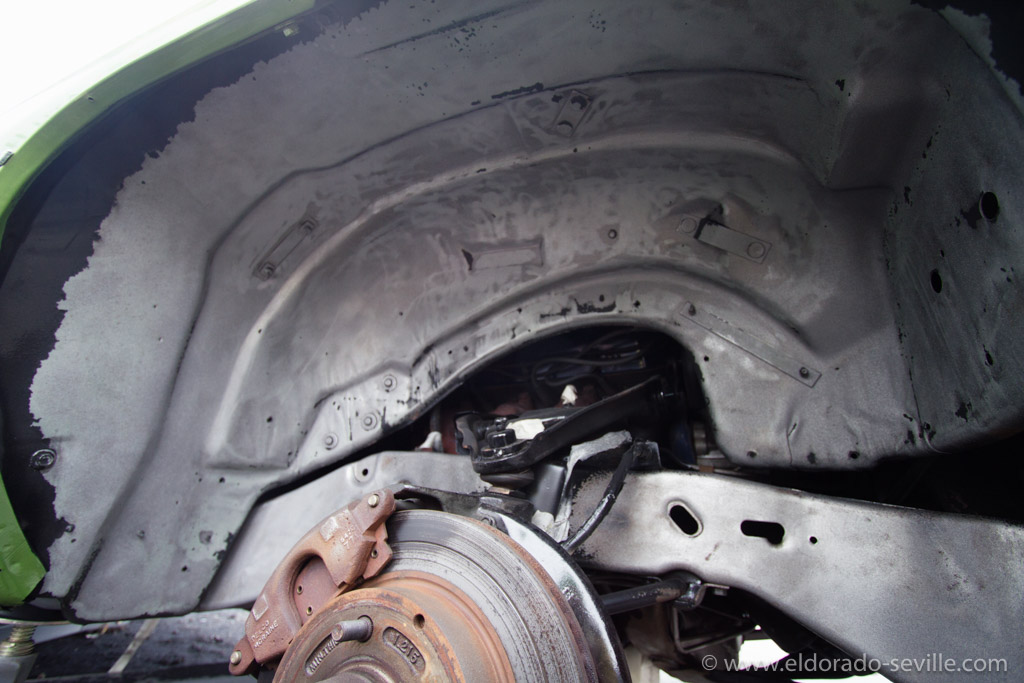
The bare metal wheel housing after blasting. The rest of the paint was removed later by hand and by dry ice cleaning.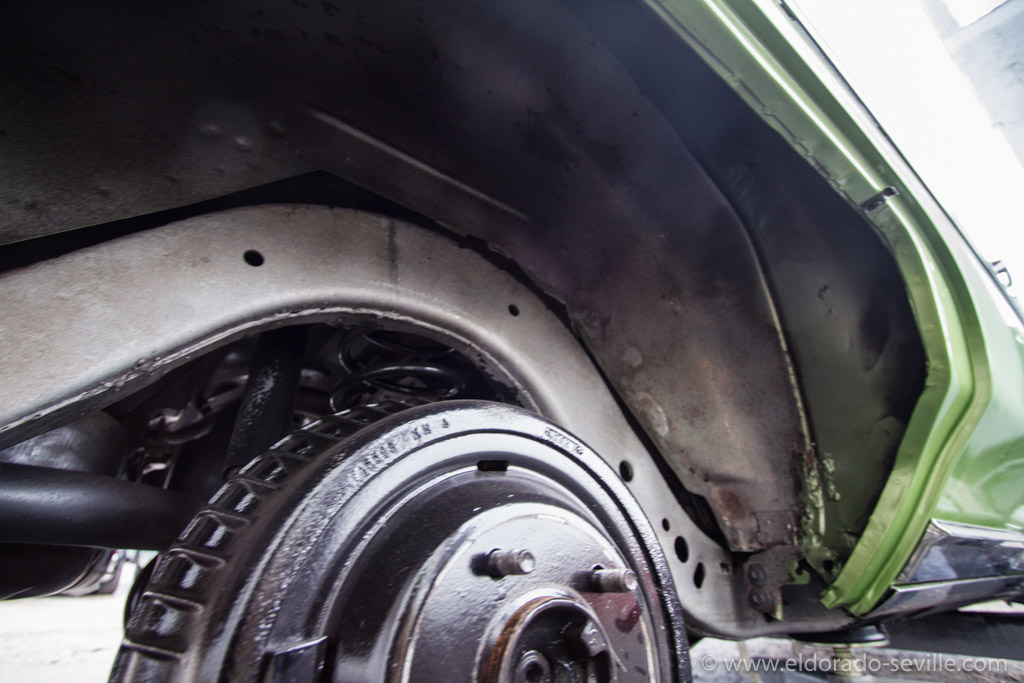
After blasting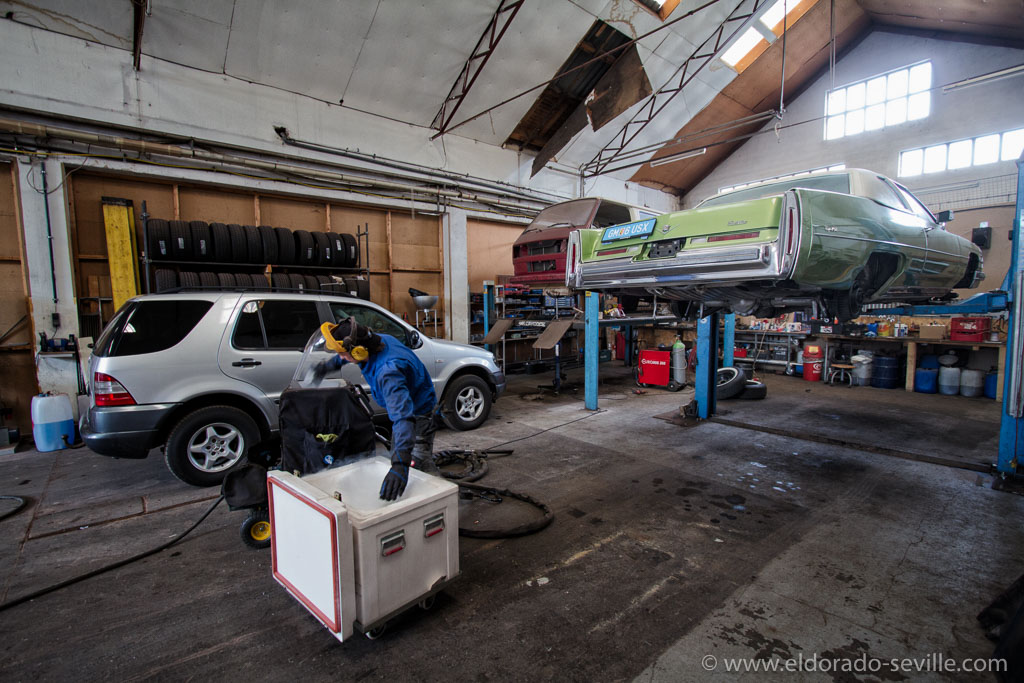
Ready for dry ice cleaning.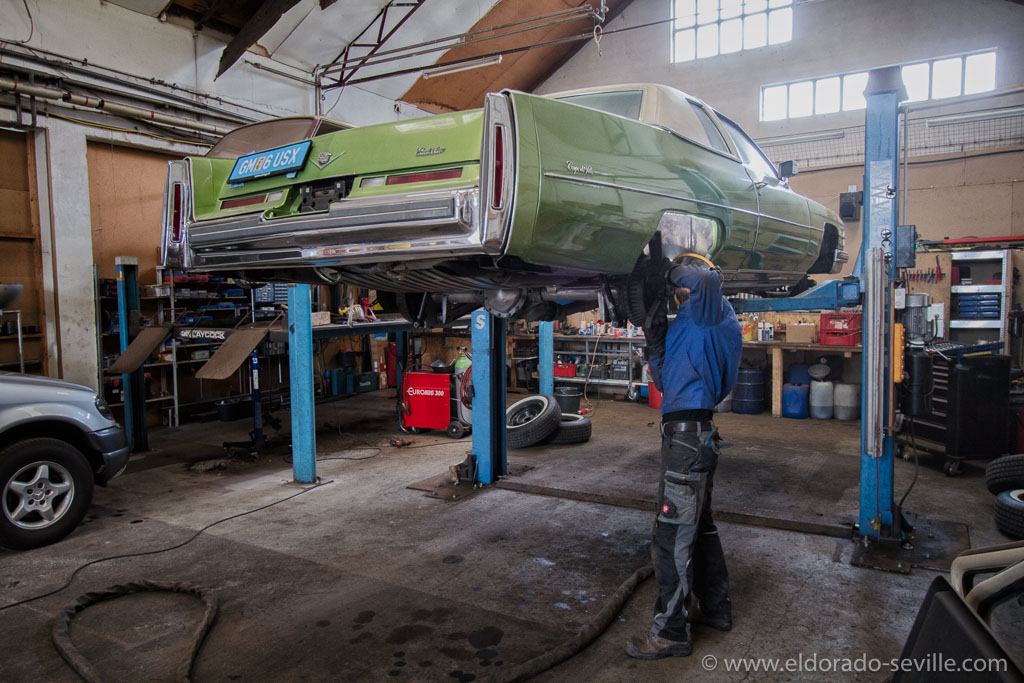
The dry ice cleaner managed to get the last undercoating out of the rear wheel housings.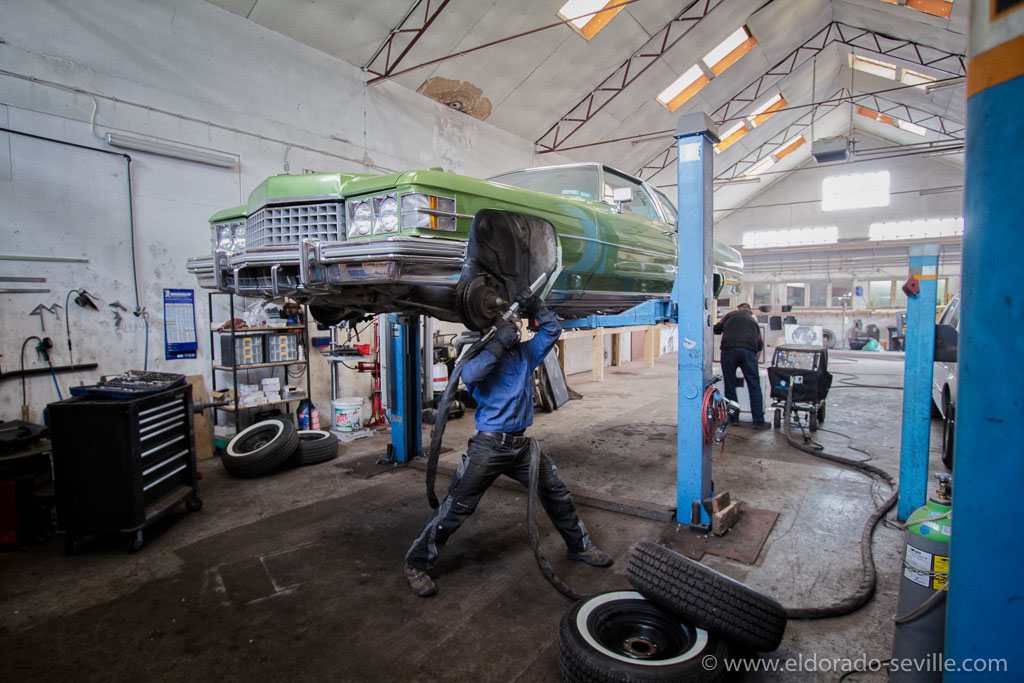
Dry ice cleaning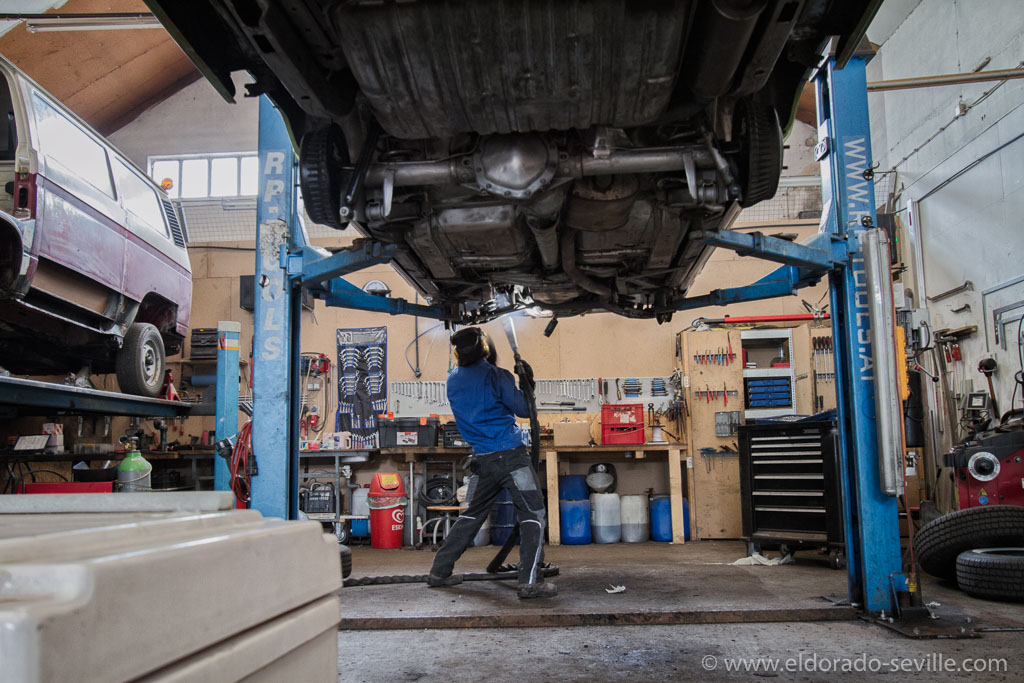
Everything is perfectly clean now.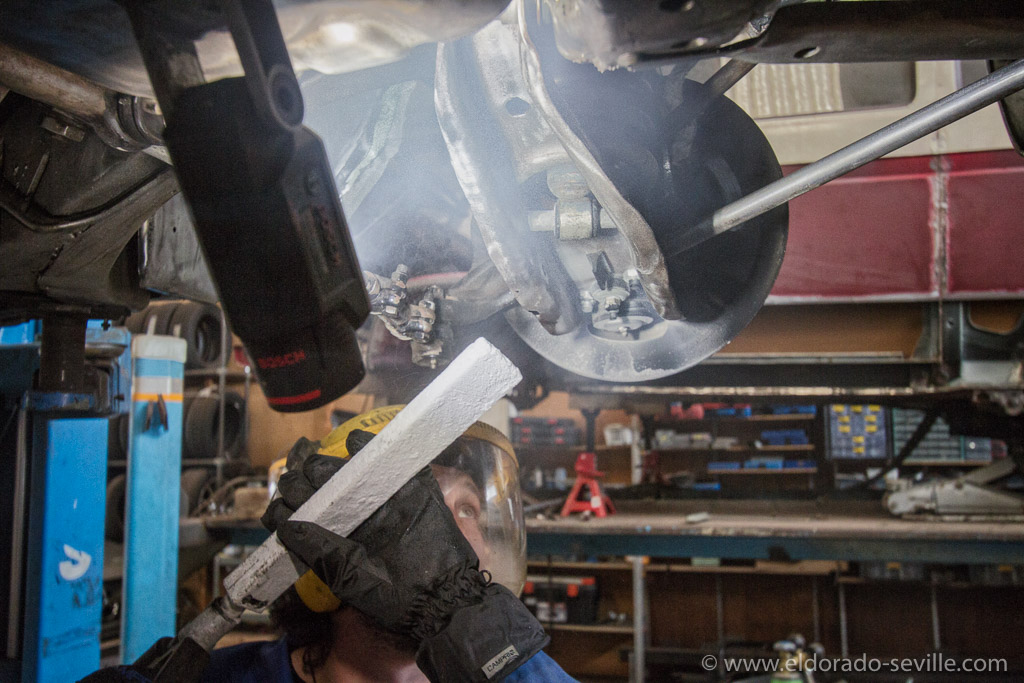
All the suspension parts were perfectly cleaned as well.
FLUSHING THE COOLANT OF THE 74
I first flushed everything with a cooling system flush chemical followed by fresh water and then I put in all new coolant (I used Prestone) and connected the heater core to the system again. Everything came out very clean, so I think that a good flush was already done a short time before I got the car.
It took a while until I got the air out of the system and the new heater core did not work at first. But after about 30 minutes of letting the car idle at about 2.000 rpm, the air was out and the AC finally blew out warm air.
Its great to have heat in the car again.
When I reconnected the heater valve to the heater core I needed a short piece of heater hose. I found perfect reproductions at Fusick - they look exactly like the original GM heater hoses with 5 ribs and are available by the foot. They are not exactly cheap, but perfect replacements if original appearance is important for you. They are also available in the correct size - 5/8 and 3/4. The smaller diameter goes from the heater core to the hot water valve.
By the way - Fusick has exceptional customer service , which impressed me very much. I will definitely buy from them in the future again.
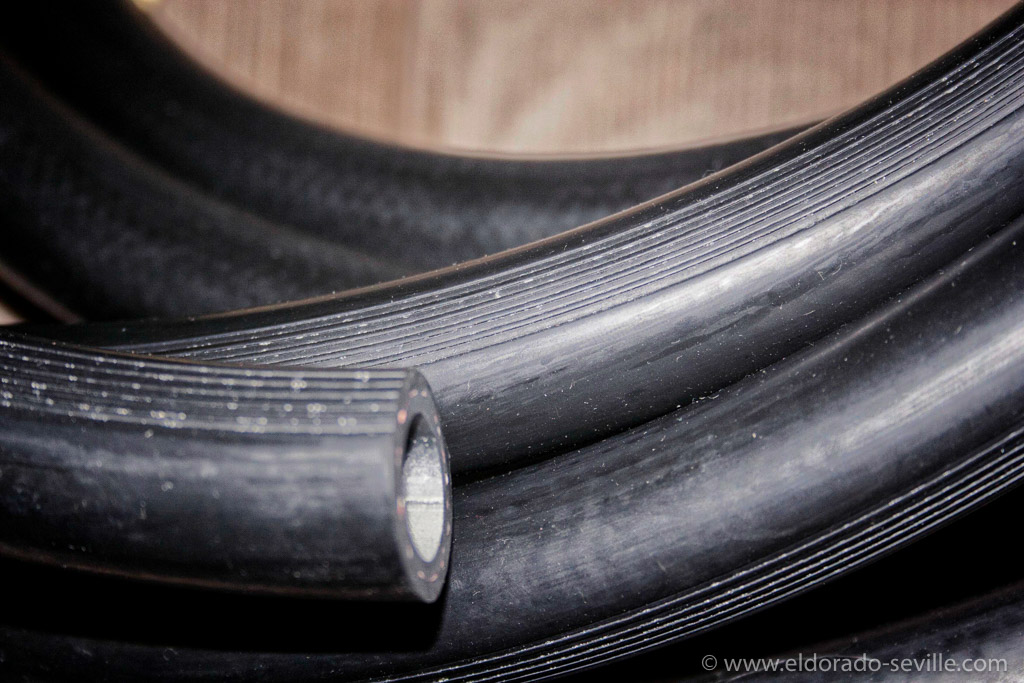
Fusick offers a perfect reproduction of the original ribbed GM heater hoses. The original heater hoses had 5 ribs just like these super nice reproductions.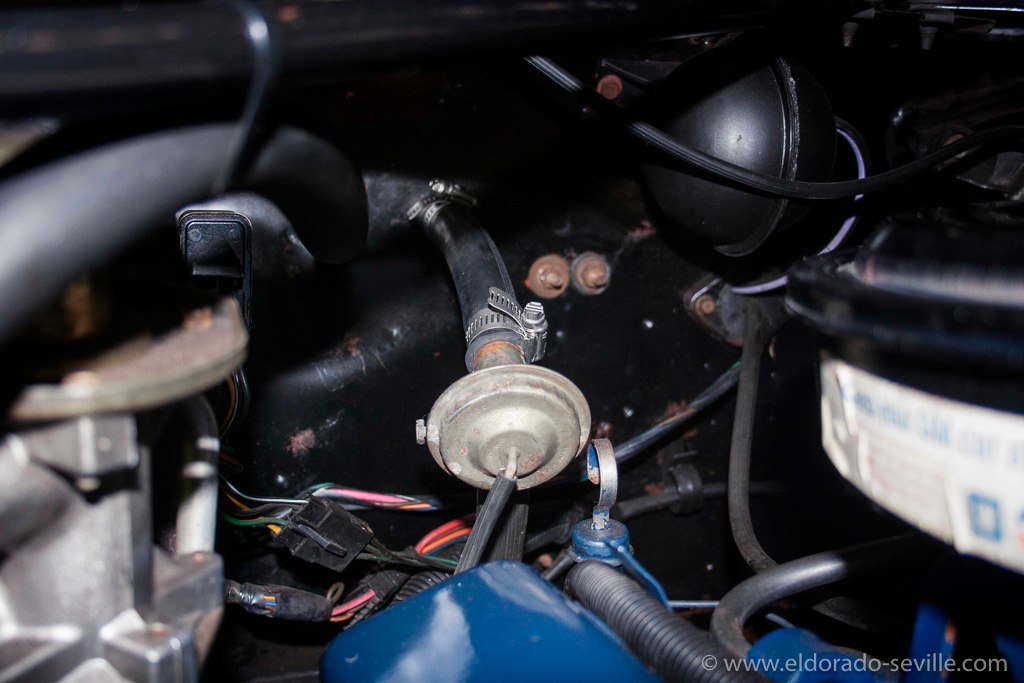
I re-connected the new heater core to the cooling system and used correct reproduction heater hoses to connect the original heater valve which is still working perfectly. The hose clamps are not the correct ones yet. I think there should be tower style hose clamps which I do not have at the moment. There is still an original one on the bottom of the valve and also one on the other heater hose, thats why I´m very sure that the other two clamps should be tower style as well. I have not found a perfect reproduction clamp yet, but I´m still looking…
PAINTING VALVE COVERS
The valve covers still wore their original factory applied Cadillac Blue paint which had suffered quite a bit over the last decades. Thats why I decided that I wanted to freshen them up.
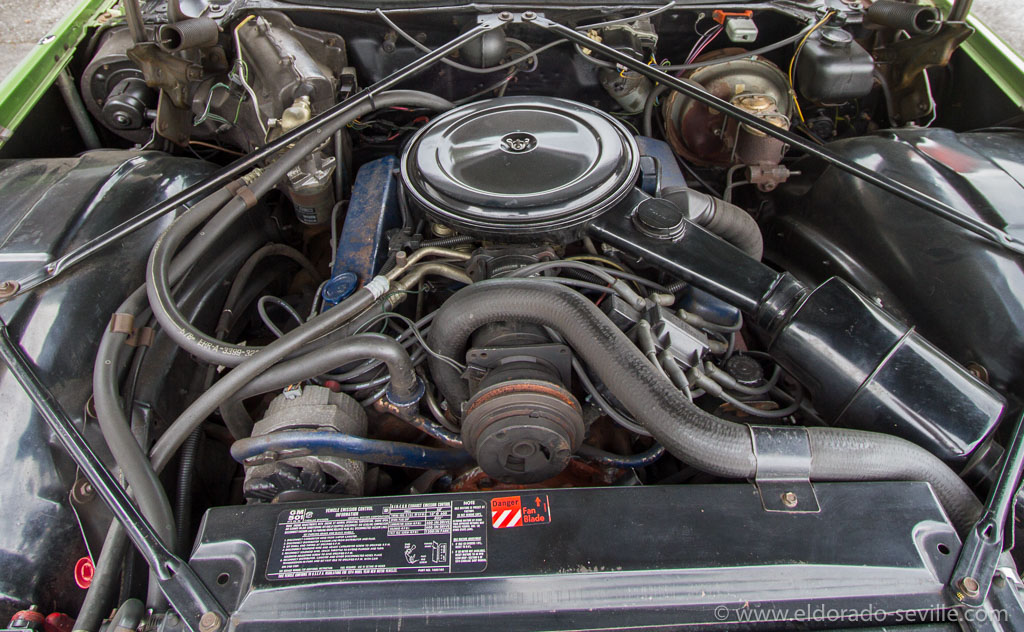
Thats how the engine bay looked like when I got the car.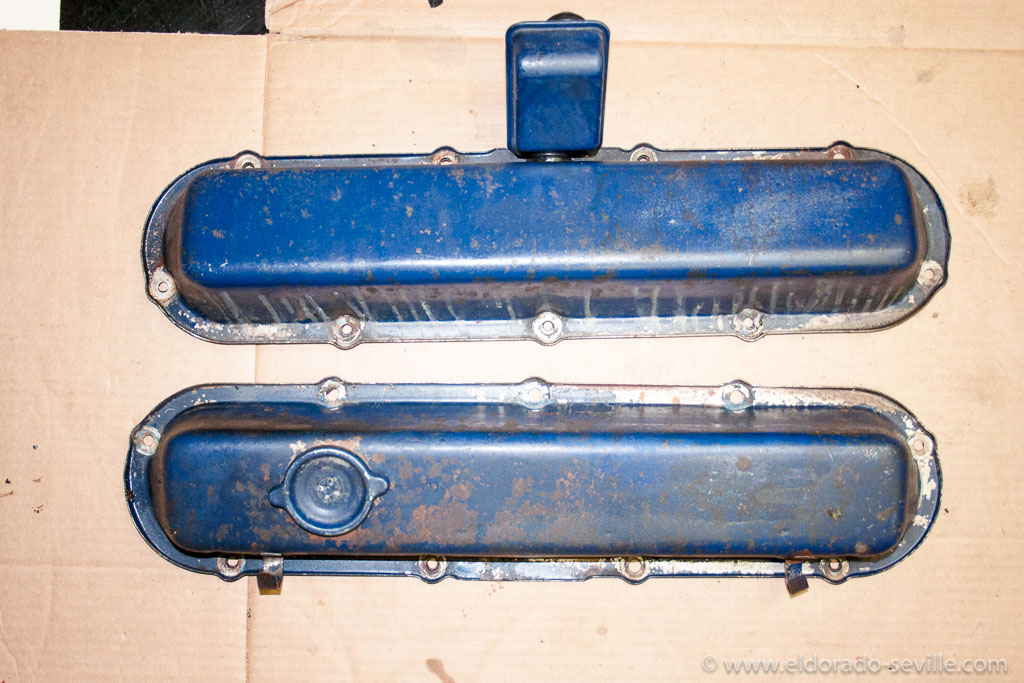
As you can see - the valve covers did not look too nice after all those years…
I bought "Bill Hirsch Engine Enamel" which is the perfect color match among all available engine enamels. Some others are good matches as well, but its said that Bill Hirsch is perfect. Also it seems to be the most durable engine enamel on the market.
The color match is really absolutely spot on. The only "issue" I had, was that the enamel is not exactly easy to work with. I have to admit that I´m not very good in spray painting, so I had to do the covers 4 times until I was happy with them.
I always had some paint runnings or dirt on the covers after spraying on the paint what is of course my fault.
Normally you can wet-sand imperfections out of the paint, but thats not possible with this enamel. You also cant spray over the paint to correct problems as the new paint will eat up the old one and damage it permanently. Its also drying extremely slowly and is extremely soft, so you can get scratches even with a microfiber cloth if you are trying to clean them.
It can take up to 4 months until the enamel is fully cured and hard.
These are things you have to be aware of if you are using this high temperature engine enamel.
I still highly recommend Bill Hirsch Enamel and I would not use anything else on my cars.
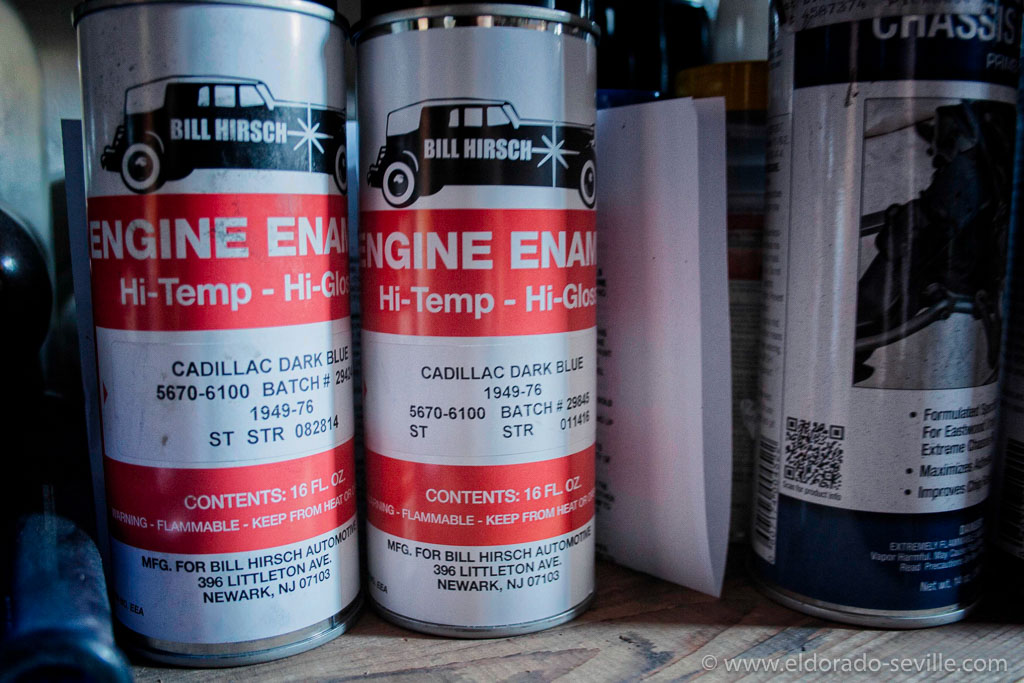
Bill Hirsch Engine Enamel - the perfect color match for the original Cadillac dark blue that was used from 1949 to 1976. Make sure to read the instructions before using this enamel - its quite different to use than other paints…
When I took the covers off my car, I media blasted them, as there was some rust on them where the paint has come off. I then used several coats of filler primer and wet-sanded between coats to fill up the former rust pores. So I got a perfectly smooth surface again.
In the meantime I thoroughly cleaned the surfaces on the rocker arms where the gasket was, to make sure that I would get a good sealing once a new gasket was installed.
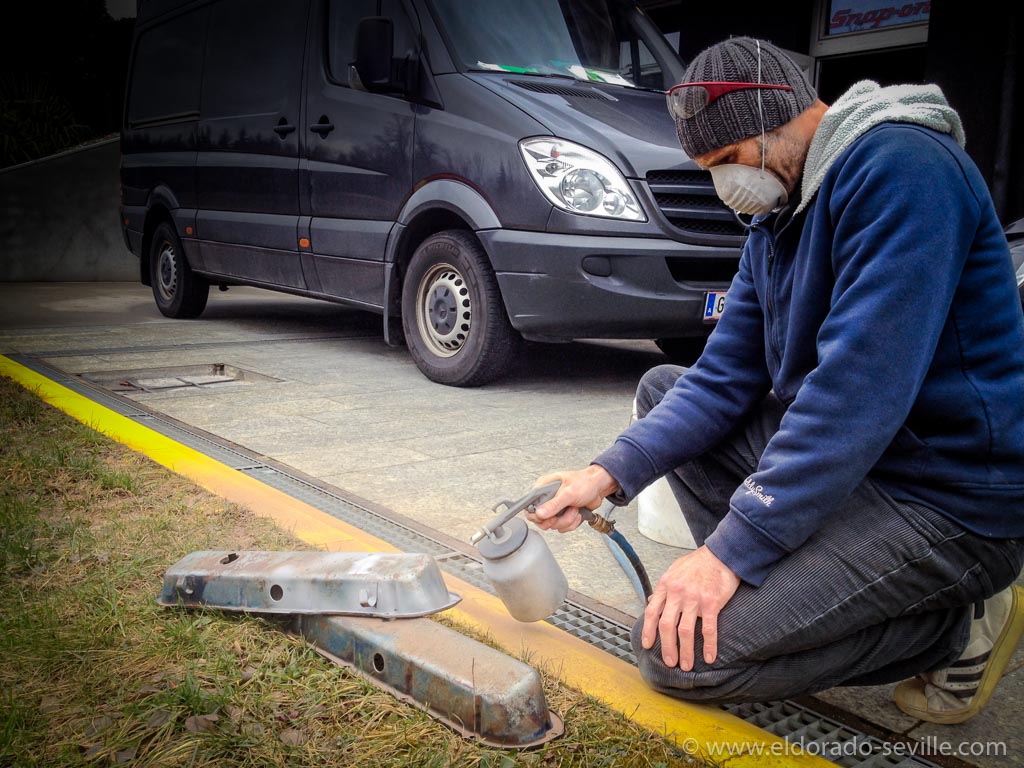
My friend Richard trying to media blast the covers.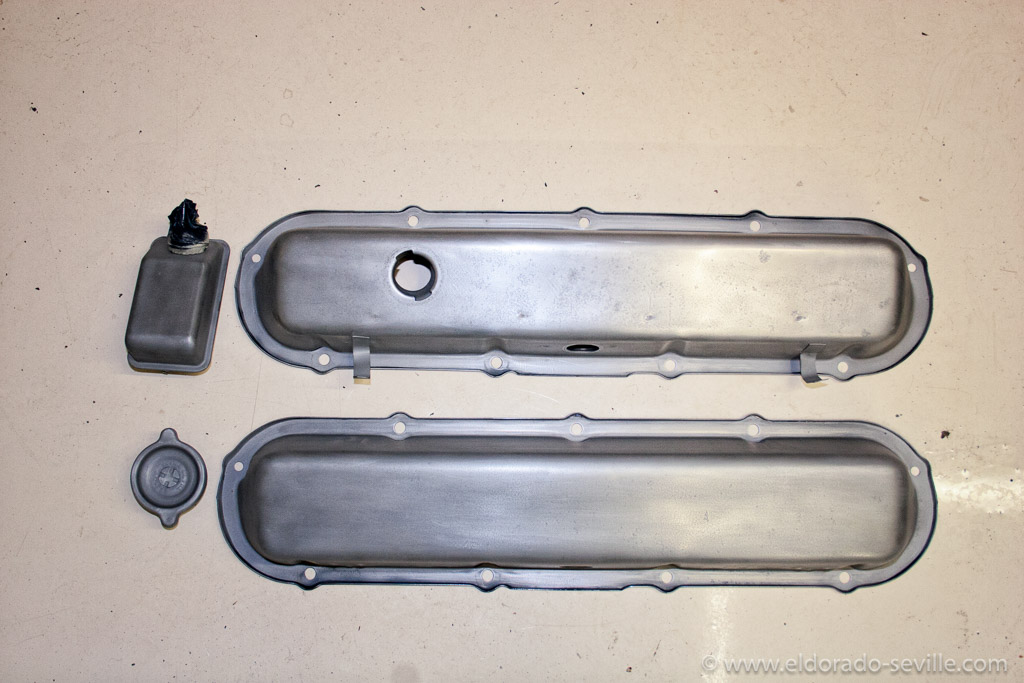
Completely rust free after sandblasting - but one can see where the rust once was…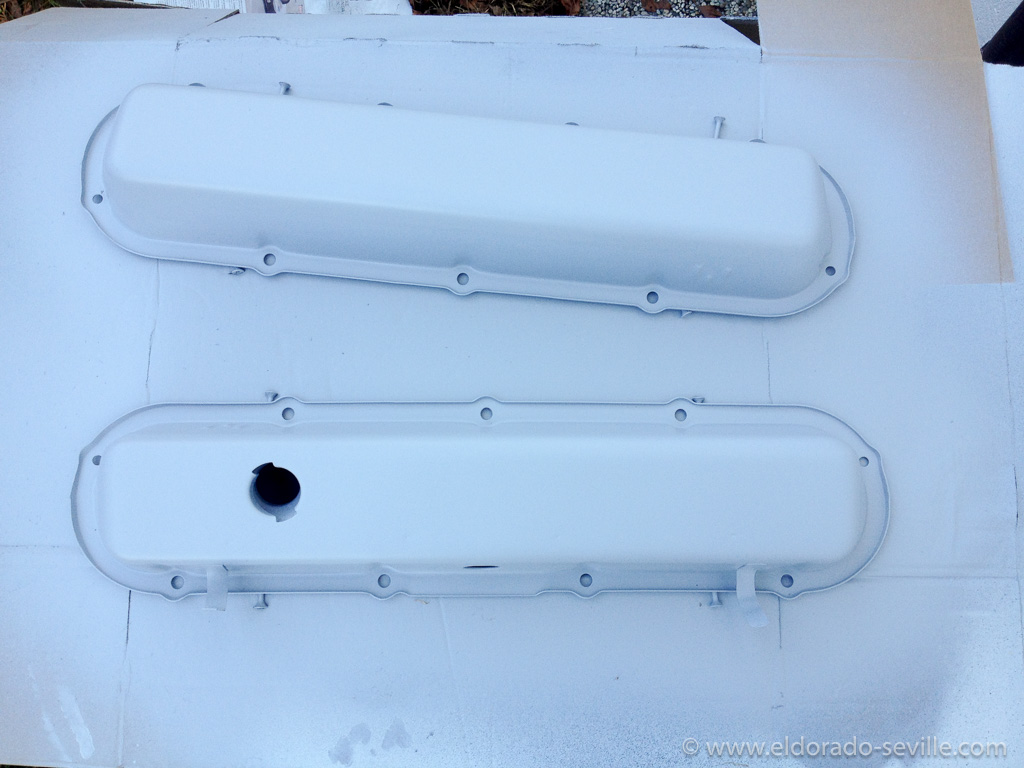
I applied several coats of filler primer and sanded the covers to a perfectly smooth finish.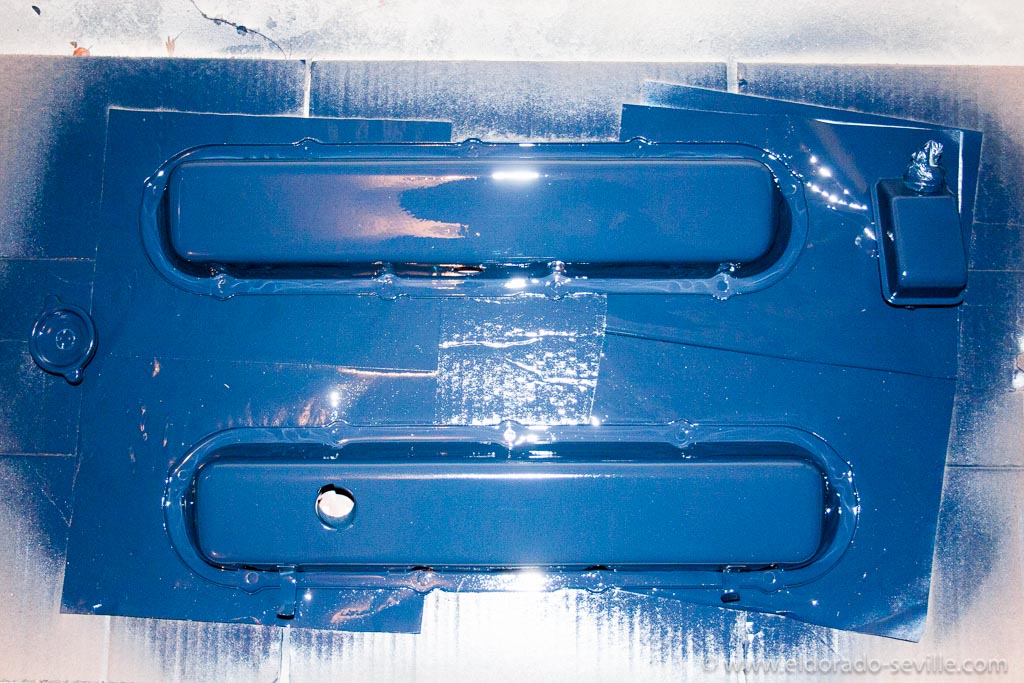
After spraying them with Bill Hirsch Engine Enamel…
After the application of the engine enamel I let the covers dry for 2 weeks before I installed them back into the car. I made sure that the new cork seal was well seated and tightened the screws carefully. You only have to tighten them to 3nm - thats only hand tight. After the first test run they seem to seal perfectly.
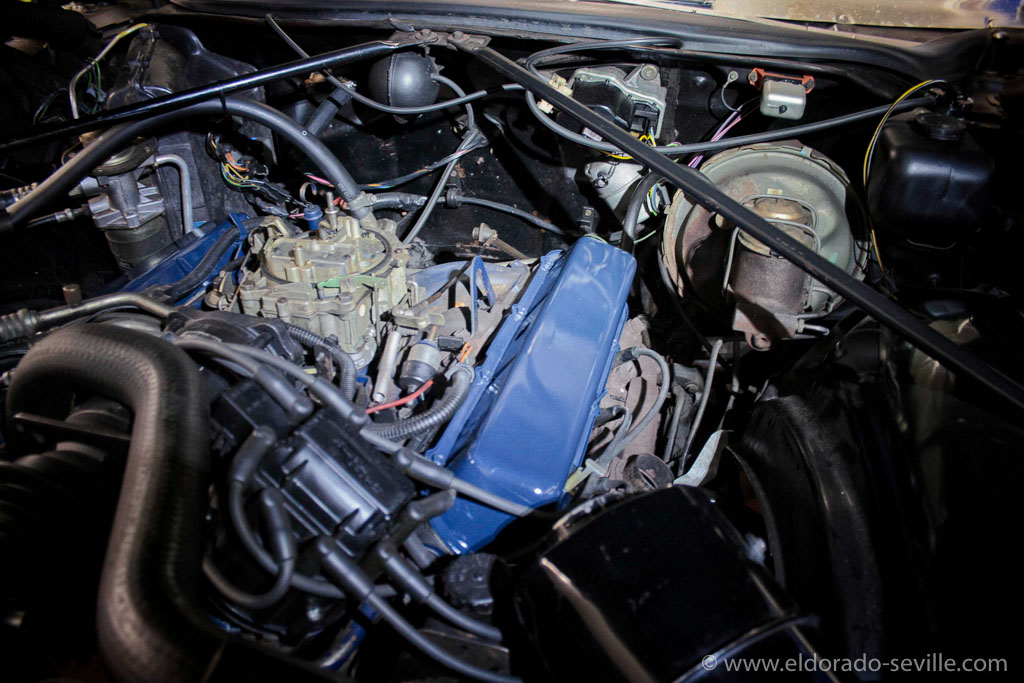
Back in the car.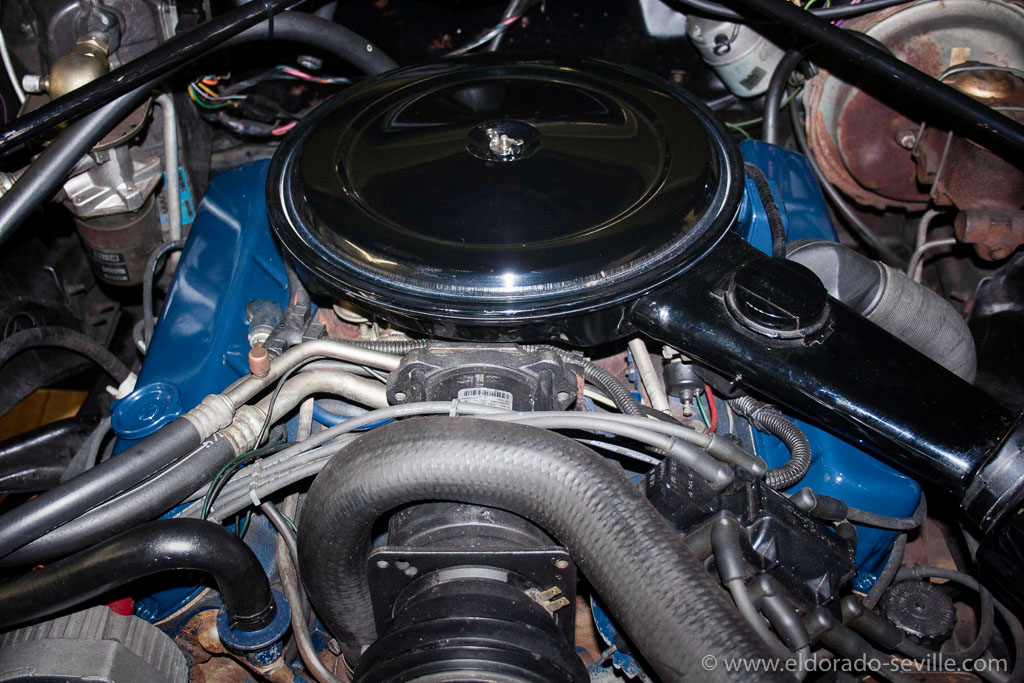
Back in the car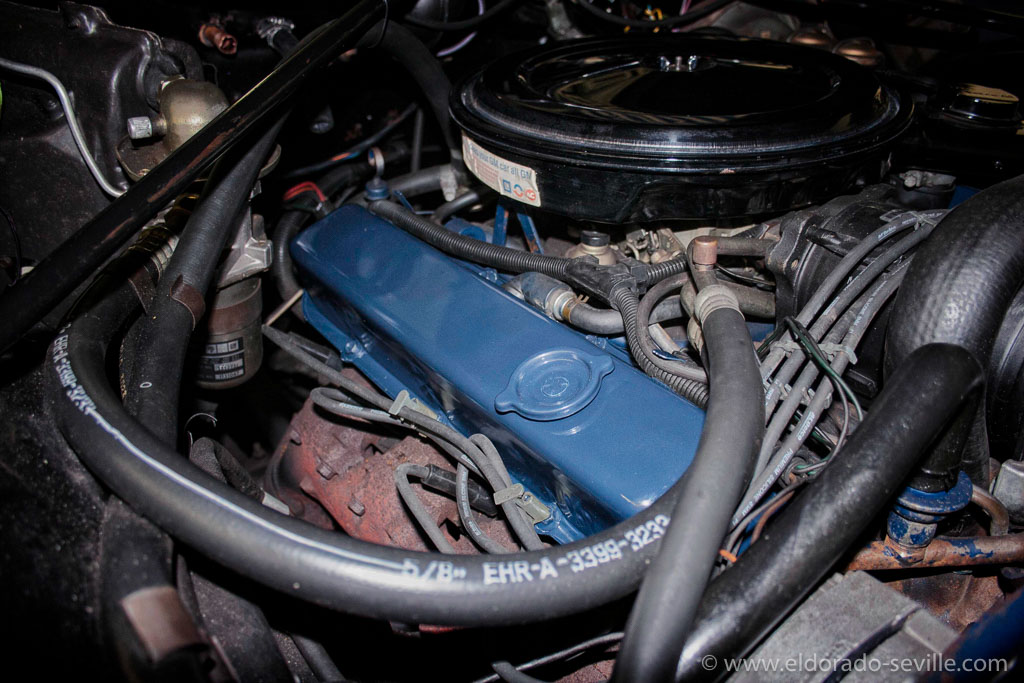
Back in the car - as you can see there are some more areas which could use some fresh paint as well. I will do that later,
1974 CADILLAC SPEAKER REPLACEMENT
I have to repair my radio anyway (see here) as it does not work properly. My friend Steve who is so kind to repair the radio for me already found out that the radio had a defect which caused the speakers to burn through.
So it was clear that I would need new speakers for my car.
In the past I already had to install replacement speakers in most of my cars. I´m always replacing them with replacement speakers from Turnswitch. They do have some really good reproduction speakers which fit perfectly with only minor modifications necessary. I have dealt with them a couple of times and they are always extremely helpful and friendly and their speakers are great. That is why I can truly recommend them and will use them again if I ever need some speakers in the future.
If you have a stereo/tape radio you need their round 3 1/2" speakers with the block cover to be able to reuse the factory mounting clips for the front speakers in the dash.
The mounting ears have to be cut off and the speaker is then held in with the wire clips used on many GM applications.
The cover blocks are the shape of the original magnet structure and go over the magnets for the wire clip. They are made of wood and you have to glue them onto the speaker in the same orientation as the original magnet. Also make sure that polarity is correct - for some reason it's exactly opposite to the original speakers and you have to connect the positive cable (green or blue) to the speaker lead with the red dot. On the original speakers the wires on the front speakers were soldered on - I re-did it with connectors on the new speakers as they are easier to install and to remove with them.
The new front speakers do not have a dust screen on them, so I carefully removed the screen from the original speakers and glued it to the replacements speakers. So they are protected now and it looks factory correct as you could see the missing screen through the speaker grilles on the dash.
To remove the left speaker and install the new one you have to remove the AC hose to get access to the speaker. The speaker cables are relatively short so be careful not to damage them when you pull the speaker out.
For the rear speakers you need their 6x9 speakers which come with a dust screen already installed.
Here you need to do some more modifications as the original speakers have an additional bracket with a bolt, which holds the insulated cardboard cover in the trunk in place. Without this bracket you cant install this cover.
I carefully drilled out the rivet which holds the original bracket in place and also drilled a hole into the metal frame of the new speaker. I then used a small bolt and nut instead of a rivet to install it onto the new speaker. This works really well, but you have to be extremely careful when you drill this hole as you can easily damage the membrane of the speaker underneath if you drill too deep … (I made this mistake when I drilled out the rivet on the old speaker and immediately had a hole in the old membrane…)
The terminals of the rear speakers were connected with a special connector which you can´t reuse with the new speakers unfortunately, so I had to cut the wire and install a supplied connector instead. On the rear speakers you also have to ground the negative terminal to the car. A short ground cable to do this properly is also supplied with the speakers.
Then you can screw the speakers back into the car and connect them.
Here is some more useful info about replacement speakers from the turnkey website:
"Many replacement speakers now sold by the discount stores, auto parts stores and mail order restoration parts houses are labeled as "4 to 8 ohm compatible" and are in fact 4 ohm speakers. These speakers can damage the older transistor radios. 4 ohm speakers will measure around 3.2 ohms with a DC ohmmeter. An 8 - 10 ohm speaker will measure around 7.4 ohms with a DC ohmmeter. The DC resistance is the critical number for the Delco radios as the output transistor is in series with the speaker. A properly operating Delco radio should have 1.5 volts DC across the speaker voice coil. A 4 ohm speaker will draw twice the current of an 8 ohm and cause the amplifier transistor (the half dollar size device mounted to the black finned heat sink on the back of a Delco radio) to run very hot. The speaker cone should be displaced in an upward (away from the magnet) direction about 1/8" when a Delco radio is turned on. If the cone moves down toward the magnet, the speaker leads need to be reversed".
I´m looking forward to installing the hopefully eventually repaired radio into the car and to test the sound of the new speakers. They should normally sound a little better than the original ones.
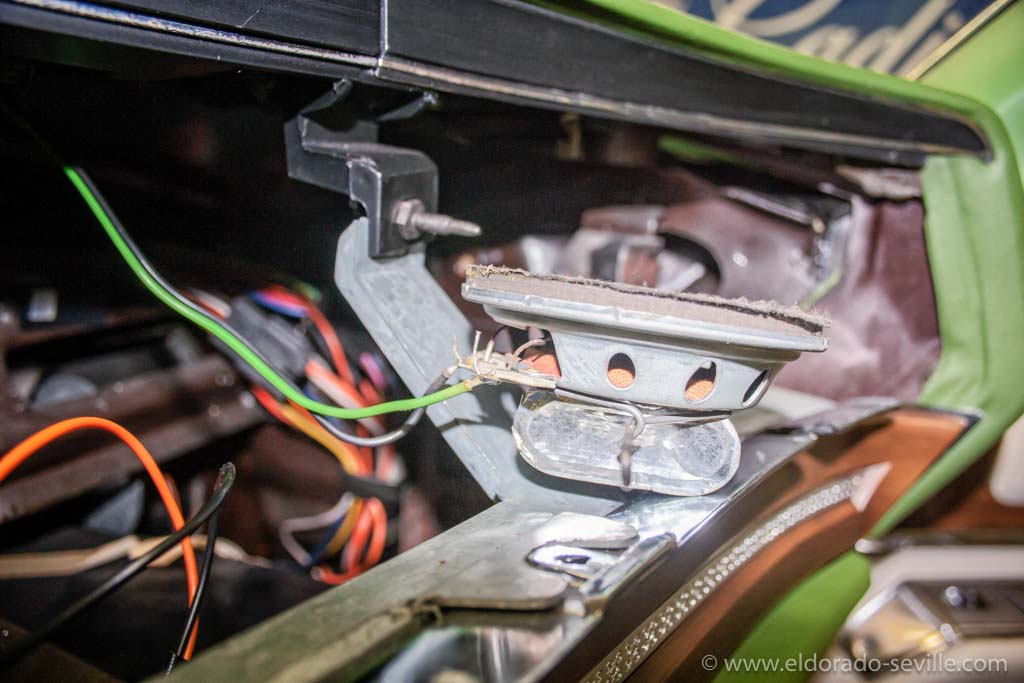
The original right front speaker unclipped from the car.
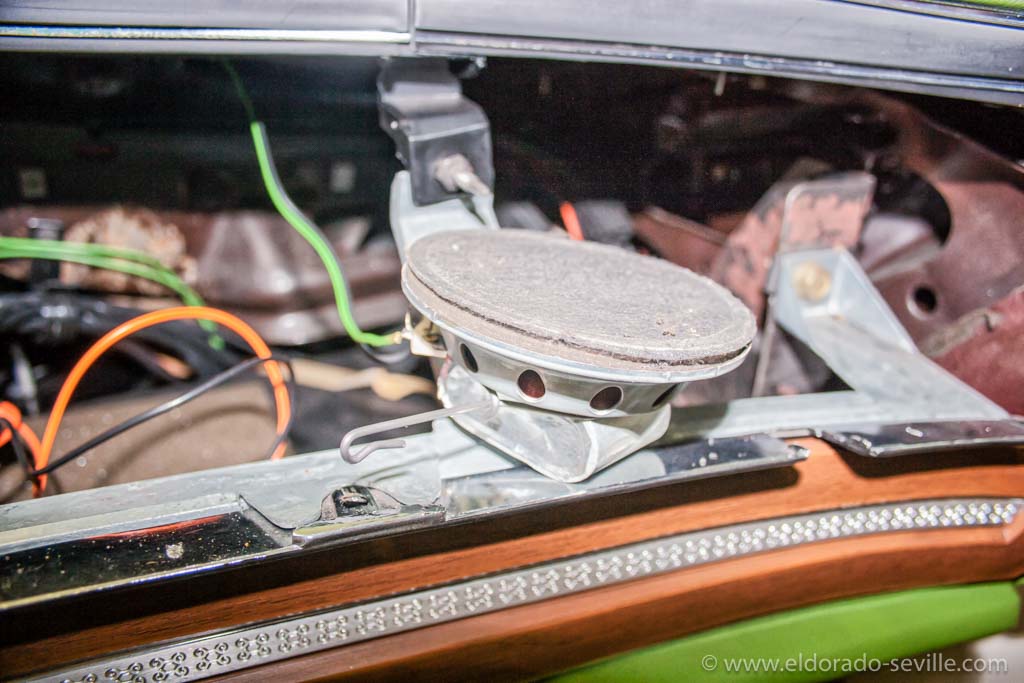
The original right front speaker unclipped from the car. Here you can see the original dust screen which you will have to reuse with the front speakers.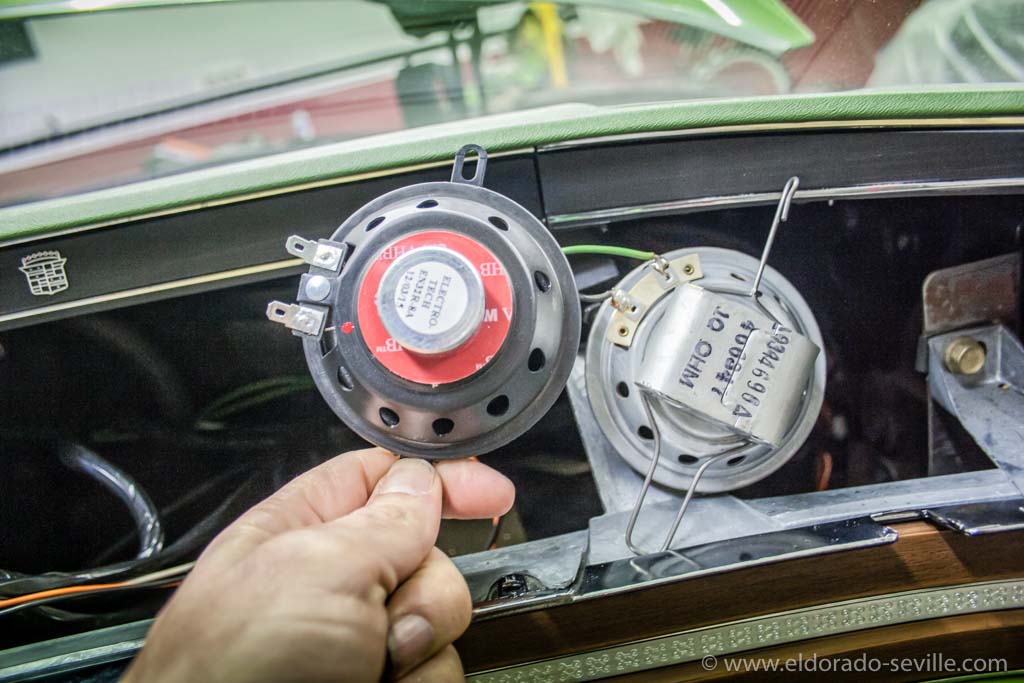
The replacement and the original speaker, as you can see the magnet looks different and you have to cut off the mounting ears.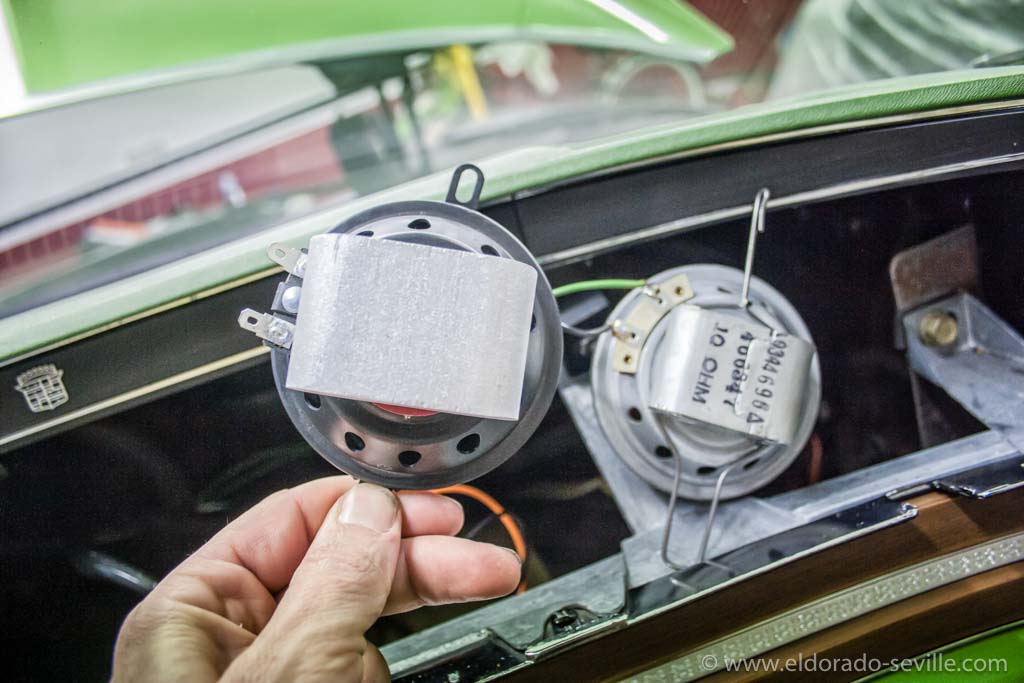
The replacement speaker with the cover block installed. You have to order it separately for your Cadillac.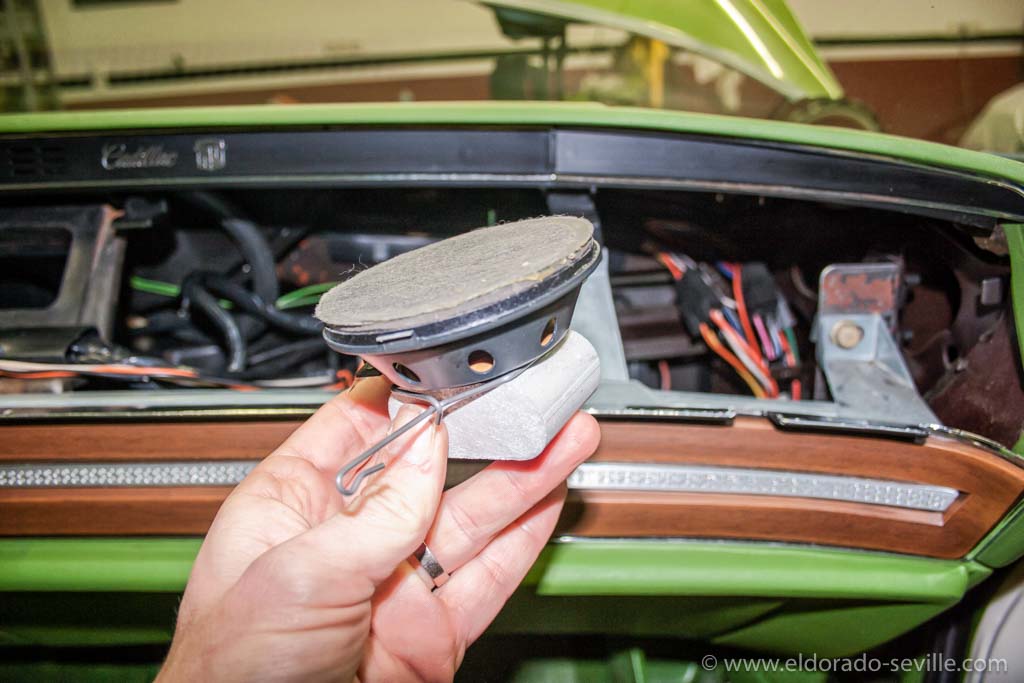
The replacement speaker with the old dust screen installed.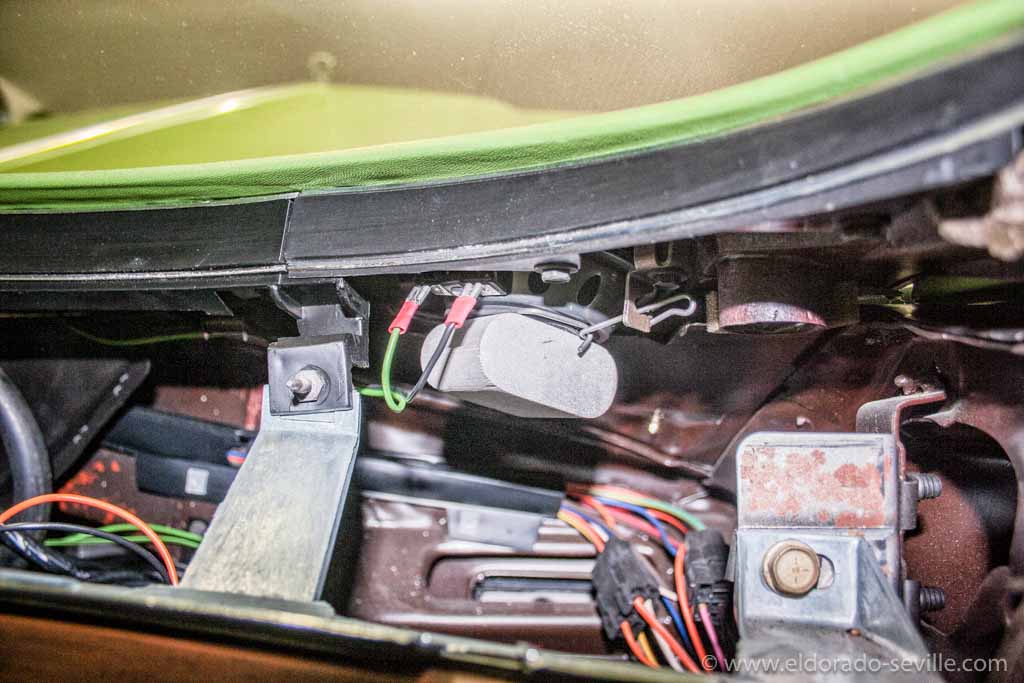
The new speaker back in the car with the supplied connectors.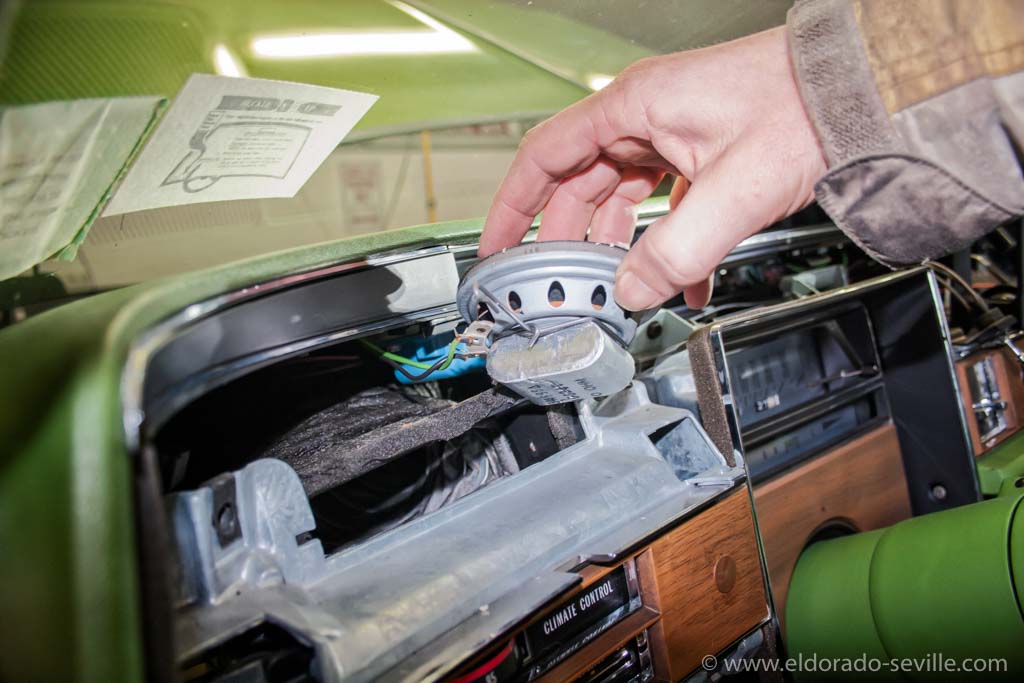
The original left speaker removed - you have to remove the AC hose to get to it.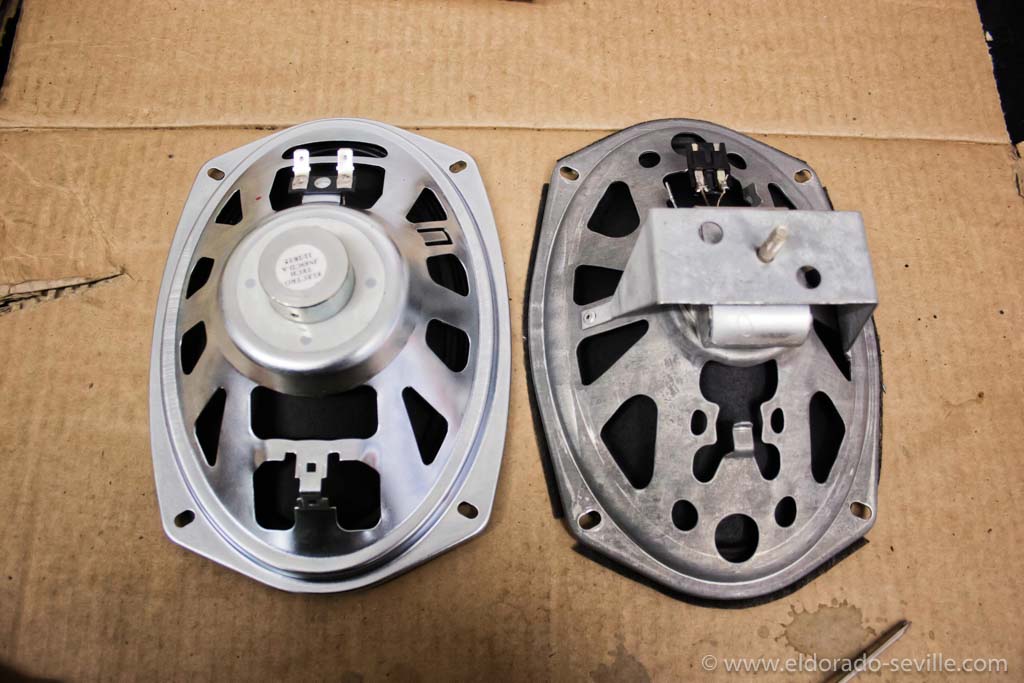
The replacement 6x9 speaker and the factory installed original speaker. Note the bracket - you have to move it to the new speaker and install it there.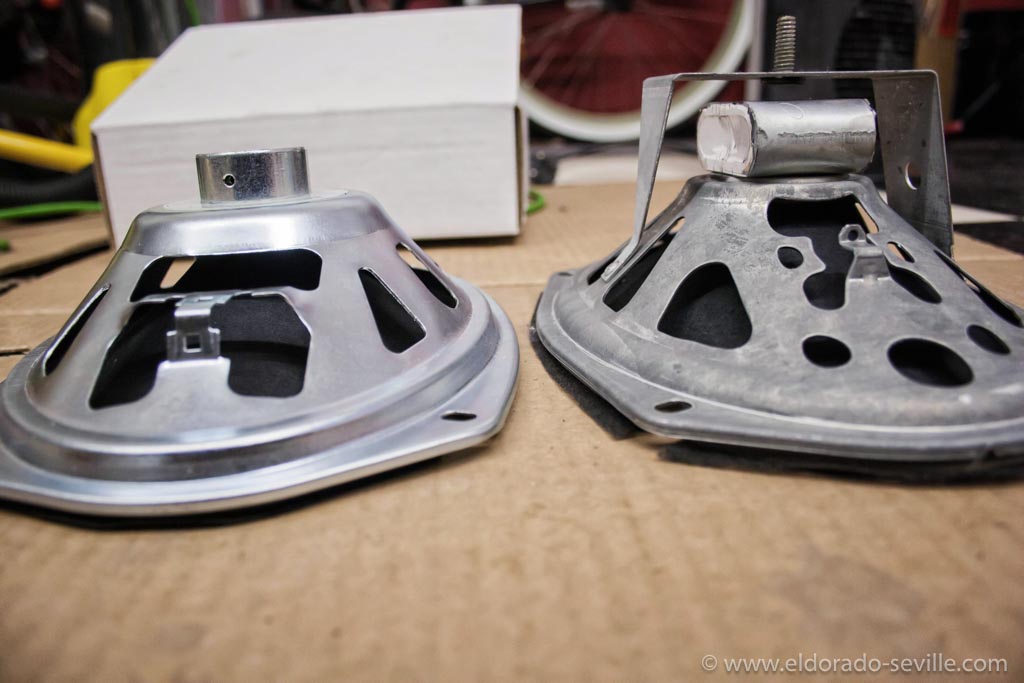
The replacement 6x9 speaker and the factory installed original speaker. Note the bracket - you have to move it to the new speaker and install it there.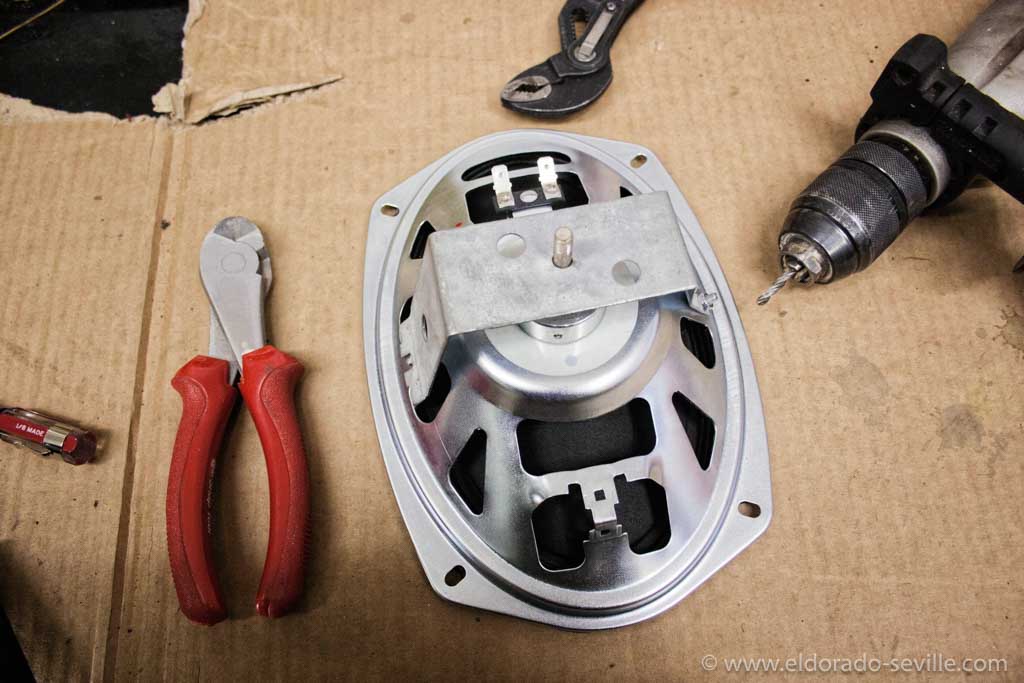
I drilled out the rivet to be able to remove the bracket. Be extremely careful when you drill it out!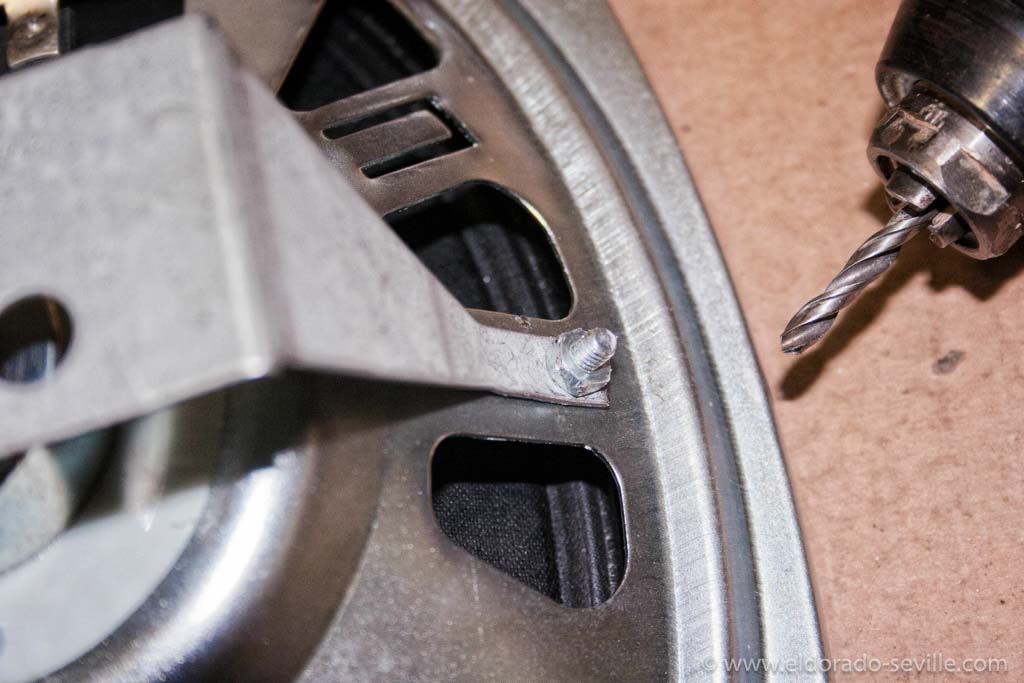
Instead of the original rivet I used a short bolt to install the bracket to the new speaker.
1974 CADILLAC FRONT BUMPER ENDS REPLACEMENT
To remove and to install them you only have to remove two nuts at each bumper. You can reach the one on top from the top of the grille. To get to the other one you have to remove the center splash guard in front of the radiator. You only have to loosen two clips and put the rubber away to get access to the two remaining nuts.
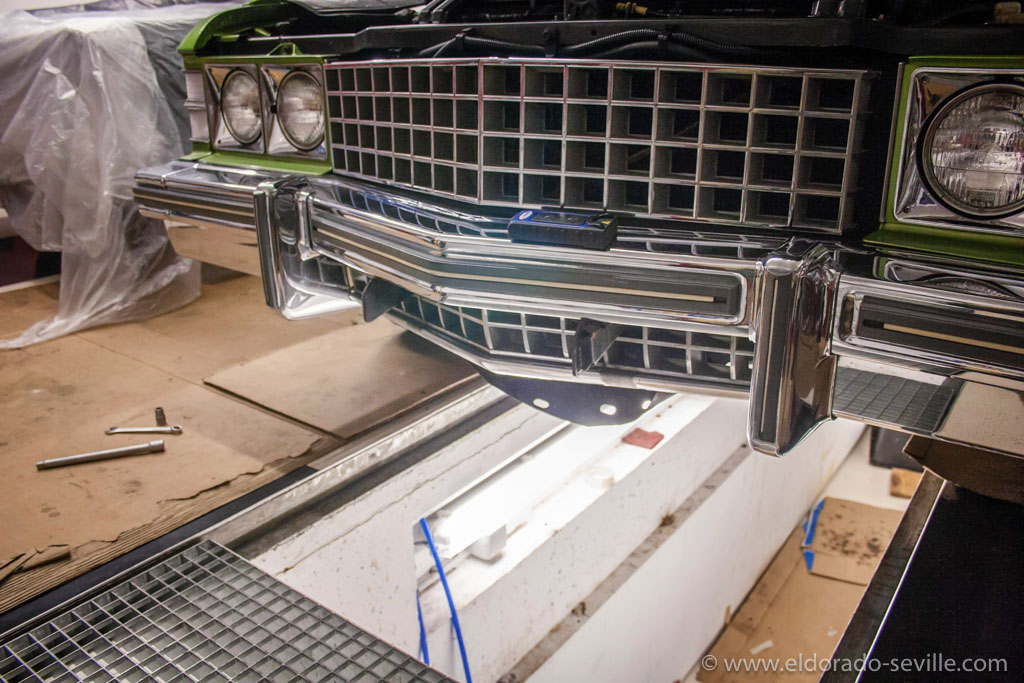
Here I have already removed the original center bumper ends.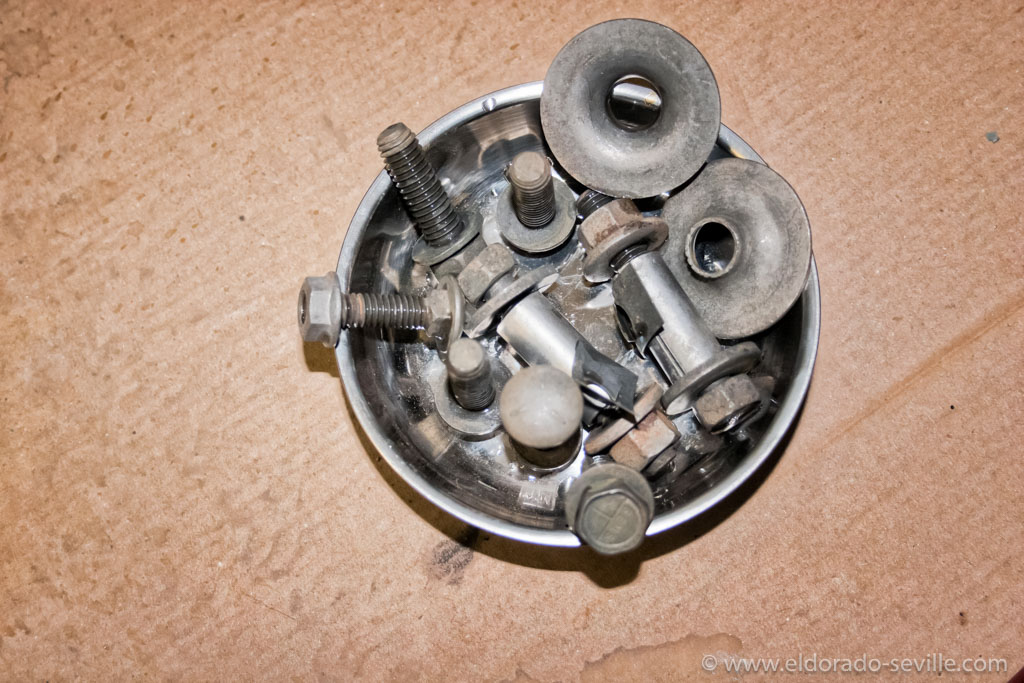
I cleaned the rusty hardware before I put it back together.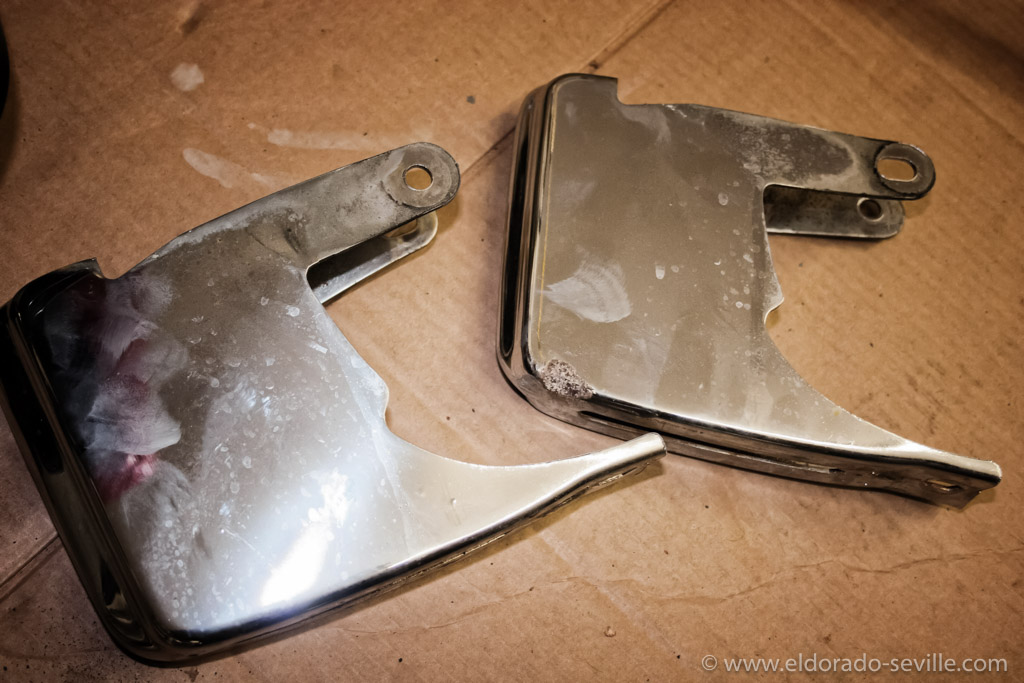
The old bumpers removed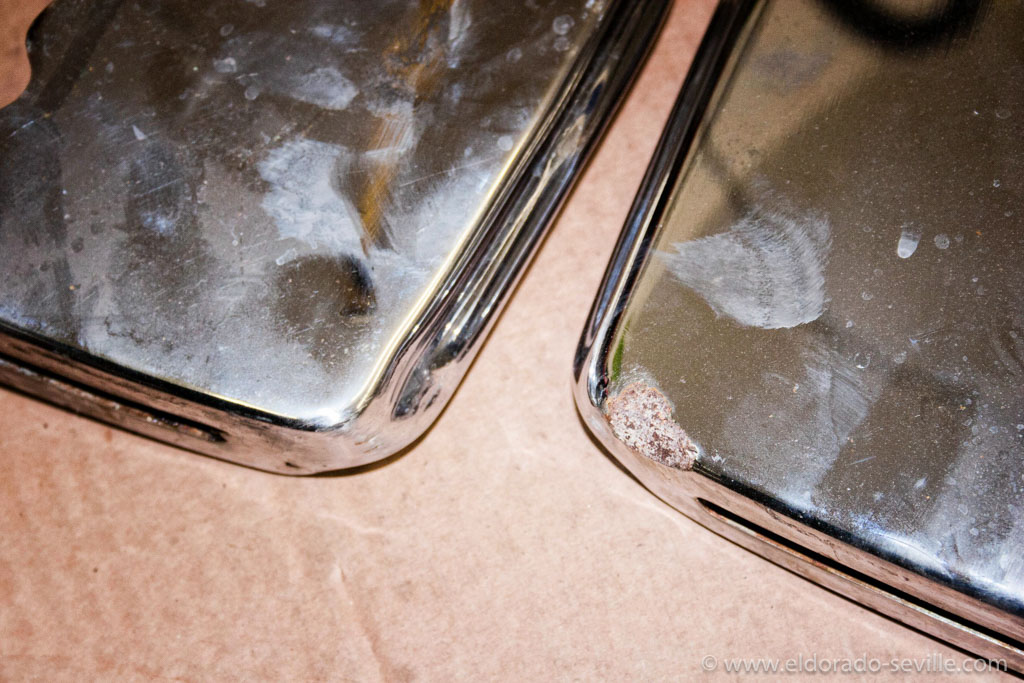
One of the bumpers had deep scratches and the other one was bent and had some dents.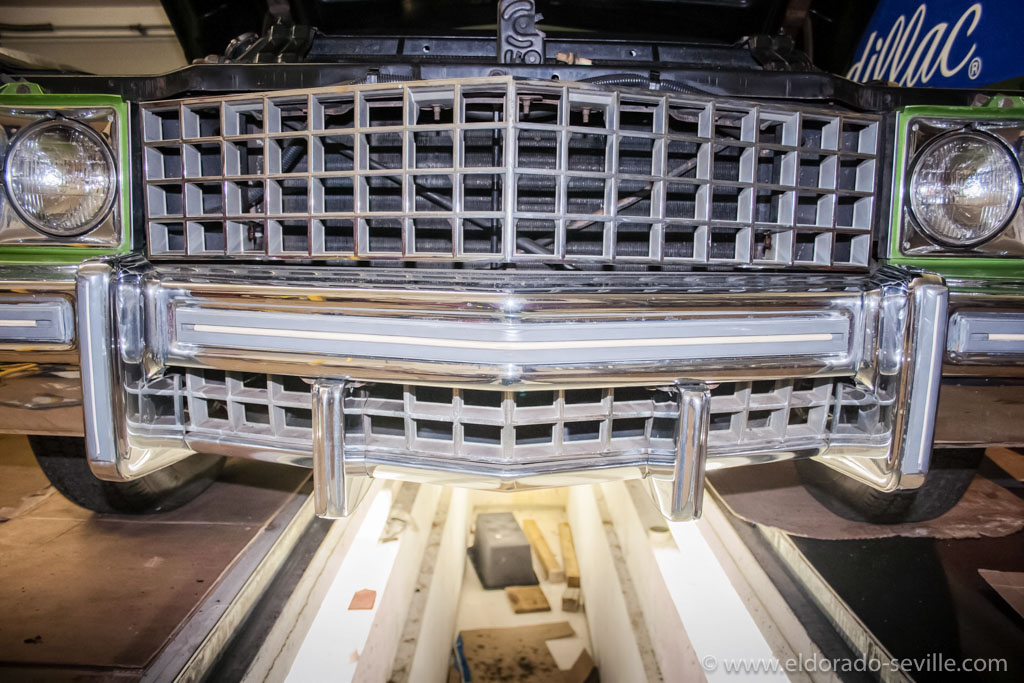
The "new" bumpers in place.
1974 CADILLAC DIGITAL ROTARY DRUM CLOCK REPAIR AND SERVICE
The clock still works on warm summer days or when the heat is on, but it can get stuck from time to time and does not work on colder days at all.
Its a clear sign that it needs a good cleaning and some fresh oil. My guess is that it was never serviced as the car is a low mileage beauty which was stored for longer periods of time.
While I have successfully brought some regular clocks from 1958 to 1967 back to life in the past , I have never worked on a digital rotating drum clock before, and somehow I can't find any information on the internet about it...
I have already showed it to the clockmaker in my town and asked if he could service it, but he did not even want to touch it...
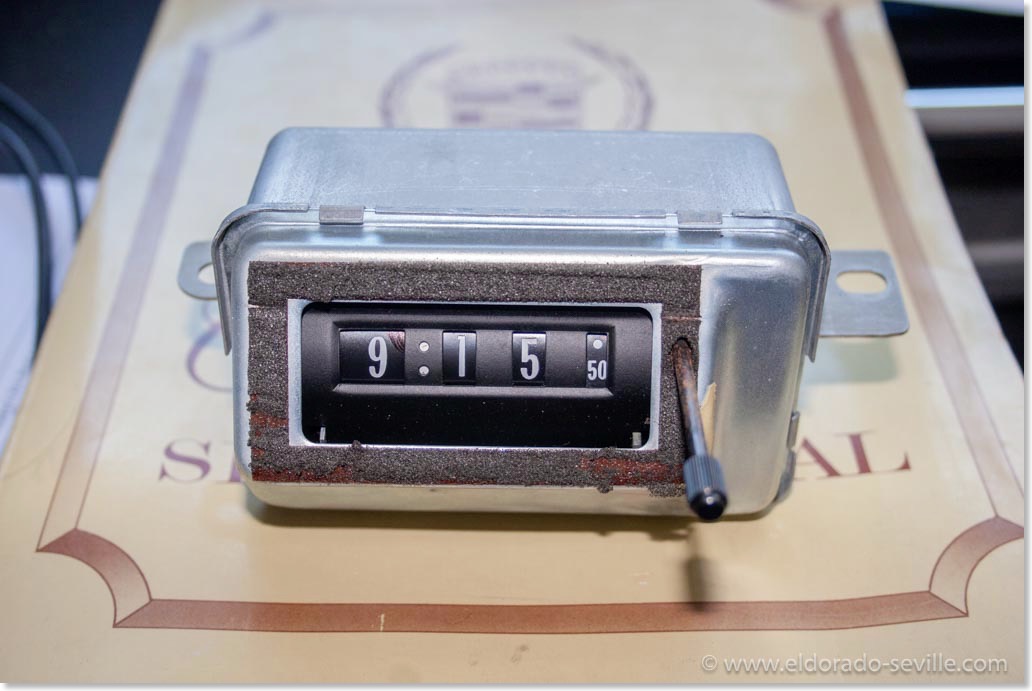
The removed clock out of my 74.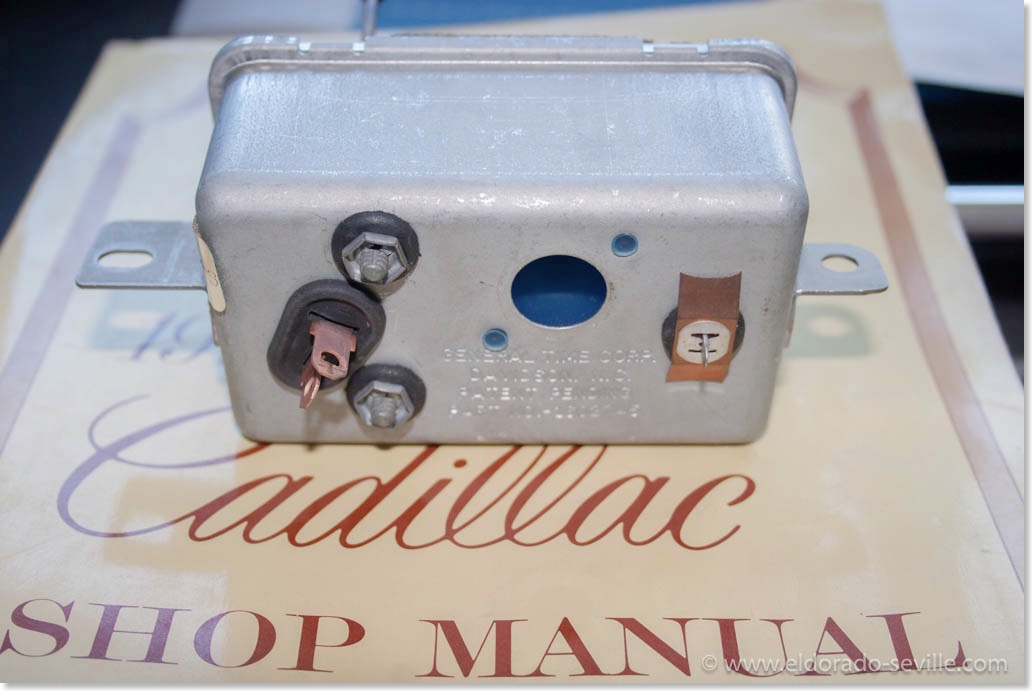
The 1974 Cadillac clocks were produced by General Time Corp. They were used up to 1978, but 1978 had different connectors on the back.
I contacted the excellent Cadillac La Salle Club forum and got valuable tips on how these clocks can be serviced by oneself.
Unfortunately these tips came a little late as I had already sent out the clock to a professional clock restorer in the USA. A company called "The Clockworks" will do the service for me. I cant wait to get the clock back hopefully by the end of February 2016.
Nevertheless here are the instructions on how the clock could be repaired by user "Aprules2" who was so kind to take pictures and upload them to the CLC forum:
All pictures and description © Aprules2
"OK, I finally got around to getting some pictures for you. The clock is super simple, nothing like what you're used to. I apologize that its dirty I apparently took it apart, cleaned and oiled it and never put it back together and it sat in my tool box all this time.So this is a picture of the front of the clock - this part wont come off.
Once this case is open you'll be able to see this. This is the black cover that protects the clock motor. Just carefully get under that silver ring and work it off so you can remove the cover.
Now you'll be looking at this that thin round piece standing in the middle is what I was calling the little record - thats actually the armature of the motor. Try not to get any oil on it but it's not the end of the world if you do. Just drip some on the ends of the shaft it rides on and put a bunch on any gear you see including the one on the end of the shaft the record rides on. If you do get oil on the armature just wipe it carefully with a q tip with rubbing alcohol on it.
Heres another shot of the motor that round brown part is what I called the record.
Make sure to really oil these gears you want to try and get oil on every tooth you see. This isn't like the old school mechanical clocks that wont run right with too much oil. These seem to run better when oiled.
Heres the back side of the clock put a liberal amount of oil between each reel, and you'll notice the real with the seconds on it has a gear built into it try to oil all those teeth too. Sometimes once it's running Ill dribble some on while it rotates.
Once you've done all that plug it in with it still apart. If it doesn't start instantly, give the clock a slight shake or GENTLY roll the record just to get it started, it should start spinning and your clock will now keep time. I usually leave it to run all night, and if it stops in the middle of the night I add some oil and restart it. Im pretty sure it's the same issue as most old mechanical clocks and watches the oil dries up and becomes sticky and because the motor has very little torque it cant keep the clock running. But adding the slot car oil loosens it up, its just got to migrate through all the friction points. So it's not uncommon to have it stop 2 or 3 times, before it starts running reliably, which is why I like to bench test them. "
Thank you Aprules2 for this great description - whenever I need to service another clock like this in the future I will definitely do it myself.
REMOVING AND REPLACING THE 1974 CADILLAC HEATER CORE
There could have been 3 possible scenarios why it was disconnected:
- The heater core is leaking
- The heater core is blocked
- The heat could not be turned off in the heating system due to a problem in the ATC
Most probably the core is leaking on such old cars. So I had ordered a new core a while ago, but I never really wanted to tackle this job as it needs quite a bit of effort to get it done and it is not a very funny job. It's not that technically challenging but very tedious. I finally bit the bullet and decided to finally do it.
You can normally detect a defective heater core by fog build up inside the car and by the smell of coolant.
I studied the shop manual and started to tear the dash apart to get access to the heater box which houses the heater core.
I found out that the shop manual lists a lot of necessary work and does not show all the screws that you have to remove to get the box out. Some of the screws are very well hidden and finding them was the most frustrating part of this job.
Here is how to remove the heater core: (text in black is from the shop manual - my remarks are in green)
First you have to remove the Instrument Panel Pad
Removal of Instrument Panel Pad
- Disconnect negative battery cable.
- Remove three climate control outlet grilles - right, left and right center (see picture below on how it is done with a special tool - I just did it with two flat screwdrivers)
- Working through outlet openings, remove 3 fasteners securing pad to instrument panel support.
- Remove screws securing pad to instrument panel horizontal support.
- Pull pad outward and disconnect electrical connector from windshield wiper switch.
- Remove pad.
Heater Case Removal
- Drain radiator. (not necessary if you just clamp the hoses off, but flushing the system never can hurt)
- Remove hoses from heater core nipples and plug nipples to prevent spilling coolant remaining in core. (Thats indeed extremely important as you have to move the heater case around and it would definitely spill any remains of coolant on your carpet. Also make sure that there are no traces of leaked coolant underneath the carpet from the bad core.)
- Remove instrument panel pad. (As described in the chapter above.)
- Remove center A/C outlet support and connector from position between cowl and horizontal support, Fig. 1-36. (Scroll down to see the illustration, You basically only have to unhook the rubber part of the outlet and push it downwards.)
- Remove left A/C outlet hose from A/C distributor. (There are some steel clips inside the tube where it is mounted to the plastic distributor. You have to reach in and unclip them to be able to remove the hose without using a lot of force and maybe damaging it. See the picture where I put my arm into the opening below.)
- Remove center support and associated braces as shown in Fig. 1-36. ( I can´t see any reason why this should be done - I removed only one of the braces, and it was completely unnecessary. You only have to remove the round bent brace on the bottom of the heater case as its in the way to get it out - see the picture where I am unscrewing it below.)
- Remove two screws securing A/C distributor to heater case and remove distributor, Fig. 1-36. (If you did not remove the braces mentioned above like I did, you can´t get this part out. I just put it to the side where the glove box normally is, which you will also have to remove anyways - see later.)
- Remove one screw securing defroster nozzle and remove nozzle. (You have to remove the screw - but leave the nozzle in place. There is no whatsoever reason to take it out. And its also impossible to get out if you did not remove ALL the braces and brackets.)
- Remove glove compartment liner. (Its self explanatory - just remove all the philips screws you see inside.)
- Remove vacuum and electrical connectors from programmer. (You can do this now through the glove box opening.)
- Disconnect vacuum hose from recirc door actuator (Orange - near the right door kick panel.) , defroster door actuator (You can see it on the left side of the heater box with a blue and a yellow hose going into it.), mode door actuator (There is no way you can remove these hoses now, as they are on the back of the heater case. The upper mode door is green and the lower one is tan. You can really only remove them once the entire box comes out.) and position vacuum harness out of way, Fig. 1-37.
- Disconnect aspirator hose from in car sensor. (The thick black hose on top of the heater box)
- Remove three nuts and one screw securing heater case to cowl on engine side of cowl, Fig. 1-8. (It was the most tricky part for me to find these screws. See my picture below where I have marked the location of the screws as seen from the engine bay.)
- Remove heater case from position under instrument panel .(See picture how you have to position it to get it out - remove the two vacuum hoses mentioned before on the back now. Be careful - they are attached with metal clips)
- Replace heater core. (Only 2 screws - self explanatory - also re-use the rubber seals from your old core around the water nipples.)
You can then put everything back together which should be much faster, but before you could also remove the clock, which is very easily accessible now and clean and lubricate it (the shop manual recommends to do this every 2 years). You also have access to all the dash lights, tell tale and warning lights and to the speakers (which are shot on my car due to a defect in the amplifier in my radio) while everything is apart. While I had the heater box out of the car I also cleaned the inside of the programmer and re-lubricated it with white lithium grease. I used electronic cleaner to clean the electric contacts inside the programmer while it was open, as most probably the contacts will have some oxidation on your car as well. While the heater box is out you can also lubricate the various doors and clean out all the dust which has collected inside the box over the last decades.
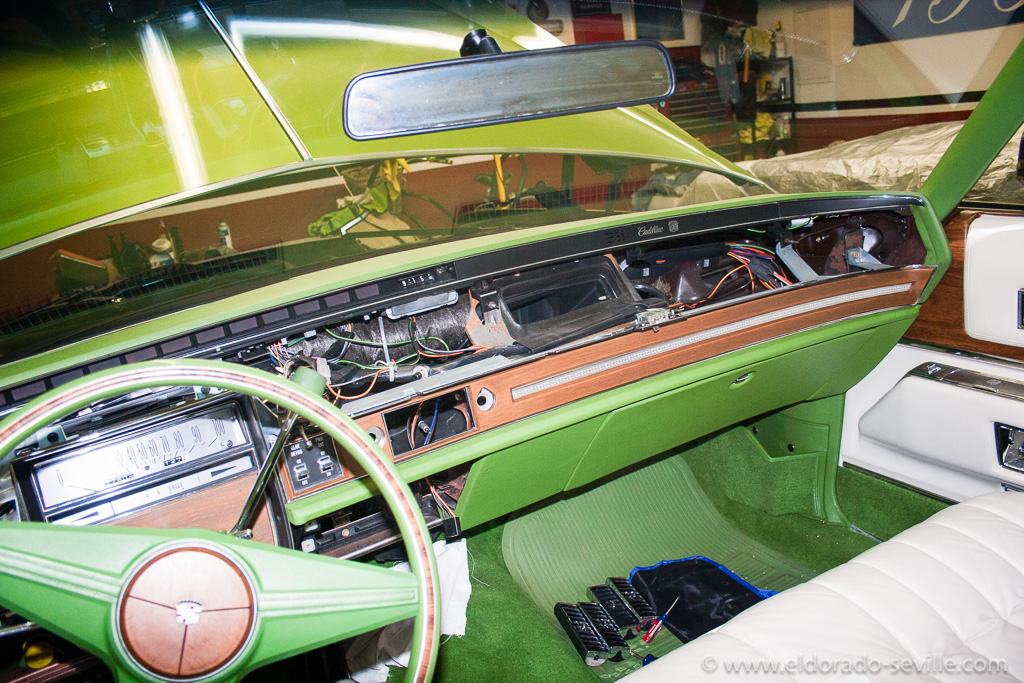
The dash removed. The radio is also out for repair.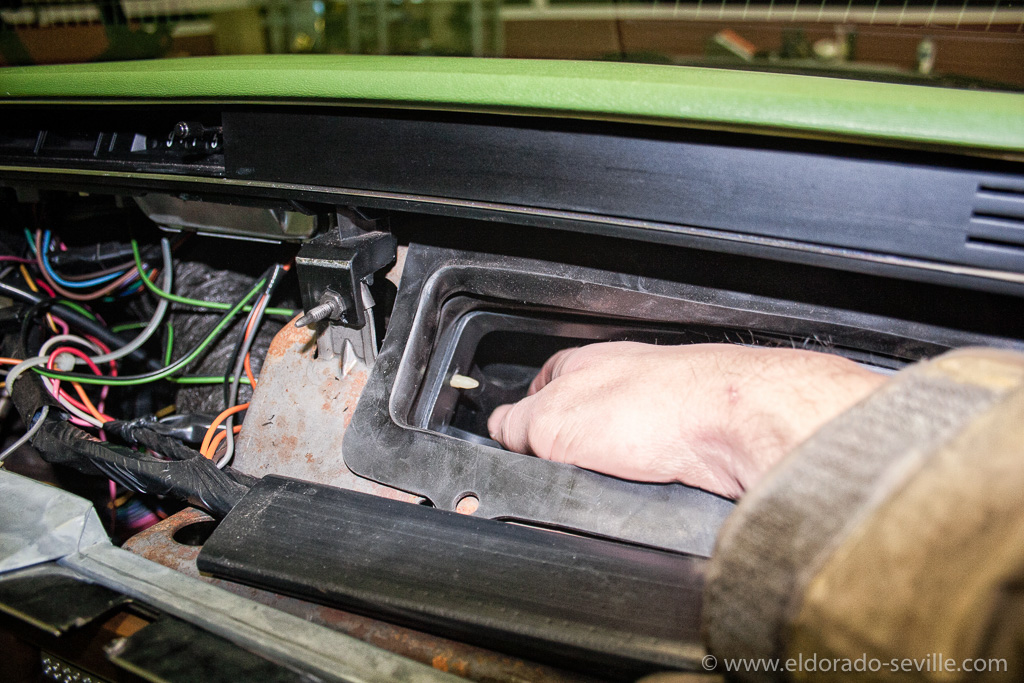
There are metal clips inside holding the left A/C hose in place. You have to reach in and unclip them.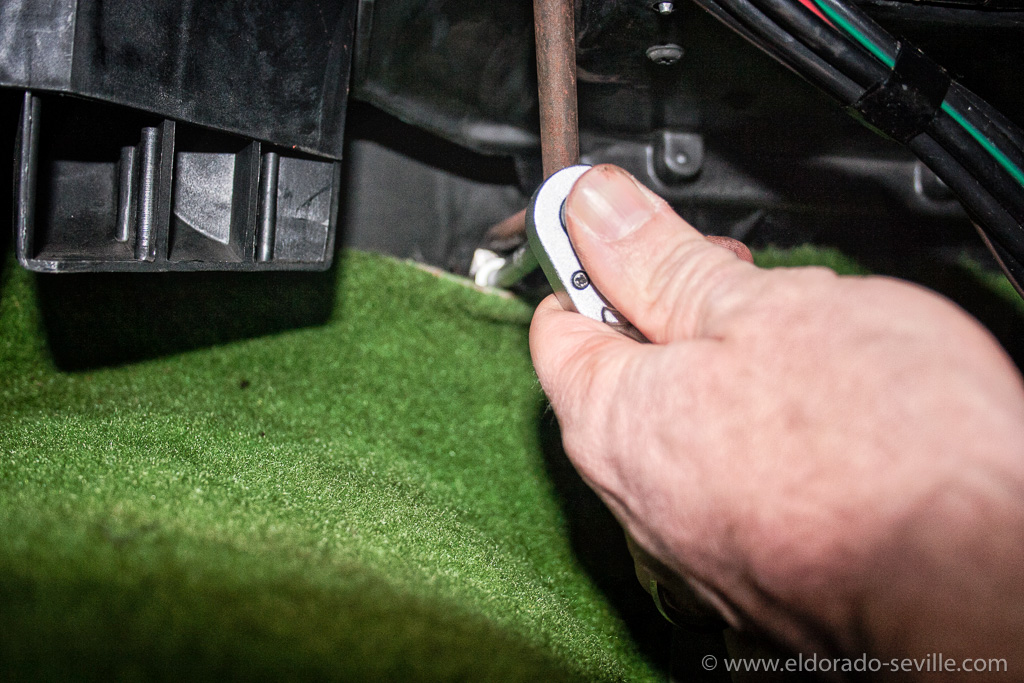
You will have to remove this support bracket.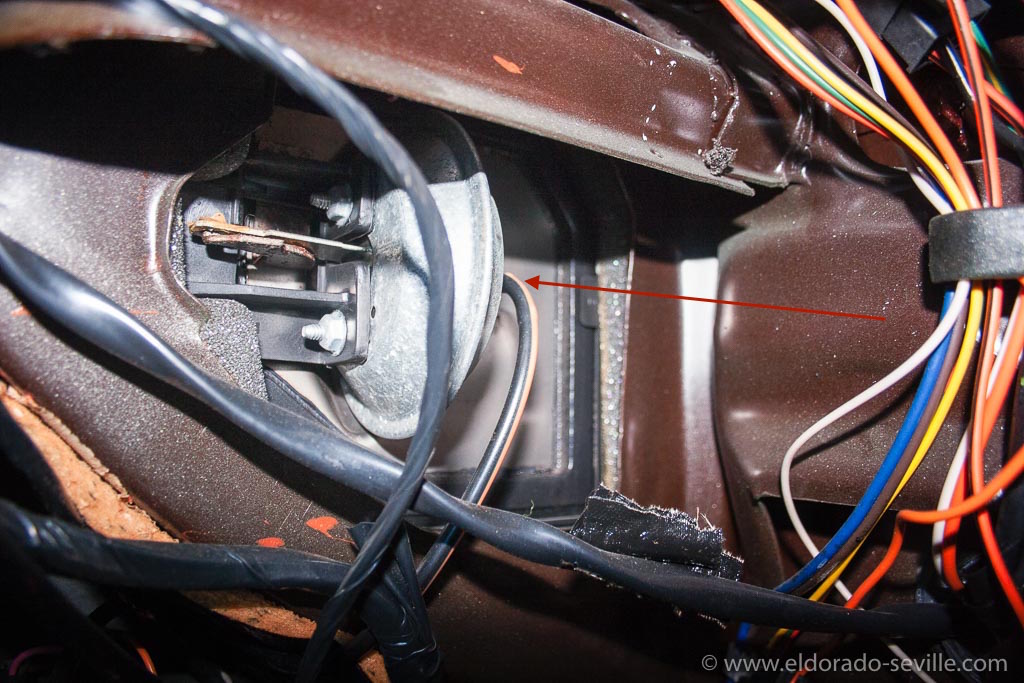
Recirculation door - un-plug the orange vacuum hose.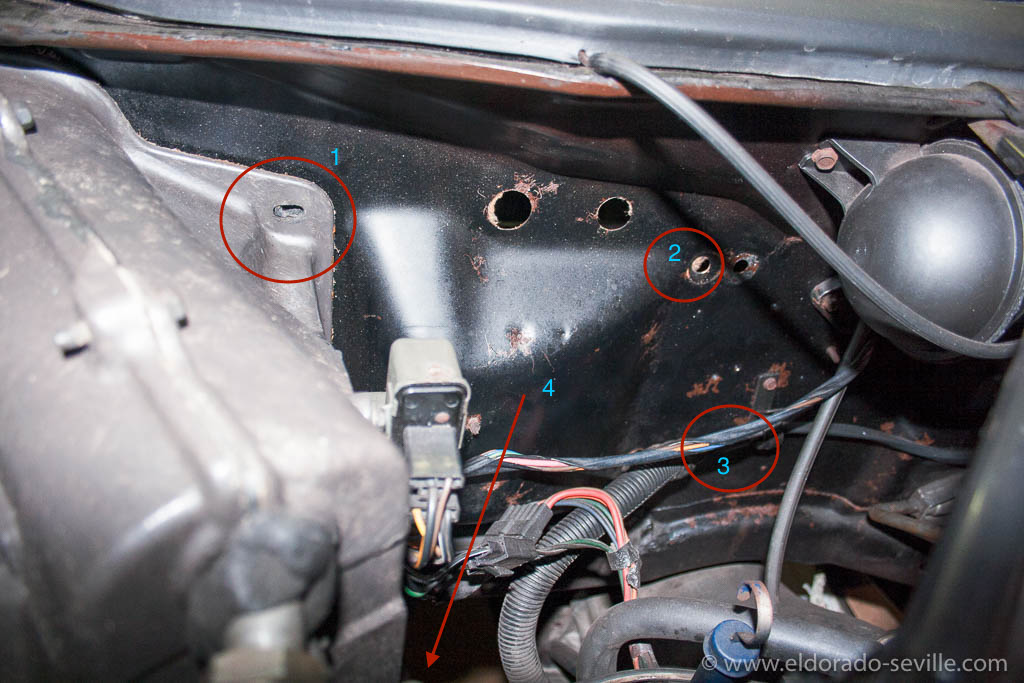
You have to remove these 4 screws/nuts on the firewall. You can access number 4 from underneath the car only. Number 3 is hidden underneath the cables.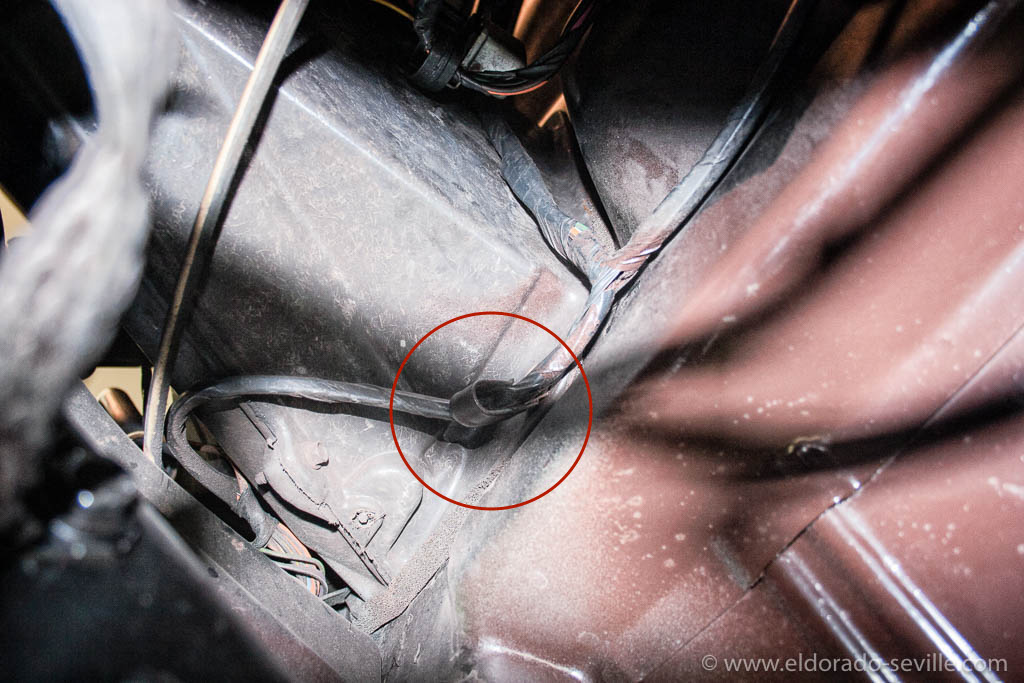
The number 4 screw on the cowl is holding a cable clip in place and the other end is the right bottom screw of the heater box - you need a second person with a 7/8 wrench to release it from the side under the car while you unscrew it from inside the car with a 3/8.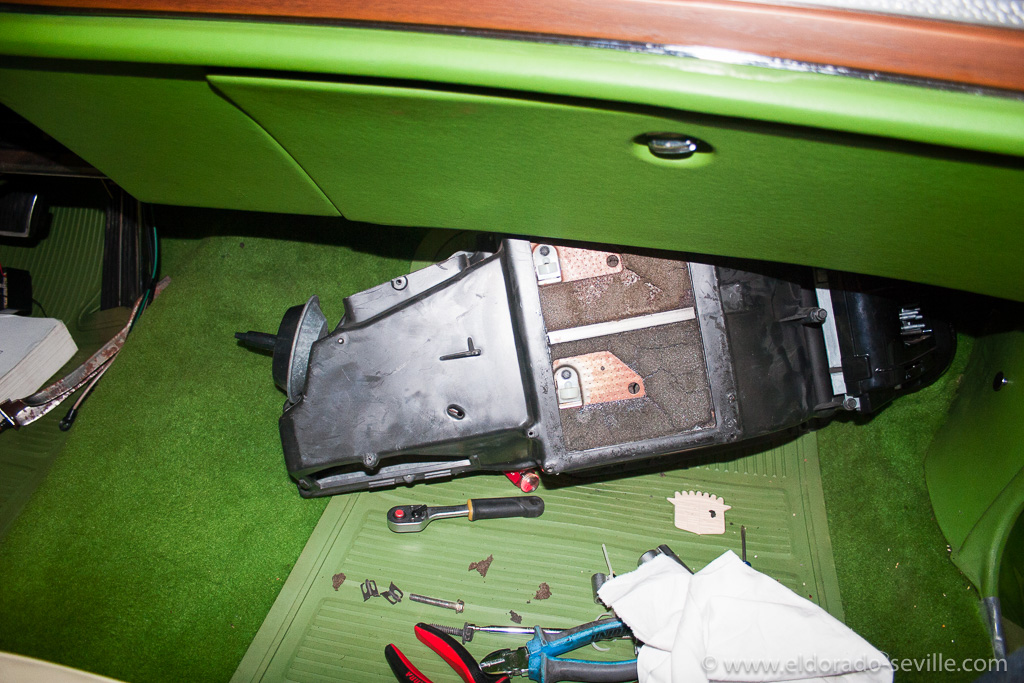
Once all the screws are off you can carefully remove the box. You have to slip it to the passenger side to get it out.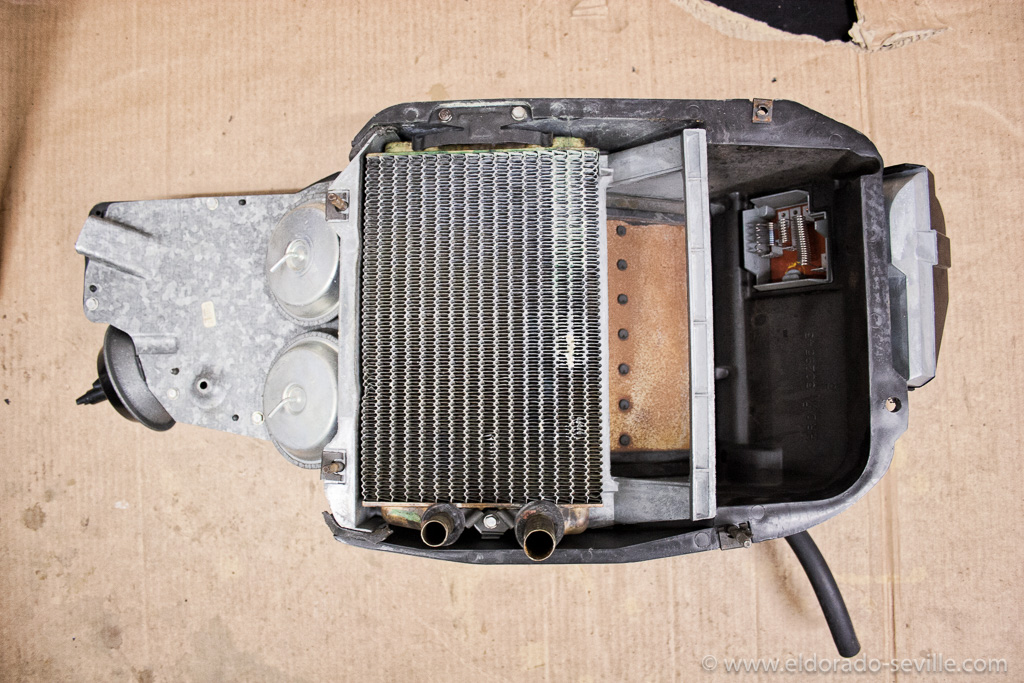
The old core in the heater case.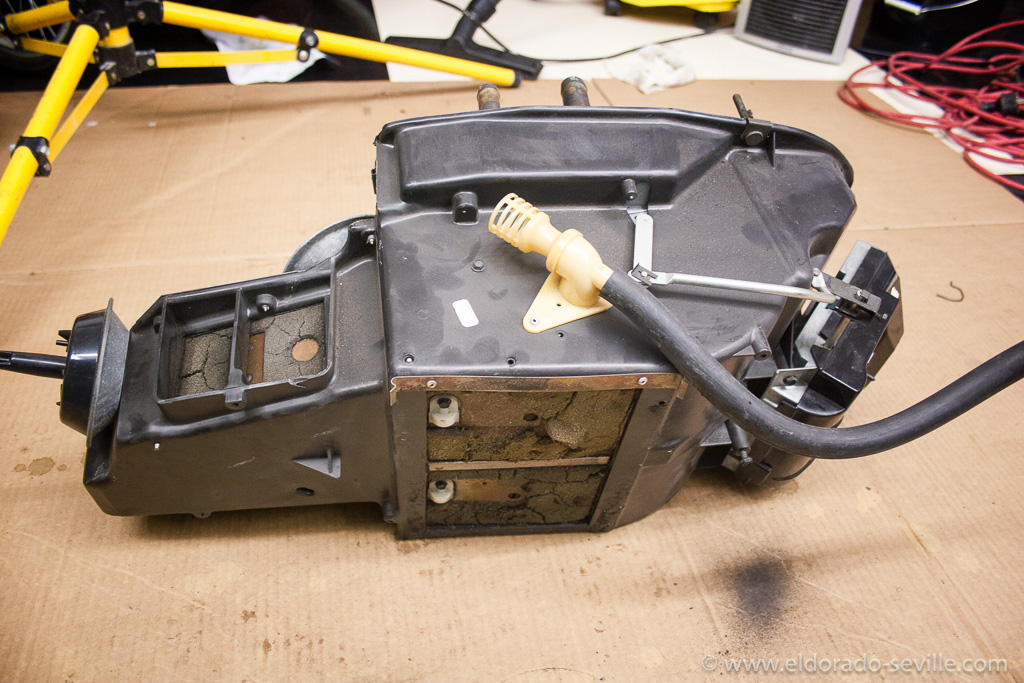
The 1974 Cadillac heater case and heater core. You can see the two mode doors here and on the right is the recirculation door. The thick hose on top is the aspirator hose going to the temperature sensor in the dash.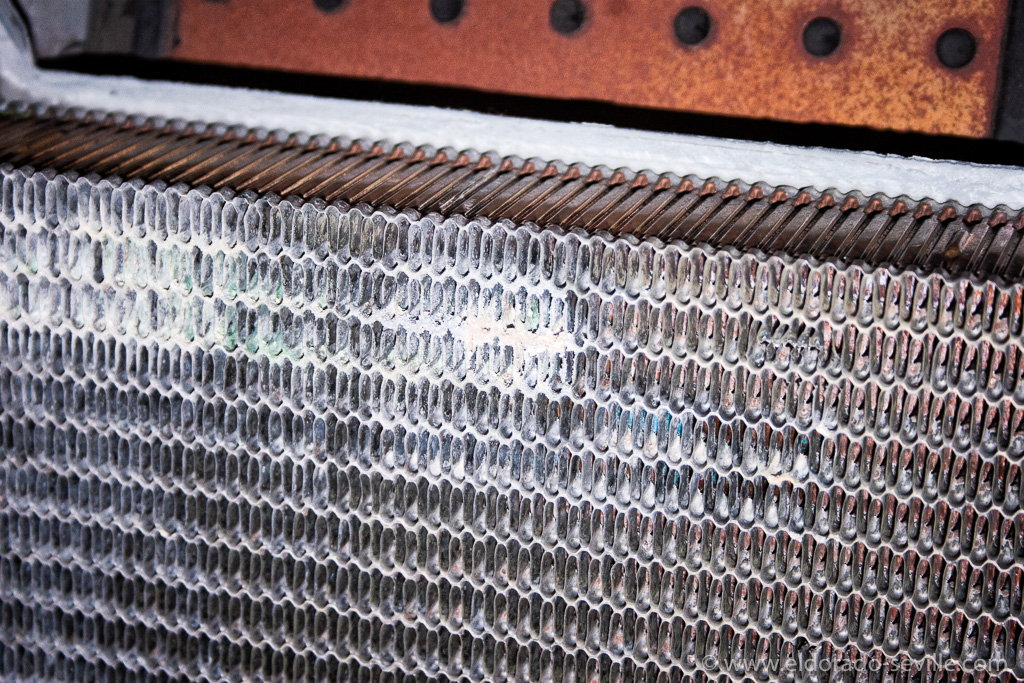
This is where the old core had developed a leak.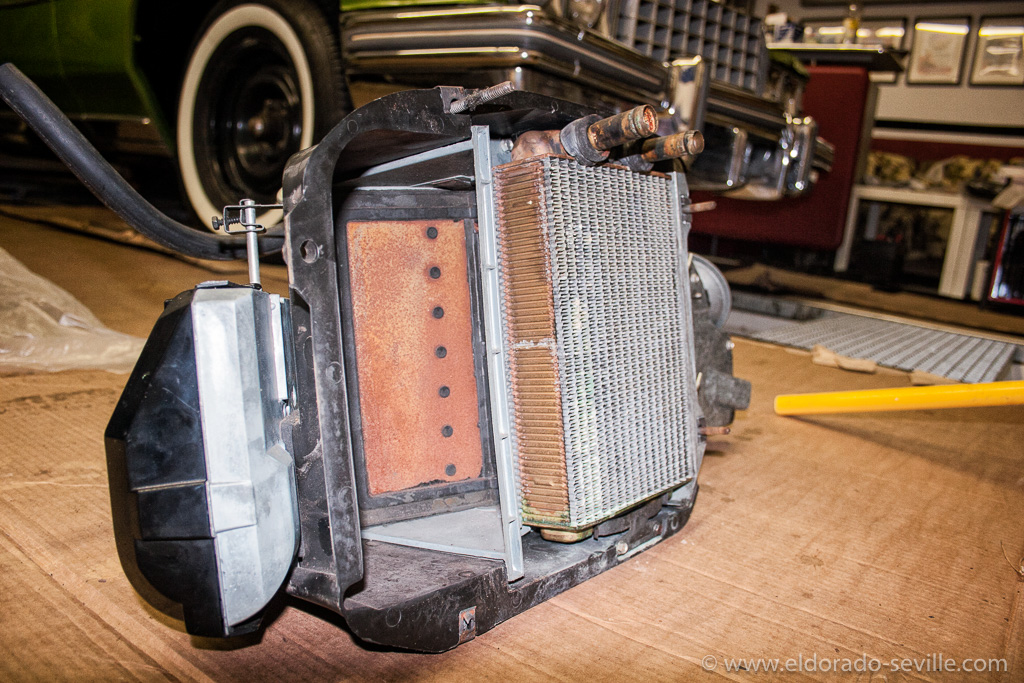
The old core still in place. Note the rubber seals on the tubes of the heater core. You have to move them over to the new core.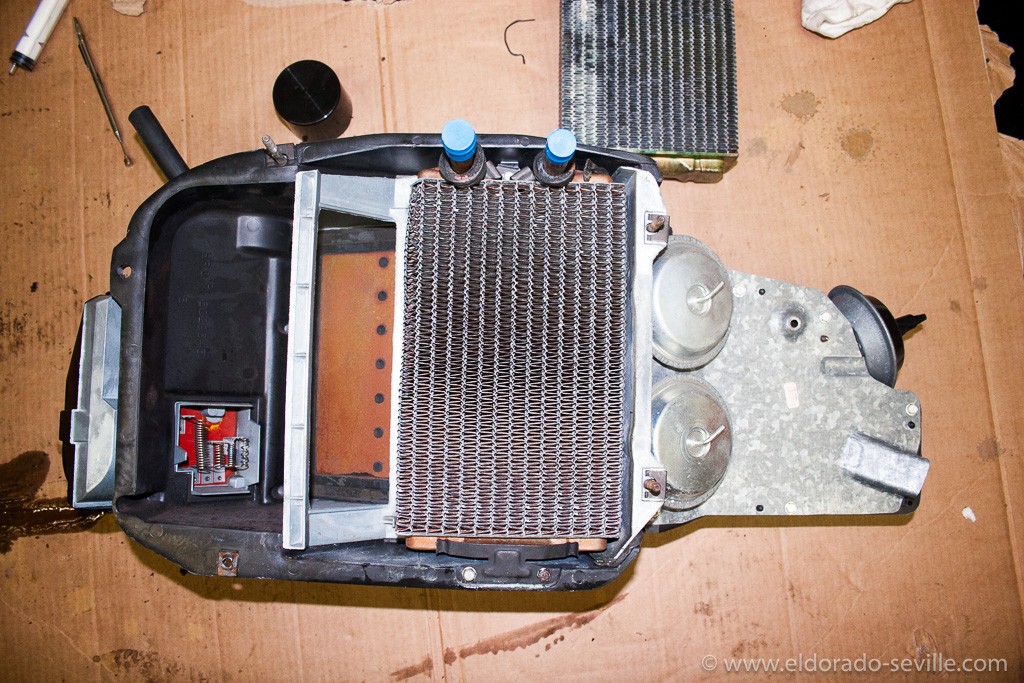
The new heater core in place. I got mine from rockauto.com. Its very similar - the only difference is how the two tubes are braced to the core, but that is no problem at all.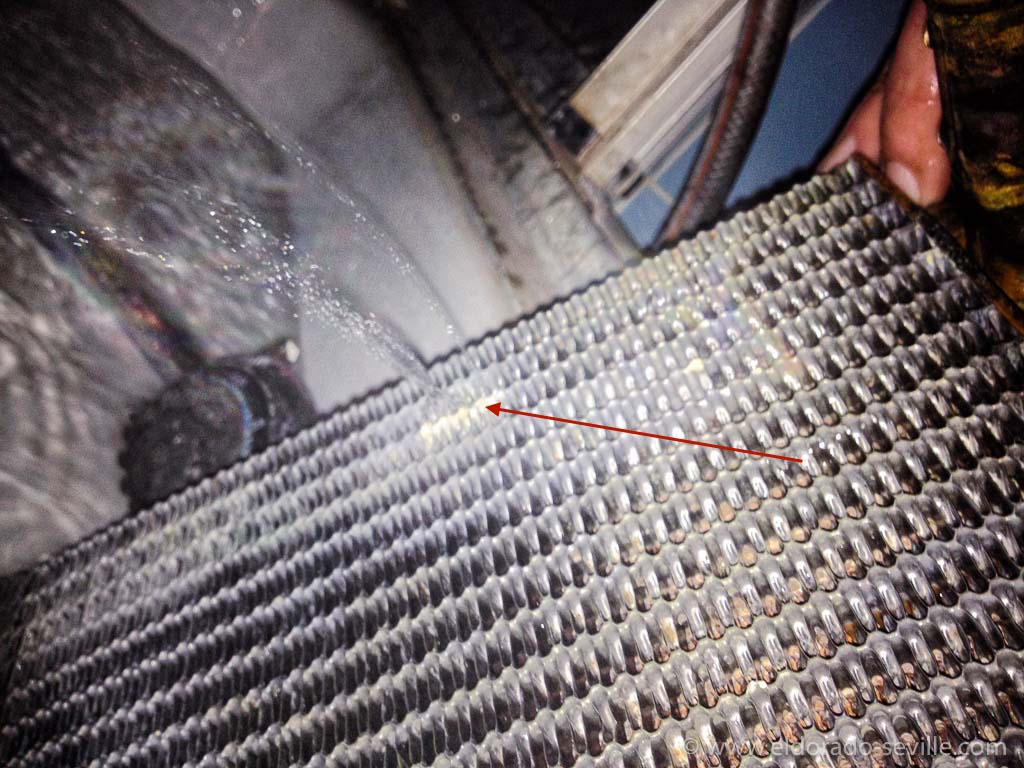
Out of curiosity I checked where the old core was leaking, and the leak was pretty obvious as you can see.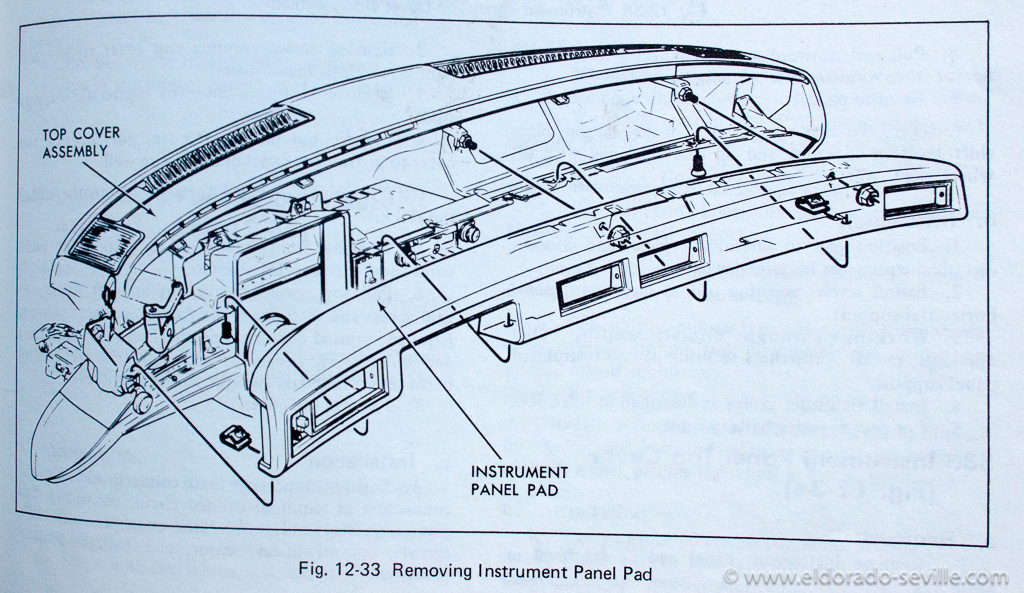
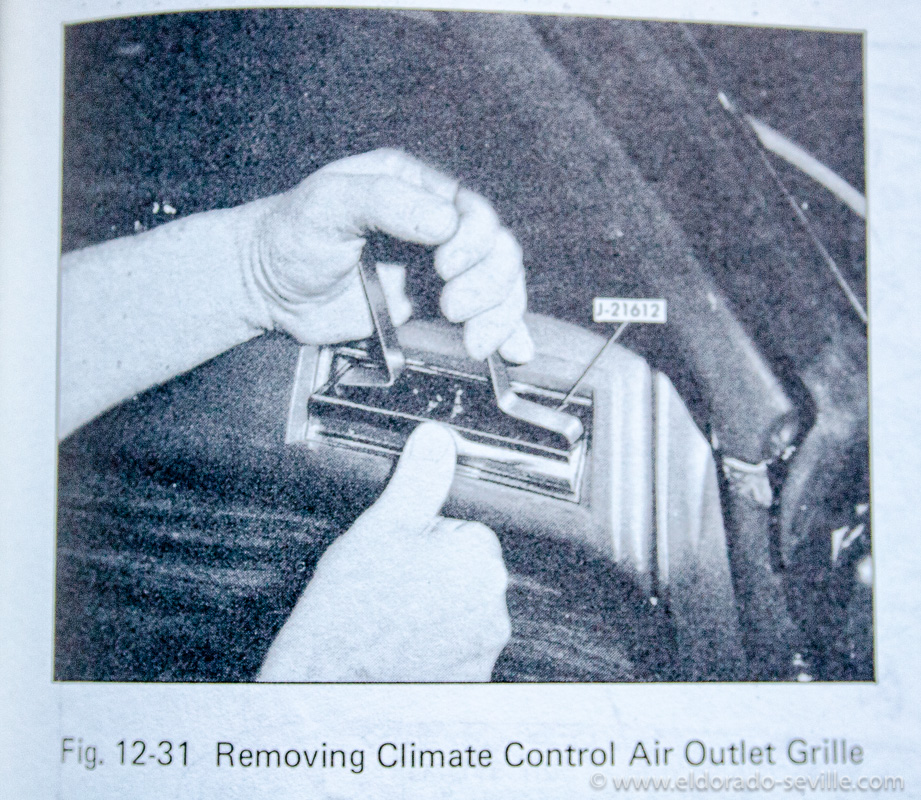
I just used two flat screwdrivers instead of this special tool.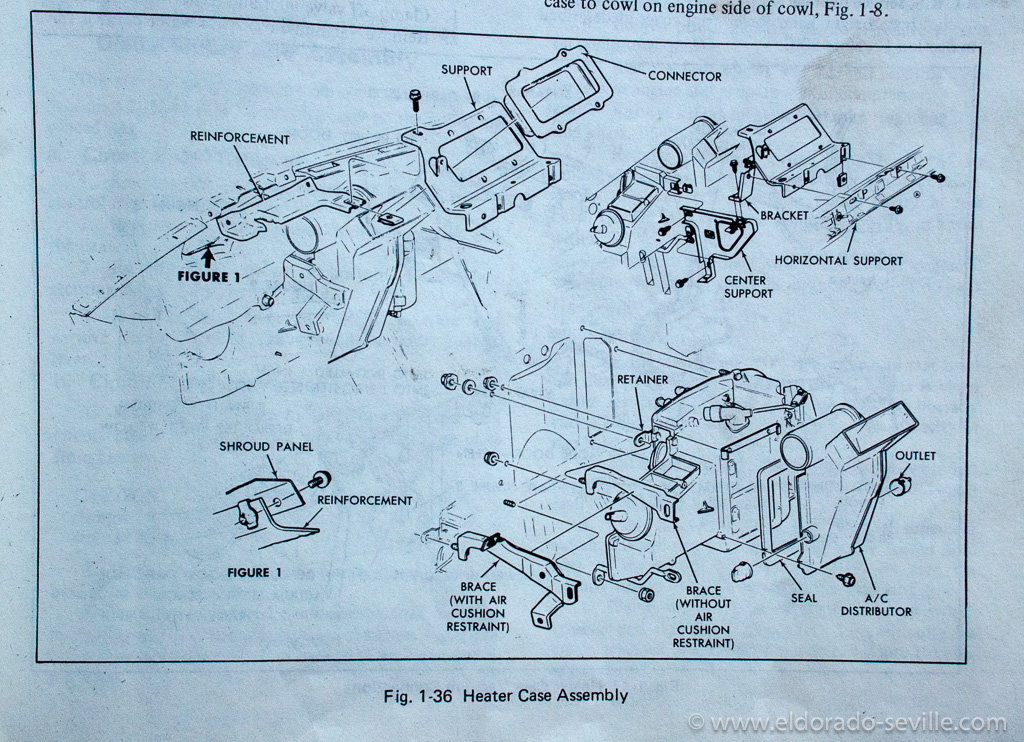
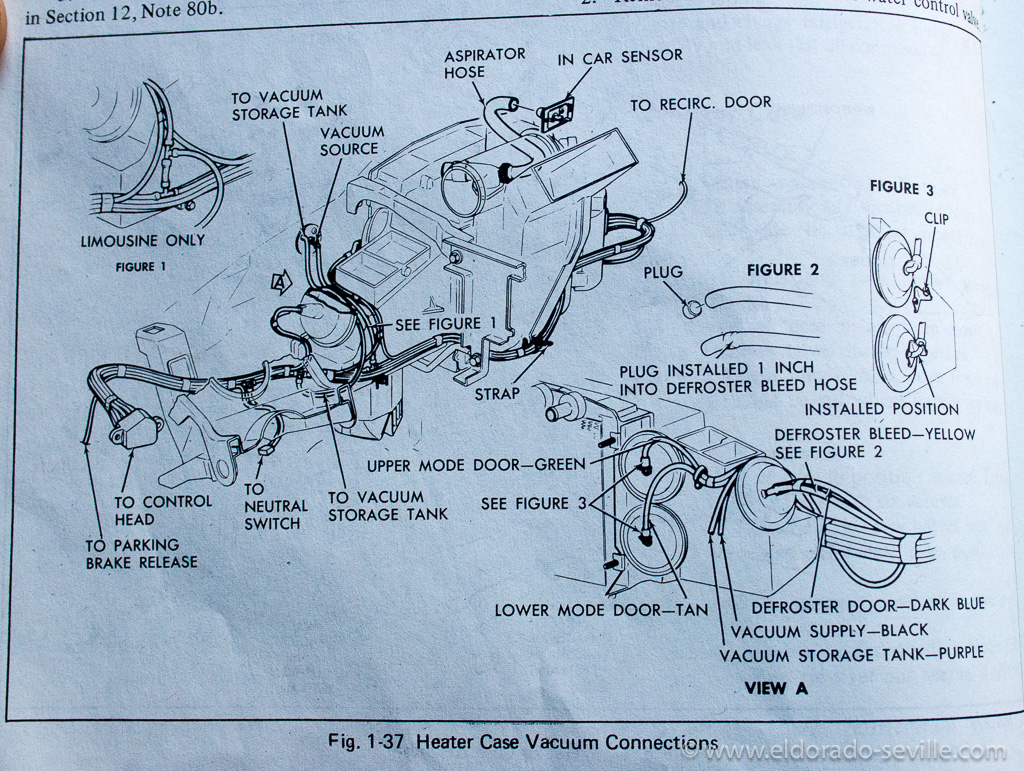
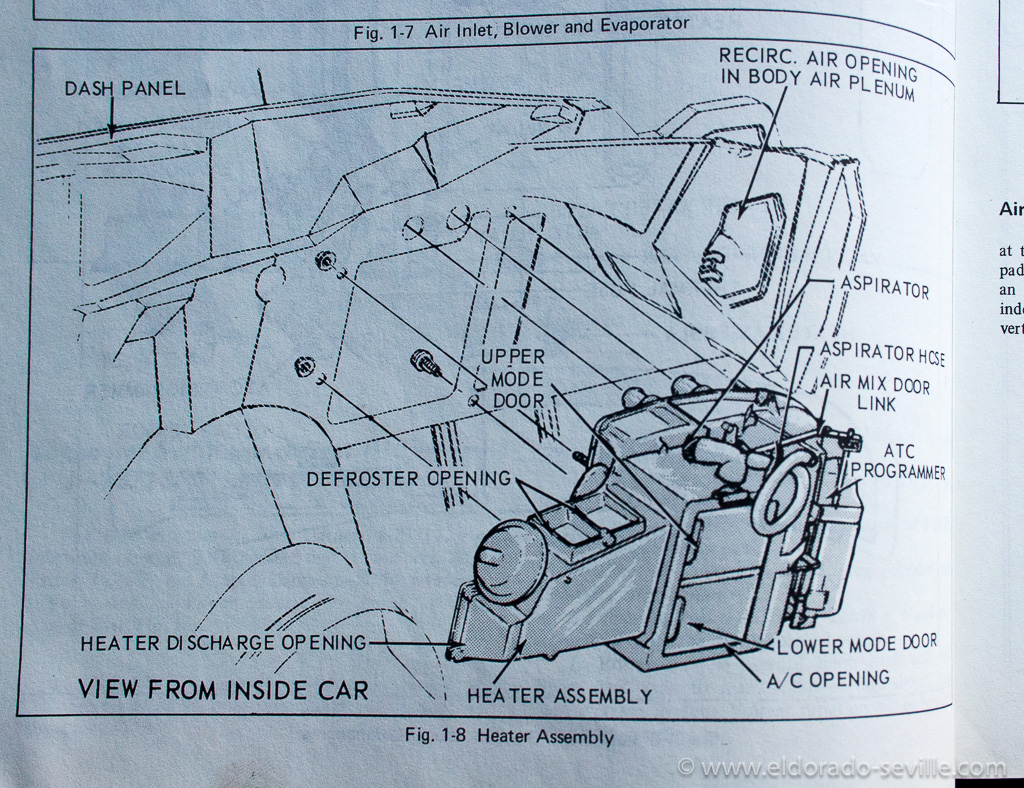
Additional information for Eldorado owners regarding the heater core:
Dan Mercer reached out to me and wrote the following: (Thanks Dan for letting us know!)
As a favor to Eldorado owners who will undoubtedly come across your repair process and use it in the future, would you be so kind as to add one addendum to it?1976 Eldorados have a FIFTH fastener attaching the heater box to the firewall! For the life of me I can't really figure out how this would have been necessary on an Eldorado but not a DeVille, but it's true. The 7/16's screw that needs to be removed is just above the right side of the ATC, in between the upper attachment and the lower one you have to get at underneath the car. Due to where it sits somewhat behind the ATC, it's impossible to see from any angle in the car.
I've attached pictures below.
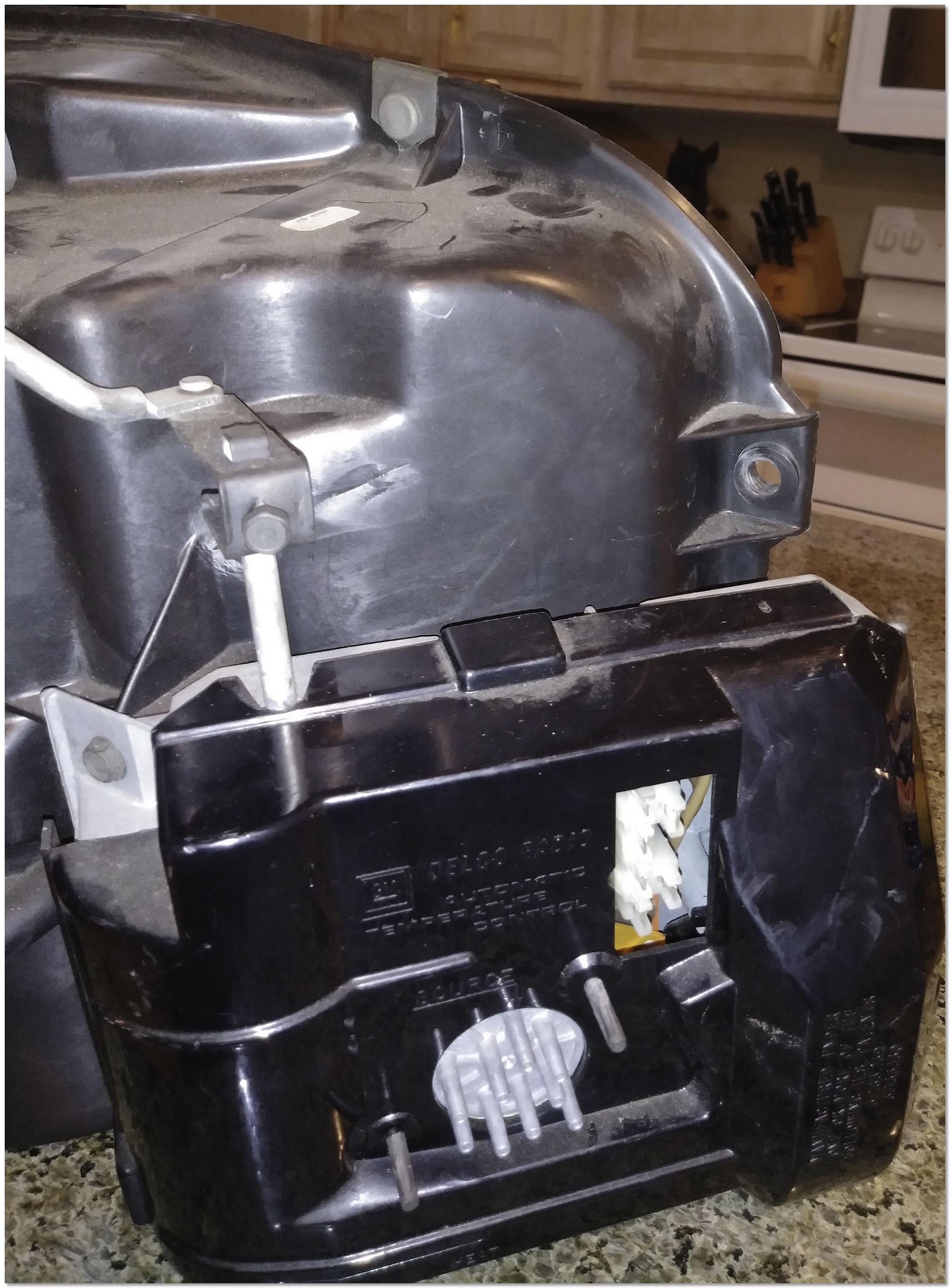
REMOVING THE 1974 CADILLAC RADIO
The first work in 2016 was to remove the radio of the 1974 Coupe DeVille to repair it.
The radio basically works, but the volume dial is a little quirky and sometimes does not work as it should. The radio sometimes only comes to life if the volume is turned to maximum.
The 8 track and AM/FM reception all work like they should. Also 3 speakers do not work at all, and I have to find out if the speakers themselves are defective, or if the radios output has a problem. Its more likely that the speakers are defective after so many years, as the membrane tends to dry out, get very brittle and tear apart. So far I had to change the speakers and/or repair the radios on most of my cars when I got them.
The radio out of the 74 can be removed pretty easily:
- Remove the lower steering column cover - there are 4 screws on top of the cover and 4 screws on the lower edge and one in the door jamb facing the drivers door.
- Then remove the ash tray assembly. There are 4 screws. You have to put your head underneath the dash to get to all of them. For the one on the right side you need a 5/16" nutrunner or socket with 3" extension. Work from lower edge of instrument panel to get to it. Then disconnect the electrical connector and bulb.
- Remove the radio knobs, wave washers, control rings and hex nuts.
- Remove radio to lower instrument panel support brace nut at rear of radio.
- Loosen brace to support screw and rotate brace to the right.
- Slide radio from instrument panel and disconnect antenna cable, speaker connector and power connector.
- Rotate dial side downward and lower the left hand side of the radio.
- Remove through ash tray opening.
Out of my personal experience its easier to remove the radio than getting it back in. Especially connecting the cables again is a pain…
The radio is now out, and I will hand it over to my friend Steve, who will have a look at it, and see what he can do. He already successfully repaired the radio of my 78 Eldorado. He is a genius, and I´m very glad to have such fantastic and talented friends.
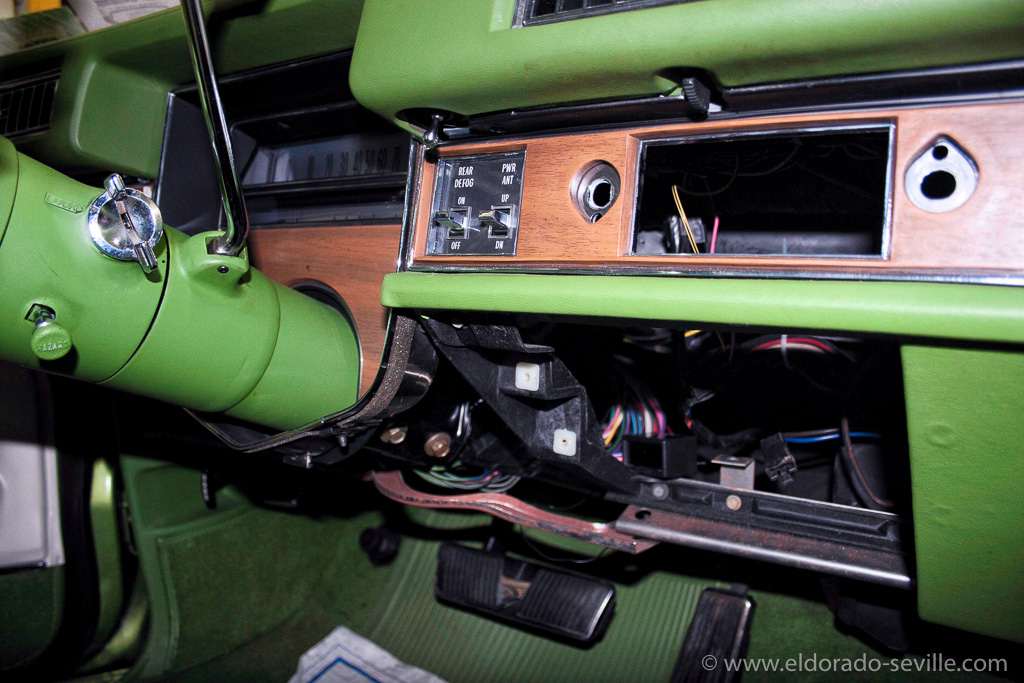
You have to remove the lower steering column cover and the ash tray, to be able to get the radio out. On this picture you can see the removed lower steering column cover and the removed ash tray assembly.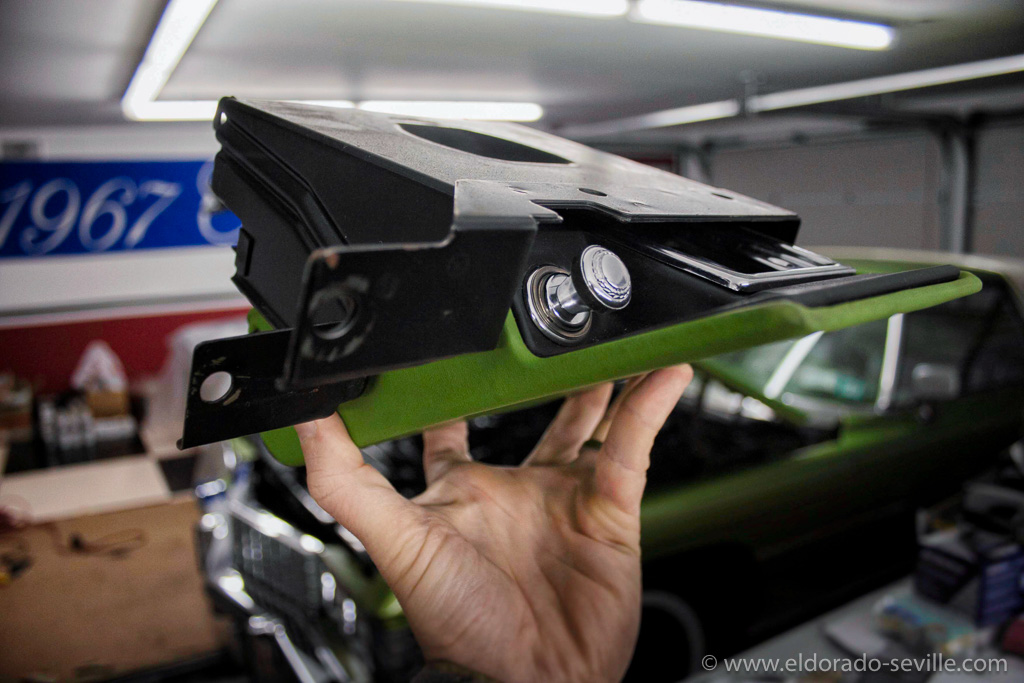
The removed ash tray assembly.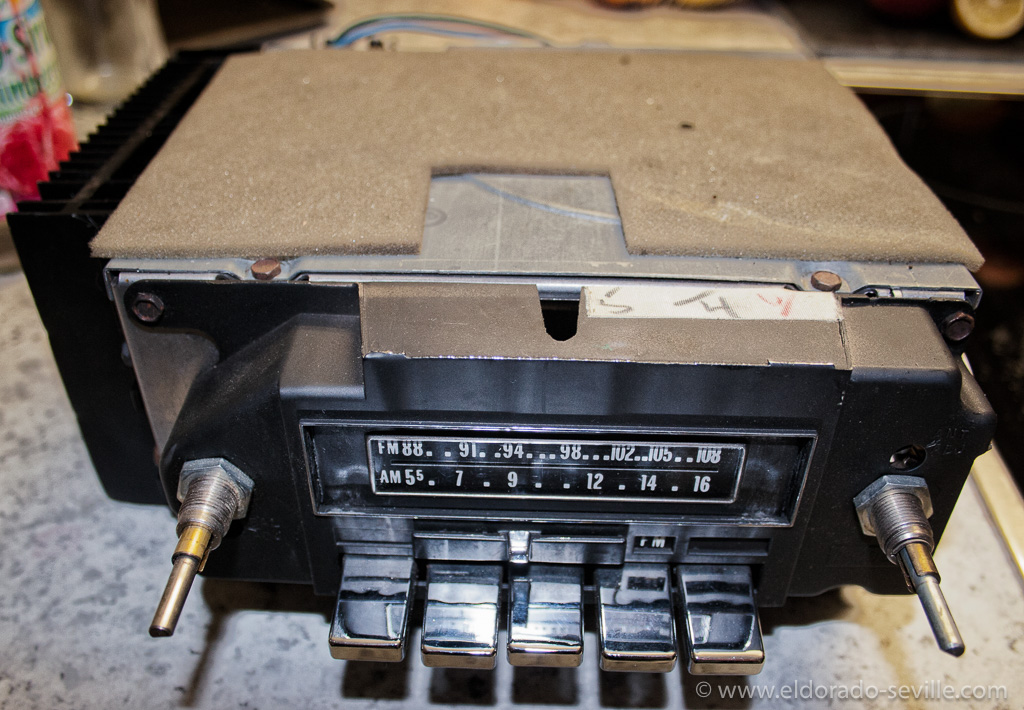
This is the 1974 Cadillac stereo radio with 8 track tape player.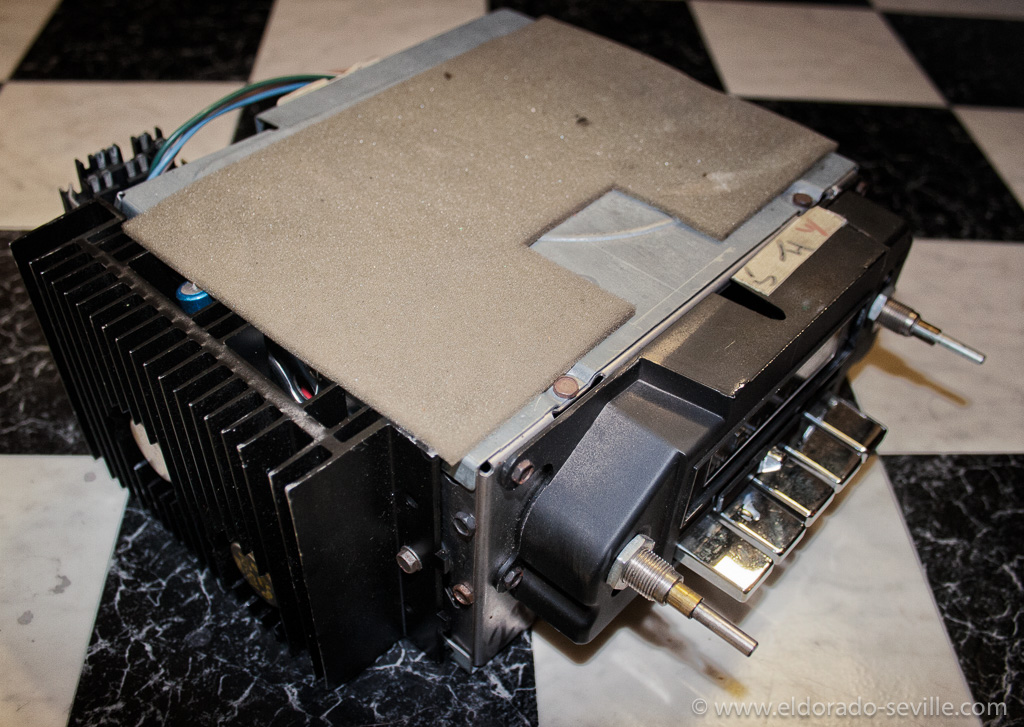
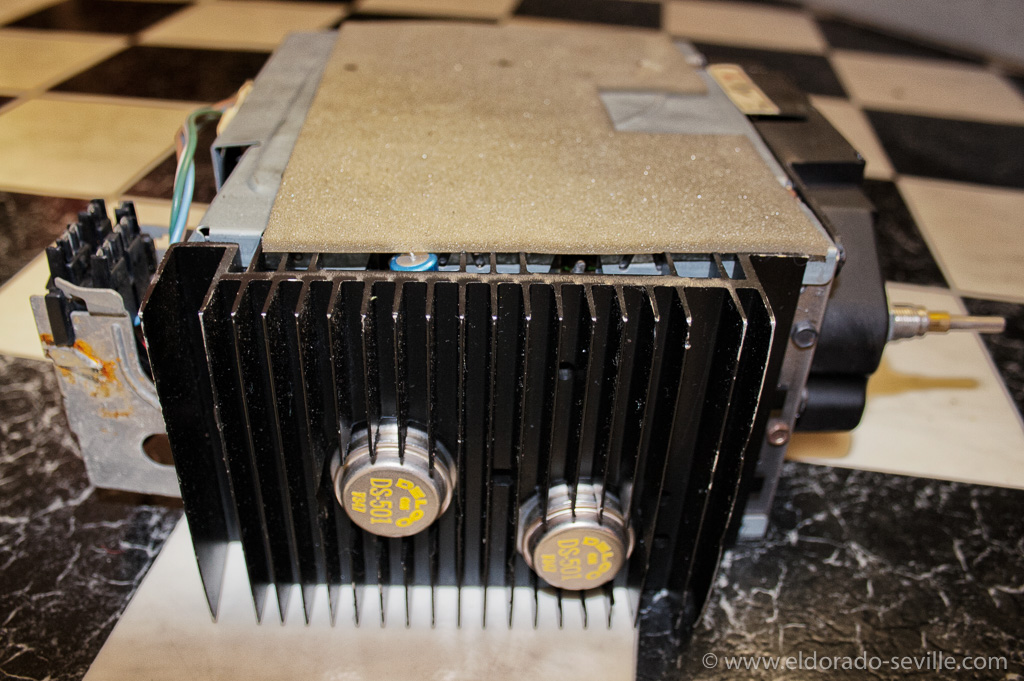
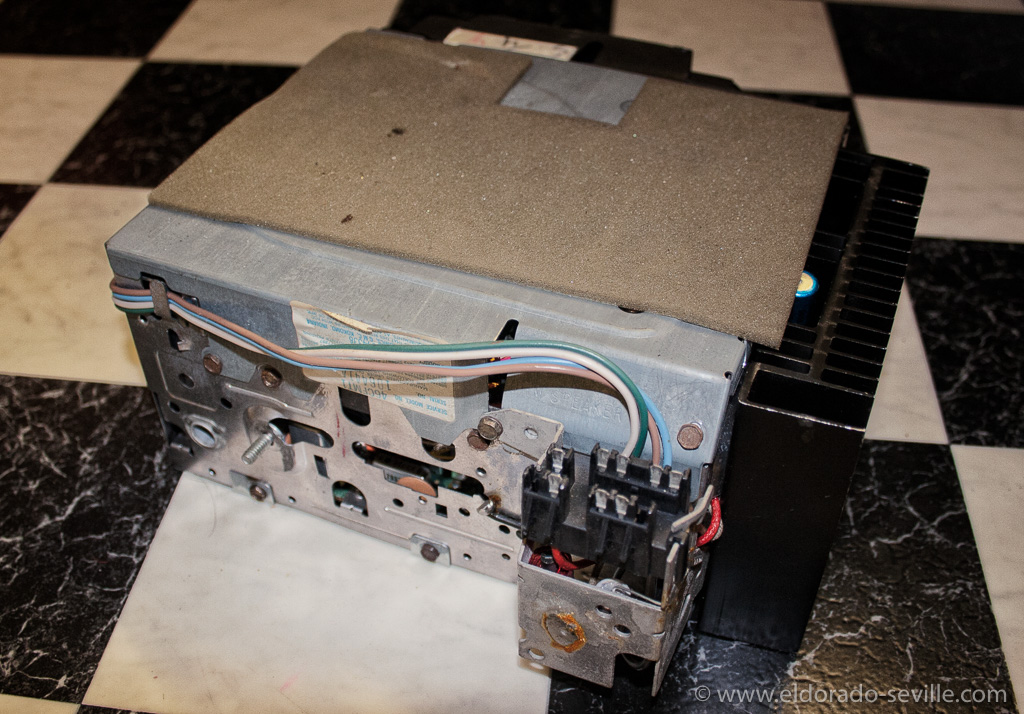
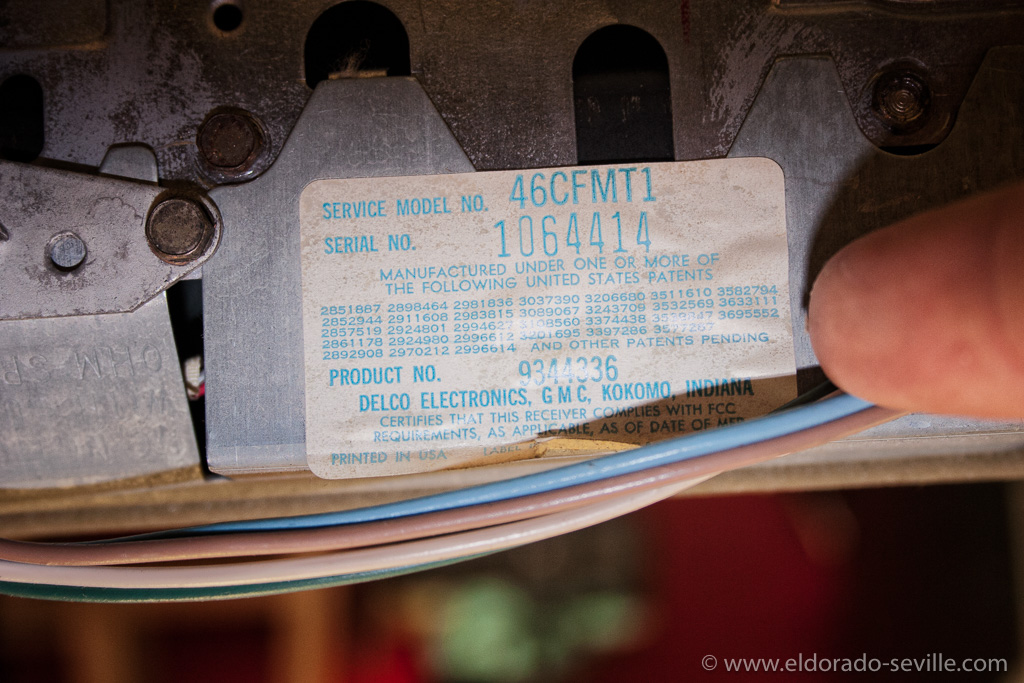
Part # 9344336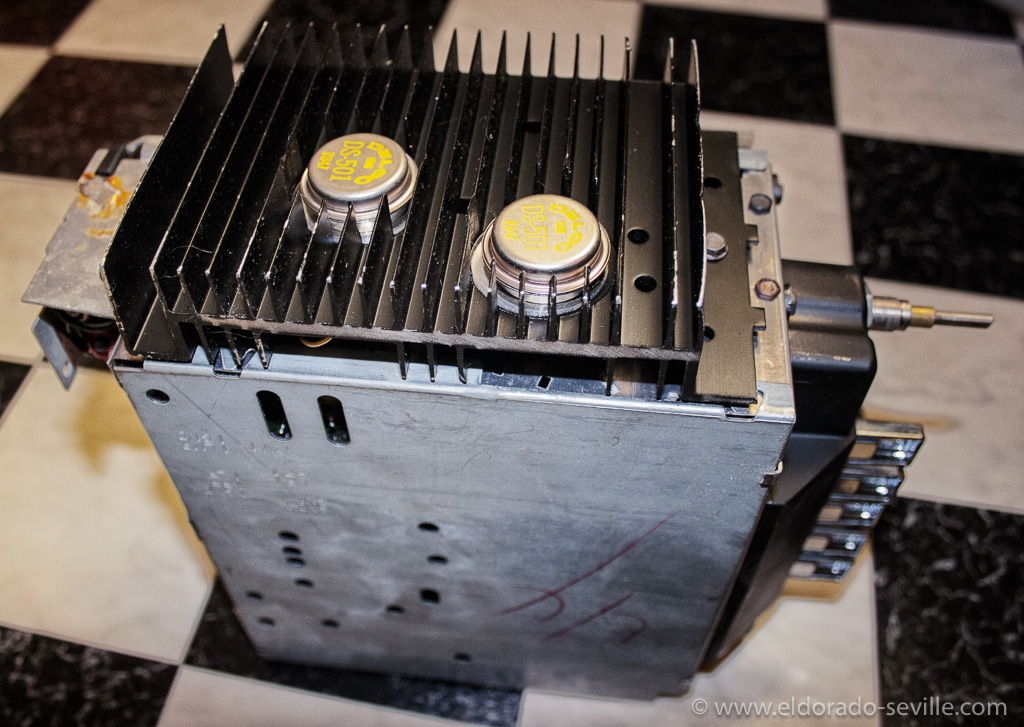
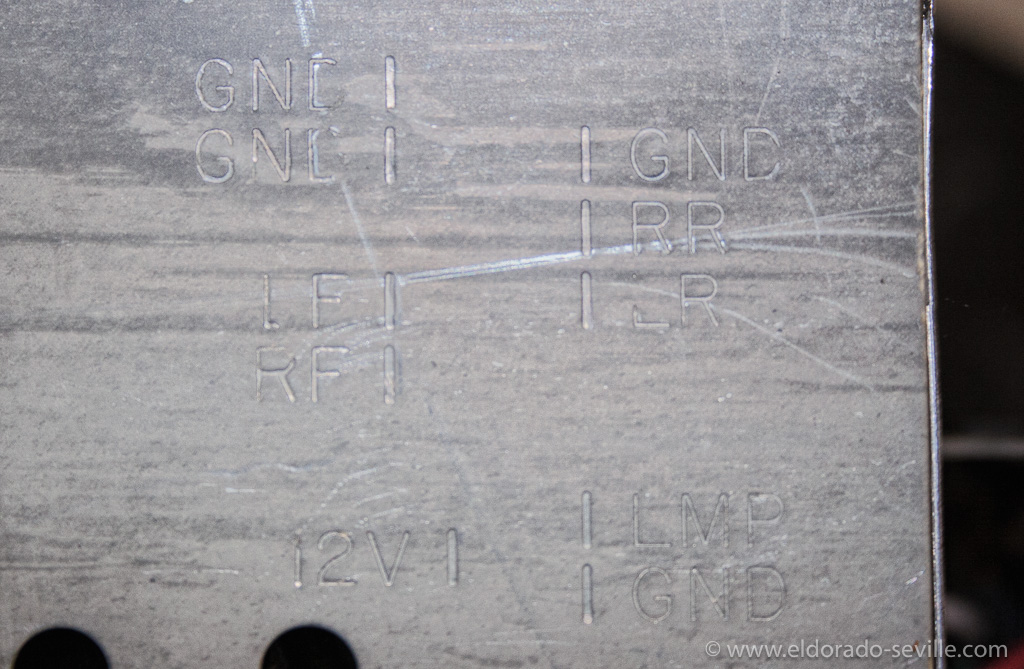
This shows where the wires in the connector are going to.
THE 1974 UNDERCARRIAGE RESTORATION PROJECT - I HAVE TO START ALL OVER AGAIN
As I had put so much effort in totally de-rusting the underbody of this low mileage car, I decided to let a professional body shop re-paint the bare metal frame, suspension parts and floor pans this time. My goal was to have the ultimate quality paint job in the factory correct colors underneath the car. I´m not very good in painting and my attempts often result in runnings, which I have to sand out and other imperfections I wanted to avoid.
So I handed the de-rusted car over to the paint shop.
BACK FROM THE PAINT SHOP
When I got the car back, everything looked o.k. as you can see on the pictures below. I was not too impressed by the work they did, as there were quite a few imperfections and some sloppy paint work visible, if you looked very closely. At this point I was already worried that they maybe did some shortcuts before painting, when they should have properly cleaned the bare metal, before they sprayed the primer.
They used some high quality epoxy primer and 2k paint for the job though.
THE MESSED UP ENGINE BAY - OVERSPRAY HELL
There was a terrible mishap at the shop, as they did not mask off the engine bay properly, so all the paint dust and overspray collected inside of the engine bay, and the entire engine bay looked like somebody emptied a spray can into the engine compartment from about 5 feet away. Everything was covered with paint overspray.
I was so shocked when I opened the hood that I almost passed out. The once perfectly clean, all original engine bay was a total mess. It looked so terrible that I could not even snap a picture. Last year I had spent weeks to clean it to my standards…
I had no idea how I could remove the overspray without damaging the original finish of the engine, rubber hoses, cables, wires, accessories and engine parts. This was a terrible situation for me.
REMOVING OVERSPRAY WITH CLAY
I then remembered that detailing clay can be used to remove overspray from paint, but I was not sure if it would work with this heavy amount of overspray. The paint shop gave me a special clay towel to clean up the engine bay, which works like detailing clay, but can be cleaned more often and is easier to use and more aggressive. This thing really works well, but I had to do so much scrubbing on some parts, that some painted areas, like the wheel wells or the air filter housing, turned a little dull after this tiring work. To get them shiny again, I had to hand polish each and every part after claying it. It took me about 25 hours to remove all the accessible overspray from inside the engine bay. I had to thoroughly scrub each and every part, wires and hoses with the clay towel and all purpose cleaner as a lubricant. The areas which I could not clean good enough by hand will be cleaned with dry ice soon. I´m 100% confident that it will look as good again as it did before this happened - I have already achieved 90%, the rest will get perfect again with some dry ice cleaning…
TIME FOR UNDERCOATING
My plan is to protect the undercarriage with a transparent undercoating, which is as good as invisible if properly applied. It will provide a perfect protective shield against road debris, stones and is rust prohibitive. This high-tech material is far superior than the original tar based undercoating which is normally used, and as an additional bonus you can always see what is going on underneath the undercoating. I decided to use a product from a german company called "Timemax USB Clear". Timemax is one of the leading specialists for rust protection, and their products have won some independent tests, done by classic car magazines.
THE PAINT DOES NOT STICK!
Before spraying on the undercoating, I had to mask off the areas like the frame, drive shaft, axle, suspension parts, fuel tank, brake lines, hoses and brakes. After a day of masking off all the areas, I discovered a small paint chip on the frame. When I inspected it with my fingernail, a bigger chunk of paint flaked off the frame. I then used a scraper to scrape the paint, to see if it was just a small area where the paint would not stick properly. The area where the paint came off got bigger and bigger, and soon it became clear that the paint does not stick properly anywhere…
Of course this was another big shock for me, as this meant that 3 months of work were completely destroyed… When I inspected the areas underneath the removed paint, it quickly became clear that the paint shop did not treat and clean the bare metal before painting, as they should have done. They just did a quick wipe with silicone remover.
Of course the bare metal underneath a 41 year old car is full of oil and grease and needs a lot of cleaning with strong chemicals before paint will adhere to it. Unfortunately they skipped this most important step. Although I brushed away all the rust and everything looked shiny, the oil and grease is in all the pores of the metal.
I HAVE TO START ALL OVER AGAIN - REMOVING THE FRESH PAINT AGAIN
This now means that ALL the paint they sprayed on has to come off once again. Also the brown paint on the floor pans has to be stripped again as well.
I asked a dry ice cleaner to try if it can be removed with his method, and it soon became clear that it is possible, but will take at least one full working day, and this will cost a small fortune.
There will probably be some areas left which I will have to rework by hand.
As you can imagine, this is a huge step back for me. I worked so hard and so many hours, often till late into the night, to finish this project for nothing …
The paint shop knows that they did a lousy job and is very supportive to resolve this issue.
This video shows how badly the paint sticks to some of the frame parts. It can be blown off with the pressurized air on some areas…
WHAT´S NEXT?
Before dry ice blasting the undercarriage once again, we will try to get the paint off with a powerful high pressure washer. Once the paint is gone again, we will clean the bare metal multiple times with acetone, marine clean, a special metal cleaner and metal prep. We will also sand everything with some coarse sandpaper to get a little rougher surface to make sure that the paint adheres much better next time.
I also want to go for a black with less gloss, as it was too glossy and did not look correct.
I hope that the weather will be good enough in January 2016, so that I can start all over again. At the moment I do not have the motivation to do anything on the car, and I do not even want to look at it, as it hurts too much. I still have to recover from the things that have happened. This is so frustrating. I hope that it will look like it should after the second attempt.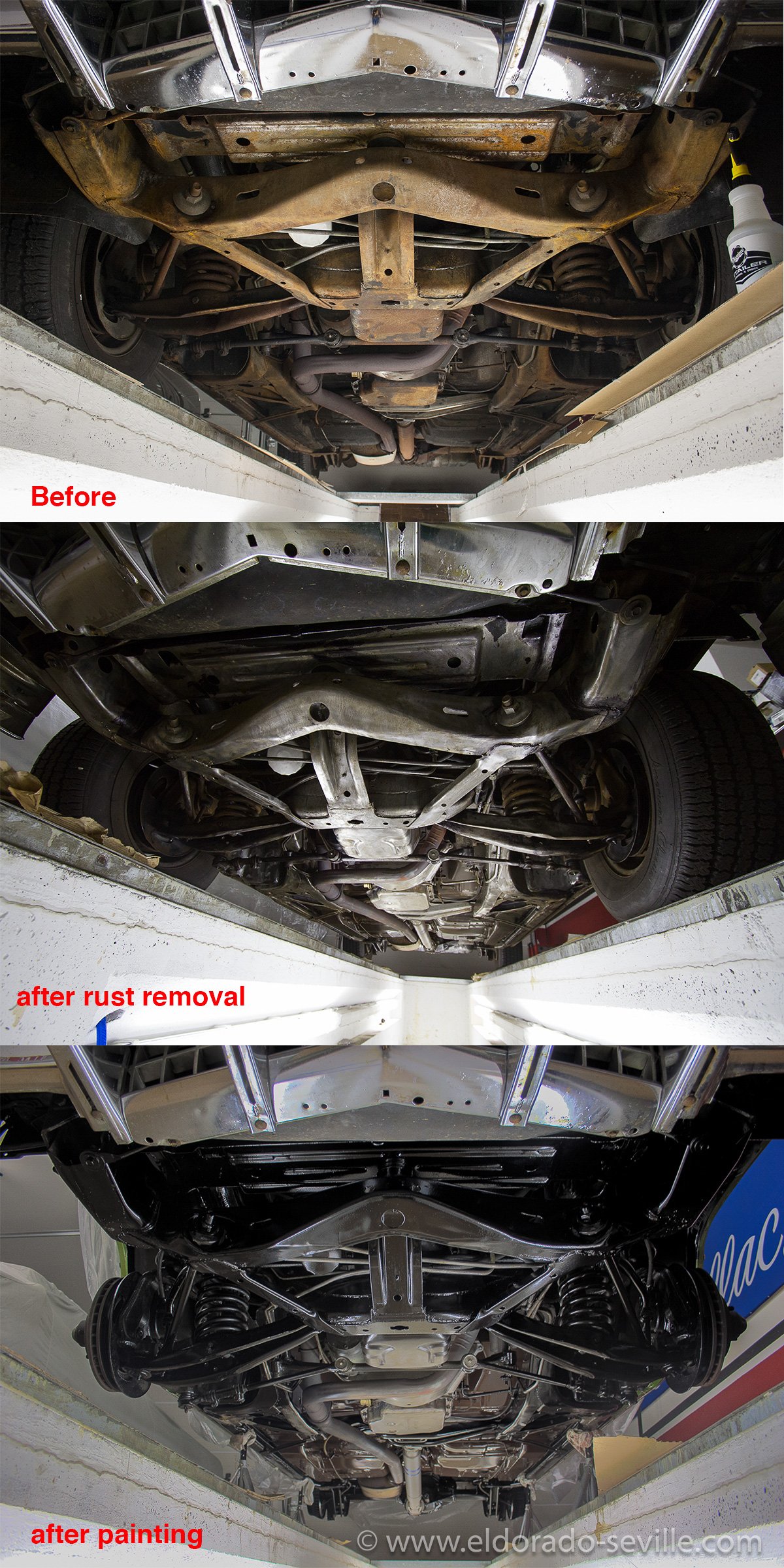
The 3 stages of the project so far.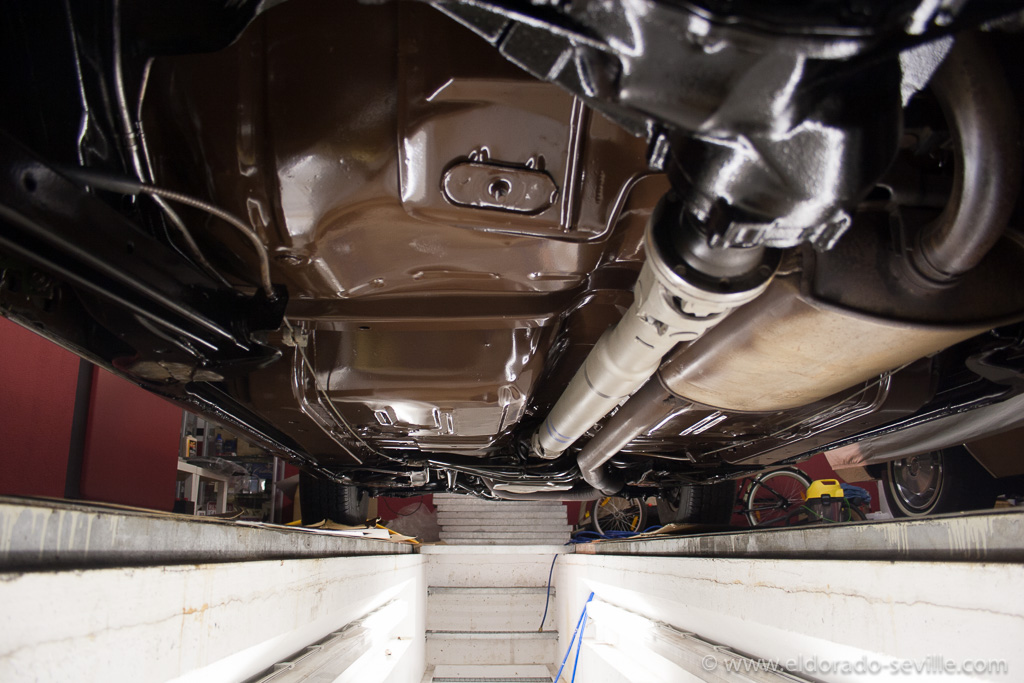
Everything looked o.k. after painting, but the paint does not stick to the metal due to poor cleaning by the paint shop.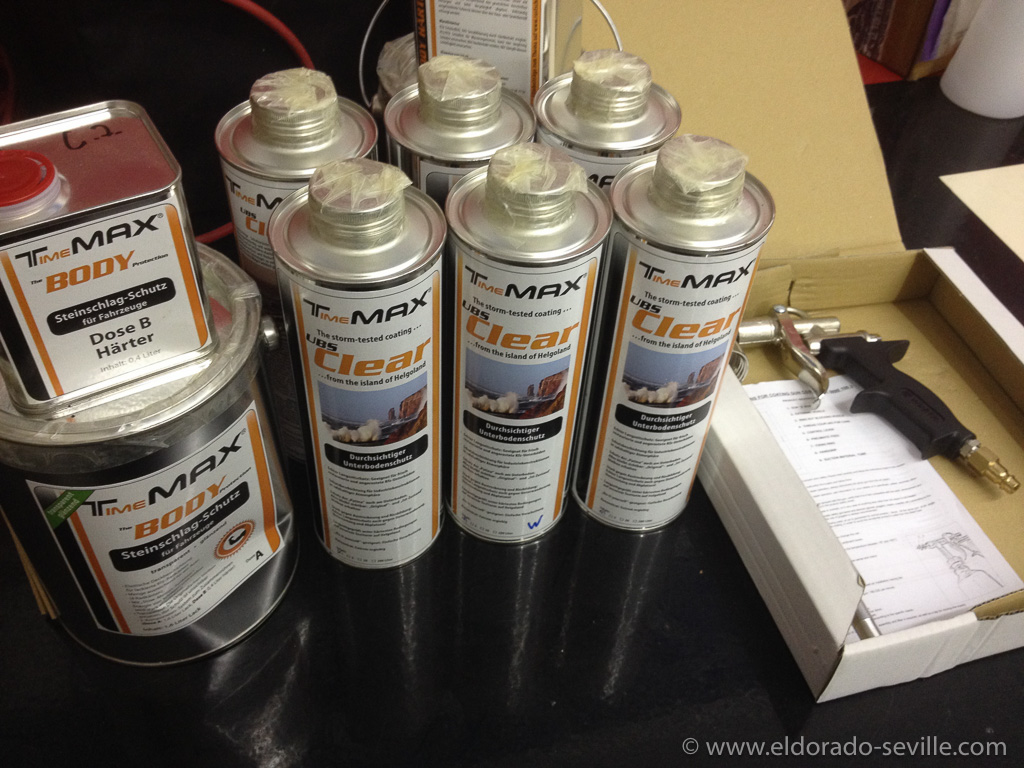
This is the transparent undercoating I wanted to apply when I found out that the entire paint on the undercarriage does not stick…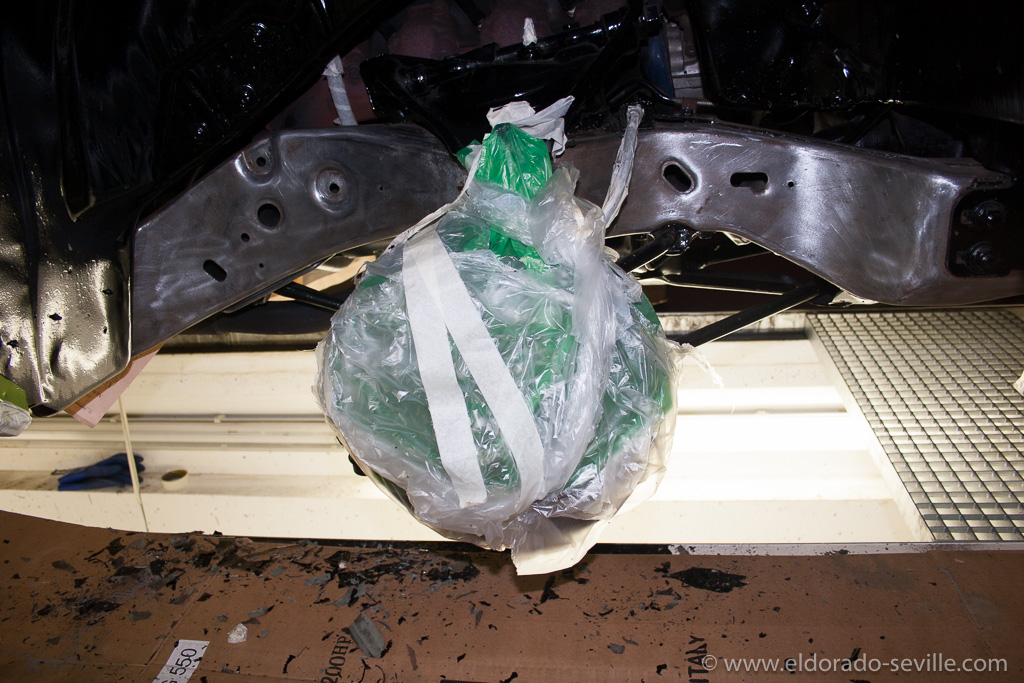
Unfortunately the paint does not stick to the bare metal… I could scrape it of with a simple scraper. You can see all the flaking paint on the floor…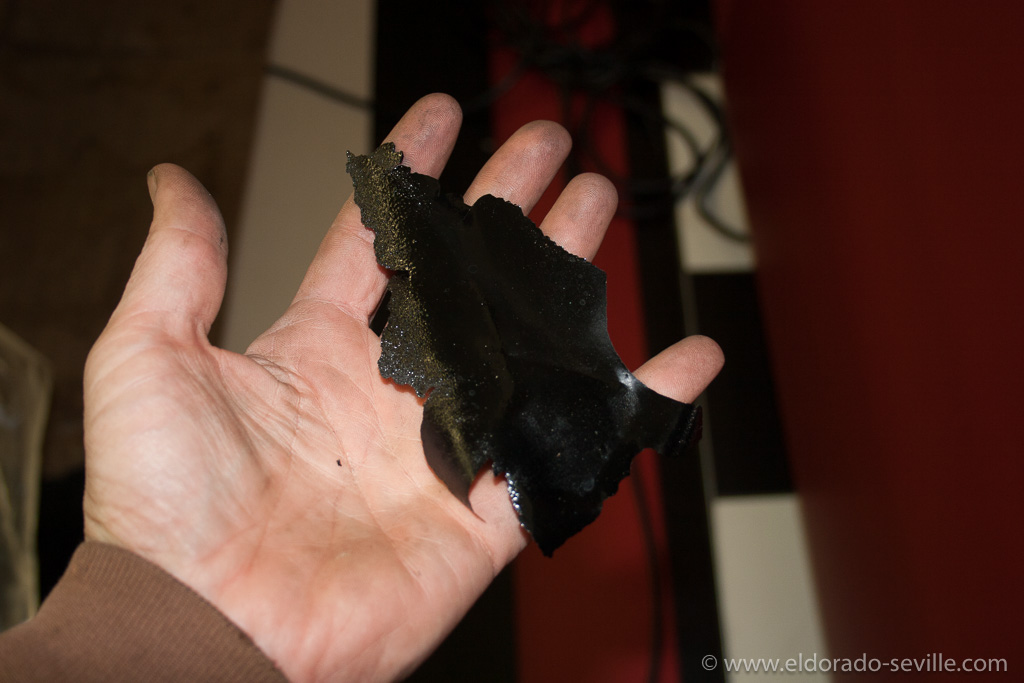
The paint is peeling off in big chunks…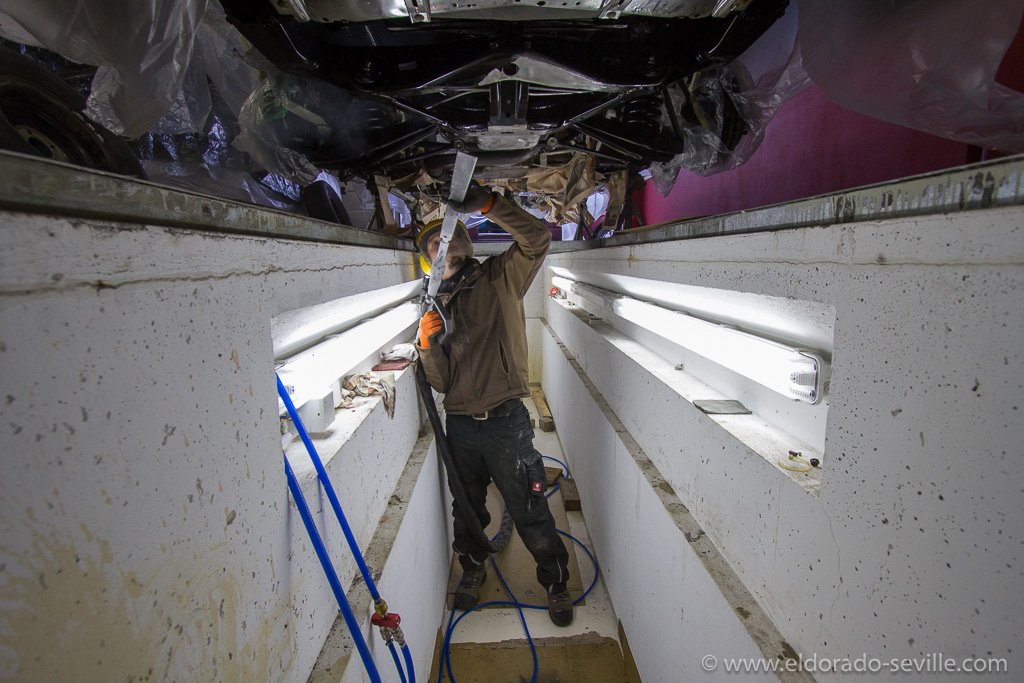
So ALL the new paint has to come off again. Here the dry ice blaster is trying if it can be removed with dry ice cleaning.
BE CAREFUL WITH ZINC PLATED PARTS AND RUST REMOVAL SOLUTIONS
Due to all the problems I had, I completely forgot about some fasteners from the rubber splash guards, which I had soaked in the rust remover solution for more than a week. This long time in the liquid removed all the surface rust, but the acid also ate away the zinc plating. So whenever you try to remove the rust from anodized fasteners and screws, make sure not to soak them for too long.
As I can´t get the fasteners and screws very easily here in Austria, I had to brush away the remnants of the zinc coating with a wire brush, and then painted everything with Eastwoods Silver Cad paint. This does not look 100% correct of course, but will have to do until I find some original replacement hardware. Besides a few washers, these fasteners won´t be visible anyway.
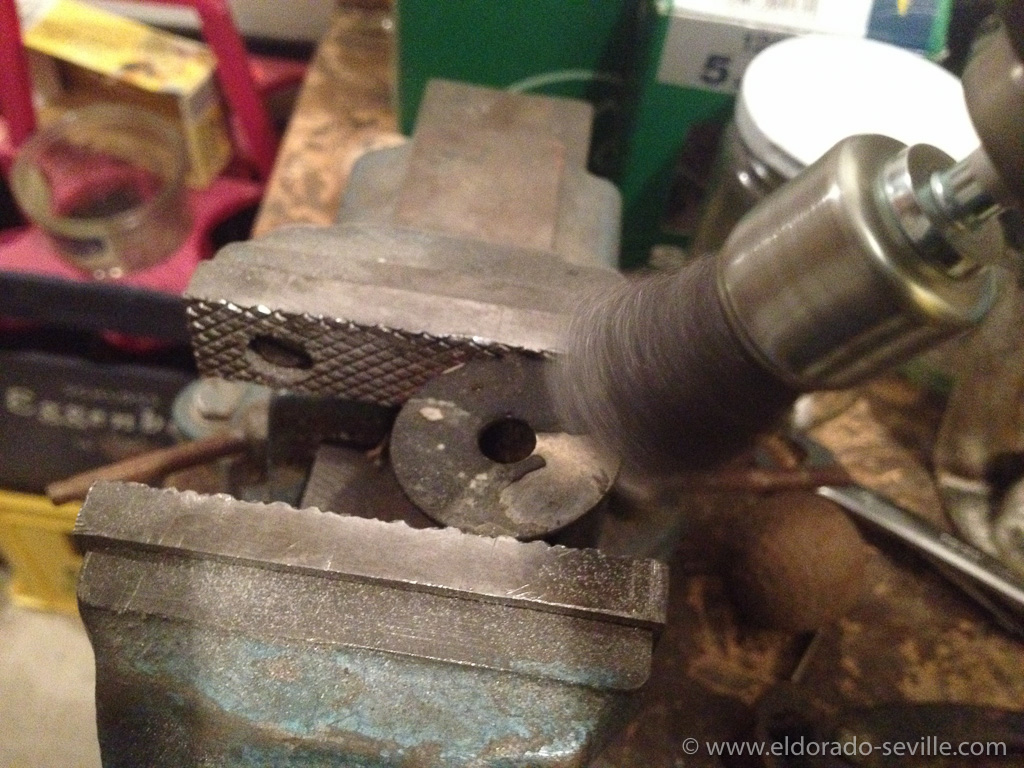
I forgot some of the fasteners for the rubber splash guards in the rust dissolver solution. It ate away the zinc plating. So I had to remove the remains of the zinc plating with a wire brush.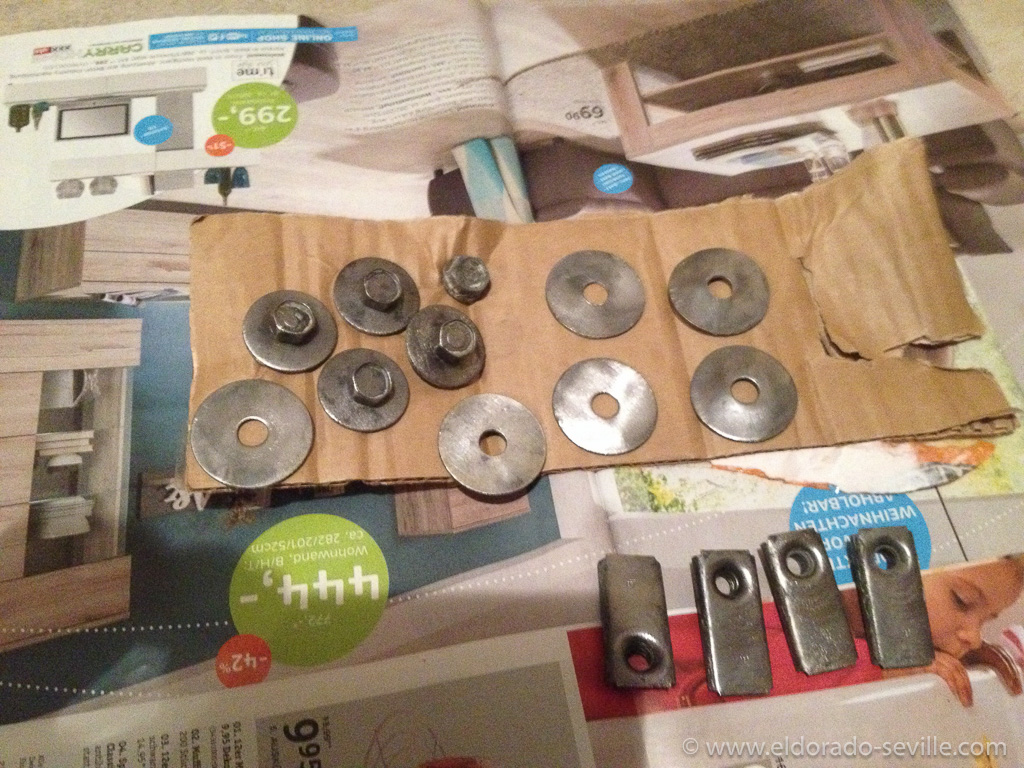
The cleaned fasteners. I spray painted them afterwards with Eastwood zinc paint.
THE 1974 ´S UNDERCARRIAGE GETS REPAINTED
Now that I had removed ALL the rust over the last few weeks the underbody needed a fresh coat of paint.
After dry ice cleaning some light surface rust also showed up under the rear quarter panel ends, the fender skirt area and the lower front fender. All these areas were attacked by water, road debris and other stuff coming from the wheels. These areas suffer the most. Also moisture got trapped underneath the body moldings in this area.
When we removed the moldings fortunately nothing really serious showed up, but only some small spots needed a little attention, more as a preventive and cosmetic measure to make sure that rust can´t spread underneath and show up when its too late to fix it.
The downside of this repair is that I had to sacrifice a small percentage (maybe 5%) of the original paint on the rear quarter panel up to the belt line molding. I do not like this fact very much, as I prefer original paint over repaints, but the other option would only have been to wait for rust damage to happen eventually, but therefore have 100% original paint on the car… As I intend to drive the car I wanted to have everything fixed as good as possible.
A friend of mine is a professional body man, and I asked him to take over from me and do the painting and body work, as I do not have the expertise and skills to do this myself.
The floor pans are now repainted in the correct shade of satin brown, which he had to custom mix, based on "Chocolate Brown" which is a little too bright and contains too much red.
Then the floor had to get taped off again to paint the frame and suspension parts in satin black.
We will even go so far to replicate the factory flaws like green overspray in the rear wheel housings for the authentic look and to remember how these cars were built in 1974…
Next up was the repaint of the repaired areas of the sheet metal in “Persian Lime“. He found the formula for this special green in his computer database and he sprayed a test sheet which was an almost perfect match. He then had to find the perfect match by himself. He succeeded and found the perfect color and the repairs are now invisible. It was my biggest concern that he would have trouble to get the color right and gave me some sleepless nights…
Once the car will be back home, I will re-paint the brake parts in a bare metal look and rebuild the brakes while everything is apart. I also already have new shocks waiting for installation, I will put in new brake hoses, repair the radio and heater core and do a good general tune up and change all fluids. So next spring I should have a car which looks and drives like new :-) You can find all the pictures of this project in a gallery here.
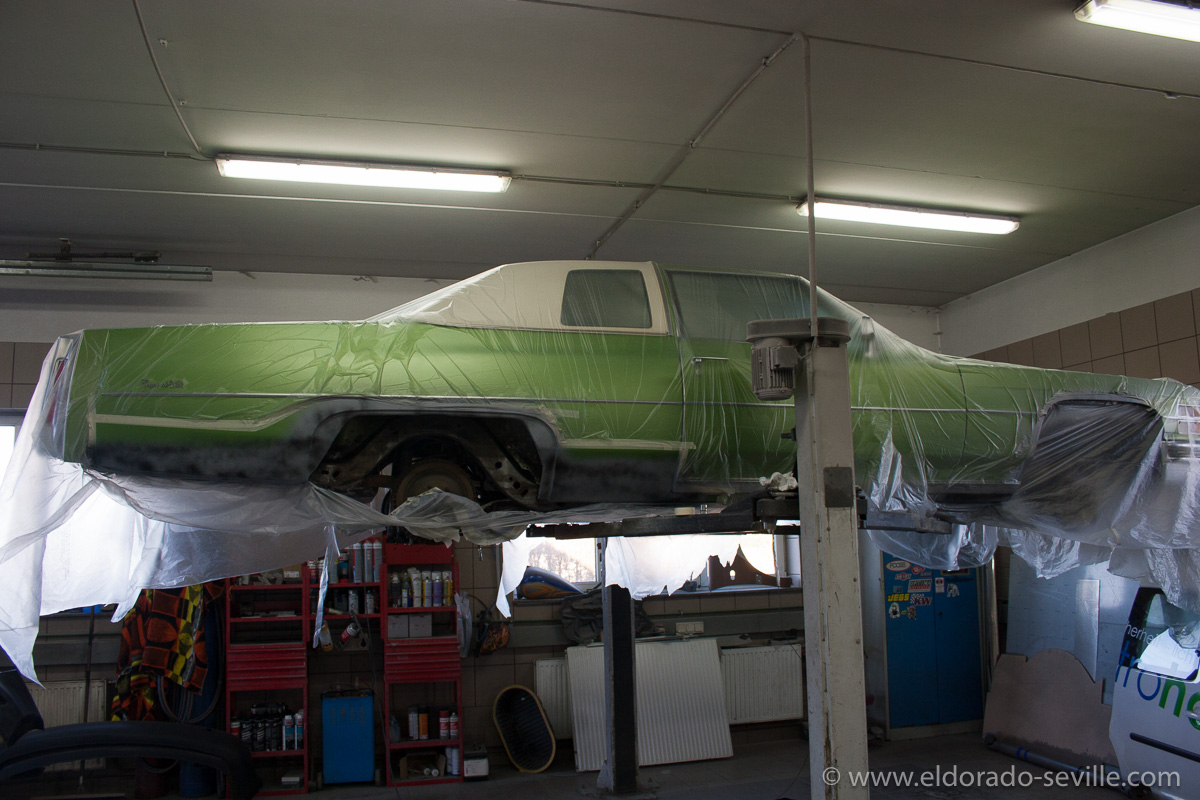 The Cadillac in the paint shop.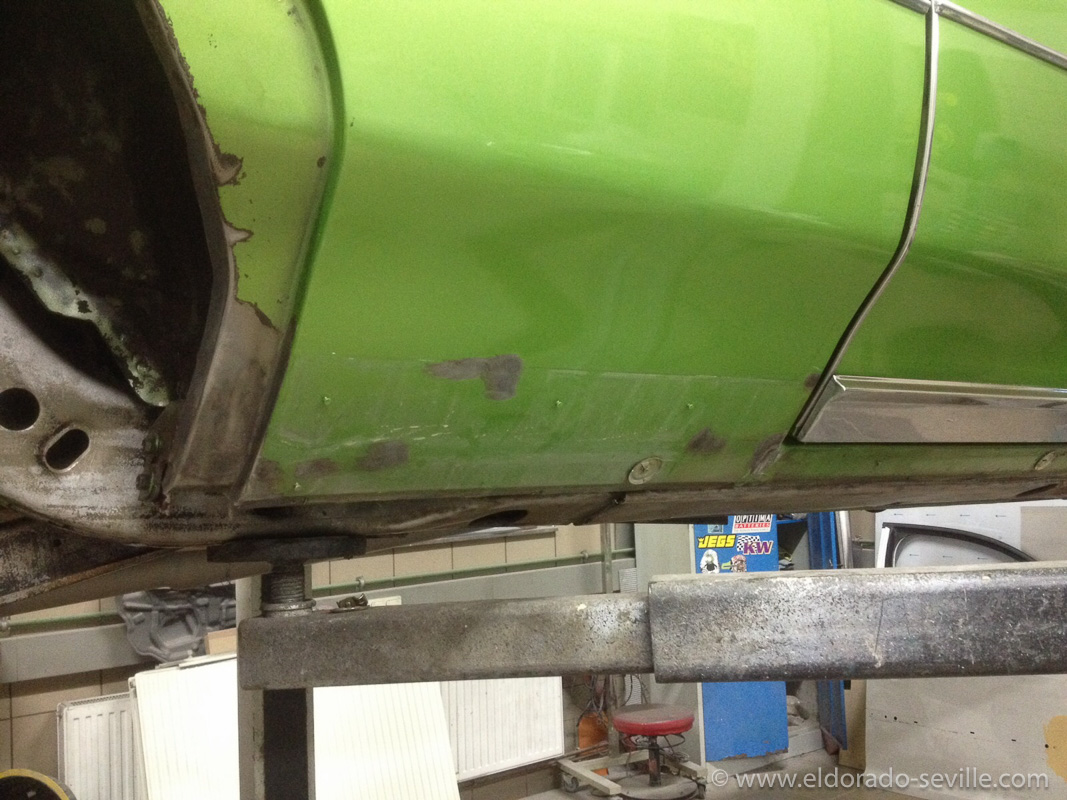
This are the areas on the sheet metal that needed some attention. Nothing serious - but better to fix it now before a problem arises eventually in the future. Here the lower trim is removed to see what is going on.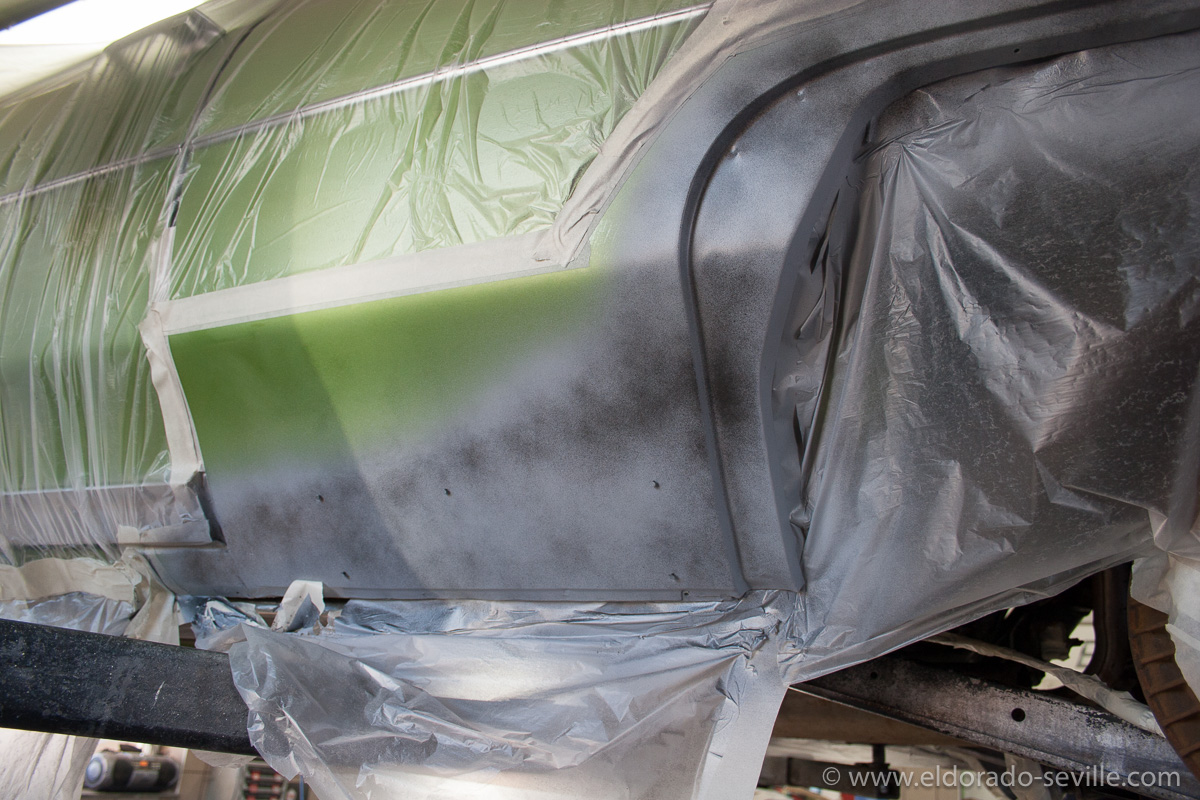
The lower edge behind the rear wheels had suffered a bit over the last 41 years... I decided to have it fixed properly and sacrifice a little of the original paint for this. Also the area around the fender skirts needed a little attention to look like new again. No real severe rust issue, but more of a preventive and cosmetic measure... Fender skirts will be repainted as well... On this picture you can see the primer and a very small amount of filler for a perfect surface.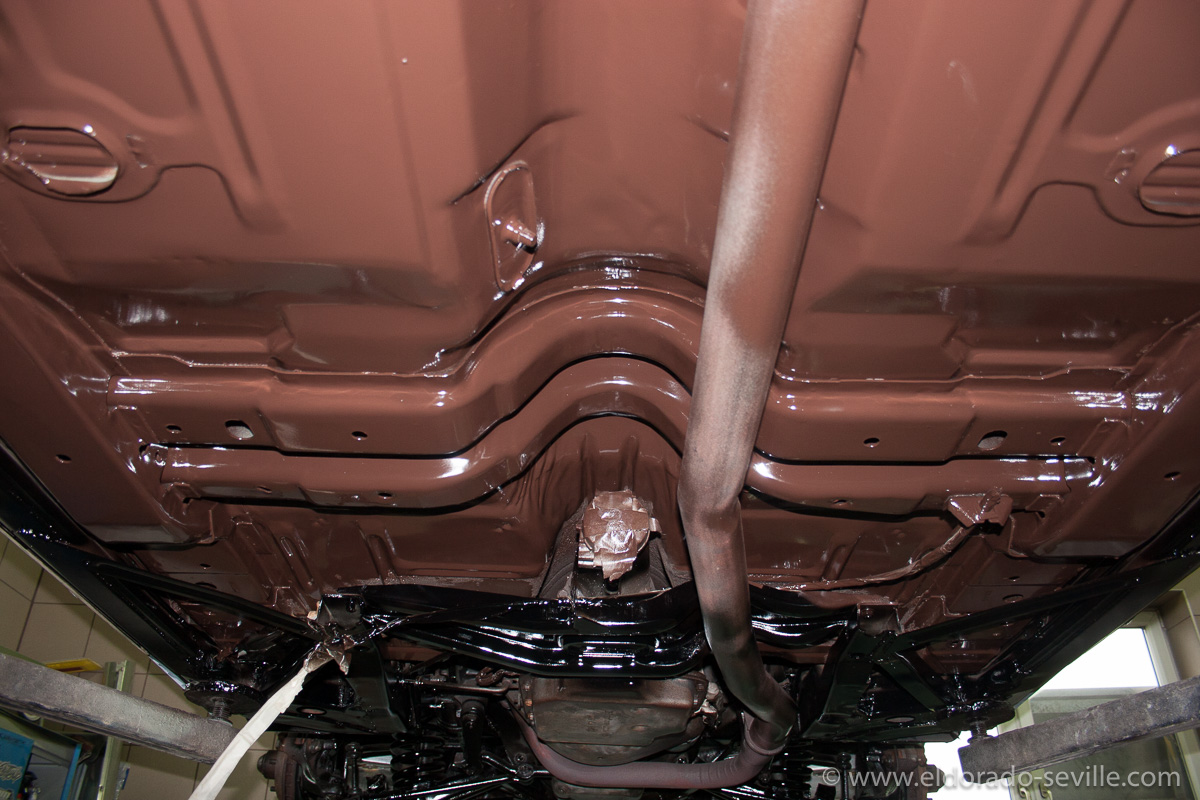
The floor pans are now repainted in the correct shade of brown. It will get a little less glossy once the 3 coats of transparent undercoating are applied.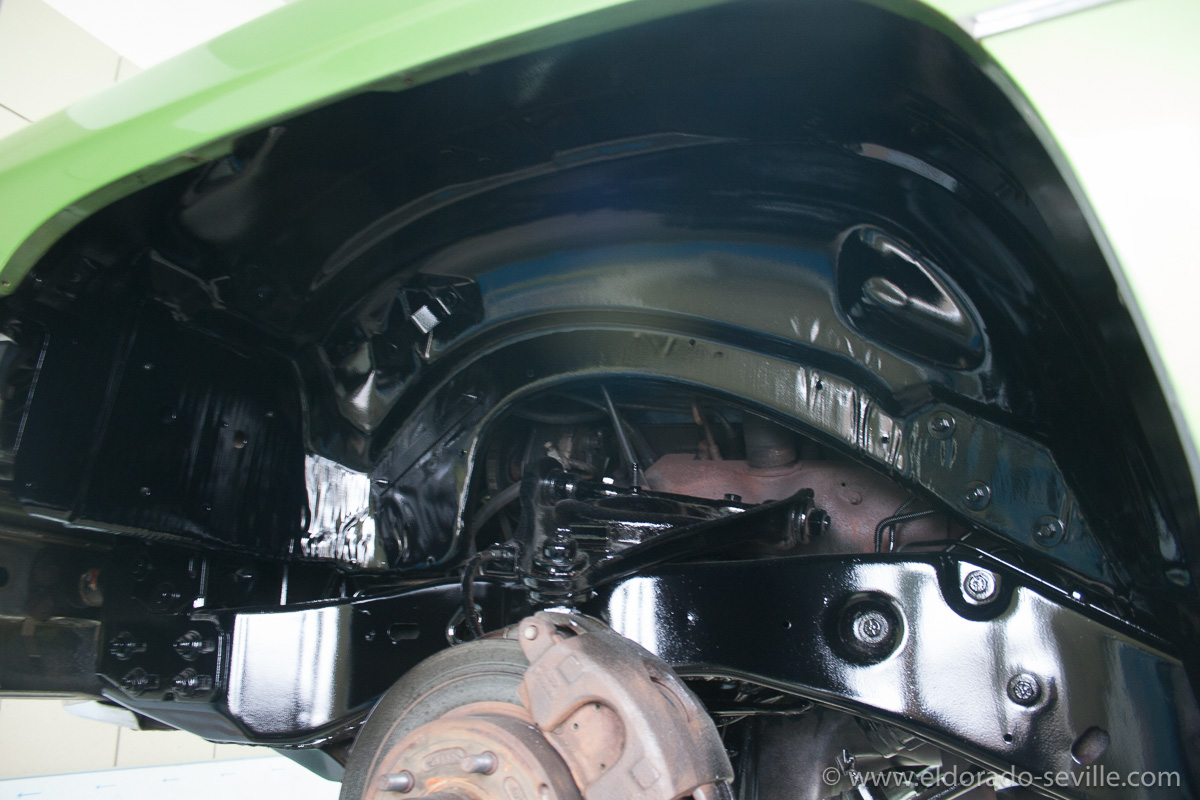
The wheel housing after the first coat of satin black.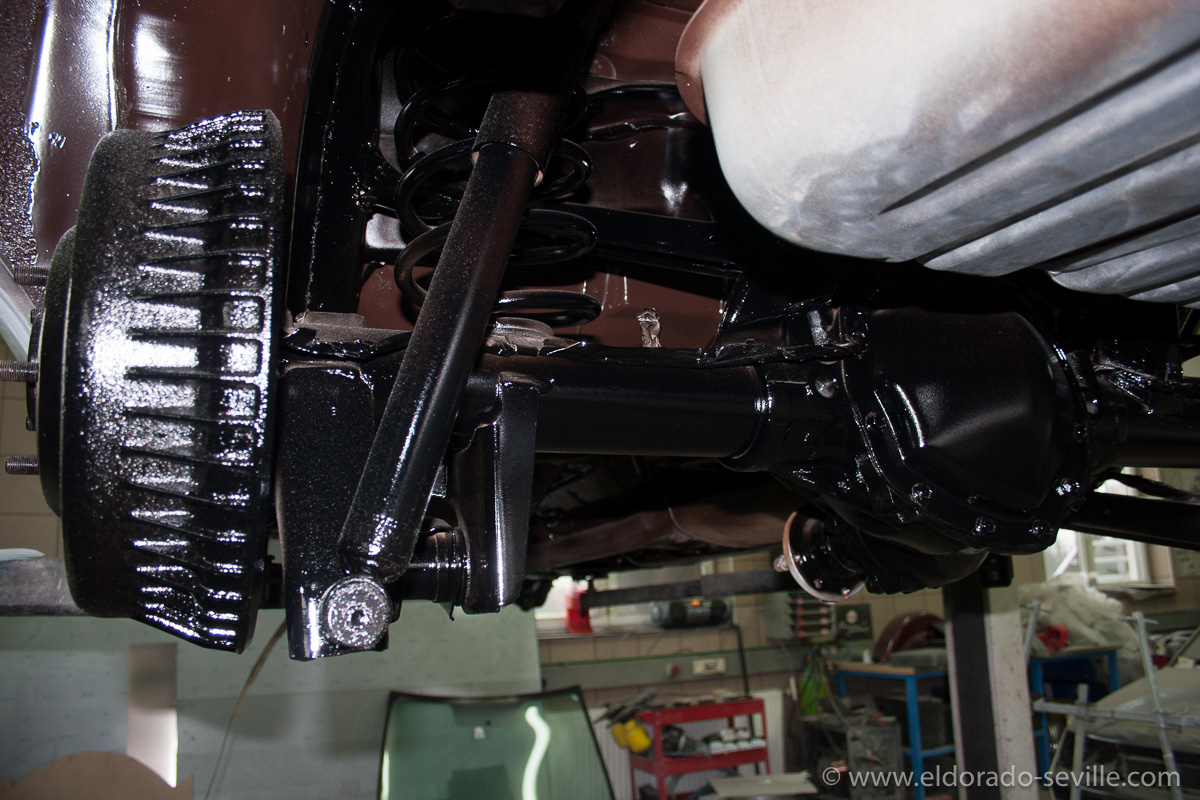
The rear axle is back in black. I will paint the rear brake drums in a bare metal look later once the car is back home.
I will also install new shocks and paint the tank with Eastwood Tank Tone paint.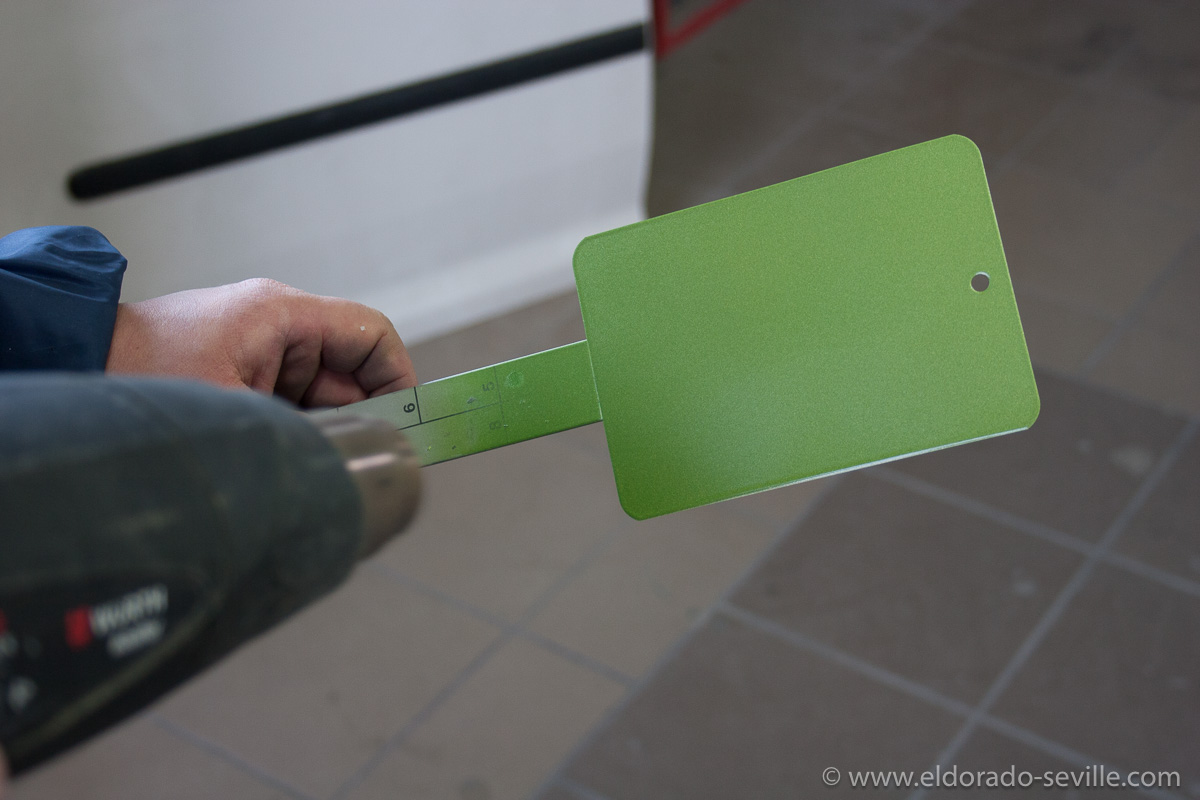
Finding the right shade of Persian Lime for a perfect match. The computer had the color in the system and it already was a very good match.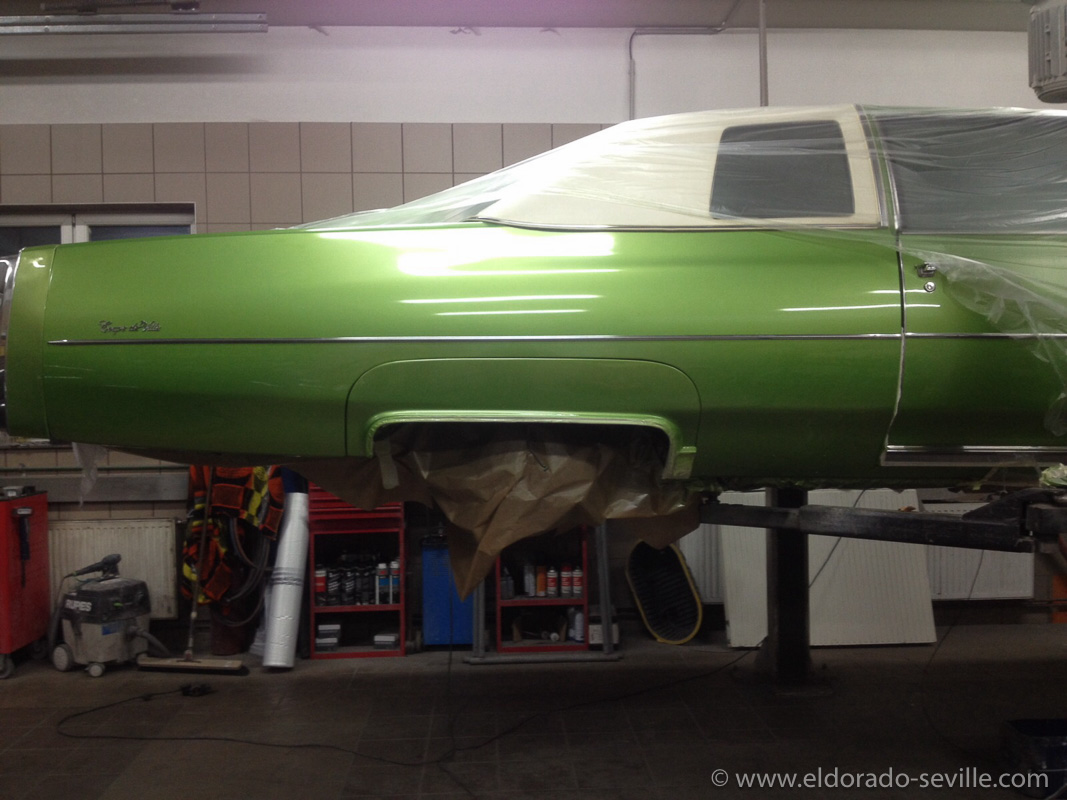
The paint shop found a perfect match for the Persian Lime paint. Great job Jürgen!
You can find all the pictures of this project in a gallery here.
DETAILING THE 1974 CADILLAC DRIVESHAFT
When the car was built, Cadillac and all other car companies did not bother to protect the bare metal driveshafts in any way, so they already had surface rust on them when they were delivered new…
My initial plan was to use a wire brush to knock of the rust and just paint it black like most people would do.
But I then decided that I wanted to go the extra mile, do it properly and put it back into the condition it was when it was built.
I wanted to remove the rust chemically in a rust dissolving fluid that is normally used for de-rusting fuel tanks, but I had no idea how I could soak such a long piece in this fluid.
I came up with the idea to just use a big tarp and put some wood to the sides, put the driveshaft in it and fill it with rust removing liquid. This worked out really well.
It took about 48 hours until all the rust was gone.
After a little of the rust was gone I discovered the remains of the 3 factory markings on the drive shaft. There were three rings painted onto the shaft - two in blue and one in black. I found some small traces of the paint during rust removal. I wanted to re-apply them once the shaft was finished.
When the shaft was fully de-rusted I found out that flash rust would come back literally after only a few minutes. Thats why I decided to paint the shaft to replicate the factory appearance.
I used Eastwood Detail Gray to mimic the original look of bare metal. Before applying the paint, I used self etching primer on the bare metal.
When all the paint was dry, I added the finishing touches with the three color rings.
I´m very happy how it turned out - it looks great. You can see more pictures of this project here.
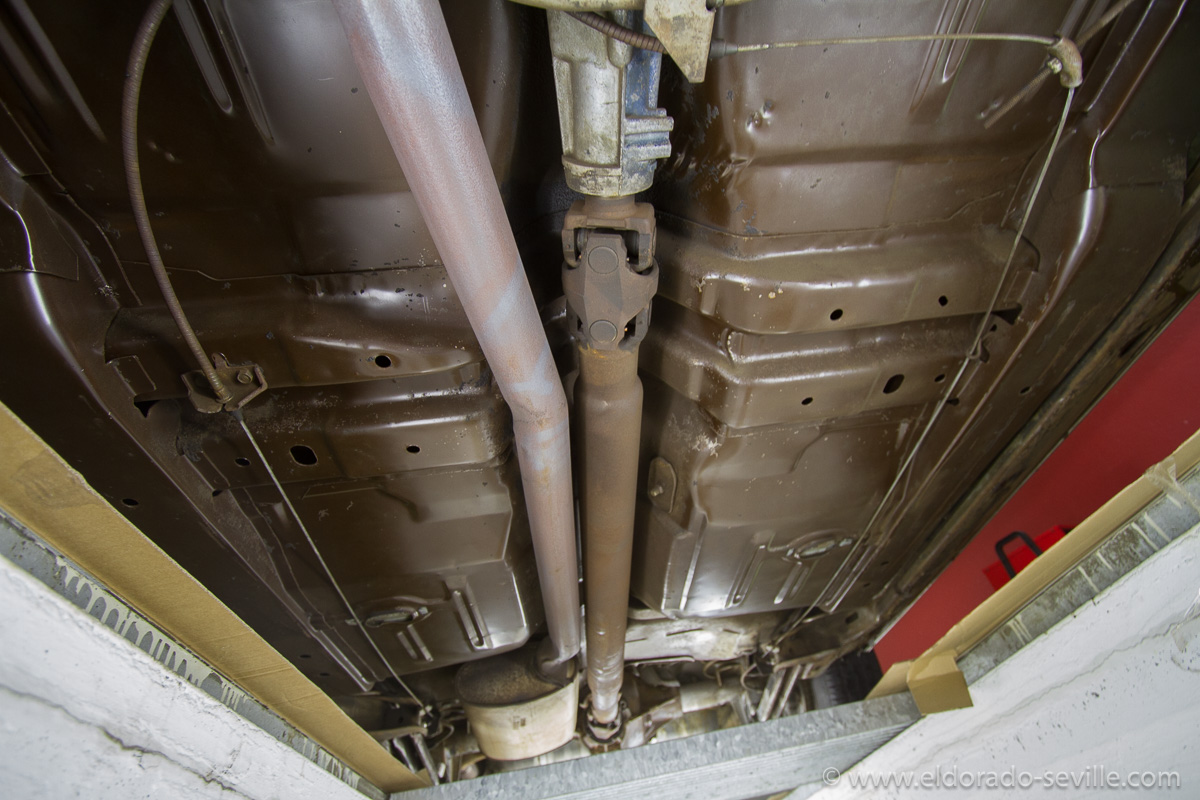
The driveshaft before…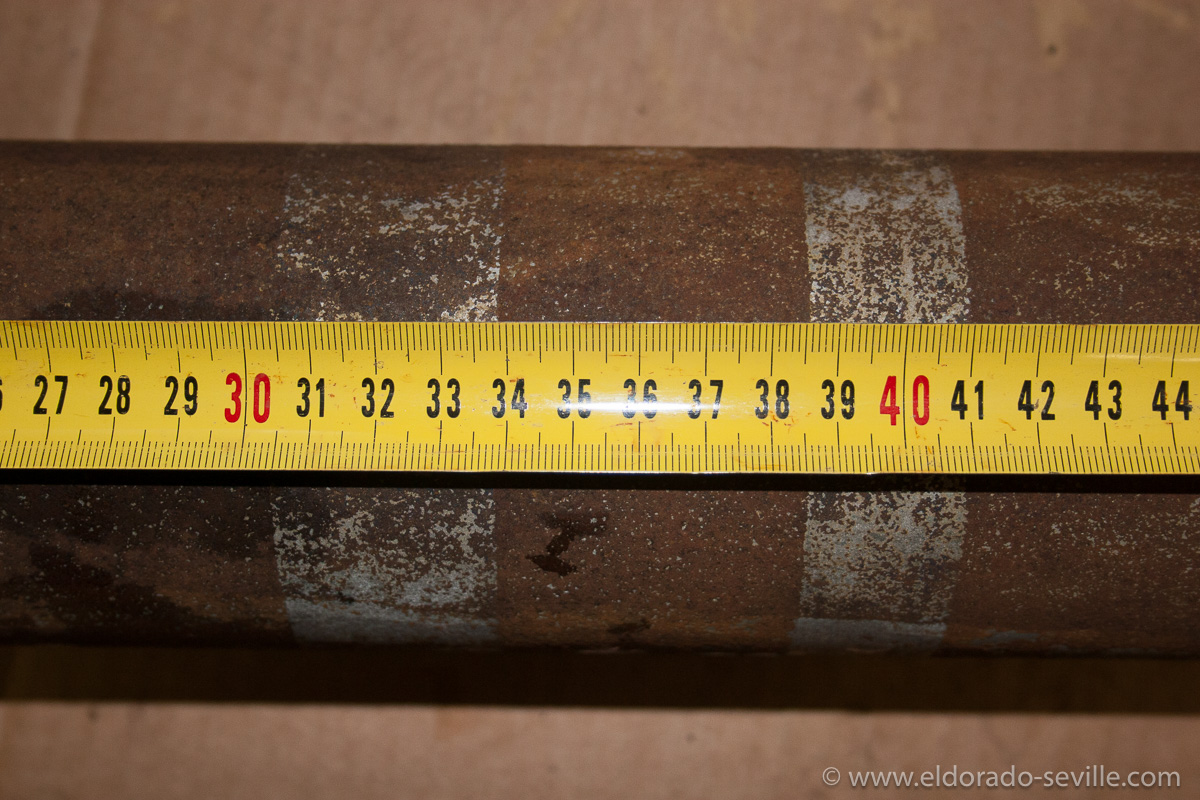
The location of the first two factory markings. I measured them to make sure that I could replicate them when I painted the driveshaft. The first two markings were (light) blue. 
The location of the third factory marking. I measured it to make sure that I could replicate it once I painted the driveshaft. This marking seemed to be black once.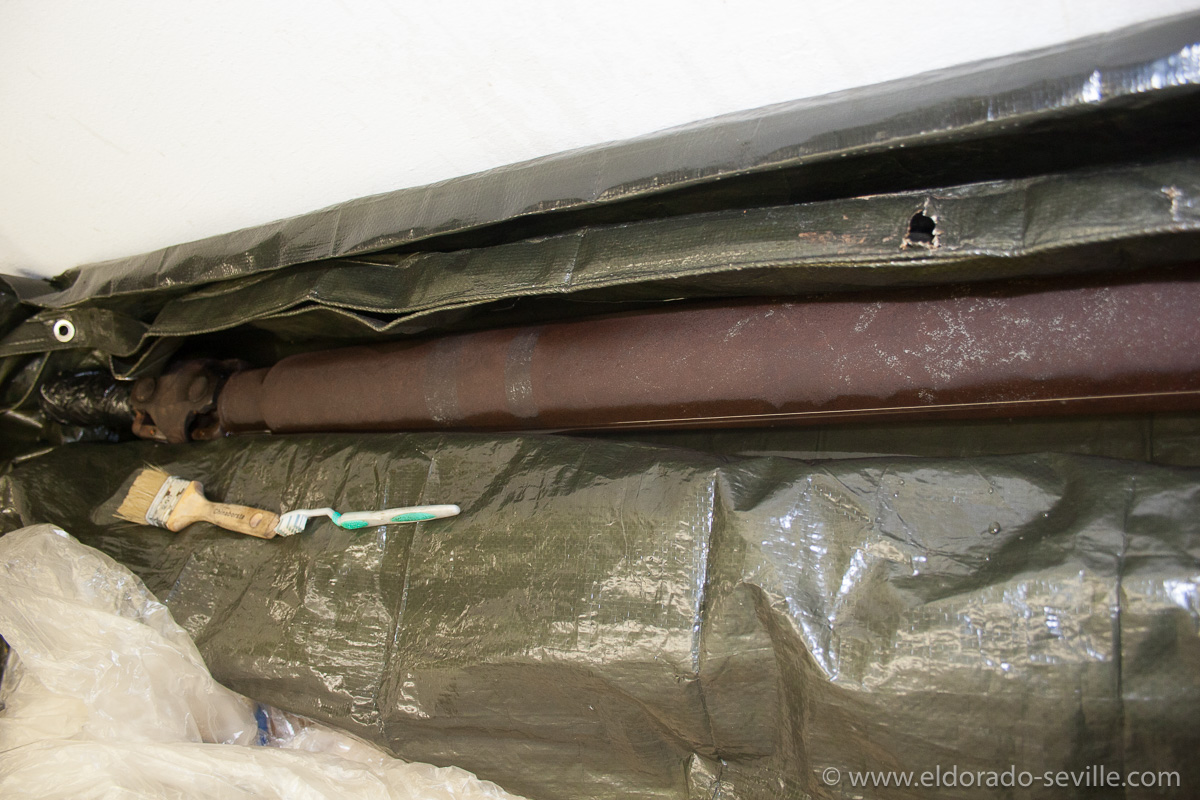
I soaked the driveshaft for 48 hours in rust removing liquid and used these two brushes to agitate it into the rust.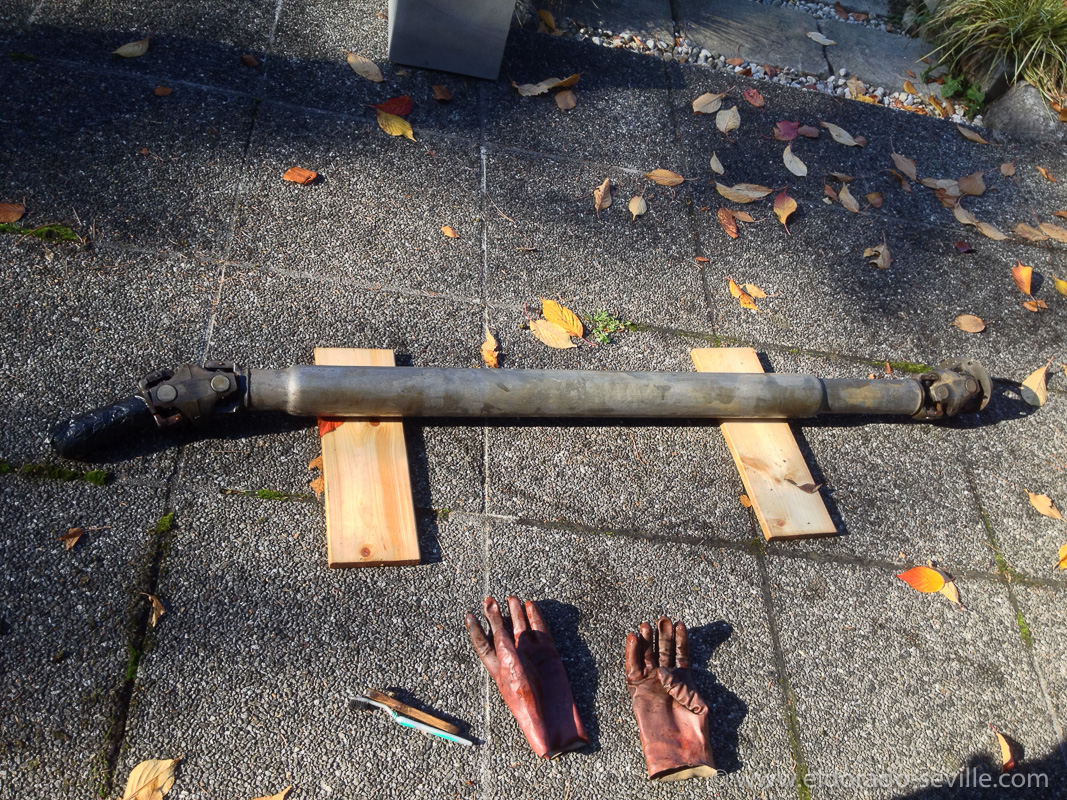
This is how it looked after soaking for 48 hours. All the rust was completely gone and only bare metal was left.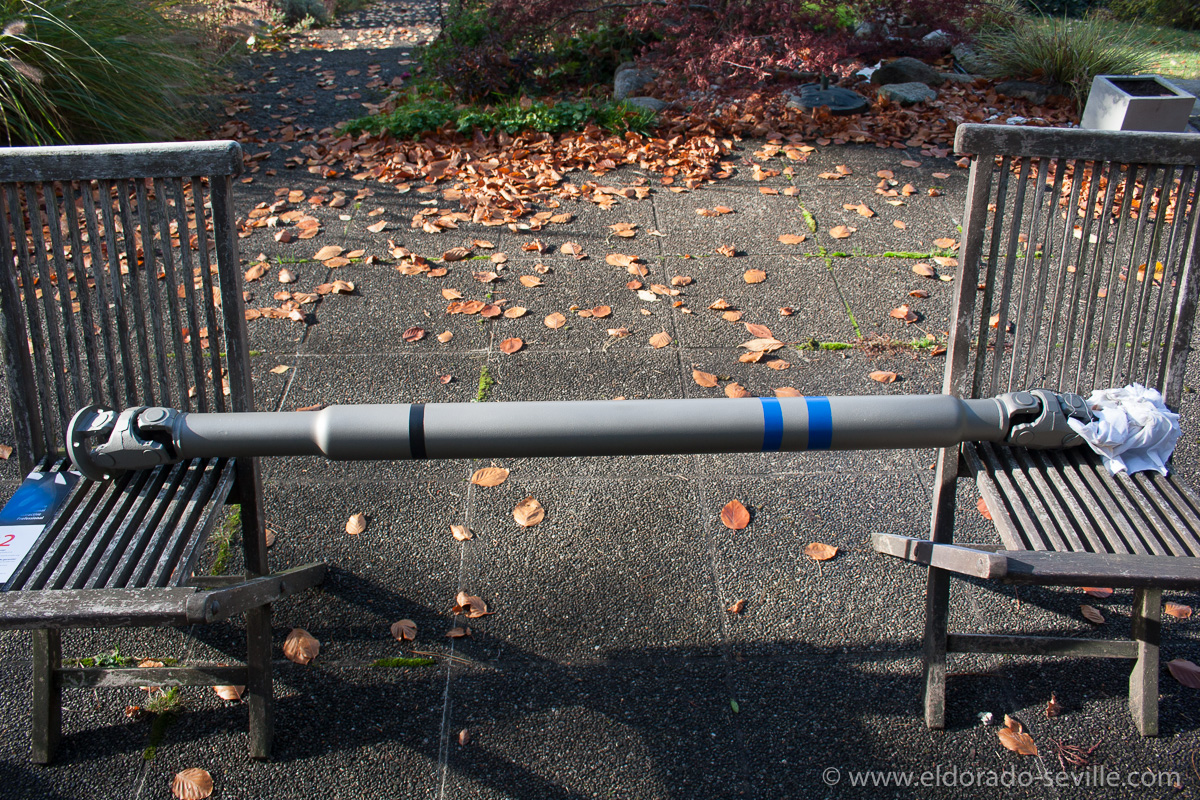
The finished drive shaft.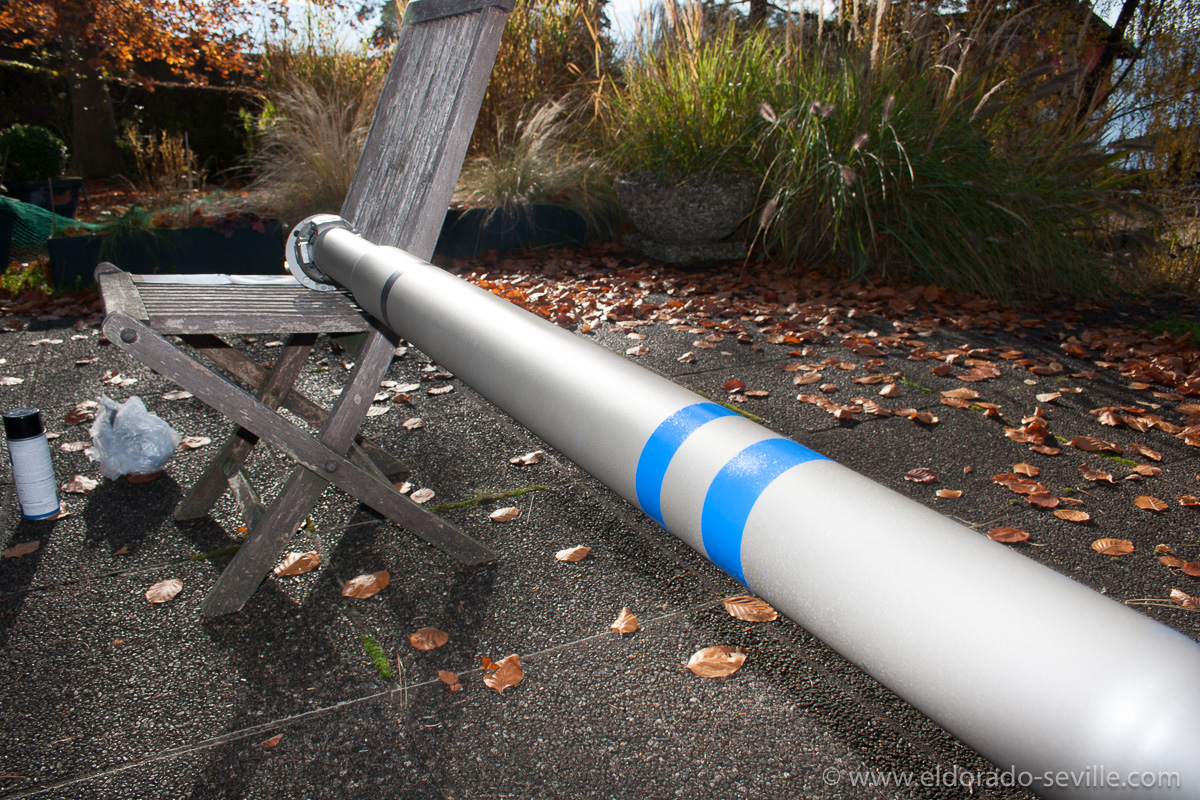
The replicated factory markings on the drive shaft. The correct shade of blue color was only a good guess - I think it comes pretty close to the traces of paint I had found.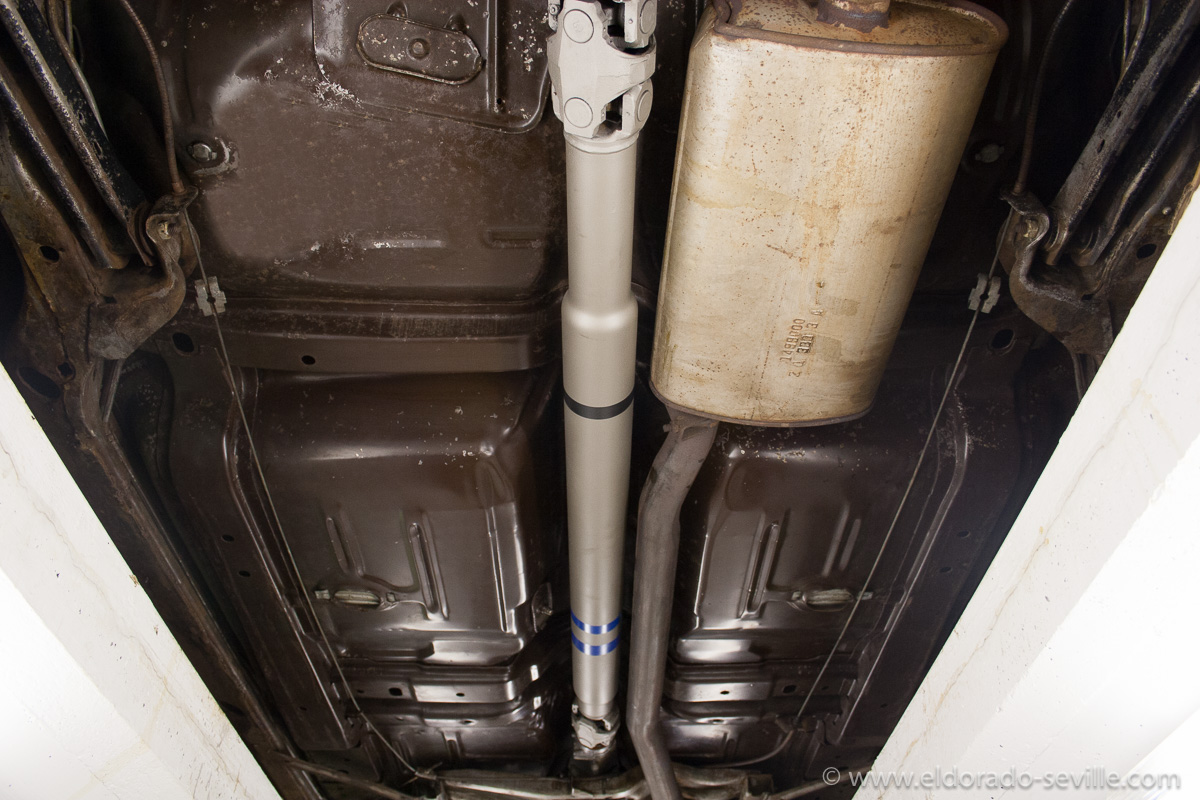
Back in the car to be able to move it around.
DRY ICE BLASTING THE UNDERCARRIAGE OF THE 1974 CADILLAC
As I want to do it as perfectly as possible, I wanted to remove all the undercoating which was applied when the car was new.
I do not like rubberized undercoating, as you cannot see whats going on underneath. It can trap moisture and once it flakes off due to corrosion, there is already some major damage in the metal underneath.
There are different methods for removing the undercoating and most of the methods are a pain in the a**.
This stuff can be removed with a scraper and chemicals, or with heat and a scraper. Both methods will damage the metal underneath and scratch the paint on the underbody, and it takes forever…
As I did not want to use any of the methods mentioned above, I decided that I wanted to try dry ice blasting.
Dry ice-blasting is a form of carbon dioxide cleaning, where dry ice, the solid form of carbon dioxide, is accelerated in a pressurized air stream and directed at a surface in order to clean it. An alternative media for non-abrasive blasting is water-ice, known as ice blasting.
The method is similar to other forms of abrasive blasting such as sand blasting, plastic bead blasting, or soda blasting but substitutes dry ice as the blasting medium. Dry-ice blasting leaves no chemical residue as dry ice sublimates at room temperature.
Dry-ice blasting involves propelling pellets at extremely high speeds. The actual dry-ice pellets are quite soft, and much less dense than other media used in blast-cleaning (i.e. sand or plastic pellets). Upon impact, the pellet sublimates almost immediately, transferring minimal kinetic energy to the surface on impact and producing minimal abrasion. The sublimation process absorbs a large volume of heat from the surface, producing shear stresses due to thermal shock. This is assumed to improve cleaning as the top layer of dirt or contaminant is expected to transfer more heat than the underlying substrate and flake off more easily. The efficiency and effectiveness of this process depends on the thermal conductivity of the substrate and contaminant. The rapid change in state from solid to gas also causes microscopic shock waves, which are also thought to assist in removing the contaminant.
Unlike abrasive media blasting you cannot remove rust with dry ice blasting.
I found a company through the website of a classic car club, which is only a little over an hour away. I wanted to have it done before the first snow and as soon as possible, so that I could continue working on my car during the winter. The owner of the company did a great job. He is a very friendly and competent gentleman and it was a pleasure working with him.
Here is a short video how it was done: (make sure to watch in HD for proper image quality)
You can find all the pictures I took today in my restoration album.
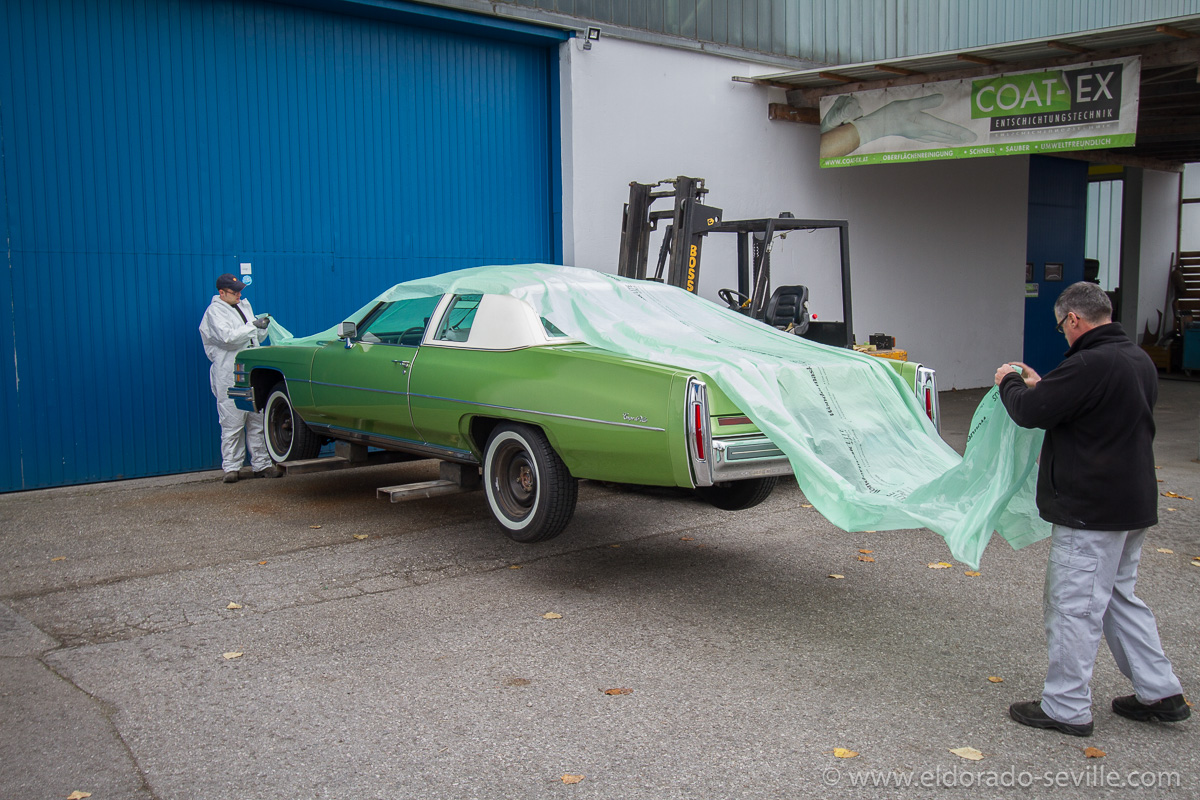
The car was lifted with a forklift and then covered in plastic.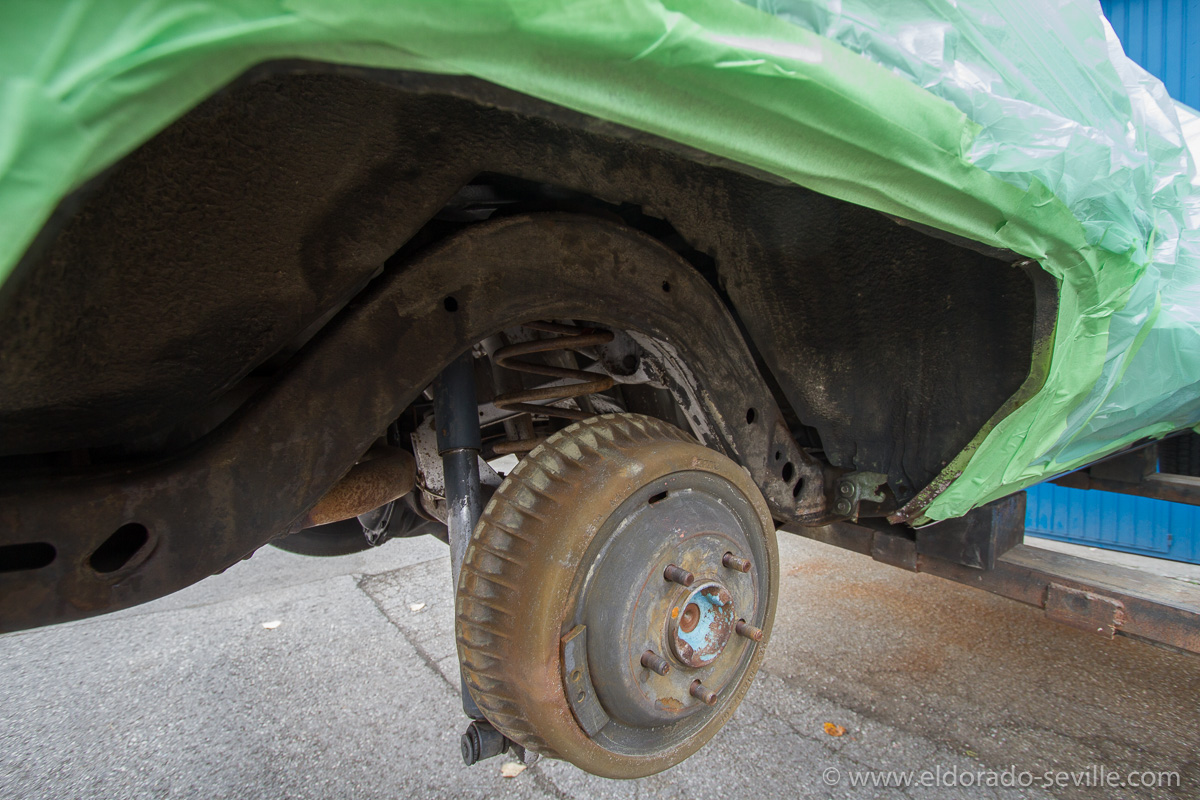
One of the rear wheel-housings before blasting - you can see the undercoating everywhere. 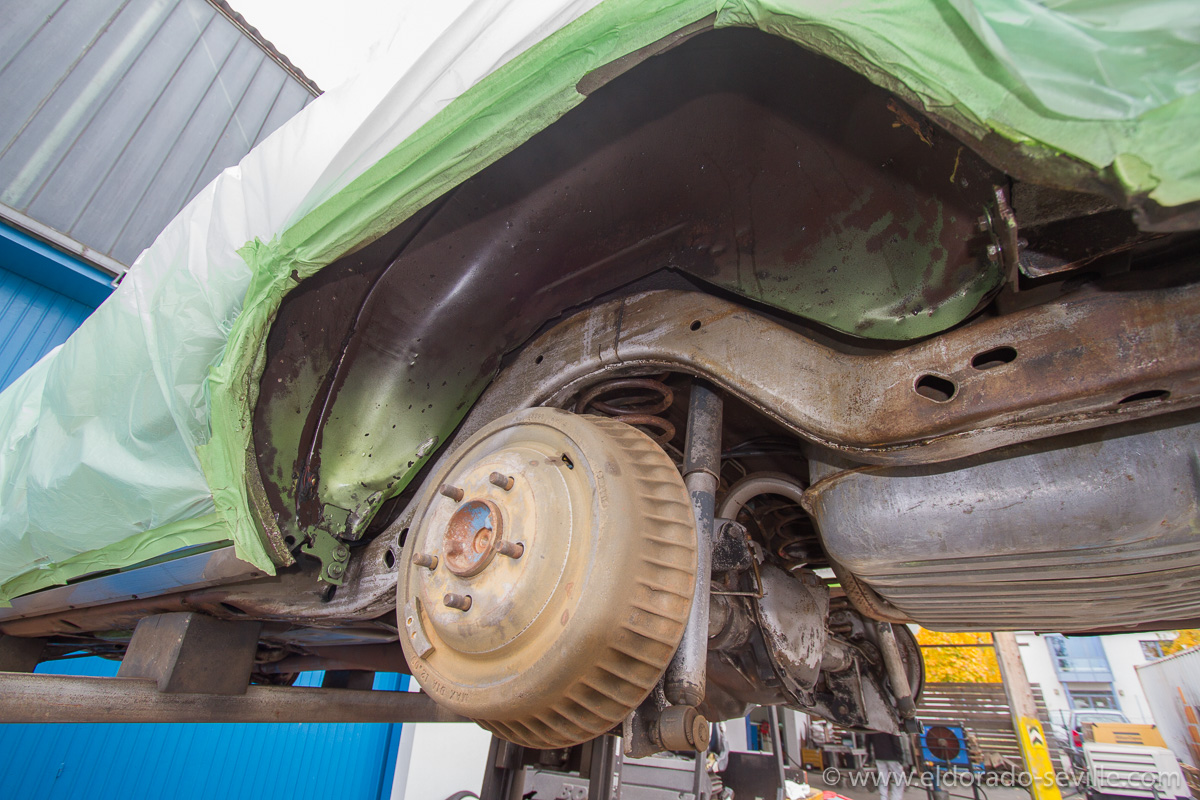
The same wheel housing after blasting - all the original paint was still very well preserved under the undercoating. As you can see originally the wheel housing was brown. During painting a lot of overspray from the body landed in the wheel housing. Then Cadillac added rubberized undercoating to protect the metal from stone chips and to keep the car more quiet. Luckily there is no rust to be found anywhere.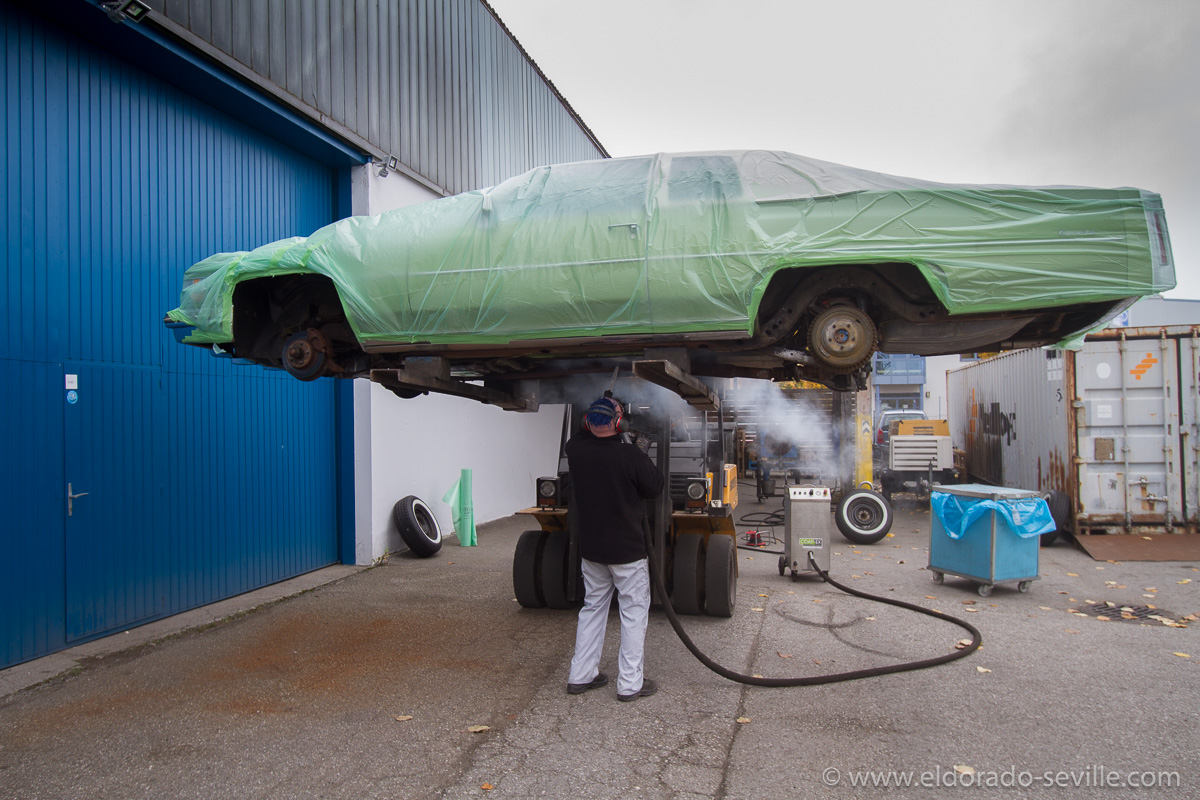
During blasting.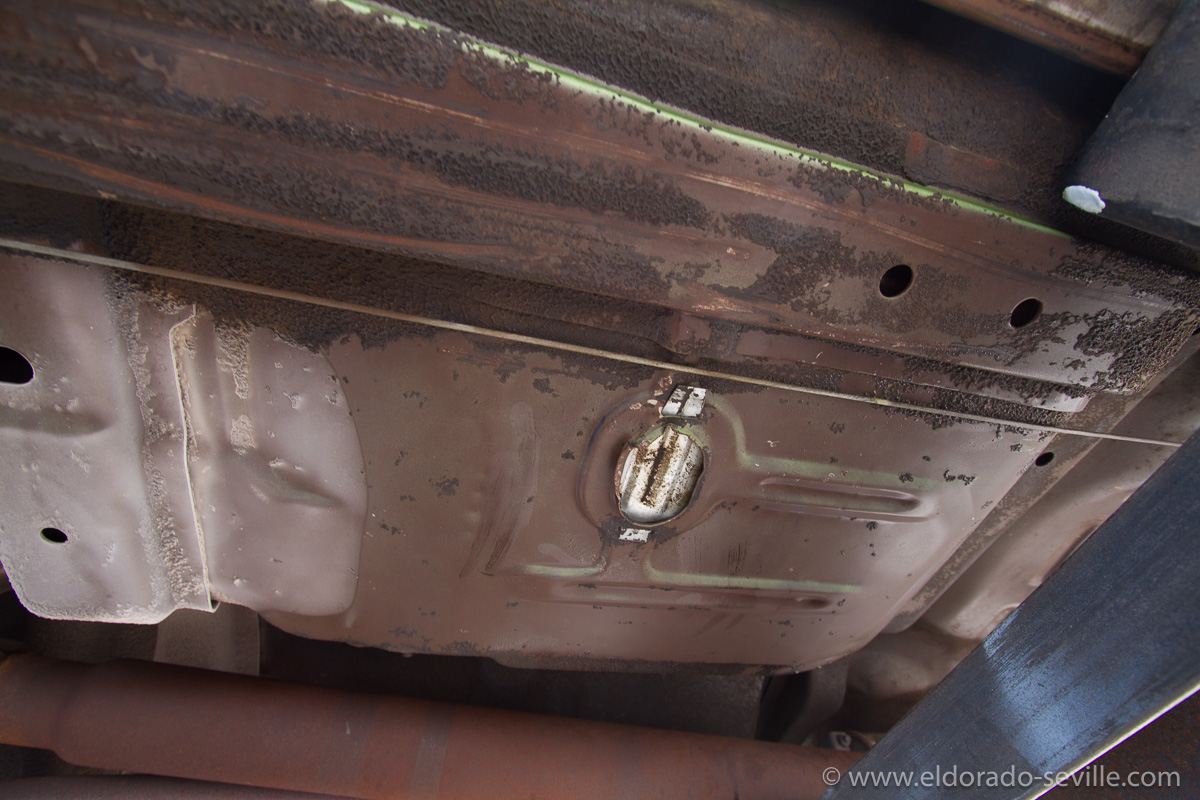
The original brown paint showed up underneath the undercoating. The paint is still in perfect condition. 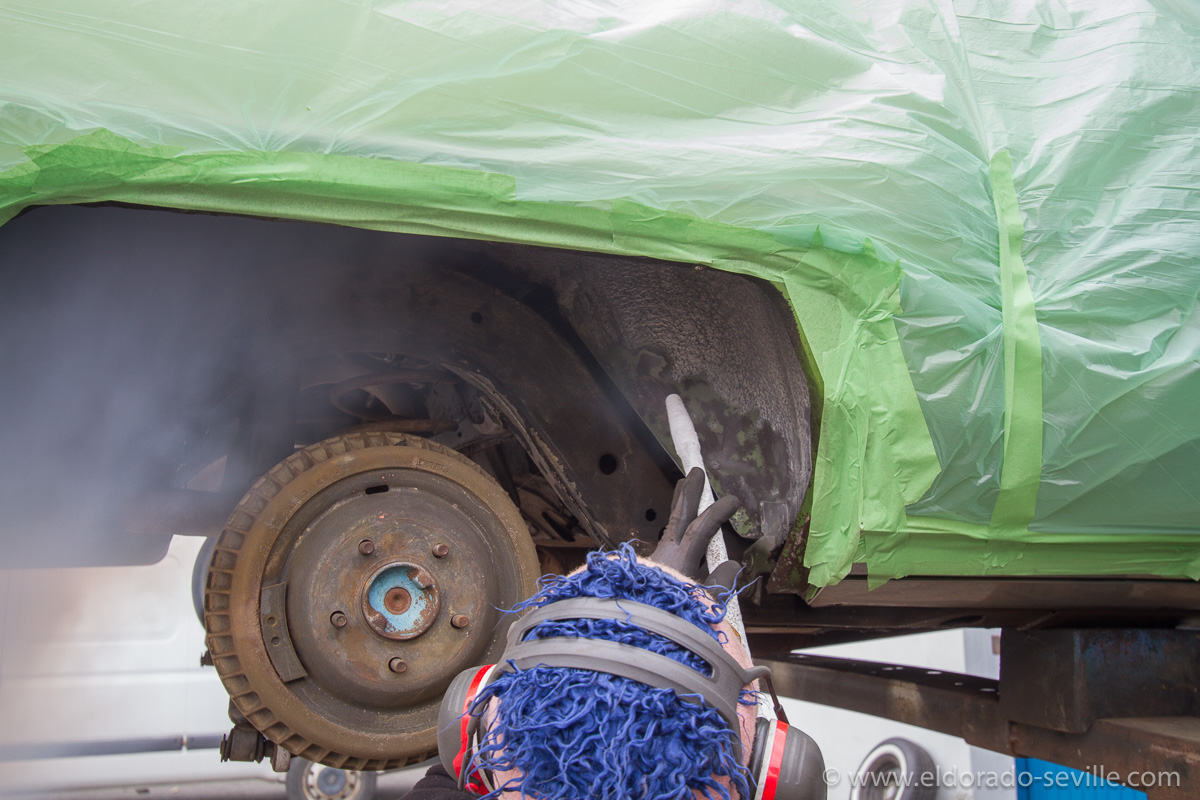
The original paint showed up underneath the undercoating in the wheel housings as well.
After cleaning - it came out really nice! I will touch up some areas and conserve the others with a special transparent coating.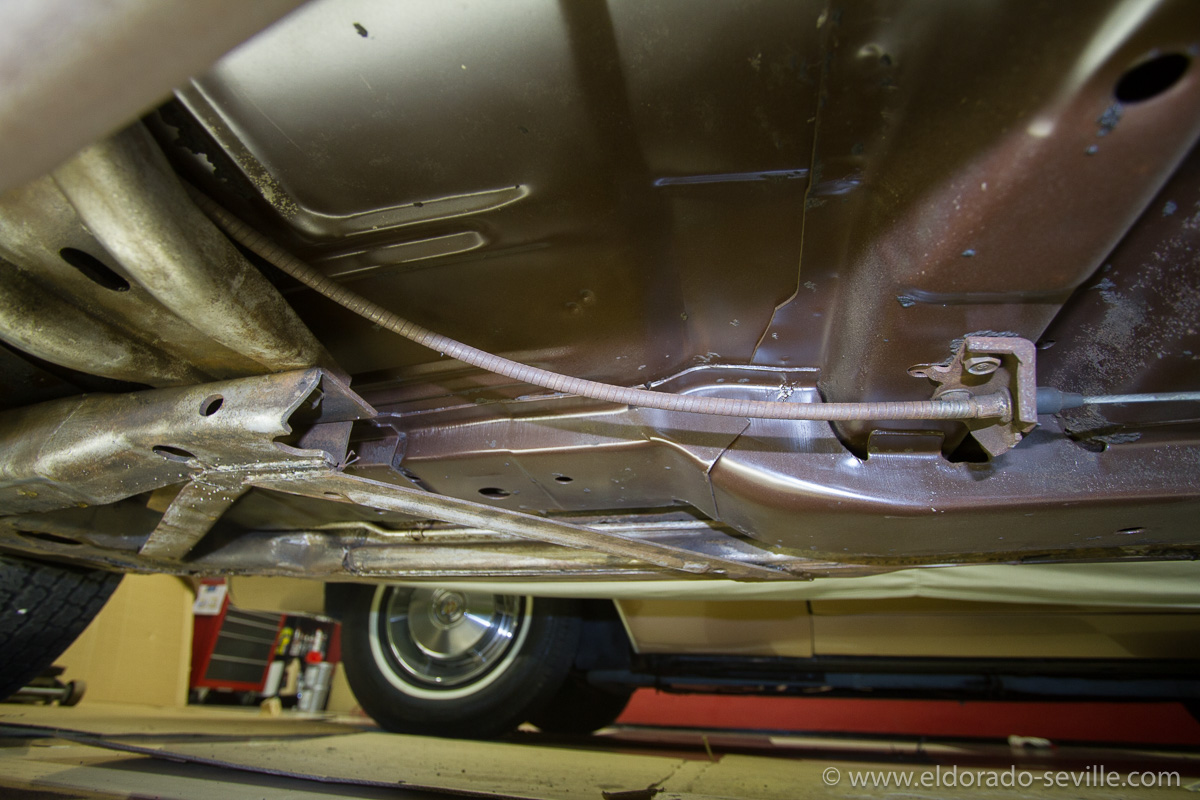
I´m very happy with the result of the cleaning and will now have to protect everything and paint some areas.
REMOVING RUST FROM THE UNDERCARRIAGE WITH RUST REMOVING LIQUID
I´m using a german product called "Rostio" - it's a concentrate used for de-rusting fuel tanks. You have to mix it with hot water. I have also heard great things about Evapo Rust.
I let my system run for days until all the surface rust was gone. The advantage is that the liquid can now get everywhere and should remove the last little piece of rust.
You will be surprised how well this works. This area now looks like a new car. There is not the slightest trace of rust to be found after 12 hours of spraying the car.
After spraying it with the rust remover you then have to flush it with water thoroughly and then dry it properly to avoid flash rust.
I also used various wire brushes and other abrasive materials to remove rust and strip bad paint.
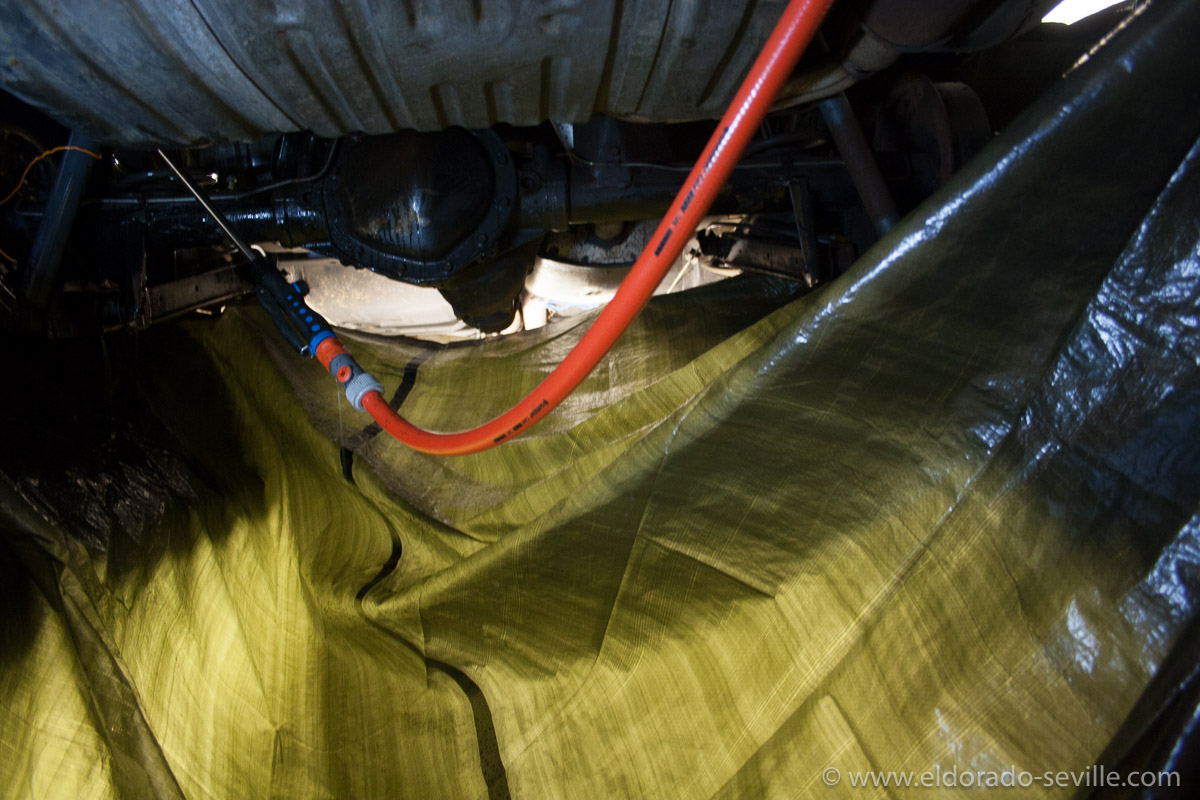
I simply used a garden hose and shower to spray the rust remover on.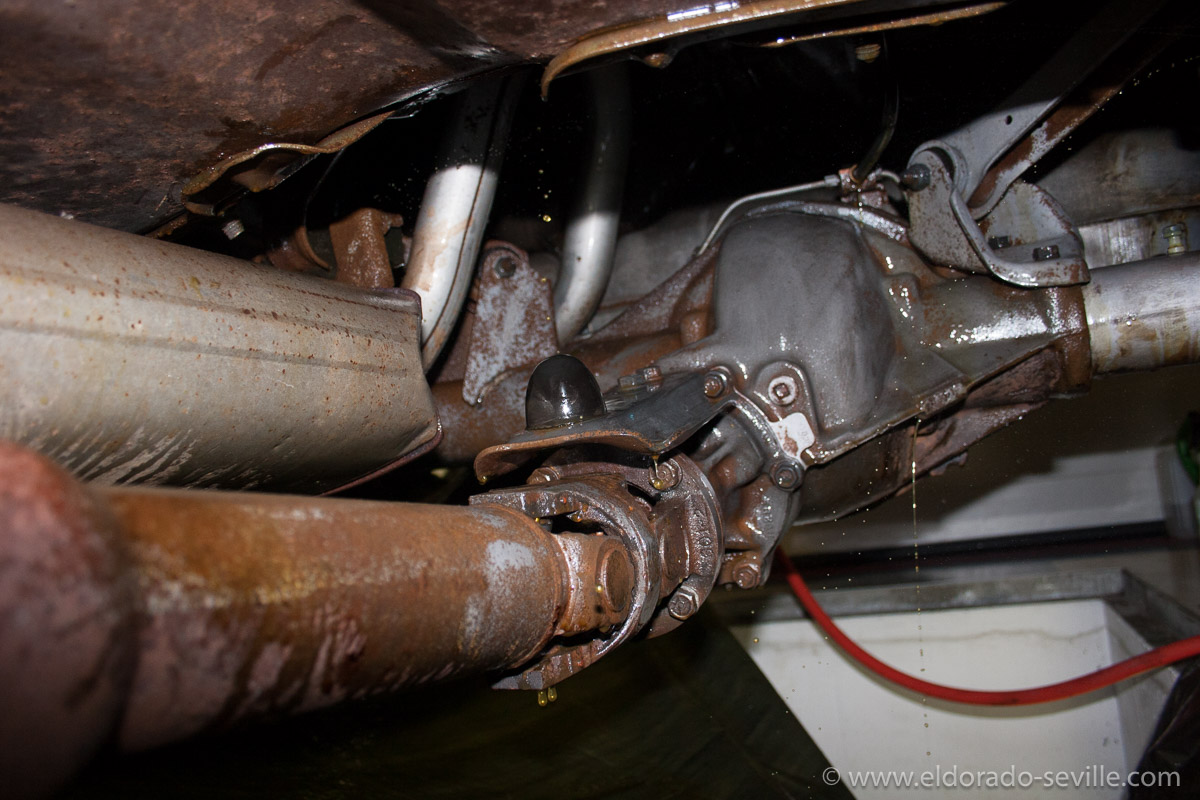
As you can see it only leaves rust free metal behind - I always let it run for 2 - 12 hours - depending on the amount of rust that had to be removed.
The liquid is collecting in the big bucket where I put the pump in to recirculate it.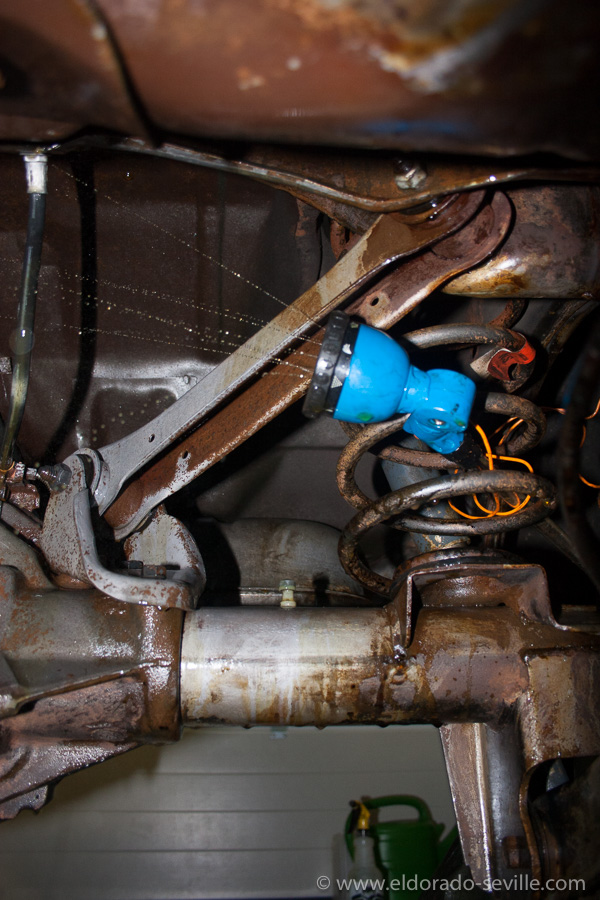
You can spray the liquid everywhere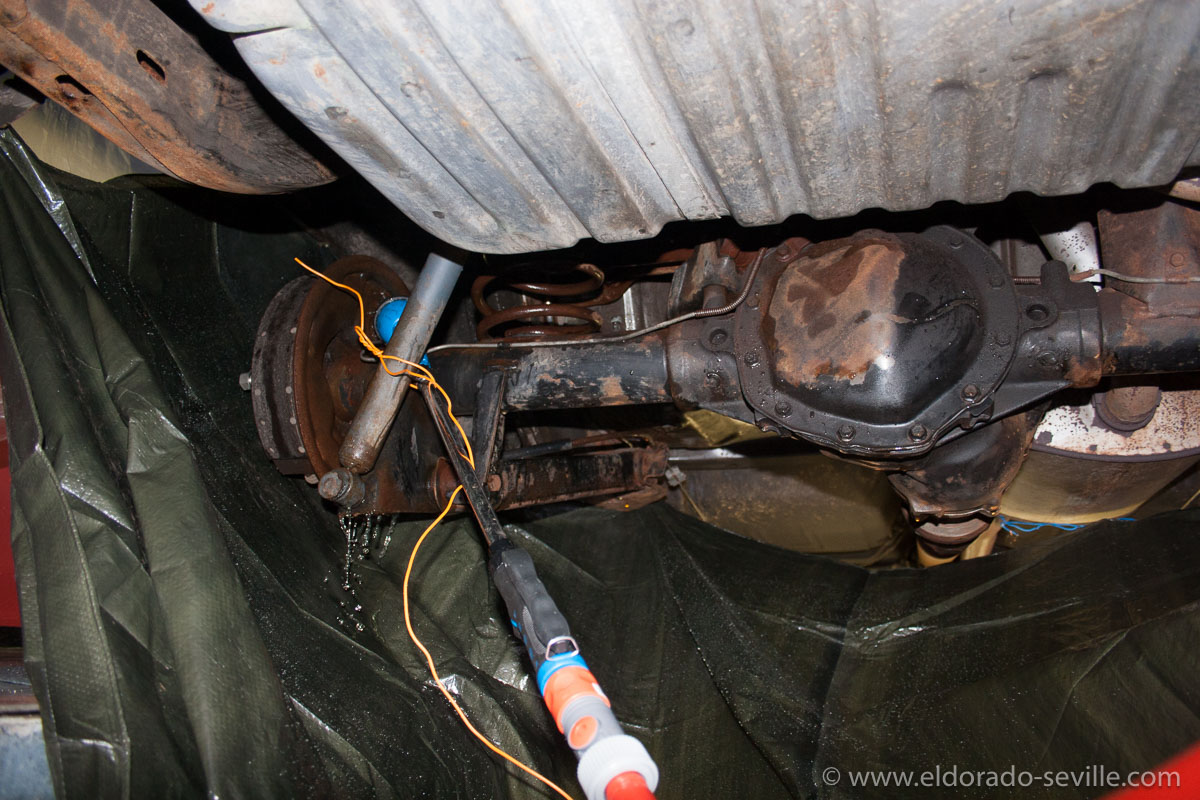
A "before" picture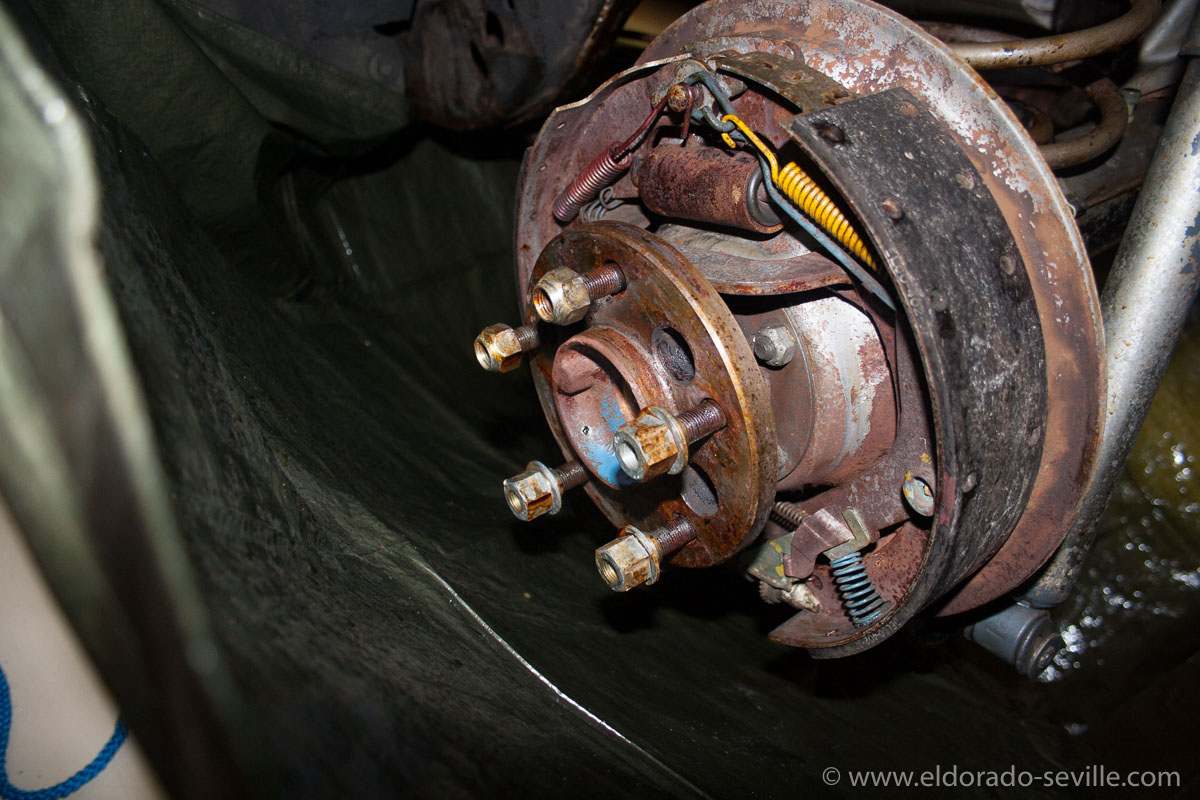
You can also remove the rust from the brakes without disassembling them. A before picture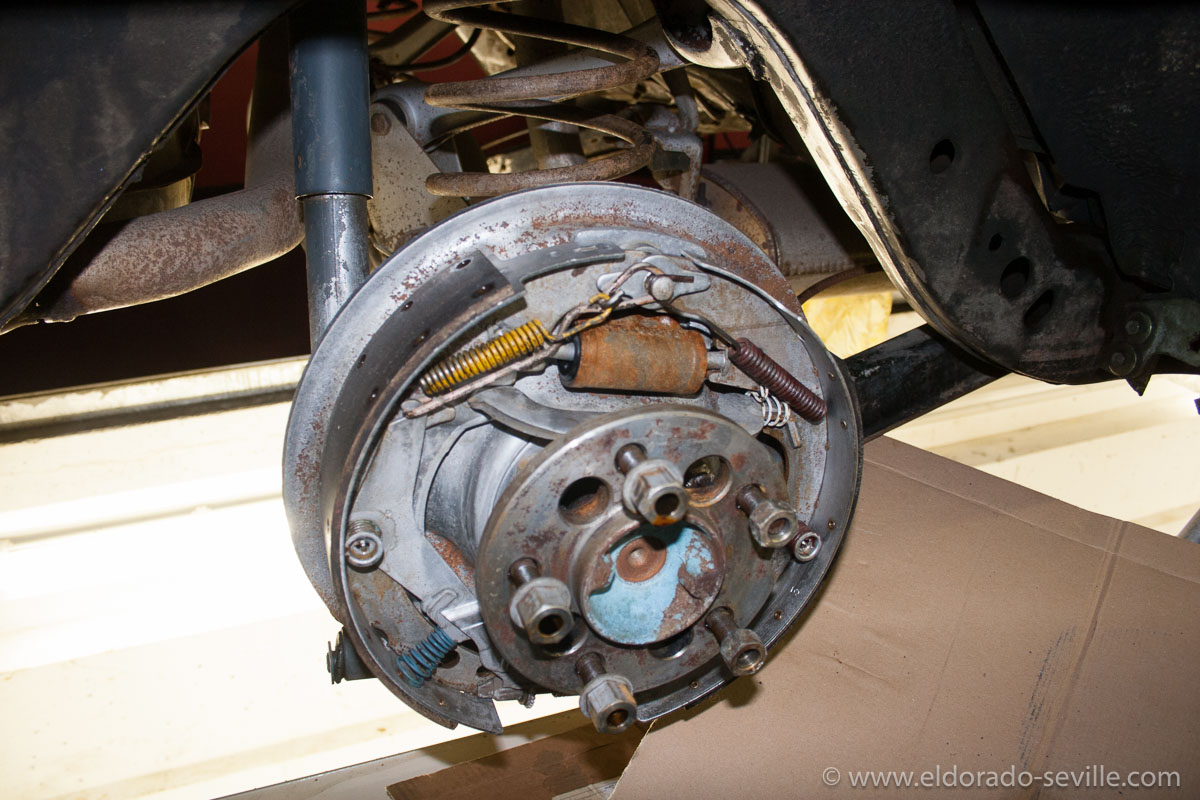
After cleaning - the brake cylinder developed flash rust immediately again.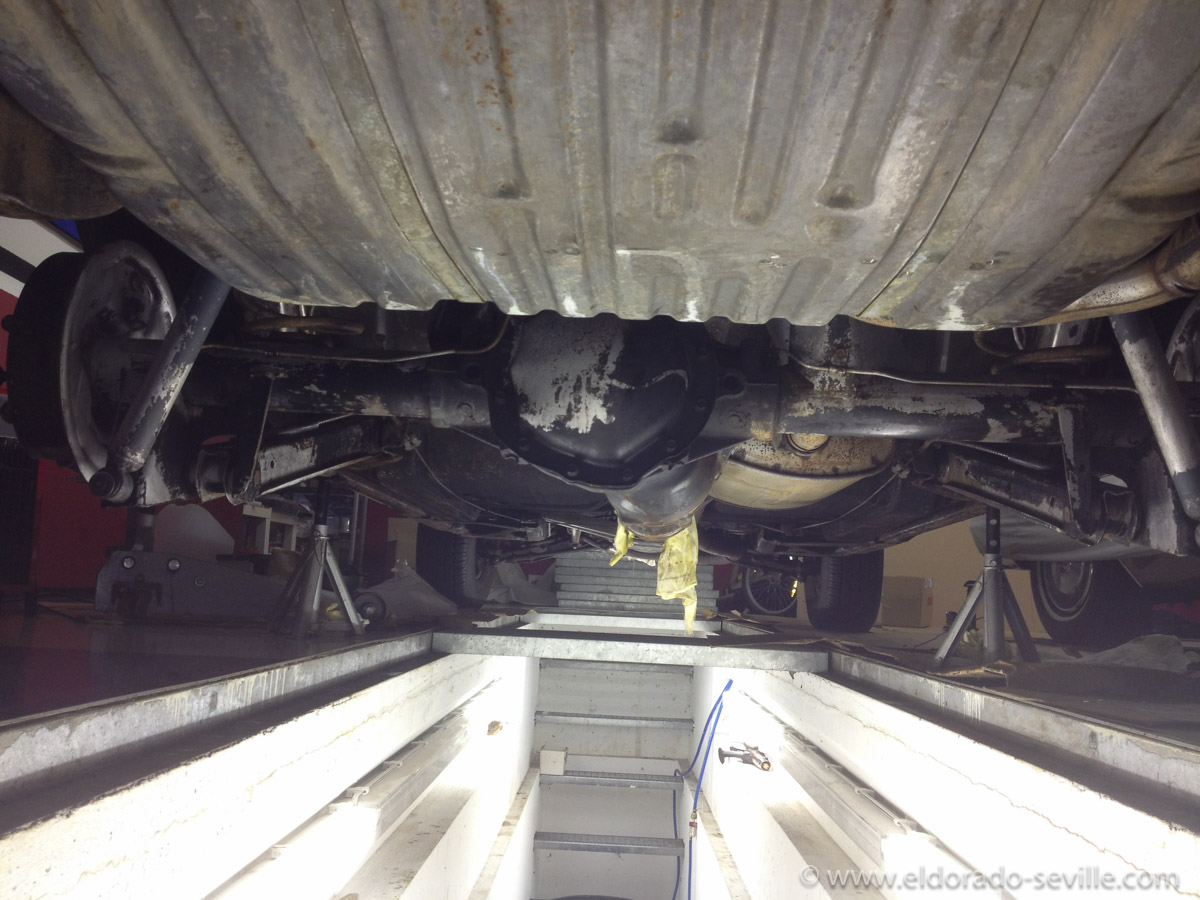
As you can see - the rust is gone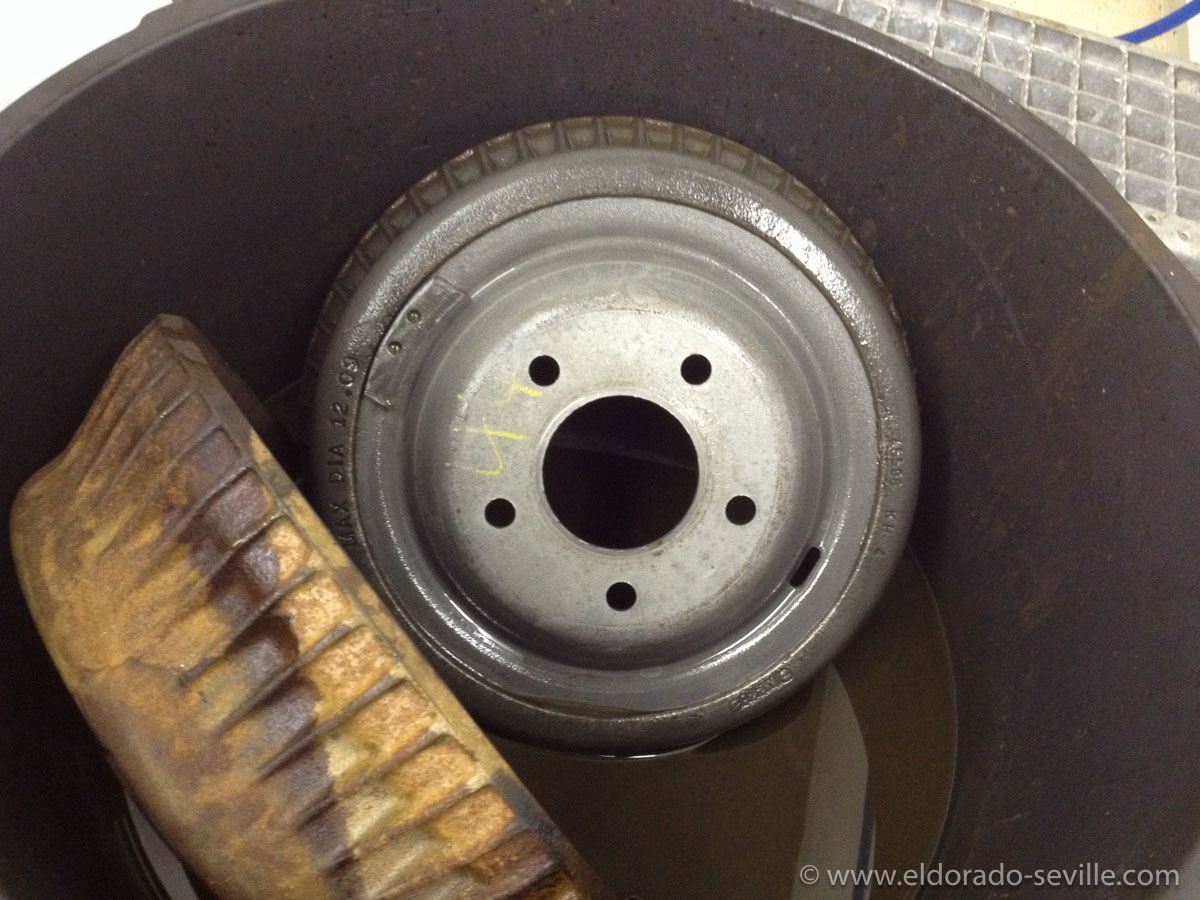
The liquid also works great on brake drums - the original factory markings were still there.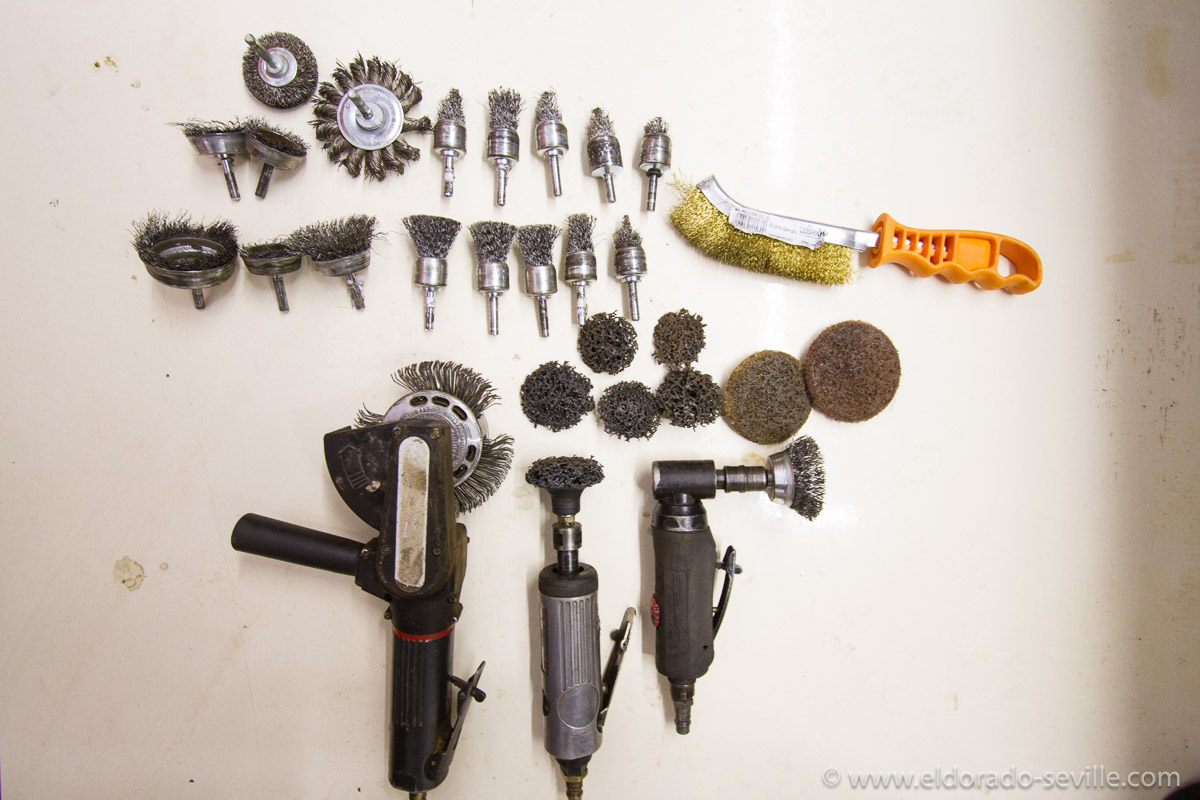
Cleaned the fuel tank with the wire brush and painted it afterwards with tank paint from Eastwood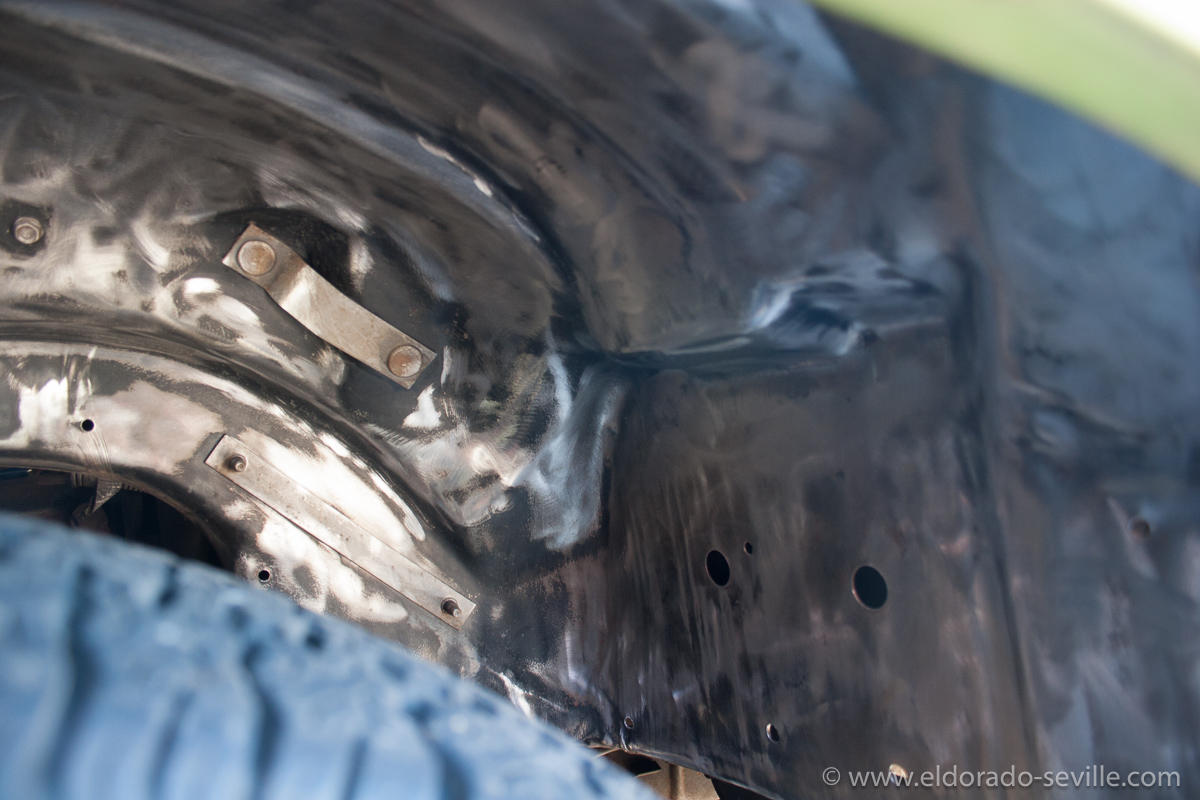
Cleaned the wheelhousings as well - stripped all the paint in there as well.
≈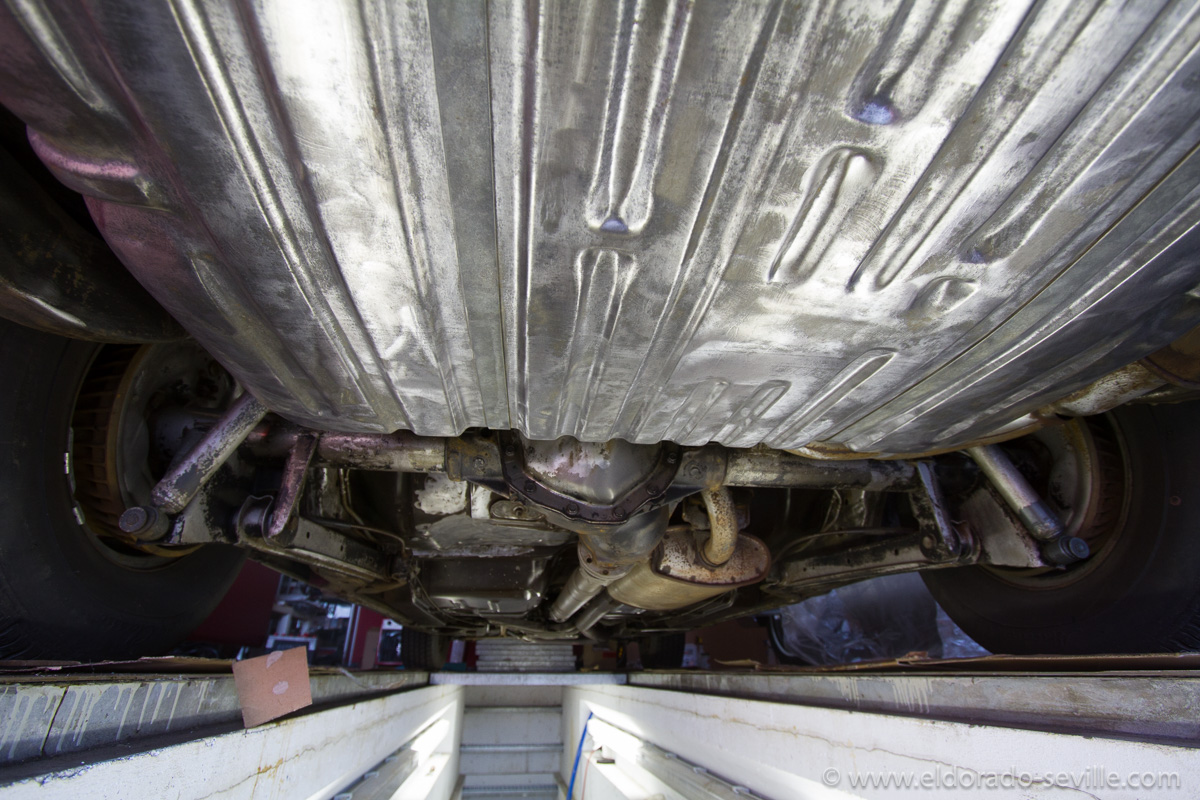
Cleaned the fuel tank with the wire brush and painted it afterwards with tank paint from Eastwood
MY WINTER PROJECT FOR 2015/16 - I WILL FRESHEN UP THE 74s UNDERCARRIAGE!
Some other smaller things could happen as well…
The plan is to make the car to look and drive like new until next season. It's such a great car!
I think there are many different approaches for removing the rust from the bottom side of a car.
My personal method and plan so far, was to scrape any loose rust off with a wire brush.
I then steam cleaned the undercarriage.
Next step was to apply a rust removing gel, which I let on over night. Then I steam cleaned the car again to get rid of the gel. The gel is a quite a bit of pain to remove if it's getting dry, especially as I had to do the steam cleaning with the car on jack stands and limited access to the undercarriage. (I can't do this inside the garage over the pit)
So a lot of manual cleaning is necessary after the pressure wash to get rid of the gel on areas I cannot hit during the pressure wash... I then applied the gel once again and did the same routine all over again.
I will now mechanically remove the more stubborn rust with some pneumatic tools and wire brushes of various sizes I borrowed from my dear friend Richard.
Once the rust is completely removed, I will use the gel for a last time.
I will then use fine sandpaper to achieve a smooth surface of all metal parts.
If afterwards there is still some minor corrosion left I´m planning to use a rust converter and rust encapsulator to paint everything.
The oil pan and transmission oil pan will be painted in Bill Hirsch Cadillac blue again. I will completely clean up the fuel and brake lines as well.
The frame and chassis parts will most probably get painted with Eastwood Extreme Chassis Paint in satin black. As a last step I will cover everything in a transparent undercoating wax. This project will keep me busy until next spring as I want to do it very thoroughly and as perfectly as possible. The most common approach most people would do, is to knock off any loose rust, and then paint it with rust converter and rust encapsulator. Thats perfectly fine as well - but I want the underside of my car better than new and in perfect show quality like the rest of the car
You can find all the pictures of the “Restoration“ here.
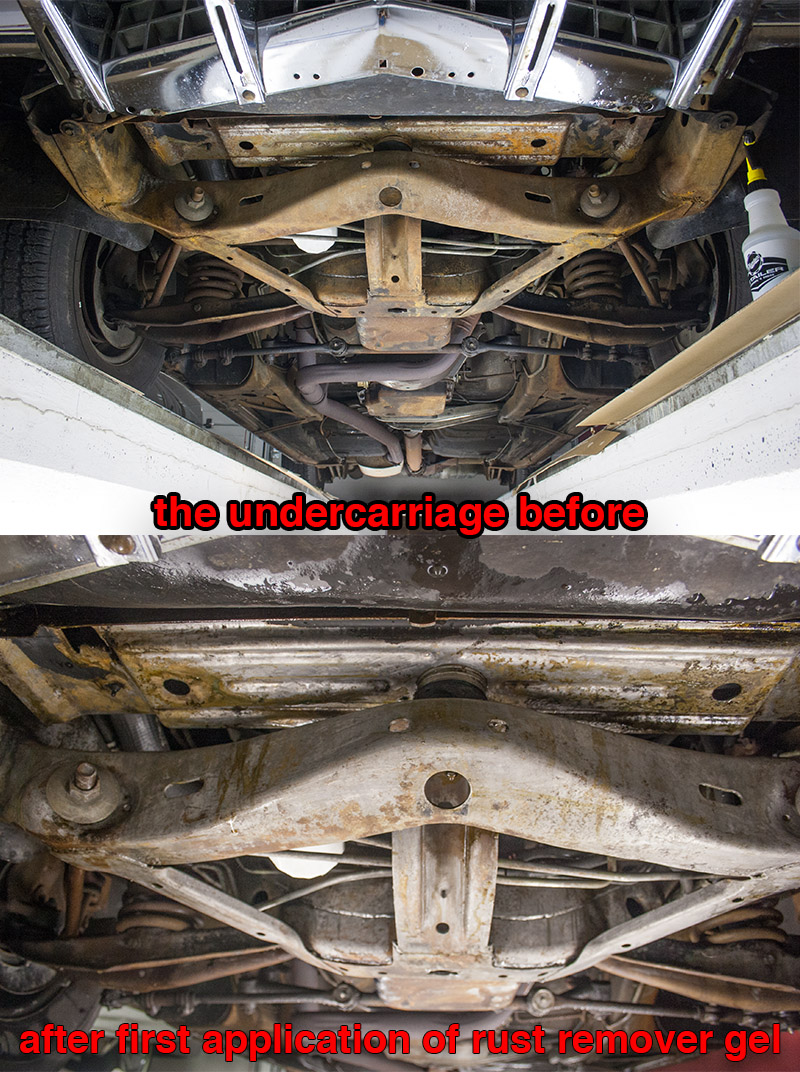
The 74 has some light surface rust on the undercarriage as most areas were left bare metal at the factory. The original owner did not have the car undercoated. Its nothing major - it is more a cosmetic thing than anything else. I want the car to look as good on the underside as it looks from the in and outside. I will remove as much rust as possible with a wire brush and then use rust removal gel to get rid of all the rust. It´s a messy job - but I want to do it as thoroughly as possible. After everything is clean I will paint the frame with rust preventive paint in semi gloss black paint.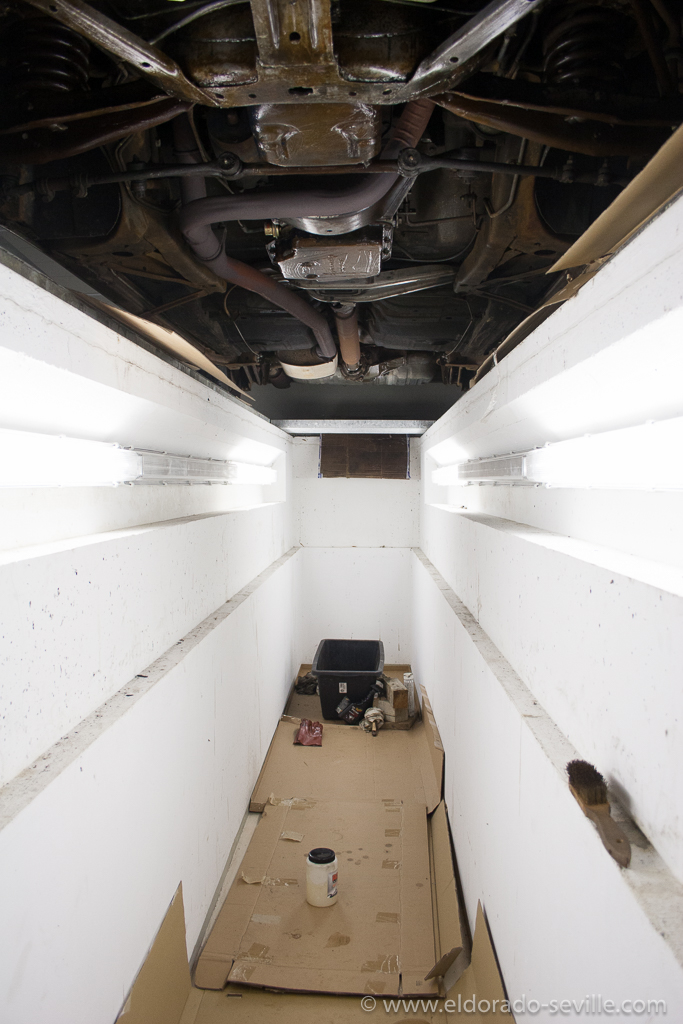
The pit in my garage - this is how I will see my car most of the time for the next months… You can see that I applied some rust removal gel to some areas already. I steam-cleaned the undercarriage before.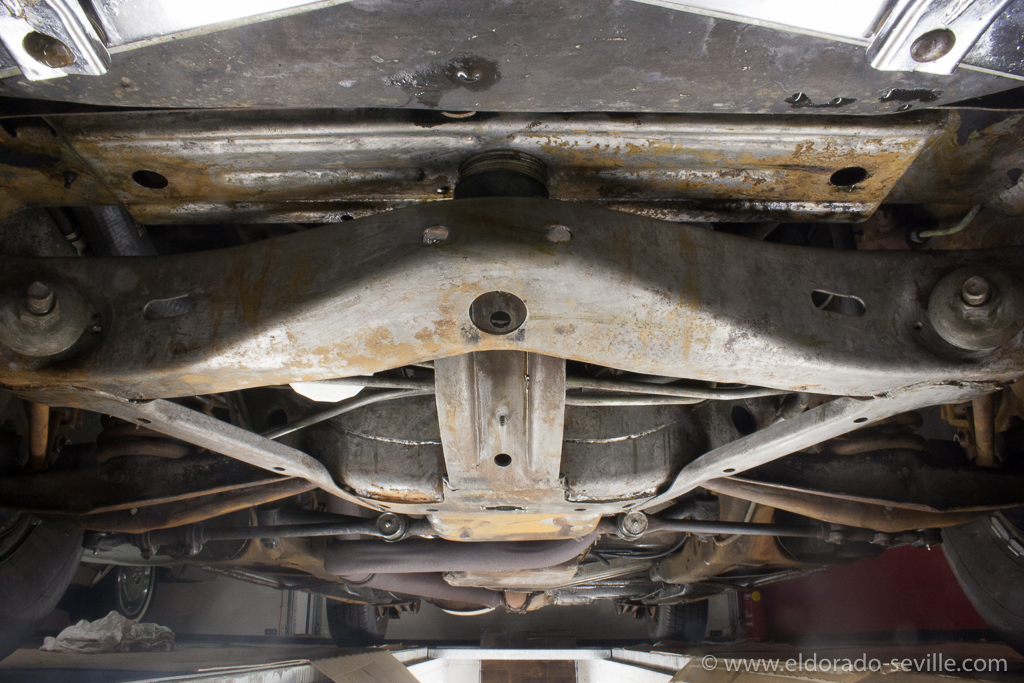
A small test spot after only one application of the gel - 2-3 more are recommended.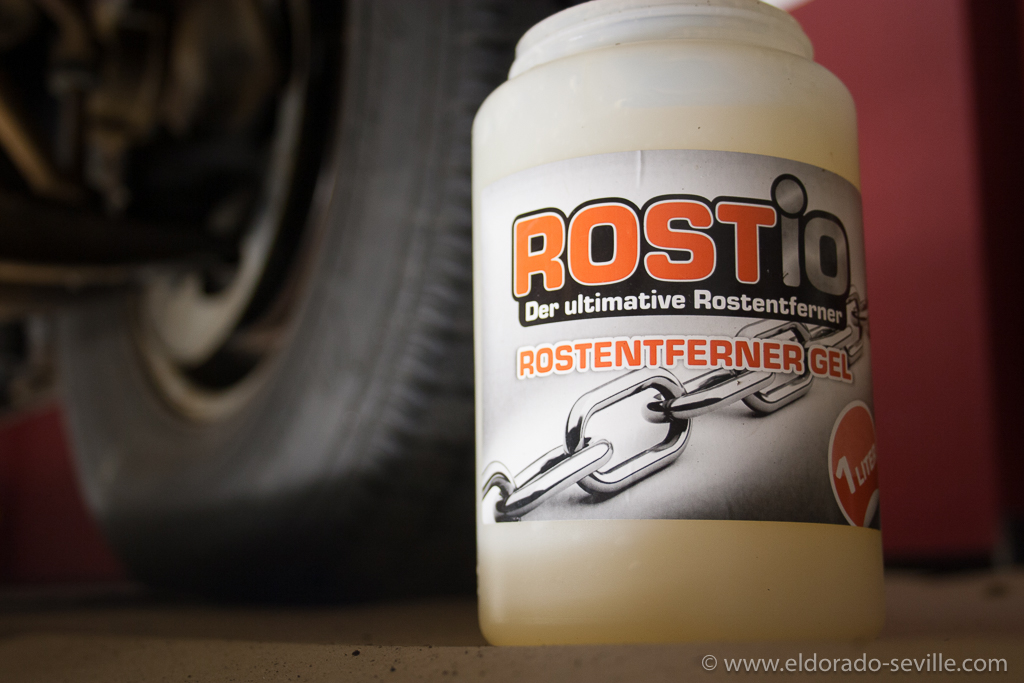
Thats the gel I´m using - it seems to be a great product. I got it through www.rostio.de . 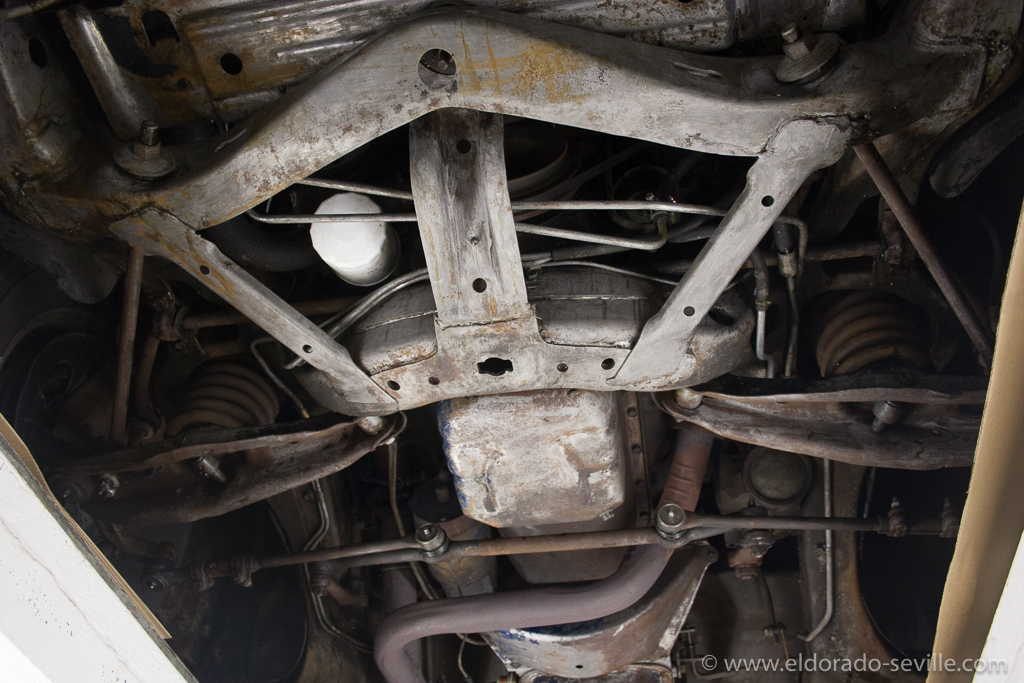
After the first coat of rust remover gel. It looks very promising.
REPAIRING THE 6 WAY POWER SEAT OF THE 1958 ELDORADO SEVILLE
First I suspected that the switch has a problem - so I took it apart. With a test light you can easily test its function. With a three way jumper wire you can simulate the switch as well at the switch connector. You can see the picture below from the shop manual and its described which terminals you have to connect together to get the desired movement. The shop manual is extremely helpful in diagnosing any seat related problem. Check it out below!
Everything was fine at the switch. So I checked the wires going to the solenoids. There is a plug underneath the switch and I checked the wires from there. Everything was ok there as well.
For some reason the mechanism still did not engage. The front actuator was repaired by the previous owner once, as there were some screws in there which originally were not used. I tightened them and suddenly it worked again when I almost wanted to give up and wanted to try to find a good used one from one of the Cadillac parts places.
I hope it will work now for a long time. The seat is fully adjustable again.
Below are some pictures from the shop manual which should be very helpful if you have power seat problems as well.
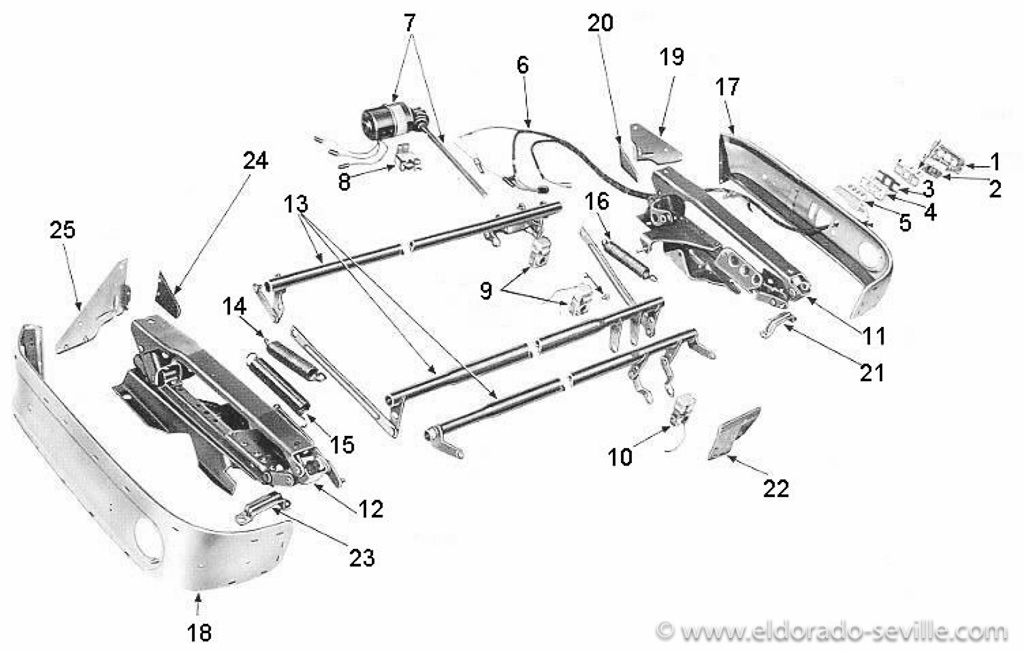
Six-way power seat diagram.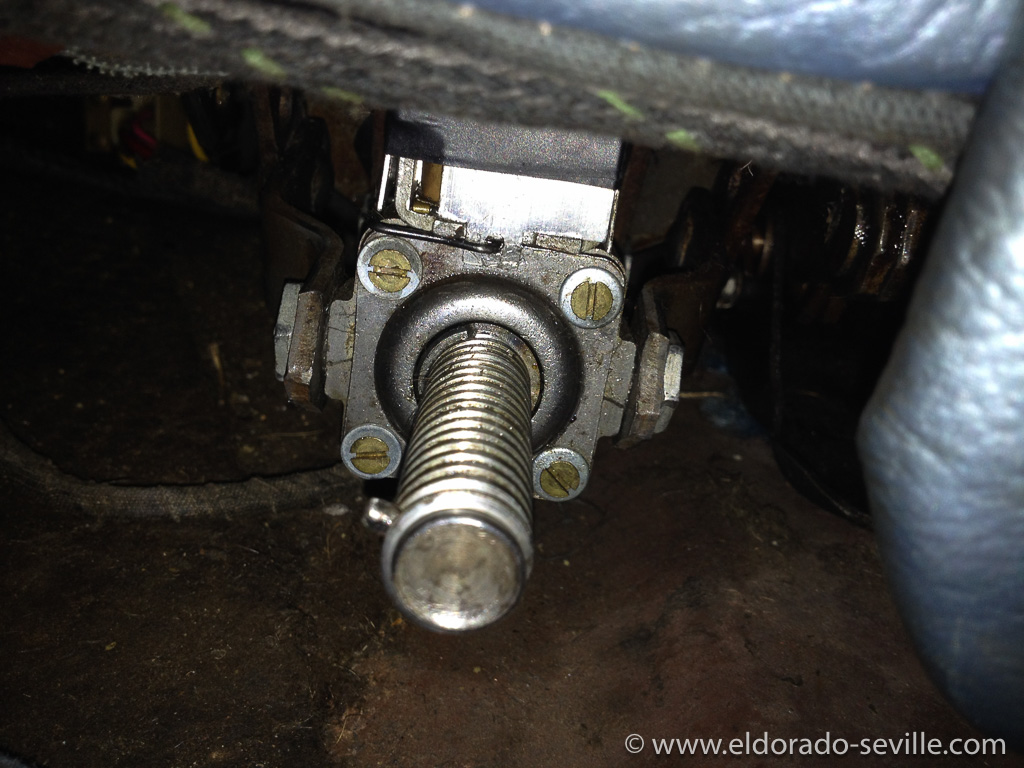
Thats the front actuator and solenoid which had a problem on my car. The mechanism did not engage for some unknown reason. Probably a bad internal contact or the mechanism was stuck somehow.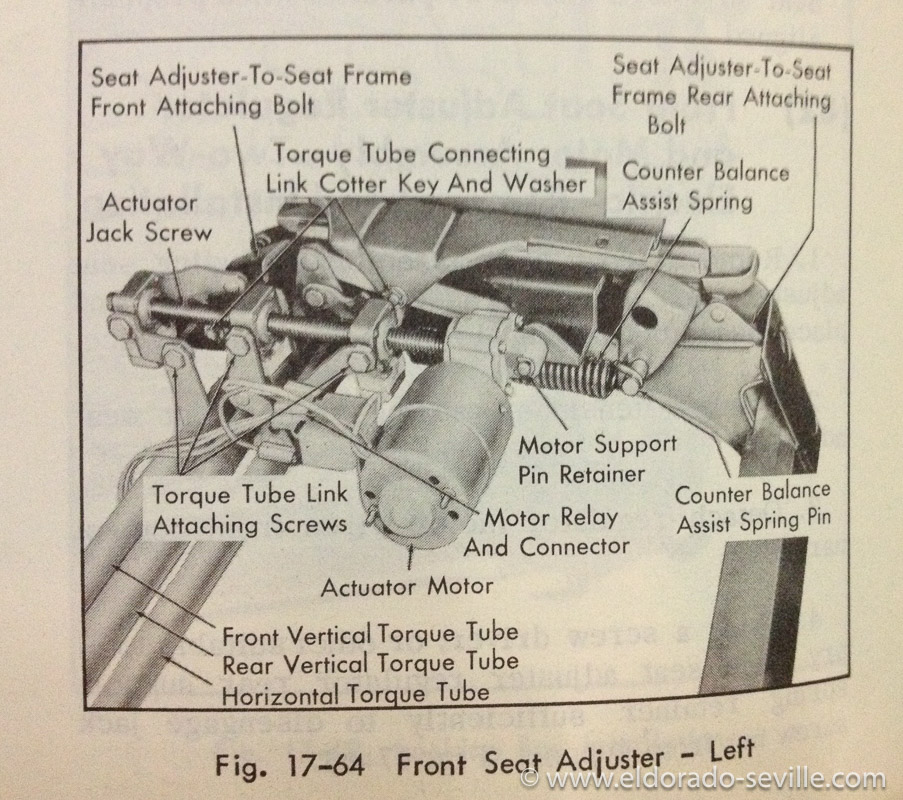
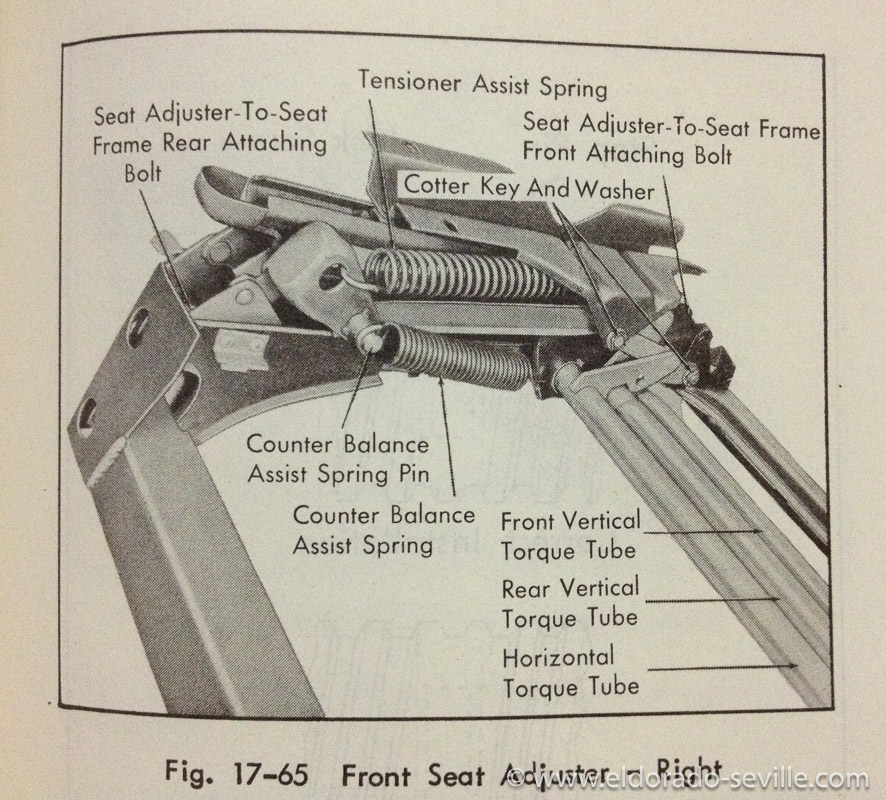
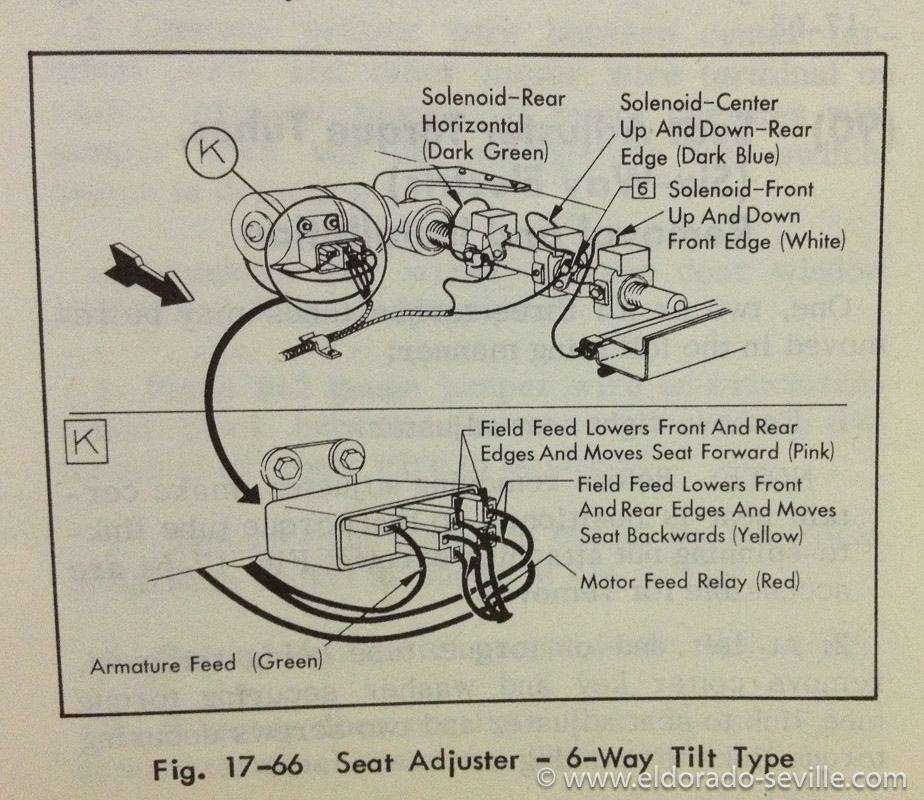
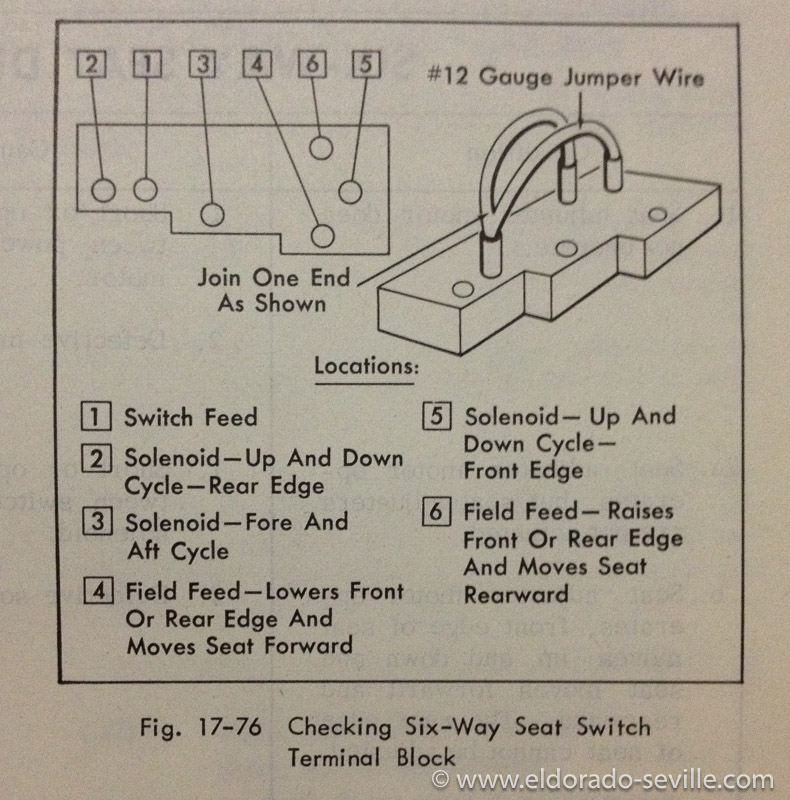
This 3 way jumper wire is very helpful to test the various functions and to rule out any problem with the switch.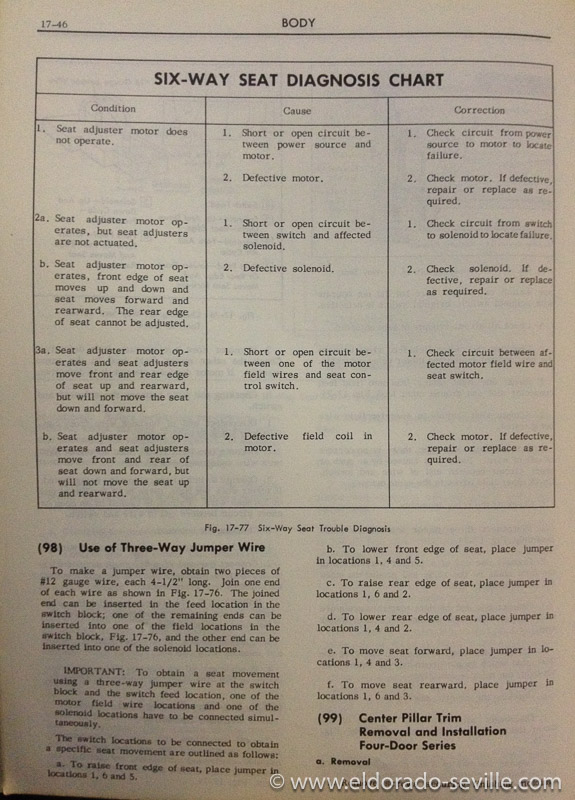
The procedure to test all the functions of the seat.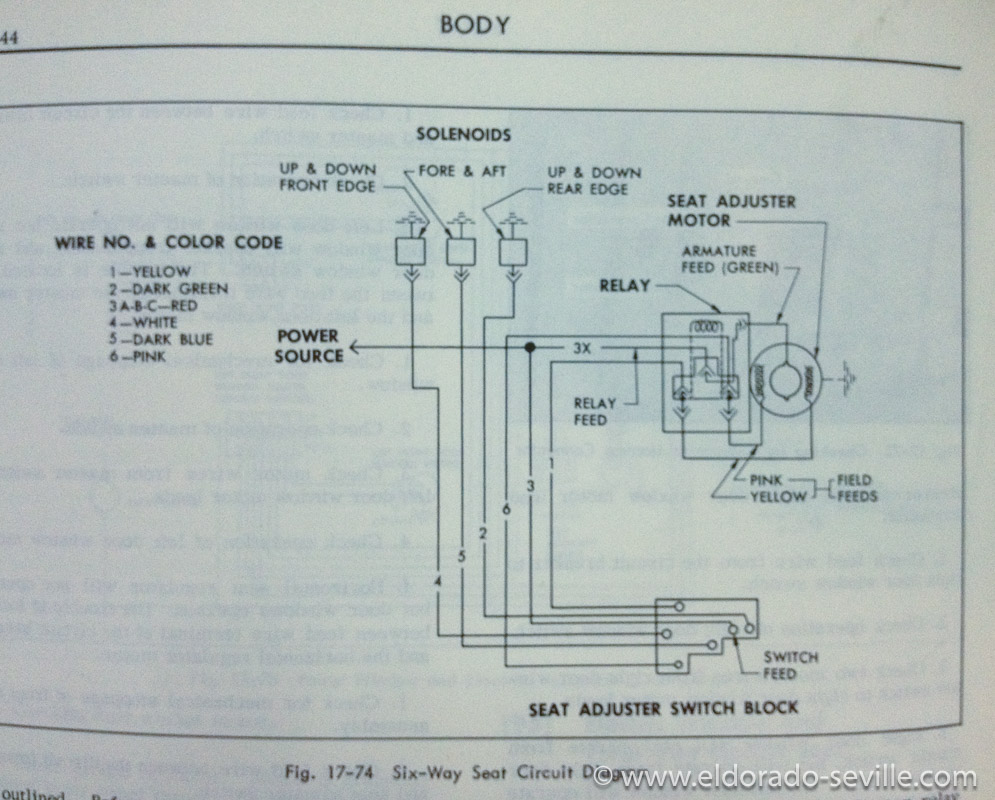
The 6 way power seat wiring diagram.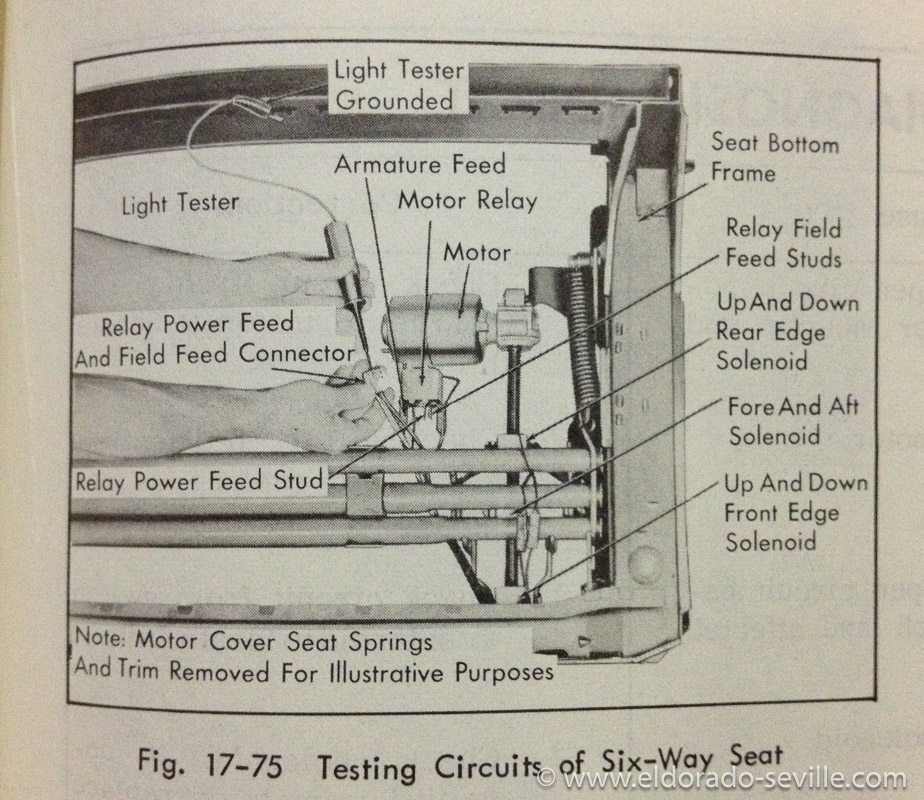
How to test the circuits.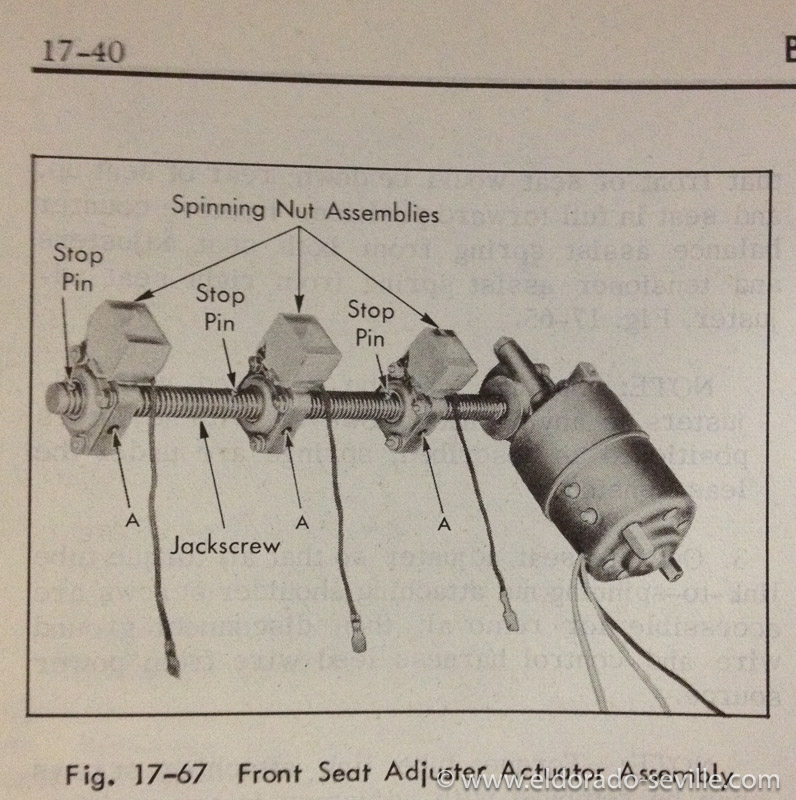
Front Seat Adjuster Actuator Assembly (1957 and 1958)
REPAIRING THE 1967 CADILLAC AC CONTROL HEAD
This time the 67 Eldorado had a new problem which I had to fix.
It suddenly only blew hot air out of the AC outlets. It did not change modes at all. That was a sign of a weak vacuum signal…
I started to inspect all the AC related vacuum lines of the car which checked out fine. Next I did the test I´m describing here in an older posting, as I suspected that the power servo had a problem.
I soon found out that still not enough vacuum was supplied through the transducer.
That meant that either the transducer could be faulty, the temperature sensor could be defective, or the dash control head would not work properly. I took out the temperature sensor of my 67 Deville to test it in the Eldorado but it did not change anything.
I then removed the control head and tested it with a spare one I once bought cheaply on ebay. It did miss some connectors and switches, it had some blemishes on the chrome and did not look good enough to install it into any of my cars. When I put it into the Eldorado anyway the AC suddenly worked perfectly again.
So I removed all the electrical parts from this working unit and transferred it to the perfectly looking but defective control head. After I had swapped all the usable parts I put the unit back into the car and I now have a perfectly working unit once again.
It looks like that there was a problem in the amplifier part which translates the signal coming from the rheostat into a current going to the transducer which regulates the vacuum going to the control head and the power servo.
Lets see what issue comes up next spring…
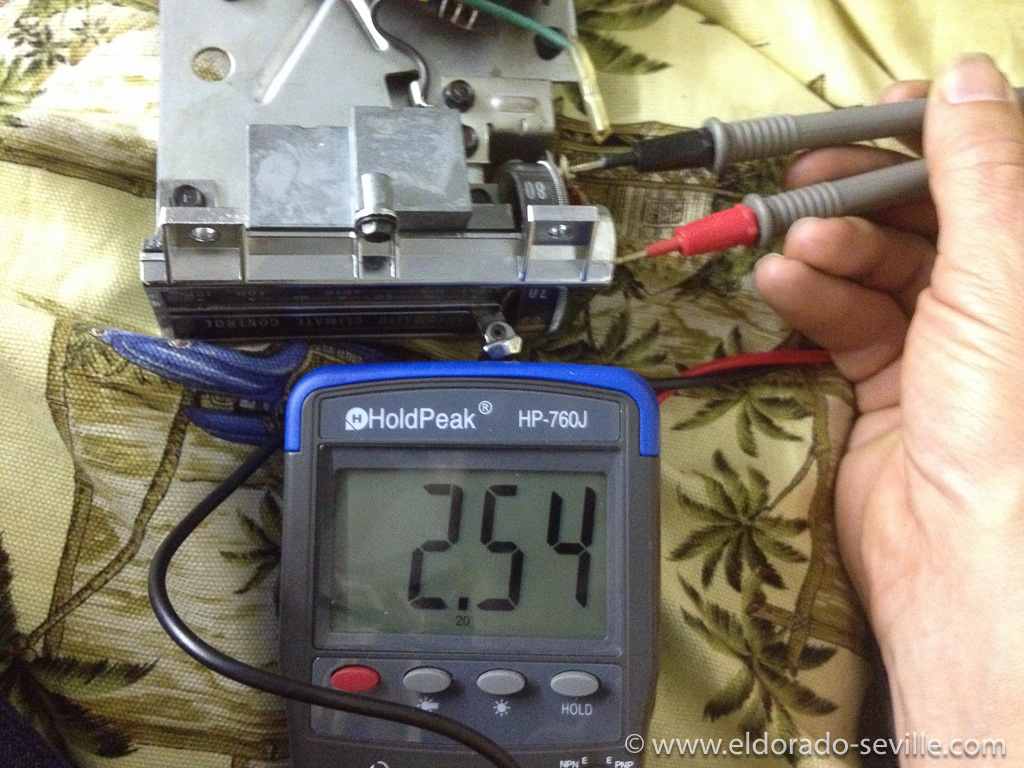
The Rheostat when set to the lowest temperature setting shows around 2,5 Ω You can check if it is working with an Ohmmeter.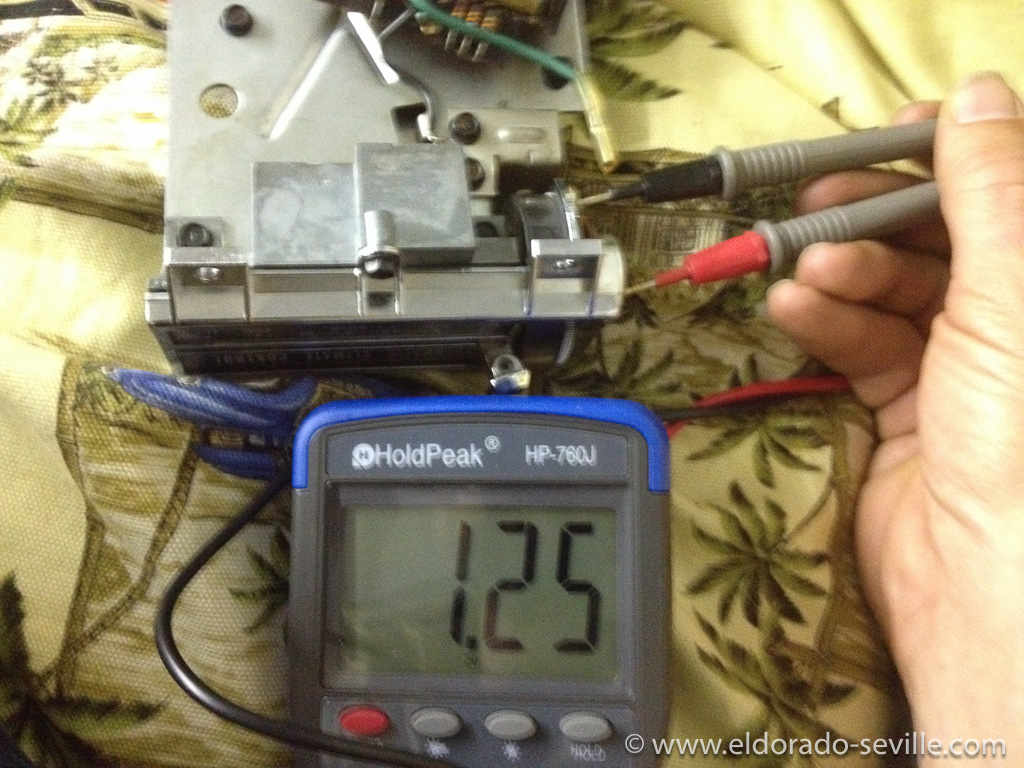
At the highest temperature setting the resistance is getting lower.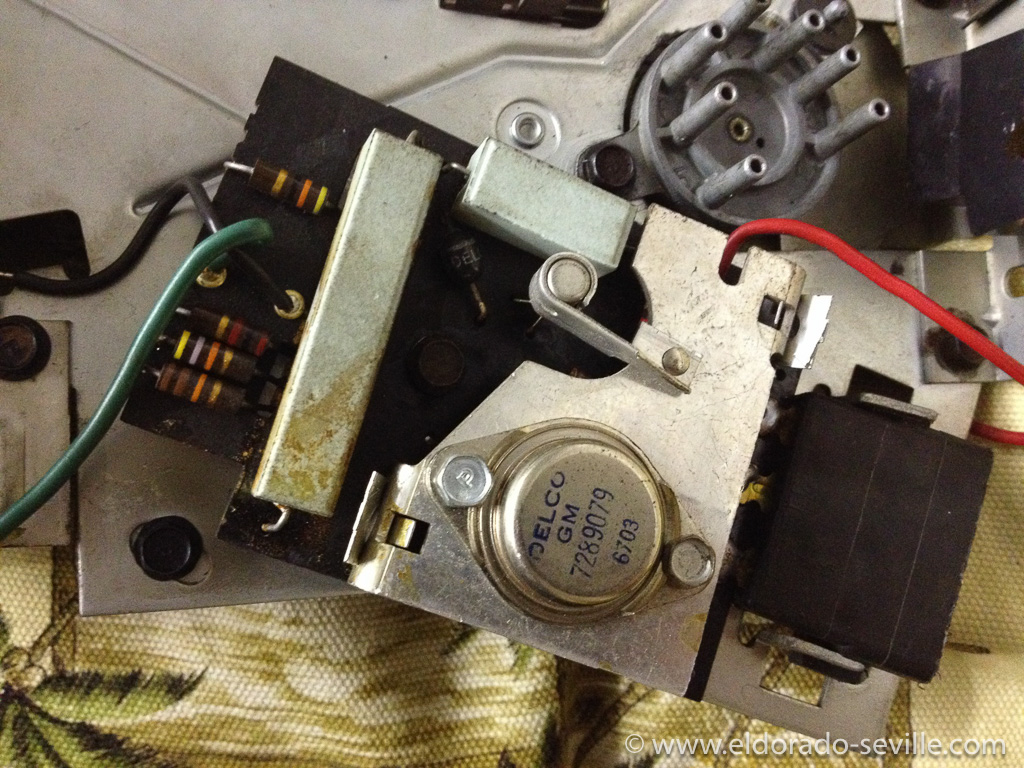
The Amplifier part of the control head is on the underside. Something in here must have gone bad on my control head. I will try to find out what went bad and repair it to have a spare part.
The 67 Eldorado is back on the road for the 2015 season.
1967 CADILLAC BORG CLOCKS REPAIR AND A PROBLEM WITH A PRINTED CIRCUIT BOARD.
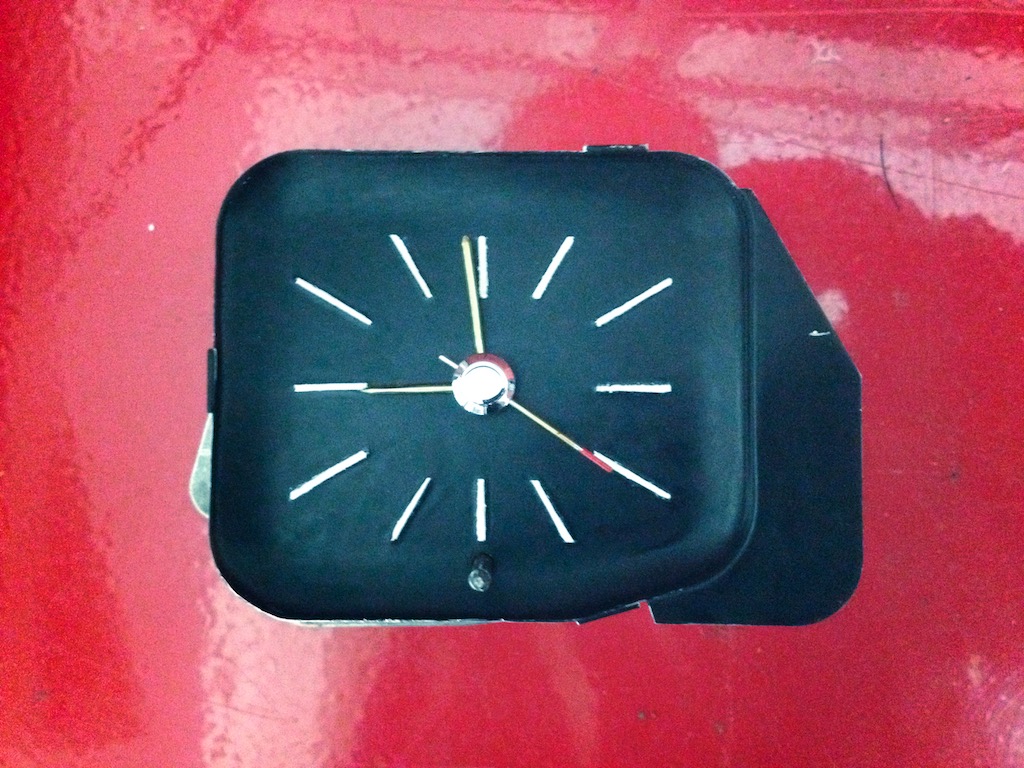
The 1967/1968 Cadillac Westclox clock out of my 67 Eldorado.
The last time I tried to repair the clock in my 67 Cadillac DeVille I totally failed. This was in 1998…
After I got the clocks in all the other Cadillacs moving again - I could no longer stand watching the dead clocks in my 67 Eldorado and DeVille.
So I decided to try to repair them as well.
The last repair attempt at my 67 Eldorado was very disappointing.
In 1998 I took the clock out of my 67 DeVille the last time, and after my repair attempt the hands started spinning in an extremely fast pace - like a ventilator. So I had to disconnect the power to the clock at the printed circuit at the back of the instrument cluster. When I did that I forgot to disconnect the battery and when the power feed touched some metal I had a short somewhere and some smoke came out of the dash… I could not locate where the smoke was coming from - all wires looked perfect. So I just insulated the clock coil power feed and gave up on the repair and forgot about what had happened.
As I found out now - some connection of the printed circuit board got burned back then…
After the failed repair of the 67 Eldorados clock last fall, I decided to try to find a good used clock. Once again Arizona Vintage Parts - my favorite source for parts - came to the rescue. He sold me two non working Borg clocks for a really good price. Unfortunately by now he has run out of stock for them.
So I tried to repair the clocks he sent me - appearance wise they were in very good condition, and I got one back to life for a short time by just cleaning it.
So I put it back into the car and then I made a stupid mistake and ruined it completely. I wanted to tighten the mounting screws and accidentally grabbed the connector for the coil - as you have to work inside the dash without being able to see what you are doing - and so I overtightened it… This stripped the threads of the coil… I had to cut the nut off then and somehow the oscillator wheel inside the mechanism did no longer work properly and when I tried to adjust the stepper it broke off :-(
BTW - Do not use WD40 for cleaning and lubricating a clock like I did… This will ruin the clock as I found out when it was already too late… There are special clock oils available to lubricate clocks.
The other clock I got had a defective oscillator wheel and I could not repair it as well…
So I contacted Arizona Vintage Parts once again for some new clocks but he had sold all his stock on clocks to Sweden…
I had to contact all the Cadillac Parts dealers I found in Hemmings Motor News for two Borg clocks, but I was unsuccessful or they were exorbitantly expensive. Some of the well known Cadillac Parts dealers either did not have them, did not react to my inquiries or asked up to $ 385.- for a used, rebuilt clock. Others asked up to $180.- for a non working clock.
Luckily I found a company called “The Clockworks" which was highly recommended on some Cadillac and other classic car forums for their good work in repairing clocks and also converting them to a quartz movement.
Everybody seems to recommend to convert your clock to a much more reliable and cheaper quartz movement. I thought about it for a while but I decided that I wanted to go for an original movement for authenticity reasons. If you convert to quartz the "tic-toc" movement will be gone and you can tell by just looking at the clock…
I ordered two rebuilt Borg clock movements for my clocks from "The Clockworks". Their service was excellent and they were a great help. Great customer service! I would buy from them again or have my clocks rebuilt by them anytime.
After I received the movements I installed them and put everything back together. You have the keep the adjustment stem and the housing from your old clocks if you replace the movement.
When I put the clock back into the 67 DeVille it did not work though. I soon found out that no power was coming to the coil through the printed circuit board.
I then remembered about my failed repair attempt 17 years ago and the smoke that came out of the dash… Somewhere the circuit board was burned. So I connected the orange cable going into the multiple terminal connector at #7 terminal to the clock directly and it worked again.
So I installed a cable directly to the clock. This is a temporary fix until I´ll have a new circuit board. Installing a new board requires to take the dash completely apart to replace it.
A printed circuit board is available new here: https://www.opgi.com/cadillac/CE11091/
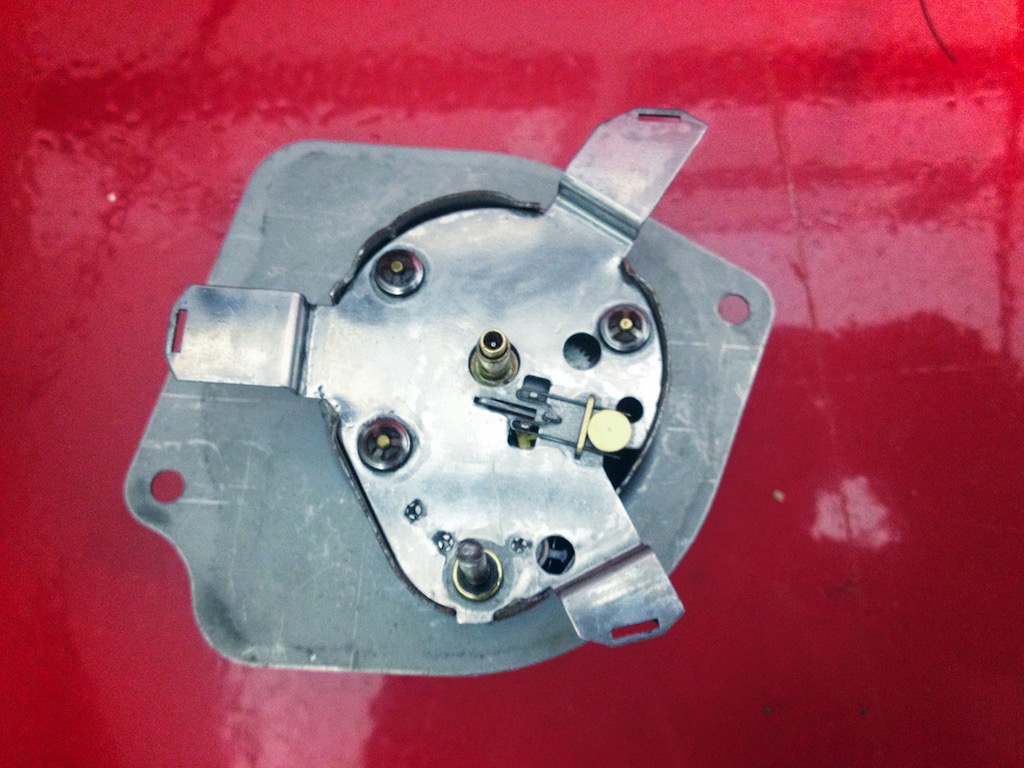
The 1967 Cadillac Westclox clock out of my 67 Eldorado. Seen from the top with the clock face removed. The clock face on the Westclox is mounted differently than on the Borg.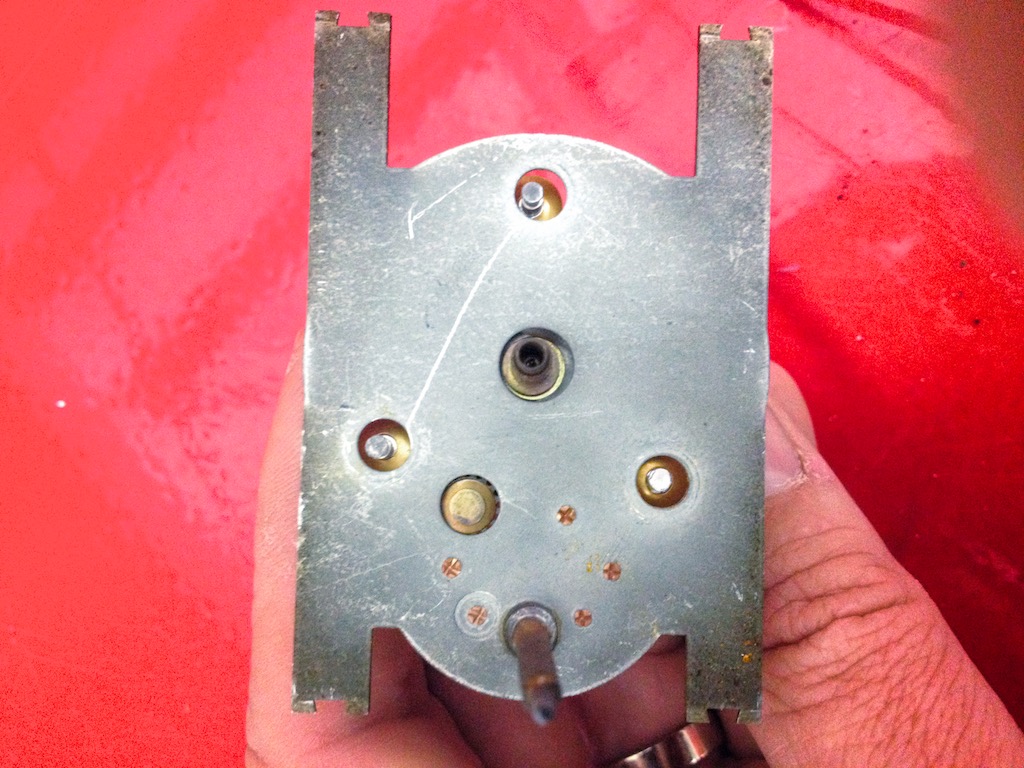
The 1967 Cadillac Borg clock. The housing cover in place - as you can see it looks completely different than the one on the Westclox.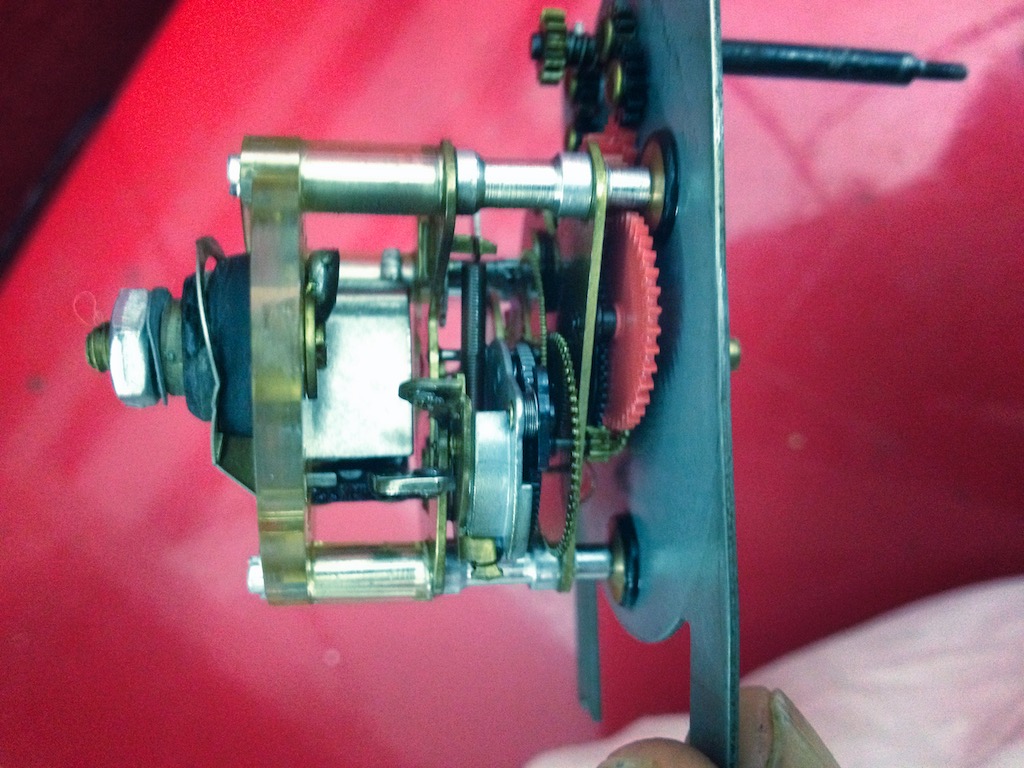
The 1967 Cadillac Borg clock out of my 67 DeVille.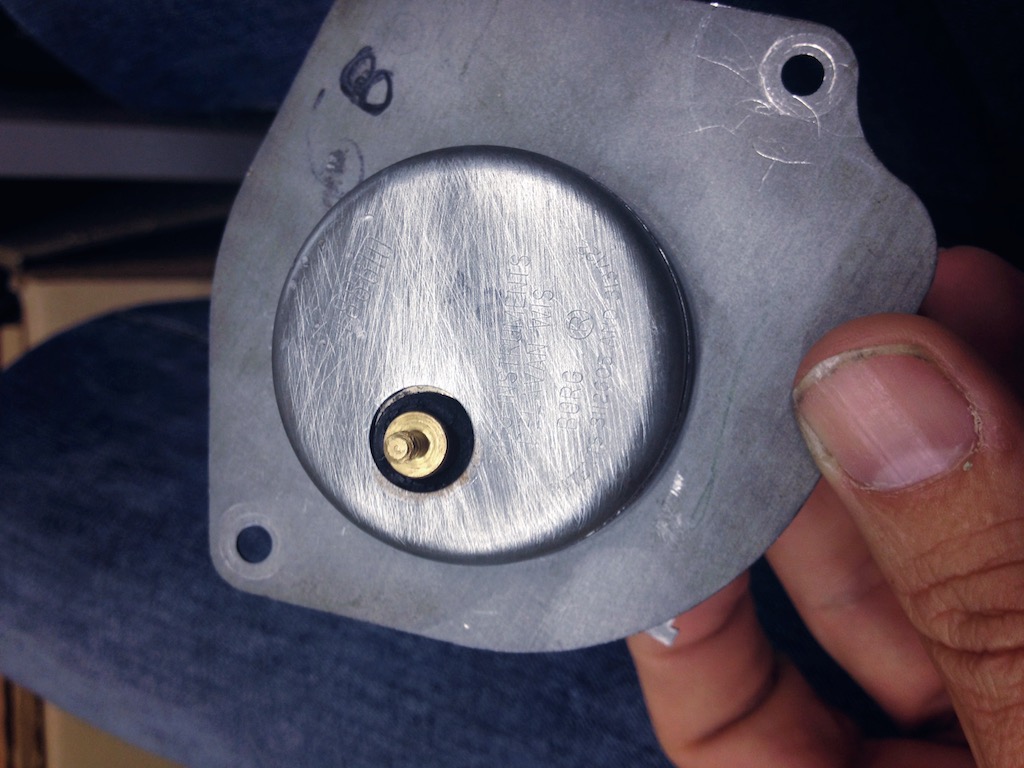
The Borg replacement clock I got from Arizona Vintage Parts. 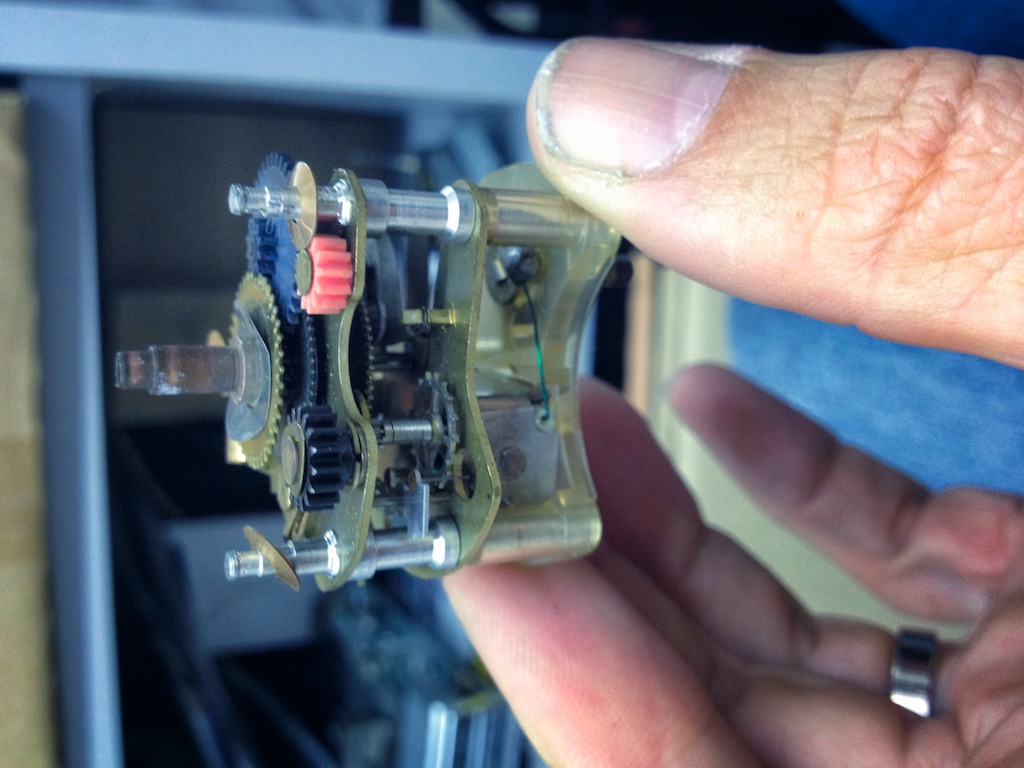
The Borg replacement clock I got from Arizona Vintage Parts - this is the original movement removed from the housing.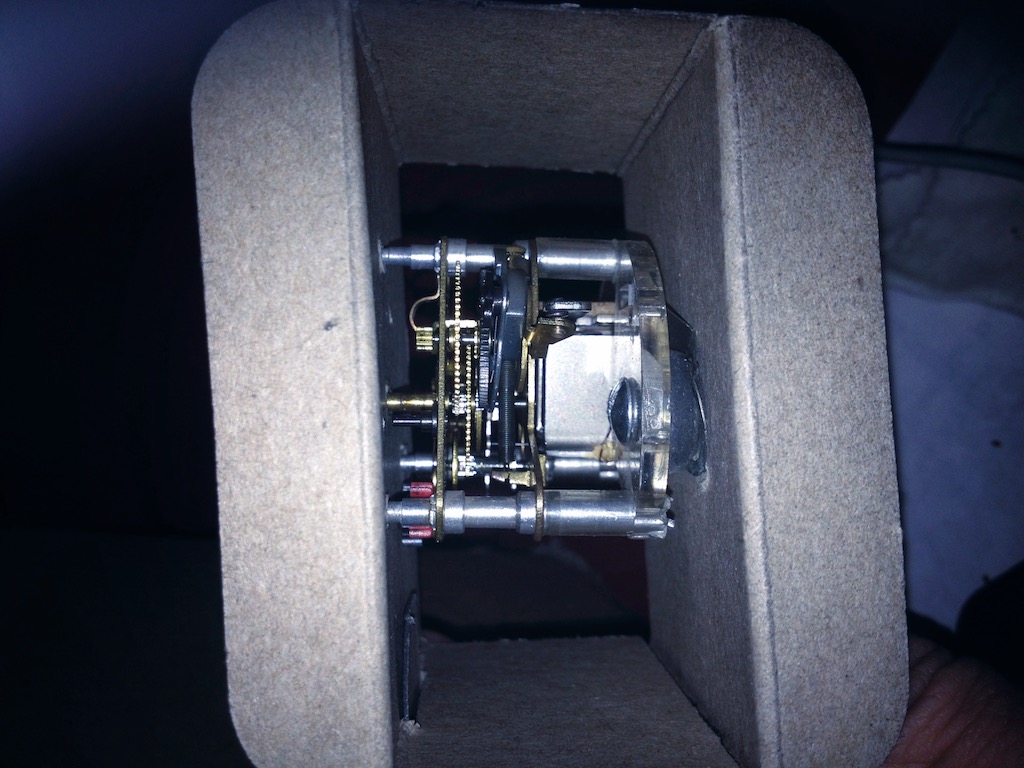
The rebuilt Borg movement I got from "The Clockworks"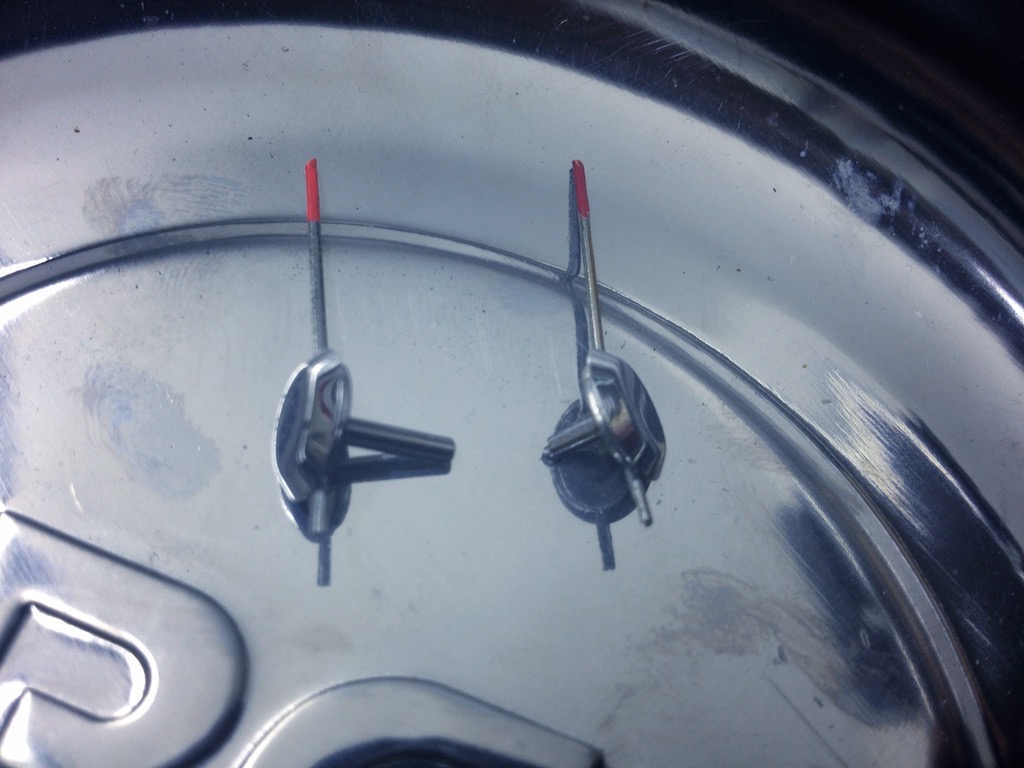
There is a difference in the second arms: On the left the one from a Borg Clock - on the right one from a Westclox. They are not interchangeable. Also the housing of the clocks is different. You cant interchange parts between these two clock types.
I repainted the setting stem in semi gloss black.
The 1967 Cadillac printed circuit. The one for the Eldorado is slightly different though.
FIXING THE LOW WASHER FLUID INDICATOR ON THE 1974 CADILLAC
On the 74 Coupe deVille the “Washer Fluid" light came on when I turned on the wipers.
When I checked the fluid level, the bottle was full.
I then discovered that the float unit seemed to be missing some parts like the magnet, which activates a reed switch, and the float itself.
Luckily I found all the parts sunken at the bottom of the washer fluid bottle.
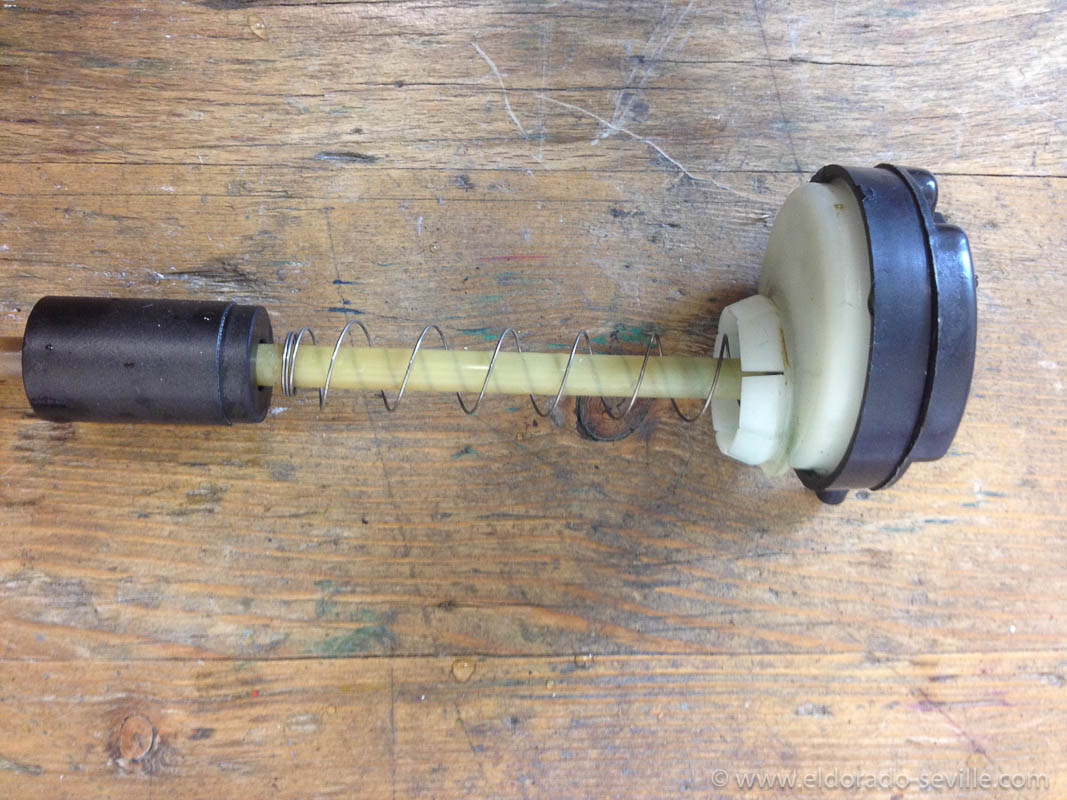
The unit from the 1974 Coupe deVille
When the fluid level in the washer fluid bottle drops below 1/3 full, an amber tell tale light comes on labeled "WASHER FLUID".
Engaging the wipers allows a small amount of current to flow from the wiper motor terminal through a yellow wire to the washer bottle float unit. When the fluid level in the washer bottle is low, the float drops, allowing the circular magnet to separate from the cap assembly. This permits the contact points within the cap to close, bypassing the resistor that is in parallel with the contact points, and causing current to flow to the indicator light.
I had two problems:
- The float itself did no longer float in the washer fluid
- The reed switch in the cap did not deactivate - it was stuck and the contact points in the switch did not open with the magnet.
I got some valuable tips on the CLC forum about what kind of switch is used inside the cap, and how to make the float floating again.
TJ wrote about the switch:
"I don't remember what year it was that I fixed but I don't remember it being that difficult. There was some rivets or something that had to be drilled out or broken off. I think I used screws and nuts to put it back together. The working bit is what is called a reed switch. They are by today's standards old technology but since there is a fair amount of room in there you don't need to find the exact same one. If you do a search for reed switch you should find em. It's usually a greenish glass capsule with 2 leads coming off the ends. "
After I applied an additional, much stronger magnet to the switch, it suddenly came back to life! For whatever reason it is working again. It looks like the stronger magnet opened the stuck contact.
I still had the problem with the sinking float though and got another great tip from Jim:
“After inspecting the assembly and pulling up on the float, the warning light no longer displayed, so I knew the float was bad. I took the float off and dropped it into the reservoir. It sank like lead, so I knew it was a porous material. I knew I had to remove the moisture somehow, so I thought the safest solution was to slowly heat it up so the fluid would evaporate. I figured it was designed to tolerate extremely cold and extremely hot outside temperatures, so figured the lowest oven setting should work. I got lucky in that there was no distortion. I wouldn't recommend leaving it in longer than a few minutes, though. "
I tried the oven drying method mentioned in Jims posting above at the lowest setting. I left it in the oven like Jim recommended, and afterwards the float did not sink any longer, but it still could not hold the magnet up to the switch.
Then I put it into the oven again for an hour. Afterwards it got slightly better, but it was still to weak.
Once again I put it into the oven at a higher temperature (230 degrees Fahrenheit, or 110 degrees Celsius). Luckily the float does not warp or melt at this temperature. I switched the oven off after another hour, and I left it in there to cool down over night.
It indeed is a porous material. It seems like the higher temperature in the oven "fixed" the float for me. It also feels completely different after the cure - when I touch it now it feels much more porous than before, when it felt like a piece of plastic.
It's floating perfectly again - I hope it will stay like this for a long time. If the problem reoccurs it´ll go back into the oven…
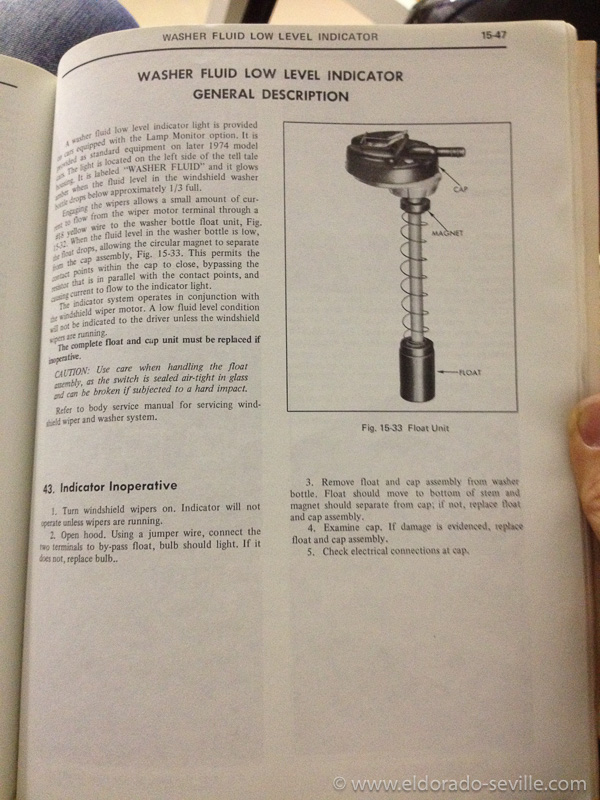
From the 1974 Factory Shop Manual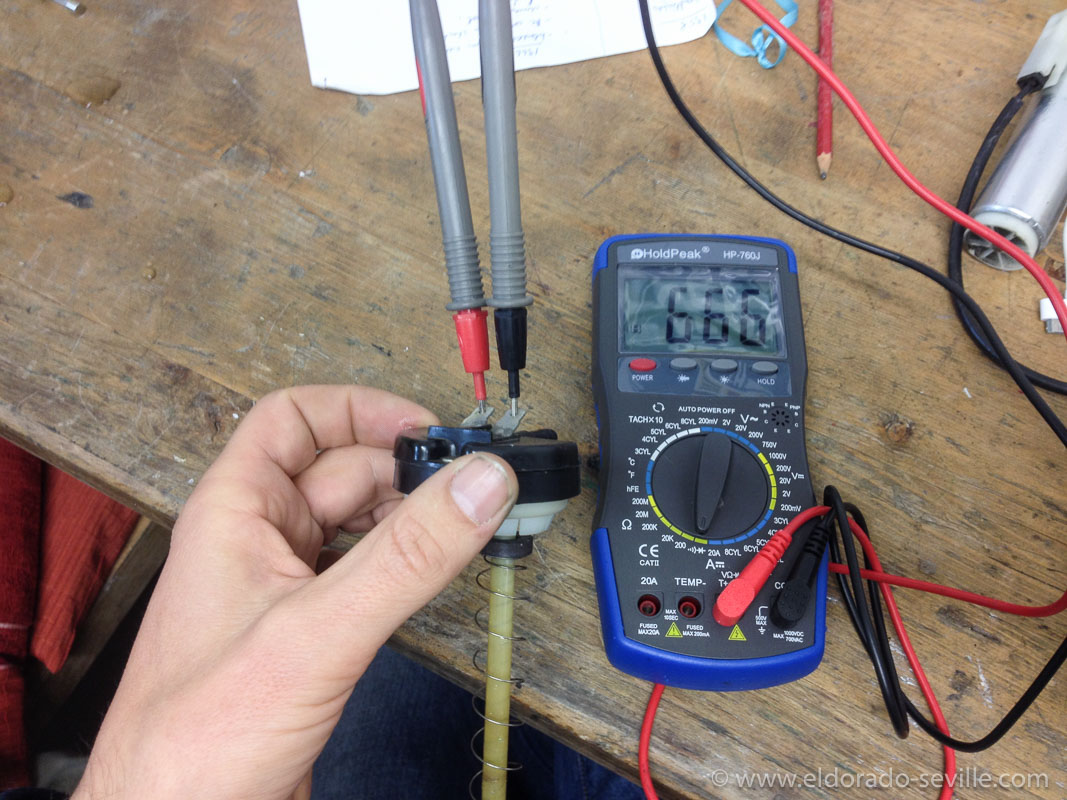
I checked the switch with a voltmeter.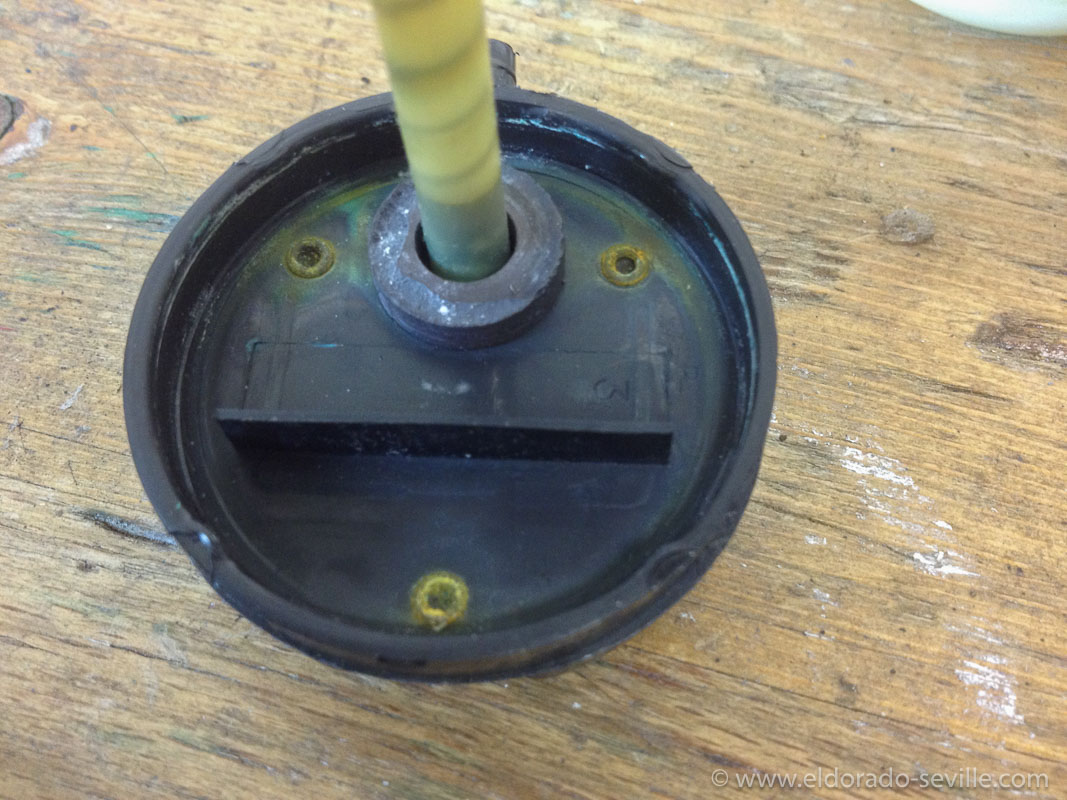
You have to get the rivets out if you want to access the switch.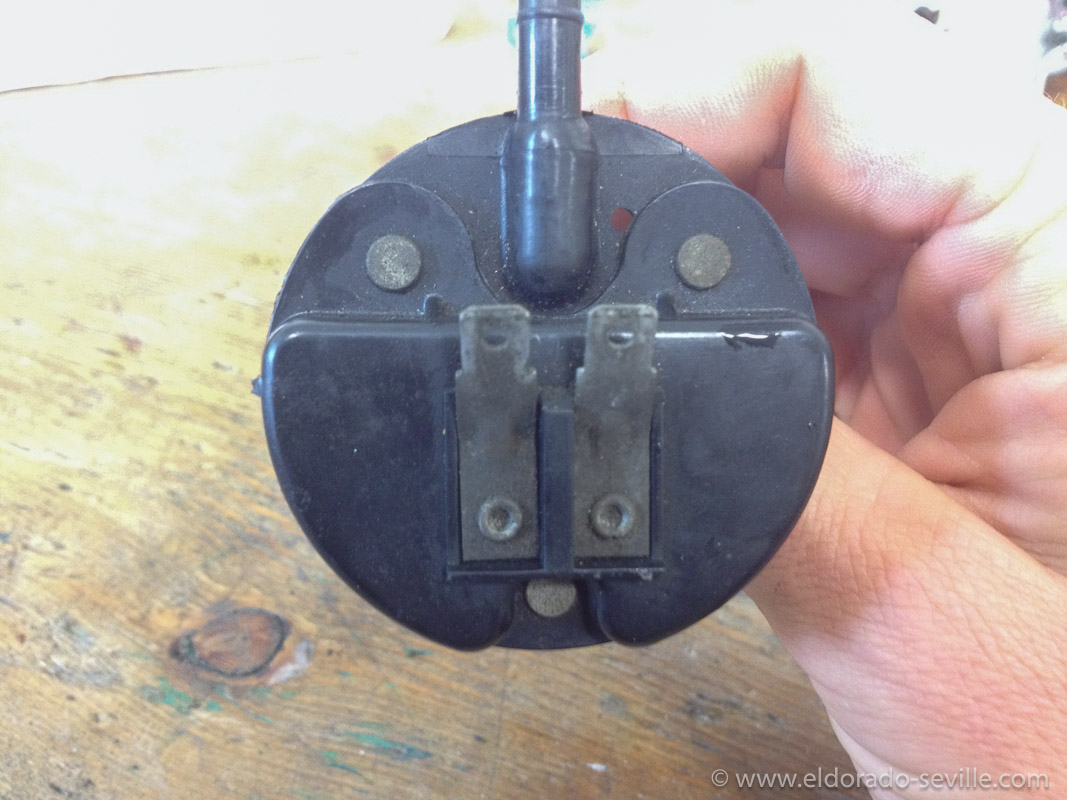
The reed switch is under this cap.
The magnet which is normally activating the reed switch.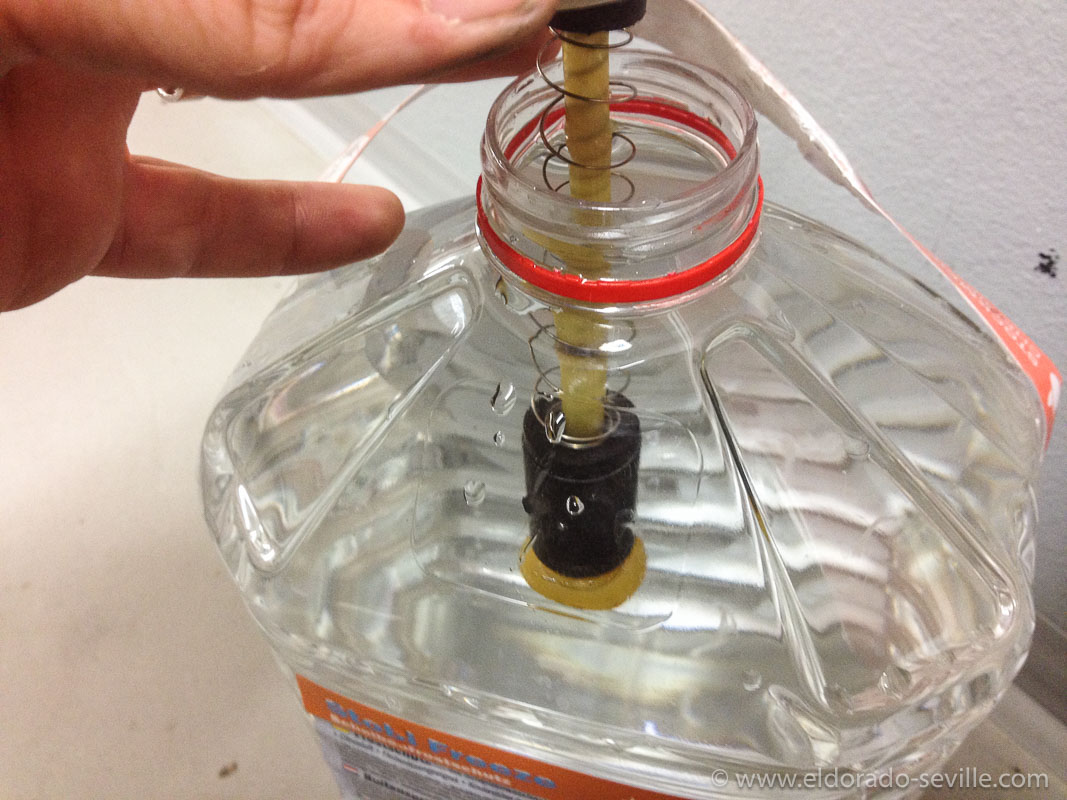
When I tested the float it sank…
REPAIRING THE 1978 ATC PROGRAMMER (AGAIN)
***This is an update to an older article as I had a very similar problem in the past already.***
I finally found the time to take the 1978 Eldorado out of winter storage. It started right up after many months of inactivity and I checked all accessories and options for operability.
Everything checked out fine but the air-condition… It only blew warm air out of the heater outlets and would not change modes, blower speed or temperature.
I immediately suspected a problem in the ATC programmer again. I already fixed it last year when the system would only work in full AC mode.
Last time I had a bad contact at the transducer which is the most important part in the programmer as it regulates the vacuum supply to the system.
The shop manual mentions that when the system is stuck in full heater mode, most probably an electrical problem is the main cause.
So I tried to push the transducer in again but the system did not come back to life like it did last time when I did this.
The MKII programmer which you can access through the glove box had to come out again for inspection.
This is how it looks with the cover removed:
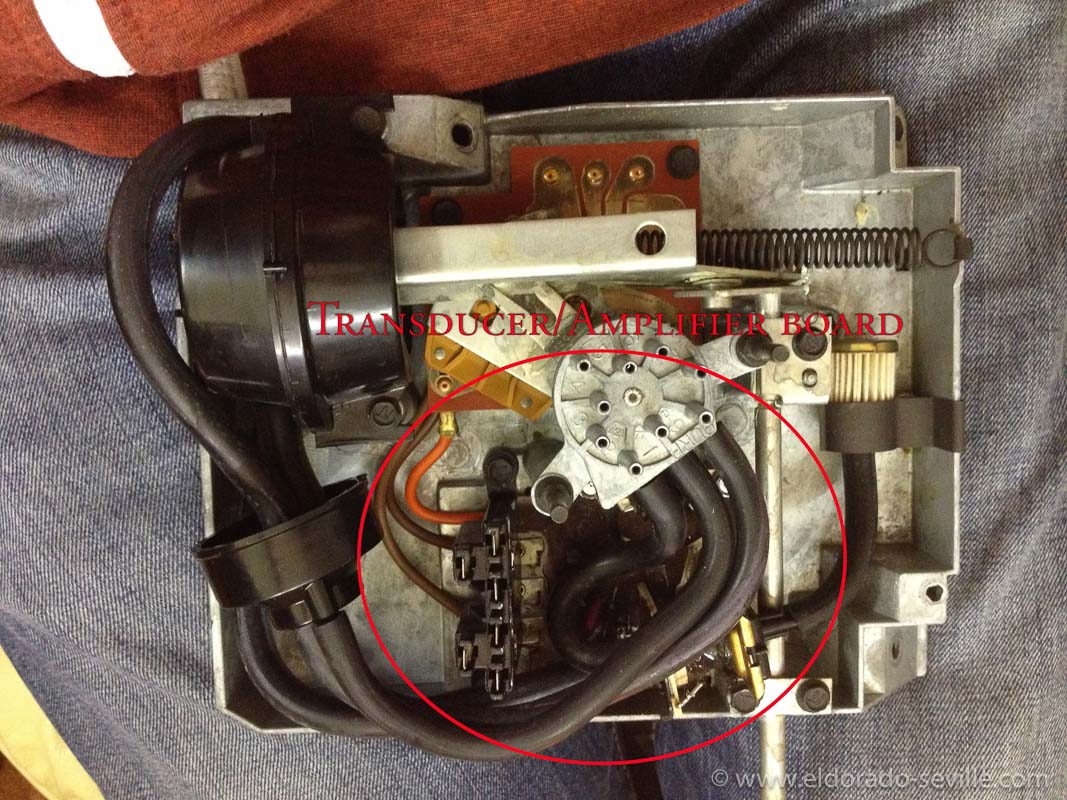
The 1978 MKII programmer with the cover removed.
I decided to take the transducer/amplifier board out of the programmer this time to see where the problem could be. It can be removed very easily - it's only held in place by 4 screws. Be careful not to turn the gear wheel with the potentiometer though as you would have to recalibrate it again afterwards.
After the board came out, I quickly found out where the problem was. Below is a picture of the removed board:
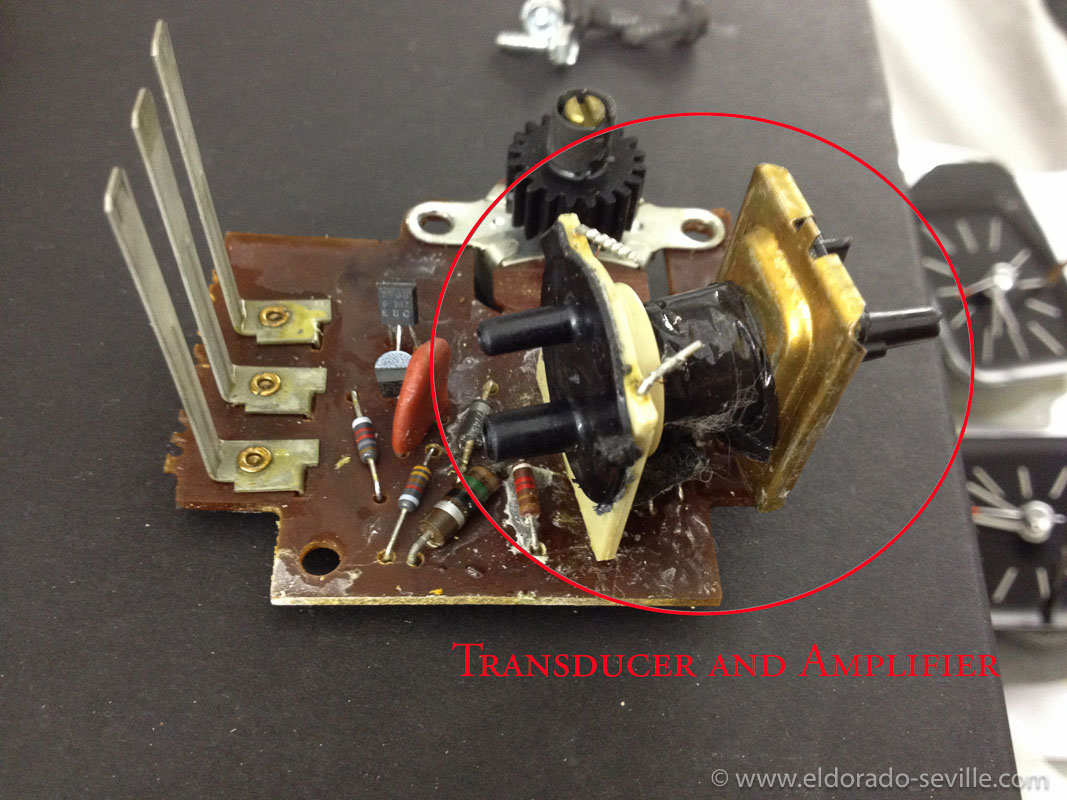
The transducer/amplifier board.
The transducer/amplifier unit was sitting pretty loosely on the circuit board, and one of the very thin and fragile wires going to the coil was broken, as you can see on the picture below:
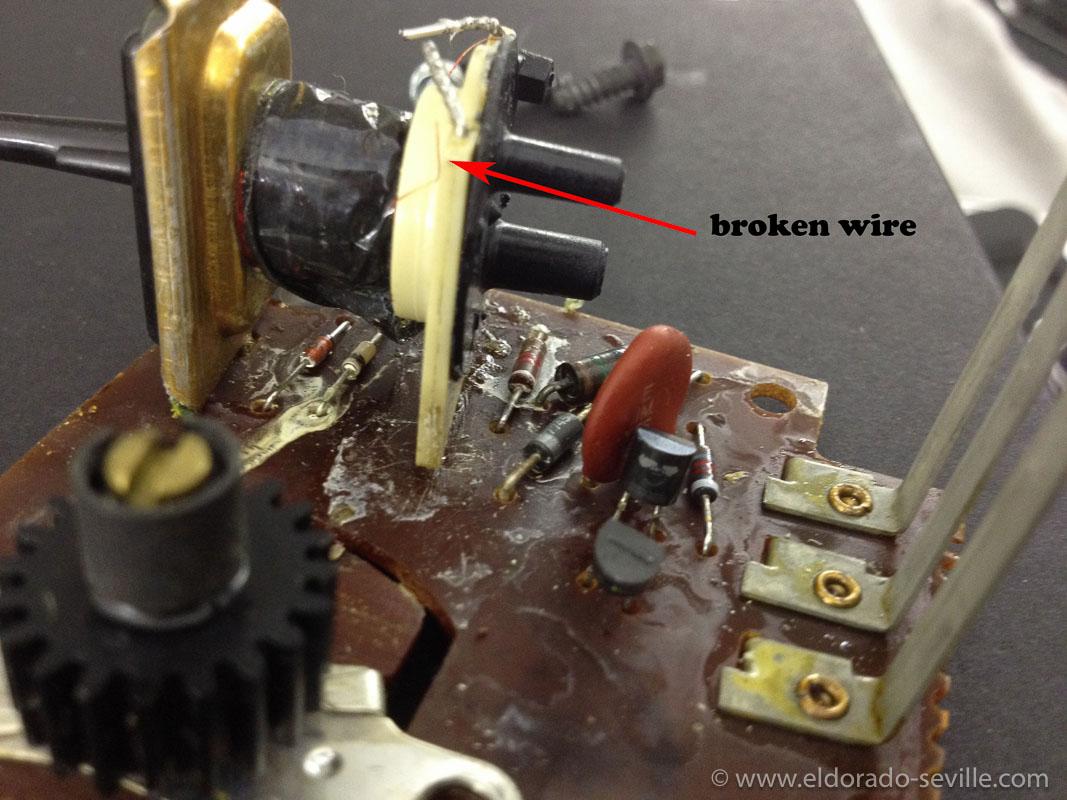
A broken wire at the coil of the transducer.
When I turned the circuit board around I could see that the soldering points on the circuit going to the transducer and the amplifier were broken and that they no longer were making good contact. That was the reason why the system did no longer work.
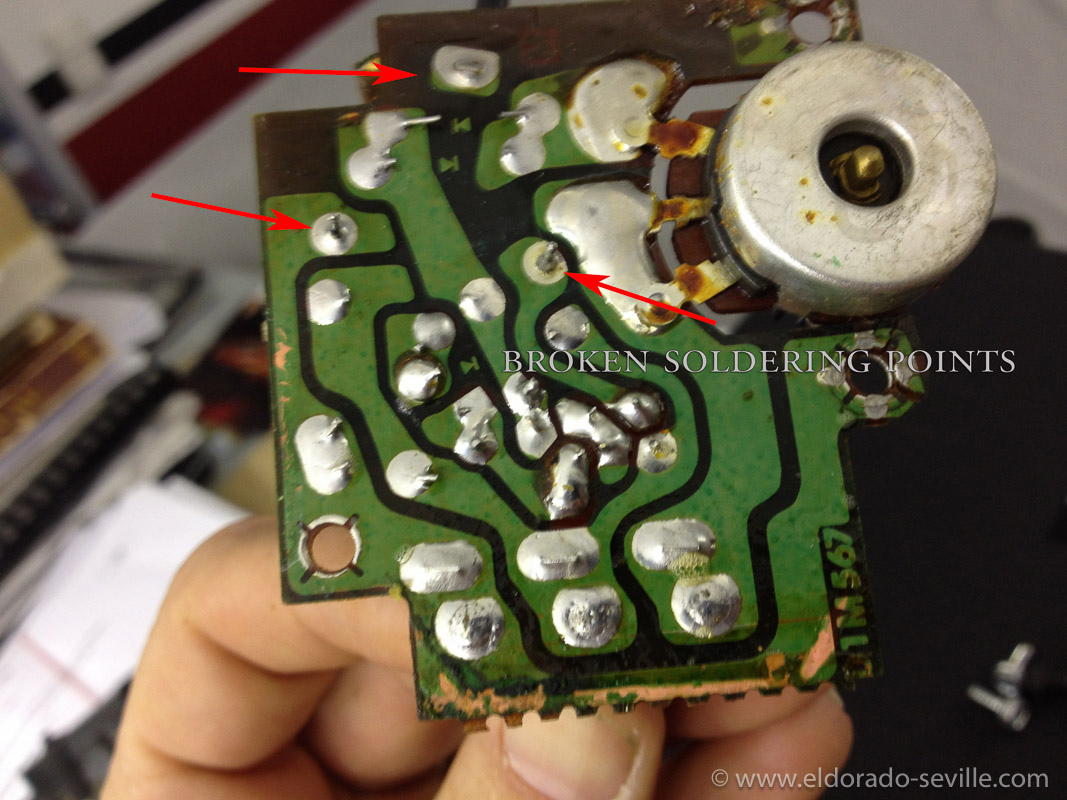
Broken soldering points at the rear of the circuit board.
The pretty simple solution was to re-solder the 3 soldering points and fix the broken wire going to the coil. I then put everything back together and now have a perfectly working ATC again. These old circuit boards can be very troublesome and I think that most of the time when a programmer goes bad on these 70s cars its probably a fixable problem like this. I was very worried that I would need an expensive rebuilt programmer and I am very glad that I could fix it by myself.
I have no idea though why everything worked when I put the car into storage last fall and how it broke while the car was inoperative…
Check my older post of the MKII programmer to also see the electrical diagram for the ATC system.
1978 CADILLAC ELDORADO BIARRITZ RADIO REPAIR
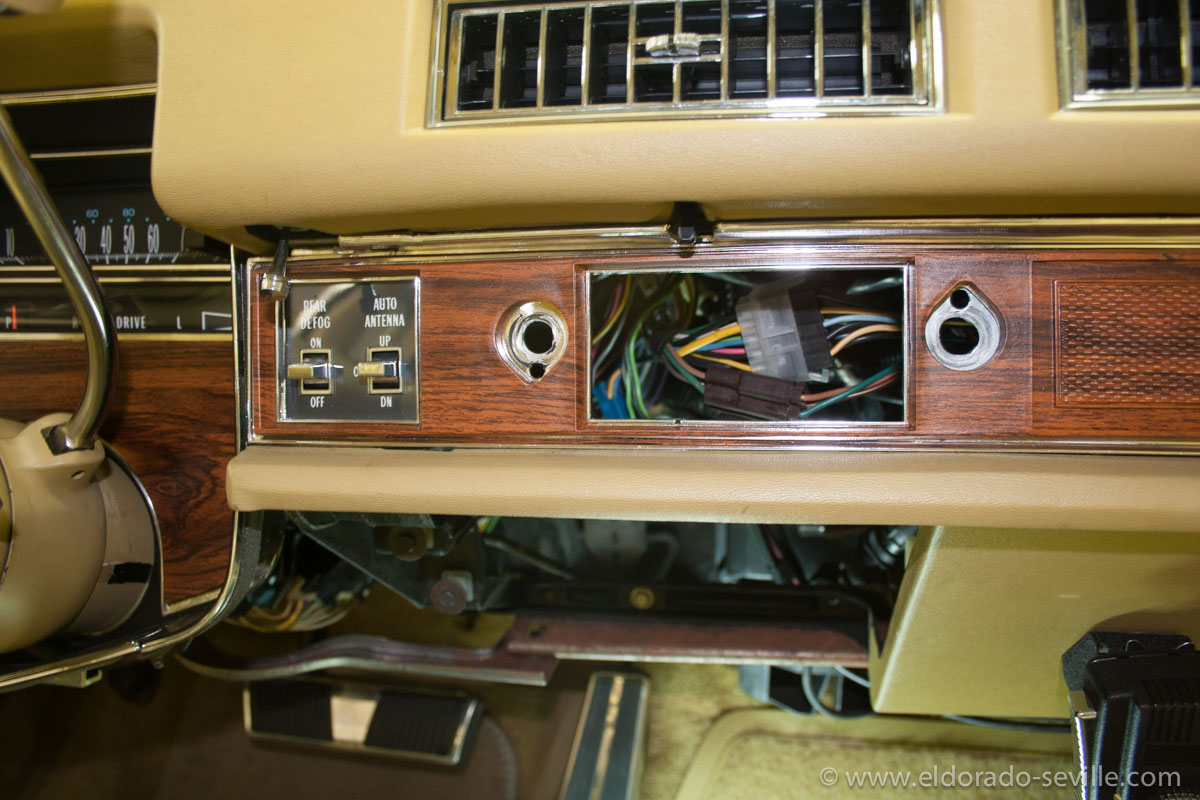
You have to remove the ashtray and part of the lower dash to get the radio out.
Before the spring season will start in May, I want to make sure that all my cars are in top notch condition until then.
The radio on my 78 suddenly died last summer. I was driving the car and the radio and 8-track and CB worked flawlessly. It had great sound and everything worked.
Suddenly, when I wanted to turn the volume down a little bit, the antenna retracted, and the radio went off completely and I could not turn it on again. I also could no longer operate the power antenna.
When I was home I discovered a blown fuse and replaced it, but it immediately blew again when I wanted to turn the radio back on.
I took the radio out now, and measured the power source, and I can clearly see that there is a problem somewhere inside the radio.
It looks like the power source is defective.
My friend Steve who is really good in repairing older radios offered to have a look at it. Unfortunately I cant fix this myself, as I have no clue how this could be repaired, or what could be defective…
Its great to have such good and competent friends who can fix such things.
In a very short time Steve found out what was wrong with the radio. One of the many condensators on the radio got dry over the years and caused a short. Steve replaced the broken condesator and even replaced all the other old ones with new ones to make sure that the radio will last for a long time.
I can´t thank Steve enough for fixing the radio for me. It is very important for me to know that it works again - I hate when things do not work properly on a Cadillac.
When I installed the radio back into the car, it came back to life, but the FM functionality did no longer work, and it was stuck in AM mode. 8 track and CB worked perfectly, but I could not switch to FM mode.
So Steve was so kind to disassemble the radio once again, and found the problem with a disengaged spring which could no longer activate the AM/FM switch.
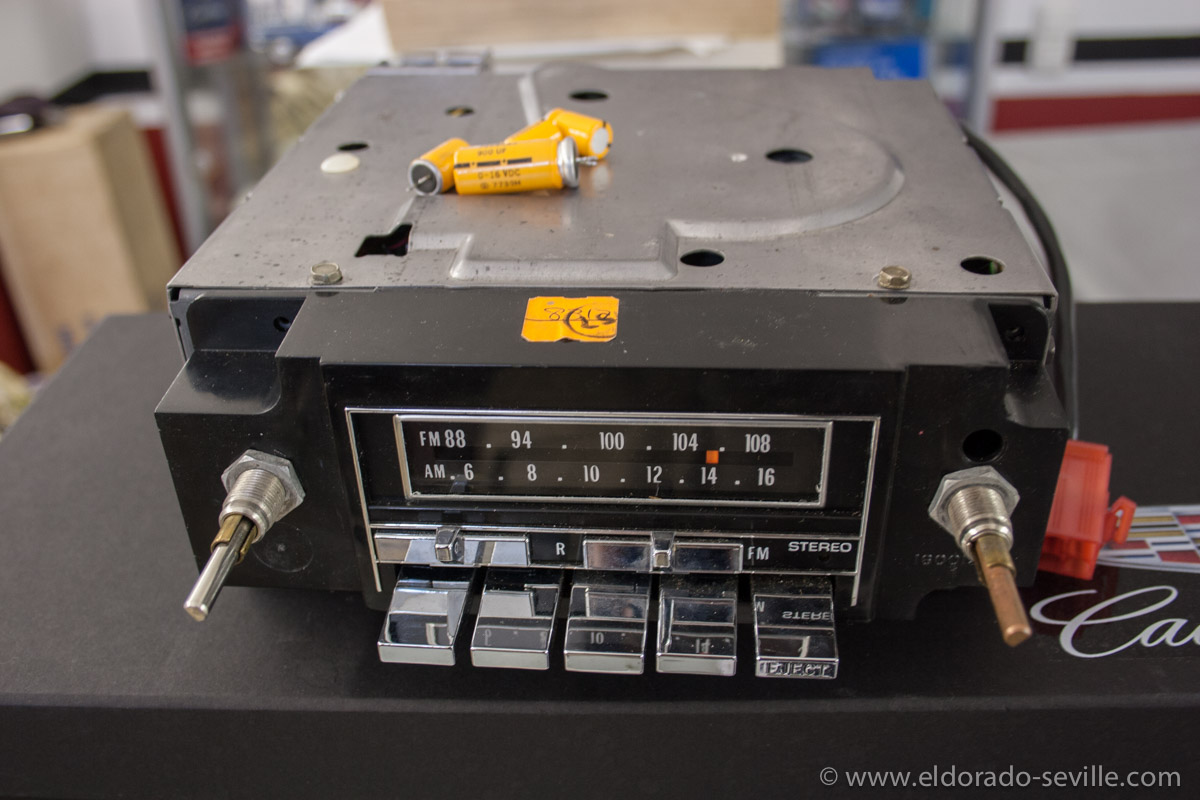
The radio is out of the car - it's the one with 8-track and CB - the most expensive one available in 1978. You can see the replaced condensers on top of the radio.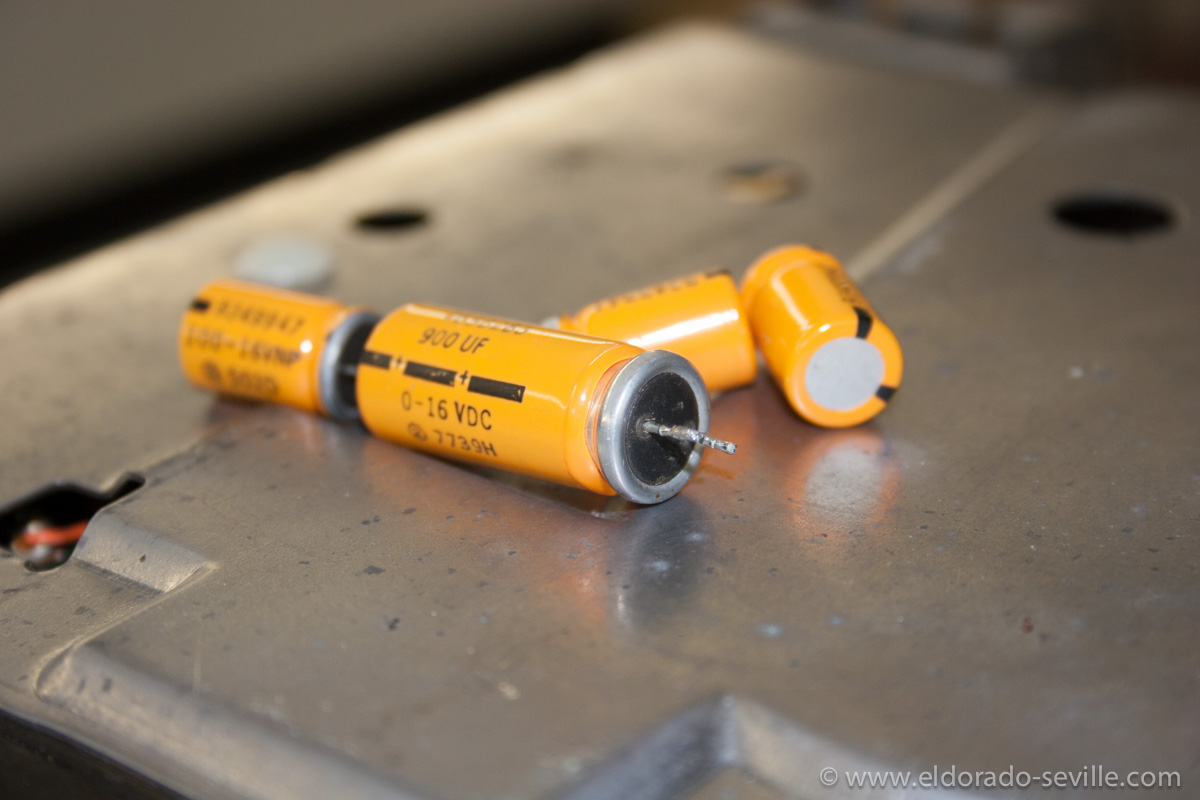
This bigger condenser was the cause for the trouble - it got dry inside and caused a short. The others were exchanged as well as a precautionary measure.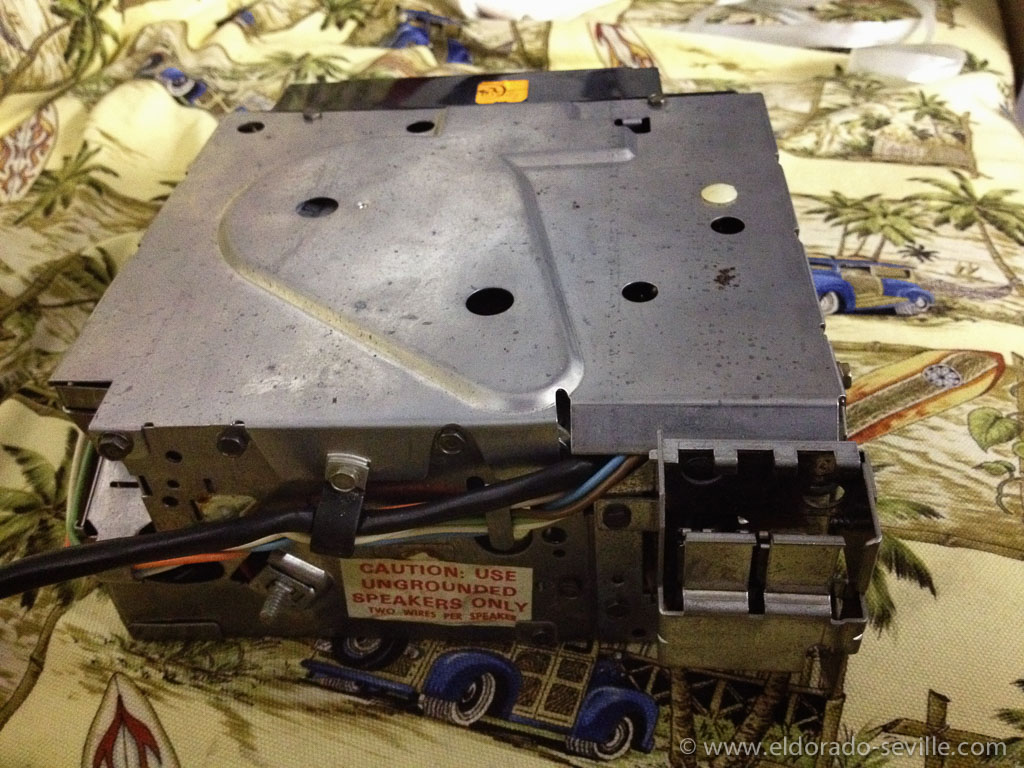
The back side of the radio.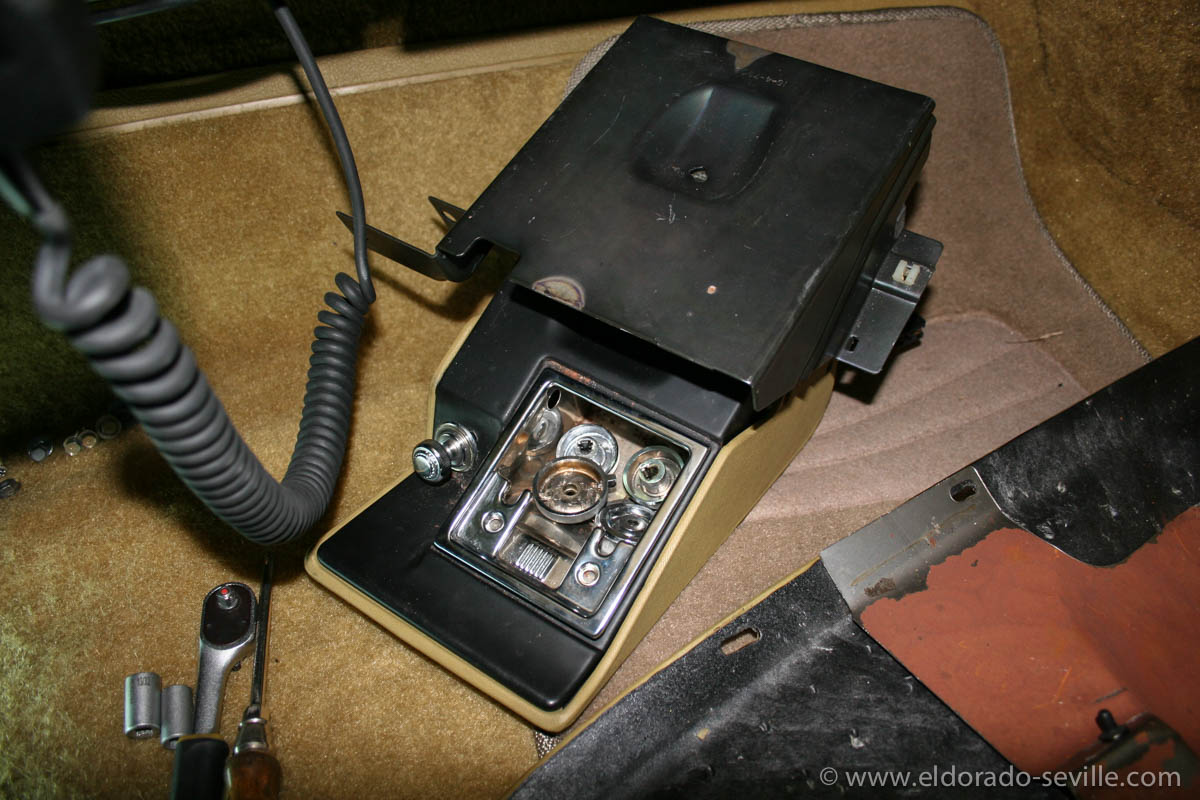
You have to remove the ash tray assembly to get the radio out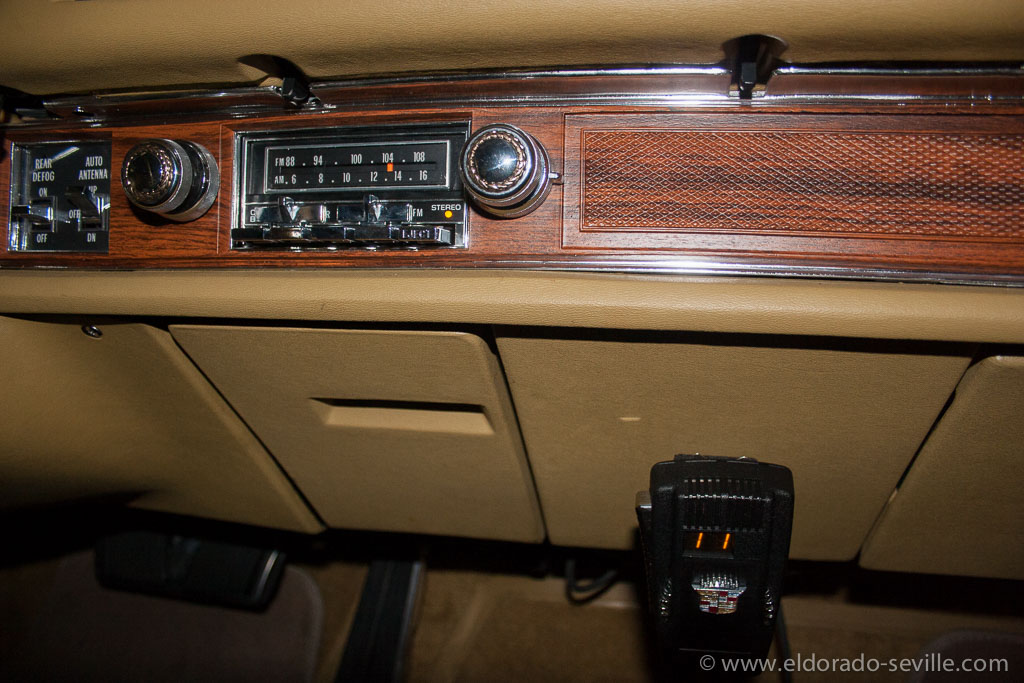
The radio works again and is back in the dash. 8-track and CB work perfectly as well.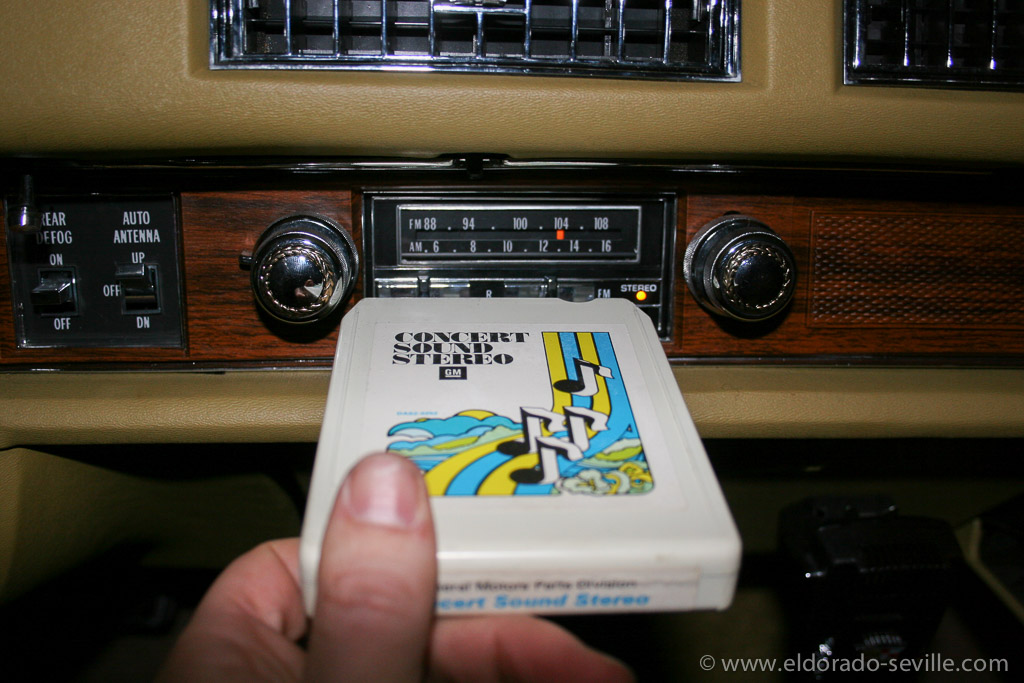
The GM demo tape which came with the car sounds amazingly good. Love the sound.
While I was working on the car I finally repaired the glove box light switch which had a problem since I got the car. I got a new switch from Arizona Vintage Parts and it now works perfectly again.
The glove box light is back in working order.
REPLACING THE HOT WATER VALVE
I also replaced the cars original hot water valve, which had a leak at the vacuum diaphragm and could not close any longer.
I found a perfectly working NOS replacement on ebay for it, as the one I got from Rockauto before looked completely different.
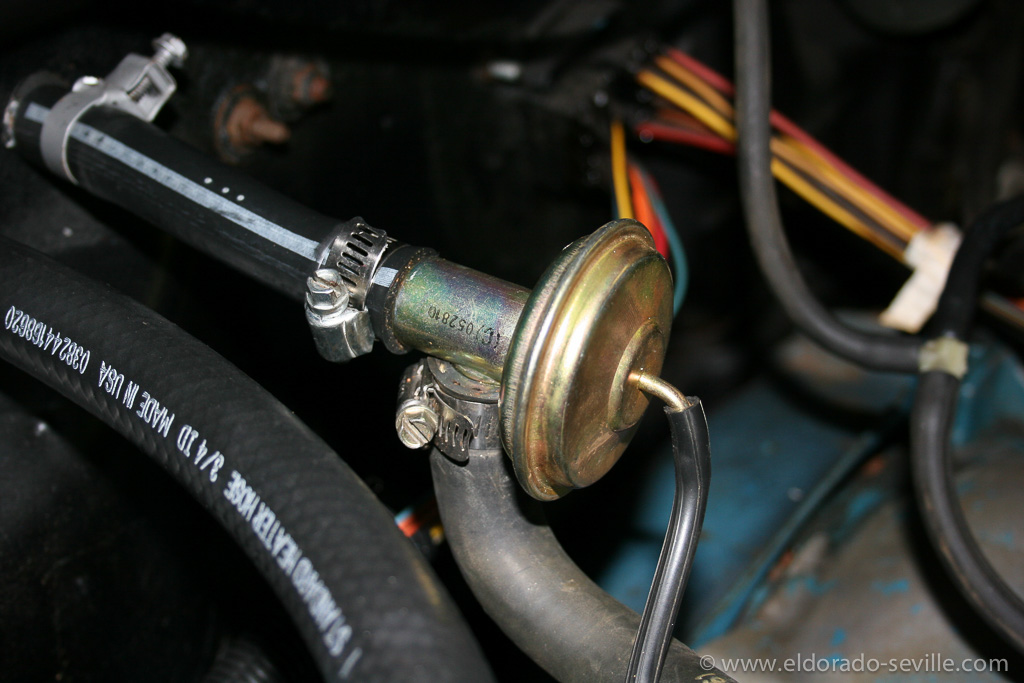
The new hot water valve in place.
REPAIRING THE SEAT BACK LOCKS OF THE 1974 (AGAIN) AND NEW POWER ANTENNA INSTALLED
I found a way to remove the seat back lock mechanism without disassembling the whole front seat and replaced the mechanism with one which I got from my favorite Cadillac Parts vendor - Arizona Vintage Parts. As always they delivered a perfect part and it only took me half an hour to remove the old part and install the new one.
The function of this lock is that it latches the seat backs in place when the doors are closed. The lock disengages and unlatches when the door is opened, so that rear passengers can simply fold the seat backs away when entering or leaving the car, without having to push a button.You can hear this "Automatic Seat Back Release" working when you open or close each door.
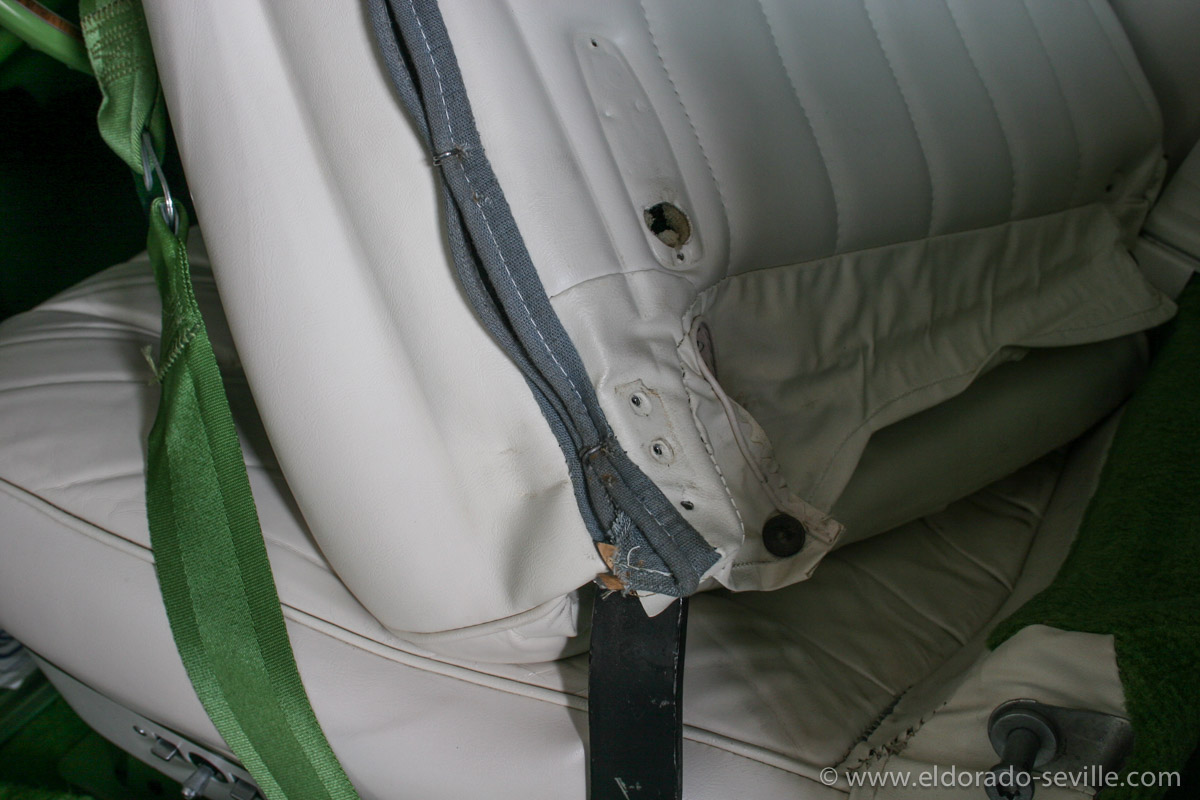
After removing the plastic covers around the seats - it will look like this. The seat back lock mechanism is hiding inside under the seat back.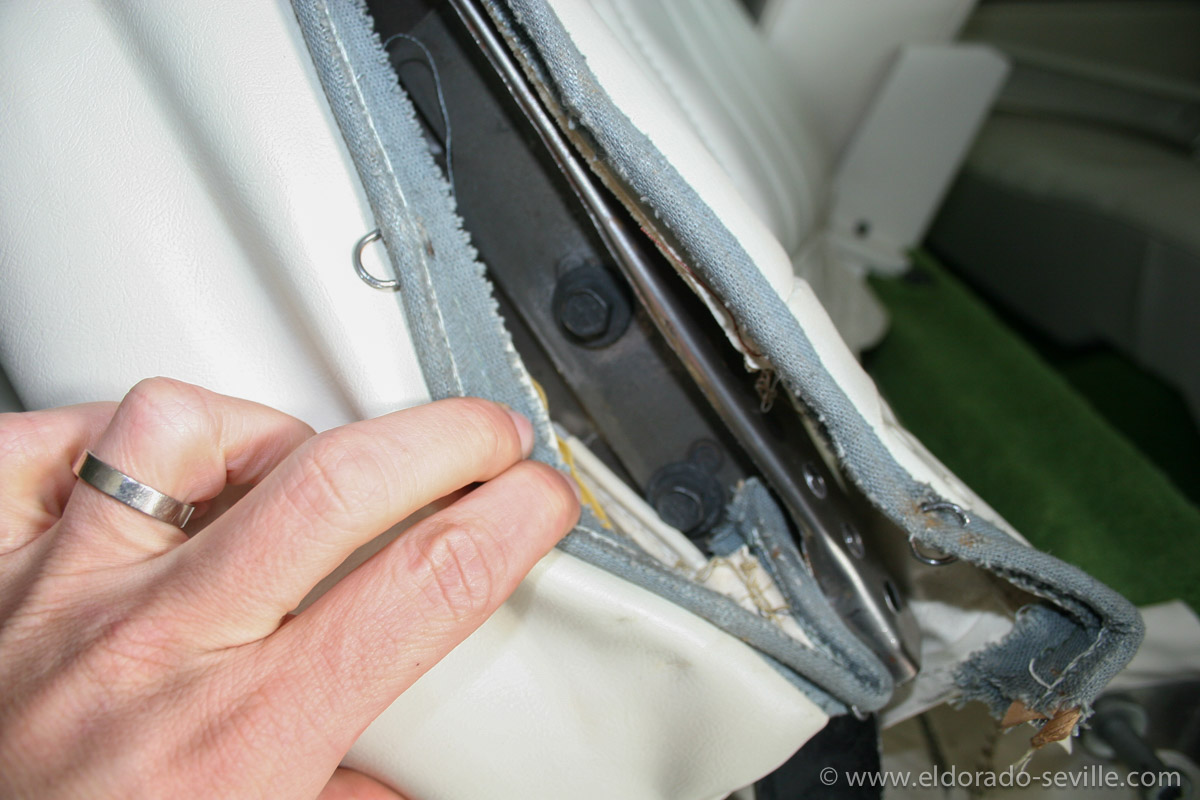
You have to remove the lower 3 hog rings to get access to the two mounting screws.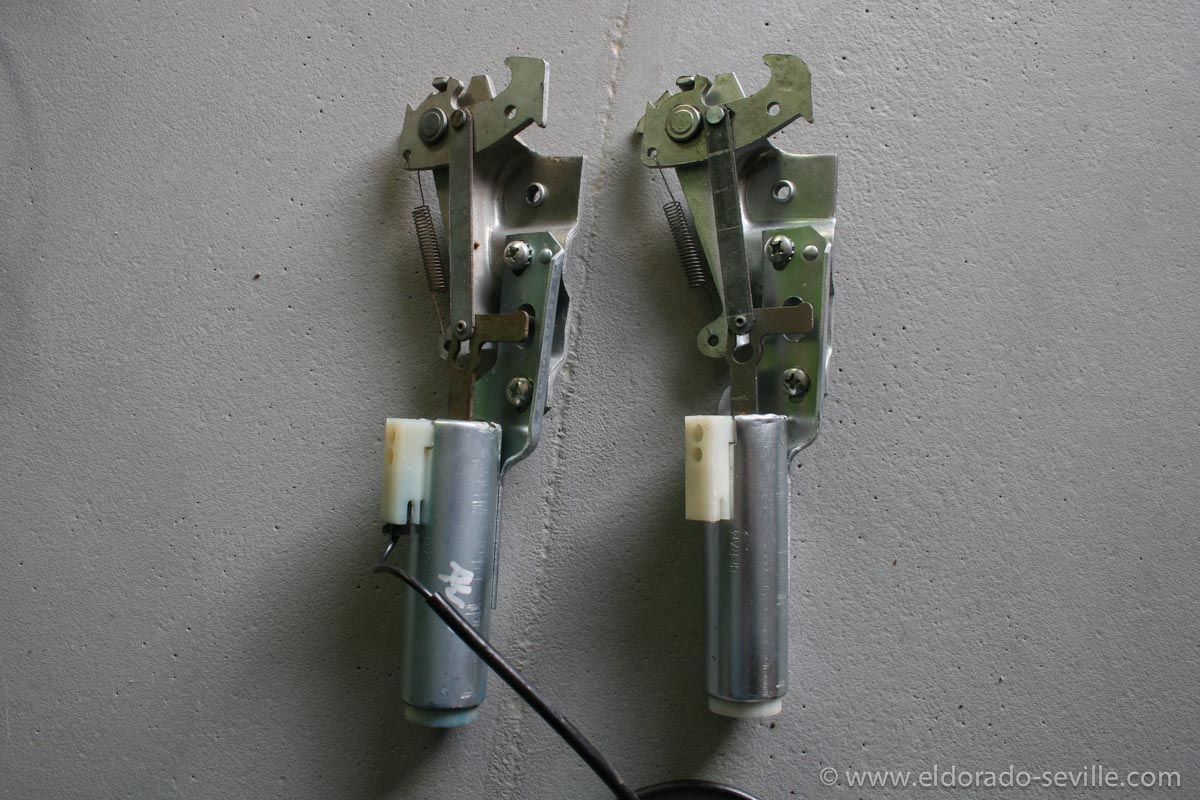
The new mechanism I got from AVP on the left and the old original one which does no longer work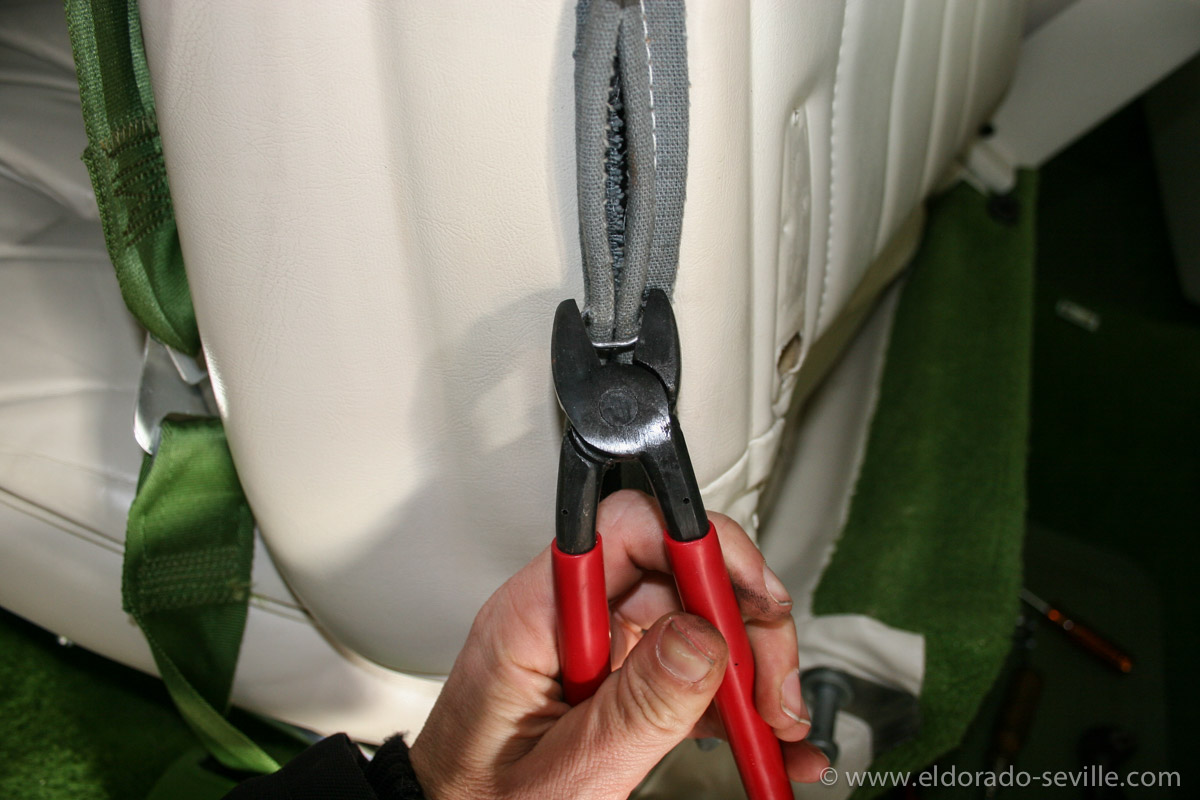
After installing the new part all you need to do is to install the hog rings again and install the seat cover surround moldings. Here I´m using a hog ring plier - but you can use some simple other pliers as well.
DEFECTIVE POWER ANTENNA
I also had to replace the defective power antenna of the 74. The original one had a burnt motor and also the gears and the whole mechanisms were broken. I can´t imagine how this could have happened. When the antenna died it also burnt the fuse. After inspecting the power antenna I decided that it was not rebuildable and ordered a rebuilt one from Arizona Vintage Parts as well.The antenna can be removed very easily on the 74 - so much easier than on my 60s cars. I was able to switch it out within 10 minutes. It works perfectly now.
It´s very important to me that all things on a Cadillac do work like they should.
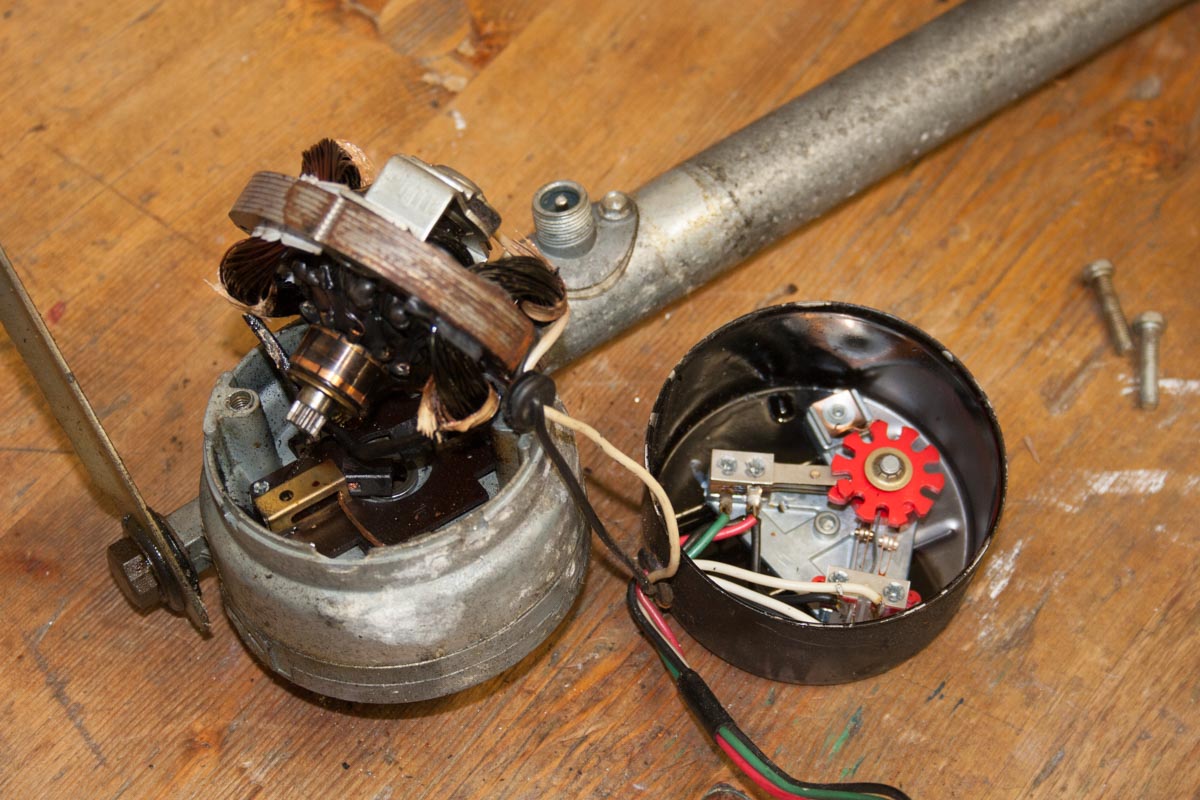
This is how the disassembled original power antenna looked like when taken apart - you can clearly see that the motor was burnt.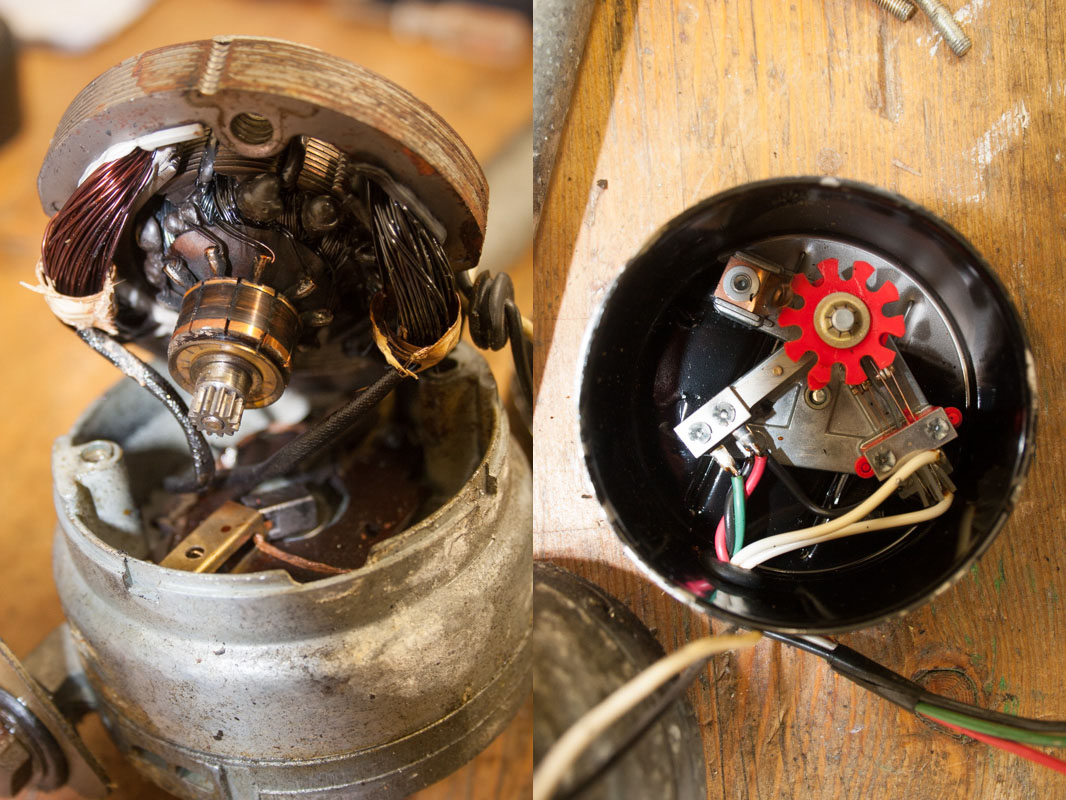
This is how the disassembled original power antenna looked like when taken apart - you can clearly see that the motor was burnt. Also the mechanism itself was damaged.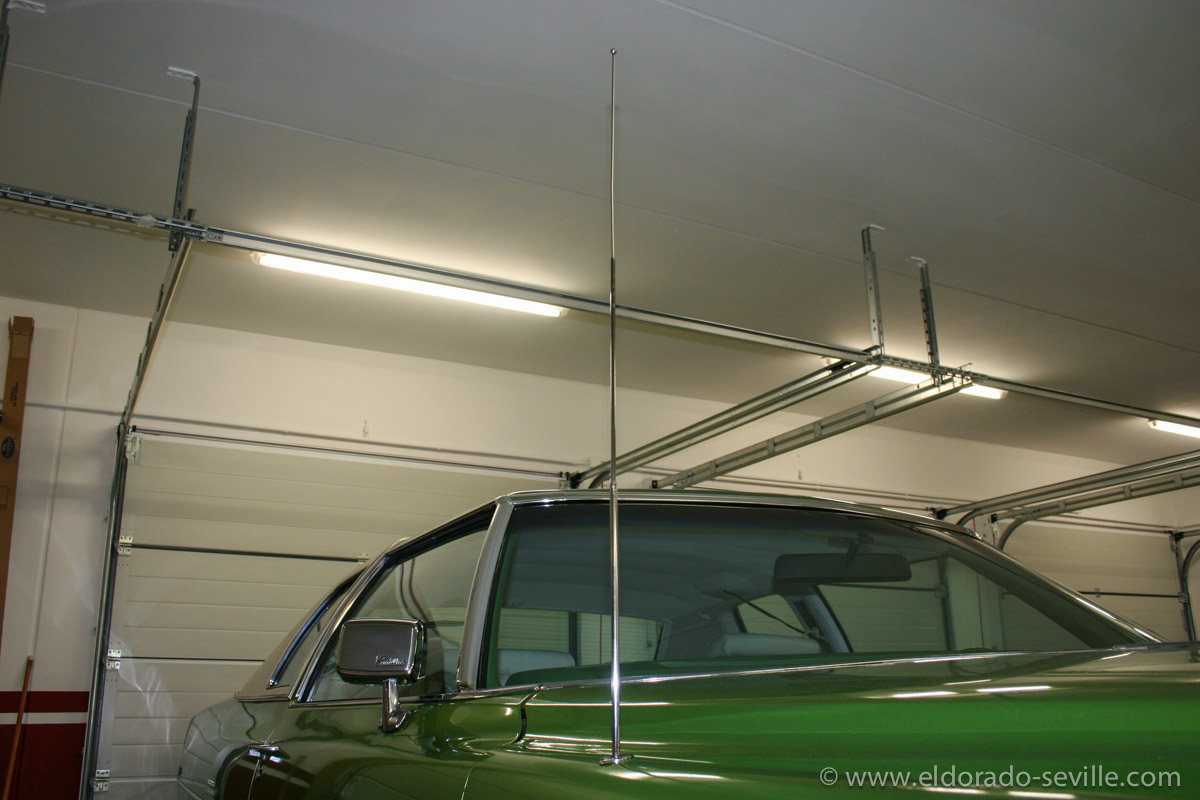
The 74 has a working power antenna again.
1967 AND 1968 CADILLAC ELDORADO HEADLIGHT ACTUATOR REPAIR ARTICLE UPDATED
After many years they tend to fail for many owners of the 1967 and 1968 Eldorados.
One company has offered a reproduction, but from the experience some people made with it, it was said that it was very poorly made and extremely expensive. I can´t tell anything about it from my own experience though.
But there is a better and much cheaper solution to the problem in the form of a modified reproduction 1969 Camaro RS actuator which is readily available. I´ve written an article a couple of years ago what could be done and I have now updated it, as one reader sent me some excellent description and pictures of how he modified the Camaro actuator to work perfectly on his 1968 Eldorado.
Thanks for the tip Mark Maromonte from Marks Truck and Auto Repair.
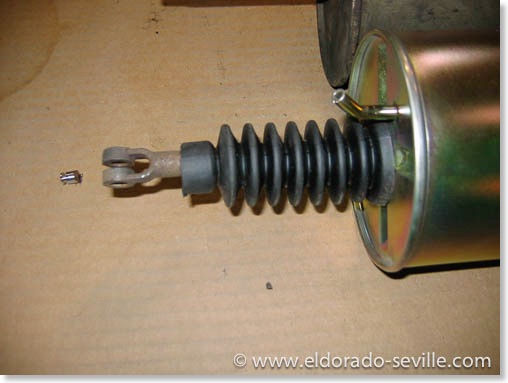
Click on the picture to go to the updated article.
TRYING TO REPAIR THE SEAT BACK LOCK MECHANISM ON THE 1974 CADILLAC
They are actuated by big solenoids which are mounted in the back rest of each front seat.
When you open the door they are actuated, and the seat backs can be folded forwards to allow access to the backseats without having to manually unlock the seat. You can hear this "Automatic Seat Back Release" working when you open or close the according door.
It worked perfectly on the passenger side, and most of the time on the driver side.
When the door was open though you could sometimes hear a rattling sound from the solenoid as it did not make good contact.
That was not acceptable for my standards of course.
You have to remove most of the back seat material to get to the solenoid unfortunately.
Once we got it out, we took the solenoid apart. Some of the actuators insulation foam had crumbled inside the end stop of the solenoid - so we replaced that, cleaned and lubricated everything, and put it back together.
Unfortunately the problem was still there after this.
So we eventually found out that the striker where the seat latches, was not adjusted correctly. Something must have gone wrong at the factory already.
We had to modify it slightly to make it perfect again, so that the solenoid could disengage itself properly when the seat back was in the back position.
When everything was back together it worked for a while before it broke again. I will have to find a good working solenoid now and replace it once again.
UPDATE: You can read about the final repair here!
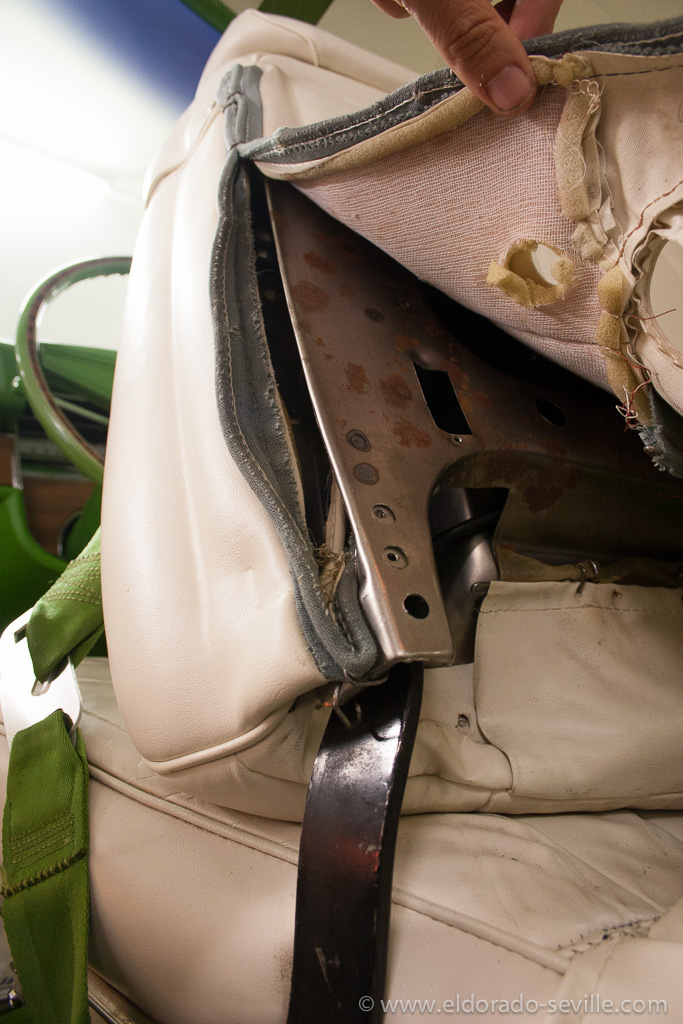
You have to remove the seat back material to be able to access the solenoid and latch mechanism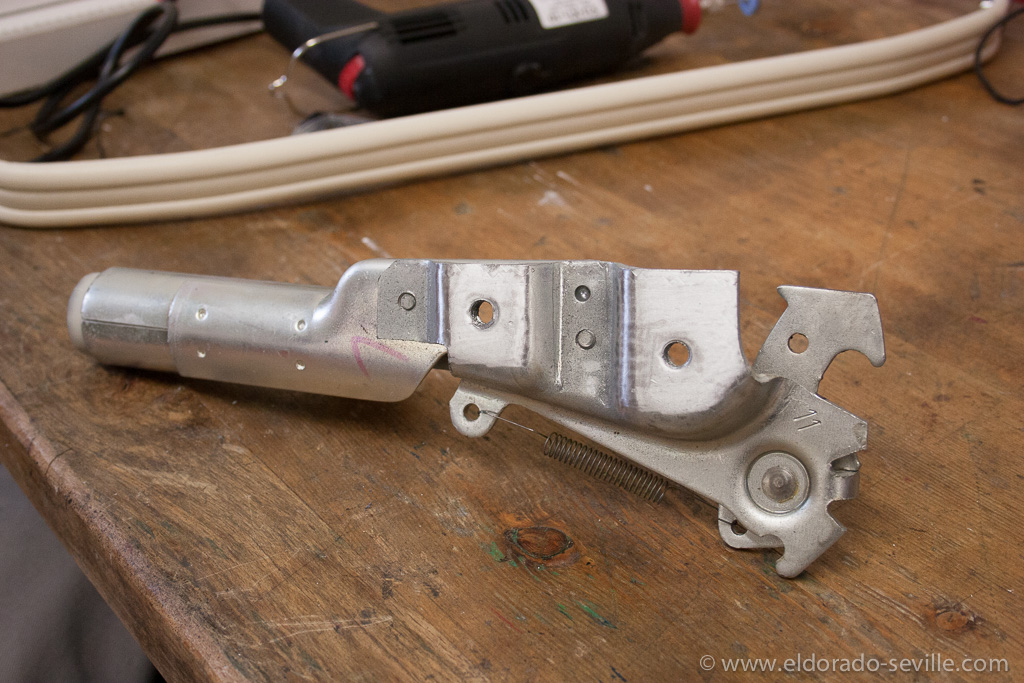
The latch mechanism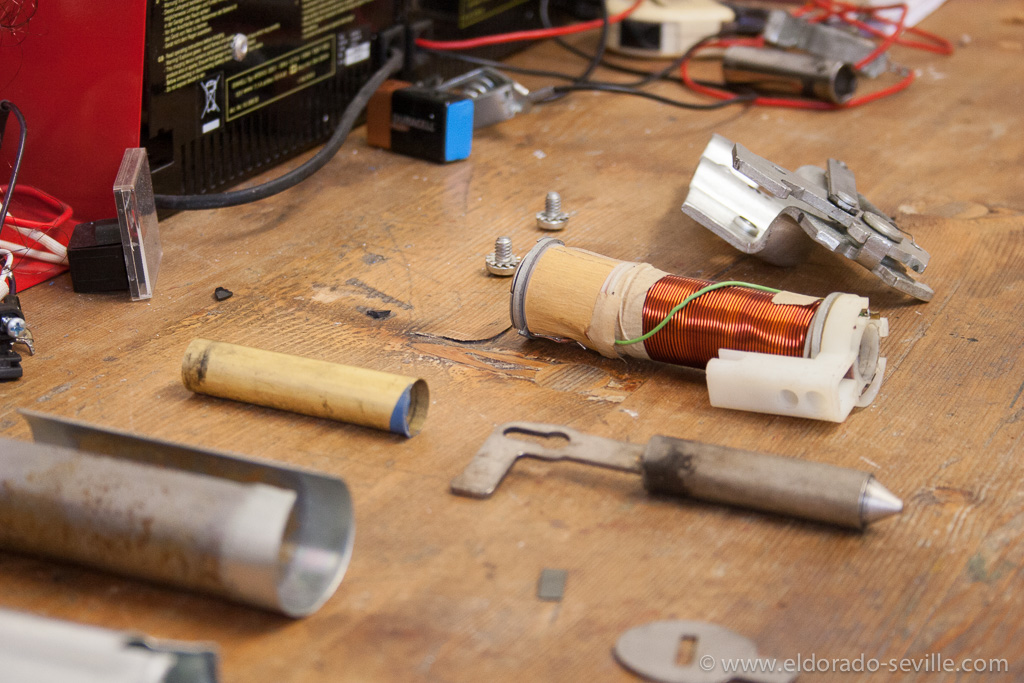
The solenoid disassembled - before cleaning - there are two coils inside.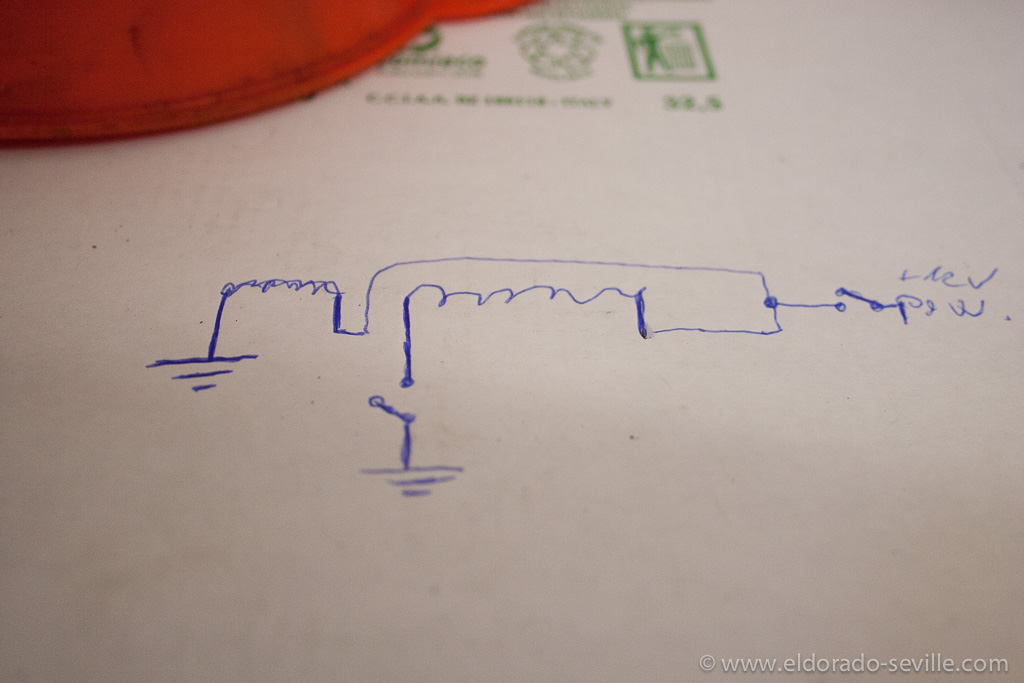
A quick drawing of how the system works.
REPAIRING THE WONDERBAR RADIO OF THE 1958 CADILLAC SEVILLE
Another Cadillac fan I know who likes to try to repair old things and especially older tube radios wanted to give it a try. So the radio came out of the dash.
After his first investigation it soon turned out that the vibrator inside the radio was inoperative.
We could not find a new one - so he decided to cut the aluminum tube with the vibrator inside open.
He ordered a couple of other parts and somehow managed to repair the original vibrator.
I have no clue how he managed to do that and what he did exactly - but I now have a working AM - “Wonderbar" radio inside my 58 Eldorado Seville and for the first time I can proudly say that EVERYTHING works on my 58!
He also managed to repair the speakers on the 1966 and I have a perfectly working radio on this car as well now.
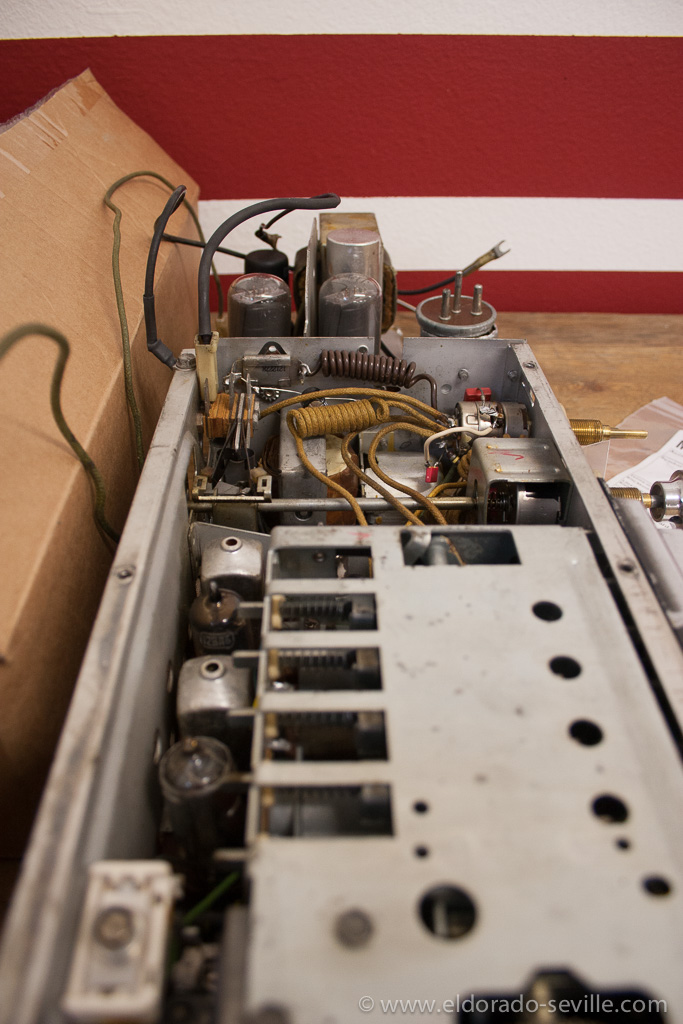
The 58 radio out of the car on the work bench…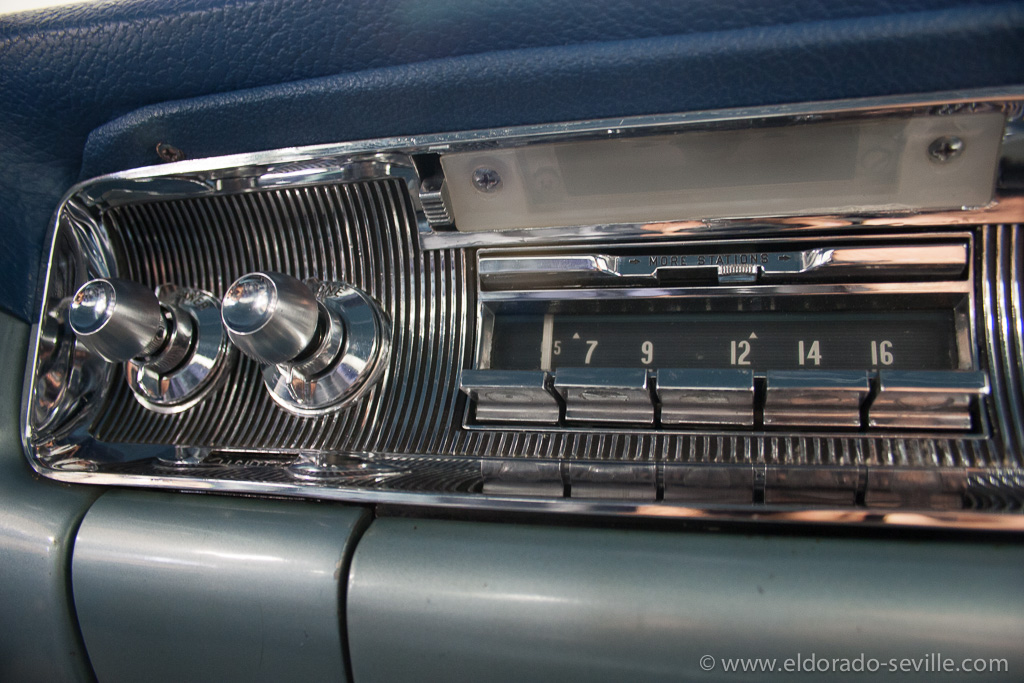
…and back in.
REPAIRING THE CLOCKS OF THE 1958, 1966 AND 1967 CADILLAC
So it was time to service some of the clocks which stopped working over the years.
The clock in the 66 did not work at all.
It's extremely simple to remove on the 66 as you can get it out of the instrument panel by just unscrewing one bolt.
The clock was very dirty in the clock work and needed a good cleaning and some good lubrication. Also the contact of the coil was a little worn and this was fixed. It then happily ticked back to life and now works perfectly.
The clock on my 58 stopped working a couple of years ago. So it came out as well. It's a little more complicated to get it out though...
When it was finally out - it could be seen that the coil was burnt and that it needed some very good cleaning as well. Some of the melted insulation material was all over the clock mechanism and of course I had no spare coil for it - so the original one had to be rewound with some good wire from a left over light solenoid...
Wow - this really took a while - but now the clock works perfectly again!
I was not so lucky with the clock on the 67 Eldorado which only worked when the car was warm. To take it out you have to remove the upper dash and then get out some light bulbs and disconnect it from the printed circuit.
It was also cleaned and lubricated and the clock worked, but it made a very loud noise when the coil rewound the spring of the clock.
The sound got better over night, but then the clock stopped working completely... It's a Westcox clock which uses a double coil and is much more complicated to rebuild than the Borg clocks. Its also almost impossible to find parts for it, as Borg clocks are much more widely used.
Looks like I will need a new 1967 clock and replace it with a Borg unit :-(
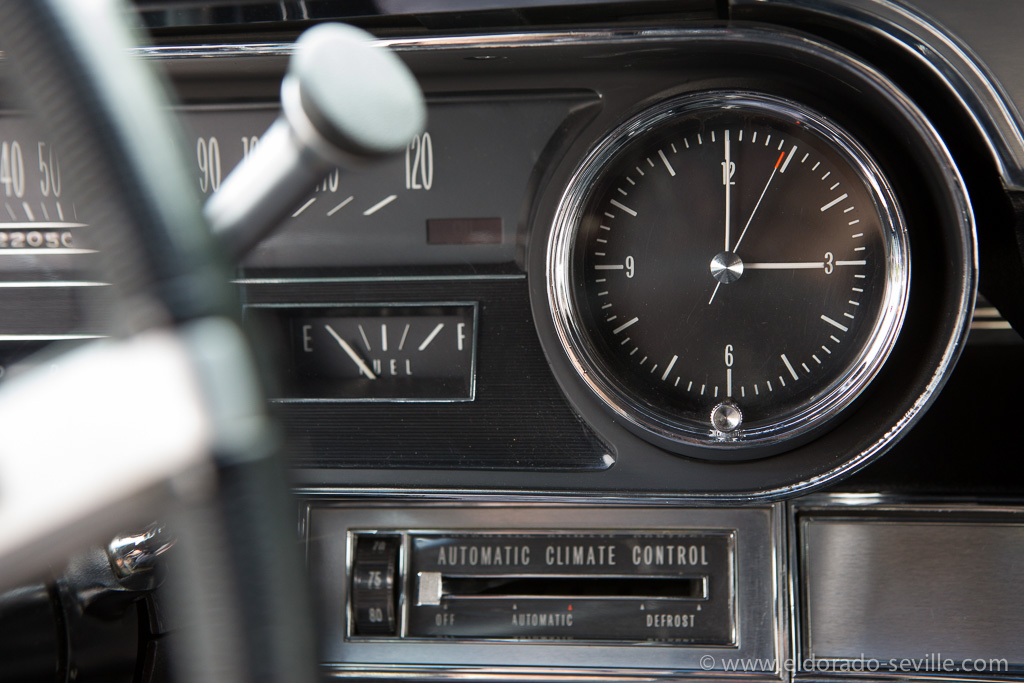
The clock in the 66 is now working perfectly again.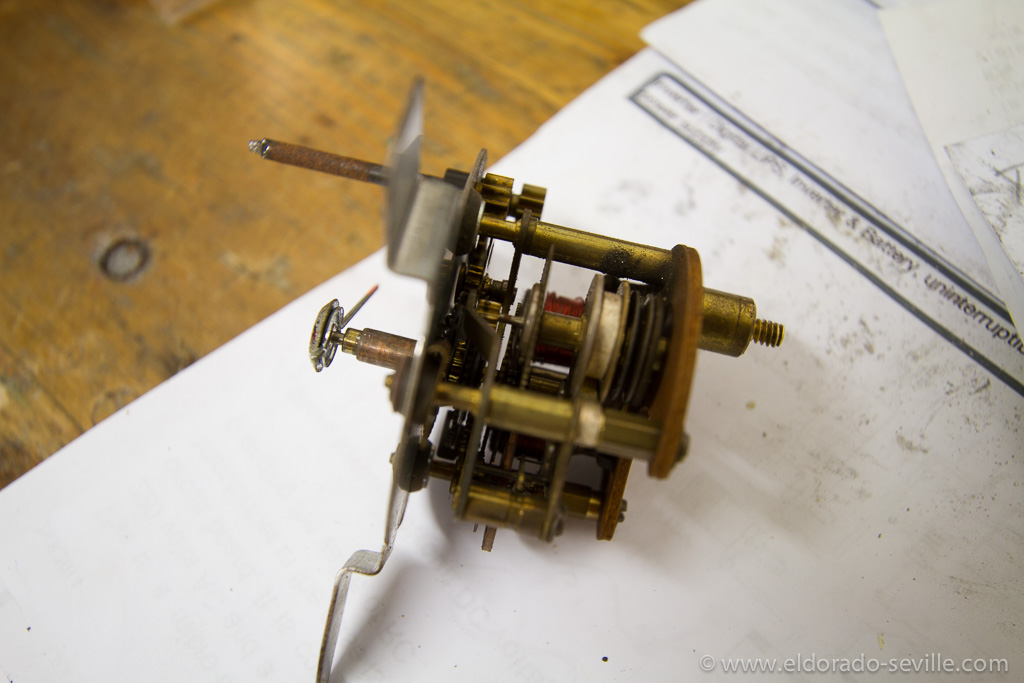
The disassembled clock of the 58 Eldorado.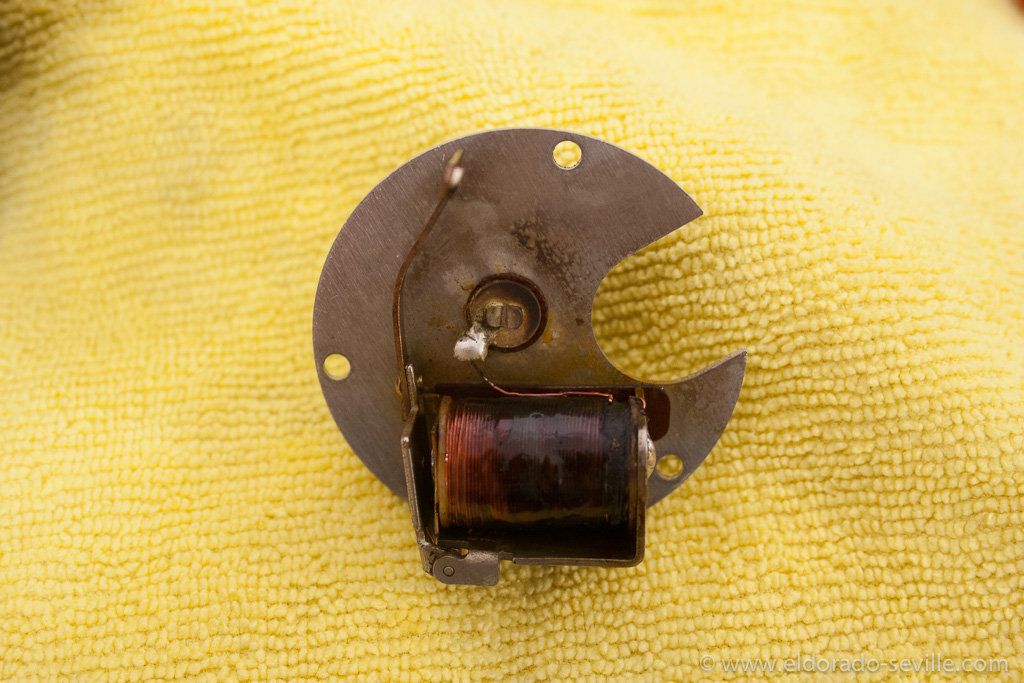
The coil was burnt on the 58 clock.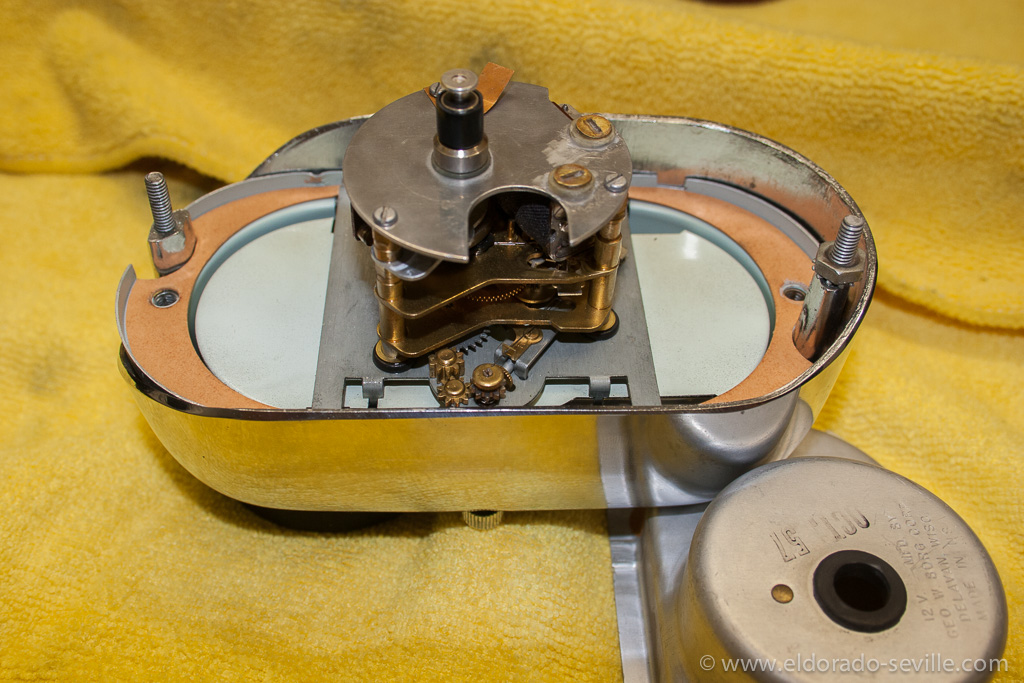
Fully cleaned clock. 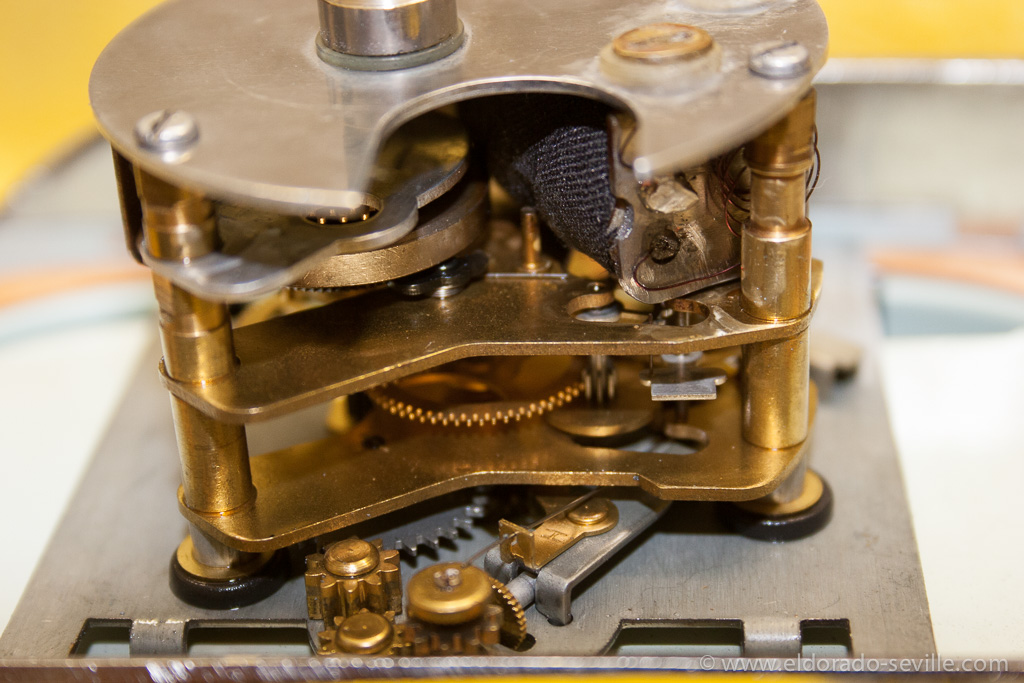
Back together with a rewound coil.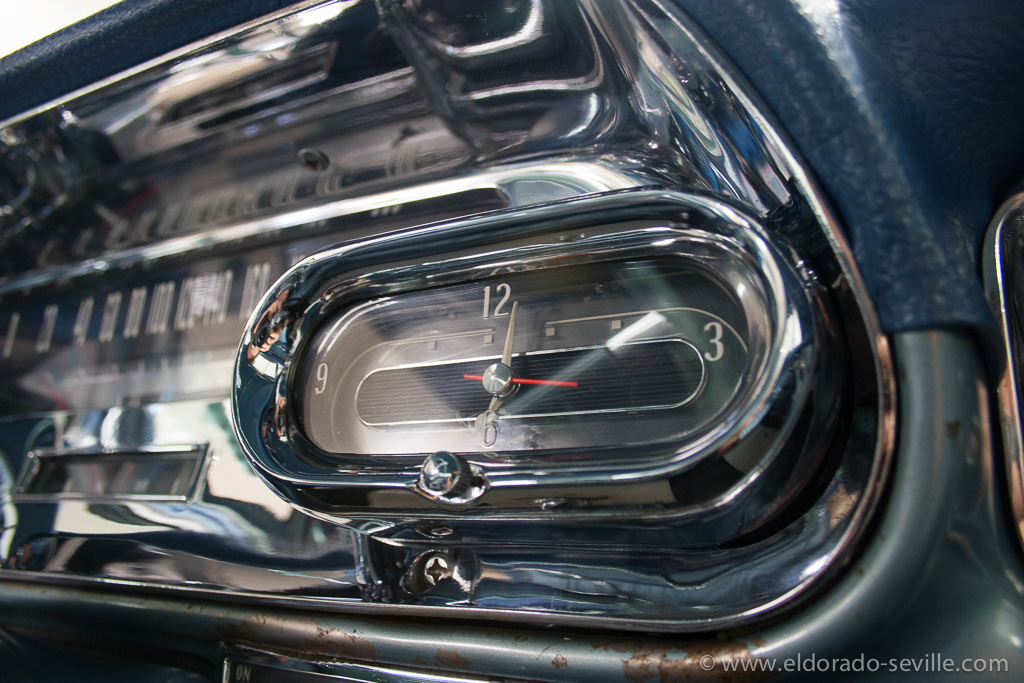
Back in the car - working perfectly again.
REBUILDING THE CRUISE CONTROL OF THE 1966 CADILLAC
Too bad that almost nothing worked when I got the car.
Of course I do not accept any non working things on my cars.
So with the help of another Cadillac aficionado who likes to work with anything electric - we took on the big challenge to repair the “Perfect Circle Cruise Control“ of the 66.
We had no idea how it worked and only had the shop manual as a reference.
The speed reminder function did kind of work, but the cruise control function was completely inoperative.
It took us a couple of days to fix it properly and now it works like the day the car left the factory!
We encountered a multitude of problems:
- 1) The dash mounted switch was defective - the plastic gear to set the desired speed was broken.
- 2) Most of the contacts inside the unit were oxidized
- 3) We had to adjust the contacts inside the unit properly and calibrate the system to the speed set on the dial
- 4) As it turned out later the brake switch was not properly adjusted (we should have checked this first and read the shop manual properly...)
After a lot of trial and error we eventually learned how the system works and we finally could adjust it correctly. It's a very nice system when it works properly, but you really have to calibrate it correctly. It's a fascinating option and there is some great engineering behind it. As it is rather complicated to repair you will see a lot of 60s car without a working cruise control.
Luckily its pretty well described how to adjust the contact points in the shop manual and I should have read it more thoroughly before we started to work on it - it would have saved a lot of time troubleshooting.
UPDATE: Here is the chapter about the Cruise Control from the 1967 Cadillac Shop Manual as a downloadable pdf file. I do no longer have the 1966 manual - thats why I have this document for 67 only. Its very similar to 1966 and differs mainly from the set switch.
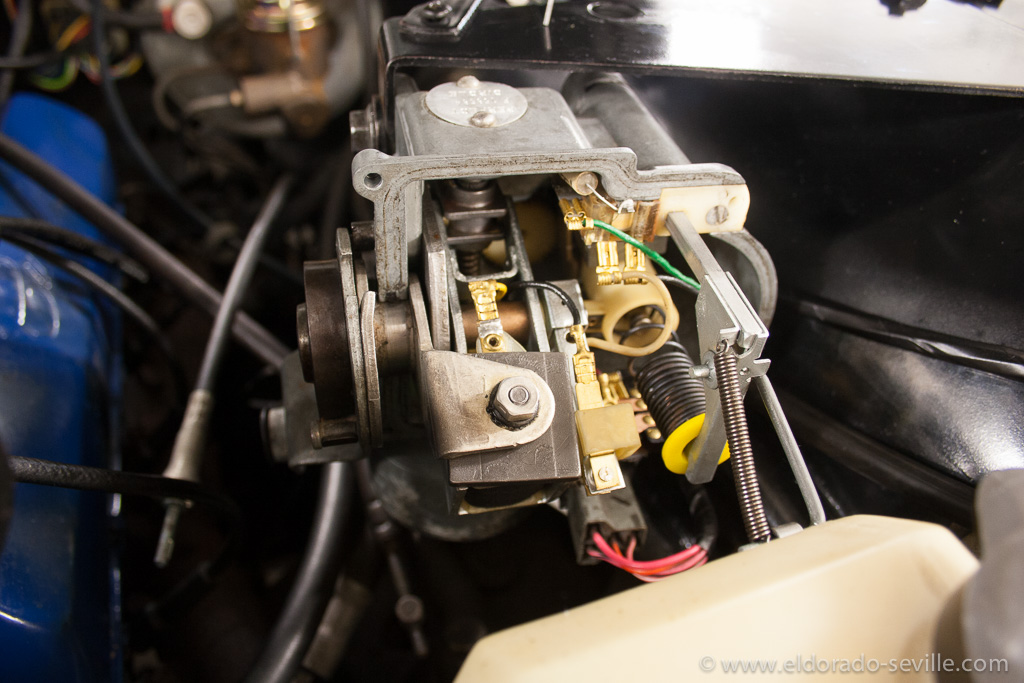
inside the system - still on the car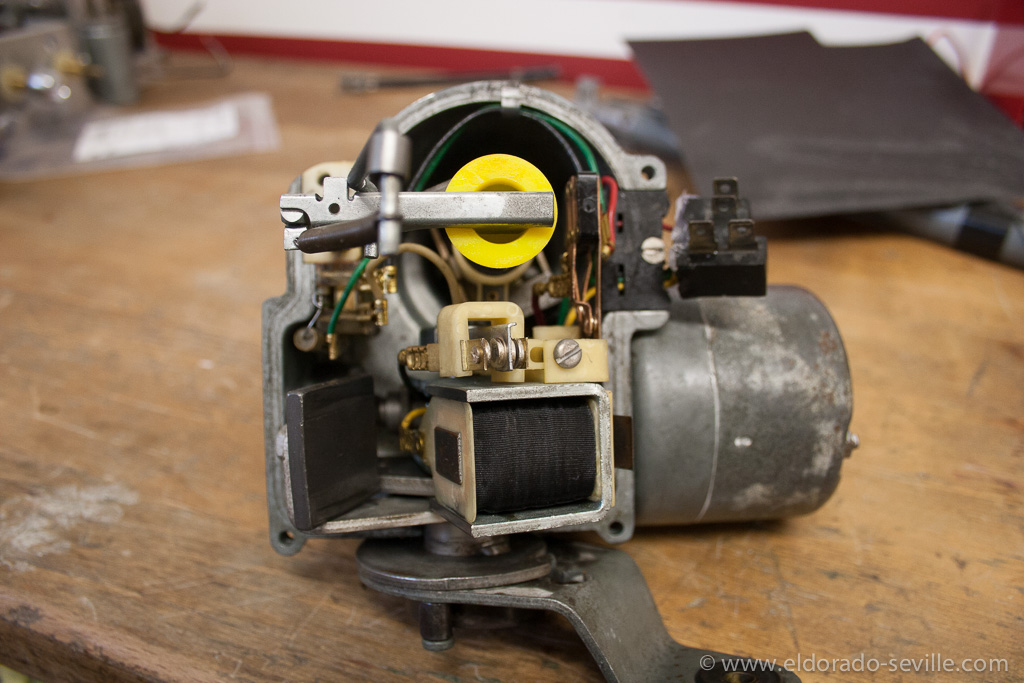
the “perfect circle“ unit on the bench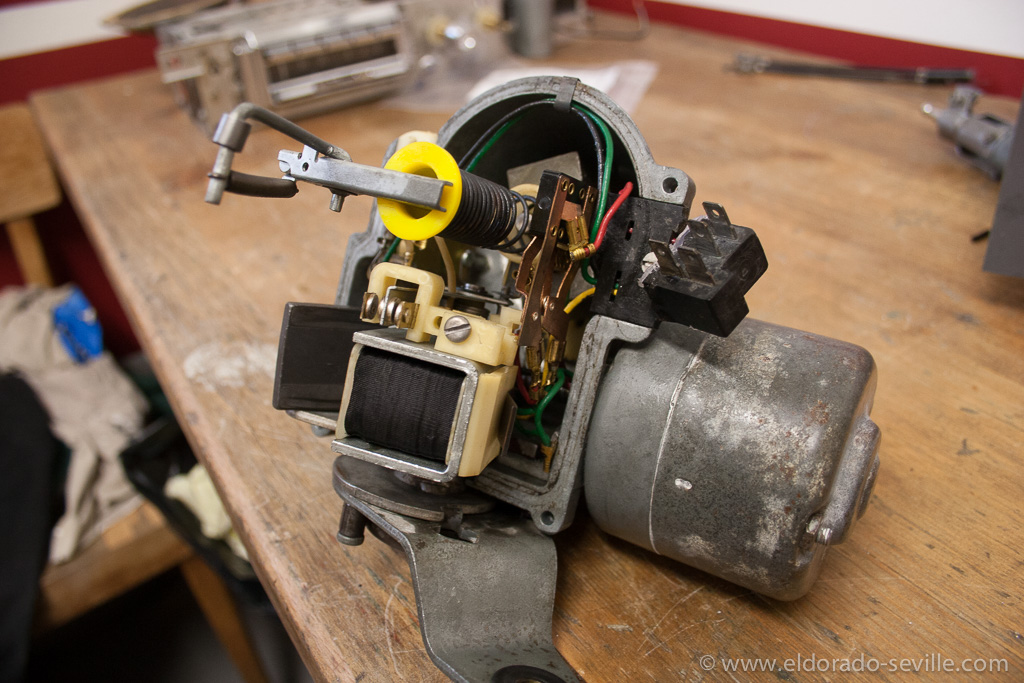
on the bench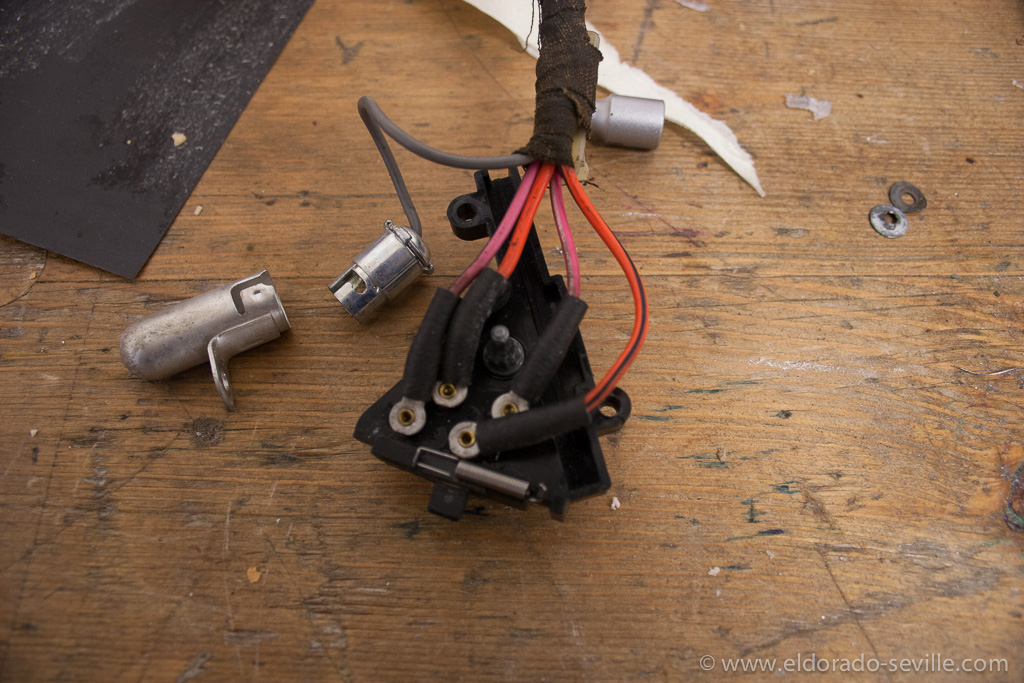
the dash mounted control switch disassembled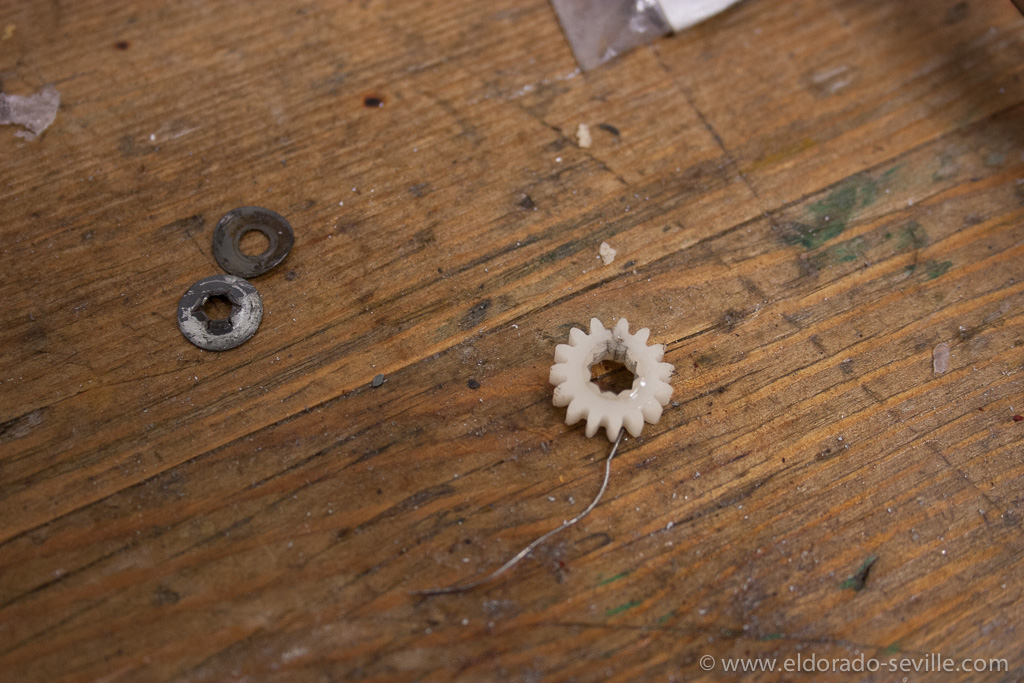
the broken plastic gear before we repaired it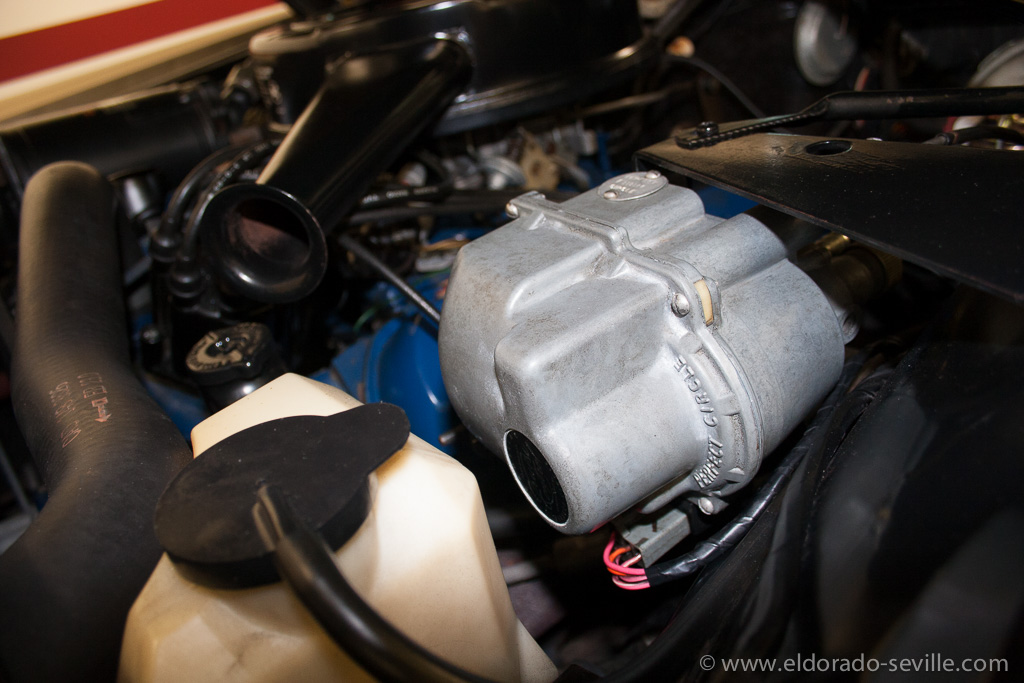
the rebuilt and perfectly cleaned unit - back in the car
REPAIRING THE AIRCONDITION OF THE 1966 COUPE DEVILLE
So I started to search for the cause of the problem.
Everything seemed to be fine on the vacuum side. When the lever on the control panel was moved all the vacuum actuated doors operated and the master vacuum switch also seemed to work.
After some searching I found out that no current was flowing through the master vacuum switch on the firewall.
So the switch was taken apart.
If you do this you have to be very careful not to damage the membrane.
The contacts inside the switch were oxidized and so no more current could flow through.
The contacts were also adjusted so that the switch could engage properly when vacuum was applied.
When everything was put back together the whole system once again worked as it should.
It works absolutely perfect now.
*UPDATE 2022* - Check out this article and video as well!
Unfortunately I forgot to take pictures of the switch rebuild but here is a video on youtube where a gentleman explains how this switch works…
A video that explains how this switch works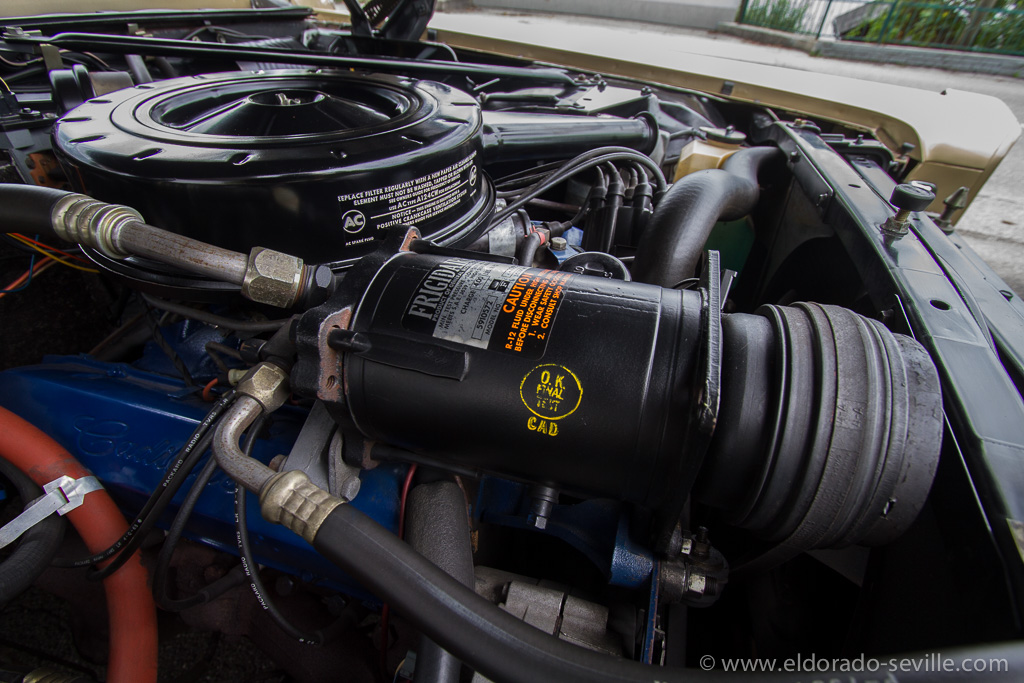
The original AC system of the 1966 Coupe deVille is now working perfectly again.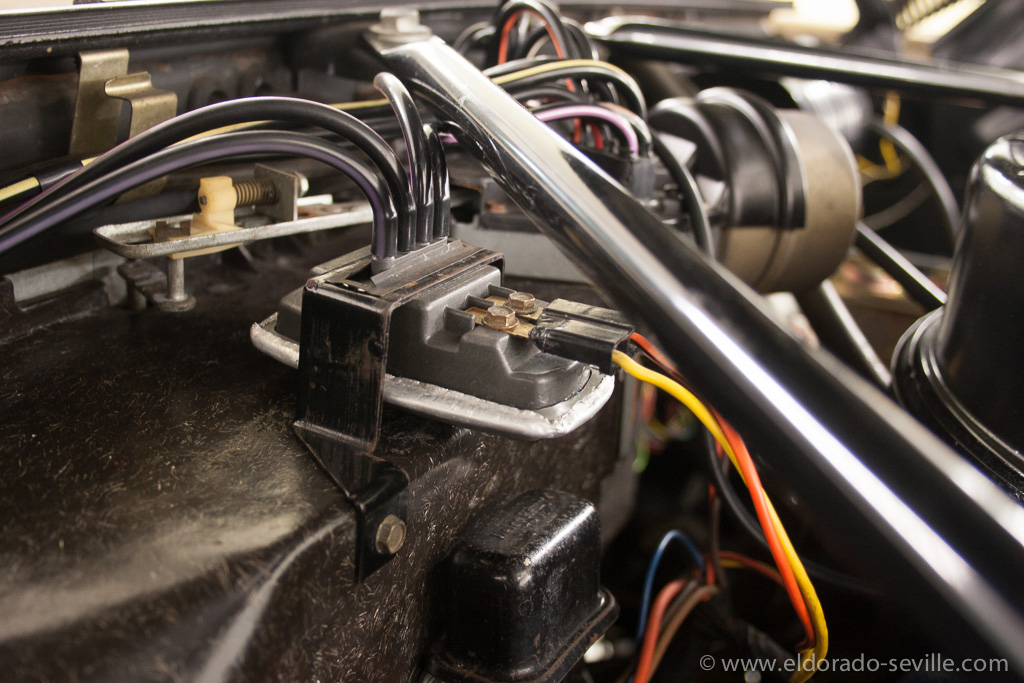
Thats the master vacuum switch which was defective.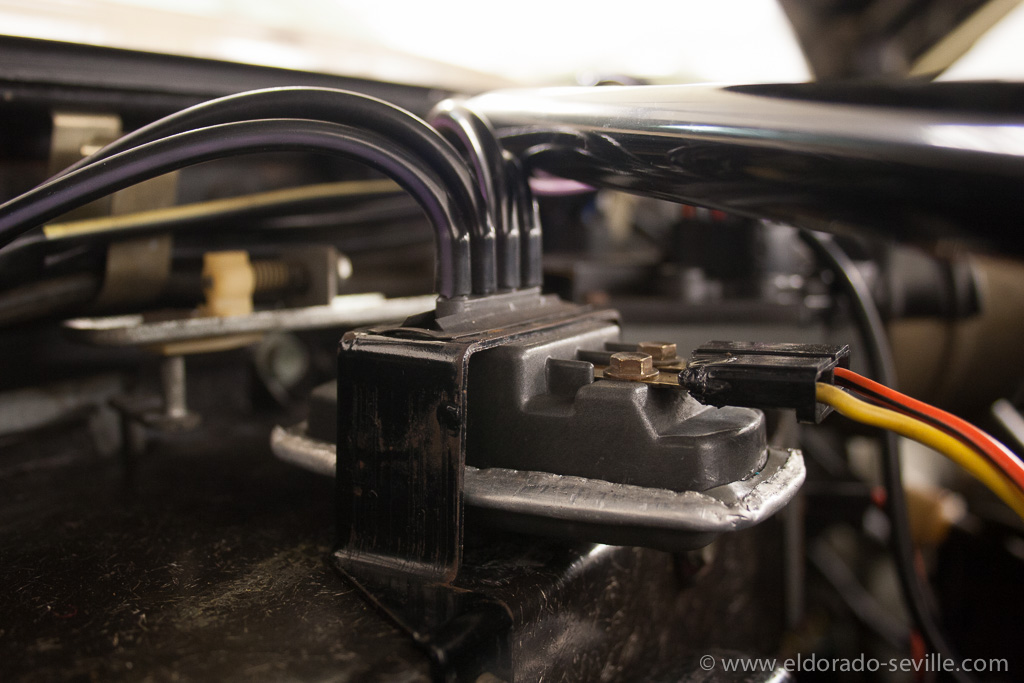
The rebuilt master vacuum switch.
REPAIRING THE TRANSMISSION SHIFT INDICATOR ON THE 74 CADILLAC
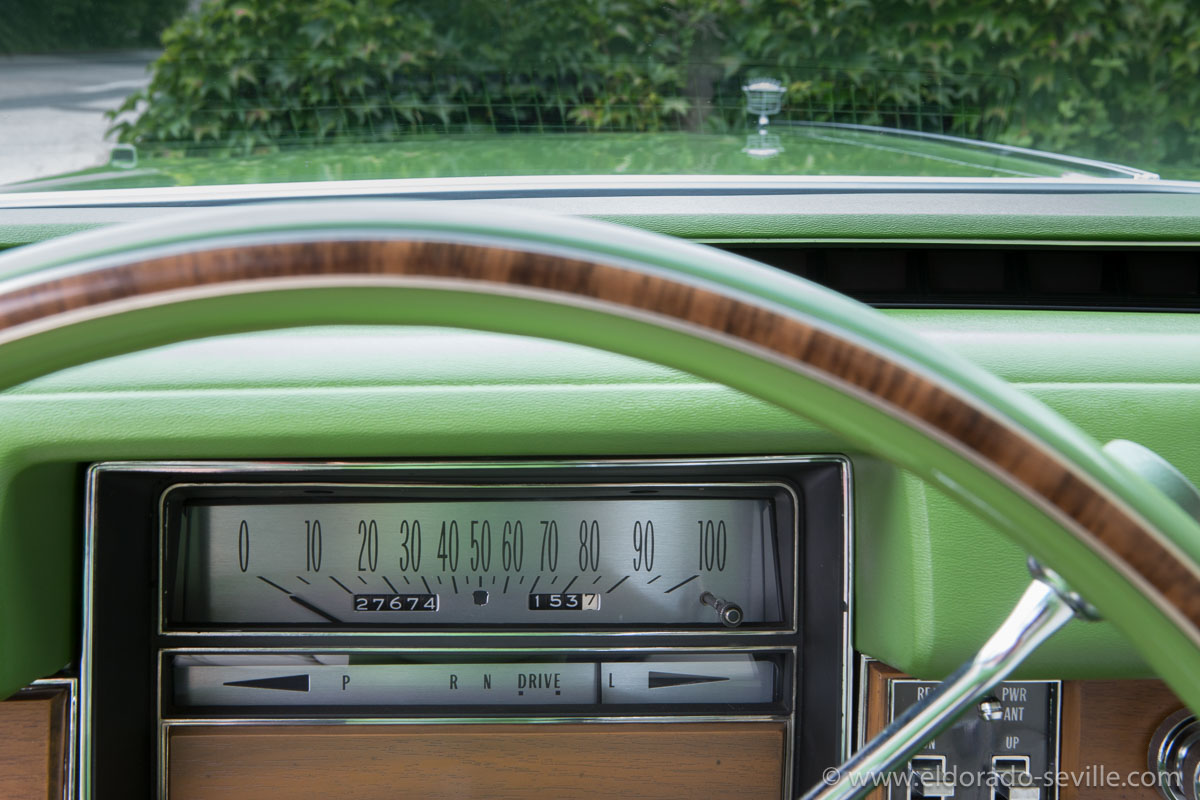
The stuck indicator at the L position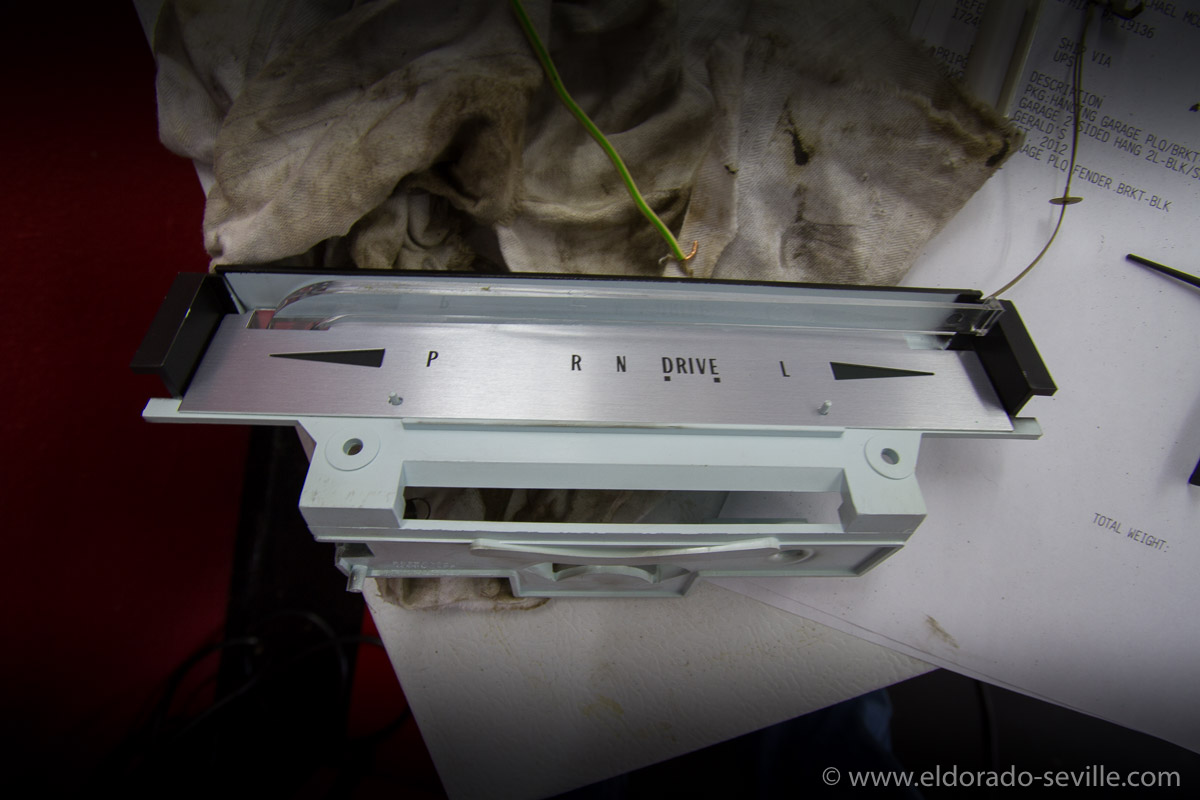
You have disassemble almost the whole speedometer to be able to access the transmission selector dial mechanism. A small part was broken and therefore the spring behind the indicator could no longer work properly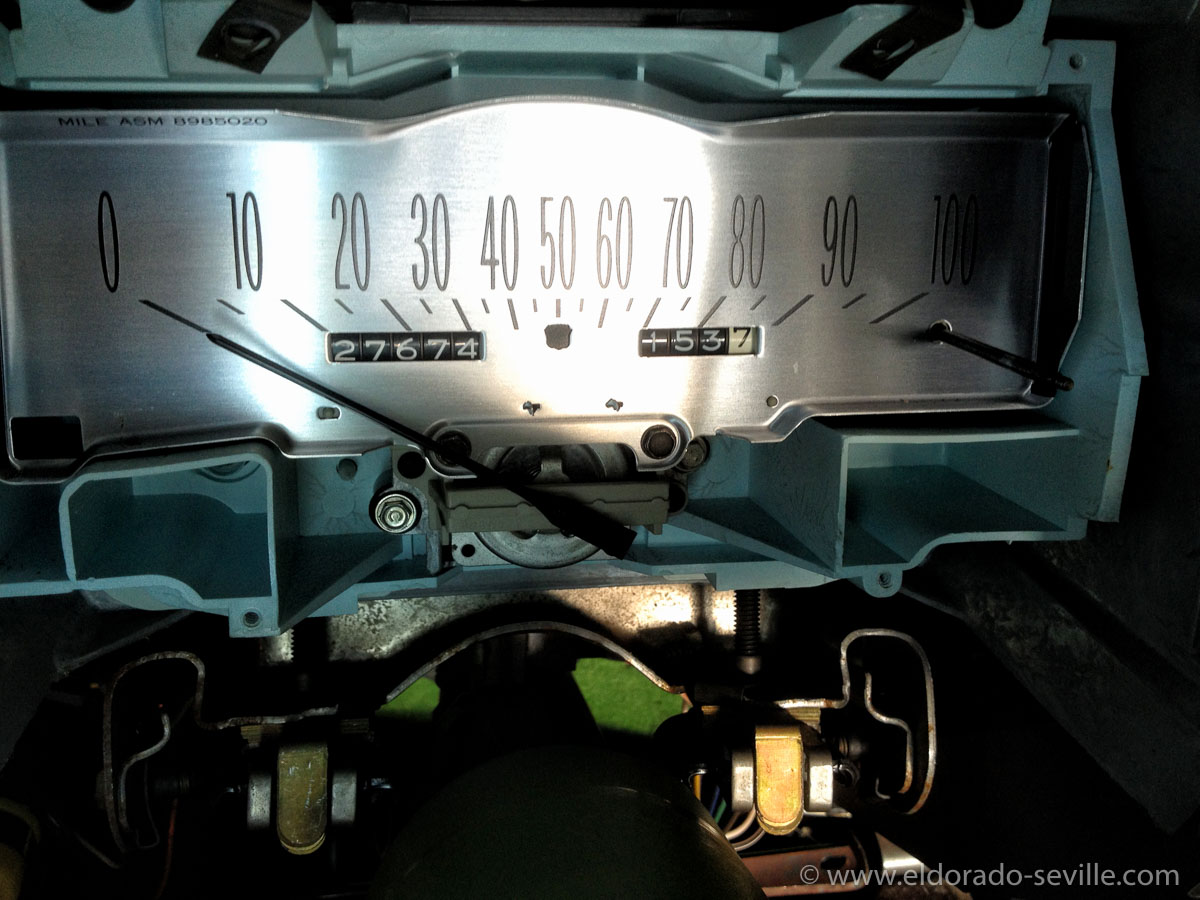
The rest of the speedometer could stay in the car
1966 Cadillac Turn Signal Switch repair
One of the few problems this cars had were some weird issues with the turn signal lights.
I´m a perfectionist and everything has to work on the Cadillacs that are in my garage ;-) - thats one of my rules ;-)
Strange things happened on the right rear and front turn signal lights when the headlights were on or off...
This light switch is made of "unobtainium", so I was pretty scared that it could be broken.
The switch is located underneath the dash and is screwed onto the steering column and is controlled and actuated by a steel cable that is coming from the turn signal lever.
On this car the cable was out of alignment and did not engage the switch correctly on the right side position and this intermediate position of the switch caused the various problems.
It took me quite a while to get the adjustment of the cable right again, as you carefully have to shorten or lengthen it with a nose-plier to get the right length.
I also adjusted the spring you can see on the picture below. This makes the switch more snappy. It now works perfectly and the lever moves much nicer!
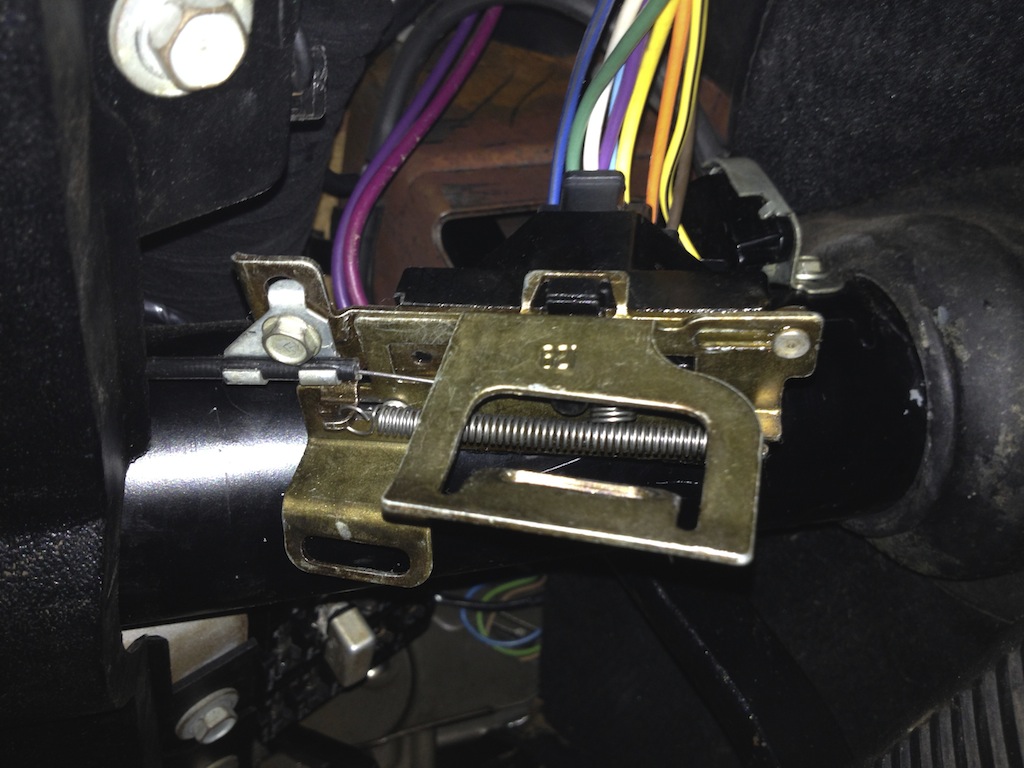
the 1966 Cadillac turn signal switch as seen from underneath the dash - already removed from the steering column.
1967 Eldorado headlights did not work
When I took the car out of the garage I noticed that the headlights did not come on, but the taillights worked.
I suspected that the light switch must be the problem... I unplugged the connector of the switch and tested if 12V power was coming to the switch through the wiring.
There was one hot wire and I connected it directly to the headlights and they came on.
I then wrongfully assumed that the switch must be the problem then...
So I decided to take it out and inspect it.
Getting this switch out is a real pain as there is one screw thats almost impossible to reach. You can only get to the switch from underneath the dash btw...
It took me a couple of hours to get it out lying on my back under the dash...
I then opened up the switch and when I opened it up it fell apart immediately. I had a really hard time getting it back together correctly. Before that I cleaned everything inside.
I measured it with the multimeter and everything was fine.
Getting the switch back into the car was even more difficult than taking it out... There is this one d*mn screw thats almost impossible to get back in. Try to avoid to take the switch out, as you can measure if it works with the multimeter. I did not read the electrical diagrams carefully enough, so I did not measure it correctly and so I took it out.
!!! Be aware that the headlight switch on the 67 Eldorado is almost impossible to find, as it is a very special switch with the vacuum valves! If yours has twilight or auto dimming its even harder to come by!!!
As it turned out my switch was o.k. and the headlights did not work for another unknown reason... So I googled the problem and to my surprise I found my own website with a solution!
I had completely forgotten that I had the very same problem with my headlights a couple of years before and found a solution back then. I was just lucky that I do use my website as a sort of diary for the repairs I do on my cars.
As it turned out the same fusible link had burned through again. It runs very closely to the headers to the starter on the positive battery cable. Maybe it got too hot and failed or just broke apart. I could not see any melting or signs that it had burned through. It looked fully intact from the outside and I could only see that it was defective when I removed the insulation...
To replace the fusible link you have to take out the positive battery cable and replace the fusible link. Thats not a big deal. I rerouted the cables a little bit this time and hope that it wont fail again.
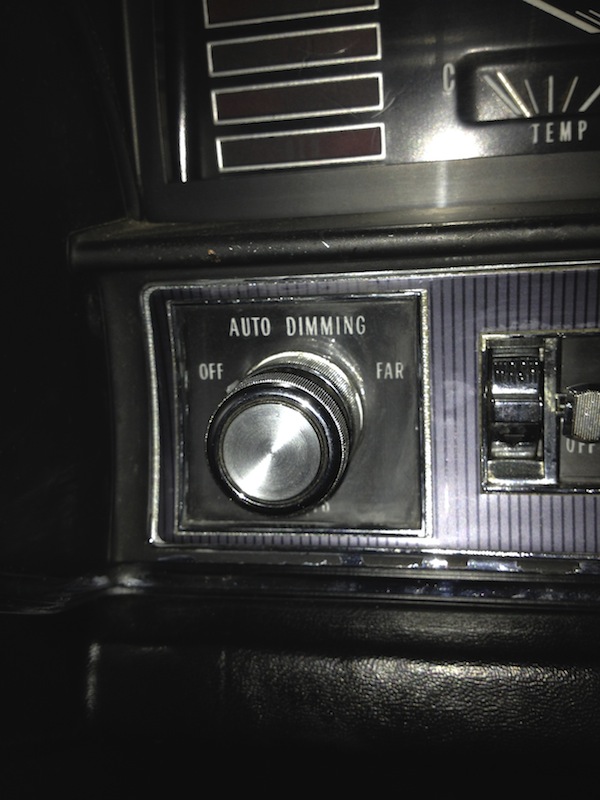
The 1967 headlight switch with automatic dimming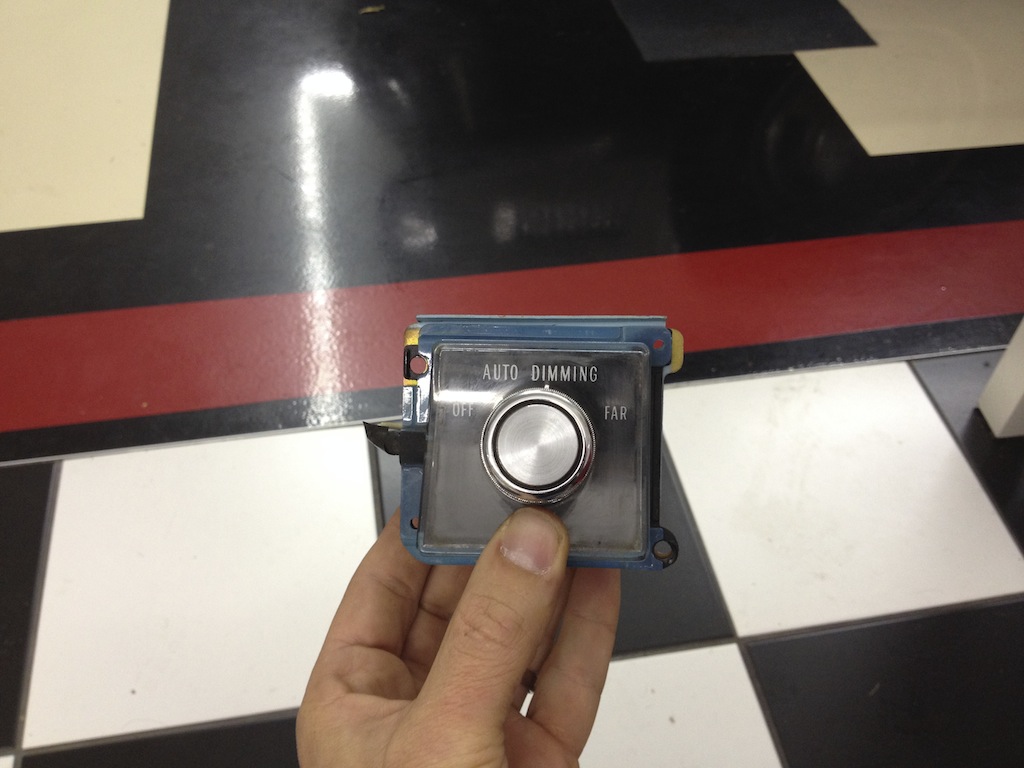
the light switch out of the car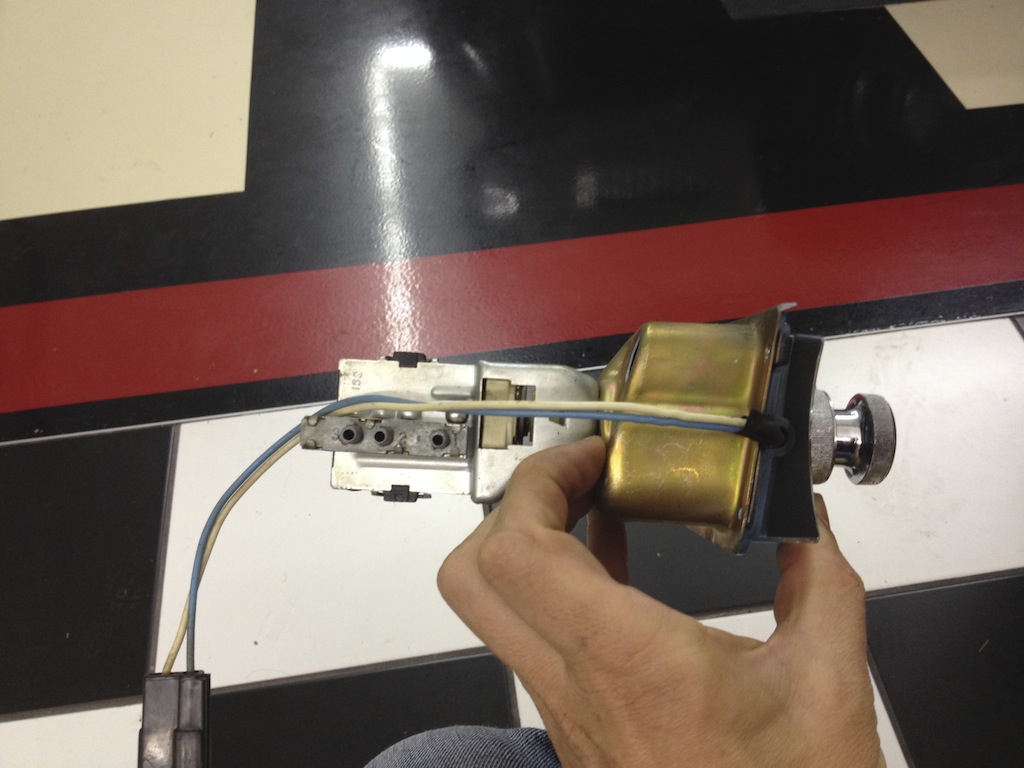
Seen from the side - you can see the vacuum valves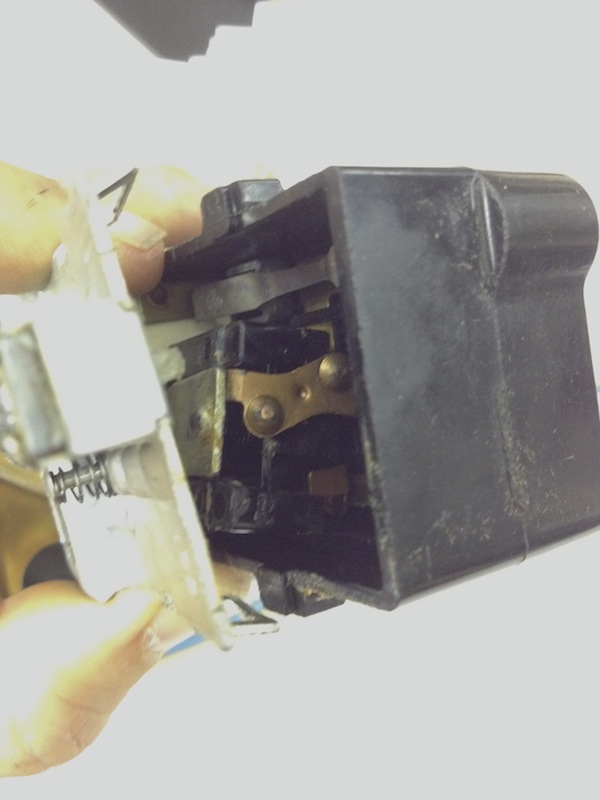
Be very careful if you take the switch apart - as some parts will fall out...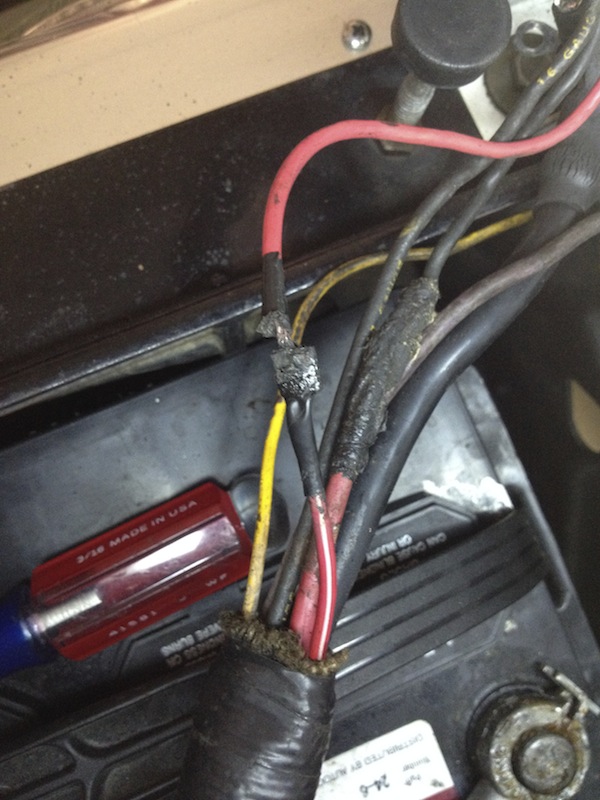
The red cable on top is a fusible link and it caused the problem. I could not see from the outside that it was broken under the insulation.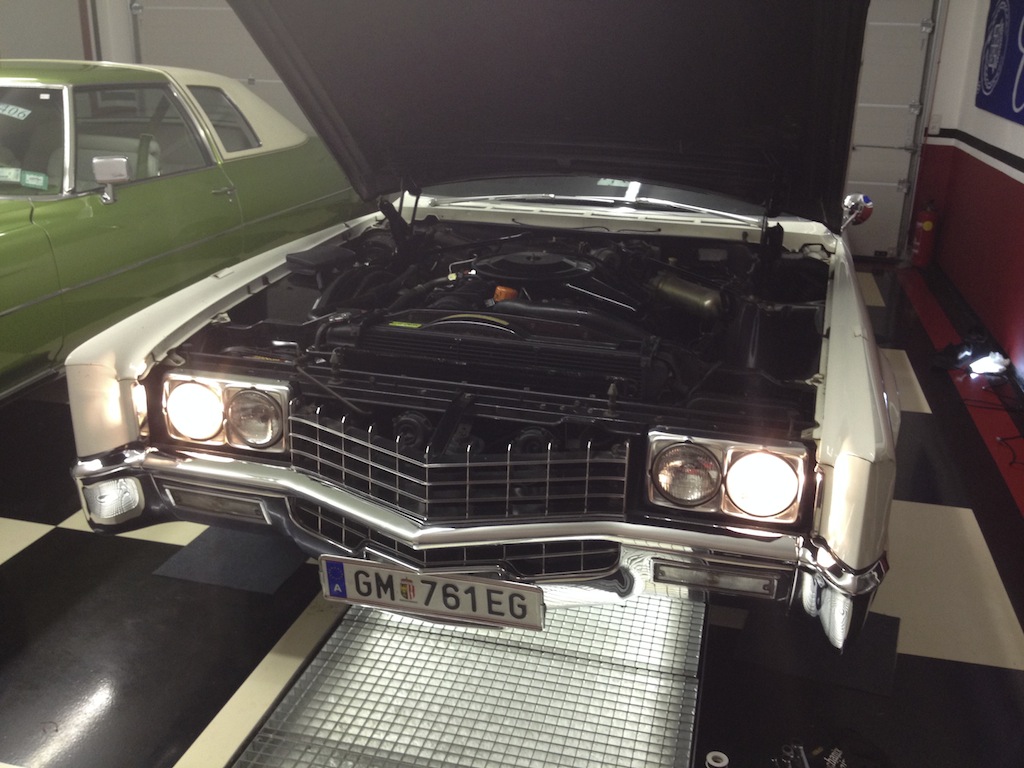
The headlights are back in working order
Changing the transmission indicator bulb on the Lincoln Mark III
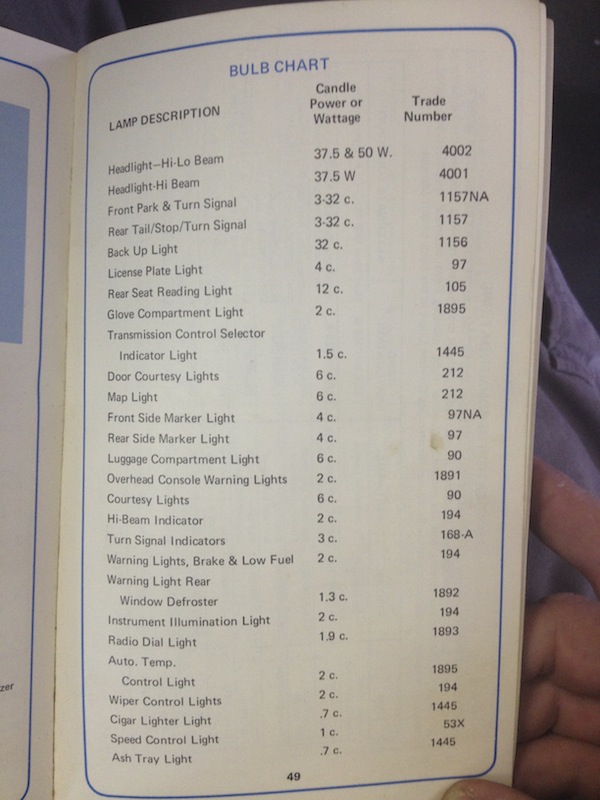
The owners manual lists all the bulbs you need. One should order them by part number.
The shop manual for the Mark III is not very helpful when you try to change the transmission control selector indicator light...
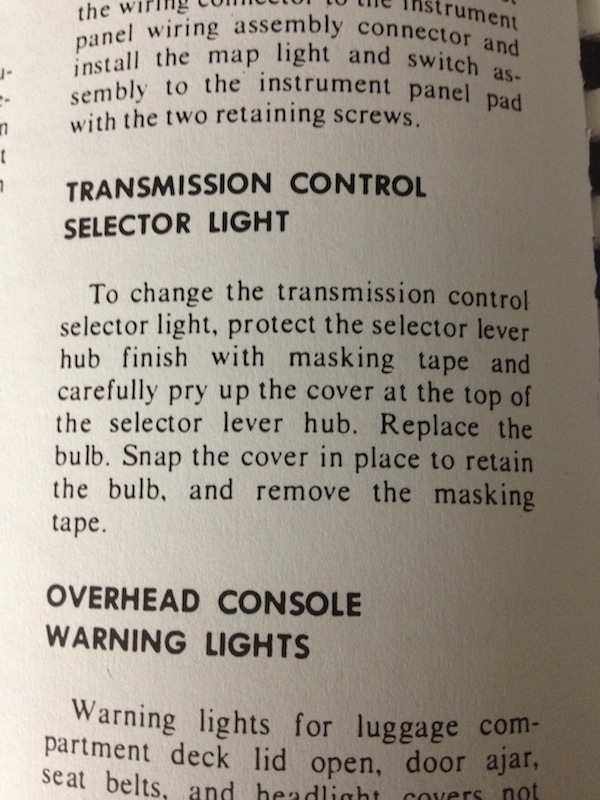
I had no idea where to start so I contacted the excellent Lincolnforum where I got some very helpful tips.
2sasilverbullet sent me the following two pictures below to show what covers have to get removed to be able to access the indicator bulb.
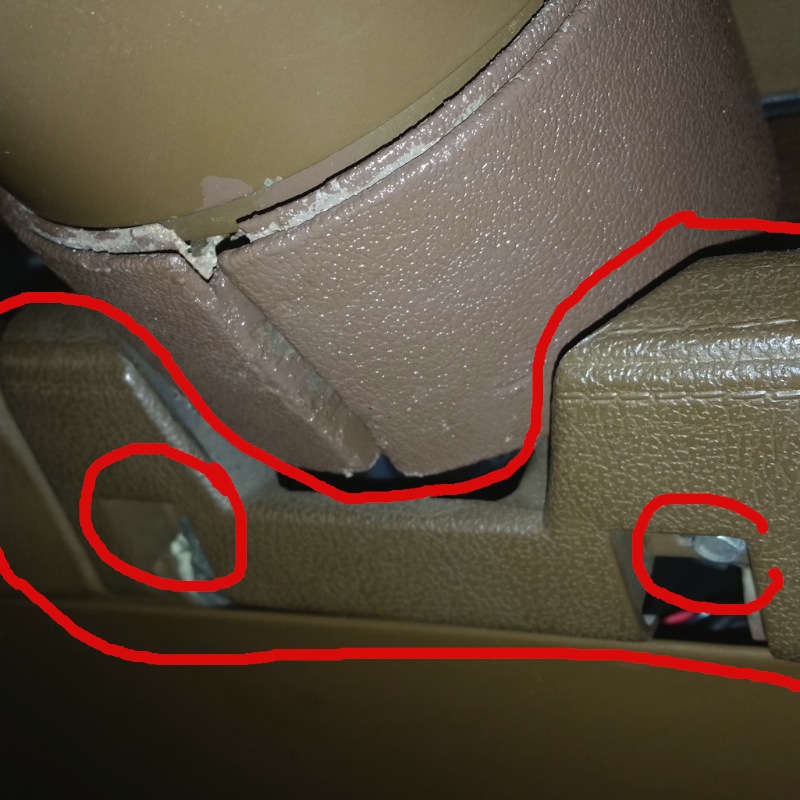
© 2sasilverbullet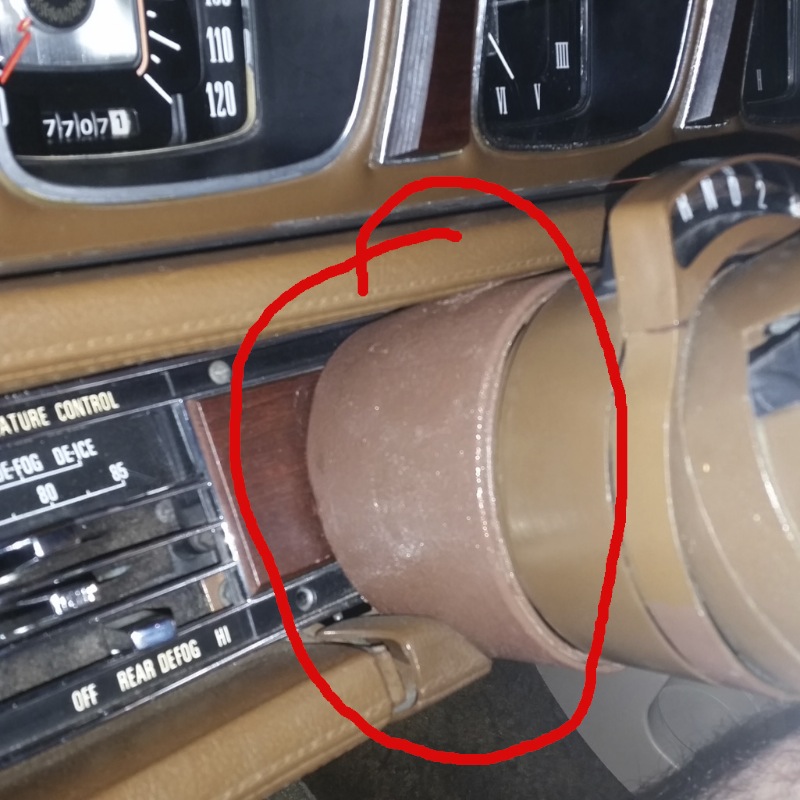
©2sasilverbullet
You have to carefully remove these covers and you then get access to the bulb.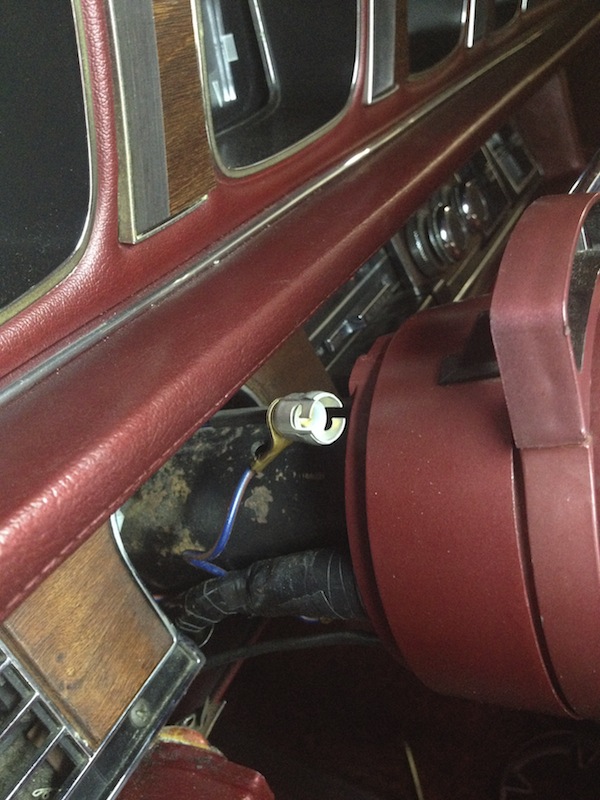
with the bulb already removed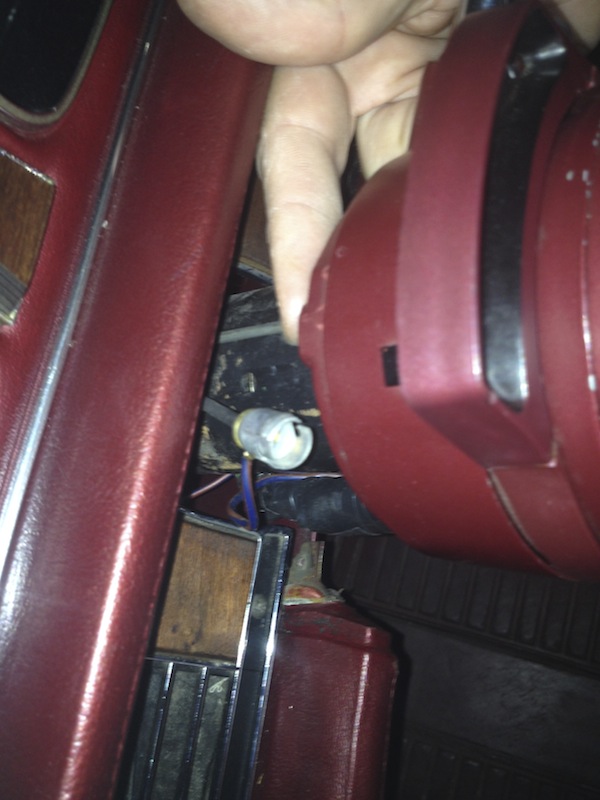
The bulb is then inserted into the hole where you can see the finger.
After the bulb is replaced its pretty tricky to put the covers back into place. Be very careful to not break the plastic covers!
Fixing the 1978 Cadillac Eldorado´s ATC programmer. The AC works again.
****UPDATE****
An update to the article below can be found here as I had to repair the programmer again in May 2015:
The air-condition in my 1978 Biarritz did not work correctly. For some reason the system always stayed in full AC mode and no matter to where I put the temperature dial on the control head I could not get the heat on, no matter what I tried.
The shop manual is very helpful in trouble shooting the system. Its covered in the 1977 factory shop manual (FSM) as there were no changes made to the system in 1978.
It took me a while to fully understand how the system works - so I had to read the FSM multiple times to get the grip what is going on in the system.
First I inspected all the vacuum lines in the car to make sure that there was no leak anywhere, as the heating mode requires a very high vacuum at the vacuum motor in the controller.
All lines were in very good condition. I also checked the control head connections in the dash which were good as well.
I then suspected the vacuum motor in the programmer as it did not move. I removed the programmer from the car. You can access it from underneath the dash on the passenger side or even better if you remove the glove box lining through the glove box.
From there you only have to unscrew 5 screws, unplug the wires and the vacuum lines to get it out.
When I had it out of the car I checked the vacuum motor. I just sucked air through the hose and it moved and held vacuum perfectly.
The transducer or the amplifier in the programmer were most likely the problem.
When I checked the transducer which regulates the vacuum supply to the vacuum motor, I noticed that it seemed to not be connected to the electrical board as it should. I pressed it in, so that it made good contact with the board again and put the programmer back into the car and connected everything again.
***UPDATE 2015 - its not connected with pins but soldered to the circuit board - 3 of this soldering points were broken - the “repair“ I made here only temporarily worked. You have to check the soldering points for a permanent fix***
I started the car and the AC came back to life again immediately. I could see how the vacuum motor went through all the modes as it should according to the position of the temperature dial on the control head.
The build quality of the programmer obviously is not very good and the transducer somehow came loose causing the ATC to not work as it should. ***Update 2015 - it did no come loose but the soldering points broke***
After I tested everything I put the parts back together and can now enjoy a full working ATC in my 78 Biarritz again ;-)
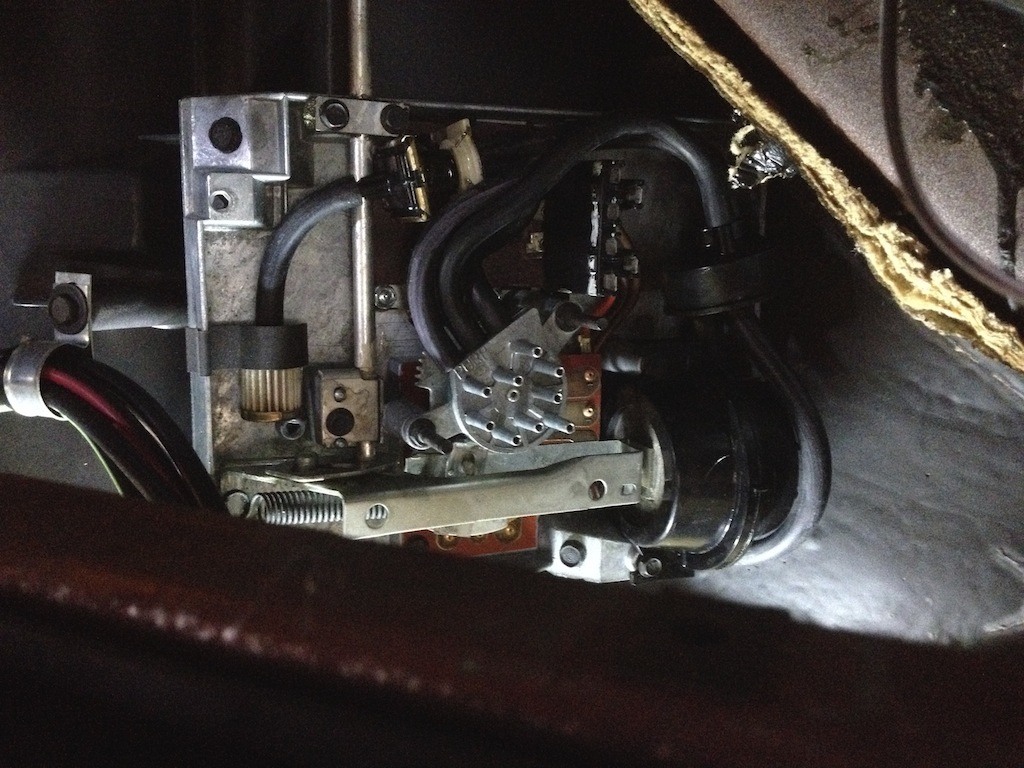
The programmer as seen through the glove box with the connectors and the plastic case removed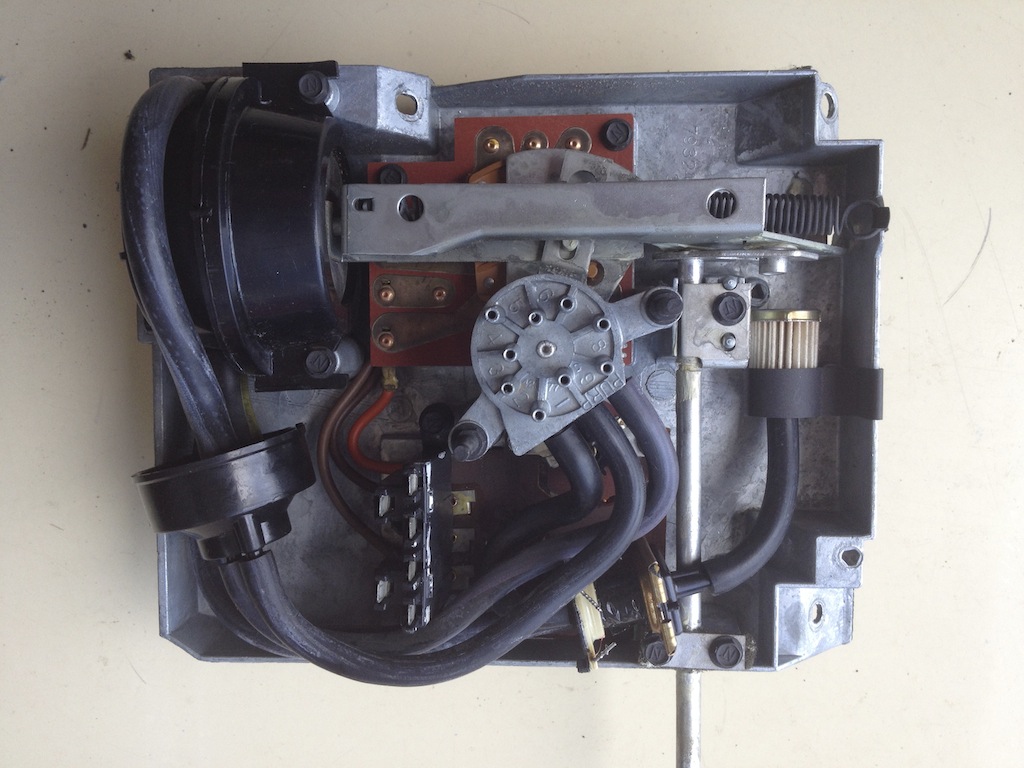
The 1977 / 1978 Eldorado MK II Automatic Temperature Control Programmer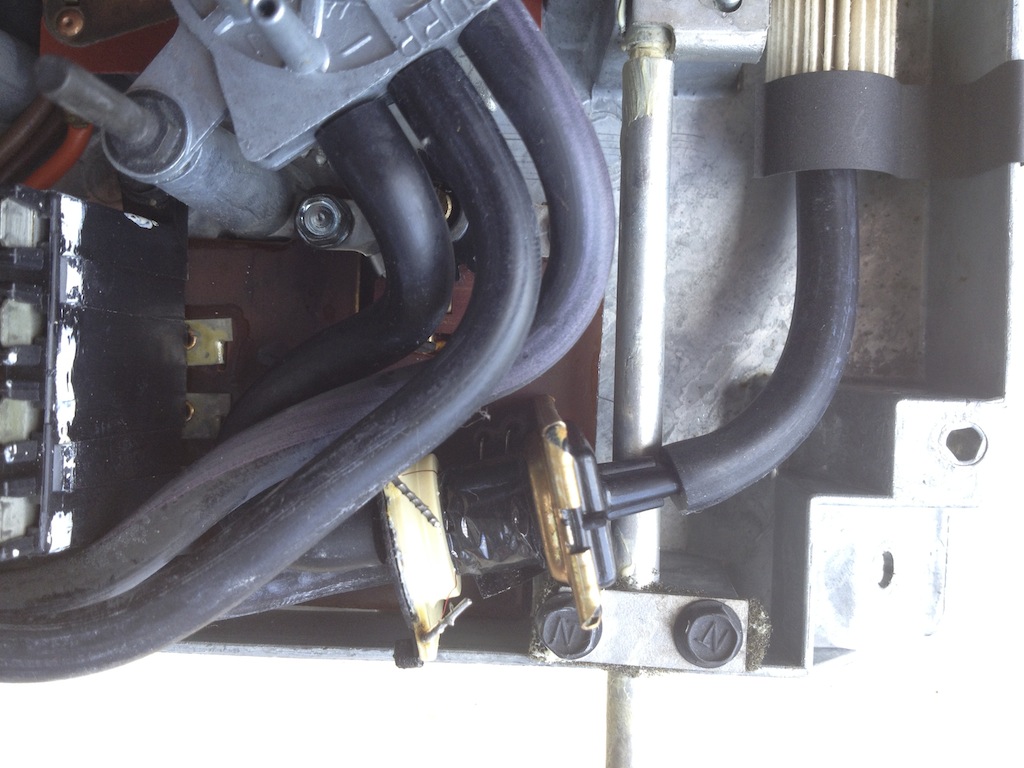
The transducer which caused the problem (the golden part with the single vacuum line going into it)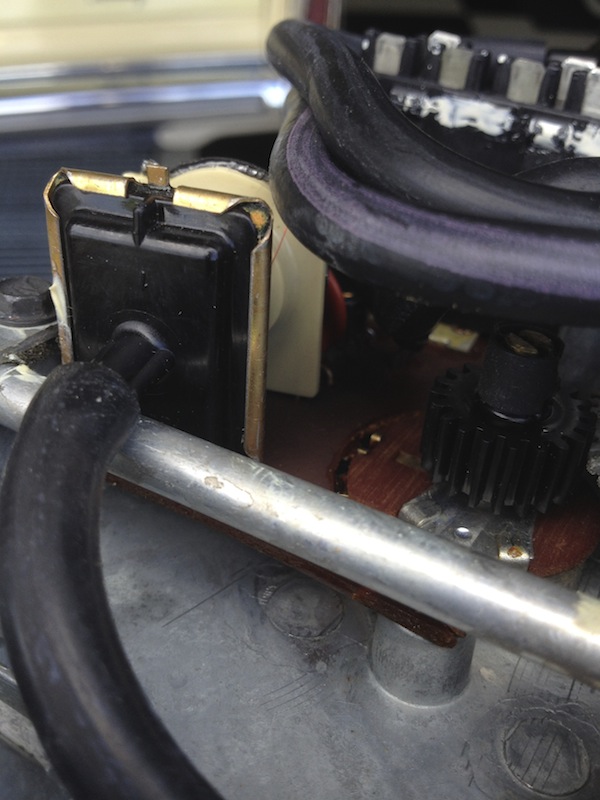
The transducer is connected to the electrical board through a couple of pins - it was not connected properly and somehow became loose over the years - that was why the system did not work.
***UPDATE 2015 - its not connected with pins but soldered to the circuit board - 3 of this soldering points were broken***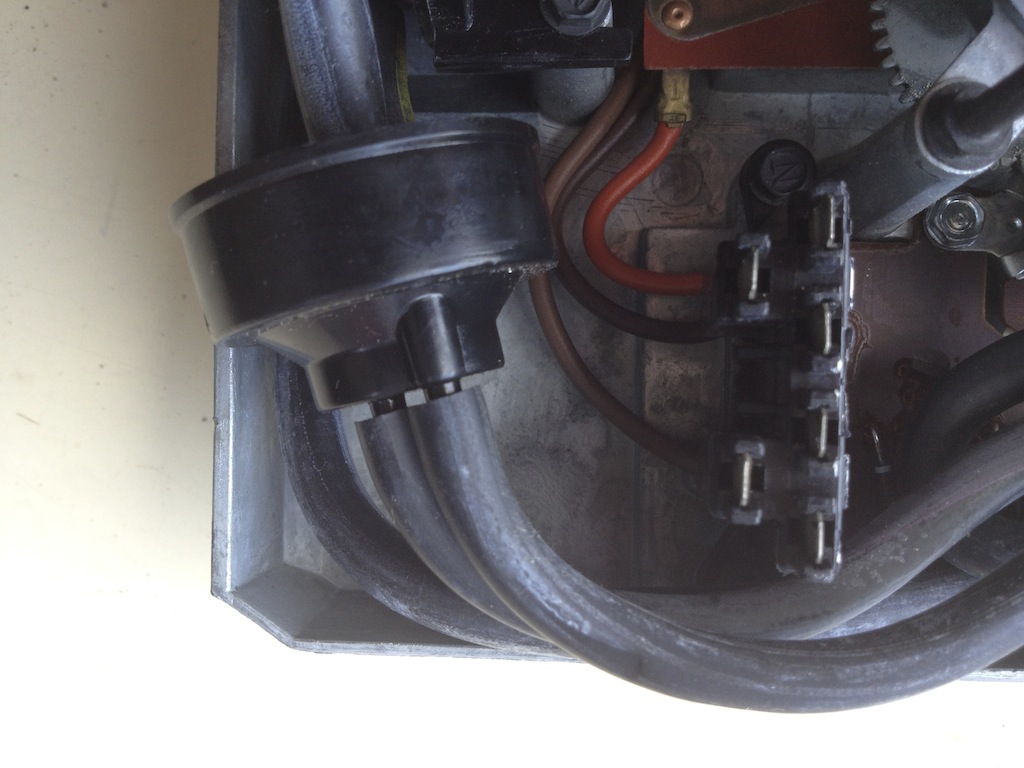
The vacuum checking relay and the electric connectors.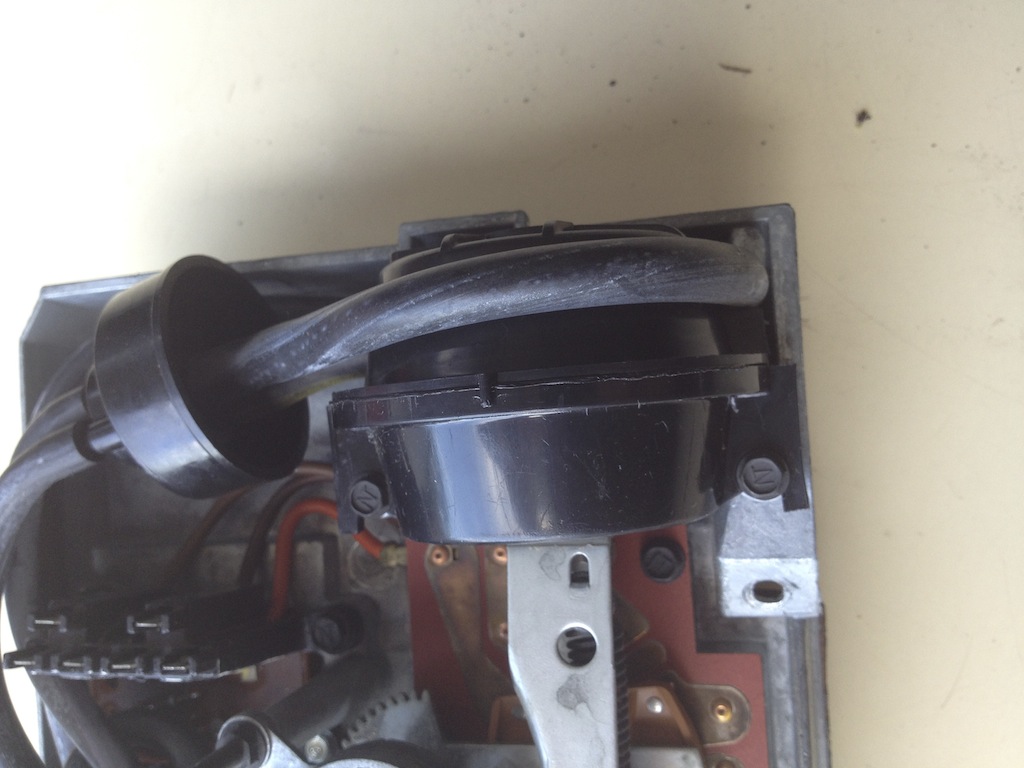
The vacuum power motor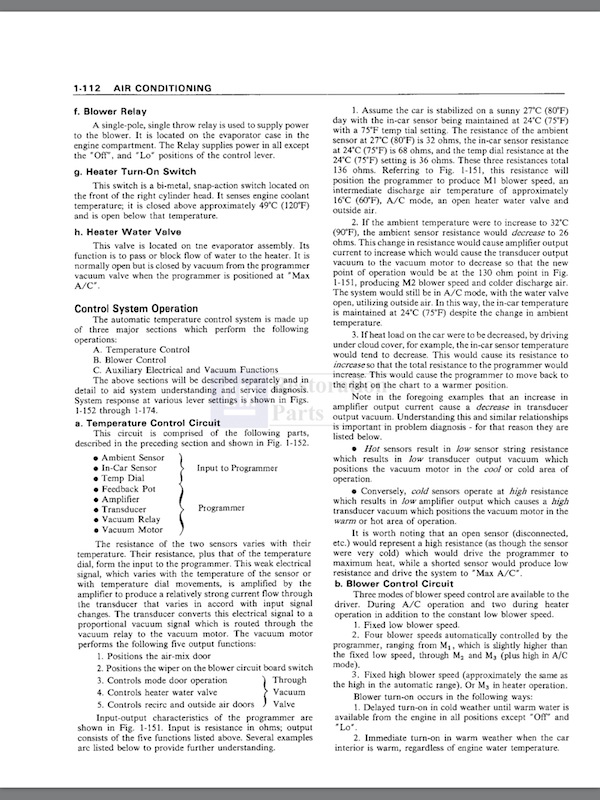
from the 1977 FSM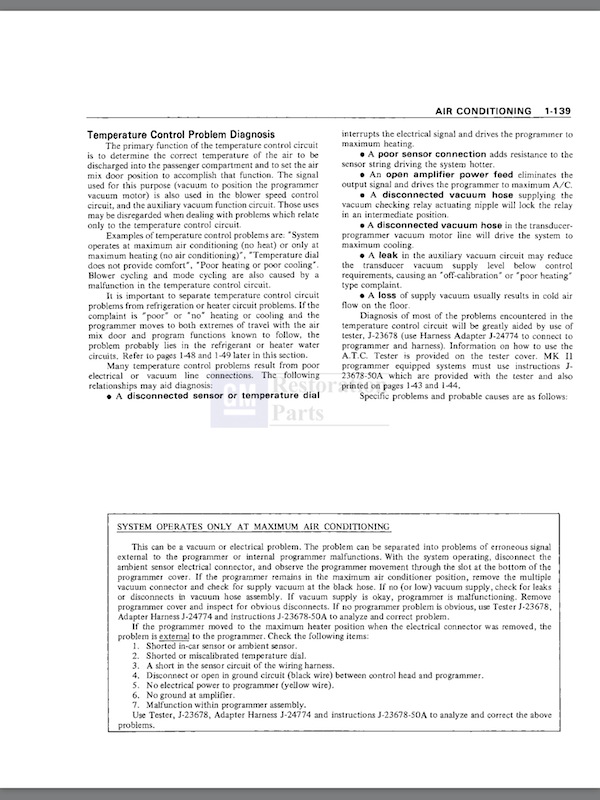
Trouble shooting guide for when the system works in full AC mode only.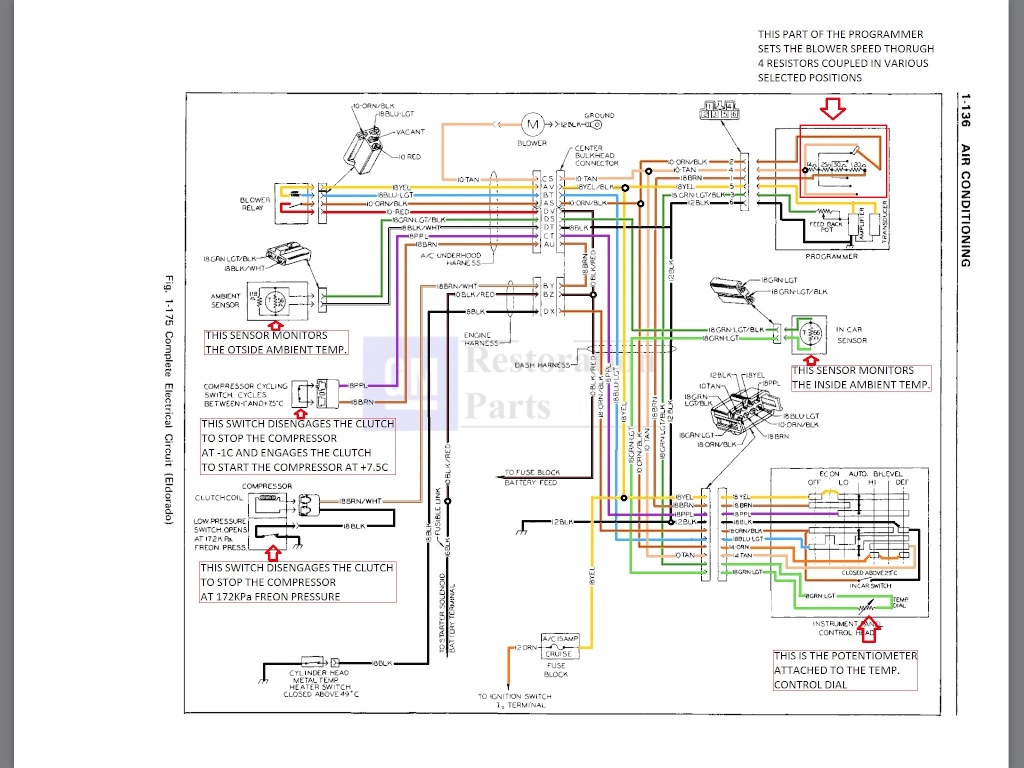
A color coordinated electrical schematic with annotations to describe the various functions of the system.
My friends and I bought a 1980 Biarritz.
Also the trunk is full of parts for this car - the major issue is rust around the vinyl roof.
Best thing is that it cost us almost nothing.
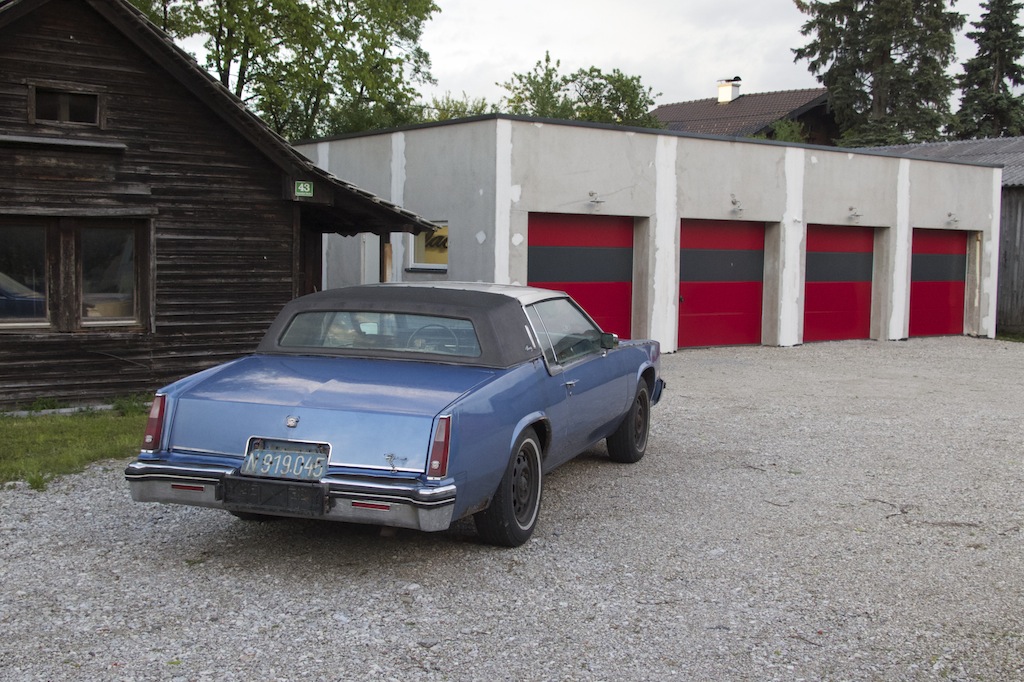
The Biarritz is still drive-able - but the body is very rusty. The technical condition its pretty good though.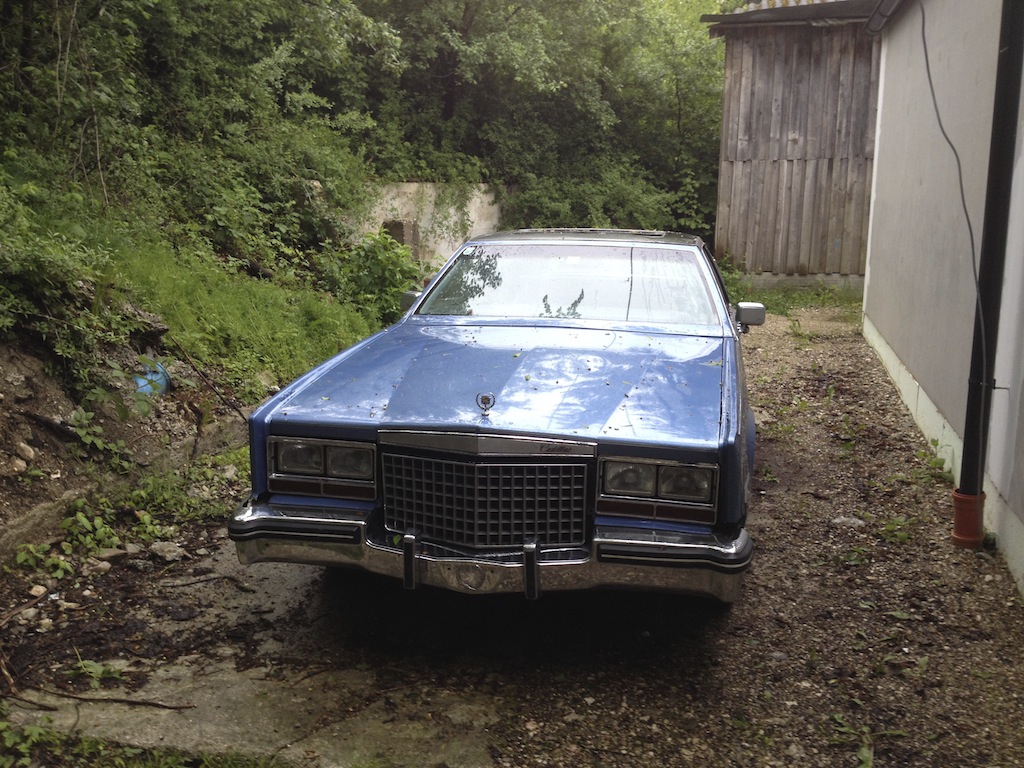
It's resting behind the garage at the moment. Will try to build a shelter for it.
Correcting the paint of the Lincoln Mark III.
I even had the car at a professional detailer to have some of the paint corrected - but he gave up and said that there is nothing he could do for me as the paint would be too soft...
The paint really is very soft, and you could even make swirl marks with a soft microfiber towel...
The detailer left some wet sanding marks behind on the trunk lid, which were a big sore in my eyes.
So I decided to correct the paint by myself.
I bought the best dual action polisher on the market - the Rupes BigFoot 21. This is a professional machine which can correct all serious paint defects and bring the paint back to perfect condition. It takes some practice to do it correctly, but its not very difficult to do. I can't recommend this polishing machine enough!
See my previous post to check out the correct technique.
I also bought the complete Rupes foam pads, compound and polishes system, and the results are amazing.
The swirled and scratched paint came out like a mirror!
I´m very happy with the outcome.
I also did some touchups on some small stone chips and wet sanded some areas.
You can see the before and after pictures below.
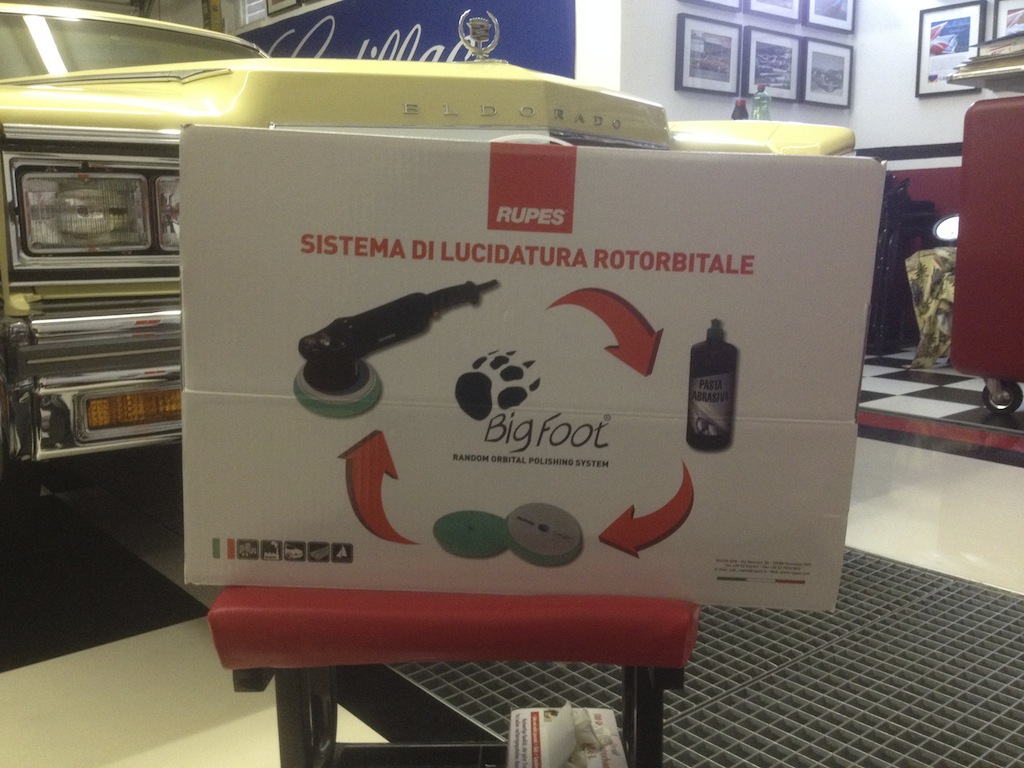
I finally bought a professional polishing machine. The Rupes BigFoot 21. It's a great and very effective tool!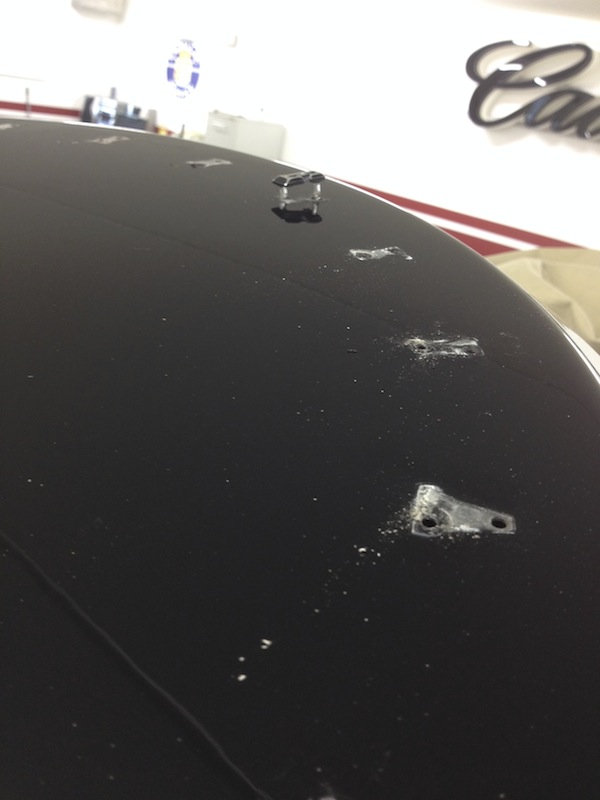
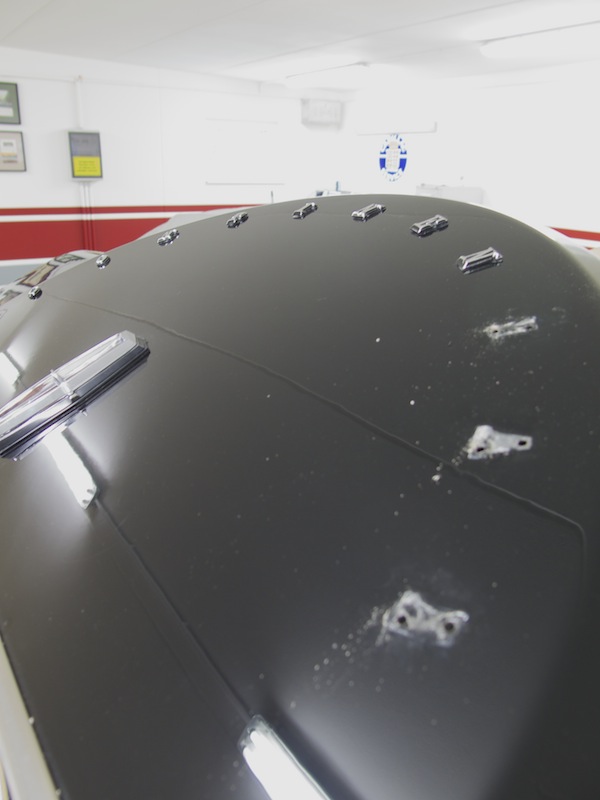
I removed the CONTINENTAL letters to be able to polish the hood better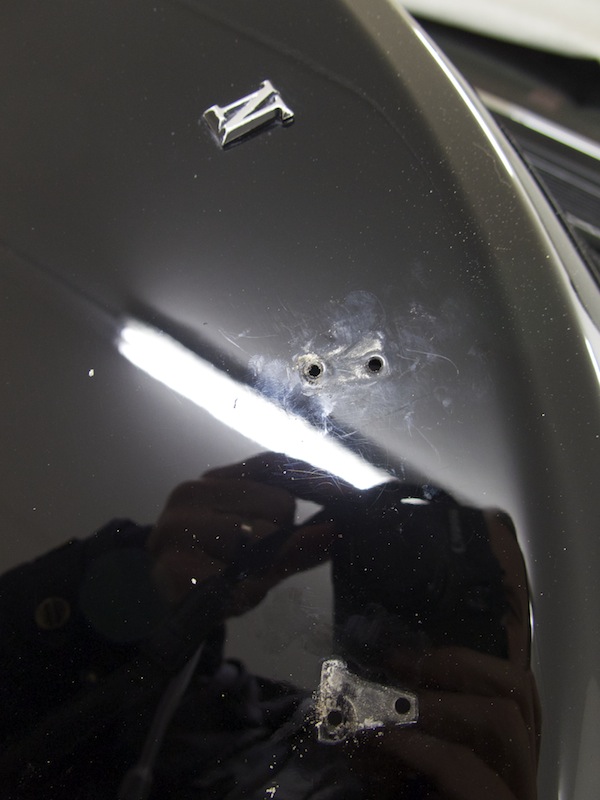
Look at all the fine swirls and scratches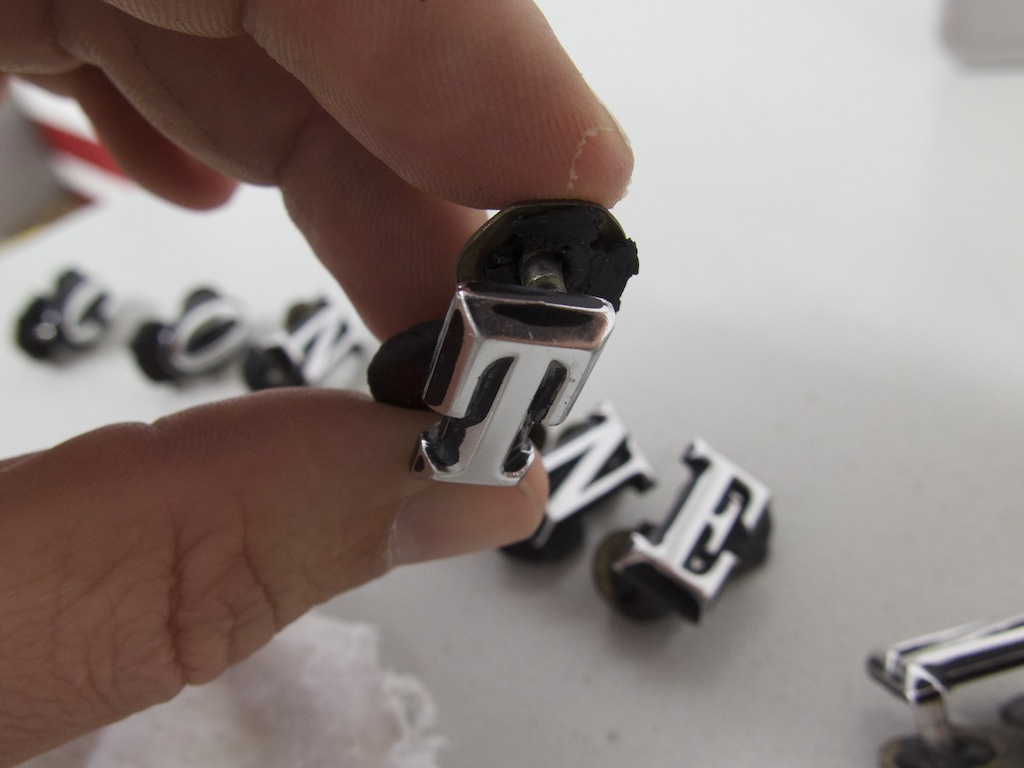
I will also restore the letters, as some of the black paint has polished off over the years...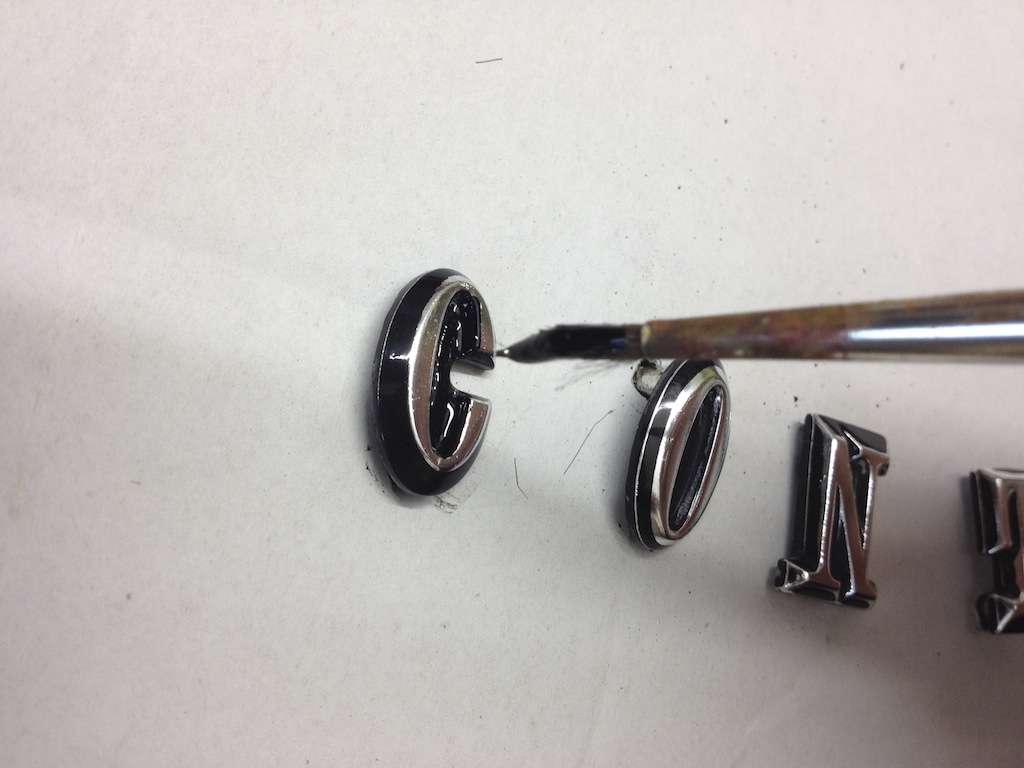
Repainting the letters
The paint before and after polishing - as you can see all the imperfections are gone.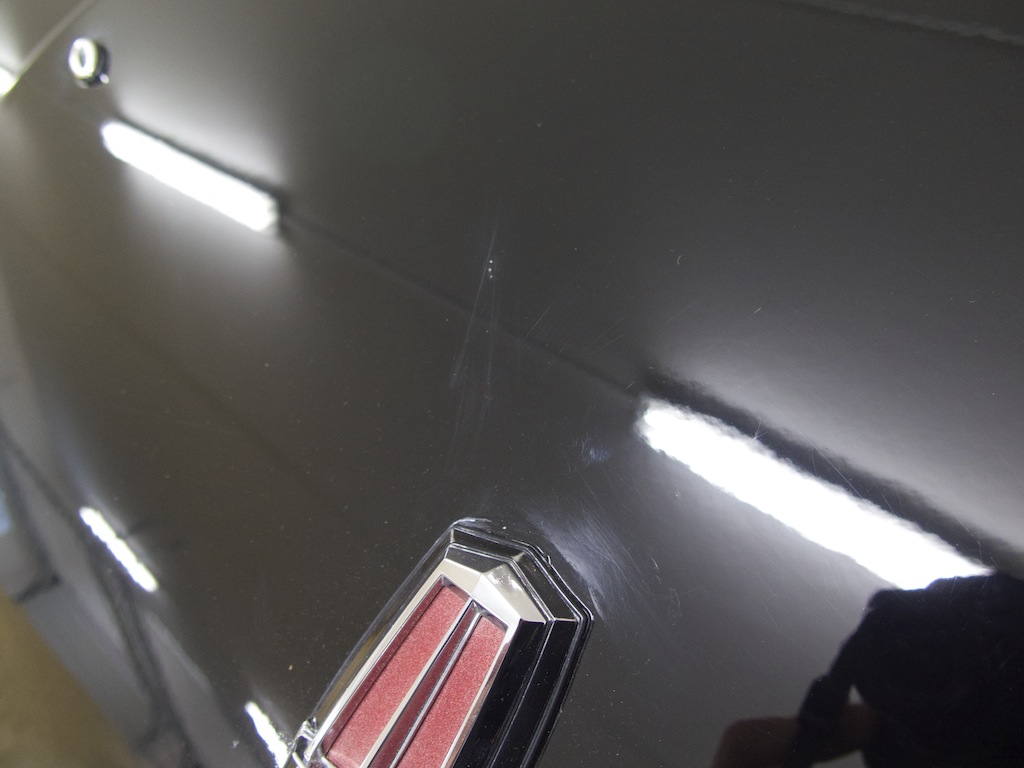
You can see all these fine scratches and haze and some wet sanding marks that were left behind from the professional detailer.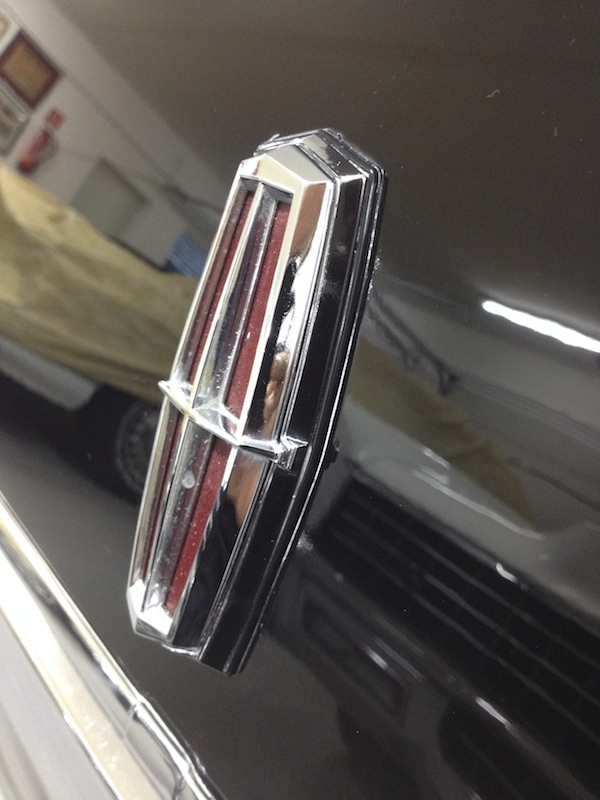
All scratches and imperfections are gone after polishing!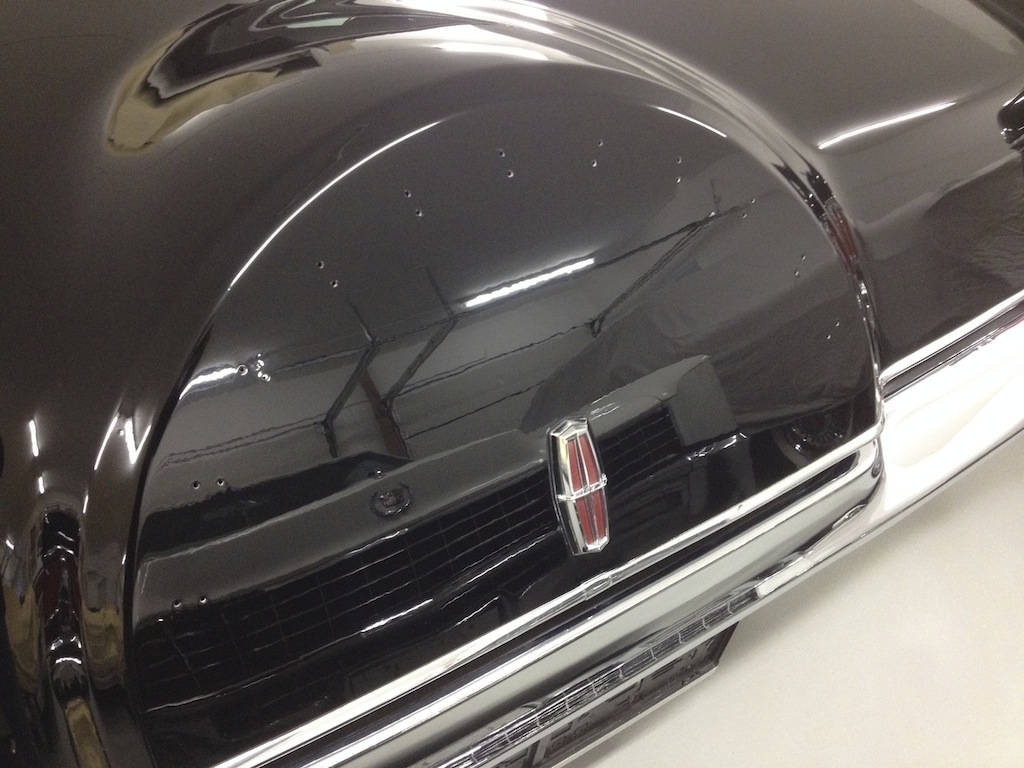
The Mark III looks spectacular after the paint correction. I have to reinstall the restored letters now.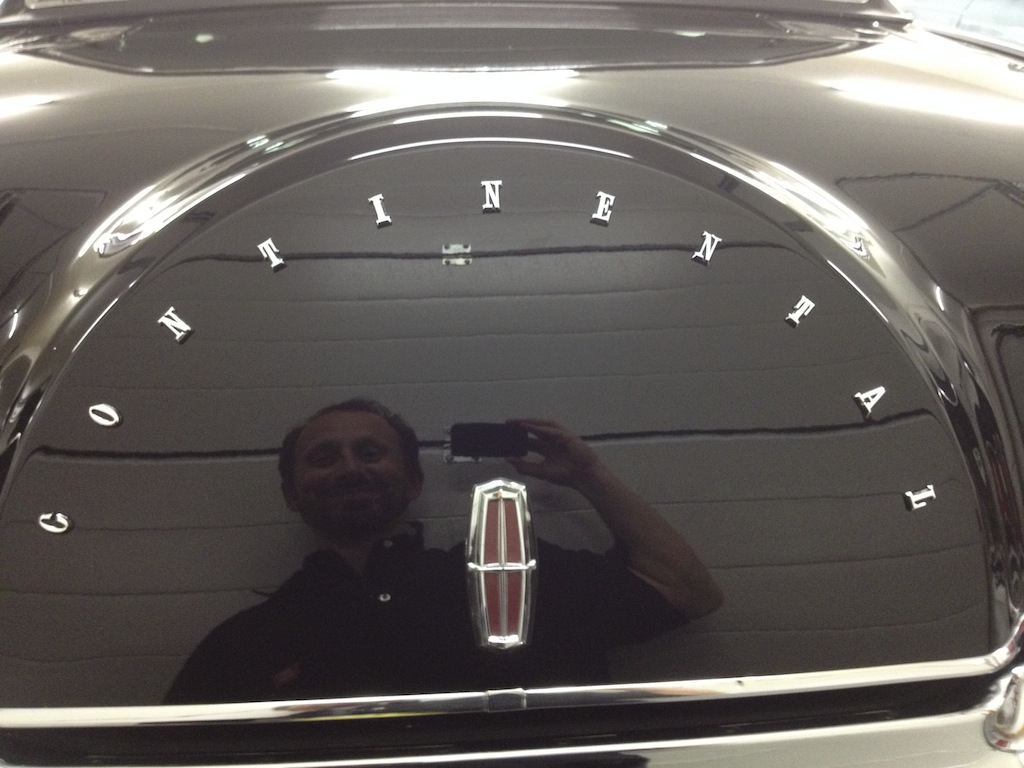
The restored letters are back on the car. As you can see I´m very happy with the result.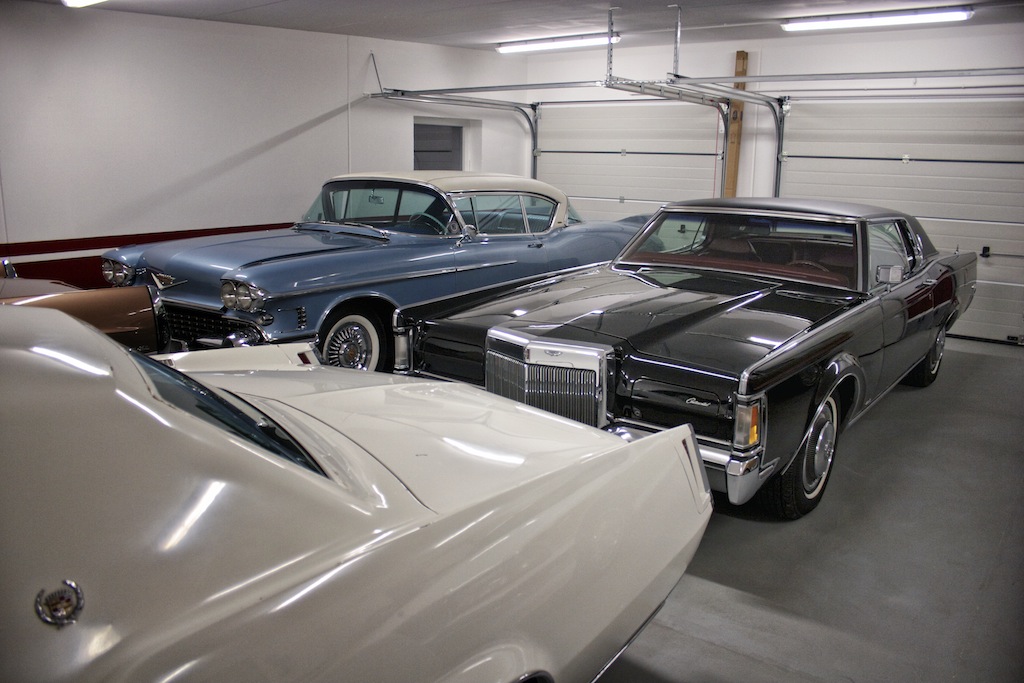
The polished car
Detailing the paint of my 1978 Biarritz.
My goal is to make this mint car as good as it can get, while keeping everything as original as possible.
I´m really obsessed with cleanliness when it comes to cars... Everything has to be completely detailed and shining like new.
I completely cleaned the entire engine and gave it a good wash and afterwards applied some engine dressing.
I then removed some screws and small parts which were left unpainted by the factory, like some screws, the hood latch, some brackets and some other smaller parts. Of course these parts developed some slight surface rust during the last 36 years...
As I had no real rust dissolver at hand, I soaked the rusty parts in vinegar over night, which completely removed all the surface rust. I then gave these parts a coat of primer and painted them with Eastwood paint, which looks like bare metal.
With this method I can keep the rust away, while the parts still look original. Only if you look very closely you might see that these few parts are now painted...
I then started to bring the original single stage paint back to like new condition.
I used a couple of Meguiars compounds and polishes to make the paint as smooth as possible. I had to carefully wet sand some of the deeper scratches with 2000 grit paper. Be very careful when doing this as the single stage paint was applied in only VERY thin layers during the 70s.
The car now shows almost no more paint imperfections and the swirl marks are gone. The original paint looks like on a new car now and is extremely shiny. When the car is out in the sun its almost blinding.
I sealed the paint with Meguairs #16 wax.
I used a Meguiars DA polisher (G125) for the paint correction work - which is not really that good, but I would like to have a more powerful machine for the future like the Flex 3401 or the Rupes Bigfoot .
I used the procedure explained in the following video for my paint correction:
Download his description as PDF file here
This gentleman, Larry Kosilla, has a lot more awesome video tutorials for people who love detailing their cars. Check him out!
I also started detailing the interior of the car. I treated the leather with Gliptone Leather Conditioner - which is the best conditioner I have tried so far. It really makes the leather very soft.
I´ll have to steam clean the carpet once its really warm outside so that it can dry fast afterwards.
I also cleaned the undercarriage a little and removed some of the factory applied undercoating from components where it does not belong to, on which they sprayed it on very carelessly at the factory. Looks much better now.
The car really looks spectacular already - I´ll continue with the chrome and stainless steel trim now. It should be shining in fully glory for the 2014 season beginning in May and also be ready for various car shows, especially the Cadillac BIG Meet in August.
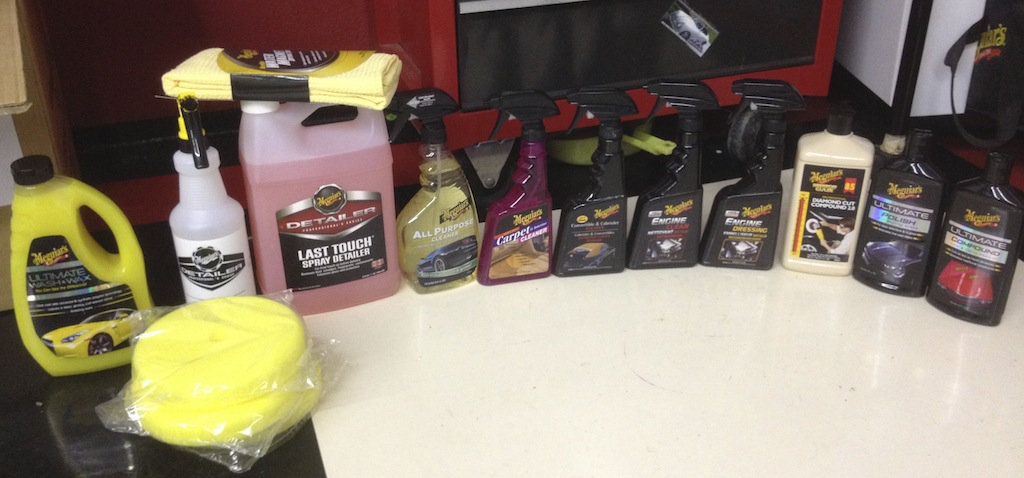
My weapons of choice came from the Meguiars dealer...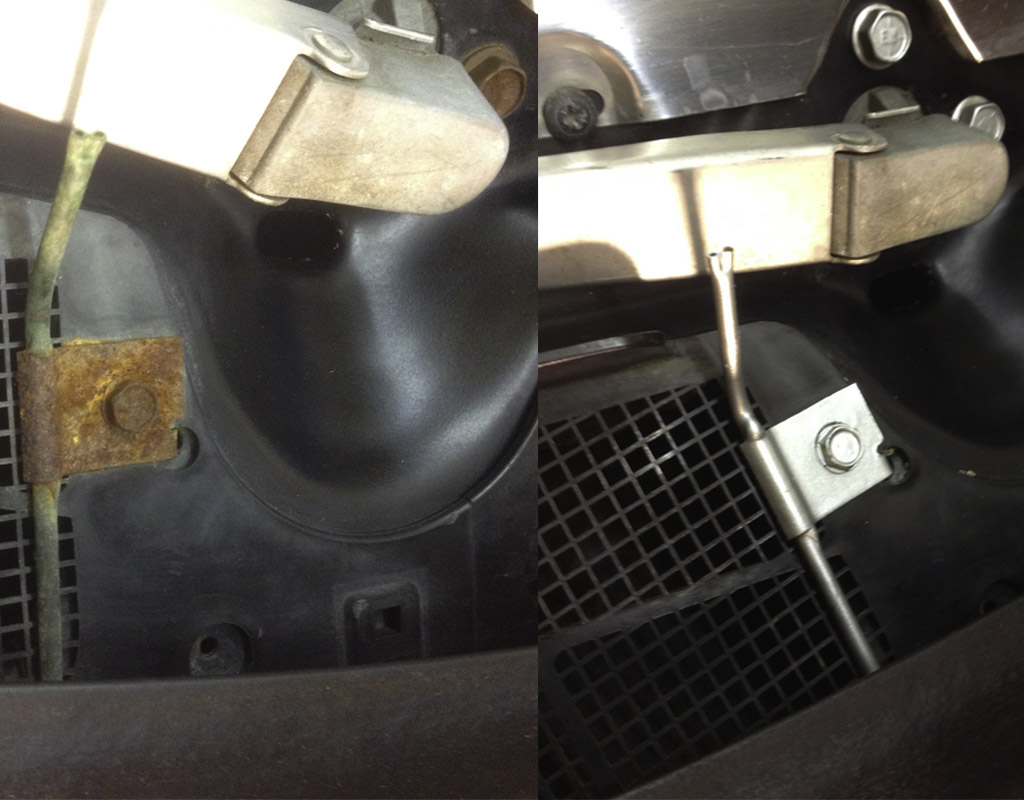
before and after cleaning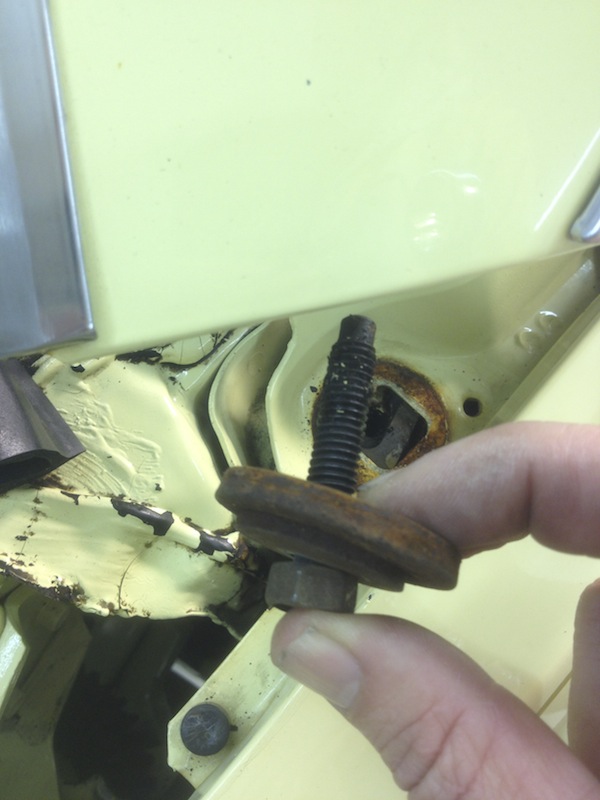
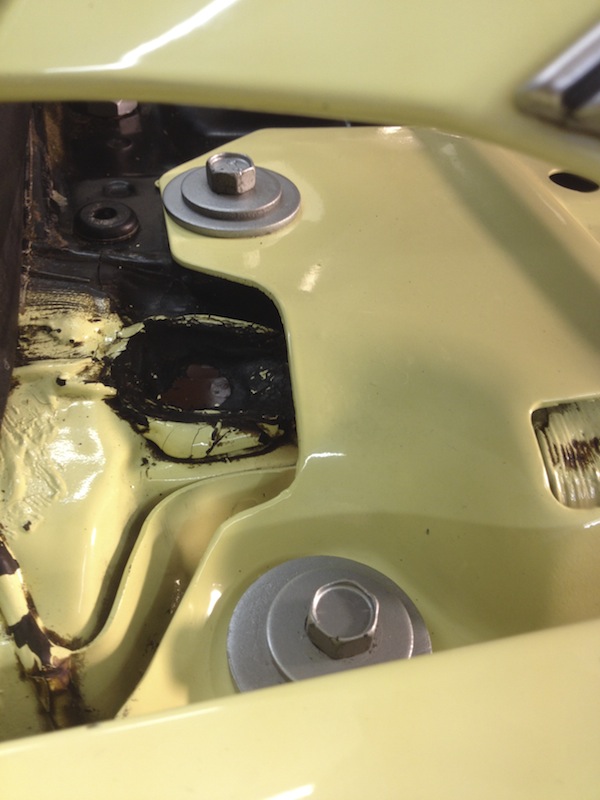
rusty bolts before and after cleaning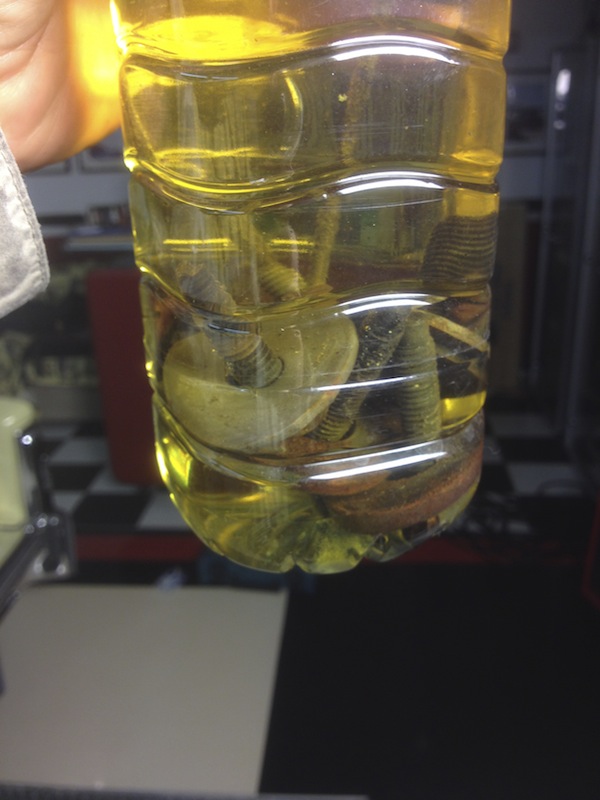
Soaking rusty parts in vinegar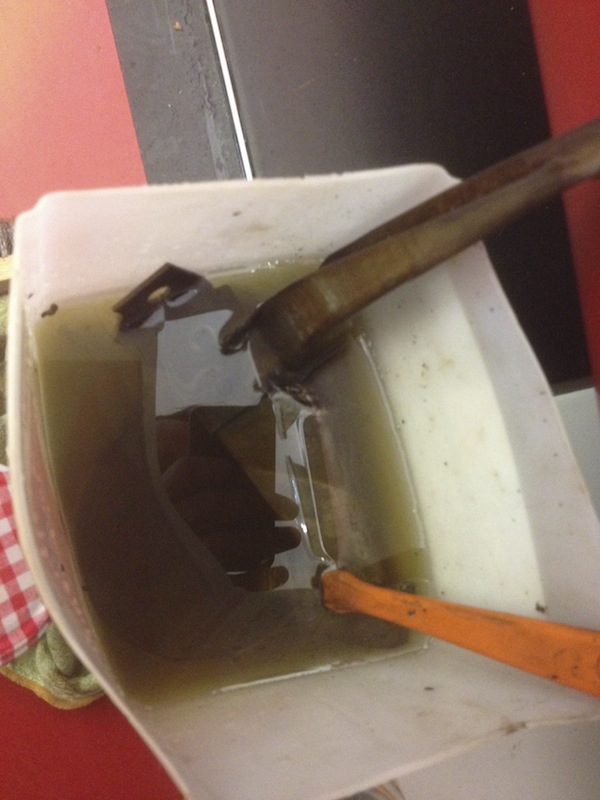
Cleaning more rusty parts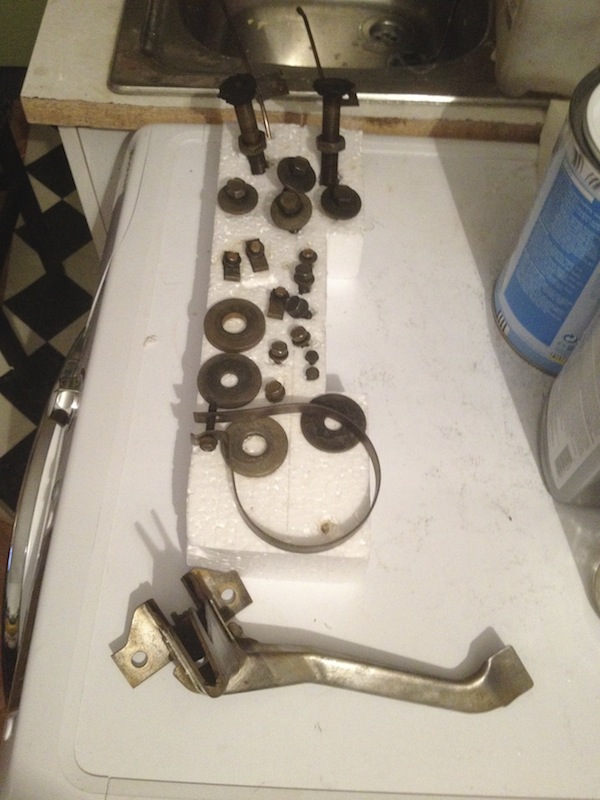
with the rust removed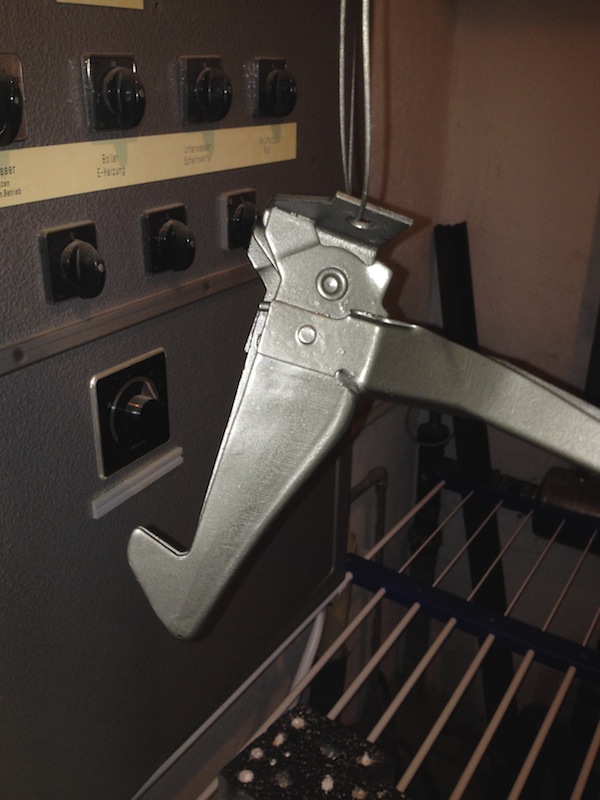
The Hood latch cleaned and painted with Eastwood Silver Cad Paint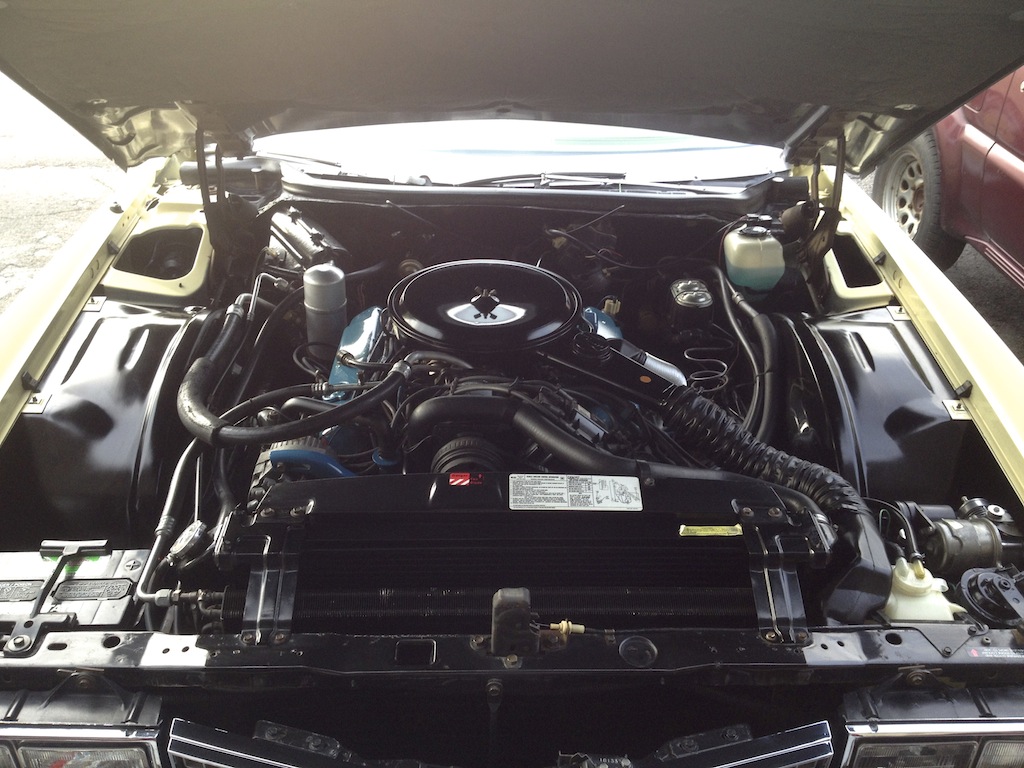
The cleaned engine bay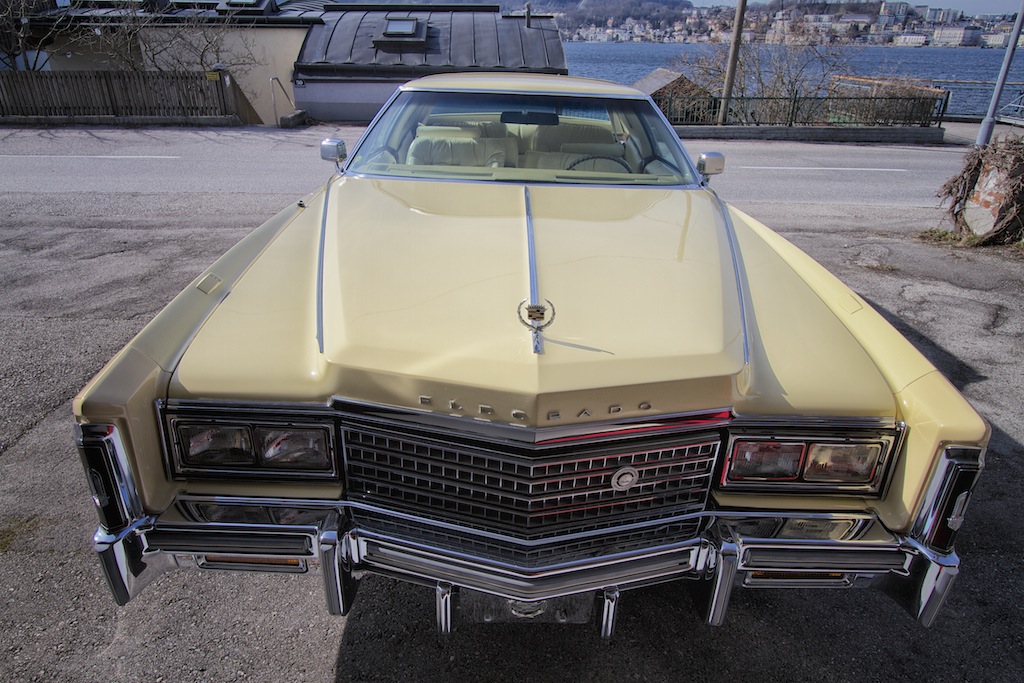
The car after polishing the paint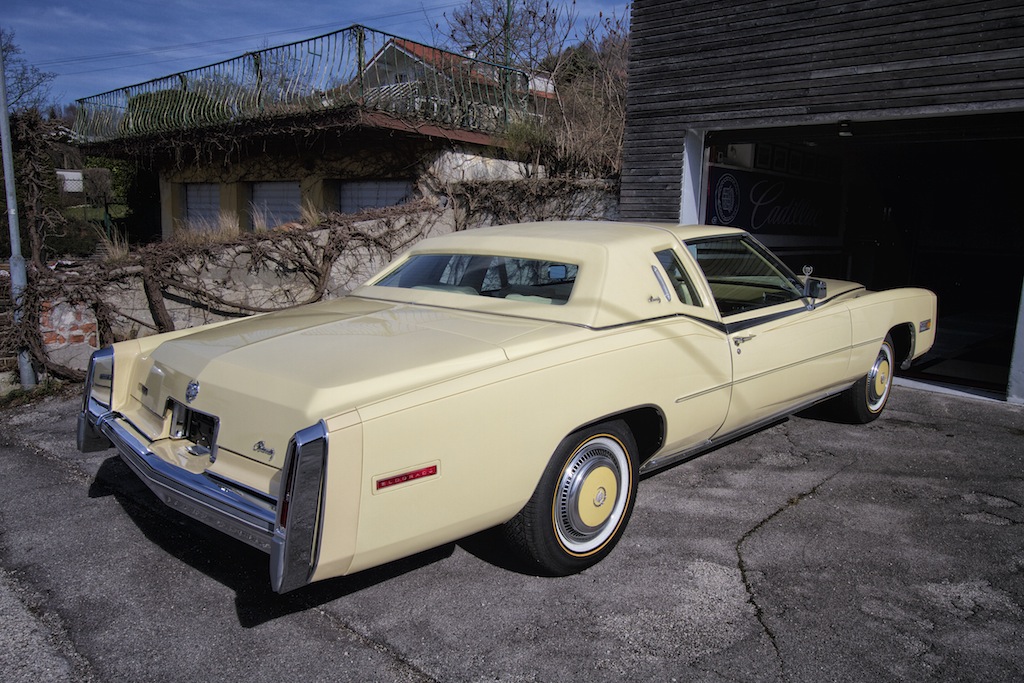
the polished paint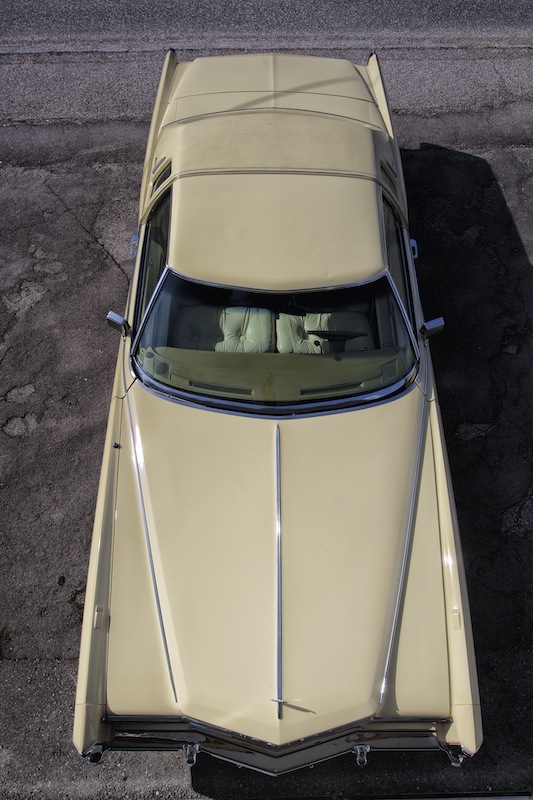
very shiny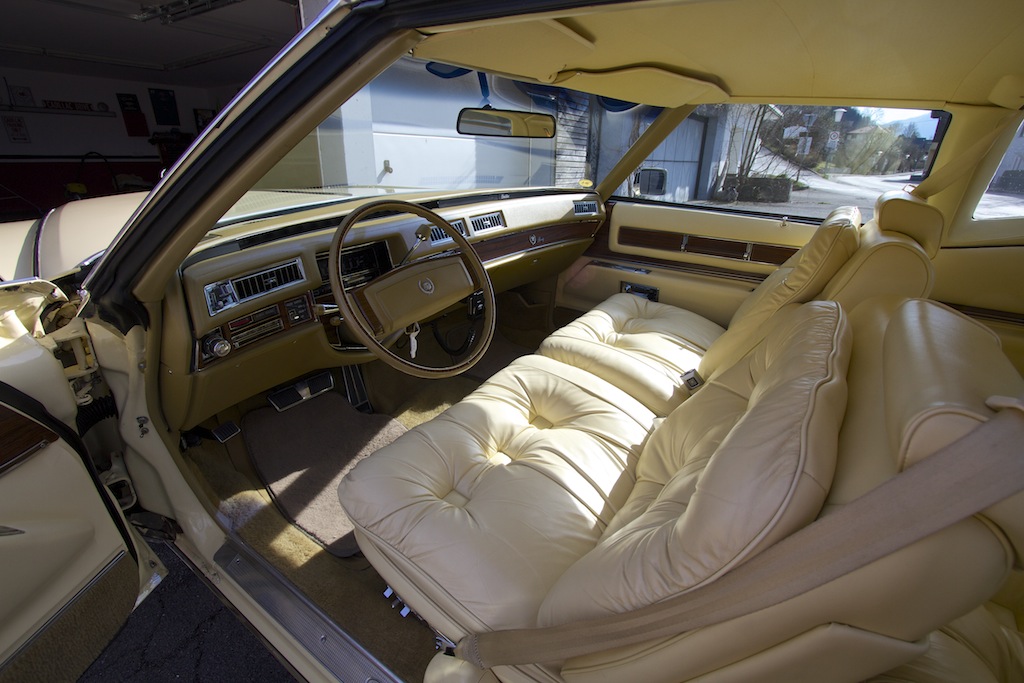
Besides the carpet - the interior is already perfectly clean. The original floor mat is under the aftermarket mats.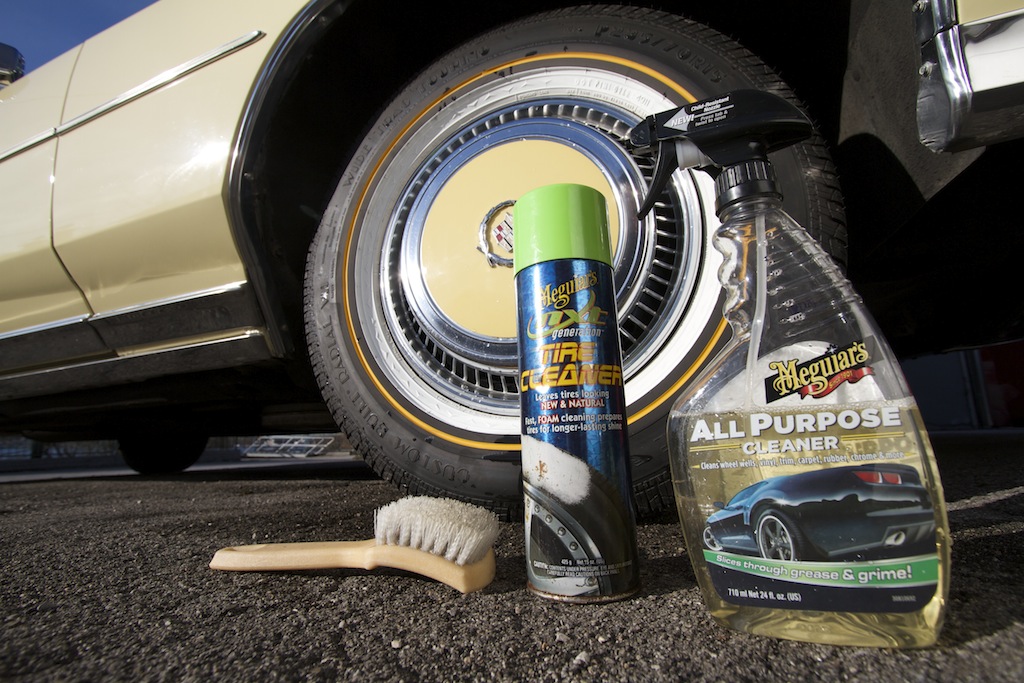
Cleaning the Vogue tires.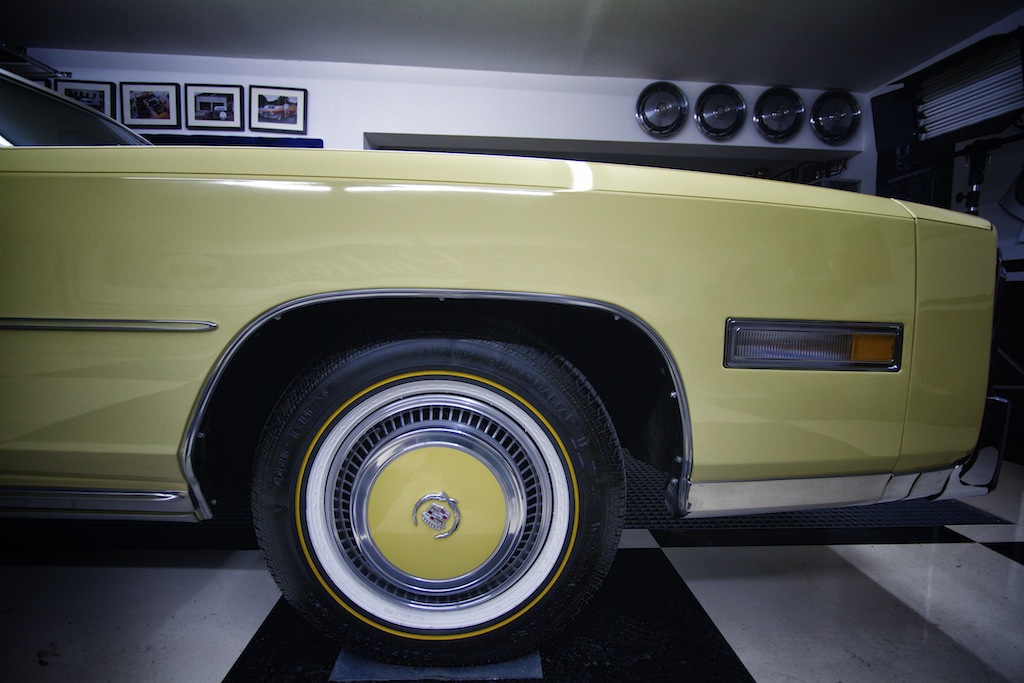
Clean paint and tires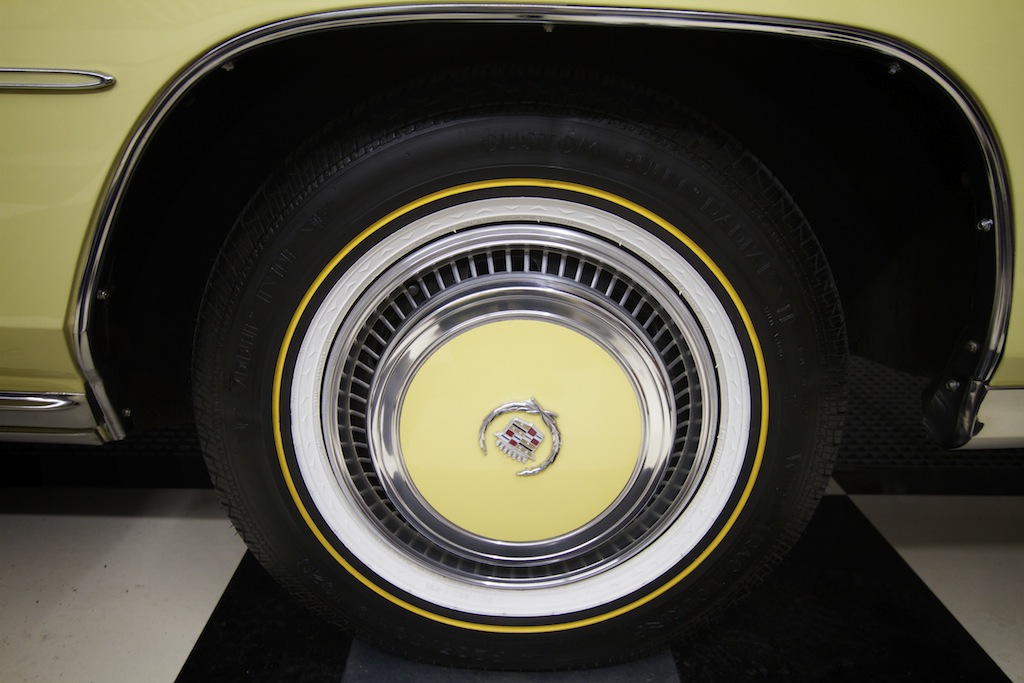
Clean tires and perfect hubcaps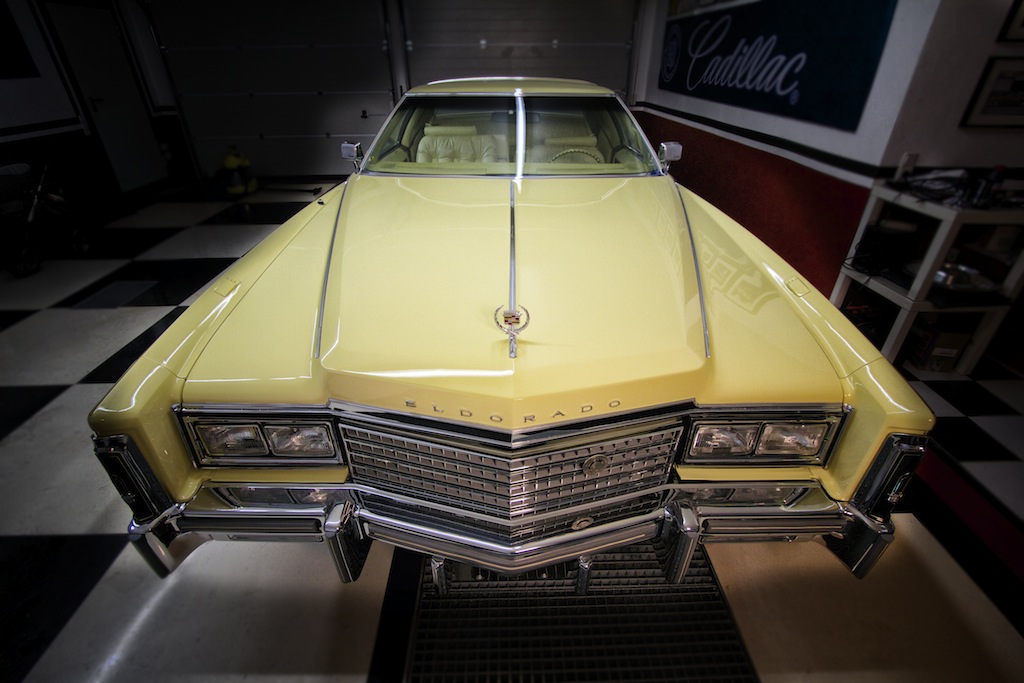
Before waxing
I really like this Meguiars wax. Its one of their cheapest but best waxes. A gentleman from Meguiars once told me that it is one of their oldest waxes, but contains a lot of carnauba wax, which makes it so good! Its also offering the best protection of their product range.
Here are some links to Meguiars products I like to use (link to german Amazon Shop):
1978 Eldorado - Choke problems.
The only way I could get it to normal idle speed was to manually release the fast idle cam on the carburetor. For some for me unknown reason it did not release itself - even when the car was fully warmed up...
As I´m not exactly an expert when it comes to carburetors, it took me a while to figure out what was going on and what the problem could be.
I got myself the Rochester M4MC / M4ME Carburetor Manual online and started reading. The trouble shooting section did not mention my problem and symptoms though, at least I learned a lot by reading through the manual...
The carburetor in my 1978 Eldorado is a Rochester M4ME # 17058531 (late Federal).
After a lot of reading I suspected that the electric choke thermostat must be the problem.
I removed it to test it like it is described in the manual.
Electric Choke Diagnosis and Checking
In order to have good engine performance during warm up and be able to pass Federal exhaust emission standards, the electric choke must function properly .
Possible reasons for the choke not operating properly are listed below.
1. No engine oil pressure.
2. Malfunctioning oil pressure switch.
3. No current to oil pressure switch due to:
a. Burned out 15 amp "radio -idle stop" fuse.
b. Broken wire to switch (18 brown/double white).
4. No current between choke coil and oil pressure switch due to:
a. Broken 18 light blue lead wire.
b. Wire terminal not locked on coil terminal.
c. Ground circuit incomplete between grounding plate of choke assembly and housing.
5. Failed choke coil assembly.
A voltmeter or continuity light may be used to check the circuits for continuity to the oil pressure switch and the choke coil.
If it is suspected that the choke coil assembly has failed, the following check may be made.
1. Remove coil from carburetor and cool to room temperature (above 60°F).
2. Attach a jumper wire between positive battery terminal and terminal of coil assembly. Attach a second jumper wire between negative battery terminal and grounding plate of choke coil assembly.
3. The tang of the coil should rotate 45°in 54 to 90 seconds.
4. If coil fails to rotate or exceeds the above timing specification, replace coil assembly.
5. If coil is within above timing specification then coil is good and problem is elsewhere.
6. Reinstall coil and set to proper index (Fig. 52).
If coil is cooled off sufficiently the choke valve will close when throttle is opened slightly. Attach a jumper wire between the positive battery terminal and choke coil terminal. Choke coil should warm up and the choke blade can be observed opening, indicating a good and properly grounded choke coil assembly. At room temperature the choke blade should be wide open in approximately 90 seconds.
If the choke does not operate properly after the coil has been proven satisfactory , check out the other possibilities that prevent current from getting to the choke coil.
After I performed the test procedure above it was clear that the choke coil was the problem.
I ordered a new one from www.rockauto.com and it arrived within 3 days. The manual mentions the original part #17059968 (the original one on my car showed #17059969 though - but every parts list I checked does not list this number...?).
I got a replacement from Airtex # 2C1045 and it seems to fit.
I installed it today and the choke works as it should again.
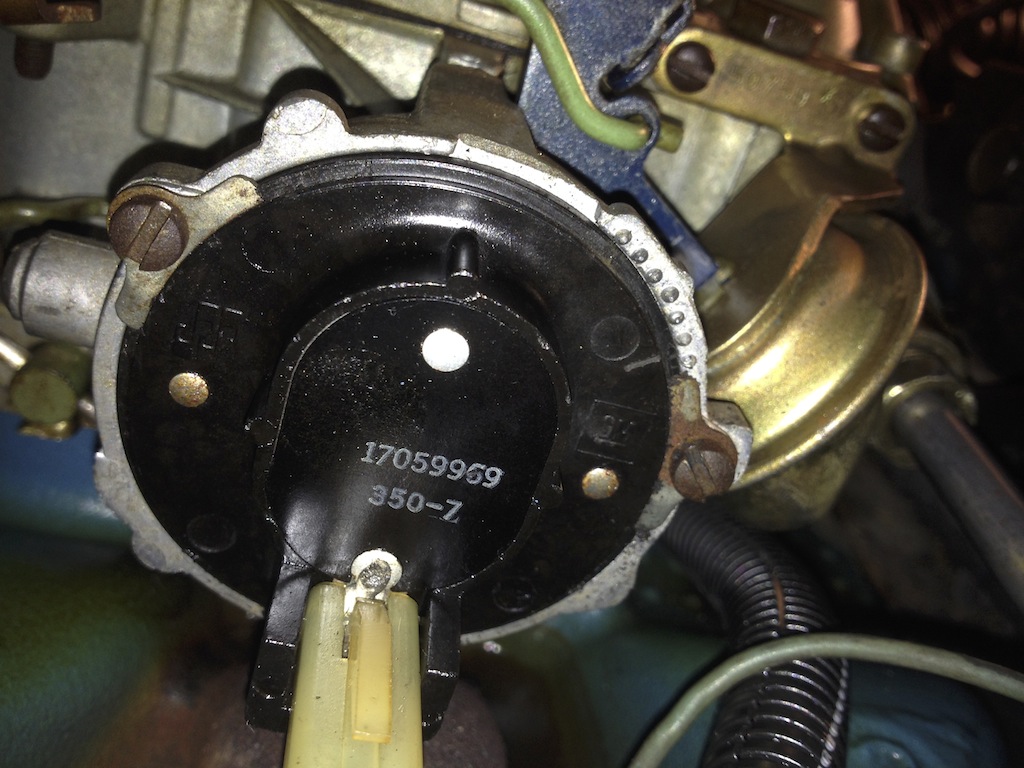
This was the original choke thermostat on the car . #17059969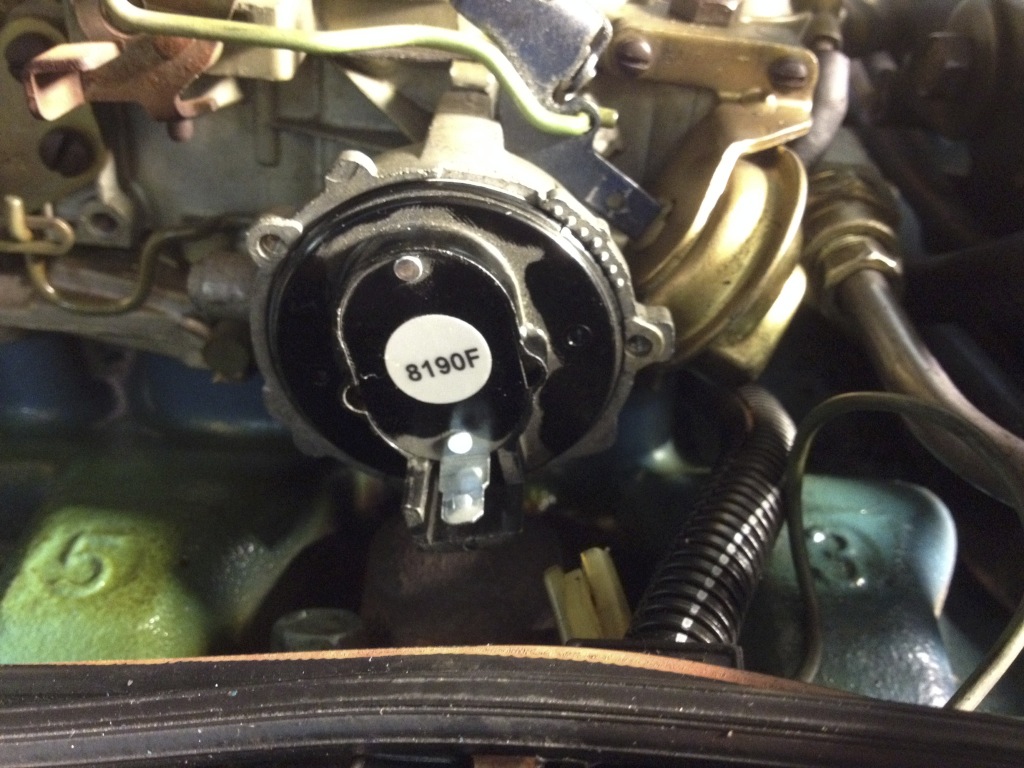
The Airtex replacement part in the car.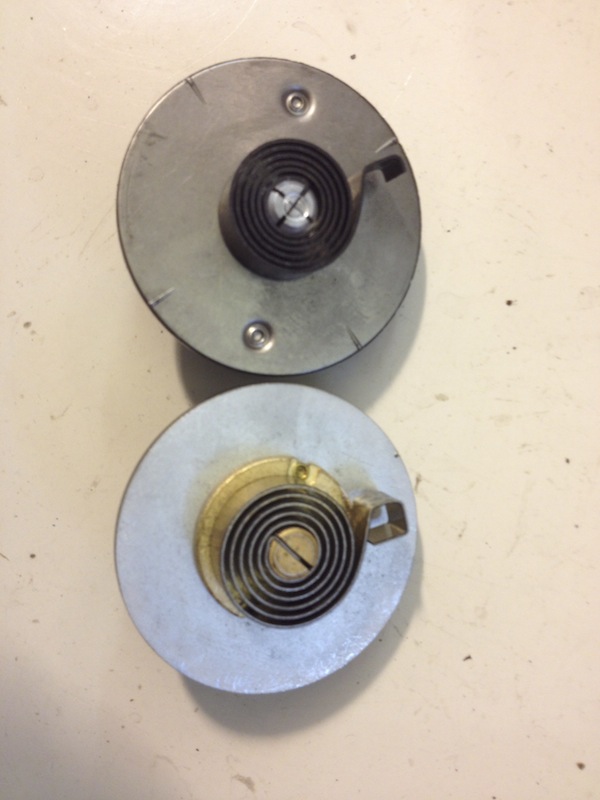
The original part and the new part - slightly different at the tang of the spring - but it works and fits perfectly...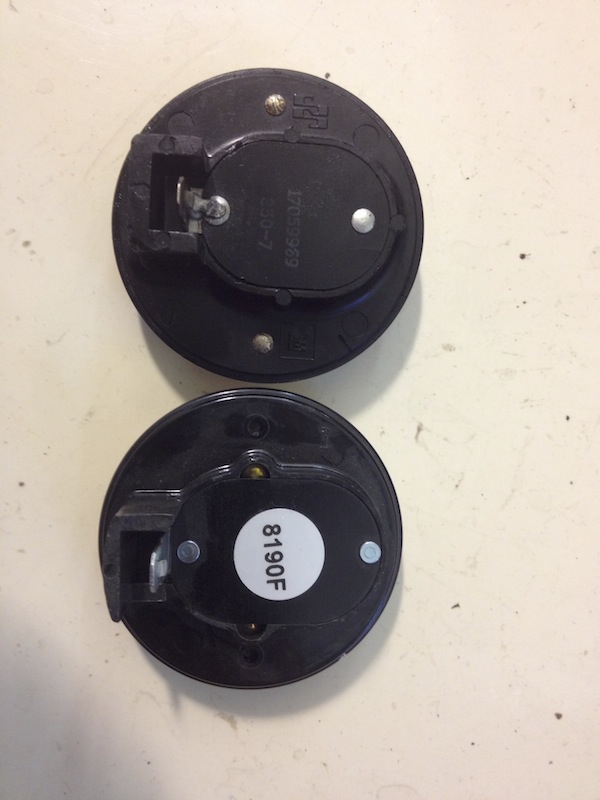
original and new part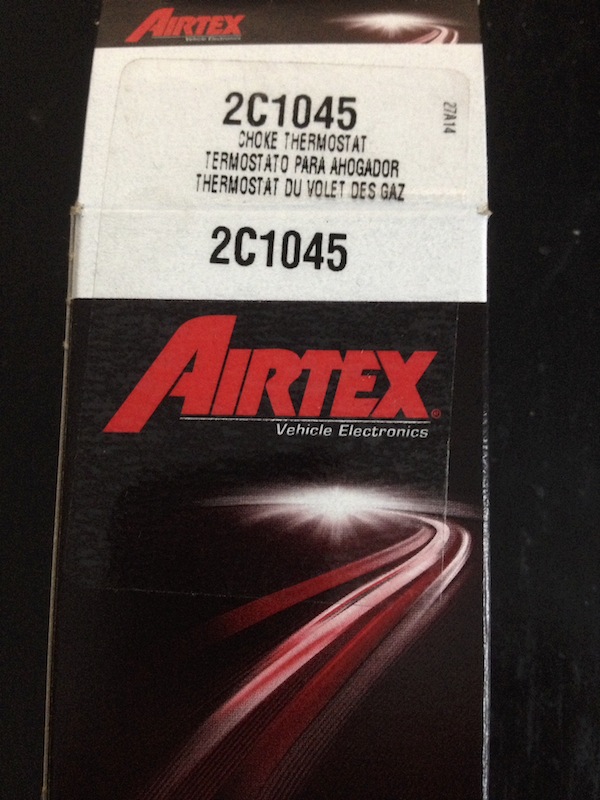
The Airtex replacement choke thermostat
1978 Cadillac Eldorado - defective door jamb switch repair.
I also have the same system on my 1971 Lincoln Mark III where I had some problems as well in the past with a loose wire.
On the Biarritz the passenger side worked flawlessly, but on the drivers side the solenoid would not engage.
I started my search for the problem at the top of the two door jamb switches which is the one controlling this function.
When I wiggled it and pulled it out, I could hear the solenoid engage. So I knew that the problem must be with this switch.
Unfortunately it's not easily accessible. As I do not have the 1978 shop manual yet - it took me a while to figure out how to access it.
I managed to get to it through the lower dash and to uninstall it.
As it turned out it was slightly bent and did not make good contact once the door was opened.
I carefully bent it back straight - and after some trial and error it was back in working order.
It took me a good hour to fix this.
Now I´m back to cleaning the car to my standards, something that will probably take the whole winter...
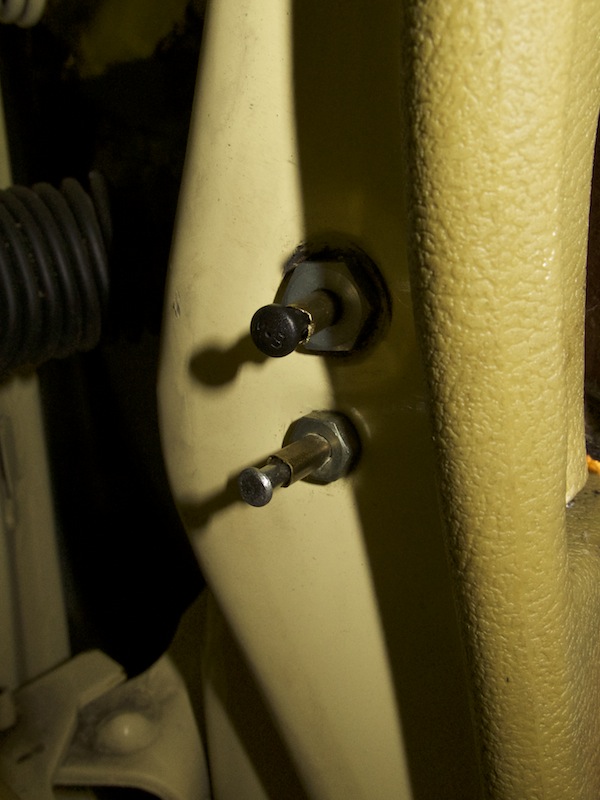
The upper switch is controlling the seat back solenoid. (Picture was taken before cleaning the door jambs...)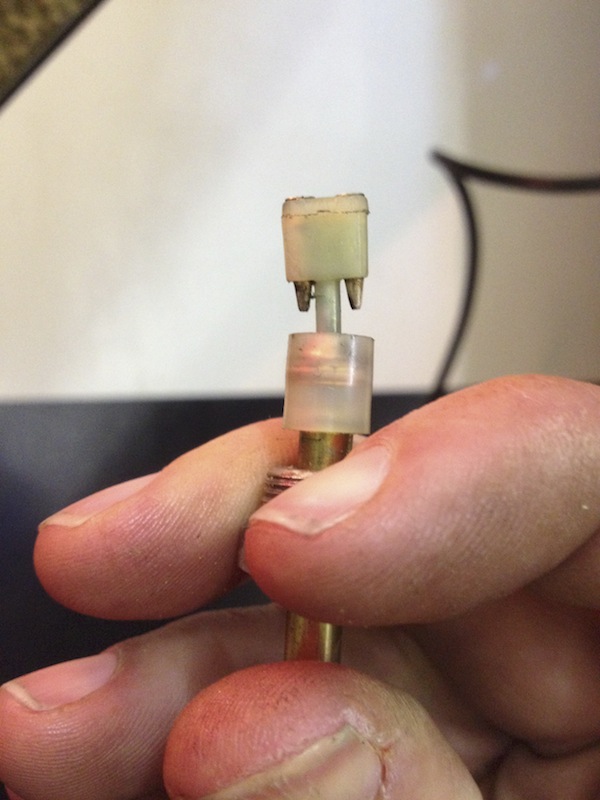
The removed door jamb switch. When the door is closed no contact is made and the solenoids are not energized causing the seat back to be locked in position.
You can see that the switch was slightly bent - making no good contact.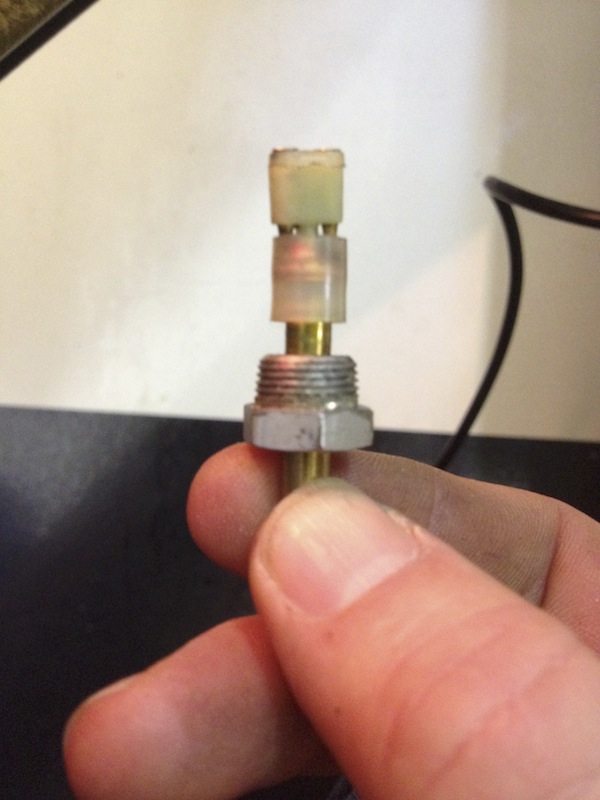
When the door is open contact should be made and the solenoid should energize... The switch did no longer make a good contact though.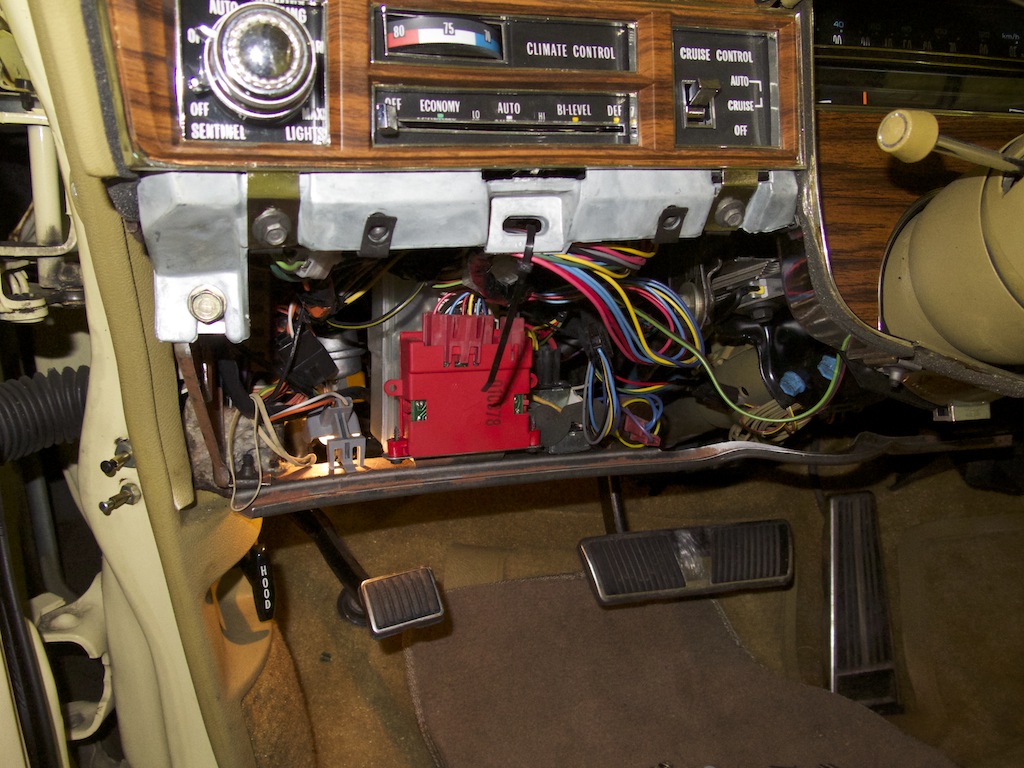
I had to remove the lower dash to access the cables on the rear of the door jamb switch through a tiny hole and disconnect the connector with a long nose plier...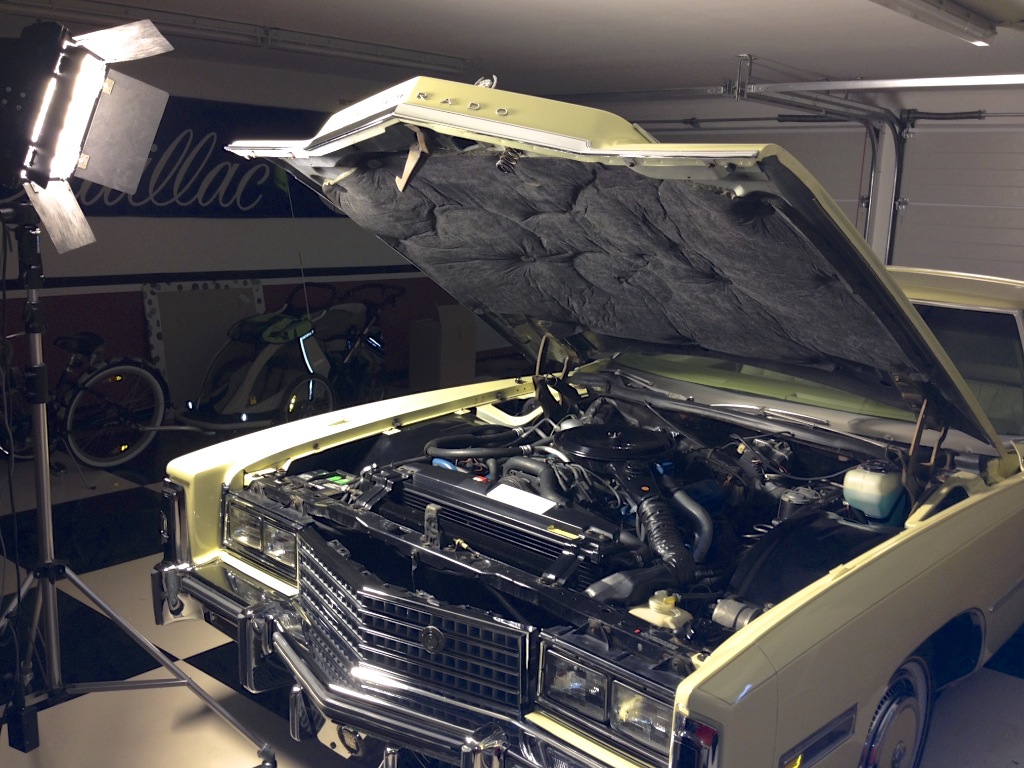
I´m now in the long process of thoroughly cleaning the engine bay to look like new again...
1958 Eldorado Wheel Bearing Replacement - oil change - winter hibernation...
The newly installed Speedbleeder valves made the job a lot easier and quicker. I bled the brakes two times and took the 58 Eldorado for a test drive. The brakes worked fine, but felt differently than before the rebuild. The car did stop perfectly, but pedal travel was too long for my taste, before any brake action took place.
I consulted the shop manual for this symptom and it first suggested to adjust the brake pads first.
As I had no brake adjusting tool, I use a flat screwdriver to adjust the star wheel like described in the shop manual and bled the brakes once again.
After this the brakes worked like before the rebuild again — great!
As I had the front brake drums off anyways, I decided to finally change the wheel bearings as well, as they were making a very slight noise, and I had the new bearings laying around in my garage for years now...
They are pretty easy to remove and replace — no big deal — no special tools necessary. Just make sure to tighten them back to specs (shop manual mentions 4 ft-pound of torque (around 5,5nm))
After this, I also changed the oil after I brought the engine to operating temperature and put in 5 quarts of fresh 10W40 oil and a new oil filter. I also lubed some other parts like the alternator.
I then parked the 58 in the new garage - along with my other cars - where it will spend the long, cold winter.
It will get a good coat of fresh wax on the outside and some good leather treatment soon, and I will also treat the rubber parts and weather stripping, so that everything stays soft during hibernation.
I only managed to drive the 58 Eldorado 86 miles this year - way too less!
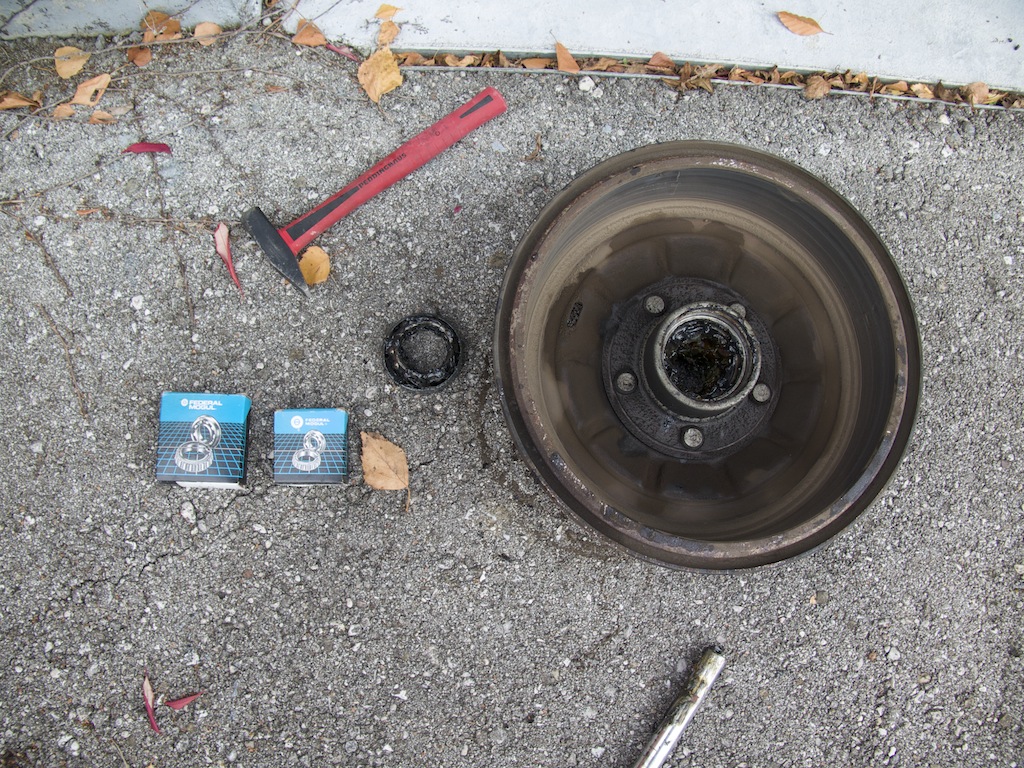
Removed the old bearings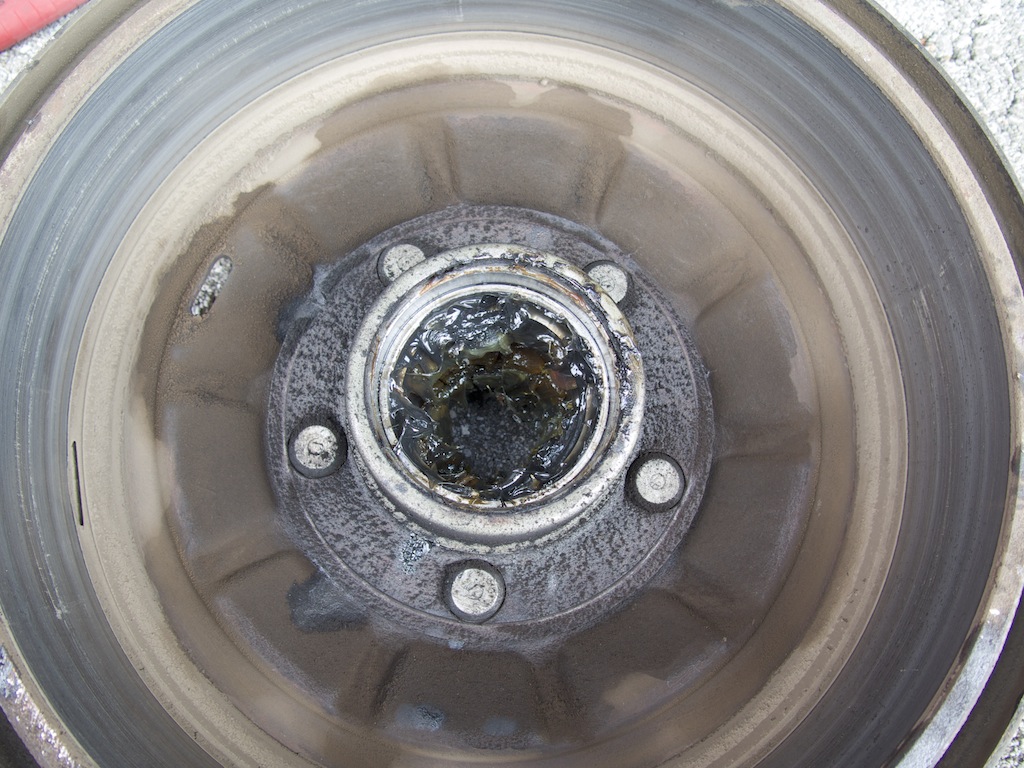
You just have to tap out the rear dust shield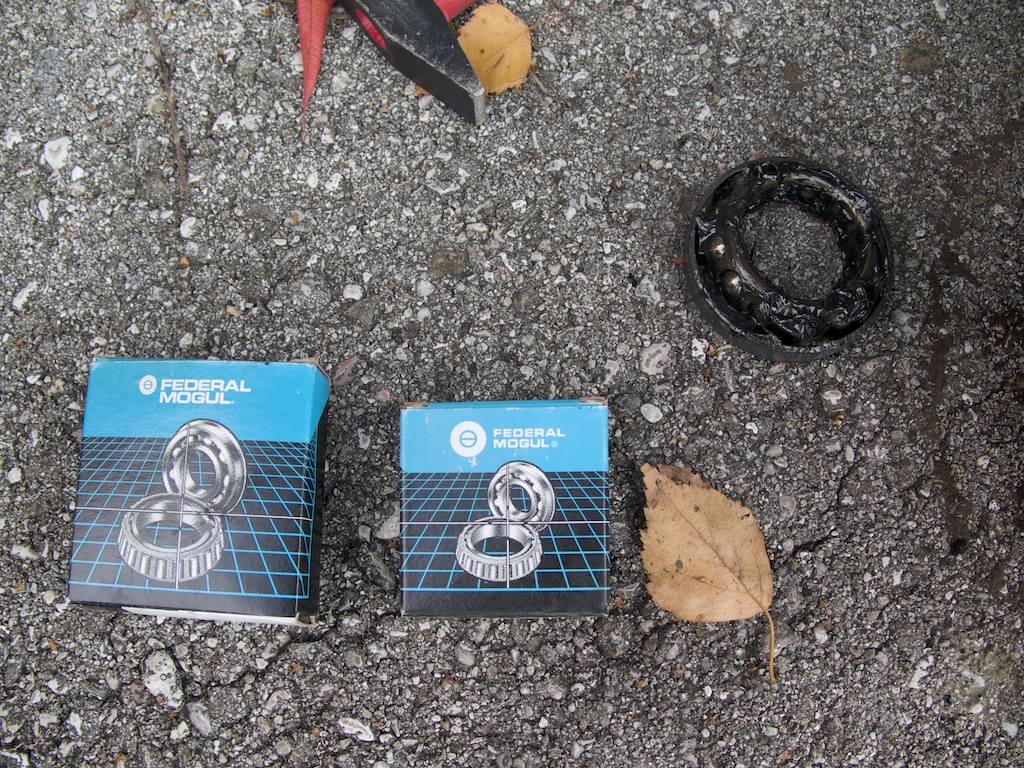
The new bearings waiting for installation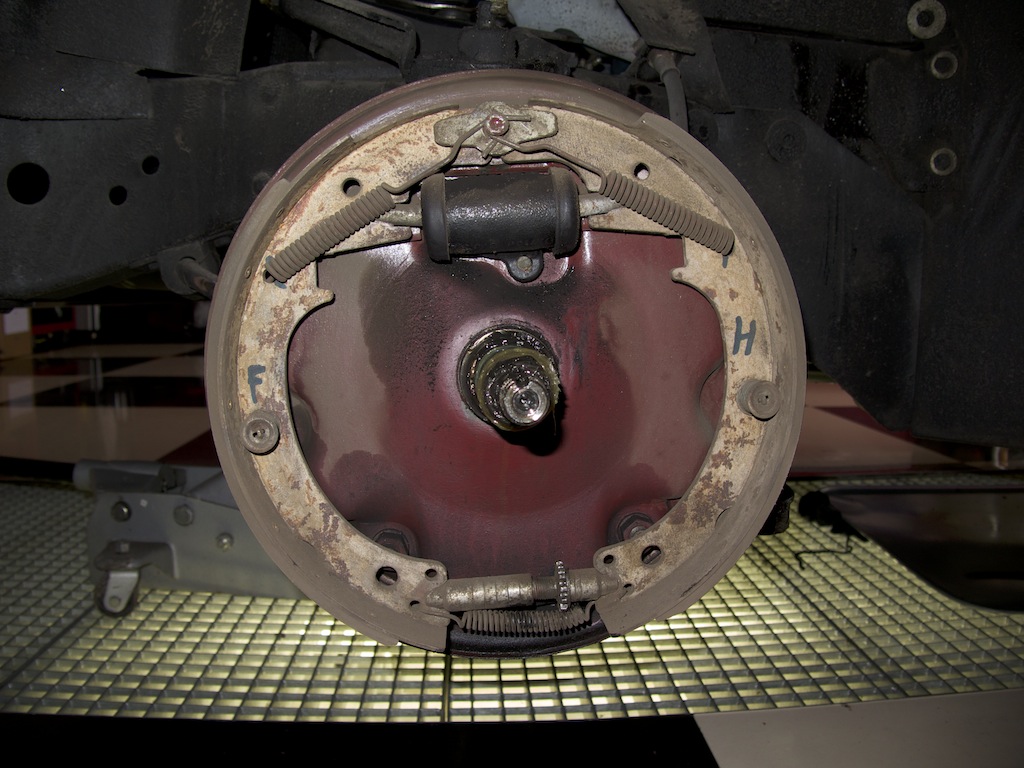
Adjusted the star wheel and checked the front brakes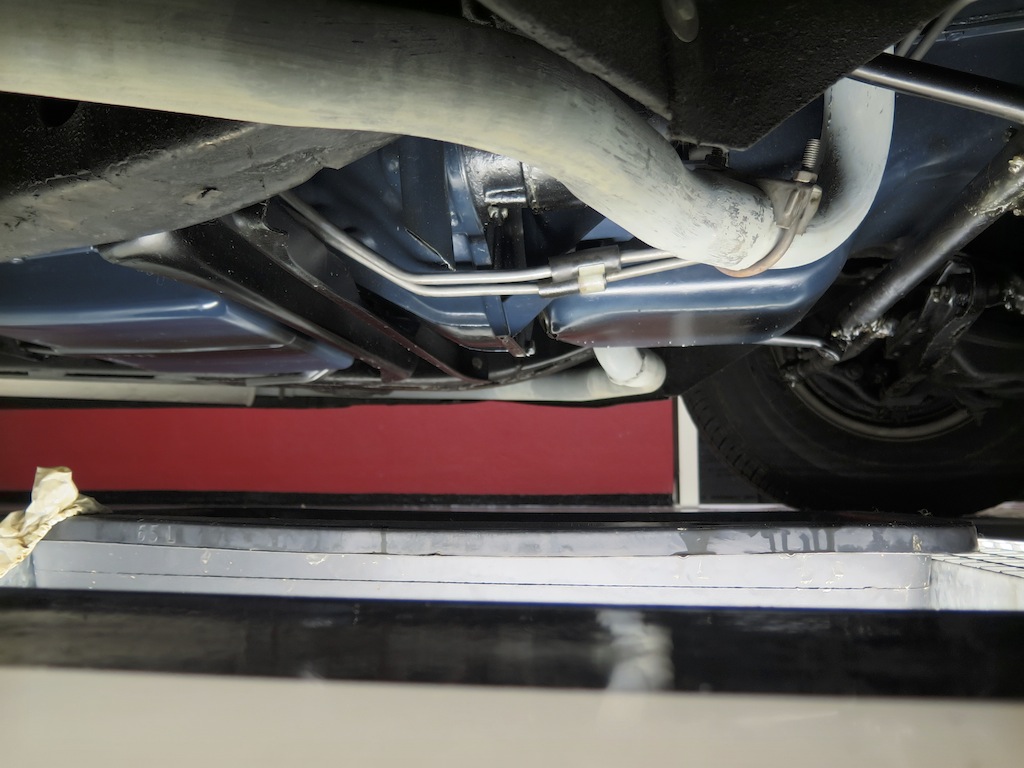
Changing the engine oil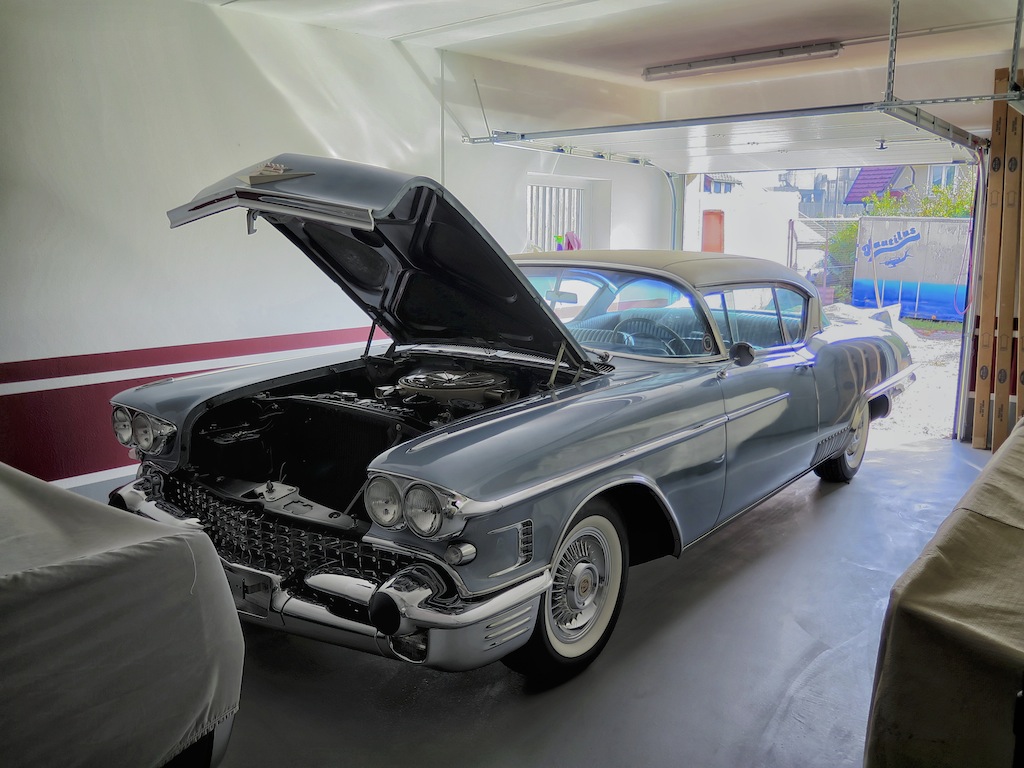
In its winter home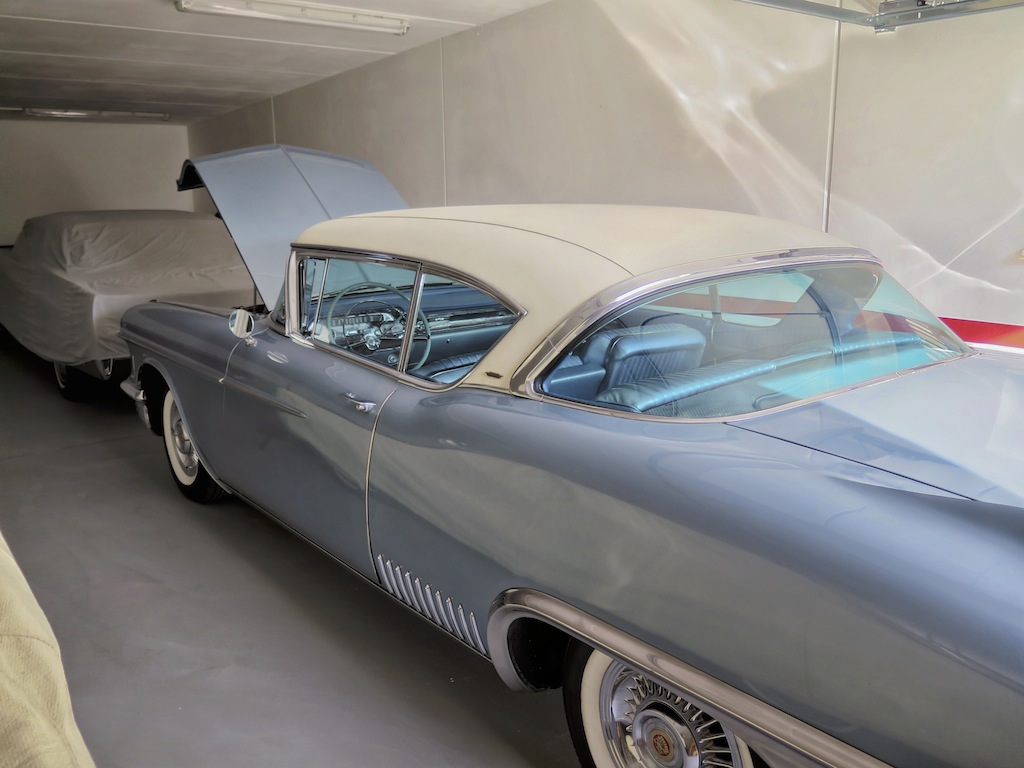
In the winter home
Sleep well!
Repairing the Treadle Vac Master Cylinder and Brake Booster of my 58 Eldorado
Now as I wanted to drive it out of the garage, I found a puddle of brake fluid under the car.
So I went on to search where it was coming from.
I suspected a leaking wheel cylinder, but could not find any traces of fluid coming from the wheels. After some more searching, I eventually found out that fluid was dripping out under the brake booster along the push rod. When I checked the fluid level it was only half full.
So I knew that the Treadle Vac would need a full rebuild…
I ordered a rebuild kit at Cadillac Parts LTD. They offer a kit to rebuild everything from the booster to the master cylinder. As I found out, the gasket for the reservoir did not fit from their set and some other correct smaller rubber parts are also not included in the set. So remove everything carefully from your unit as you might have to reuse some parts for your rebuild. I contacted them about the wrong parts and they immediately sent me the correct parts by mail. Great customer services - I would order from them anytime again!
As I had never done a full rebuild I asked my Cadillac friend Lucky for help - knowing that he can repair almost everything, and that he had done this job during the full restoration of his awesome 58 Biarritz before.
He was so kind to offer his assistance and invited me to his fantastic work shop where he is restoring his cars.
So I carefully removed the whole unit from my car and visited Lucky´s workshop.
With his skills he managed to rebuild the whole unit within a couple of hours. As it turned out a bad O-ring caused fluid to leak into the booster.
Due to all the brake fluid the finish of the Bendix unit suffered a lot, and so I decided to strip everything on the outside down to bare metal to repaint it.
So I took everything apart once again to make sure to do it perfectly.
I ordered some great spray cans from Eastwood to get the perfect look to match its appearance to when it was new.
Originally the master cylinder was not painted at all - but left in bare cast metal. Of course it started to collect surface rust very quickly - even on new cars back in 1958.
The booster originally was painted in semi gloss black.
Eastwood has a product called "Brake Gray" which I used to emulate this look. It comes extremely close to bare metal, but of course the paint protects the metal from rust. This paint is also resistant against brake fluid. I first primered the master cylinder with self etching primer two times before two coats of brake gray were applied.
For the brake booster I ordered Eastwoods Chassis Black extreme primer and satin black paint - painting turned out really fine! See pictures below
To make bleeding brakes easier and a one person job I also ordered a set of speed bleeder screws. (SB3824-SS)
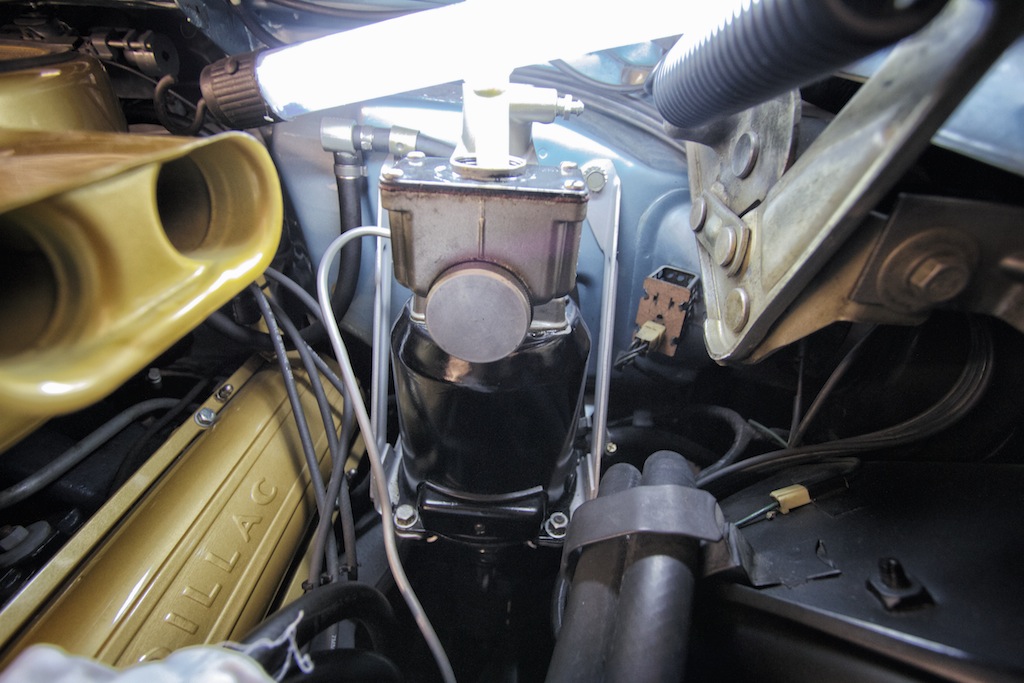
The unit still in the car - before removal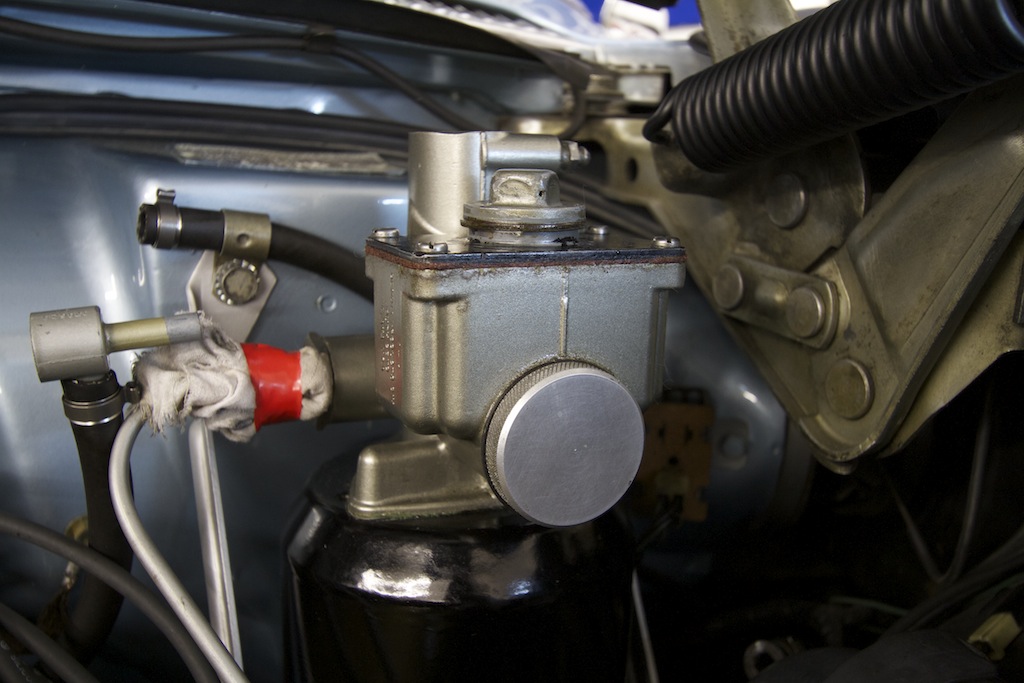
Removal has started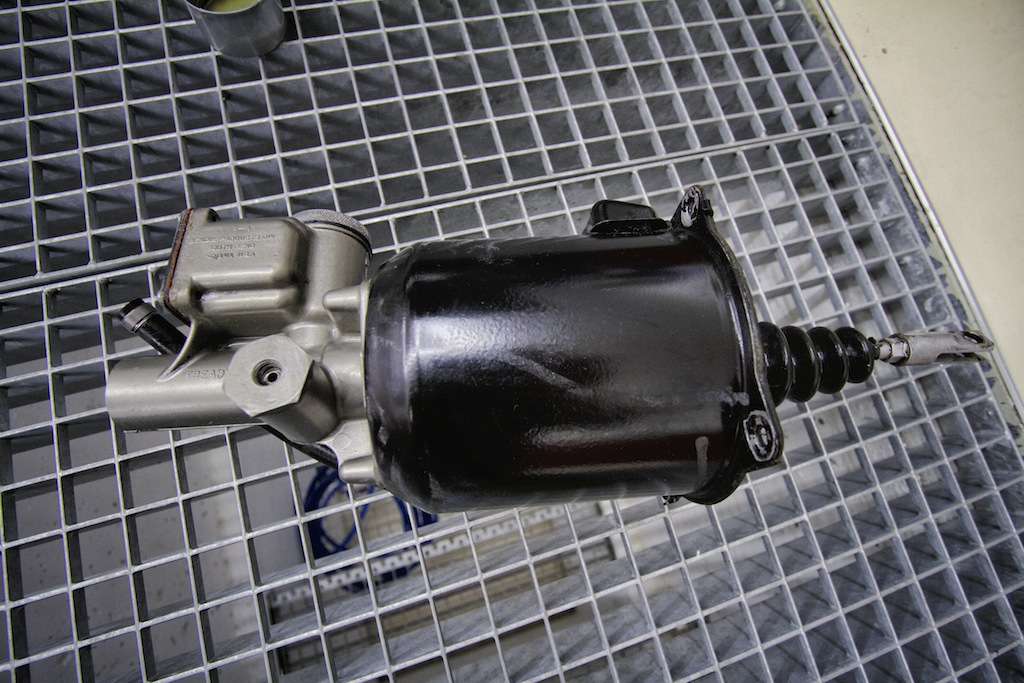
The unit out of the car - before rebuilding it.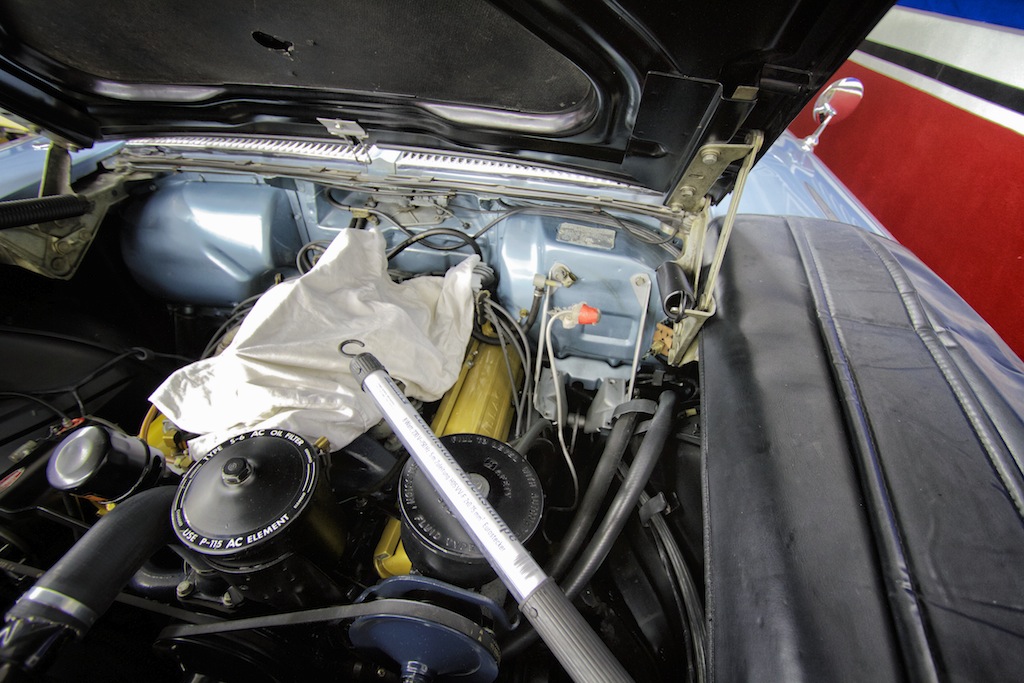
Out of the car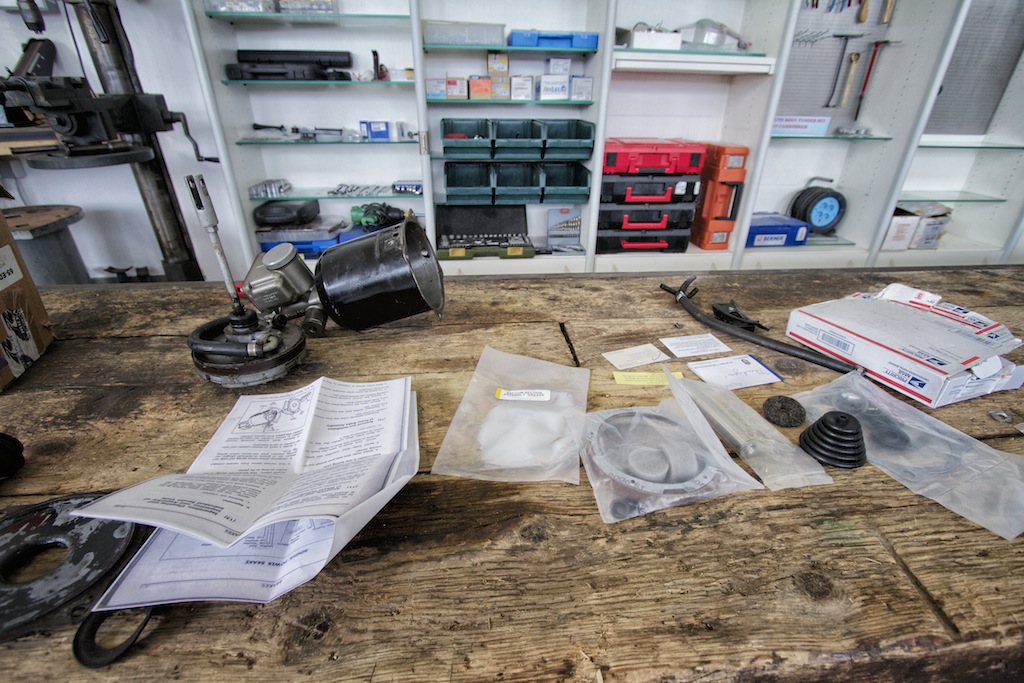
In Lucky´s workshop with the rebuild kit I got from the USA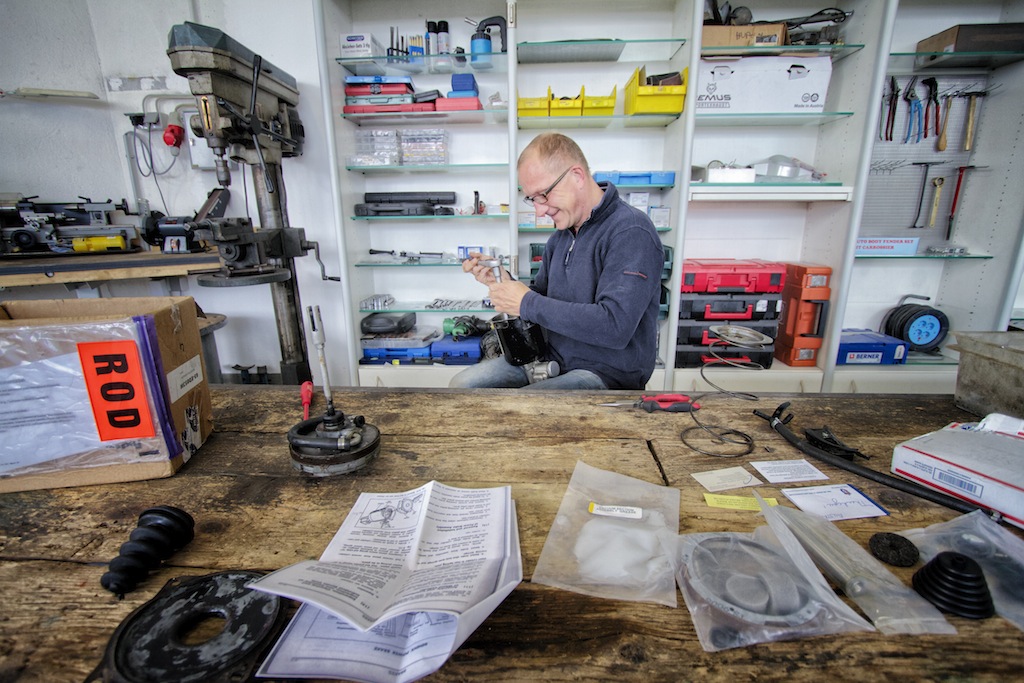
My friend Lucky at work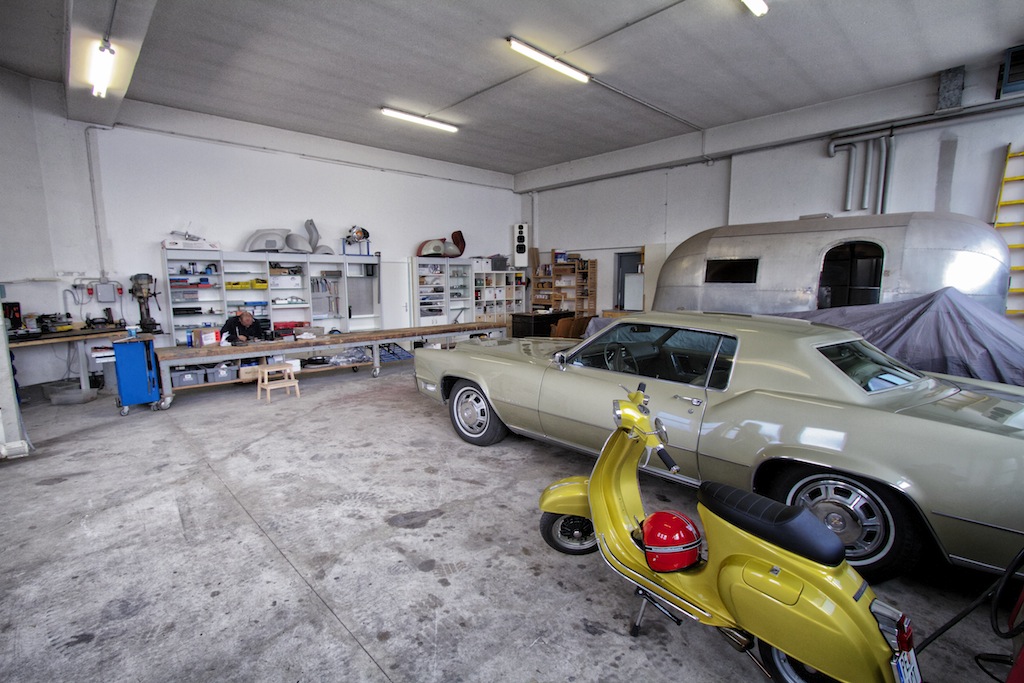
Lucky´s fantastic work shop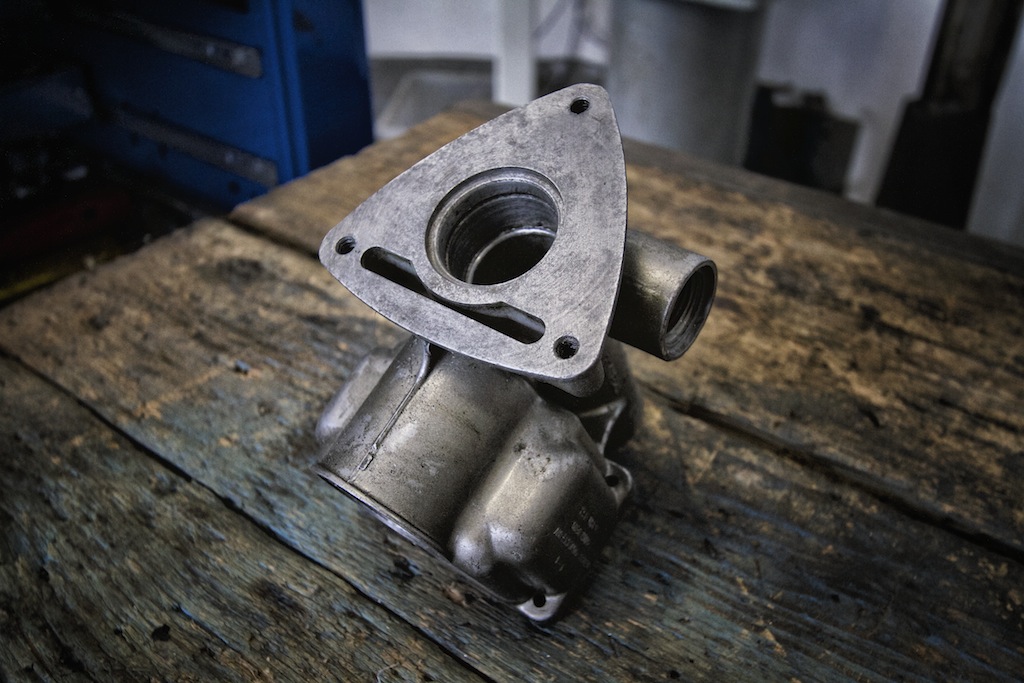
The Bendix master cylinder fully disassembled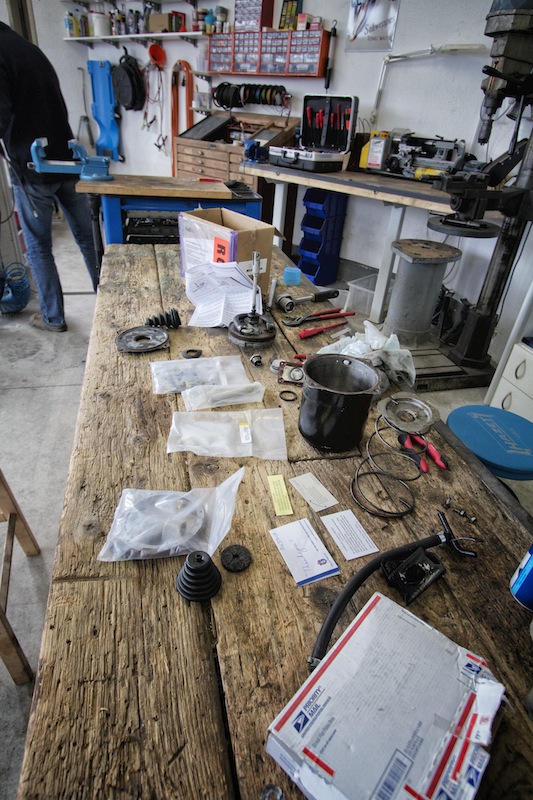
Everything disassembled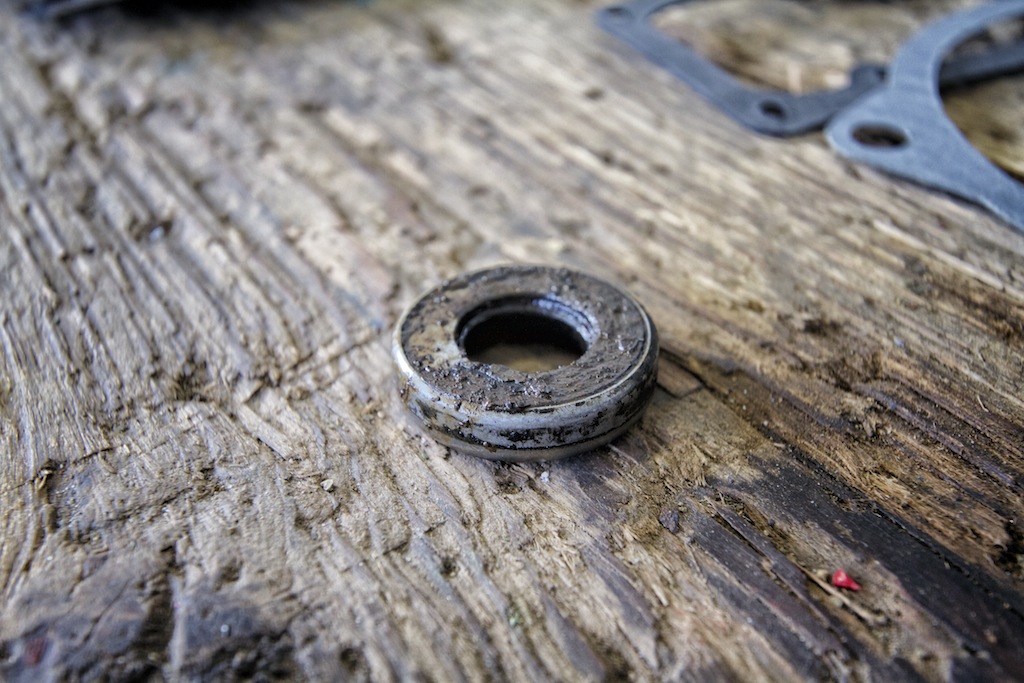
This O-ring was leaking and caused the problem.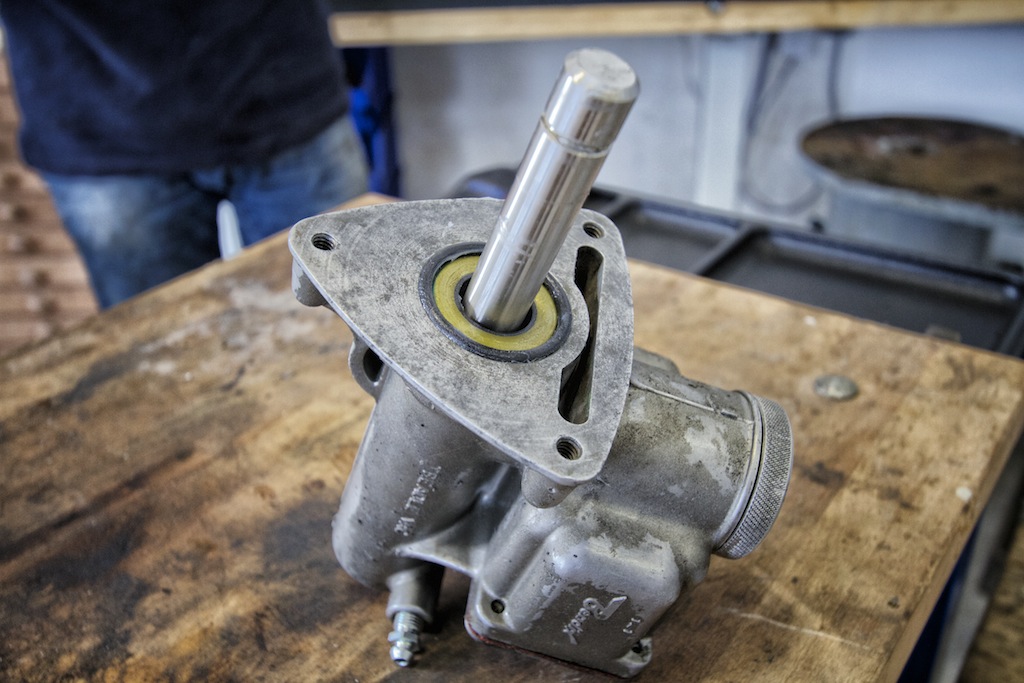
The new o-ring in place.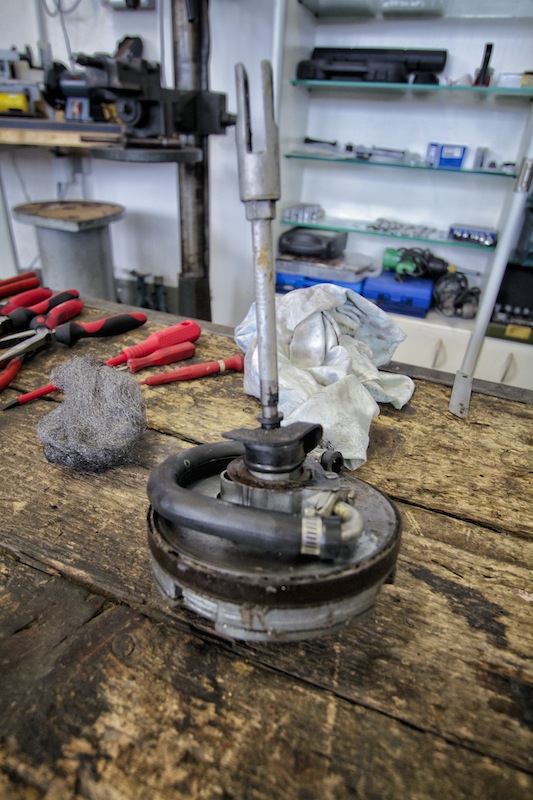
The vacuum cylinder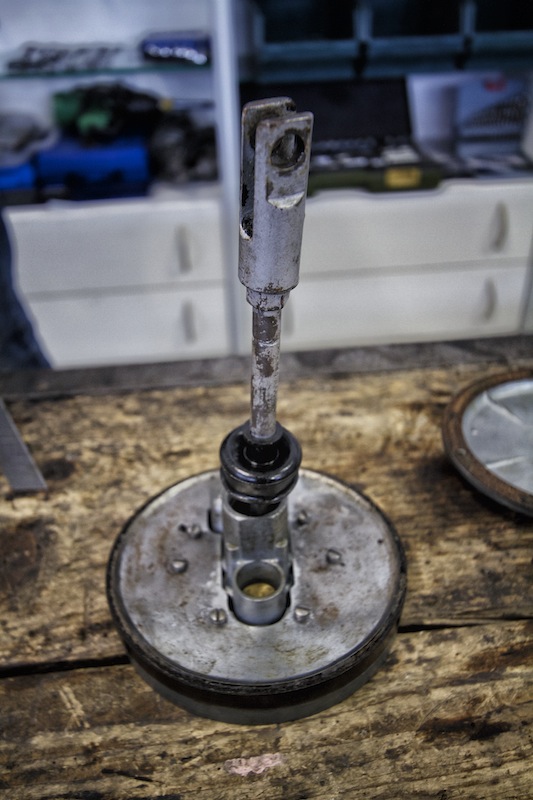
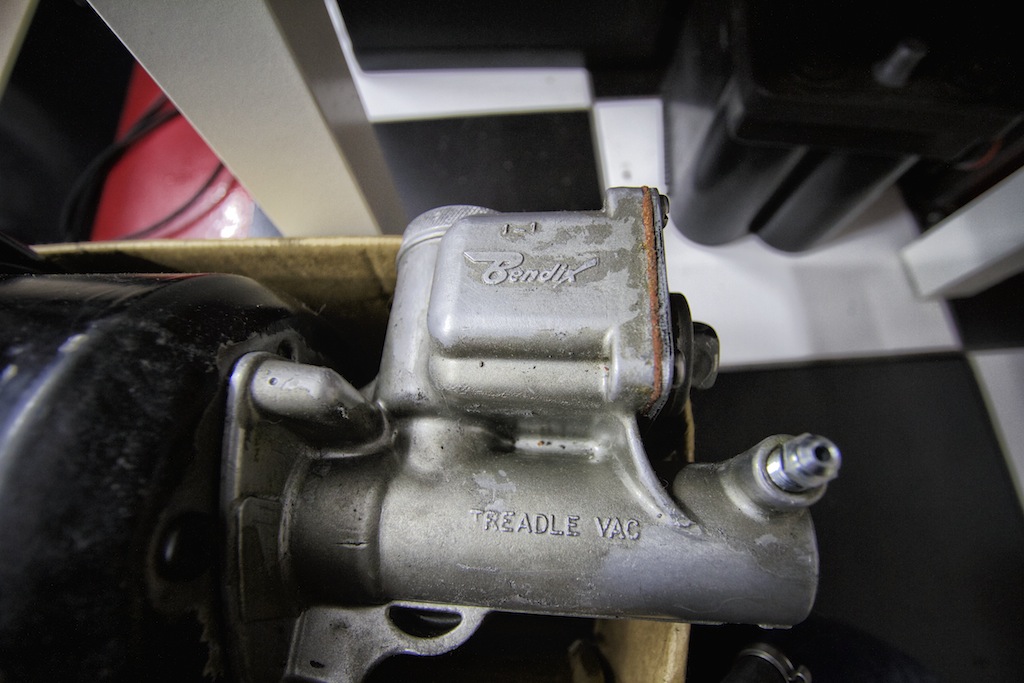
As you can see the paint suffered from the brake fluid - a repaint was necessary after the rebuild.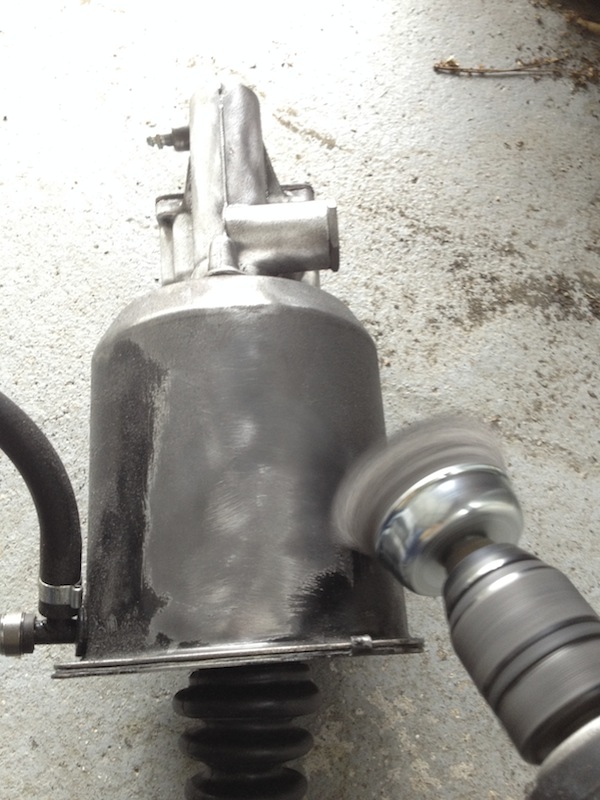
I started to wire brush the paint off - took it apart once again after this picture.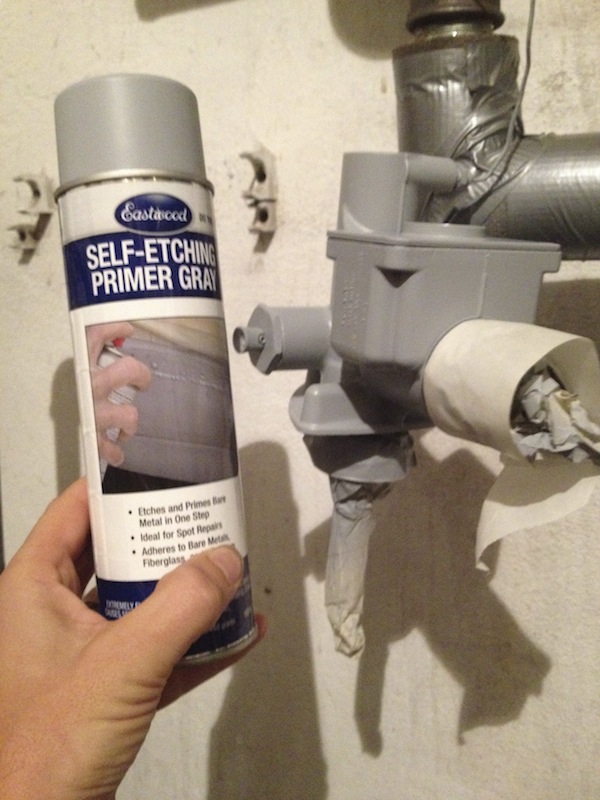
The master cylinder in primer.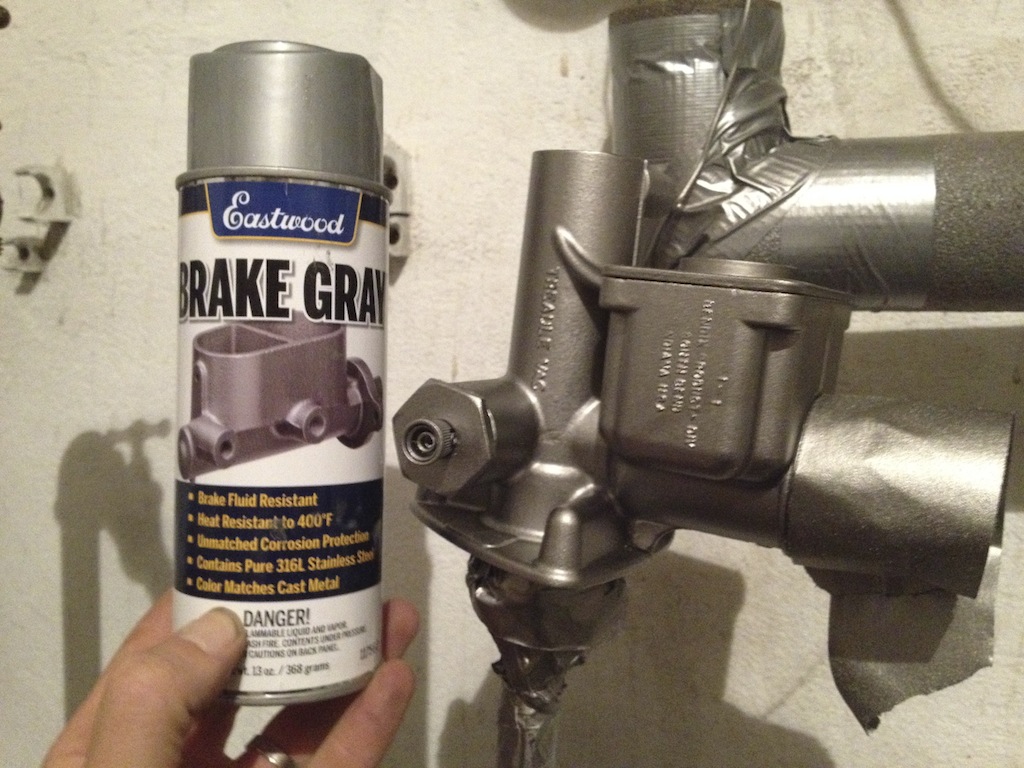
After painting it with "Brake Gray" - great stuff.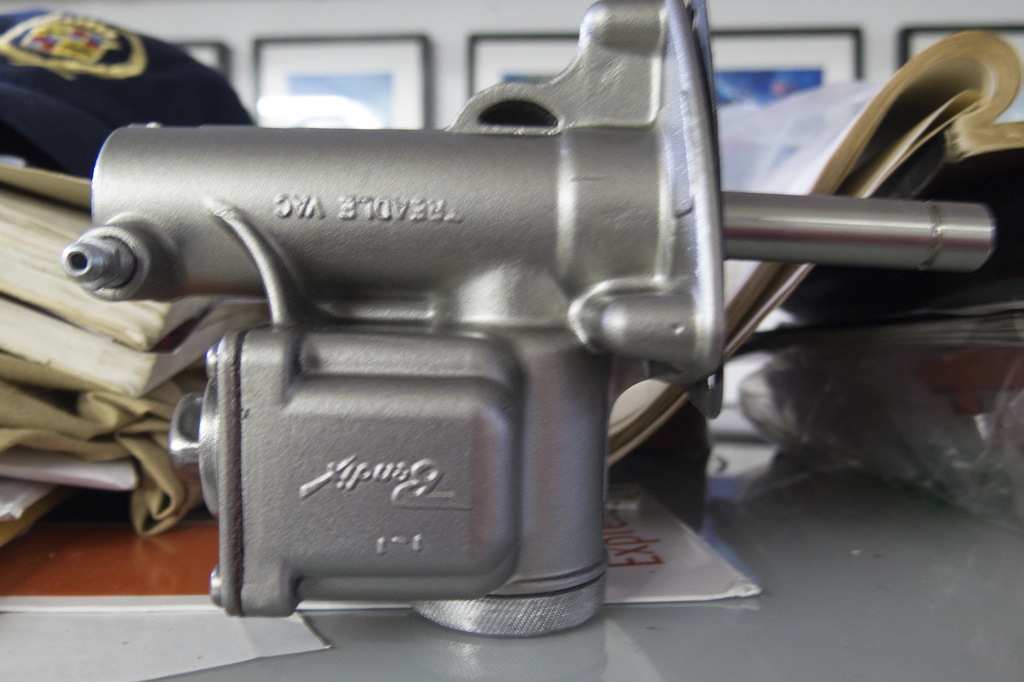
The master cylinder with paint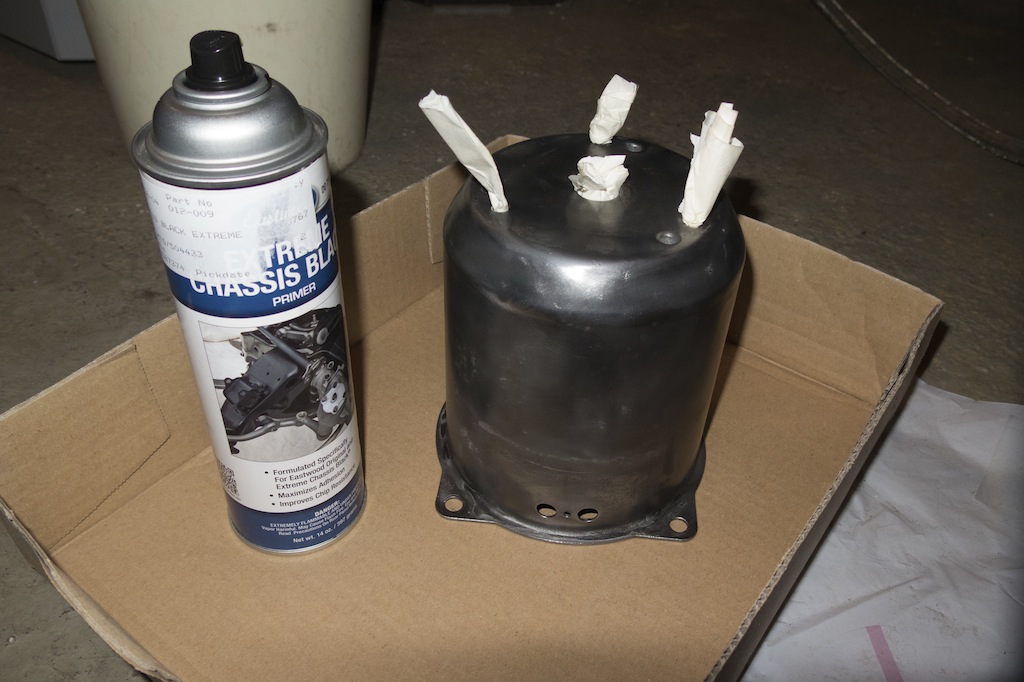
The booster in bare metal before primer. I used Eastwood Extrem Chassis Black primer and paint.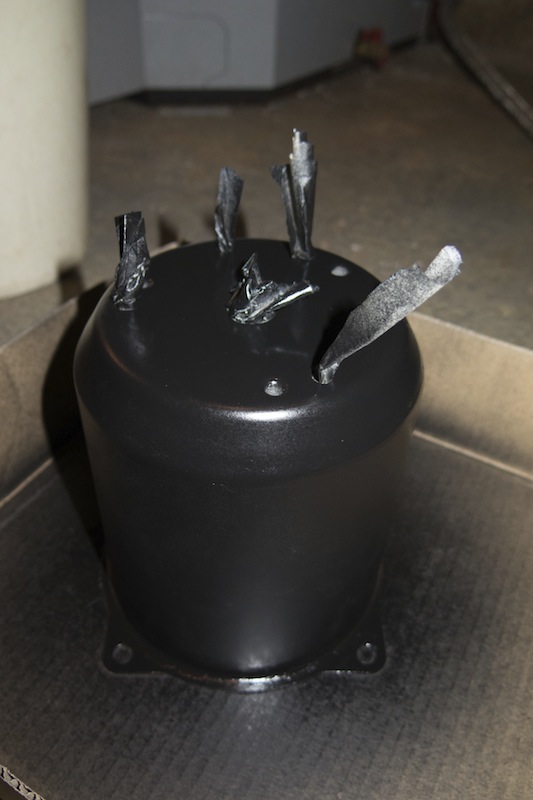
In primer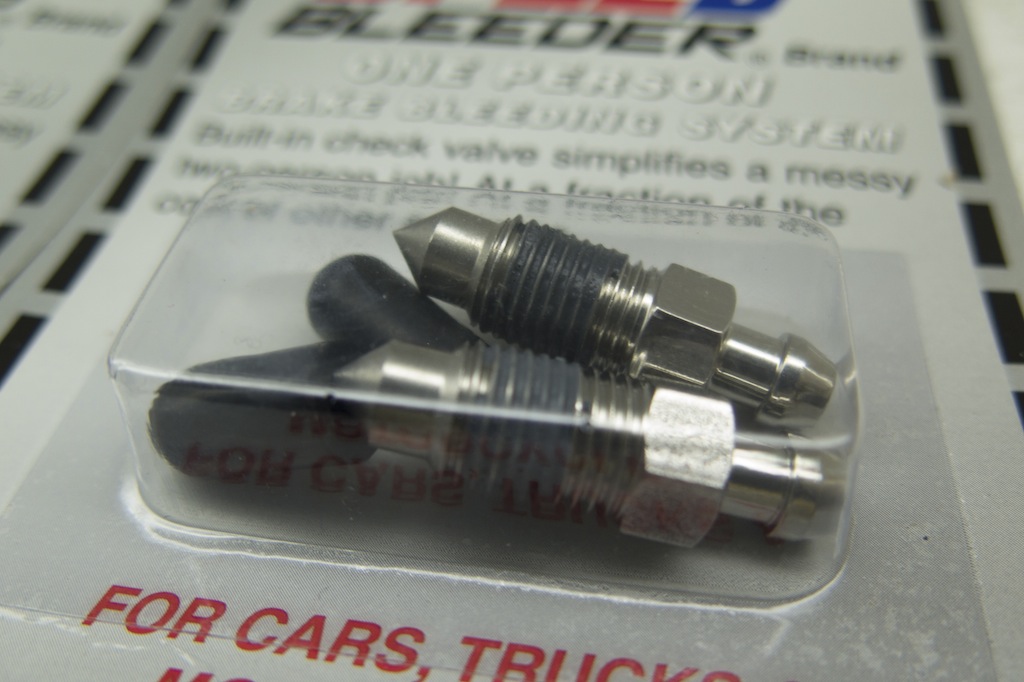
Speed Bleeder screws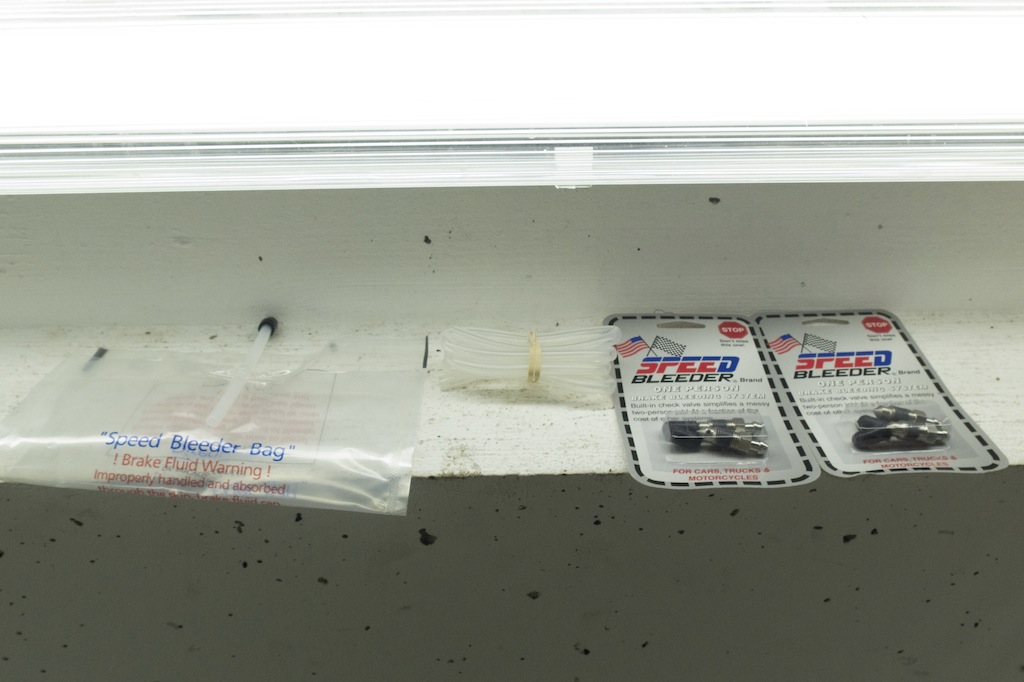
Speed Bleeder screws and bag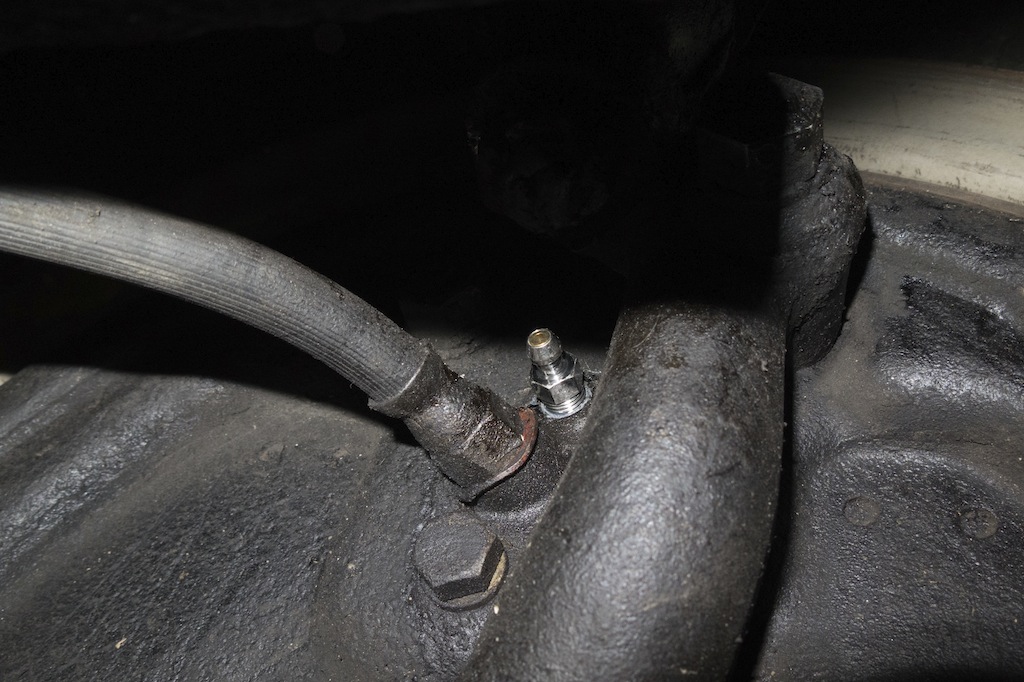
The new Speed Bleeder screw in place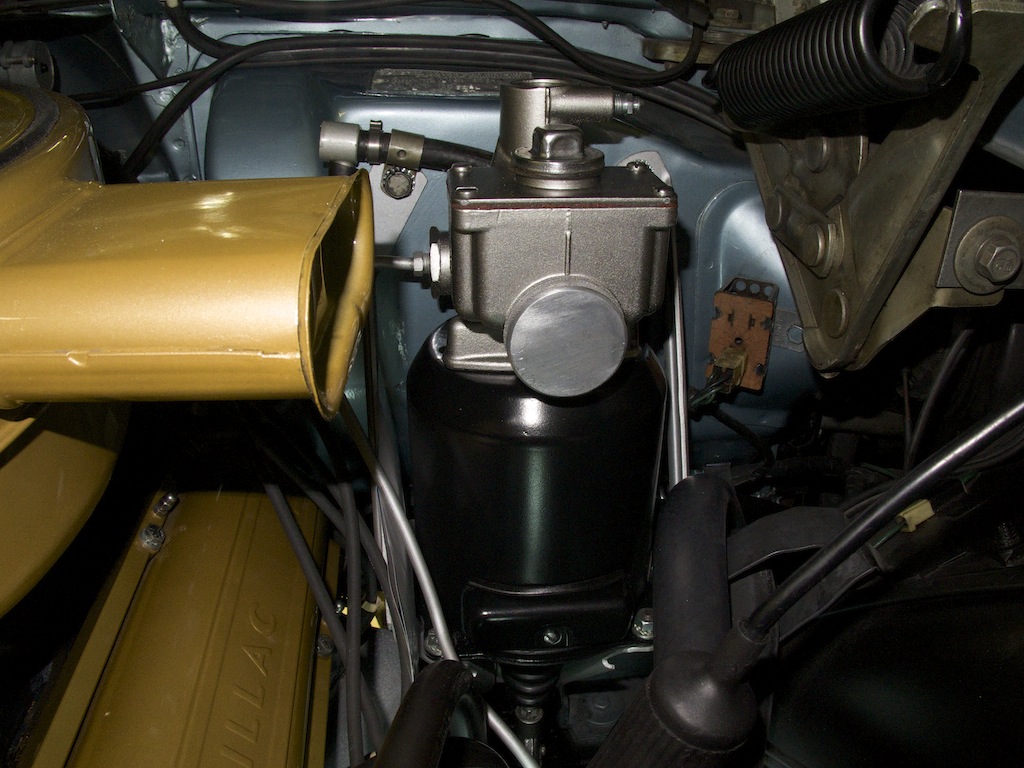
The reassembled unit back in the car.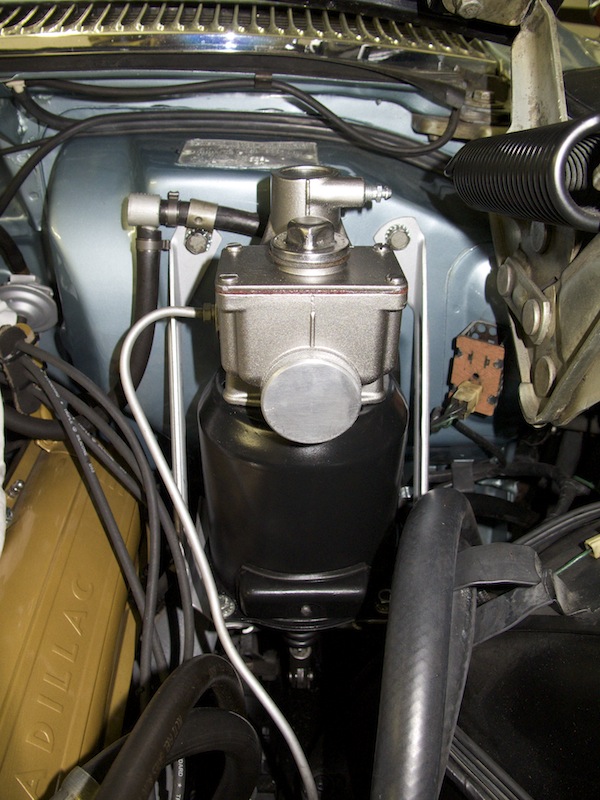
On the road again - Season 2013 begins
Lets hope for some really nice weather this summer and that I will have enough time to drive and enjoy my cars.
The 58 Seville came out first and needed some new brake fluid and a complete flush of the brake system and a thorough bleeding. Thankfully my wife helped me pushing the brake pedal while I was doing the bleeding procedure under the car. Its great to have such a lovely helper! Thanks darling!
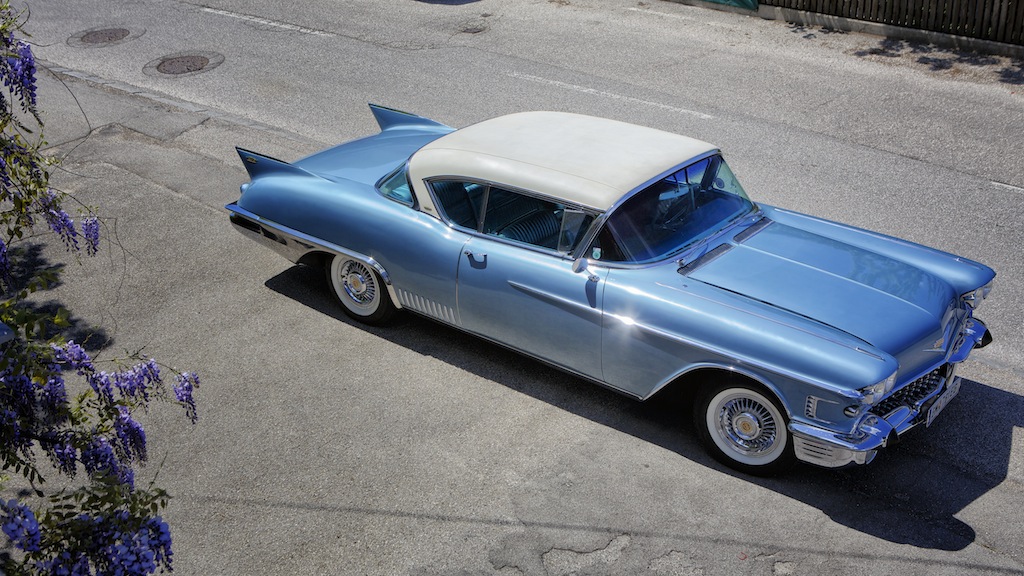
My 1958 Seville on one of the first spring days
A visit to Toms Club - The Mark III is back home
Tomsclub has a great restoration service and besides the Cavalry Twill roof repair they also did some other work on the car like repairing the carburetor base plate, adjusting the ignition and other little tune-up things. The quality of their work is exceptional.
My Mark III made the 400 Mile trip home without a problem and turned out to be pretty fuel efficient on the highway at a steady 65mph. It averaged 21 mpg - which is really good for such a car.
Tom Witzel is famous for his awesome collection of the finest Cadillacs and Lincolns. If you want to buy the best of the best low mileage cars you should check him out. He really has the finest cars available. They of course are not cheap on the first look - but worth every cent in my opinion. Tom gave me a tour through his inventory and I was just blown away by his cars. I did not take many pictures - below are a few:
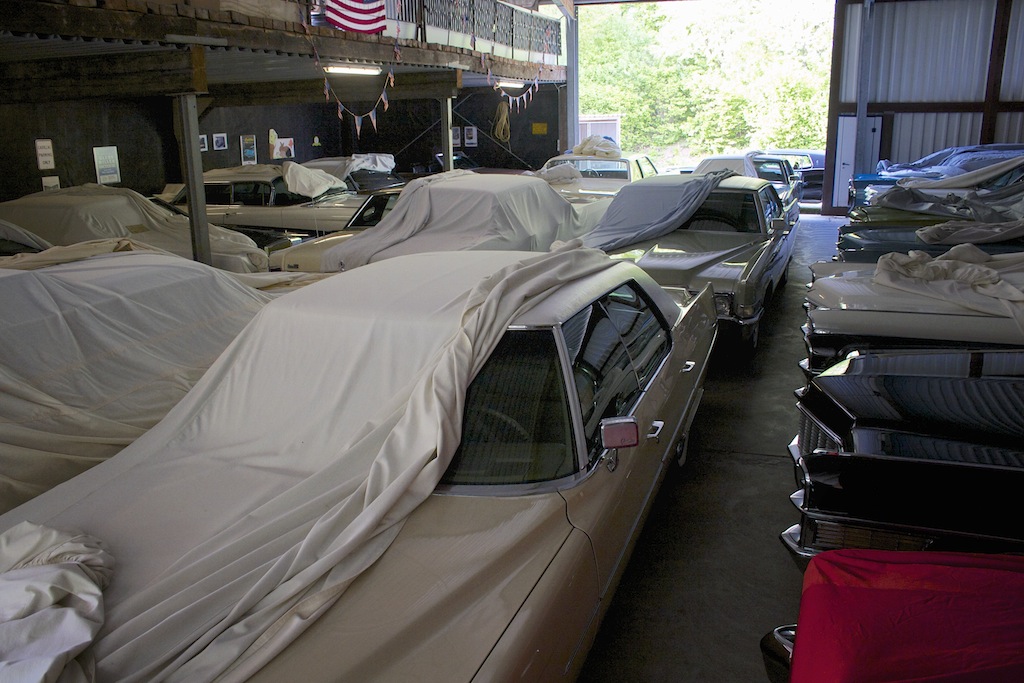
A part of Tomsclub inventory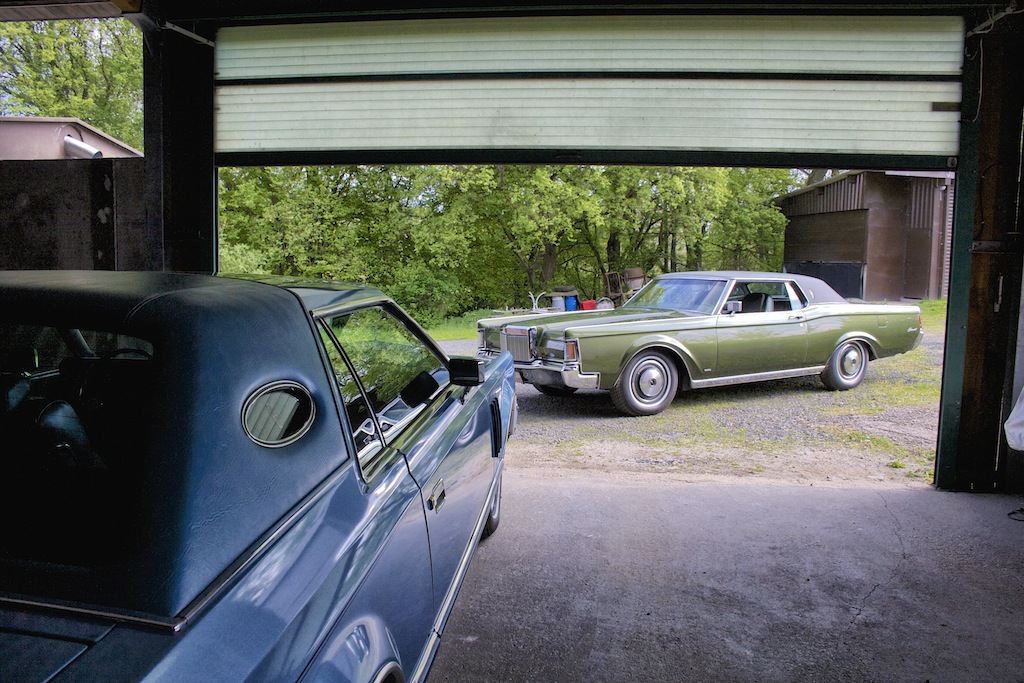
A fantastic 1971 Lincoln Mark III and a 1977 Mark V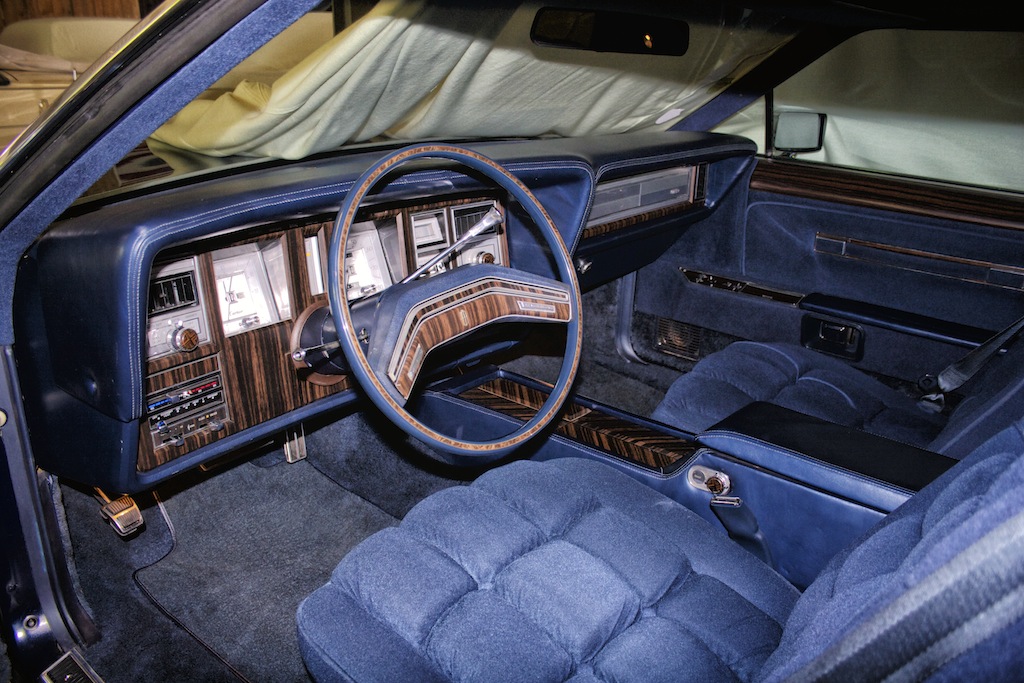
A spectacular super low mileage 1979 Mark V - only 4.500 Miles!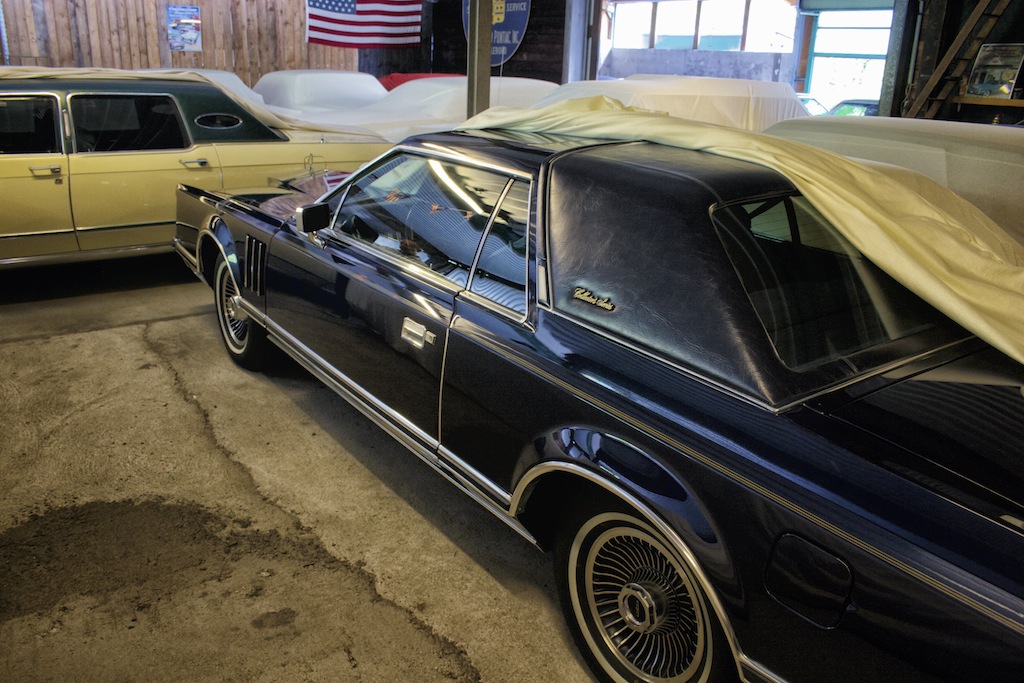
A spectacular super low mileage 1979 Mark V Collectors Edition - only 4.500 Miles!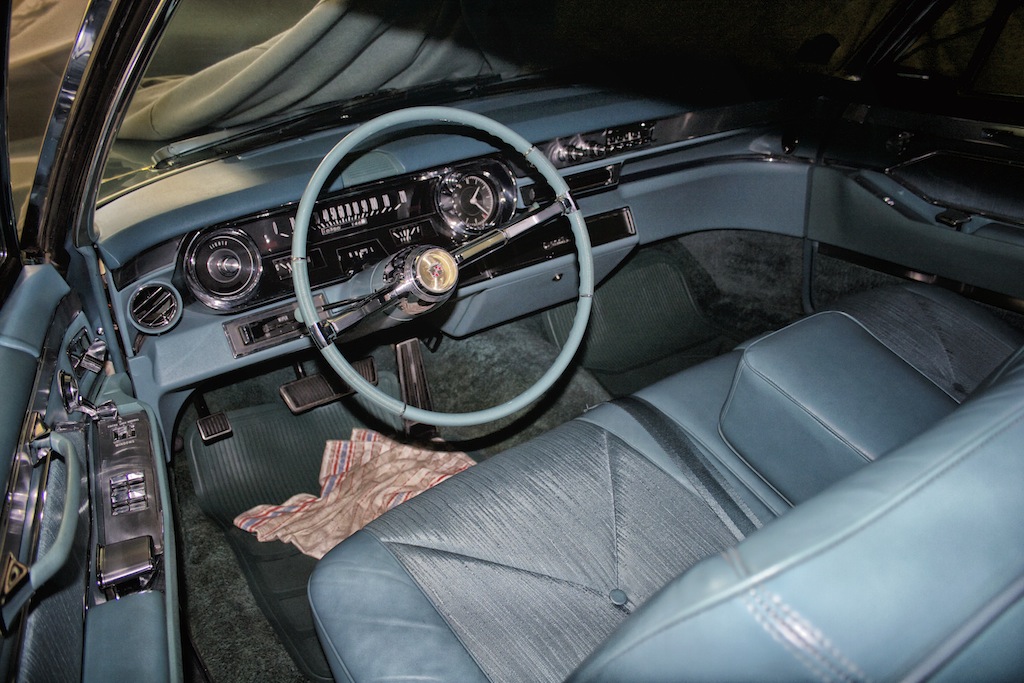
One of the many cars I would have loved taking home was this 1965 Coupe de Ville! Awesome! It looked like new inside and out...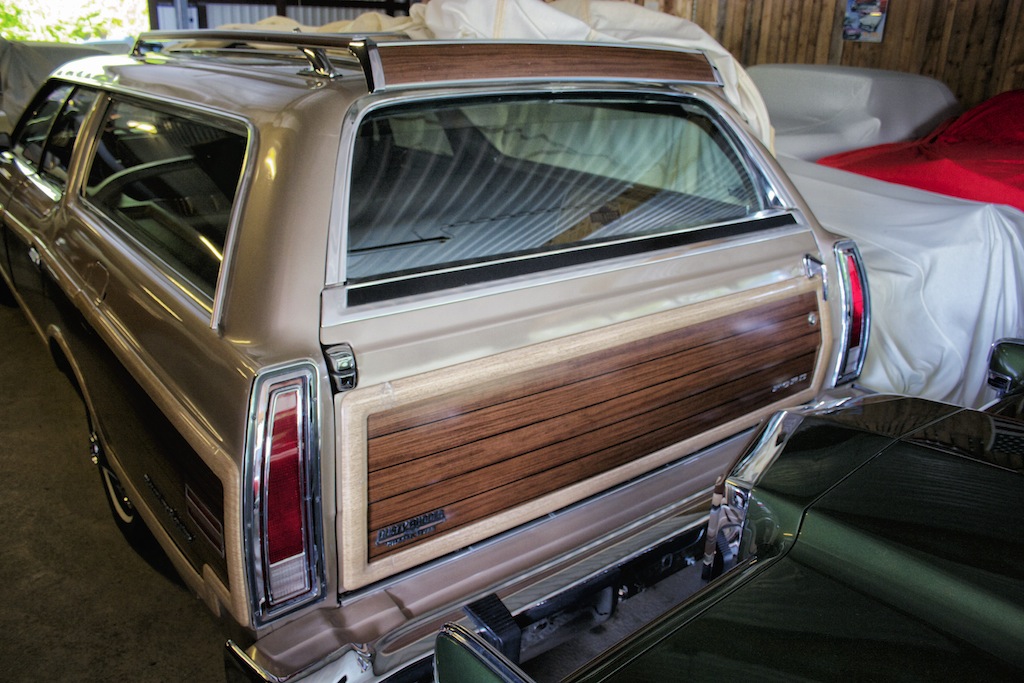
I have a soft spot for old Station Wagons - this 1978 Ford Country Squire just blew me away.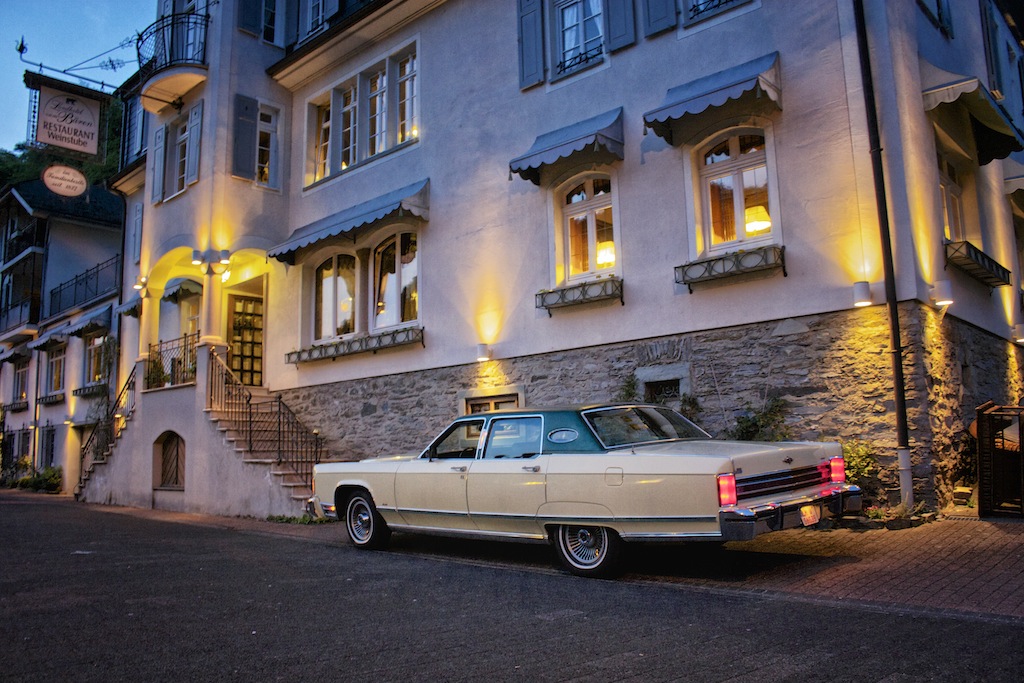
In the evening at the restaurant - Tom Witzel arrived with this awesome 1977 Town Car.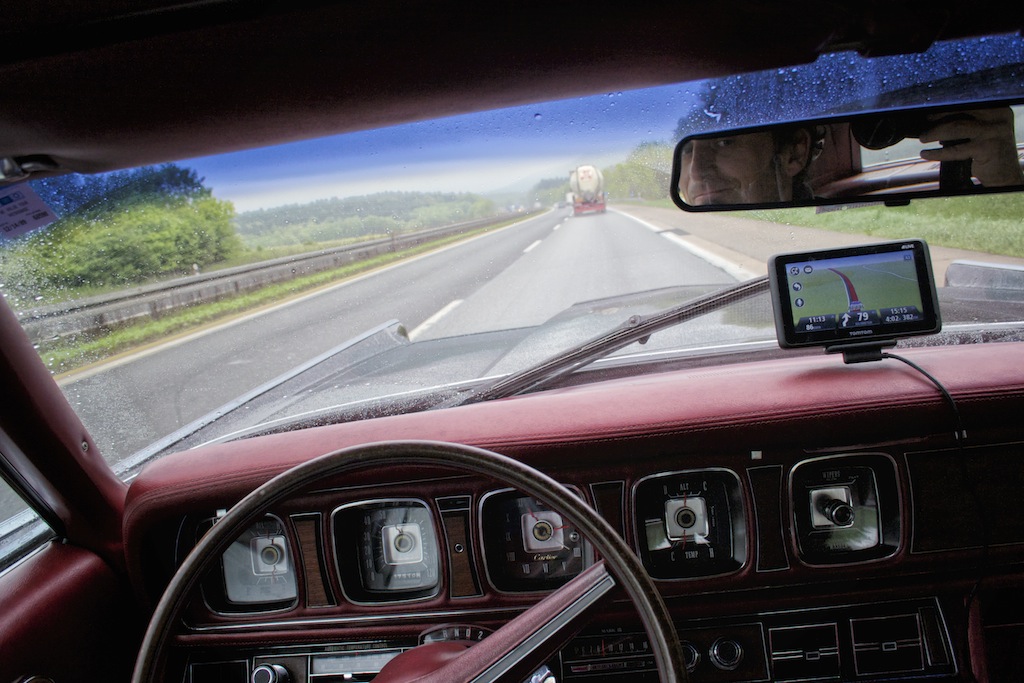
During the almost 400 mile trip home with my Mark III - it drove like a dream! Too bad it was raining... Fuel efficiency was pretty good - 21mpg!
Front wheel bearings replacement on my 1967 Cadillac DeVille
As we had the first really warm and sunny days this weekend, I took the car out of storage and put it into my old garage to do the work. It's a pretty easy job on the 1967 Deville - you do not even need any special tools or presses.
I got a set of inner and outer wheel bearings for both front axles from Rockauto.com - I got a set made by “Moog“ as I have heard good things about their quality.
You just have to remove the tires, remove the pin at the axle, remove the big nut and pull off the brake drum. The outer bearings can just be pulled out - the inner bearings have to be tapped out with a long screwdriver, as they are held in place by a dust cap. A very slight tap is all it needs to get it out. I cleaned everything and put the greased new wheel bearings in and put everything back together. I also readjusted the front brakes and also found that one of the new brake hoses was a little loose and loosing a little brake fluid, so I tightened it.
As I had the front wheel tires off the car - I also cleaned the entire front suspension and detailed it. Everything is squeaky clean now again. No more noise is coming from the wheel bearings now…
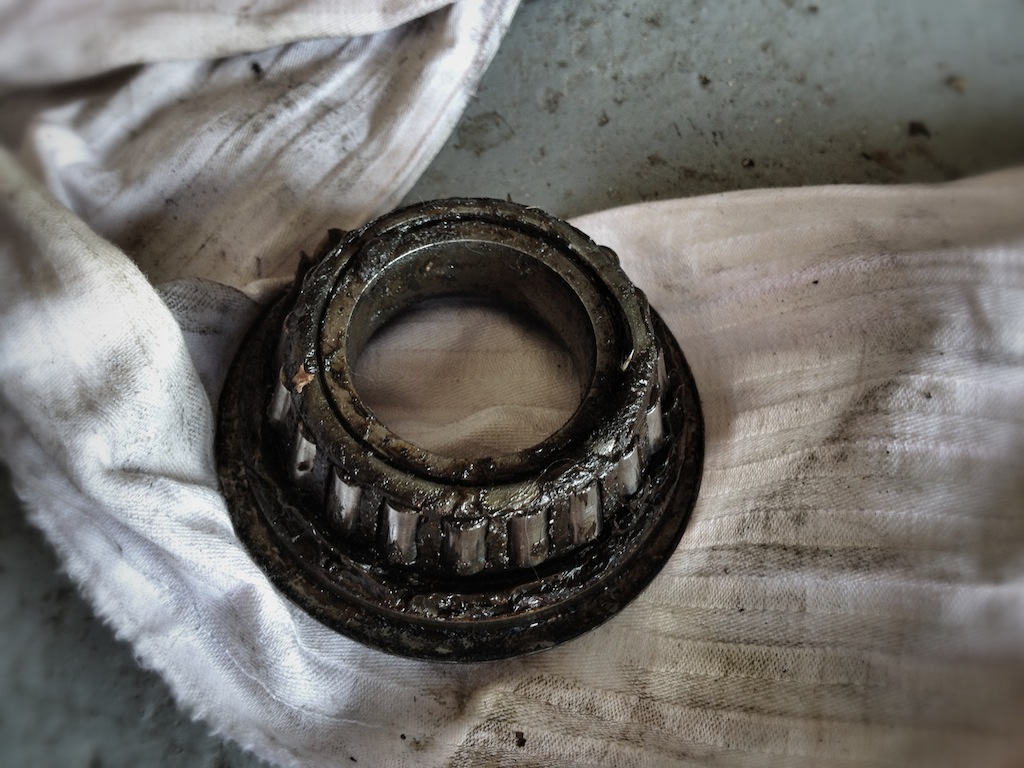
The old inner wheel bearing is out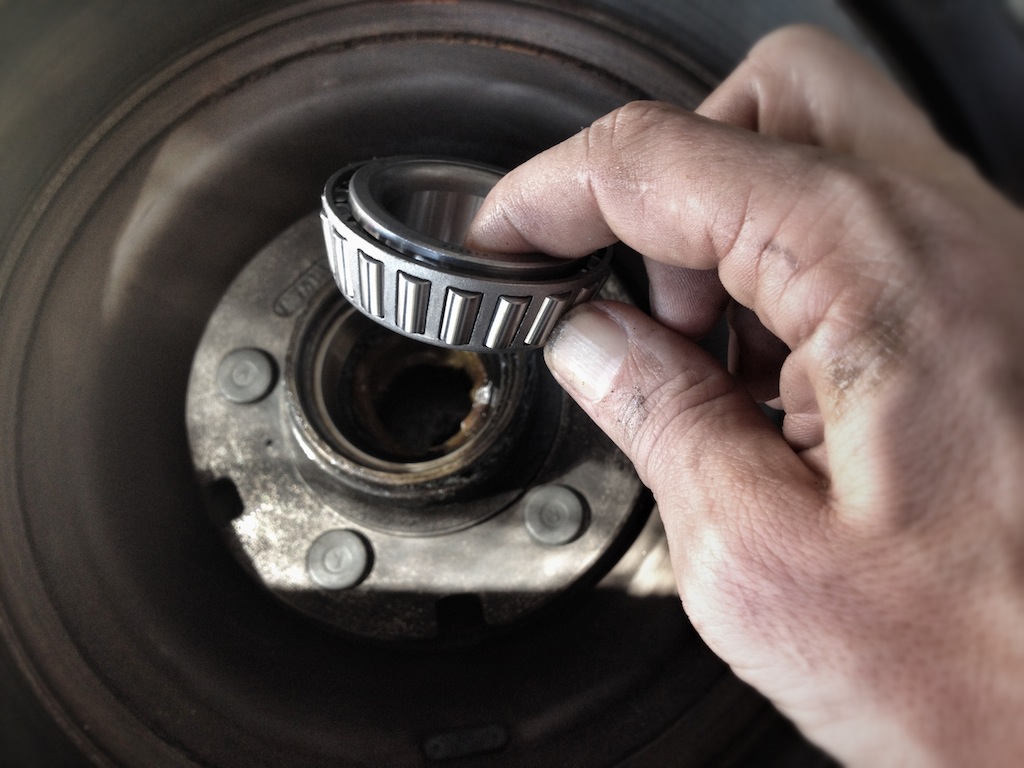
The new inner bearing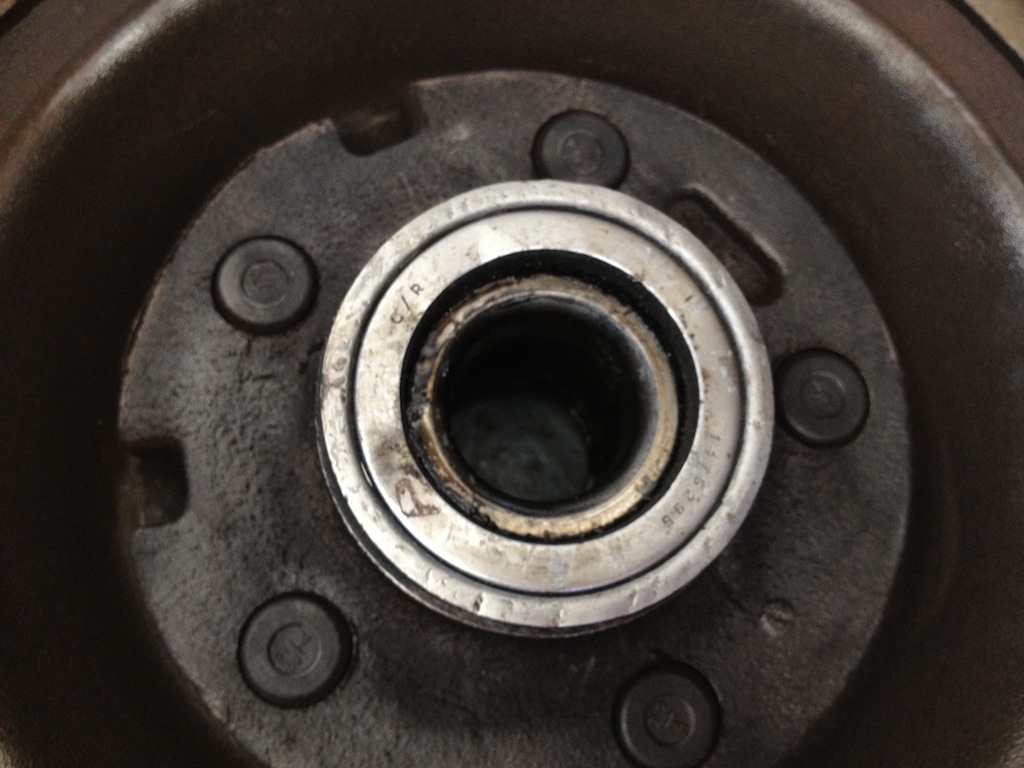
There is a dust cap which you have to tap out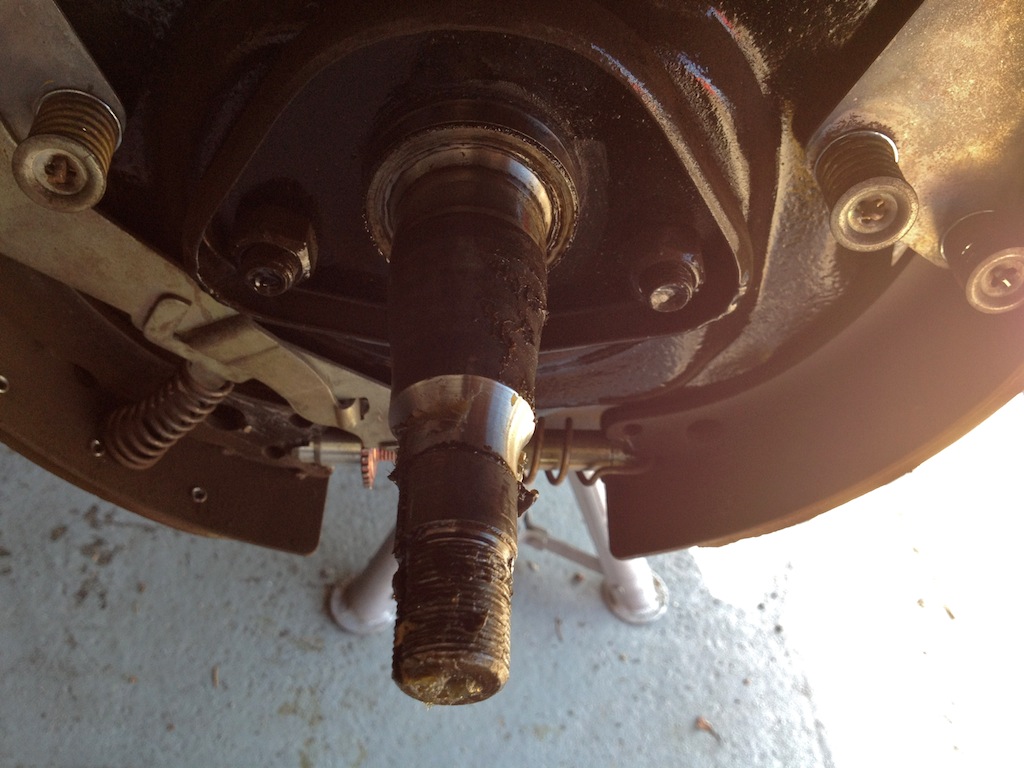
the front axle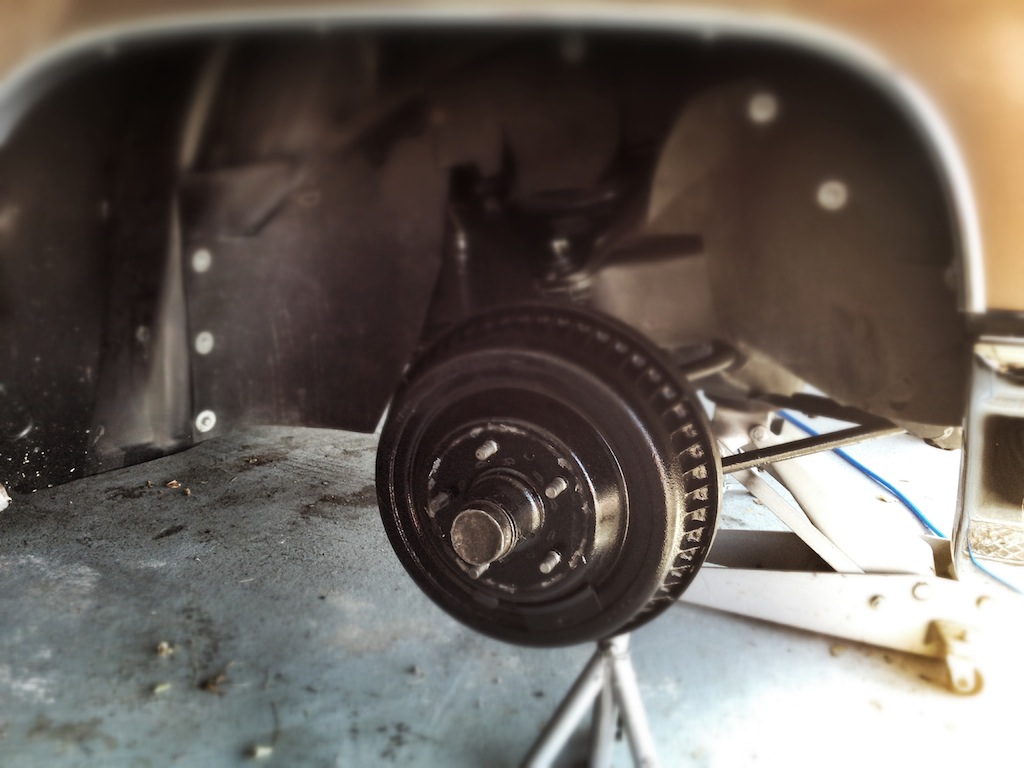
Back together - before detailing the wheel housing and front suspension
Outlook to the 2012 season - doing the first repairs 2012
The following work is planed for the next few months before the cars will be put back on the road in May 2012.
1971 Mark III
- new vinyl roof (the original one was damaged during transport and the insurance will pay for a new one)
1967 DeVille
- needs new front wheel bearings (I already have the spare parts)
- will try to find a rebuilt OEM Bendix master cylinder and vacuum booster. These are very difficult to find. Everybody seems to offer Delco Moraine parts only. I have replaced my original booster and master cylinder 2 years ago and I´m not quite happy with the power assist of the new units. It seems that the after market master cylinders from Delco have a smaller bore diameter and therefore you will have to depress the pedal with more force. There is a discussion going on on the topic of finding the correct booster and master cylinder in the CLC forum - check it out for more detail! If you know where I could find a correct Bendix booster and master cylinder or where I could get my original core rebuilt, please let me know!! The parts number for the Bendix Master Cylinder is #1489981 and for the Bendix booster it is: #1489071
- re-adjust the gear indicator as it's slightly out of line.
1967 Eldorado
- I will remove the starter motor and have it rebuilt - it sometimes is acting up
1958 Eldorado
- It needs some new front wheel bearings as well. I already bought the parts.
I will of course post the repair progress here on my website
A new garage?
The biggest planned project for 2012 will be to find a solution for my storage problem. I hope to be able to build another garage or to rent one. I will have to find a solution until the spring of 2012. I´m dreaming of building a building which can hold 8 Cadillacs, but I do not know yet if I will be able to afford it...
Car Shows
I hope to attend and visit the „Klassikwelt Bodensee“ from May 17th to 20th and of course the best meeting in Europe - the Cadillac BIG Meet August 25th to 26th. I will also hopefully make it to some local shows here in Austria.
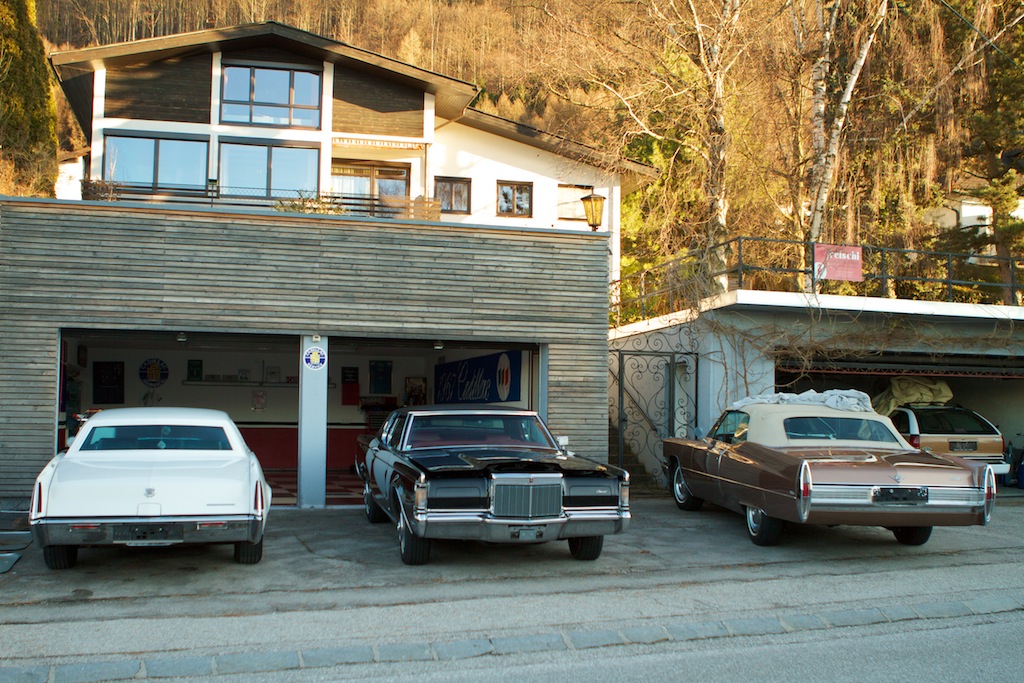
As we had a dry winter day I took the cars out of the garage - they fired right up after some months of sleeping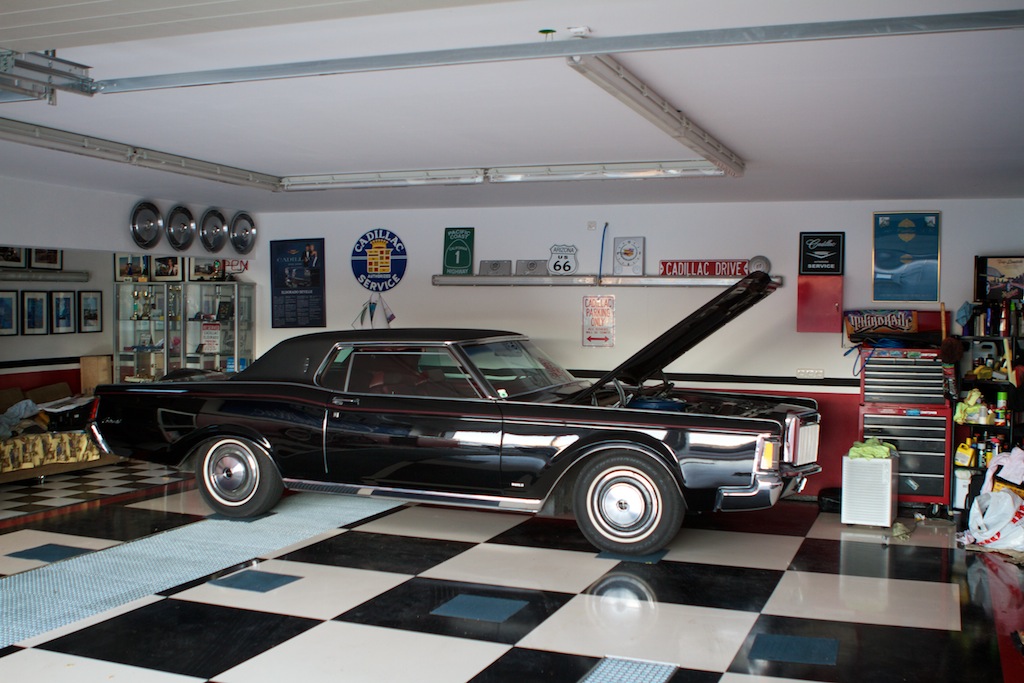
The Mark III was moved to the back of the garage, so that I can start working on the other cars first
Little Elliot loves Daddy´s cars as well ;-)
Cadillac BIG Meet 2011
My wife and I are part of the organization team together with some good friends. At this years addition we had the theme “Cadillac meets Lincoln“ and so we invited Lincolns to the show field. My own Continental Mark III just got ready for the show a couple of days before the show, so I drove it there along with my 1958 Eldorado Seville which was piloted by my friend Tayfun.
On Saturday there is always a cruising tour limited to 40 preregistered cars. When we arrived at the host hotel lots of people were surprised seeing me arrive in a Lincoln ;-)
30 minutes before the tour started, suddenly the 58 cut out and did not want to start again. I once again suspected a clogged fuel line and we blew the line through. Unfortunately it did not help at all - the line was free. With the help of Lucky (a fellow 1958 Biarritz owner) we disassembled the fuel pump and found out that the valve inside came loose and was no longer in its seat. Lucky put it back and the car ran beautifully again. It all was fixed in 15 minutes and the 58 was ready for the cruising tour.
At the show on sunday 133 Cadillacs and 11 Lincolns participated. There were many awesome cars on the show field, like one of the worlds best 1953 Eldorados, a spectacular 1958 Eldorado Brougham, lots of 59 Eldorados and everything else ranging from 1921 to 2011. The show was once again spectacular.
You can find all the pictures of the show here:
http://www.cadillac-meeting.com/english/pictures/pictures.html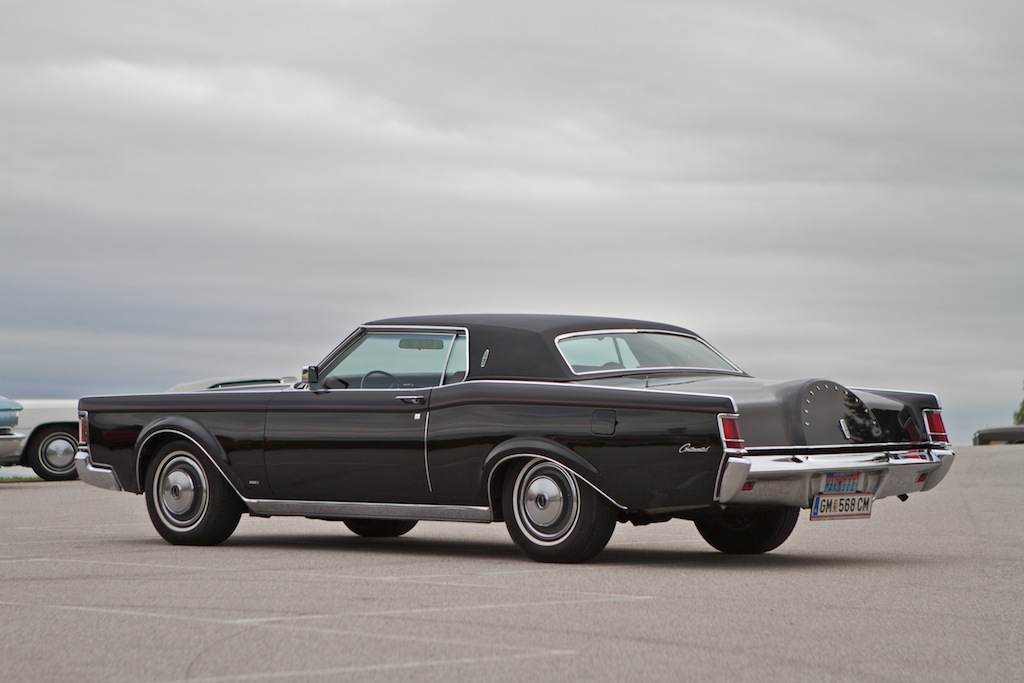
My 1971 Continental Mark III just before the start of the cruising tour.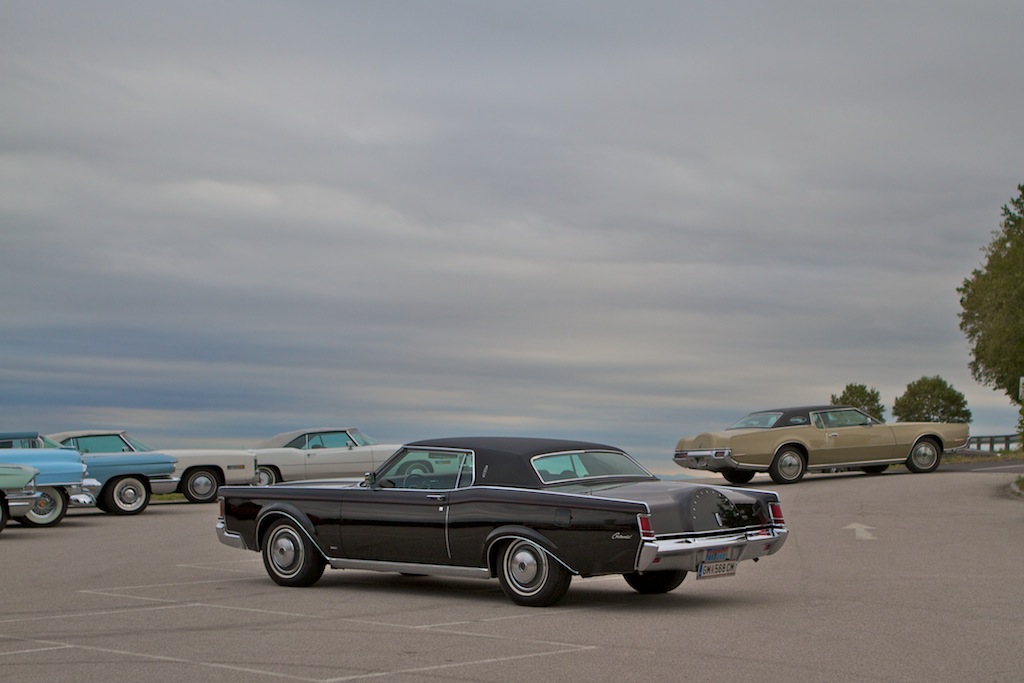
The cars are gathering for the cruising tour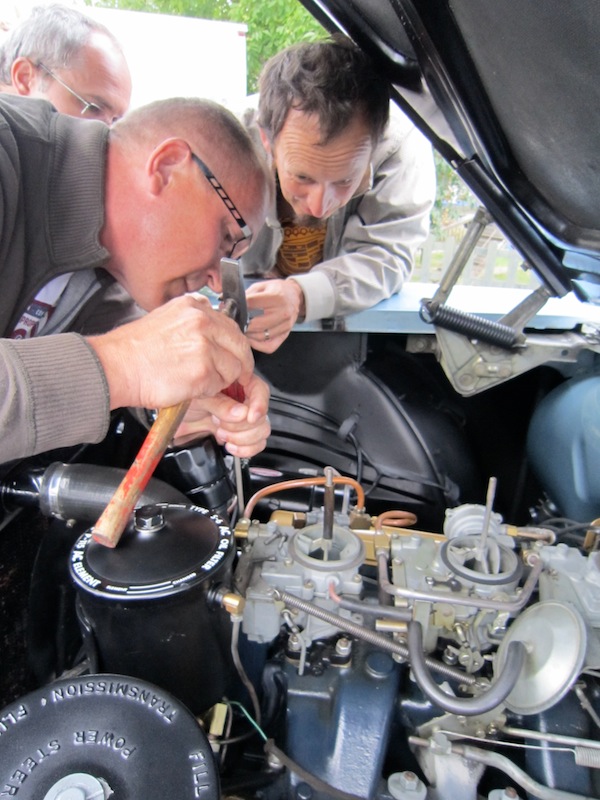
Lucky repaired the fuel pump of my 58 Seville 30 minutes before the start of the cruising tour - Thank you Lucky!!!!
My friends Claudia and Tayfun drove my 58 Eldorado Seville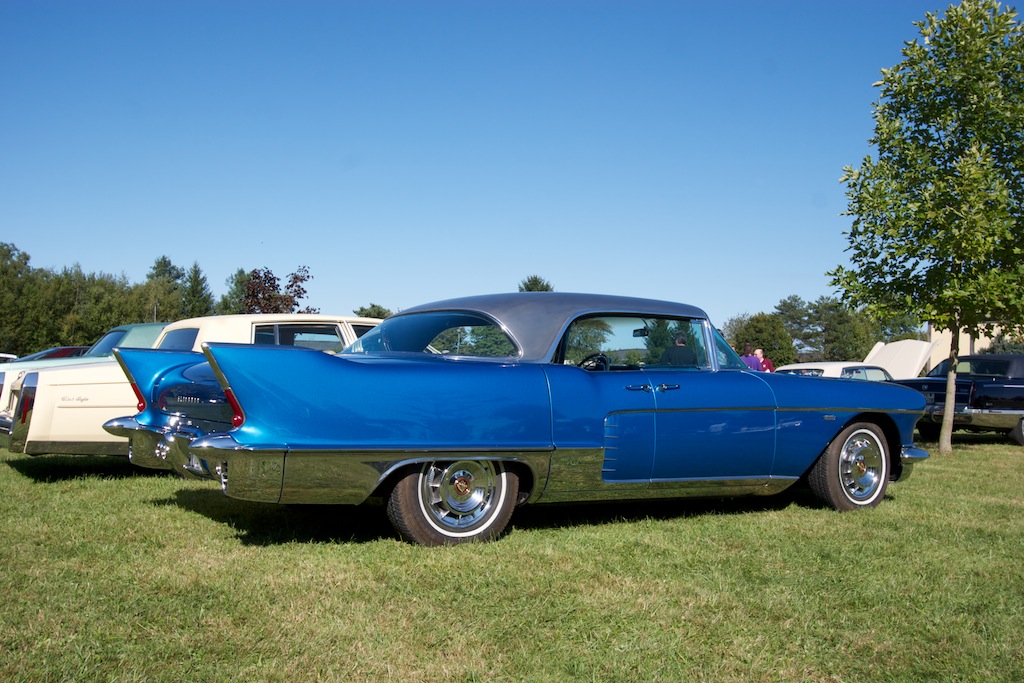
one of the many awesome cars at the show - 1958 Eldorado Brougham # 535 - my dream car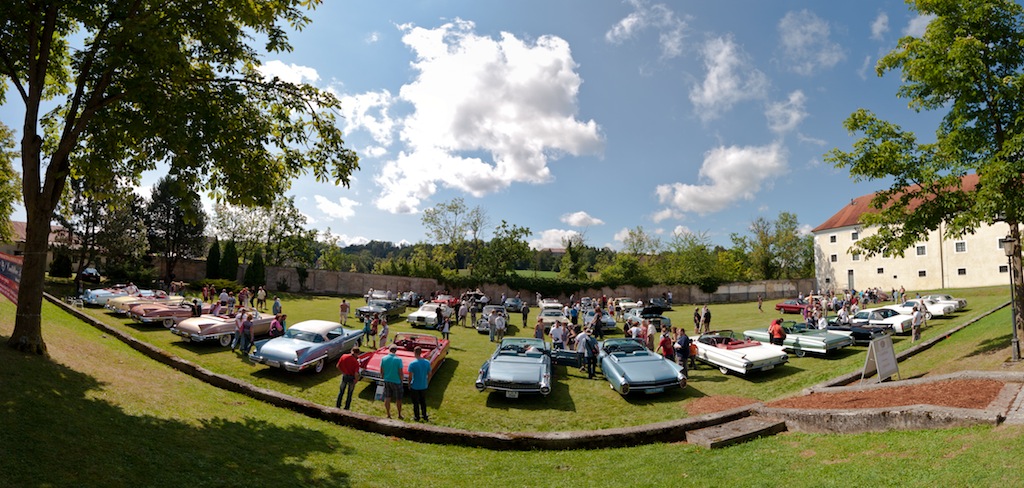
a small overview of a part of the show field at the Kremsegg castle
You can find all the pictures of the show here:
http://www.cadillac-meeting.com/english/pictures/pictures.html
Preparing the Mark III for the Cadillac BIG Meet
Luckily my buddy Tayfun volunteered to come to my garage for 2 full days to help me getting the car show worthy. Without his help I would not have been able to get the car ready in time. Thanks Tayfun!!!!
As I ran out of garage space my other great friend Richard helped me out and lets me store my 1967 Eldorado at his cool garage for a while - thanks Rick!!
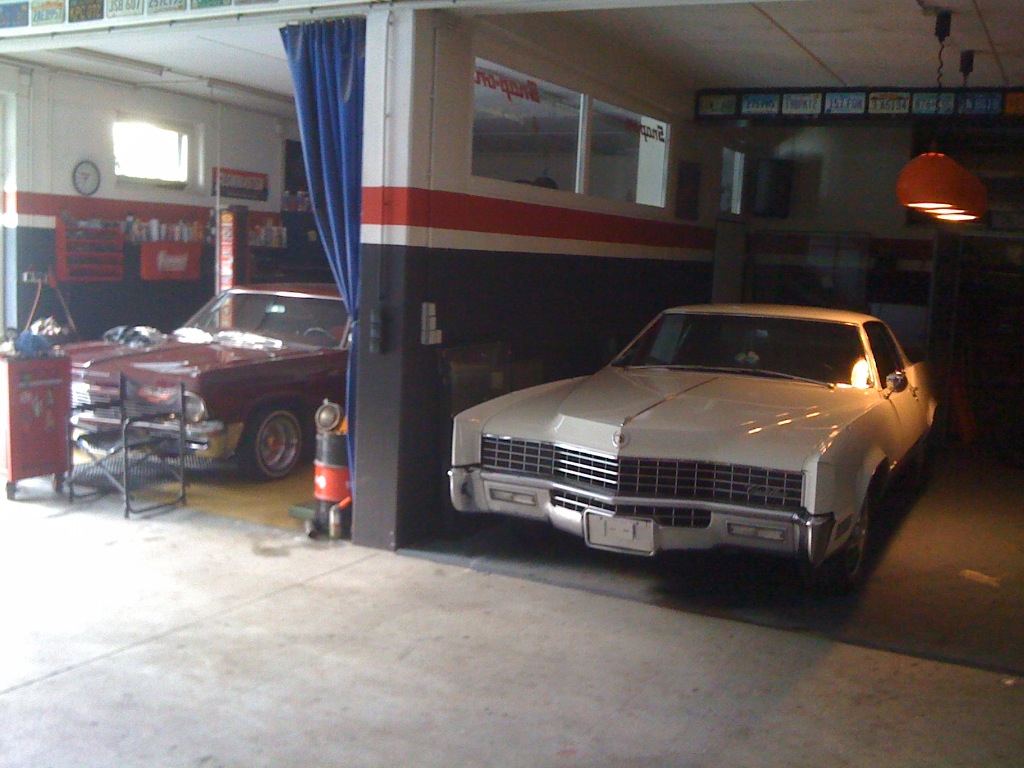
My 67 Eldorado is temporarily stored at my friend Richards garage until I find a solution for my storage problems - thanks Rick!
The Mark III needed the full treatment as it was very dirty from its long journey from the United States to Europe. It needed a complete interior treatment along with lots of paint detailing to look great again. So we worked until 1am in the morning each day. During these few days we had the highest August temperatures ever recorded, so a lot of sweat was produced...
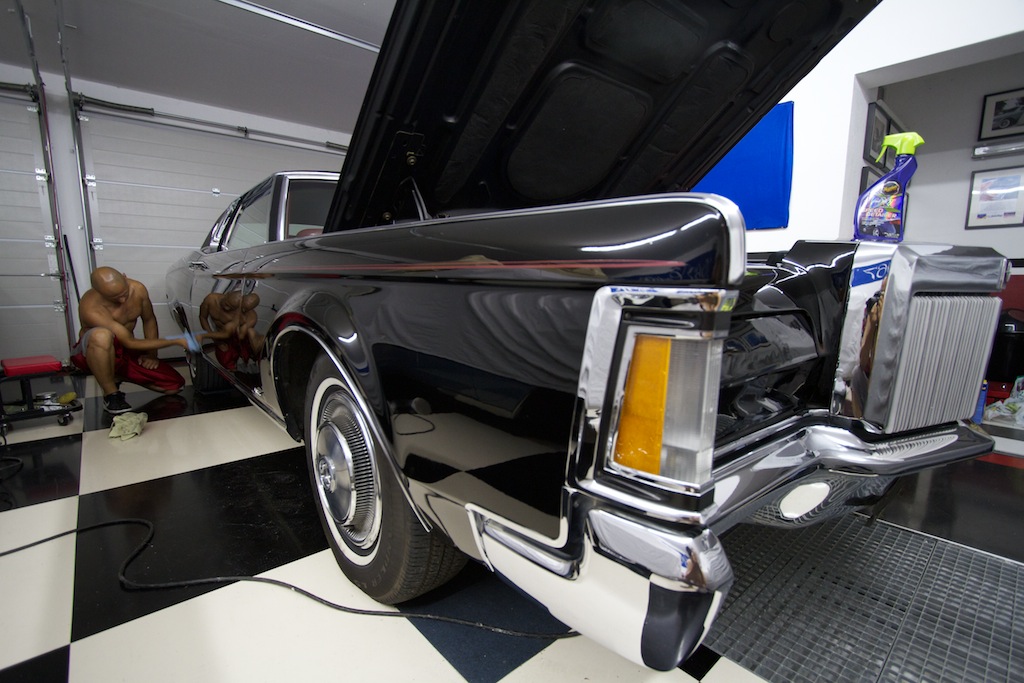
My friend Tayfun in the garage polishing the paint - around midnight...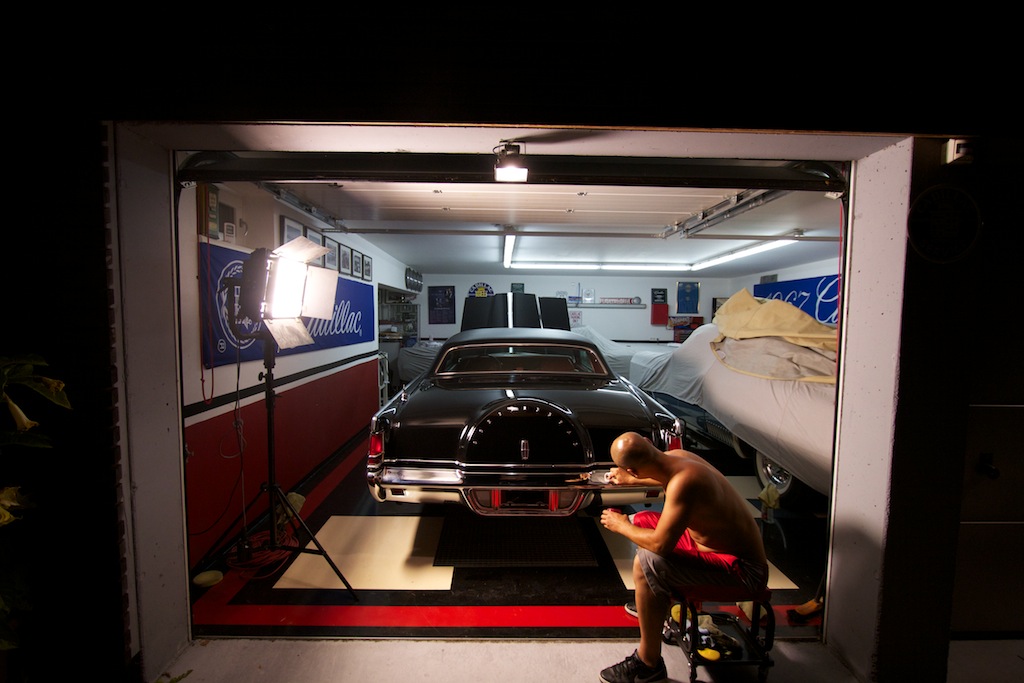
In the middle of the night - we set up some film light...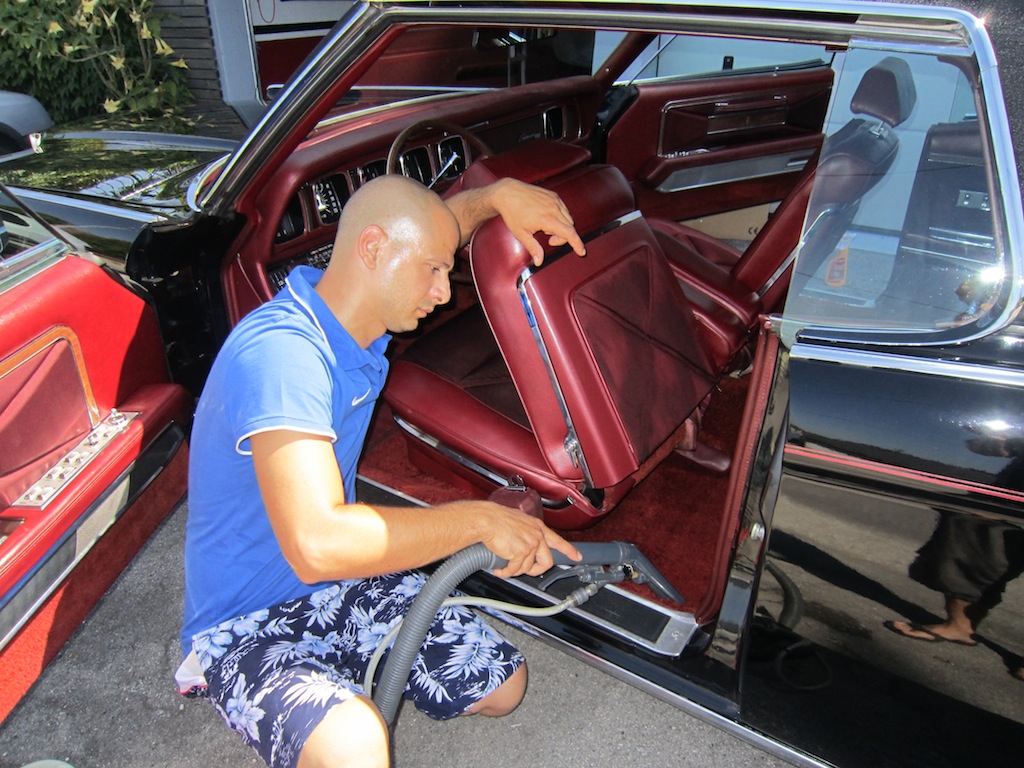
Tayfun wet - cleaning the interior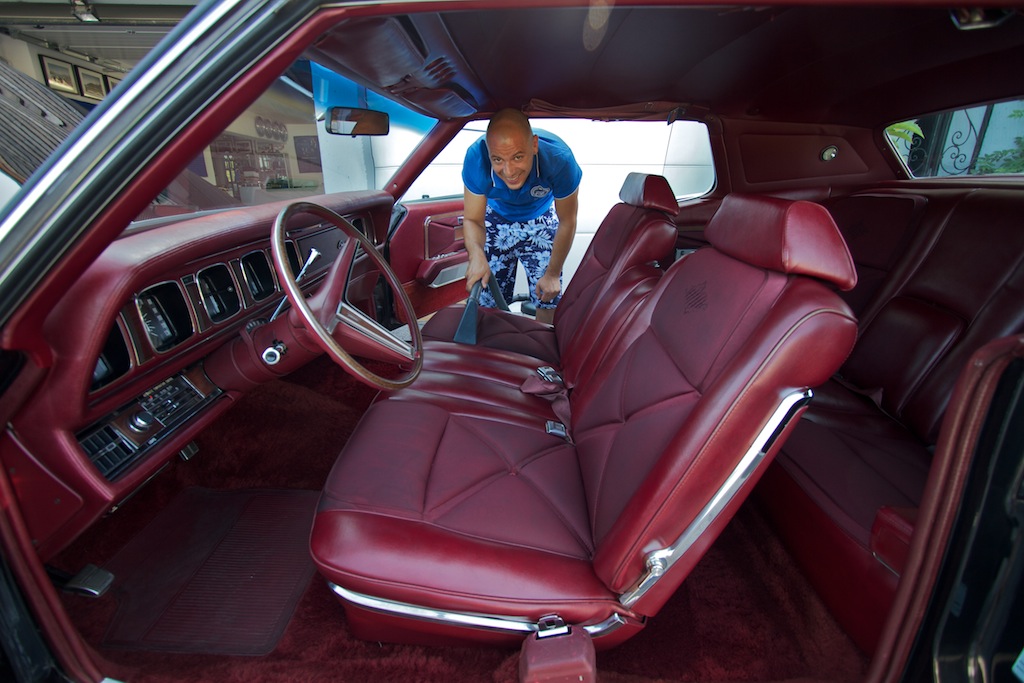
Tayfun cleaning the interior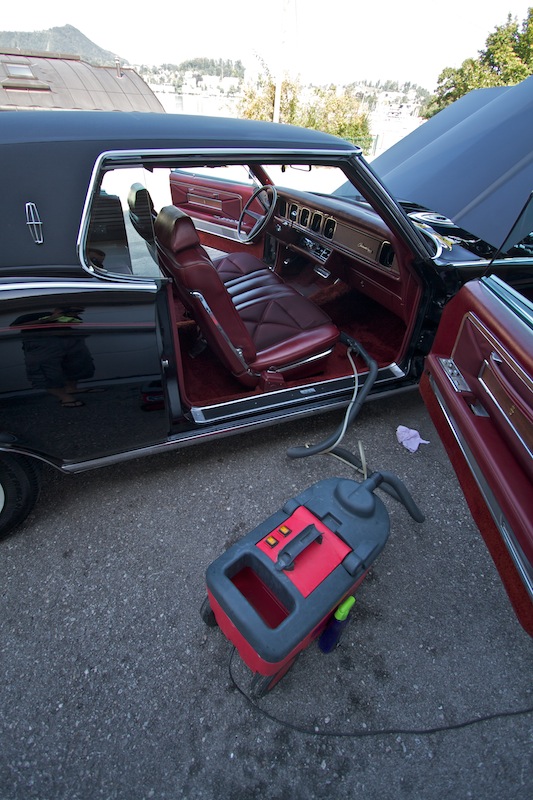
wet-cleaning the interior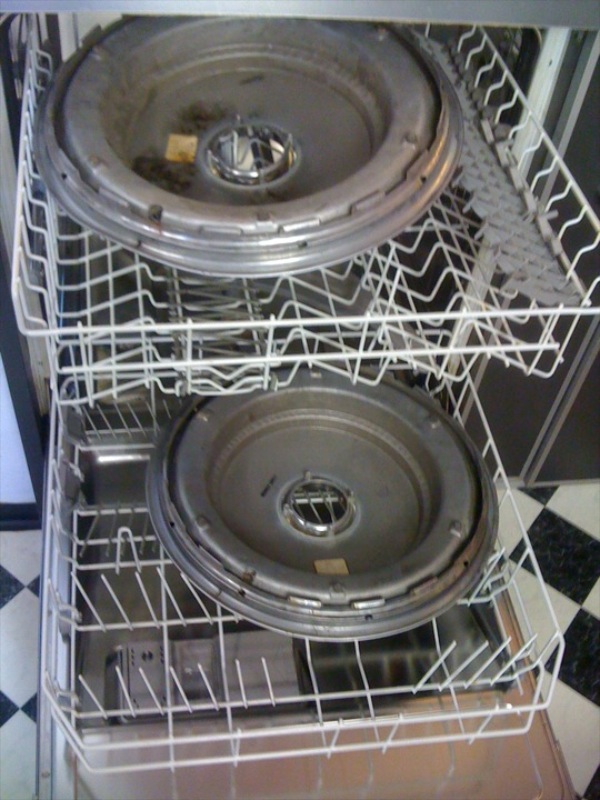
the hubcaps were cleaned in the dish washer - my wife was not very happy about this...
The Mark III now has an Austrian license
I had to install 4 new shock absorbers, all new brake hoses, 2 upper ball joints and 2 outer tie rod ends before it could pass the inspection.
The car then passed the test without a problem and I´m now having all the paper work in hands to have the car registered here in Austria.
The Mark III arrived today!
It arrived today - very unexpectedly when I got a call from a lady I know who is the manager of local gas station. She called me and asked if I would expect a Continental. She explained that a truck just stopped at her gas station to ask for directions to my home. Luckily I was still at home and so I jumped into the car to get to the truck driver and show him where I live, as he did not speak our language at all.
I then guided him through town and we started to unload the car close to my home.
When the car rolled of the truck I was shocked! The once perfect vinyl roof was badly damaged. It was immediately clear that it was damaged on the truck of the long journeys last leg.
Problem was that I could not really talk to the driver and write something down. I took lots of pictures immediately though. So I called the trucking company and they said that I should send them the pictures. The next day they called and asked why nothing about the damage was written down on the papers when I received the car and that they probably would not pay because of this!!!
Looks like I will need a good lawyer now to fight with the insurance company.
I got a raw estimate from a good upholstery shop here for the repair which is for 60 hours of work + material.
You have to remove almost the entire interior of the Mark III, including the rear window mechanism with the glass and most of the weatherstripping to get access to the fasteners which hold the moldings in place. Most of the plastic fasteners also are no longer available - so you will have to be very careful when you remove them.
The original top material of the Mark III was called “Cavalry Twill Vinyl“ and the only company which can offer a correct replacement top seems to be SMS Auto Fabrics http://www.smsautofabrics.com/products/vinyl-tops.php
The material alone costs 475.- + shipping. (price from August 2011)
Besides the damage to the roof during shipment- the car is really nice. It drives beautifully and everything works as it should.
I already delivered the Mark III to my restoration shop to prepare it for the inspection for the Austrian license. We will have to convert the lighting system to go with Austrian law.
The first inspection showed that I will also have to install 3 new brake hoses, 2 upper ball joints and both outer tie rods. Got most of the parts already from rockauto.com - only the front brake hoses seem to be difficult to get and very expensive. Luckily I found a shop on ebay where they are available for half of the price of what most Lincoln specialists are asking.
Here are some pictures of when the car arrived - it got extremely dirty from the transport unfortunately.
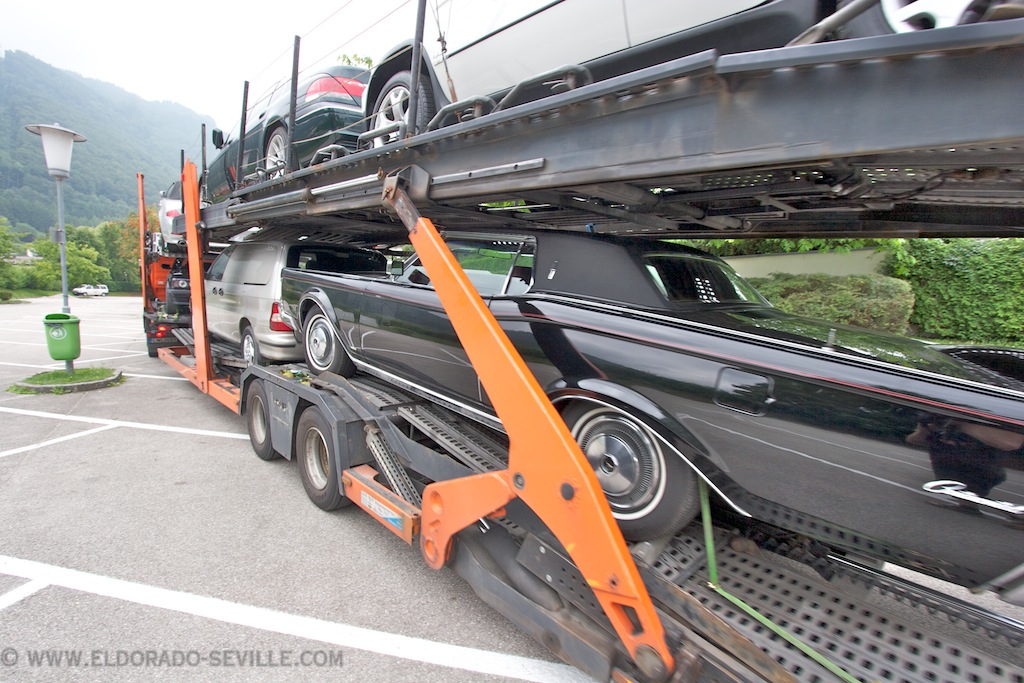
As you can see it was squeezed in pretty closely into the truck - watch the beam just above the vinyl top...
The damaged “Cavalry Twill Vinyl“ roof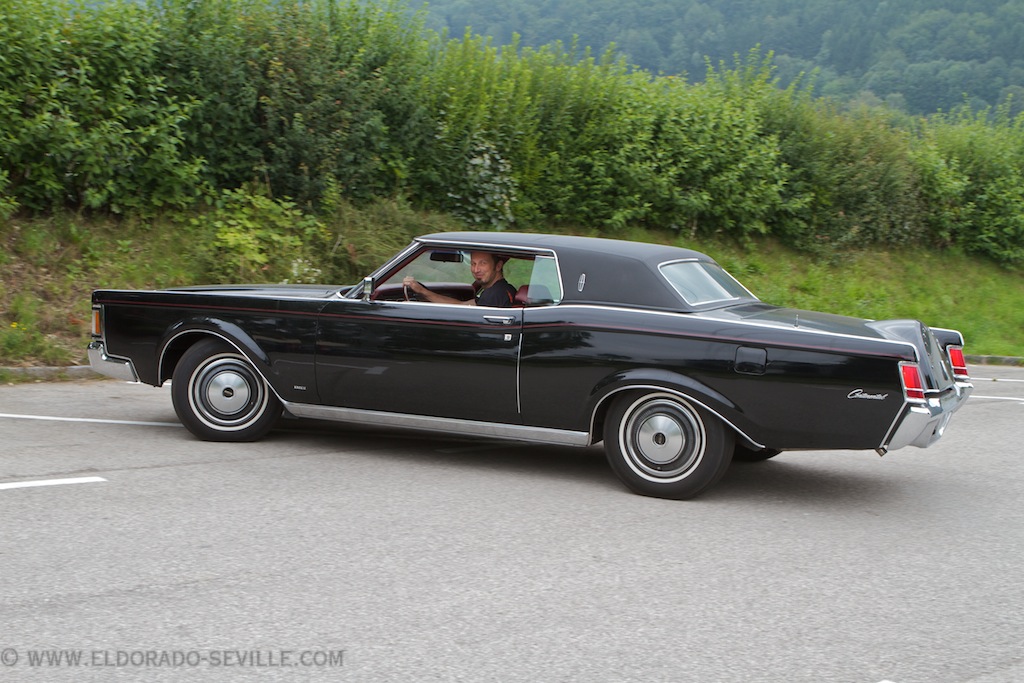
My first ride in the Lincoln.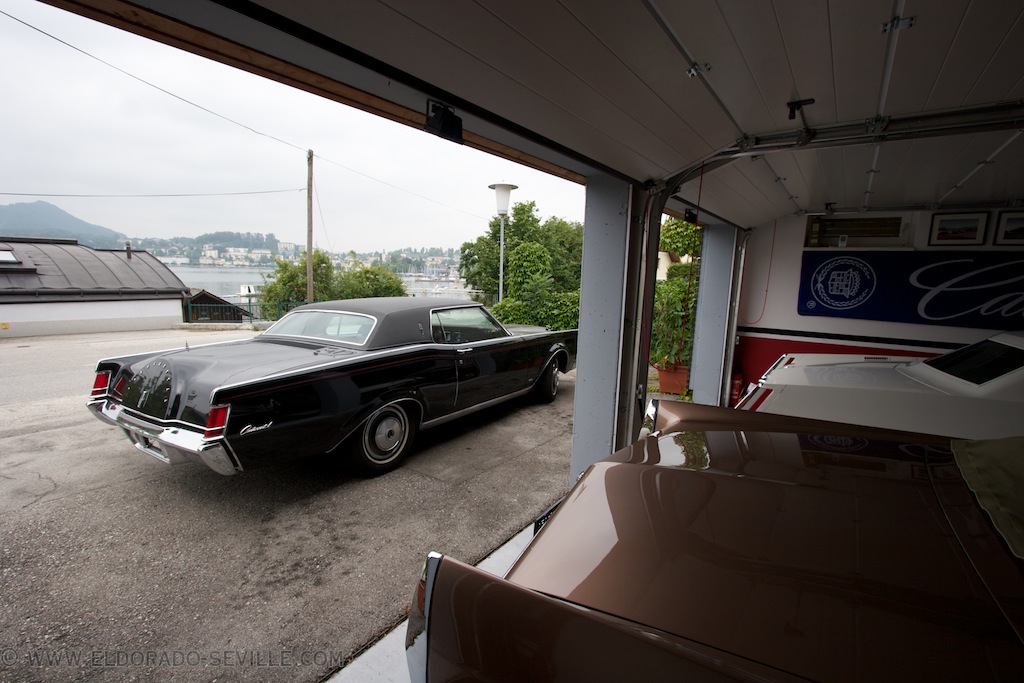
At home - saying “Hello“ to the Cadillacs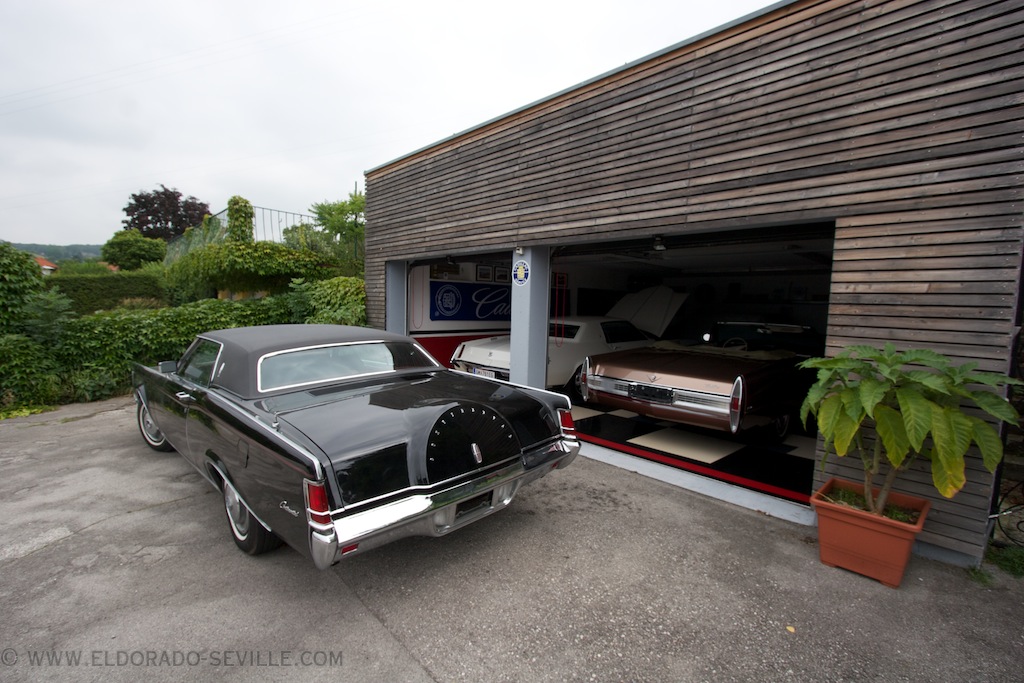
in front of the garage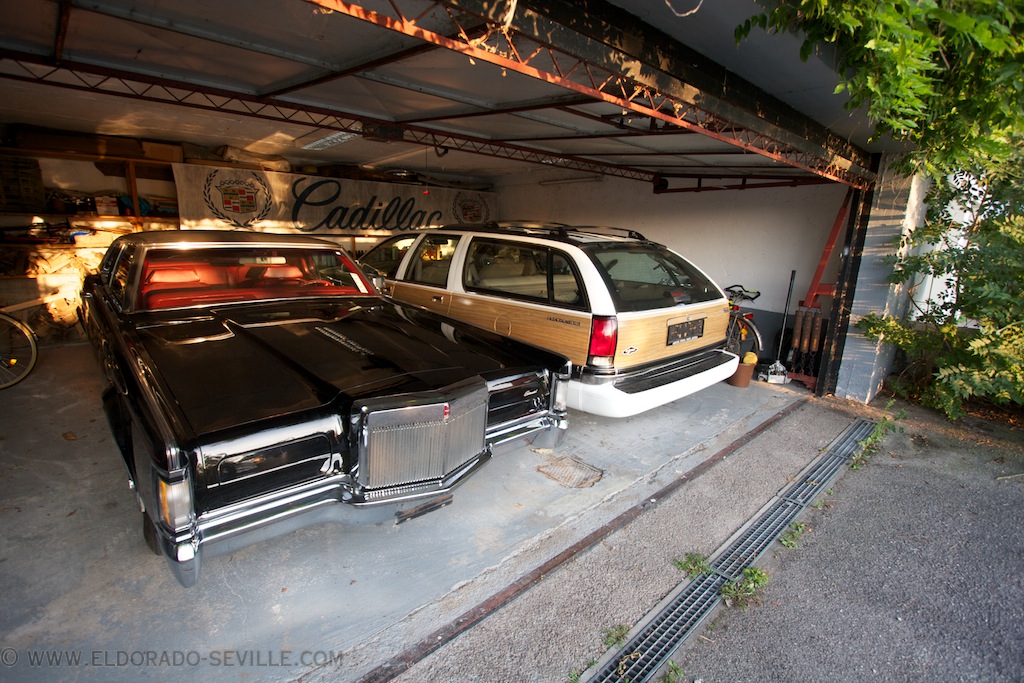
In my old garage - together with our Roadmaster
First sunset in Austria
Dressed for the first night...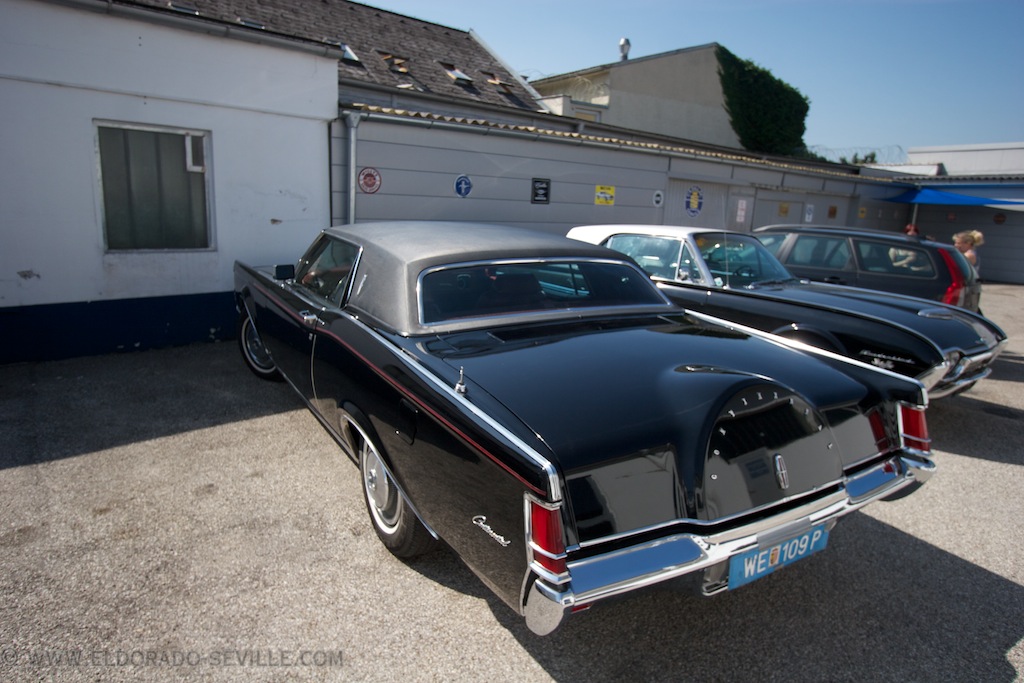
At the restoration shop - awaiting inspection
Replacing the rear shocks on the 67 DeVille
The right shock came out pretty easily and as planned - it was great to work with Richards awesome collection of tools he has in his workshop. I could not help my friends as much as I would have liked as I had snapped one of my ribs two days ago while changing tires and so I cant even hold a wrench properly at the moment... So my great friends did most of the work for me.
As it turned out the new Monroe shocks I had bought were delivered with one wrong bolt - the other 3 bolts were correct though. Fortunately I had a correct bolt as a spare from another set I had bought. When we wanted to take out the left shock we ran into a problem with the top bolt which would not want to loosen up. Its also pretty difficult to get access to it - as it is hiding behind the curve of the exhaust pipe. After 1,5 hours of sweating and bad cursing it finally gave up due to the help of a heavy duty metal saw. The new left shock went in pretty quickly afterwards but then it was already 1 am.... Thank you my friends for your great help and support!
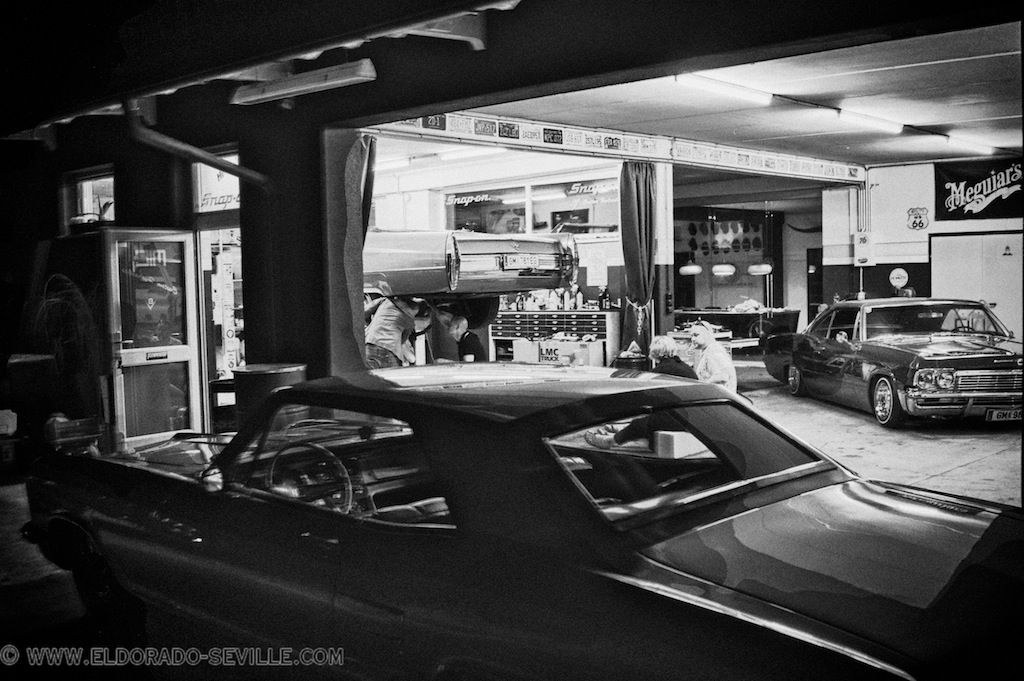
At work in Richards garage around midnight... In the background Richards 65 Impala and Alex´s 63 Riviera in the front...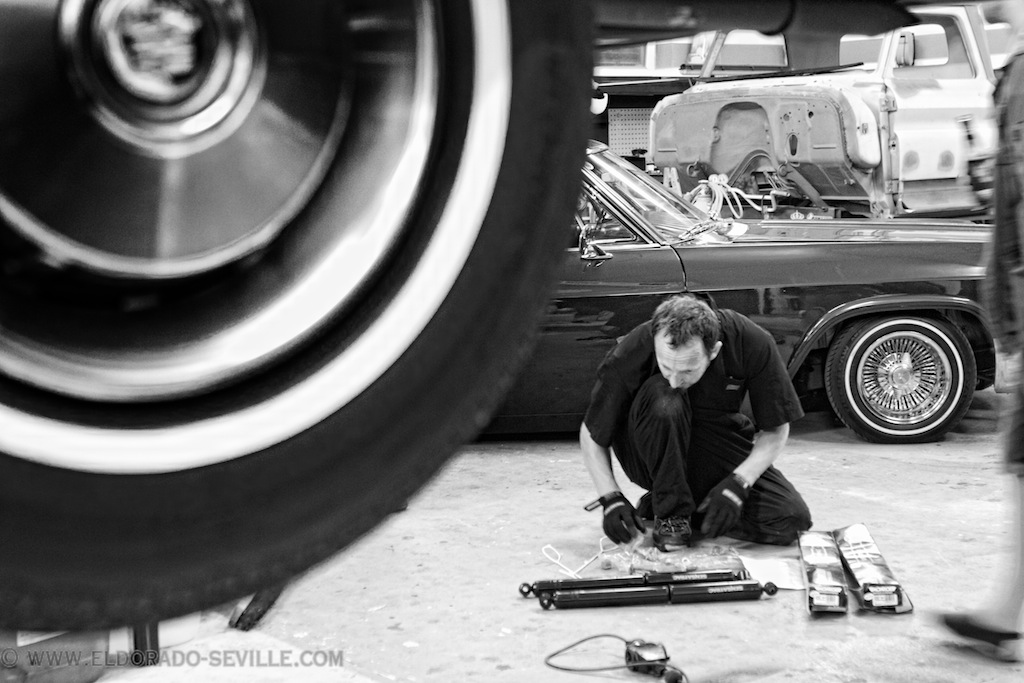
Unpacking the new shocks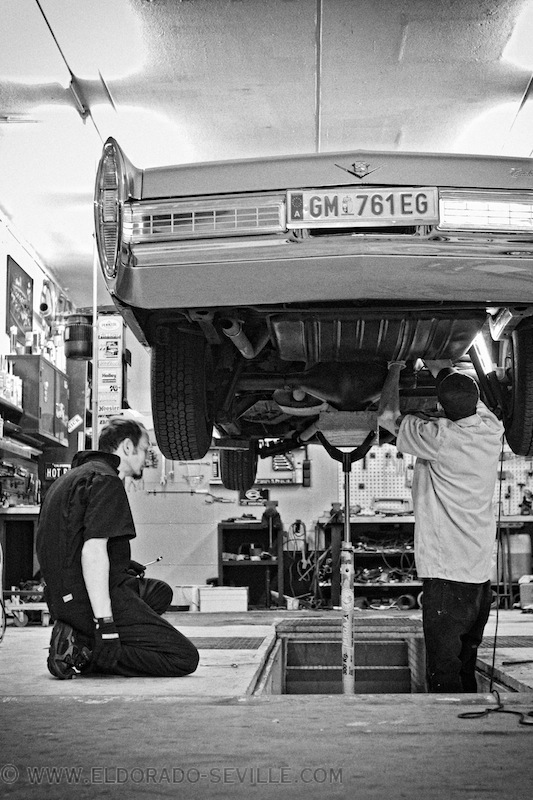
Richard and me at work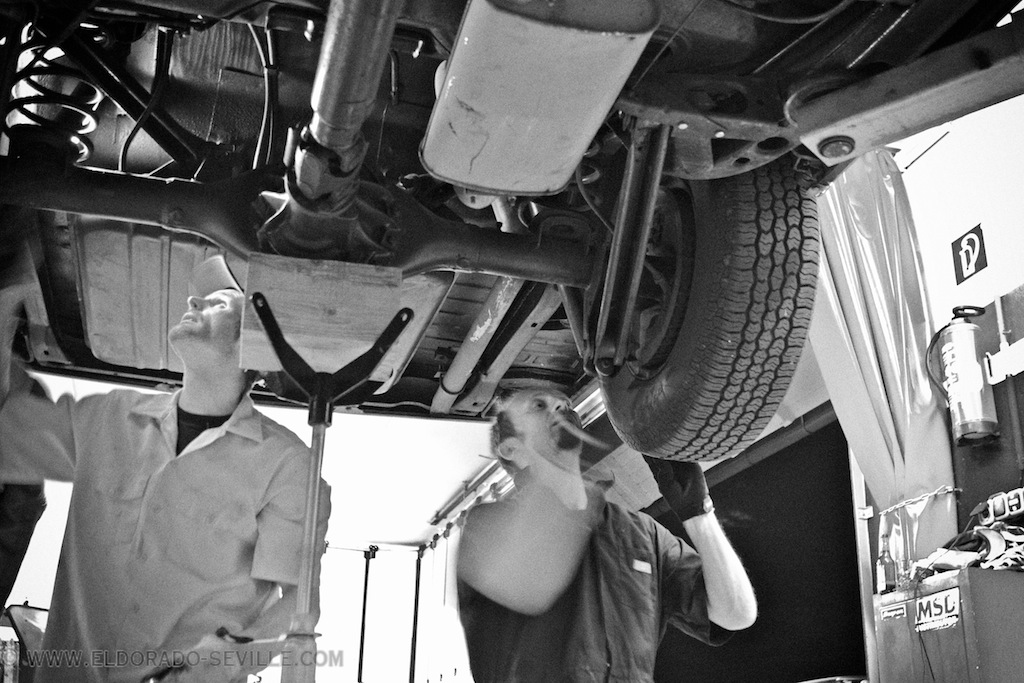
Unscrewing the old shocks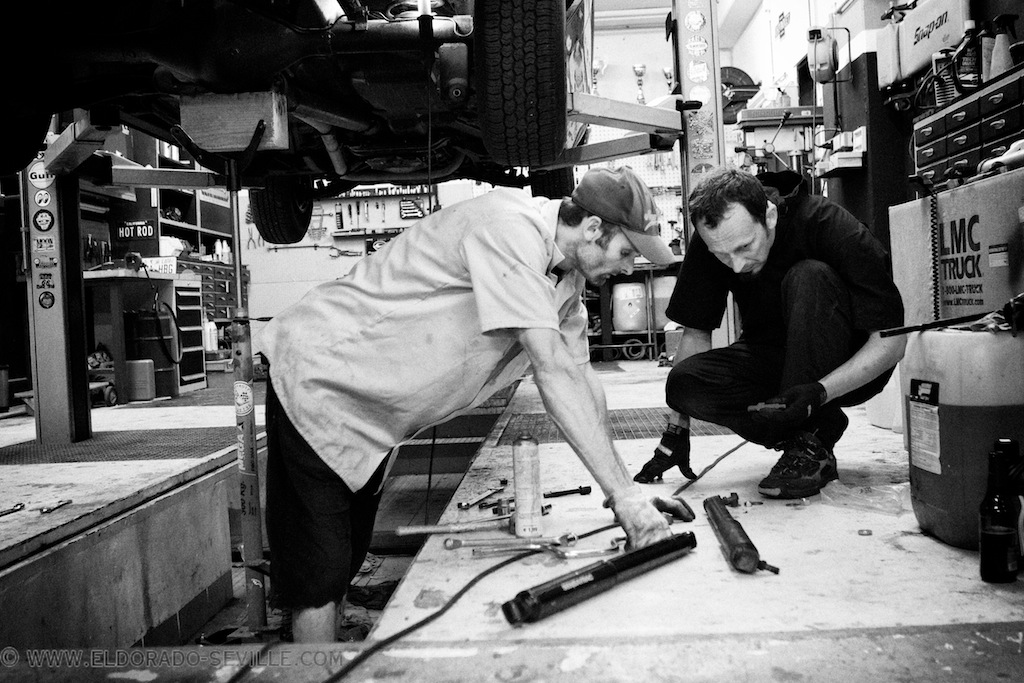
Figuring out how to mount the new Monroe shocks...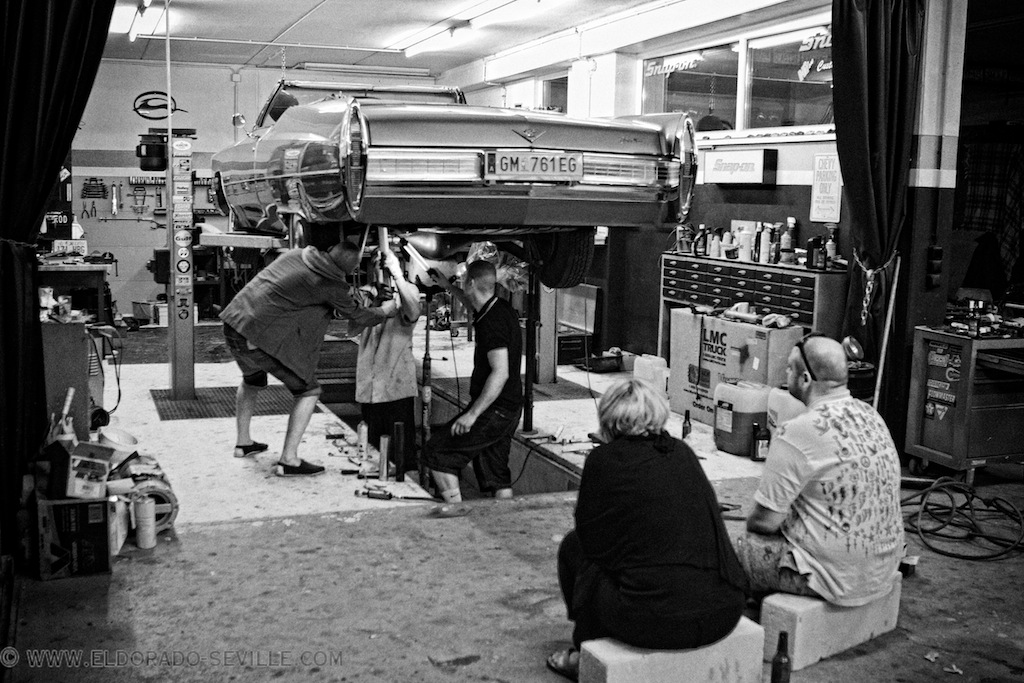
the left shock just did not want to come out...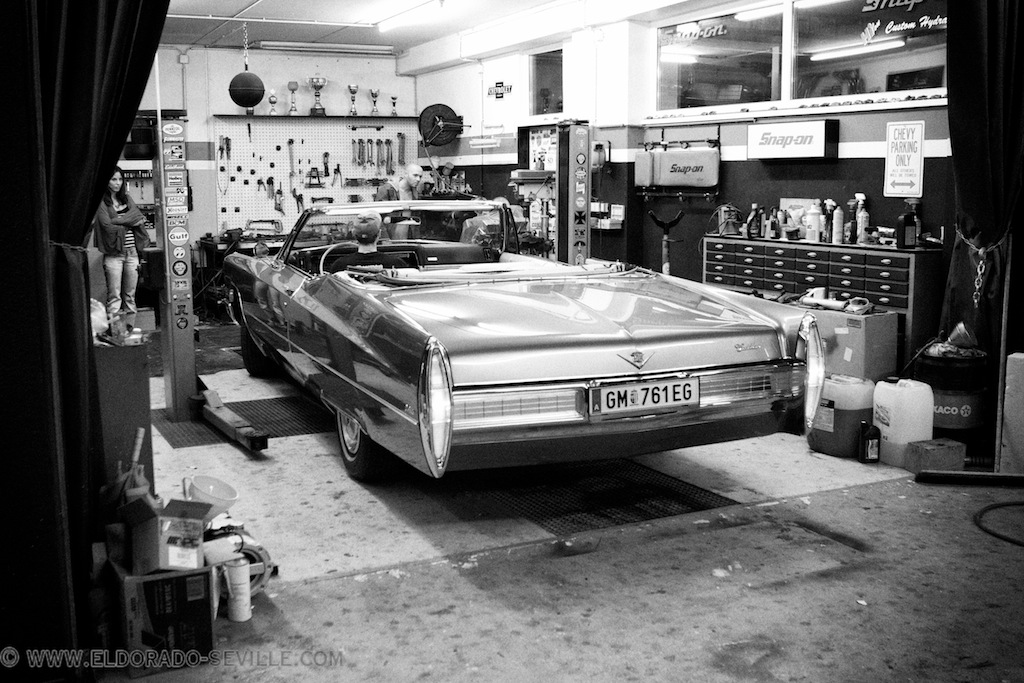
Backing out of Richards garage...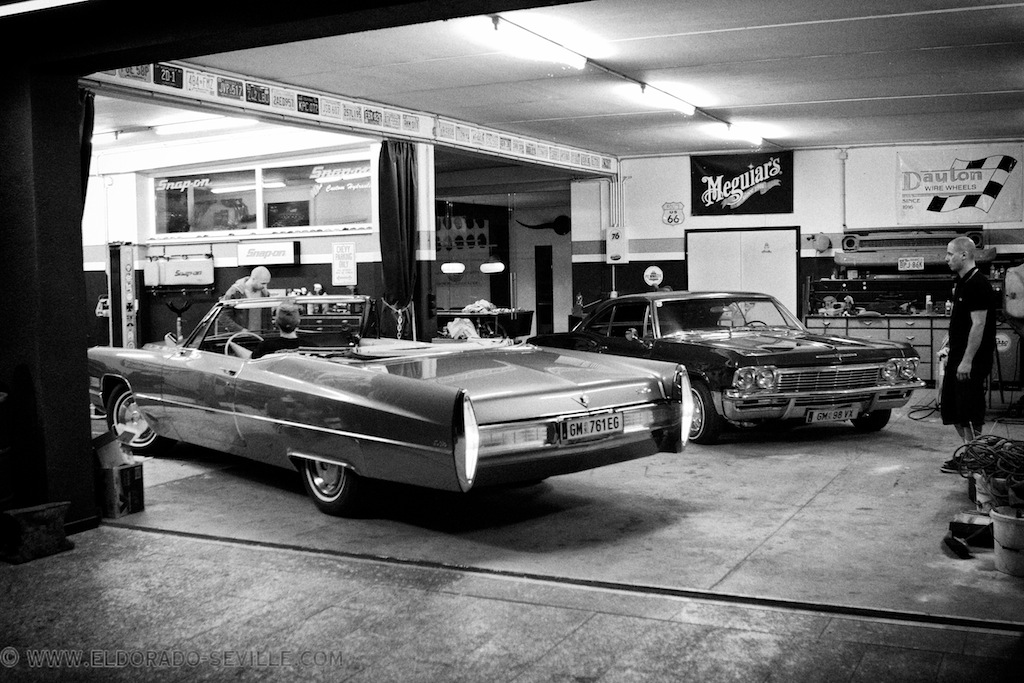
The 67 Eldorados new POA valve and recharge of the AC
I got a new remanufactured POA valve (suction throttling valve) from Classic Auto Air to make sure that the system can cope with the much higher pressures of R134. Classic Auto Air was very helpful with providing the factory correct parts. Classic Auto Air says that the re-calibrated valve can make a 15-20º F / 6º C difference.
Yesterday I got the Eldo back from the shop and so far it seems to cool the car down properly. The air discharged out of the vents is 10º C / 50º F cold - not bad for R134.
This is what Classic Auto Air is recommending for a change from R12 to R134:
Minimum Requirements
- Change or restore the filter-drier.
- Drain the compressor oil and recharge with 134a compatible oil. (PAG or Ester Oil)
- Insure that the system is clean and free of contaminants (Depending on component condition, this may be a simple matter of blowing out with compressed air or liquid flushing with an air-conditioning flushing agent)
- Replace or restore all rubber hoses with barrier hose.
- Install 134a charge port adapters
- Send POA valve in to be calibrated
- Charge with 134a between 70-80% of the original R12 charge amount.
- Replace any o-rings with 134a compatible
Recommended:
- Install hi/lo pressure switch
HELPFUL HINTS
- Ignore the sight-glass. A properly charged 134a system will likely show bubbles in the sight-glass.
- Typical 134a charge rate will be approximately 70-80% of the factory R12 charge amount.
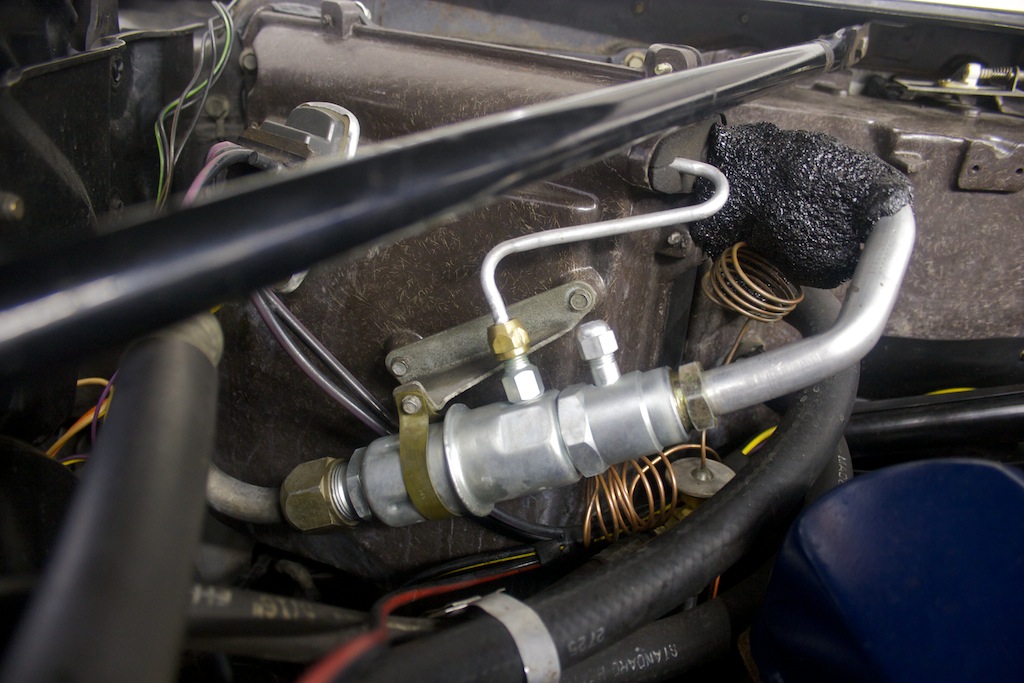
The new factory correct POA valve. Internally it was calibrated for the use of R134 instead of R12. The expansion valve was also replaced together with the evaporator, condenser, compressor, O-rings, filter-dryer. I did not install a hi/lo pressure switch which would cycle the compressor on and off to keep the car original.
New speakers, new alternator, new trunk lining material and a new windlace for the Mark III.
He got a new set of replacement speakers for the car The right one had a tear in the cone. The left wasn't that bad, but the mounting part was starting to crumble. Brian removed the wiring harness from the old speakers and soldered them onto the new, so they would plug in correctly. He is a professional philharmonic musician and he said that they sound much better, no distortion and better frequency response. Brian got the speakers from the same source where I got the ones for my Cadillacs before - from Greg Thompson from Turnswitch.
Skip, the upholstery guy, installed the new trunk carpet - and as you can see on the pictures below - it turned out beautifully. He also installed a new windlace on the drivers side - which turned out perfectly as well. As you can imagine I´m really looking forward to finally get the car ;-)
When Brian thought that everything was fixed the alternator went out - so he replaced it as well and even installed a new battery! AWESOME! The speed control was also fixed and works perfectly too!
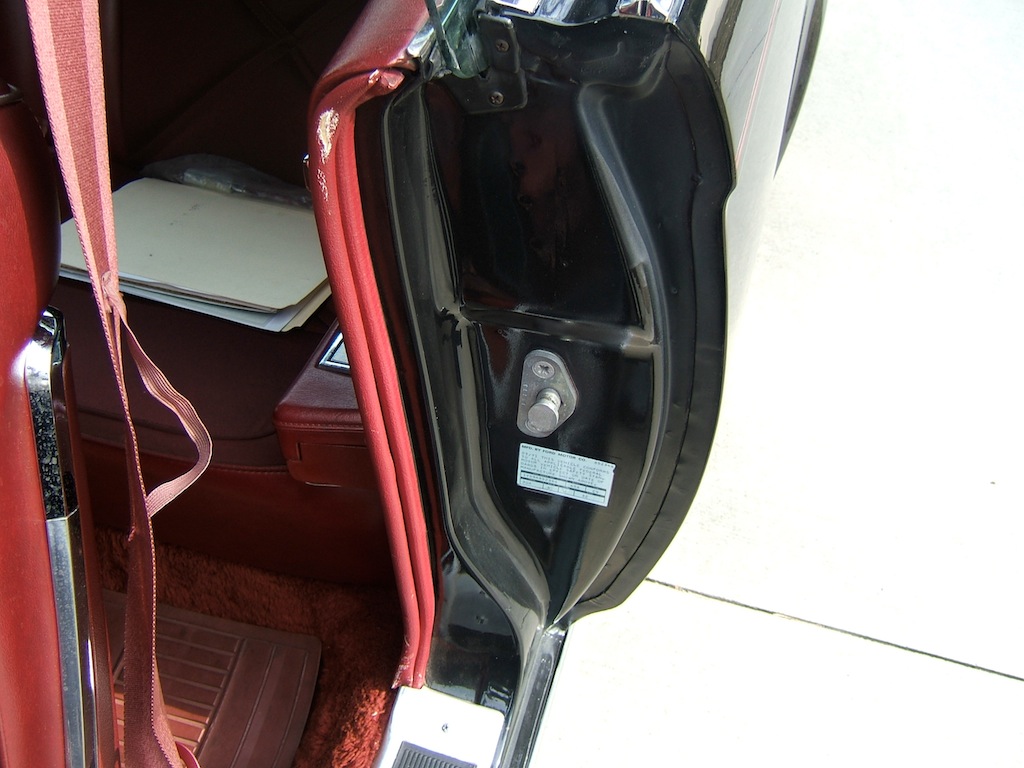
The windlace before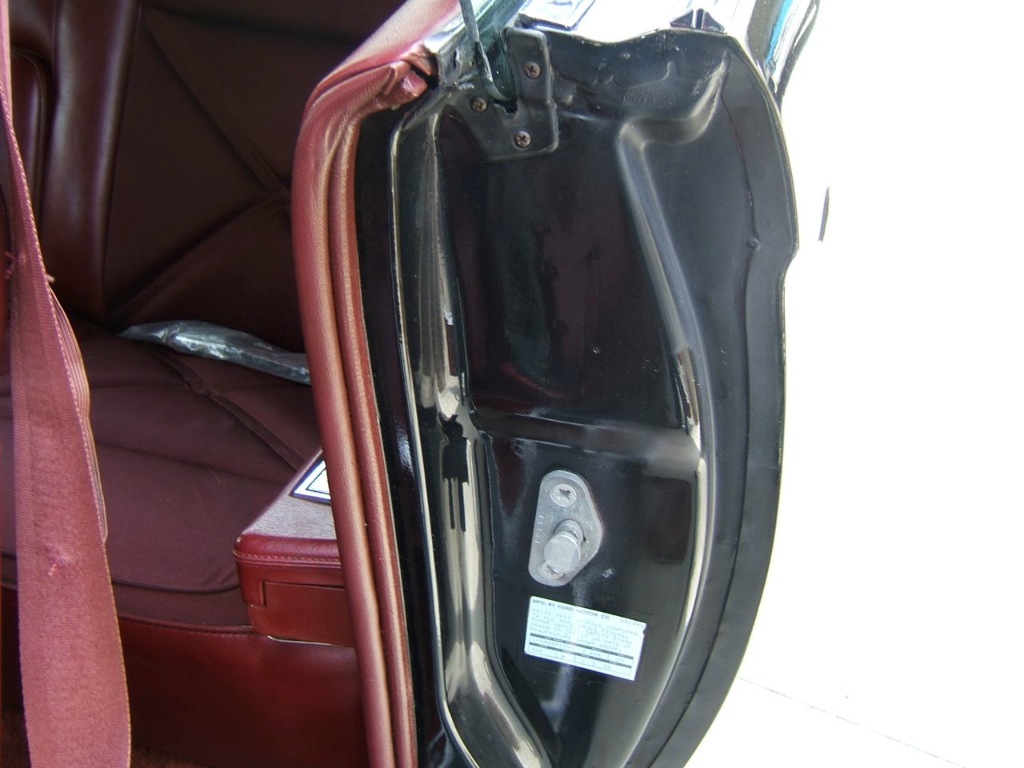
and after it was replaced...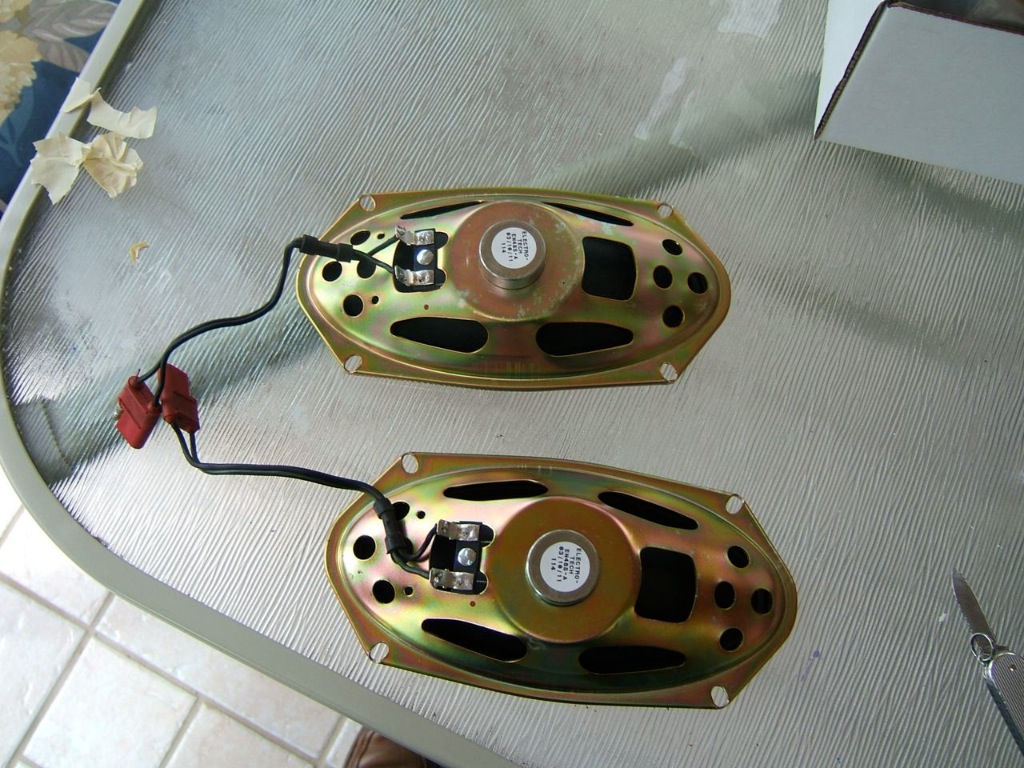
The old connectors were soldered to the new replacement speakers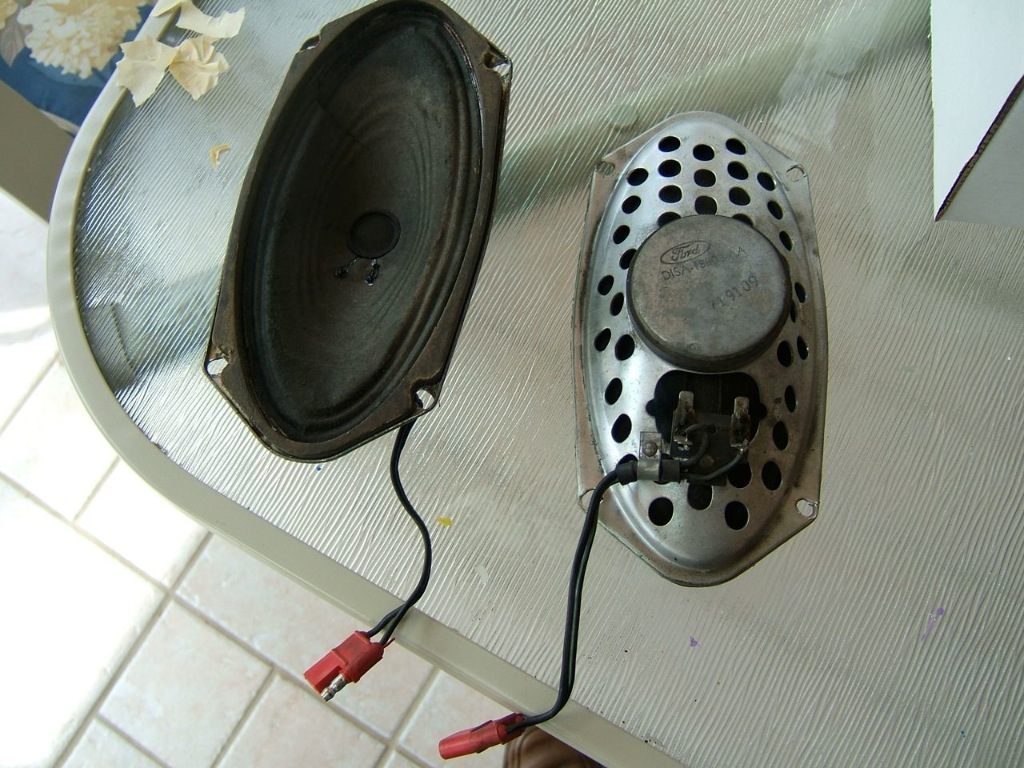
The old speakers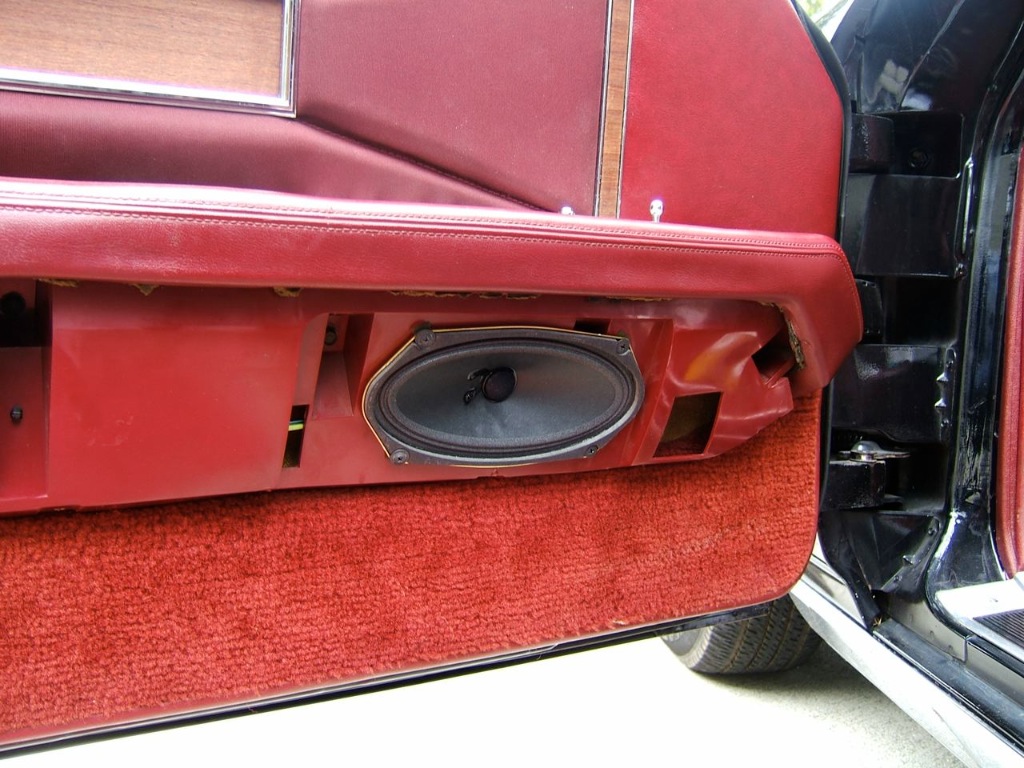
The new speaker installed on the drivers side...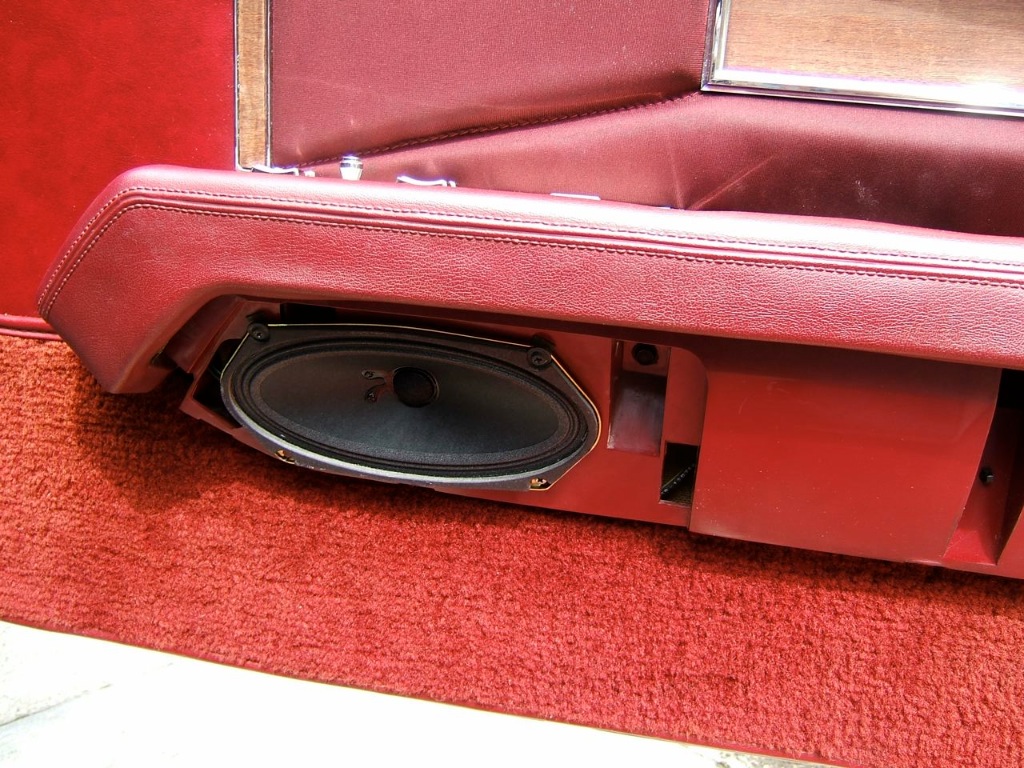
...and the passenger side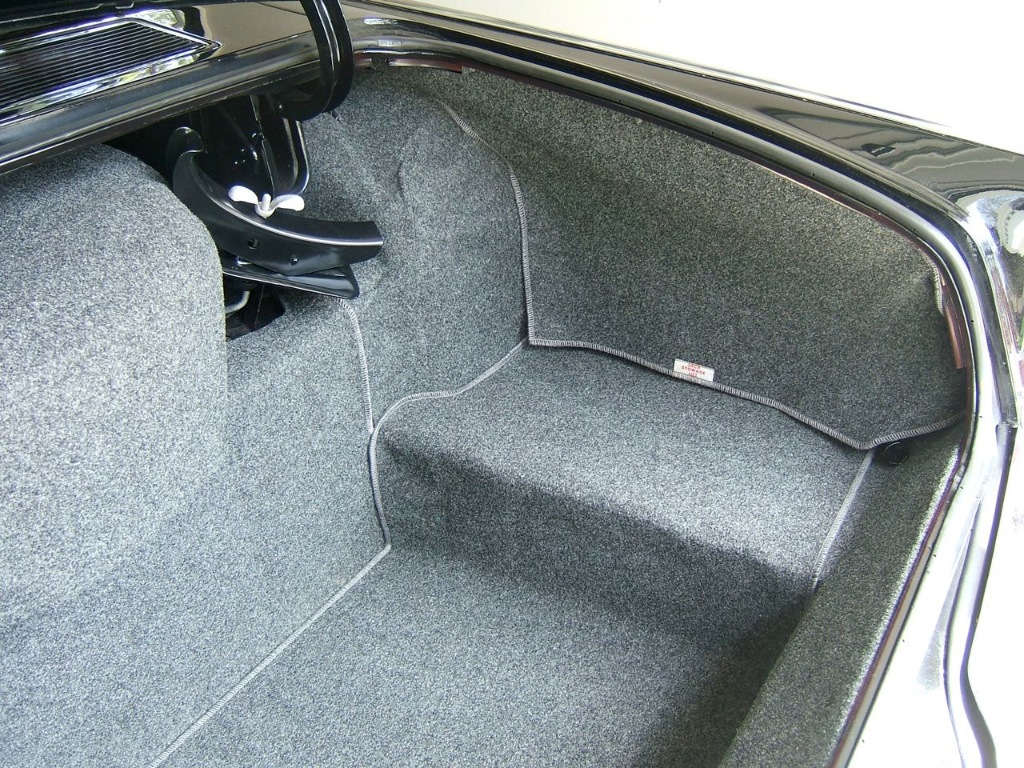
The new trunk carpet - perfectly installed by Skip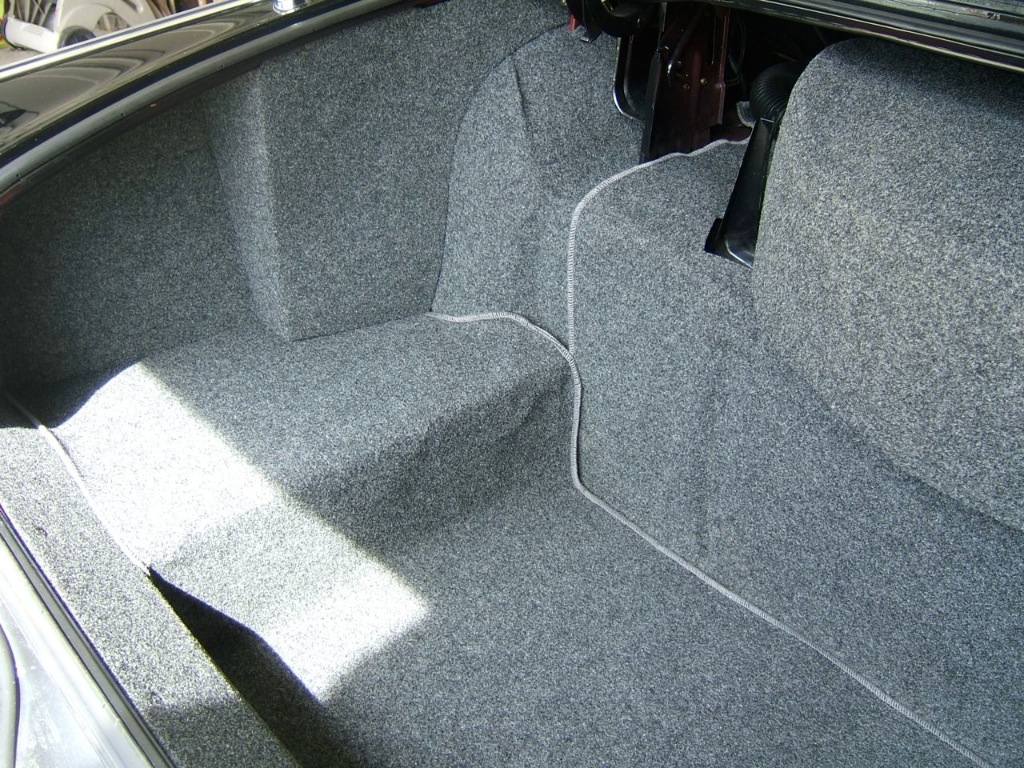
The new trunk carpet - perfectly installed by Skip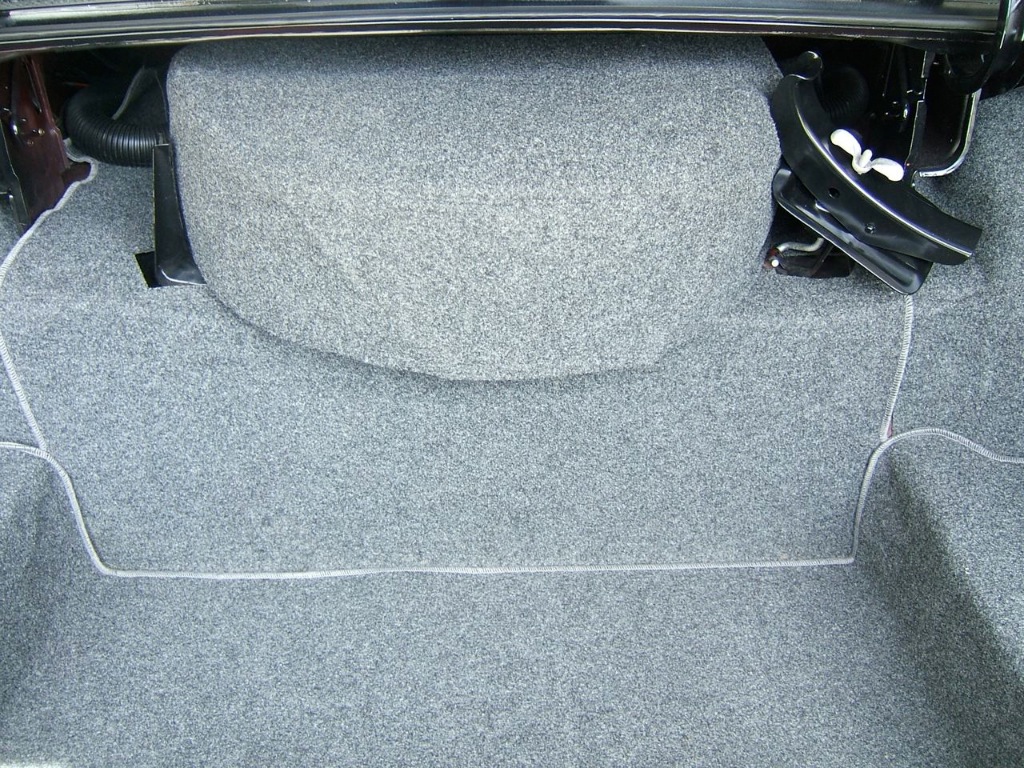
The new trunk carpet - perfectly installed by Skip
The Mark III got new seat padding
The padding underneath the drivers seat became very dry and crumbled. So he took the car to his upholstery guy to have some new foam installed. While the car was there, they also installed a new trunk carpet set, a windlace and repaired the front window mechanisms to work perfectly.
I cant thank Brian enough for having all these little things done before the car is leaving. He will also install a new set of original front speakers, fix a heater valve and repair the acceleration function of the speed control. He also already installed a new inside rear view mirror as the old one was “blind“.
Thank you Brian!
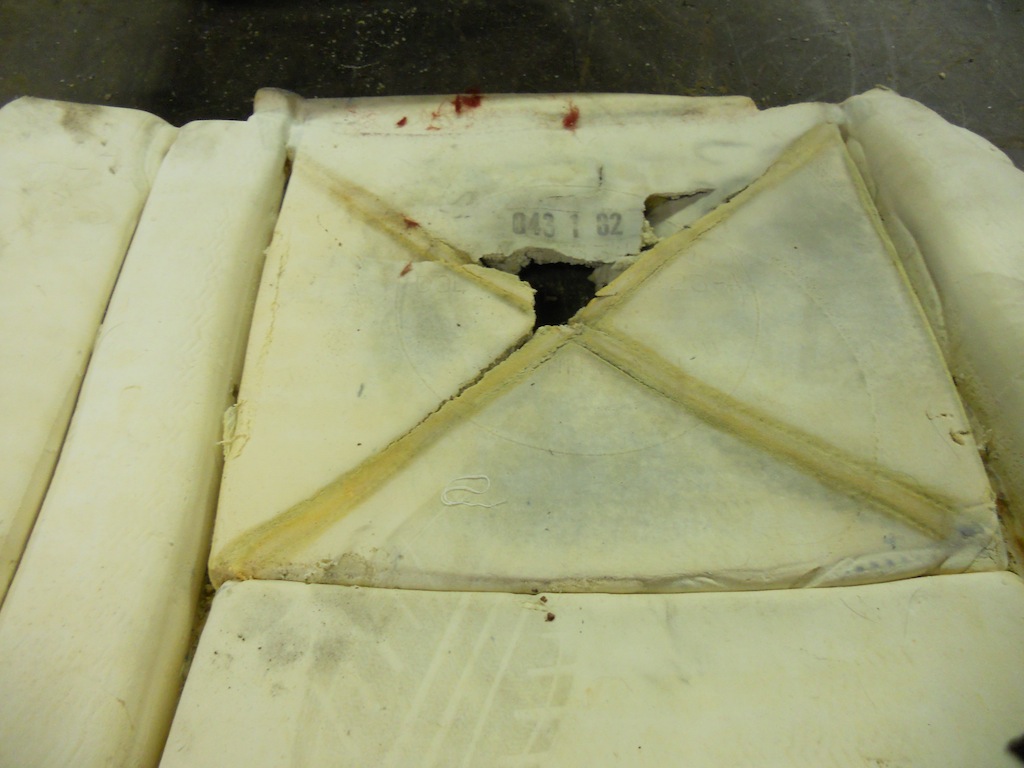
The foam underneath the drivers side was crumbling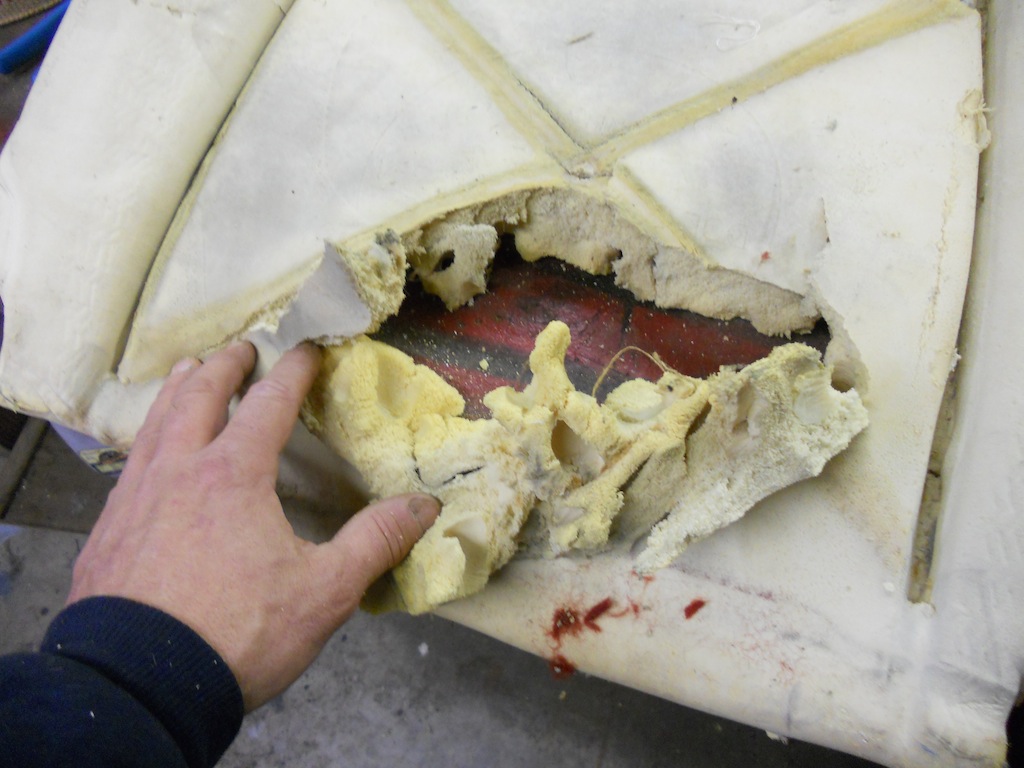
pretty big hole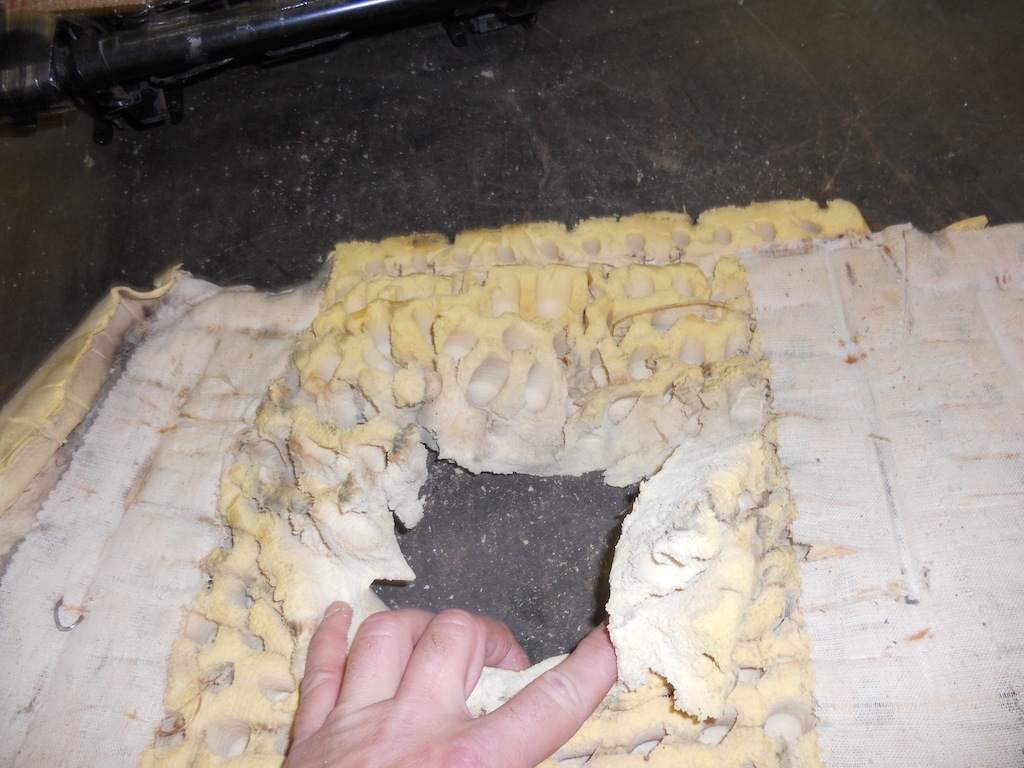
not much left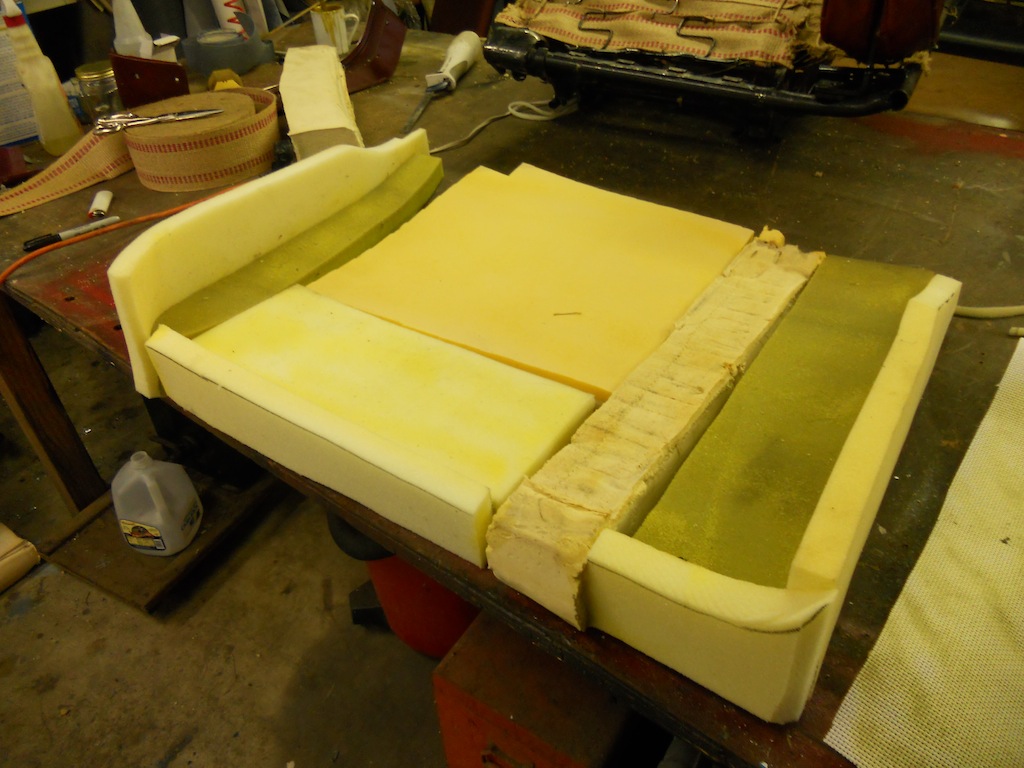
the new seat padding under construction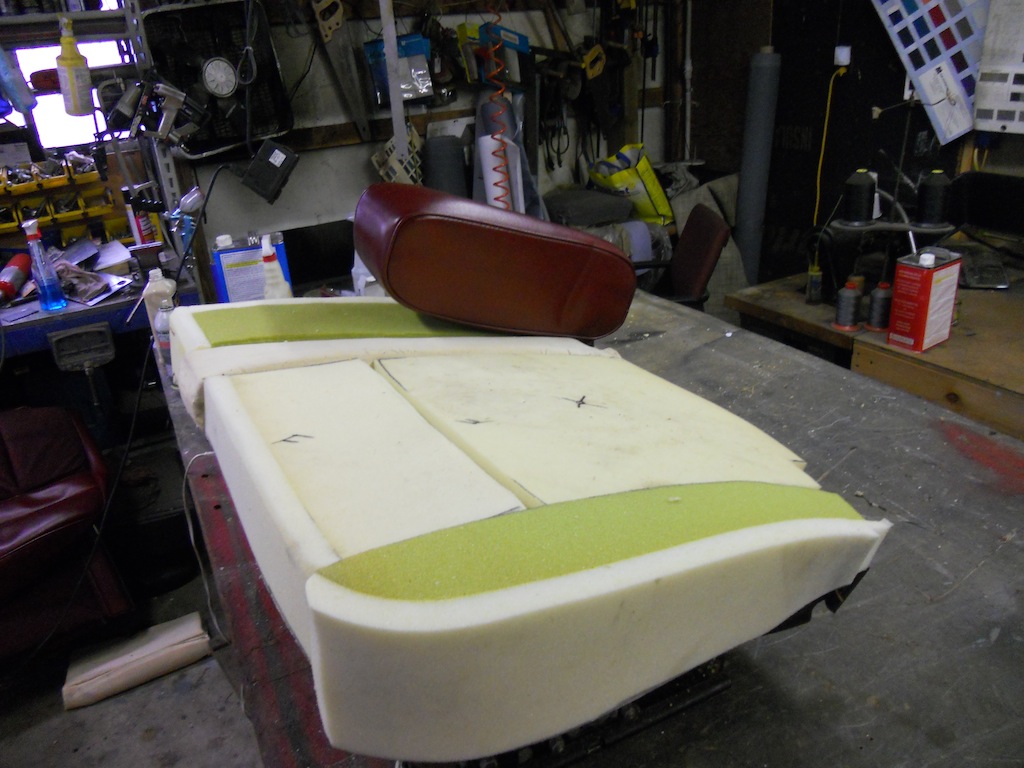
the finished new seat padding
THE 1967 CADILLAC AUTOMATIC CLIMATE CONTROL SYSTEM - MORE ISSUES - AND A FINAL FIX? RESTORING THE POWER SERVO VALVE!
The 67 Eldorado lost its complete charge of refrigerant over the winter - so it will have to go back to the shop to see where it is leaking. All components were replaced with new ones last year and so I have no idea where it could have leaked out. A tracer was put in before the last recharge so we should be able to find the leak. I guess that it will be one of the original hoses are a bad fitting.
Another thing that bothered me was that the system basically worked most of the time, but sometimes I had to wait for a long time before the system came on, or I had to switch to “FOG“ or “ICE“ position before the blower would come on in the “Auto“ position. Then sometimes the blower would cut out again if the temperature dial was moved to a colder temperature. Sometimes the temperature would move to full heat regardless off the selected temperature in the 67 Eldorado.
I had the very same problems on my 67 Deville as well - but there also the “Vent“ and “Low“ position did not work at all...
So I started trying to find the issues and finally wanted to fix them. Sounded easy - but it took me 4 full days with long nights in the garage to fix it...
BTW - Cadillactim has an excellent trouble shooting guide for the ACC on his website - its for sale for $ 45.- and I can highly recommend it if you are troubleshooting your 1967 or 1968 Air Condition System.
A great troubleshooting guide for 1967 and 1968 Cadillac´s Automatic Climate Control Systems I got from Gary Sisk - owner of a 1968 Cadillac.
This is a very easy to follow explanation which will save you a lot of time and you do not even need any special tools.
It was written by Lynn Nicholls and can be found on Stampies Cadillac page - here is the direct link to it. I used some excerpts from his document in the explanation below:
I first suspected a vacuum leak to be responsible for most of the erratic behavior of the system. A clear indication was that the system would initially have to be switched to the “ICE“ position to make the blower come on.
Lynn Nicholls writes:
“Sometimes the dash control can be switched to the fog or ice positions to bring the blower motor on and then when it is switched back to auto the blower may stay on and the system seems to work fine until the car is shut off. If the vacuum leak is only moderate there may be enough vacuum to hold the master switch closed once it gets , but not enough to pull it closed in the first place. When the dash control is switched to fog or ice, it assumes the air temperature is cold and that the engine is not yet warmed up, but that the blower is needed immediately for defrosting the windshield. So it supplies vacuum to the master switch through another circuit, bypassing the temperature controlled vacuum switch on the heater core shutoff valve on the right fender well. This source of vacuum is enough to close the master switch.When the dash control is switched back to auto this vacuum source is shut off, but there may be just enough vacuum left from other circuits to hold the switch closed. This routine will work for a while but as the leak gets worse, there won’t be enough vacuum left to hold the master switch closed anymore and the blower will shut off again as soon as the system is switched back to auto.With these symptoms and behavior the problem is most likely the power servo. This is half the brains of the system; the other half is the control panel in the dash. The power servo is controlled by a varying vacuum signal from the transducer. This vacuum supply is a completely separate circuit from that which supplies vacuum to the master switch. High vacuum moves the servo to the maximum heater position, and with low vacuum, a return spring moves it to the maximum AC position. In between these two extremes, it regulates the air temperature door to blend warm air and cool air, and simultaneously regulates the blower speed. It also spins an internal rotary vacuum valve back and forth that makes various connections between the several small vacuum lines on the top. This rotary valve controls the various vacuum motors of the system that operate the AC, heater, and defrost functions. It is this rotary valve that goes bad. l have seen these things visibly warped, and very badly so. It must be caused by engine heat, because there is also one inside the car on the control panel that is moved back and forth by the dash control lever, but that one seldom seems to cause any trouble. A warped rotary valve leaks all kinds of vacuum and the first part of the system to be affected by low vacuum is the master switch; there’s not enough vacuum there to close it and turn on the blower. To verify this is the problem, take some spare vacuum line, some scraps of 1/8 inch pressure line (like for air shocks), and a vacuum T and manually make the connections that the rotary valve should make in the maximum AC position. The connections that the rotary valve makes in various positions are shown in the factory shop manual. Disconnect the black connector with the striped vacuum lines from the power servo. Connect the yellow, red, and purple lines together with a T; also connect the tan and blue lines together and connect the orange and green lines together. If this rotary valve is the one and only culprit the AC will now work beautifully and the blower motor will come on every time, like magic. With the dash control on high the system should be recirculating air and there will be a lot of air noise coming from under the right side of the dash; when the dash control is moved to auto the air door should move to provide fresh air and the system will become much quieter. Of course with these manual connections the system is not fully automatic and the heater won’t work right at all, however this is enough to diagnose the problem.“
I did this test (see picture below) - and with the power servo bypassed everything worked as it should. This way I knew that the power servo was to blame for some of my problems.
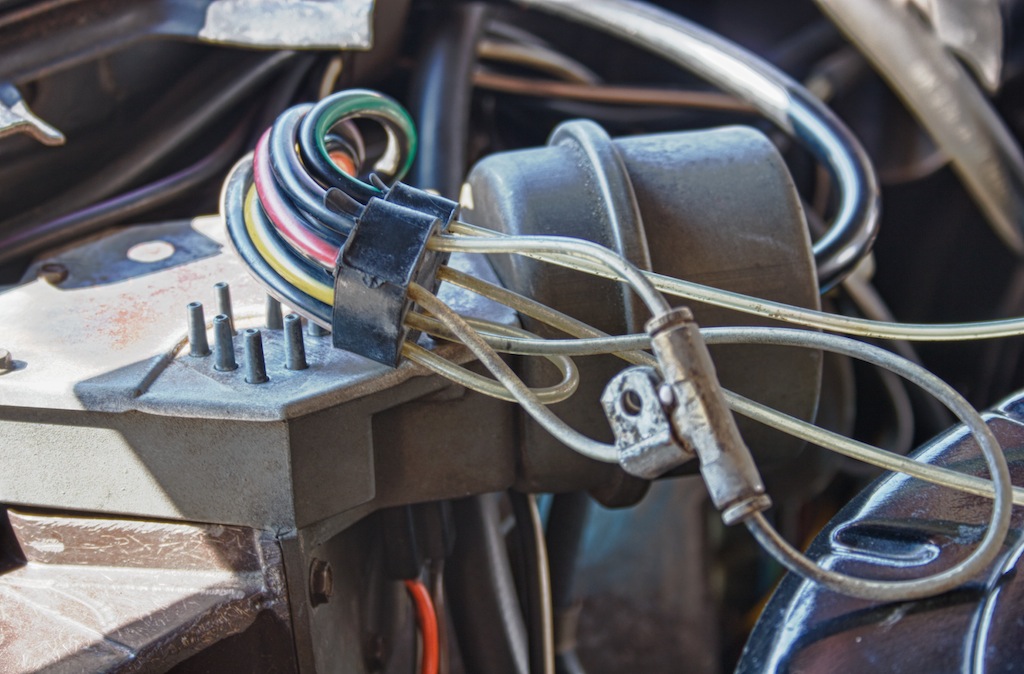
So this rotary valve needed to be repaired...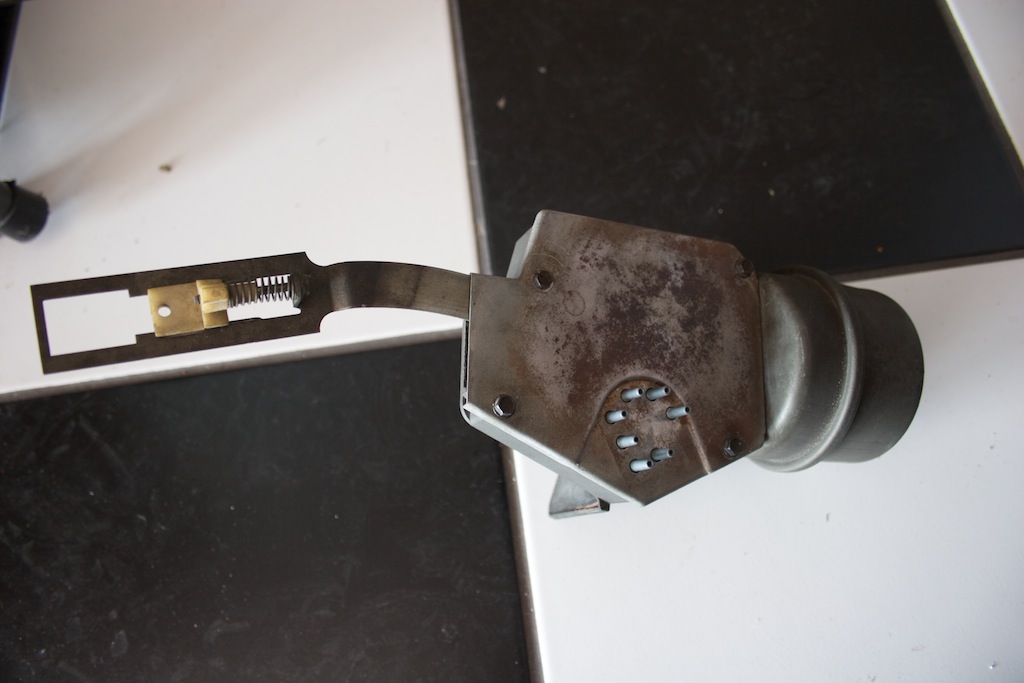
I removed it from the power servo and disassembled everything.
The removed power servo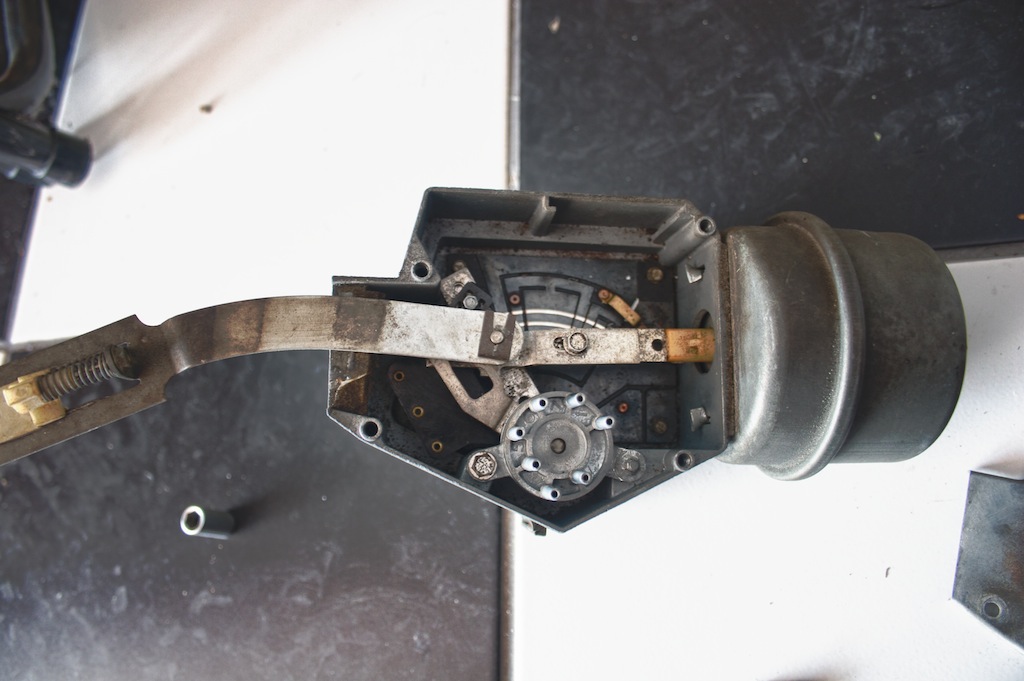
After opening the cover, you can see the rotary valve in the lower center.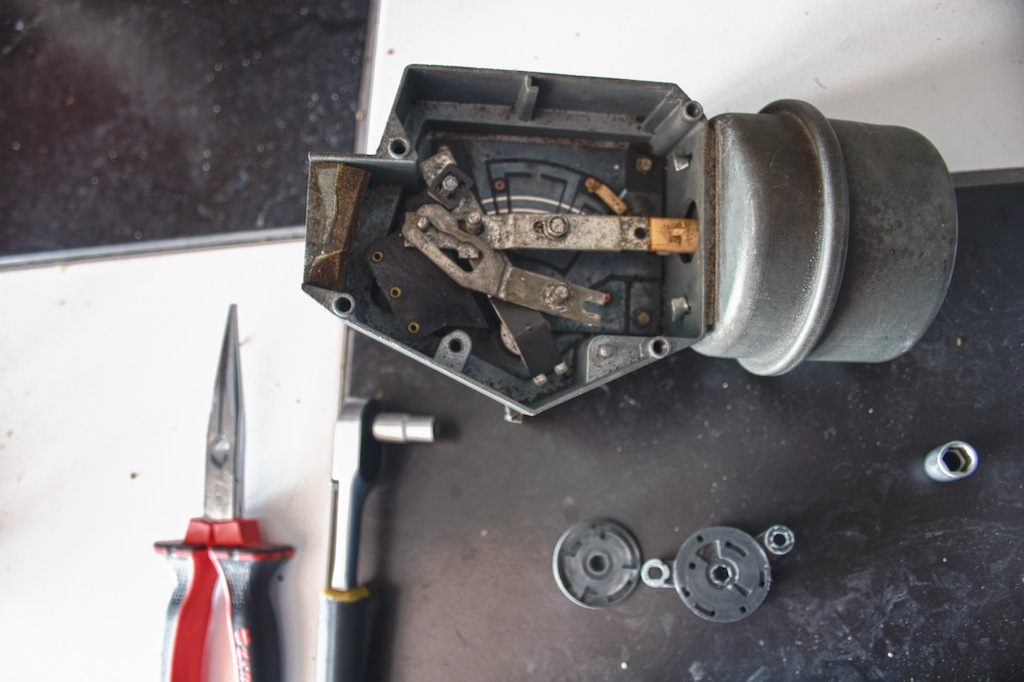
Remove one screw and a clip and the rotary valve comes out.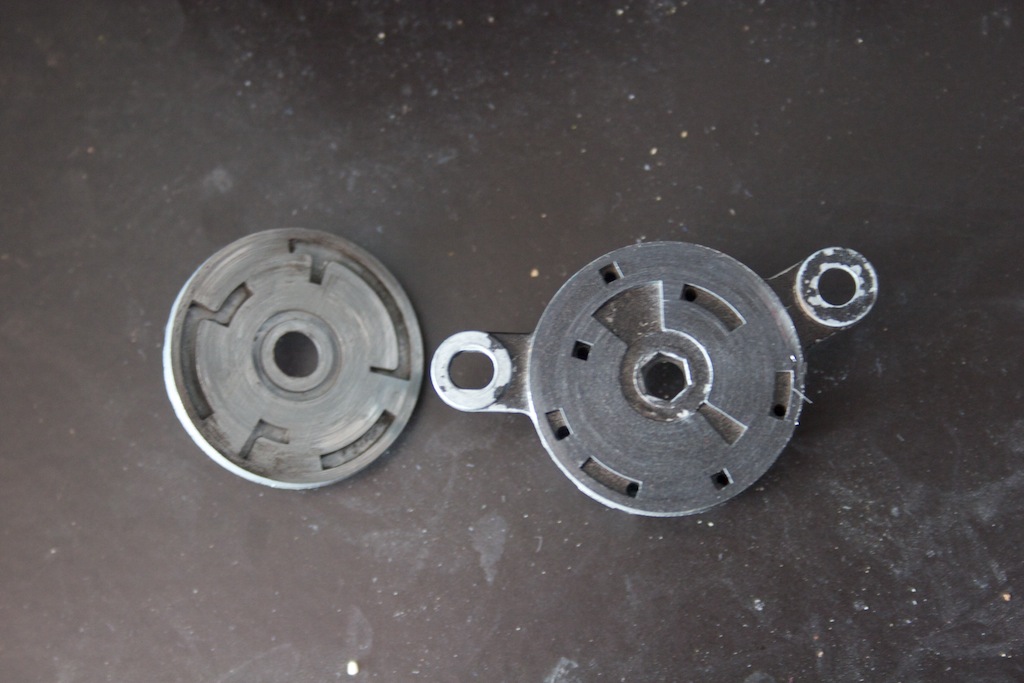
The rotary valve consists of two halves which make the connections - as you can see it was very dirty and rough - and slightly warped.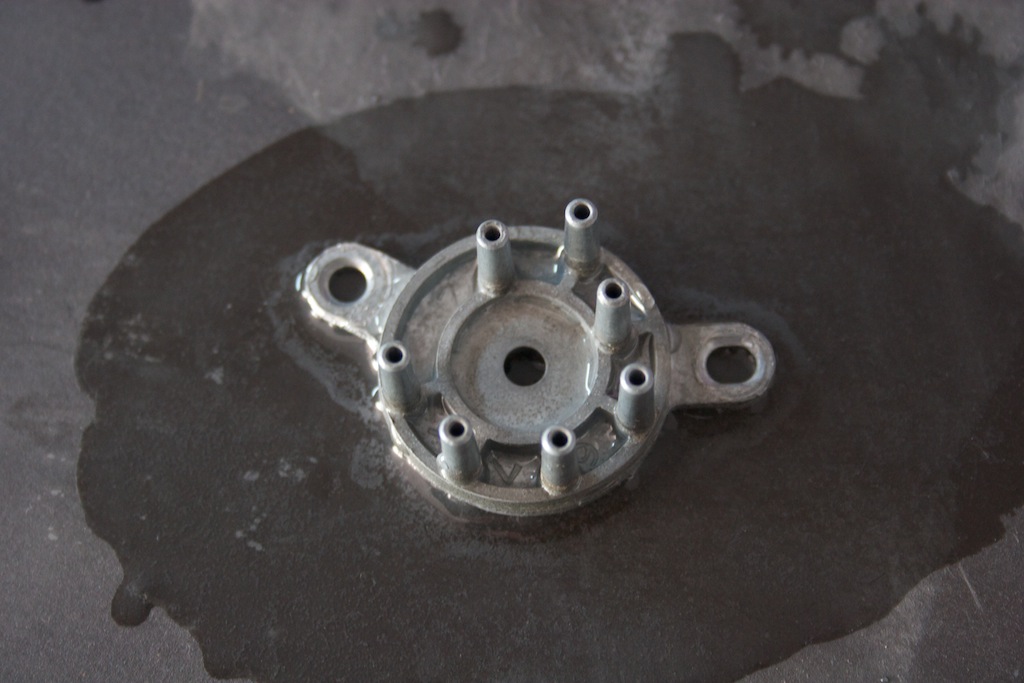
I started to wet sand both halves with 800 grit sandpaper.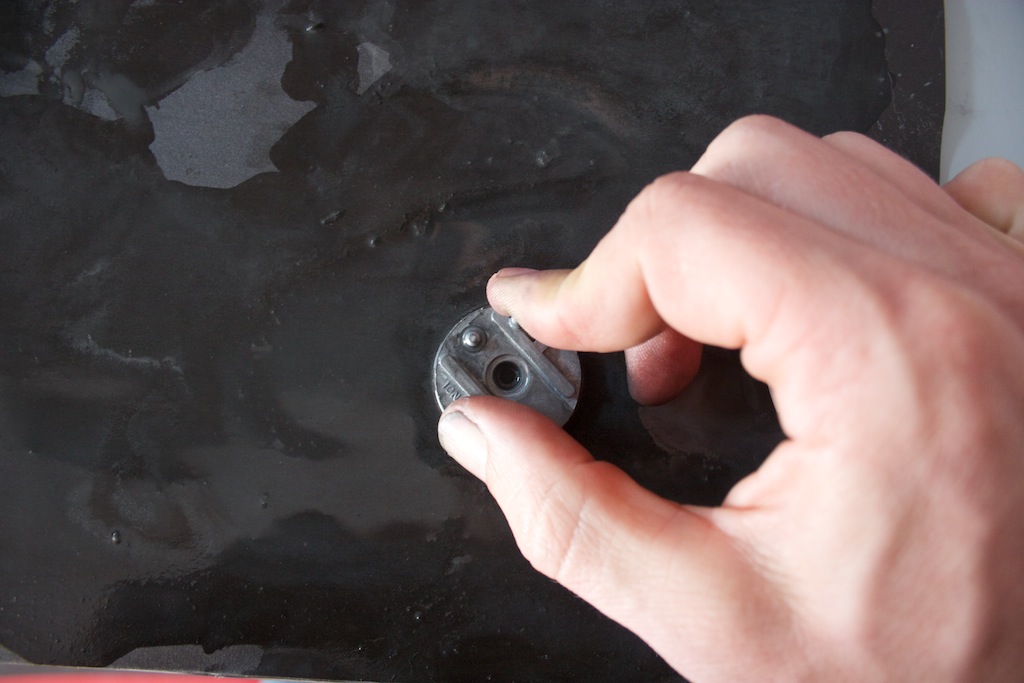
When everything was flat and shiny again I used some 2000 grit sandpaper for a perfect finish.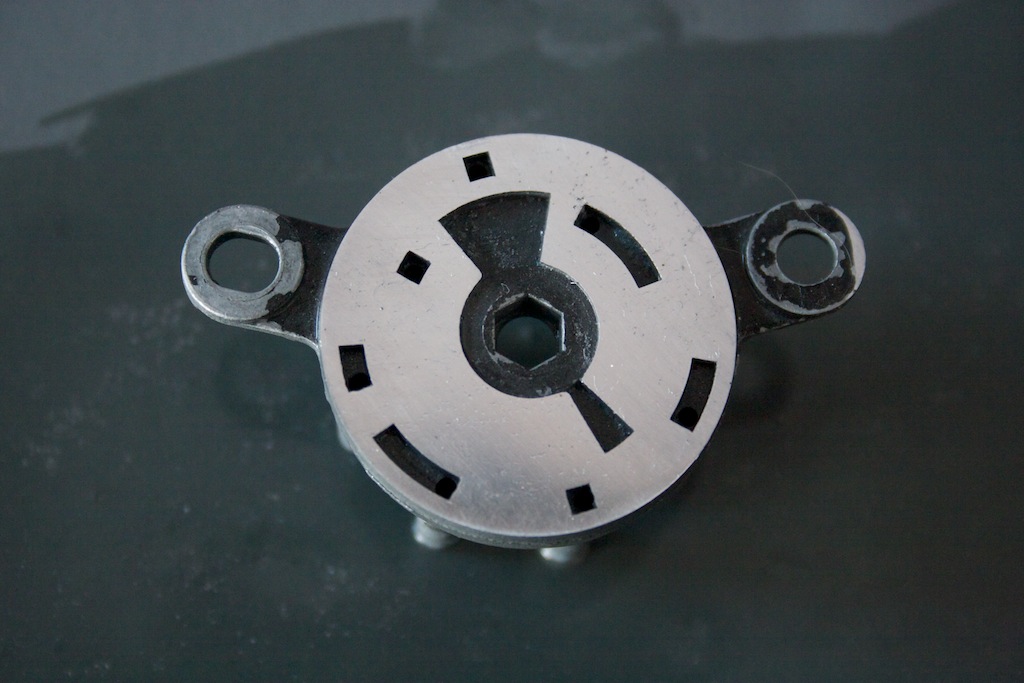
Looks shiny and flat again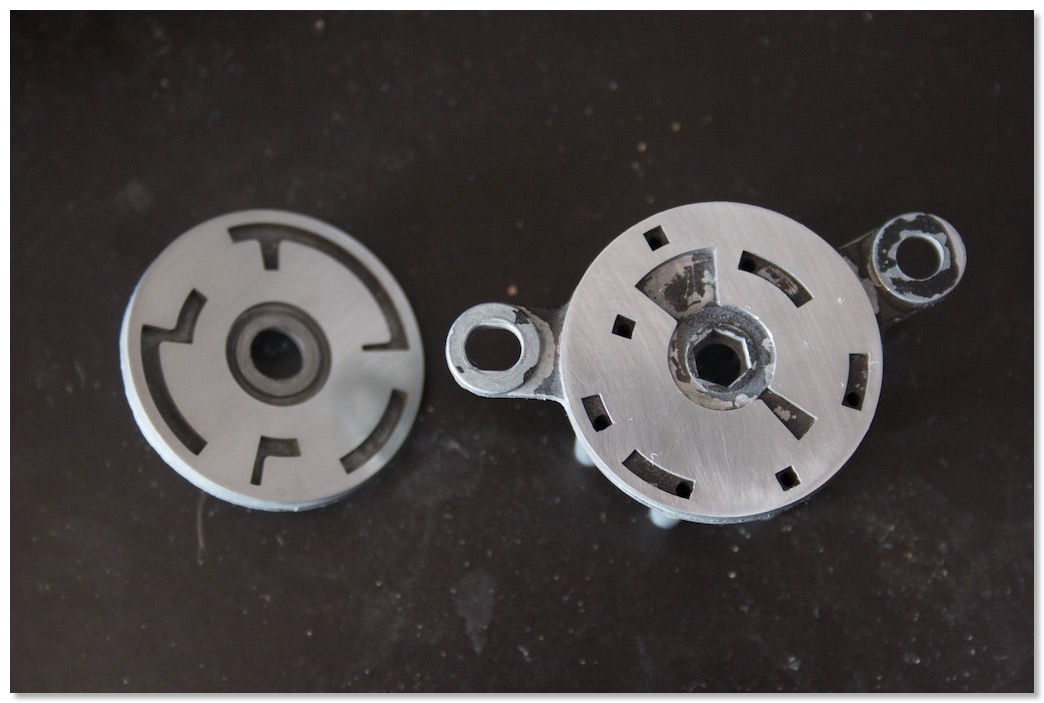
Make sure that none of the ports are clogged - I used compressed air to clean everything.
When you put the two halves together lubricate with WD40 to make sure that when you put them back into the power servo that they are properly held together with the underlying spring.
After I reinstalled them into my cars - almost everything worked as it should. In the 67 Eldorado I still had the problem that in the “AUTO“ position the fan would always be slow - so I knew that the control head in the dash had a problem with the “LOW - AUTO“ switch as well.
In the 67 DeVille the “VENT“ and “LOW“ position still did not work at all...
So I switched the control panels between the two cars and suddenly everything in the 67 Eldorado worked perfectly. I never had such a perfectly working system before. Its like it just left the factory!
In the DeVille I still had no “VENT“ and “LOW“ settings working... So out came the control panels again... (its a pain in the a*** to remove and install them...)
As it turned out the “LOW-AUTO“ switch on one panel was stuck in the “LOW“ position. You can easily remove it and readjust it to work again - sorry I forgot to take pictures. Make sure that all switches on the control head are adjusted properly or they wont work as they should!
So I knew that both control heads were working correctly by installing it back to the 67 Eldorado and the other panel back to the 67 DeVille.
While the 67 Eldorado was perfectly fixed now with everything working as it should - the 67 DeVille was still giving me the problem with a non working “VENT“ position...
I studied the shop manual for hours and could not find what the problem could be. I knew that the power servo was working perfectly now and I knew that the control head was in perfectly working order as well. I verified this once again by switching these parts between the cars once again and everything worked as it should in the Eldorado but not in the DeVille.. I´m really good in switching these parts between my cars now ;-)
I started to look for electric connection problems and finally found out that no electricity was coming out of one of the three power servo connectors, but I did not know why...
After I removed the power servo once again to re-check it again it struck me - one of the pins was slightly bent and the wire connector did not make proper contact. This problem was not visible with the power servo installed in the car. It took me 2 long nights to find this little flaw... I just bent it straight and everything works as it should on both of my 67 Cadillacs. Now I have to recharge the systems and I should have perfectly working AC again... I will also install new dryers and a re-calibrated R134 POA valve before the recharge.
One the one hand the 1967 ACC is very complicated but once you know how it works its pretty easy to fix. The rotary valve in the power servo is pretty easy to refurbish, the dash servo valve is riveted together unfortunately, so its not such an easy fix, but NOS valves are still available at “Classic Auto Air“
*UPDATE 2022* - Check out this article and video as well as I had to repair my switch again in 2022 on my 66 DeVille!
Here is a video about the Master Switch that a gentleman posted on youtube
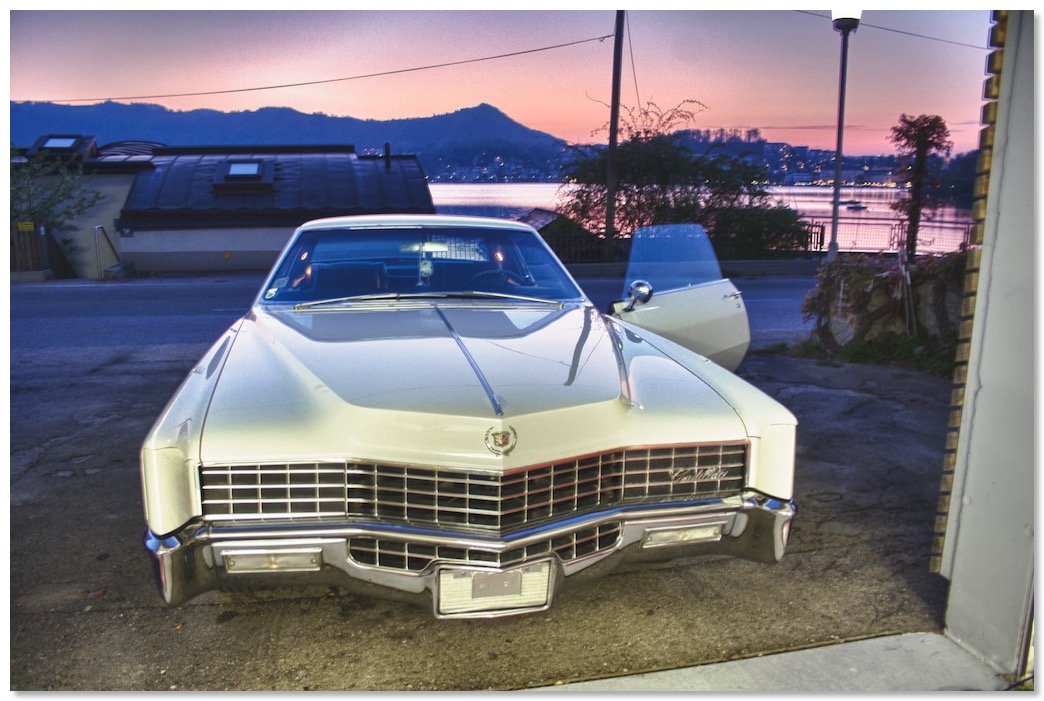
The 67 Eldorado in front of the garage after the AC system was fixed.
The 67 Eldorado now has a working radio!
Up first was the radio. The Eldorado came with the original AM radio. When it was turned on nothing happened though... The power antenna worked flawlessly and the signal seeking feature worked as well, but it would not make any sound at all. So I assumed that the speakers were shot and got a new front and rear speaker from Greg Thompson from Turnswitch. They have exactly the same size as the original ones. Cadillac used 10 Ohm speakers for all their cars in 1967. I installed them today and the radio came back to life. As there are no AM stations around any longer I came across a great solution which would enable me to use an Ipod or Iphone to play over the original radio, without having to do any non original conversions to my car. Its a plug and play solution which can be undone in 2 minutes and does not involve any cutting or screwing. The product is called RediRad and it works perfectly. Just tune the radio to 1000 khz on the AM band and plug in the audio source and you can hear your favorite music on your original radio! It is simple and affordable and undetectable as its hidden under the dash.
I also tried to repair the broken stem on my clock and it took me a while to get the clock out only to find out that my replacement stem would not fit. So I had to reinstall it. But at least it seems that it has a better electrical connection to the printed circuit now and the clock works all the time now. Problem is that I can only set the time with long nose pliers at the moment. Looks like I will need an entire new clock or live with it the way it is now. At least it works...
It was great to spend some time with the car again after the long winter months!
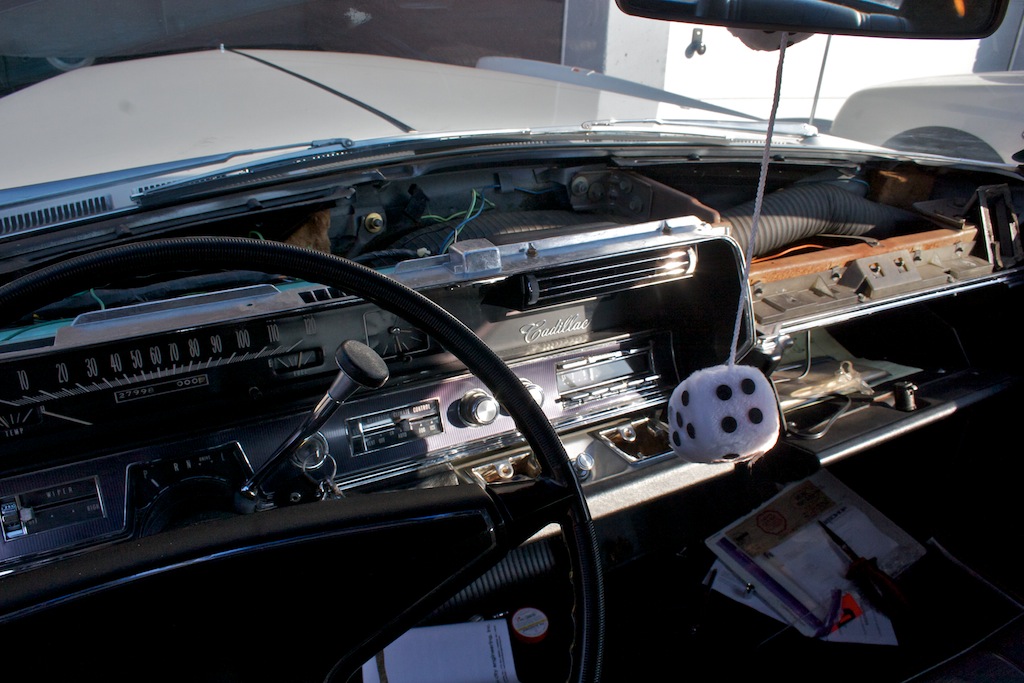
The removed dash.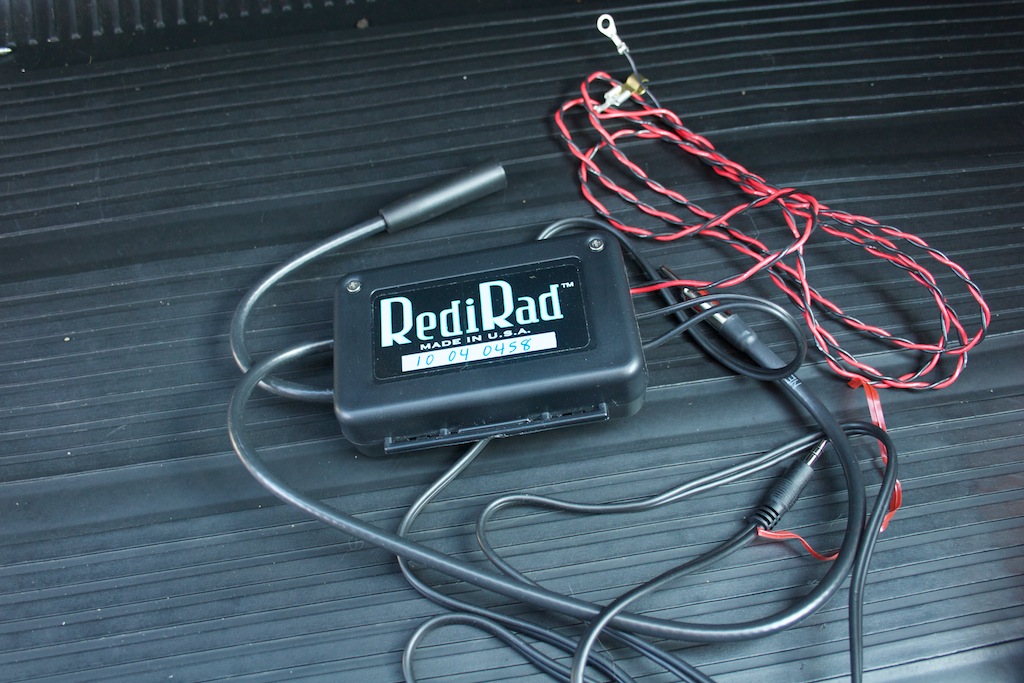
The RediRad system! Great stuff!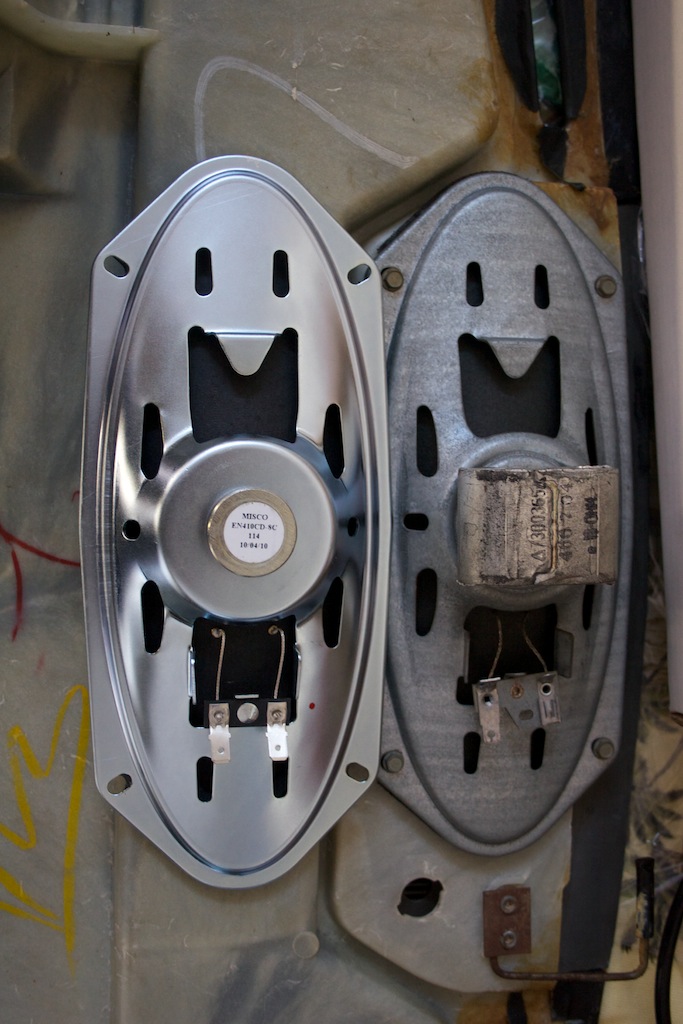
The replacement speaker on the left and the original one on the right.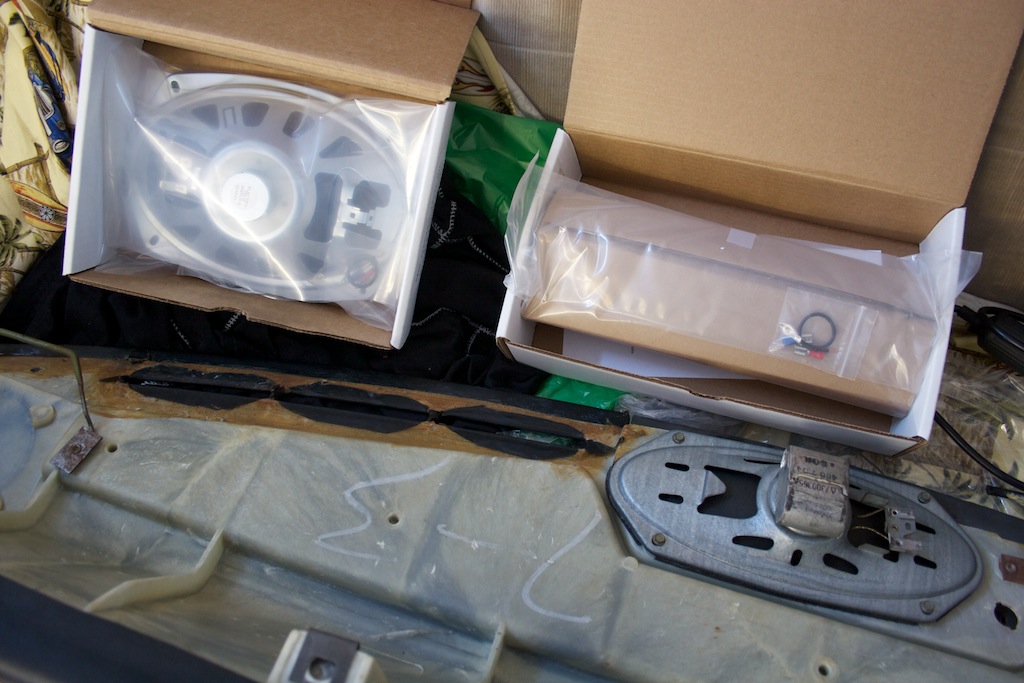
The new speakers with the old one.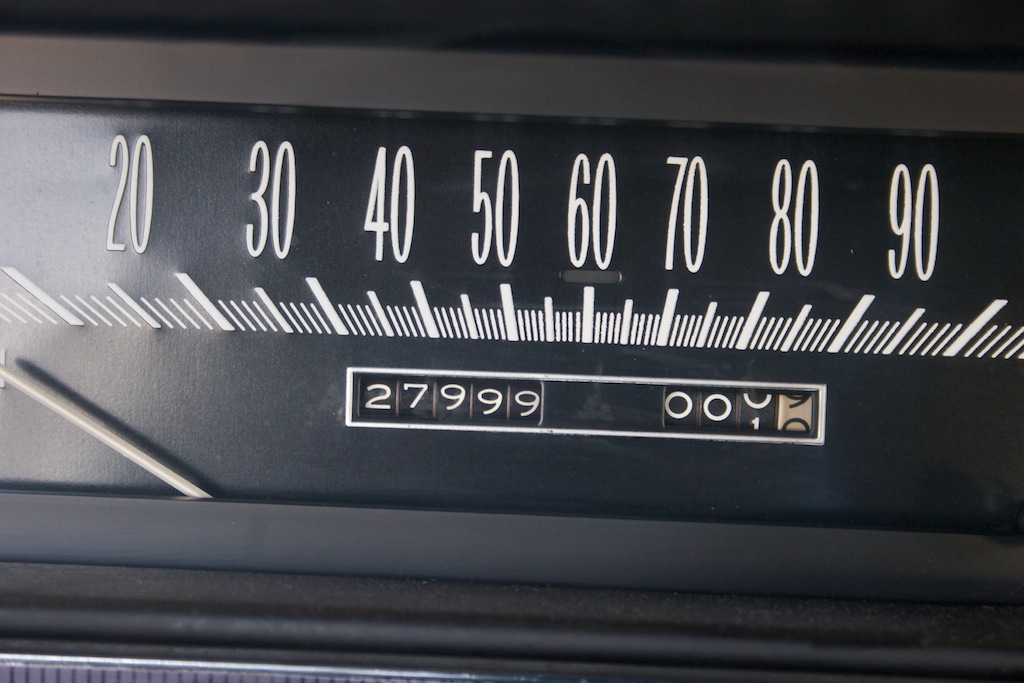
The Eldorado is coming close to the 28k mark... Still a low mileage car ;-)
The 96 Roadmaster gets a new fuel sending unit
I ordered a new pump from Rockauto. When it arrived I dropped the tank to get access to the unit. You also need some special tools to disconnect the fuel lines. I found these tools at Summit racing and ordered them.
When I had the fuel sending unit out of the tank I noticed that at the previous repair they did not install a strainer. I also got the tip that it would be a good idea to also exchange the whole fuel sending unit, just to be sure that I would not have to remove the tank again anytime soon. So I bit the bullet and also ordered a complete fuel sending unit including a strainer. So the car was sitting there waiting for the parts to arrive from the USA blocking the garage for the 67 Eldorado which I already wanted to put into winter storage.
As it turned out the parts where delivered to Australia, not Austria where I live... After 3 weeks they finally arrived. My wife helped me putting everything back together. The most difficult part turned out to install the strainer, as it came loose whenever I wanted to reinstall the fuel sending unit back into the tank. Eventually everything was back together and it was time to reinstall the tank. I worked from underneath the car, standing in the pit and my wife helped to reconnect the fuel lines. Everything is back together now and works as it should. So the Roadmonster is ready for the 2011 season waiting in its garage for spring to arrive.
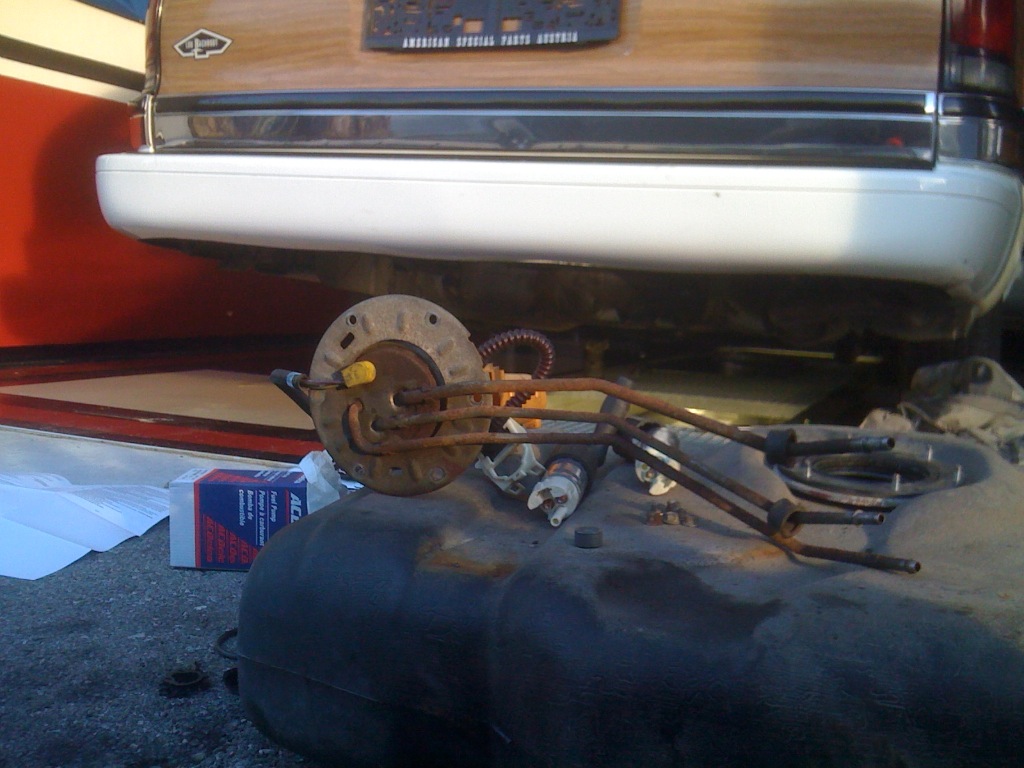
The old unit and the dropped tank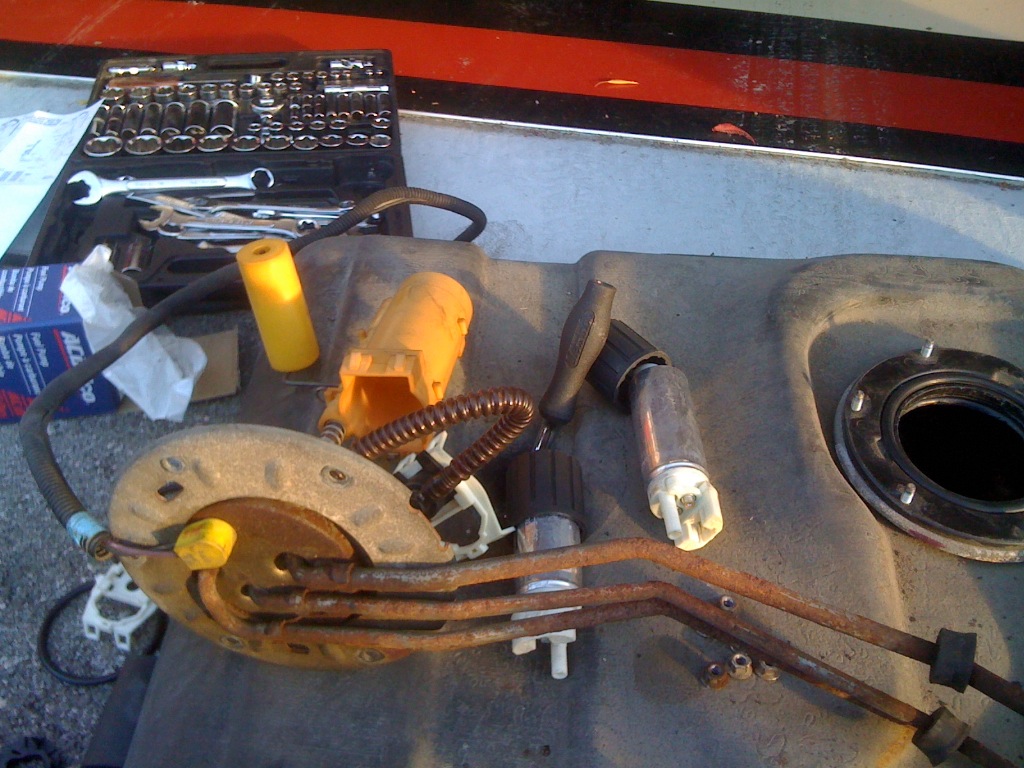
the old unit with the fuel pump removed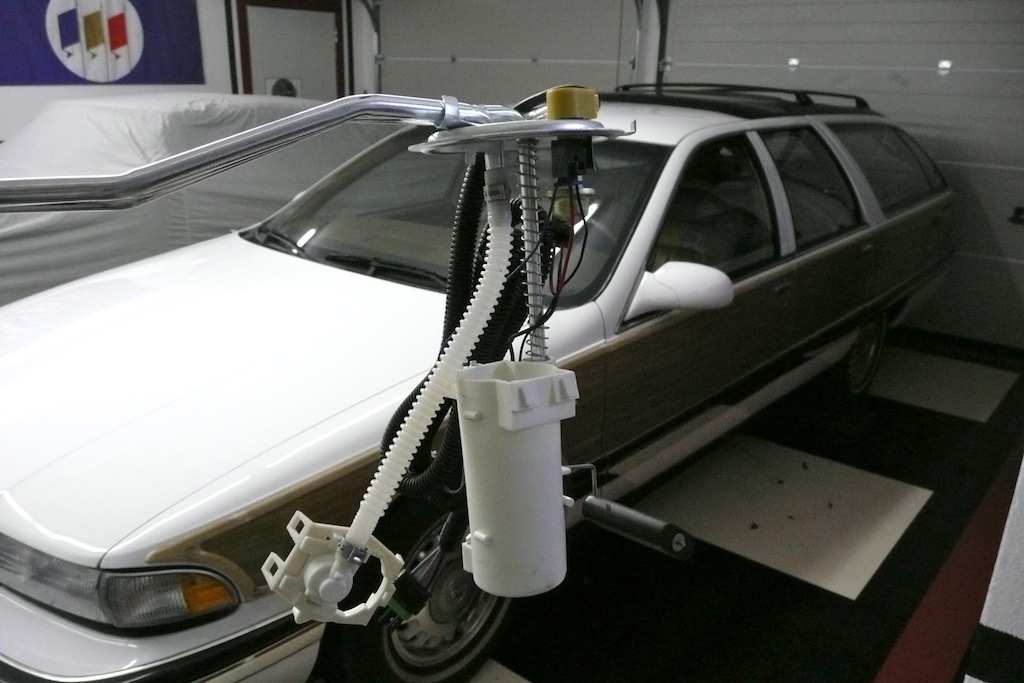
the new fuel sending unit when it arrived
The 67 Eldorado is at the shop again
Also the ignition and the rebuilt carburetor were not quite up to my standards yet, and so I decided to ask for some professional help for the last finishing touches. So I delivered the car to the shop, and the experts did some more tweaking. The result is that I finally have a perfectly working AC on my car. It took a while, but finally it's working as it should. When I got the car, a lot of AC parts were defective or torn out, and now everything is back to factory specs.
Also the carburetor is finally working as it should.
From a technical standpoint the car is now in perfect condition - you wont find anything that´s not working as it should.
Great! - next up is a repaint...
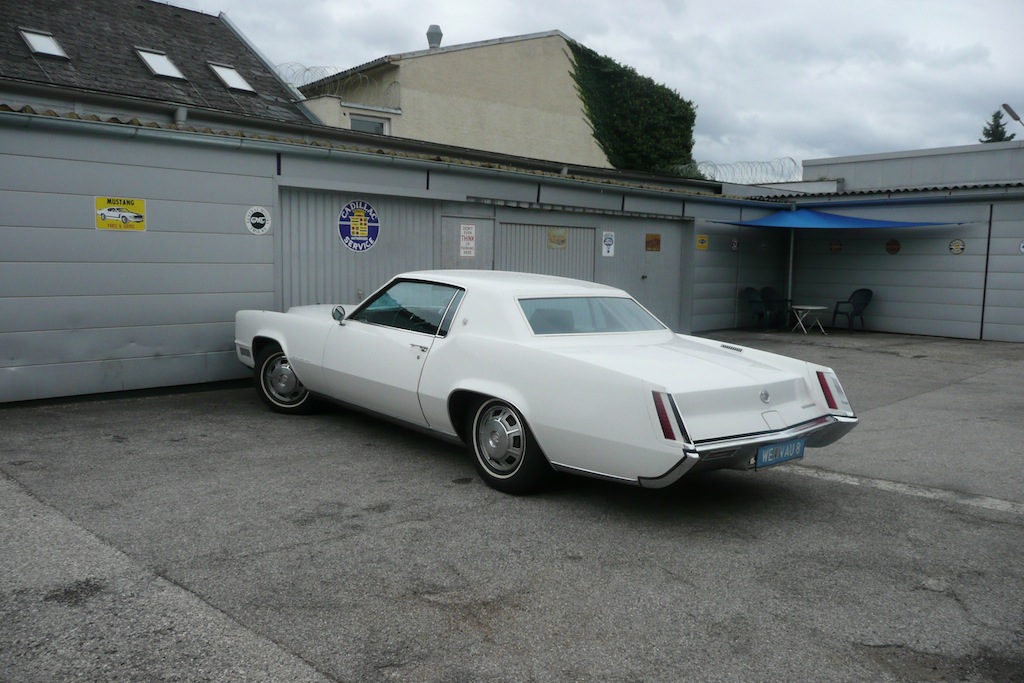
The Eldo at the shop.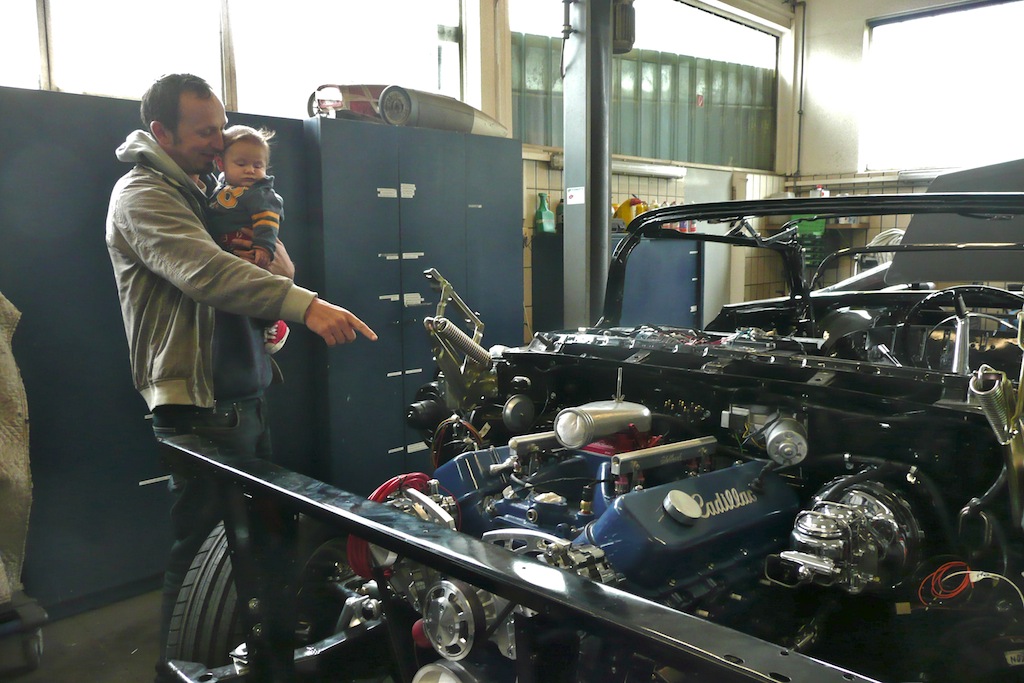
I took my little son with me to show him whats going on in the restoration shop.
Looking at so many cool cars made little Elliot very thirsty. Here he is having his milk in the shop.
Detailing the paint of the 1967 Eldorado
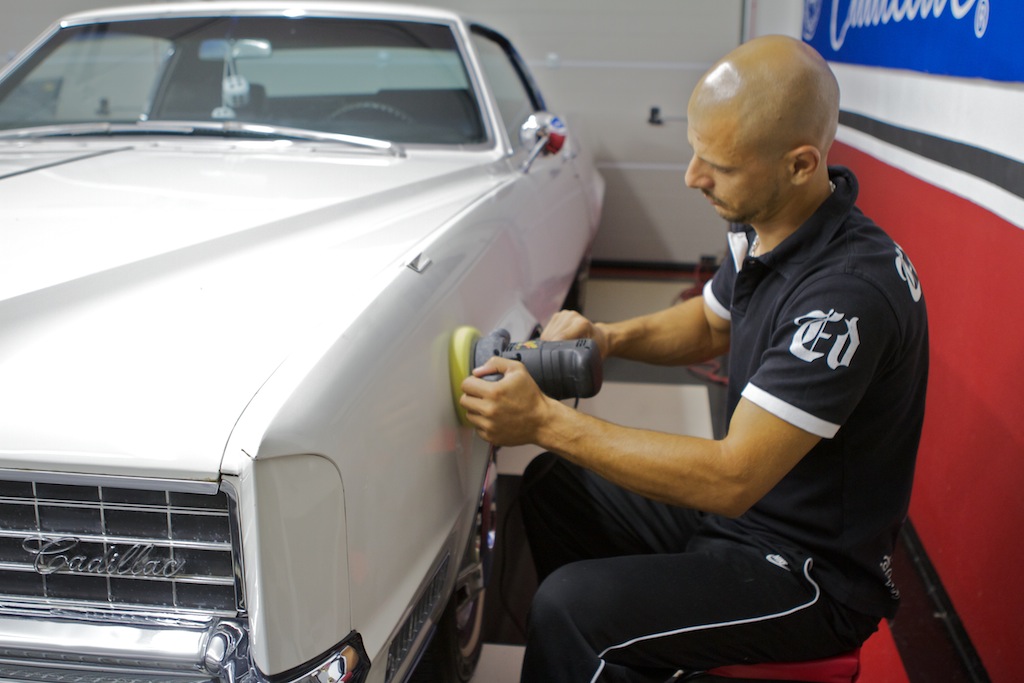
My friend Tayfun polishing the paint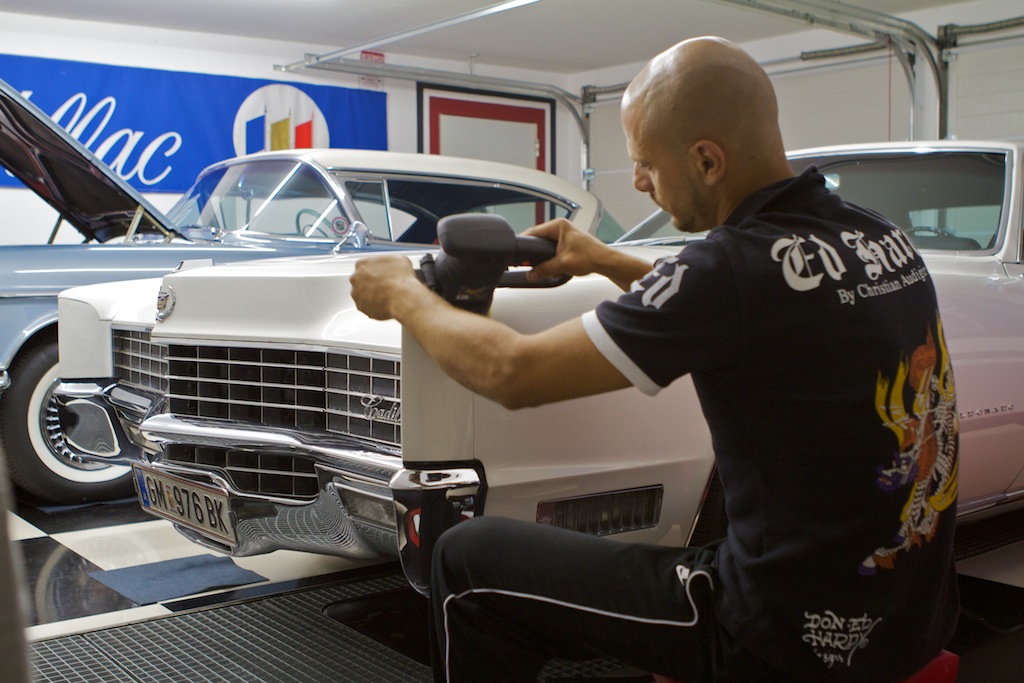
it took 7 steps for a smooth surface...
1967 Eldorado Headlight Actuator repaired
The instructions on the reproduction part mentioned that one could use silicone spray to lube the internals of the actuator through the vacuum inlets - this would also make the rubber parts in there soft for a better sealing. So I thought it might be a good idea to spray something in my old part and really soak it...
I had the impression that the rod was easier to move after application. I also put some gasket sealant around the vacuum inlets, just to make sure that there is no leak anywhere.
So I installed the old unit once again and it still did not work properly - but it worked fine if I only installed one vacuum line at a time. Suddenly it rang a bell. There are some T-connectors which also act as a valve going to each actuator. They do vent the system on one side when the doors are operated.
I cleaned the connector valve and reinstalled one hose going there and suddenly everything was back in working order! It now works like it should again!
Looks like I bought the new actuator for nothing... It cant hurt to have a spare though, as they are pretty fragile and even failed when new in 1967... In the meantime I might also find a way to install the original rod ends... Let me know if you have an idea!
If you are looking for a vacuum diagram for the Eldorados headlight doors you can find it on my website.
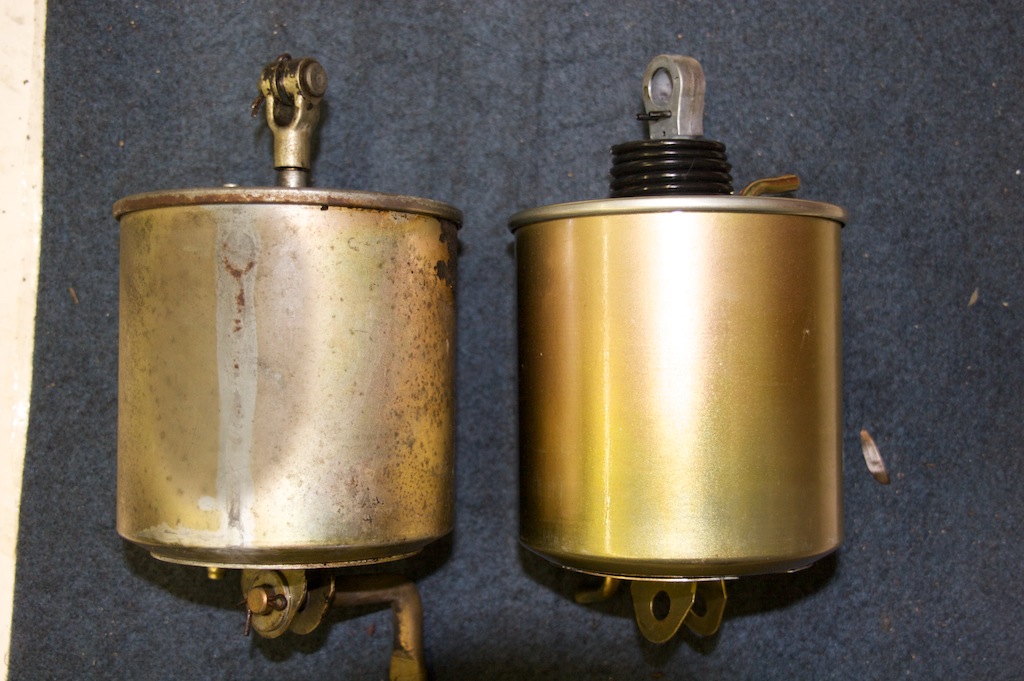
on the left the original actuator - on the right the reproduction unit from a 1969 Camaro RS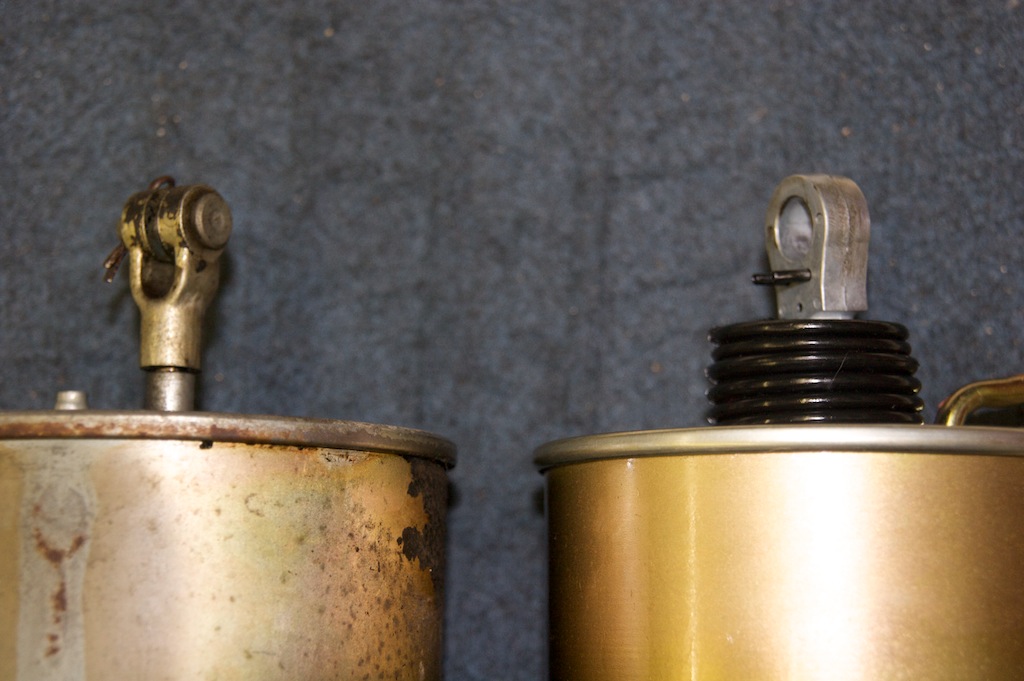
The different rod ends - the original one on the left - the headlight door mechanism is installed in the center of the rod end with a pin.
On the Camaro unit one could probably install it on the side using a bushing.
I have heard that this worked fine for some Eldorado owners as you can see on the picture below.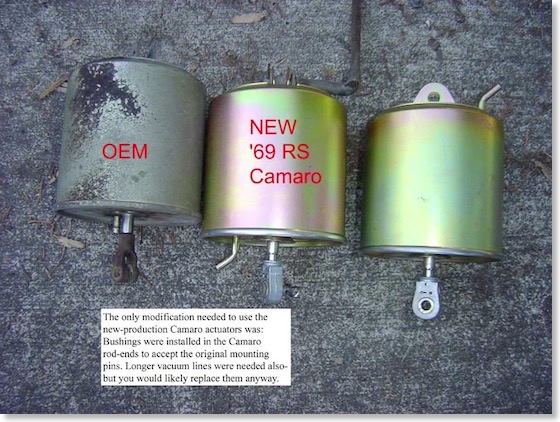
This is how it worked for another Eldorado owner - he installed some bushings on the new unit.
I found this picture on ebay at the auction for a 1967 Eldorado recently.
Update November 2014:
I have been in contact with Mark Maromonte who found this post on my website and replaced his bad OEM actuator with the 69 Camaro RS unit. He did some modifications and sent me some pictures to share here. Thanks Mark! I´m sure its helpful to others as well:
Mark wrote (all pictures below were provided by © Mark Maromonte):
I bought an actuator for a 1969 Camaro RS. I removed the two pins that held the attachment to the end of the rod. Then I cut 3/8 of a inch of the rod off, so the rods were the same length. Then I beveled the end of the rod on a grinding wheel, for about a ½ inch at the end of the rod. This was done so that I could start a ¼ tap on the end of the rod. After the tap was done. I threaded on the Eldo clevis pin. Done! 20 minuets, $76 vs $245. Works fine. Thanks again for suggesting that in your post. Take care, Mark
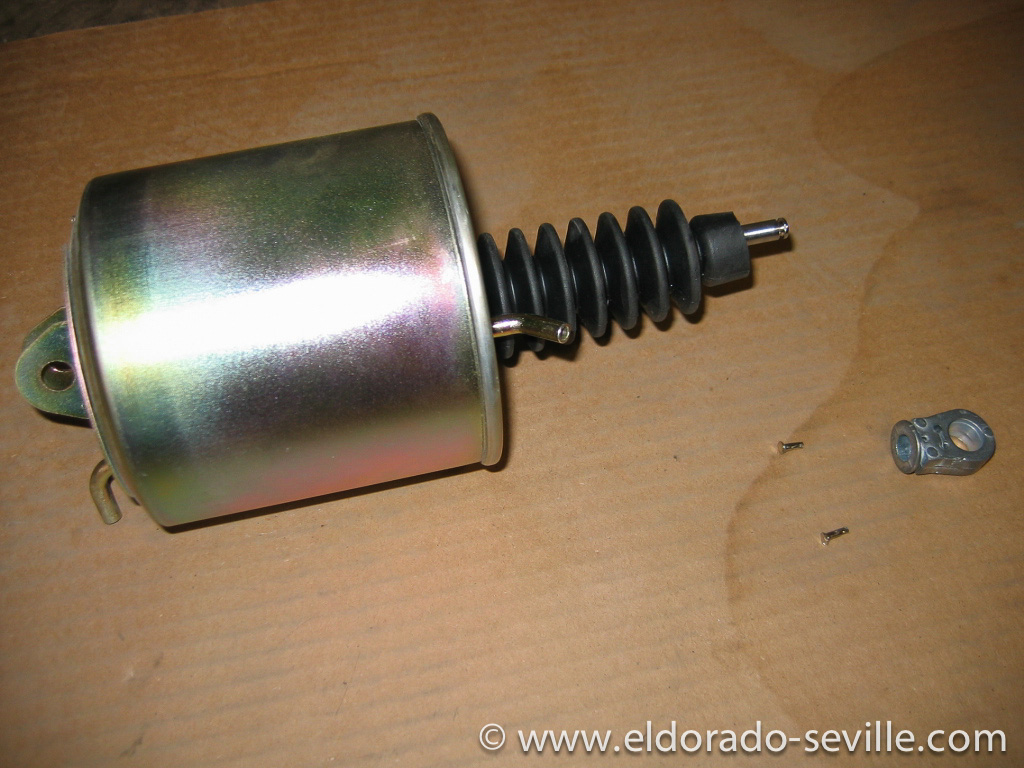
The 1969 Camaro RS headlight actuator is slightly different from the original Cadillac actuator. It can be made to fit though.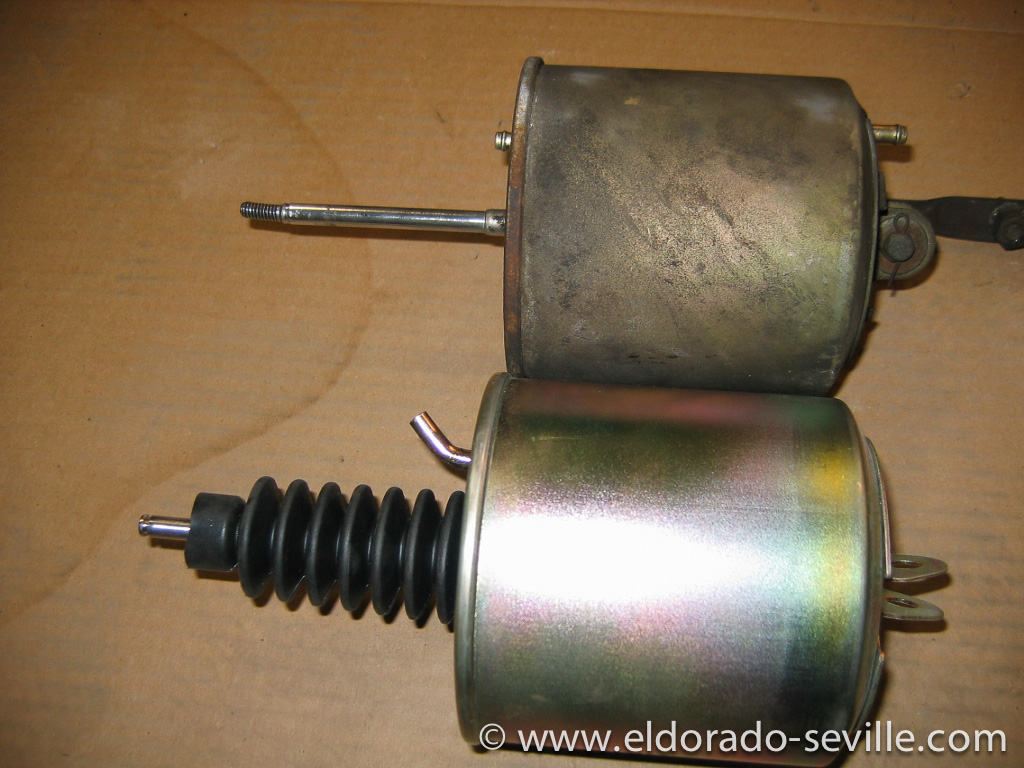
The original Cadillac OEM actuator on top and the Camaro RS actuator below. You can see the difference on the mounting. Also the air outlet is slightly curved on the Camaro. There is a thread on the Cadillac actuator and a clevis pin on the Camaro rod end.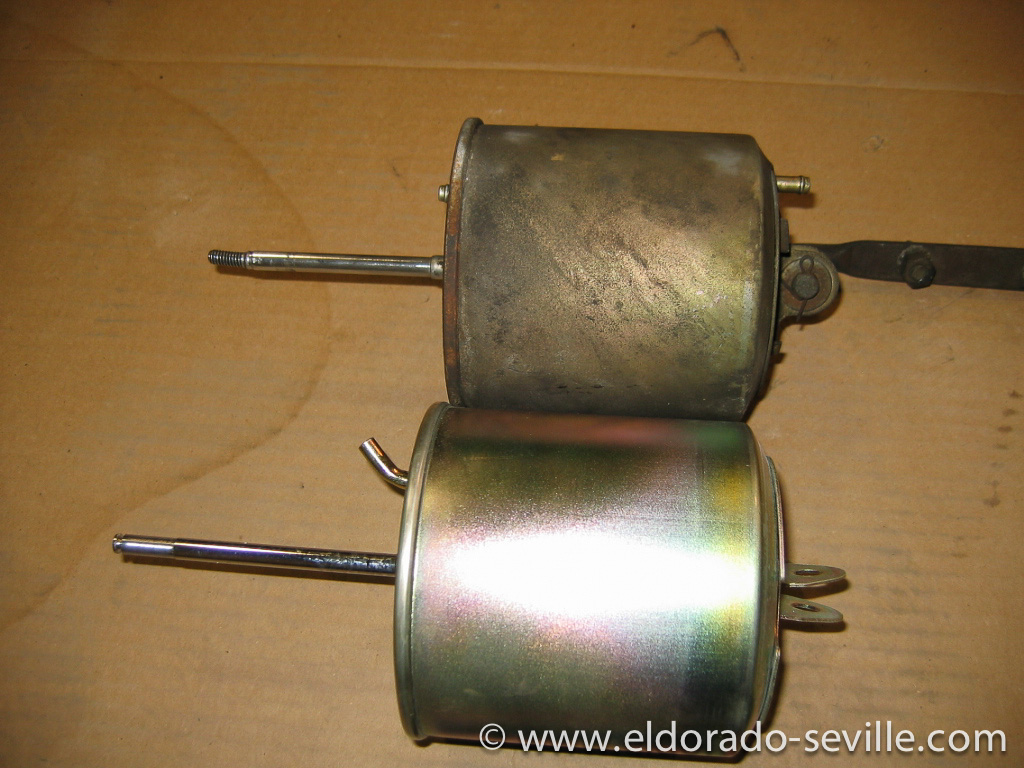
The original Cadillac OEM actuator on top and the Camaro RS actuator below. You can see the difference on the mounting. Also the air outlet is slightly curved on the Camaro. There is a thread on the Cadillac actuator and a clevis pin on the Camaro.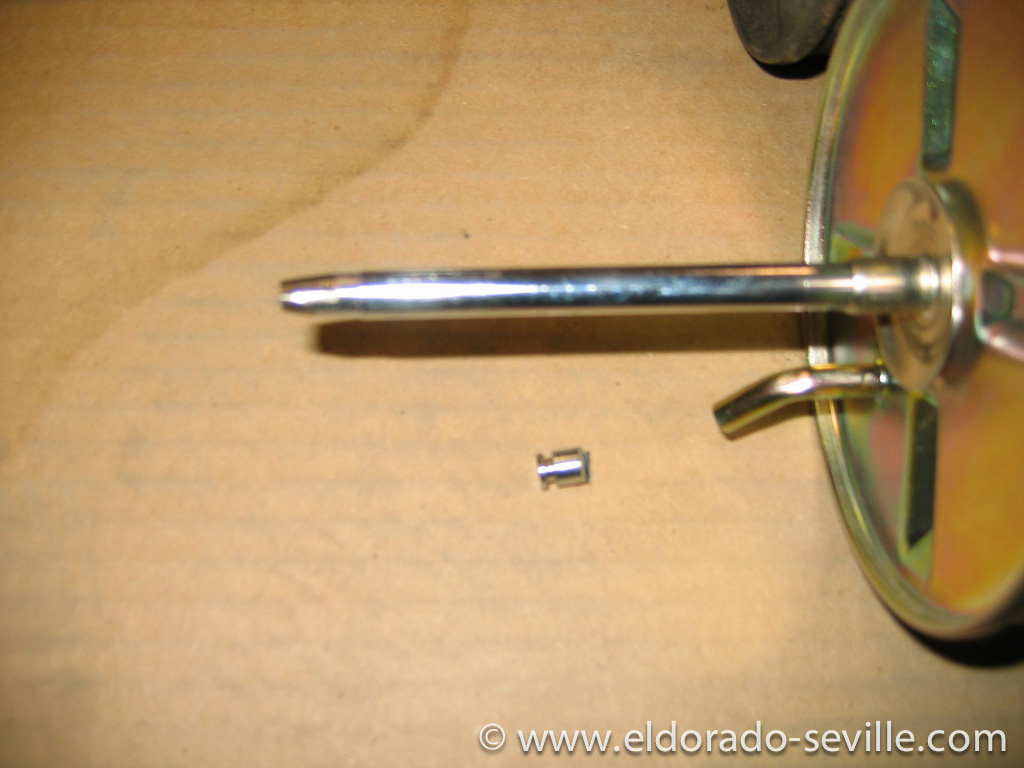
Mark beveled the end of the rod on a grinding wheel, for about a ½ inch at the end of the rod.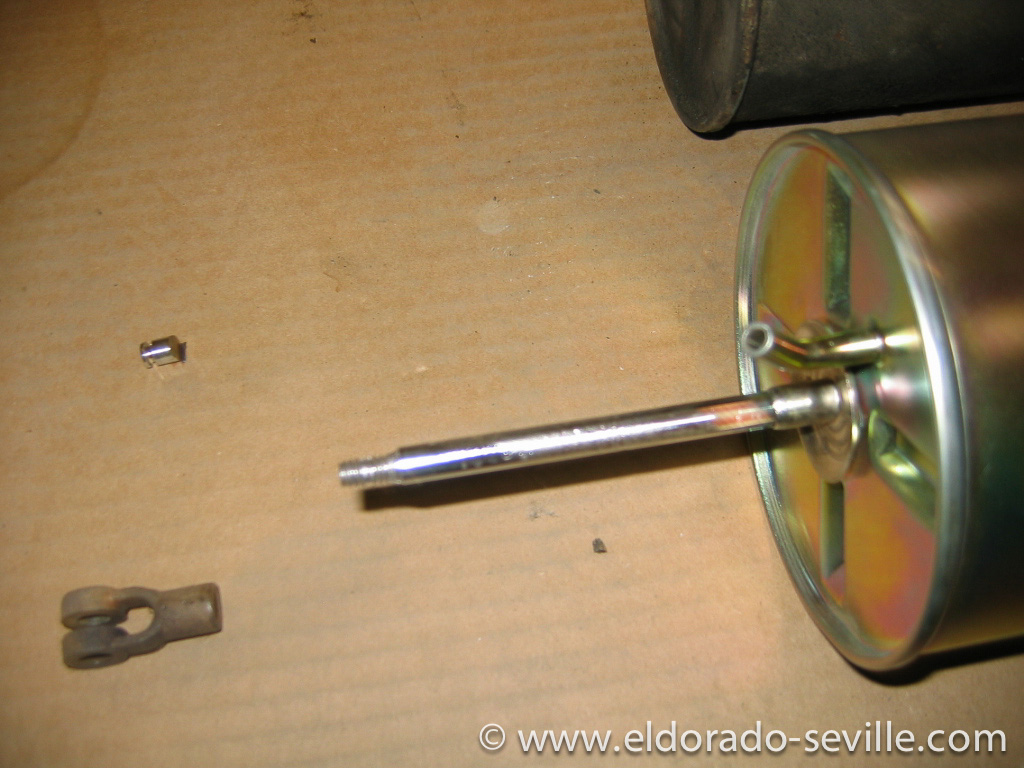
Mark cut a thread onto the Camaro shaft so that the original Cadillac clevis would fit.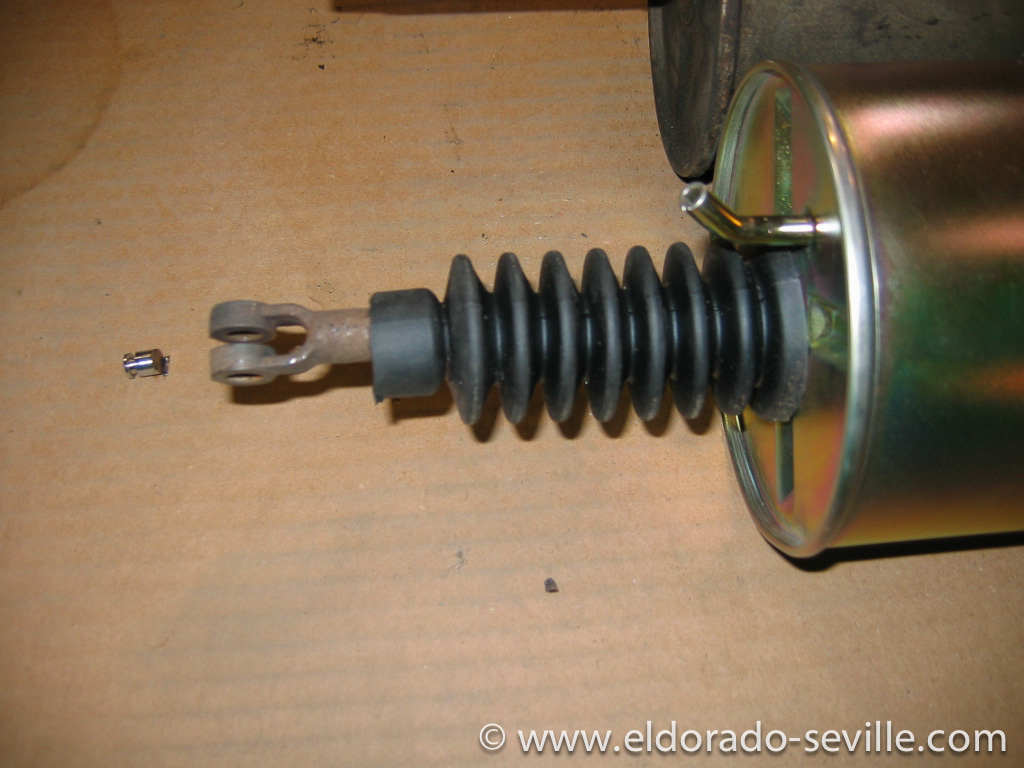
Finished- works perfectly. The modification is done.
A problem with the 67 Eldorados carburetor
The right headlight door actuator also suddenly no longer works correctly. All hoses are new and it worked perfectly until recently. I can now only make it close if I jiggle on the actuator. Is there any way to rebuild them? A source for new or rebuilt ones? I have heard that the ones from the 1969 Camaro is very similar and only needs some minor modifications to work on the Eldorado as well. So I went ahead and ordered one. But the worst thing was that the freshly rebuilt carburetor made strange ticking noises and sounded like a tractor while accelerating. It worked well though, but the sound was unbearable. Could it be a defective gasket? It was also idling quite badly. Acceleration was superb though, its much more powerful than before, but still something was wrong... The ignition also was completely rebuilt. So I played around with the ignition first, but the ticking sound did not go away, no matter in which direction I changed the timing... Almost sounded like an exhaust leak, but there seemed to be none... It was LOUD! Before I had the carb and ignition rebuilt, it was extremely quiet and idling smoothly but had misses while accelerating.
I got some very valuable tips from fellow Cadillac aficionados and the previous owner of this Eldorado even called me from the USA to give me some tips to solve this issue, and he was spot on with his diagnosis...
With a hose held to my ear and the other end to the carburetor, I was able to locate the source of the noise. It came from the carburetor below the choke assembly. So I took the freshly rebuilt Rochester Quadrajet out again, only to find out that the gasket and the metal shim were installed the wrong way around. This burned a hole into the brand new gasket where the exhaust gases from the heat crossover passage could escape and make this noise.
Of course I did not have a new gasket at hand, so I carefully removed the old one from my spare engine, which was in pretty good shape and installed it.
No more ticking - no more noises, no more bad idling.
The car now drives amazingly good and is silky smooth. It could not be any better.
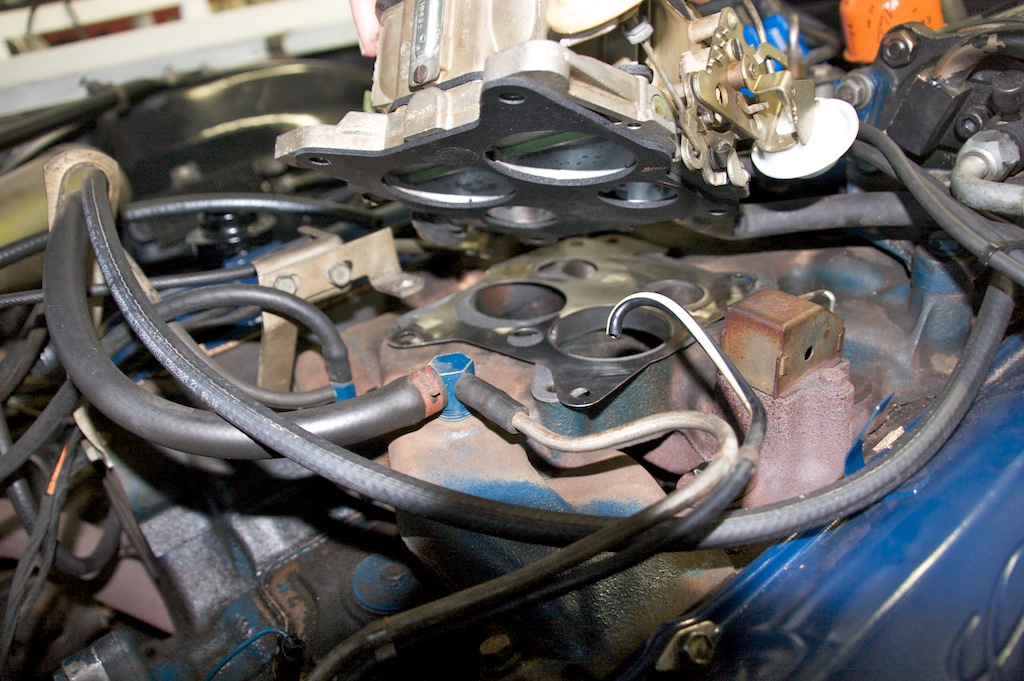
The shim was installed first and then the carb - thats wrong! The gasket has to go on the intake manifold first - then comes the metal shim.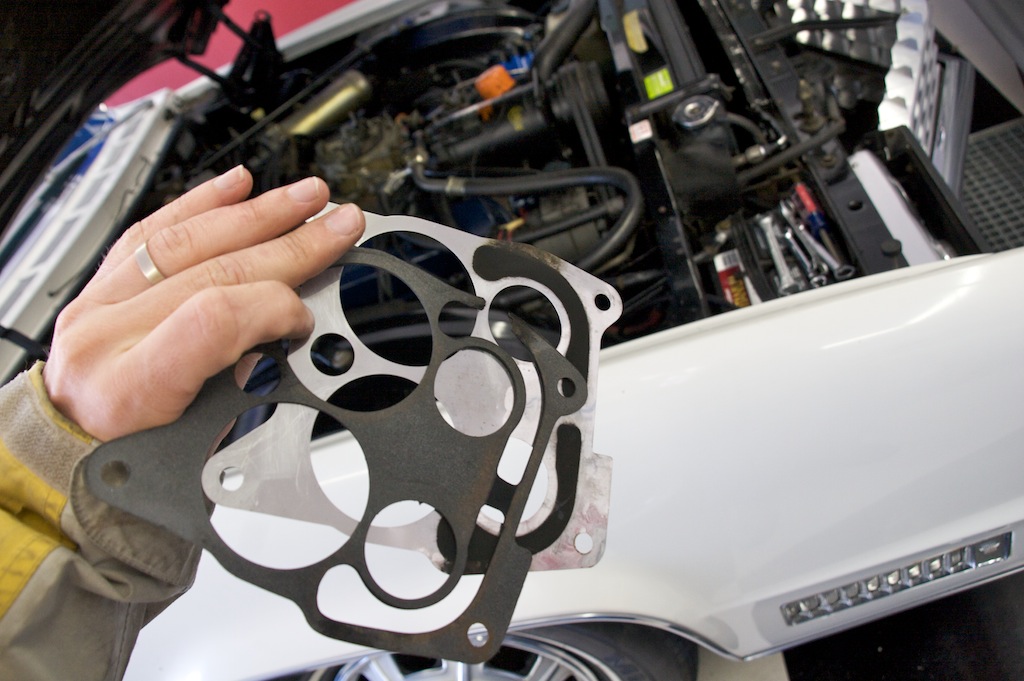
Here you can see the burnt gasket and the metal shim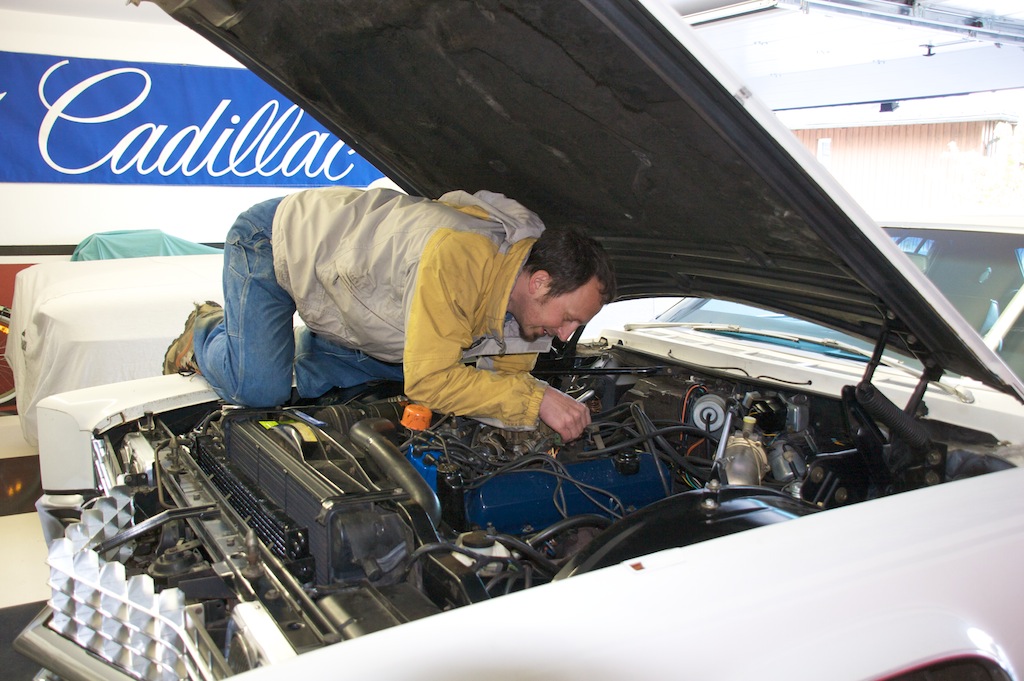
Putting everything back together again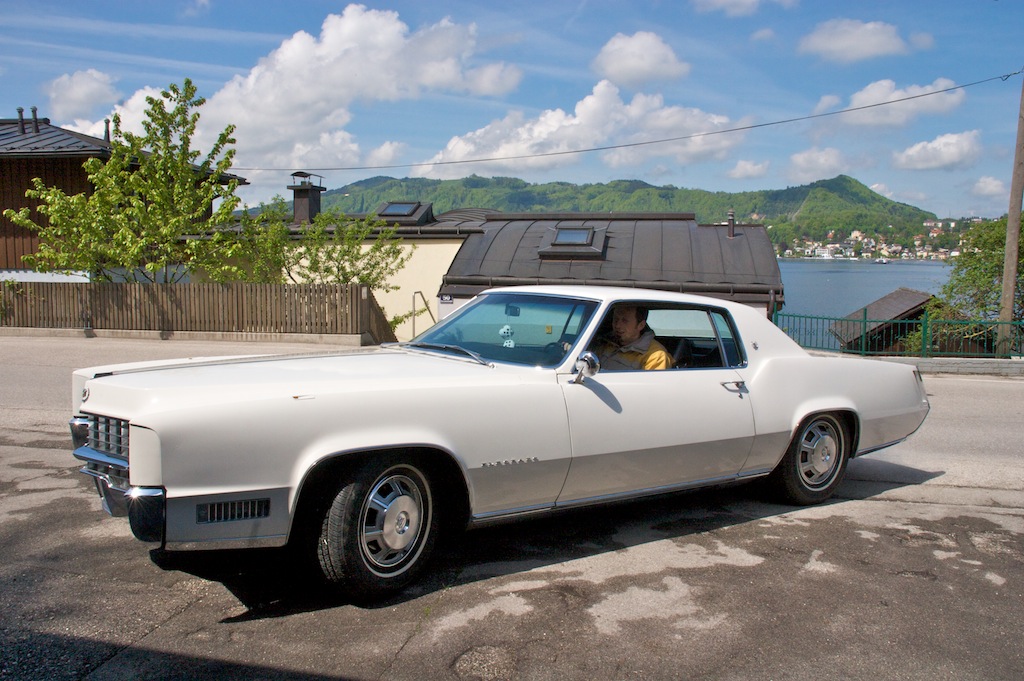
Test drive after the repair - perfect!
The 67 Eldorado is at the restoration shop again
Also on the „to do list“ is to install a new condenser for the air condition, recharge it with good old R12 and to fix a problem with the ignition timing. Cant wait to have the car back!
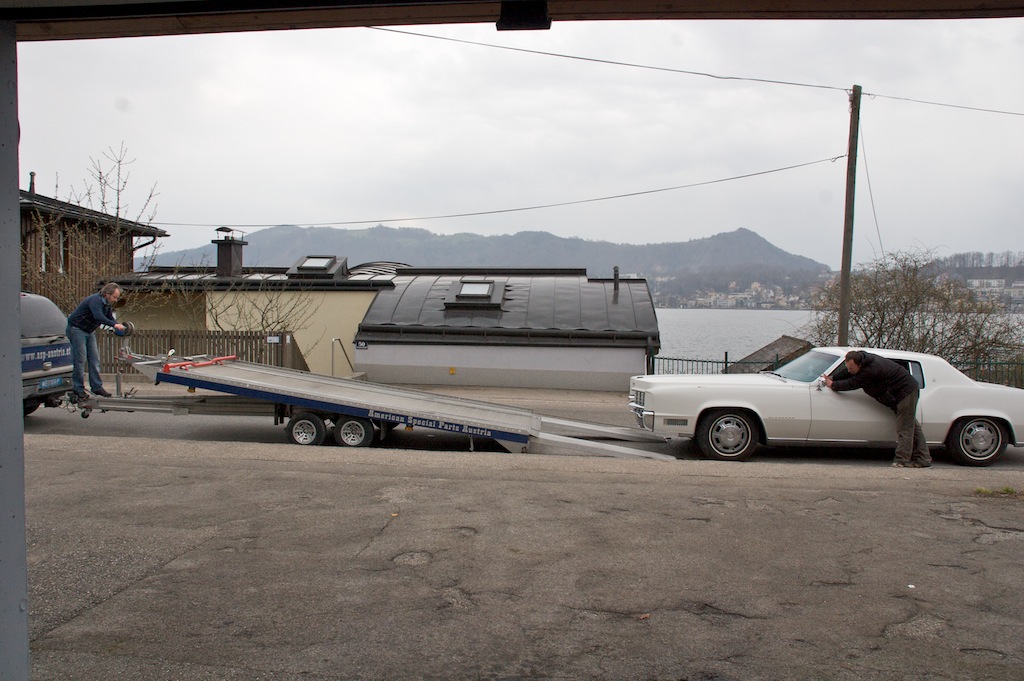
As I could not start the car we had to winch it up onto the trailer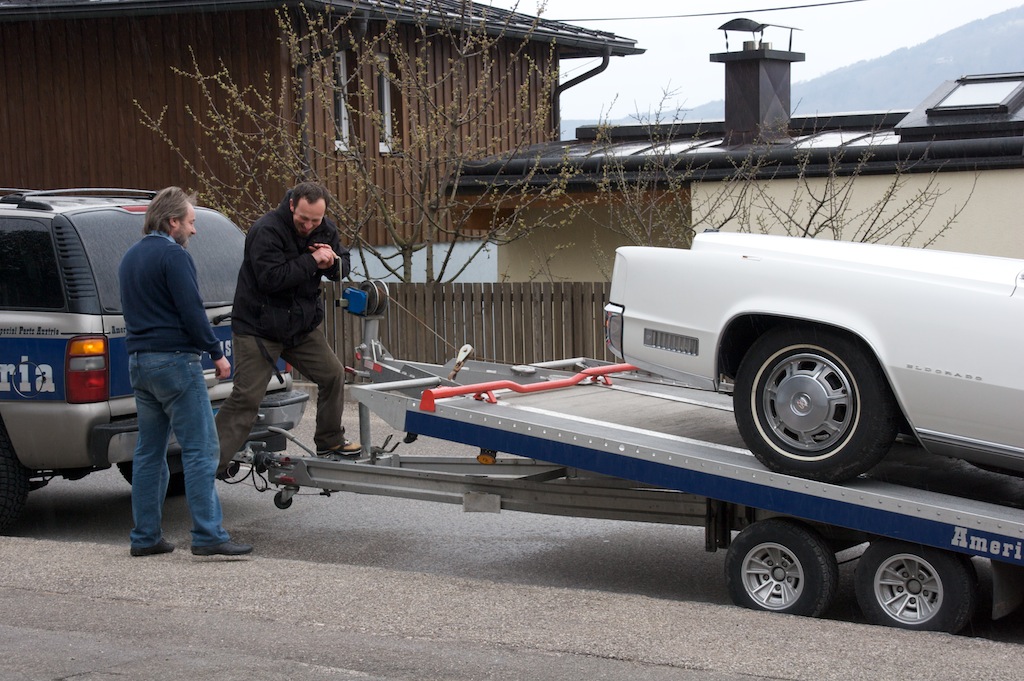
Its pretty heavy...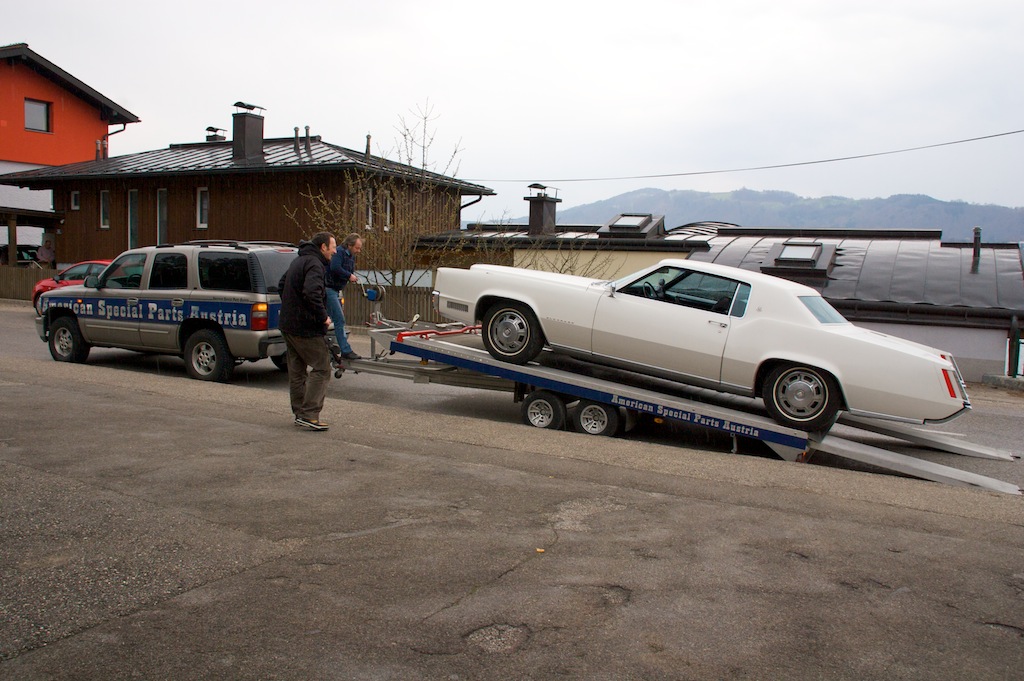
Almost up...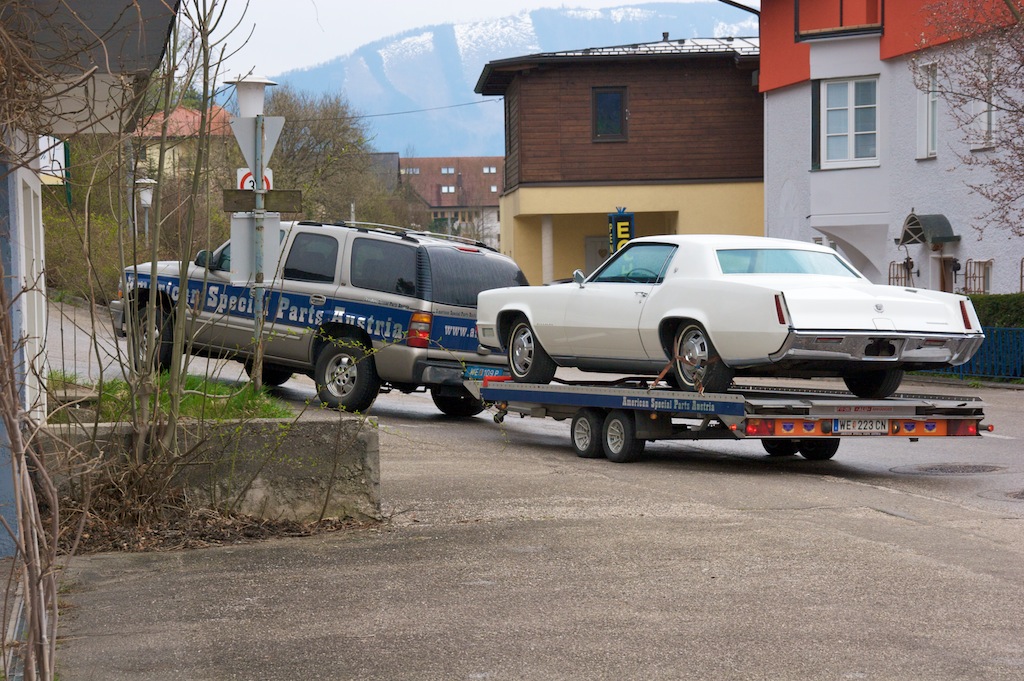
Good bye!
The 67 Eldorado´s waterpump is defective
There are only very few possibilities why this could have happened.
- The thermostat did no longer open
- The waterpump failed
- Air was trapped somewhere in the cooling system
So I removed the thermostat housing first to check the thermostat. This is when disaster struck. The two bolts in the thermostat housing snapped off immediately when I tried to unscrew them. *Cr*p”
I then removed the thermostat and put it into boiling water and it worked perfectly. So I think I can rule out the thermostat.
As the upper radiator hose stayed pretty cool and it did not feel like there is any coolant circulating through it, I suspected the water pump. Maybe the impeller does no longer work. I will have to remove the pump to check it.
My friend Richard came over to help me to try removing the broken bolts which got stuck in the cylinder head water outlet pipe. As all methods we tried to remove the broken bolts failed, we began drilling the remains out. This did not turn out very successful either... The threads also got damaged with this method. Of course one could now rethread this part, but I decided to order a good used one.
Once again Arizona Vintage Parts is the company where I ordered all the spare parts. They are really a great company! They are reasonably priced and so far they had everything I ever needed and inquired for. They are a pleasure to deal with and I can highly recommend them. I´m looking forward for the parts to arrive, as the car in its current state is immobile and blocking the garage...
UPDATE 03/09: The parts from Arizona Vintage parts already arrived within a couple of days after ordering! Wow thats fast! Now I need some time and warmer temperatures to install them...
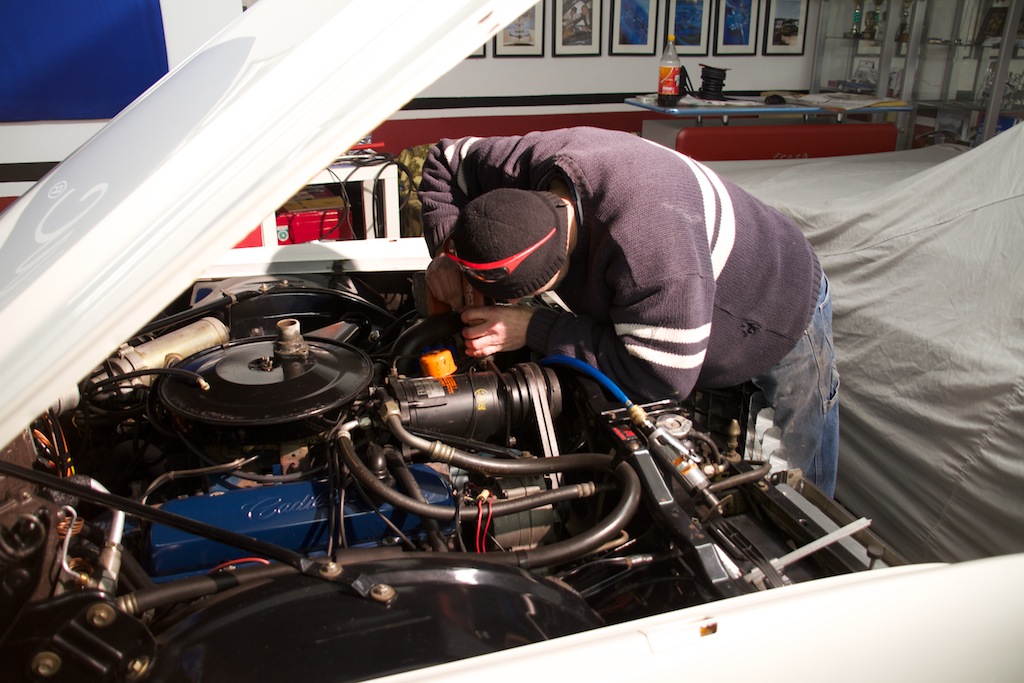
My friend Richard drilling out the snapped off bolts...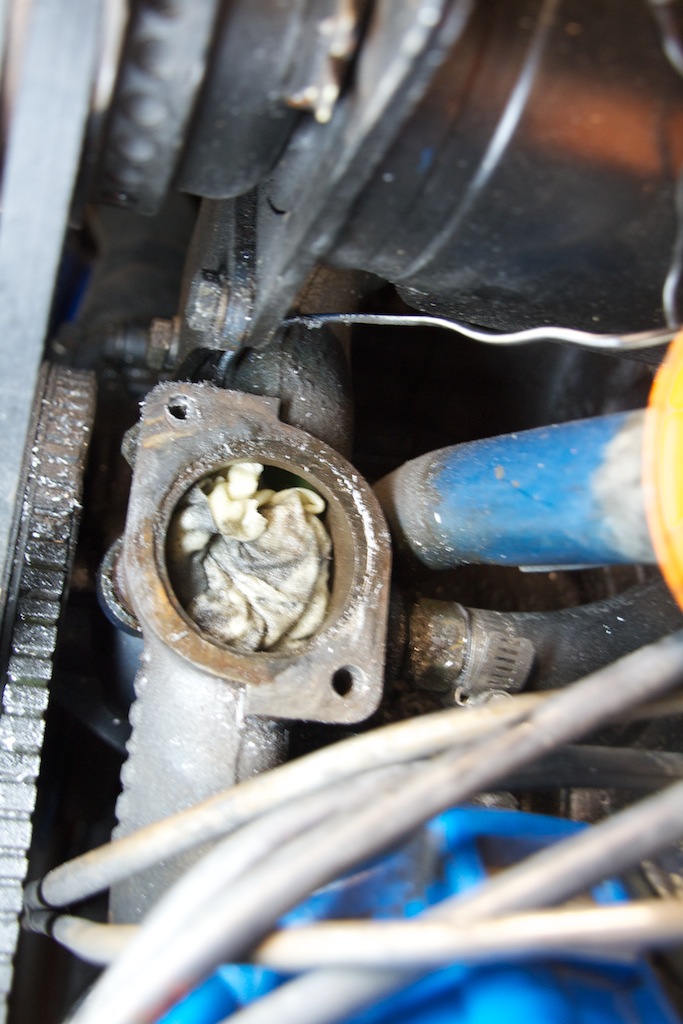
Normally the thermostat is in there. You can see the mounting holes from where we drilled out the bolts. Unfortunately the threads did not survive this treatment...
1967 Eldorado Seat Transmission repaired
I removed it from under the seat, what was a little tricky and involved getting in some strange positions to access all the screws. It would be easier if one removes the seat from the car, but thats a rather unpleasant work as well...
Eventually it came out of the car. I disassembled it and at first everything looked pretty good, but it soon showed that the old grease became rather hard and sticky and one of the three solenoids was no longer able to push the gear into a locked position.
I thoroughly removed all of the old grease and re-greased everything with white lithium grease. I then reassembled everything, reconnected the gear cables, reinstalled the transmission under the seat (thats a very tricky part...) and everything worked like new!
I now have perfectly working power seats again!
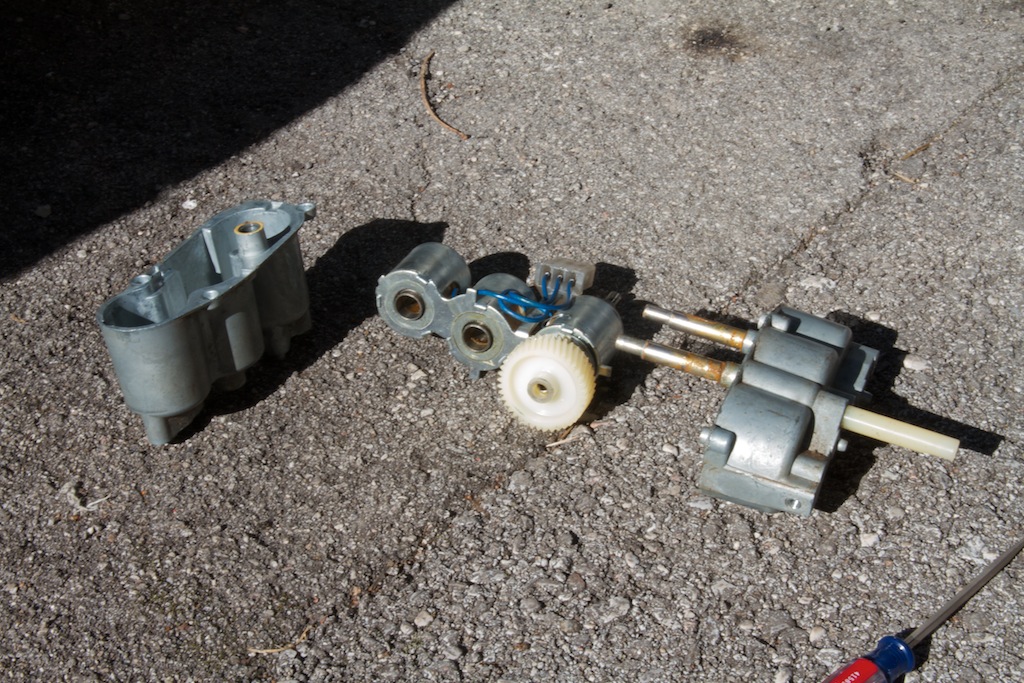
The seat transmission disassembled - you can see the brownish old grease everywhere.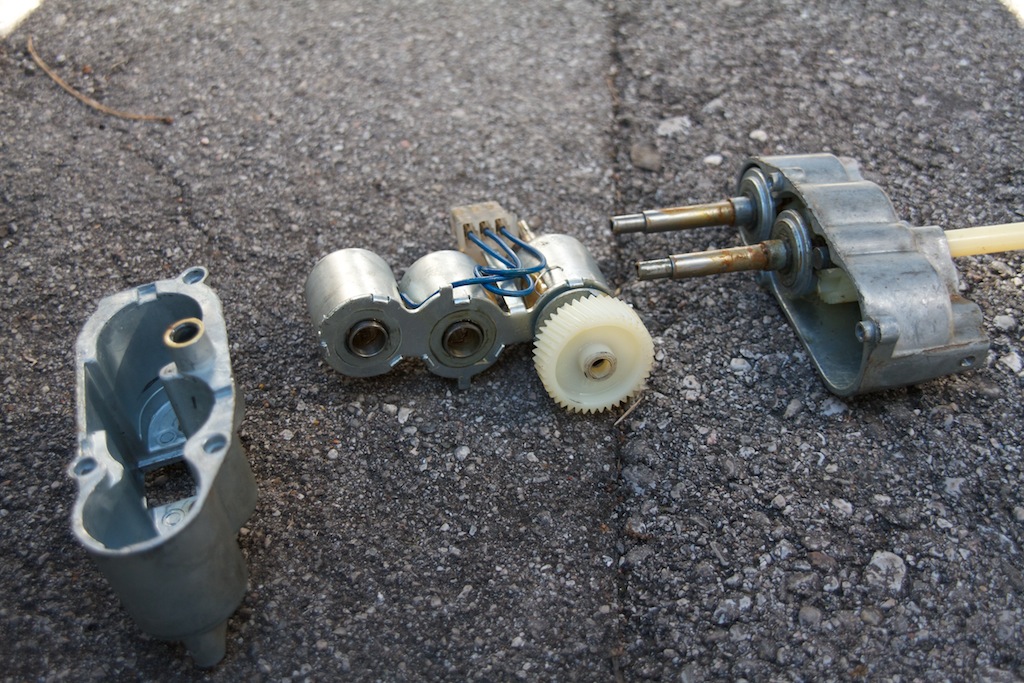
Part of the gears and the solenoids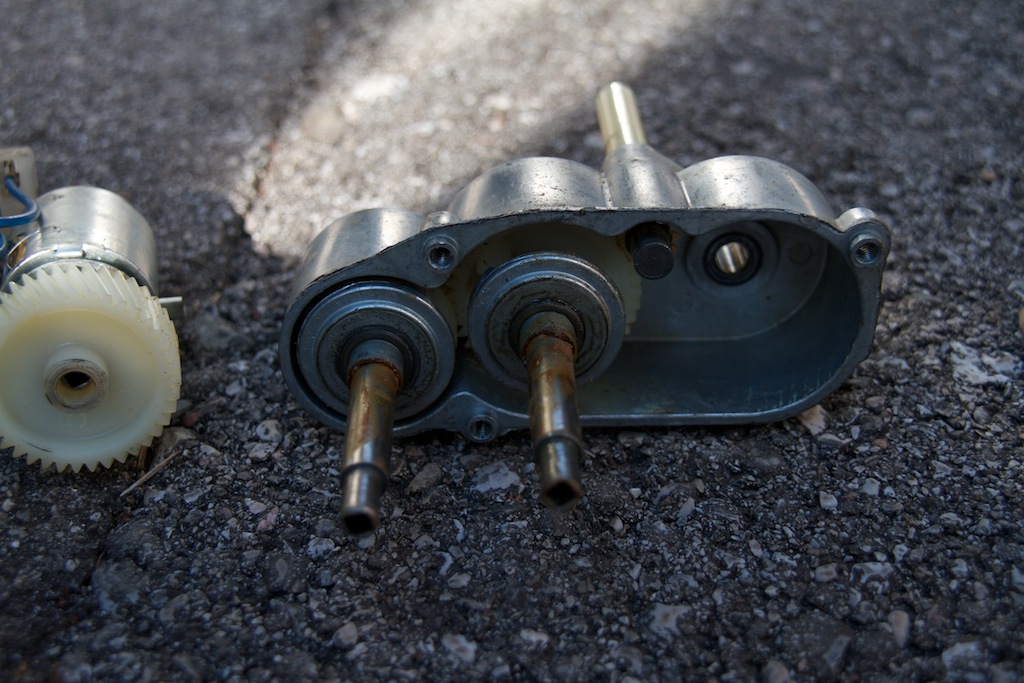
The transmission part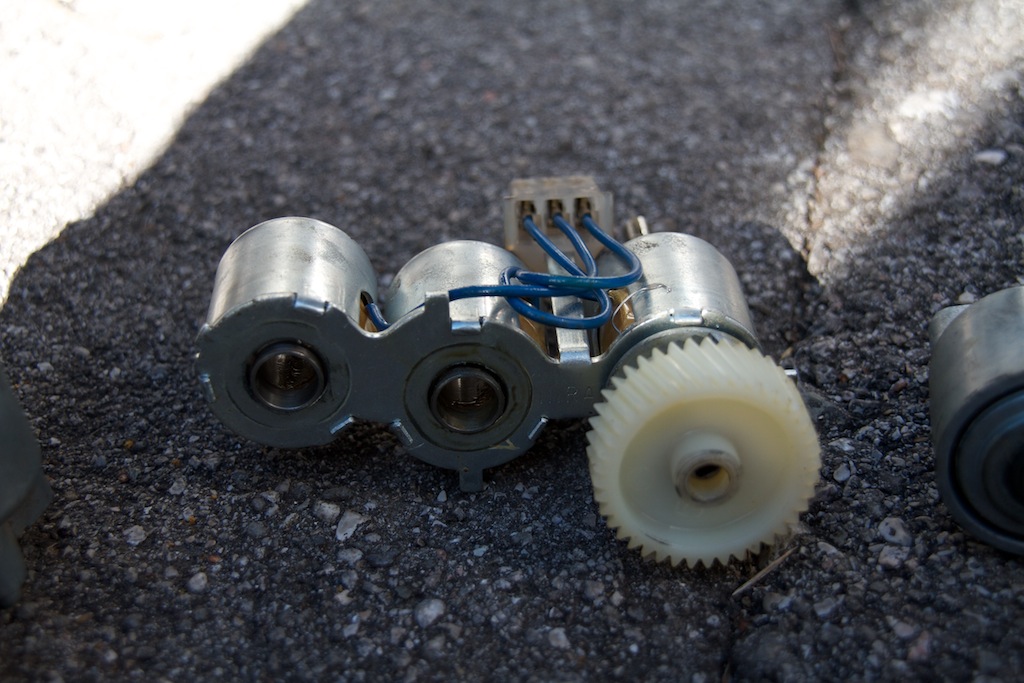
The three solenoids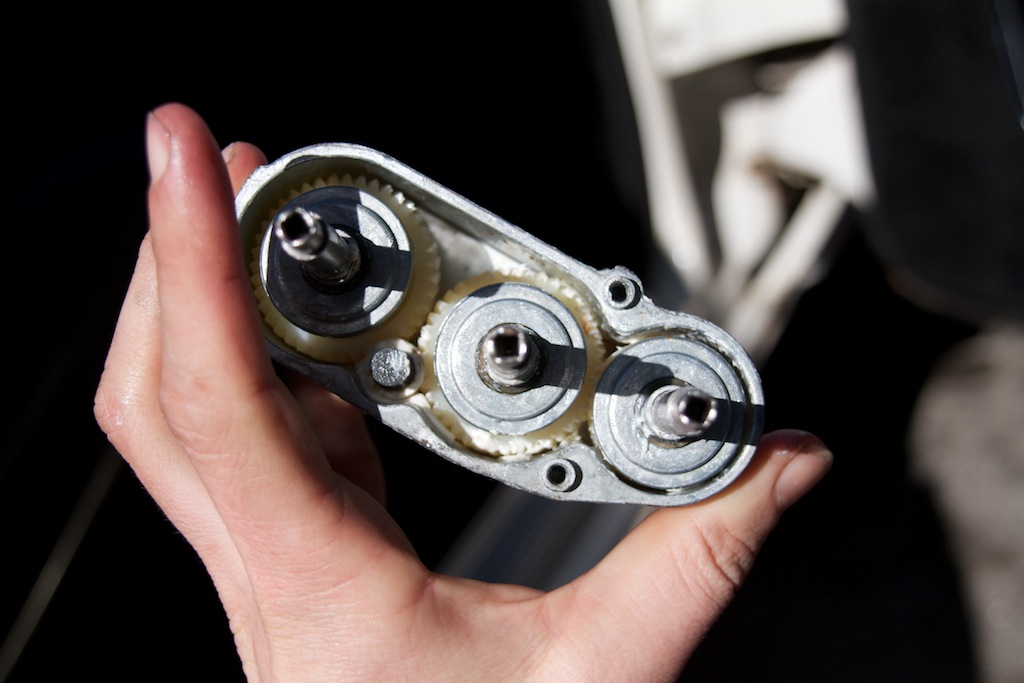
The cleaned and re-greased transmission
1967 Eldorado Door Jamb Switch Repair
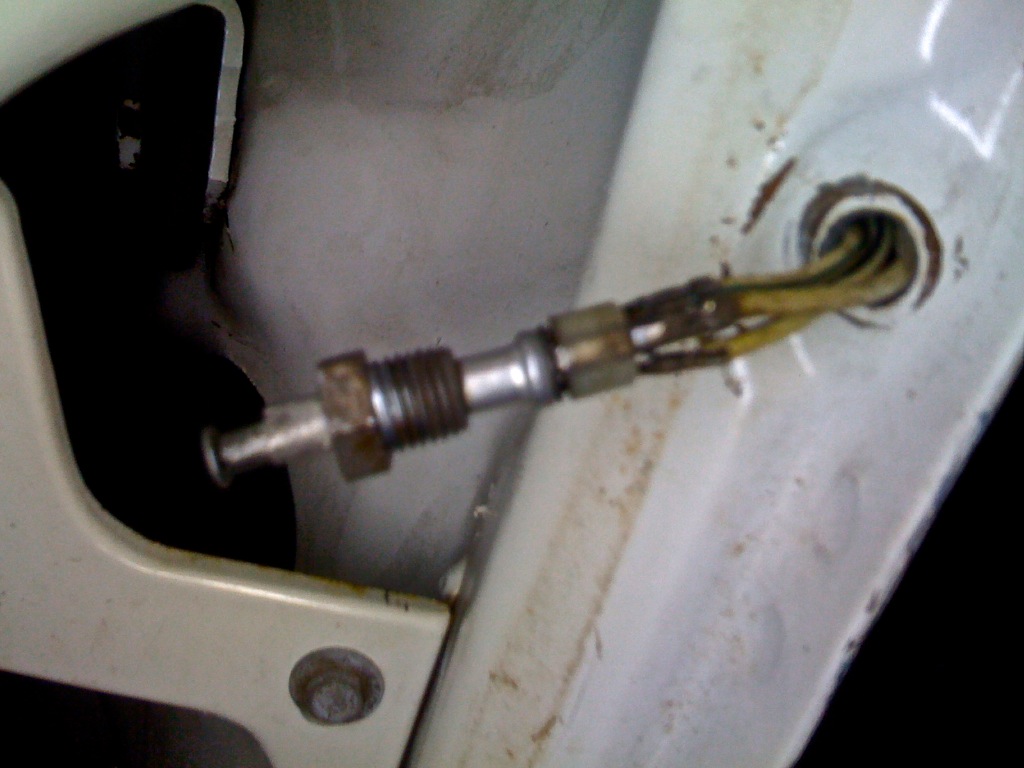
This is how the doorjamb switch looks like on a 1967 Eldorado when removed. Sorry for the crappy cell phone picture!
I will have to clean the paint in the doorjambs soon as you can see in this picture...
The 1967 Eldorado headlight door repairs - first spring outing
While I had the 67 Eldorado out I also turned on the headlights and was once again annoyed by the fact that the right one opened simultaneously, but closed slightly slower than the left one when I turned the lights off. There was a difference of around 1 second in movement between the two headlight doors.
Being a perfectionist I could not stand this, so I began searching for the problem. I already had spent some time in the past trying to fix this, but I did not succeed. The system is driven by vacuum only, so I started to look through the vacuum hoses once again. I had already exchanged a couple of them last year. I found another two brittle ones going through the firewall to the headlight switch from where a slight hissing sound was coming when the lights were on. When I touched them the hissing would become even more noticeable. I then tried to press them onto the connector of the switch and the first hose began to crumble into pieces. So I replaced all the hoses on the switch and rerouted them through firewall through the rubber insulation. There are three hoses . One is the vacuum feed (the one in the middle - I think it was yellow), one is for opening the doors (green) and one for closing (red). I also replaced the red hose behind the firewall going to a T-connector from where the vacuum is fed to the headlight door actuators. I had already replaced the two hoses after the T-connector in the past. With all new hoses in place the doors now perform almost simultaneously and quite fast. So when you run into troubles with your headlight doors, check and replace all the according vacuum hoses first. Its amazing how brittle the hoses going to the headlight switch inside the car can become over the years. It looks like they used a quite different material for these three hoses, as all other vacuum hoses are in much better shape and do not show any sign of deterioration at all.
You can see a video of the headlight doors in action below. On this video they are slightly out of sync. As it looks like they are slightly different every day, depending on temperature and engine idle...
watch on youtube or below
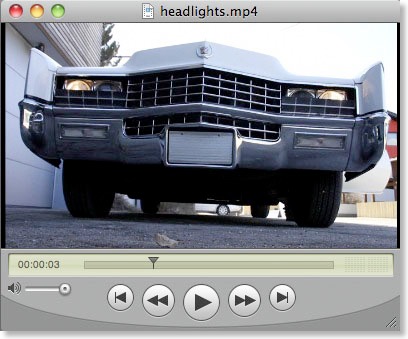
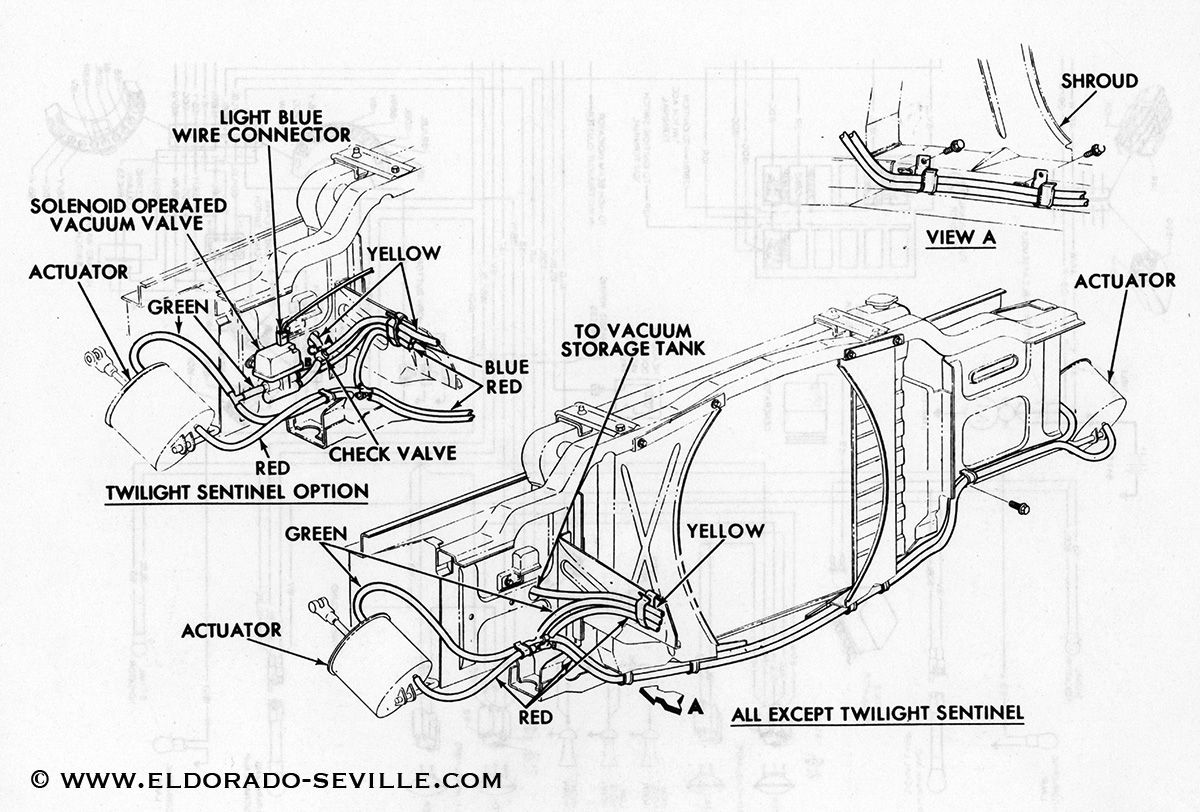
the vacuum diagram for the headlight doors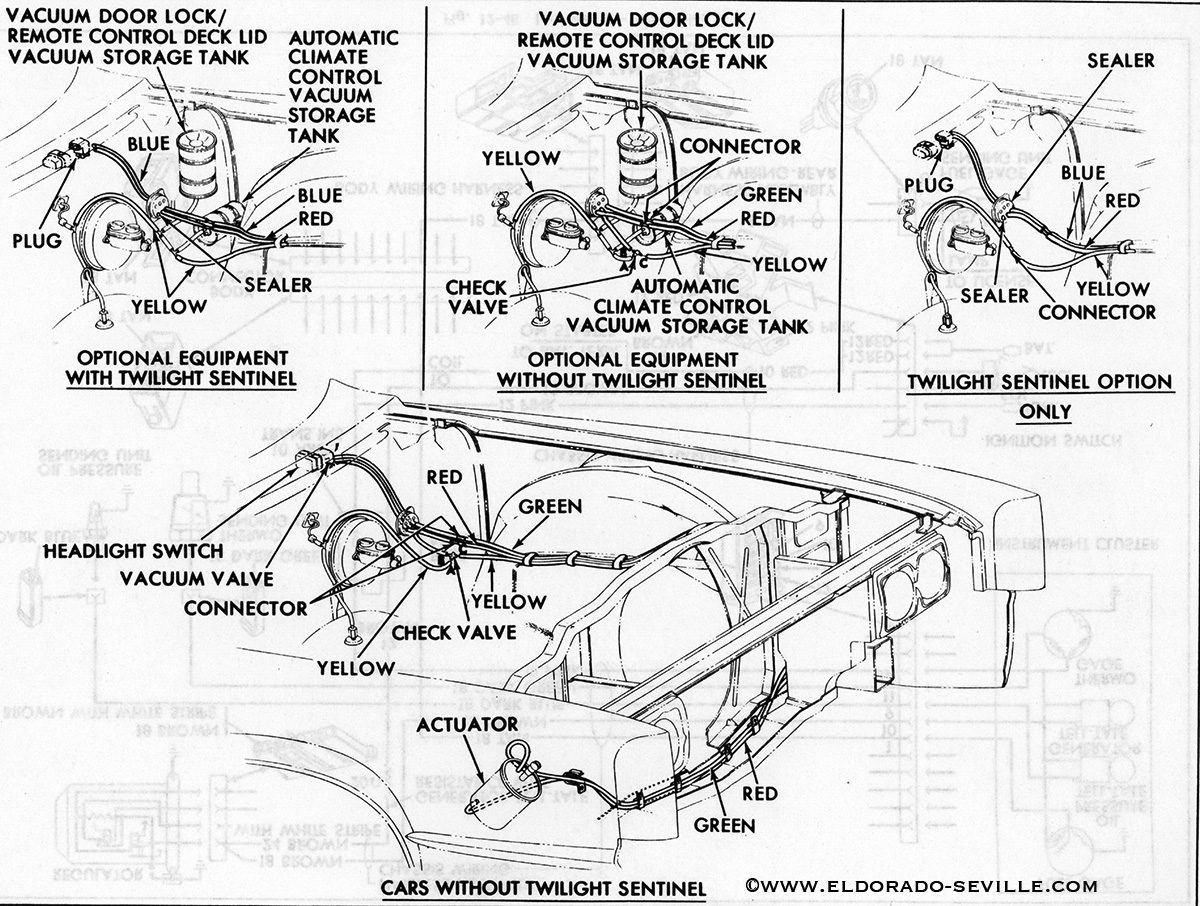
The vacuum diagram for the headlight doors
While the Eldorados were outside the garage my wife used the opportunity to shoot a couple of pictures she had in her mind, which she is planning to hang into the kids room. Cant wait until the medium format film is back from the photo lab. Below you can see only some digital snap shots I took.
Despite the last two unusual warm and beautiful days unfortunately winter is not over yet here in Austria, as some more snow is predicted for next week and the cars are back in the garage desperately waiting for April to come...
The Eldorado is enjoying some sun rays for the first time this year
Although she is 7 months pregnant, my wife Afra is still climbing ladders to get the best angle for her shots...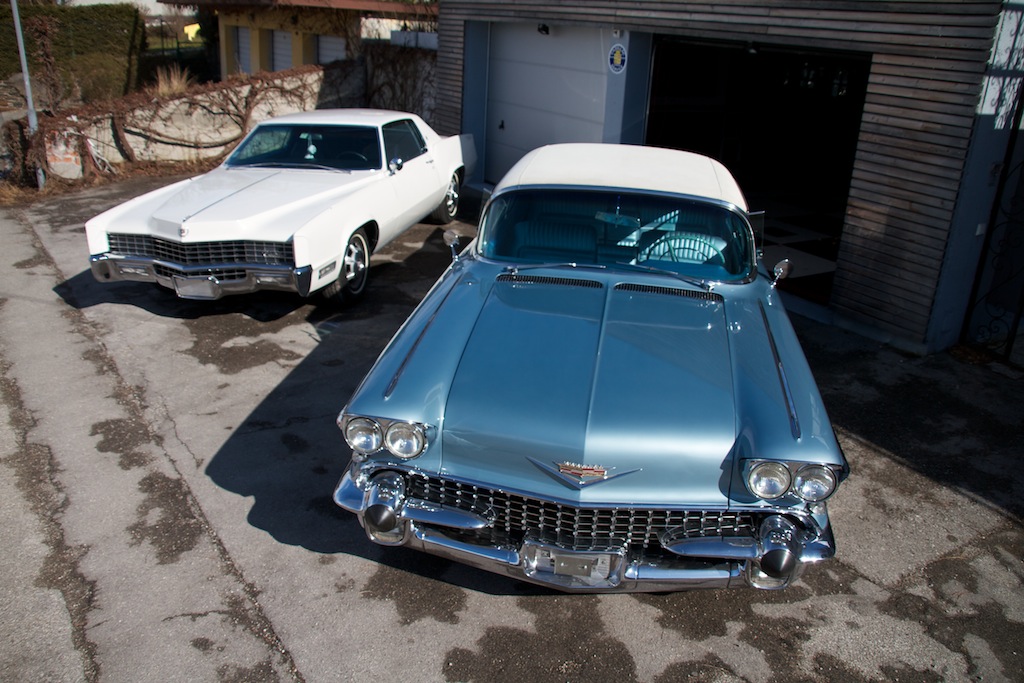
The two Eldorados in front of the garage where the snow has just melted away.
FIXED - 1958 Power Vent Window wiring problem
Today I started to repair the broken wires by soldering them together and put some heat shrinking tubes and electric tape around the repaired areas.
You can see some image below. More of them can be found in the restoration section.
Everything now works as it should! Lets hope that the repaired wires wont break again any time soon ;-)
Next up - repair the door jamb switch of my 1967 Eldorado and install a new power seat transmission as the front up/down solenoid does no longer work and therefore does not engage the according seat transmission. This will involve removing the front bench seat which is very heavy... Oh it is so much fun owning these cars! ;-)
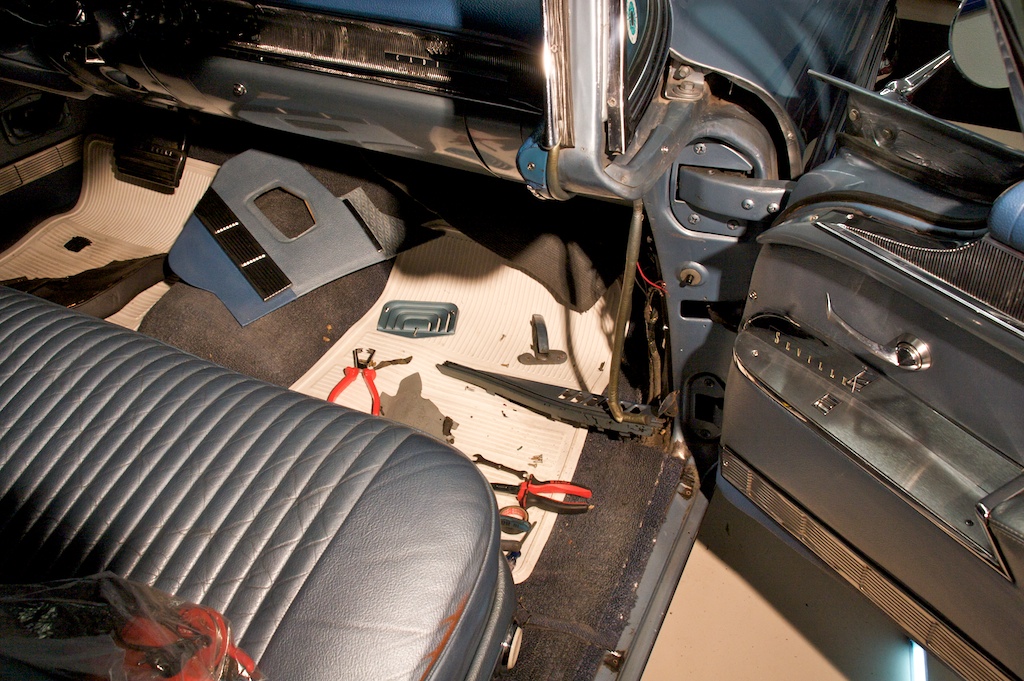
I removed the kick panel, heater-box and door sill scuff plates to get access to the broken cables.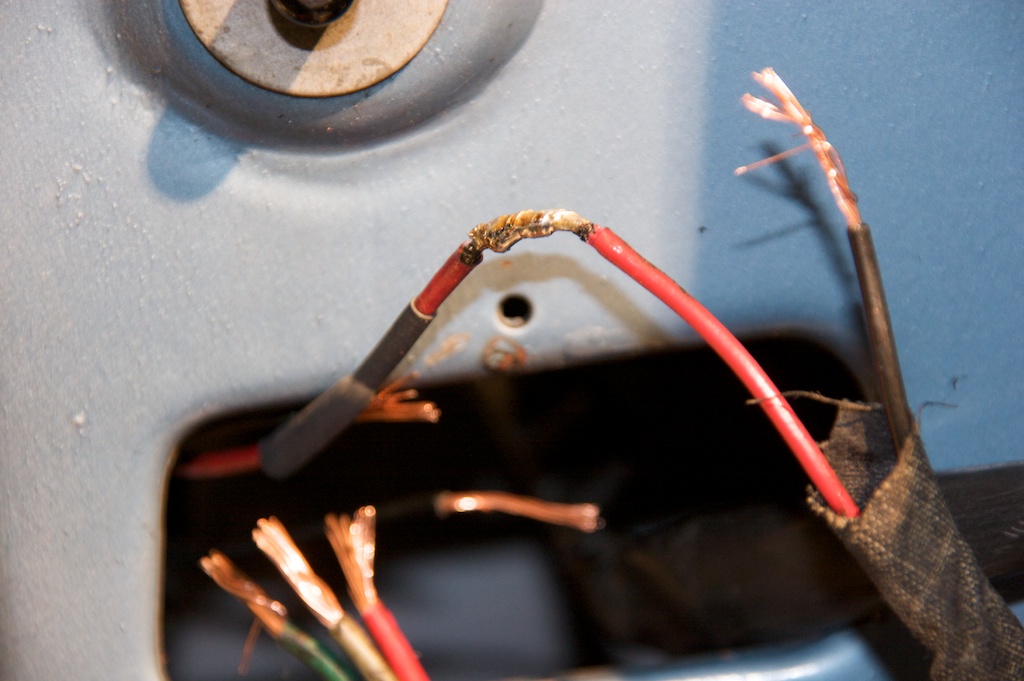
They broke at the area where all the bending is taking place when the door is opened. Here the first wire is already soldered together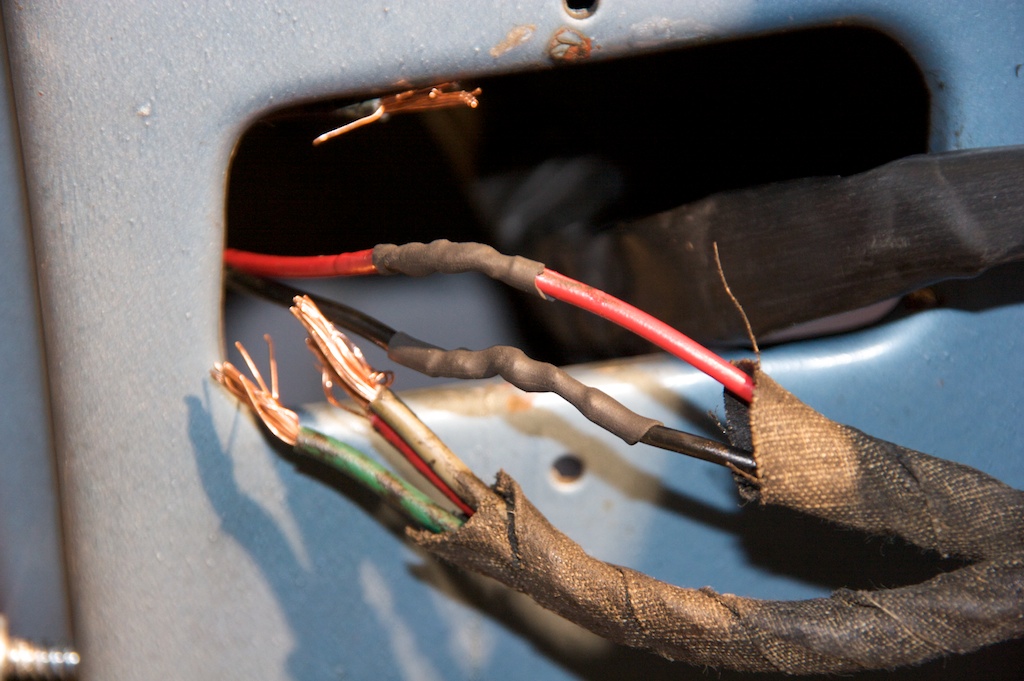
I put some heat shrinking tube around it after soldering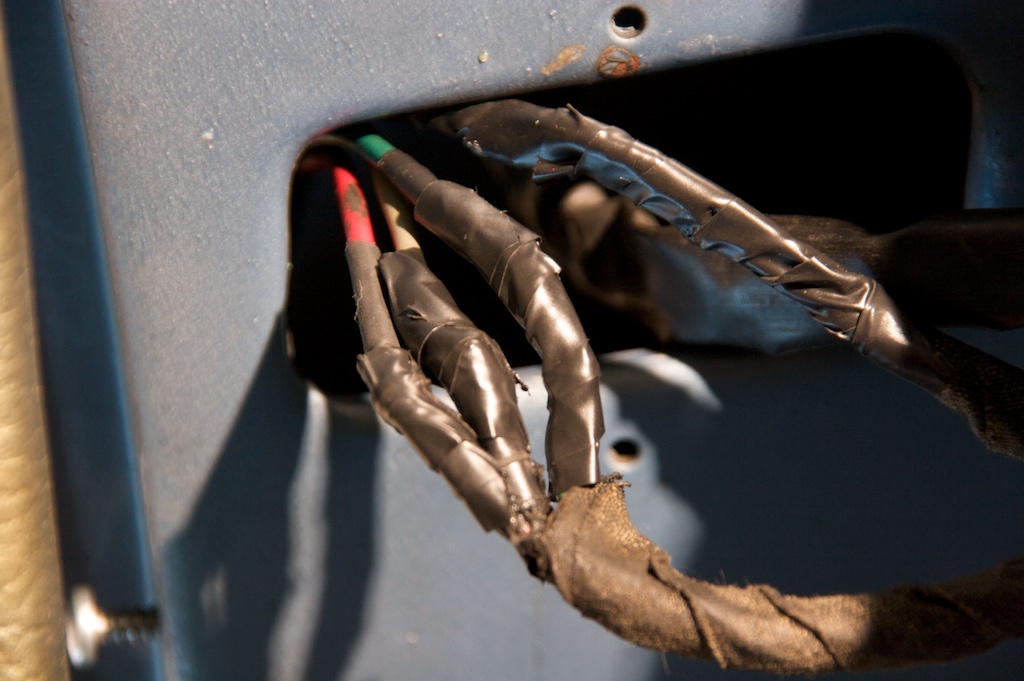
Just to be safe I wrapped some more electric tape around it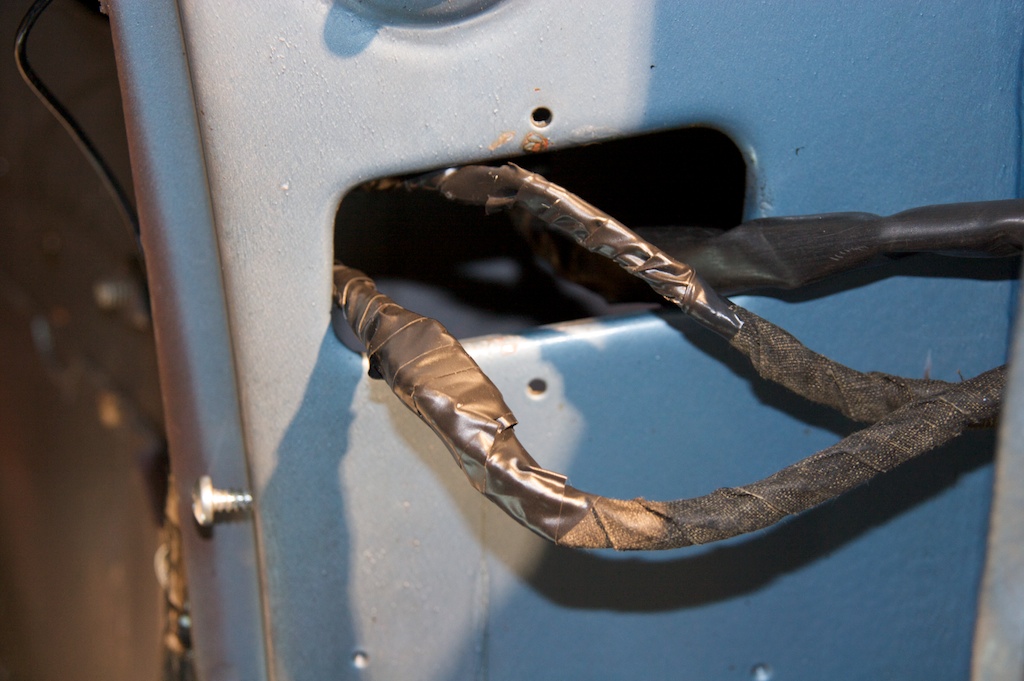
All the wires are back together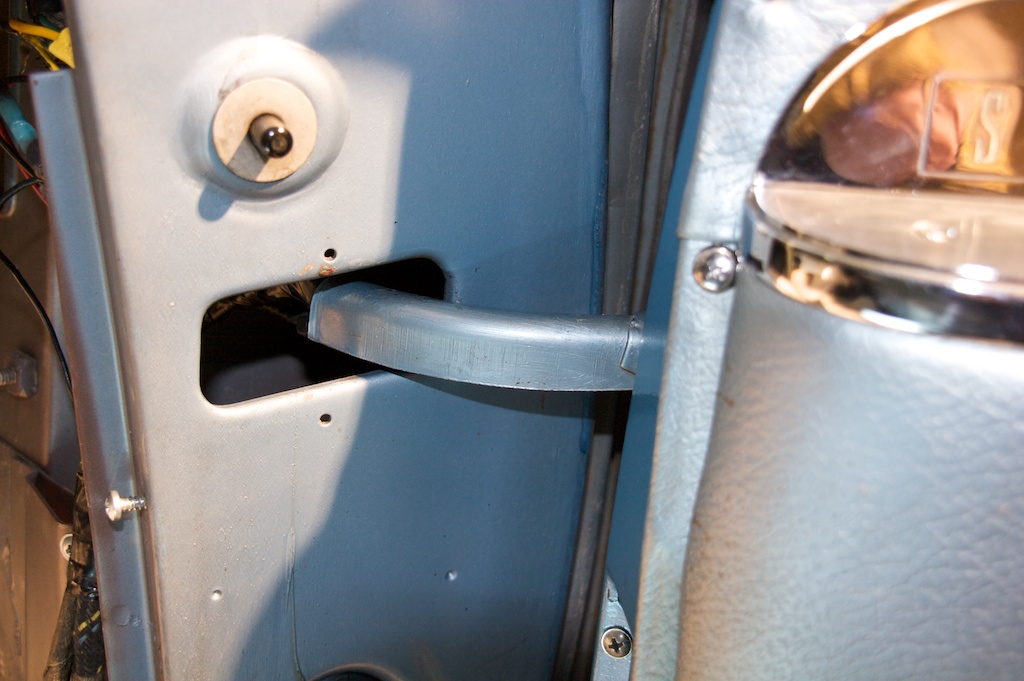
The wires are back together in the metallic tube going through the door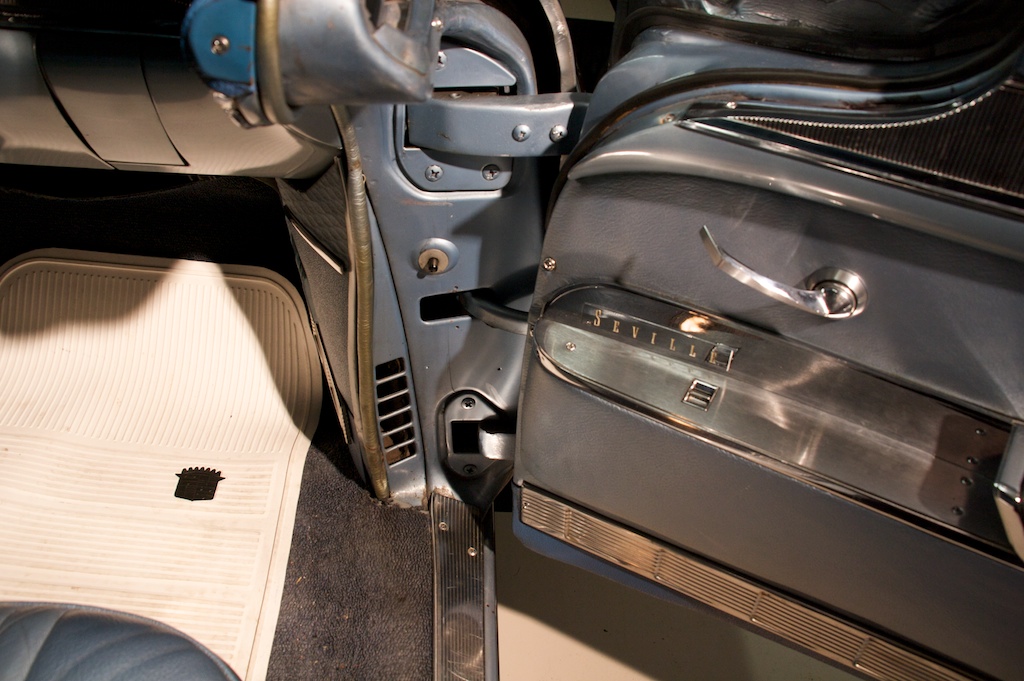
Kick panel and everything else back in place. Everything works as it should now.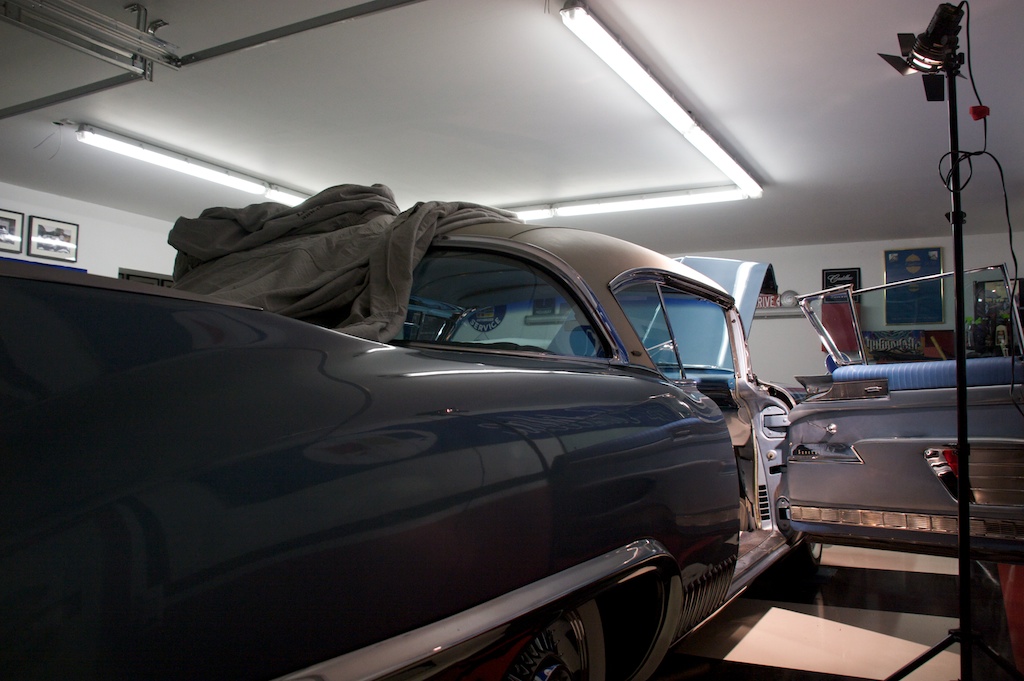
As I work as a cameraman I had a good film light at hand to light the working area properly.
1958 Power Vent Window wiring problem
Yesterday when I was repairing the 6 way power seat which had a contact problem somewhere at a solenoid - suddenly the power vent window started to close itself when I shut the door. So the problem was back! (At least the power seats do work perfectly now!)
So I decided to spend the day in the garage - rewiring the 58´s passenger door as there definitely was a short somewhere in the power vent window circuit. Thats the kind of work I absolutely HATE! 52 years of bending the wires whenever you open the door took its toll.
The bug was easily found after I removed the kick panel, door sill plates, parts of the heat tubing, and the metal tube which is going through the door to protect the wires. 5 (!) cables were broken and only held together by the original fabric covering around it. The cables all broke exactly at the end of the tube where all the bending is going on when the door is opened. I will now have to splice the cables back together somehow and get them back into the tube. No idea how I will do this - I will have to buy some electric supply material first, but the shops are all closed over the weekend. I´m still stunned that the windows still worked and the only sign of failure was that they started to open or close themselves sometimes when I opened the door, and that the battery was drained at one occasion. I guess I was lucky that the car did not catch fire...
UPDATE - Feb. 8th:
I fixed it - read everything about it above or by clicking on this link!
Cleaning the 1967 Eldorado´s Engine Bay
Below you can find some pictures of the now clean engine bay.
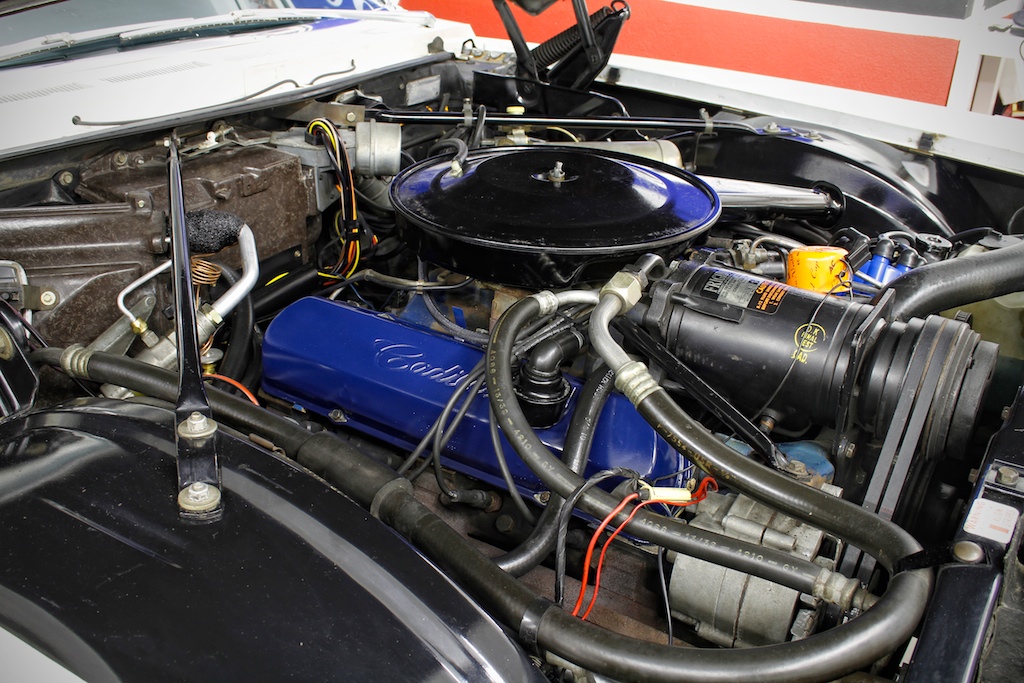
As seen from the passenger side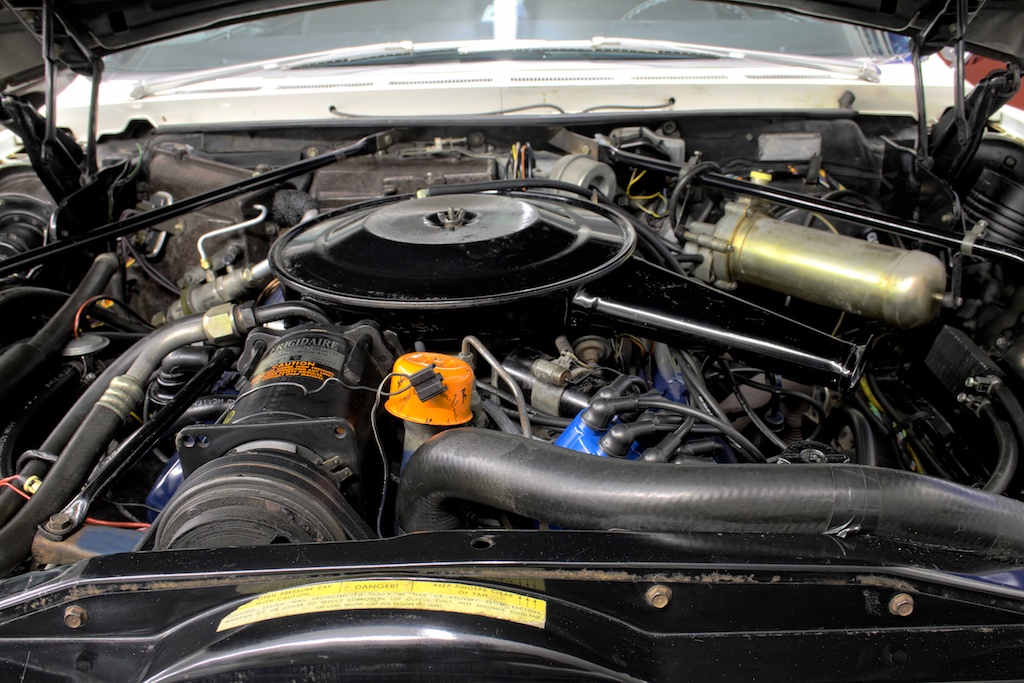
From the front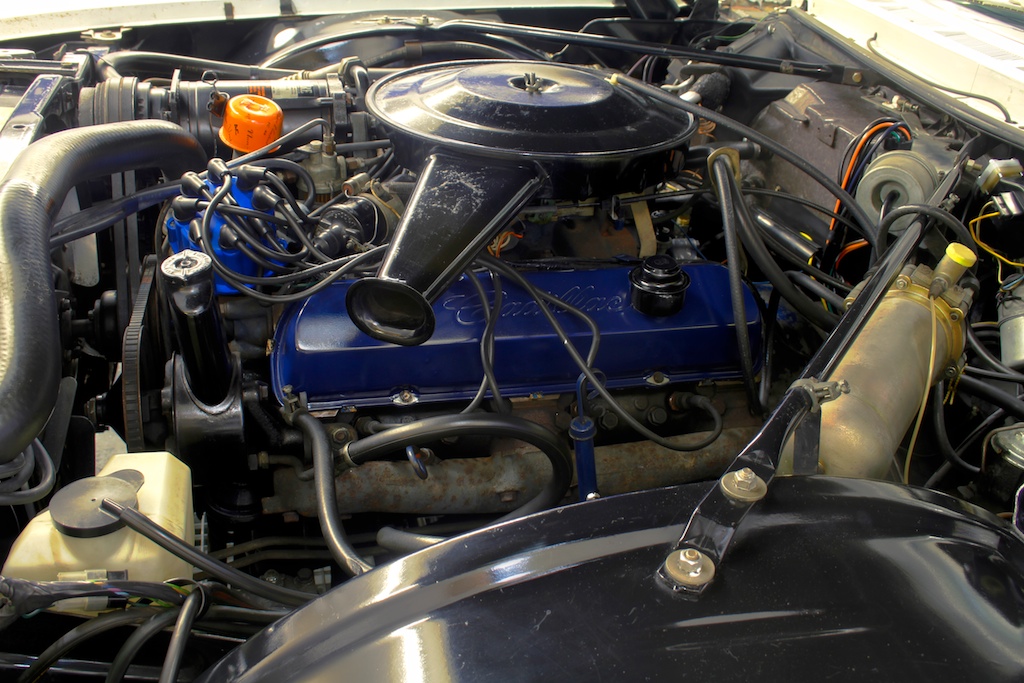
From the left
The 67 Eldorado´s Automatic Climate Control System is back in working order
I suspected a vacuum leak somewhere in the system. Troubleshooting began with going through all the vacuum hoses. I replaced some which were a little worn out at the connectors. I also cut off the ends of most hoses, as they were all becoming a little loose during the last 40 years. I then plugged them in again.
Not much did change though.
When I came to the hose of the hot water valve and the delay relay, I had the first success. At least the blower motor would stay on in all “Auto” modes, even when the car was idling - but would still go off in “Fog” and “Ice”. I then suspected a leak in the power servo or in the dash controller. So I installed the power servo from my 67 DeVille where everything works perfectly, to be able to rule out any problems. Nothing changed though - the blower would still come on and off depending on the throttle position.
I then soon found the culprit of the whole issue - it was the master vacuum switch - which seems to have a problem with the internal electric switch. As I had a spare one around I installed it - and voilá - everything worked as it should. It always looked good when I checked it before.
I´m very happy that everything is back in working order. The only thing which I still have to repair is the fast idle diaphragm which completely dried out and is no longer functioning. Fortunately I do have a spare 429 engine in the garage from where I can grab and use this part - so I will repair it soon.
I then need a new condenser which is already on the way across the Atlantic coming from Old Auto Air.
By the way - Cadillactim has an excellent trouble shooting guide for the ACC on his website.
The evaporator had to be replaced as well along with the heater core. This is a pretty big task as you can see on the pictures below. You even have to remove the hood to get access to the whole unit. The fiberglass AC enclosure had to be repaired at my car as well as the previous owner tried to repair the evaporator and missed a screw and made a tear into the enclosure. The restoration shop repaired this professionally and it looks like new now.
The best troubleshooting guide for 1967 and 1968 Cadillac´s Automatic Climate Control Systems I got today from Gary Sisk - owner of a 1968 Cadillac.
This is a very easy to follow explanation which will save you a lot of time and you do not even need any special tools.
It was written by Lynn Nicholls and can be found on Stampies Cadillac page - here is the direct link to it.
Below you can find some pictures of my system:
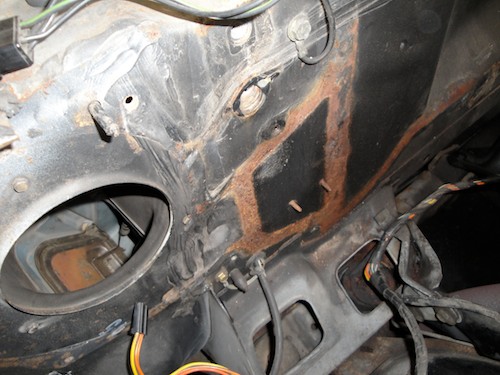
The whole AC unit has to be removed to get access to the evaporator and heater core... The slight surface rust that showed up where the gaskets were, was removed as well of course...
The big hole on the left is where the blower motor is installed.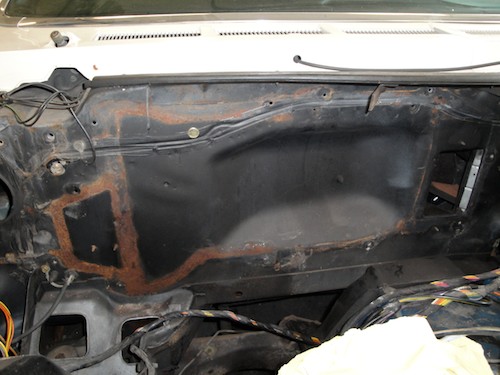
This is where the AC box usually is installed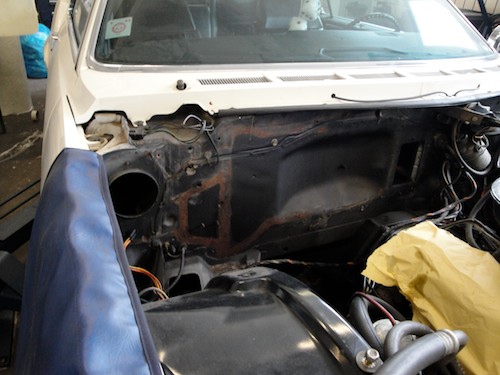
You can see how much has be removed just to get to the evaporator and heater core...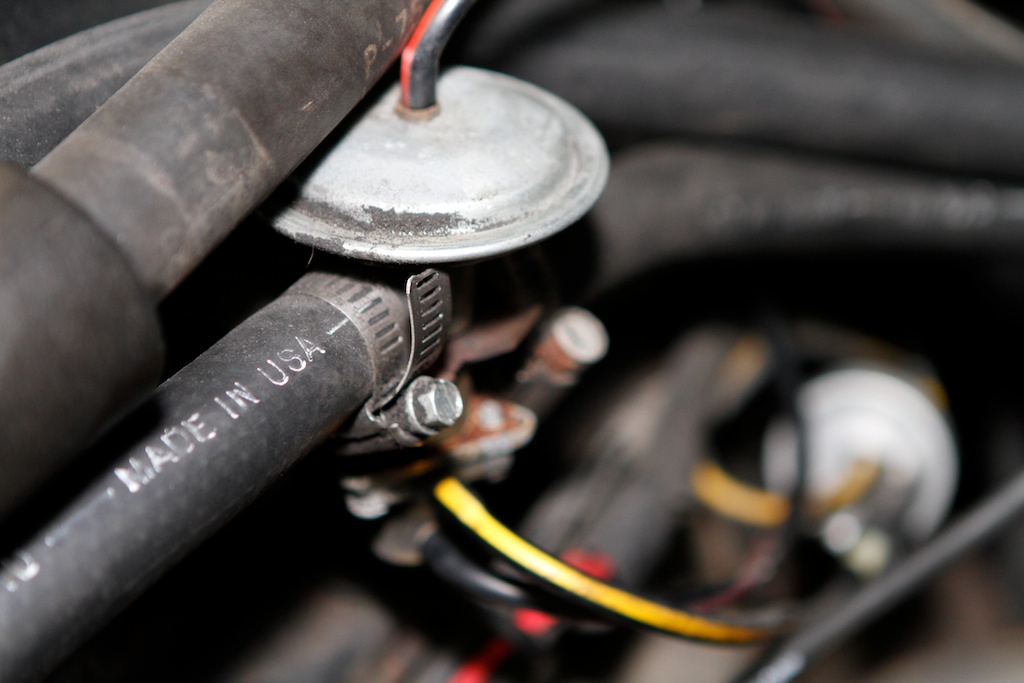
I discovered the first issue at the hot water valve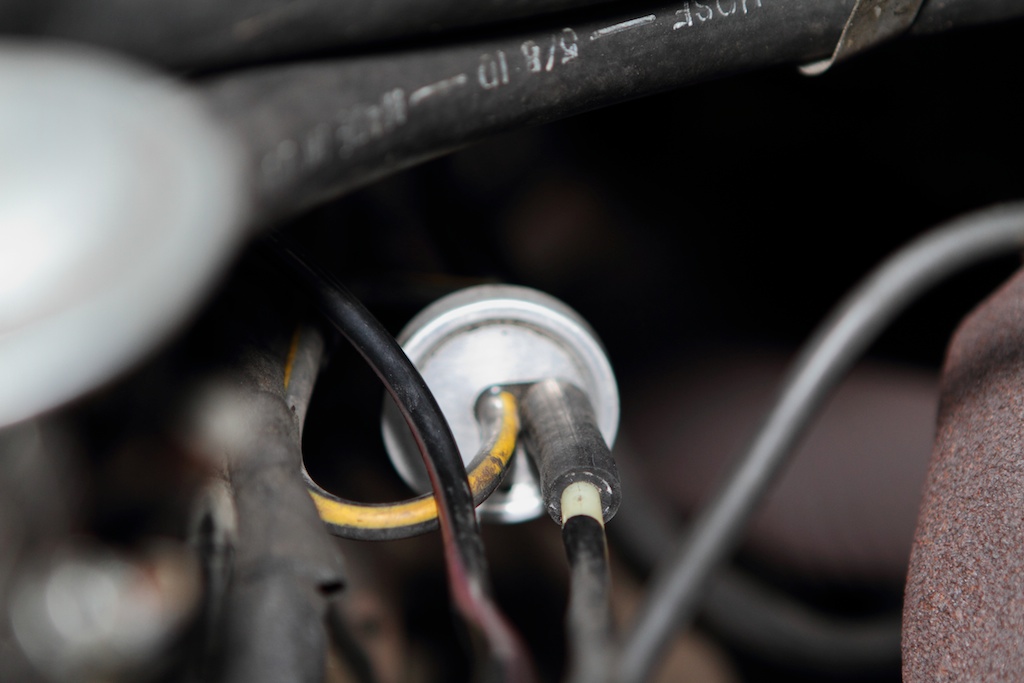
The hoses around the time relay delay were leaking a little bit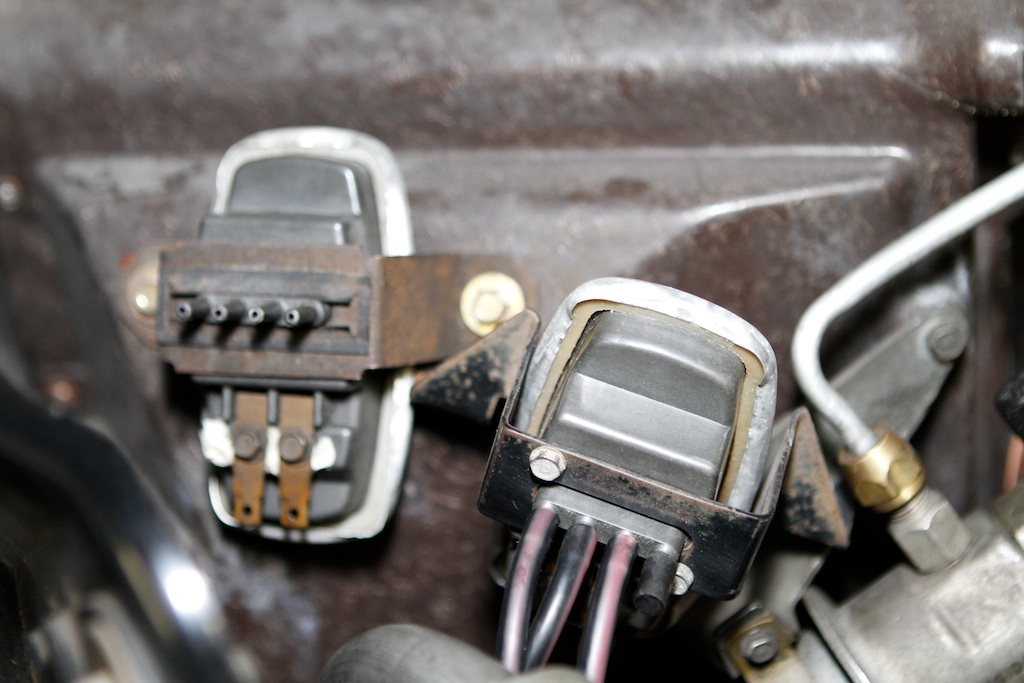
For testing purposes I hung a spare master vacuum switch into the car - this solved the problem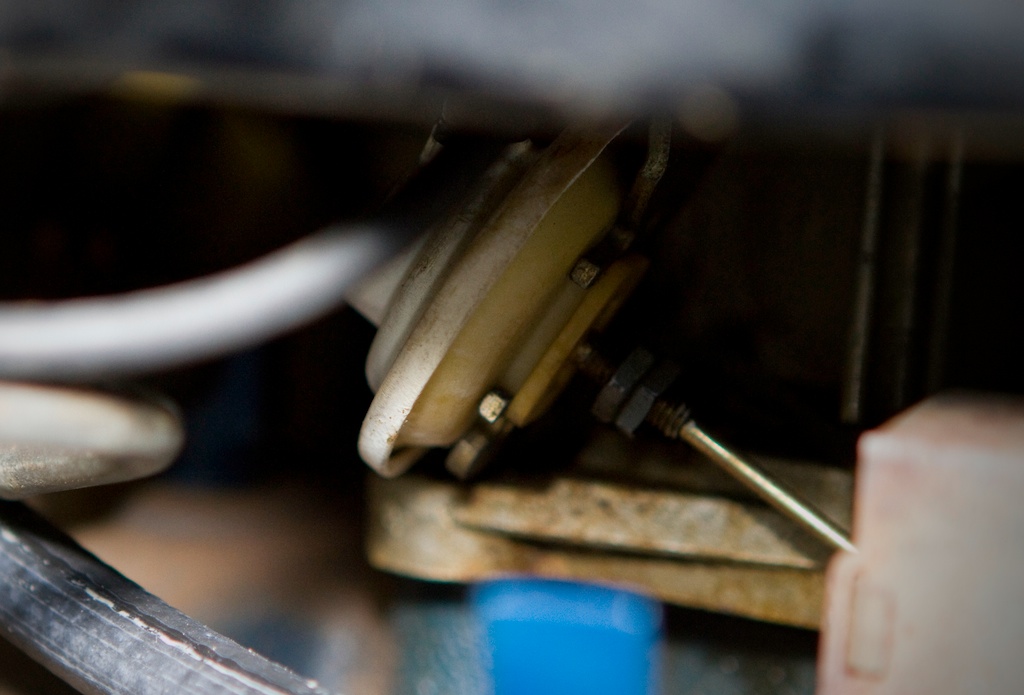
The old fast idle diaphragm was leaking and brittle and was replaced with a better one...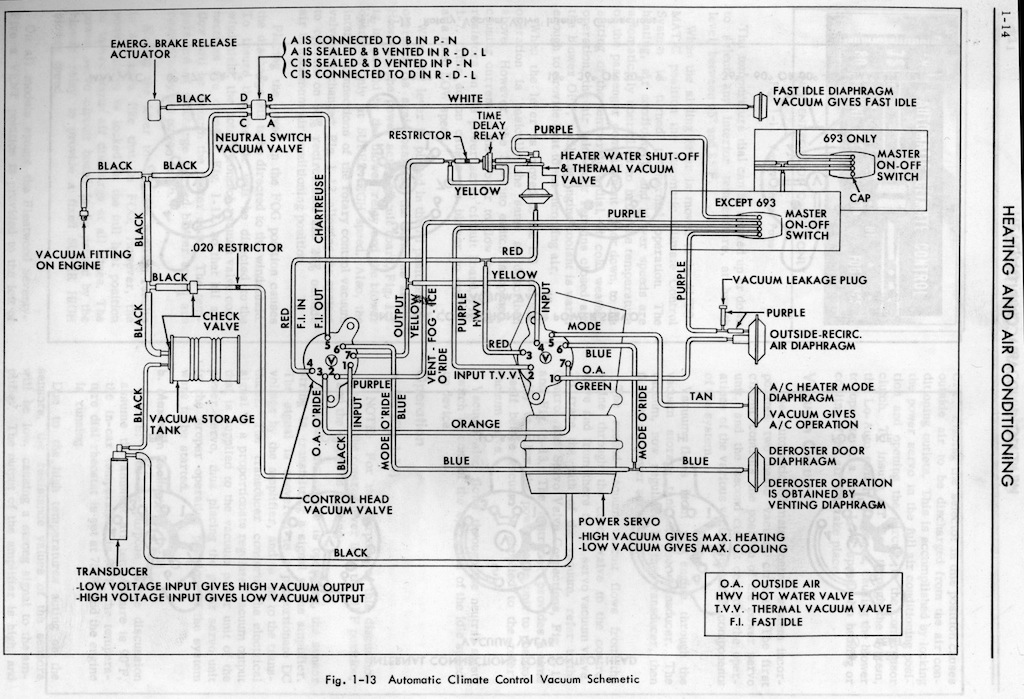
The 1967 Cadillac Automatic Climate Control Vacuum Schematic from the shop manual -
1968 is almost identical BTW... Click on the image for a larger view!
Here is a video about the Master Switch that a gentleman posted on youtube
The 67 Eldorado´s vacuum hoses - Blower issue
During the rebuild of the whole AC system I found out that I´m also having a little issue with the blower which does not always come on at full heat. So as a first step I started to go through the numerous vacuum hoses in the car yesterday. I soon found some old and brittle ones which fell apart when I just touched them. The two hoses that fell apart were the ones going to the right headlight doors.
Original color coded hoses seem no longer available anywhere. Thats why I had to buy regular black ones and paint the red and green stripes on them. Looks almost perfect - I did not think that it would turn out this nice.
Will go through the rest of the hoses soon. With the replaced hoses the headlight doors now work 100% simultaneously, whereas before one was slower.
I still have to find the issue with the blower motor - but I now suspect either the AC controller or the power servo. It works perfectly in full cold - only when I set a higher temperature the blower will cut out. Another problem to solve over the winter... I had almost the same problem with the 67 DeVille before which I could successfully repair.
BTW - if you know of any source for the GM OEM style color coded vacuum hoses please let me know.
You can find a vacuum diagram for the headlight doors here!
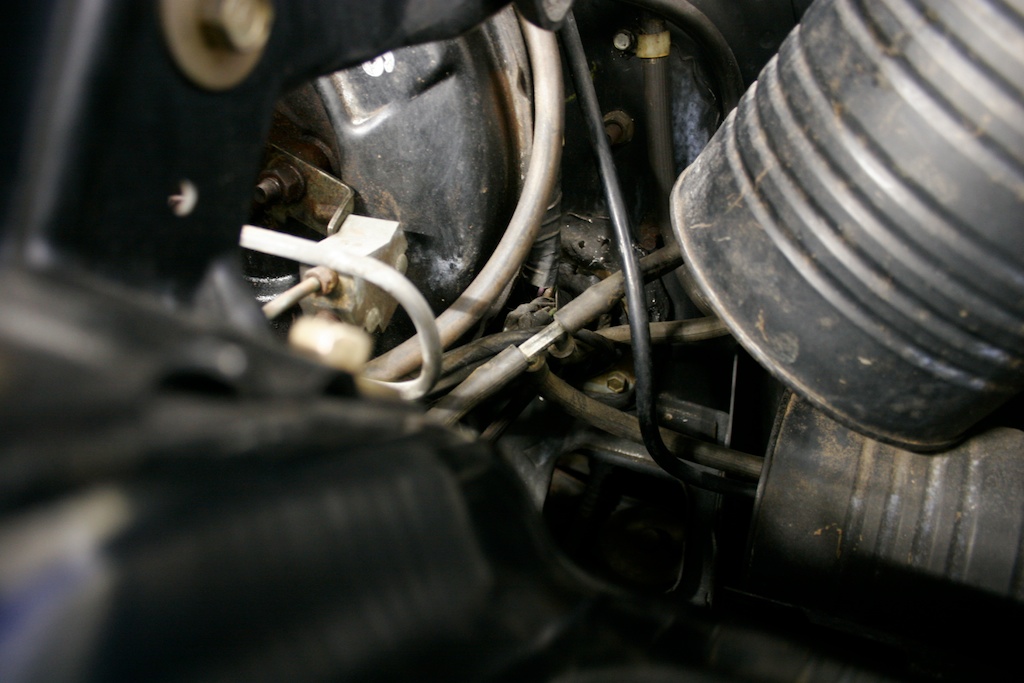
There are lots and lots of vacuum hoses in the Eldorado to check - here are only a few going to the storage tanks...
I will also give them a good cleaning during the winter.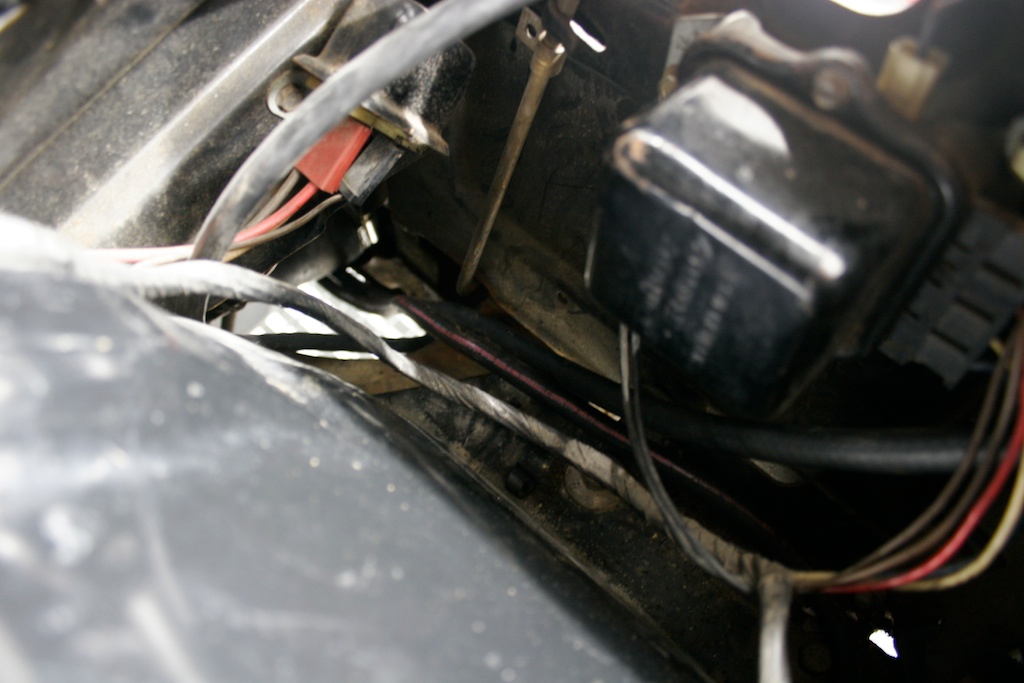
The new hose with the painted red stripe is already in place - looks some kind of original...
Visiting the 67 Eldorado at the restoration shop
Here are some pictures of what is going on in the shop. You can also see all the restoration pictures here!
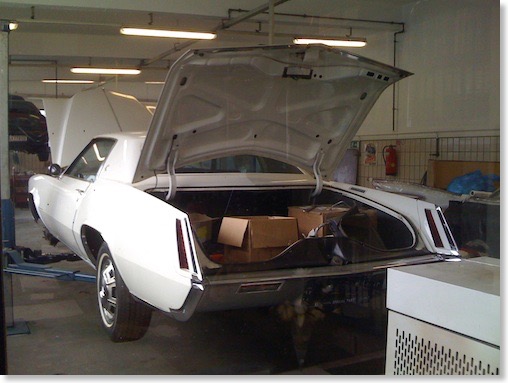
The 1967 Eldorado at the lift - the trunk is full of parts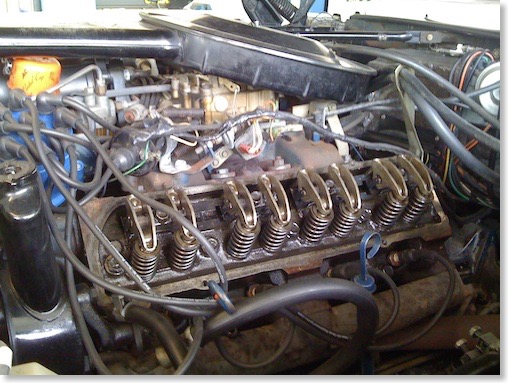
Look how clean the 429 engine looks inside - it only has 27k miles on it - the valve covers will get a repaint and new gaskets will be installed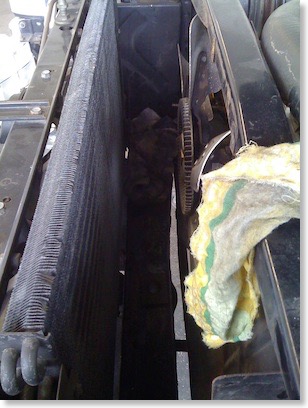
The radiator is out for re-coring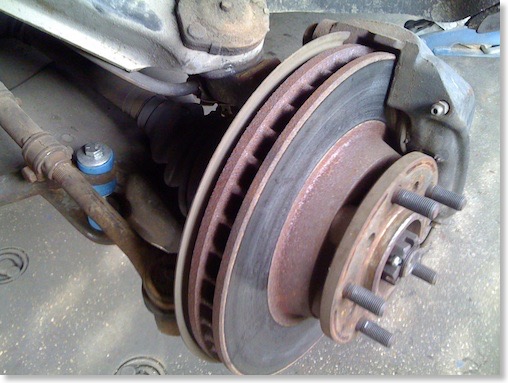
The left front disc brake is sticking a little - it will be completely overhauled as well soon.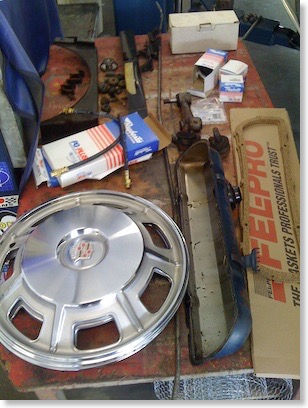
Some of the parts - the old ball joints are out. New brake hoses and brake parts are waiting for installation.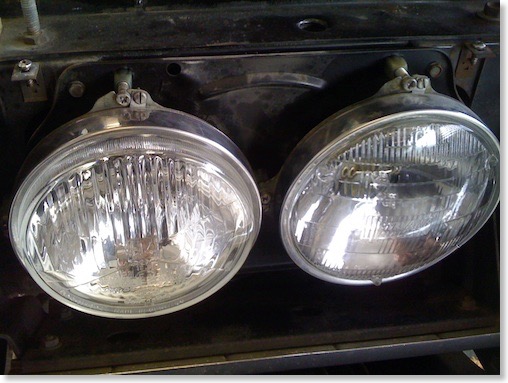
New H4 headlights had to be installed as the original T3 headlights are not street legal in Austria
A short in the 1958 Eldorado power vent window wiring
So there was no other way than hooking up the charger. Two hours later, the battery was strong enough to start the car. I checked all electric components and everything seemed to work - so I was wondering what drained down a fully charged battery over night? This was the moment when I noticed a clicking noise coming from the passenger door. I opened all windows including the power vents . When I opened the passenger door the vent window started to close itself! So even when the vent window was fully closed, the window motor would still draw current. At a test drive with the door closed (of course)- the window would eventually start closing itself again.
So I had to remove all the window switches and unscrew the kick panels. Of course some of the cables behind there were broken or had the isolation coming of at the areas where they had to bend each time the door was opened or closed. I replaced one section of a cable and isolated the other ones.
So far everything seems to be working o.k. now. After an extensive test drive and opening the doors multiple times - everything seems to be well.
It is really a pain to get access to all these cables and trying to repair them. Some smaller hands would be very handy in this cases.
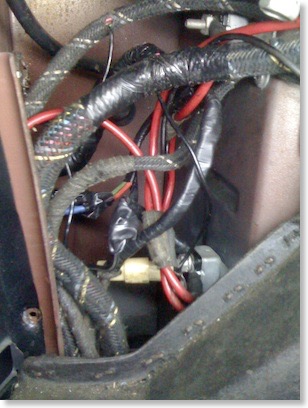
Thats the area behind one of the 1958 Eldorado kick panels where the cables have to bend all the time. After 51 years they seem to get tired.
The 67 Eldorado is now at the shop to get an Austrian license
The cars have to be safe and in very good condition. They check the brakes, all the suspension parts, rust, emissions and everything else what is important. The regulations are very strict - so basically everything has to be in perfect order. We even have to change the lighting system. Its obligatory to have amber rear turning signals, which makes it impossible to keep the rear lighting system in original condition (at least for the time of the inspection...). Often there is no other way than to install additional amber turn signals somewhere on the rear bumper or trunklid. (!)
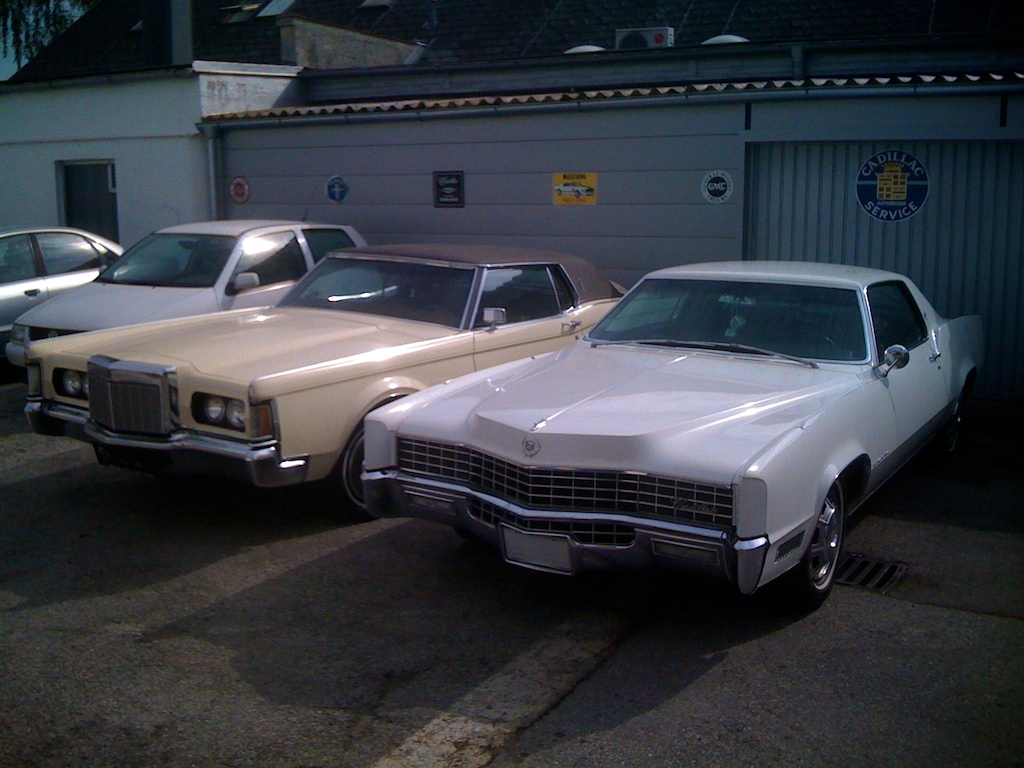
The 1967 Eldorado is now at the restoration shop - here it is on the side of a nice low mileage 1971 Lincoln Mark III.
As I finally want to be able to drive the Eldorado on our roads, today I delivered the Eldorado to my restoration shop, where they will do some of the necessary conversions and repairs. They already helped me with my 67 Deville and the 58 Eldorado.
The Eldorado will now get a new radiator as the original one is leaking badly. Actually I will have the original one recored and repaired. The front disc brake will get an overhaul due to a partly sticking piston, together with all new brake hoses. The fuel line will be replaced as it started to leak as well. The lower ball joints and the idler arm will get exchanged along with some rubber bushings. Besides of this list of repairs the rear lights will be converted for the inspection.
After the Eldorado is back in perfectly working condition, the inspector will check the car and hopefully approve it... Unfortunately until all this will be done it will take some time, and the winter is just around the corner - so it will go right back in winter storage after this procedure.
The 1996 Buick Roadmaster - new rear wheel cylinders
As our 96 RMW did not pass the technical inspection 3 weeks ago I had to order new rear wheel cylinders which were installed today as well. It then passed the annual inspection and can be driven for another year.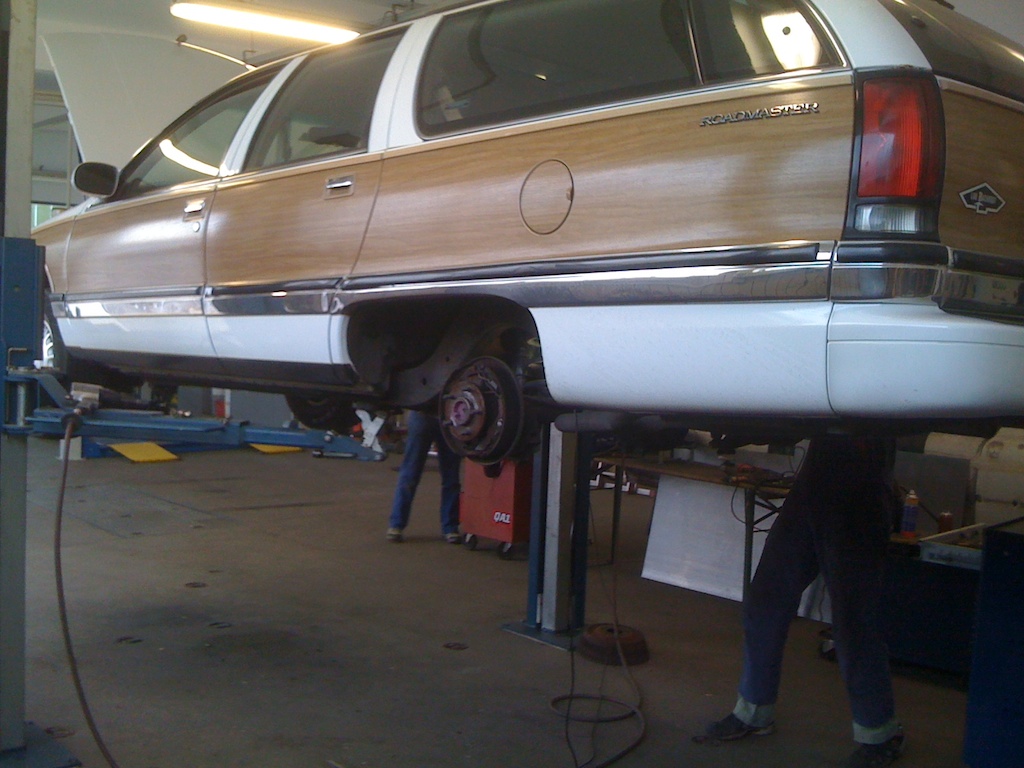
1967 Eldorado - the headlights and the ALC work again
I also got a new control valve for the ALC compressor from Arizona Vintage Parts (a company I highly recommend). With this new valve the ALC is back in working order and the car is now raising its rear to the correct riding height again.
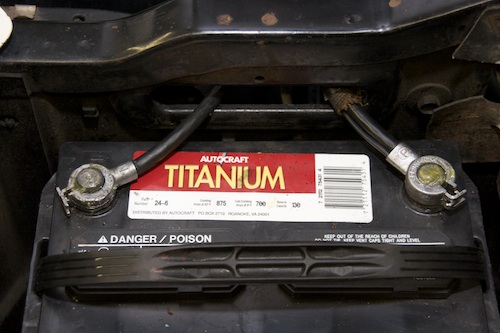
the new original style spring clamp battery cables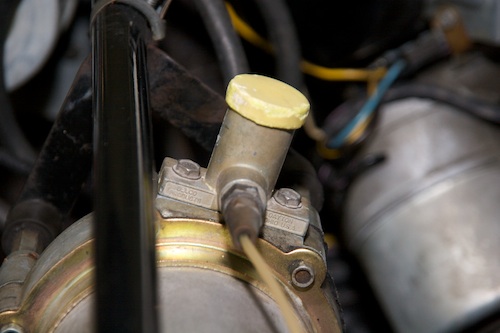
a new used ALC control valve is also in place.
The first 1967 Eldorado parts arrived
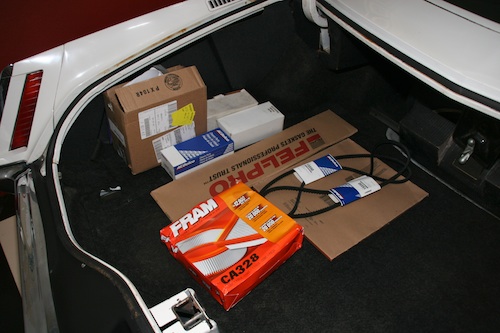
The first few parts that arrived - belts, filters, gaskets, caliper repair kits, dryer, pitman arm, air filter and some other stuff....
1967 ELDORADO HEADLIGHT ISSUE - ONE STEP FURTHER
Glen wrote the following:
“If you take the panel under the steering column off I think you can reach up and disconnect the connector from the light switch. Or you maybe able to get a meter probe up there to check voltage. The battery connection to the switch for the headlights is on the 14 gauge yellow wire. This only supplies the headlights and front parking lights. If you have 12 volts there then your problem is in the switch. There is a circuit breaker in the switch and it may be bad or the contacts in the switch are bad. IIRC these switches have a vacuum switch on the side that operates the headlight doors. This makes them hard to find. They do not interchange with the 68 Eldorado because in 67 the parking lights only come on when the switch is pulled out to the first position while in 68 the parking lights come on with the headlights also. If you do not have voltage on the yellow wire then you should check the fusible link on the starter. It is an 18 gauge dark green wire that changes to a 14 gauge red with white tracer before it gets to the connector. Check for 12 volts at the connector and check the contacts in the connector. “
Glen was spot on with his diagnose and it turned out that the green 18 gauge fusible link was the culprit for my headlight problem as it came apart for unknown reasons.
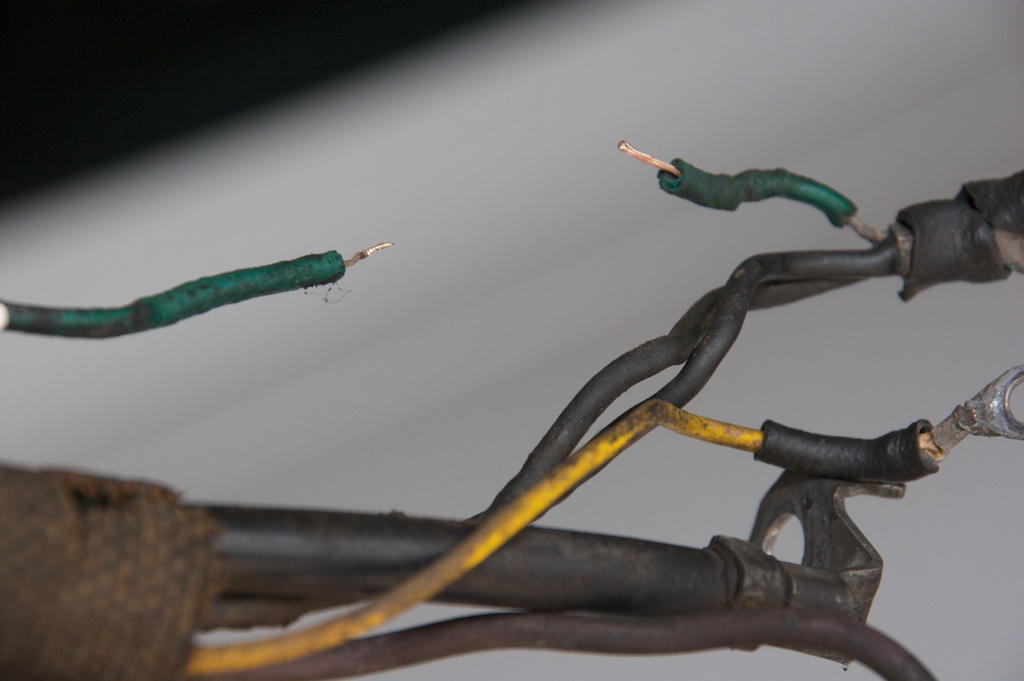
the green wire once was a fusible link - it fell into pieces when I slightly pulled on it
As a follow-up Glen recommended the following:
“You might want to look closely at the break in the link. See if it is melted or did was it broken by mechanical means. If it was just pulled apart or cut then you have to check what caused that.
To trouble shoot this if it was actually melted due to over current, I would unplug the headlights and front parking lights, and temporarily connect a headlight or other big light bulb, in place of the fusible link. You can then try things without blowing fuses. With the troubleshooting light in place it will light up brightly if there is a direct short. With the headlights and front parking lights disconnected the test light should not light up at all under any condition. You should be able to move change the position of the headlight switch, switch from high to low beam (light switch in the headlight position); wiggle the wire harness anywhere and not light up the test light. If it does you have found the short.”
I did this procedure today but it did not show any shorts. I then reconnected the front lights and everything did work again. I will now have to find a replacement fusible link which is very uncommon over here in Europe. I will replace it together with the positive battery cable where the clamp is almost falling apart. I hope the issue wont come back. It looks like the fusible link maybe only fell apart due to age as it did not show any signs of burning. Its located very close to the starter and the exhaust manifold - so maybe 42 years of dirt and heat just made it crumble into pieces....
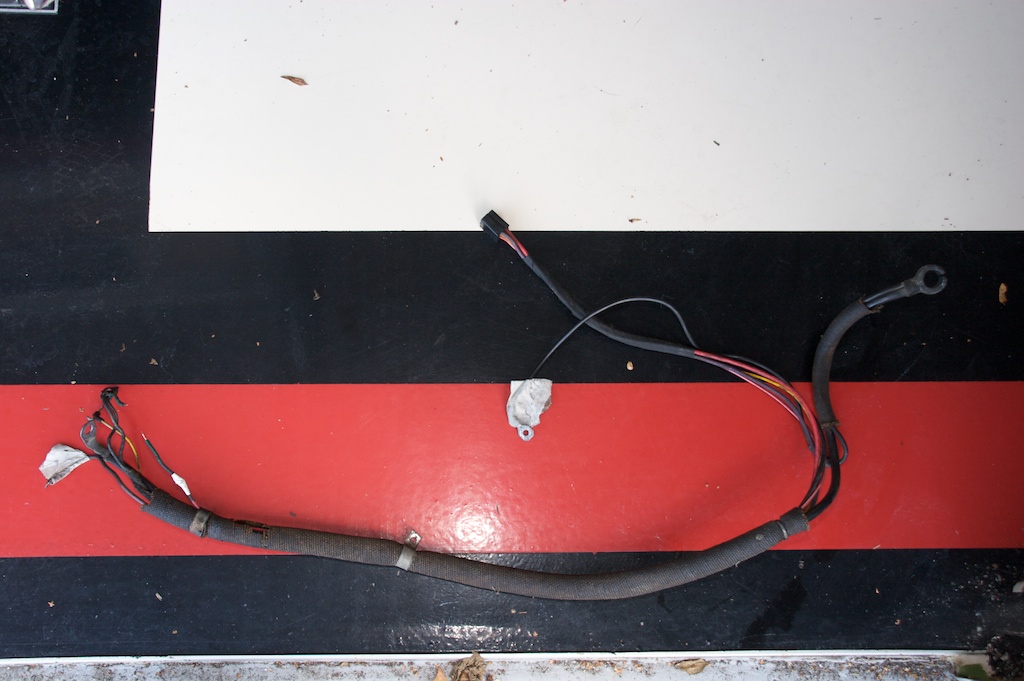
the completely removed positive battery cable harness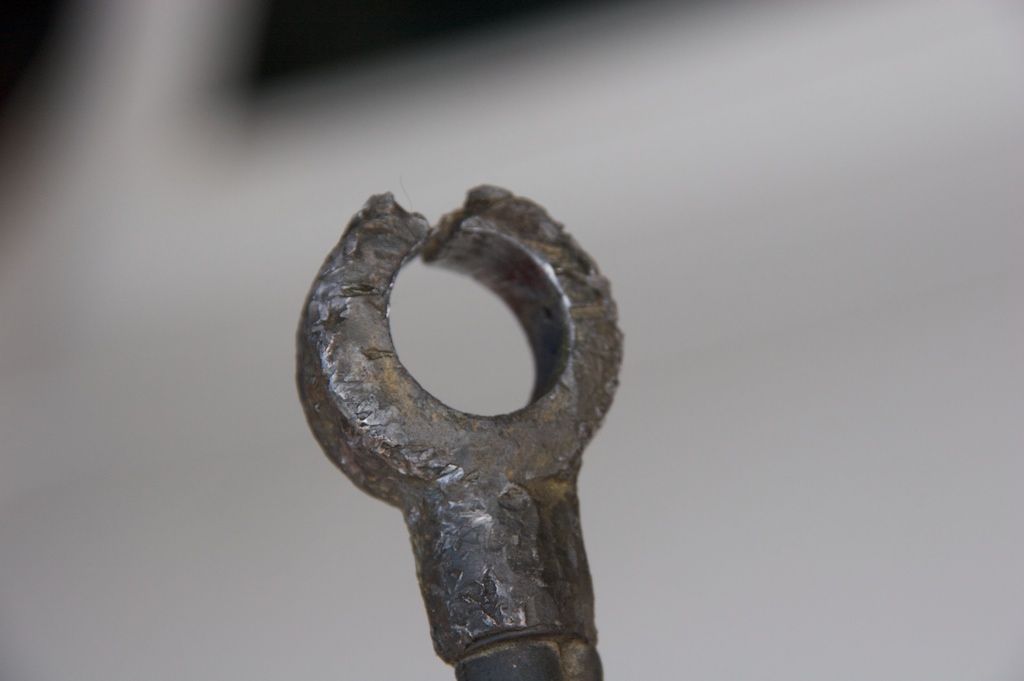
the original battery clamp - its already missing the spring part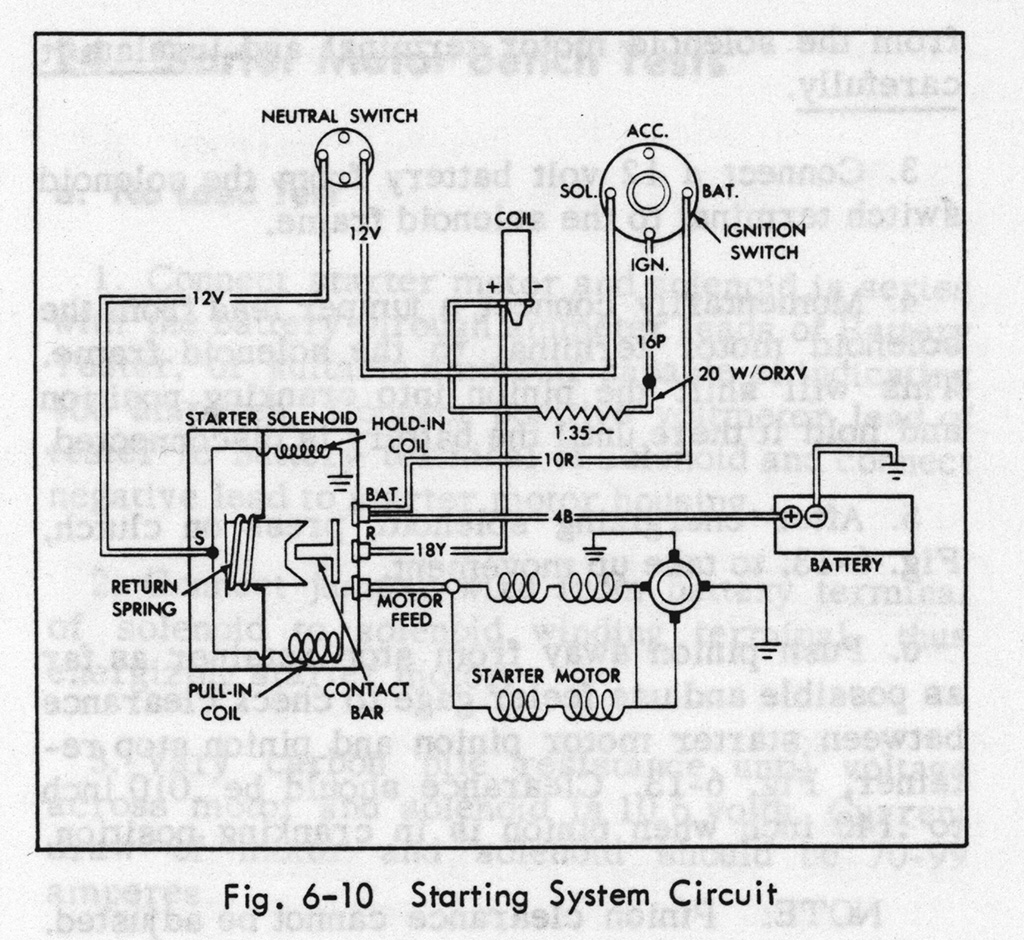
The starting circuit diagram is showing the battery cables - Click for larger picture!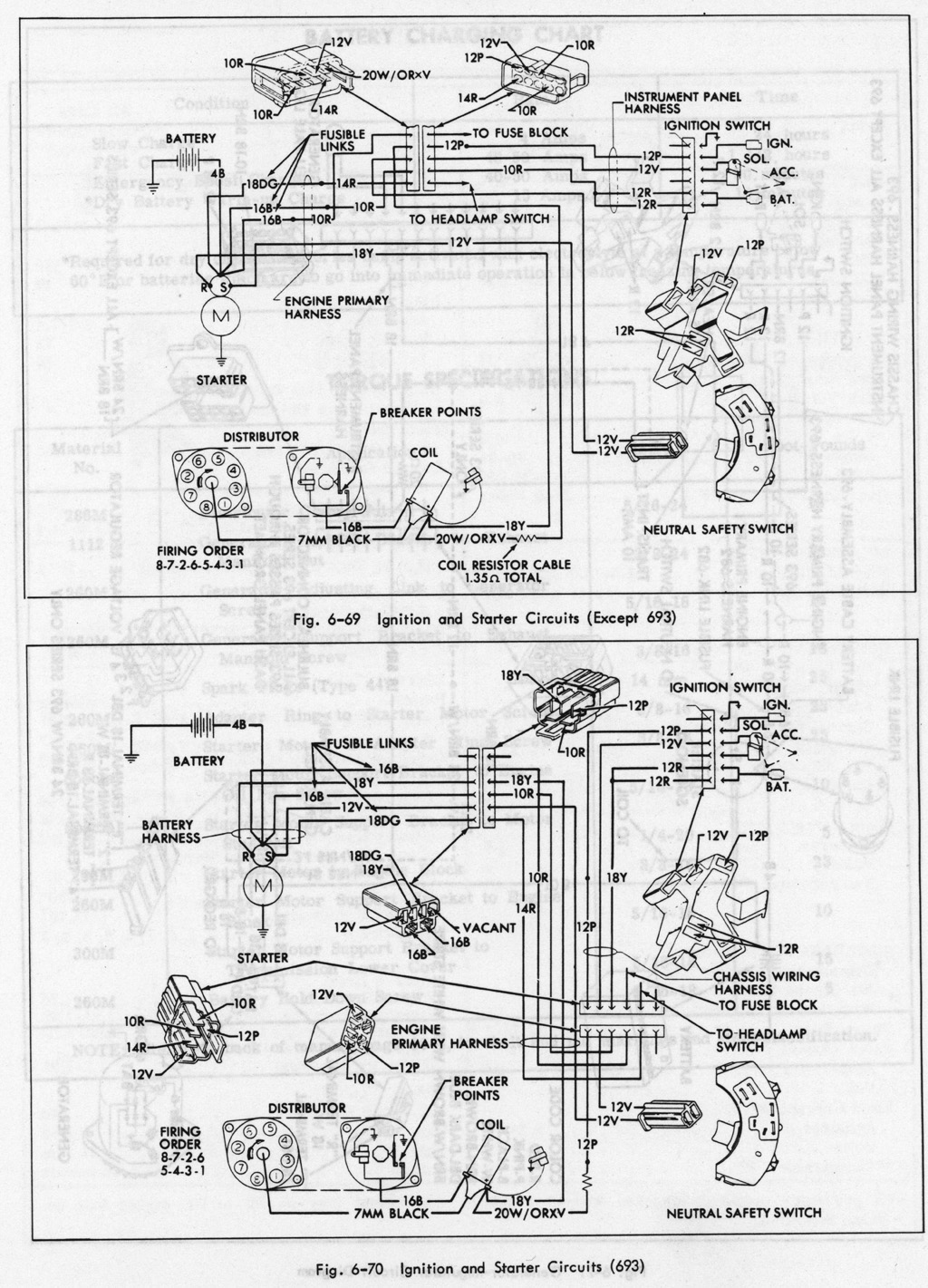
The Iginition and Starter Circuit Diagram for the Eldorado (693) and the other Cadillacs of 1967.
Click for larger version!
1967 Eldorado Inspection - ALC issues and dead headlights
When I arrived there the headlights did no longer work. They did not have any problem before.
When the inspector wanted to turn them on - the headlight doors did open but the lights did not come on.
Also the parking lights and high beams do no longer work. The taillights did come on though and the cornering lights and turn signal do work as well.
Very strange… Checking the fuse panel I found out that there is no fuse for the headlights. My guess is now that it must be the headlight switch - can this be repaired? The shop manual mentions a 25amp circuit breaker in the switch but it does not mention how to repair it or check it.
The other thing which stopped working yesterday was the Automatic Level Control. The vacuum operated compressor in the engine bay seems to work as I can hear a ticking noise, but the car does not raise. I also added some pressure (100psi) to the service valve at the compressor but the rear of the car did not raise at all. When I depressurized the compressor the car did not come down any further either. Very strange… I really need to get this fixed - non working parts are making me crazy!
The car lost the yellow plastic cap which is located on the top of the regulator valve while driving it into the shop. Unfortunately it landed directly below one of the tires and was crushed to tiny little pieces. I will have to try to find a replacement. I have no idea how this could have come loose.
The car did not pass the inspection for some other reasons as well , like a sticky front disc brake, worn ball joints and pitman arm and some other minor things . It will keep me busy repairing all this for a while. Whats worrying me most is the headlights and the ALC as I do not have any clue at all.
On the positive side - the car was a pleasure to drive the 60 miles to the shop - its so much different to the “regular” Cadillacs - Big, silent and powerful and no big boat ride ;-)
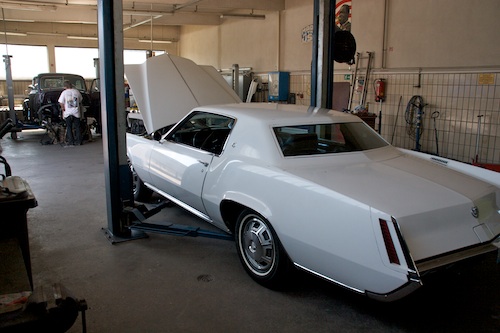
in the shop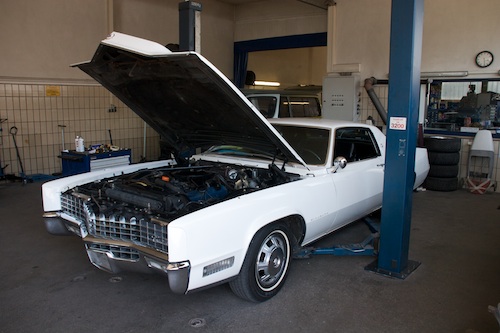
67 DeVille Brakes finally fixed
As I replaced the complete front end including the entire front brakes last year, I did not think that the drum brakes might only need a simple re-adjustment. As it turned out the front brakes were out of the range where the star-wheel can adjust itself while driving the car backwards and applying the brakes.
I now adjusted the front brakes pretty tightly and the pedal is now pretty firm again. I hope it will stay like this. If not - there must be something wrong with the automatic self adjuster, but I´m very optimistic that the problem is now solved. I also gave the rear drums a check - they turned out fine. I just wished the DeVille had front disc brakes like my 67 Eldorado...
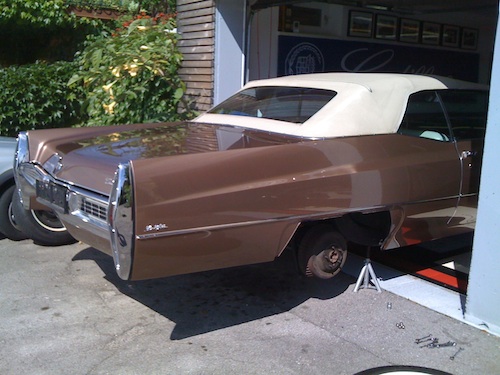
checking the rear drums - crappy cell phone picture...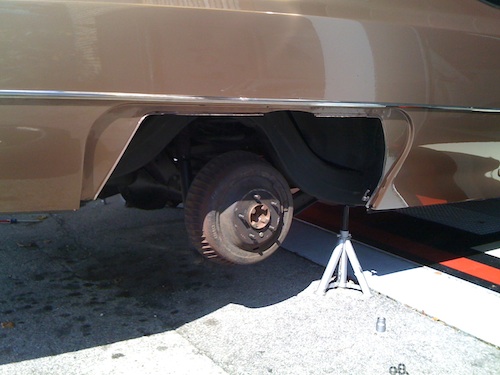
the rear drums
1967 DeVille got new brake booster and power cylinder
Everything went pretty smoothly at first - only bleeding the brakes was a little complicated and it did not help either that I spilled some brake fluid into the engine bay. Some harm was done to the black paint which had to be repainted immediately. So it took us some unplanned time to get everything back in working order. As it was raining heavily we could not even test the brakes. In the meantime I did a test drive and found out that the pedal travel is way too long. Looks like the push rod in the booster needs adjustment... D*mn this means removing the master cylinder once again... I hope I will find the time to do this soon.
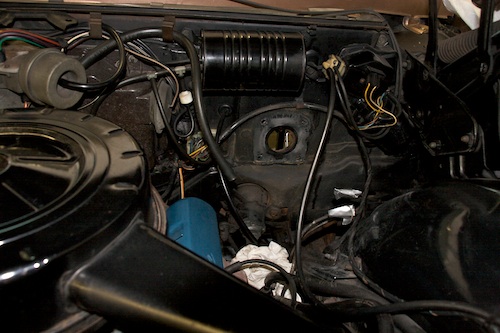
the removed brake booster - the hole in the firewall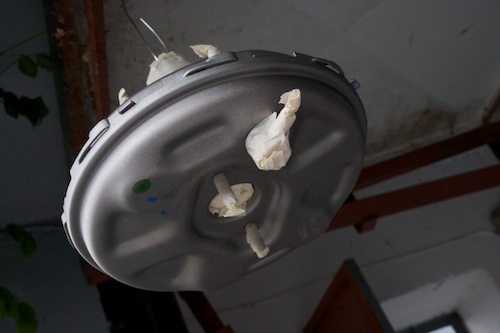
the new booster needed some paint before installation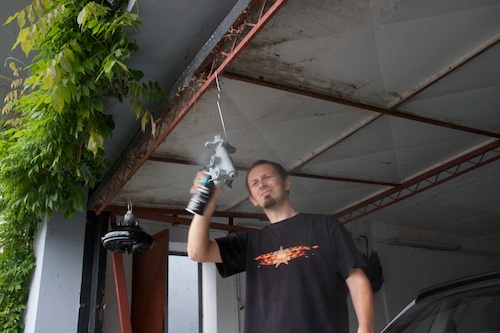
painting the master cylinder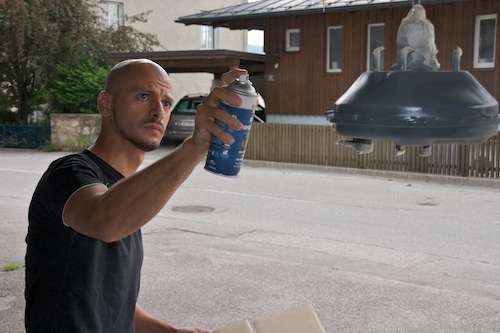
Tayfun painting the primered booster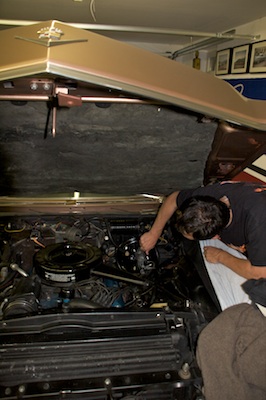
reinstalling the whole unit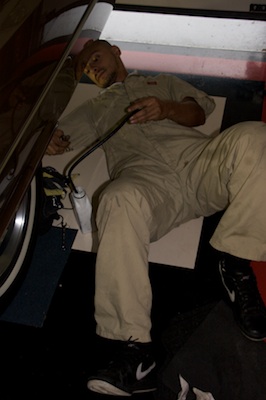
Tayfun bleeding the brakes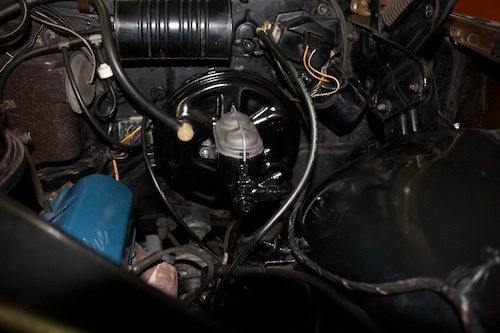
finished - looking good
1967 Eldorado detailing
The Eldorado got a wet cleaning treatment of the carpet and trunk and a full detailing of the interior - which looks like from a new car now. We also started to clean and polish the original paint but ran out of time. We only finished the hood - but the before and after difference is amazing. More work will be done soon.
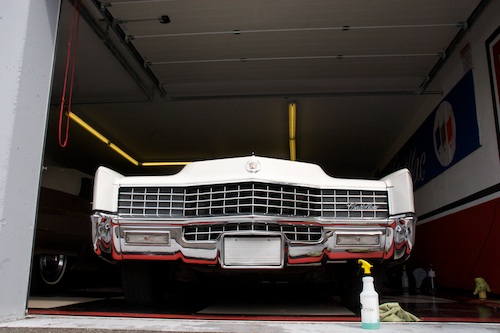
The Eldorado is lurking out of the garage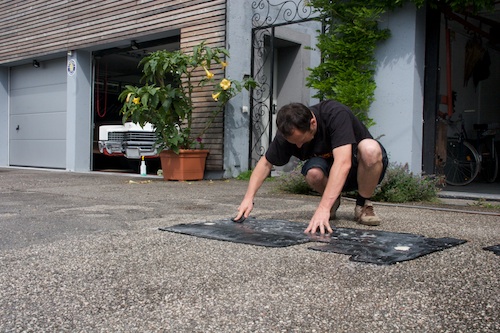
washing and brushing the original rubber floormats...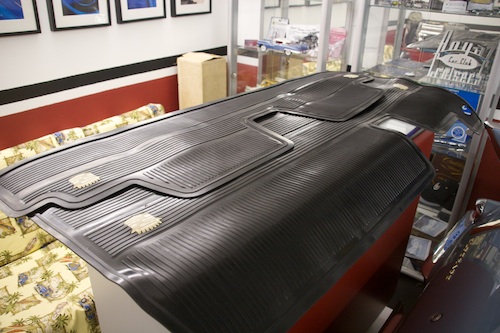
...they turned out as if they just left the factory - awesome - this Meguiars rubber treatment is more than fantastic!
Tayfun - wet cleaning the carpet and trunk - looks like new now as well - the low miles are showing on the interior pretty well
My buddy Tayfun polishing the hood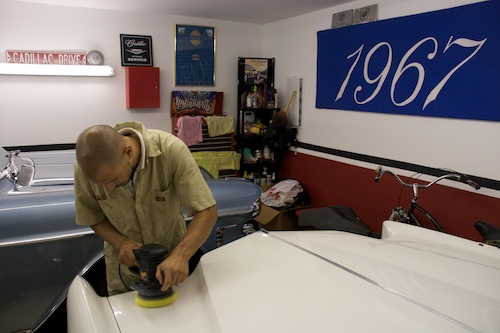
Tayfun at work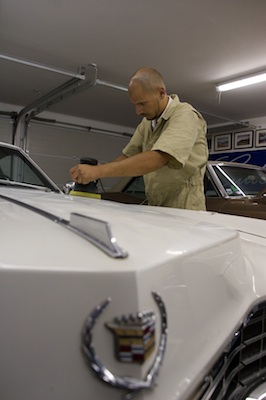
The hood´s paint came out really fine and smooth - unfortunately we ran out of time and could not finish the rest of the paint
1967 Cadillac Eldorado radio replacement attempt
Today my wife helped me trying to replace it. It is always a pain to get the old radios out, as the electrical connectors are pretty hard to reach if you have big hands like me... After some fiddling and lots of bad cursing, the radio eventually came out. During this procedure I found out that somebody messed around with the speaker cables which go to the rear speakers and installed new ones - which were connected directly to the front speaker. They cut the wire going to the front speakers and spliced in the rear speakers. Not very well done...
When I finally managed to install the “new” AM/FM radio I found out that it does not fit at all... It either comes from a 66 or a 69 Cadillac?
So I installed the old AM radio coming from my convertible where I did the same procedure 2 years ago - only to find out that non of the 2 speakers seem to work anyways...
I now have to find a good used 1967 AM/FM radio and 2 speakers - the list of things I need is getting longer everyday. I will also have to repair the wiring of the rear speaker back to original.
Thanks to my wife Afra for helping me!
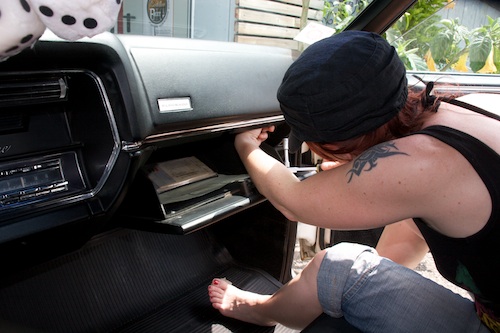
removing the dash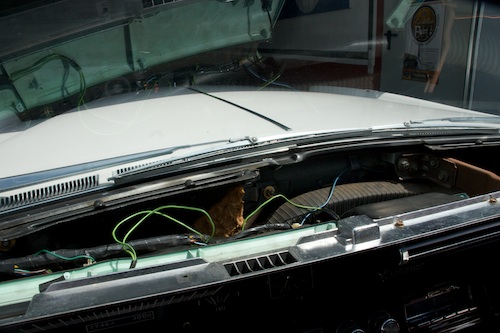
the removed dash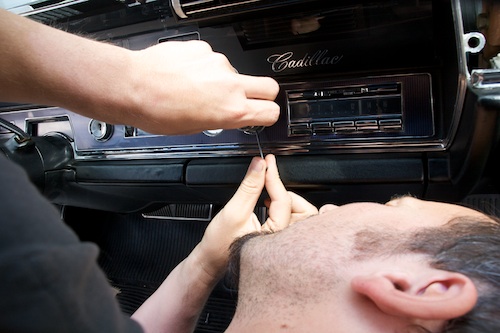
removing the radio buttons was the easiest part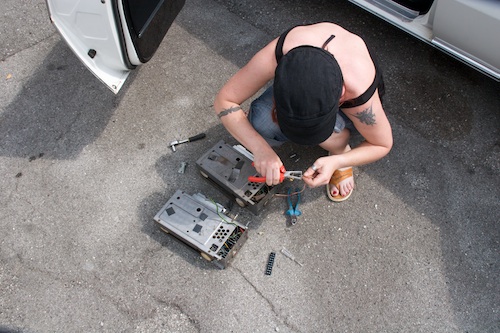
Afra repairing the wiring of the old radio
Detailed seats are finally back in the 67
If you compare the new pictures to the “before” pictures below - you can clearly see the difference.
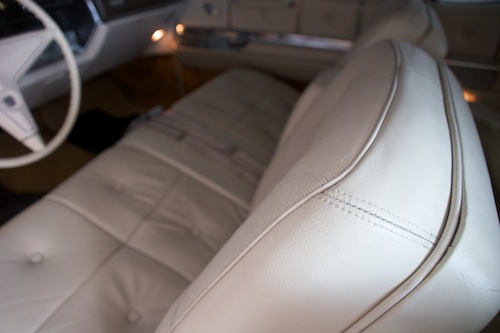
Thats the area which showed the most wear - looking perfect now!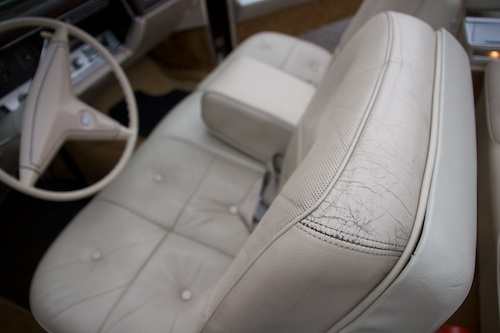
the same area before detailing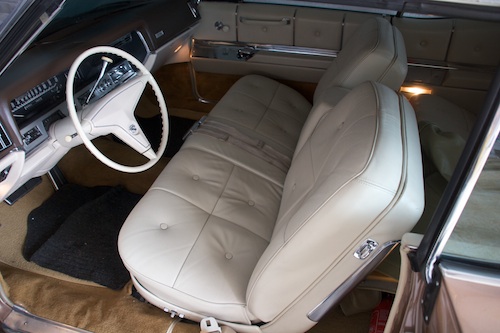
the interior is back together and now waiting for the cruising season
Leather seats are back from detailing!
They look like brand new leather seats now!
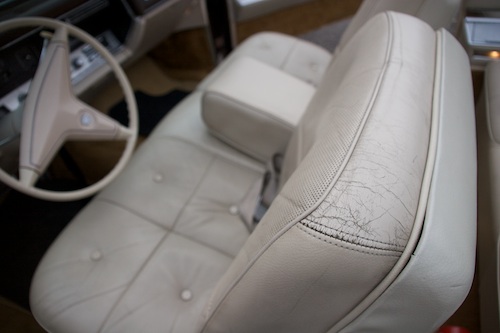
the front seat before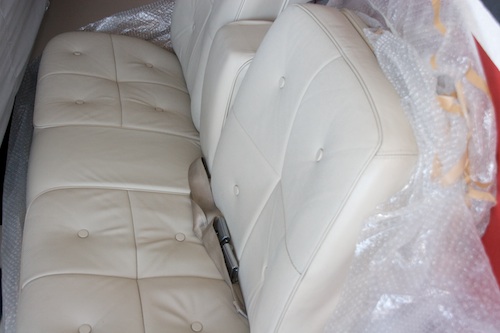
the front seat now - before installation
the rear bench before the repair
after the repair - all the tears and cracks are gone!
The 2008 Season Begins!
First we both made a "To Do List" for each individual car and plans for repairs that we want to do this spring and summer.
Also on the agenda was to wake up the cars, which were stored for the last months.
Yesterday we replaced the fuel pump on the 58, which I already replaced last summer - it was brand new but did not work correctly. So yesterday we installed another one.
This work was done pretty quickly within a couple of minutes. It now seems to work flawlessly. I hope it will stay like this.
Tayfun also did a lot of work on his 1981 Pimperado.
Today Tayfun and I moved all the cars out of the garage to clean the floor a little and to do some spring cleaning.
My buddy Richard also helped me last night doing doing some "Garage Pimpin´".
It was pretty funny - with lots of car talk till late in the night.
The 67´s battery seems to be on its last breaths, as it was no longer strong enough to start the car up - I have it since 1996 - so it lasted pretty long anyways, never needing any charge before. It looks like I will finally need a new one.
So I borrowed the battery from my Buick and then the 67, like all the other Cadillacs, fired right up.
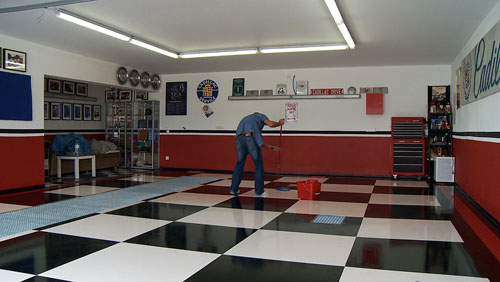
Tayfun cleaning the garage
The 67 is back with a "New" Front Suspension!
Today I picked up my 1967 Cadillac DeVille from the shop where all my repairs and restoration work is done when I can´t do them for myself.
The car got a complete new front suspension including all bushings, ball joints and paint. Some of the old bushings already fell apart. As everything was apart we also did the complete front brakes.
Also the radiator was fixed and the car got a new ignition lock which I removed from a 67 limousine at a junkyard in California last year. Also the turn signal switch was finally fixed after it broke 3 years ago...
The car is in spectacular condition, now and with the new suspension it drives like a brand new car - I could not have imagined that the difference would be that big.
Below you can see a picture of the rebuilt front suspension. Its still a little dirty as I had to drive the car home through rain - it will be cleaned soon though.
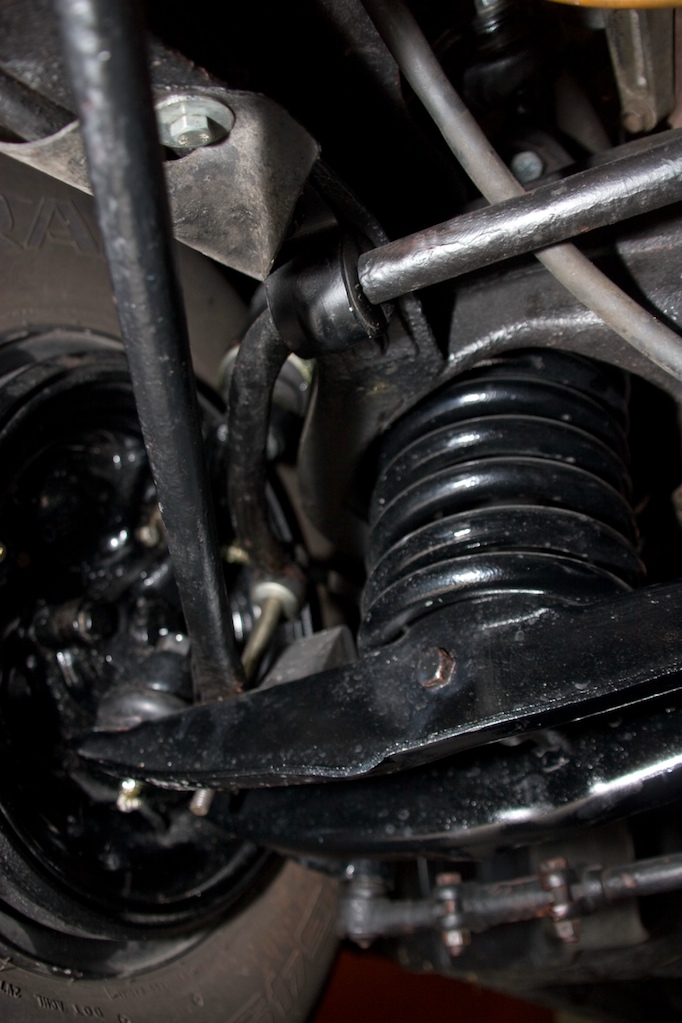
Cleaning the 67´s front suspension
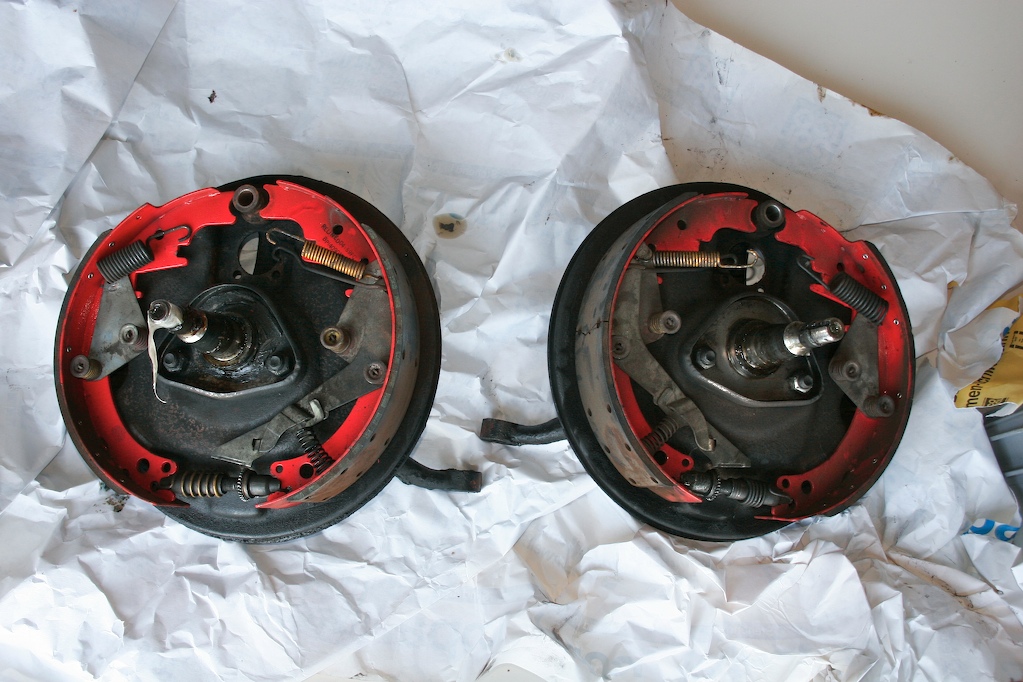
The brakes before I disassembled them - I hope I can clean the small metal parts with an ultrasonic cleaner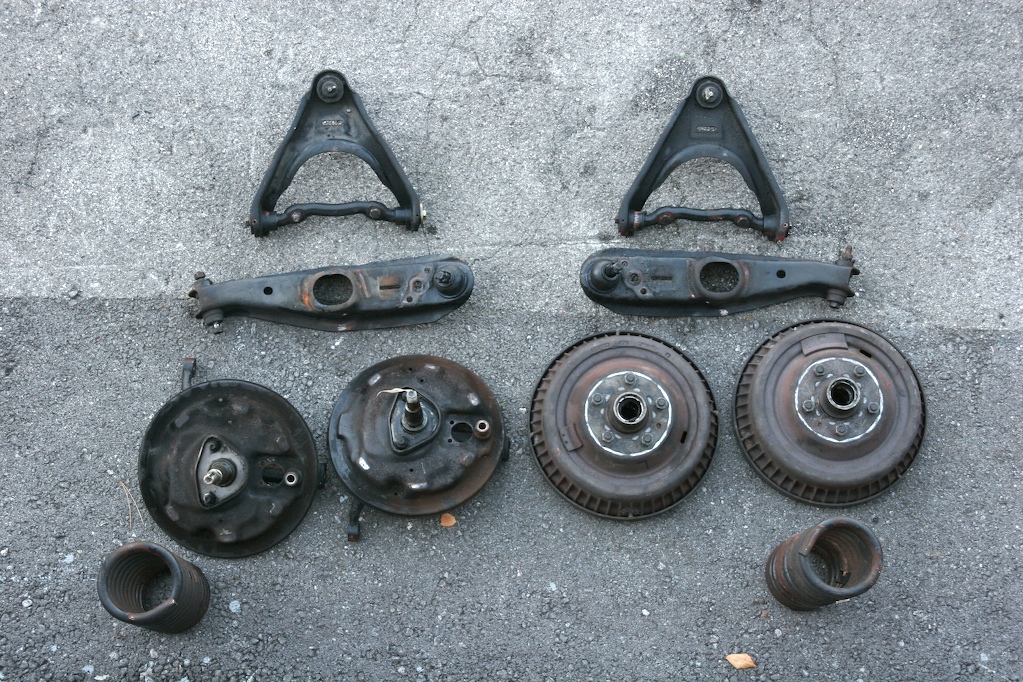
All these parts will be sandblasted and painted afterwards
The 67´s front suspension
After this the suspension will be in new condition - one of the last things that have to be done on the 67 before it is really in like new condition.
The only other thing which will need attention in the future will be the top which is still the original 40 year old one, but is still a little to good to be replaced…
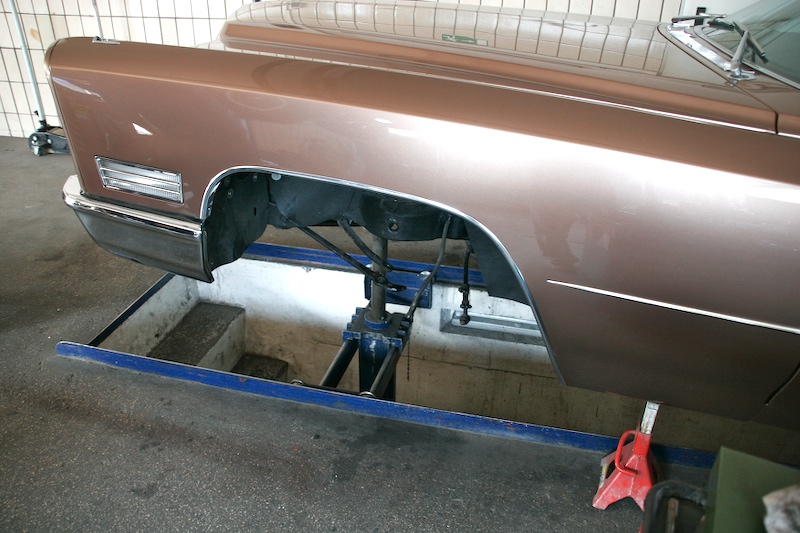
The completely stripped front suspension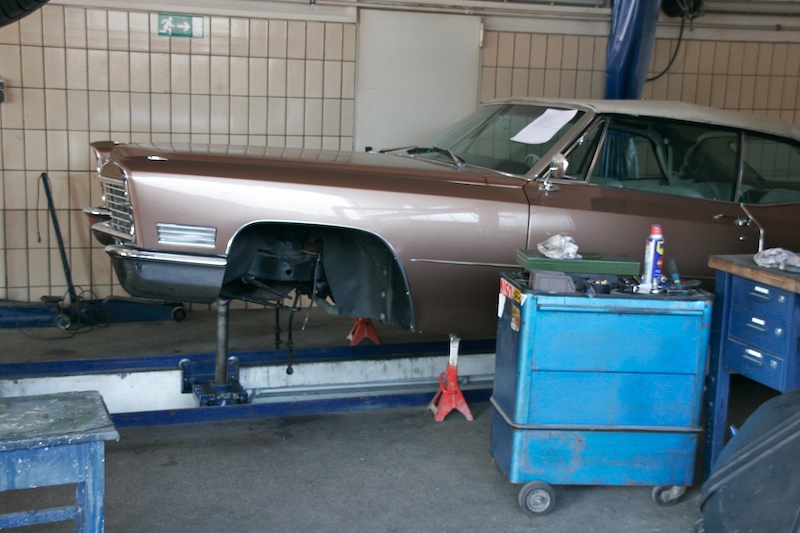
The 67 at the shop
The 67 is in the shop...
Later I also dropped off the 67 there as some smaller things have to be repaired as I do not have the necessary tools nor skills to do them myself.
- The front-suspension needs a rebuild and I do not have the presses to push some of the bushings in and out.
- The switch for the directional switch in the steering column has to be replaced
- Need a new ignition lock
- The transmission has some leaks I could not find
The guys from who helped me with the restoration of my cars will take over.
In a couple of weeks I should have the car back. It will go directly into winter storage then. Today also was the last day to drive the 58. I will return the plates over winter.
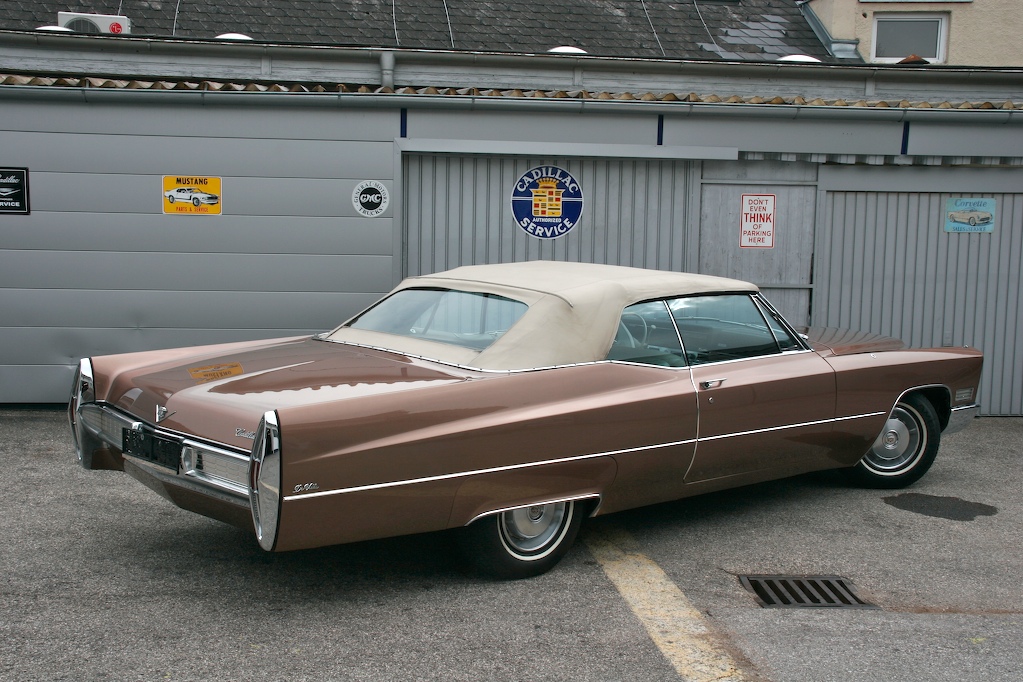
The 67 at American Special Parts
AC Problem
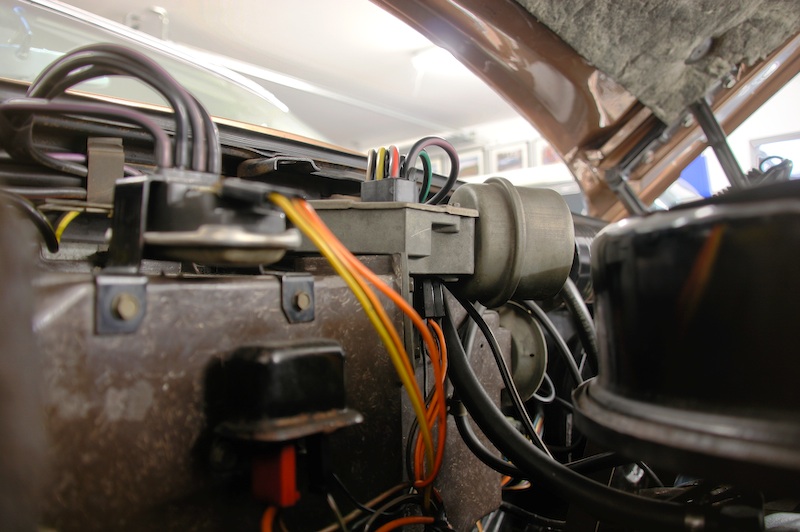
Three parts could cause this problem:
- The dash switch with its rotary valve from where I can hear a slight hissing noise,
- the power servo on the firewall
- or the master switch itself - what I doubt.
As I hate when something does not work on my cars I ordered all the parts. I found a good source which sells all these parts rebuilt. Hopefully they will arrive soon as I would like to have this issue resolved before the Cadillac Big Meet. It should not be too much of a hassle to install them when they are here.
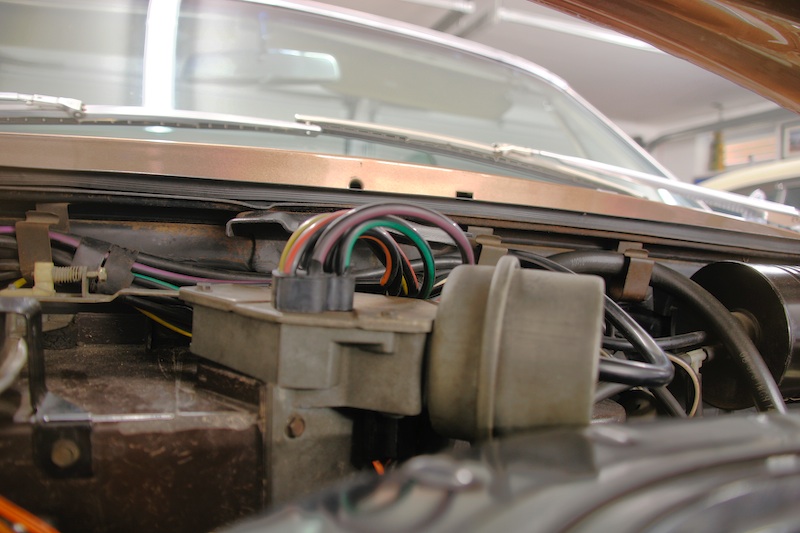
The power servo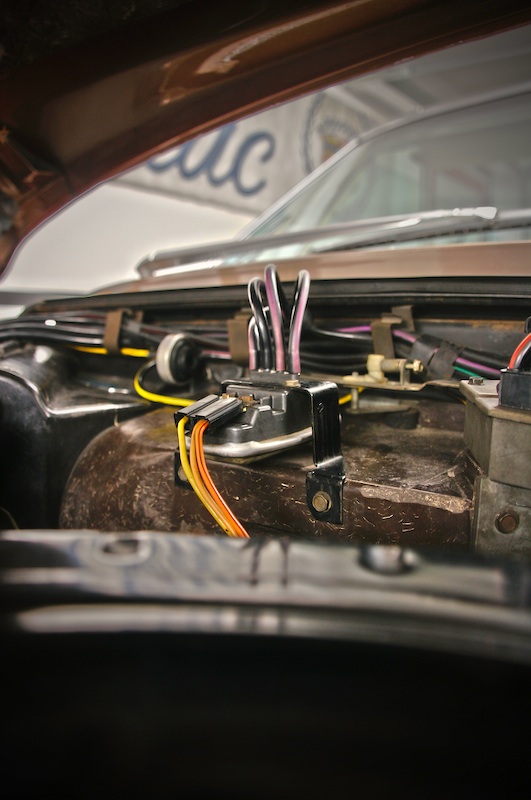
The power servo and master switch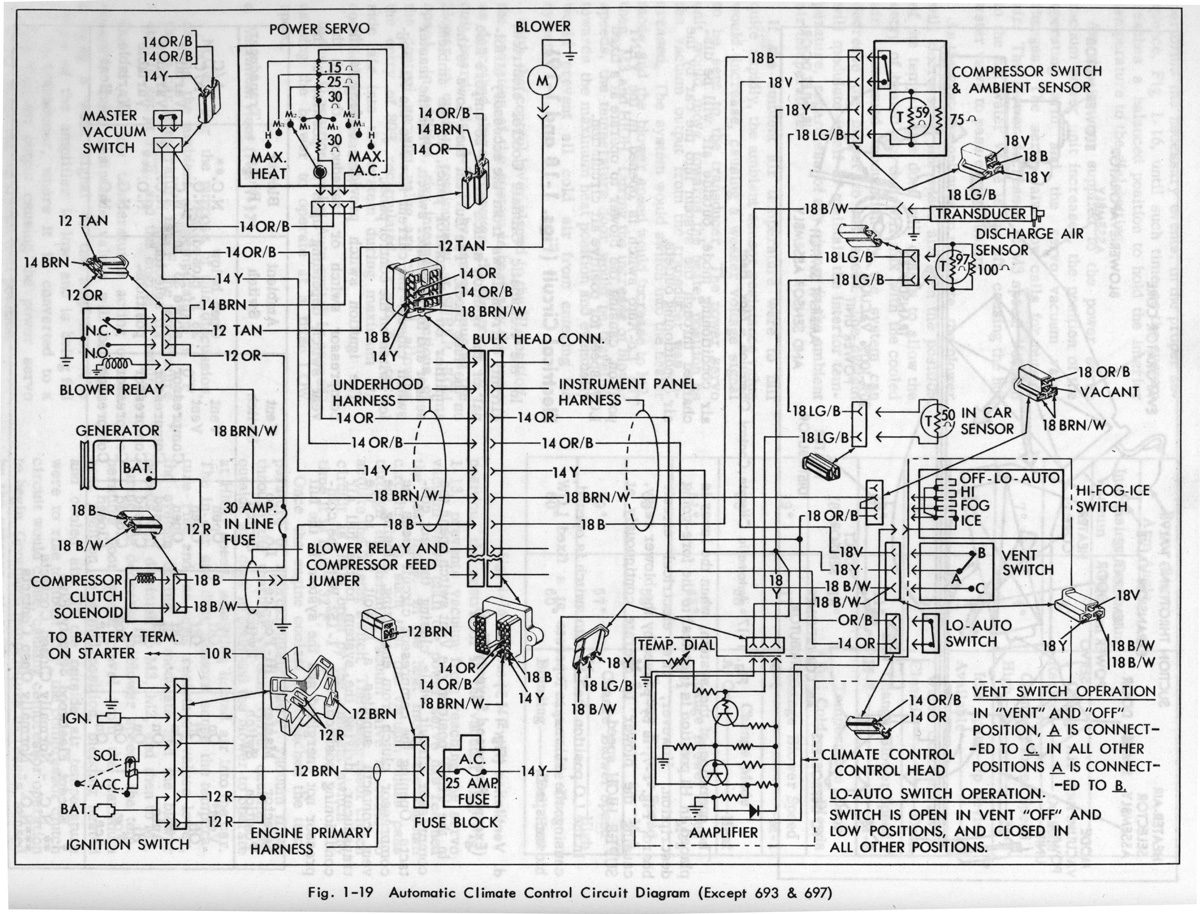
The electrical circuit of the Air Conditioning system of the 1967 Cadillac DeVille in a digram
Here is a video about the Master Switch that a gentleman posted on youtube
Interior cleaning and Cruisenight
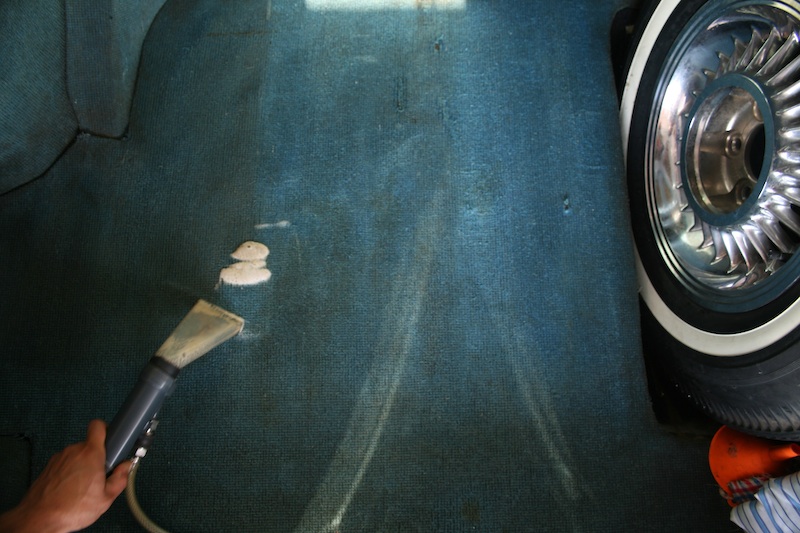
cleaning the trunk of the 58
Cruising night!
After cleaning we had a nice cruising trip around the lake with friends and our ladies.
Tayfun
on a hill
the ladies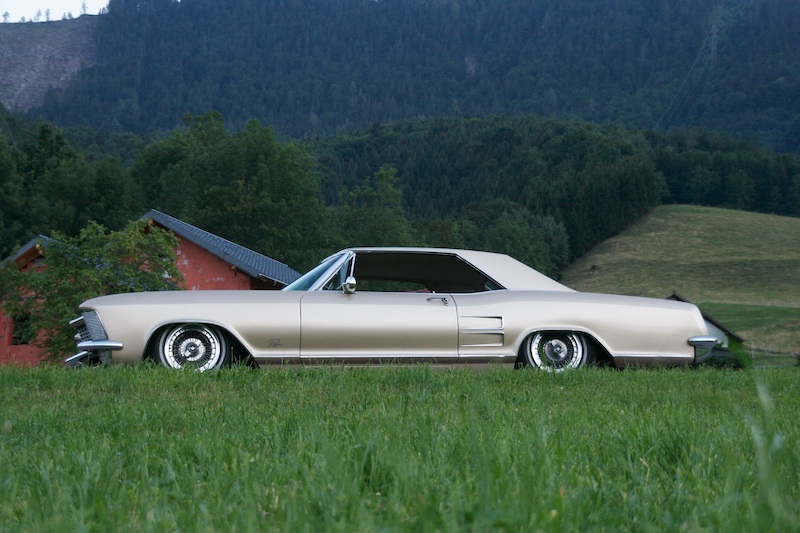
Alex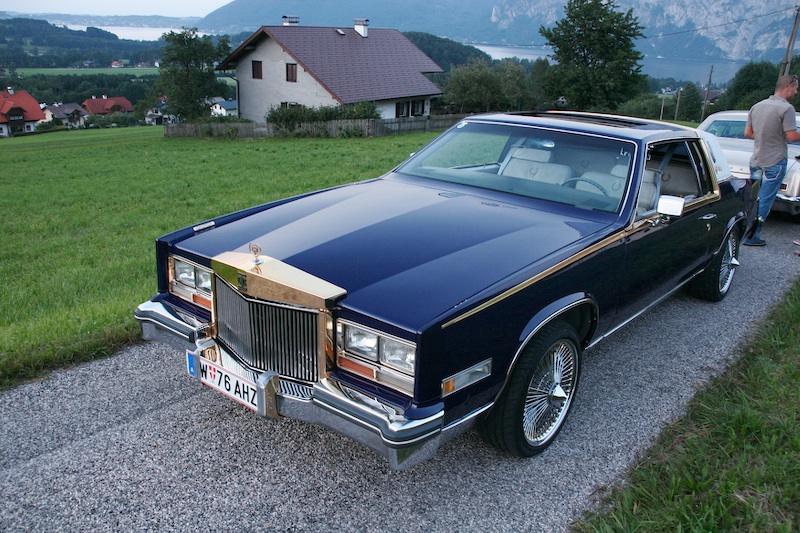
Tayfun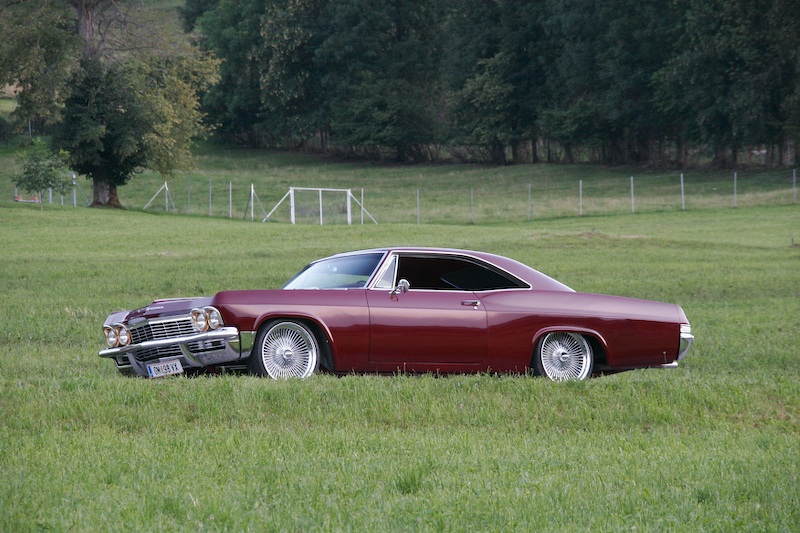
Richard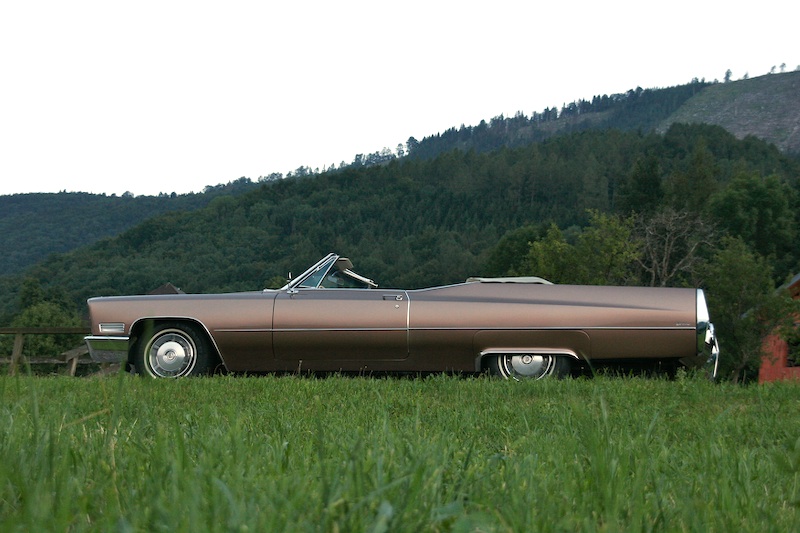
I took the 67
58 gets a new fuel pump - Video shoot
Later we also did some more repairs on my friend Tayfuns 81 Eldorado. After that we had a nice cruising evening with some friends where we did some professional filming for our next video.
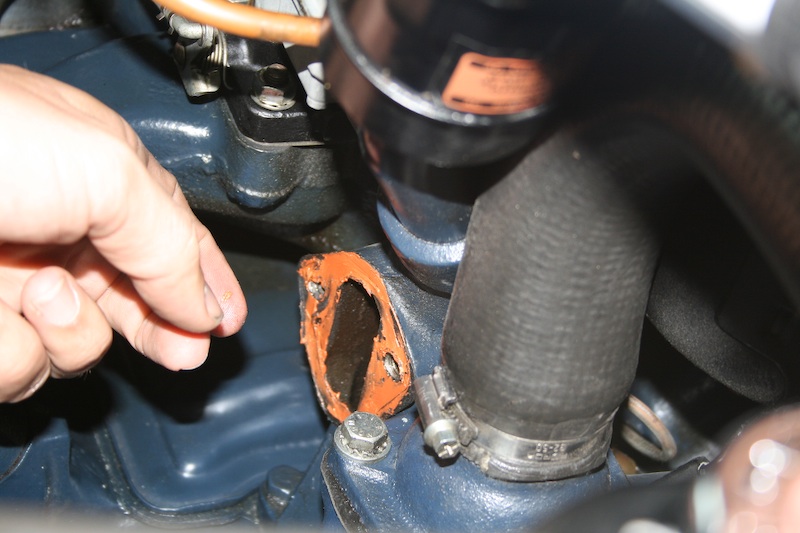
This is where the new fuel pump goes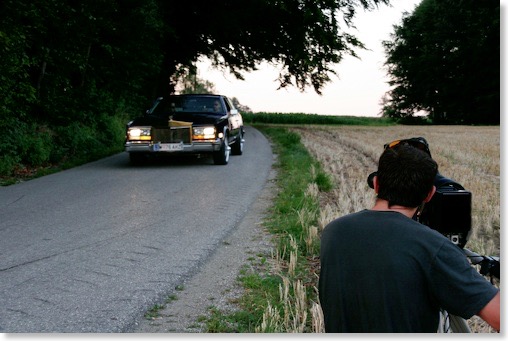
filming
67 gets new fuel filter
Eventually I made it and when everything was back together, the bowl leaked. So I had to re-open everything. I readjusted the gasket and now everything is tight. The old filter was very dirty, because at the last big service I forgot to replace it...
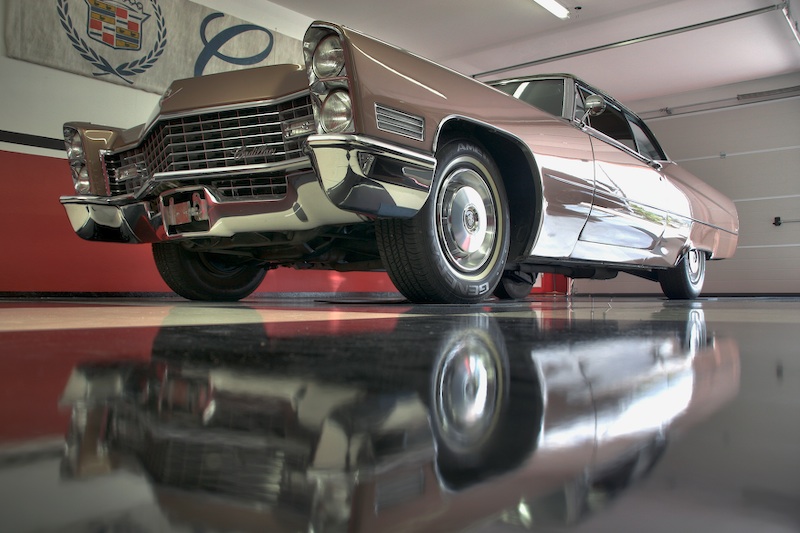
I think it´s the fuel pump
I ordered a new fuel pump today - they are relatively cheap - I hope to have it here in about 2 weeks...
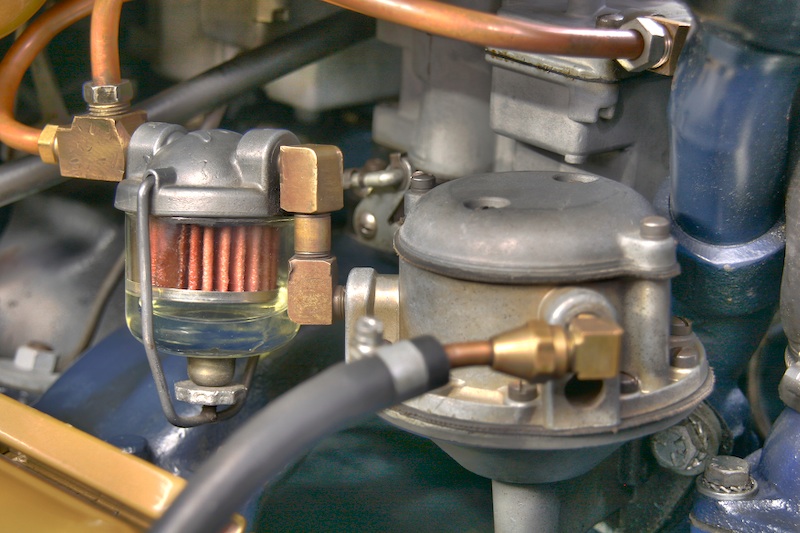
58 wont start!
My friend Richard towed me to his garage where he has an air compressor and all the tools and we blew air through the fuel line to check if it would be clogged. We were not clever enough to open the gas tank cap before we did that though.
When we removed the compressor from the line of course lot of now pressurized gas sprayed out of the line and into my face...
Well, at least it works again - looks like it really was only a clogged line. I already suspected that the fuel pump was on its way out, but luckily it wasn´t.
Will check everything again tomorrow and install a new fuel filter as well. I hope that I wont need a new fuel pump.
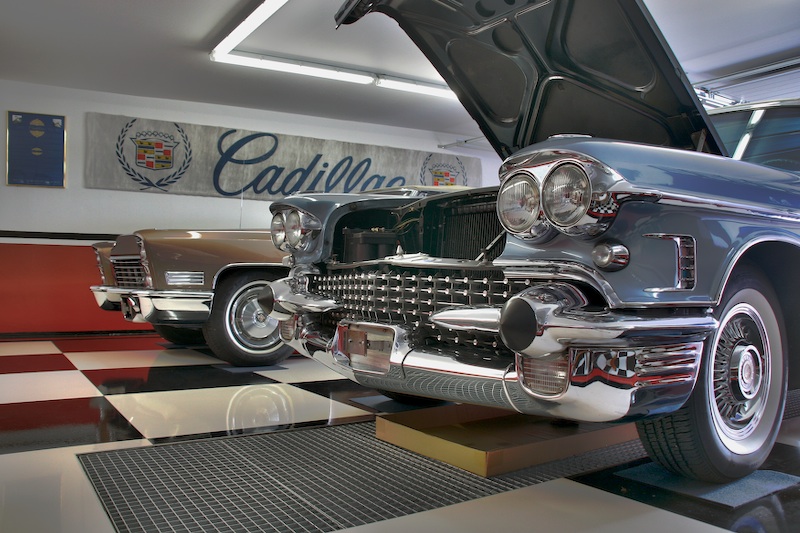
"New" vent window switch arrived + new Battery
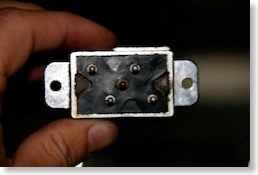
When I opened the box I immediately had the feeling that it would not work. The buttons felt sluggish and two prongs were missing on the backing plate. So somebody must have had it open at some point in its history.
So down I went into the garage to check it.
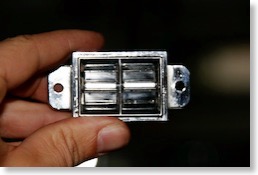
As I spent quite an amount of money for it and could not find another switch anywhere, I did not want to give up yet and so I disassembled it. Of course the 2 rusty prongs broke apart when I bent them open... A really good start! Eventually I made a good working switch from most of my old switches parts and the help of the plastic backing plate of the new switch. So I could also reuse the perfect chrome bezel of my old switch. :-)
Now everything works again - it´s not a concourse winning repair, but a solid one I can be proud of, and nobody can notice until he takes the car apart... ;-)
Now the clock is the only non working gadget on my 58 - my next project.
The new Battery
I also had to install a new battery today as my old one died after only 3 years in service. I bought an Exide Maxxima 900 - hope it will do a better job - I´ve heard lots of good things about it.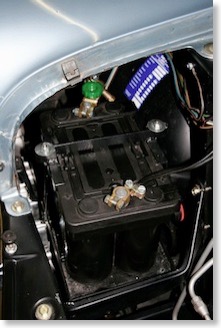
The new Exide battery - the green knob is a battery shut off switch
58 Vibrations...
58 Carburetor Rebuilding Project finished
The 3 dual carburetors were rebuilt completely. The carbs were blasted, cleaned and rebuilt and work perfectly now. I did not think that it would make a difference that big. It´s a real pleasure to drive the car now.
And the best surprise was, that the rebuild cost much less than the initial cost estimate I got.
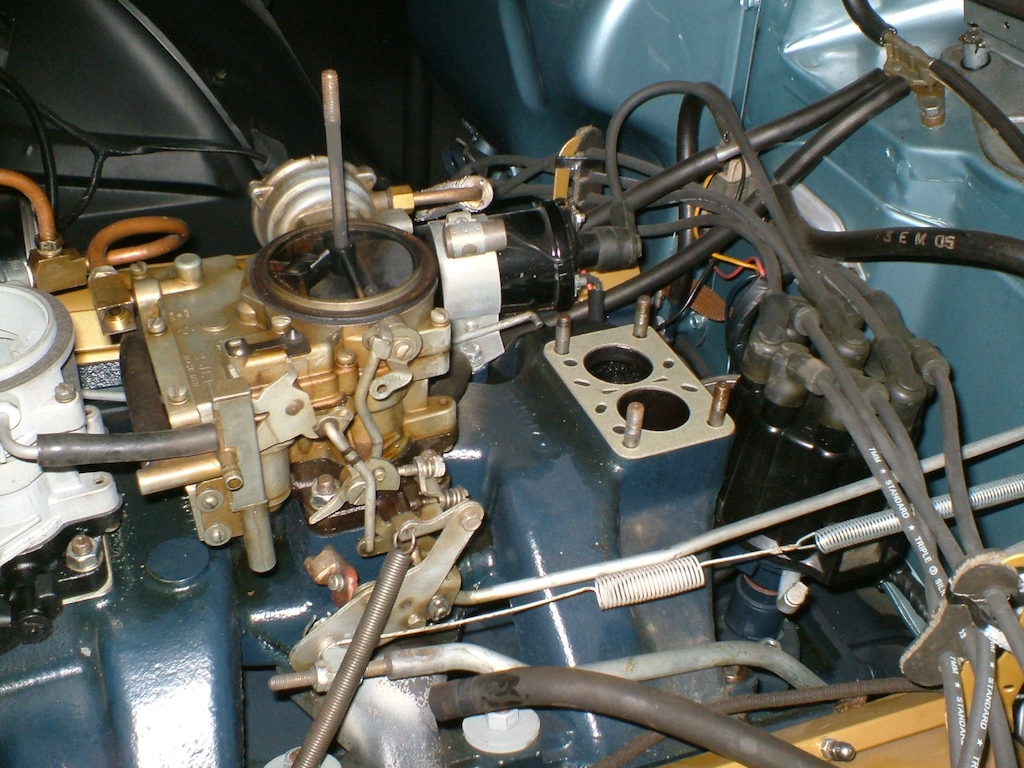
during the rebuilding - click on any picture for larger view!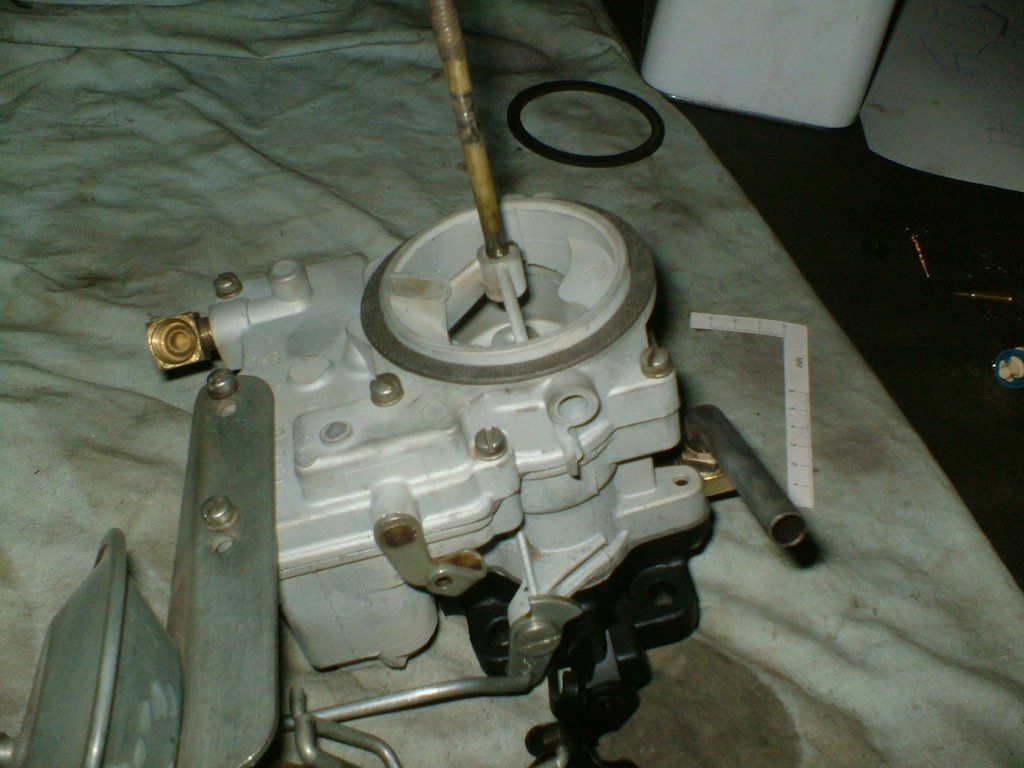
all carbs were blasted and cleaned
the rebuilt front carb
1966 Cadillac Coupe deVille (15)
1967 Cadillac DeVille (54)
1967 Cadillac Eldorado (71)
1971 Lincoln Continental Mark III (23)
1974 Cadillac Coupe deVille (45)
1978 Cadillac Eldorado Biarritz (24)
1996 Buick Roadmaster (19)
Car Shows (53)
Cruising (4)
For Sale (3)
Garage Stuff (32)
Pacer (1)
Restoration (137)
Various (55)
Video (16)
Website News (30)
- 6 way power seat
- 8-track
- 10 Ohm
- 429
- 1932
- 1957
- 1958
- 1958 Cadillac Eldorado Seville
- 1958 Cadillac Repair Tip
- 1959 Cadillac Eldorado Seville
- 1964
- 1965
- 1966
- 1966 Cadillac Coupe deVille
- 1966 Cadillac Repair Tips
- 1967
- 1967 Cadillac DeVille
- 1967 Cadillac Eldorado Repair Tip
- 1967 Cadillac Repair Tip
- 1967 Eldorado
- 1968
- 1970 Cadillac Eldorado
- 1971
- 1971 Lincoln Continental Mark III
- 1974
- 1974 Cadillac Coupe DeVille
- 1974 Cadillac Repair Tip
- 1976
- 1977
- 1978
- 1978 Cadillac Eldorado Biarritz
- 1978 Cadillac Repair Tip
- 1980 Cadillac Eldorado Biarritz
- 1996
- 2012
- 2014
- 2017
- 2018
- 2019
- 2022
- 2023
- 3063206
- 7027235
- 7800483
- 7805675
- 7805676
- 12355706
- 17058531
- 17059968
- 17059969
- 22010515
- 22010661
- A.I.R
- A6
- AC
- AC Compressor
- AC Electrical Diagram
- ACC
- Accelerator Pump
- Accelorator pump
- Actuators
- Adriatic Blue Metallic
- Ads
- Aftermovie
- Air Pump
- Aircondition
- AIRPUMP
- ALC
- Alternator
- AM
- AM-Transmitter
- Antenna
- Anti Rattle Clips
- Antique Gold
- Arizona Vintage Parts
- Arrival
- Article
- ASC
- Ash Tray removal
- ATC
- Atlantis Blue Firemist
- Austria
- Austro Classic
- Autolite SP-459
- Automatic Seat Back Release
- Award
- Banner
- Barn Find
- Battery
- Battery Tray
- Beach Race
- Bearing
- Bendix
- Biarritz
- Bigfoot
- Bill Hirsch Engine Enamel
- Bleeder Screws
- Blower
- Bolts
- Borg
- Brake Booster
- Brake Fluid
- Brake Gray
- Brakes
- Broken Bolt
- Brougham
- Bucket seats
- Buick
- Bumper End
- Bushings
- Cadillac
- Cadillac BIG Meet
- Cadillac BIG Meet
- Cadillac birthday cake
- Cadillac Blue
- Cadillac Color Selections Dealer Book
- Cadillac Coupe deVille
- Cadillac Dealer
- Cadillac Meeting
- Cadillac Mini Meeting
- Camaro RS
- Caorle
- Car Show
- Carburetor
- Card
- Carpet
- Carter AFB
- Cavalry Twill Vinyl
- CB
- CBM
- CCCD
- Choke
- Christmas
- Citizens Band
- Classic Cadillac Club Deutschland
- Clay Towel
- Cleaning
- Clock
- Clockwork
- Clutch
- Clutch Coil
- Collector
- Colonial Yellow
- Color Coded Springs
- Commercial
- Compound
- Compressor
- Condenser
- Continental Mark III
- Control Head
- Conversion
- Convertible top
- Coolant
- Corona
- Cowl
- Cruise Control
- Cruising
- CV Boots
- CV JOINTS
- D6230
- Dash Trim
- Decal Removal
- Decals
- Decoration
- Dehumidifier
- Delco Moraine
- Der Standard
- detailing
- Deville
- Diagnosis Chart
- Diagram
- Dial
- Digital Rotary Drum Clock
- Diner
- Disc Brakes
- Distributor
- Diverter Valve
- Door Jamb Switch
- Door Rubber Conduit
- Dornbirn
- Dot3
- Drive Shaft
- Driving tour
- Drum brakes
- Dry Ice Blasting
- Dry Ice Cleaning
- DVD
- Eastwood
- Eldorado
- Electric Choke Thermostat
- Electrical schematic
- Elvis
- Engine Bay
- Ep
- Epoxy floor
- Europe
- Evaporator
- Exide
- Factory Markings
- Fender Skirt
- Floor
- Flushing
- Foam
- For Sale
- Front AXLE
- Front brakes
- Front bumper filler
- Front Floor
- Front wheel bearing
- Fuel Filter
- Fuel Pump
- Fuel Sending Unit
- Fusible Link
- Garage
- Garage Cabinets
- Gasket
- GE
- Gear indicator
- General Time
- Glove box light
- Grand European
- H4
- Haus of Hot Rod
- Headlight Actuator
- Headlight doors
- Headlights
- Heater Core
- Heater Hose
- Heater Valve
- High Idle
- Holley
- Honest John
- Hood
- Hood Emblem
- Hood Ornament
- Hose Clamp
- Hot Choke
- Hot Water Valve
- HotRod
- How to
- Hödlmayr
- Ignition Diagram
- Illuminated Entry
- John D‘Agostino
- John Foust
- Klassikwelt Bodensee
- Kremsmünster
- LaSalle
- Leather seats
- Light Switch
- Limited
- Lincoln
- Lincoln Mark III Repair Tip
- Low Mileage
- Magazine
- Marilyn Monroe
- Mark III
- Master Cylinder
- Master Switch
- Master Vacuum Switch
- Media Blasting
- Meeting
- Meguiras
- MK II
- Mobile
- Model
- Moldings
- Mom
- Mopar Nationals
- Mostkost Kustom
- Movie
- Neon
- NOS
- Oberösterreicher des Tages
- oilchange
- ORF
- Overspray
- Pacer
- Paint
- Paint correction
- Paintjob
- Part Number
- Parts
- Patch Panel
- Perfect Circle
- Permabag
- Persian Lime
- Photo shooting
- Photoshooting
- Pictures
- PinUp
- POA Valve
- Power Antenna
- Power Servo
- Power Vent Windows
- Power Window
- Printed Circuit Board
- Programmer
- Pulley
- Quadrajet
- Quarter Panel
- Quartz Conversion
- R134
- Radiator
- Radio
- Rattle
- Rear brakes
- Rebuild
- Recalibrate
- RediRad
- Reed Switch
- Relais
- Relaunch
- Removing Overspray
- Repaint
- Repair
- Restoration
- RIP
- Roadhouse
- Roadmaster
- Rochester
- Rocker Arm Cover
- Rocker Panel Extension Clips
- Rostio
- Rotary Valve
- Rotterdam
- Rupes
- Rust removal
- Rust removal gel
- Sabre Wheels
- Sand Blasting
- Sandblasting
- Screed
- Season Greetings
- Seasons Greetings
- Seat Back Locks
- Seat Padding
- Seat Transmission
- See through ornament
- Self adjusters
- Sepp's Garage
- Seville
- Sheetmetal
- Shocks
- shop manual
- short
- Sign
- Solenoid
- Spark Plug Wire Routing
- Speakers
- Special Award
- Speed Bleeder Screws
- Splash Guard
- Starter Diagram
- Starter Motor
- Steering Column
- Storage
- suction throttling valve
- sunroof
- suspension
- Swirl Mark removal
- Switzerland
- T3
- Taillight Cover
- Texan´s Choice Award
- Thermostat
- Tilt and Telescope
- Time capsule
- Tomsclub
- Torque Specifications
- Tower Hose Clamp
- Towtruck
- Transducer
- Transmission
- transmission control selector
- transmission control selector indicator light
- transmission shift indicator
- Treadle Vac
- Treffen
- Tri-Band
- Troubleshooting
- Trunk Cardboard Kit
- Trunk lining
- Trunk to bumper cover
- Turn Signal Switch
- TV
- Typisierung
- Ultimate Garage
- Underbody
- Undercarriage
- Undercoating
- Undercoating Removal
- Vacuum Booster
- Vacuum diagram
- Vacuum hoses
- Vacuum Master Switch
- Vacuum Schematic
- Vacuum Valve
- Valve Cover
- Various
- Vent Window Switch
- Vibration
- Vibrator
- Vicodec roof
- Video
- Vinegar
- Vinyl Roof
- Visitor
- Washer Fluid Float
- Washer Fluid Low Level Indicator
- Water Pump
- Wax
- Weatherstripping
- Website News
- Westclox
- Wheel Bearings
- Wheel Housing
- Wiesbaden
- Windlace
- Winter
- Wiring
- Wiring Diagram
- Wonderbar
- Workbench
- Zurzach